
Skip to main content Accessibility help
×
  • Cited by 167
    • Show more authors
    • Access check Access
      You have digital access to this book
    • Select format
    • Publisher:
      Cambridge University Press
      Publication date:
      05 November 2009
      28 April 2003
      ISBN:
      9780511510557
      9780521809672
      9780521071277
      Dimensions:
      (228 x 152 mm)
      Weight & Pages:
      0.46kg, 224 Pages
      Dimensions:
      (228 x 152 mm)
      Weight & Pages:
      0.37kg, 224 Pages
    Access check Access
    You have digital access to this book
    Selected: Digital
    Add to cart View cart Buy from Cambridge.org

    Book description

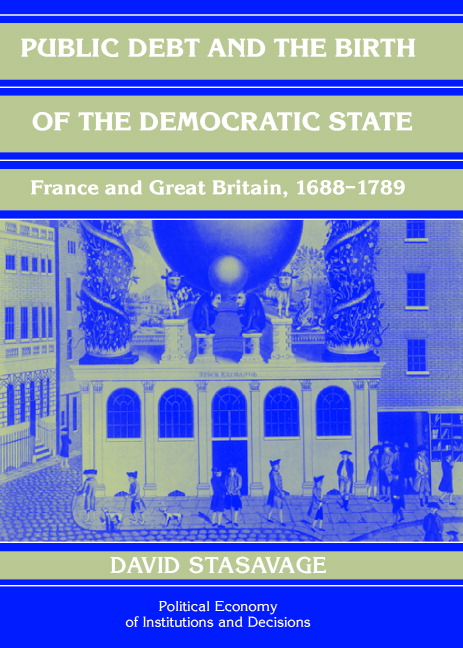
    This book develops new theory about the link between debt and democracy and applies it to a classic historical comparison: Great Britain in the eighteenth century which had strong representative institutions and sound public finance vs. ancient regime France, which had neither. The book argues that whether representative institutions improve commitment depends on the opportunities for government creditors to form new coalitions with other social groups, more likely to occur when a society is divided across multiple political cleavages. It then presents historical evidence to show that improved access to finance in Great Britain after 1688 had as much to do with the development of the Whig Party as with constitutional changes. In France, it is suggested that the balance of partisan forces made it unlikely that an early adoption of 'English-style' institutions would have improved credibility.

    Reviews

    Review of the hardback:‘… this stimulating study … raises some fundamental questions about our understanding of the eighteenth-century state … Stasavage has produced a work that will give historians of eighteenth-century politics and government finance much food for thought.’

    Source: European History Quarterly

    Review of the hardback:'… remarkably rich book … intelligent and innovative … a very comprehensive book on an interesting subject … I have learned quite a few interesting things on the evolution of public debt management over the centuries and I have a feeling that many of us who discuss the pros and cons of public debt today would gain some useful insights by reading this book.'

    Source: History of Economic Ideas

    Refine List

    Actions for selected content:

    Select all | Deselect all
    • View selected items
    • Export citations
    • Download PDF (zip)
    • Save to Kindle
    • Save to Dropbox
    • Save to Google Drive

    Save Search

    You can save your searches here and later view and run them again in "My saved searches".

    Please provide a title, maximum of 40 characters.
    ×

    Contents

    Reference
    Reference
    Contemporary Writings and Other Primary Sources
    An Impartial View of the Two Late Parliaments (1711). British Library
    Archives Parlémentaires. 1862. 1st series, 1787–99. Paris: Dupont
    Broughton, John (1705). Remarks upon the Bank of England, with Regard More Especially to Our Trade and Government. London: A. Baldwin
    Castaing, John (1698–1711). The Course of the Exchange. London
    Cocks, Sir Richard (1698–1702). The Parliamentary Diary of Sir Richard Cocks, David Hayton, ed. Oxford, 1996
    Condorcet, Marquis de (1789). Sur la proposition d'acquitter la dette exigible en assignats. Paris: Imprimerie de l'Assemblée Nationale
    Custine, Comte de (1789). Réflexions sur la proposition du premier ministre des finances de sanctionner, comme Caisse Nationale, la Caisse d'Escompte appartenant à des capitalistes. Paris: Imprimerie de l'Assemblée Nationale
    Defoe, Daniel (1701a). The Freeholders' Plea against Stock-Jobbing Election of Parliament Men. London
    Defoe, Daniel (1701b). The Villainy of Stock-Jobbers Detected. London
    Defoe, Daniel (1710a). An Essay upon Loans. London
    Defoe, Daniel (1710b). An Essay upon Publick Credit. London
    Defoe, Daniel (1710c). Faults on Both Sides. London
    Dutot (1738). Histoire du système de John Law, Antoin Murphy, ed. Paris: Institut National d'Etudes Demographiques, 2000
    Fénelon, François de Salignac de La Mothe (1692). Lettre à Louis XIV. Paris: Séquences, 1994
    Fénelon, François de Salignac de La Mothe (1710a). “Plans de gouvernement.” In Fénelon, ecrits et lettres politiques. Paris: Editions Bossard, 1920
    Fénelon, François de Salignac de La Mothe (1710b). “Projet d'une assemblée des notables.” In Fénelon, ecrits et lettres politiques. Paris: Editions Bossard, 1920
    Fénelon, François de Salignac de La Mothe (1711). “Plans de gouvernement, concertés avec le duc de Chevreuse, pour être proposés au duc de Bourgogne.” In Oeuvres de Fénelon, vol. 22, pp. 575–95. Paris: J.-A. Lebel, 1824
    “Histoire des finances pendant la régence de 1715.” Bibliothèque de l'Arsenal, Paris, Ms. 4560
    Hume, David (1742). “Of the Parties of Great Britain.” London
    Journal d'Adrien Duquesnoy, Député du Tiers-État de Bar-le-Duc (1894). Paris: Alphonse Picard
    Lavoisier, Antoine (1789). Réflexions sur les assignats et sur la liquidation de la dette exigible ou arriérée lue à la Société de 1789, le 29 aoÛt 1790. Paris: Société de 1789
    Le Moniteur Universel (various dates 1789–1790)
    Paterson, William (1694). A Brief Account of the Intended Bank of England. London: Randal Taylor
    Pittis, W. (1711). The History of the Present Parliament and Convocation. London
    “Projets de gouvernement résolus par M, le duc de Bourgogne, Dauphin” (attributed to the duc de Saint-Simon). M. P. Mesnard, ed. Bibliothèque de l'Arsenal, Paris
    “Remonstrances faites au Roy par le parlement de Bretagne au sujet de la levée du cinquantième en nature de tous les biens du royaume” (1725). Arsenal Ms. 3890, Paris
    Saint-Simon, Louis de Rouvroy de (1715, 1720). Mémoires. Paris: Vols. 5 and 7. Gallimard, 1985
    Société de 1789. Journal de la Société de 1789. Paris
    Société de 1789. Mémoires de la Société de 1789. Paris
    Swift, Jonathan (1710–11). The Examiner. London
    Swift, Jonathan (1711a). The Conduct of the Allies. London
    Swift, Jonathan (1711b). Some Advice to the October Club. London
    Swift, Jonathan (1712). A Letter to a Whig Lord. London
    Secondary Sources
    Albertone, Manuela (1990). “Le Débat sur le credit public en France et la naissance des assignats.” Economies et Sociétés, vol. 24, July–October, pp. 405–29
    Albertone, Manuela (1992). Moneta e politica in Francia: Dalla cassa di sconto agli assegnati (1776–1792). Il Mulino: Bologna
    Albertone, Manuela (1997). “Réferences economiques et pratiques financières: Le Crédit public en France sous l'ancien régime.” In L'Administration des finances sous l'ancien régime. Paris: Comité pour l'Histoire Economique et Financière de la France
    Aldrich, John (1995). Why Parties? University of Chicago Press
    Almond, Gabriel (1956). “Comparative Political Systems.” Journal of Politics, vol. 18, pp. 391–409
    Althusser, Louis (1959). Montesquieu, la politique et l'histoire. Paris: PUF
    Andréades, A. (1909). History of the Bank of England. London: Frank Cass
    Applewhite, Harriet (1993). Political Alignment in the French National Assembly, 1789–1991. London: Louisiana State University Press
    Ashton, Robert (1960). The Crown and the Money Market: 1603–1640. Oxford: Oxford University Press
    Baron, David (1989). “A Non-Cooperative Theory of Legislative Coalitions.” American Journal of Political Science, vol. 33, pp. 1048–84
    Baron, David (1991). “A Spatial Bargaining Theory of Government Formation in Parliamentary Systems.” American Political Science Review, vol. 85, pp. 137-64
    Baron, David (1994). “A Sequential Choice Theory Perspective on Legislative Organization.” Legislative Studies Quarterly, vol. 19, pp. 267–96
    Baron, David, and Ferejohn, John (1989). “Bargaining in Legislatures.” American Political Science Review, vol. 89, pp. 1181–206
    Baron, David, and Michael Herron (1999). “A Dynamic Model of Multidimensional Collective Choice.” Mimeo, Graduate School of Business, Stanford University
    Bates, Robert (1981). Markets and States in Tropical Africa. Berkeley: University of California Press
    Bates, Robert (1996). “Institutions as Investments.” Harvard Institute for International Development, Discussion Paper No. 527
    Bates, Robert, and Donald Lien, Da-Hsiang (1985). “A Note on Taxation, Development and Representative Government.” Politics and Society, vol. 14, pp. 53–70
    Bates, Robert, Avner Greif, Margaret Levi, Jean-Laurent Rosenthal, and Barry Weingast (1997). Analytic Narratives. Princeton: Princeton University Press
    Bawn, Kathleen (1999). “Constructing ‘Us’: Ideology, Coalition Politics, and False Consciousness.” American Journal of Political Science, vol. 43, pp. 303–34
    Beard, Charles (1913). An Economic Interpretation of the Constitution of the United States. New York: Macmillan
    Beck, Thorsten, George Clarke, Alberto Groff, Philip Keefer, and Patrick Walsh (1999). “New Tools and New Tests in Comparative Political Economy: The Database of Political Institutions.” Mimeo, World Bank
    Beckett, J. V. (1985). “Land Tax or Excise: The Levying of Taxation in Seventeenth and Eighteenth Century England.” English Historical Review, vol. 100, pp. 285–308
    Beik, William (1985). Absolutism and Society in Seventeenth Century France: State Power and Provincial Aristocracy in Languedoc. Cambridge: Cambridge University Press
    Besley, Timothy, and Coate, Stephen (1997). “An Economic Model of Representative Democracy.” Quarterly Journal of Economics, vol. 112, pp. 85–114
    Besley, Timothy, and Stephen Coate (2001). “Issue Unbundling via Citizens' Initiatives.” Mimeo, London School of Economics
    Bien, David (1987). “Offices, Corps, and a System of State Credit: The Uses of Privilege under the Ancièn Régime.” In Keith Michael Baker, ed., The French Revolution and the Creation of Modern Political Culture. Oxford, Pergamon Press
    Bien, David (1989). “Manufacturing Nobles: The Chancelleries in France to 1789.” Journal of Modern History, vol. 61, pp. 445–86
    Bonney, Richard (1999). “France, 1494–1815.” In Richard Bonney, ed., The Rise of the Fiscal State in Europe: 1200–1815. Oxford: Oxford University Press, pp. 123–76
    Brewer, John (1989). The Sinews of Power. London: Hutchinson
    Broz, J. Lawrence (1998). “The Origins of Central Banking: Solutions to the Free-Rider Problem.” International Organization, vol. 52, pp. 231–68
    Brugière, Michel (1992). “Les Assignats.” In Francois Furet and Mona Ozouf, eds., Dictionnaire critique de la révolution française. Paris: Flammarion. Pp. 59–72
    Buchanan, James, and Gordon Tullock (1962). The Calculus of Consent. Ann Arbor: University of Michigan Press
    Bulow, Jeremy, and Rogoff, Kenneth (1989). “Sovereign Debt: Is to Forgive to Forget?American Economic Review, vol. 79, pp. 43–50
    Calvert, Randall (1995a). “Rational Actors, Equilibrium, and Social Institutions.” In Jack Knight and Itai Sened, eds., Explaining Social Institutions. Ann Arbor: University of Michigan Press. Pp. 57–94
    Calvert, Randall (1995b). “The Rational Choice Theory of Social Institutions.” In Jeffrey Banks, ed., Modern Political Economy. Cambridge: Cambridge University Press. Pp. 216–68
    Calvert, Randall, and Nathan Dietz (1998). “Legislative Coalitions in a Bargaining Model with Externalities.” Wallis Institute of Political Economy Working Paper no. 16
    Calvert, Randall, and Justin Fox (2000). “Effective Parties in a Model of Repeated Legislative Bargaining.” Paper presented at the Annual Meeting of the American Political Science Association, Washington, D.C
    Calvert, Randall, and Barry Weingast (1993). “Party Coherence and Cooperation in a Legislature.” Paper presented at the American Political Science Association Annual Meeting, Washington, D.C
    Carruba, Clifford, and Volden, Craig. 2000. “Coalitional Politics and Logrolling in Legislative Institutions.” American Journal of Political Science, vol. 44, pp. 255–71
    Carruthers, Bruce (1996). City of Capital: Politics and Markets in the English Financial Revolution. Princeton: Princeton University Press
    Carruthers, Bruce (1990), “Politics, Popery, and Property: A Comment on North and Weingast.” Journal of Economic History, vol. 50, pp. 693–98
    Chandaman, C. D. (1975). The English Public Revenue: 1660–1688. Oxford: Oxford University Press
    Chari, Vijay, and Kehoe, Patrick (1993). “Sustainable Plans and Mutual Default.” Review of Economic Studies, vol. 60, pp. 175–96
    Chartier, Roger, and Denis Richet (1982). Représentation et vouloir politiques: Autour des etats généraux de 1614. Paris: Editions de l'École des Hautes Études en Sciences Sociales
    Clapham, John (1958). The Bank of England, a History. Cambridge: Cambridge University Press
    Clark, Gregory (1996). “The Political Foundations of Modern Economic Growth, England 1540–1800.” Journal of Interdisciplinary History, vol. 26, pp. 563–88
    Cobban, Alfred (1964). The Social Interpretation of the French Revolution. Cambridge: Cambridge University Press
    Collins, James B. (1988). Fiscal Limits of Absolutism: Direct Taxation in Early Seventeenth-Century France. Berkeley: University of California Press
    Cox, Gary (1987). The Efficient Secret: The Cabinet and the Development of Political Parties in Victorian England. Cambridge: Cambridge University Press
    Cox, Gary (1997). Making Votes Count: Strategic Coordination in the World's Electoral Systems. New York: Cambridge University Press
    Cox, Gary, and Mathew McCubbins (1993). Legislative Leviathan: Party Government in the House. Berkeley: University of California Press
    Cukierman, A. (1992). Central Bank Strategy, Credibility, and Independence. Cambridge: MIT Press
    Davis, Herbert (1951). Introduction to Jonathan Swift: Political Tracts: 1711–1713. Oxford: Basil Blackwell
    De Krey, Gary Stuart (1985). A Fractured Society: The Politics of London in the First Age of Party. Oxford: Clarendon Press
    De Long, J. Bradford, and Andrei Shleifer (1993). “Princes and Merchants: European City Growth before the Industrial Revolution.” NBER Working Paper no. 4274
    Dessert, Daniel (1984). Argent, pouvoir et société au grand siècle. Paris: Fayard
    Dickinson, H. T. (1981). “Whiggism in the Eighteenth Century.” In John Cannon, ed., The Whig Ascendancy: Colloquies on Hanoverian England. London: Edward Arnold. Pp. 28–50
    Dickson, P. G. M. (1967). The Financial Revolution in England. London: Macmillan
    Diermeier, Daniel (1995). “Commitment, Deference, and Legislative Institutions.” American Political Science Review, vol. 89, pp. 344–55
    Diermeier, Daniel, and Feddersen, Timothy (1998). “Cohesion in Legislatures and the Vote of Confidence Procedure.” American Political Science Review, vol. 92, pp. 611–21
    Diermeier, Daniel, and Keith Krehbiel (2001). “Institutionalism as a Methodology.” Research Paper no. 1699, Graduate School of Business, Stanford University
    Dixit, Avinash, and Londregan, John (2000). “Political Power and the Credibility of Government Debt.” Journal of Economic Theory, vol. 94, pp. 80–105
    Dixit, Avinash, and Robert Pindyck (1993). Investment under Uncertainty. Princeton: Princeton University Press
    Dixit, Avinash, Grossman, Gene, and Gul, Faruk (2000). “The Dynamics of Political Compromise.” Journal of Political Economy, vol. 108, no. 3, pp. 531-68
    Doyle, William (1980). Origins of the French Revolution. Oxford: Oxford University Press
    Doyle, William (1996). Venality: The Sale of Offices in Eighteenth Century France. Oxford: Clarendon Press
    Drazen, Allan (2000). Political Economy in Macroeconomics. Princeton: Princeton University Press
    Dunham, William Huse Jr., and Wood, Charles (1976). “The Right to Rule in England: Depositions and the Kingdom's Authority, 1327–1485.” American Historical Review, vol. 81, pp. 738–61
    Durand, Yves (1996). Les Fermiers généraux au XVIIIeme siècle. Paris: Maisonneuve et Larose
    Durkheim, Emile (1938/1895). The Rules of Sociological Method. New York: Free Press
    Ehrenberg, Richard (1928). Capital and Finance in the Age of the Renaissance. London: Jonathan Cape
    Eisenmann, Charles (1933). L'Ésprit des lois et la séparation des pouvoirs. Paris
    Ellis, E. L. (1969). “William III and the Politicians.” In Geoffrey Holmes, ed., Britain after the Glorious Revolution: 1689–1714. New York: St. Martin's Press. Pp. 115–34
    Ellman, Matthew, and Wantchekon, Leonard (2000). “Electoral Competition under the Threat of Political Unrest.” Quarterly Journal of Economics, vol. 115, pp. 499–531
    Elster, Jon (2000). Ulysses Unbound. New York: Cambridge University Press
    Epstein, David, and Sharyn O'Halloran (1999). Delegating Powers: A Transactions Cost Politics Approach to Policy Making under Separate Powers. Cambridge: Cambridge University Press
    Erlanger, Philippe (1938). Le Régent. Paris: Gallimard
    Ertman, Thomas (1997). Birth of the Leviathan: Building States and Regimes in Medieval and Early Modern Europe. Cambridge: Cambridge University Press
    Esteban, Joan (2001). “A Hobbesian Theory of Agreements.” Mimeo, Institut d'Analisi Economica, Barcelona
    Fachan, J. M. (1904). Historique de la rente française et des valeurs du trésor. Paris: Berger-Levrault
    Falaschetti, Dino (2001). “Credible Commitment and Investment: Do Checks on the Ability or Incentive to Play Opportunistic Actions Matter?” Mimeo, University of Tennessee
    Farrand, Max (1911). The Records of the Federal Convention of 1787. New Haven: Yale University Press
    Faure, Edgar (1977). La Banqueroute de Law. Paris: Gallimard
    Félix, Joel (1994). “Les Dettes de l'état à la mort de Louis XVI.” In Comité Pour l'Histoire Economique et Financière de la France: Études et Documents, vol. 6, pp. 603–8
    Firmin-Sellers, Kathryn (1994). “The Politics of Property Rights.” American Political Science Review, vol. 89, pp. 867–88
    Forbonnais, Véron Duverger de (1758). Recherches et considérations sur les finances de France depuis l'année 1595 jusqu'à l'année 1721. Basle: Frères Cramer
    Frieden, Jeffry (1991). “Invested Interests.” International Organization, vol. 45, no. 4, pp. 425–51
    Frieden, Jeffry (1994). “Making Commitments.” In Barry Eichengreen and Jeffry Frieden, eds., The Political Economy of European Monetary Unification. Boulder: Westview Press. Pp. 25–46
    Fryde, E. B., and M. M. Fryde (1963). “Public Credit, with Special Reference to North-Western Europe.” In M. M. Postan, E. E. Rich, and Edward Miller, eds., The Cambridge Economic History of Europe, vol. 3: Economic Organization and Policies in the Middle Ages. Cambridge: Cambridge University Press, pp. 430–553
    Furet, François (1988). La Révolution, I 1770–1814. Paris: Hachette
    Furet, François, and Denis Richet (1963). La Révolution française. Paris: Hachette
    Garber, Peter (2000). Famous First Bubbles: The Fundamentals of Early Manias. Cambridge: MIT Press
    Given, James (1990). State and Society in Medieval Europe: Gwynedd and Languedoc under Outside Rule. Ithaca: Cornell University Press
    Grandmont, Jean-Michel (1978). “Intermediate Preferences and Majority Rule.” Econometrica, vol. 46, pp. 317–30
    Greif, Avner (1993). “Contract Enforceability and Economic Institutions in Early Trade: the Maghribi Traders' Coalition.” American Economic Review, vol. 83, no. 3, pp. 525–48
    Greif, Avner, Milgrom, Paul, and Weingast, Barry (1994). “Coordination, Commitment and Enforcement: The Case of the Merchant Guild.” Journal of Political Economy, vol. 102, no. 4, pp. 745–76
    Gueniffey, Patrice, and Ran Halévi (1992). “Clubs et Sociétés Populaires.” In François Furet and Mouna Ozouf, eds., Dictionnaire critique de la révolution française, vol. 2: Institutions et créations. Paris: Flammarion, pp. 107–32
    Hafer, Catherine (2001). “The Political Economy of Emerging Property Rights.” Unpublished manuscript, New York University
    Hamilton, Earl J. (1936). “Prices and Wages at Paris under John Law's System.” Quarterly Journal of Economics, vol. 51, pp. 42–70
    Hamilton, Earl J. (1947). “Origin and Growth of the National Debt in Western Europe.” American Economic Review, vol. 37, pp. 118–30
    Hargreaves, E. L. (1930). The National Debt. London: Edward Arnold
    Harris, Robert (1986). Necker and the French Revolution of 1789. London: University Press of America
    Harris, Tim (1993). Politics under the Later Stuarts. London: Longman
    Harsin, Paul (1933). Crédit public et banque d'état en France du XVIéme au XVIIIème siècle. Paris: Librairie E. Droz
    Hayden, J. M. (1974). France and the Estates General of 1614. London: Cambridge University Press, London
    Hayton, David (1984). “The ‘Country’ Interest and the Party System, 1689–c. 1720.” In Clyve Jones, ed., Party and Management in Parliament 1660–1784. Leicester: Leicester University Press. Pp. 37–85
    Hayton, David (2002). Introductory survey in The History of Parliament: The House of Commons 1690–1715. Cambridge: Cambridge University Press
    Hazard, Paul (1961). La Crise de la conscience européenne. Paris: Fayard
    Heckman, James, and James M. Snyder (1996). “Linear Probability Models of the Demand for Attributes with an Empirical Application to Estimating the Preferences of Legislators.” NBER Working Paper no. 5785
    Helpman, Elhanan, and Torsten Persson (1998). “Lobbying and Legislative Bargaining.” NBER Working Paper, no. 6589, June
    Henisz, Witold (2000). “The Institutional Environment for Economic Growth.” Economics and Politics, vol. 12, pp. 1–31
    Henisz, Witold (2001). “The Institutional Environment for Multinational Investment.” Journal of Law, Economics and Organization, vol. 16, pp. 334–64
    Hill, B. W. (1976). The Growth of Parliamentary Parties, 1689–1742. London: George Allen and Unwin
    Hoffman, Philip (1994). “Early Modern France, 1450–1700.” In Philip Hoffman and Kathryn Norberg, eds., Fiscal Crises, Liberty, and Representative Government, 1450–1789. Stanford: Stanford University Press. Pp. 226–52
    Hoffman, Philip, and Kathryn Norberg (1994). Fiscal Crises, Liberty, and Representative Government 1450–1789. Stanford: Stanford University Press
    Hoffman, Philip, Postel-Vinay, Gilles, and Rosenthal, Jean-Laurent (1992). “Private Credit Markets in Paris, 1690–1840.” Journal of Economic History, vol. 52, pp. 293–306
    Hoffman, Philip, Postel-Vinay, Gilles, and Rosenthal, Jean-Laurent (1995). “Redistribution and Long-Term Private Credit in Paris, 1660–1726.” Journal of Economic History, vol. 55, pp. 256–84
    Hoffman, Philip, Gilles Postel-Vinay, and Jean-Laurent Rosenthal (2000). Priceless Markets: The Political Economy of Credit in Paris 1660–1879. Chicago: University of Chicago Press
    Hofstadter, Richard (1969). The Idea of a Two Party System: The Rise of Legitimate Opposition in the United States: 1780–1820. Berkeley: University of California Press
    Holmes, Geoffrey (1967). British Politics in the Age of Anne. London: Macmillan
    Holmes, Geoffrey (1976). The Electorate and the National Will in the First Age of Party. Lancaster: University of Lancaster Press
    Holmes, Geoffrey (1993). The Making of a Great Power: Late Stuart and Early Georgian Britain, 1660–1722. London: Longman
    Holmes, Geoffrey, and W. A. Speck (1967). The Divided Society: Parties and Politics in England, 1694–1716. London: Edward Arnold
    Holmes, Geoffrey, and Daniel Szechi (1993). The Age of Oligarchy. London: Longman
    Homer, Sidney, and Richard Sylla (1991). A History of Interest Rates. New Brunswick: Rutgers University Press
    Horwitz, Henry (1969). “The Structure of Parliamentary Politics.” In Geoffrey Holmes, ed., Britain after the Glorious Revolution: 1689–1714. New York: St. Martin's Press. Pp. 96–114
    Horwitz, Henry (1977). Parliament, Policy, and Politics in the Reign of William III. Manchester: Manchester University Press
    Horwitz, Henry (1987). “Party in a Civic Context: London from the Exclusion Crisis to Fall of Walpole.” In Clyve Jones, ed., Britain in the First Age of Party. London: Hambleton. Pp. 173–94
    Horwitz, Henry (1996). “The 1690s Revisited: Recent Work on Politics and Political Ideas in the Reign of William III.” Parliamentary History, vol. 15, pp. 361–77
    Huber, John (1996). “The Vote of Confidence in Parliamentary Democracies.” American Political Science Review, vol. 90, pp. 269–82
    Humphreys, Macartan (2001). “To Bargain or to Brawl? Politics in Institutionally Weak Environments.” Mimeo, Harvard University
    Hyde, J. K. (1973). Society and Politics in Medieval Italy: The Evolution of Civil Life, 1000–1300. London: Macmillan
    Israel, Jonathan (1991). The Anglo-Dutch Moment: Essays on the Glorious Revolution and Its World Impact. Cambridge: Cambridge University Press
    Israel, Jonathan (1995). The Dutch Republic: Its Rise, Greatness, and Fall. Oxford: Oxford University Press
    Jackson, Matthew, and Moselle, Boaz (2002). “Coalition and Party Formation in a Legislative Voting Game.” Journal of Economic Theory, vol. 103, pp. 49–87
    Jones, Clyve (1987). “The House of Lords and the Growth of Parliamentary Stability, 1701–1742.” In Clyve Jones, ed., Britain in the First Age of Party. London: Hambleton. Pp. 85–110
    Jones, Clyve (1991). “The Parliamentary Organization of the Whig Junto in the Reign of Queen Anne: The Evidence of Lord Ossulton's Diary.” Parliamentary History, vol. 10, pp. 164–82
    Jones, Clyve (1984). “‘The Scheme Lords, the Necessitous Lords, and the Scots Lords’: The Earl of Oxford's Management and the ‘Party of the Crown’ in the House of Lords, 1711–14.” In Clyve Jones, ed., Party and Management in Parliament 1660–1784. Leicester: University of Leicester Press
    Jones, Clyve (1997). “The Parliamentary Organization of the Whig Junto in the Reign of Queen Anne: An Additional Note.” Parliamentary History, vol. 16, pp. 205–12
    Jones, D. W. (1988). War and Economy in the Age of William III and Marlborough. Oxford: Basil Blackwell
    Jones, J. R. (1961). The First Whigs. London: Oxford University Press
    Jones, J. R. (1978). Country and Court: England 1658–1714. London: Edward Arnold
    Jones, J. R. (1994). “Fiscal Policies, Liberties, and Representative Government during the Reigns of the Last Stuarts.” In Philip Hoffman and Kathryn Norberg, eds., Fiscal Crises, Liberty, and Representative Government, 1450–1789. Stanford: Stanford University Press. Pp. 67–95
    Kaiser, Thomas E. (1991). “Money Despotism, and Public Opinion in Early Eighteenth Century France: John Law and the Debate on Royal Credit.” Journal of Modern History, vol. 63, pp. 1–28
    Keefer, Philip, and David Stasavage (2001). “Bureaucratic Delegation and Political Institutions: When Are Independent Central Banks Irrelevant?” World Bank Policy Research Working Paper
    Keefer, Philip, and David Stasavage (2002). “Checks and Balances, Private Information, and the Credibility of Monetary Commitments.” International Organization, Autumn
    Kehoe, Patrick (1989). “Policy Cooperation among Benevolent Governments May Be Undesirable.” Review of Economic Studies, vol. 56, pp. 289–96
    Kelsen, Hans (1932). La Démocratie, sa nature, sa valeur. Paris: Librarie du Recueil Sirey
    Kemp, Betty (1968). King and Commons, 1660–1832. London: Macmillan
    Kennedy, Michael (1979). “The Foundation of the Jacobin Clubs and the Development of the Jacobin Club Network, 1789–1791.” Journal of Modern History, vol. 51, pp. 701–33
    Kennedy, Michael (1982). The Jacobin Clubs in the French Revolution. Princeton: Princeton University Press
    Kennedy, Michael (1984). “The Best and the Worst of Times: The Jacobin Club Network from October 1791 to June 2, 1793.” Journal of Modern History, vol. 56, pp. 635–66
    Kenyon, J. P. (1977). Revolution Principles: The Politics of Party: 1689–1720. Cambridge: Cambridge University Press
    Kernell, S. (2001). “Reassessing the Madisonian Model: Factional Competition and Separation of Powers.” Mimeo, University of California, San Diego
    Key, V. O. (1964). Politics, Parties, and Pressure Groups. New York: Crowell
    Kitschelt, Herbert (1994). The Transformation of European Social Democracy. New York: Cambridge University Pres
    Kohn, Meir (1999). “The Capital Market before 1600.” Mimeo, Dartmouth College
    Kramnick, Isaac (1968). Bolingbroke and His Circle: The Politics of Nostalgia in the Age of Walpole. Cambridge: Harvard University Press
    Krehbiel, Keith (1993). “Where's the Party?British Journal of Political Science, vol. 23, pp. 235–66
    Laprade, William Thomas (1936). Public Opinion and Politics in Eighteenth Century England. New York: Macmillan
    Laver, Michael, and W. B. Hunt (1992). Policy and Party Competition. New York: Routledge
    Laver, Michael, and Norman Schofield (1990). Multiparty Government: The Politics of Coalition in Europe. Oxford: Oxford University Press
    Lease, Owen C. (1950). “The Septennial Act of 1716.” Journal of Modern History, vol. 22, pp. 42–47
    Legoff, T. J. A. (1997). “Les Caisses d'amortissement in France (1749–1783).” In L'Administration des finances sous l'ancien régime. Paris: Comité pour l'Histoire Economique et Financière de la France. Pp. 177–96
    Levi, Margaret (1988). Of Rule and Revenue. Berkeley: University of California Press
    Levy, Brian, and Pablo Spiller (1996). Regulation, Institutions and Commitment: Comparative Studies of Telecommunications. Cambridge: Cambridge University Press
    Levy, Gilat (2001). “The Role of Parties in Multidimensional Policy Space.” Mimeo, London School of Economics
    Ligou, Daniel (1965). “Les Élus généraux de Bourgogne et les charges municipales de 1692 à 1789.” Actes du 90eme Congrès National des Sociétés Savantes, pp. 95–118
    Lijphart, Arend (1977). Democracy in Plural Societies. New Haven: Yale University Press
    Lindblom, Charles (1982). “The Market as Prison.” Journal of Politics, vol. 44, no. 2, pp. 324–26
    Lipset, Seymour Martin (1960). Political Man. Garden City: Doubleday
    Lipset, Seymour Martin, and Stein Rokkan (1967). Party Systems and Voter Alignments: Cross-National Perspectives. New York: Free Press
    Londregan, John (2001). “Problem Solving and Partisanship, the Double-Edged Sword of Constitutional Design.” Mimeo, University of California, Los Angeles
    Lüthy, Herbert (1959–61). La Banque protestante en France. Paris: SEVPEN
    Luzzato, Gino (1963). Il Debito pubblico della repubblica di Venezia, 1200–1500. Milan
    Macaulay, T. B. (1861). The History of England from the Accession of James II, vol 4. London
    Maintenant, Gérard (1984). Les Jacobins. Paris: PUF
    Major, J. Russell (1960). Representative Institutions in Renaissance France. Madison: University of Wisconsim Press
    Major, J. Russell (1964). “The Crown and the Aristocracy in Renaissance France.” American Historical Review, vol. 69, pp. 631–45
    Manin, Bernard (1997). The Principles of Representative Government. Cambridge: Cambridge University Press
    Marion, Marcel (1919). Histoire financière de la France depuis 1715. Paris: Arthur Rousseau, vols. 1 and 2
    Marmontel (1819). Oeuvres complètes de Marmontel, vol. 18: Régence du duc d'Orléans. Paris: Verdière
    Martin, Lisa (1994). “Heterogeneity, Linkage and Commons Problems.” Journal of Theoretical Politics, vol. 6, pp. 473–93
    Mathias, Peter, and O'Brien, Patrick (1976). “Taxation in Britain and France: 1715–1810.” Journal of European Economic History, vol. 5, pp. 601–50
    Matthews, George (1958). The Royal General Farms in Eighteenth Century France. New York: Columbia University Press
    McCarty, Nolan (2000). “Proposal Rights, Veto Rights, and Political Bargaining.” American Journal of Political Science, vol. 44, pp. 506–22
    McCubbins, Mathew, Noll, Roger, and Weingast, Barry (1989). “Structure and Process, Politics, and Policy: Administrative Arrangements and the Political Control of Agencies.” Virginia Law Review, vol. 75, no. 2, pp. 431-83
    McLean, Iain (2001). “Before and after Publius: The Sources and Influence of Madison's Thought.” Mimeo, Oxford University
    Milgrom, Paul, North, Douglass, and Weingast, Barry (1990), “The Role of Institutions in the Revival of Trade: The Law Merchant, Private Judges, and the Champagne Fairs.” Economics and Politics, vol. 2, pp. 1–23
    Miller, Nicholas (1984). “Pluralism and Social Choice.” American Political Science Review, vol. 77, pp. 734–47
    Mitchell, B. R. (1988). Abstract of British Historical Statistics. Cambridge: Cambridge University Press
    Montesquieu (1979 [1748]). Charles de Secondat, baron de. L'Ésprit des Lois. Paris: Flammarion
    Morgan, William Thomas (1920). English Political Parties and Leaders in the Reign of Queen Anne: 1702–1710. New Haven: Yale University Press
    Morgan, William Thomas (1921). “The Ministerial Revolution of 1710 in England.” Political Science Quarterly, vol. 36, pp. 184–210
    Morgan, William Thomas (1922). “An Eighteenth-Century Election in England.” Political Science Quarterly, vol. 37, pp. 585–604
    Morgan, William Thomas (1929). “The Origins of the South Sea Company.” Political Science Quarterly, vol. 44, pp. 16–38
    Morini-Comby, Jean (1925). Les Assignats: Revolution et inflation. Paris: Nouvelle Librairie Nationale
    Munro, John (2001). “The Origins of the Modern Financial Revolution: Responses to Impediments from Church and State in Western Europe, 1200–1600.” Mimeo, University of Toronto
    Murphy, Antoin (1990). “John Law and the Assignats.” Economies et Sociétés, vol. 24, pp. 431–48
    Murphy, Antoin (1997). John Law: Economic Theorist and Policymaker. Oxford: Clarendon Press
    Murphy, Antoin (2000). “Introduction” to Dutot, Histoire du système de John Law (1716–1720). Paris: Institut National d'Etudes Demographiques
    Neal, Larry (1990). The Rise of Financial Capitalism. Cambridge: Cambridge University Press
    Nichols, Glenn (1971). “English Government Borrowing, 1660–1688.” Journal of British Studies, vol. 10, pp. 83–104
    Norberg, Kathryn (1994). “The French Fiscal Crisis of 1788 and the Financial Origins of the Revolution of 1789.” In Philip Hoffman and Kathryn Norberg, eds., Fiscal Crises, Liberty, and Representative Government, 1450–1789. Stanford: Stanford University Press. Pp. 253–98
    North, Douglass (1981). Structure and Change in Economic History. New York: W. W. Norton
    North, Douglass (1990). Institutions, Institutional Change, and Economic Performance. New York: Cambridge University Press
    North, Douglass, and Weingast, Barry (1989). “Constitutions and Commitment: The Evolution of Institutions Governing Public Choice in Seventeenth Century England.” Journal of Economic History, vol. 49, pp. 803–32
    O'Brien, Patrick (1988). “The Political Economy of British Taxation, 1660–1815.” Economic History Review, vol. 41, pp. 1–32
    O'Brien, Patrick, and Philip Hunt (1999). “England, 1485–1815.” In Richard Bonney, ed., The Rise of the Fiscal State in Europe: 1200–1815. Oxford: Oxford University Press. Pp. 53–100
    Olson, Mancur (1993). “Dictatorship, Democracy, and Development.” American Political Science Review, vol. 87, pp. 567–76
    Olson, Mancur (2000). Power and Prosperity. New York: Basic Books
    Ormrod, W. M. (1999). “England in the Middle Ages.” In Richard Bonney, ed., The Rise of the Fiscal State in Europe: 1200–1815. Oxford: Oxford University Press. Pp. 25–52
    Osborne, Martin, and Ariel Rubinstein (1990). Bargaining and Markets. London: Academic Press
    Osborne, Martin, and Slivinski, Al (1996). “A Model of Political Competition with Citizen-Candidates.” Quarterly Journal of Economics, vol. III, pp. 65-96
    Persson, Torsten, and Tabellini, Guido (1994). “Representative Democracy and Capital Taxation.” Journal of Public Economics, vol. 55, pp. 53–70
    Persson, Torsten, and Guido Tabellini (2000). Political Economics: Explaining Economic Policy. Cambridge: MIT Press
    Plumb, J. H. (1956). Sir Robert Walpole: The Making of a Statesman. London: Cresset Press
    Plumb, J. H. (1967). The Growth of Political Stability in England: 1675–1725. London: Macmillan
    Poole, Keith, and Rosenthal, Howard (1991). “Patterns of Congressional Voting.” American Journal of Political Science, vol. 35, pp. 228–78
    Potter, Mark (1997), “The Institutions of Absolutism: Politics and Finance in France, 1680–1715.” Ph.D. dissertation, UCLA
    Potter, Mark (2000). “Good Offices: Intermediation by Corporate Bodies in Early Modern French Public Finance.” Journal of Economic History, vol. 60, pp. 599–626
    Potter, Mark, and Rosenthal, Jean-Laurent (1997). “Politics and Public Finance in France: the Estates of Burgundy, 1660–1790.” Journal of Interdisciplinary History, vol. 27, pp. 577–612
    Powell, Robert (1996). “Bargaining in the Shadow of Power.” Games and Economic Behavior, vol. 15, pp. 255–89
    Powell, Robert (1999). In the Shadow of Power: States and Strategies in International Politics. Princeton: Princeton University Press
    Prescott, Edward (1977). “Should Control Theory Be Used for Economic Stabilization?Carnegie-Rochester Conference Series on Public Policy, vol. 7, pp. 13–38
    Przeworski, Adam (1991). Democracy and the Market. Cambridge: Cambridge University Press
    Przeworski, Adam, and Limongi, Fernando (1993). “Political Regimes and Economic Growth.” Journal of Economic Perspectives, vol. 7, pp. 51–69
    Przeworski, Adam, and Wallerstein, Michael (1988). “Structural Dependence of the State on Capital.” American Political Science Review, vol. 82, no. 1, pp. 11–29
    Raynaud, Philippe (1993). “L'idée Républicaine et ‘Le Fédéraliste.’” In François Furet and Mona Ozouf, eds., Le Siècle de l'avènement républicain. Paris: Gallimard. Pp. 57–79
    Rebillon, Armand (1932). Les Etats de Bretagne de 1661 à 1789. Paris: Auguste Picard
    Richards, James (1972). Party Propaganda under Queen Anne. Athens: University of Georgia Press
    Richet, Denis (1973). La France moderne: L'Ésprit des institutions. Paris: Flammarion
    Riker, William (1980). “Implications from the Disequilibrium of Majority Rule for the Study of Institutions.” American Journal of Political Science, vol. 74, pp. 432–46
    Riley, James (1973). “Dutch Investment in France, 1781–1787.” Journal of Economic History, vol. 33, pp. 733–57
    Riley, James (1986), The Seven Years War and the Old Regime in France. Princeton: Princeton University Press
    Riley, James (1987). “French Public Finances, 1727–1768.” Journal of Modern History, vol. 59, pp. 209–43
    Robinson, James (1998). “Debt Repudiation and Risk Premia: The North-Weingast Thesis Revisited.” Mimeo
    Roche, Daniel (1993). La France des lumières. Paris: Fayard
    Roemer, John (1998). “Why the Poor Do Not Expropriate the Rich: An Old Argument in New Garb.” Journal of Public Economics, vol. 70, pp. 399–424
    Roemer, John (1999). “The Democratic Political Economy of Progressive Income Taxation.” Econometrica, vol. 67, pp. 1–19
    Roemer, John (2001). Political Competition: Theory and Applications. Cambridge: Harvard University Press
    Root, Hilton (1989). “Tying the King's Hands: Credible Commitments and Royal Fiscal Policy during the Old Regime.” Rationality and Society, vol. 1, no. 2, pp. 240–58
    Root, Hilton (1994). The Fountain of Privilege. Berkeley: University of California Press
    Rosenthal, Jean-Laurent (1997). “The Political Economy of Absolutism Reconsidered.” In Robert Bates et al., eds., Analytic Narratives. Princeton: Princeton University Press. Pp. 65–108
    Roseveare, Henry (1969). The Treasury: The Evolution of a British Institution. London: Allen Lane
    Roseveare, Henry (1991). The Financial Revolution. London: Longman
    Rousseau, Peter, and Richard Sylla (2001). “Financial Systems, Economic Growth, and Globalization.” NBER Working Paper no. 8323
    Rubinstein, Ariel (1982). “Perfect Equilibrium in a Bargaining Model.” Econometrica, vol. 50, pp. 97–109
    Sargent, Thomas, and François, Velde (1995). “Macroeconomic Features of the French Revolution.” Journal of Political Economy, vol. 103, pp. 474-518
    Saugrain, M. Gaston (1896). The Decline of the Interest Rate. Paris
    Say, Jean-Baptiste Léon (1865). Histoire de la Caisse d'Escompte, 1776 à 1793. Reims: Imprimerie de P. Régnier
    Schattschneider, E. E. (1942). Party Government. New York: Farrar and Rinehart
    Schattschneider, E. E. (1960). The Semisovereign People. New York: Harcourt-Brace
    Schofield, Norman (1993). “Political Competition and Multiparty Coalition Governments.” European Journal for Political Research, vol. 23, pp. 1–33
    Schofield, Norman (2001a). “Power, Prosperity and Social Choice: A Review.” Mimeo, Washington University, St. Louis
    Schofield, Norman (2001b). “The Republic of Virtue and the Empire of Liberty.” Mimeo, Washington University, St. Louis
    Schultz, Kenneth, and Barry Weingast (1996). “The Democratic Advantage: The Institutional Sources of State Power in International Competition.” Hoover Institution Essays in Public Policy
    Schumpeter, Elizabeth (1938). “English Prices and Public Finance, 1660–1822.” Review of Economics and Statistics, vol. 20, pp. 21–37
    Schwartz, Thomas (1989). “Why Parties.” Mimeo, UCLA
    Sedgwick, Romney (1970). The House of Commons 1715–1754. History of Parliament Trust
    Shepsle, Kenneth (1979). “Institutional Arrangements and Equilibrium in Multidimensional Voting Models.” American Journal of Political Science, vol. 23, pp. 27–59
    Shepsle, Kenneth (1991). “Discretion, Institutions, and the Problem of Government Commitment.” In Pierre Bourdieu and James Coleman, eds., Social Theory for a Changing Society. Boulder: Westview. Pp. 245–60
    Shepsle, Kenneth, and Nalebuff, Barry (1990). “The Commitment to Seniority in Self-Governing Groups.” Journal of Law, Economics, and Organization, vol. 6, pp. 42–72
    Snyder, James, and Michael Ting (2000). “An Informational Rationale for Political Parties.” Mimeo, MIT
    Speck, W. A. (1969). “Conflict in Society.” In Geoffrey Holmes, ed., Britain after the Glorious Revolution: 1689–1714. London: Macmillan. Pp. 135–54
    Speck, W. A. (1970). Tory and Whig: The Struggle in the Constituencies 1701–1715. London: Macmillan
    Speck, W. A. (1977). Stability and Strife: England, 1714–1760. Cambridge: Harvard University Press
    Speck, W. A. (1981). “Whigs and Tories Dim Their Glories.” In John Cannon, ed., The Whig Ascendancy: Colloquies on Hanoverian England. London: Edward Arnold. Pp. 51–70
    Spiller, Pablo (1995). “Regulatory Commitment and Utilities Privatization: Implications for Future Comparative Research.” In Jeffrey Banks and Eric Hanushek, eds., Modern Political Economy. Cambridge: Cambridge University Press. Pp. 63–79
    Stasavage, David (2002a). “Credible Commitment in Early Modern Europe: North and Weingast Revisited.” Journal of Law, Economics, and Organization, March, pp. 155–86
    Stasavage, David (2002b). “Private Investment and Political Institutions.” Economics and Politics, March, pp. 41–63
    Stasavage, David, and Dominique, Guillaume (2002). “When Are Monetary Institutions Credible: Parallel Agreements and the Sustainability of Currency Unions.” British Journal of Political Science, vol. 32, pp. 119–46
    Stokes, Susan (1999). “Political Parties and Democracy.” Annual Review of Political Science, vol. 2, pp. 243–67
    Stone, Bailey (1986). The French Parlements and the Crisis of the Old Regime. Chapel Hill: University of North Carolina Press
    Stone, Lawrence (1965). The Crisis of the Aristocracy: 1558–1641. Oxford: Oxford University Press
    Stone, Lawrence (1980). “The Results of the English Revolutions of the Seventeenth Century.” In J. G. A. Pocock, ed., Three British Revolutions: 1641, 1688, 1776. Princeton: Princeton University Press. Pp. 23–108
    Szechi, Daniel (1986). “The Tory Party in the House of Commons 1710–1714: A Case Study in Structural Change and Political Evolution.” Parliamentary History, vol. 5, pp. 1–15
    Tackett, Timothy (1989). “Nobles and the Third Estate in the Revolutionary Dynamic of the National Assembly: 1789–1790.” American Historical Review, vol. 94, pp. 271–301
    Tackett, Timothy (1996). Becoming a Revolutionary: The Deputies of the French National Assembly and the Emergence of a Revolutionary Culture. Princeton: Princeton University Press
    Taylor, George (1967). “Noncapitalist Wealth and the Origins of the French Revolution.” American Historical Review, vol. 72, no. 2, pp. 469–96
    t'Hart, Marjolein (1993). The Making of a Bourgeois State: War, Politics, and Finance during the Dutch Revolt. Manchester: Manchester University Press
    t'Hart, Marjolein (1997). “The Merits of a Financial Revolution: Public Finance, 1550–1700.” In Marjolein t'Hart, Joost Jonker, and Jan Luiten van Zanden, eds., A Financial History of the Netherlands. Cambridge: Cambridge University Press. Pp. 11–36
    t'Hart, Marjolein (1999). “The United Provinces, 1579–1806.” In Richard Bonney, ed., The Rise of the Fiscal States in Europe: 1200–1815. Oxford: Oxford University Press, pp. 309–25
    Thelen, Kathleen (1999). “Historical Institutionalism in Comparative Politics.” Annual Review of Political Science, vol. 2, pp. 369–404
    Tilly, Charles (1990). Coercion, Capital, and European States AD 990–1990. Oxford: Oxford University Press
    Tomz, Michael (1999). “Do Creditors Ignore History?” Mimeo, Harvard University
    Tomz, Michael (2001). “How Do Reputations Form? New and Seasoned Borrowers in International Capital Markets.” Mimeo, Stanford University
    Tracy, James (1985). A Financial Revolution in the Habsburg Netherlands. Berkeley: University of California Press
    Trevelyan, George M. (1933). England under the Stuarts. London: Methuen
    Troper, Michel (1980). La Séparation des pouvoirs et l'histoire constitutionnelle française. Paris: Librairie Générale de Droit et de Jurisprudence
    Tsebelis, George (2002). Veto Players: How Political Institutions Work. Princeton: Princeton University Press
    Tsebelis, George, and Jeannette Money (1997). Bicameralism. Cambridge: Cambridge University Press
    Veenendaal, Augustus (1994). “Fiscal Crises and Constitutional Freedom in the Netherlands, 1450–1795.” In Philip Hoffman and Kathryn Norberg, eds., Fiscal Crises, Liberty, and Representative Government, 1450–1789. Stanford: Stanford University Press. Pp. 96–139
    Veitch, John (1986). “Repudiations and Confiscations by the Medieval State.” Journal of Economic History, vol. 46, no. 1, pp. 31–36
    Velde, François, and Thomas Sargent (1990). “The Macroeconomic Causes and Consequences of the French Revolution.” Mimeo, Stanford University
    Velde, François, and Weir, David (1992). “The Financial Market and Government Debt Policy in France: 1746–1793.” Journal of Economic History, vol. 52, no. 1, pp. 1–39
    Vovelle, Michel (1972). La Chute de la monarchie, 1787–1792. Paris: Seuil
    Walcott, Robert (1956). English Politics in the Early Eighteenth Century. Oxford: Oxford University Press
    Waley, Daniel (1989). The Italian City Republics. New York: Longman
    Weiller, Kenneth, and Mirowski, Philip (1990). “Rates of Interest in 18th Century England.” Explorations in Economic History, vol. 27, pp. 1–28
    Weingast, Barry (1995), “The Economic Role of Political Institutions: Market Preserving Federalism and Economic Development.” Journal of Law, Economics and Organization, vol. 11, pp. 1–31
    Weingast, Barry (1997a), “The Political Foundations of Democracy and the Rule of Law.” American Political Science Review, vol. 91, no. 2, pp. 245-63
    Weingast, Barry (1997b), “The Political Foundations of Limited Government: Parliament and Sovereign Debt in 17th and 18th Century England.” In John Drobak and John Nye, eds., Frontiers of the New Institutional Economics. London: Harcourt Brace. Pp. 213–46
    Weingast, Barry, and Moran, Mark (1983). “Bureaucratic Discretion or Congressional Control? Regulatory Policymaking by the Federal Trade Commission.” Journal of Political Economy, vol. 91, no. 5, pp. 765–800
    Weir, David (1989). “Tontines, Public Finance, and Revolution in France and England, 1688–1789.” Journal of Economic History, vol. 49, pp. 95–124
    Wells, John, and Wills, Douglas (2000). “Revolution, Restoration, and Debt Repudiation: The Jacobite Threat to England's Institutions and Economic Growth.” Journal of Economic History, vol. 60, no. 2, pp. 418–41
    White, Eugene Nelson (1989). “Was There a Solution to the Ancien Règime's Financial Dilemma?Journal of Economic History, vol. 49, pp. 545–68
    White, Eugene Nelson (1990). “The Evolution of Banking Theory during the French Revolution.” Economies et Sociétés, vol. 24, pp. 451–63
    White, Eugene Nelson (1995). “The French Revolution and the Politics of Government Finance, 1770–1815.” Journal of Economic History, vol. 55, pp. 227–55
    White, Eugene Nelson (1999). “France and the Failure to Modernize Macroeconomic Institutions.” Mimeo, Rutgers University
    Williams, Basil (1939). The Whig Supremacy. Oxford: Oxford University Press
    Wolfe, Martin (1972). The Fiscal System of Renaissance France. New Haven: Yale University Press

    Metrics

    Altmetric attention score

    Full text views

    Total number of HTML views: 0
    Total number of PDF views: 0 *
    Loading metrics...

    Book summary page views

    Total views: 0 *
    Loading metrics...

    * Views captured on Cambridge Core between #date#. This data will be updated every 24 hours.

    Usage data cannot currently be displayed.

    Accessibility standard: Unknown

    Why this information is here

    This section outlines the accessibility features of this content - including support for screen readers, full keyboard navigation and high-contrast display options. This may not be relevant for you.

    Accessibility Information

    Accessibility compliance for the PDF of this book is currently unknown and may be updated in the future.
