

1. Introduction
The Ordos Basin is a major cratonic sedimentary basin in central-western China, which hosts prolific hydrocarbon resources, and its tectonic evolution has significantly influenced the development of petroleum systems in the basin (Yang et al. Reference Yang, Ren, Fu, Bao, Xiao, Shi, Wang, Zhang, Liu and Li2024; Ju et al. Reference Ju, Wang, Ren, Yang, Liu, Hou and Xiao2025). The eastern margin of the basin is located within the Trans-North China Orogen (TNCO), a transitional zone between the strongly reactivated eastern North China Craton (NCC) and the relatively stable western NCC. Structurally, the TNCO is dominated by several major fault systems, including the Taihangshan Fault, Lvliangshan Fault, and the Fenhe–Weihe rift system. These fault systems exhibit two principal orientations, NNE–SSW and NW–SE, reflecting the stress regime associated with palaeo-orogenic tectonics (Li et al. Reference Li, Zhang and Zhao2021; Zhang et al. Reference Zhang, Wang, Qu, Zhang, Zhao, Yun, Li, Niu, Nie, Hui and Zhang2021 b). As a result, the eastern margin of the Ordos Basin has undergone multiple tectonic and thermal events. The thermal history also exhibits significant spatial heterogeneity due to the tectonic interplay with adjacent units such as the Taihang and Lvliang Mountains, and the marginal tectonic belt of the NCC. Therefore, constraining the detailed tectonic activity in this region since the Mesozoic is not only helpful for understanding oil and gas distribution within the basin but will also provide crucial insights into the large-scale deformation that has shaped the entire eastern NCC since the Mesozoic.
A substantial body of work using a range of thermochronometers, such as zircon U-Pb, fission-track, and (U-Th)/He dating(Chen et al. Reference Chen, Sun, Zhou, Zhang, Li and Wang2007; Chen et al. Reference Chen, Deng, Xu, Zhang, Hu, Yu, Li, Meng and Liu2013; Ren et al. Reference Ren, Zhu, Zhu, Wang and Luo2015; Huang et al. Reference Huang, Ren and Gao2016; Peng et al. Reference Peng, Wang, Liu, Zhang and Zattin2019; Huang et al. Reference Huang, Wang, Zhang and Yang2021; Zhang et al. Reference Zhang, Wang, Zhang, Zhang and Zhang2021 a; Peng et al. Reference Peng, Wang, Liu, Ma, Ma, Li, Pan, Li, Qin, Xie and Zattin2022; Ren et al. Reference Ren, Cui, Qi, Yang, Liu, Zhang, Yang, Gao, Zhang and Xing2022; Xu et al. Reference Xu and He2022; He et al. Reference He, Liu, Wang, Du and Xiong2023; Peng et al. Reference Peng, Wang, Liu, Zhao, Huang, Zhao, Zhang, Liang, Wang, Cattò, Jiao, Zhang, Zhang, Zhang and Zattin2023; Yang et al. Reference Yang, Ren, Tian, Cui, Liu and Wu2023; Chen et al. Reference Chen, Li, Chen and Zhao2025; Qi et al. Reference Qi, Ren, Cui, Yu, Bai, Liu, Chen and Xing2025), has constrained the tectono-thermal evolution of the Ordos Basin and its eastern margin since the Mesozoic. This previous research has presented evidence that the eastern Ordos Basin and the Taihang-Lüliang Mountains have undergone at least four episodes of rapid exhumation since the Mesozoic (Ding et al. Reference Ding, Chen, Guo, Zhang, Shi, Xu and Liu2016; Huang et al. Reference Huang, Wang, Zhang and Yang2021; Zhang et al. Reference Zhang, Wang, Zhang, Zhang and Zhang2021a; Chen et al. Reference Chen, Liu, Jepsen, Li, Zhang and Wang2022; Chen et al. Reference Chen, Li, Chen and Zhao2025). Furthermore, the shortening and deformation of the Taihang-Lvliang Mountains are most likely linked to the tectonic activity of the Palaeo-Pacific Plate (Clinkscales et al. Reference Clinkscales, Karlstrom, Heizler and Crossey2021). These studies have also clarified the tectonic setting for the formation of the eastern margin of the basin and have provided constraints on its multi-stage exhumation from the Late Cretaceous to Cenozoic. Despite this previous work, systematic thermochronological research across the entire eastern Ordos Basin remains limited, as these studies largely concentrated on the northeastern and southeastern corners of the basin or within the adjacent Lvliang Mountains. As a result, there remains a gap in our understanding of the differential uplift and cooling processes across the entire region. Consequently, the differences in cooling history between the various tectonic units of the eastern Ordos Basin and their underlying geodynamic mechanisms have not yet been fully resolved. This study addresses this gap by presenting new apatite fission-track (AFT) data from multiple transects across the eastern Ordos Basin. By integrating these data with the regional geological context, we can more precisely constrain the variations in tectonic activity and cooling processes of the different structural units. This work aims to provide new thermochronological constraints for reconstructing the tectonic evolution of the eastern Ordos Basin, while also offering crucial data for research into the tectono-thermal coupling at the margin of the NCC.
2. Geological setting
2.a. Tectonic background of the eastern Ordos Basin
The NW-SE trending Ordos Basin (Figure 1a) constitutes a major, long-term tectonically stable block within the NCC and is rich in hydrocarbon resources (Yang et al. Reference Yang, Ren, Tian, Cui, Liu and Wu2023, Reference Yang, Ren, Fu, Bao, Xiao, Shi, Wang, Zhang, Liu and Li2024). Its eastern margin, however, is a tectonically active zone situated adjacent to the Lvliangshan structural belt, which is characterized by multi-stage, superimposed faulting and uplift events (Li et al. Reference Li, Yue, Liu, Wang and Li2013, Reference Li, Liu, Yue and Wang2015; Ding et al. Reference Ding, Chen, Guo, Zhang, Shi, Xu and Liu2016). This eastern boundary is structurally defined by the Lvliang Mountains and is influenced by a tectonic deformation zone at the edge of the ancient North China block (Figure 1b and c). This deformation zone has resulted in multiple sets of NE–NNE trending fault systems (Zhang et al. Reference Zhang, Wang, Zhang, Zhang and Zhang2021a). Compared to the Yishan Slope in the west, the stratigraphic thickness along the eastern margin of the basin is significantly reduced. The Lvliang Mountains exhibit significant north-south geological variations. The northern section is dominated by exposures of Carboniferous, Permian, Triassic, and Jurassic strata, whereas the southern section primarily consists of Carboniferous-Permian strata and Cambrian-Ordovician limestones, where a series of west-verging thrust faults has also developed (Zhang et al. Reference Zhang, Wang, Zhang, Zhang and Zhang2021a). The basement of the Lvliangshan anticlines primarily consists of Palaeoproterozoic metamorphic rocks and Neoarchean to Palaeoproterozoic granites (Geng et al. Reference Geng, Wang and Shen2000; Zhao et al. Reference Zhao, Sun, Wilde and Li2005). The denudation of the overlying strata varies; the northern area (Shenmu-Fugu) retains Jurassic strata, whereas the southern area is dominated by Cambrian-Ordovician and Carboniferous-Permian strata, accompanied by the development of a series of west-verging thrust faults (Zhang et al. Reference Zhang, Wang, Zhang, Zhang and Zhang2021a). The structural pattern in the northern area is relatively simple, being characterized predominantly by NW-SE-trending normal faults. Further south, near Xingxian, these structures gradually evolve into an anticline, with fault types changing from normal to reverse. The central area, near Linxian, represents the zone of most intense tectonic deformation. Owing to the intrusion of the Zijinshan igneous, the overall structure exhibits a dome-shaped geometry. The strata on both limbs of the anticline are gently dipping and nearly horizontal, indicating a symmetrical fold. In the southern area, the faults transition into normal faults, arranged along the boundary between the Ordovician and Carboniferous strata. Further south, the structures are mainly characterized by synclines.
(a) Tectonic subdivision of the North China Craton (modified after Zhao et al. (Reference Zhao, Sun, Wilde and Li2005)), (b) Structural location and thermal maturity distribution of Upper Palaeozoic strata (c) typical cross-section of eastern Ordos Basin, A-A’ is the north-south cross-section, extending from Baode in the north to the Daji area in the south.

Since the Late Triassic, the Lvliangshan area has transitioned from a depocenter to a zone of denudation, showing a trend of continuous uplift (Zhang et al. Reference Zhang, Wang, Zhang, Zhang and Zhang2021 a). This uplift was especially rapid during the Early Cretaceous (ca. 150–100 Ma), when the region was subjected to intense compression at the margin of the NCC. During this compression, the region underwent significant structural inversion, leading to asymmetric uplift and denudation in the surrounding areas. The Cenozoic tectonic activity further intensified tectonic denudation and created distinct differences in cooling and thermal evolution pathways between the northern and southern parts of the region. Consequently, due to its unique location and structural characteristics, the Lvliangshan uplift has become a key tectonic element governing the thermal evolution of the eastern Ordos Basin.
3. Methods and data
3.a. Sampling and location selection
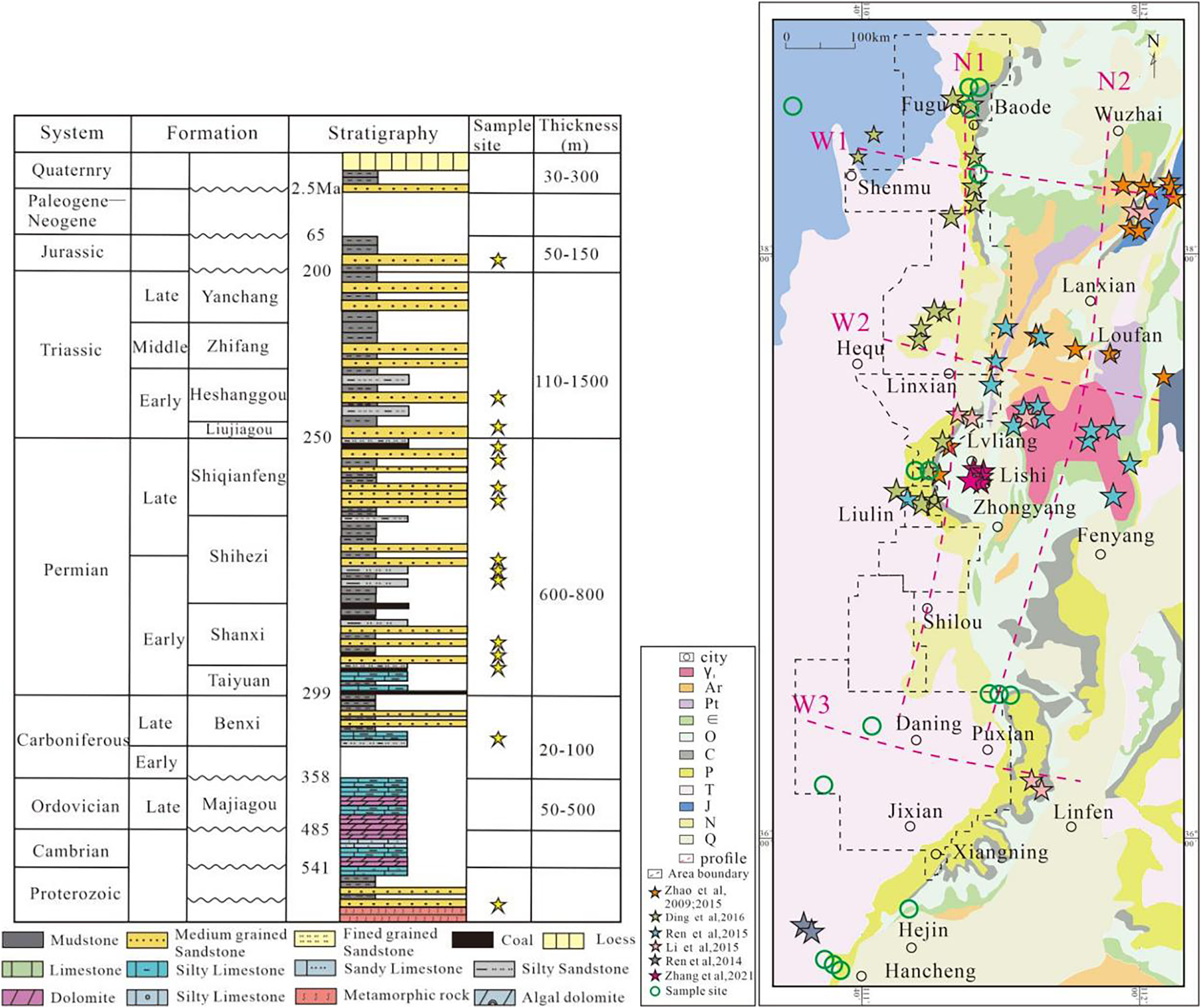
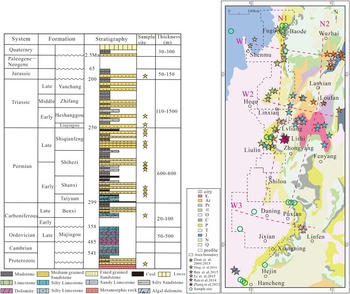
For this study, a total of 15 Upper Palaeozoic sandstone samples were collected from across the Lvliangshan uplift on the eastern margin of the Ordos Basin. The sample set comprises two Permian drill core samples from the Daji area and thirteen surface outcrop samples. These samples were systematically collected from Carboniferous, Permian, and Triassic strata, with sandstone being specifically targeted to ensure a sufficient yield of apatite crystals for analysis. The specific locations of all sampling sites are shown in Figures 1 and 2.
Stratigraphic column and distribution map of AFT sample locations (tectonic location is the same as in Figure 1b.) from the Eastern Ordos Basin.
3.b. Fission-track analysis and age calculation
In this study, AFT analysis was carried out on 15 samples from the eastern Ordos Basin. For each sample, between 14 and 29 apatite grains were analysed. A minimum of three Dpar values were measured for each grain to characterize its annealing properties (Ketcham et al. Reference Ketcham, Donelick and Carlson1999). Apatite grains were separated from the samples through standard crushing, magnetic, and heavy-liquid separation techniques by Yu-Neng Technology Service Limited Company, Langfang, Hebei, China. To reveal the fission tracks, the grains were etched with 5.5 Mol HNO₃ for 20 seconds at room temperature (Donelick et al. Reference Donelick, O’Sullivan and Ketcham2005).
Spontaneous fission-track counting and length measurements were performed using an automated microscopy system. The 238U content of each grain was subsequently measured by LA-ICP-MS. Single-grain ages were calculated from the spontaneous track density and the measured U-concentration (Hasebe et al. Reference Hasebe, Tamura and Arai2013).
3.c. Thermal history modelling
Thermal history modelling was conducted using the HeFTy software (Ketcham, Reference Ketcham2005), which employs a time-temperature box modelling approach. Key input parameters for the models included the AFT ages and the confined track-length distributions (with c-axis projection) within the Partial Annealing Zone (PAZ, 60–120°C). Known geological constraints, such as stratigraphic depositional ages and major exhumation events, were also incorporated. A present-day surface temperature of 20 ± 5°C was set for all modelled samples. To identify distinct uplift and cooling pathways controlled by the Lvliangshan uplift, separate initial models were established for samples from the northern and southern areas of the eastern basin.
4. Results
4.a. Fission-track results
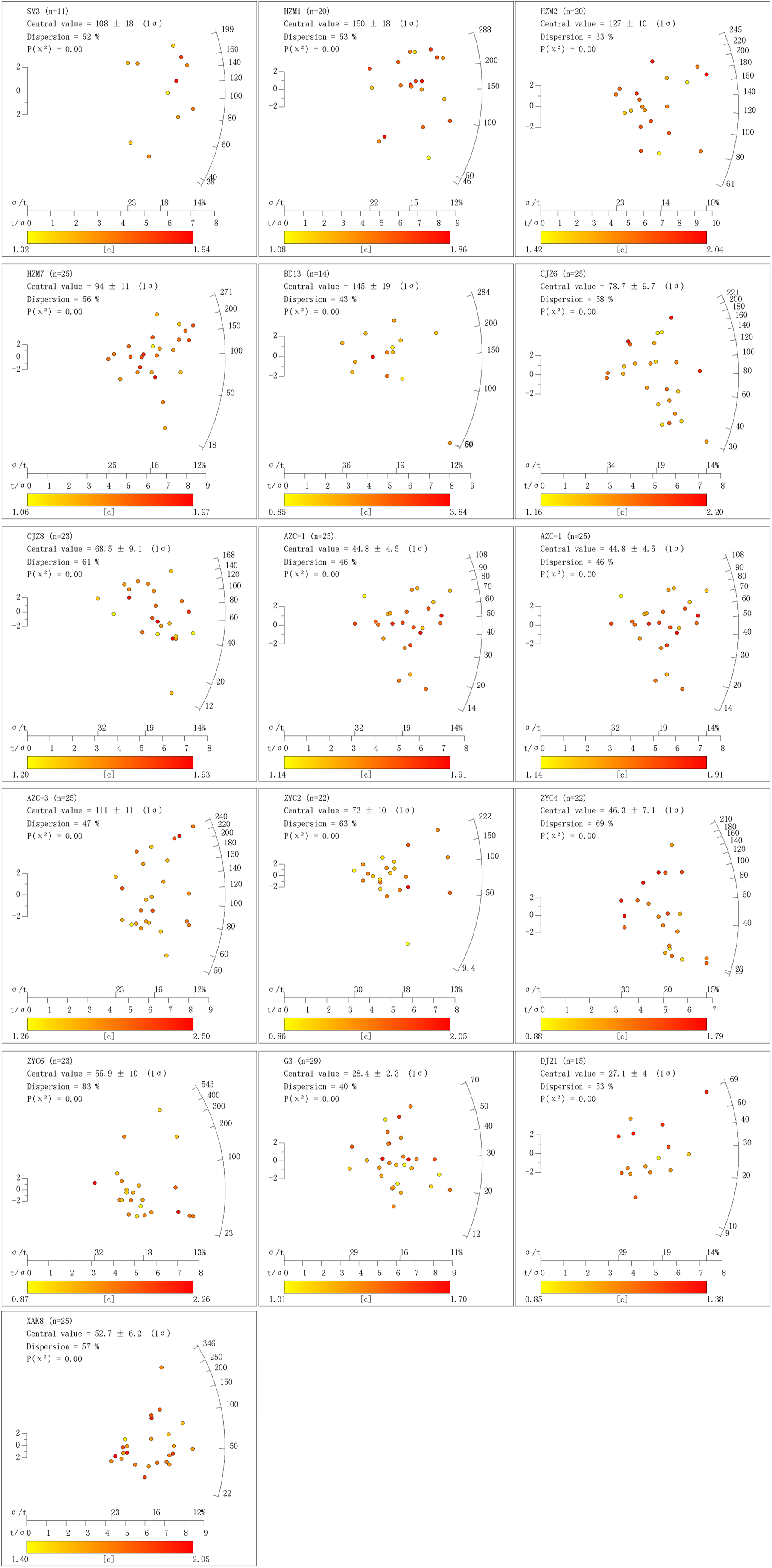
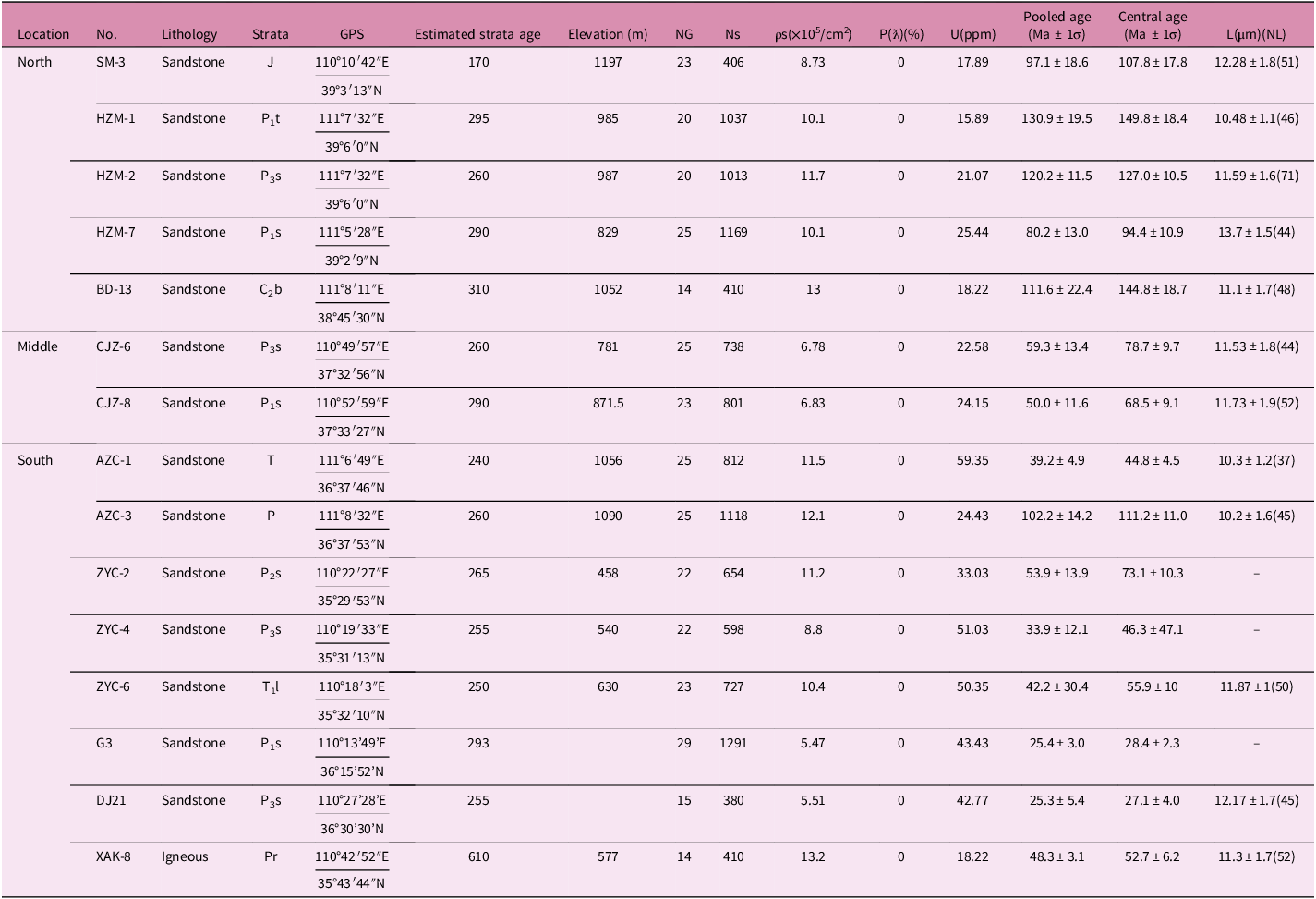
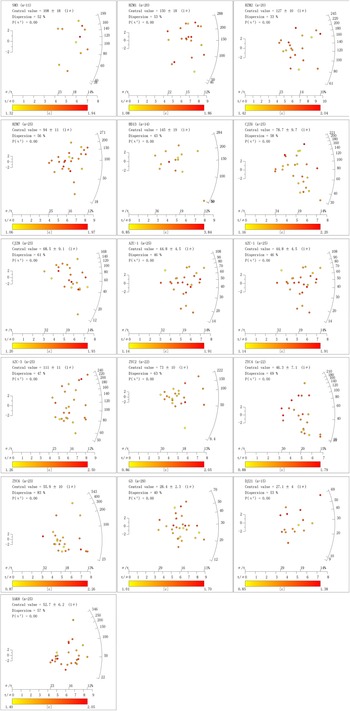
Central ages, calculated using the RadialPlotter software (Vermeesch, Reference Vermeesch2008), range from 21.7 ± 4 Ma to 149.8 ± 18 Ma (Table 1). All samples failed the chi-squared (χ2) test (P(χ2) < 5%), indicating significant dispersion among their single-grain ages (Figure 3). Among the samples, one (XAK-8) is an intrusive igneous rock from the southeastern part of the basin, yielding an AFT age of 52.7 ± 6 Ma. A clear spatial trend is observed in the ages, with samples from the northeast being older (average AFT age: 124.8 Ma; oldest age: 149.8 ± 18 Ma) than those from the southeast (average AFT age: 53.9 Ma). The measured Dpar values range from 1.15 to 1.8 μm, extending beyond the typical range of the Durango apatite standard (1.5–1.9 μm; McDowell et al. Reference McDowell, McIntosh and Farley2005). This suggests that the apatite grains are compositionally diverse and possess variable annealing kinetics (Donelick et al. Reference Donelick, O’Sullivan and Ketcham2005). Furthermore, the single-grain age histograms typically exhibit bimodal distributions, indicating the influence of multiple thermal events. All samples’ AFT ages are younger than their stratigraphic depositional ages. Their mean track lengths range from 11.5 ± 1.8 μm to 12.3 ± 1.8 μm, and are also significantly shorter than the initial length of ∼16.3 μm (Gleadow et al. Reference Gleadow, Duddy, Green and Lovering1986). Therefore, all samples have experienced significant fission-track annealing, confirming that their AFT data are suitable for constraining the tectono-thermal history of the basin.
New apatite fission-track data from Eastern Ordos Basin

Radial plots of apatite fission track ages of collected samples.
4.b. Reconstruction of uplift history
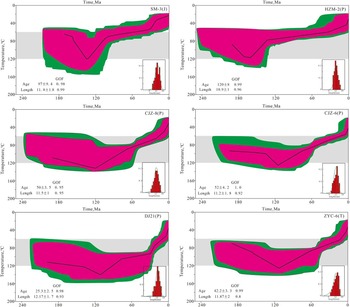
Thermal history modelling was carried out on individual samples using the HeFTy software (Ketcham, Reference Ketcham2005), applying the annealing model of Ketcham (Reference Ketcham, Carter, Donelick, Barbarand and Hurford2007) and utilizes a Monte Carlo inversion algorithm. The initial conditions for the modelling were constrained by both fission-track data and the stratigraphic age. The exhumation of the eastern margin since the Mesozoic commenced in the Middle Jurassic (Zhang et al. Reference Zhang, Wang, Zhang, Zhang and Zhang2021a) and potentially includes three cooling stages: the late Jurassic, Late Cretaceous, and early Cenozoic. To obtain a more reliable thermal history path during modelling (Figure 4), constraint boxes were set for the T-t (temperature-time) simulations based on potential cooling events since the Mesozoic. The modelling timeframe spans from the late Jurassic to the present (160–0Ma), with an initial temperature above the total annealing temperature (>110℃) and a present-day surface temperature constrained to 0–20℃. The Goodness-of-Fit (GOF) coefficients ranged from 0.8 to 0.99, indicating a good fit for the results.
Thermal modelling results showing the time–temperature paths for the Eastern Orods Basin.
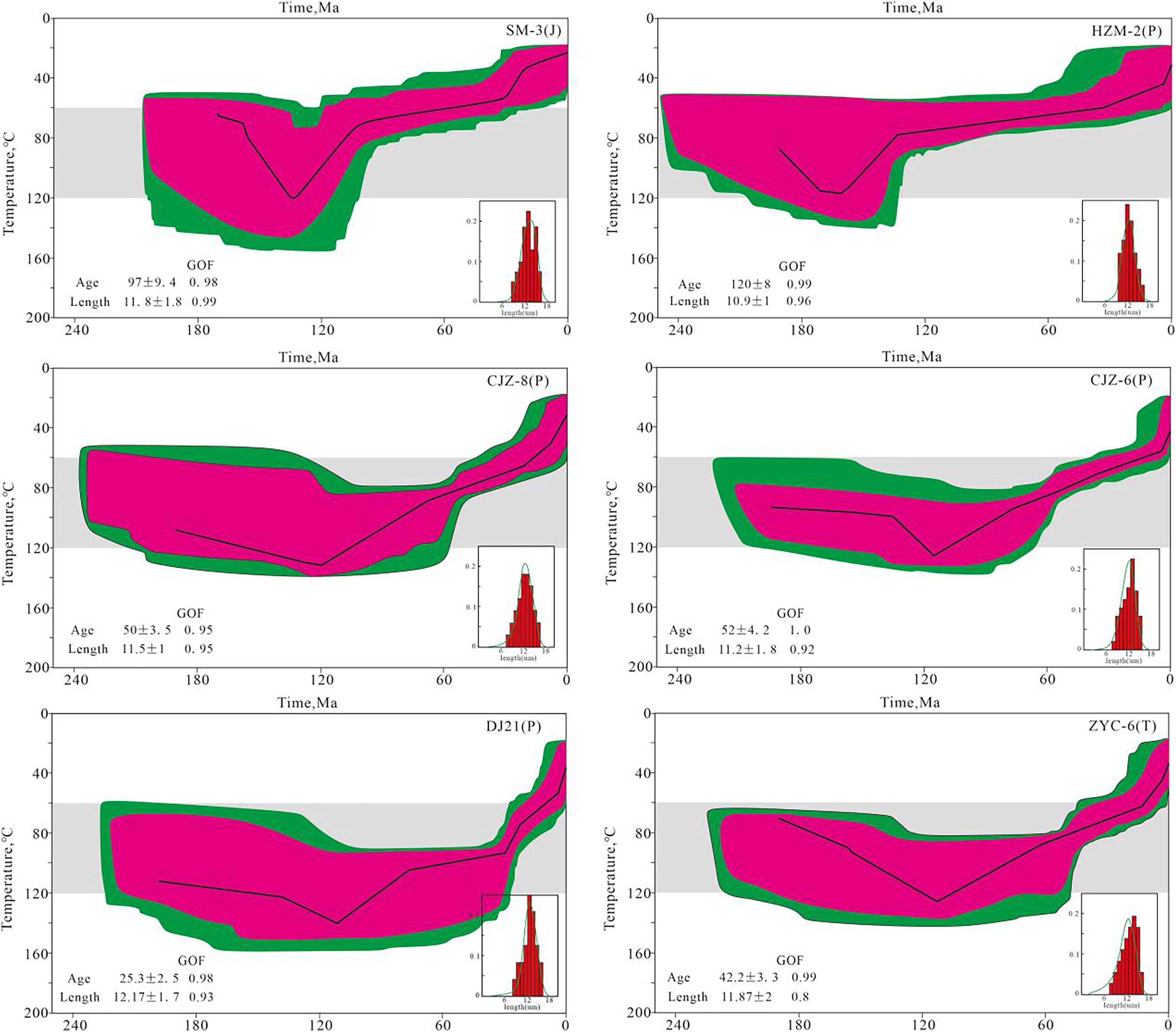
Within these acceptable fit ranges, the modelling results indicate that each sample recorded two or three significant cooling stages. The cooling rate has progressively decreased since the Early Cretaceous, and there are distinct differences in cooling rates between the northern and southern areas. The envelopes for samples SM-3 and HZM-2 from the northern area reached their maximum burial depth at approximately 140 Ma, exceeding the 120°C isotherm. They began to experience a major cooling event from 140–100 Ma (Late Jurassic–Early Cretaceous), passing through the annealing zone. Similarly, samples D21 and ZYC-6 from the southern area experienced higher temperatures and began rapid uplift at 120 Ma (Early Cretaceous), slightly later than the northern and central areas. Since the Neogene, their temperatures have decreased to below 60°C. Samples CJZ6 and CJZ8, located in the central part of the eastern margin, primarily reflect a rapid cooling stage during the Early Cretaceous (ca. 130–120 Ma).
Despite the dispersion in single-grain ages, the AFT data and the model path provide clear evidence for a multi-stage and spatially heterogeneous exhumation history across the eastern Ordos Basin since the Late Jurassic. The thermal history models, constrained by fully reset samples that once reached temperatures >120°C, consistently reveal a complex three-stage cooling pattern. This pattern is well-exemplified by sample SM-3 from the northern area, which records the following: (1) an initial, major exhumation phase (140–70 Ma) with a cooling rate of ∼1.5°C/Ma; (2) a subsequent period of relative tectonic quiescence or slow exhumation (70–30 Ma) at ∼0.25°C/Ma; and (3) a final, rapid phase of uplift and cooling that initiated at ∼30 Ma, with a cooling rate of ∼2°C/Ma. This detailed evolution for the eastern margin contrasts with the thermal history of the central part of the basin, where previous studies of the central basin identified a simpler, two-stage process. This two-stage process involved a prolonged cooling phase from 120–30 Ma (late Early Cretaceous–Palaeogene) at a rate of 2.5°C/Ma, followed by a more rapid cooling phase since 30 Ma (Neogene) at 3.6°C/Ma (Chen et al. Reference Chen, Liu, Jepsen, Li, Zhang and Wang2022). This discrepancy confirms that the eastern basin margin underwent non-uniform uplift and cooling along its north-south extent, providing important constraints on the tectonic evolution of the eastern boundary of the Ordos Basin.
The thermal history recorded by these samples begins with a period of post-Triassic burial and heating. This was followed by an initial phase of rapid cooling that commenced at approximately 140–120 Ma. Subsequently, the samples cooled at a slower rate as they passed through the Apatite PAZ (mostly 80°C–120°C), before undergoing a final episode of accelerated cooling since 30 Ma. The weighted average paths of all samples show that they experienced similar cooling stages.
5. Discussion
To better understand the tectono-thermal evolution and regional geodynamic background of the eastern Ordos Basin since the Mesozoic, this study has compiled previously published AFT thermochronology data (Zhao et al. Reference Zhao, Liu and Wang2009; Ren et al. Reference Ren, Li, Liang, Wu, Yu, Ren and Wang2014; Li et al. Reference Li, Liu, Yue and Wang2015; Ren et al. Reference Ren, Zhu, Zhu, Wang and Luo2015; Zhao et al. Reference Zhao, Liu, Lu, Cao, Yang and Xue2015; Ding et al. Reference Ding, Chen, Guo, Zhang, Shi, Xu and Liu2016; Zhang et al. Reference Zhang, Wang, Zhang, Zhang and Zhang2021a) (Figure 1). The significant variation observed in the AFT ages and the dispersion noted in the modelling is indicative of a non-uniform tectono-thermal history, with tectonic processes exhibiting pronounced spatial heterogeneity. Furthermore, thermal history modelling of this data reveals multi-stage and asynchronous cooling processes, suggesting that the evolution of the eastern Ordos Basin is the product of multiple, superimposed tectonic regimes.
5.a. Thermochronological analysis
Previous studies indicate significant north-south variation in the magnitude of exhumation across the eastern Ordos Basin. Vitrinite reflectance (Ro) in the eastern Ordos Basin ranges from 0.7% to 3.1% (Figure 1b), with thermal maturity gradually increasing from north to south. In the northern Baode area, values range from 0.6%–0.9%; in the Linxing area, Ro values are concentrated between 0.8% and 1.4%; and in the southern Daji area, they span from 1.3%–3.1%. The erosion thickness, estimated from vitrinite reflectance and sonic log data, is approximately 1500 m in the northern area but increases southward to >2000m (Yu et al. Reference Yu, Ren, Li, Wang, Qin and Tao2017; Li et al. Reference Li2018). The erosion thickness in the south is significantly greater than in the north. Barker (Reference Barker and Pawlewicz1986) utilized a large dataset of mean vitrinite reflectance (Rm) from humic organic matter and their corresponding maximum temperatures (Tmax) to establish the regression equation:
 $$ln(Rm) = 0.0096Tmax - 1.4,$$
This equation is used to estimate the maximum palaeotemperatures experienced by rocks during their geological history. Based on calculations, the Tmax for the Shanxi Formation in the northern Baode area is 115.7°C. In the central Linxing area, Tmax for the Shanxi-Benxi Formations ranges from 142.4–163.3°C, and in the southern Daji area, it ranges from 208.9–239°C. These temperatures exceed the AFT closure temperature. This indicates that the measured AFT ages represent the time when the samples cooled through the AFT PAZ during a later phase of tectonic uplift. Therefore, the AFT ages record the Meso-Cenozoic uplift history.
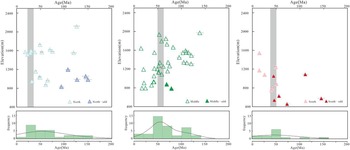
The AFT ages of almost all detrital grains are older than their stratigraphic ages. This suggests that in certain areas or at certain stratigraphic levels, post-depositional burial was insufficient to heat the samples into the AFT PAZ, or that the samples experienced 120–60°C temperatures for a very short duration. By integrating previously published AFT data, Peng et al. (Reference Peng, Wang, Liu, Zhao, Huang, Zhao, Zhang, Liang, Wang, Cattò, Jiao, Zhang, Zhang, Zhang and Zattin2023) found that the detrital AFT ages are mainly concentrated in four ranges (Figure 5): Peak 1 (120–110 Ma), Peak 2 (70–60 Ma), Peak 3 (50–40 Ma), and Peak 4 (30–20 Ma). The distribution of AFT ages also suggests that the apatite grains may have been derived from multiple source regions. Based on the AFT data from the eastern segments, ages corresponding to Zone 1 and Zone 2 are found mainly in the northern and central areas, whereas ages from Zone 3 and Zone 4 are distributed throughout the eastern area (Figure 6).
Apatite fission track age distribution maps of eastern Ordos Basin.
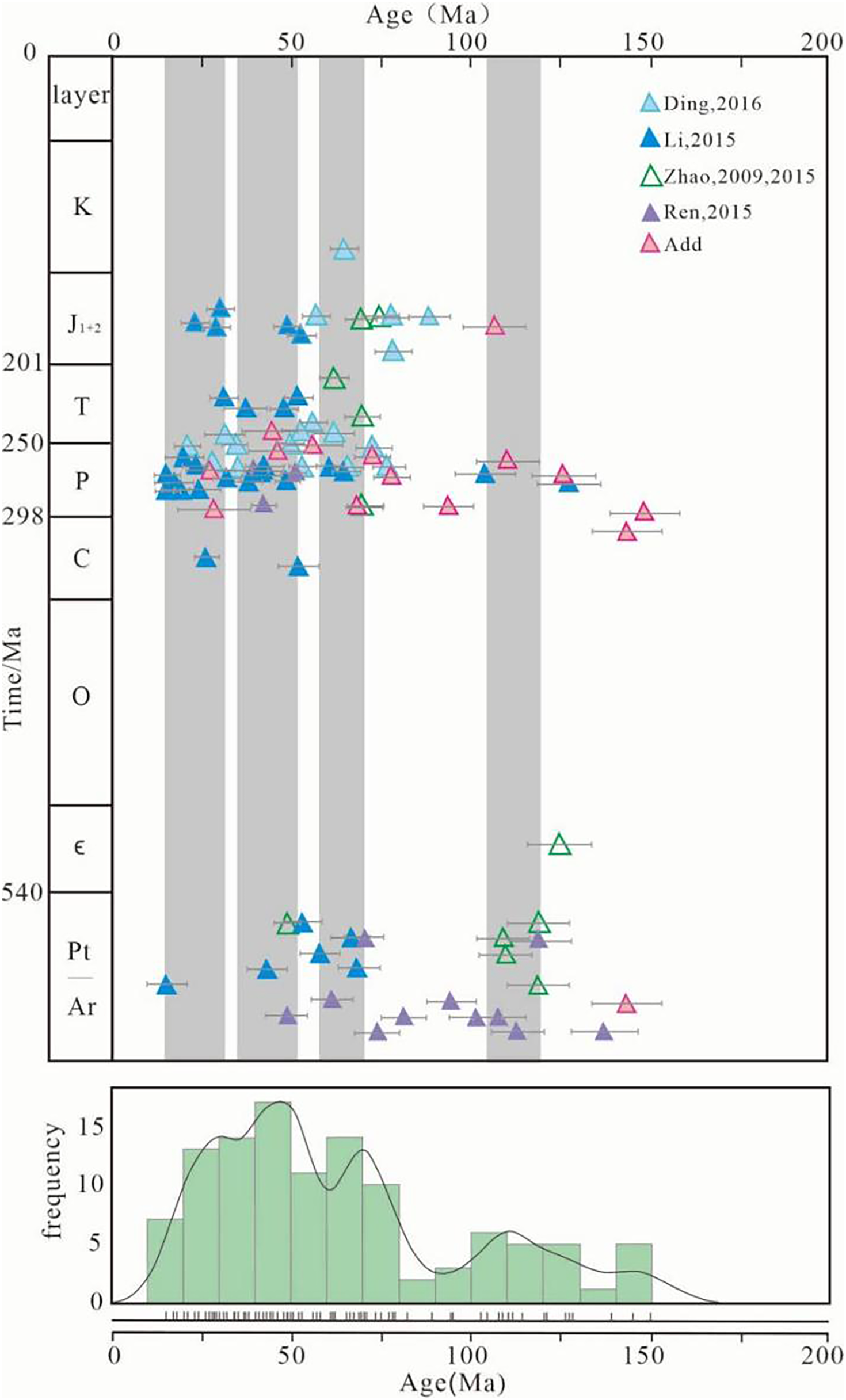
Apatite fission track age distribution maps of the northern, central and southern segments of the eastern Ordos Basin.

The abundance of P1 and P2 age peaks in the northern and central areas indicates that these segments were among the first areas (ca. 120 Ma) to be affected by the destruction of the NCC, with significant early activity along marginal faults. The northern area had greater palaeotopographic relief and a higher exhumation rate, which facilitated the earlier uplift of deep-seated rocks above the AFT closure temperature zone. The P1 and P2 peaks reflect the onset of uplift in the northern and central areas during the early Mesozoic (110–70 Ma). The northern area (P1) cooled earliest at a relatively moderate rate represents this ‘medium-temperature, medium-speed’ cooling. In contrast, the cooling process in the central segment was more continuous, extending to 60–70 Ma, with a moderate cooling rate of approximately 2.5°C/Ma (Chen et al. Reference Chen, Liu, Jepsen, Li, Zhang and Wang2022), reflecting the influence of inherited tectonic activity superimposed by Cenozoic far-field uplift. The central area exhibits a ‘multi-stage, medium-speed’ cooling pattern.
The southern area is dominated by the younger P3 (40–50 Ma) and P4 (20–30 Ma) age peaks, indicating a later onset of major tectonic activity. This area shows no significant cooling signal during the Cretaceous, likely because a thicker sedimentary cover prevented the deep-seated rocks from being exhumed into the AFT PAZ at that time. Instead, this area experienced intense Cenozoic inversion, driven by far-field compressional stresses emanating from the Tibetan Plateau, which significantly enhanced Neogene uplift (Peng et al. Reference Peng, Wang, Liu, Zhang and Zattin2019; Zhang et al. Reference Zhang, Wang, Zhang, Zhang and Zhang2021a). This later, rapid uplift, resulted in the southern area cooling through the AFT closure temperature during 50–20 Ma, thereby recording the P3 and P4 peaks.
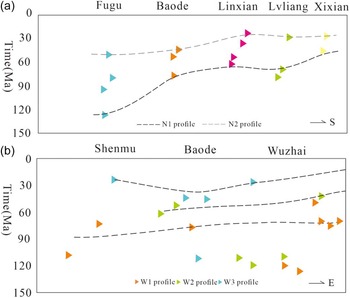
The widespread appearance of P3 and P4 peaks across the entire eastern margin is attributed to tectonic reactivation in the early Cenozoic. The period since 30 Ma, in particular, marks the most intense phase of uplift for the eastern Ordos Basin. Far-field stresses from the ongoing growth of the Tibetan Plateau drove the inversion and strike-slip reactivation of marginal faults, enhancing tectonic activity and causing widespread, significant exhumation and cooling throughout the eastern margin (Huang et al. Reference Huang, Wang, Zhang and Yang2021; Zhang et al. Reference Zhang, Wang, Zhang, Zhang and Zhang2021 a; Peng et al. Reference Peng, Wang, Liu, Zhao, Huang, Zhao, Zhang, Liang, Wang, Cattò, Jiao, Zhang, Zhang, Zhang and Zattin2023). This regional trend is clearly illustrated by the AFT ages transect from Fugu in the north to Xixian in the south (Figure 7a). East-west profiles show little variation in AFT ages along the same profile, whereas north-south profiles reveal a distinct trend of younger ages from north to south (Figure 7b). This indicates significant differential cooling and thermal evolution across the region. This north-south age gradient reflects differential tectonic uplift and exhumation since the Mesozoic, with the influence of tectonic activity at the margin of the NCC being particularly pronounced.
AFT fission track age profiles in eastern Ordos: a) North-South profile and b) West-East profile.

Samples in the north record the older P1, P2 and P3 uplift and cooling events, suggesting they captured earlier phases of Mesozoic thermal activity or uplift. In contrast, the southern area is dominated by younger AFT ages, indicating that its exhumation was delayed but more intense, concentrated primarily in the 50–20 Ma period, reflecting significant Palaeogene-Neogene tectonic uplift and rapid cooling. This spatial pattern of cooling ages, which young southward, is intrinsically linked to regional inversion structures, the activity of basin-boundary faults, and tectonic movements at the margin of the NCC.
5.b. Uplift and exhumation history of the eastern Ordos Basin
The eastern Ordos Basin lies within the TNCO, where the NCC, assembled from Archaean-Palaeoproterozoic micro-continental blocks (Zhao et al. Reference Zhao, Sun, Wilde and Li2005, 2016; Duan, Reference Duan, Zhai, Zhu, Zhou and Fan2024). The basin exhibits an east-west differentiation, with the Western Block having a lithospheric thickness of 150–200 km and low heat flow values (40–60 mW/m2), preserving typical cratonic attributes (Zhu et al. Reference Zhu, Fan, Li, Meng, Li and Zeng2015). In contrast, during the Mesozoic, both the TNCO and the Eastern Block underwent a massive lithospheric thinning event, where the lithosphere was reduced to 60–80 km, accompanied by elevated heat flow (>70 mW/m2). Lithospheric thinning in the Ordos Basin initiated during the latest Jurassic and culminated in the Early Cretaceous. According to reconstruction results (Qi et al. Reference Qi, Ren, Cui, Yu, Bai, Liu, Chen and Xing2025), the lithospheric thickness in the eastern basin was reduced to 61 km by the Early Cretaceous. Subsequently, the eastern lithosphere has re-thickened to 81 km since the Cenozoic due to thermal subsidence. Thermal inversion modelling reveals high-temperature anomalies within the TNCO, indicating the upwelling of deep, hot mantle materials (Zhang et al. 2025). This lithospheric thinning and mantle thermal activity resulted in a peak heat flow in the eastern basin during the Early Cretaceous. Since the Late Cretaceous, with the waning of tectonic activity, the lithosphere has gradually cooled and re-thickened. Consequently, the thermal regime of the basin has stabilized, ultimately evolving into its present-day “warm basin” status (Qi et al. Reference Qi, Ren, Cui, Yu, Bai, Liu, Chen and Xing2025).
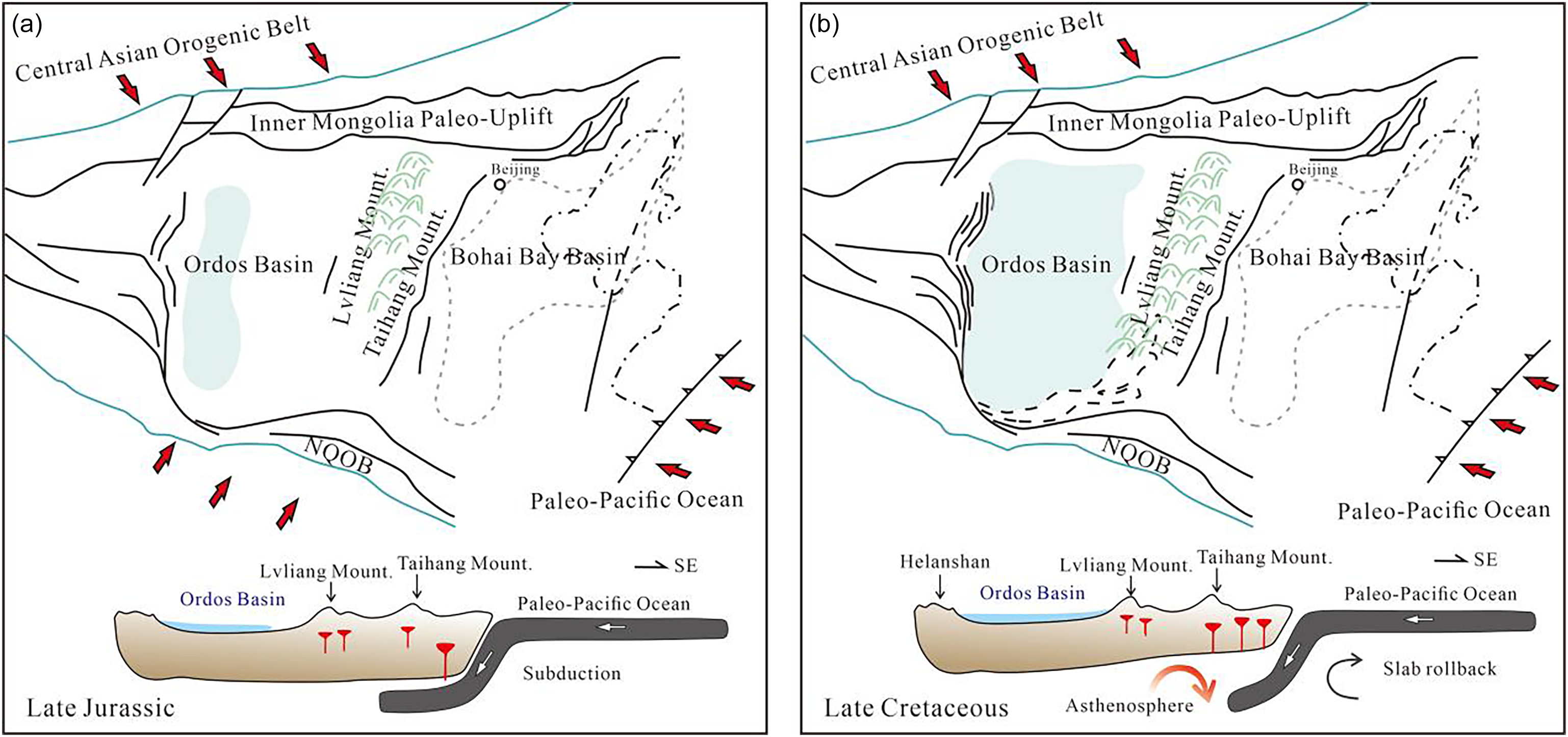
It is well-established that the tectono-thermal history of the eastern Ordos Basin region, including the Taihang-Lvliang Mountains, is marked by at least three significant episodes of rapid exhumation since the Mesozoic (Figure 8): in the Late Jurassic (ca. 150 Ma) (Figure 9a), the Late Cretaceous, the Eocene (ca. 50–40 Ma) and the Late Oligocene–Early Miocene (ca. 30–20 Ma) (Huang et al. Reference Huang, Wang, Zhang and Yang2021; Zhang et al. Reference Zhang, Wang, Zhang, Zhang and Zhang2021a). Previous research (Ren et al. Reference Ren, Zhang, Gao, Cui, Xiao and Xiao2007; Chen et al. Reference Chen, Deng, Xu, Zhang, Hu, Yu, Li, Meng and Liu2013) has reconstructed palaeotemperatures using multiple methods on Upper Palaeozoic samples, including vitrinite reflectance, fluid inclusions, apatite fission track and illite crystallinity. These authors concluded that the palaeogeothermal gradient along the eastern Ordos Basin during the Late Mesozoic was 2.9–4.0°C/100m. Temperatures reached peak values during the Early Cretaceous, corresponding to a geothermal gradient of 40°C/km, followed by 32°C/km during the Late Cretaceous–Palaeogene and 28°C/km during the Neogene. Exhumation rates were calculated based on these values.
Thermal history modelling results for the northern, middle, and southern sections of the Eastern Ordos. The different coloured lines represent the best-fit paths from different samples. Data are from Ding (Reference Ding, Chen, Guo, Zhang, Shi, Xu and Liu2016), Huang (Reference Huang, Ren and Gao2016), Ren (Reference Ren, Zhu, Zhu, Wang and Luo2015), and Wang (Reference Wang, He, Bian, Zhao, Chen, Dong, Zhang, Zhu and Liu2024) and this study.

The erosion rate can be estimated using the closure temperature of individual minerals and the fission-track ages of samples, combined with the regional palaeo-geothermal gradient, to calculate the long-term average uplift rate of a sample since it cooled through its closure temperature (Parrish, Reference Parrish1983). The calculation is expressed as: ${\rm{\;}}U = {{{{T_{\rm{B}}} - {T_{\rm{S}}}}}\over{{{\rm{G}} \times {\rm{t}}}}}$
, where U is the long-term average uplift rate of the sample, m/Ma; T
B is the closure temperature of the mineral, taken as 110°C for apatite and 240°C for zircon; T
S is the mean annual surface temperature of the study area, assumed to be 20°C; G is the palaeo-geothermal gradient of the area, °C/100 m; and t represents the AFT age of the sample, Ma. Through a comparative analysis of the tectono-thermal processes in the northern, central and southern areas of the eastern basin, we conclude that the eastern Ordos Basin has undergone a three-stage tectono-thermal evolution since the Mesozoic. However, the thermal history paths of individual samples show variations in the onset, duration and rate of these three rapid uplift phases, characterizing the uplift process as differential.
${\rm{\;}}U = {{{{T_{\rm{B}}} - {T_{\rm{S}}}}}\over{{{\rm{G}} \times {\rm{t}}}}}$
, where U is the long-term average uplift rate of the sample, m/Ma; T
B is the closure temperature of the mineral, taken as 110°C for apatite and 240°C for zircon; T
S is the mean annual surface temperature of the study area, assumed to be 20°C; G is the palaeo-geothermal gradient of the area, °C/100 m; and t represents the AFT age of the sample, Ma. Through a comparative analysis of the tectono-thermal processes in the northern, central and southern areas of the eastern basin, we conclude that the eastern Ordos Basin has undergone a three-stage tectono-thermal evolution since the Mesozoic. However, the thermal history paths of individual samples show variations in the onset, duration and rate of these three rapid uplift phases, characterizing the uplift process as differential.
5.b.1. Early cretaceous to late cretaceous
The Early Cretaceous was a key turning point in the tectonic history of the Ordos Basin. During this period, the thickened ancient lower crust of the NCC sank into the underlying asthenosphere, driven by the subduction of the Palaeo-Pacific Plate beneath the Eurasian continent (Figure 9b). This deep process triggered the upwelling of the asthenospheric mantle, leading to significant lithospheric thinning and an elevated regional geothermal gradient (Zhang et al. Reference Zhang, Zhao and Li2022). As a direct result of this process, the lithosphere in the central transition zone of the NCC currently has a thickness of 100 to 140 km, and shows significant west-to-east thinning (Ren et al. Reference Ren, Tamaki, Li and Jun2002; Zhu et al. Reference Zhu, Fan, Li, Meng, Li and Zeng2015; Ren et al. Reference Ren, Qi, Li, Huo, Cui, Yang, Wang, Wang, Chen and Yang2021).
Most of the AFT data record this tectono-thermal event of the Early Cretaceous, which represents the first cooling stage in the east. The modelling results (Figure 4) indicate that the Early Cretaceous was the main uplift period for the eastern region. The region experienced overall uplift, with differential cooling occurring between approximately 130 and 110 Ma. These two cooling phases are clearly reflected in the AFT ages obtained from the eastern part. More specifically, by ca. 130 Ma, strata in the eastern part had subsided to their maximum depth, reaching 120°C in the north and 150°C in the south. During the Early Cretaceous, the entire eastern region began to uplift at relatively low cooling rates, approximately 25 m/Ma in the northern area (sample SM3), 33 m/Ma in the central area (sample CJZ-8), and 50 m/Ma in the southern area (sample ZYC6), indicating that the region experienced a similar overall exhumation process.
A rapid cooling event occurred between 130–100 Ma, marking the key transition of the Ordos Basin from burial heating to uplift and cooling. The onset of uplift was earlier in the north (ca. 130 Ma) compared to the south (ca. 110 Ma). Thermal history modelling (using a geothermal gradient of approximately 40°C/km (Chen et al. Reference Chen, Deng, Xu, Zhang, Hu, Yu, Li, Meng and Liu2013) shows a temperature decrease of about 20–60°C. This decrease corresponds to an exhumation depth of 0.5–1.5 km, indicating significant tectonic uplift, with the uplift rate in the north being significantly higher than in the south. The magnitude of erosion across the entire basin gradually increases towards the eastern margin and the southeast. Additionally, magmatic intrusions occurred in the Zijinshan area of the central section (136.7–130.4 Ma) (Chen et al. Reference Chen, Deng, Xu, Zhang, Hu, Yu, Li, Meng and Liu2013). The Zijinshan intrusive rocks are characterized by a deep magma source from the crust-mantle transition zone, indicating lithospheric delamination, extension and asthenospheric upwelling in the central NCC during the Early Cretaceous. This tectono-thermal event led to intensified exhumation in the region, resulting in the differential uplift of the eastern margin since the Early Cretaceous.
5.b.2. Late cretaceous to Palaeogene
The second major exhumation phase in the eastern Ordos Basin occurred between approximately 70 and 40 Ma. This period was governed by a complex interplay of regional tectonic forces. Since the Late Cretaceous, the basin had been in a state of long-term uplift and denudation, driven primarily by the subduction of the Palaeo-Pacific Plate to the east (Ren et al. Reference Ren, Zhu, Zhu, Wang and Luo2015; Suo et al. Reference Suo, Li, Li, Yu and Liu2012). This resulted in a regional depositional hiatus and transformed the eastern margin into a source area for erosion, with Jurassic and Cretaceous strata becoming widely absent. Based on a geothermal gradient of 32°C/km (Chen et al. Reference Chen, Deng, Xu, Zhang, Hu, Yu, Li, Meng and Liu2013), this corresponds to a maximum exhumation depth of about 1 km. During this stage, the overall uplift rate of the eastern part of the region slowed down, the exhumation thickness was not substantial, and a process of relatively slow uplift was maintained.
Regionally, the collision between the Indian and Eurasian plates occurred between 60 and 50 Ma, leading to eastward and southeastward extrusion (Zhang et al . Reference Zhang, Wang, Zhang, Zhang and Zhang2021a). Concurrently, the subduction direction of the Palaeo-Pacific Plate shifted from NNW to NWW between 50 and 42 Ma, causing tectonic inversion in eastern China (Chen et al. Reference Chen, Liu, Jepsen, Li, Zhang and Wang2022). During the Late Cretaceous, the study area was characterized by a depositional hiatus and intense exhumation, transforming it into a source area for erosion. Furthermore, the basin and its periphery underwent regional exhumation, and the tectonic stress field shifted to compressional (Figure 10) (Zhang et al. Reference Zhang, Wang, Zhang, Zhang and Zhang2021a; Shi et al. Reference Shi, Soares, Shen, Wang, Yang, Liang and Liu2019), forming a series of thrust-fold belts and strike-slip structures (Chen et al. Reference Chen, Li, Chen and Zhao2025).
Schematic summary of the mainly Mesozoic–Cenozoic tectonic history of Eastern Ordos and its surroundings (a) Late Jurassic (b) Late Cretaceous with reference to Huang et al. (Reference Huang, Wang, Zhang and Yang2021).
Thermal history modelling results based on other thermochronological methods in the eastern Ordos Basin (simulation results are from Zhang, 2021 and Wang, Reference Wang, He, Bian, Zhao, Chen, Dong, Zhang, Zhu and Liu2024).

5.b.3. Since the Palaeogene
Since 30 Ma, the lithosphere of the eastern NCC has thinned significantly. The interior of the basin exhibited overall uplift, while a series of graben and pull-apart basins developed along its periphery. The most prominent feature on the eastern margin is the formation and evolution of the Shanxi Graben. Low-temperature thermochronology studies confirm that the Lvliang and Taihang Mountains underwent renewed, albeit slow, uplift and denudation during this time (Ren et al. Reference Ren, Zhu, Zhu, Wang and Luo2015; Zhang et al. Reference Zhang, Wang, Zhang, Zhang and Zhang2021a; Huang et al. Reference Huang, Wang, Zhang and Yang2021; Li & Song Reference Li and Song2010). This tectonic framework, which has shaped the modern landscape of North China, is considered a far-field response to the interplay between the ongoing uplift of the Tibetan Plateau and the subduction of the Pacific Plate. The AFT data consistently record this Cenozoic event, with a prominent age peak between 30 and 20 Ma. The acceptable thermal history path indicates that most sample paths passed through the PAZ during this time and show a ‘fast-slow-fast’ cooling pattern since 30 Ma. Based on a geothermal gradient of 28°C/km (Chen et al. 2012), the total Cenozoic exhumation is estimated at 1.8–2.1 km. This Neogene uplift was also differential, with exhumation rates of ∼35 m/Ma in the northern (SM3) and central (CJZ-6) areas, increasing to a more rapid ∼54 m/Ma in the southern area (D21, HC19). This southward intensification of uplift is consistent with a greater far-field effect from the Tibetan Plateau on the southern part of the basin.
By integrating ZFT/AFT and (U-Th)/He (ZHe/AHe) thermochronometers with varying closure temperatures (Figure 10), the cooling sequence from deep to shallow crustal levels has been reconstructed (Zhao et al. 2016; Zhang et al. Reference Zhang, Wang, Zhang, Zhang and Zhang2021a; Wang et al. Reference Wang, He, Bian, Zhao, Chen, Dong, Zhang, Zhu and Liu2024). The high-closure-temperature zircon systems (ZFT/ZHe) constrain a rapid cooling event during the Middle Jurassic–Early Cretaceous (180–130 Ma), AFT data record the complex thermal history of the Cretaceous (130–65 Ma), specifically capturing the annealing effects induced by anomalous geothermal gradients during Early Cretaceous extension (Zhang et al. Reference Zhang, Wang, Zhang, Zhang and Zhang2021a), followed by a phase of rapid exhumation. The age discrepancy between the AFT and ZFT results implies a prolonged cooling interval bridging the Early Cretaceous and the Cenozoic. Finally, low-closure-temperature AHe data (Wang et al. Reference Wang, He, Bian, Zhao, Chen, Dong, Zhang, Zhu and Liu2024) record the final cooling stage from shallow depths to the surface, with ages ranging from 41.6 to 80.5 Ma, confirming a regime of slow uplift since the Cenozoic.
In summary, the post-Early Cretaceous evolution of the Ordos Basin can be synthesized into a three-stage history of differential uplift (Figure 11). (1) During the Early Cretaceous, significant uplift was concentrated in the northern and central areas, while the south remained a zone of subsidence or very slow uplift. (2) In the Late Cretaceous–Palaeogene, the basin experienced slight regional uplift, with the southern area beginning to experience slow-to-moderate uplift. (3) During the Neogene, the entire basin entered a phase of accelerated regional uplift, with the southern area exhibiting the highest rates. This complex, diachronous history, driven by the evolving interplay of regional stress fields, has resulted in the removal of up to 2 km of Mesozoic strata from the eastern margin (Yang et al. Reference Yang, Ren, Fu, Bao, Xiao, Shi, Wang, Zhang, Liu and Li2024).
Evolutionary model of a profile through the Eastern Ordos Basin since the Mesozoic.

Such long-term uplift has exerted a profound influence on petroleum systems. Tectonic uplift since the Late Cretaceous not only slowed organic matter maturation but also destroyed early-formed hydrocarbon reservoirs. While the Permian-Jurassic served as a critical period for burial and thermal maturation, the subsequent uplift and denudation during the Early Cretaceous led to a rapid decrease in temperature. The cooling event halted thermal evolution and terminated gas generation. Notably, the timing of the uplift determined the duration of the hydrocarbon generation window. The northern area of the eastern margin experienced early uplift, resulting in a truncated accumulation period and weaker generation intensity. In contrast, the southern underwent later uplift, allowing source rocks to remain within the hydrocarbon generation window for a longer duration. Furthermore, the uplift from the Late Cretaceous to the Neogene disrupted the original preservation conditions, leading to a decline in formation pressure and the dissipation of natural gas. This process directly resulted in the low-pressure characteristics observed in present-day reservoirs; specifically, the northern region developed into undersaturated, low-pressure coalbed methane reservoirs due to tectonic uplift and modification (Tao et al. Reference Tao, Wang, Ni and Wu2018).
As a major, stable block in China, the eastern Ordos Basin has recorded a complex history of uplift and cooling in response to regional tectonic events, which have driven both basin-wide and differential uplift (Figure 11). Its evolution since the Mesozoic has been primarily governed by the interplay between tectonic activity and lithospheric thermal processes. Situated in a transitional zone between the craton and an active orogenic belt, the study area is dissected by a series of large-scale fault systems. These faults have experienced repeated reactivation since the Mesozoic, triggering intense crustal uplift, which in turn led to rapid surface denudation and rock cooling. This process was further exacerbated by thermal anomalies associated with lithospheric thinning. Ultimately, the complex thermal history of the eastern Ordos Basin was sculpted by the coupling of these surface processes – uplift, exhumation and cooling – with deep mantle dynamics.
To contextualize the thermal evolution of the eastern Ordos Basin within a global framework, a comparative analysis was conducted with the Beaufort-Mackenzie Basin (BMB) in Canada and the Eastern Brazilian Margin Basins. The BMB, a typical continental margin foreland basin, experienced significant Cenozoic tectonic activity associated with the Cordilleran and Eurekan orogenies, leading to multiple phases of tectonic uplift and exhumation (Midwinter et al. Reference Midwinter, Powell and Schneider2017). Despite differing tectonic settings – BMB as a foreland basin and the Ordos Basin as a stable cratonic basin – both regions underwent pronounced tectonothermal events during the Late Cretaceous to Palaeogene, which are clearly recorded by AFT data (Midwinter et al. Reference Midwinter, Powell and Schneider2017). The thermal history of the BMB is primarily burial-driven, governed by the accumulation of thick Cenozoic sediments (over 12–16 km), which significantly contributed to subsurface heating (Tang et al. Reference Tang and Lerche1992). In contrast, the thermal evolution of the eastern Ordos Basin during the Early Cretaceous was marked by a high heat flow regime, closely related to the lithospheric thinning and extension of the NCC (Ren et al. Reference Ren, Qi and Liu2020), as evidenced by thermal modelling and AFT analyses. Meanwhile, the Eastern BMB underwent an intense tectonothermal event in the Early Cretaceous, interpreted as the consequence of lithospheric rupture, mantle upwelling and continental rifting. This event resulted in elevated palaeotemperatures (Fonseca et al. Reference Fonseca, Cruz, Novo, He and De Grave2022; Cogné et al. Reference Cogné, Gallagher and Cobbold2011). AFT thermochronology effectively captured both this heating phase and the subsequent Cenozoic cooling and uplift, demonstrating the prolonged thermal and tectonic evolution of these passive margins well beyond the rifting phase (Costa et al. Reference Costa, Fonseca and De Grave2024).
6. Conclusions
-
(1) The eastern Ordos comprises four AFT (Apatite Fission Track) age zones: P1 (110 Ma), P2 (70 Ma), P3 (50 Ma) and P4 (30 Ma). These zones exhibit spatial variations: the Early Cretaceous (P1) and Late Cretaceous (P2) age peaks are predominantly concentrated in the northern and central areas, indicating that these areas initiated tectonic uplift and exhumation/cooling in the early stages of the NCC destruction, with the northern area cooling earliest. In contrast, the Eocene (P3) and early Miocene (P4) age peaks are widely distributed across the entire eastern margin, with the southern area showing the highest concentration. The later cooling time in the southern area reflects the intense characteristics of Neogene tectonic activity.
-
(2) Since the Mesozoic, the Ordos Basin experienced three phases of uplift. In the Early Cretaceous, the northern and central areas generally underwent uplift, with rates around 25 m/Ma. Uplift in the southern area initiated slightly later, but its rate of approximately 50 m/Ma was higher than that further north. The region experienced similar denudation processes but exhibits clear north-south differences. During the Late Cretaceous–Palaeogene, overall uplift activity in the basin was relatively low. Since the Neogene, the southern uplift rate has been significantly high, at approximately 54 m/Ma, while the northern and central regions also showed higher uplift rates, around 35 m/Ma. This may be related to the far-field effects of the Qinghai-Tibet Plateau uplift, which imposed a stronger driving force on the southern area of the basin. The complex interplay of regional tectonic stress field evolution and thermal history led to differential tectonic uplift and subsidence processes in the northern, central and southern areas across various geological periods.
-
(3) Since the Mesozoic, uplift and cooling processes in the eastern Ordos Basin have been primarily controlled by tectonic activity and lithospheric thermal evolution. The region has undergone intense and repeated faulting and crustal uplift, leading to rapid surface exhumation and rock cooling. Furthermore, thermal anomalies resulting from lithospheric thinning have intensified this process. Therefore, the tectonic uplift–exhumation–cooling processes in the eastern basin are coupled with deep mantle processes, jointly shaping the complex thermal evolution history of the eastern Ordos Basin. Early-stage stratigraphic uplift may impede the thermal maturation of source rocks, while late-stage uplift can promote natural gas leakage and dissipation.
Acknowledgements
This study is supported by The PetroChina Changqing Oilfield Company Science and Technology Major Project ‘Research on Tectonic-Sedimentary Environment, Hydrocarbon Accumulation Conditions and Favorable Exploration Zones in the Deep Strata of Ordos Basin’ (2024D1JC06), and Petrochina Coalbed Methane Company Limited (NCCBM24035KT03). The authors sincerely thank the anonymous reviewers and the editors for their constructive comments and suggestions, which greatly improved the quality of this manuscript.




 Open access

