




When we first got to know Suzan Akello in 2018, she was twenty-nine years old and had been a member of the asianut savings group for two years.Footnote 1 Suzan was living in the village of Oledai, in the Teso region of eastern Uganda. She made money quarrying stone by hand and working as a day labourer in other people’s fields. The savings group, she hoped, would be a place where she could keep money for a better future for herself and her family. She dreamed of using her savings to buy a plot of land for her eldest child, a boy conceived when Suzan was in secondary school.Footnote 2 There was no support from the boy’s father, and little support from the family of her husband, who were unrelated to the boy. In the years since joining the group, Suzan found her savings being consumed by hospital bills and school fees. She also found herself taking out a loan with the Bangladesh Rural Advancement Committee (BRAC), a microfinance NGO that operates in the area. By May 2023, when we last spent time with Suzan, we found that she was finding it difficult to make the weekly savings contributions to the group. Like some other poorer members of the group, Suzan had started ‘renting out’ her membership, and would sit at the Friday meetings saving for someone else.
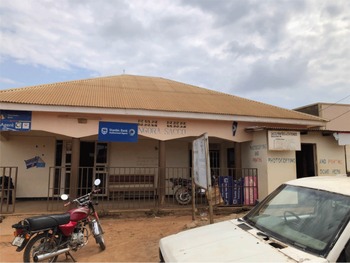
A walk around the trading centre of Ngora, about half a mile from Suzan’s home, would find you passing the offices of BRAC. There are agents of commercial banks such as the Standard Bank Investment Corporation (Stanbic), Centenary Bank, Finance Trust Bank and the Development Finance Company of Uganda bank. There are also private moneylenders, typically a businessperson or civil servant renting a lock-up (a storeroom-like structure with a single door onto the street) with a notice in front, a table and a chair inside. There are also the offices of different savings and credit cooperatives (SACCOs) operating as member-based savings and loans institutions (see Figure 1). Funds can also be moved at speed through mobile money operators who work on behalf of the commercial telecommunications companies Mobile Telephone Network (MTN) and Airtel (cf. Johnson Reference Johnson2016). The Catholic-founded Centenary Bank sponsors the lectern in the main parish church. If we follow Epstein’s definition of financialization as ‘the increasing role of financial motives, financial actors, financial markets, financial institutions in the operation of domestic and international economies’, then life was becoming increasingly financialized in Ngora (Epstein Reference Epstein and Epstein2005: 3). The phrase isirigin emoiete isirigin – ‘money looks for money’ – was used by people in the area to conceptualize this changing landscape, as richer people were moving ahead – using money to buy their way into jobs and contracts – while poorer people struggled.Footnote 3
The offices of the Ngora Savings and Credit Cooperative (SACCO), 14 July 2022. Members of the asianut group kept their lockbox – asaduk – here. You can also see signs for ‘authorized agents’ of Stanbic Bank and Centenary Bank. These agents charge bank customers a fee for withdrawals. During office hours, mobile money agents for Airtel and MTN also sit on the veranda.

Within this landscape, the most usual way to borrow money is through savings groups, what the current literature refers to as VSLAs (village savings and loans associations). Earlier examples, often termed ROSCAs (rotating savings and credit associations), include the Mexican tanda (Kurtz and Showman Reference Kurtz and Showman1978), the Cameroonian njangi (DeLancey Reference DeLancey1977), the Indonesian arisan (Geertz Reference Geertz1962) and the Nigerian esusu (Bascom Reference Bascom1952). In Ateso, the language most commonly spoken in the area, VSLAs are also known as aimono, meaning ‘saving’, suggesting that the group might be used to put money out of reach of others, what Parker Shipton terms an ‘illiquidity preference’ (Reference Shipton1990; see also Moya Reference Moya2015). The sorts of practices observed in tontines and other savings forms across Africa, with their ability to tie up money, help explain why VSLAs are often celebrated as an alternative to more neoliberal paths to economic development. Scholars critical of the ‘market-based’ solutions proffered by the microfinance industry and the ‘financial inclusion’ agendas of the World Bank and corporate philanthropy (Mader Reference Mader and Mader2015) relate VSLAs back to Africa’s ‘long history of community-based finance’ (Bateman and Sharife Reference Bateman, Sharife, Bateman and Maclean2017: 161). They are distinctive, it is argued, for the way in which they do not rely on outside capital or ongoing financial or administrative support from external agents. Maia Green writes of the role ritualization plays in VSLAs in Tanzania, their reliance on member practices, and also what she terms ‘extreme compliance’ (Green Reference Green2019: 106; see also Vokes and Mills Reference Vokes and Mills2015).
This view of VSLAs is possible when they are looked at close up. But if you take a few steps back, they can also be understood as part of a landscape where ‘money looks for money’, and where savings groups are not so much an ‘alternative’ to other financial forms as a way into those forms (cf. O’Sullivan Reference O’Sullivan2023). Rather than a place to tie up savings, Suzan’s group was focused on the issuing of loans, which were often used to pay off debts to other financial institutions or to take out loans elsewhere. There was also less of the ‘extreme compliance’ found in other studies, with rules pushed and pulled in different directions depending on the status of the group member. Poorer members ‘rented out’ membership to others – both within and outside the group – eroding ideas of equality and collective solidarity. Committee members felt pressured to turn a blind eye to richer members when they failed to pay interest on time, not applying the sorts of fines that might be issued to poorer members. At least one member of the group was using loans to finance her business as a private moneylender. This explains why the savings group with which we spent time was spoken of not in isolation but was theorized by its members as part of a financializing landscape. While it was valued for being softer and more social than other forms of finance, members recognized that this did not set it apart from the wider world.
Like many other VSLAs in the area, Suzan’s group was started, in 2012, with the support of an NGO, in this case the Uganda Women’s Effort to Save Orphans (UWESO).Footnote 4 It met on a weekly basis, in the home of a better-off neighbour. The maximum a member could borrow at any one time was 1,000,000 Ugandan shillings (Ush) (US$275). A member of the group saving the maximum allowed, in 2019, for example, would have received Ush 780,000 (US$215) in savings and Ush 265,000 (US$75) as an equal share of the interest collected among the group, at the end of the financial year.Footnote 5 The Friday meetings were animated and social. Members were a mix of richer and poorer individuals, mostly women, and mostly from the same extended lineage group, known as an ateker. Most were also members of the Catholic church (the name adopted by the group, asianut, translates as ‘grace’). As well as weekly contributions, members were required to take out loans that were paid back with a modest rate of interest shared out later in the year (this was a particularly popular feature of the group, given the way commercial financial institutions ‘take’ the interest for themselves). The return of a person’s savings plus an equal share of interest, which took place in February each year, was known as ‘the division’ (cf. Musinguzi Reference Musinguzi2016: 504). We found group members borrowing money for business ventures and construction work. But it was more usual to borrow money for school fees and healthcare costs, or to cover debts elsewhere (James Reference James2012). While the VSLA was seen as one of the better ways of borrowing money in the area – commercial banks and microcredit lenders have higher rates of interest and more punitive ways of dealing with defaulters – loans often went to service debts in these other institutions.
In what follows we point to three ways in which the savings group shaped experiences of financialization for its members. First, the group demanded visible social competence and social navigation when compared with microfinance organizations or commercial banks (Vigh Reference Vigh2010; Green Reference Green2019) – social navigation in terms of who got loans from the group, the way members borrowed from each other, and also how committee members used their work as a platform for political careers in the community. Second, loans from the group were often a way into borrowing money elsewhere. Members calculated the way in which ‘softer’ VSLA loans would help them take out loans elsewhere: from BRAC, commercial banks and private moneylenders (Krige Reference Krige2019).Footnote 6 Third, the group offered a space for members to discuss and reflect critically on their experiences of financialization. We found occasions where members struggled with the idea that their savings group was both different to and a part of the world of commercial microfinance, banking and moneylending. We witnessed a particular set of meetings where members wrestled with the offer of a commercial loan from Finance Trust Bank.
In making these points, we complicate accounts of financialization in Africa and elsewhere by taking seriously savings groups as dynamic financializing sites.Footnote 7 Rather than seeing savings groups as primarily a holdover from a more ‘communitarian’ past (Bateman and Maclean Reference Bateman and Maclean2017; Musinguzi Reference Musinguzi2016), we focus on them as a contemporary space where people navigate and make sense of a rapidly financializing landscape. We examine the region’s history, the role of racial segregation, and the violent reordering of Iteso society at different points in the twentieth century, to offer a more complex and contested account of the social landscape against which savings groups were establishing themselves (Vincent Reference Vincent1982). In emphasizing this wider landscape and its history, we take a different point of departure to studies focused on single systems of borrowing – notably, accounts critical of commercial microfinance (Karim Reference Karim2011; Kar Reference Kar2017; Hinrichsen Reference Hinrichsen and Wood2018; Schuster Reference Schuster2014). We also differ in our approach to recent work on savings groups in Africa, where they are presented as a direct challenge to prevailing development orthodoxies (O’Sullivan Reference O’Sullivan2023; Dulhunty Reference Dulhunty2022; Ahimbisibwe and Ndidde Reference Ahimbisibwe, Ndidde, Holma and Kontinen2022; Vokes and Mills Reference Vokes and Mills2015; Bannor et al. Reference Bannor, Oppong-Kyeremeh, Derkyi, Adombila and Amrago2020; Musinguzi Reference Musinguzi2016). Instead, our approach borrows from studies where financialization is inescapable and multi-sited, where different forms of borrowing are available, each with their particularities, histories and associations, and where individuals navigate their way through a range of options, while also engaging intellectually and critically with the changing financial landscape (Guérin and Kumar Reference Guérin and Kumar2020; Bähre Reference Bähre2020; Krige Reference Krige2019; Green Reference Green2019; James Reference James2012, Reference James2014).
In the next section we discuss experiences of financialization in the Teso region, observing the move to a fiduciary culture where ‘money looks for money’, and where social relationships are increasingly shaped by financial institutions (Shipton Reference Shipton2007). Next, we describe our methods and the way in which our original research concern – with the sociality of the Friday meetings – was replaced by an interest in understanding how the group pulled its members into other financial sites. We then pick up the story of Suzan’s savings group in more detail.
Political economies in eastern Uganda
Since Uganda’s independence in 1962, the economy of the Teso region can be divided roughly into three periods. Up to the mid-1980s, the primary source of money for people in the area came from the growing and selling of cotton (Vincent Reference Vincent1968, Reference Vincent, Nash, Danlier and Hopkins1976). This was a system carried over from the colonial period, when growers received seeds and inputs from licensed stores or on credit from their local cooperative society (Lawrance Reference Lawrance1957: 149). When cotton was delivered to a larger cooperative union, the farmer would receive a receipt that would entitle him – wives were kept at a distance from the money end of this system – to cash (Brett Reference Brett1970: 3). Ginneries, where cotton fibres were separated from their seeds, were mostly owned and managed by ‘Asians’ – typically settlers from the Gujarat region of north-west India (Jamal Reference Jamal1976; Vincent Reference Vincent1982: 202). After the expulsion of ‘Asians’ by Idi Amin in 1972, cotton ginneries were run by the Teso Cooperative Union. As part of the cotton economy, there was also a small group of individuals – teachers, nurses, government workers – who received salaries (typically paid in cash, monthly, at the site of their employment). A few individuals kept their savings in a lockbox at the post office in Ngora trading centre, but most kept their money at home, in a tin or small pot buried inside the house. The Iteso, a cattle-keeping society, channelled profits from the cotton economy into large herds (which were also useful for ploughing). As Vincent describes, ‘any cash that was made from cotton went for taxes, licenses, and more rarely, school fees’ (Reference Vincent1982: 210). As one man in his seventies told us, when recalling that time, there was ‘nothing like interest’ – not for the African, at least.
This system was shadowed by colonial ideologies of male authority over the household economy. For the most part, women were not to deal directly with the institutions of the colonial or postcolonial state; they were expected to depend on their husbands for any relationship to the wider economy. Carol Summers writes of an ‘alliance of British officials, African chiefs, white missionaries and African mission teachers’ in early colonial Teso, relegating women, who had had considerable autonomy in the precolonial economy, to the role of agricultural labourer (Reference Summers, Bahemuka and Brockington2002: 183). This generated gendered hierarchies where ‘women were expected to grow it [cotton], as they did food, but men sold it, rather than allowing women to store it in women’s granaries for family consumption’ (ibid.: 184). Colonial manuals stated that ‘weeding is the task of women … harvesting is the duty of women’ and those who failed to comply were whipped or imprisoned (ibid.: 184). Summers writes of ‘dissident women’ who threatened the region’s productive and reproductive orders (ibid.: 185). The search for ‘stability’ over women in local government and customary systems continued into the postcolonial era, demanding stable marriages and women’s compliance.
In this racialized, gendered system, the bulk of profits from cotton went to ‘overseas companies’ and the development of Kampala (Vincent Reference Vincent1982: 211). ‘Asians’ in the Teso region were able to access banking services via the Bank of Baroda, established as a Ugandan subsidiary in 1953, while Europeans – as teachers, administrators and missionaries – were able to use Barclays Bank, and received higher salaries, higher levels of in-kind support in Uganda – in terms of accommodation and allowances – and also support from family members overseas. Africans, for the most part, existed within the cotton economy as farmers, at a remove from the formal banking sector. The payment of taxes and, for the few, school fees, was made through income from cotton or the occasional sale of cattle – cows were popularly referred to as a ‘bank’ or edula.Footnote 8
A second period got under way in 1986. A series of raids by the neighbouring Karamojong resulted in the wholesale theft of cattle, precipitating the collapse of the region’s economy. This was coterminous with an eight-year insurgency (1986–93) against the new government of Yoweri Museveni, further immiserating the population (Jones Reference Jones2009). In the 1990s the economy was slowly rebuilt, though not through cotton, but rather through the growing and selling of commercial foodstuffs – mainly groundnuts and sweet potatoes. Rotating savings groups – known as abukonikin – grew in popularity.Footnote 9 In this impoverished economy, more and more villagers started working as day labourers. The absence of oxen meant that previous economies around ploughing, and the hierarchical relations of dependence they generated, were replaced by agricultural labour parties – aleya. (When oxen slowly returned to the area, they were lent out for money on commercial terms.) Starting in the early 2000s, salaries – for teachers, government employees and NGO workers – were paid into bank accounts rather than as cash in hand (first in the government-owned Uganda Commercial Bank, then in its privatized successor, Stanbic). Bank loans – typically available to those with a guaranteed salary – became popular only in the late 2010s.
There has been a recent shift in how people relate to money. While the 1990s were defined by the diminished economy that emerged in the aftermath of the insurgency, where collective endeavours – abukonikin, aleya – were possible, this has given way to a more financialized economy, where women are more fully incorporated in the search for credit through financial institutions. As late as 2007, when Sarah Amongin (co-author) started high school, money for school fees was raised through selling foodstuffs (cassava and sweet potatoes), and there was no recourse to loans from savings groups or commercial lenders. ‘Money looks for money’ – isirigin emoiete isirigin – helped people understand and appraise the very recent, fundamental changes to this landscape, where loans were now part of the way people paid school fees. The phrase isirigin emoiete isirigin describes a world where better-off families use money to buy government jobs and contracts, and where those further down the scale struggle with loans. Since the late 2010s, Amongin’s family has borrowed through membership in three VSLAs, through ‘business loans’ from a moneylender in the market and through saving and borrowing in the local SACCO, where her mother is a member. Each of these forms of borrowing comes with different rates of interest, different terms and conditions, and loans from one institution are often used as a means of managing debts in another.
While Parker Shipton (Reference Shipton2007: 17) writes of the intricate ‘variety of symbolic, ritual, moral, spiritual and social factors’ at play among Luo society in the 1990s, the situation in 2020s Teso was one where borrowing through financial institutions, including VSLAs, was beginning to dominate. Members of the savings group spoke of running numbers through their head on a daily basis: calculating interest payments; adding up the money borrowed; counting the future cost of school fees; weighing up different loan terms; worrying over how payments could be made by a specific date. Amongin spoke of loans as ‘always on your mind’ and how this was a common complaint. To complicate matters further, individuals often had more than one loan within the same institutional form (Suzan was a member of three different VSLAs, one of which she was ‘renting out’, while another member of the group was saving through five books, only one of which was his own). There were also different penalties for non-payment. Failure to repay the moneylender, for example, resulted in additional daily payments, while BRAC ‘rolled the loan’, increasing the amount to be paid each week. BRAC, SACCOs, commercial banks and VSLAs also retained the right to confiscate and sell property – clothes, motorbikes, land, livestock. We sometimes found mattresses being looked over by neighbours of a defaulter, with a BRAC officer standing by. We also found ourselves walking past houses and commercial structures with the words ‘property for sale’ written on the wall and the phone number and name of the institution to benefit from the sale: ‘Centenary Bank 0784728743’.
Amongin on a mat, Jones on a chair
Amongin and Jones have been going along to the Friday savings group meetings since October 2018. Jones, a UK-based researcher, is always given a chair or some sort of structure to sit on (a bench or a log); Amongin, a market trader from the nearby town, sits on one of the papyrus mats laid out on the floor, reflecting some of the gendered hierarchies at work in the group. Men typically sit on a chair or stand, most women sit on the mat, although women on the committee and women with more formal education than others typically take a chair. Amongin often sits next to Suzan, who offers commentary and gossip, and Amongin is well placed to see the social navigation and tactics deployed by poorer women in the group as they seek out loans. Jones, on the chair, and more of an outsider, is less able to listen in to the gossip and has a more detached role taking notes. After some initial scepticism about our presence at the group – access was brokered by women members we already knew – we have become a sort of regular audience, with the participation of Jones in particular adding a certain cachet to the meetings. Neither Amongin nor Jones is a member, despite being invited to join on several occasions. Jones has helped with the purchase of ledger books (for US$20) and crates of soda (at US$8 a time).
During a six-month period in 2018, we attended a total of fourteen Friday savings group meetings. We also followed the group as it went through the complex process of the ‘division’ (a time when debts had to be collected, interest calculated and divided, and discussions held over what to do about the one or two members who failed to pay back loans). Since then, Amongin has been a regular at Friday meetings and a second research phase started in the area in March 2021. Amongin is a market trader in her late twenties; she has a certificate in social work and social administration from a nearby university. Jones has been working in the area since 2001. After each meeting, Amongin and Jones combined notes, either in a small lock-up they rented or, when Jones was in the UK, Amongin talked over her notes and observations via WhatsApp. It took a full financial cycle to give us a reasonable sense of what was going on, to understand the complex nature of the group and the personalities at play. We attended funerals and other social events in the area where we observed the lives of group members in other social spaces. Following on from the work of Krige and James in studying financialization in South Africa, we have followed up, informally, with individual members concerning their savings histories (Krige Reference Krige2019; James Reference James2014).
What struck both of us, at first, was the way in which the savings group seemed to be about so many other things, a marked contrast to the sober, focused, developmental ideal promoted in the VSLA literature (Green Reference Green2019). There were political discussions, a chance to share gossip, the opportunity for many of the women members to get a bit of rest on a Friday afternoon. We had initially wanted to write about these other things, as a counterpoint to the economic focus of much of the literature. But as time wore on, and as we became more aware of the fact that many members had loans elsewhere, including bank loans, loans from BRAC and loans from other savings groups – what Ardener (Reference Ardener, Ardener and Burman1995) terms, albeit in a more positive framing, the ‘money-go-round’ – our concern shifted more to what we could specifically say about savings groups and how they fitted into broader experiences of financialization. In particular, we asked ourselves what the savings group had to do with the harder edges of financialization in the area: the loans from BRAC, commercial banks and moneylenders, and the flow of money through mobile phones. We also found our findings aligning with studies that observed how financialization through savings groups reworks rather than dissolves social relationships and dependencies (Green and Estes Reference Green and Estes2019; Harker Reference Harker2017; Kar Reference Kar2017).Footnote 10
Writing this up has been a collaborative process. Both Amongin and Jones read and debated the studies that inform our analysis, with Amongin able to offer a particularly nuanced account of the ways in which the literature did or did not correspond with the way the savings group worked or with more general experiences of financialization in the region. Jones was able to draw on his work on the history of the area to challenge some of the more romantic accounts of VSLAs that want to see them as set apart from, or as an ‘alternative’ to, other changes in the area (Jones Reference Jones2009). Jones and Amongin benefited during the final stages of writing up the article from the opportunity to sit together – on chairs – in Ngora in the spring of 2023.
The mechanics of a Friday meeting
With this in mind, it is worth looking at what went on at a typical Friday meeting. This is important for the way it gives us a sense of the meeting as a structured space around which opportunities for discussion and social navigation open up. It is also important as a way of understanding the work poorer members did when saving on behalf of others, and how other parts of the financial landscape made their presence felt. The group has a complex design, particularly when compared with accounts of savings groups described in earlier anthropological work (Bascom Reference Bascom1952; Ardener Reference Ardener1964; Geertz Reference Geertz1962). It was also more complex in its structure than recent accounts from south-western Uganda (Vokes and Mills Reference Vokes and Mills2015; Ahimbisibwe and Ndidde Reference Ahimbisibwe, Ndidde, Holma and Kontinen2022), and closer in operation to O’Sullivan’s study of VSLAs in northern Uganda (Reference O’Sullivan2023).Footnote 11
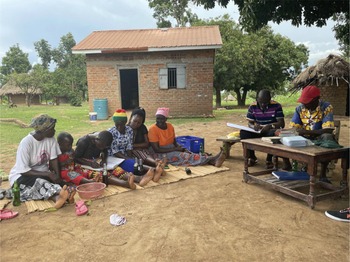
Friday meetings were structured in six formal components: first, the savings component, where each member gave their individual donation for that week (this can be Ush 3,000, 6,000, 9,000, 12,000 or 15,000 – roughly between US$1 and US$5). Members are called upon by the secretary to come to the desk and make their donation, which is put in a blue plastic tray kept by the money counter (see Figure 2). Each member has a membership book which is handed to the chairperson, who records the amount by marking between one and five stamps in the book (one stamp for Ush 3,000, five for Ush 15,000). At this time, members are also able to give a donation in a separate pink plastic tray for an activity called engeso; this fixed weekly fee of Ush 1,000 (US$0.25) acts as a sort of emergency fund that members can draw on and pay back at no interest, and at the end of the year each engeso member gets back what they have saved. Another committee member records these engeso contributions in a different book. In yet another book the deputy money counter records any fines (for lateness, non-attendance, speaking out of turn). The fines are kept underneath the pink engeso basket. In 2018, fines were a regular, if uneven, feature of Friday meetings, but since 2021 they have largely disappeared as an activity due to the difficulty of keeping the group going during the Covid-19 lockdowns.Footnote 12
Members of the savings group on 26 May 2023. The chairman, John Acelun, is wearing a red baseball cap. Suzan is sitting on the mat with the book recording donations to the engeso fund. Amongin is two places away from Suzan next to Petelina Anyabo, who is wearing an orange T-shirt. Jones is taking the photograph while sitting on a wooden chair.

The second element is the paying back of interest on loans (members are also free at this stage to pay back the loans themselves, although loan repayment is more common at the end of the financial year). The secretary asks who has money to pay back that day. Anyone who wants to can come forward. Those who go up announce how much they are paying and give their money to be counted. The secretary then reads out the amount and the chairperson calculates how much interest remains on the loan on a digital calculator. The amount announced is often checked again by another group member. Once agreed, the secretary enters the balance in a separate red ledger. This element is more important in the later part of the financial cycle.
The third element is the issuing of new loans. The secretary asks who wants a loan, and those wanting money raise their hands. Depending on the savings made that day, the group decides on how many loans can be given. As we shall see later, this is a moment in the meeting when personal relationships and social navigation come to the fore. Sometimes some of those wanting loans have to wait until the following week, or they get only a fraction of what they ask for. The secretary registers the names and the amount, and the chief money counter, who holds the money from the day’s savings in his blue basket, hands out the loans. The chairperson asks the borrower to sign off their loan with a thumbprint in the ledger book. At this point the main work of the group is done, and some members drift off.
A fourth element is the distribution of engeso money (the emergency fund). Those who want help gather around the pink plastic tray. The deputy money counter writes down the name and the sum borrowed. A fifth element, referencing savings practices from the 1990s and an addition to the structure put in place by UWESO, is the abukonikin. Like engeso, this is an optional element, and it takes the form of a rotating savings group where members pay Ush 2,000 (US$0.50) every week. Once collected, the full amount is given to the person whose turn it is in the rotation. Another addition is the ‘Christmas club’, which takes place some years, where those signed up make a weekly contribution for the purchase of a bull to be slaughtered in December, with the meat distributed among members. Finally, the committee calculates and agrees how much has been saved that day. The money collected is recorded and put in the lockbox. The lockbox – in a nod to longstanding practices – is either kept in a cavity inside the house next to where the group meets, if it is early in the financial cycle when loans are being given out, or deposited in the office of the district SACCO in the trading centre (where more than a hundred VSLA lockboxes are kept) when loans are being repaid later in the cycle.
These formal elements typically take about forty minutes to complete. Proceedings are almost second nature for the group. On some weeks, the second, third and fourth elements are not needed. At the first meeting we attended, no new loans were being issued as it was the end of the financial year. At the start of the year the chairperson will not bother depositing the lockbox in the SACCO, as funds are rarely carried over from week to week.
As of June 2023, there were forty-eight members in the group, although on any given Friday between fifteen and twenty members would usually show up.Footnote 13 The majority, forty-one, were women, although some ‘stood’ for their husbands, who gave them money to save each week, or, like Suzan, they saved on behalf of richer individuals, both men and women, reflecting wider practices of gendered labour in the economy. The windfall nature of the division meant that some members also used the annual payout for one-off projects. An unemployed schoolteacher, for example, told us that she used her savings to help towards the building of a mabati – iron-roofed – house. Most poorer members told us that the savings group was a way to meet immediate financial needs: school fees and hospital bills, or to pay back debts elsewhere.Footnote 14
Managing financialization
Navigating loans?
Our first observation concerns social navigation and the wider politics of the group (Vigh Reference Vigh2010). This helps extend our understanding of the Friday meetings and offers a less idealized perspective when compared with recent scholarship on VSLAs in Uganda, which regards them as something set apart from the wider landscape (Vokes and Mills Reference Vokes and Mills2015; O’Sullivan Reference O’Sullivan2023).Footnote 15 Social navigation came in two types. First, women members, who mostly sat on the mat, supported one another but also worked hard at cultivating good relations with committee members. The focus was on getting loans to help with consumption needs such as healthcare costs, school fees or debts elsewhere. Second, richer members, particularly those on the committee, cultivated relationships with group members because they were also interested in the group as a space for them to gain wider recognition in the community (cf. Vincent Reference Vincent1968). This helped committee members advance political careers and also put them at the front of the queue when NGOs and government officials brought projects to the area. The secretary, a friend of Suzan, was a town councillor representing disabled people. The person recording the engeso money contributions was a woman’s councillor who was also on the town council. The deputy money counter was a treasurer of her clan and a treasurer of the village council.
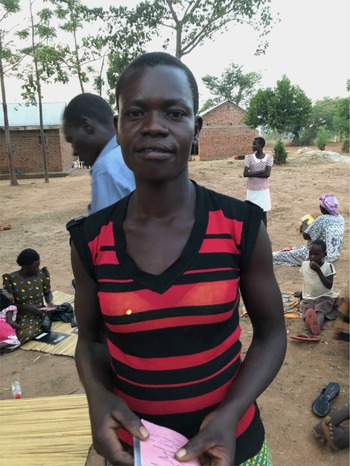
We observed Suzan’s skills as a social navigator at a meeting on 14 October 2021 (see Figure 3). Suzan told Amongin she had not planned to come to the meeting that day. What pushed her was a debt that had to be cleared with St Clare’s, a private primary school in Ngora trading centre. Suzan sends her first-born son to the school (the son who is without a father). St Clare’s had reached the point in the academic year when students were to sit for exams. Parents were asked to clear any debts before the school would allow the child to go forward. When the secretary arrived, Suzan invited her over with a wave of the hand. They spoke in whispers, and although Amongin could not hear what was being said, Suzan later told her that she had asked the secretary to support her with a loan request, going so far as to specify the amount needed Ush 80,000 (US$20). Suzan already had a loan that needed to be repaid and so, by rights, she would not have been a priority for a new loan. At the point in the meeting when the secretary asked those who needed loans to raise their hands, Suzan raised hers and was put on the list and received the exact sum required. The secretary favoured Suzan because she was a faithful supporter when the secretary was in dispute with other group members. Suzan was also preferred by the secretary because she comes across as more educated than other women on the mat (her few years of secondary school put her closer to the level of committee members), and she was sometimes given the account book to manage when the secretary was absent.
Suzan Akello. This photograph was taken early on in our interactions with Suzan, at the annual ‘division’ meeting on 19 February 2019.

In contrast to Bähre’s account from South Africa (Reference Bähre2020), where urban residents withdrew from groups because they saw them as time-consuming and full of conflict, we found the savings group tended to hold onto its members. Poorer members needed money for school fees and other costs, while those seeking political careers elsewhere valued the opportunities for committee work. Richer members could benefit from the group without needing to turn up. For the would-be politicians we find something close to Joan Vincent’s description of ‘spiralist’ practices in the Teso region, with individuals progressively ascending through a range of institutions and leadership positions (Reference Vincent1968: 283; see also Watson Reference Watson and Gluckman1964). This helped bind the savings group into the wider landscape. Peter Ojilong, the treasurer, who had only a few years of secondary school, was admired and respected for his bookwork (when he broke his leg in a motorbike accident he would sometimes be carried to the meeting on a stretcher, such was his reputation) and was invited to sit on other VSLA committees. His assistant, who had only a few years of primary school education but was recognized for her work on the committee, had built up a ‘committee career’ in the village. Suzan, though not on the committee herself, was often invited to substitute for members when they failed to turn up. When Amongin spoke to Suzan in private, Suzan told her that she ‘might like to try for a position at some point’ in the future.Footnote 16
That said, there were also ways in which the VSLA reflected a new sort of economic order. Not everyone needed to turn up: the richer members, mostly men, rarely showed their face, typically delegating an employee or family member to appear in their stead. Their status was also seen in the way they had certain privileges unavailable to others. On one Friday in June 2021, Robert Okalebo, a retired soldier who was working as a butcher in Ngora market, was meant to pay back interest on a loan. He was not there himself and had sent someone along to pay his weekly savings contribution, but he had not given the person money to pay the loan interest. When they read out Robert’s name from the loan book, committee members scrambled to call him on his mobile phone. There was no answer. The secretary asked members, ‘What should I do? Do I roll the loan?,’ which would have meant Robert facing a financial penalty. The chairman replied that someone should step in and pay his interest, and another committee member ended up covering Robert’s interest payment.
Rotating credit?
Our second observation concerns the place of the savings group in the wider landscape. It was a less pressured space than other financial institutions. Interest was paid back on a monthly basis, rather than weekly or daily (as with BRAC or commercial moneylenders). There was also more room for sympathy should you fail to pay back your loan on time. For example, John Omoding, an older member, who had not managed to pay back a 2018 loan, had one of his gardens rented out for an annual fee of Ush 80,000 (US$20) (a group member rented the garden from him and paid the money directly to the VSLA). Ann Amuge, an older member of the group who had a debt to clear in another savings group, was able to borrow money privately from the deputy money counter who kept Ann’s bull as surety. In this, at least, the savings group was a softer part of the financial landscape.
The savings group was also striking for the way it reworked relations between group members, with poorer members ‘renting’ out their account to others.Footnote 17 For ‘renters’ this was a way to stay in the group in years when they did not have money to save, retaining some of the social prestige that came with membership (and resisting some of the criticism that might come with a departure). This was particularly common for poorer members, such as Suzan, who had more than one VSLA on the go. In this system, richer members benefited from the cheaper loans VSLAs afforded and from the labour of poorer members who turned up to the weekly meetings on their behalf. Robert Okalebo and Simon Odeke, his brother, both wealthier members of the group, saved not only through their own accounts but also through the accounts of family and non-family members. The VSLA was therefore a space where poorer people might appear to the casual observer as active, while actually doing the work for someone else. In these practices it is difficult to see the more celebratory narratives of increased autonomy and women’s economic empowerment that have been a leitmotif of the VSLA literature in Uganda and elsewhere (cf. Musinguzi Reference Musinguzi2016; Ahimbisibwe and Ndidde Reference Ahimbisibwe, Ndidde, Holma and Kontinen2022).
The savings group was also, for many, an introduction to the business of taking out loans elsewhere (cf. Malual and Mazur Reference Malual and Mazur2017). The structure of a VSLA loan – with its low interest rate and year repayment term – meant that it could be used to service shorter-term loans from other financial providers. This was what Amongin (co-author) was trying to do when joining a new VSLA group in April 2022. As with other members of this new group, Amongin joined partly because she hoped to benefit from a recently launched government scheme known as the ‘parish fund’. (It was rumoured that the fund might be disbursed through VSLAs.) Amongin also joined because she needed some money quickly and had the reasonable expectation of using a loan from the group to cover another loan from a local moneylender. (Amongin speculated that once the VSLA loan came through she could quickly clear her debt with the moneylender.) Unfortunately, Amongin found herself waiting for the VSLA loan (the group turned out to be disorganized) and was left servicing the high-interest moneylender loan. Amongin accepted that her hopes around the VSLA loan had got her into the situation with the moneylender.
This was because VSLAs were seen as a ‘softer’ lender (charging less interest, with a longer loan repayment term, and with room for social navigation). Once a loan was secured it was possible to imagine entering into the ‘harder’ world of microfinance and commercial moneylending. Suzan, for example, only started taking loans from BRAC after joining the VSLA. There was thus little sense that the VSLA was set apart or an ‘alternative’ to commercial finance. Instead, members of the group juggled multiple loans, joined other savings groups, and borrowed from BRAC and from other members, and in so doing shifted the terms on which they related to one another. If this was a financial ‘money-go-round’ then it was one where the VSLA played its part in setting the wheel spinning (Ardener Reference Ardener, Ardener and Burman1995). The savings group, in softening the edges of financialization, also pulled its members from those edges to a more central place in Uganda’s financializing landscape.
Debating financialization?
Our third observation concerns the way in which the savings group was a space where members reflected on the role financialization played in their lives and its seemingly inexorable pull. At times, members spoke about the way their savings group differed from other options, burnishing the reputation of the asianut for softer lending. At a meeting on 9 July 2021, the deputy money counter told a story about a man who had joined another savings group in the area. Before this, he had been borrowing from a bank on commercial terms. We were told that the man said he would never go back to the bank: ‘There are some people who do not know how beneficial these groups are.’ This story pleased those assembled, who murmured their approval for the way it praised VSLAs (as well as helping the deputy money counter, who was seeking members for a new VSLA she was setting up). The simple moral of the tale, while appealing, had a slightly unreal air, based on what members knew.
We might, at first glance, relate this idea of ‘never going back to the bank’ with O’Sullivan’s recent work from northern Uganda, where she sees a culture of ‘refusing’ development in the independence of VSLAs (Reference O’Sullivan2023). But life was more complex and ambivalent, and members knew that the borrower would likely go back to the bank at a later point (if he had ever cancelled his account in the first place). While many members of the group liked the idea of ‘refusing’ other lenders, this was not how life worked. Rather, in an echo of Krige’s findings from South Africa, we found that, while borrowers were ‘quick to complain about their experiences’ and to draw ready comparisons between different forms of lending, they also found themselves in a situation where one sort of financial institution led to encounters with others (Reference Krige2019: 419).
Later that month there was a series of meetings where members discussed the possibility of the VSLA becoming a conduit for a commercial bank. This would have been in the form of a loan from Finance Trust Bank, and was proposed by Robert Okalebo, the retired soldier we saw being helped out in the previous section, and one of the richer members of the group. Like many other richer members, he had been complaining, for some time, that there was not enough money in the weekly savings contributions to issue loans to all who wanted them (loans depended on the savings collected). Robert claimed that ‘ten million shillings’ (US$2,750) could be borrowed from Finance Trust Bank, allowing the group to make more loans to its members. He was one of the major borrowers in the group, and benefited from the favourable terms on which the VSLA lent out money compared with commercial lenders.
When Robert was asked about the interest that would be charged by the bank, he said, ‘It will be at 3 per cent.’ It was unclear to us whether he was picking a number out of the air to impress others in the group, or whether he was reporting what he felt to be fact (3 per cent is lower than the 10 per cent the group charges, although the bank loan was probably being quoted as an annual compound interest rate). Some of the committee members, notably the secretary, were interested in following up and argued that the loan might enhance the profile and capacity of the group (and, for the secretary, her status as a leader in the community). But two issues emerged that resulted in no action being taken. First, poorer members noted that any interest paid would be ‘taken’ by the bank. This violated the principle that interest generated in the group should be shared among its members at the end of the financial year. Second, most of the poorer members of the group were concerned that the bank would have the right to dip into the group’s general savings, should individuals, such as Robert Okalebo, fail to pay back these larger loans.
However, this did not mean that members would refuse to take bank loans on an individual basis, or that the group would resist such an offer from commercial banks in the future. Rather, it shows that financialization was experienced as an ongoing social fact, to be negotiated, navigated, absorbed and returned to. What is so striking about the discussions noted above is that, while VSLA members were able to cast financialization in a critical light, particularly its harder edges, they also understood the limits to their own capacity in navigating the changes that were in front of them. Members debated the way some forms of borrowing were better than others, while understanding the inexorable nature of financialization. It was a world of critical reflection rather than radical alternatives. While members questioned the role of commercial financial institutions in the area, they did this to make sense of the world they were in, rather than claiming that there was some sort of alternative reality they were making for themselves through their VSLA. Financialization was not easily picked apart. Those who valued the VSLA as a ‘softer’ lender also had loans with commercial lenders, while those who resisted the enticements of Finance Trust Bank also knew that there would probably be another offer in the future that might be more tempting.
Future directions?
In writing about savings economies in Senegal, Ismaël Moya describes how money gets turned into mutual debt and how this is central to social life: ‘the conversion of liquidity into relations is not a mere financial strategy; it lies at the very foundations of sociality’ (Reference Moya2015: 158). He observes how people use tontines as a way of holding off claims from near relations, what he terms the ‘bombardments’ of city life, and how they save in groups to stop their own fingers getting ‘burnt’ by money. In this setting, savings groups become a sort of pause on the claims of others, offering up the chance, for a time at least, to save money for a new house, to pay school fees, or to meet the hospital bill of a husband injured in a domestic dispute.
Our approach has been to observe the ways in which a savings group not only offered a chance to tie up money, but also offered a way into trying out other financial relationships – with microfinance institutions, moneylenders, commercial banks and other savings groups. So, something often presented as an ‘alternative’ to other forms of finance becomes the point of entry. In joining the asianut savings group in the village of Oledai, members found themselves pulled into encounters with BRAC, Finance Trust Bank, private moneylenders and the local SACCO. They also joined other savings groups and borrowed money from one to pay off debts in another. Savings groups reworked rather than challenged increasing social and economic inequality in the area. Poorer members ‘rented out’ their books to richer members, while committee members pulled money from their own pockets to cover the interest payments of wealthier borrowers.
There was something inexorable about this. But this did not mean that members avoided engaging with their experiences of financialization, critically and intellectually. The Friday meetings were social spaces, and members reflected not only on their individual situations but also on the wider changes around them. They might extol the benefits of savings groups over other financial forms – BRAC, the moneylender, the bank – but they also recognized that they inhabited a reality where these forms were part of the mix and made their presence felt at the Friday meetings. Members might turn up worried about a loan that was due to be repaid to BRAC, while the offer of a loan from Finance Trust Bank turned out to be a way of debating what was hard to resist. As with previous transformations of the region’s economy, financialization was to be negotiated and navigated rather than resisted or refused.
Where does this take us? In going along to the Friday meetings over a number of years, we have learned to approach the savings group as part of the wider landscape, a landscape where ‘financial motives, financial actors, financial markets, financial institutions’ are increasingly a part of how people think and act (Epstein Reference Epstein and Epstein2005: 3). Spending time with Suzan’s group helped us understand the ways in which the ‘softer’, more social spaces of financialization were also tangled up with its harder edges. In taking the research forward, we would suggest the value of an ethnographic orientation that understands the specific histories at play in a given location, while getting to know group members, their complex financial lives, and to what extent these lives differ from those of previous generations. We would also recommend a more agnostic view of savings groups than has typically been the case; we would argue that they are first and foremost a social reality that has to be studied and analysed carefully. Finally, we would argue that this social reality is better understood when stepping away from group meetings, looking instead at what happens on the edges, seeing savings groups as one sort of institution where ‘money wants for money’ among many other financializing sites.
Acknowledgements
The research for this article was funded by the British Academy (grant numbers MD170053 and YF190162). We wish, first and foremost, to thank the members of the asianut savings group who welcomed us into their Friday meetings and spent time with us explaining the workings of the group, and the complexities and challenges they, as individuals, were facing. Particular thanks go to Suzan Akello, who taught us so much, and the chairman of the group, John Acelun, for his patience and guidance. At various points in the research, we have been helped by Stella Aguti, Joel Ekaun Hannington and Joseph Ochana. This article has benefited from the very helpful comments of Maren Duvendack, Ben Eyre and two anonymous referees.
Ben Jones is Associate Professor in the School of Global Development at the University of East Anglia. He is currently researching the experiences of educated ‘unemployed’ youth in eastern Uganda. Recent publications include ‘Education as identity: the scaffolding of “being educated” in eastern Uganda’ in American Ethnologist.
Sarah Amongin is a market trader from the town of Ngora in eastern Uganda. She has a certificate in Social Work and Social Administration from Kumi University. Sarah is currently working on a paper on educated Pentecostal youth and the changes they are bringing to the church she attends.

 Open access

