





Background
Peripherally inserted central catheters (PICCs) are traditionally used for patients requiring outpatient parenteral antimicrobial therapy (OPAT). The Infectious Diseases Society of America guidelines for OPAT currently offer a weak recommendation to consider midlines for antibiotic durations of <14 days, Reference Norris, Shrestha and Allison1 and certain manufacturer’s instructions for use permit dwell times of up to 30 days. 2 However, the relative safety of midlines versus PICCs in the context of OPAT is still unclear. Reference Paje, Walzl and Heath3,Reference Thomsen, Boa, Vinter-Jensen and Rasmussen4 The purpose of this study was to compare the complication rate of midlines versus PICCs among patients receiving long-term antibiotic therapy.
Methods
Study setting and design
We performed a single-center, retrospective cohort study of hospitalized patients ≥18 years of age receiving either a midline or PICC placed by the bedside vascular access team for OPAT as recommended by the infectious diseases (ID) consult service between July 2019 and June 2022 at a 670-bed urban academic medical center. The vascular access team chose the catheter type primarily based on planned antibiotic duration (e.g., <30 days favors midline) and the use of an antibiotic with vesicant properties (e.g., vancomycin favors PICC), as described in the Infusion Therapy Standards of Practice. Reference Gorski, Hadaway and Hagle5 Patients requiring concomitant chemotherapy or total parenteral nutrition were excluded. Patients not ultimately requiring OPAT and patients never seen by the ID consult team were also excluded. This study was determined exempt by the Rush University Medical Center Institutional Review Board.
Exposure, outcome, and covariates
The primary exposure was the placement of a midline versus PICC. The primary composite outcome was any bloodstream infection or superficial or deep venous thrombosis. Bloodstream infection was defined as any positive blood culture obtained during routine clinical care, excluding common commensals identified in a single blood culture. 6 Venous thrombosis was defined as superficial or deep venous thrombosis as identified by clinical ultrasound obtained during routine clinical care. Bloodstream infections and venous thrombosis were also analyzed individually as secondary outcomes. Time at risk for complications was defined starting from the date of catheter insertion until 3 days following the end date of intravenous antibiotic therapy. Patients who were lost to follow-up, transferred to another ID provider, died, or discharged to hospice were censored at the time of last contact with the ID team. A complete data dictionary is provided in Supplemental Table 1.
Statistical analysis
We examined the frequency of categorical variables, distribution of continuous variables, and missingness of all variables. We compared the medians of continuous variables and proportions of categorical variables between patients with midlines and PICCs. We estimated the hazard ratio (HR) of developing outcomes among patients with midlines compared to PICCs using Cox proportional hazards models, using robust sandwich variance estimators to account for clustering (i.e., patients with multiple infections requiring OPAT over the study period). 7 We tested planned antibiotic duration of ≤14 days, the use of vancomycin, and catheter placement in an intensive care unit (ICU) as potential confounders using the change-in-estimate approach. We tested whether planned antibiotic duration of ≤14 days modified the association between catheter type and the outcome using an interaction term. Finally, we conducted sensitivity analyses including only outpatient line-days, and excluding patients who were prescribed vancomycin.
We tested the proportional hazard assumption by assessing the statistical significance of time-dependent covariates added to the final model. We assessed multicollinearity in the final model using a variance inflation factor cutoff of 5. We used SASStudio 3.8 software (SAS Institute, Cary, NC, USA) for all statistical analyses. We used an α of .05 as the significance threshold for all statistical tests.
Results
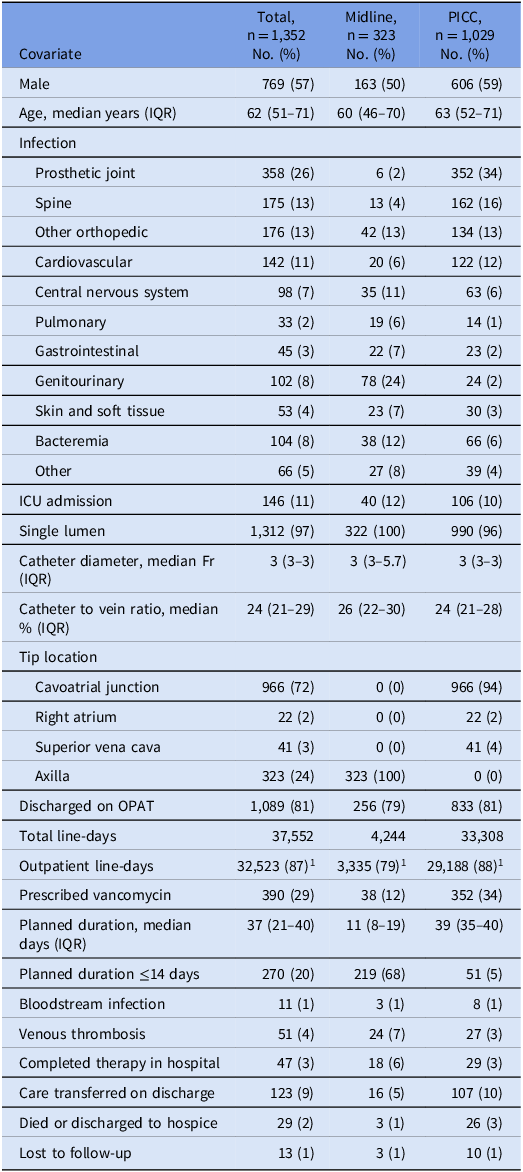
Our vascular access team placed 1,432 catheters in patients requiring long-term antibiotic therapy without concomitant chemotherapy or total parenteral nutrition. Excluding 61 not ultimately planned for OPAT and 19 never seen by the ID consult team, the final cohort was comprised of 1,352 catheters placed in 1,169 unique patients. Demographic and clinical characteristics are presented in Table 1. Patients with PICCs were more likely to have orthopedic infections, be prescribed vancomycin, have longer planned antibiotic durations, and a greater proportion of outpatient line-days than patients with midlines. Patients with PICCs were similar to patients with midlines for other covariates including ICU admissions, catheter-to-vein ratio, and proportion discharged on OPAT, and the proportion of episodes with complete follow-up data were available in 90% of episodes.
Demographic and clinical characteristics

Table 1. Long description
The table presents demographic and clinical characteristics of patients with different types of catheters. It has 30 rows and 10 columns. The columns are labeled as Covariate, Total, n = 1,352 No. (%), Midline, n = 323 No. (%), and PICC, n = 1,029 No. (%). The rows include various covariates such as Male, Age, median years (IQR), Infection types, ICU admission, Single lumen, Catheter diameter, median Fr (IQR), Catheter to vein ratio, median % (IQR), Tip location, Discharged on OPAT, Total line-days, Outpatient line-days, Prescribed vancomycin, Planned duration, median days (IQR), Planned duration ≤14 days, Bloodstream infection, Venous thrombosis, Completed therapy in hospital, Care transferred on discharge, Died or discharged to hospice, and Lost to follow-up. Each row provides specific data points for each covariate across the different catheter types.
PICC, peripherally inserted central catheter, IQR, interquartile range, OPAT, outpatient parenteral antimicrobial therapy, 1% of total line-days.
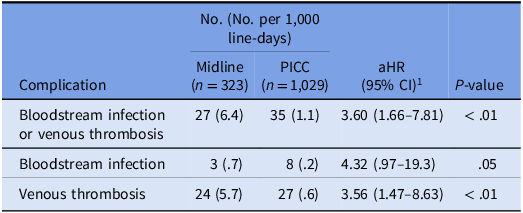
The rate and hazards of complications by line type are summarized in Table 2. Having a midline was significantly associated with a 3.60-fold increased hazard of developing the primary composite outcome of bloodstream infection or venous thrombosis, adjusted for vancomycin and planned antibiotic duration of ≤14 days. Adjusted survival curves are given in Supplemental Figure 1. Having a midline was significantly associated with a 3.56-fold increased adjusted hazard of developing the secondary outcome of venous thrombosis. However, there was no significant association between line type and the hazard of developing a bloodstream infection; microbiology is summarized in Supplemental Table 1. There were no statistically significant time-dependent covariates to suggest a violation of the proportional hazard assumption. No covariate had a variance inflation factor of >5 to suggest multicollinearity. We did not observe effect modification by planned antibiotic duration (p-interaction = .10). In the sensitivity analyses including only outpatient line-days and excluding patients receiving vancomycin antibiotic therapy, patients with midlines also had an increased hazard of developing complications compared to patients with PICCs (Supplemental Tables 3 and 4).
Rate and hazards of complications by line type

Table 2. Long description
A table comparing complications rates and hazards between midline and PICC lines. The table has four rows and five columns. The columns are labeled Complication, No. (No. per 1,000 line-days), Midline (n = 323), PICC (n = 1,029), aHR (95% CI), and P-value. The rows are labeled Bloodstream infection or venous thrombosis, Bloodstream infection, and Venous thrombosis. Row 1: Bloodstream infection or venous thrombosis, 27 (6.4), 35 (1.1), 3.60 (1.66–7.81), <.01. Row 2: Bloodstream infection, 3 (.7), 8 (.2), 4.32 (.97–19.3), .05. Row 3: Venous thrombosis, 24 (5.7), 27 (.6), 3.56 (1.47–8.63), <.01.
1 Cox proportional hazards model adjusted for vancomycin and planned antibiotic duration of ≤14 days, using robust sandwich variance estimators to account for patients with multiple infections requiring outpatient parenteral antimicrobial therapy over the study period.
PICC, peripherally inserted central catheter, aHR, adjusted hazard ratio.
Discussion
In this study of patients receiving long-term antibiotics, complications were more common in patients with midlines than patients with PICCs, driven primarily by venous thrombosis rather than bloodstream infections. We consistently observed this association, irrespective of planned antibiotic duration and vancomycin use. Bloodstream infections also occurred more frequently in the midline group, but small numbers—consistent with other published work—may have obscured a significant association. Reference Thomsen, Boa, Vinter-Jensen and Rasmussen4,Reference Johnson, Alvarez and Jaybanks8
Previous work in this area has yielded discordant results. A large multicenter retrospective cohort study reported fewer bloodstream infections and venous thromboses in patients with midlines than PICCs for OPAT but excluded a large proportion of patients receiving vancomycin. Reference Paje, Walzl and Heath3,Reference Ali and Khan9 In our sensitivity analysis, the exclusion of patients receiving vancomycin did not alter our conclusion. Another retrospective study modeling the predictors of OPAT complications suggested that receiving vancomycin and having a midline were risk factors for complications. Reference Keller, Dzintars, Gorski, Williams and Cosgrove10 Like our study, a randomized controlled trial reported no difference in bloodstream infections in patients receiving antibiotics via midlines versus PICCs, though the primary outcome did not include other complications such as venous thrombosis. Reference Thomsen, Boa, Vinter-Jensen and Rasmussen4
Limitations of this study include its single-center, retrospective design, which may limit its generalizability. Our definition of bloodstream infection was culture-based but excluded common commensals from a single specimen, which are most likely to be considered contaminants in clinical practice. 6 Device selection was not random, raising the potential for selection bias and residual confounding. Strengths of this study include its large cohort treated in routine clinical practice with relatively few losses to follow-up, as well as our ability to ascertain accurately the catheter dwell times and outcomes.
It is noteworthy that current incentives to reduce central line-associated bloodstream infections may encourage the use of midlines over PICCs, aligning with previous work concluding that midlines are relatively safe. However, based on our findings, the safety of midlines for patients requiring OPAT remains uncertain.
Supplementary material
The supplementary material for this article can be found at https://doi.org/10.1017/ice.2026.10512.
Acknowledgements
This work was presented as an oral abstract at the 2026 Spring Conference of the Society for Healthcare Epidemiology of America in Chicago, IL, on April 8, 2026.
Financial support
None.
Competing interests
None.


 Open access

