

Introduction
Health care professionals are often required to interact with the administrative/legal system at multiple levels during a medical career, but may have limited medicolegal knowledge.Reference Kollas and Frey1 Most commonly, clinicians will be asked to provide patient-related information to an adjudicating body as the treating physician, but may also be summoned as an expert witness (e.g., in matters of causation), and some may provide services as independent medical examiners. Chronic pain, especially in the absence of identifiable tissue abnormality, as is the case with nociplastic pain, is often the cause of clinical doubt and legal debate, requiring medical input.Reference Assis2
At the simplest level, clinicians may need to complete medical certificates attesting to health status to justify a leave of absence or functional accommodation in school, work, or society. Insurers typically require more comprehensive health status documentation for reasons that can include medication reimbursement, disability claims, or issues of liability. And at a more focused medicolegal interface, a clinician may be required to provide patient-related information to the courts, or alternately provide an independent expert opinion of health status for a person not in their care, when the courts require clarification of health issues. There may be some clinicians who consider medicolegal expertise as an adjunct to clinical practice, especially after years of clinical experience. However, at all levels, health care professionals have limited training and experience.Reference Williams3 One survey of pain physicians found that over 70% had participated in medicolegal work within the past year.Reference Kulich4 Although they may be well schooled in the practice of medicine, many clinicians may be apprehensive or even intimidated when required to interact with the legal world, a function that is largely neglected in medical training. In the aforementioned survey study, less than one-quarter of respondents stated that their discipline offered guidance on patient-related legal matters.5 Interaction with the legal system is, however, an integral part of medical practice at many levels, and poor performance can lead to adverse outcomes for patients as well as clinicians.
In consideration of the legal perspective, the courts are attuned to reaching decisions based on objective facts. Objective and measurable parameters are mostly absent in the setting of chronic pain requiring judgement of credibility pertaining to all parties.Reference Le Page6 Central sensitization, as the mechanistic explanation for nociplastic pain, occurs in over 25% of musculoskeletal disorders, which are the most common reason for litigation/disability claims/workers’ compensation.Reference Marcum and Adams7 Central sensitization, similar to most psychiatric conditions, is a continuum rather than a binary variable, which can be challenging to quantify.Reference Fernández-de-las-Peñas8 The clinician’s role will therefore be to assist the trier-of-fact to understand the current concepts of chronic pain within the biopsychosocial context and with pertinence to the case in dispute. Medical reports, testimony, or memorandums should emphasize that the personal experience of chronic pain is an interplay of multiple contextual factors, resulting in variable pain experience amongst individuals who seemingly have a similar condition to an outside observer.Reference Meints and Edwards9
Moreover, unlike medical conditions that are traditionally assessed by objective measurements using physical examination, laboratory testing, or recourse to special investigations, nociplastic pain conditions have no consistent measurable abnormality. Individuals often report pain severity that defies usual clinical understanding, and evaluation is reliant on clinical opinion that is bolstered by current scientific knowledge.Reference Kaplan10 Symptoms are typically disproportionate to examination or imaging findings. This complexity of pain, along with the associated features/consequences of pain such as fatigue, sleep and mood disturbances, cognitive difficulties, and functional impairment, cannot currently be measured clinically by any biomarker.Reference Fitzcharles11 A further complicating dimension is the fact that chronic pain, especially nociplastic conditions which often carry a >50% co-prevalence rate, is commonly associated with psychiatric comorbidities, which may bias an evaluator to attribute the report of subjective pain entirely to the psychiatric condition(s).Reference Kleykamp12 The clinician must therefore apply best clinical judgement in the evaluation of a patient’s/claimant’s narrative report of subjective symptoms to provide the courts with reasonable information on which to base decisions. This situation is beyond the usual clinical paradigm, especially for those outside the discipline of pain medicine, and not at all typical for legal evidence. This “soft evidence” is especially perplexing in the medicolegal setting, where issues are preferentially decided by objective facts.
In the context of chronic pain, with much reliant on subjective opinion, risk of bias is inherent. Beyond strictly health-related issues of global physical and mental health status, personal characteristics of both patients and health care professionals such as beliefs, culture, and socioeconomic environment will influence the interpersonal interaction and the resulting impression. In this report we will highlight some of the factors that can introduce bias into the assessment and reporting of a person with chronic nociplastic pain (Figure 1), with particular emphasis on the medicolegal context, and suggest mitigating approaches that can serve to attenuate bias.
Overview of the principal factors of the person with chronic nociplastic pain.

Materials and Methods
This study used a structured qualitative review and conceptual analysis to examine sources of bias in the medicolegal evaluation of chronic nociplastic pain. The objective was to synthesize current scientific, clinical, and legal knowledge to develop a comprehensive framework describing how bias may arise and influence adjudication processes. Because the topic spans multiple disciplines, a methodology appropriate for integrative and interdisciplinary research was employed.
Literature Search Strategy
A targeted literature search was conducted between July and November 2025 using PubMed, MEDLINE, Scopus, and Google Scholar. Search terms included “nociplastic pain,” “chronic pain adjudication,” “medicolegal assessment,” “independent medical evaluation,” “expert testimony,” “bias,” “credibility,” “pain mechanisms,” and “disability determination.” Reference lists of key articles were screened to identify additional relevant sources. Grey literature was also reviewed, including policy documents, legal guidelines, insurer frameworks, and professional association statements related to disability evaluation.
Inciting Events Precipitating Nociplastic Pain
The medicolegal system is geared towards objective evidence (e.g., pathology on imaging or during physical exam; a mechanistic basis connecting the event(s) to the injury), which forms the foundation for legal decisions. Patients with nociplastic pain are therefore at an inherent disadvantage in that there are no biomarkers to confirm a diagnosis, nor pathognomonic findings on physical exam or imaging that could confirm the presence of reported symptoms or validate causation.13 Of particular relevance is the issue of causation, with a significant percentage of patients across the entire spectrum of pain conditions reporting an inciting event, when such an event is unlikely to be a mechanistic contributor. Nociplastic pain conditions are underdiagnosed: The proportion of individuals diagnosed with central sensitization pain who attribute their symptoms to a specific event is approximately 20% for fibromyalgia, 10%–25% for irritable bowel syndrome, 15% to >50% for migraines, and 18%–36% for bladder pain syndrome.Reference Yavne14 This confounding factor of attributing symptoms to a specific event even in the absence of a pathophysiological link is evidenced by studies showing that around 50% of patients with lumbar facet arthropathy and spinal stenosis, conditions widely acknowledged to be due to cumulative degenerative changes associated with aging, report a specific causative incident.Reference Odonkor15 The most commonly reported “inciting events” for nociplastic conditions include infection, physical trauma, and a major psychological stressor preceding a formal diagnosis.16
However, true causation cannot be discounted, as these events can trigger a vicious circle of spiraling central sensitization. Studies have shown that early childhood and recent trauma are associated with chronic pain, with: proposed mechanisms including epigenetic dysregulation of glucocorticoid receptors, imbalances in the endocannabinoid and mesolimbic systems, and increased proinflammatory responsiveness throughout life, mediated for example through priming of glial cells.Reference Manuel17 In one study performed in 149 patients with nonspecific low back pain and 31 control patients, those reporting psychological trauma experienced hyperalgesia on quantitative sensory testing in both painful and nonpainful areas, while those without preceding trauma experienced lower pain thresholds vs. controls only in painful areas.Reference Tesarz18 There is thus ample evidence that a primary nociceptive pain condition such as knee osteoarthritis can evolve into a documented nociplastic pain condition,Reference Previtali19 providing credibility that an initiating tissue abnormality has led to a persistent pain condition in at least some individuals.Reference Chen20
Therefore, the attribution of an inciting event to the onset of chronic pain requires careful scrutiny without simply accepting an individual’s report, or even the medical record documentation of causation, at face value. The medical record may also be erroneous when there is perpetuation and repeated entry of a diagnostic code that may be incorrect or not fully validated, such as a diagnosis of fibromyalgia or complex regional pain syndrome.Reference Walitt21 When attention is not given to previous medical and mental health status, previous functional status, and psychosocial factors, conclusions may be erroneous.
The Independent Medical Evaluation
An independent medical evaluation (IME) is a specialized assessment requested by a third party and conducted by a qualified impartial clinician who has no prior or ongoing therapeutic relationship with the examinee.Reference Sullivan22 The examiner’s role is to address a specific health-related administrative or legal question, clarified in advance, and to formulate an opinion based on the relevant health record and clinical findings. An examiner is required to uphold the ethical and professional standards of medical practice.Reference Ky23 Unlike conventional clinical evaluations, the IME does not aim to provide clinical care, but rather is focused on questions posed by the requesting party, which could include causation, functional impairment, maximal possible medical improvement, or return-to-work capacity. Table 1 presents the key elements of an IME. An IME should be neutral and evidence based to assist the trier-of-fact in reaching a decision.24
Core principles for an independent medical examination (IME)

The best practice standards for IMEs require impartiality, accuracy, and consistency. The examiner must reach a conclusion that is free from influence by the referral source, remuneration, or external opinions, and should have no previous or future involvement with the examinee. The IME process includes the fundamental elements of a medical assessment: history-taking, physical examination, and review of relevant records and diagnostic results. At times, only review of medical records is required, which is termed an independent medical record review.Reference Brigham25 While IMEs are mostly conducted by physicians, they may also be performed by other qualified health care professionals such as psychologists, neuropsychologists, dentists, chiropractors, or physical/occupational therapists, each with specialty-specific considerations.
The final product of an IME is a written report, which should be clear, free of jargon, well reasoned, and based on a thorough and accurate evaluation.26 The report may be more comprehensive than a usual clinical evaluation to ensure that there is sufficient information for decisions regarding effective case management, dispute resolution, and litigation closure. In contrast to clinical records, the report, and possible testimony, should use plain language.Reference Currey and Sprogis27 Given that it may be read by diverse stakeholders — many without medical training — the report should be written in easily understood language while maintaining medical precision. In some jurisdictions, an IME report may be considered part of a requesting attorney’s work product and be withheld from disclosure. However, if legal proceedings advance, it is typically shared with all parties under rules of discovery.
International Differences
IMEs are conducted worldwide, but with considerable differences between various countries and jurisdictions. Some operate within the common law tradition, whereby a judge functions as a moderator in an adversarial system, and others operate within the civil law tradition based on systematic legal codes, with the judge acting as the investigator. Some examples of the particulars of the medicolegal framework for IMEs in various countries are shown in Table 2. The oversight of the medicolegal framework may be at the state or provincial level as in AustraliaReference Mazza28 and Canada,Reference Ebrahim29 whereas in FranceReference Trésallet30 and Germany,Reference Ulsenheimer31 the process is operational within the national civil law tradition. In the United States32 and India,Reference Naveen and Kumar33 governance is according to common law, whereas in Mexico,Reference Tena-Tamayo and Sotelo34 the medicolegal system is largely subject to civil law. Some countries, such as New Zealand and several Scandinavian countries, have established “no-fault” administrative compensation schemes. Generally, under civil law, IMEs are requested by the judicial system, whereas insurers, work-related regulatory bodies, or plaintiffs may initiate a request for an IME under common law. Identification and qualifications for experts as well as financial responsibilities vary amongst different countries.
Key aspects of the medicolegal framework in selected countries worldwide

Legend: IME, Independent medical examination; WCB, Workers Compensation Board
Risk of Bias in Independent Medical Evaluation
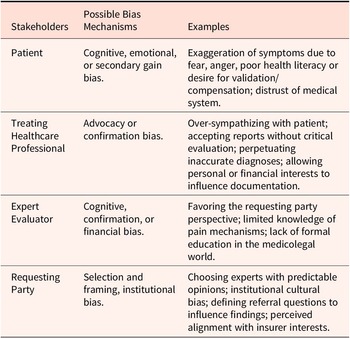
Bias may be defined as a prejudice, attitude, or belief that can interfere with an objective analysis or judgment and may function as a mental shortcut, allowing for quick conclusions at the cost of accuracy.Reference Blumenthal-Barby and Krieger35 In the IME context, personal biases, which may be conscious or unconscious, can influence the evaluation process. Health care professionals will be inherently influenced by personal factors of personality, experience, and knowledge.Reference Shah and Bohlen36 For example, one expert may rely heavily on established scientific evidence and documented facts, whereas another may base conclusions largely on longstanding personal experience, both of which should be considered according to evidence-based recommendations and best practices.Reference Iqbal37 Although these differences in reasoning may appear to favor certain stakeholders, they do not automatically indicate bias, unless the evaluator’s approach consistently aligns in a specific direction that will undermine impartiality. Table 3 demonstrates that bias may occur at many focal points of an IME, including from the patient/claimant, examiner, treating health care providers, benefit payers, employers, factfinders, and legal representatives.
Potential sources of bias

Key Players in the Medicolegal Process
The Patient
Patients generally have an anticipatory negative perception when required to undergo an IME, with concerns that they may be unfairly judged, or that the evaluator may be insufficiently qualified or will provide a biased evaluation.Reference Dean38 More pain and poorer mental health was reported in a study of 585 workers’ compensation claimants in Australia when there was a perception of being misjudged.Reference Orchard39 Validating the severity of a subjective pain complaint and resulting functional limitation is likely the most common and contentious issue in the medicolegal adjudication of chronic pain.Reference Fitzcharles and Assis40 An individual’s communication about pain to others is highly dependent on factors that have many layers of influence, extending from the personal to the broader societal context. Personal factors, such as personality characteristics, global physical and mental health status, and specifics of the pain complaint and associated features, are more easily recognized than the full scope of psychosocial factors, especially during a single encounter IME.
Numerous reasons may account for the exaggeration of symptoms, such as fear, anger, or the desire for validation or compensation.Reference Akca41 Fear and uncertainty occur when symptoms are poorly explained by conventional understanding and may lead to a patient either downplaying or overemphasizing symptoms. Previous adverse pain experiences may have sensitized a person to be more vigilant about a new emerging pain.Reference Thompson42 Poor health literacy may contribute to the fear of a serious underlying illness that may not have been identified by the medical team.Reference Briggs43 This fear can promote lack of confidence and distrust in the medical system, especially when multimodal therapy that may include psychological counselling is recommended. These patients are also more likely to experience adverse medical safety events, leading to increased malpractice claims.Reference Morrison44 For many, referral for psychological intervention suggests that pain is being discounted. Poor response to drug treatments, as is commonly seen in chronic pain conditions, may also cause distrust and resentment.Reference Koesling and Bozzaro45 Within the broader context, the family and environmental milieu, which includes societal and work interactions, will influence the presentation of illness, with all potentially introducing bias in the clinical evaluation.Reference Fang46
Severity of pain is often closely aligned with function.Reference McGorry47 Perception of exaggeration may be valid, but the underlying reason for exaggeration should not be immediately ascribed to dishonesty or malingering.Reference Etherton48 Emotions that can include fear, anger, or guilt may cause a person to present a subconscious demeanour of exaggerated suffering that is communicated to the observer. At the other extreme, exaggeration may simply reflect a conscious attempt to misrepresent symptom severity for secondary gain, which could be monetary or even personal, such as receiving more sympathy and attention. It is important to recognize that secondary gain can be both unconscious and subconscious. In one study based on data from the New Zealand Accident Compensation Scheme, which provides no fault compensation, the prevalence of symptom exaggeration after an unintentional injury was estimated to be 20–50%.Reference Wise49
Although conscious exaggeration of pain severity may be suspected by a health care professional, there is no recourse to a specific clinical test to identify or confirm exaggeration, as biomarkers such as fMRI are considered experimental. Nonorganic (Waddell) signs, which are more common in nociplastic than neuropathic or nociceptive pain (e.g., superficial tenderness is a hallmark of central sensitization), are strongly associated with treatment failure, but often conflated with malingering. Studies have mostly shown that they are not correlated with secondary gain but are instead mutable.Reference Fishbain50
Attribution of causation by a person with chronic pain is often contentious. It is human nature to seek a plausible explanation for a health situation, especially when an event such as a trauma or an illness seems to have triggered a change in health status. A patient may introduce bias into the medicolegal context by honestly believing that a health condition was precipitated by an event, without acknowledging that a subclinical or lesser underlying process was present. Low grade symptoms that were previously discounted might be brought to the forefront by an event that could simply have tipped the balance to more prominent symptoms. Causal attribution theory may be explained as a person’s attempt to reconcile an adverse situation and thereby restore a perception of personal control.Reference Weiner51 In a study of 92 workers who sustained serious hand injuries requiring treatment by a surgeon, those who blamed coworkers or equipment for their injury were more resistant to returning to their former work activity,Reference Rusch52 emphasizing that causal attribution may contribute to continued disablement. Engagement with the legal system at any level has an influence on presentation of health status. When an event such as a motor vehicle accident leads to chronic pain, involvement with compensation systems is associated with overall poorer outcome, as was reported in a systematic review of 27 studies involving over 16,000 individuals.Reference Melita53 All secondary gain does not confer the same risk of litigation and failure to return to work. In one large database study conducted of almost 40,000 people receiving workers’ compensation in Denmark, individuals with adjudicated claims, regardless of compensation status, had higher return-to-work rates than those with ongoing claims.Reference Rudbeck54 In such settings, for patients in poor general health, remaining in a sick role may be associated with perceived greater financial gain. Factors contributing to the patient experience of interaction with the legal world in the context of chronic pain are shown in Figure 1. The above data suggests that avoiding litigation in general, or shortening the length of a dispute, would be the best predictor of long-term functional outcomes.
In summary, numerous health-related, personal and societal factors can contribute to real or perceived bias from the patient perspective in the medicolegal setting. This is particularly important in the evaluation of a person with non-measurable subjective symptoms of pain that contribute to functional impairment that is beyond usual understanding.
The Treating Health Care Professional
The responsibility of a treating health care professional is to foster care in the best interests of the patient and to be their advocate.Reference Charles and Lazarus55 The ideal doctor-patient relationship will extend beyond simply attention to the medical condition to include multiple layers of understanding the “whole person.” In this context, the treating health care professional may be overly sympathetic to the needs of a patient or may resent the request for an IME as a reflection on their personal competence. General practitioners in Norway expressed positive attitudes to second opinions from a peer for their long-term sick-listed patients, but found regular IMEs unsuitable.Reference Aamland56 An overly sympathetic treating clinician, or one who stands to gain from positive framing (e.g., patient evaluations), may be judged as providing unreliable biased information, especially when providing testimony to the courts.Reference Rich57 This can have professional consequences regarding credibility and competence.
In the setting of an injury, the physician may accept the report of a patient at face value without sufficiently exploring the exact circumstances of an event, or, in a work setting, without understanding the precise nuances of a work activity. In contrast, with pressures on the medical community caused by increased workplace demands, staffing shortages, and time constraints, care may be suboptimal.Reference Nguyen58 It may be easier and less time-consuming to accept the report of a patient and simply sign a document granting leave of absence from work or reporting an event as causative. There are also health care professionals who surreptitiously promote the system of injury and disablement for personal financial gain by scheduling repeated unnecessary appointments, referring the patient for unnecessary testing or consultations, and supporting a leave of absence from work without fully understanding a person’s functional status. These actions promote illness persistence and medicalization of patients. Another caveat is the repetition in health care records of erroneous diagnoses, without due attention to the validity of diagnosis. This occurs often in the context of persons labelled with diagnoses such as fibromyalgia or complex regional pain syndrome. These diagnoses and actions are a prelude to engagement with the legal system and must therefore be noted.
The treating health care professional provides an integral and necessary component to the medicolegal evaluation of a claimant. All communications regarding patient care should be objective, factual, and free of overt advocacy, to allow the courts to reach fair decisions.
The Expert Evaluator
When the legal system requires clarification on a health issue, the services of an expert witness are requested. The idea of expert witness has been rooted in English common law since the mid-16th century. In the case of Buckley vs Rice Thomas, Justice Saunders wrote in 1554, “If matters arise in our law which concern other sciences or faculties, we commonly apply for the aid of that science or faculty which it concerns, which is an honourable and commendable thing in our law.”Reference Milroy59 The expert is a health care professional who is contracted to provide an accurate medical opinion that is evidence based and well reasoned, on which decision-makers can rely with confidence.60 It is critical that the expert act with fairness, objectivity, and impartiality; remain within their scope of expertise; disclose relevant documentation and instructions; and assist the legal process by clarifying medical issues without advocacy. While experts are not expected to have a detailed knowledge of the law, they should be familiar with current assessment frameworks within their jurisdictions, such as the American Medical Association’s Guides to the Evaluation of Permanent Impairment and the World Health Organization’s International Classification of Functioning, Disability, and Health. 61 During testimony or depositions, experts are frequently asked in which proportion of cases they are retained by plaintiffs or defendants; too skewed a ratio (e.g., 90% for defendants) is a red flag. Experts may conduct an evaluation for the defense or the plaintiff, with findings that may benefit or disadvantage the engaging party.
Only a judge, or, in administrative contexts, a tribunal, has the authority to recognize an individual as a qualified expert and to determine whether their opinion is admissible and relevant to the matter at hand.62 It is important to recognize that the bar for legal recognition of a subject matter expert may be lower than in academia. The expert’s role is advisory: It is the court or tribunal that ultimately decides the outcome. In weighing expert evidence, the court applies legal principles, considers other forms of evidence, and balances the expert’s input against the broader context of the case.
The expert evaluator is, by training and career, first and foremost a health care professional who has been involved in patient care.63 This can result in unintentional bias when the evaluator sympathises with a claimant or unconsciously adjusts findings in their favor. Another source of bias/error may occur when the evaluator is not sufficiently up to date regarding recent evidence-based medicine.64 This is particularly pertinent when evaluators with a predominant musculoskeletal focus are not sufficiently knowledgeable about newer concepts of chronic primary musculoskeletal pain of a nociplastic origin and remain focused on traditional musculoskeletal examination techniques, such as of range of motion of joint, muscle strength and wasting, and the neurological topography of deficits. There are also those experts who provide evaluations mostly for either claimant or defense with pressure to produce findings consistent with the requesting party expectations. Such conduct is ethically indefensible, especially when neutrality gives way to adversarial statements and posturing. Finally, there may be a few individuals who confine their professional activities almost entirely to expert evaluations, a practice that is discouraged and legally prohibited in many venues. According to the US Department of Justice, the best expert witnesses are subject matter experts with strong resumes, who can translate complex issues into simple statements, use supportive documents and creativity to demonstrate concepts, and are humble, truthful, sincere, and eloquent.65
Conflict of interest for an expert is a concern, especially when there are financial considerations, with benefits for experts greatly exceeding reimbursement for clinical work.66 Financial incentives may sway an evaluator to produce a report favorable to the requesting party, and longstanding financial relationships may unintentionally influence opinions. Implicit bias and fear of error can occur when a controversial conclusion is avoided. Conclusions can be distorted when the clinical narrative is incomplete or when there is poor knowledge of current scientific evidence. Finally, there may be those clinicians who view doing medicolegal evaluations as a stress-free environment towards the end of a medical career. This approach is not tenable, as medicolegal work requires focused attention, full cognitive competence, and an up-to-date knowledge of current medical standards.
The Requesting Party
IMEs may be requested by either the claimant or the defendant. Insurers, as the defendant, frequently initiate and finance IMEs, particularly in automobile, disability, and workers’ compensation claims.67 Alternately, a claimant or plaintiff may seek legal recourse by initiating a lawsuit to seek compensation or resolution of a dispute. The requesting party typically selects the expert and defines the specific questions to be addressed to support the adjudication process. Both sides have a legitimate interest in managing financial risk and controlling costs of the legal process, but also with the consideration that final decisions can profoundly affect claimants’ livelihoods and well-being. This underscores the importance of ensuring that IMEs are conducted to the highest standards of objectivity and fairness.
Legal professionals are qualified to provide legal advice, represent clients in disputes, and prepare legal documents. In the context of IMEs, legal professionals assist claimants to understand the IME process and its implications, review documentation and correspondence, recommend suitable IME experts, accompany claimants to the examination (where permitted), review IME reports, initiate appeals or challenges to unfavorable decisions, and provide reassurance and emotional support during a stressful process.
Even in the absence of overt partiality, insurer-driven selection and funding create the risk of bias. Referral agencies or brokerage firms may limit the information provided to experts, control access to records, or interfere with report drafting, practices that have been criticized in tribunal decisions and professional commentary. The impression of claimants’ and treating general practitioners experience within the compensation system is also largely negative.68
Although the IME process should be independent, conflict of interest can arise when experts are selected on the basis of their assessments that selectively favor a specific party, especially the insurer.Reference Lax69 Selection bias may occur when requesting parties repeatedly choose from a small panel of experts with whom they have an established relationship, creating the perception or reality of loyalty or expectation bias. In some cases, experts may be selected because they predominantly conduct evaluations for either the claimant or the defense. The requesting party can introduce bias by framing the referral questions and defining the scope of assessment, thereby exerting influence over the conduct of the IME and potentially shaping the outcome. There may also be a perception of influence when claimants distrust the process if they believe the expert is aligned with a particular party, especially an insurer. This perception is reinforced when public reports or legal commentary describe IMEs as defense-oriented by design.
Consequences of Bias in Clinician or Expert Report
The consequences of bias in the medicolegal setting are far reaching and can affect every stakeholder. When bias in a report or testimony of a clinician or expert is identified, credibility will be lost, testimony may be rejected, and the clinician’s professional reputation can suffer long-term damage. A biased report will be discarded and can lead to adverse rulings, public criticism, financial liability (e.g., the expert being sued), and reputational harm.
Bias in medical reporting, and especially in an IME, will adversely affect a claimant. There may be unfair denial or reduction of benefits; illness or injuries may be minimized, disability ratings lowered, or return-to-work readiness overstated, thereby reducing financial compensation and access to treatment.70 Biased findings can prolong disputes by triggering additional IMEs, appeals, and legal challenges, delaying resolution, which results in increased costs to the individual and to society. There may be resulting long-term health impacts due to treatment delays and worsening medical conditions as well as emotional distress when claimants are frustrated by a process they perceive to be unfair.
Bias can also have important adverse consequences for the insurer. Public insurers may pay out more than necessary, resulting in higher premiums, payroll taxes, or general taxes depending on their financing model. This will negatively impact economic activity and may lead to loss of employment or a lower living standard. Private insurers will need to raise premiums or accept lower profits. Raising premiums may make them uncompetitive while lower profits will reduce payments to shareholders, including pension plans. This reduces household income or the capacity to pay pensions.
When a clinician or an expert report is biased or inaccurate, there are consequences beyond the individual case. Since decision-makers often place significant weight on expert evidence, biased opinions can influence legal rulings in ways that compromise justice. When medicolegal assessments are seen as unfair or arbitrary, trust in the justice system declines and public confidence is eroded. Bias has implications for workers’ compensation and employment, especially in work-related injury cases, which could cause loss of wages or medical benefits payable to the worker and increased tensions between employers and employees, damaging workplace relations.
There are also reputational and legal risks for the nonmedical stakeholders. Public confidence can be eroded by negative media coverage, causing harm to the images of insurers, employers, and experts involved in biased IMEs. As an extreme example, employees of insurers or legal experts may be personally targeted. In the event of proven bias, employers or insurers may face legal repercussions, particularly if it is proven that flawed assessments were knowingly used as evidence.
In summary, bias in medical reporting can perpetuate injustice, delay recovery, and cause harm beyond the individual claimant. It also threatens the integrity of the medicolegal process, increases litigation costs, and erodes public trust. Ensuring impartial, evidence-based evaluations is therefore not only an ethical obligation but also a practical necessity for all stakeholders.
Mitigating Bias in Independent Medical Evaluations
Since impartiality is the fundamental core of credible expert evidence, and given the serious consequences of bias, stakeholders in the IME process must take proactive steps to reduce risk of bias. In a review of the current IME process from a qualitative perspective, and with emphasis on practice in Australia, Currey and Sprogis have offered suggestions for strengthening quality practices at all stages, including expert selection, the examination process, reporting, and mapping the quality of the experience.71 These measures involve not only the medical expert, but also insurers, legal professionals, and the judicial system.
There should be transparent selection of assessors on the basis of known competence, experience, and credibility. They should be sufficiently qualified with respect to the condition under evaluation, be impartial, have up-to-date clinical training and experience, and avoid any health-related contact with the claimant outside the IME setting. As many assessors move into the less physically demanding medicolegal setting towards the end of a career, such as for surgeons, their capacity to perform should be monitored to ensure that they are physically, cognitively, and professionally capable of conducting competent evaluations. Any prior professional relationships with the parties involved should be identified as a conflict of interest and should preclude conduct of an evaluation.
Standardized protocols should be encouraged to ensure consistent methodology. In a survey of 144 pain medicine clinicians, over 50% stated that guidelines for medicolegal practice should be developed.72 Assessors should be encouraged to implement uniform assessment procedures, including clear examination checklists, structured interview formats, and evidence-based functional testing; simply “cutting and pasting” for report generation is unacceptable. The report should be the product of the assessor, with ghostwriting, selective file disclosure, or report editing by third parties prohibited. There should be a clear process of communication between all parties, especially the claimant, and the purpose, scope, and methods of the IME should be explained. Above all, written consent to conduct the IME must be given by the claimant.
Oversight of the medicolegal field from the health care practitioner perspective should be the responsibility of the regulating medical authority, as for any medical discipline. There should be consideration for independent review and quality control of the function of assessors, as is standard for other areas of medicine. As a first step, a selection of reports could be submitted for peer review with the objective to ensure completeness, accuracy, and neutrality. Periodic audits of IME providers would identify patterns of partiality, recurrent omissions, plagiarism or procedural deviations.
Ongoing training beginning at the student level and subsequent professional development are the cornerstones for competent practice.Reference Norris and Mumford73 Some disciplines for which pain medicine is a subspecialty, such as emergency medicine and neurology, have raised awareness of the need for education in medicolegal matters, but this is not universal for all medical fields or countries.Reference Williams74 Assessors should be knowledgeable in the interface of law and medicine, and while extensive legal knowledge is not required, assessors should be sufficiently educated in the basics of the law pertaining to medicolegal interactions. Although most countries do not mandate specific medicolegal qualifications for an expert, it is implicit that individuals should maintain their continuing professional education. Numerous specialty organizations provide education, such as the International Academy of Independent Medical Evaluators and the American Board of Independent Medical Examiners.75 Participation in continuing educational events will ensure that assessors remain informed on current clinical guidelines and relevant legislative frameworks and are better prepared for encounters with the legal system. Several safeguards are suggested, such as randomised or rotational panel selection to avoid repeat use bias, and use of a transparent fee structure. Table 4 summarizes the discussed key points of bias identification and how to minimize them.
Key points in the identification of bias against individuals with nociplastic pain, and steps to minimize them

Finally, strengthening legal oversight would contribute to the ethical standards of the IME.Reference Kulich76 Some have suggested a process of pre-admissibility review, requiring reports to be screened for procedural fairness and neutrality before they are accepted as evidence. When there is a perception of bias, reports should be challenged by legal professionals who could require clarification, seek rebuttal reports, or request additional evaluations. Claimants should be aware of their rights, including the right to contest assessor selection.77 Reducing bias in IMEs requires systemic safeguards, transparent processes, and active oversight. These measures protect not only the claimant’s rights but also the credibility of the medicolegal process, ensuring that expert evidence serves justice rather than undermining it.
Conclusions
When interacting with the legal system at any level, a clinician should provide clear, objective, and accurate information to assist the requesting party, judge, or arbitrator to reach a fair decision. These principles are particularly relevant in the context of an IME, which should be characterized by impartiality in providing trustworthy evidence. When bias enters the equation, the effects extend far beyond the individual case: Patients/claimants lose faith in the system, insurers risk credibility, and courts are provided with compromised evidence. Preventing such outcomes requires more than good intentions; there should be structured safeguards at each stage.
When clinicians function as experts, they should adhere to standardized protocols, undergo regular training, and be prepared to submit their reports for independent review. Insurers must commit to transparent selection processes, objective remuneration structures, and full disclosure of case materials. The judiciary must exercise vigilant oversight, ensuring that expert opinions admitted into evidence meet the highest standards of neutrality and procedural fairness.
Bias in providing medical information to the courts is not an inevitable flaw; it is preventable. An IME process should be transparent for all parties with a shared commitment to integrity. When clinicians interact with the legal system, credibility is critical to promote fairness of legal outcomes. The measure of a just system lies not in the speed of its decisions, but rather in the trust it inspires. In the end, unbiased medical opinions are not just good practice, but justice in action.
Data Availability
No datasets were generated or analyzed in this study. All information presented is based on publicly available literature, professional guidelines, and conceptual analysis. Therefore, all relevant data are contained within the manuscript.
Author Contribution
Rodrigo Deamo Assis: conceptualization, methodology, visualization, writing — original draft preparation, writing — review & editing; Steven P Cohen: conceptualization, methodology, supervision, visualization, writing — original draft preparation, writing — review & editing; Hance Clarke: conceptualization, methodology, visualization, writing — original draft preparation, writing — review & editing; Nimish Mittal: conceptualization, methodology, visualization, writing — original draft preparation, writing — review & editing; Mary-Ann Fitzcharles: conceptualization, methodology, supervision, visualization, writing — original draft preparation, writing — review & editing.
Funding Statement
The authors received no specific funding for this work.
Competing interests statement
The authors declare no competing interests. The authors also confirm that their clinical or medicolegal roles did not influence the content, interpretation, or conclusions of this manuscript.
Disclosures
The authors have nothing to disclose.




 Open access

