


Partisan polarization in Congress is one of the best-documented features of contemporary American politics (McCarty et al., Reference McCarty, Poole and Rosenthal2006; Lee, Reference Lee2016; Lewis et al., Reference Lewis, Poole, Rosenthal, Rudkin, Boche and Sonnet2023), and many suggest that campaign finance is partly responsible. Individual donors tend to hold extreme positions (Bafumi and Herron, Reference Joseph and Herron2010; Barber, Reference Barber2016c), and scholars commonly assume or argue that donors contribute to candidates on the basis of ideological congruence, thus aiding in the election of more extreme legislators (Bonica, Reference Bonica2014; La Raja and Schaffner, Reference La Raja and Schaffner2015; Barber, Reference Barber2016a, Reference Barber2016b). Conversely, corporate political action committees (PACs) appear to value moderation, but exert limited spending and influence in the electoral arena (Milyo et al., Reference Milyo, Primo and Groseclose2000; Bonica, Reference Bonica2013; La Raja and Schaffner, Reference La Raja and Schaffner2014; Barber, Reference Barber2016b; Jacobson and Carson, Reference Jacobson and Carson2019).
Identifying a causal effect of candidates’ ideology on their ability to raise money, however, is extremely challenging. Candidates’ positions are obviously not randomly assigned, and they are arguably strategically chosen to maximize electoral success. This endogeneity makes it particularly difficult to isolate the impact of candidates’ ideology on their fundraising performances. While some studies demonstrate that individual donors tend to support extreme candidates and PACs tend to support moderates (e.g. Ensley, Reference Ensley2009; Bonica, Reference Bonica2013), interpreting this correlational relationship in terms of implications about the relative ability of moderate and extreme candidates to raise funds is complicated as receipt patterns may not be due to candidate positioning per se.
Given these identification challenges, the connection between candidate ideology and campaign fundraising has largely been examined either in state legislative contexts (La Raja and Schaffner, Reference La Raja and Schaffner2015; Barber, Reference Barber2016b) or at the individual donor level (Barber, Reference Barber2016a; Barber et al., Reference Barber, Canes-Wrone and Thrower2017). Although such studies provide valuable insight into how candidates’ positions might affect donors’ campaign contributions, the extent to which these relationships result in differential financial support for House candidates on the basis of their positions remains unclear due to the multidimensional nature of the decisions that donors face.
Indeed, the most recent evidence suggests that ideology may not be the sole driver of candidates’ individual nor PAC receipts (Thieme, Reference Thieme2020; Stuckatz, Reference Stuckatz2022; Meisels et al., Reference Meisels, Clinton and Huber2024). Because of the contentiousness and importance of majority control in the contemporary Congress, candidates vying for seats needed to maintain or gain a legislative majority may receive strong financial support from individuals looking to maximize the marginal impact of their donation with lesser regard for ideology (Gimpel et al., Reference Gimpel, Lee and Pearson-Merkowitz2008; Lee, Reference Lee2016). On the other hand, corporate PACs are known to optimize “access-buying” by supporting heavily favored candidates and those who hold institutional influence (Milyo et al., Reference Milyo, Primo and Groseclose2000; Bonica, Reference Bonica2013; Fouirnaies and Hall, Reference Fouirnaies and Hall2014), who may not be moderate given their district compositions and valence advantages (Burden, Reference Burden2004; Carson and Williamson, Reference Carson and Williamson2018). If individual and business PAC contributions are shaped by such strategic considerations and not allocated on the basis of candidates’ positions alone, differences in candidates’ positions may not translate into differences in fundraising.
To estimate the relationship between candidate ideology and campaign contributions, I leverage a regression discontinuity design to estimate the effect of “as-if randomly” nominating an extreme candidate over a moderate candidate on the winner’s general election fundraising success (Hall, Reference Hall2015). Specifically, I use data on candidates’ ideology, transaction-level contribution records, and election outcomes via Bonica’ (Reference Bonica2023) Database on Ideology, Money, and Elections (DIME) from 1980 to 2020 to identify races where an extreme candidate just barely won the primary over a moderate co-partisan, with the “counterfactual” consisting of races where a moderate was just barely nominated over an extreme candidate.
Conditional on the identifying assumptions being satisfied, any difference between these otherwise comparable extreme and moderate nominees’ fundraising in the general election should be attributable to the quasi-random assignment of an extreme nominee. If campaign contributions to House candidates are primarily based on their ideologies, we should observe a substantial difference depending on whether an extreme or moderate candidate wins the primary. In particular, existing work predicts an increase in individual fundraising and a decrease in corporate PAC fundraising in response to extremist nominations. If other factors primarily drive candidates’ receipt patterns, however, we would not necessarily expect differences in the amounts raised by extreme and moderate nominees.
At the nominee level, I find little evidence that extreme House candidates experience a fundraising advantage among individual donors compared to moderates, while extremists are significantly disadvantaged in corporate PAC fundraising compared to moderates. Likewise, analysis of contributor-level donation decisions suggests that corporate PACs are substantially less likely to contribute to extremists, and there is no consistent effect of candidate ideology on individual donors’ likelihood of contributing. Moreover, individuals are not consistently more likely to fund extreme candidates than moderates even in electoral contexts which are the most favorable to extremists, and corporate PACs are not consistently less likely to fund extreme candidates than moderates where extremism is more of a liability. Despite recent arguments about the nationalization of congressional races (Bonica and Cox, Reference Bonica and Cox2018; but see Canes-Wrone and Kistner, Reference Canes-Wrone and Kistner2022; Lockhart and Hill, Reference Mackenzie and Hill2023), corporate PACs’ eschewing of extremists is driven by elections in recent decades.
Taken together, these results regarding the behavior of the two largest sources of campaign funds in congressional elections have important implications for how we study and understand the causes of ideological polarization in Congress. Contrary to the idea that individuals disproportionately fund candidates on the basis of extremism, the evidence presented here suggests that their individual-level contributions do not consistently favor extremists over moderates, nor do candidate-level contributions from individuals favor extremists. On the other hand, corporate PACs consistently favor moderates over extreme candidates. To be clear, I examine just one pathway for money to affect political outcomes—ignoring, for instance, how extreme individual donors may influence the candidate field itself (Thomsen, Reference Thomsen2014, Reference Thomsen2017; Hassell, Reference Hassell2016). However, conditional on winning a closely contested primary, the effects that I identify suggest that nominating candidates with vastly different ideologies does not affect candidates’ ability to raise funds in the general election in ways consistent with individual and corporate contributors exacerbating extremism.
1. The logic of political contributions
Scholars have long been concerned about the disproportionate access to elected officials and accompanying representational advantages enjoyed by political donors (e.g. Thayer, Reference Thayer1974; Hall and Wayman, Reference Hall and Wayman1990; Miler, Reference Miler2010; Kalla and Broockman, Reference Kalla and Broockman2016; Powell and Grimmer, Reference Powell and Grimmer2016). With the growth of ideological polarization in legislatures in recent decades, campaign contributors’ role in the electoral process has likewise come under scrutiny. Specifically, the dominant argument of extant work is that individual donors seek to elect extreme candidates while corporate PACs seek to elect moderates.
1.1. Individual donors
The ideological extremism of individual donors is well-documented. Survey evidence suggests that contributors hold more extreme preferences on policy than the general population (La Raja and Schaffner, Reference La Raja and Schaffner2015), voters (Bafumi and Herron, Reference Joseph and Herron2010), co-partisans (Barber, Reference Barber2016c), primary voters (Hill and Huber, Reference Hill and Huber2017), and even senators (Barber, Reference Barber2016c). Moreover, Ansolabehere et al. Reference Ansolabehere, de Figueiredo and Snyder(2003) argue that contributions are a “consumption good” in which donors receive utility from the participatory act of supporting candidates who share their policy preferences.
Most recent empirical work on individual donors shares the view that donors give expressively on the basis of ideological congruence. In a study of contributions to senators running for re-election in 2012, Barber Reference Barber(2016a) finds that donors report recipient ideology as extremely important in their contribution decisions, and Barber et al. Reference Barber, Canes-Wrone and Thrower(2017) show that policy agreement increases donors’ likelihood of contributing to a senator. Likewise in the sub-national context, scholars have linked polarization in state legislatures to campaign finance environments that are friendly to individual donors (La Raja and Schaffner, Reference La Raja and Schaffner2015; Barber, Reference Barber2016b). This view of individual contributions as expressions of donors’ ideology constitutes the behavioral assumption of donation-based measures of ideology, in which receipt patterns are thought to reveal the preferences of both recipients and contributors (e.g. Bonica, Reference Bonica2014; Hall and Snyder, Reference Hall and Snyder2015).
While donor-level surveys provide valuable insight into how individuals make their decisions, and studies of state campaign finance laws illuminate causes of polarization in state legislatures, the extent to which these findings can inform us about the relationship between House candidates’ ideology and fundraising is unclear. Respectively, the influence of ideology on donors’ decisions may not translate into an aggregate-level difference in individual fundraising for moderate versus extreme candidates, and extreme state legislative candidates’ advantage in individual fundraising does not necessarily imply a similar advantage for extreme House candidates. Along these lines, scholars have also found some evidence that House candidates who are more extreme or closer to their district’s donor constituency receive more individual campaign contributions (Ensley, Reference Ensley2009; Johnson, Reference Johnson2012; Kujala, Reference Kujala2020). However, given the plethora of factors that likely confound the relationship between candidate positioning and individual campaign contributions—such as district competitiveness, media attention, and party support—its level of causality remains an open question.
Although the characterization of individual donors as expressive and ideology-motivated largely dominates, other work suggests that donors may also be driven by strategic, instrumental considerations (Meisels et al., Reference Meisels, Clinton and Huber2024). Given the contentiousness of majority control in recent congresses as well as contributors’ disproportionate stake in electoral outcomes (Lee, Reference Lee2016), individuals may prioritize contributions to copartisans in importance races with less regard for ideological congruence. Consistent with this, many Senate donors report influencing the race outcome as a top priority when making their contribution decisions (Barber, Reference Barber2016a), and studies have found that competitiveness is a strong predictor of out-of-district individual contributions (e.g. Gimpel et al., Reference Gimpel, Lee and Pearson-Merkowitz2008) and suggested that individuals’ contributions may be more related to their perceived benefits of their own party winning than ideological proximity (Hill and Huber, Reference Hill and Huber2017). In addition to valuing important races, donors may also strategically support “high-quality” candidates who are otherwise expected to perform better electorally (e.g. Box-Steffensmeier, Reference Box-Steffensmeier1996; Maestas and Rugeley, Reference Maestas and Rugeley2008) or contribute to candidates supported by their employer (Stuckatz, Reference Stuckatz2022). If individuals consider these instrumental factors in their donation decisions, House candidates’ ideologies alone may not strongly determine their individual receipts.
1.2. Corporate PACs
In contrast to individual donors, who are thought to allocate funds to extreme candidates, much of the literature on corporate PACs suggests that business PACs seek to elect moderates. Some scholars have argued that PACs are ideologically moderate and, like individual donors, “incorporate ideological proximity into their contribution decisions” (Bonica, Reference Bonica2013, 302). Indeed, recent work has suggested that PACs within politicized industries adopt ideologically motivated contribution strategies (Barber and Eatough, Reference Barber and Eatough2019) and that corporate PACs’ contribution strategies may be affected by their donors’ partisanship (Li, Reference Zhao2018).
In an alternative vein, others argue that corporate PACs prefer moderate candidates for non-ideological reasons (Barber, Reference Barber2016b). Specifically, numerous studies suggest that these PACs are primarily driven by their desire to gain access to the policymaking process rather than by ideological alignment (Hall and Wayman, Reference Hall and Wayman1990; Snyder, Reference Snyder1990; Bonica, Reference Bonica2016; Powell and Grimmer, Reference Powell and Grimmer2016). Because gaining election to office is a prerequisite to lawmaking and moderates are thought to be more electable than extreme candidates (e.g. Burden Reference Burden2004; Hall Reference Hall2015), moderate candidates should receive more corporate PAC receipts.
Although PACs value candidates’ likelihood of election, as demonstrated by their support of those who are heavily favored to win (Milyo et al., Reference Milyo, Primo and Groseclose2000; Bonica, Reference Bonica2013), moderates may not hold a monopoly over electability. Due to the increasing number of uncompetitive districts that are “safe” for one party (Abramowitz et al., Reference Abramowitz, Alexander and Gunning2006) and polarization among partisan constituents (Lelkes, Reference Lelkes2016), recent work has called into question the idea that extreme candidates are less electable than moderates (Utych, Reference Utych2020). If extreme candidates fare no worse than moderates, and corporate PACs are indeed access-driven and value electability, moderate candidates should receive no more PAC contributions than extreme candidates.
However, if corporate PACs are indeed access-oriented, supporting electorally successful candidates is merely one aspect of the contribution strategy. Because the goal is to increase their access to and control over the policymaking process, PACs likewise value institutional influence, leading them to fund incumbents (Fouirnaies and Hall, Reference Fouirnaies and Hall2014), candidates who chair committees or sit on power committees (e.g. Romer and Snyder, Reference Thomas and Snyder1994), and those who hold procedural power (Fouirnaies and Hall, Reference Fouirnaies and Hall2018), among others. Consistent with this, recent studies of corporate political giving find that such interest groups are more conservative than what their moderate contribution records suggest, indicating strategic donation behavior (Thieme, Reference Thieme2020). Regardless of whether corporate PACs are “truly” moderate or conservative, the importance of candidates’ existing institutional clout and other strategic considerations to their goals suggests that candidates may not garner different amounts of corporate PAC funds based on ideology.
2. Empirical strategy
While a large body of work has sought to identify whether ideology impacts individual donors and corporate PACs’ contribution decisions, assessing whether candidates receive different levels of financial support on the basis of their ideologies is exceptionally difficult. Candidates’ positions are non-random and likely chosen to maximize electoral success in the context of their district, making it particularly challenging to identify the causal impact of positions on fundraising performance. Moreover, confounding and difficult-to-observe characteristics such as experience, strong personal character, and connections in the district threaten our abilities to make inferences about relationships between candidates’ ideologies, fundraising performance, and electoral success (Burden, Reference Burden2004; Maestas and Rugeley, Reference Maestas and Rugeley2008; Stone and Simas, Reference Stone and Simas2010). Even if extreme candidates systematically raise more funds from individual donors and less from corporate PACs than moderate candidates, these receipt patterns may not be due to candidate positioning per se.
Because of the difficulty of isolating the effect of congressional candidates’ ideology, the evidence on the relationship between candidate ideology and fundraising success comes from contexts that allow for stronger causal claims yet speak less directly to this relationship. Some (e.g. McCarty and Poole, Reference McCarty and Poole1998; Kujala, Reference Kujala2020) have attempted to directly test whether congressional candidates’ receive more or less PAC and individual receipts on the basis of their ideologies, such as Ensley Reference Ensley(2009) who finds modest evidence that extreme candidates garnered more individual contributions in 1996. However, most recent work has turned to the state legislative context (La Raja and Schaffner, Reference La Raja and Schaffner2015; Barber, Reference Barber2016b) or surveying donors directly (Barber, Reference Barber2016a).
While these studies illuminate how individuals understand their donation behavior and how different types of contributions may affect state legislative polarization, the extent to which their conclusions suggest differential support for moderate and extreme congressional candidates is unclear. For example, individual donors could report prioritizing candidates’ ideology in their donation decisions, yet contribute most heavily to co-partisans of varying ideologies running in races critical for majority control of Congress due to their heightened stakes (Meisels et al., Reference Meisels, Clinton and Huber2024). Likewise, state legislative candidate fundraising dynamics may not generalize to federal contexts due to differences in media attention paid to the races, perceptions of importance of majority legislative control, variation in candidate professionalization and experience, and costs of campaigning.
To investigate whether candidates receive more or less financial support from corporate PACs and individuals due to their ideological positions, I employ a regression discontinuity design to estimate the impact of as-if randomly nominating an extreme candidate over a moderate on general election campaign receipts. To do so, I identify primaries with substantial ideological gaps between candidates, with “treated” races consisting of those where the extreme candidate just barely beat the moderate, and the “control” is those where the moderate just barely won (Hall, Reference Hall2015). This strategy complements existing work by using a causal inference approach to evaluate one potential pathway for money to influence polarization via a subset of House elections.
2.1. Data and sample construction
I obtain transaction-level receipts and candidate-level information spanning 1980 to 2020 from Bonica’ (Reference Bonica2023) Database on Ideology, Money in Politics, and Elections (DIME), which also includes unique contributor identifiers and a code for corporate PACs. Following Hall Reference Hall(2015), my sample includes primary elections where the top two vote-getters are an extreme candidate and a moderate candidate, which I identify using Bonica’ (Reference Bonica2014) CF Scores also made available in DIME. In light of the potential issues with donation-based scaling methodologies (e.g. Hill and Huber, Reference Hill and Huber2017; Barber, Reference Barber2022; Meisels et al., Reference Meisels, Clinton and Huber2024) and endogeneity concerns given contribution-based independent and dependent variables,Footnote 1 I impose especially tight restrictions on contests entering the sample to ensure that primaries are clearly between an extreme candidate and a moderate.
First, I drop races with a top-two candidate whose CF score is on the “wrong” side of zero—that is, Republican primaries with a “liberal” candidate and Democratic primaries with a “conservative” candidate. Aside from the chance that such candidates are ideologically misclassified, it is not clear whether a Republican with a liberal score or a Democrat with a conservative score should be classified as the extremist or moderate relative to her correctly aligned opponent. Second, the main sample is restricted to elections in the top quartile of distance between candidates’ positions.Footnote 2 This cutoff is stronger than the median cutoff employed by Hall Reference Hall(2015) due to concerns about measurement error, which may lead to primaries being incorrectly classified as between an extremist and a moderate when in reality there is little meaningful difference between candidates.
Despite the steps taken to minimize issues with using CF Scores in this context, some aspects remain problematic. In the Appendix, I compare CF Scores to alternative scalings based solely on candidates’ primary contributions (Hall and Snyder, Reference Hall and Snyder2015; Lockhart and Hill, Reference Mackenzie and Hill2023) and based on contribution-independent roll call voting and positioning (Shor and McCarty, Reference Shor and McCarty2011). Correlations between CF Scores and alternative measures of candidate ideology are strong among both primary winners and runners-up, and there is substantial agreement between the measures’ classification of primaries falling into the top quartile of distance between candidates, where top two candidates are categorized as either as extreme or moderate. In addition to this evidence that results are not dependent on CF Scores specifically, I also demonstrate robustness to a wide range of bandwidths, sample candidate distances, and alternative dependent variables in the Appendix.
Although the sample of primaries employed here is not necessarily representative of the universe of primaries, this subset of races is disproportionately important and theoretically relevant for investigating the influence of candidates’ ideologies on their fundraising performances. Table 1 reports characteristics of interest for (1) the universe of contested primaries over the time period, (2) restricting the sample to opposed primaries, (3) further restricting to primaries in the top quartile of ideological distance between candidates, and (4) further restricting to primaries won within a 20% bandwidth.Footnote 3 No restrictions are placed on the sample with regard to general election context nor characteristics.
Characteristics of primaries across samples, 1980–2020

Note: Characteristics of primaries across increasingly restrictive samples: (1) at least one candidate, (2) more than one candidate, (3) top quartile of ideological distance between candidates, and (4) 20% bandwidth.
Across all levels of restrictiveness, the similarity of average presidential vote margin and proportion occurring during midterm years demonstrates that races in the most restrictive RDD sample are relatively representative of the universe of primaries with regard to national electoral environment. Consistent with greater prevalence of ideological primarying among Republicans (Boatright, Reference Boatright2014), the proportion of Democratic contests is slightly smaller once the sample of primaries is restricted to those between candidates of substantially different ideologies. Finally, the characteristics with the largest divergences between samples suggest that the regression discontinuity design (RDD) relies on an especially timely and consequential set of primaries. While 9% of all House primaries over the period were fought without an incumbent running for reelection, open seats made up more than 20% of closely contested primaries between ideologically different candidates. Given the infrequency with which incumbents are unseated, open seats are how the vast majority of new members enter the House, making these races which are over-represented in the RDD sample especially important for the composition and institutional dynamics in Congress. The primaries used in RDD analysis are also drawn most heavily from recent elections: post-2008 is the period most overrepresented in the sample, suggesting that results presented here are disproportionately informed by trends occurring most proximately to the present.
Beyond the general representativeness of the subset of races used for the regression discontinuity, we can also investigate fundraising patterns among those who do and do not enter the sample. Extrapolating treatment effects to populations away from the threshold is inappropriate in single-cutoff regression discontinuity settings, but it is nevertheless important to determine whether the design relies upon cases that have entirely anomalous patterns. To compare campaign receipts of extremists and moderates who competed in more and less competitive primaries, Figure 1 plots the density of individual and PAC general election contributions among extreme and moderate nominees who won their primaries within or outside of a 20% bandwidth.
Density of general election contributions by candidate ideology and primary competition.

Plotting the distribution of the dependent variable by candidate ideology and primary competitiveness reveals some important takeaways. First, there are some notable differences between general election contributions to candidates who won more and less competitive primaries. The spread of individual and corporate PAC contributions to both extreme and moderate nominees is greater among those who won a competitive primary, with substantially more moderates who won uncompetitive primaries receiving over $250,000 from corporate PACs compared to moderates who won competitive primaries. Additionally, Figure 1 is inconsistent with extremists enjoying individual fundraising advantages over moderates—if anything, there appears to be a slight preference for moderates. Finally, corporate PACs appear to contribute more to moderates than to extremists, especially among candidates who won their primary handily.
2.2. Regression discontinuity design
Having established the broad representativeness and importance of the sample, as well as the descriptive similarity between fundraising patterns of moderate and extreme nominees, I now turn to regression discontinuity to estimate the effect of “as-if randomly” nominating an extreme candidate over a moderate on general election fundraising.Footnote 4 In particular, I use this design to estimate the difference in individual and corporate PAC general election contributions between extreme candidates who narrowly beat a moderate and moderate candidates who narrowly beat an extremist. Following the recommendation of Chen and Roth Reference Chen and Roth(2024),Footnote 5 I estimate the following equation via Poisson quasi-maximum likelihood:
 \begin{align}
C_{ipt} = & \text{ exp(}\beta\text{Extremist Nomination}_{ipt} + \tau \text{Extremist Vote Share}_{ipt}\ +\\
& \ \mu\text{(Extremist Nomination * Extremist Vote Share)} _{ipt} + \gamma_t) \epsilon_{n}, \nonumber
\end{align}
\begin{align}
C_{ipt} = & \text{ exp(}\beta\text{Extremist Nomination}_{ipt} + \tau \text{Extremist Vote Share}_{ipt}\ +\\
& \ \mu\text{(Extremist Nomination * Extremist Vote Share)} _{ipt} + \gamma_t) \epsilon_{n}, \nonumber
\end{align} where Cipt stands in for general election contributions from individuals and from corporate PACs to party p’s nominee in district i in year t. By using Poisson regression, the implied proportional effect of nominating an extremist compared to nominating a moderate on individual or corporate contributions is then given by 100×(exp(β) – 1)%. The “treatment” indicator Extremist Nomination $_{ipt}$ takes a value of 1 if the extreme candidate won party p’s primary in district i in year t and 0 if the moderate won instead. Because I focus on close races, β estimates the as-if random effect of nominating an extremist compared to a moderate on general election fundraising from individuals or PACs. The forcing variable Extremist Vote Share $_{ipt}$ represents the extreme candidate’s share of the top-two primary candidates’ vote, such that values above 0.5 designate an observation as treated (extremist victory) and below 0.5 as untreated (moderate victory).
Following convention (Imbens and Lemieux, Reference Imbens and Lemieux2008; Lee and Lemieux, Reference Lee and Lemieux2010), I allow the slopes to vary on either side of the extremist win threshold by interacting the extremist nomination indicator with the extremist vote share running variable. Thus, the coefficient µ on the interaction term captures the difference in slope for extreme candidates from the parameter τ, which estimates the slope for moderate candidates. Additionally, I include year fixed effects γt to account for secular changes in the campaign finance environment with regard to contribution limits, campaigning costs, and fundraising trends (Abramowitz et al., Reference Abramowitz, Alexander and Gunning2006; La Raja and Schaffner, Reference La Raja and Schaffner2015; Hall, Reference Hall2019), as well as differences between donor composition and receipts in presidential election years versus midterms (Rhodes et al., Reference Rhodes, Schaffner and La Raja2018) and general changes in the economy such as inflation and growth. Remaining idiosyncratic variation is represented by the error term ϵ, clustered at the nominee level.
Consistent with current best practices, I use two different data-driven optimal bandwidth selection procedures and triangular kernel weights, which upweight observations closest to the cutoff (Imbens and Kalyanaraman, Reference Imbens and Kalyanaraman2012; Calonico et al., Reference Calonico, Cattaneo and Titiunik2014; de la Cuesta and Imai, Reference de la Cuesta and Imai2016; Gelman and Imbens, Reference Gelman and Imbens2019). In the Appendix, I report results across the range of all possible bandwidths, ideological distance sample cutoffs, and specifications, including candidates whose ideology “disagrees” with their partisanship, using the number of contributors as the dependent variable, and controlling for a quadratic specification of the running variable.
While it is important to understand the impact of extremist nominations on candidate-level general election fundraising, these observed contribution totals are ultimately the result of decisions at the contributor level. To investigate contributors’ individual-level response to the nomination of extreme candidates, I estimate the following specification via the linear probability model:
 \begin{align}
Y_{cipt} = & \ \beta\text{Extremist Nomination}_{cipt} + \tau \text{Extremist Vote Share}_{ipt}\ +\\
& \ \mu\text{(Extremist Nomination * Extremist Vote Share)} _{ipt} + \gamma_t + \epsilon_{c}. \nonumber
\end{align}
\begin{align}
Y_{cipt} = & \ \beta\text{Extremist Nomination}_{cipt} + \tau \text{Extremist Vote Share}_{ipt}\ +\\
& \ \mu\text{(Extremist Nomination * Extremist Vote Share)} _{ipt} + \gamma_t + \epsilon_{c}. \nonumber
\end{align}The term Ycipt is an indicator for whether contributor c made any general election contribution to party p’s nominee in district i in year t, with models estimated separately for corporate PACs and individuals.Footnote 6 The independent variables in Equation 2 are identical to those in Equation 1; however, idiosyncratic error is clustered at the contributor level. On the one hand, we want to construct contributor–primary dyads that capture contributors’ decisions about whether to contribute to each possible candidate. While this is a reasonable approach for corporate PACs, it is unlikely that all individuals who donated to any of the sample primaries meaningfully considered contributing to nominees from all such primaries. To better capture the donors of interest, I estimate parameters of Equation 2 separately with individuals who contributed to more than one race, individuals who contributed to more than five races, individuals who only ever contributed to candidates of one party,Footnote 7 and all corporate PACs.
The key identifying assumption of the regression discontinuity designs is that expected potential outcomes—here, the nominations of extreme versus moderate candidates—are continuous at the threshold, as candidates cannot perfectly manipulate their vote shares. Because the density of potential outcomes should be continuous for each individual, this implies that the density for the sample population should likewise be continuous (McCrary, Reference McCrary2008; Lee and Lemieux, Reference Lee and Lemieux2010). As argued elsewhere, the no-sorting assumption in House races is especially likely to be met in the context of primary elections (Cooper and Munger, Reference Cooper and Munger2000) conditional on a lack of electoral fraud or other post-election sorting behavior (de la Cuesta and Imai, Reference de la Cuesta and Imai2016). In the Appendix, I test for evidence of sorting around the extremist primary victory threshold and find no significant discontinuity in the density of extremist nominees versus moderate nominees. Another important implication of the continuity assumption is that races where an extreme candidate was just-barely nominated are otherwise comparable to those where a moderate was just-barely nominated, which I investigate via the balance of key pre-treatment covariates in the Appendix.Footnote 8
3. Results
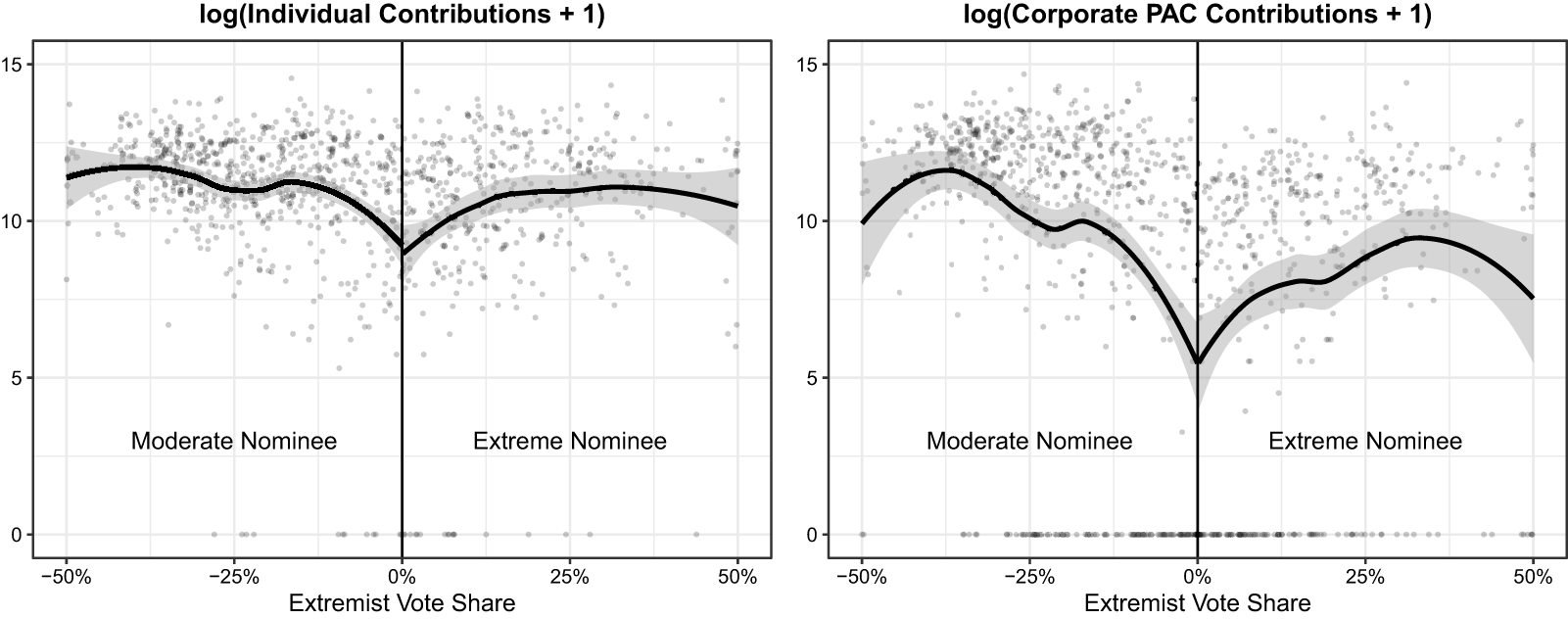
Figure 2 plots the extremist’s primary victory margin against the nominee’s logged general election contributions, such that observations to the left of the vertical cutoff line are moderate winners and those to the right are extreme winners. Based on the loess curves fitted separately on either side of the cutoff, the average logged individual and corporate PAC funds raised by extreme versus moderate nominees do not appear to be substantially different among those who just barely won their primary.Footnote 9 However, among other simplifications, this descriptive visualization does not account for temporal changes in fundraising environments and economic conditions over the 40-year period.
Effect of nominating an extremist on general election contributions.

More formally, Table 2 estimates the size and significance of any discontinuity in general election fundraising that may be present when an extreme candidate is nominated compared to a moderate. The results suggest that “as-if randomly” nominating an extreme candidate over a moderate does not affect general election contributions from individual donors. Across varying levels of distance between primary candidates and bandwidth selection procedures, extreme House nominees do not appear to raise significantly more funds from individuals compared to moderate candidates. None of the estimates come close to approaching traditional levels of statistical significance, and all four are signed in the negative direction. In the Appendix, I find that using the number of unique donors as an alternative dependent variable produces similarly weak results. In contrast to what existing work would predict, individual contributions do not appear to advantage extreme candidates over moderate candidates.
Regression discontinuity estimates of effect of nominating extremist on general election contributions

Note: Coefficients estimated using Poisson QMLE. Models include triangular kernel weights with nominee-clustered standard errors in parentheses. *p < 0.05, **p < 0.01, ***p < 0.001.
On the other hand, Table 2 suggests that corporate PAC fundraising suffers in the general election when an extreme candidate is nominated compared to when a moderate is nominated. Estimates from all four models are significantly negative and substantively large. The smallest point estimate, from the specification including primaries in the top median of candidate distance and using the Calonico, Cattaneo, and Titiunik (CCT) 2014 bandwidth, represents a 50% decrease in corporate PAC contributions when an extremist is nominated compared to a moderate, while the largest point estimate represents a nearly 70% decrease.Footnote 10 However, as mentioned previously, existing work demonstrates that many corporate PACs restrict most of their spending to incumbents. A more difficult test, then, is whether corporate PACs even penalize extreme incumbents compared to moderate incumbents. In the Appendix, including only incumbents in the analysis produces qualitatively and quantitatively identical results. Moreover, I show in the Appendix that this relationship persists both before and after the Citizens United Supreme Court decision of 2010, which allowed corporations to make independent expenditures, and the relationship remains unchanged when including independent expenditures in the dependent variable. Altogether, this constitutes strong evidence that nominating an extreme candidate significantly reduces contributions from corporate PACs in the general election compared to nominating a moderate.
The results reported in Table 2 are based upon a couple of different bandwidths and ideological distance cutoffs out of infinitely many of each. In the Appendix, plotting coefficients and accompanying confidence intervals across a wide range of possible bandwidths and candidate distance cutoffs demonstrates that these findings are highly insensitive to the particular values selected. I also examine the robustness of the results to employing alternative contribution-based measures of candidates’ ideologies.Footnote 11 While the negative impact of nominating an extremist on corporate PAC contributions is consistent across measures, estimates of the impact on individual contributions are much more unstable, highlighting the generally weaker results regarding individual donors compared to corporations. Finally, I estimate the relationship between nominee extremism (i.e. absolute CF Score) and contributions with fixed effects for district-party-census cycle and state-year. The results from this design, which allows for the inclusion of much more data but likely requires stronger assumptions than the RDD, remain generally consistent with the main results.
In addition to how nominating an extremist versus a moderate affects total general election contributions, we can also investigate how extremist nominations affect contributor-level donation decisions. Among individuals who gave in more than one race, individuals who gave in more than five races, and individuals who only gave to candidates of one party over the entire period, Table 3 suggests that nominating an extreme candidate lowers their likelihood of contributing in the general election relative to nominating a moderate. Comparing effect sizes to baseline rates of giving, individuals who gave in more than one race are 15% less likely to give to extremists, while pure partisans and those who gave in over five races are 50% less likely. However, alternative specifications in the Appendix result in estimates with highly variable signs, statistical significance levels, and substantive sizes, suggesting that relationships are not robust.
Regression discontinuity estimates of effect of nominating extremist on likelihood of general election contribution

Note: Results from Equation 2 estimated separately by contributor type with sample primaries in top 25% of ideological distance between candidates. Standard errors clustered by contributor in parentheses, Imbens-Kalyanaraman optimal bandwidth, and triangular kernel weights. ***p < 0.001.
Consistent with the nominee-level results in Table 2, the contributor-level results in Table 3 show that corporate PACs are much more hesitant to contribute to extreme nominees compared to moderate nominees. The estimated probability of a given corporate PAC contributing to a given nominee in the general election decreases 0.14 percentage points when the nominee is extreme, nearly a 50% decrease from their baseline giving rate of 0.30 when the nominee is moderate. In contrast to the volatility of individual donation estimates across specifications, the finding that corporate PACs are less likely to donate when an extreme candidate is nominated is quite consistent across alternative specifications and samples in the Appendix. Taken together, nominee- and contributor-level results suggest that corporations significantly disadvantage extreme candidates compared to moderates in general election fundraising.
3.1. Heterogeneous effects
Thus far, we have uncovered evidence that nominating an extreme candidate versus a moderate is detrimental to corporate PAC fundraising but does not substantially alter individual contributions in the general election. The potential liability from nominating an extreme candidate, however, varies across electoral context and time. Looking beyond general ideology-motivated giving, we can investigate whether individuals are more likely to give to extreme candidates when they should fare best ex ante and corporate PACs are less likely to give to extreme candidates when they should suffer most ex ante.
Electoral penalties to extreme candidates are largest in competitive districts—due to worse ideological fit between extreme candidates and moderate or ideologically divided constituencies—and open-seat races, where there is a greater emphasis on issues (Canes-Wrone et al., Reference Canes-Wrone, Brady and Cogan2002; Abramowitz et al., Reference Abramowitz, Alexander and Gunning2006; Campbell et al., Reference Campbell, Dettrey and Yin2010; Hall, Reference Hall2015; Carson and Williamson, Reference Carson and Williamson2018). Given that safe districts and incumbent-challenger races present the greatest opportunity for extreme candidates to fare well, ideology-motivated individuals should be particularly enthusiastic to contribute to extreme nominees in such cases. Conversely, ideology-motivated corporate PACs should be especially punitive toward extreme nominees in less safe districts and open seats, where partisan competition is higher and issues matter more.
To test whether nominating an extreme candidate has different effects on individuals’ and corporate PACs’ general election contributions depending on electoral context, I re-estimate the parameters of Equation 2 with the addition of relevant interaction terms. In one model, I include an interaction for whether the race was for an open seat (those without an incumbent running in either primary), and in the other, I include an interaction for whether the district is safe for the party, with safe Democratic districts having a previous Democratic presidential vote share of 60% or higher and 40% or lower for safe Republican districts.Footnote 12
Table 4 provides mixed evidence on whether individual donors are especially likely to contribute when an extremist is as-if randomly nominated in a safe district or an incumbent-challenger race. Adding together the direct and interacted coefficients of Safe District, pure partisans and individuals who contributed in over five races are significantly more likely to contribute to extremists who are nominated in safe districts, but individuals who contributed in more than one race are, if anything, less likely to fund extreme candidates when they are nominated in safe districts. In the seat type models, the sum of the direct and interacted Open Seat coefficients suggests that pure partisan and more habitual donors are more apprehensive about funding extreme nominees in open seat races compared to incumbent-challenger races, yet this difference is not present among all individuals who contributed more than once. As demonstrated in the Appendix, however, these results are not robust to alternative specifications, as signs and significance levels change are variable across sample restrictiveness.
Regression discontinuity estimates of effect of nominating extremist on likelihood of general election contribution

Note: Models estimated separately by contributor type with sample primaries in top 25% of ideological distance between candidates. Standard errors clustered by winning candidate in parentheses, Imbens-Kalyanaraman optimal bandwidth, and triangular kernel weights. *p < 0.05, **p < 0.01, ***p < 0.001.
Among corporate PACs, Table 4 demonstrates that extreme nominees are not especially penalized in districts less safe for the candidate’s party and in open seats. Although extremism is more of a potential liability in these contexts, the additional negative (sum of direct and interaction) effect of safe districts and positive effect of open seats suggest that corporate PACs do not further eschew contributions to extremists in places where they are the most at risk a priori. While there is not an additive penalty to extremists nominated in unsafe districts and open seats, the effect of nominating an extremist on corporate PAC contributions remains net negative in safe districts, unsafe districts, open seats, and incumbent-challenger races. In the Appendix, results suggest that corporate PACs may further penalize extremists nominated in open seat races in some alternative samples.
Aside from seat and district type, ongoing debates regarding electoral nationalization suggest that the potential liability of nominating an extreme candidate may be smaller during the past three decades as compared to previous decades. In particular, Bonica and Cox Reference Bonica and Cox(2018) argue that political parties strategically nationalized congressional elections in response to increased competition for majority control since 1994, incentivizing candidates to appeal to their party’s extreme donors and activists. However, the most recent evaluations of this argument have not found decreasing support for extreme nominees post-1994, suggesting that incentives may not have changed along these lines (Canes-Wrone and Kistner, Reference Canes-Wrone and Kistner2022; Lockhart and Hill, Reference Mackenzie and Hill2023).
To investigate whether individual donors and corporate PACs respond differently to the nominations of extreme candidates after 1994, I re-estimate Equation 2 and include an interaction for post-1994 elections. Across all samples, Table 5 suggests that, if anything, extreme nominees have been even less likely to receive a contribution after 1994. Although corporate PACs’ penalty to extremists is consistently greater post-1994, the results for individual donors are not robust across alternative samples in the Appendix. Overall, this provides some suggestive evidence that corporate PACs may actually see extreme candidates as a greater liability in recent decades, while a temporal shift among individual donors is less clear.
Regression discontinuity estimates of effect of nominating extremist on likelihood of general election contribution

Note: Models estimated separately by contributor type with sample primaries in top 25% of ideological distance between candidates. Standard errors clustered by winning candidate in parentheses, Imbens-Kalyanaraman optimal bandwidth, and triangular kernel weights. *p < 0.05, **p < 0.01, ***p < 0.001.
4. Discussion and conclusion
Do House candidates’ ideologies drive their campaign contributions? Although findings from state legislatures and donor surveys have suggested that individual donors favor extremists while corporate PACs prefer moderates, the challenges of isolating variation in House candidates’ ideologies have made it difficult to test whether more extreme candidates have a fundraising advantage among individual donors and a disadvantage among business PACs. Using a close-elections regression discontinuity design, I assessed the impact of nominating an extreme candidate as compared to a moderate on individual and PAC receipts in the general election. Evidence at the nominee and contributor levels suggests that nominating an extremist does not increase contributions from individuals and, if anything, may decrease them. On the other hand, nominating an extreme candidate reduces corporate PAC contributions by at least 50% at the nominee level and reduces corporate PACs’ likelihood of contributing by nearly 50% at the contributor level as well. Further investigation demonstrates that corporate PACs’ penalty of extremists is disproportionately driven by elections after 1994.
These results paint a nuanced picture of how campaign donors may respond to and incentivize candidate extremism, contributing to recent work illuminating the heterogeneity and sophistication of both firms’ and individuals’ giving strategies (Barber et al., Reference Barber, Canes-Wrone and Thrower2017; Li, Reference Zhao2018, Reference Zhao2023; Thieme, Reference Thieme2020; Stuckatz, Reference Stuckatz2022; Meisels et al., Reference Meisels, Clinton and Huber2024). Corporate PACs appear to penalize extreme candidates and respond strongly to nominee ideology, which may be part of their strategic and access-oriented behavior. The greater corporate PAC fundraising success of moderate nominees may also help to explain why extremists have been shown to fare worse in general elections (Hall, Reference Hall2015; Carson and Williamson, Reference Carson and Williamson2018). Contrary to the expectations of past work, however, there is little evidence that individual donors financially advantage extreme candidates, raising questions about the extent to which they are truly driving or exacerbating ideological polarization. It might in fact be the case that individual donors prefer extreme candidates over moderates all else equal, yet also want to help co-partisan candidates in important races, and the latter may win out in practice.
While the identification strategy adopted here obtains causal estimates conditional on identifying assumptions being satisfied, the sample and scope conditions of the analyses make these average treatment effects local to cases near the winning threshold and cannot be extrapolated away from the cutoff. For instance, nominating an extremist compared to a moderate may not substantially impact general election individual fundraising among those who competed in close primaries where the top-two candidates’ positions were quite far apart, but there may be an effect in other contexts. As noted in the discussion of Table 1, however, the subset of races included in these analyses are relatively representative of the universe of races, aside from an over-representation of open seat races. Given that the vast majority of new House members are elected via open seat, the sample races are therefore disproportionately important in shaping the composition of Congress.
Although these elections might constitute a particularly relevant set of cases, this research design also investigates just one avenue through which individual donors and corporate PACs have an opportunity to incentivize political polarization. For instance, individual donors may advantage extreme candidates by helping build up their war chests to war to sufficiently ward off would-be opponents, allowing them to run uncontested in their primary race. Additionally, other types of campaign contributors not included here—such as ideological and issue PACs—may disproportionately fund extreme nominees over moderates, exacerbating polarization. While these findings do not preclude campaign finance from creating incentives for extremism through other means, they do suggest that individual and corporate PAC general election fundraising does not significantly advantage extremists in an important portion of House races.
Supplementary material
The supplementary material for this article can be found at https://doi.org/10.1017/psrm.2025.23. To obtain replication material for this article, https://doi.org/10.7910/DVN/FAFWTY.
Acknowledgements
I am grateful to Josh Clinton for advice at multiple stages of this project. Thanks go to Larry Bartels, Dave Primo, Michael Shepherd, and participants in the 2022 Society for Political Methodology Annual Meeting and 2021 Midwest Political Science Association Annual Meeting for helpful feedback and conversations.
Competing interest
None.




 Open access

