

Introduction
What role can citizens in authoritarian regimes play in exercising oversight of the legal system? We tend to answer this question by looking at human rights lawyers – those whose professional lives are committed to pushing back against the excesses of the state through courts – or through the lens of contentious politics, with protest as its most visible form. There is less discussion, however, on the dynamic currents of civic activism which are also engaged in oversight activities. This article takes a bottom-up view of the ways that ordinary citizens can have an impact on the operation of legal institutions, even in a system that is fundamentally tilted in the state’s favor. I examine police and court monitoring, bottom-up oversight activities that developed in pre-war Russia, as a way to hold the increasingly authoritarian state accountable.
This paper addresses two puzzling questions about monitoring in authoritarian regimes. First, why do authoritarian regimes allow monitoring of policing and courts, two institutions that serve as powerful tools for authoritarian consolidation and survival? In keeping with the literature, I argue that monitoring, like other “participatory technologies,” has the potential to help the authoritarian regime with two of its greatest challenges – information gathering and legitimacy (Chapman Reference Chapman2024). Second, even when authoritarian regimes do allow monitoring in these sensitive sectors, why do people engage in this form of activism? In contrast to democracies where the exposure of problems revealed through monitoring can lead to accountability and broader institutional change, authoritarian regimes make it a point to destroy most bottom-up accountability mechanisms or keep them carefully controlled (Glasius Reference Glasius2018) and show little interest in the kinds of institutional changes that might threaten the power of legal institutions to do their bidding. Monitoring under these circumstances may seem pointless.
I argue that we should pay attention to these initiatives not because they have potential to successfully advocate for larger systemic changes in an authoritarian legal system – they do not – but because they provide important opportunities for empowerment in a profoundly disempowering authoritarian space. Using interviews, participant observation, and analysis of documents from monitoring campaigns in pre-war Russia, I show how engaging in monitoring empowers participants by educating them about the proper operation of legal institutions, and the importance of rights and the many ways they can be violated in service of the regime. Monitoring also involves citizens in the project of everyday governance, teaching them to hold the state accountable in small, local ways so that they can experience the feeling of pushing back and achieving small victories in a system designed to disempower. The goals of monitoring are both present and future oriented – against civic apathy in the present, and helping participants develop the muscle memory for holding the state accountable in a post-authoritarian future. Key to this argument is that participation matters more than success. Empowerment occurs regardless of whether the performance of the institutions being monitored improves or not.
More broadly, this paper demonstrates how insights from authoritarian regimes can reveal blind spots in our understandings of democratic institutions and practices. The limited research that exists on monitoring in the legal sphere focuses on developed democracies. This has led to an emphasis on outcome-based goals – improving the performance of the state – and the success or failure of the monitoring campaign in achieving them. In the absence of a responsive state, authoritarian regimes present a more challenging context for monitors hoping to induce change. Looking at monitoring in an authoritarian regime, then, opens our eyes to a parallel set of goals for monitoring campaigns – the meaningful impact that participation itself can have on monitors. This lesson has resonance beyond the authoritarian context featured here.
The paper proceeds as follows. I first describe how monitoring fits within and is enabled by the authoritarian state’s need for legitimacy and information. I then discuss the main goals of monitoring activities – improving state performance and empowerment. In the following section, I describe my methods. I then turn to a discussion of monitoring campaigns in the legal sector in Russia, profiling some of the many campaigns occurring between 2012 and 2022 and demonstrating how they have fulfilled these goals. I conclude by returning to the question of monitoring in authoritarian regimes, discussing its promise and perils as a form of civic activism in these largely closed spaces.
Authoritarian regimes and oversight
A trademark practice of authoritarian regimes is to sabotage the institutions of accountability (Glasius Reference Glasius2018), so why tolerate monitoring activities at all? This is particularly true with regard to the security services and judicial system, two institutions that must stay loyal, or at least compliant, for an authoritarian regime to survive, and which can be harmed by the criticism and exposure that monitoring brings to light (Ginsburg and Moustafa Reference Ginsburg and Moustafa2008; Greitens Reference Greitens2016). In short, authoritarian regimes need both legitimacy and information. Monitoring can help with both.
The literature has demonstrated that autocracies gain legitimacy through a variety of mechanisms in addition to co-optation and repression (Dukalskis and Gerschewski Reference Dukalskis and Gerschewski2017; Guriev and Treisman Reference Guriev and Treisman2023). Particularly important are performance-based and procedure-based claims to legitimacy (Von Soest and Grauvogel Reference von Soest and Grauvogel2017). Performance-based legitimacy includes economic stability, social service, and security provision. But with too few resources and too much to watch, the large hulking bureaucracies of an authoritarian state may find it challenging to monitor performance. In addition, copious research has shown that authoritarian leaders suffer from information deficits because lower-level bureaucrats often hide the truth or manipulate information so that it reflects well on them (Wintrobe Reference Wintrobe1998; Wallace Reference Wallace2016).
One strategy is to create a system of formal and informal incentives that encourage bureaucrats to do their jobs, like the formal cadre evaluation system in China, or the informal quota system (palochnaya sistema) in Russian law enforcement (Paneyakh et al. Reference Paneyakh, Pozdnyakov, Titaev, Chetverikova and Shklyaruk2012; McCarthy Reference McCarthy Lauren2015; Khalioullina Reference Khalioullina2016). A complementary option is to engage society in monitoring performance. In China, for example, recent work shows that monitoring, documentation, and disclosure of information by local NGOs, as long as it does not garner extensive public attention, can improve local officials’ compliance with central mandates, thus reducing the costs of centralized monitoring (Anderson et al. Reference Anderson, Buntaine, Liu and Zhang2019; Buntaine, Zhang, and Hunnicutt Reference Buntaine, Zhang and Hunnicutt2021). Over the longer term, however, even a “hybrid” system of top-down and bottom-up monitoring to enforce government policy may be limited by the authoritarian’s unwillingness to allow civil society to operate more independently (van der Kamp Reference van der Kamp2021).
In the security sector, performance legitimacy comes from keeping people safe from crime, as well as making sure that those who are supposed to be keeping public order are not predatory (Gerber and Mendelson Reference Gerber and Mendelson2008). Monitoring can help with this too. Agencies and institutions that are plagued by mistrust from the public, as many of Russia’s are, may find value in selectively exposing cases of corruption and misconduct, through monitoring, to reinforce the claim that they are working to improve their performance vis-à-vis citizens. This is especially important at the local level where most ordinary people encounter corruption, for example in offering bribes to traffic police to avoid citations, or to beat cops to ignore noise violations (Zaloznaya Reference Zaloznaya2017). Alternatively, informal resolution of performance problems that come to local authorities’ attention through monitoring can prevent the regime from looking incompetent in the eyes of its citizens and help avoid scrutiny by higher level authorities.
Authoritarian governments also rely on procedure-based claims to legitimacy. While most research highlights elections as the clearest and most visible example (Gandhi and Lust-Okar Reference Gandhi and Lust-Okar2009), authoritarian governments also engage in many other large and small-scale ways of showing responsiveness, including: constituent services (Ong Reference Ong2015; Truex Reference Truex2016; Distelhorst and Hou Reference Distelhorst and Hou2017); complaint mechanisms (Dimitrov Reference Dimitrov2014; Chen Reference Chen2016; Bogdanova Reference Bogdanova2023); ombudsmen (Finkel Reference Finkel2012); open government initiatives (Johnson and Kolko Reference Johnson and Kolko2010; O’Connor, Janenova, and Knox Reference O’Connor, Janenova and Knox2019); and call-in shows (Chapman Reference Chapman2024). Though many observers dismiss these state-citizen communication mechanisms as window dressing, they perform important functions in authoritarian polities. They allow citizens to blow off steam, within limits, (King, Pan, and Roberts Reference King, Pan and Roberts2013); enable information collection about what citizens are dissatisfied about (Lorentzen Reference Lorentzen2013; Ong Reference Ong2015); and can solve problems at the individual, bureaucratic, or societal level (Teets Reference Teets2014). In sum, the need for legitimacy and information makes authoritarian regimes willing to tolerate some oversight, as long as the state can maintain control over the problems it reveals and the outcomes it produces. At the same time, the existence of these mechanisms creates an opportunity for activists to repurpose them into something more – opportunities for empowerment and education.Footnote 1
Goals of monitoring campaigns
Monitoring has been used for decades in countries around the world as an oversight practice to report on police behavior and the operation of courts, and to push for accountability and change.Footnote 2 In their most organized form, monitoring campaigns in the legal sphere recruit volunteers, train them to understand what is supposed to happen according to the law, have the volunteers observe the court process or police work, and have them write up their findings, with particular attention to where they find violations. These findings are then collated into a report and sent to the relevant government authority. This section lays out the two goals of monitoring campaigns – improving the performance of the state and empowerment. Though I separate these two aspects for conceptual clarity, it is important to note they are occurring simultaneously.
Improving the performance of the state
Monitoring campaigns use detailed documentation to try to trigger improvements and reform in the state institutions they are monitoring. However, the available channels for bottom-up communication with the state often dictate the tactics used. In a democracy, the underlying assumption of monitoring campaigns is that documentation of violations can enable institutional change by engaging accountability mechanisms like media exposure, political pressure, litigation, or protest, if direct appeal to the responsible authorities does not work. And indeed, the research on monitoring campaigns has demonstrated these effects. Studies on “cop-watching” – filming, taking photos, and observing police behavior – mostly from the US, highlight their importance as a grassroots technique to counteract over-policing, particularly of minorities (Robé Reference Robé2020; Durán and Shroulote-Durán Reference Durán, Shroulote-Durán, Craig and Blount-Hill2023). Revelations of shocking abuse have also propelled societal reckonings and large-scale changes. In the US, UK, and France, videos of police killings taken by citizens have led to society-wide pushes for police reforms, like the Black Lives Matter movement in 2020 (see also Marat Reference Marat2018, Reference Marat2024). Likewise, the literature on “court-watching” programs suggests that they can help ensure unbiased judicial proceedings, respectful treatment of litigants, and create more nuanced understandings of the judicial process for participants (McCoy and Jahic Reference McCoy and Jahic2006; Gill and Hynes Reference Gill and Hynes2021). Reports from court watchers have led to changes in how courts treat domestic violence victims in the US (Ford Reference Ford2005; Griest Reference Griest2014),Footnote 3 and in Poland, have led to more on-time hearings and fewer closed door conferences between judges and prosecutors (Burdziej and Pilitowski Reference Burdziej and Pilitowski2013).
In authoritarian regimes, monitors must rely more heavily on approaches that work through the state bureaucracy rather than pressuring it from outside, since accountability institutions that can exert pressure on the state function poorly, if at all. Here, monitoring is based on an underlying approach of “taking the state at its word,” pushing the state to honor commitments it has made in its own laws (Straughn Reference Straughn2005; Cheskin and March Reference Cheskin and March2015; Chua Reference Chua2019). To avoid state crackdown, monitors frame their activities as “consentful contention,” “rightful resistance,” and “social-critical patriotism,” – looking to improve and help the state rather than to upset the existing power structure (Straughn Reference Straughn2005; O’Brien and Li Reference O’Brien and Lianjiang2006; Clément Reference Clément2018). To induce change, they must navigate and gain cooperation from bureaucracies that use the weapons of time and proceduralism to dissuade people from engaging at all. This requires a deep understanding of context to figure out the appropriate mix of formal and informal pressure mechanisms to get unwilling bureaucrats to change their behavior, but it also requires extensive documentation. Monitoring in authoritarian regimes uses the knowledge that a bureaucrat’s greatest fear is to draw the attention of superiors at the national or regional level (Paneyakh et al. Reference Paneyakh, Pozdnyakov, Titaev, Chetverikova and Shklyaruk2012; McCarthy Reference McCarthy Lauren2015). Consequently, a combination of indirect pressure and engagement of top-down accountability mechanisms is the preferred strategy. In authoritarian contexts, monitors also document violations for external audiences – to provoke international condemnation, and as evidence for appeals to international bodies like the European Court of Human Rights or the UN Human Rights Commission.
Empowerment
Even when the prospects for reform and improved institutional performance are limited or unsuccessful, monitoring still has an additional impact – empowerment. Empowerment comes from: becoming an educated citizen; gaining a sense of civic duty and responsibility; and creating a feeling of inner strength and resolve to have the confidence to interact with and/or push back against the system. Importantly, all of these aspects of empowerment are obtained whether or not the monitoring induces any change in the system.
Drawing on the insight that unfamiliarity with a powerful system can be inherently disempowering (Silbey and Ewick Reference Silbey and Ewick2000), monitoring training imparts concrete and specific knowledge of how the legal system and legal actors work, and emphasizes monitors knowing their rights in general and as monitors. Many ordinary citizens, even those who are civically minded, have fears that are constructed by stereotypes and cause significant misconceptions of how the police and other legal actors operate. The education people receive as they train to become monitors creates an opportunity to correct these. The process of monitoring itself is also intended to help citizens form their own opinions – good or bad – based on actual experience rather than vague ideas about how the system works. In terms of civic duty, the animating philosophy of monitoring campaigns is that anyone can participate in holding the state accountable for good governance using the available accountability mechanisms. They endeavor to show ordinary citizens that activism is not just the provenance and responsibility of human rights activists or NGOs, but that they can also play a role.
Finally, empowerment comes from creating the feeling that a person has the power and the right to demand something of a state designed to be unapproachable, and sometimes even get it. This type of empowerment plays out differently in authoritarian systems, which thrive on profound disempowerment, disengagement, and fear in their population. Consequently, small acts that would not merit a mention in a democracy, can have empowering effects (Scott Reference Scott1990). This may include approaching a police officer for directions, filing a complaint, or simply entering a courthouse. In this sense, the tools and know-how that monitoring campaigns give participants benefit them beyond the length and the target of any specific monitoring campaign. They learn ways that they can act on and push back against the state and develop a sense of inner strength in the face of state oppression.
Methods
This study is based on interviews with twenty-two monitoring activists in the summer of 2017 (in person), and from March 2020–February 2022 (on Zoom). These activists first encountered monitoring in a variety of ways, some through preexisting work in the human rights field, others motivated to get involved in defending human rights in an increasingly repressive Russia. All began as ordinary monitors and later became local coordinators, serving as points of contact in their regions, running training seminars for new monitors, and writing up findings, while also participating in the campaigns as monitors themselves.Footnote 4 Several had since moved on to work at international organizations. Interviewees ranged in how long they had been engaged in monitoring activities – some since the 1990s, others since the 2010s. As a result, they were able to offer multiple perspectives on monitoring as a mechanism for civic engagement and oversight, from their own on-the-ground experiences, to observing the impact on new monitors, to thinking about the broader potential and challenges of monitoring as a form of activism.
In spite of, or perhaps thanks to, the COVID-19 pandemic, my interviews had broad geographic reach. I spoke with monitoring activists from ten different regions of Russia. Networks from previous research and work with Russian civil society enabled my initial contacts, and I approached interviewees via email and through social media messages. I used snowball sampling to build trust in this politically sensitive context, focusing on the people most actively involved in monitoring campaigns – the ones whose names consistently came up (van der Vet Reference van der Vet2018). Conversations ranged from 1–1.5 hours and were conducted in Russian or English according to the preference of the interviewee. They were then transcribed with the help of a native speaker.
Given that most of the interviews took place on Zoom during the pandemic, my semi-structured interviews were focused on past and future (rather than present) activities – courtrooms and police stations had extremely limited access during the quarantine phase of the pandemic when most of the interviews took place. I also asked about personal motivations for their involvement, perceived successes and failures, relationships with local legal actors and institutions, and broader movement goals.Footnote 5 The interview transcripts were open coded to identify these themes and the broader theme of empowerment. This article comes out of a broader research project exploring bottom-up oversight and accountability work in the legal sphere, which received approval from the University of Massachusetts Amherst’s IRB.Footnote 6 As might be inferred from the end date of the interviews, the project was disrupted by Russia’s full-scale invasion of Ukraine and consequent domestic crackdown on anything perceived as opposition activity. Due to concerns about respondent safety, I decided to stop interviewing additional people for the project.Footnote 7
As a result, one limitation of this paper is that I was unable to extend my interviews to cover people who casually participated in monitoring. Instead, to get a better sense of what it was like to be an inexperienced monitor, I joined six other first-timers for a virtual training session offered by two interviewees in December 2021 in preparation for an upcoming police monitoring campaign. Given the limitations on fieldwork imposed at the time by the pandemic, I was unable to participate in the campaign in person. Instead, I participated virtually via Telegram messenger, where I tuned in to the monitors’ activities on the day of the campaign and saw the photos and findings from the sixteen people who drove around the city to inspect police stations. These participant observation experiences, albeit virtual, gave me a good sense of how these campaigns work in practice, and the ways that participants were impacted by what they saw and learned.
This article excludes state-based monitoring activities in the legal sphere. While the state has created official oversight bodies at the national and regional level (the Obshestvennyi Nabliudatelnyi Komissii (ONK) for prisons, and Obshchestvennyi Sovet (OS) for police and other state agencies) which give members the legal power to monitor and observe, these bodies also require an application process, which has been actively used to exclude civil society groups and known activists.Footnote 8 I also do not focus on vigilante forms of monitoring, which target ordinary citizens’ compliance with the law and then take the law into their own hands to punish violators (Favarel-Garrigues Reference Favarel-Garrigues2022), or vigilantes who intentionally try to provoke or embarrass police to get a “clickbait” reaction (Gabdulhakov Reference Gabdulhakov2018).
Monitoring in Russia
As a civic engagement activity, monitoring proliferated in Russia after large-scale oversight of the 2011 legislative elections produced irrefutable evidence of fraud and led to massive street protests (Greene Reference Greene2014). In many ways, monitoring became the mechanism du jour for engaging with the state in the 2010s. People engage in monitoring campaigns for everything from preventing alcohol sales to minors; shops selling expired food; pharmacies; and conditions in state hospitals, psychiatric institutions, and orphanages (Averkiev Reference Averkiev2015).Footnote 9 In many areas of social life, monitoring activities were actively encouraged by the state, particularly as a way for the state to help meet its national development goals (Hemment Reference Hemment2012).
In Russia, monitoring of the legal system primarily focuses on the courts and the police, the most public-facing of the law-related institutions, and the ones that ordinary citizens are most likely to come into contact with.Footnote 10 Organizers take the laws governing these sectors, turn them into checklists, and send people to see whether or not officials are following the laws. Monitors then compile reports about the deficiencies they observe and send them to the relevant agencies, which are obligated by law to respond. Some monitoring campaigns take this a step further and lodge an official complaint to redress issues that they uncover. Monitors work through a careful study of and reliance on the law to accomplish their objectives, a deep understanding of bureaucratic incentives, and by using state-created mechanisms for feedback (Lu Reference Lu2021). These tactics are particularly well suited to monitoring the Russian legal system, which is steeped in bureaucratic regulations and staffed by people whose quantitative indicators are closely monitored from above (Paneyakh et al. Reference Paneyakh, Pozdnyakov, Titaev, Chetverikova and Shklyaruk2012; Paneyakh Reference Paneyakh2014; McCarthy Reference McCarthy Lauren2015, Reference McCarthy, Kubal and Kurkchiyan2018; Solomon Reference Solomon, Kubal and Kurkchiyan2018; Hendley and Solomon Reference Hendley and Solomon2023).
Each monitoring program requires its participants to attend a training to standardize procedures and approaches. They steer participants away from conflictual or provocative approaches, which, as several interviewees noted, can make officials defensive, aggressive, and ruin the chances for engagement in the future. Importantly, these activities take place throughout Russia and are not just centered in Moscow and St. Petersburg. In fact, local pockets of activism that focus on accountability have existed throughout Russia since the 1990s. They come together for larger campaigns, but carry out their own work during the rest of the year. In many cases, they manage to establish good working relationships at the local level and have managed to push for small, but meaningful changes.
In addition, some offer more extensive educational opportunities. For example, one organization in central Russia drew on many years of successful monitoring campaigns in their region to design a School for Citizen Monitors, a 5-month course aimed at training people to develop and head their own monitoring projects. Another active organization, the Russian Federation of Automobilists (FAR) ran a school to teach people how to do oversight with the ultimate goal of creating safe roads for everyone. Their programs focused on common loci of corruption in driving regulation and enforcement, including traffic police, long considered to be the most corrupt part of the police force (Oleinik Reference Oleinik2016), at stops and speed traps, and in vehicle licensing and registration stations where bureaucrats can extract bribes to move paperwork along. Another campaign checked police cars to make sure they had the correct emergency number for the region painted on them.
Monitoring activities vary in the level of contact and involvement required of the person doing the monitoring, from casual – taking pictures of a court building or police station to report on whether it had the basics required by law – to extremely involved – observing lengthy court hearings to assess whether due process has been followed. This variety of activities also requires a range of experience levels, from the specificity that professional lawyers or law students can provide, to the scope that can be accomplished by having many ordinary people monitoring many different locations at once. Monitoring activities also vary in how engaged they are with the state agencies that they are monitoring. Some engage directly and seek cooperation, others prefer to operate without advance warning.
The time period this research focuses on, 2012–2022, was not Russia’s first experience with monitoring in the legal sphere. From 2007–2011, in partnership with the INDEM (Information Science for Democracy) foundation, Russia participated in the Altus Global Alliance’s international program called “Police Station Visitor’s Week,” observing police stations according to a specified rubric and handing out awards for the best (i.e., most accessible and friendly to the public) police stations in each country and internationally (Altus Global Alliance 2012, 2013; OGON 2014).Footnote 11 The earliest court monitoring programs in Russia appeared in the 1990s and were connected with international networks. In fact, many of the monitoring activists I interviewed emerged from these initiatives or were trained by those who engaged in them. Looking further to history, monitoring campaigns of today can trace their lineage to the Soviet dissident movement. The Moscow Helsinki Group, formed in the 1970s to monitor the Soviet Union’s compliance with the Helsinki Accords on human rights, used many of the same tactics of holding the state to its word (Thomas Reference Thomas2001). Similarly, the Soviet Union and its satellite states relied on monitoring and complaint mechanisms to oversee local bureaucrats (Lampert Reference Lampert1985; Dmitrov 2014; Bogdanova Reference Bogdanova2023). In other words, the basic methods are familiar, but they have been updated to take advantage of the technological savvy of the users – for example, creating automatic complaint generators to speed up the work of volunteers.
Institutional openings in the 2010s also enabled the development of organized monitoring activities. Under President Dmitri Medvedev (2008–2012), Russia took significant steps toward open government and transparency, many of which have remained law to this day. By law, all federal, regional and municipal government agencies are required to have websites with basic information including location, opening hours, and contact information, alongside more detailed information about their activities, structure, responsibilities, available job opportunities, annual reports, and the results of any inspections by other government agencies (Federal Law No. 8-FZ 2009, Art. 1, 10, 13). Article 123 of the Russian Constitution guarantees that courts are open to the public, and the law “On Access to Court Information” guarantees openness and transparency of court information, describes which information must be displayed where, and how people can access the courts (Federal Law No. 262-FZ 2008). All state agencies, including the police, are also obligated by law to respond to any inquiries or communications from the public within thirty days (Federal Law No. 59-FZ 2006). Additionally, the 2011 police reform law “On the Police,” specifies that openness to the public should be the norm and requires information on police activities to be available to the public and to organizations (Federal Law No. 3-FZ 2011, Art. 8). Though the reform was considered unsuccessful in virtually every other way, the 2011 law also recognized the the concept of public oversight (obshchestvennyi kontrol’) over the police for the first time and declared that the police’s primary function was to serve the citizens. These laws with clearly articulated requirements created an opening for monitoring campaigns.
Yet these changes went hand-in-hand with the Russian state’s crackdown on independent civil society. State-created bodies like Public Chambers and Public Councils, restrictions on funding from foreign donors, and the creation of a domestic fund to support loyal forms of civil society have helped the state channel social activism into officially recognized and easily controllable forms (Owen Reference Owen2016; McCarthy, Stolerman, and Tikhomirov Reference McCarthy, Stolerman and Tikhomirov2020). Furthermore, the most visible forms of dissatisfaction with the government – street protests – were all but outlawed during this same period. The shrinking available space for independent civil society pushed activists toward supporting modes of activism that were more horizontal in nature so that they could continue oversight and accountability work directed at the legal system without exposing their participants to the risks of police brutality and arrest that began to be a regular part of protest. In other words, monitoring became a relatively safe fit between the methods available within the system, and the tools and tactics at the disposal of activists. One interviewee explicitly noted that monitoring gave people under authoritarian rule a middle option between apathy and risking arrest (Interview #25). These programs ran until the full-scale invasion of Ukraine led to a total crackdown on civil society activity. The rest of this section discusses the two most prominent objects of monitoring in the Russian legal system, police and courts.
Police monitoring
At the national level, monitoring of the police has taken place under the auspices of two main programs, the Day/10 Days of Police Station Checks (Den’/Dekada proverki otdelenie), created by OGON (Obshchestvennaia Gruppa Obshchestvennogo Nabliudeniia),Footnote 12 and the Moscow Helsinki Group’s Citizen and Police (Grazhdanin i politsii) campaign. These campaigns rely on a network of local activists in regions across Russia who come together to act as regional coordinators for national campaigns, including badge checks, station checks, and monitoring of required annual public reports by beat officers. Importantly, they show two alternative approaches that monitoring groups have used to do oversight work – planned and unplanned visits. There are also numerous local monitoring campaigns that occur throughout the year and focus on local-level policing issues, cited by interviewees as the most likely to bear fruit when compared to working in Moscow or St. Petersburg.
OGON emerged in 2011 out of a partnership with Transparency International and the international Youth Human Rights MovementFootnote 13 during the police reform process, part of which included opening the bill for public comment (Taylor Reference Taylor2014). One of OGON’s recommendations, eventually included in the law, was requiring police to wear name badges visibly displayed on their chests to enhance accountability and decrease impunity. In April 2012 they deployed their first monitoring campaign on compliance with the badge law as few officers were wearing badges and there had still been no internal regulations issued by the Ministry of Internal Affairs (Ministerstvo Vnutrennykh Del’ (MVD)). In this “Day of Document Checks,” groups of 3–4 people identified officers not wearing badges, asked them to identify themselves, and inquired about where their badges were. The activists printed cards with the specific wording of the law, along with pre-formatted complaint cards so that the monitoring teams could send complaints directly to the procuracy, the government organ that oversees the police. All encounters were videotaped. They repeated the campaign in over twenty regions in the fall of 2012. By the end of 2012, activists reported that seeing officers without their badges was more the exception than the rule.
This success spawned an annual campaign called “Day/10 Days of Police Station Checks,” where teams of three OGON observers were deployed to police stations to verify that the stations were in compliance with the law. For each station, the team examined information available on the Internet (is the address listed? is the station chief’s name listed? are the public hours listed?). They then visited the station in person, where they assessed accessibility (is the station easy to find? are there clear signs noting its location? is the team of observers allowed to freely enter the station?) and whether the station is outfitted according to legal regulations (are there chairs, tables, paper and pens for citizens who wish to file a report? is information available in the lobby on: how to file a police report, how to file a complaint against the police, what to do if police refuse to take a report, rights of the detained?). Finally, the monitors observe the demeanor of the police – how polite they are, whether they made it difficult to access the station. Their findings were collated and the resulting report shared with local police leadership.
Drawing on OGON’s strategy, the Moscow Helsinki Group, one of Russia’s oldest and most active human rights groups, received a Presidential Grant from 2013–2018 for a monitoring program called “Citizen and Police.” They entered into agreements with the MVD and the MVD’s police-public councils to implement the program. The Citizen and Police initiative extended the police monitoring concept to also monitor beat police, traffic police, transport police, vehicle registration facilities, and the emergency hotline “02.” In addition to monitoring, the project brought together organizations working on oversight, and created an online resource hub, which included standardized rubrics for monitoring each type of facility.Footnote 14 Over these five years, the Citizen and Police campaign visited over 3,000 police facilities in nearly fifty regions with the help of about 500 volunteers (Interview #12).
These two campaigns offer an interesting contrast in monitoring approaches. Citizen and Police worked closely with the federal level MVD to set up a monitoring program that was pre-announced to police stations and coordinated with local police-public councils. This campaign deployed a conscious strategy to tap into the police’s incentive structure, praising them to their higher ups to convince them that monitoring was in their interest and giving them time to fix problems before reporting it up the chain. In contrast, OGON’s strategy was focused on giving participants the tools to do oversight on a whim, like casually stopping to ask a police officer why their name badge is not visible, or dropping by a local police station to encourage police to be more accessible on a day-to-day basis. They also targeted their monitoring at beat police, who are frequently overworked and underpaid, rather than engaging with police leadership.
The police reaction to these different approaches was telling. Interviewees noted that the Citizen and Police inspections were met with some fanfare and publicity on police websites, and a “rolling out the red carpet” for monitors (Interview #2). In press releases about their visits, police were described as polite and welcoming, whereas OGON’s unannounced observers were often met with hostility and/or difficulty in access. Monitors I spoke to recollected how at one station in Moscow, the police asked them why they were there since Citizen and Police had already observed the station, making it clear that they believed it was not acceptable for people to show up unannounced (Interview #3). And in July 2018, a group of OGON volunteers doing a station inspection in Voronezh was threatened with arrest for asking questions about why the officer on the schedule had not shown up for the legally mandated quarterly report to the public (OVD-Info 2018).
Court monitoring
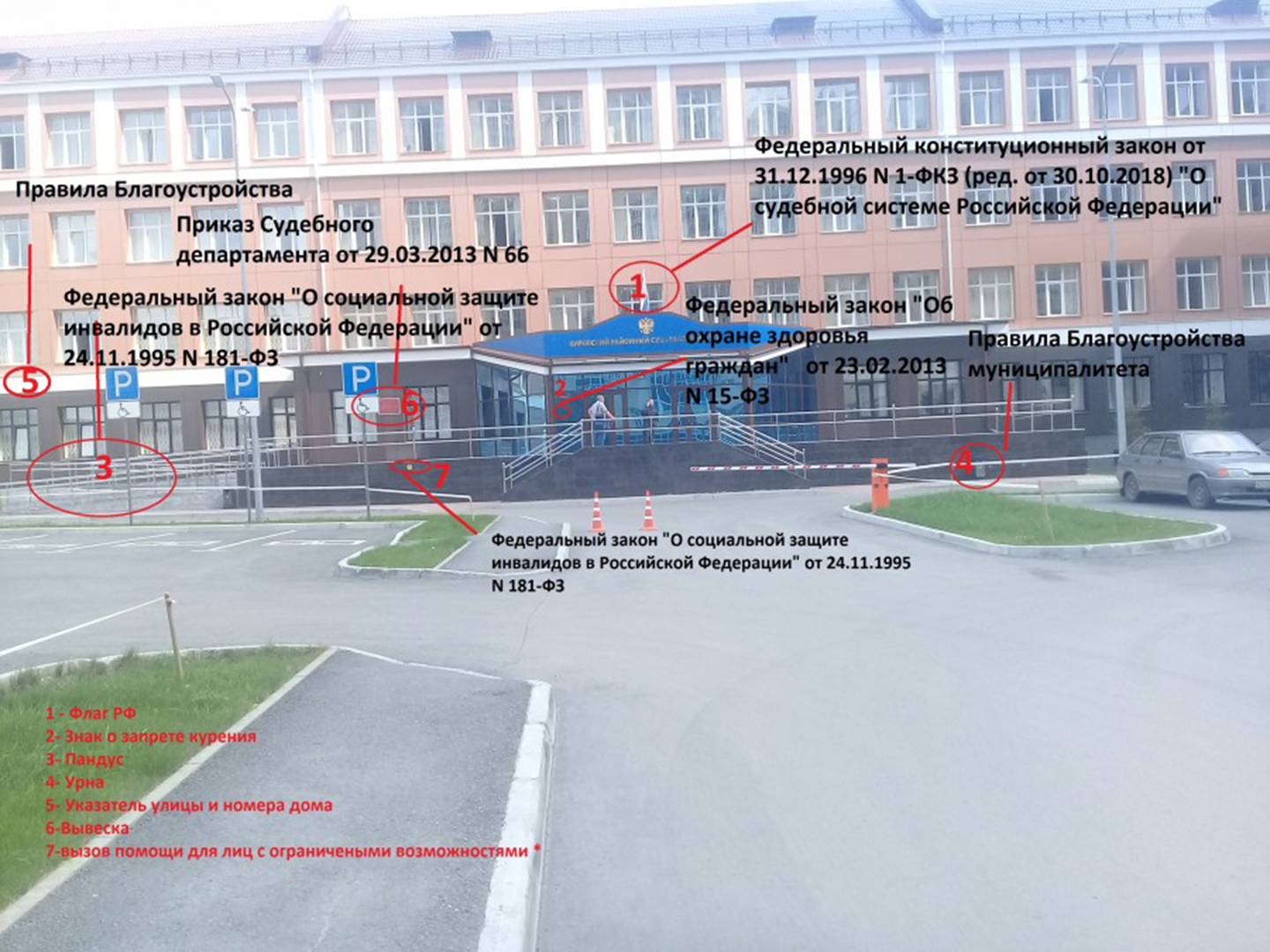
Court monitoring comes in two basic forms: monitoring court buildings to see if they are complying with the basic laws on how they should be outfitted both inside and out; and monitoring of court hearings to assess whether trials are fair, procedurally correct, and comply with basic standards of justice. The “Court through the Eyes of Citizens” campaign (Sud glazami grazhdan) represents the first of these types of monitoring. It ran for seven years and had a similar approach to the police monitoring campaigns described above. The project’s organizers created a seven-item checklist from the law regulating courts (see Figure 1). In a two-week-long yearly campaign, participants were encouraged to take photos of court buildings near where they lived, and email or text them to a central repository. Any violations were then written up and sent to local and regional court authorities, who were obligated by law to respond within thirty days. Failure to respond or to make changes would lead to a second letter, this time to national authorities. The back and forth was then meticulously documented, including scans of all official correspondence, on a LiveJournal blog by one of the organizers who authored all of the complaints.Footnote 15 This program was born out of the recognition that ordinary people are often intimidated by the idea of monitoring courts without having a legal education, and was designed to involve as many people over as many regions as possible by making the format simple (Interview #2). The final two campaigns before the war, in 2019 and 2021, involved observations of courthouses in fifteen and eleven of Russia’s regions respectively.
Seven Requirements for a Court Building. Notes: The seven elements, in accordance with Russian laws regulating courthouse appearance and city buildings, are: 1) Russian flag; 2) no-smoking sign; 3) entrance ramp; 4) ashtray/trashcan; 5) placard with street name and number; 6) placard with name of court; 7) call button to be used by people with disabilities. An eighth element was later added – whether placards were written in Braille for people with vision impairments.Footnote 16
The second form of court monitoring focuses on court processes themselves. The most prominent and longest operating court monitoring organization in Russia is the St. Petersburg-based NGO Citizens’ Watch (Grazhdanskii Kontrol’), which has been engaged in various forms of court monitoring since 1992 in St. Petersburg and Rostov-on-Don. Their observers attend hearings without notifying the judge in advance. In their reports, they document each stage of the court process looking for violations of Russian law, the European Convention on Human Rights,Footnote 17 and international law (i.e., presumption of innocence, right to a speedy and public trial, equality of parties, impartiality of judges). They do this for high profile cases, like the 2017 metro bombing in St. Petersburg, but also for broader categories of cases like hate crimes, and administrative cases stemming from protest actions.Footnote 18 Sometimes this means they are the only observers in the courtroom, sometimes they are among dozens of journalists and human rights activists. In addition, they have focused on a more literal form of access to justice through an assessment of the physical accessibility of court buildings in St. Petersburg and, during the COVID-19 pandemic, access to information on court websites countrywide.
These more intensive forms of monitoring usually require someone with a legal education to assess procedural violations and to adequately document them. And indeed, Citizens’ Watch relies heavily on law student trainees and interns to help with their work. To make it possible for more people to join in their monitoring efforts, however, they have created an online course and make their entire monitoring packet available for anyone to download, complete with basic instructions and a dictionary of legal terms.Footnote 19 While the “professional” observation form is thirty-eight pages long, they try to make the process accessible to “novices” with a simple Google Form that asks several basic questions about the trial itself (did it start on time? did they allow everyone in? did the judge inform everyone of their rights? did the judge appear to listen carefully to both sides?) with some additional questions for those monitoring criminal cases. Their educational efforts also go beyond court monitoring to the operation of courts themselves. In one delightful example, they created an interactive online video game, which uses the example of a terrorism trial for Lord Voldemort to educate players about the basics of the courtroom, court personnel, and the trial process.Footnote 20
Fulfilling the goals of monitoring campaigns
As outlined above, monitoring campaigns have two simultaneous goals – improving institutional performance, and the empowerment that comes from engaging in the process. This section relates the successes and challenges experienced by interviewees in fulfilling these goals. Figuring out how to get the police or courts to do what they wanted was an endless challenge for interviewees, and a major point of pride when they succeeded. In learning to “use what they can to get what they need,” they felt empowered to push back against a system designed to disempower (Silbey and Ewick Reference Silbey and Ewick2000, 53).
Successes
Monitors relied on a combination of formal and informal pressure mechanisms to get the state to respond. Informal pressure mechanisms were usually the first line of offense, knowing that no lower-level officer wants to draw the attention of their superiors or the media. Monitors working on the Citizen and Police program noted that their direct engagement with the MVD gave them leverage – one of the best ways to get things done in the hierarchical policing system is an order from Moscow. There were also instances where agencies were completely non-responsive to reports issued by monitors, but eventually made the recommended changes anyway (Interview #2). Other monitors worked through more formal channels, using the laws that require a response to citizen complaints. These formal and informal mechanisms often worked hand in hand. Once state agents understood that a monitor was willing to engage the bureaucracy to hold them accountable, they often did things the monitors suggested. Two interviewees from a city in central Russia described this process:
Interview #41: When he first started writing complaints, most of the responses were that there was no such law, that they weren’t the right office to go to, that they didn’t know if our information was trustworthy…Well, after they wrote a refusal [to deal with the complaint], he wrote to their bosses.
Interview #8: Appealing is absolutely necessary. With all of their responses…If you’re systematic and methodical you can get anyone to give in. Every complaint letter chips away a little, every letter! The key is to not get depressed. Pressure, pressure, pressure and bam, there it is. And now they understand that it’s pointless to argue with us.
Interview #41: Now we just have to write a complaint and they fix it. They’re engaging with ordinary people. At the beginning it was very hard to communicate with them.
Later in the interview they also described even greater challenges getting responsiveness from the prosecutor’s office, but ultimately despite the institution’s significant resistance, “they ended up submitting, yes, because the law is the law. You can’t escape it. At the end of the day, you have to follow it” (Interview #8).
Monitoring campaigns teach participants to use the incentive structures contained within the bureaucracy to get the outcome they want. As noted above, monitoring can help build legitimacy for the state and improve performance, but getting more resources is also an important motivator. It is well known that local police stations, the targets of most police monitoring campaigns, are under-resourced and beat officers overburdened (Khodzhaeva Reference Khodzhaeva2011; McCarthy Reference McCarthy2014). Likewise, though courts have had increased funding over the years, there are still significant areas of neglect (Hendley Reference Hendley2017). In terms of increasing legitimacy, nearly all of the Citizen and Police inspections were featured on the station’s websites, social media, and in local papers to advertise how well police were engaging with citizens. Police leadership welcomed these coordinated inspections to show that they are open to interaction with society. With some advanced warning, they can prepare and clean up any egregious violations, but still use the inspection reports strategically to leverage more resources. In fact, police news releases about the Citizen and Police inspections frequently noted buildings that were not suitable for work, or in which basic supplies were missing. Especially for low-level officers, whose complaints about inadequate resources are routinely ignored by their superiors, monitoring provides an opportunity to air their grievances. One interviewee related the story of monitoring a beat officer’s office and finding the officer soaked in sweat sitting behind a tiny desk in a dark and humid room with no air conditioning in the dead of summer. The interviewee was outraged: “how can we expect police to work in conditions like this” (Interview #28). Eventually, the city “found” a new location for the station. Citizens Watch’s monitoring of the physical accessibility of court buildings in St. Petersburg was likewise used by court personnel to bolster their arguments to the federal Judicial Department for additional financing to make improvements.
Monitoring can also help to reveal corruption and protect whistleblowers. For example, when the Ministry of Justice allocated money to local courts to purchase flags and placards to display on their building, and monitoring revealed that these items were missing, the interviewee noted that it was a good bet that the money was embezzled somewhere along the line (Interview #8). Monitors’ presence can also protect low-level officers from pressure by their superiors. One interviewee described a situation in which a low-level traffic police officer issued a drunk driving ticket to someone who had connections with the station head. When the station head called the officer to let the drunk driver go without a citation, the officer was able to say that the monitors were there so he couldn’t do it (Interview #38). Another described how lower-level court officials reported to the monitor on the drunken escapades of their superiors, even providing pictures of the event so that the monitor could write up a complaint about their behavior (Interview #8).
Work with monitors can also offload tedious processes that police are not interested in doing. In one city, monitors examined the information stands required by law in each police station,Footnote 21 calling all of the numbers listed and discovering that many were not working. After reporting this to the police, with whom they had developed a fairly cooperative relationship, the police thanked them and removed all of the non-working numbers. The organizers of the campaign then created materials for the stations to display on the information stands about rights for the detained and the numbers to non-police hotlines that detainees can call if they experience abuse, both of which the police also now use regularly (Interview #14). Working with monitors can also have personal benefits for officers. One interviewee who had worked for several years monitoring his local police station described how the certificate from the monitors commending the station’s cooperation with citizens ended up being an important piece of the station head’s future promotion (Interview #2). Several interviewees also noted the value of these interactions for front-line police to practice interacting with citizens in a non-confrontational way, something they receive almost no training on at the police academy.
Challenges
Despite these positive examples and concrete changes, interviewees also identified numerous barriers they faced while monitoring. When asked about challenges, everyone identified having to overcome fear and distrust of monitors, which they termed the “who are you?” (kto vy) question. Sometimes this was accomplished, often it was not. Especially as civil society activity became increasingly stigmatized by the state as a “hostile element,” monitoring became increasingly challenging to conduct. In particular people working with organizations that had been designated “foreign agents” noted that the increased reporting burdens, Ministry of Justice inspections, and withdrawal of financing from domestic and international sources, had massively increased the difficulty of their work (Daucé Reference Daucé2015). In addition, this designation meant an end to previous contacts that they had been able to establish with high-ranking regional and local officials, and programs they had been working on cooperatively. Interviewees who had worked on monitoring since the 1990s also noted that as power had become more centralized in Russia, so too had law enforcement, becoming hesitant to do anything locally without direct orders from Moscow (Interview #10). Court monitors noted that bailiffs tried to block their entry in protest-related cases, even going so far as to confiscate their identification documents (Interview #5).
Another challenge was that without continuous monitoring, police may only make changes “for show” at the moment of inspection (Averkiev Reference Averkiev2015). Several interviewees related stories of going to visit a police station for an unannounced inspection only a week after an announced inspection to find that many things that were previously there had gone missing. More generally, many cooperative efforts between the police and monitoring campaigns relied on personal connections with a regional or station head, which ceased to exist when there was a transfer of station leadership. In courts, judges and other court officials met monitors with a range of reactions, from welcoming, to curious, to angry (Interview #5). But it was always a challenge to develop these more personal relationships with judges who face overwhelming caseloads and tight schedules, and do not generally interact with the audience in the courtroom or meet with monitors outside of it (Hendley Reference Hendley2017; Solomon Reference Solomon, Kubal and Kurkchiyan2018).
Empowerment
Though the interviews discussed successes and challenges of getting concrete institutional change, most interviewees believed that the biggest “success” of monitoring was the less tangible goal of empowerment and education. According to one, “It’s not data that we are after. I mean, data comes in nice. And sometimes we criticize that there is not enough of it. And that’s fair, but I mean, the main idea is actually to encourage citizen action rather than collecting data” (Interview #25). Empowerment, in other words, was a key, if not the key point of what they were doing – showing government officials and participants alike that citizens were not only under the state’s control, but that they too could control the state, and that officials had to listen. Flipping the power dynamic is also what kept many of the monitors themselves coming back for more:
That feeling that you are not a weak person. A person who the police can insult and who doesn’t understand anything in court. What they tell you to do, you do. Then all of a sudden, you have some sort of strength, you can have an influence on these terrible institutions, these terrible people in uniform. That is very inspiring. (Interview #40).
Another monitor was even more direct, “here I am an ordinary mortal, I force this state to move. I force changes in federal laws, yes, which [Duma] deputies themselves were unable to correct. I am forcing the Prosecutor General to fix his orders. This is cool! It’s just fun to force them with their own weapons” (Interview #5).
Empowerment also came through education. Interviewees noted that when they first began offering monitoring training, most attendees expressed surprise to learn basic things about the law, for example, that it was legal to appear in a courtroom without prior permission. Another described a conversation from a police monitoring training where a participant stated definitively that he would never approach a police officer because the officer would just pull out their gun and shoot him in the face (Interview #3). Education involved people learning their rights and responsibilities as citizens, but also opened their eyes to the way that the system works in reality. As one interviewee put it, with monitoring, it’s
not only that you see violations all the time, you might also come and see that because of your observation, or maybe it was like that before, it’s actually functioning to some extent. And some cases that are not considered a threat by authorities, like minute conflicts, they can be successfully resolved in court…and you can actually start trusting your own justice system more which is important for the overall well-being of the society and democracy. (Interview #21).
Discussion and conclusion: The promise and perils of monitoring
This article has discussed the successes and challenges of oversight of police and courts in an authoritarian regime, highlighting the Russian case as an example. In doing so, I demonstrate that even in authoritarian regimes, activists and state actors may find mutual benefit in oversight – for the state, a chance to gain information about the performance of low-level bureaucrats, to perform legitimacy for the citizenry, and to agitate for resources; and for monitors, a chance to push for limited changes, flip the power dynamic, and instill civic consciousness through education and empowerment. Unlike in democracies, however, in an authoritarian regime the power to permit bottom-up monitoring activities ultimately resides with the state. In Russia, despite its benefits to the regime – MVD leadership supported the Citizen and Police initiative receiving another Presidential Grant – over time, all non-regime sponsored civil society activity became seen as a threat to the state. Monitoring was caught up in this crackdown. In this final section, I discuss what the Russian experience can teach us about the promises and perils of monitoring in an authoritarian regime.
Unlike other forms of civic activism – like running for elected office, participating in official state-based oversight committees, protesting, or suing the state – monitoring has features that make it challenging for an authoritarian state to control. It is decentralized, which makes it more challenging to target individual citizens for taking part, particularly in campaigns where participants do not need to provide any identifying information to do so. While many authoritarian leaders try to push for the individualization of complaints rather than collective complaints, monitoring can successfully walk the fine line between individual (non-threatening) and group (threatening) efforts since it frames itself as helping the state (Lorentzen Reference Lorentzen2013; Chapman Reference Chapman2024). A group of individual citizens filing individual complaints makes it extraordinarily difficult for the state to regulate out of existence, a common strategy used by authoritarian regimes to suppress other forms of civil society activity. Despite Russia’s attempts to channel civil society activity into its preferred institutional structures, monitoring can always remain outside of this framework because it does not require cooperation or permission from the government, and takes advantage of institutional opportunities created by the state – the government cannot forbid talking to a police officer, entering a courtroom, or looking at a website or the outside of a building.
Even if it wanted to regulate monitoring out of existence, an authoritarian regime like Russia’s cannot do so without limiting its own access to information from below and undermining the appearance of providing transparency and accessibility to citizens. There is value to showing domestic (and sometimes international) audiences that state agencies are nominally accessible and transparent to help maintain legitimacy. Though most citizens in authoritarian regimes may not actually use these mechanisms to communicate with the state, they do care that they are available (Chapman Reference Chapman2024). As the literature on authoritarian regimes has made abundantly clear, authoritarian leaders need a variety of channels of feedback from society to overcome the fact that bureaucrats are incentivized to withhold information about the true state of things. This is particularly true of the security services (Greitens Reference Greitens2016). As described above, the Russian state has used monitoring to fulfill these goals too.
Another promise of monitoring is for its participants – empowerment in a profoundly disempowering situation. Modern authoritarian regimes rely on citizen disengagement, atomization, and apathy to maintain their power. Monitoring shows citizens that they can not only ask for something from the state, but may even get it. Concrete changes of course benefit certain constituencies – the detainee who now has better information about their rights, the disabled person who needed access to the police station or court and who now has a ramp – but even these small successes can have important symbolic meaning. Interviewees understood this well, often making the point that given the political system they were operating in, success ought not to be measured by larger scale reform. At one monitoring training, the facilitator told participants,
Be prepared for no one to understand what you’re doing. They’ll ask: “why do you care about a bench in the courthouse [for someone to sit on] when the acquittal rate is less than 1%.” Sometimes the state doesn’t understand us, and sometimes other activists don’t understand us, they think we need to be fighting for a brighter future, a revolution in state power. But we’re interested in small changes, in small steps.
Small improvements like the police treating them professionally and politely, even if it was pragmatic because they knew that rude behavior would be reported to their bosses, were goals that they were proud to have accomplished. One interviewee noted that the back and forth with state officials was particularly important in a system that provides limited horizontal connections between ordinary citizens and the state, and instead only offers vertical ways to ask for change (Interview #10).
At the same time, monitoring as an organizational form has inherent drawbacks. The decentralized nature of these activities means they are heavily reliant on volunteer labor and societal interest. While one committed monitoring activist in a city can act as a central coordinating point for others and get a monitoring program off the ground, there were still very few cities across Russia in which this was the case. Reaching new audiences was regularly described as a challenge by monitoring activists. Several interviewees mentioned that monitoring as a form of civic engagement was no longer as “trendy” as it was during the Medvedev era and had fallen “out of fashion” over the past several years. Moreover, monitoring is not a quick fix solution to problems with police and courts. It requires a long-term and often dogged commitment to breaking down trust barriers and multiple yearly visits to police stations and courts to continue to hold authorities accountable.Footnote 22 As interviewees noted, not everyone is patient enough to do activism this way.
Similarly, the decentralized, do-it-yourself philosophy of monitoring – that anyone should be able to do it at any time – creates a catch-22. Without some degree of institutionalization (and compensation), there is little incentive to engage in the more time-consuming aspects of monitoring – collation of information, report writing, and filing complaints. Interviewees almost all had paid employment which either encompassed activism as part of their job, or enabled this (very time-consuming) hobby. One who had been very involved in police station monitoring described the onerous volunteer work of running a monitoring campaign: “Over four years we went to every single station in the city. It was 130 of them!…Every time, we organized the campaign for two months, went to the stations for two months and then spent another six months writing the report.” After six years, they became disillusioned with the inability to get compensation for their labor and stopped being involved altogether:
It seemed to me that without resources it’s pointless to do this because it takes a long time to write our summaries…and by the time they’re done, they’re no longer up to date… At the end, the police took our report and said: “Thank you for your civic activism” and that was it. I decided that it was pointless to waste my time. (Interview #11)
While these organizational challenges apply to monitoring efforts regardless of regime type, the authoritarian context adds additional perils. The primary one is risk. When monitoring campaigns become more institutionalized as formal organizations, they become at greater risk of government scrutiny and potential closure. As an activity, monitoring is not inherently anti-regime. In fact, it is usually framed as just the opposite. Interviewees repeatedly told me that they would be doing the same whether Putin was in power or not, that they worked with groups of all political persuasions, and that their own personal politics were unrelated to their oversight activity. On the other hand, monitoring can easily be felt by the regime as a threat, particularly by local bureaucrats who can use their administrative resources and power to retaliate. For most people I spoke to, safety was a paramount concern, not so much for themselves – they understood and were willing to accept the risks – but for other participants, who they did not want to be dissuaded by undue pressure. Campaigns like “Court through the Eyes of Citizens” deliberately designed their programs to create maximum anonymity for participants, who can simply send in their photographs with no personal information attached. Technological advances and open government initiatives like the requirement to post court hearing information and judicial decisions on websites have also opened up avenues for monitoring that do not require interaction with officials.
Of course, the greatest risk to monitoring is a crackdown by the state. Whereas some authoritarian regimes like China’s have figured out how to make use of oversight activities insofar as they do not threaten the broader social order (King, Pan, and Roberts Reference King, Pan and Roberts2013; Lorentzen Reference Lorentzen2013), the Russian state ultimately decided that any form of civic activism was a threat that needed to be eliminated. Starting in 2021, using a variety of legal tools, the state began a broad crackdown on independent civil society organizations and media, and against any perceived influences from the West. The 2022 war in Ukraine hastened these developments. After forty-seven years of operation spanning Soviet and post-Soviet Russia, the Moscow Helsinki Group was shut down in January 2023 by court order for “working outside its official location of registration,” Moscow (RFE-RL 2023). Nearly all the people I spoke with are now subject to legal liability for being associated with a foreign agent organization, if they have not already been declared foreign agents themselves. Many have left Russia. No police or court monitoring campaigns have occurred since the war began, and the only remaining court-watching initiative is Citizen’s Watch in St. Petersburg, which has continued to do heroic work monitoring and documenting war-related and other politically sensitive cases.
In conclusion, monitoring as a mechanism for oversight and accountability can only be successful in changing institutional behavior in an authoritarian regime when the state sees its benefits, and civil society is free enough to take advantage of the opportunity. But if we expand our understanding of success beyond concrete changes to the empowerment created by participating in the process itself, the story is somewhat less bleak. Especially for participants in these campaigns, the development of an underlying civic consciousness on oversight accountability, the knowledge of how legal institutions should work, and the opportunity to participate in local-level engagement and spur change in the most closed of authoritarian institutions, may continue to resonate in the future.
Acknowledgments
Special thanks to Hannah Chapman, Renata Mustafina, Will Pomeranz, Peter Solomon, Sindiso MnisiWeeks, and the anonymous reviewer, who all offered helpful comments and ideas to develop this paper. This paper was also presented at ASEEES 2023 and at several other workshops and I am grateful to those who commented on it in those venues.
Data availability statement
All replication materials are available on the Journal of Law and Courts Dataverse archive.
Appendix
Semi-structured interview protocol (translated into English)
-
1) Tell me about your work in the field of citizen oversight (grazhdanskii kontrol’).
-
2) How and why did you start working in this field? What motivates your work?
-
3) What, concretely, are you hoping to change? What are your goals?
-
4) What have been your successes in your work?
-
5) What tactics have been the most successful?
-
6) Have you noticed any changes in the behavior of the police/courts? Are they open to cooperation?
-
7) What have been the challenges/difficulties in your work?
-
8) How do government agencies/the police/the courts react to your work?
-
9) Do you think that citizen oversight can change the situation for the better in the long term?
-
10) What do you think about the official [state-based] bodies doing citizen oversight?
-
11) Do you work with other organizations in other regions?
-
12) Who else would you recommend I talk to?


 Open access

