1.1 From Language/s to Languaging
You might assume that I speak, write, and use Mongolian fluently, since I am Mongolian by birth, raised in Mongolia, and spent most of my childhood there. I do consider Mongolian as my first language – the language of my homeland and my mother tongue. However, I must admit, somewhat reluctantly, that I am not able to produce “pure” academic written Mongolian system, as I have not been immersed in that system for the past two decades due to my migration to Australia. This long-term separation from formal Mongolian academic contexts has limited my ability in its academic conventions. In contrast, I have been more actively engaged with academic English, having had direct access to it since I settled in Australia. However, I still speak English with my own accent – nonstandard and not so perfect Mongolian-accented English (Dovchin, Reference Dovchin2024a). I have also had direct access to and exposure to the Russian language since childhood, due to Mongolia being under Soviet rule for seventy years until the collapse of the Soviet Union in 1990. This historical context allowed me to learn Russian early on, but since my connection with the language was disrupted after the Soviet Union’s collapse, I do not consider myself a fluent Russian speaker, even though I can understand Russian movies or news. Later in life, I worked in Japan and learned some Japanese, but not at a level of fluency or native-like proficiency – just a few phrases and expressions here and there (Dovchin, Reference Dovchin, Milak and Tankosic2024b). From this perspective, it makes little sense to classify myself as a “pure” language user in either Mongolian or English, or in Japanese or Russian. My linguistic practice is shaped by complex indexicalities, drawing on all available linguistic resources – language contact, accessibility, and contextual availability. What I do with what languages I have is not a reflection of linguistic purity, but rather a response to the conditions under which I live, work, and communicate. My birthright to Mongolian language does not guarantee mastery across all its registers. Similarly, my direct exposure to English coexists with an accent that conflicts with dominant standard English norms. My case here somewhat illustrates that real-life language use is not merely about purity or proficiency but more about access, contact, exposure, and the evolving contexts of its use over time.
Mainstream applied linguistics has traditionally adopted an ontological stance that treats language as a bounded and self-contained entity with clear rules, purity, and internal structured organisation. This structuralist perspective has had far-reaching implication for how languages are understood, taught, and studied – particularly in relation to standardisation, grammar, and the construction of so-called legitimate or true languages (Gramling, Reference Gramling2016, Reference Gramling2021; Lee, Reference Lee2022; Makoni & Pennycook, Reference Makoni and Pennycook2005; Matras, Reference Matras2025; Pennycook, Reference Pennycook2024). Language is often viewed as a biological trait we have – humans’ innate capacity for language – our brains are wired for acquiring and processing language. This includes abilities like hearing sounds, producing speech, and understanding grammar, which are rooted in our biology (Millikan, Reference Millikan2005). Viewing language as a single, unified system that humans have inherently implies perceiving it as a fixed, autonomous entity that exists independently of its users – akin to a ready-made set of rigid rules or structures that precede and govern actual communication. Within this ontological position, language is seen as something fixed and separable – something that can be named, fixed, purified, and measured (Otheguy et al., Reference Otheguy, García and Reid2015). Often, language is thought of as a static, pre-existing entity – a system with clearly defined boundaries, grammar, vocabulary, and rules that are established independently of how people actually speak or interact. This view imagines language as something complete and unchanging, waiting to be used by speakers who simply apply these preset rules when communicating. This conception assumes that language is a completed, unchanging system, passively waiting for speakers to merely activate and reproduce it with precision and fidelity. These elements are regarded as objective and universal truths, existing outside and regardless of the dynamic realities of human interaction.
The languages I have in me, from this perspective – Mongolian, English, Japanese, and Russian – could be seen as belonging to four distinct, bounded language systems, each judged against idealised notions of linguistic “purity” and “correctness.” Whenever I switch between languages or blend them, it has sometimes been perceived as a deviation from these norms. In my own experience, I have always felt the pressure to demonstrate my strongest multilingual competence precisely by aligning my use of Mongolian or English, by extension Russian and Japanese, with established monolingual norms – emphasising purity and correctness – especially in formal or professional settings. Whether in meetings, presentations, or official communications, I found myself consciously adjusting my language to fit dominant expectations. This pressure reveals the persistent power of dominant monolingual frameworks that continue to shape what is considered appropriate and legitimate language use. As a result, like many multilingual individuals, I often strategically adopt monolingual behaviours to navigate social expectations, gain acceptance, and enhance my credibility or effectiveness. This personal negotiation has made me keenly aware of how rigid, essentialist views of language obscure the flexible, hybrid, and deeply contextual nature of multilingual communication as it unfolds in real life.
In everyday contexts – as I mentioned earlier and reiterate here – “what I do with the languages I have is not a reflection of linguistic purity,” because English, Mongolian, Russian, Japanese, and so on that I have in me are certainly not “pure” in any prescriptive sense. Rather, what I do with these languages shapes the nature of my everyday communication. For instance, when chatting with a friend, I might ask a question in Mongolian, with some integration of English expressions to describe something technical like a phone app and then finish with a Russian phrase to capture the exact emotional feeling – each shift happening naturally as part of the flow of conversation. This insight fundamentally challenges the traditional ontological position that views language as a fixed, bounded, and pure system. Such a view not only reduces language to a mechanical code to be mastered but also enforces an illusion of linguistic purity and homogeneity. It overlooks the profound complexity and variability inherent in real-world language use, where meaning is continuously negotiated, reshaped, and reinvented within social contexts. It denies the creative, adaptive, and fluid nature of language as a living practice – one that evolves with culture, identity, and power relations.
This traditional ontological position, which views language as a fixed, bounded, and pure system, is itself a constructed invention (Gramling, Reference Gramling2016, Reference Gramling2021; Makoni & Pennycook, Reference Makoni and Pennycook2005; Reagan, Reference Reagan2004). Reagan (Reference Reagan2004, p. 42) provocatively suggested a decade ago, “there may not actually be such a thing as English. In fact, my argument goes further – not only does English not truly exist as a fixed entity, but neither do Russian, French, Spanish, Chinese, Hindi, or any other language” (p. 42). To support this bold assertion, Reagan (Reference Reagan2004) highlighted that the concept of languages as stable, bounded entities is problematic from both historical and social perspectives. Historically, language has always been evolving and changing, meaning any attempt to define the boundaries of a language only captures it at a specific moment in time and place (Reagan, Reference Reagan2004, p. 44). Socially, language varies depending on context, individual speakers, social class, gender, and other factors. Reagan (Reference Reagan2004, pp. 44–46) proposed that a language is essentially a collection of individual speech varieties – or idiolects – that have been grouped together for reasons beyond purely linguistic criteria. He concluded by advocating for a critical awareness of language that adopts a constructivist approach, rejecting the positivist tendency to treat language as a fixed object, in favour of a more complex, nuanced, and sophisticated understanding of language (Reagan, Reference Reagan2004, p. 56). Building on Reagan’s claim, Makoni and Pennycook (Reference Makoni and Pennycook2005) asserted that while it is notable that new linguistic categories have been given invented names, the more important issue goes beyond just naming. Many languages were constructed and named within the context of colonial and missionary activities. At the same time, a system of classification – a metalanguage or overarching discourse – was also created to organise languages into distinct, countable units. This classification system promoted the idea that languages are fixed, separate entities, an idea reinforced by the existence of grammars and dictionaries that treated languages as institutionalised objects. These inventions had tangible consequences: they influenced how people understand languages, shape language policies, impact educational practices, and affect individual and group identities linked to linguistic labels. A critical approach to language studies, therefore, must involve questioning and deconstructing these invented categories. This “disinventing” process requires recognising the historical origins of these concepts and reimagining how languages relate to identity, place, and social life today. Their goal was not to romanticise a return to a pre-colonial linguistic landscape but to find new, critical ways of understanding language in the modern world.
More recently, David Gramling (Reference Gramling2016, Reference Gramling2021), in his works The Invention of Monolingualism and The Invention of Multilingualism, has presented a critical rethinking of how language in relation to the concepts of monolingualism and multilingualism was understood. He has argued that neither language nor multilingualism exist as fixed, natural, or purely linguistic entities. Instead, these concepts were socially and politically constructed, deeply embedded within power dynamics and historical contexts. Gramling, in this sense, challenges traditional essentialist and structuralist perspectives that view languages as pure, bounded systems with clear-cut boundaries. Instead, he insists that what counts as a “language” or as “multilingual competence” is always defined and regulated through social practices, prevailing ideologies, and institutional policies. A key focus of Gramling’s analysis is how multilingualism, rather than being an organic reflection of people’s everyday linguistic realities, is often deliberately “invented” or framed in particular ways to serve nationalist agendas or reinforce existing social hierarchies. Official definitions and institutional categorisations tend to impose rigid boundaries on what qualifies as a language or legitimate multilingual ability. These boundaries privilege certain languages – usually those associated with political and economic power – while marginalising others, thus denying the hybrid, fluid, and dynamic linguistic repertoires that many individuals and communities actually use in daily life. Furthermore, Gramling has shown how languages have increasingly been treated as standardised, monolithic codes designed primarily to serve the interests of dominant elites. This institutionalised vision of language as a fixed system has become deeply entrenched in educational systems, government policies, and social norms. As a result, individuals and entire communities are often judged and marginalised based on their perceived deficiencies in adhering to these dominant language standards. This can perpetuate exclusion, discrimination, and linguistic injustice, as the diversity and hybridity of real-world language use are disregarded or devalued. Ultimately, Gramling’s work has revealed how language ideologies are not merely abstract theories but have concrete consequences for how people experience identity, social inclusion, and access to resources. By exposing the invented nature of monolingualism and multilingualism, he calls for a more critical and inclusive approach to understanding language – one that recognises linguistic diversity as dynamic, fluid, and inseparable from social and political realities.
By clinging to this narrow, prescriptive, and invented model, we risk perpetuating rigid linguistic hierarchies that marginalise dialects, hybrid forms, and fluid linguistic practices. This perspective not only limits academic understanding but also influences education, policy, and societal attitudes in ways that stifle linguistic diversity and the rich, dynamic realities of how people actually communicate. For example, Moyer (Reference Moyer, Cabrelli, Chaouch-Orozco and Alonso2023, p. 98) argues that nationalist discourses have emerged, relying on “a homogenous language system based on linguistic criteria to define belonging to a community of speakers but also as a source of identity and nation-state building.” The myth of monolingualism has remained as the norm in many spheres of linguistics as well as in popular thinking (Moyer, Reference Moyer, Cabrelli, Chaouch-Orozco and Alonso2023, p. 98). This is because “the idea of a single nation with one language system has been promoted at the expense of negating variation and language diversity existing within a given nation or state” (Moyer, Reference Moyer, Cabrelli, Chaouch-Orozco and Alonso2023, p. 98). Aligning with Moyer’s idea, Nystrom’s (Reference Nystrom2025) recent study also highlights how Canada’s multicultural image is, in fact, creating monolingual realities within multilingual families. Its official bilingual policy privileges English and French, effectively marginalising other languages, actively constructing linguistic boundaries. This privileging of English and French creates an uneven linguistic landscape that marginalises the rich diversity of other languages spoken by immigrant communities across the nation. These national language policies do much more than merely regulate communication at the societal level. They actively construct and reinforce linguistic boundaries that influence how families use language in everyday life. These policies shape parental language choices and children’s language learning environments, and ultimately drive intergenerational language shifts – where heritage languages are displaced by dominant official languages. In doing so, these policies contribute to creating monolingual realities inside families that were once multilingual, leading to significant cultural and identity implications for future generations.
Similarly, in Australia, clinging to invented models of language has had profound implications for education and policy, particularly within the Australian schooling system’s approach to First Nations children (Steele & Oliver, Reference Steele and Oliver2024). The prevailing single-minded emphasis on English language and literacy skills has largely overlooked the linguistic identities of these learners, as well as the broader social, cultural, and political contexts that shape their language practices. This approach failed to recognise that First Nations children navigate complex multilingual realities deeply intertwined with the ongoing processes of colonisation. By prioritising literacy narrowly defined in terms of English proficiency and correctness, educational policy effectively sidelined the rich linguistic and cultural knowledge these children bring to the classroom. The authors go on to argue that this singular focus on English-only policy represents more than a pedagogical oversight; it functions as a policy of distraction that serves as a mechanism of colonial control. Rather than fostering genuine inclusion or linguistic justice, such policies reinforce colonial structures by marginalising Indigenous languages and epistemologies. This perpetuation of dominant language ideologies sustains existing power asymmetries within Australian society, maintaining systemic inequities between settler and First Nations peoples. In effect, educational policies that insist on English literacy as the sole marker of success contribute to the erasure of Indigenous linguistic identities and uphold a colonial status quo that restricts First Nations children’s agency and full participation in their own education (Steele et al., Reference Steele, Ober and Oliver2025).
So, moving forward, how can we actively, as Makoni & Pennycook (Reference Makoni and Pennycook2005) note, “disinvent” this essentialist view of language – recognising the real risks it poses – and instead cultivate more inclusive, dynamic understandings that reflect lived linguistic realities? Jerry Lee’s Locating Translingualism (Reference Lee2022) opens with a compelling metaphor: a bird soaring high above the earth, surveying the landscape for sustenance. It spots a caterpillar – yet something seems amiss. This caterpillar has evolved to mimic a snake, complete with eyespots and movements that deceive even the most vigilant predator. The bird hesitates, uncertain whether it faces prey or a threat. This image aptly introduces Lee’s investigation into the complexities of language and culture in a globalised world. Just as the bird must interpret ambiguous signs to survive, humans continuously decode cultural and linguistic cues to navigate social realities. Yet, these signs – like the caterpillar’s eyespots – can be misleading, partial, and deeply dependent on context. Building on this metaphor, Lee urges us to reconsider how we conceptualise language and cultural interaction. He cautions against limiting our understanding to how individuals from distinct cultures – “culture A” and “culture B” – communicate across their dominant languages, “language X” and “language Y.” Lee critiques this framing for assuming communication merely bridges gaps between fixed linguistic and cultural boundaries, a simplification that obscures the fluid and contested nature of these boundaries themselves (Lee, Reference Lee2022, p. 270). In this light, the author invites readers to adopt a “bird’s-eye view” of language – not as a fixed, discrete system of codes, but as a dynamic semiotic practice shaped fundamentally by spatiality, movement, and interaction. He challenges traditional conceptions of language as bounded, countable entities and instead foregrounds translingualism as a fluid, everyday reality where communication flows across and beyond established linguistic borders. Language in this respect – manifested through signs and semiotic landscapes – becomes a vital site of inquiry, revealing how cultural identities are represented, negotiated, and at times reinvented.
Indeed, the consequences of this sort of understanding of the language were already highlighted by Haugen (Reference Haugen and Dil1972, p. 25) many decades ago: “The concept of language as a rigid, monolithic structure is false, even if it has proved to be a useful fiction in the development of linguistics. It is the kind of simplification that is necessary at a certain stage of a science, but which can now be replaced by more sophisticated models.”
These words from Haugen (Reference Haugen and Dil1972) contribute to our understanding of the underlying ideas that have shaped the object of inquiry, whereby the existence of language is so deeply entrenched in the predominant paradigm of language studies that they are rarely questioned. When people are speaking “different” languages, the structuralist view encourages us to focus on the distinctiveness of those languages – as if each one exists independently of the others. But this raises an important question: how do we account for why one language, variety, or form is used in a particular context over another? Such questions challenge the assumption that language use can be fully explained by structural properties alone. Instead, the call for an ontological shift towards understanding language is socially embedded, relational, and dynamic – something that emerges through interaction, shaped by history, power, and identity (Gramling, Reference Gramling2016, Reference Gramling2021; Gurney & Demuro, Reference Gurney and Demuro2023; Makoni & Pennycook, Reference Makoni and Pennycook2005; Matras, Reference Matras2025; Pennycook, Reference Pennycook2024). This call has been instrumental in revealing how the notion of language as a fixed and homogenous system is itself an invention that remains to be persistent by numerous ideological constructs and how effective communication can occur even when it challenges traditional norms that prioritise dominant perceptions of language boundaries.
In this book, I approach language not as a fixed object, bounded system, or innate biological possession, but as a living practice – something people do, not something they inherently are or have. Language, in this view, is shaped by use, by context, and always in motion rather than biologically predetermined or static. Language starts from the speaker, not from the code, grammar, or syntax. Seeing language this way helps us better understand how languages are constantly being shaped, reshaped, and negotiated through everyday interactions. This view rejects static definitions of language handed down through structuralist linguistics and instead focuses on showing language emerging through real-life social processes. The view – something people do, rather than something they inherently have – has been explored through a range of “languaging” perspectives: from translanguaging (Lee & Li Wei, 2025; Wong & García, Reference Wong and García2025), polylanguaging (Arellano & Torres-Vásquez, Reference Arellano and Torres-Vásquez2025; Jørgensen et al., Reference Jørgensen, Karrebæk, Madsen, Møller, Arnaut, Blommaert, Rampton and Spotti2015), and linguascaping (Dovchin, Reference Dovchin2018) to translingual practice (Canagarajah, Reference Canagarajah2012; Lee, Reference Lee2017, Reference Lee2022) and metrolingual practice (Pennycook & Otsuji, Reference Pennycook and Otsuji2015). While each of these frameworks has distinct contextual and analytical roots, they share a common focus on the dynamic, fluid, and socially embodied nature of language use, challenging traditional views of language as a fixed and bounded system. While polylanguaging focuses on the languaging practices of urban youth in European social media contexts, metrolingualism examines everyday interactions among migrants in urban marketplaces and corner shops in Australia. Linguascaping, in contrast, broadly concerns the visual and spatial dimensions of language within linguistic landscapes. Translanguaging primarily relates to pedagogical contexts, where speakers strategically and fluidly draw upon their entire linguistic repertoires to facilitate learning, communication, and identity expression. In this book, however, it is not my aim to delineate all these conceptual distinctions. The notion of languaging already encompasses these various “-ing” dimensions of language use, representing a more integrated and holistic approach to understanding how people make meaning through language – an issue I have already addressed elsewhere in the book. Languaging, therefore, is understood as the active, embodied process of doing language. It is not something people are born with, but something they do – learned, shaped, and transformed through lived experiences and social interactions. Languaging is not an inherited trait, but an ongoing embodied experience and practice of meaning-making in the world. It is something people enact, perform, and reshape in response to the demands of their lived realities. Languaging is fluid and agentive – a practice rooted in doing, not in having.
Cowley’s (Reference Cowley2019, Reference Cowley2024, p. 1) vision on languaging takes on new life here. He argues that if we consider languages as structures, we might fail because “as structures, languages merely interact with other structures (in theories).”
Descriptions of linguistic forms, functions, sentences, X bars, concepts, etc., do nothing at all. Living beings do not use mental proxies of symbols (“language”), but, rather, practices, bodies and brains. … Given how human subjects use languaging, agency is transformed by languages and practices. As we co-act, coordinative activity combines with the wording types that are also used in describing linguistic structure.
With the vision of languaging, Cowley (Reference Cowley2019, Reference Cowley2024) turns to the notion that encompasses doing, thinking, talking, and understanding. When people communicate together – that is, when they co-act – they engage in more than just exchanging words. They participate in a coordinated social activity that involves gesture, tone, timing, shared understanding, and mutual responsiveness. In this process, the fluid and response nature of languaging (spontaneous meaning making in real time) interacts with more conventionalised, recognisable forms of language, such as vocabulary, grammar, and syntax – what Cowley (Reference Cowley2024) refers to as wording types. These wording types are the same elements typically analysed in formal linguistics descriptions. In other words, human subjects are involved in languaging to do linguistic structures rather than having languages. Humans are “made in languaging” – not as a matter of having languages but as a way of actively enacting, shaping, and uttering linguistic structures. This integration of dynamic interaction shows that structure, in fact, emerges through coordinated social action. In other words, language structure is not just a pre-existing code we draw from – it is continually shaped and reshaped by how we use it in interaction.
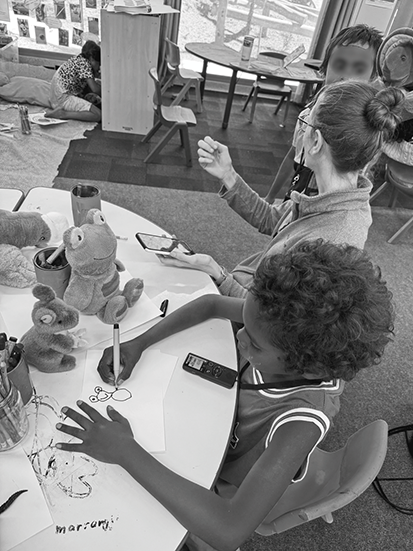
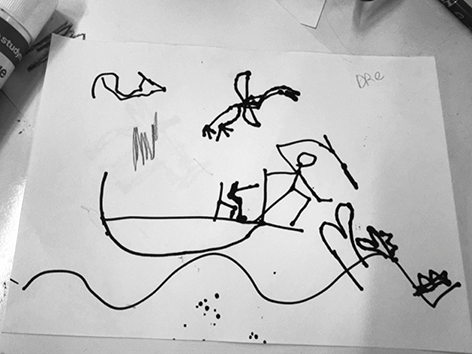
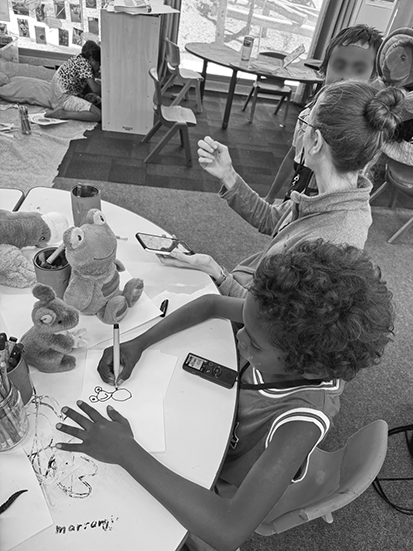
I recall one example when I was visiting a remote school in Purnululu School, (Frog Hollow (see also Dovchin et al., 2026) in WA, I connected with a young Aboriginal boy who was eager to show me his drawings (see Figure 1.1). I will discuss my encounters with the Aboriginal school in more detail in Chapter 2. He proudly held up one and began explaining it to me Dovchin et al. (2026). I asked him in Standard Australian English (SAE), “Can you please explain to me what this picture is about?” He responded in Kriol, “Dasda berd flaiyen awei en dasda peeboorl gada rowep an dasda men wen ee draiben an ee traina sbeeya ad da krogedail” (that’s a bird flying away that that’s people with a rope and that’s a man when he’s driving and he’s trying to spear at the crocodile). Although I did not fully understand everything he was saying, I could see how animated and enthusiastic he was. Wanting to keep the conversation going, I asked another question in SAE: “Spearing the crocodile, wow, why is he spearing the crocodile?” He replied again in Kriol: “So ee, so ee, so ee jagem indoo det eemyoo” (so he, so he, so he chucked it (the spear) into that emu) (see Figure 1.2) (Dovchin et al. 2026).
David is drawing
David’s artwork
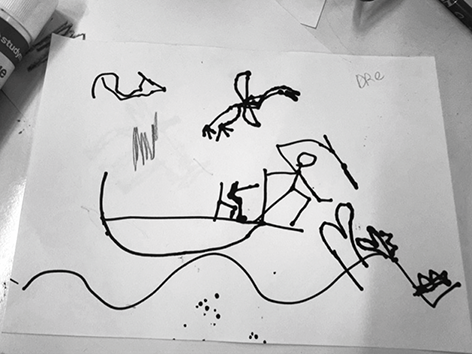
Here, our interaction was “made in languaging,” as Cowley (Reference Cowley2019, Reference Cowley2024) would say, where doing, thinking, talking, and understanding converge in a moment of shared engagement between a child and me. Our conversation was not merely a mix of Kriol and SAE but an example of spontaneous meaning-making in real time. The Aboriginal boy’s language practice did not align neatly with traditional models of language competence. He does not have English in the standardised monolingual sense, nor does he possess a singular, fully developed academic register in any one language. Yet, through languaging, he actively “did language” – navigating concepts, identities, and relationships across linguistic boundaries. Rather than drawing from separate, bounded languages, he engaged in a languaging, constituting meaning by drawing on the linguistic resources available to him in the moment. We were not having language but rather doing language within a shared social context. Although I was not able to fully grasp the linguistic content, the relational and affective cues – such as the child’s excitement, tone, gesture, and engagement – guided our interaction. The boundaries of language systems (e.g., SAE, Kriol) were already blurred at this stage in favour of real-time meaning negotiation. Our interaction was not comforting to standard grammar, linguistic compatibility, or purity, but meaning emerged nonetheless through co-actions and responsiveness. This reflects the idea that humans are “made in languaging” – not defined by the possession of discrete languages but by their participation in socially situated, emergent acts of communication.
Languaging, therefore, invites us to focus on social action and interaction, rather than abstract systems. Through this lens, language becomes a dynamic, open-ended, and context-dependent activity. As Pennycook (Reference Pennycook2024, p. 4) reminds us, “if we are trying to deal with real-world contexts, it doesn’t really make sense to draw on theories of language that haven’t emerged from such contexts.” Language is shaped by its speakers, situated in time and place, and deeply intertwined with the physical and social environments in which it occurs. Words, gestures, tone, bodily movements, and material objects all come together in the act of languaging – highlighting that language is not separate from the world but deeply of the world. By framing language as languaging, this book challenges conventional, objectified views of language that dominate much of applied linguistics. Instead, it centres a view of language as an emergent, lived, and embodied practice – one that resists tidy boundaries and demands that we pay attention to the messy, creative, and socially embedded nature of communication (Dovchin et al., 2026).
Languaging reminds us of Judith Butler’s statement “we do things with language” (Butler, Reference Butler2021, p. 8), in which she theorises that speech is not merely a vehicle for conveying information, but an act performed to produce effects that align with, or challenge, norms constituted by juridical and political systems (Butler, Reference Butler2006). When Butler says “we do things with language,” she invites us to see speaking as a form of action in itself – an act that can shape the world around us. Drawing on Austin’s speech act theory, Butler emphasises that words do not simply describe reality; they enact it. For example, the phrase “I now pronounce you married” does not just state a fact but actively changes people’s social and legal status. Every utterance carries the power to effect change. Butler extends this idea by showing that language is deeply intertwined with power: each time we speak, we are either reinforcing or resisting existing social and political norms. Words have real, material effects – they can open doors to rights and opportunities or inflict harm and exclusion. Language is performative: it does not merely reflect the world; it actively shapes it. In Butler’s view, language is not a static mirror but a dynamic tool through which society is continuously created and transformed. In this book, language understood in this way is languaging. Language is performative – it does not just repeat the world, it makes it. For this book, that active, world-shaping process is languaging.
1.2 Languaging or Code-switching?
“What is the difference between code-switching and languaging?” This question resonates widely – not only within the specialised field of applied linguistics but also among undergraduate students, passionate language enthusiasts, educators, policymakers, and even seasoned linguists. It reflects a fundamental curiosity about how people navigate multiple languages and language varieties in real life (Balam, Reference Balam2021; Goodman & Tastanbek, Reference Goodman and Tastanbek2021; Treffers-Daller, Reference Treffers-Daller2024). When we talk about languaging, however, we must ask: are we simply referring to the act of switching back and forth between discrete linguistic codes, as implied by code-switching, or are we engaging with a more dynamic and holistic process of languaging – where speakers draw from an integrated, fluid linguistic repertoire that transcends conventional language boundaries? To answer this question, I follow Pennycook’s (Reference Pennycook2024, p. 8) suggestion around code-switching versus languaging:
people are talking about different things, some focusing on language as structure (How do we account for one language or another being used in a particular context?), others on language practices (What are people doing with different linguistic elements?).
This distinction is not merely semantic. Code-switching traditionally frames language use as alternating between separate, fixed systems – each with its own rules and boundaries. Indeed, when people are talking about code-switching, it is most often based on the understanding that the code-switchers function as two or three separate monolinguals. This means that each linguistic code used by code-switchers is expected to be produced “purely” and “fluently,” as if it were independent and unaffected by the influence of the other languages (Ag & Jørgensen, Reference Ag and Jørgensen2013). For example, while reminiscing (having a conversation) with the Mongolian nomadic herders, we began discussing the role of English in their lives, a topic I will explore in more detail in Chapter 3. In a playful tone, the herders described themselves as “multilinguals” shaped by today’s globalisation. One of them said, “Opa ni govoryu po Ruskii, and bas English. Buh heleer yarina shuudee.” From the norms of the code-switching, this herder appears to be code-switching across Korean (Opa ni – your friend, your folk), Russian (govoryu po Ruskii – speak Russian) and Mongolian (Buh heleer yarina shuudee – We speak all languages). This highlights how code-switching is often compartmentalised into distinct language systems such as Mongolian, English, Korean, and Russian. Under this norm, when someone switches from the codes such as Mongolian to Russian or Korean, they are expected to speak each language “purely,” as if functioning as two or three separate monolinguals – one speaking Mongolian, and another speaking Russian. This also means that people who can formulate more than one language will employ their multiple monolingual capacities in any given context appropriate to the relevant discussants’ needs and language skills (Ag & Jørgensen, Reference Ag and Jørgensen2013; Jørgensen et al., Reference Jørgensen, Karrebæk, Madsen, Møller, Arnaut, Blommaert, Rampton and Spotti2015). The main norm of the code-switching, thus, is the principle of double or triple monolingualism – individuals who speak two or more languages are expected to use only one language at a time, and to use each language in a way that mirrors monolingual speakers. This norm assumes that languages exist as separate, bounded systems and promotes the belief that each should be used in a “pure” form – without blending elements from other languages. Within this framework, code-switching is accepted, but only as the alternate use of two or three distinct language systems. Even in translingual interactions, speakers are expected to switch clearly from one language to another, maintaining clear boundaries between them. This reinforces the idea that multilingual speakers must compartmentalise their languages and align their use with monolingual norms.
Related to this understanding of language, the epistemological knowledge of languaging challenges the norms of code-switching. The main critical questions are widely circulated: What if the language users do not necessarily orient to the distinction of separate language systems when they code-switch? What if they instead adapt to a communicative norm where they use all available resources to achieve their communicative aims? Then it is not suitable to categorise, for example, code-switching as bi/multilingual communication because it relies on the separability of pure linguistic categories. The norms of code-switching become much more complicated when the speakers are not necessarily fluent or pure in the languages they use. During my conversations with those Mongolian nomadic herders (see Chapter 3), it became clear that code-switching in their context does not follow conventional boundaries. The herders are not fluent in either Korean, English, Russian or English – yet freely blend them with Mongolian in everyday speech. This mixing does not stem from clear distinctions between first and second languages but rather reflects how their conversation is “made in languaging” – shaped by former Soviet influence in Mongolia, English through media, and casual borrowings from Korean popular culture – has become a localised mode of communication. The herders’ linguistic practice forms a kind of grassroots lingua franca, not defined by fluency but by flexibility, creativity, and their positioning in today’s globalised world. This observation aligns with recent neuroscience, which tells us that human brain pools bring together elements and features from different semiotic resources while (re)coordinating, (un)selecting, and (de)activating specific parts of the linguistic repertoire for different purposes and in different contexts (Kroll & De Groot, Reference Kroll and De Groot2009). The brains of multiple language users also command paralinguistic resources: from genres, gestures, styles, and modes to emotions, attentions, and memories when articulating language as part of everyday communication (Li, Reference Li2018). Multilinguals should not be thought of as multiple monolinguals coexisting in one mind. People rarely use language in a completely “pure” form. Instead, language users navigate intricate and layered criteria when selecting linguistic resources in specific contexts. Therefore, it is misleading to label code-switchers as “pure” language users, since their choices reflect complex linguistic indexicality and the fluid relationships between linguistic resources and conventional notions of distinct languages.
Languaging challenges the traditional view of parallel monolingualism by highlighting the importance of contact, accessibility, and availability (Goodman & Tastanbek, Reference Goodman and Tastanbek2021; Otheguy et al., Reference Otheguy, García and Reid2015). Rather than starting from fixed linguistic codes, grammar, or systems, communication begins with the speaker, who draws on all resources available to them – shaped by factors such as technology, digital media, popular culture, education, socio-economic status, ideologies, and migration – to create meaning (Jørgensen & Møller, Reference Jørgensen, Møller, Leung and Street2014). In other words, as Jørgensen et al. (Reference Jørgensen, Karrebæk, Madsen, Møller, Arnaut, Blommaert, Rampton and Spotti2015) note, individuals utilise whatever linguistic tools they have at hand to accomplish their communicative goals, regardless of their proficiency in particular languages. From this perspective, speakers’ linguistic repertoires are continuously “dis-invented and reconstituted” (Makoni & Pennycook, Reference Makoni and Pennycook2005, p. 1) through ongoing acts of languaging and semiotic mobility. The focus is on language users’ fluid and creative adaptation of diverse semiotic resources, shaped by their socio-historical experiences across multiple interactions in space and time (Hawkins & Mori, Reference Hawkins and Mori2018). Languaging is seen as operating through complex, interwoven repertoires, composed of fluid and dynamic assemblages of semiotic resources, modes, emotions, styles, voices, genres, parodies, and signs (Pennycook, Reference Pennycook2024). It frames language use as a holistic, creative process in which individuals skilfully combine multiple languages to construct meaning, shape identity, and communicate effectively across varied contexts (Wang, Reference Wang2024). Recognising this perspective is crucial for appreciating the depth of contemporary multilingual communication and challenges conventional, rigid notions of language that fail to reflect speakers’ lived experiences globally (Jørgensen & Møller, Reference Jørgensen, Møller, Leung and Street2014). Consider Table 1.1, which presents two contrasting approaches to multilingual language use: code-switching and languaging.
This comparison highlights two contrasting theoretical orientations towards language use: one based on the norm of plural monolingualism, and the other informed by a languaging repertoire-based perspective. Under the plural monolingualism framework – code-switching – languages are viewed as bounded, fixed, and distinct systems, each existing in isolation from the other. The speaker’s role within this model is seen as one of code-switching – shifting between two clearly defined language systems. Communication is shaped by a desire for clarity, correctness, and linguistic purity, and speakers are often assessed based on how closely they adhere to standard grammar and normative language use. In contrast, the repertoire-based languaging perspective sees language as fluid, dynamic, and interconnected. Rather than switching between discrete codes, speakers are seen as drawing from a single, integrated communicative repertoire, blending linguistic resources in creative and meaningful ways (Jørgensen & Møller, Reference Jørgensen, Møller, Leung and Street2014). This approach values the speaker’s agency in constructing identity and meaning, recognising such hybridity not as a deficiency but as a legitimate, natural way of using language (Wang, Reference Wang2024). Assessment, accordingly, shifts away from rigid standards towards embracing linguistic fluidity as an authentic communicative practice. This contrast, therefore, reinforces the arguments that we need to shift from a separate (monoglossic) view of language to a holistic (heteroglossic) view (Goodman & Tastanbek, Reference Goodman and Tastanbek2021).
1.2.1 Playfulness in Languaging: Linguistic Play and Playful Voices
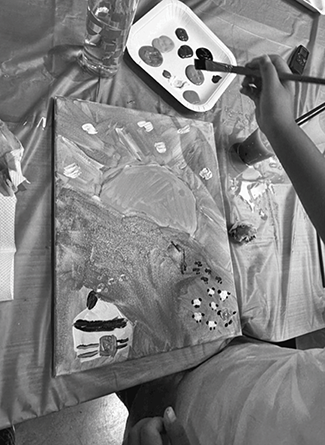
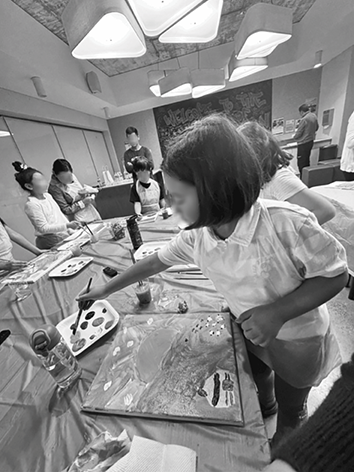
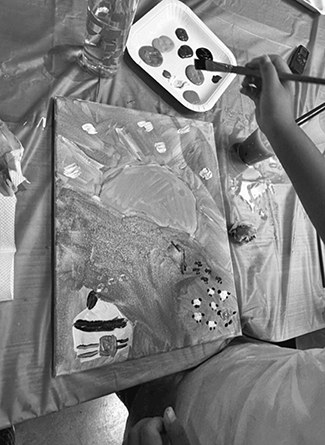
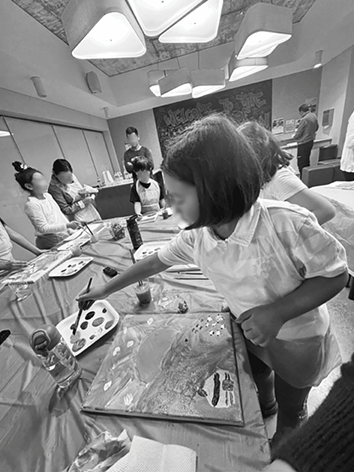
In one of the workshops we ran at Mongol School, WA, we asked the children to create artworks related to Mongolia. Many of the students at this school were either born in Australia or moved here at a very young age. In most cases, their English is stronger than their Mongolian. This is why they attend weekend Mongolian language school – to learn the written Mongolian language, connect with their cultural heritage, and socialise with other Mongolian children. During one of these Mongolian art workshops, two children were painting their visions of “My Mongolia.” As they worked, they began teasing each other and laughing, playfully languaging between English and Mongolian. Their interaction was full of lively languaging, drawing from both linguistic repertoires and playful voices as they painted (see Figure 1.3).
1. Tergel: Look, bagshaa, minii art is the best! (Look! Teacher! My art is the best!)
2. Nomin: Best? Minii bodloor … it looks like tolgoigui sheep! Haha (In my opinion … it looks like the headless sheep!)
3. Tergel: Haha, yu? Thank you for the compliment! (Haha, what? Thank you for the compliment!)
4. Nomin: Tergel is the Queen of tolgoigui sheep, Nomin is the narnii Queen! Haha! (Tergel is the Queen of headless sheep, Nomin is the sun Queen!)
5. Tergel: Narnii Queen? Your sun looks like a mustard sun!
They speak in a lively rhythm, their sentences tumbling effortlessly between English and Mongolian, while all laugh while playfully swapping brushes and adding silly doodles to each other’s artworks (see Figure 1.4). “Tergel is the Queen of headless sheep, Nomin is the narnii Queen! Haha!” one says with mock seriousness, prompting the other to snort with laughter before firing back, “Narnii Queen? Your Sun looks like a mustard sun!” and both collapse into giggles. This is languaging at its most playful: fluid linguistic play between languages, whimsical invented titles, and voices pitched high or deep for comic effect. The boundaries between English and Mongolian blur into shared playful voices where humour, identity play, and friendship all mingle. Here, languaging is a canvas for both linguistic play and playful voices – the central theme of this section – where the playfulness is understood both from a linguistic perspective, as the fluid and creative mixing of English and Mongolian, and from an affective perspective, as a shared performance of humour, teasing, and identity play that strengthens peer bonds.
Headless sheep
Mongol School
The concept of fluidity is central to much of the literature on languaging, and the notion of play/playfulness is closely linked to this very idea. Playfulness in languaging refers not only to the linguistic play – imaginative, creative, and experimental ways in which language users engage with their linguistic resources (Dovchin, Reference Dovchin2024a; Jakonen et al., Reference Jakonen, Szabó, Laihonen and Mazzaferro2018), but also to the playful voices (Holflod, Reference Holflod2022; Parnell & Patsarika, Reference Parnell, Patsarika, Burke and Jones2014; Robson & LeVoguer, Reference Robson and LeVoguer2025; Waring Reference Waring2013) – affective, embodied, and often joyful voices of communication that emerge when boundaries between named languages are blurred. Key linguistic features such as creativity (Nie & Yao, Reference Nie and Yao2025), innovation (Ilonga, Reference Ilonga2023), and hybridity (Guo et al., Reference Guo, Xiong and Lin2025) are foundational to the sense of linguistic play in languaging. Creativity refers to the ability of languagers to recombine linguistic and semiotic resources in novel, unexpected ways (Mu et al., Reference Mu, Han and Wen2025; Nie & Yao, Reference Nie and Yao2025); innovation captures the emergence of new linguistic forms, meanings, and communicative strategies that challenge conventional language boundaries (Ilonga, Reference Ilonga2023); and hybridity reflects the blending of diverse linguistic codes, styles, and registers that defy rigid categorisations of language (Guo et al., Reference Guo, Xiong and Lin2025). These elements collectively enable language users – especially those operating within linguistically diverse environments – to engage in imaginative, boundary-crossing interactions. This sense of linguistic play has been explored across a wide range of sociolinguistic contexts, highlighting the creative and agentive potential of languagers – particularly in linguistically diverse settings. For instance, studies have examined linguistic play in language crossing – the deliberate movement across socially or ethnically marked linguistic boundaries – as a means of identity negotiation and social positioning, particularly among youth in urban classroom settings (Rampton, Reference Rampton2017). Relatedly, transglossic practices – where speakers draw fluidly on their linguistic repertoires beyond the constraints of standardised language norms – exemplify the inherently playful, hybrid, and dialogic nature of language use in everyday life (Sultana, Reference Sultana2015). From a Bakhtinian perspective (Reference Bakhtin1984, Reference Bakhtin1986, Reference Bakhtin and Morris1994), such practices reflect the operation of double voices, multivocalities, and heteroglossia, where multiple social and ideological perspectives coexist and interact within an utterance. Speakers navigate these overlapping voices creatively, producing meanings that are simultaneously personal, social, and intertextual, highlighting language as a dynamic site of negotiation, adaptation, and socio-cultural engagement (Sultana, Reference Sultana2015). In early childhood education settings, the merging of translanguaging with the imaginative possibilities of play-based learning has given rise to a powerful pedagogical space – translanguaging playworld (Oakley et al., Reference Oakley, Steele, Robinson, Dobinson, Dovchin and Cumming-Potvin2025). Playworlds are co-constructed in imaginary scenarios where children and adults engage together in active play, using storytelling, games, toys, and symbolic activity to explore emotions, relationships, and learning. When translanguaging is integrated into this space, the playworld becomes not only imaginative but linguistically and culturally expansive (Oakley et al., Reference Oakley, Steele, Robinson, Dobinson, Dovchin and Cumming-Potvin2025; Parini, Reference Parini2025). de la Piedra & Johnson (Reference de la Piedra and Johnson2025) demonstrate how human learning is an embodied, affective, and contextually situated practice that emerges through interactions with both people and the material environment. In the music classroom, languaging is not just a linguistic act but is deeply intertwined with the body, musical instruments, and a range of semiotic resources, including multiple languages, musical notation, sounds, songs, gestures, and bodily movement. These interactions are further shaped by students’ emotions, cultural references, and accumulated experiences within the community over time. Together, these elements create dynamic, multimodal assemblages that demonstrate how teaching and learning are collective, creative, and contextually grounded processes (de la Piedra & Johnson, Reference de la Piedra and Johnson2025).
Beyond classroom settings, linguistic play is vividly present in performative music, popular music, and hip-hop culture, where linguistic innovation, stylisation, and remixing of codes become tools of resistance, identity-marking, and performative expression (Dryden & Izadi, Reference Dryden and Izadi2023; Williams, Reference Williams2017). For example, Dryden & Izadi (Reference Dryden and Izadi2023) investigate the social media activity of Aboriginal Australian hip-hop artist Danzal Baker, who goes by the stage name of Baker Boy, who is known for his hip-hop music that blends English and Yolngu Matha resources originating from Arnhem Land (Yolngu = person, matha = tongue/language). Baker Boy shows how he and his audience use linguistic and semiotic resources to create local–global connections in his hip-hop music and videos, recontextualising these resources for both local and international audiences. His followers, in turn, respond with their own linguistic, cultural, and identity expressions. In so doing, the study shows how these interactions are shaped by the histories of colonisation and the treatment of First Nations peoples’ languages in both the Global North and South. Through these exchanges, Baker Boy celebrates his lived cultural and linguistic experiences, asserting their value and normality, while demonstrating how social media enables the fluid deployment of semiotic and linguistic resources across global and local contexts. Williams (Reference Williams2017) conceptualises “remixing multilingualism” as the creative linguistic play of combining, manipulating, and reimagining linguistic forms to produce new cultural expressions and identities, often through a process of bricolage. Drawing on ethnographic research in Cape Town’s local hip-hop scene, it examines how highly multilingual artists, many from historically marginalised backgrounds, use performance to showcase their voices and identities in innovative ways. Through interviews, performance analysis, and interactional analysis, the study applies concepts such as stylisation, performativity, entextualisation, and enregisterment to explore how young speakers craft varied personae, styles, registers, and language varieties. In doing so, it offers fresh theoretical insights into multilingualism from a Global South perspective.
Digital communication spaces provide fertile ground for verbal and orthographic experimentation, as users engage in multimodal play – bending spelling norms, mixing scripts, and creating humorous, affectively charged expressions across platforms like social media and messaging apps (Liang, Reference Liang2024). For example, Liang’s (Reference Liang2024) study adopts a creative, translingual lens to explore online transcreation on social media, focusing on multilingual speakers who subtitle and translate video content using translingual English. It examines the interplay between translanguaging, translation, and transcreation, analysing figurative, phatic, and pragmatic expressions alongside manga visuals, anime actions, and comic-style multimodal performances in YouTube videos. Set within the context of transnational cultural flows such as Japanese pop culture and the Korean wave, the findings highlight how YouTubers employ playful transcreational strategies. The study advances theoretical and practical understandings of translingual transcreation in participatory social media discourse. Ilonga (Reference Ilonga2023) examines linguistic innovations in the digital advertisements of commercial banks in Tanzania, analysed through the lens of translanguaging theory. The research identifies linguistic plays such as the incorporation of foreign words, slang, idiomatic expressions, blending, truncation, vowel lengthening, and denominalisation – some even going beyond official advertising policies. The findings reveal significant linguistic shifts in Tanzanian advertising from the mid 2000s to early 2022, with the growth of digital advertising expected to continue as it aligns with global marketing trends and evolving language practices.
Overall, linguistic play – the imaginative, creative, and experimental ways in which individuals engage with their linguistic resources – extends far beyond surface-level ornamentation. Such playful practices embody deeper sociolinguistic processes, revealing speakers’ capacity for creative agency and their determination to communicate on their own terms. In the fluid and dynamic spaces of contemporary languaging, these practices challenge conventional norms and open up possibilities for reimagining how meaning, identity, and social relations are negotiated. Such interactions are further infused with what Creese and Blackledge (2010, p. 111) term “playful naughtiness” – playful voices that subvert linguistic expectations and disrupt normative language ideologies, not in defiance but in joy (Robson & LeVoguer, Reference Robson and LeVoguer2025; Zhu et al., Reference Zhu, Li and Lyons2016). This spirit of play allows languagers to take pleasure in bending rules, pushing against fixed standards, and embracing ambiguity and contradiction. As Pennycook (Reference Pennycook2007a, pp. 41–42) argues, it is precisely in these moments that languagers experience the “pleasure of doing things differently” – a feeling of linguistic freedom that emerges when one is no longer confined by the demands of correctness, fluency, or monolingual norms. In English Medium Instruction (EMI) classrooms, researchers have documented that learners employ translanguaging not only as a tool for constructing meaning but also as a social and playful resource. Through playful voices such as joking, teasing, and other forms of humorous interaction, students create moments of solidarity and camaraderie, while simultaneously challenging traditional hierarchies of language proficiency and authority (Tai & Li Wei, Reference Tai and Wei2021). These practices reveal that translanguaging is not purely instrumental or cognitive; it is deeply embedded in the social life of the classroom, shaping relationships, identity, and participation in ways that extend beyond the formal curriculum (Tai & Li Wei, Reference Tai and Wei2021). In such playful engagements, language users do more than simply communicate: they perform identities, thrive on ambiguity, spontaneity, and going with the flow, despite uncertainty, anxiety, and chaos that come with it (Zhu et al., Reference Zhu, Li and Lyons2016). They challenge linguistic hierarchies and assert ownership over the communicative process. The pressure to conform to a singular, target language is eased, enabling a space where languaging is not only accepted but celebrated. This leads to a sense of emotional safety, ease, and joy – a space where language becomes a tool for connection, rather than a gatekeeper of belonging. Consequently, languaging becomes intimately tied to laughter and affect – speakers tease, joke, mimic, and parody (Blackledge & Creese, Reference Blackledge and Creese2009; Haugh, Reference Haugh and Bell2017), often engaging in humorous exchanges that build rapport and community. This humour is not incidental but central – it signals comfort, intimacy, and a refusal to take dominant linguistic norms too seriously. Through such playful voices, languagers carve out alternative and second lives, where their full repertoires are not only visible but actively celebrated and where the joy of expression transcends the confines of linguistic correctness (Holflod, Reference Holflod2022; Parnell & Patsarika, Reference Parnell, Patsarika, Burke and Jones2014; Robson & LeVoguer, Reference Robson and LeVoguer2025; Sultana, Reference Sultana2015; Zhu et al., Reference Zhu, Li and Lyons2016).
1.2.2 Languaging: Precarious Grounds and Precarious Voices
As the interaction unfolds at Mongol School, WA, continuing from the previous section, the children’s conversation shifts towards learning and speaking Mongolian. The atmosphere begins in a light-hearted tone, with playful voices and linguistic play in full swing. However, what starts as playful languaging gradually turns into a moment of precarity when one child resists the use of Mongolian.
1. Bataa (frowning): “Stop saying in Mongolian! I don’t understand it!”
2. Nomin (frustrated voice): “Yu genee? You need to learn Mongolian!” (What? You need to learn Mongolian!)
3. Bataa (angry, raised voice): “You need to speak English!”
4. Tergel (raised voice): “Mongol helee suraa! Za yu?” (You need to learn Mongolian! OK?)
5. Bataa (repeating Tergel and laughing): “Mongol helee suraa! Za yu?”
6. Tergel (laugh and raised voice): “Shut up!”
The exchange is a linguistic play where the children engage in teasing repetitions (line 5), sliding in and out of English and Mongolian (across all lines), playful voices such as humorous mimicry (line 5), and offensive phrases and laughter (line 6). Yet, beneath this surface of fun, there are precarious grounds where playfulness intersects with precarity. When Bataa voices feelings of exclusion for not being able to understand Mongolia (“I don’t understand it!”) and reasserts English as the preferred medium (line 3), he not only expresses an immediate emotional vulnerability but also reveals a deeper precarious ground – the fragility of his ability to engage in his heritage language – Mongolian. This moment reflects more than just a breakdown in playful interaction; it signals the emotional strain of navigating identity in a context where heritage language competence is uneven among peers. On another level, this fragility is situated within the broader structural precarious grounds of heritage languages in English-dominant societies like Australia, where English is prioritised and heritage languages are often forgotten, devalued, or left to erode across generations (Dovchin, 2025b). In this sense, the child’s anger and frustration are not isolated outbursts but are symptomatic of an overarching precarious structural attitude towards minority languages. From this perspective, the playful repetition of Mongolian (“Mongol helee suraa! Za yu?”) shifts from being a light-hearted game to a site of power struggle – a moment where language becomes a symbolic boundary between inclusion and exclusion. What began as friendly teasing is now charged with the weight of linguistic vulnerability and precarious voices such as “Shut Up!” This transformation highlights the inherently precarious nature of playfulness in languaging settings, its potential to both strengthen and strain peer relationships, depending on how language ideologies, comprehension, and structural forces shape the interaction. Block (Reference Block2013), in this sense, cautions that any analysis of linguistic diversity must grapple with unequal social, economic, and political conditions that inform and constrain communicative practices. In languaging encounters, linguistic choices are rarely free – they are shaped by access to education, economic capital, racialisation, and linguistic ideologies. Sah and Li (Reference Sah and Li2022) similarly argue that the celebration of fluidity can risk glossing over the structural constraints faced by many translanguagers. As Kubota (Reference Kubota and Tupas2015, p. 33) defiantly asks, “Can all English users regardless of their racial, gender, socio-economic, and other background equally transgress linguistic boundaries and engage in hybrid and fluid linguistic practices?” These questions remind us that playfulness is not evenly distributed: they are privilege enabled by certain social positions and denied to others. Hence, while languaging offers a valuable reimagining of language, it must also be situated within broader critiques of precarity – inequality, power, and access. Only then we can fully appreciate both its potential and its limitations. In this section, I argue that playfulness in languaging must always be understood in tension with precarity, and the two concepts are inseparable and should not be treated as distinct.
While playfulness in languaging turns has emerged as a powerful framework in applied linguistics, offering innovative ways to conceptualise the ontological nature of language, a more complex and contradictory picture also begins to emerge – one that demands a deeper, more critical engagement with the assumptions underpinning playfulness. The recent shift in languaging urges us to understand that beneath its seemingly playful exterior lies precarious grounds (Dovchin, Reference Dovchin2024a). In fact, the reason behind all of this playfulness is precisely the precarious positions of the creators of the playful (Dovchin et al., Reference Dovchin, Oliver and Wei2024). The recent evolution of languaging urges us to remain attentive to the socio-political and material conditions that shape who can play with language, when, and how. Beneath the surface of apparent linguistic playfulness exists a more precarious reality, particularly for language users operating within structures of inequality, marginalisation, or linguistic subordination (French et al., Reference French, Stanford-Billinghurst, Armitage, Dovchin, Oliver and Wei2024; Jun & Mori, Reference Jun, Mori, Dovchin, Oliver and Wei2024). The reality of precarity is often obscured by discourses of playfulness, in which languaging practices are framed as celebrations of becoming, transformation, re-creation, and renewal (Dovchin et al., Reference Dovchin, Oliver and Wei2024). From this perspective, languaging must be understood not as an open-ended space of endless mobility, but as a process embedded in relations of power, access, and material reality (Dovchin, Reference Dovchin2024a).
Hawkins & Tiwari’s (Reference Hawkins, Tiwari, Dovchin, Oliver and Wei2024) argument on translingual precarity is relevant here. Translanguaging and transmodal communication are inherently precarious, as they carry risks of unequal positioning and reinforce status hierarchies. Using the example of Ugandan and Indian youth exchanging videos, they show how creative acts intended to display innovation and resourcefulness were reinterpreted through outsider lenses as signs of poverty, inspiring pity towards “the other” while reinforcing positive self-perceptions. Both groups, however, expressed pride in their lives and sought to share lessons of ingenuity – Ugandan youth showcasing local creativity, and Indian youth producing a video on jugaad (improvisation) to demonstrate their own resourcefulness. These exchanges illustrate how participants continuously reposition themselves and others within broader historical, cultural, and ideological flows, often reinscribing precarious grounds. Hawkins & Tiwari (Reference Hawkins, Tiwari, Dovchin, Oliver and Wei2024) argue for the importance of a transmodal analytic approach that attends to semiotic complexity, relational positioning, and power – precarity in communication across diversity. Such attention is essential for fostering critical cosmopolitanism and moving towards more equitable global relations. As Hawkins & Tiwari (Reference Hawkins, Tiwari, Dovchin, Oliver and Wei2024, p. 105) note,
translanguaging, and all communications, are semiotic functions – they are leveraged in meaning-making between people – and are always and everywhere embedded in, shaped by and constitutive of power relations. Therefore, precarity and playfulness are not either/or constructs; communications are always precarious, always embedded in sociocultural and sociopolitical contexts, always risking inequitable positioning and relations, whether or not they involve a degree of playfulness.
Within the field of languaging, the notion of precarity has been integral, even if it has not always been explicitly labelled as such. Here, precarity refers to the linguistic and communicative practices shaped by the lived experiences of marginalised communities navigating unstable conditions – what Tsing (Reference Tsing2015, p. 2) describes as “life without the promise of stability” – conditions that undermine both material security and emotional well-being (Dovchin, Reference Dovchin2022). Languaging itself emerged as a bottom-up framework, connected to concepts like “globalisation from below” and “language from below” (Pennycook & Otsuji, Reference Pennycook and Otsuji2015), offering a lens to examine how marginalised speakers in precarious contexts resist sociolinguistic conventions, disrupt dominant ideologies, and transgress linguistic boundaries in order to contest the status quo (Li Wei & Zhu, Reference Li and Zhu2020). Otsuji & Pennycook (Reference Pennycook2024) have developed an understanding of precarious assemblages – a relational understanding of languaging and precarity. Precarity is not limited to economic insecurity or marginalisation but also includes fragile social networks, cultural and religious practices, gender norms, and language policies. For them, it is important to avoid equating precarious language use with precarious lives, as language is only one element within broader precarious assemblages shaped by political economy, material conditions, and social relations. A key risk lies in imposing Northern assumptions that view unstable work or non-normative language practices as inherently precarious. While some theories treat precarity as a shared condition enabling collective action, its relational and isolating nature complicates such possibilities. An assemblage approach, however, offers a more productive lens. It moves beyond deterministic views that tie linguistic marginality to economic exclusion, instead recognising how diverse factors such as economic, social, material, and linguistic factors intersect to both produce and unsettle precarity. Overall, while instability often refers to fluctuating or uncertain conditions, it does not necessarily equate to precarity, which I understand as the embodied and affective experience of living within such unstable conditions. In other words, instability describes the structural or material dimension (e.g., insecure employment, migration status, or linguistic marginalisation), whereas precarity captures the lived consequences – the sense of vulnerability, dispossession, or lack of agency that individuals experience as a result of those unstable conditions. Thus, their approach positions precarity not simply as the presence of instability but as the socially mediated experience of that instability, shaped by intersecting factors such as language, identity, and belonging. This distinction allows for a more complex understanding of how linguistic and social inequalities are felt and negotiated in everyday life.
In line with these ideas on precarity, recent scholarship emphasises that the lives of languagers are deeply shaped by precarity (Dovchin et al., Reference Dovchin, Oliver and Wei2024) – a state of persistent instability (Bourdieu, Reference Bourdieu1962/Reference Bourdieu1994) intertwined with uncertain social, economic, and political conditions (Standing, Reference Standing2011), compounded by intersecting forms of marginalisation (Chang & Canagarajah, Reference Chang, Canagarajah, Dovchin, Oliver and Wei2024; Schierup & Jørgensen, Reference Schierup and Jørgensen2016), and laden with emotional strain and vulnerability (Butler, Reference Butler2004; Canagarajah, Reference Canagarajah2022). This perspective aligns with emerging critical frameworks such as raciolinguistics (Rosa & Flores, Reference Rosa and Flores2017), linguistic racism (Wang & Dovchin, Reference Wang and Dovchin2023), unequal Englishes (Tupas, Reference Tupas2015), unequal languaging (Sah & Li, Reference Sah and Li2022), linguicism (Uekusa, Reference Uekusa2019), translingual discrimination (Dovchin, Reference Dovchin2022), accentism (Lippi-Green, Reference Lippi-Green2012), and linguistic citizenship (Williams et al., Reference Williams, Deumert and Milani2022). Across these literatures, the cumulative forms of precarity experienced by languagers – ranging from homesickness, unemployment (Chang & Canagarajah, Reference Chang, Canagarajah, Dovchin, Oliver and Wei2024), academic setbacks, and pressures to use “pure” English (Hopkyns & Sultana, Reference Hopkyns, Sultana, Dovchin, Oliver and Wei2024; Horner, Reference Horner, Dovchin, Oliver and Wei2024), to racism, sexism, and classism (Dovchin, Reference Dovchin2025b), family separation, grief, and loss (Ladegaard, Reference Ladegaard2014, Reference Ladegaard2015, Reference Ladegaard2018) – are well documented. The compounding of these stressors significantly impacts languagers’ emotional resilience, physical health, and mental well-being, often eroding their sense of belonging. The long-term consequences can be severe, including linguistic inferiority complexes (Tankosić et al., Reference Tankosić, Dryden and Dovchin2021), depression and anxiety (Piller, Reference Piller2016), trauma and shock (Busch & McNamara, Reference Busch and McNamara2020; Canagarajah, Reference Canagarajah2022), self-harm, eating disorders, substance abuse, and even suicidal ideation (Dovchin, Reference Dovchin2020).
Connected to these precarious grounds are also what may be termed precarious voices – expressive forms that manifest through a range of paralinguistic and embodied modalities, such as crying, weeping, yelling, or, in Bakhtinian terms (Reference Bakhtin1984, Reference Bakhtin1986, Reference Bakhtin and Morris1994), grotesque voices that include swearing, cursing, or other disruptive utterances (Dovchin, Reference Dovchin2024a; Dryden et al., Reference Dryden, Tankosić and Dovchin2021; Ladegaard, Reference Ladegaard2014, Reference Ladegaard2015, Reference Ladegaard2018). In online contexts, these precarious voices can extend to hate speech, verbal aggression, and hostile and offensive exchanges (Dovchin et al., 2026; Guo & Jiang, Reference Guo and Jiang2025; Schmid, Reference Schmid2025). Such voices often emerge from, and respond to, experiences of precarious grounds such as exclusion, marginalisation, or linguistic injustice. Yet, despite their significance in revealing the emotional and socio-political dimensions of languaging, these forms of expression have been largely sidelined in existing literature, which tends to (spotlight) playfulness as the dominant interpretive frame. Consequently, the affective, resistant, and sometimes volatile dimensions of precarious voices remain under-represented in scholarly accounts, leaving an incomplete picture of the complex ways people use language to navigate precarious conditions. This book, therefore, aims to broaden the concept of precarity in relation to languaging by focusing on precarious voices – those of millions of language users who express vulnerability, uncertainty, or marginality in their communication, yet whose experiences are frequently under-represented in scholarly discussions.
1.2.3 Languaging: Playful Voices and Precarious Grounds
When I was visiting an Aboriginal boarding school in WA, I sat down for a yarn with a group of boys during a lunch break. I casually asked if any of them could tell me something in their traditional language. Without hesitation, Jarrah – whose mob is from Miriwoong, Kununurra, WA, and whose ancestral language is Miriwoong – responded by singing “Gooloo-gooloob Yarroondayan” (We are all happy!). His voice was bright and animated, his body language expressive. Almost immediately, the other boys around him erupted into laughter. Intrigued, I asked them, “Why are you all laughing?” They replied with cheeky smiles, “He is just singing the songs. He doesn’t even know how to speak it!” “Shame job!” “Big shame!” The laughter grew louder, mixing with playful teasing and mockery.
On the surface, this moment was light-hearted – full of playful voices – joking, parody, singing, energy, and joy. But it also revealed much more. What I witnessed was a powerful instance of languaging – a fluid, dynamic sliding, and negotiation between the combination of various linguistic repertoires – Miriwoong (“Gooloo-gooloob Yarroondayan” (We are all happy!)), Aboriginal English expressions (“Shame job!” (Embarrassing behaviour!) “Big shame!” and my own use of English, which is also Mongolian-accented. The languaging was formed by linguistic play. The entire mood was filled with playful voices. But within that playfulness was a poignant tension. Jarrah’s attempt to sing in Miriwoong was met with laughter that hinted at more than just amusement. It hinted at shame, discomfort, embarrassment, and even a sense of cultural disconnection. The entire interaction was marked by joy, play, and laughter. Yet this lightness coexisted with something darker. Beneath the surface of this playfulness lies a sense of precarity – the lingering effects of colonisation, linguistic racism, and language loss. The boys’ laughter, while warm and spontaneous, also reflects the fractured relationships many Aboriginal people have with their traditional languages – languages that were once silenced and punished by the colonisers (Wigglesworth & Oliver, Reference Wigglesworth, Oliver, Dovchin, Oliver and Wei2024). In this moment, the languaging is both a form of play and a site of precarity (see also Dovchin, 2025b).
At the heart of this interaction lies precarity. The boys are growing up in a society where speaking their traditional languages is not always supported, celebrated, or even possible. Many are only partially fluent in their traditional languages – they may know a few words or phrases, often learned through family members, but not enough to feel confident using them (Dovchin, Reference Dovchin2025b). So, when Jarrah sings in Miriwoong and the others laugh, their reaction is layered: it is both play and precarity, pride and shame. The laugher becomes a façade – a way of dealing with the gap between who they are, who they want to be, and structural conditions that have made that gap so difficult to bridge. In this way, their laughter becomes a reflection of a colonial interruption and of the disrupted intergenerational transmission of Aboriginal languages. This moment reminds us that even the most playful expressions of language can carry the weight of historical violence and language loss. But it also shows that through playfulness and shared language practices, these boys are actively negotiating their identities, reclaiming space and keeping their language and culture alive – even if imperfectly and even through laughter. While the languaging often challenges rigid linguistic boundaries experimentation, it simultaneously reveals the conditions of instability and constraint under which such play becomes meaningful. Languagers often rely on linguistic resources that are only accessible – or only gain social legitimacy – when actively mobilised in context. This suggests a paradoxical precarity within playfulness: a constrained playfulness that challenges the idea of languaging as wholly unrestricted or universally empowering. This reminds us of Wigglesworth & Oliver’s (Reference Wigglesworth, Oliver, Dovchin, Oliver and Wei2024) argument on how translanguaging in Aboriginal classrooms embodies both playfulness and precarity, creating a productive yet fragile tension. On the playful side, Aboriginal children’s enthusiasm for exploring differences across languages can spark curiosity, creativity, and engagement. Activities such as discussing phonological or discourse-level variation or reflecting on their role as custodians of Indigenous languages open space for joyful exploration, pride, and imaginative use of linguistic resources. This linguistic play supports their learning, fosters collaboration, and validates their multilingual repertoires. At the same time, there is a precarious dimension of translanguaging. Aboriginal students’ willingness to draw on their full linguistic range depends heavily on teacher attitudes. A supportive teacher enables playful experimentation, but a negative reaction risks shaming students, delegitimising their backgrounds, and reinforcing the deficit view that Aboriginal children have “no” appropriate language. Such precarious positioning underscores the vulnerability of students negotiating between languages and ideologies in unequal power relations. Wigglesworth & Oliver (Reference Wigglesworth, Oliver, Dovchin, Oliver and Wei2024) suggest that translanguaging offers a way to transform precarity into possibility. By validating all linguistic resources and resisting rigid binaries of “home” versus “school” languages, teachers can shift classroom dynamics from marginalisation towards inclusion. Yet, the very act of translanguaging remains precarious, always vulnerable to misrecognition or rejection. Thus, translanguaging is never purely playful or purely precarious; rather, its power lies in the ongoing negotiation between these forces, where playfulness can mitigate precarity but cannot erase it.
This tension of playfulness and precarity can also be interpreted as semiotic precarity by Lee (Reference Lee2022), who draws our attention to the instability and uncertainty of certain cultural and linguistic signs, symbols, and semiotic markers when they are encountered outside their “native” context. Just as playful languaging unfolds on precarious social and material grounds, sites of semiotic precarity render cultural features visible precisely because their meaning is unstable or contestable. It does not claim that culture exists only in its representations; rather, it highlights moments in which cultural features become visible, negotiable, or open to reinterpretation because their meaning is not fully secure. For Lee (Reference Lee2022), both linguistic play and cultural representation are, therefore, never neutral but emerge within structures of power, inequality, and uncertainty, revealing how creativity and precarity are inseparable in language practice. Pennycook & Otsuji (Reference Pennycook and Otsuji2015) introduced metrolingualism as a framework which points out that languages are not pre-given but emergent, context-dependent practices. Here, the spatial, temporal, and mobile aspects of urban communication are important. However, we also need to recognise at fixity – such as invoking named languages – can have symbolic, ideological, and strategic value. Crucially, fluidity and fixity are not opposites in this model, they coexist and co-constitute meaning, identity, and social relations (cf. Prinsloo, Reference Prinsloo2023). Ultimately, metrolingualism offers a powerful alternative to conventional framings of language, revealing how mobility, hybridity, and essentialism are intricately entangled in the lived realities of language users navigating complex global and local contexts. As they urged us not to “construe fixity and fluidity as dichotomous, or even as opposite ends of a spectrum, but rather to view them as symbiotically (re)constituting each other” (Otsuji & Pennycook, Reference Pennycook2010, p. 244). In other words, semiotic precarity may differ from other forms of precarity discussed earlier. While earlier discussions focus on material and structural forms of precarity, such as economic insecurity, unstable employment, or precarious migration status, semiotic precarity here refers to the symbolic and communicative dimension of precariousness. It highlights how individuals experience vulnerability and marginalisation through language, discourse, and other semiotic resources that index social hierarchies and power relations. In other words, semiotic precarity does not stem solely from material instability but from the unequal value and legitimacy assigned to certain linguistic and semiotic practices.
In this book, I call on applied linguists to reflect more deeply on the ways playfulness is entangled with precarity. I argue that playfulness should not be seen merely as light-hearted, but as a force that highlights our capacity for transformative and even subversive action. At the same time, we must remain attentive to the tensions between playfulness and precarity. Critical questions arise: How can what is fundamentally “precarious” be framed as “playful”? Could playfulness itself be another expression of precariousness? And why has languaging, inherently precarious in nature, so often depended on the idea of playfulness to gain legitimacy? To move forward, mainstream understandings of languaging must shift towards a sharper examination of precarity – its socio-ontological dimensions, its unequal distribution, and the structural conditions that render some groups more vulnerable than others. This book therefore seeks to highlight the unstable realities shaped by a history of precarity (Bourdieu, (Reference Bourdieu1962/Reference Bourdieu1994) and to explore how these realities intersect with the playful dimensions of languaging.
1.2.4 Structure of the Book
I will further expand on the intricate connections between First Knowledging and First Languaging in Chapter 2, particularly as they intersect with the tension of playfulness and precarity. Drawing on my ethnographic visits to Australian Aboriginal schools across Western Australia, I explore how these two interwoven practices are lived, performed, and negotiated by Aboriginal children and educators. First Knowledging, rooted in ancestral wisdom, cultural practices, and land-based ontologies, is not transmitted through rigid forms but through dynamic, living languages – what I term First Languaging. These languages embody a fluid interplay of orality, gesture, and spirit, often expressed in classroom settings through storytelling, yarning, art, and song (Dovchin, Reference Dovchin2025b). Yet, this vibrant linguistic expression exists in precarious tension with institutional constraints, standardised curricula, and settler–colonial educational systems that often suppress or marginalise these ways of knowing and being. Within this complexity, I focus on the role of playfulness – not merely as a form of child’s play, but as a radical act of resistance, creativity, and resilience within a framework of uncertainty and survival. By centring the lived realities of Aboriginal learners, this chapter reveals how First Knowledging and First Languaging offer not only pedagogical alternatives but also cultural continuities that defy dominant narratives.
In Chapter 3, I introduce the concepts nomadic knowledging and nomadic languaging through ethnographic encounters with Mongolian nomadic herdsmen (Dovchin, Reference Dovchin2025a). Centred on the practice of the nomadic reminiscing circle, it explores how nomadic communities integrate additional languages such as English within their land-based epistemologies, while safeguarding cultural and linguistic boundaries. These practices embody both fluidity and rootedness, playfulness and precarity, reflecting the adaptability and resilience of nomadic life. By examining how English is accepted only when mediated by humility and respect, the chapter highlights the relational ethics underlying nomadic engagements with language. It argues that applied linguistics must learn from nomadic perspectives, which emphasise mobility, contextual responsiveness, and land-connected ways of knowing, thereby offering new pathways for rethinking language in global and local contexts.
Chapter 4 examines the notion of racialised languaging, which emphasises that languaging practices are never assessed independently of the bodies, identities, and social positions of their speakers. It demonstrates how language is evaluated not only in terms of what is said but also through the racialised perceptions of who is speaking and how society chooses to listen. The chapter argues that accents, dialects, and speech patterns associated with racialised communities are often constructed as inferior, humorous, deficient, or even criminal, while similar features in White speakers are normalised or excused. By centring languaging as a site of racial meaning-making, the chapter exposes the ways in which communication is entangled with race, racism, and embodied identities. Racialised languaging is further situated within the broader colonial matrix of power, where Western linguistic norms and White racial identities are privileged over non-Western languages and non-White speakers. Drawing on critical scholarship and empirical examples, this chapter illuminates how colonial legacies continue to shape contemporary postcolonial Anglophone contexts, perpetuating inequalities that advantage White, monolingual English speakers while marginalising those who speak from racialised positions.
Chapter 5 explores the interplay of playfulness and precarity in AI-mediated languaging. Drawing on examples from social media users experimenting with generative AI, the chapter illustrates how AI reshapes communication, linguistic practices, and social interaction. These playful engagements demonstrate AI’s capacity to expand linguistic creativity and produce novel forms of meaning, while simultaneously revealing its fragility and the ethical tensions inherent in its use. By exposing the cultural assumptions, power relations, and value judgements embedded in AI systems, such moments highlight the non-neutral and unpredictable nature of AI technologies. The chapter argues that while AI opens up new possibilities for expression, it also demands critical reflection on issues of power, identity, and social norms. Ultimately, these examples highlight the (dis)engagement with AI’s potential while recognising and addressing the risks it poses to language and society.
Chapter 6 brings the book to a close by advancing an understanding of languaging as a relational, embodied, and political practice. Rather than treating language as a neutral vehicle for transmitting information, the chapter emphasises how languaging is deeply entwined with questions of identity, belonging, and power. It is shown to be simultaneously playful and precarious, resistant and creative, continually challenging static and purified notions of language. This concluding discussion foregrounds the lived realities of linguistic diversity, realities shaped by colonial histories, racial hierarchies, global mobilities, and technological mediations, yet also sustained through everyday acts of creativity, solidarity, and care.
The chapter further develops the notion of pedagogical languaging as a way of reframing education in response to the radical cultural and communicative reconfigurations of the twenty-first century. Pedagogy, it argues, must move beyond the delivery of standardised curricula to become the intentional design of spaces where learners mobilise their full semiotic repertoires, such as linguistic, embodied, cultural, and digital, in dynamic, relational, and multimodal meaning-making. Such a reframing requires abandoning deficit perspectives on learners’ non-dominant practices and instead recognising these as epistemic resources that expand possibilities for knowledge, creativity, and critical insight. In doing so, pedagogical languaging positions education not as the policing of correctness, but as the co-construction of interactional spaces where diversity is affirmed and all learners’ contributions are made central to the work of learning.