

Introduction
Guatemala is a nation that is still recovering from the open wounds of a U.S. backed 36-year counter insurgency war (Schlesinger and Kinzer, Reference Schlesinger and Kinzer1983; Booth, Wade, and Walker, Reference Booth, Wade and Walker2020) and genocide, where over 200,000 people were murdered by the state (McAllister and Nelson, Reference McAllister and Nelson2013); most victims were indigenous people from the country’s Maya majority (Burns, Reference Burns1993). Historically, Guatemalan society has maintained a specific social and class hierarchy made up of four distinct racial and ethnic groups: Maya, Ladino/a, or Mestizo/a, Xinca, and Garifuna. Ladinos continue to enjoy a relative amount of social and economic power as the dominant racial group (Hale, Reference Hale2006), and multiple indigenous communities continue to be a super-exploited class. Nevertheless, ruling Ladino classes, consisting of eight wealthy families, continue to own most land, control over 250 companies, manipulate Guatemalan electoral outcomes through authoritarian means (Velásquez Nimatuj, 2005), and have ties to transnational capitalist classes (Robinson, 2008). While an understanding of Guatemala’s history, its peoples, and their reasons for migrating remains invisible in popular and academic discourse, migration has continued in the postwar period after the signing of the 1996 Peace Accords. In fact, while migration from Mexico to the United States has been in decline since 2014 (Goodfriend, Reference Goodfriend2022), migration from Guatemala has continued to increase, especially during the early part of the twenty-first century. This specific period is characterized by forced migration among all Guatemalan racial and ethnic groups, including minoritized indigenous communities and racially dominant populations. In addition, this period has witnessed the emergence of Guatemalan political organizations that began to form within the U.S. over the last forty years because of their displacement. This study was driven by the following research question: How do capitalism and the historical context of forced migration in Guatemala relate to the creation and development of migrant-led organizations in the U.S. and the various types of leadership and political participation?
Examining the political economy of Guatemalan migration to inland Southern California and the activities of migrants and community organizations, I argue that capitalism not only provokes the displacement of Guatemalan migrants as a social class of people from multiple racial and ethnic backgrounds, but it has also contributed to the emergence of distinct political Guatemalan diaspora organizations in the U.S. at the community, national, and transnational level. Furthermore, due to historical social relations in Guatemala, organizations have emerged in Southern California along ethnic, racial, and gender lines. Moreover, activism emerges within destination countries because exploitation and exclusion take on distinct forms beyond the specific economic and political forces that generate displacement in migrants’ origin countries. Within the U.S., irregular Guatemalan migrants are threatened by the constant threat of deportability (Genova and Nicholas, 2005; De Genova, Reference De Genova2005) and they are targeted by the racialization of “illegality” (Menjívar, Reference Menjívar2021) within an anti-migrant context that has become sharpened after the 2025 election of Donald Trump. Since the Guatemalan community lives within a state that does fulfill its obligations to protect the human rights of irregular persons, various organizations, small in scale, take it upon themselves to engage in the invisible and unpaid labor of migrant-led advocacy. These forms of advocacy include cost-free translation services in detention centers, repatriation processes, and labor rights. In some ways, this unpaid work is the migrant communities’ subsidy to local, state, and national governments as people work voluntarily to fill the gaps left by states, particularly those under neoliberal forms of governance that continue to reduce the social welfare state (Harvey, Reference Harvey2007).
Among the merits and contributions of this study is an original analysis of an invisible sector of the Latinx population in an understudied region where these communities constitute most residents. Not only does this challenge common-sense assumptions about where Guatemalan migrants are living, but it reminds scholars and the broader public of the relationship between globalized neoliberalism and racialized migrant labor. For example, my study unearths how Guatemalan migrants have emerged in new destinations (Zuniga and Hernández-León, 2006) such as Southern California’s Inland Empire. Furthermore, as Guatemalan migrants grow as a Latinx subgroup away from traditional gateway cities and are pushed into the periphery of the metropolitan Los Angeles region, Guatemalan grassroots organizations view inland Southern California as an area of interest that will be discussed in the present paper.
Theoretical Framework
Within the social science literature on Latin American migration to the United States, hegemonic conceptualizations based on rational-choice theories (Sjaastad, Reference Sjaastad A1962) argue that individuals take part in carefully calculated cost-benefit analysis before making the choice to migrate. Other scholarship on migration has collectively yielded important insights for understanding displacement. For example, previous research has established that migration from Guatemala to the U.S. began as early as the 1950s and 1960s (Menjívar, 2011; Rocco, Reference Rocco2014; Chinchilla and Hamilton, 2011). Amidst the country’s 36-year armed conflict from 1960–1996, migrants primarily arrived in states such as California, Florida, and Texas (Fink and Dunn, Reference Fink and Dunn2003; García Bedolla and Hosam, 2021; Jonas and Rodriguez, Reference Jonas and Rodriguez2014). However, forced migration from Guatemala to the U.S. is not fully understood as there are potential limitations with regard to understanding how Guatemalan migration and migrant communities’ experiences with racialization, exploitation, and resistance in the United States are linked to important political-economic processes. In contrast, a critical approach theorizes that the global political economy creates the conditions for migratory patterns to take shape, which are collective, forced, and ultimately economic (Roldan, 2013). As such, my analysis in this paper is grounded in a critical Latin American Dependency Theory framework to interrogate how such processes relate to historic political-economic exploitation and Guatemala’s integration into the global capitalist economy (Torres-Rivas, Reference Torres-Rivas1969).
Originating from Latin America in the 1960s and 70s, critical Latin American Dependency Theory is premised on the analysis of economic development of the Global North at the expense of the Global South’s underdevelopment through historical processes rooted in colonization, imperialism, and uneven development (C., Arancibia Córdova Arancibia, 2011; Delgado Wise, Reference Delgado Wise2009; Marini, Reference Marini2022). In other words, centers of racialized capital accumulation such as the U.S. and Western Europe did so at the expense of the Global South’s economic development. As such, the historical processes from which Central American nation states emerged in the postcolonial period during the early part of the nineteenth century continue to keep countries across Latin America in a perpetual state of dependence with the Global North, to varying degrees. What is more, these forms of underdevelopment have occurred through the historic and ongoing expropriation of land, labor, and natural resources. These dynamics continue to be expressed spatially through the uneven geographic development (Smith, Reference Smith2010) between regions of the globe such as the United States and Central America. Such processes have shaped forced migration across the world, and in general, the direction of migrant flows of labor travels from the periphery to various metropoles across the West.
I employ Latin American Dependency theory to understand displacement and migration from Guatemala over time. Dependency theory permits me to theorize the macro-structural forces that forcefully displace migrants from Guatemala and absorbs them into the U.S. labor market essential services (Ness, 2023). Overall, dependency theory demonstrates how, rooted in histories of colonization and an international division of labor, value, in the form of migrant labor as one very particular example, travels from peripheral economies to centers of capital accumulation, therefore, re-entrenching unequal social relationships between the Global North and South. As a macro conceptual framework that foregrounds the unequal structural conditions between two poles, the Global North and Global South, dependency theory provides scholars of migration studies with tools to understand the complex political-economic forces that produce displacement of vulnerable mobile populations across the globe. As such, dependency theory emphasizes how in particular regions of the world such as Central America, return migration is unviable due to dire political-economic conditions, authoritarian regimes, and violence which challenge the refugee/migrant binary (Cintra et. al, Reference Cintra, Owen and Riggirozzi2023). This is especially true in the case of contemporary Guatemalan migrations that are not occurring during times of war, when return migration poses a threat to migrants’ livelihood. Latin American dependency theory provides a macro-theoretical framing for understanding Guatemalan migration among multiple racial, ethnic, and linguistic groups, especially since the 1990s, as most Latin American migrants are in search of work and fleeing the intersecting social and economic crises that neoliberal capitalism has generated across the region.
My research questions are informed by Mexican economist Genoveva Roldán Dávila’s concept of “complementariedad subordinada” (subordinate complementarity) (Dávila, Reference Dávila2013; Roldán, 2011). Dependency theory and subordinate complementarity have their roots in the historical materialist critique of political economy and offer a critical approach to migration by emphasizing how the economies of the U.S. and Guatemala share a complimentary yet highly uneven relationship, given the conditions of dependence of Guatemala towards the U.S. At a global level, they become dependent on one another through their economies and by the social reproduction of each nation’s population. This highly uneven relationship is not unidirectional, but dialectical. According to Roldán (2011), the migratory relationship, which emerges after the restructuring of the production process during the neoliberal period, is characterized by “the particularities of underdeveloped countries and their incorporation into the reproduction of the global-capitalist system, and in particular, the relations between dependency and inequality that they maintain with industrialized or receiving countries, are the ones that generate the conditions of subordinate complementarity, that permit the impulse of those migratory labor flows from those countries.” In addition, Roldán suggests that the migratory patterns which emerge during the neoliberal period (1980–2009)Footnote 1 have transpired during a particular stage of capitalist development. During the colonial period, imperial metropoles such as the U.S. extracted value through forced labor and the exploitation of natural resources. During the neocolonial period, capital accumulation was achieved through economic policy and reinforced through military intervention. In the current neoliberal period, surplus value from the periphery to the metropole is partly achieved through the exportation of human resources—namely migrant labor. This contemporary stage of capitalist development is part of a long historical trajectory that has expressed itself during key moments of labor migrations. The first of these is the “classical” migrations from the 19th century to the early 20th century, the Fordist migrations from 1945–1970 and the neoliberal migrations from 1980–2009.
Furthermore, Latin American dependency theory foregrounds modern political-economic and sociocultural conditions in the historical context of colonialism and uneven capitalist development, where contemporary patterns of forced international migration unfold. Although these migrations take shape at a collective level among thousands and even millions of people, they are nonetheless decisions taken by “necessary fleers” at an individual level in the interest of themselves, their families, and, in the case of women, their unborn children (Cintra et. al, Reference Cintra, Owen and Riggirozzi2023). Thus, migrants exercise limited forms of agency extremely constrained by the social and political-economic conditions of origin countries shaped by extreme precarity and poor or non-existent social welfare systems which, combined with intersecting structural inequalities, make access to basic services such as sexual reproduction nearly impossible (Cintra et. al., 2003). Scholars such as Achiume (Reference Achiume2019) have argued that economic migrants displaced from former colonial territories to Western nations should not be barred from entry since their countries historically developed at the expense of migrants’ origin nations, as would be the case of Guatemalans migrating to the U.S., given the former country’s permanent dependency to the latter via neocolonial mechanisms. As such, Achiume advocates for a framing of “migration as decolonization” demonstrating the limits of describing the drivers of movement solely as “economic” by giving them historical and political context and complexity, as in the analyzed case in this paper. Moreover, although economic migrants’ decisions are shaped by desires to live dignified lives, their individual agency acts as a form of “migration as decolonization” (Achiume, Reference Achiume2019) as they seek improved material conditions for themselves. Nevertheless, these acts of agency at the individual level do not amount to structural forms of decolonization that would have a collective impact.
In summary, dependency theory and subordinate complementarity provide an overarching framework to understand international Guatemalan migration from the perspective of critical political economy. This macro-theoretical framework provides the context for the conditions that migrant-led organizations have emerged within the diaspora because of their displacement during key moments in time within the last seventy years. These concepts allow me to theorize how as a country on the periphery of the global-capitalist system, people from all regions of Guatemala, experience forced international migration, including both marginalized and dominant groups.Footnote 2
In addition to Latin American Dependency Theory, I draw on critical theories of Latinx racialization from the Latino Politics scholarship to understand how Guatemalans’ racialization is rooted in how they are differentially incorporated into the U.S. body politic as racial others based on their national origin (Sampaio, Reference Sampaio2015; Bedolla and Hosam, 2021; Valdez, Reference Valdez2023). This is especially true for those who have historically arrived in the U.S. as irregular migrants which has posed challenges for them towards obtaining permanent residency and citizenship status. In particular, I draw upon Rocco’s (2014) concept of “inclusionary exclusion” concept to theorize how Guatemalans have been differentially incorporated into U.S. society. This framing is useful since Rocco (2014) explains how various sectors of the U.S. Pan-Latinx community continue to lack social belonging in dominant U.S. institutions and the broader American society because of their racialization. In addition, Rocco (2014) discusses how migrant communities engage in political processes within the “submerged networks of everyday life.” The various forms of political activity which can serve as a basis for mutual-aid societies, voter mobilization, mass demonstrations, and transnational activism, across the political spectrum, emerge within a political-economy established on colonization and racialized forms of capitalist accumulation. As such, neoliberal capitalism—the current mode of production rooted in dismantling the social welfare state at a global level—is the social and economic context where Guatemalan grassroots organizations emerge. It is within these political-economic conditions where these relatively small organizations try to exercise forms of agency within extreme limitations. These constraints should not be underestimated since American and Guatemalan political institutions are not free of social conflicts which reproduce class power and racial advantages within Western democracies that have increasingly become authoritarian (Gonzales, Reference Gonzales2017).
Central American Studies, Latinx Politics, and Transnationalism
There is an urgency for Central American Studies to counter misinformation, racialization (Abrego and Villalpando, 2021), and injustice across the region in relationship to insecurity and false representations confronting migrants in their countries of origin, in transit, as in Mexico and within the U.S. (Menjívar and Abrego, Reference Menjívar and Abrego2012; Abrego and Cárcamo, Reference Abrego and Cárcamo2021). Part of this scholarship has focused on multi-sited experiences of insecurity (Menjívar, Reference Menjívar2006), agency (Menjívar, Reference Menjívar2000; Zimmerman, Reference Zimmerman2010; Dorrington, Reference Dorrington1992; Coutin, Reference Coutin2003), identity in the U.S. (Chinchilla and Hamilton, Reference Chinchilla and Hamilton1960; Valle, 2017), and resilience. Others have contributed to this field by theorizing and contesting U.S. imperialism, global capitalism, neoliberalism (Osuna, Reference Osuna2020; Chinchilla and Hamilton, Reference Chinchilla, Hamilton and Bonacich1994), structural racism, and patriarchy in Central America (Abrego, Reference Abrego2014; Chinchilla, Hamilton, and Loucky, Reference Chinchilla, Hamilton and Loucky2009; Portillo, 2012; Osuna, 2017; Velásquez Nimatuj, Reference Nimatuj and Alicia2005; Robinson, Reference Robinson2003). In addition, some scholars have focused on how the logic of settler-colonialism throughout the Americas (Batz, Reference Batz2022; Boj Flores, 2017; Speed, 2017; Herrera, 2016) impacts indigenous migrants in very specific ways, particularly Mayan communities in relationship to dispossession, language, “racialization of ‘Illegality’,” (Menjívar, Reference Menjívar2021) cultural memory, and epistemological decolonization (Lopez, Reference Lopez2017).
Building on Latinx Politics scholarship that has examined the ways in which Latinx communities in the U.S. have organized within civil society in general (Bedolla, Reference Bedolla2005; Apostolidis, 2019; Rocco, Reference Rocco2014; Felix, 2019; Gonzales, Reference Gonzales2014; Beltran, Reference Beltrán2010; Garcia-Bedolla and Hosam, 2021; Hardy-Fanta, 1993; Pardo, 1998; García-Bedolla, Reference García-Bedolla2005) and Guatemalan migrants (Jonas and Rodriguez, Reference Jonas and Rodriguez2014; Hamilton and Chinchilla, 2001), of both Maya and ladino/a communities in the Greater Los Angeles region. Using Latinx Politics methods from scholars focused on theoretically driven approaches allowed me to capture the rich nuance of root causes of migration and why grassroots organizations emerge within the margins of the dominant political institutions and create parallel institutions or subaltern counter-publics (Fraser, Reference Fraser1990) that engage in “Latinx Politics” at the community, national, and transnational level (Orellana, Reference Orellana2024; Fox, Reference Fox2005)
I theorize how many of the Guatemalan migrant-led grassroots organizations found in Southern California display transnational characteristics. Like other Latin American origin populations such as indigenous Oaxacans and non-indigenous mestizos from the state of Zacatecas (Félix, Reference Félix2019), migrants have created their own transnational and binational organizations (Bada, Reference Bada2014; Fox and Salgado, Reference Fox, Salgado, Fox and Salgado2004; Smith and Baker, Reference Smith and Bakker2008; Fox and Bada, Reference Fox and Bada2011). Transnational organizing has focused on dynamics such as labor organizing during the 21st century through indigenous cultural practices (Ramirez-Lopez, Reference Ramirez-Lopez2023), binational migrant civil society associations (Bada et al., Reference Bada, Fox, Donnelly and Selee2010; Fox and Salgado, Reference Fox, Salgado, Fox and Salgado2004) and “transnational political belonging and membership” (Félix, Reference Félix2019), all of which have developed globalized public spheres and their manifold citizenship practices. Similarly, Guatemalan migrants continue to maintain ties to their origin states through various types of organizations, and Guatemalan migration is not unidirectional in the sense that migrants continue to be tied to their origin countries in numerous ways including being part of transnational collective actions (Steigenga and Williams, Reference Steigenga and Williams2009) mobilizing Mayan pan-ethnic identities at both ends of the migrant circuit (Popkin, Reference Popkin2003), cultural practices, remittances, and familial ties. These contributions are significant for this paper because they shape my theorization on the local and transnational dynamics of Guatemalan politics, and it allows me to show how migrants engage in forms of Latinx Politics that are not bound to the unit of the nation-state.
As such, just as the drivers of migration are not limited to one nation state, forms of activism will continue to emerge among migrants in destination countries so long as they are displaced by contemporary political-economic forces (Delgado-; Gonzales, Reference Gonzales2014). In the case of Guatemalan migrant communities, some sectors have joined U.S.-based social movements such as the historic immigrant rights movement along with other Central American populations (Gonzales, Reference Gonzales2014; Zepeda-Millán, 2017), while simultaneously being involved in the politics of their origin country. And in the case of indigenous migrant organizations, such as Maya Vision, they have participated in global efforts that have revolved around indigenous rights by participating in delegations at the United Nations. These multiple levels of active engagement among a heterogeneous migrant community with diverse political and ideological orientations, demonstrates how their organizing efforts will focus on specific sociopolitical contexts including those at the community, national, and international level.
Methodology
Based on over three years of active ethnographic participation in Guatemalan migrant communities in Southern California and 30 structured and semi-structured interviews with migrants, this paper challenges our assumptions about where Guatemalans migrate to by focusing on the inland region of Southern California, an understudied geography within the Greater Los Angeles metropolitan area. The Inland Empire, or “IE” as it is locally known, does not pertain to a specific government territory, but is vast region that encompasses Riverside and San Bernardino Counties. In other words, the Inland Empire does not have a larger legal jurisdiction, but contains and cities with their own governing bodies and elected officials. The area includes “eastern suburbs of Los Angeles County, divided by the Interstate 10 freeway and State Route 57, and western portions of Riverside and San Bernardino Counties. Its western edges, bounded by the mountains to the north and desert to the east, extend south from San Bernardino to Temecula and stretch westward from Redlands to Pomona. But it has not always been so. Rather than forming around static political or even geographic boundaries, regional borders have stretched and twisted with the contours of equally supple cultural and economic identities. As regions without strict governmental boundaries, places such as the Inland Empire, the Sunbelt, and the Gunbelt reflect how regions are actively constructed around their topography, economy, memory, and race” (Carpio, Reference Carpio2019). This theorization of the Inland Empire is useful because it demonstrates how regions are constructed, contested, and remade at the material and ideological level (Law and Wolch, Reference Law, Wolch and Knox1993). A fundamental driver of the changes that have occurred in the Inland Empire is founded upon regional demographic transformations that have global implications rooted in the world capitalist system (Lara, Reference Lara2012; Bonacich and Wilson, Reference Bonacich and Wilson2008; Bonacich and David Lara, Reference Bonacich and David Lara2009; De Lara, Reference De Lara2018).
Part of the way in which the Inland Empire, and by extension the Greater Los Angeles region, is being transformed is by the large influx of Guatemalan migrants from multiple regions and from various racial, ethnic, and linguistic groups. These migrant communities transform regions through the social production of space (Lefebvre, Reference Lefebvre1992) by establishing areas into arenas of social practice including the development of migrant advocacy organizations, collectives, and broader networks that span across nation-states and regions (Jonas and Rodríguez, Reference Jonas and Rodriguez2014). Primarily, these labor migrations into the Inland Empire demonstrate that Guatemalans are living in areas outside traditional receiving cities such as Los Angeles and San Francisco, California and Houston, Texas where these migrants have historically lived (Fagan, Reference Fagan1994). As I will demonstrate throughout this paper, these multi-dimensional Guatemalan migrations are primarily driven by global economic precarity, both in Guatemala and the U.S., which has been shaped by over forty years of neoliberalism.Footnote 3 Finally, inland Southern California and the Greater Los Angeles region are excellent sites to understand what Guatemalan grassroots organizing can teach us about Latinx politics, broadly conceived, through theoretically driven approaches grounded in empirical research.
My examination entailed collaborating with migrant-led Guatemalan grassroots networks for over three years to carry out the research. Through structured interviews and informal conversations with migrants and activists, I came to learn about the life stories of 30 people and their reasons for leaving Guatemala roughly between 1980 and 2022. In addition, I captured the demographic profiles of approximately 200 Guatemalan migrants across the Greater Los Angeles region, including the eastern Inland Empire region. The Inland Empire is an area that encompasses the cities of Riverside and San Bernardino. The region is located east of Los Angeles and Orange County, and North of San Diego County. This area experienced rapid demographic transformations beginning in the 1990s, which have accelerated in the twenty-first century due to political-economic transformations across Southern California (De Lara, Reference De Lara2018; Gonzales, Reference Gonzales2014; Scott Reference Scott2024). The Inland Empire has a population of more than four and a half million inhabitants, of which multiple Latin American origin groups now form the majority. I made the expert decision to develop an original survey instrument to amass additional information that would complement my structured/semi-structured interviews and ethnographic research. The survey was disseminated within the Inland Empire at key sites of everyday migrant life such as the Guatemalan consulate in San Bernardino, Latino bakeries, flea markets, grocery outlets, and Home Depot hardware stores. By creating an original data set focused on the Guatemalan migrant community in Southern California,Footnote 4 I was able to triangulate this quantitative fieldwork with my qualitative information.
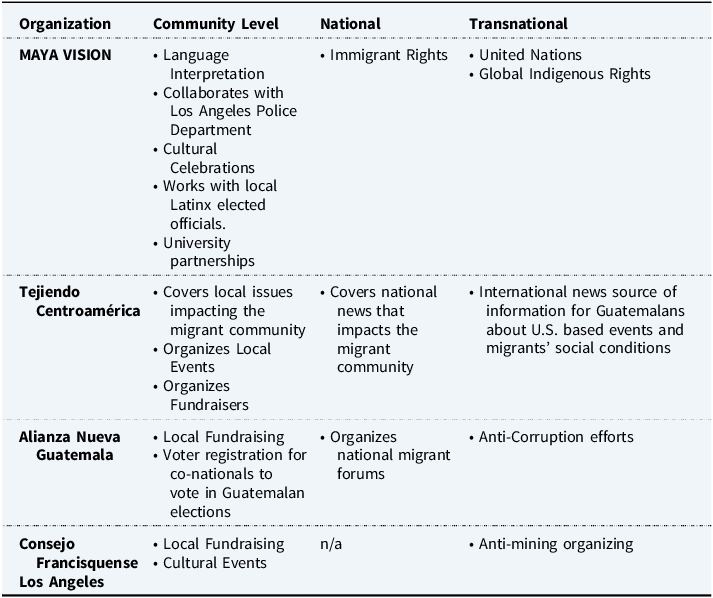
I was actively engaged by collaborating with migrant-led grassroots Guatemalan organizations (Table 1) such as Maya Vision, Tejiendo Centroamérica, and Alianza Nueva Guatemala, and taking a lead role in organizing events that leveraged university resources with Guatemalan grassroots organizations. Part of this work included my ethnographic approach to research based on “accompanying”Footnote 5 (Abrego, Reference Abrego2024; Gilmore, Reference Gilmore1993) these groups by being physically present in intimate spaces and settings such as funerals and fundraisers. In addition, by showing up to virtual spaces such as political rallies for Temporary Protected Status (TPS) and various fundraisers, especially during the COVID-19 pandemic, physical distance was necessary, but where being socially connected could continue. These forms of solidarity built the trust required to carry out collaborative research (Gonzales, Reference Gonzales2018). In other words, my approach to ethnography was not passive but very involved. By the time it was safe to conduct fieldwork, I had already built the necessary rapport to conduct the research successfully. I was uniquely situated to conduct this research as both an insider to the Guatemalan migrant community and an outsider Guatemalan migrant-led organizations.
The Local and Transnational Character of Maya and Ladino Guatemalan Grassroots Organizations in Greater Los Angeles
A key observation and theoretical insight that came out of this research is how the migrant-led organizations I worked with all have ties to political organizations in Guatemala. While these organizations in the Greater Los Angeles region are concerned with and advocate on behalf of migrants in Southern California, they consistently keep an eye on the situation in Guatemala. They are inherently transnational because they belong to the first waves of migrants to the United States and had a deep connection to the social conditions in Guatemala when the large migrations began. Not enough time has gone by, and the first generation of these migrants is still organizing and trying to keep historical memory alive. Notwithstanding, not all political actors engage with the electoral politics of their home country, as many continue to be distrustful of political parties and the mainstream institutions of the state. In the case of indigenous communities, they are especially critical of a settler state (Speed, Reference Speed2019) that has never been in the service of the nation’s working-class, poor, and peasant majorities.
Table 1. Guatemalan Grassroots Civil Societies in Greater Los Angeles

Author’s own elaboration.
“Este Es Un País De Leyes” (This is a Country of Laws): The Emergence of Maya Vision and Efforts Towards Indigenous Migrants Social and Political Incorporation
As an organization, Maya Vision emerged as a response to the needs of indigenous Guatemalan migrants. A primary need particular to indigenous migrants is language interpretation. Guatemalan migrants are a Central American migrant population that has been historically racialized in the U.S. as “illegal” writ large (Abrego and Villalpando, 2021) and one that has experienced social, political, and economic “inclusionary exclusion” (Rocco, 2014). Such challenges founded upon racial discourses and cultural constructions, immigration law, and U.S. foreign policy have made it extremely difficult for Guatemalan migrants to incorporate themselves into the social and political institutions of the U.S. Nevertheless, as a Guatemalan social class who carries with it a legacy of colonization, war, and genocide; the challenges that indigenous migrants face are compounded by the fact that they may only know and understand non-Western indigenous languages such as Q’anjobal and K’iche. Although ladino/mestizo migrants may also find themselves disadvantaged because they are monolingual Spanish speakers, they are more likely to find Spanish language interpreters. During an interview with Maya Vision member Edgar Chaj, he explains how the organization emerged when they noticed a pronounced lack of indigenous language interpreters at court hearings and during migrant detention. In addition, finding interpreters is difficult since the number of those trained to do such specialized work is few in numbers.
Nevertheless, I want to emphasize that although indigenous migrants face challenges related to language, by no means does this indicate that mestizo and ladino experiences are free of exploitation and discrimination as their racialization as “Latino” immigrants is based on their national origin regardless of immigration status and generation. This form of racialization is based on multiple factors including phenotype, national origin, and ethnicity are attached to negative perceptions about Guatemalans and Central Americans more generally that have criminalized these groups (Chomsky, Reference Chomsky2021). Historically, these ideological investments within U.S. society have justified differential pay rates and labor market segmentation among Latin American origin populations across racial and ethnic differences (Barrera Reference Barrera1979; De Genova, Reference De Genova2005; Almaguer, Reference Almaguer2009). In the case of Guatemalan migrants, both indigenous and non-indigenous, they enter and become incorporated into U.S. society with specific racialized social relations (Omi and Winant, Reference Omi and Winant1986; Robinson, Reference Robinson1992).
Although migrants in legal and court proceedings are entitled to interpretation based on U.S. law, indigenous Guatemalans, and Guatemalan migrants in general, historically have not attained the political power necessary to build institutions that address their specific needs (Bedolla and Hosam, 2021). Despite being a migrant population that began to grow since the 1980s, one reason the Guatemalan community has not been able to build up political institutions may be time, resources, and social and political divisions within the community itself (Jonas and Rodríguez, Reference Jonas and Rodriguez2014). In addition, irregular Guatemalan migrants have been incorporated into the U.S. mainly as a group that is perceived and constructed as having “voluntarily” migrated to the U.S., making their entry “illegal” since they have not been considered refugees or asylees, and thus have made it difficult for Guatemalans to gain permanent legal status and build political institutions (Bedolla and Hosam, 2021; Jonas and Rodriguez, Reference Jonas and Rodriguez2014).Footnote 6 Moreover, since the specific issue of indigenous language interpretation impacts communities at the extreme margins of Guatemalan society, indigenous communities themselves have taken up this work since it is not an issue that impacts ladinos and mestizos similarly. In fact, when it comes to interpreting within the court system, this can have life-and-death consequences for indigenous migrants, as understanding legalese in a foreign language can prevent them from signing their own deportation orders, which can potentially place them in migrant detention and expel them back to their country of origin where they may die due to social, political, gendered, and structural violence (Alvarez, Reference Alvarez2020). In fact, during an interview with Maya Vision member Edgar Gutierrez, he explained how the emergence of the organization came about when the Mayan community and its leaders in Los Angeles took notice that K’iche and Q’anjobal speakers were repeatedly losing their court cases due to being misinformed and even signing their own deportation orders. In addition, research shows that the number of interpreters fluent in Mesoamerican indigenous languages is scarce (Solis, 2021). Not only is this a matter of supply, but it also challenges understandings about Guatemalan migrants by rendering visible their indigeneity (Blackwell, et al., 2017), which may be overlooked or erased.
Part of the advocacy work taken up by indigenous organizations such as Maya Vision entails both language interpretation and the work of navigating American social institutions. Most of this community-responsive labor is a way to prevent indigenous migrants from becoming entangled within the U.S. legal system. As indigenous migrants who have lived in the U.S. for decades, and some of whom have attained legal status in the form of permanent residency and citizenship (although not all), they understand how recently arrived migrants may engage in activities that are deemed “illegal.” For example, migrants may not understand all traffic regulations or “break” laws by engaging in social practices from their communities of origin in new social contexts. For example, indigenous migrants may have older children take care of younger siblings without parental supervision, something not uncommon among other working-class groups, regardless of race and ethnicity, who may lack the economic resources necessary for childcare in a society where these services have become highly privatized markets. Specifically, Maya Vision leader “Juan,” (a pseudonym) who lacks legal status after living in the U.S. since the late 1990s and having U.S.-born children, underscores how Mayan migrants have repeatedly had their children taken away from them by the state because they do not understand U.S. law and societal norms which stem from the American legal system. Juan stresses how migrants struggle to navigate a social setting alien to them and how not speaking English or Spanish increases the precarity experienced by migrants forcibly displaced from Guatemala.
In part, the organization’s goal is not to change or assimilate indigenous migrants but to prevent them from becoming unknowingly criminalized. As a community that continues to be overwhelmingly undocumented and of mixed legal status (confirmed by my own original research), organizations such as Maya Vision seek to address the specific needs of indigenous migrants, whose legal status is compounded by the reality that they are monolingual speakers who cannot readily access indigenous language interpreters due to lack of access and infrastructures which address these linguistic and cultural needs. In other words, indigenous migrations disrupt taken-for-granted understandings about who Guatemalans are, and it reveals the heterogeneous character of Guatemalan society, especially when indigenous organizations such as Maya Vision emerge within the diaspora because of their communities’ specific needs.
In addition, this foregrounds how they are a racialized and exploited class at multiple levels, both as transnational migrant labor (Robinson, Reference Robinson2003) and at the level of everyday personal discrimination, such as the experiences of adolescent students in American schools (Barrillas Chón, 2022). They are a class of migrants who experience linguistic barriers tied to their indigenous communities. Although ladino migrants also experience language barriers as forcibly displaced laborers who only speak Spanish, they are part of a language community that spans much of the Latin American continent through a shared history of colonization that continues to impact indigenous migrants negatively in different ways.Footnote 7 What is more, the broader Latinx community and its civil society organizations may not understand the resources necessary for indigenous migrants to navigate American society successfully since it may be assumed that all Guatemalan migrants are Spanish speakers. Both within and outside the Latinx community, it is also assumed that all Latinx may be of Mexican origin, especially in the Western U.S. and the Southwest that borders the Mexican border.Footnote 8
The organization’s approach to targeting the barriers that indigenous migrants face in the U.S. speaks to the varying political ideologies present not only within the Guatemalan migrant population itself but also within heterogeneous indigenous communities. Like other social groups, indigenous Guatemalan communities are by far anything but monolithic in cultural and linguistic terms, and their political orientations are just as diverse. Maya Vision has worked with state representatives such as local Latinx elected officials whom they have used as brokers to connect them to dominant political institutions (Zepeda-Millán, 2017) and the Los Angeles Police Department to create indigenous language cards. In contrast to other Guatemalan activist organizations, the political practices of Maya Vision may seem counterintuitive by working with the U.S.—a government that was involved in a 36-year counterinsurgency war in Guatemala and one that continues to criminalize migrants at the border, within the interior (Varsanyi, Reference Varsanyi2008) and one that has externalized the U.S. border into Mexico (Osuna, 2021). These approaches may seem contradictory since the Los Angeles City Council and its Latinx elected officials were publicly exposed for making racist remarks against their own constituents in 2022. In addition, language cards were created through working with the Los Angeles Police Department (LAPD) when officers fatally shot indigenous migrant Manuel Jaminez Xum for allegedly not dropping a knife he was brandishing. He could not heed the officers’ orders because he did not understand what they were saying to him in Spanish.Footnote 9
However, these relatively small organizations, comprised of about ten core members at most and a membership base that remains unclear, use any tools at their disposal to make citizenship claims (Rocco, Reference Rocco2014) and create spaces of belonging as subaltern “Latinx” groups. Nevertheless, the vital element to note here is not so much how to locate where on the political spectrum (i.e. liberal, conservative, radical, abolitionist, etc.). Maya Vision falls, but why do these organizations within the spaces of civil society emerge in the first place? My argument is that these indigenous organizations with very specific objectives emerge because they have historically had no political power in the U.S. as a vulnerable community forcefully displaced by the conditions created by neoliberal capitalism. They come from an economically dependent nation where indigenous majorities hold little to no power within the state and where they continue to experience “accumulation by dispossession” (Harvey, 2004), organized abandonment (Gilmore, Reference Gilmore2008) and authoritarian political violence. In addition, within the U.S., no political parties represent their specific needs. Even Latino elected officials may not understand or care about their communities’ wants and needs.Footnote 10 Although these organizations identify first and foremost as “Mayan” or “Indigenous,” they understand the material and discursive realities of becoming “Latinx” (Castellanos, 2017; Sandoval, 2015) in the U.S. and how resources can be mobilized around a category that collapses differences related to heterogeneous Latin American origin populations (Beltran, Reference Beltrán2010; Mora, 2014). However, returning to the original premise of this paper, I theorize that these organizations have emerged within the U.S. as a direct result of Guatemalans’ forced displacement within a globalized neoliberal economic system. In addition, these organizations spring up within post-migration contexts characterized by local, national, and transnational forms of organizing.
Moreover, these semi-autonomous civil society organizations (Fox and Bada, Reference Fox and Bada2011), which may work with mainstream political institutions and non-profit organizations, understand the need to be pragmatic in addressing the urgent issues of indigenous migrants. In other words, these relatively small organizations exercise limited forms of agency within the “submerged networks of everyday” (Rocco, Reference Rocco2014). They operate within a neoliberal political order that limits migrant communities’ ability to expand their political rights and increase their social and economic mobility at levels that fully incorporate them into the social, political, and economic institutions of U.S. society (Rocco, Reference Rocco2010). This speaks to a broader condition not only for migrants but for other racial minorities and working-class groups in the U.S. who may use any means at their disposal since they have not been able to build sufficient political power within the dominant two-party system. This leaves them to voluntarily engage in forms of localized political activism at the grassroots level and organize within the social justice model centered around non-profit organizations that have come to dominate U.S. society.
Since the 1970s social justice organizations have operated primarily through the 501(c) (3) non-profit model whereby private foundations can make tax deductible donations to these groups. Historically charitable organizations such as the Ford Foundation were created by wealthy individuals and their families to shield their capital from taxation (INCITE, 2017). While these foundations support organizations engaged in valuable community-based efforts at multiple levels, the limitation of these charities, for example, has been a focus on addressing the needs of individuals in poverty instead of supporting campaigns for higher-wages that would ameliorate the condition of economic precarity at a systemic level for large segments of the population (ICITE, 2017). In turn, the non-profit industrial complex comes to stand in as a “shadow state” by doing much of the work that government agencies are responsible for in the areas of education and social services that should be done with tax money (INCITE, 2017). Although many of the organizations discussed in this article do not hold non-profit status, Guatemalan civil society groups nonetheless engage in politics within a broader social context that is always operating within neoliberalism and its accompanying political-economic structures.
In other words, this points to how invisibilized Central American communities (Arias, Reference Arias2003) such as indigenous Guatemalans seek a politics of representation both outside, within, and at times against dominant U.S. political institutions. For instance, organizations such as Maya Vision, among other indigenous-focused organizations in Los Angeles, have worked with the U.S. Census to accurately count indigenous populations, making them more visible to state institutions with the end goal of mobilizing material resources. At the same time, organizations such as Maya Vision have engaged in collective action by joining mass national mobilizations such as the Immigrant Rights Movement (Voss and Bloemraad, Reference Voss and Bloemraad2011) in addition to localized forms of grassroots organizing. Guatemalan migrant-led civil societies that have emerged across Southern California are semi-autonomous (Fox and Bada, Reference Fox and Bada2011) at best. In the face of the major obstacles that they confront as they learn to navigate the American system of social institutions, migrants and their grassroots associations exercise limited forms of political power within the dominant political structures of American politics that have increasingly become corporatized. Within this contemporary social context where political campaigns are funded by billionaires such as Elon Musk, groups such as Maya Vision engage in forms of politics that are pragmatic by working with brokers such as local elected officials, police departments, and university research centers that rely on funding from philanthropic donors such as the Mellon Foundation.
In other words, they are semi-autonomous as they work within the same social and political matrix that has historically shaped indigenous communities’ displacement and which continues to keep Guatemala in a permanent state of economic dependence. These small organizations are not able to ignore the power of elected officials and electoral politics, the state, or the limited resources they can mobilize through the non-profit industrial complex. Doing so would make their organization’s outlook idealistic by assuming they can empower themselves in isolation without alternative models, such as viable third parties within a two-party system, that do not rely on large private donations for campaign spending. In relation to Latinx politics, this also disrupts our understanding of how and, in this case, why indigenous “Latinx” groups behave the way they do politically. Rather than make sense of their political practices as an identity group, organizations such as Maya Vision teach scholars that minoritized groups on the extreme margins have tendencies to be politically moderate, and potentially conservative, as they navigate social terrains that have become increasingly hostile towards racial minorities, migrants, and oppositional groups.
Ladino and Maya Organizations: Local and Transnational Dimensions
Aside from groups such as Maya Vision, many organizations, most of which are small, have proliferated in the U.S. The social and political objectives of these groups and their demographic makeup are as varied and richly diverse as the social dynamics found in Guatemala. These groups may focus on objectives as varied as repatriation of the deceased, fundraisers because of the ecological crisis and COVID-19, transnational development projects (Popkin, Reference Popkin2003), and the restaging of religious celebrations such as La Fiesta de la Virgen de Candelaria (Steigena and Williams, Reference Steigenga and Williams2009). In relation to these forms of transnational organizing, such practices began to take shape during the 1980s and 1990s when Guatemalans were displaced by the country’s U.S. backed counter-insurgency war and while the Central American region became fully integrated into the world economy under neoliberal globalization (Robinson, Reference Robinson2003).
In addition, organizations have been created by and for women Guatemalan migrants in Los Angeles, such as GuateMaya L.A. Mujeres en Resistencia that organize transnationally around issues related to racialized gender violence and intergenerational trauma (Macal, Reference Macal2024). What is more, grassroots radio programs such as Tejiendo Centroamérica emerged in 2016 after the election of Donald Trump. As program host and long-time migrant activist and journalist who was forced to leave Guatemala in the 1990s due to political violence, Azalea Vásquez Ryckman explains that Tejiendo Centroamérica was created so that families and friends in Guatemala could understand Guatemalan migrants’ social conditions in the U.S. under an anti-migrant context. Azalea has further elaborated by stating that the radio program is a transnational effort to connect the Guatemalan community through alternative media networks necessary to tell the truth about what Guatemalans endure in both origin and destination countries. Others, such as Alianza Nueva Guatemala and Consejo Francisquense Los Angeles, are transnational organizations made up of a loose global network of activists, organizers, and political exiles. This transnational network comprises individuals and adjacent organizations found in Guatemala, the U.S., and Europe. As a case in point, during a conversation with a founding member of Alianza Nueva Guatemala, Erick Valdez describes the organization as “unitaria y amplia” (unitary and broad), meaning it is open to people with diverse political orientations. During our conversation, Erick stressed how the organization emerged around 2021 in the San Francisco Bay Area in response to the forces that continue to displace Guatemalan migrants. Alianza is not tied to any political party or funder and focuses on working with progressive groups that want to improve the conditions in Guatemala. The organization also supports indigenous movements that are leading the fight against extractivist corporations, as previous research has shown (Batz, Reference Batz2022). They support human rights efforts, and they respond to natural disasters through fundraising due to state abandonment that was led for many years by a criminal ruling coalition known as the “pacto de corruptos” (pact of the corrupt). Within the U.S., the organization advocates on behalf of Guatemalan migrants (regardless of race, ethnicity, gender, or sexual orientation) by working with and making demands upon the Guatemalan consulate in Southern California.
Although the racial and ethnic leadership of these organizations is more mixed than collectives such as Maya Vision, their rise stems from many of the same root causes. After interviewing leaders of numerous Guatemalan civil society organizations based in the Greater Los Angeles area, it became clear that many of the social and material conditions that drove them to leave Guatemala during the armed conflict overlapped with dire conditions such as economic crisis and political violence. In addition, these leaders articulate and understand the factors that continue to force people to migrate in the post-1996 Peace Accords era. Although most of these political actors arrived in California in the 1980s and 1990s during the height of Guatemala’s armed conflict, they can articulate the conditions that are driving migration in the present moment due to their on-the-ground engagement with Guatemalan migrants in Southern California and because of their continued involvement with transnational political networks. When triangulated with my survey research and follow-up interviews, civil society organizations and respondents expressed that the primary force driving migration is economic across racial and ethnic groups. In addition, through structured interviews with both activists and migrants, they expressed that although poverty and underdevelopment plague the majority of Guatemalans writ large, there is a common understanding that most poverty is found in the Western region of the country in regions such as Huehuetenango (Orellana, Reference Orellana2023). In addition, a significant portion of the migrants I surveyed were from Huehuetenango, and a recent study published by Plaza Publica, a popular newspaper in Guatemala, found that a high number of deportees who have returned to Guatemala are from the same area. In other words, the underlying causal mechanism driving migration is economic; nevertheless, this class-based force has specific implications for indigenous majorities who are forced into the migrant stream, thus finding themselves in new social contexts (Orellana, Reference Orellana2023). Nevertheless, as highlighted earlier in this piece, economic precarity impacts and shapes migration in Guatemala across racial and ethnic groups and these migrant communities continue to experience exploitation and discrimination in various ways in the U.S.
Due to the specific barriers that Guatemalan migrants confront as a transnational labor force, organizations such as Maya Vision and Alianza Nueva Guatemala have been formed. These organizations constitute migrant-led civil societies at multiple scales (Fox and Bada, Reference Fox and Bada2011; Blackwell, et. al., 2017). Such migrant-led civil societies are not only heterogeneous in their constitution but also in their form and political objectives. In other words, these migrant-led organizations operate at multiple scales within local, regional, and transborder contexts. While organizations such as Maya Vision focus on accompanying (Tomlinson and Lipsitz, Reference Tomlinson and Lipsitz2013) migrants at the local and regional level as they assist them with navigating quotidian life in new social contexts, they have also engaged in global advocacy efforts. They have advocated on behalf of indigenous peoples across the Americas at the United Nations under the leadership of such political actors as the late Maya K’iche Policarpo Chaj, whose body was repatriated to his birthplace in Totonicapán, Guatemala during the COVID-19 pandemic.
As stated earlier, the specific character of organizations such as Maya Vision is shaped by the implications of forced displacement among indigenous people as subaltern groups located at the periphery of the centers of capital accumulation. As a super-exploited class shaped by colonial social relations (Batz, Reference Batz2022; Nimatuj, Reference Nimatuj and Alicia2005; Grandin; Reference Grandin2014; Arzú, 2018), Mayan migrants face very particular forms of precarity because of their displacement and post-migration within new American contexts, such as language interpretation and preservation. Because indigenous communities’ collective identities and languages are tied to the specific regions in Guatemala and foster language acquisition, displacement has immense implications for indigenous migrants and their children in the diaspora. These challenges include cultural preservation (Boj-Lopez, 2017), historical memory, language acquisition (Chon-Barillas, 2022), criminalization (Abrego and Villalpando, 2021), inter-ethnic discrimination (Herrera, 2016) and challenges of belonging and being indigenous within the broader “Latinx” community. For instance, in the Inland Empire, Maya Vision has taken up the task of partnering with school districts to address the challenges that indigenous students face in high schools. Prior research has established that indigenous students experience discrimination because of the Mesoamerican languages they speak and their colonial relationship to the Spanish language (Chon-Barillas, 2022). As such, within the Inland Empire, where recently arrived indigenous children are outpacing Mexican students, Maya Vision is engaged in efforts to hold parent workshops on health and “know-your-rights” in indigenous languages such as Q’anjobal and K’iche.Footnote 11 However, as semi-autonomous groups, they do form relationships with governmental institutions including local government officials, police departments, and school districts. That is to say, although groups such as Maya Vision organize cultural events, they understand how state institutions can impact their material realities and how they cannot simply opt to not engage the state.
In part, this illustrates how indigenous groups have specific needs as subaltern and racialized groups that are marginal within the heterogeneous Guatemalan migrant community and within the broader U.S. Latinx community. This example speaks to how they share a common class experience with ladinos but also conveys how their experiences are different because they are indigenous. Furthermore, this example helps me advance my argument by illustrating how the economic conditions that displace both Maya and ladino migrants have varying implications in transit and because of their new post-migration contexts in the U.S.Footnote 12 However, despite these groups’ differences and the racial antagonisms present in Guatemala, they still come from an origin nation that continues to be shaped by the underdevelopment that neoliberal globalized capitalism produces.
The limits of “resistance” under Neoliberalism
It is worth mentioning that although migrants, and the Guatemalan populace more generally, are impacted by the complex forces of contemporary capitalism and legacies of over 500 years of colonization, their civic associations are relatively small and contingent upon voluntarism since members engage in activism outside of their regular work hours (Orellana, Reference Orellana2023). Guatemalan civil societies in the Greater Los Angeles region constitute a constellation of highly heterogeneous political formations made up of actors from various racial, ethnic, and gender backgrounds with various ideological orientations. The leadership of these activist organizations serves as a reflection of the larger multi-racial, multi-ethnic, and multi-linguistic population that is displaced from Guatemala. As illustrated earlier, grassroots organizations will work with representatives of the state, such as the U.S. Census, in efforts to accurately capture the demographic profile of indigenous populations or engage with the Guatemalan consulate to register voters so they can participate in elections from abroad. However, not all grassroots organizations that work with the Guatemalan migrant community agree on what are worthwhile organizing efforts for Guatemalans in the U.S. or in their communities of origin.Footnote 13
Nevertheless, I do not want to embellish or exaggerate the work that these small migrant-led organizations with relatively minimal autonomy (Fox and Bada, Reference Fox and Bada2011) are able to accomplish within capitalist structures that keep labor migrants in a “near universal complex of unfreedom” (Apostolidis, 2019). Freedom under capitalism means that the only choice migrants have is to sell their labor within a capitalist marketplace since it is the only means by which they can socially reproduce themselves. While it is important to highlight the work that these groups do, their organizations unfold within the same economic and legal structures (i.e., mode of production) that keep migrants in a state of dependence and in labor markets where they are exploited. That is to say, the forms of agency that they exercise are limited under neoliberal forms of governance.
Moreover, working within the institutions of liberal democracy that ultimately stem from the emergence of a bourgeoisie society poses extreme limitations. Because the state and its institutions are used under neoliberalism to liberalize the marketplace and produce “illegal” populations (De Genova, Reference De Genova2005) of migrant labor from the Global South (Ness, 2023) that have no legal protections or union membership, it has been difficult for migrant groups to build political power, especially in the case of Guatemalan migrants. In truth, migrant groups and the larger Latinx community in the U.S. have not been able to achieve comprehensive immigration reform (Gonzales, Reference Gonzales2014) in the face of bi-partisan resistance and the demobilization of immigrant rights groups through significant concessions such as Deferred Action for Childhood Arrival (Zepeda-Millán, 2017). As mentioned earlier in this piece, Guatemalan migrants arrive to the U.S. with very little social and political capital since they are fleeing a captured state that has abandoned the population for decades and is in the service of capitalist interests.
Taken as such, migrant-led organizations and their leaders understand the limitations they are working within, some of whom were forced into exile because of political violence during the height of Guatemala’s civil war, and they know all too well the limits of working within these structures. In this sense, these organizations use multiple tools at their disposal to address the immediate conditions of the migrant community. Transnational organizations such as Tejiendo Centroamérica and Alianza Nueva Guatemala view migration as a national issue because the large numbers of migrants living and laboring abroad (approximately 4 million) are Guatemalan nationals that should not be twice abandoned; first in Guatemala and second when they are forgotten after being displaced abroad. In addition, the leadership of these organizations articulates the relationship between migrant labor and the dependence that Guatemalan society has on these remittances and how U.S. society’s standard of living is improved by migration.Footnote 14 Although these transnational organizations may not necessarily use the language and concepts of Latin American Dependency Theory, they consistently articulate the social and economic relationship between the two countries. In addition, they demand that Guatemalan nationals laboring abroad should have a stake in the political process since a large portion of the country’s gross domestic product is based on these remittances. These transnational organizations have a tacit understanding of the ways in which Guatemala continues to be in a state of dependency that produces uneven development reinforced through U.S. foreign policy.
At the same time, organizations with ladino and indigenous memberships also emerge for similar reasons. Although ladino migrants, members of Guatemala’s dominant group, are a relatively privileged group, their racial and ethnic categorization is also transformed in transit to the U.S. Although ladinos continue to enjoy a level of social, political, and economic power as the dominant group, when they arrive to the U.S., they enter a nation with historically specific racialized social relations (Robinson, 1993) and a history of racialization premised on where they have migrated from (Ngai, Reference Ngai2004) and for being perceived as racial others (Beltran, 2020). In other words, these groups are a social class that becomes racialized and are by no means dominant once in the U.S. as they live and labor in a new geographical context with a history founded upon indigenous genocide, slavery, colonization, and white supremacy. Although ladinos may bring with them privileges from Guatemala as members of the dominant group rooted in the nation’s ethnonationalism and eugenicist ideology, once in the U.S., indigent ladinos forced to migrate are not so dominant and become part of a broader Latin American origin laboring class (Robinson, 1993). For instance, the contemporary migrations into Southern California’s Inland Empire, from approximately 1980 to 2022, which I investigated (Orellana, Reference Orellana2023), reveal that despite these privileges, self-identified ladinos and mestizos find themselves in many of the same precarious labor markets as a racialized labor force.Footnote 15 Interestingly, these jobs filled with racialized migrant labor (Olivos and Sandoval, Reference Olivos and Sandoval2015) serve as the underlying social condition for these groups to work together within political organizations because of their structural position within the U.S.’ class and racial hierarchy.
Conclusion
We continue to live in a globalized world under neoliberal capitalism. If an international division of labor predicated on the uneven development between the global North and South remains, we will continue to witness migration from nations such as Guatemala to the U.S. These mass human movements are rooted in and shaped by a history of colonization and Guatemala’s incorporation into the world capitalist system (Camayd-Freixas, Reference Camayd-Freixas2013). As a result, we have witnessed large numbers of migration from Guatemala to the U.S. during the 1980s, and they have continued into the contemporary moment. Because of these factors, grassroots organizations have emerged within the diaspora as a response to forced displacement from Guatemala. Being that Guatemalans are a relatively new migrant population in the U.S., the grassroots organizations I have accompanied emerged during the 1980s and 1990s. Although economic conditions in Guatemala cut across racial, ethnic, and linguistic communities and geographic space,Footnote 16 migration has various impacts on these groups. Specifically, Mayan migrants are impacted by forced displacement in ways that ladino and mestizo populations do not experience and may not even fully understand. My intention in this paper has been to demonstrate these differences and how grassroots formations reflect those racial and ethnic differences in the diaspora.
Nevertheless, the racial dynamics within the U.S. are different, and these organizations’ political orientations and dynamics change. There are many implications for the Guatemalan community in the U.S. But, as a group that will continue to migrate because of neoliberal reforms and uneven development, the question remains of how these groups will organize themselves not only within the U.S. with other Guatemalans and broader Latinx civil societies but also transnationally. In the future, it will be essential to understand how Guatemalan migrants from multiple racial and ethnic groups organize within the U.S. and how they continue to be involved in the politics of the home country, as my original research has shown.
Acknowledgments
Research was supported by the University of California, Riverside’s Latino and Latin American Studies Research Center; and the John Randolph Haynes and Dora Haynes Foundation.
Ethical statement
The identities of individuals that participated in this study were protected by remaining anonymous. In some cases, participants wanted their real names to be revealed. If a pseudonym was used, I indicate it in the paper.

 Open access

