

Introduction
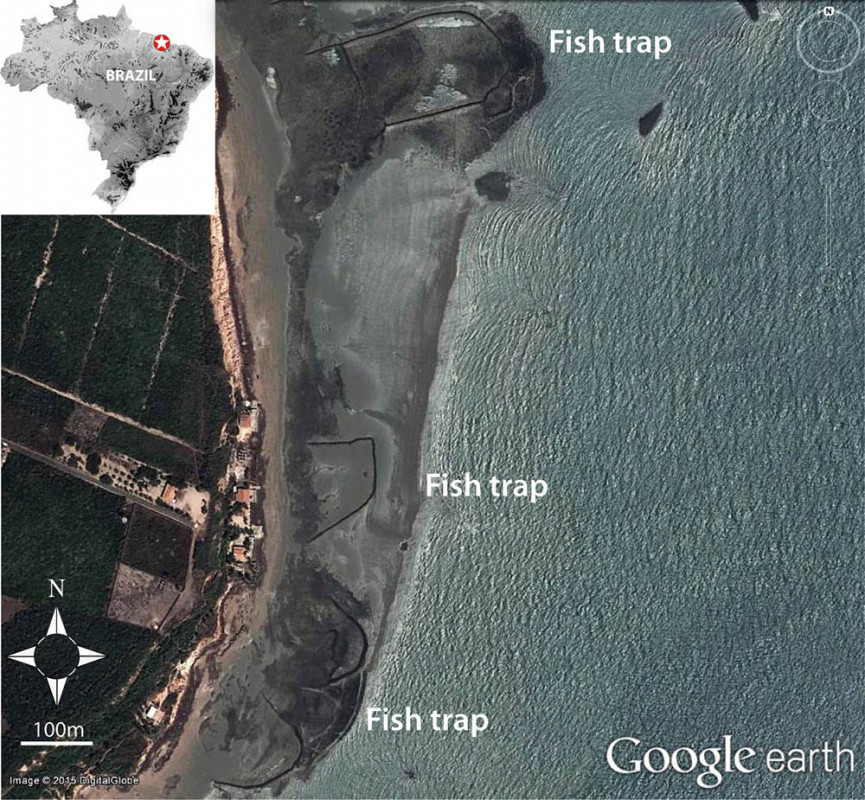
Archaeological fish traps in northern Brazil (Maranhão); the local communities today attribute them to past indigenous populations; their chronological and cultural attribution is, however, unknown ©Google Earth.

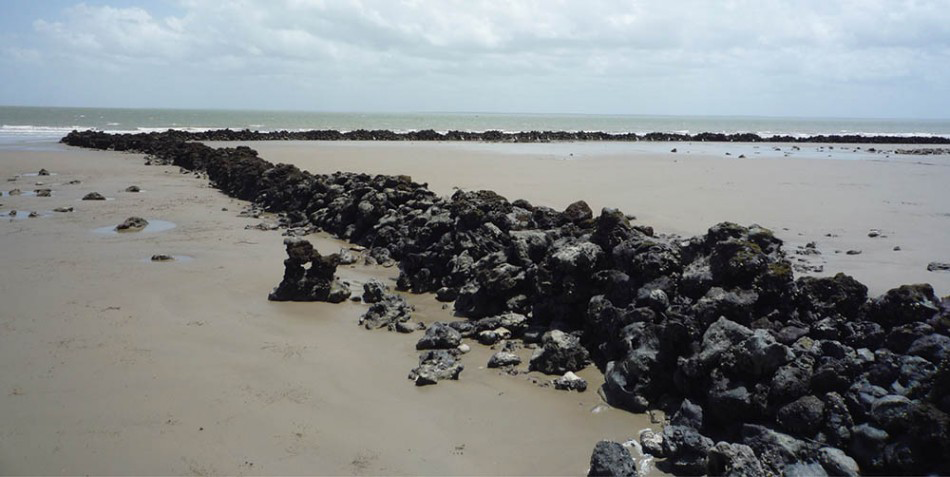
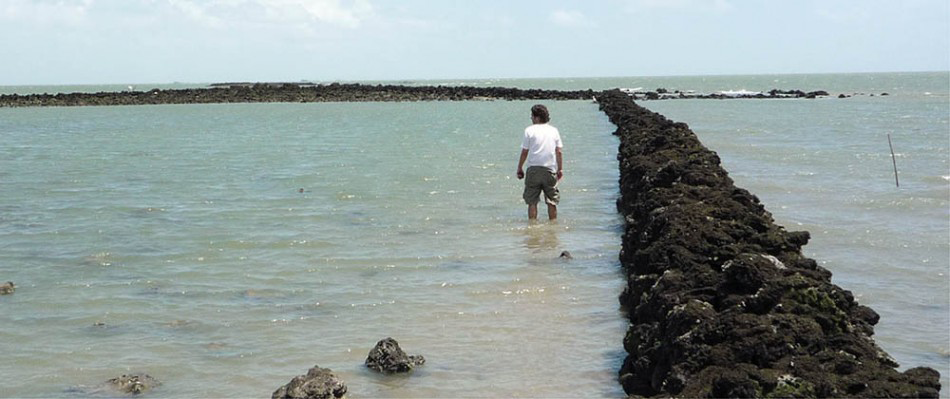
What is the role of cultural heritage for poverty alleviation in the coastal areas of Latin America? Along the coastline of Brazil, artisanal fisheries are a traditional and crucial source of food and livelihood for thousands of people (Reference BegossiBegossi 2010). Brazilian coastal communities efficiently integrate modern small-scale fishing techniques with pre-colonial indigenous knowledge, as a ‘neotraditional’ mix (Reference BegossiBegossi 1998). In the coastal areas of Maranhão, one of the poorest regions of Brazil (World Bank 2004), this culminates in the use of historic fish traps (locally known as camboas, Figure 1). The traps are intertidal structures consisting of walls built from locally available stone (plinthite and petroplinthite, Figure 2). Tidal oscillation of around 7m allows fish to enter at high tide and to be trapped as the water recedes (Figure 3). Although their date of construction is uncertain, seventeenth-century European writers documented use of similar structures by indigenous people in similarly rich and productive ecotones (e.g. Reference D’abbevilled’Abbeville 1632; Reference D’evreuxd’Evreux 1864).
Fish traps; these are made of locally available minerals (plinthite and petroplinthite) © A. Colonese.

Fish traps; tidal oscillation (around 7m) traps fish between high and low tide © A. Colonese.

Despite their importance as maritime cultural heritage in lowland South America, these fish traps have received little public or scientific attention (da Silveira et al. 2012). Their impact on the resources of local fisheries, as well as their economic and social relevance for community livelihoods, remains undocumented. Similarly, their preservation and potential to support resilient community development have never been assessed. The study of this cultural heritage, and the complex relations between these fishing societies and their environment, calls for the integration of approaches from the archaeological, social and environmental sciences. With the support of the British Academy Newton Mobility Grants (2015), a collaborative partnership has been established between archaeologists, human ecologists and economists from the University of York (UK), Universidade Santa Cecília (UNISANTA), Universidade Estadual de Campinas and the Fisheries and Food Institute (FIFO) (Brazil). Our aim is to assess the economic and social contribution of archaeological fishing methods for modern artisanal fisheries management in Brazil.
Objectives
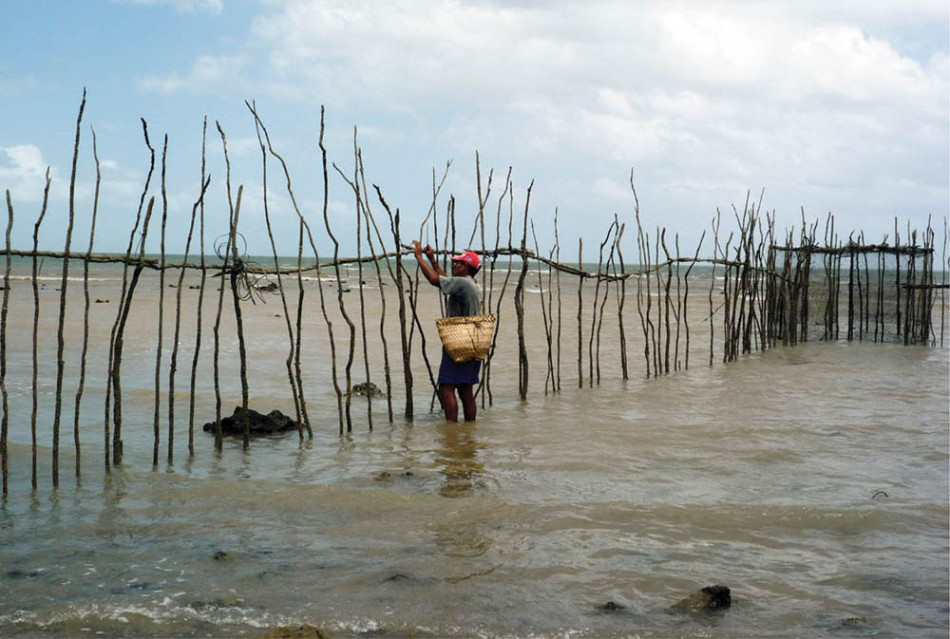
The project is based on a mobility and knowledge co-production approach revolving around: 1) a series of seminars in Brazil and the UK in 2015 on coastal archaeology and archaeological science, and on the integration of coastal zone management and poverty alleviation (livelihood, vulnerability, resilience studies in coastal contexts, participatory approaches); 2) a field school at São Luis (State of Maranhão), with the participation of the fishing communities, to assess the socio-economic importance of fish traps for small-scale coastal communities. This field school will be developed using a participatory and collaborative approach to elicit indigenous knowledge on coastal resource usage and management with communities, enabling mutual learning for fishing communities and the researchers (Figure 4).
Local people also build fish traps using organic materials (fibres, wood) © A. Colonese.

Expected outcomes
A salient aspect of the project is the impact of coastal archaeology in bridging past and modern artisanal fisheries in Brazil as a pathway to increase our understanding about their sustainability. Fish traps are a distinctive feature of coastal landscapes and the broader social and economic potential of this heritage is significant. Thus, new economic opportunities may be explored for combating the dual problems of heritage conservation and food security in the poorest area of Brazil. The understanding of fisheries management and the role of cultural heritage to poverty mitigation is of general resonance for policy-making and for the resilience of coastal socio-ecological systems in other parts of Brazil and Latin America.
Acknowledgements
This project is funded by the British Academy Newton Mobility Grants (Bridging ancient and present artisanal fisheries in Latin America).