

1. Introduction
Under the influence of rising life expectancy and declining birth rates, the process of population ageing is taking place in almost every country across the globe (United Nations, 2007). In European countries, the ageing of societies will pose major challenges for public policy in coping with a declining labour force and rising welfare state expenditures (European Commission, 2006). Furthermore, although in the short run the current economic crisis enlarges labour pools, in many European regions a decrease in the effective labour supply is expected in the long run. Policy-makers in European countries are therefore paying increasing attention to the labour market situation of older workers (OECD, 2001; European Commission, 2006).
Social policy research into the labour market situation of older workers has been mainly concentrating on attitudes towards work and retirement among older workers (McNair, Reference McNair2006; Loretto and White, Reference Loretto and White2006); on how retirement behaviour is determined by individual difference factors, including the financial position and health status of older workers (e.g., Meghir and Whitehouse, Reference Meghir and Whitehouse1997; Tanner, Reference Tanner1998; Bound et al., Reference Bound, Schoenbaum, Stinebrickner and Waidmann1999; Blake, Reference Blake2004); and on the effects of occupational and state pension policies and other social security programmes on retirement behaviour (Kohli et al., Reference Kohli, Rein, Guillemard and Gunsteren1991; Tanner, Reference Tanner1998; Blundell et al., Reference Blundell, Meghir and Smith2002; Gruber and Wise, Reference Gruber and Wise2002; Arkani and Gough, Reference Arkani and Gough2007). In all these studies, the central questions are what preferences, expectations and behaviour individuals adopt towards retirement, and how these are influenced by social policy. Vickerstaff et al. (Reference Vickerstaff, Cox and Keen2003) and Vickerstaff (Reference Vickerstaff2006a, Reference Vickerstaff2006b) incorporates the potentially dynamic role of the employer in the retirement decisions of individuals. However, the relation between social policy and organisational practice has received little attention in the empirical literature to date. This study aims to fill this void.
Earlier survey research among organisations, carried out in the United States and several European countries, shows that there is often a lack of corporate focus on older employees, reflected in an absence of programmes to retain and retrain them (Chiu et al., Reference Chiu, Chan, Snape and Redman2001; Guillemard et al., Reference Guillemard, Taylor and Walker1996; Henkens, Reference Henkens2005; Taylor and Walker, Reference Taylor and Walker1998; Van Dalen et al., Reference Van Dalen, Henkens and Schippers2009, Reference Van Dalen, Henkens and Schippers2010; Conen et al., Reference Conen, Henkens and Schippers2012). Conen et al. (Reference Conen, Henkens and Schippers2011) find that efforts to recruit older workers are changing, congruous with the economic climate, but retention behaviour shows a clear and rather gradual positive time effect over the 2000s. These studies show that, although in general the corporate focus on older workers is rather low, employers seem to be gradually changing their behaviour towards older workers. But, whereas survey research addresses questions on incidence and trends in organisational practices in general, it does not deal with ambivalent developments and underlying motivations. For instance, if an organisation reported having measures in place to maintain older workers’ health in 2000, in 2010 the content may nevertheless have changed considerably under the influence of various factors. And, regarding underlying motivations, we cannot tell from the survey results whether employers change their behaviour based on business case justifications, or whether changed behaviour can rather be conceived as an experiment in corporate social responsibility. In this study, we approach changes in organisational practices aimed at the extension of working lives from a different perspective by using case study research. In this paper, a case study refers to a study of a corporate setting, with the aim of reaching an holistic understanding of behaviour towards the extension of working lives, using a number of different research methods (unstructured interviews, semi-structured interviews and desk research).
Earlier case study research, with an emphasis on the organisation, focuses on identification, drivers and dimensions of good organisational practices in age-aware personnel policies (Walker and Taylor, Reference Walker and Taylor1998; Walker Reference Walker1999; Taylor, Reference Taylor2006; Frerichs et al., Reference Frerichs, Lindley, Alexandrowicz and Galloway2012) as well as stereotypes and age-group relations (Brooke and Taylor, Reference Brooke and Taylor2005). Case study research regarding exit pathways and continuity of employment examines older workers’ constraints, career trajectories and retirement decisions in organisations (Vickerstaff et al., Reference Vickerstaff, Cox and Keen2003; Vickerstaff, Reference Vickerstaff2006a, Reference Vickerstaff2006b; Brooke, Reference Brooke2009).
In this paper, we contribute to these strands of research by examining a topic that, to our knowledge, has not been studied before: how have changes in the economic climate and national level policies been affecting organisational practices aimed at extending the working lives of older workers over the last decade? To answer this main research question, we selected cases from existing databases that examined ageing organisations in the early 2000s, and revisited these ‘good organisational practices’ in 2010. Case study research offers the possibility to take into account the existence of contrasting or complementary views on developments in organisational practices. In our study, we seek to explore organisational behaviour from the perspective of both management and employees. As stated by Vickerstaff (Reference Vickerstaff2006a): ‘Too often research on organisational practice remains at the level of policy documents and the espoused policy of management’ (p. 508). Previous research shows that intended organisational policies, and policies as perceived by employees, may differ (Edgar and Geare, Reference Edgar and Geare2009; Khiji and Wang, Reference Khiji and Wang2006). Yin points out that a common concern about case studies is how to generalise from a case. He states that:
the case study, like the experiment, does not represent a ‘sample’, and in doing a case study, our goal will be to expand and generalize theories (analytic generalization) and not to enumerate frequencies (statistical generalization). (Yin, Reference Yin2009: 15)
Since the first decade of the twenty-first century has been a period with apparent labour market fluctuations and national level policy changes in the Netherlands, the time frame of our case study research allows us to examine why and how organisational practices towards older workers have been evolving. In 2005, unemployment was at its highest level. The period between 2005 and 2008 was very prosperous but then the financial crisis hit in 2008, resulting in higher unemployment rates in 2009 and 2010.
This paper is structured as follows. In Sections 2 and 3, we address respectively the policy context and the theoretical background regarding organisational behaviour towards older workers. Next, in Section 4, an introduction to the methodology employed in the study is provided. The results are presented in Section 5 and, in Section 6, we conclude with a summary and discussion.
2. Blocking the exit routes
During the 2000s, the Dutch government concentrated on reversing the exit culture by blocking various pathways out of the labour market. A first major route that the government attempted to close was the disability route; a route that was frequently used by employers to lay off workers. The Netherlands Bureau for Economic Policy Analysis calculated that in 1998 nearly one-third of men in the age category of fifty-five to sixty-four received disability benefits (CPB Netherlands Bureau for Economic Policy Analysis, 2000). At that time, this was a high though not a unique disability benefit recipiency rate compared to other European countries, with countries like Norway, Sweden and Portugal in a similar range (OECD, 2003).
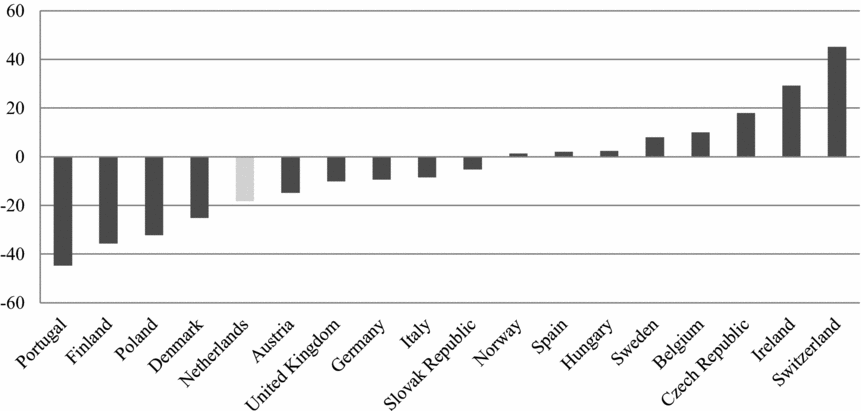
Since the 1990s, disability benefits in The Netherlands have been reduced, the criteria to enter a disability scheme have become more restrictive and several penalties have been introduced to discourage employers from ‘dumping’ workers. The sickness period for which the employer rather than the government was responsible for paying benefits was expanded and new legislation, introduced in 2002, increased the obligations of employers and employees during the first two years of illness. Employers were given full responsibility for sick leave support and reintegration, and it became the responsibility of employees to cooperate. Financial sanctions follow if either party does not live up to this obligation. In 2004, the period of sick pay to be complied with by employers was extended from a maximum of fifty-two to 104 weeks. A new law, offering employers and employees financial incentives to reintegrate partially disabled workers, was introduced in 2005. Furthermore, the Working Conditions Act contains regulations to enhance the health, safety and welfare of employees, and is aimed at the prevention of work-related injuries and illness. In 2005 and 2007, adjustments were made to the Act, bringing Dutch regulation more in line with European directives and decentralising policy-making from the government level to the organisational level (Ministry of Social Affairs and Employment, 2012). Disability benefit recipiency rates for people between fifty and sixty-four years of age declined by about 18 per cent in the Netherlands in the period 1990–2007 (see Figure 1).
Change in disability benefit recipiency rates, fifty to sixty-four years of age, 1990–2007a
Notes: (a) The specific years covered for every country are the following: 1990–2005 for Denmark; 1992–2007 for Switzerland; 1995–2006 for the Slovak Republic; 1995-2007 for Germany, Poland (FUS only) and Sweden; 1999–2005 for the United Kingdom; 1999–2007 for the Netherlands; 2000–2006 for Italy; 2000–2007 for Hungary; 2001–2007 for Ireland; and 2005–2007 for Spain.
Source: OECD, 2009.

Furthermore, substantial alterations were made to voluntary early retirement schemes. The schemes used to be based on pay-as-you-go funding and were transformed into actuarially neutral pre-pension schemes on a capital-funded basis after the middle of the 1990s. Most pre-pension schemes were designed in such a way that an employee needed to work for forty years to obtain a full allowance. At the introduction of pre-pension schemes, older employees were often offered transitional arrangements, containing guarantees of the age at which they were allowed to stop working or the allowance they would be paid. In 2006, early retirement was further restricted by a new law. These adjustments make it financially more attractive for older workers to prolong their working life. Although workers in most sectors of industry can still use early retirement schemes if they want to, this usually comes at greater costs.
In 2009, plans were launched to raise the public pension age from sixty-five to sixty-seven in about 2025. The way this increase is to be realised (gradually, stepwise, or with a ‘big bang’) was, at the time of our study, still under heavy discussion in the country (Government of the Netherlands, 2012).
3. Theoretical background
A basic tenet of organisational theory is that organisations are considered to be goal-oriented systems that strive for profit maximisation, continuity and a healthy market position (Kalleberg et al., Reference Kalleberg, Knoke, Marsden and Spaeth1996). These objectives could be described as basic organisational goals. Organisational behaviour towards older workers is assumed to be dependent on older workers’ contributions in achieving these goals. Although organisations may not be able to take all alternatives and consequences of an action into account, we assume they will strive towards rationality in their decision-making. Organisational behaviour towards older workers is influenced by the context of the broader organisation. This is not a static context, but one that is dynamically changing. Macro-level developments, such as economic changes, influence the choices made by managers. When organisations are shedding jobs as a result of an economic downturn or a declining demand for output, managers will be more pressured to implement cost-saving measures than in a favourable economic climate. We expect that business-cycle effects will affect the likelihood of employers stimulating older workers to extend their working lives.
Rational organisations, however, might also be concerned with the long-term sustainability of their staff. Although in the short run the current economic crisis enlarges labour pools, organisations may look beyond the crisis and anticipate a period with an expected decrease in the effective labour supply. In that light, it would be rational for employers to pay increasing attention to practices and policies towards older workers and to stimulate the extension of their working lives.
From an institutional economic perspective, the cultural and political contexts in which employers operate, or more generally the ‘institutional surroundings’, may play an important role in how employers behave towards older workers. In our findings, we focus on the perception and interpretation of the major changes in national level policies as outlined in the previous paragraph. The mechanism of ‘institutional isomorphism’ (DiMaggio and Powell, Reference DiMaggio and Powell1983) may have changed behaviour in such a way that employers and employees have become gradually more aware of and more likely to adjust to the extension of working lives. We expect that employers and employees have found institutional effects to be increasingly present during the 2000s, but we do not know how the implemented policies are perceived by employers and employees and how national level policy changes have affected their behaviour.
4. Methods
The case studies conducted were part of the ‘Activating Senior Potential in Ageing Europe’ project (ASPA). We conducted case studies to explore how personnel policies towards older workers evolved during the last decade and to explain why employers’ behaviour towards older workers changed. With that aim, we selected good practice organisations from existing databases (European Foundation, 2006; Grey Works, 2006, 2007). We studied the reports of these former case studies and revisited the organisations between March and October 2010. The three case study organisations in this paper are from distinct industries and contain robust information on both managerial practice and employees’ views and experiences. Characteristics of the organisations are as follows (see also Table 1):
Characteristics of the organisations

(1) The first organisation is a public sector Police organisation. The organisation employs workers in physically demanding professions as well as white-collar workers. In 2010, the organisation employed around 4,800 workers, which is an increase of approximately 8 per cent since the early 2000s. Within the organisation, 67 per cent of employees are male. In the recent past, the organisation has received orders to reduce its headcount. The organisation is active in a highly urban area of the Netherlands. A total of fifteen participants were interviewed. Key informants from this organisation included middle and upper levels of management, a career adviser, HR officers and employees.
(2) The second organisation is a private sector organisation in the Construction industry, employing mostly skilled manual workers. The organisation is in a competitive industry. In 2010, the firm employed around ninety workers and its headcount through the 2000s had remained fairly constant. Almost 90 per cent of the employees are male. A total of nine key informants were interviewed. The interviewees were from middle and upper levels of management, HR management and employees.
(3) The third organisation is an IT-Services company with a highly educated professional and managerial staff. The organisation is in a competitive industry. In 2010, the firm employed around thirty workers and there had been a decrease of approximately 10 per cent in the 2000s. About two-thirds of the employees are male. Interviews undertaken yielded a total of twenty-one informants. The interviewees in this case were from various levels of the organisation, including the director, middle management and employees.
All three organisations have a history of early retirement (as do almost all organisations in the Netherlands), but in the 2000s these organisations were recognised for their human resource policies regarding older workers and the extension of working lives (European Foundation, 2006; Grey Works, 2006, 2007). We predict that changes in the business-cycle and national level policy changes have had similar effects on the organisations under examination. This is in line with what Yin (Reference Yin2009) calls literal replication logic: we use three organisations to confirm (or reject) inferences drawn from business-cycle effects and national level policy effects.
We distinguished eight categories for measuring employers’ behaviour towards older workers, based on Frerichs and Lindley (Reference Frerichs and Lindley2009). We examined, from the original case study reporting, what areas were covered at the time of the original case study and compared this to the areas covered at the time of the revisit: what policies were still in place, did they change over time and did new policies emerge? For some aspects, the case studies can be considered to be ‘longitudinal’ in nature, because there is documentation about organisational policies in the investigated organisations at two points in time. Nevertheless, this claim may be too strong and the study as a whole may be more adequately described as ‘retrospective’ in nature, because the focus on the economic climate, and especially on the national level policy context, is explicitly covered in the fieldwork in 2010. Moreover, we only possess transcripts of the interviews from the 2010 fieldwork.
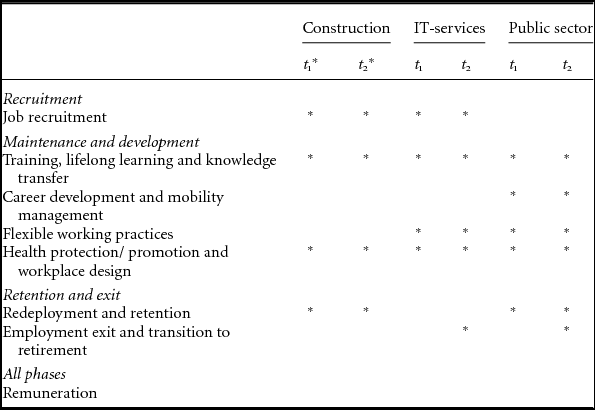
Table 2 shows an overview of developments in the action areas covered in the three organisations, categorised by three stages of a professional association. The table shows varying combinations of measures aimed at the extension of working lives. The number of measures ranges from 4 (e.g., the construction firm at t 1) to 6 (e.g., the public sector firm at t 2). Applied measures appear constant over time in these organisations, except for the recent developments in the area of employment exit and the transition to retirement.
Areas of employers’ behaviour towards older workers (fifty years and older), in three case study organisations, categorised by stage of professional association
Notes: t1= present during original case study; t2 = present during revisit.
In total, we used interviews from forty-five respondents: six HR officers (including a career adviser), twelve middle and higher managers and twenty-seven employees in low-skilled, medium-skilled and high-skilled occupations. We conducted unstructured interviews and semi-structured interviews, and desk research on policy documents, internal studies and memos, minutes, organisational newsletters and former case study materials. An interview guideline, as well as a common template for reporting and assessing the individual case studies, was developed. In all three organisations, unstructured interviews were held with one higher manager on the topic of policies and practices towards older workers, and then semi-structured interviews were conducted with the other respondents. Semi-structured interviews addressed: (1) organisational background, workforce and environment; (2) the rationale and context of the original measures; (3) the development of the original measures and current practice; (4) general age-management approach; (5) any other business, contact details and finalising the interview. Transcripts of interviews, field notes and desk research materials were imported into a software package for data storage, retrieval and analysis (WeftQDA). The analysis was carried out with the help of this programme as interviews were re-read and coded along the lines of business cycle effects, categories of institutional contexts (e.g., disability regulation, early retirement/extension of working lives) and various types of organisational practices (e.g., practices in the field of health and safety, training, flexible working practices). It is possible that organisational responses to business cycles may be shaped by the institutional contexts themselves, making a dichotomisation between the findings into ‘business cycle effects’ and categories of ‘institutional contexts’ somewhat stringent. However, it is hard to tell whether an answer was in fact influenced by the institutional context. As ‘business cycle effects’ and ‘institutional contexts’ were separate subcategories in the interviews, we think data can adequately be attributed to either category in order to categorise them for the presentation of our data. Nevertheless, we do acknowledge there might be an interaction between the two categories.
5. Results
Business-cycle effects
In this section, the main question is how the economic climate affects organisational behaviour aimed at the extension of working lives. The first stage of a professional association between employers and older workers is the hiring procedure. Interviewees in all three case study organisations indicate that business-cycle effects play a role in recruitment behaviour towards older workers. Economic downturns decrease the likelihood of recruitment of older workers, and the opposite holds for times of prosperity. A representative narrative of a fifty-nine-year-old Construction manager shows how recruitment of older workers is related to business-cycle fluctuations:
Twelve years ago, it was really hard to find someone. The only ones we could get were in fact those older employees. And they were older workers we knew. So we approached them to come and work for us. And they still do.
Subsequent to the hiring stage, productivity maintenance and development is a central theme in an older workers’ career. Extension of working life is often perceived to be stimulated by life-long learning, because learning is assumed to enhance productivity, including at older ages (European Commission, 2006; OECD, 2006). In all three organisations, considerations in the form of training initiatives, learning-on-the job routines, mentoring concepts and knowledge transfers from older/retiring employees to younger employees (or vice versa) seem to be rather consistent over time. Many quotes on this topic indicate time-consistency on the existence of policies, and are of the form: ‘because we always did it like that’, as expressed by a fifty-nine-year-old Construction worker and mentor:
[The mentoring concept] is just a way to transfer knowledge to the younger workers. Actually, I have been working with young workers for quite a while now, it is nice to work with them. And it gives extra motivation to think: ah well, I might as well add another year and then retire.
However, the extent of putting these initiatives into practice actually seems to depend on the economic climate. In all three organisations, managers proffered the information that, during economic downturns, expenses were cut and this leads to a reduction in resources spent on the employability of employees. Training budgets become tighter, and downturns lead to different forms of learning. It is not only formal training that is under pressure, but also other ways of learning, such as training-on-the-job by transferring knowledge from older to younger workers. A forty-five-year-old manager at the Construction firm describes how their organisation lets older workers purposefully work together with young workers as their mentors, to facilitate the transferring of knowledge and skills. But he also states:
Well, when shortages arise in budgets and all, you turn to completely different processes of course. Unfortunately for us, we had to do this as well. For instance, because the market is highly competitive at the moment, our mentors have less time to train their apprentices.
Flexible working practices, such as working time arrangements or facilities to reconcile work and family life or care, are seen as another important instrument for retaining older workers in employment (Naegele and Walker, Reference Naegele and Walker2006). Flexible working practices are implemented in the IT-Services organisation and the Police department, but not in the Construction firm. There is no indication from our case studies that flexible working practices are related to business-cycle fluctuations – the application of a flexible approach seems to be time-consistent.
The last stage in a professional association between older workers and an organisation includes retention and the transition to retirement. Changes in the economic climate also seem to affect these areas. A forty-five-year-old manager at the Construction firm sketches the situation of their organisation in around 2006, when the economy was recovering fast and the work ‘exploded’:
At that time we had two 62-year-olds, and there was a high pressure on our production. So we thought ‘why are we letting two fine contractors go, when we need them so much?’ And the men liked to be involved as well; they did not want to sit at home. So we asked them to continue working. We had to fix two things actually, in the short run we needed capacity and besides we needed mentors.
In 2010, the economic climate changed considerably and interviewees described how this led to different attitudes towards the extension of working lives. For instance, the Police department received orders to reduce its headcount significantly in the years to come. Whereas the retention of older workers used to be the most prominent thought on their minds, the idea of early exit as a solution to the problem of necessary staff reductions seemed to return easily. A career adviser (aged fifty-eight) stated:
While in the past we used to say ‘we are going to take measures to keep employees and their qualities on board’, we now have completely different interests because we simply need to reduce costs. This also means that people over 60 years of age will probably be offered the opportunity to leave early. The younger ones, born after a certain date, fall under other arrangements and will be transferred internally or externally. But the reasoning is based on economics rather than ideology at the moment. It is simply a budget cut.
Institutional effects
In this section, we examine how national level policy changes in (1) health and safety regulations and (2) regulations concerning early retirement and the retirement age have been affecting views and practices concerning the extension of working lives.
Health and safety
During the 2000s, the costs involved for employers if their employees called upon the sickness benefits act increased substantially, making disability leave a bigger financial problem for employers than it used to be. The influence of institutional surroundings on employers is reflected by the comments of a Construction firm manager (aged fifty-nine):
You can push until he [the employee] breaks down and then he will call upon the sickness benefits act. You as an economist understand: that costs money, and we as non-economists understand that as well, because we have to pay them.
And that is of course the topicality [extension of working lives], you hear about it everywhere, and all kinds of important issues, but what is discussed less is how exactly are we going to keep the men outside healthy until they are 65, later 66, 67?
Especially in the organisations with intense physical work (i.e., Construction firm and Police organisation), health-related institutional forces are likely to shape organisational behaviour towards the extension of working lives. In the IT-Services case study organisation – a company with a highly educated professional and managerial staff – interviewees and documents do not indicate a focus on health-related measures. In both the Police department and the Construction firm, there has been a clear increasing focus on health protection and promotion. In the Police organisation, several programmes, facilities and tests have been implemented for employees to stay hale and hearty over the years. Tests in place cover for instance shooting skills, self-defence and violence control. The organisation started to offer facilities to test physical fitness and to provide advice and support to increase fitness. During the last decade, programmes were adapted for younger and older employees, as a forty-six-year-old employee explains:
When you are 55-plus years, now, old folks follow an adapted physical training. Even for me, when I have to sport with a youngster, they easily dislocate my arm; they handle things more roughly and are more fanatical.
Initially, most of these health practices were on a voluntary basis. Later, some tests became obligatory but the results were only indicative. In the near future, some tests will become obligatory and staff will face consequences if they fail to meet targets. Moreover, several pilot programmes were started, which involve a procedure of filling in a questionnaire; discussing the outcomes with a company doctor, who will give advice on for instance food, rest or exercising; and having blood pressure measured regularly for half a year.
A significant increase of health-related practices is also visible in the Construction organisation. Whereas health and safety-related behaviour used to be voluntary in the early 2000s, considerable standardisation changes have taken place since. For instance, employees used to receive a general clothing allowance but did not always buy appropriate clothing with it so, from the mid-2000s onwards, employees receive free work wear, while retaining their clothing allowance. Also the quality of work clothing has improved considerably. The incentive to actually wear the clothing is stimulated by regulations, as expressed by a fifty-one-year-old construction worker:
I see workers wear their safety clothing. You have to, because when the health and safety inspectors [ARBO] come to visit, they will send you away and it gives trouble; also for the boss of course, because he has to pay the fine. That is a waste of money of course. Recently, I also see workers from other firms wear their safety clothing.
Furthermore, employees reported having an extensive physical examination by a company doctor every two years. Also, there has been increasing focus on the use of tools and materials to relieve heavy work, and stricter rules on the maximum weights that can be carried. This behaviour is at least partly stimulated by institutional forces, as a construction manager (aged fifty-nine) explains:
When something is less heavy and easier to handle, he [the employee] is more productive. So, often it is just an investment that is recovered soon. It is also an investment to prevent drop out. Drop out costs also 40,000 a year, yes, 2 years say 80,000 Euros. Then it is better to invest 10 or 15 thousand Euros in better equipment. We may be unable to read or write, but arithmetic we do well.
Early retirement and retirement age
During the 2000s, substantial alterations were made in the institutional context to make it financially less attractive for older workers to withdraw from the labour market early. Although workers in most sectors of industry can still use early retirement schemes if they want to, this usually comes at greater cost. Whereas the transition in the disability regulation became apparent around the middle of the 2000s, the alterations in the early retirement schemes have come into effect gradually and are of more recent date. Our study reveals that, in all three organisations, employees have fairly corresponding views on the relationship between institutional changes in retirement arrangements and the last career phase. In general, the institutional changes regarding early retirement and the debate on the extension of working lives have made workers realise that the extension of the individual's working life is increasingly becoming an inevitable fact of life, although employees do not seem too enthusiastic about it:
Extension of working lives beyond 65? I think it is an outrage! I mean, doing this work for more than 40 years, that's outrageous. They don't suffer from it, right, they sit in an office on their lazy butts and they can make the decisions. That is what I sometimes think. At one point it stops [physically], of course. And then you have nothing. Just some unemployment benefits. (Older worker Construction firm, aged 65)
Employees predominantly report external pressure in the form of financial repercussions if they do not extend their working lives, but appear intrinsically opposed to the changes.
Some employees still fall under transitional arrangements and are still ‘safe’ from recent policy reforms. The following quote from an older construction worker (aged fifty-nine) is typical in this respect:
I am not going to work until 65! Certainly not. No, I will continue until December next year. For financial reasons I would continue working, but I don't have to.
A slightly younger worker (aged fifty-eight) at the Police department can also retire early, but has decided to work considerably longer than the construction worker:
With my arrangements I think I can retire at age 62. But when I do, I lose a lot of money compared to when I retire at 63. So I am calculating and thinking about the amount of money I want to receive after retirement.
In general, employees interviewed did not dislike their work. On the contrary, after stating the unfairness of the obligation to extend their working lives, many workers indicated that, if they had to continue working, they would not really mind continuing in their current profession, as long as their constitution would allow them. The opposition to extending working lives seems to originate from the feeling of injustice, the fear of an increasing probability of productivity difficulties, and the personal financial disturbance the changes can bring. Employees in that respect also acknowledge that employers’ interests may be quite opposite to their own. A white-collar employee (aged fifty-eight) at the Police department describes this situation in his interview as a ‘peculiar paradox’:
For me, for instance, it has become very unattractive to retire early, financially, and they made it exceptionally attractive to stay, financially. And at the same time they say to me: we would like you to leave.
But it is not only employees who feel overruled in their retirement decisions by the changing policies aimed at the extension of working lives. Employers are also not necessarily keen on finding ways to keep workers employed. Sometimes they feel put upon, with problems for which they do not have a solution. A career advisor (aged fifty-eight) of the Police department formulates it this way:
Early-, late-, night shifts: they are all heavy. If you think people should extend their working lives, you have to look carefully at what those people actually can do. And how to make sure the young ones will not get burned-out? I don't know the answer to that question, but that is almost a question for the government to solve. Because they say ‘extend working lives’ and we are supposed to fix this? It has major consequences.
And a manager at the Police department says:
The formations are getting smaller, so you have the same amount of work to do with less staff. Ageing continues. If you ask me: ‘How to solve this?’ I will answer: ‘You need a magic trick’. Because there are many smart people who say this is insolvable.
Nevertheless, the choice to extend working lives is a question employers in all our three case studies principally leave to the wants and capabilities of the individual employee and therefore it seems largely to be supply-driven. The following quote of a Construction manager (aged fifty-nine) is representative in that respect:
I have one [employee] who is 60, 61 and he does not want to quit. He says: ‘I will continue until the age of 65’. And his mate is 58 and he says: ‘if I’ve got the money tomorrow, I will put my bum under a palm tree’. And I say: ‘I come and sit with you if I’ve got enough money tomorrow!’ Because it's as simple as that. They started the whole discussion about extension of working lives, but they did not think it through.
Given that the extension of working lives has become a seemingly unavoidable fact, does this also mean that organisations have started initiatives to moderate this extension? All three organisations seem to have developed a different approach towards older workers when it comes to the extension of working lives. At the IT-Services case study organisation, this phase does not have a special place in interviewees’ minds. Flexible working practices is the dominant solution in all stages of life (parenting, informal care, work–life balance in general), and is therefore also considered appropriate for older workers. The transition to retirement is, for instance, optionally seen in a reduction of working hours before retirement. A white-collar employee at the IT-Services organisation (aged sixty-two) says:
There is an option to work less days a week, and adjust time if you want. That is also convenient for instance for older workers.
At the Construction firm, redeployment and retention is a central element of their behaviour towards older workers, encapsulated in a long-term vision of how to behave towards workers at all stages of life. The general idea at the firm is that: employees rotate jobs throughout their whole career, the organisation invests in equipment and the development of lighter materials and, if necessary, workers are ‘spared’ (e.g., assigned different – less demanding – tasks) for a while (regardless of age). This view is confirmed by managers and employees themselves and seems to have been constant over time. An illustrative quote comes from a manager (aged fifty-nine):
We always looked for redeployment. We have a builder working in an administrative function, we have a paver working a crane and another one is riding a truck.
Finally, the Police case study organisation has adopted a completely different approach, by focusing primarily on the final phase. There is a strong focus on reduction of working hours, which is anchored in personnel policies especially for employees of fifty-five years of age and older. People close to retirement are asked what they want to do in their last few years within the organisation and how the organisation can facilitate this. The way the three case study organisations handle the question of how to ‘add a few years’ differs depending on their general ideology, but, all in all, the three employers seem to be able to find creative short-term solutions when necessary.
A final question is what will happen to arrangements designed to ‘spare’ older workers, such as shift exemptions and extra leave, due to institutional changes. Documents and interviews do not indicate any major change in policies for senior workers yet, but the following quote from a manager at the Police department addresses the difficulties employers see themselves faced with if they pursue sparing arrangements:
We have a government that told us to extend working lives. If people of 55 years and older can ask for night shift exemption, what happens if 40 per cent of your staff gets to 55 years and older? Ageing. They all ask for night shift exemption and you have to grant that request. Personnel policies for older workers, okay: fine with me. But can you tell me who is going to do the night shifts?
6. Conclusion and discussion
In this paper, we examined how the economic climate and institutional changes have been affecting organisational practices aimed at the extension of working lives over the last decade. With that aim, we conducted case studies among organisations with longstanding personnel policies towards older workers. The results show that business-cycle effects play a substantial role in organisational behaviour towards older workers, for instance in terms of the current crisis negatively affecting recruitment behaviour, both formal and informal training practices and retention practices. By contrast, flexible working practices seem to be more time-consistent. Employers do not seem to be inclined to look beyond the current economic crisis to a period of possible labour market shortages. Their focus is on the current situation and not on the long run.
Changes to safety regulations, and the increase in costs for employers if employees drop out of work due to ill health, have led over the last decade to an increasing focus on health-related measures in professions with intense physical work. Policy changes at national level, regarding retirement arrangements and the debate about raising the official retirement age, have made both employees and employers realise that the extension of working lives has become an unavoidable fact, although both parties still appear intrinsically opposed to it. Several ingredients seem to play a role in employees’ opposition to the extension of working lives, such as feelings of injustice, the fear of increasing productivity difficulties, and an anticipation of increasing personal financial pressure to extend working lives. Furthermore, employees anticipate that employers’ interests in extending working lives may not match their own interests. Preferences to extend working lives seem to be primarily supply driven, depending on the financial pressure felt by, and the wants and capabilities of, the individual worker. Employers in our case study organisations are willing and able to find creative short-term solutions when necessary, e.g., in redeployment and initiatives that add a few years, although they also feel they have to put up with consequences for which they do not have a solution. So, even though neither employers nor workers endorse public policies to extend working lives and raise retirement ages wholeheartedly, employers and workers do comply.
This case study research contributes to research on organisational behaviour towards the extension of working lives in several ways. First, it gives insight into the changed content of umbrella concepts. Whereas, for instance, training provisions and health-related measures in organisational longitudinal survey research may be found to exist constantly over time, the extent and the content of practices in this area seem to have evolved substantially. It is very difficult to capture the complexity of such umbrella concepts in survey research. Furthermore, the choices and constraints both managers and employees face regarding the extension of working lives are complex and shifting. Business-cycle fluctuations and changes in the institutional framework interact with organisational behaviour, and such mechanisms are difficult to capture in survey research. The use of multiple case studies, giving the perspectives of both managers and employees, sheds light on several attitudes and processes resulting from changes in health-related regulations and in regulations concerning retirement. We find that adaptations in health-related regulations have led to markedly changed behaviour in organisations in order to meet the new regulations, and the necessary changes are supported by both managers ánd employees. Regarding changes in early retirement and the retirement age, we find more ambiguous attitudes and behavioural changes in the organisations. In our study, the extension of working lives seems to follow a bottom-up process and is characterised by a rather reactive stance from employers.
The organisations under study were nominated for their good practices and could be regarded as pioneering organisations ‘experimenting’ with corporate social responsibility in age-aware personnel policies. In our study, both the results on how the economic climate affects organisational practices, as well as the influence of national level policy changes, seem to imply that, when these good-practice organisations do not perceive a clear business case to engage in age-aware personnel policies, even their ‘experiments’ in corporate social responsibility easily come to a halt and the organisation is once more swayed by the issues of the day.
When interpreting the research findings, some limitations of this study should be kept in mind. First, all three organisations under study had predominantly male workforces (between 67 and 90 per cent are male). As the debate on the extension of working life frequently neglects gender issues, future research would benefit from including this gender dimension. Second, the results are to be interpreted analytically and cannot be generalised statistically. The organisations under study were selected as, and can still considered to be, good practice organisations. Therefore, it may very well be the case that whereas employees and managers in these organisations do find opportunities to extend working lives, individuals in other organisations may have less influence on their timing and manner of retirement. For instance, in our case study organisations, workers in low-skilled occupations met considerable opportunities to extend working lives. We saw pavers being redeployed: working cranes and riding trucks. However, workers, especially in low-skilled occupations, could be expected to encounter less opportunities to extend their working lives, as they might be regarded as more easily ‘expendable’. The same applies to the relationship between the existence of a policy for older workers and the size of the organisation. In our case study, organisation workers in small- and medium-sized enterprises met considerable opportunities to extend their working lives. However, it may be that, in general, larger organisations have more opportunities to pursue policies and benefit more from economies of scale (e.g., with the implementation of training plans). This all implies that much more variation in employees’ experiences is likely to be found in a broader sample of cases.
The degree of choice individuals face in the voluntariness of their retirement decisions has been examined in previous research (cf. Isaksson and Johansson, Reference Isaksson and Johansson2000; Dorn and Sousa-Poza, Reference Dorn and Sousa-Poza2005; Van Solinge and Henkens, Reference Van Solinge and Henkens2007). These studies find a substantial degree of involuntariness in retirement decisions (on average circa 25 per cent). Our findings suggest that employers and employees do realise that the extension of working lives has become an inevitable fact. How to achieve the desired goal – a later time of retirement – is now for employers and employees to resolve. National level policy changes are likely to have a significant impact on prolongation of careers, but that does not answer the question of how to keep older workers functioning in a maximally productive way. In the organisations under study, practices towards the extension of working lives still seem to be in their initial stages. Future research may want to focus on understanding the practices applied by employers and to establish what kind of practices are beneficial to the sustainable extension of working lives.