

On 4 September 1793, Bibiana Asprilla presented her son Antonino Asprilla, who was two days and a few hours old, for baptism in the parish church of Nóvita. Bibiana was an enslaved woman “belonging to the mine of San Miguel del Playón,” situated on the San Miguel River. Nóvita was one of two small cities in the province of Chocó, a territory dominated by gold mining carried out by enslaved labourers of African descent, in the Viceroyalty of New Granada. As was frequent in the region, Bibiana selected another enslaved woman from the mine, Tomasa Asprilla, to be Antonino’s godmother.Footnote 1 Bibiana and Tomasa may have travelled from the mine for the birth, about a half-day journey by canoe upriver in good weather, and certainly for the baptism. People of African descent and the material place of the mines of New Granada’s Pacific tropical lowlands transformed the sacraments. While some baptisms, like Antonino’s, were carried out in the city, other enslaved people and overseers baptised babies on the mines, despite the fact that according to the Council of Trent, the 1545–1563 conference that defined Catholic doctrine, baptisms should only be performed by members of the clergy except when the infant’s life was at risk.Footnote 2 In these cases, clerics later recorded confirmation in baptismal books in the parish church in Nóvita. In this instance, Bibiana travelled to the city where her baby was baptised at just two days old, perhaps for the birth or to pause to recover from childbirth in the city, or to gain some distance and respite from the mine. Infants born into slavery received the sacrament of baptism as an entry into Christianity and as proof of their status as colonial subjects. Baptism also formalised black fictive kinship forged in bondage.Footnote 3 Tomasa accompanied Bibiana on her journey from Playón, likely during labour, and committed to attending to Antonino’s spiritual care as his godmother. Where enslaved people lived far from urban settlements, responsibility for adherence to sacramental orthodoxy often fell upon bondspersons themselves. Enslaved parents, often couples and always mothers – whether heavily pregnant or postpartum – travelled to receive baptism or confirmation in the city. Bibiana’s movement between the mine and the town so her baby might receive the sacrament stands in stark contrast to enslavers’ refusal of enslaved spirituality in parts of the African diaspora where the plantation was the main mode of governance. Even within New Granada, the mines of the Pacific were a unique place of exacting labour and violence, while simultaneously providing enslaved people with possibilities to create material and cultural freedoms due to its relative isolation from towns and cities and an abundance of gold.
The Pacific basin of the territory now known as Colombia is connected to the Caribbean and the Atlantic by the Atrato and San Juan rivers. As part of a vast network of rivers, most notably the Magdalena and the Cauca, these waterways created worlds in the interior of New Granada that were – and still are – shaped by Pacific, Caribbean, and Atlantic aquatic and cultural flows. Shortly after the baptism, Bibiana, Antonino, and Tomasa must have returned to San Miguel, where enslaved black women and men sieved gold from the soil with water that flowed to the Pacific. The baptismal record states that they three, all carrying the surname of their enslaver, “originated” from Chocó, but many of their fellow bondspersons were born beyond New Granada’s shores.Footnote 4 The Caribbean city of Cartagena de Indias was the principal slave port for the Spanish Americas for much of the colonial period under the asiento de negros contract system, a monopoly for the supply of African captives. Thousands of bondspeople made the arduous journey across New Granada to the Pacific region in increasing numbers throughout the eighteenth century. Along with the Atlantic and Caribbean, the Pacific was a crucial site of black historical experience in the colonial Americas, yet scholars rarely discuss these bodies of water and the cultural worlds that they produced together.
This book considers Caribbean and Pacific New Granada within the same analytic frame, illustrating the importance of understanding the correlations and cleavages in black experience in very different sites in the diaspora that were part of a shared space made by the mobilities of enslaved and free black people, the products of their labour, their knowledge, and culture. This book is the first monograph on black religious practice in New Granada in the eighteenth century, a period where enslaved and free people of African descent transformed the colony and Catholicism. Building upon scholarship that centres black religious and cultural production in New Granada, Black Catholic Worlds brings the Caribbean region into conversation and connection with communities from Pacific regions throughout the eighteenth century.Footnote 5 Although these sites had fundamentally different experiences of slavery and colonialism, they were spaces that people of African descent brought into greater connection through the mobilities, captive and free, of black people, their knowledge, the gold they extracted from the soil, and the crops they harvested.Footnote 6
Black Catholic Worlds offers an analysis of the relationship between natural and cultural geographies in New Granada, with a focus on the Caribbean and Pacific regions and the rivers and routes that connected them. Slavery and freedom and the quest for it shaped the lives of people of African descent. In doing so, this book argues that place – formed by the natural environment, systems of governance, and black people on the move – played a crucial role in the making of black religious life. Women and men of African descent inhabited New Granada’s cities, mines, rochelas, palenques, and pueblitos, distinct places connected by rivers and forests that they traversed in multiple directions, whether in bondage or as people seeking or in the condition of freedom. Enslaved and free people of African descent created religious knowledge and cultures in the metaphorical and material interstices of colonial society. They used their transculturated Catholicism alongside other forms of knowledge to heal themselves or their communities, physically, spiritually, and socially, to improve their day-to-day lives and create new possibilities. This book illuminates the multiplicity of black modes of religious knowledge production in New Granada and across the African diaspora.
Religious Geographies of Eighteenth-Century Afro-Colombia
Black Catholic Worlds considers the Caribbean (the provinces of Santa Marta and Cartagena), Antioquia, and the Pacific (the provinces of Chocó and Popayán), sites rarely considered together yet ones that were a conceptually coherent space connected by African diasporic experience due to the slave trade between them and black slavery within them. For the sake of simplicity, the term “New Granada” is used in reference to the geographic space that from 1690 to 1790 was first in the New Kingdom of Granada (founded in 1549) and later became the Viceroyalty of New Granada, temporarily in 1719 and then again in 1739 until independence. While eighteenth-century New Granada was a single colony, it was a transregional space, consisting of the territories of modern Colombia, Ecuador, Panama, and Venezuela.Footnote 7 In Colombian historiography, it is standard to refer to the country’s territories during the eighteenth century as “New Granada,” although the boundaries of the Viceroyalty extended much further. The focus of this book is principally on sites within the boundaries of modern Colombia, with the notable exception of Inquisition cases from Cuba, Panama, and Venezuela that were processed in Cartagena de Indias by the tribunal of the Holy Office of the Inquisition.
The eighteenth century was a crucial period in African diaspora history, simultaneously witnessing the huge expansion of the trans-Atlantic slave trade and the creolisation of black culture, language, and religion across the Americas. While the height of the slave trade through Cartagena was the late 1500s and the first half of the seventeenth century, the long eighteenth century witnessed great transformation in New Granada. From 1680 to 1730, Caribbean and Pacific New Granada came into far greater connection.Footnote 8 The economic potential of gold mining, transported from the Pacific into the Atlantic system, played a crucial role in the Crown’s interest in reform in the Viceroyalty. The period under consideration, around 1690 to 1790, begins and ends with military campaigns of the destruction and resettlement of rochelas (small free rural communities) and palenques, communities of maroons (escaped enslaved people and their descendants). This periodisation centres black experience rather than traditional political dates.
A focus on geography deepens our understanding of black religious experience in the colonial Americas. Bibiana and Antonino’s experiences of baptism connect with broader stories about Afro-Catholicism, yet they were also intimately tied up with local physical and cultural landscapes. Religious geographies here are understood as the intersection between physical place, space, and mobilities and spiritual practice. Dianne Stewart Diakité and Tracey Hucks called for studies of Africana religions to go beyond a model of Africa as an
“originary space” that interrogate the problem of immanent primordialism and the uncontestable question of historical origins while revaluing (1) a continent and diaspora of diversity, encounter, and transition; (2) a proliferation of “Africas” that have emerged in global milieus; and (3) a series of “unfinished migrations” and continuous diasporas of African peoples and their religious traditions worldwide.Footnote 9
“Religious geographies” pay attention to black people’s “unfinished migrations,” the place-based production and circulations of knowledge, material culture, and day-to-day spiritual practice, and the varied landscapes of Catholicism’s ambivalent possibilities that enslaved and free people of African descent seized upon in eighteenth-century Colombia.
Black Catholic Worlds argues that place played a constitutive role in black religious practice. Place, understood as space imbued with meaning, offers crucial avenues for understanding how African diaspora religions were practiced and shaped in and by local context on the one hand, and by global mobilities, economies, and colonial structures on the other. “Place” here is considered to be formed through the intersection of the natural and built environment, labour regime, and political economy. Most studies of black religious practice have centred on the plantation or the city. This book examines black religiosity in different sites – cities, towns, mines, haciendas, rochelas, and palenques – across New Granada. Examination of religion in these connected sites and across typical spatial boundaries demonstrates both shared black cultural geographies as well as how the particularities of place shaped religious practice. Bringing together areas with differing demographics and histories of colonisation and slavery reveals commonalities and connections made through the practice of enslavement and black mobilities, while throwing local particularities into sharp relief.
Black Catholic Worlds frames African-descended Catholic practice as an “interstitial religion,” defined as forms of spiritual knowledge created in New Granada’s religious geographies. People of African descent engaged in religious practice and knowledge production in the interstices, in liminal places and spaces that were physical sites but also figurative openings, in a society shaped by slavery. The interstices were everywhere – on slave ships, in enslavers’ kitchens, in the streets, along rivers, in the mine, in haciendas, in forests, and in maroon communities. Theorising African diasporic religions as interstitial does not set apart religion from other aspects of the early modern world; rather, it was central to colonial governance, social interactions, and intellectual life. Robert Baum’s conclusions about the lack of boundaries between the religious and the secular for the eighteenth-century Diola (Senegal), when indeed the “religious” permeated all aspects of life, are instructive.Footnote 10 People of African descent were key producers and circulators of religious knowledge and material culture and their engagements with the spiritual, born of in-between places and in motion, entered every kind of social space. This book offers an approach to black religious experience, in which both Africa and America were important, and studies religion as embedded in and producing its social contexts. Places and movement through them, across vast distances and on a smaller scale, as in the case of Bibiana, were an inherent part of how black religious knowledge and practice was made and constantly transformed. By focusing on how black actors produced religious knowledge in place, Black Catholic Worlds rewrites the history of eighteenth-century Colombia as a transculturally African diasporic space.
This book takes a broad conception of the religious. In general, I use the terms “religion” and “religious” rather than “spiritual” to recognise the sophistication of black religious thought and practice and to counter the denigration of African(-descended) forms as lesser than white and European traditions. As Alexis Wells-Oghoghomeh encapsulates, “the imposition or withholding of the ‘religion’ label in regard to African practices was a part of the hierarchicalization of African humanity as other-than-European/human/woman, used to discursively and theologically render Africans fit for enslavement.” Wells-Oghoghomeh offers a definition of religion “in terms of what it did as opposed to what it was … [enslaved women] adopted, adapted, and innovated ideas and performances as they proved efficacious for re/membrance.”Footnote 11 Given the absence of a canon written by early modern black authors, I take the approach that religious knowledge can be found in practice as thought inscribed in writing. As the late J. Z. Smith famously forwarded, focus on doctrine has its roots in Protestant conceptions of ritual as empty.Footnote 12 The production of knowledge occurred through religious practice and action as well as the codification of ideas. I take a holistic approach to religion, considering a wide range of practices and experience, ranging from continuing devotion to non-Catholic “saints,” to the embrace and transformation of the sacraments. Diana Paton has referred to obeah as “a set of practices,” to refer to a whole range of activities that were not part of formal organisation and are referred to by a term coined by colonial state actors.Footnote 13 A set of practices is relevant to New Granada, where the religious included a whole range of activities. However, in contrast to obeah in the Anglophone Caribbean, those practices have never had a name beyond European typologies of hechiceria and brujería (witchcraft), or sortilegio (sorcery), nor have they become celebrated as part of the project of the nation as in Cuba and Brazil.Footnote 14 Black religious practice included African-descended ritual, healing, Catholic sacraments, vernacular theologies, material culture, and family life within and outside of the Catholic institution of marriage. This capacious approach to the religious corresponds with the “incorporative” nature of African-descended knowledge traditions.Footnote 15 Yet due to the nature of the sources, most of the records pertain to people of African descent’s engagement with and/or departure from Catholicism, the production of black Catholic worlds. Throughout the 1700s, colonial authorities were increasingly less interested in African-descended rituals and “witchcraft” than they had been in previous centuries and turned their attention to policing black people’s moralities, sexualities, and mestizaje. The study of black people’s entry into the Catholic sacrament of and state of marriage, and the rejection of it, reveals how people of African descent engaged with the Church and created alternative ways of living.
Place, as Tim Cresswell encapsulates, is “space invested with meaning in the context of power. The process of investing space with meaning happens across the globe at all scales and has done throughout human history.”Footnote 16 The foundational theorisation of these concepts can be found in Yi-Fu Tuan’s Space and Place. For Tuan, the concepts require one another for definition: “Space is transformed into place as it acquires this definition and meaning.”Footnote 17 Much of his analysis centres on place as belonging, security, and attachment, on place as home and homeland.Footnote 18 Many geographers have critiqued the static nature of this, for places are constantly being transformed. For Doreen Massey, social relations between a place and the wider world play a crucial role in construction of place.Footnote 19 Local place, then, is shaped by the global; mobility is an inherent part of the study of place because movement transforms places.Footnote 20 The particularities of place are tied up with the history of a region and its constant connections to places outside of it. Movement and transformation are an inherent part of what constitutes place.
Place takes on radically different meanings in histories of slavery and the African diaspora. The notion of place as “belonging” is particularly ambivalent for black studies given that place, race, and gender are intimately tied up with histories of slavery, colonialism, and their afterlives. Scholars of black geographies have countered the traditional assumptions of the discipline that place is racially neutral. Black geographies, for Katherine McKittrick,
are located within and outside the boundaries of traditional spaces and places; they expose the limitations of transparent space through black social particularities and knowledges; they locate and speak back to the geographies of modernity, transatlantic slavery, and colonialism; they illustrate the ways in which the raced, classed, gendered, and sexual body is often an indicator of spatial options and the ways in which geography can indicate racialized habitation patterns; they are places and spaces of social, economic, and political denial and resistance; they are fragmented, subjective, connective, invisible, visible, unacknowledged, and conspicuously positioned.Footnote 21
While McKittrick’s theorisation is from the vantage point of plantation worlds, dynamics of power and black geographies circulated through physical and spiritual places across the diaspora.Footnote 22 Just as the plantation created geographies of racial governance, so too did the colonial configuration of Caribbean cities.Footnote 23 The vantage point of other diasporic places broadens our understanding of black cultural knowledge production. Analysis of the Pacific tropical lowlands and especially mines complicates our understanding of black geographies. Claudia Leal interrogates the construction of the Pacific lowlands as separate from the rest of the country through her concept of “racialised landscapes,” examining “the physical transformation of the region and the way in which race – a lens that determined literate men’s understanding of social differences – negatively affected the perception of this place and blacks’ accomplishments.”Footnote 24
It was in these betwixt and between places that African diaspora religions were made in New Granada. The concept of interstitial religions in this book is inspired by Stephanie Camp’s conceptualisation of “rival geographies” and Sidney Mintz’s argument about the interstices and reconstituted peasantries. Building on Edward Said’s earlier theorisation, Camp argued that rival geographies were not a “settled spatial formation” – neither were they a mere physical space or one beyond the planter’s reach. Rather, the concept refers to both physical and political places of alternative articulations of power that traversed and connected fixed locales.Footnote 25 While Camp’s concept of rival geographies is based on the dynamics of a region dominated by plantation slavery, it is also useful for understanding the movement of black knowledge through spaces shaped by very different forms of black enslavement – in our case, the cities, mines, and montes of New Granada. Mintz’s study of what he terms “proto-peasantries” and maroons, across the region but particularly in the Spanish Caribbean, usefully demonstrates how cultures were formed in the interstices, in borders and hinterlands. For Mintz, “reflection on these ‘interstices’ tells us something about the direction and intent of imperial strategy in the islands, and allows us to discern more clearly how the peasantries responded to such strategy.”Footnote 26 Bringing together theories of rival geographies and the interstices allows us to see how people of African descent created and circulated knowledge in the open and in hiding. It sheds light on how they engaged in ritual, healing, and sacramental practice in interstitial places, in spaces that they imbued with meaning but that were not a refuge from racialisation and slavery. In doing so, they engaged in political action and articulated alternative ways of knowing and experiencing the world, alongside those dictated by the Spanish colonial state and Catholic Church. Divergent yet mutually constitutive forces connected sites as different as gold mines and maroon communities that were shaped by slavery and racialisation on the one hand, and black cultural knowledge production on the other.
This work examines the religions of African-descended persons who were inscribed in the Spanish colonial archive as negro/a (black), mulato/a (of black and European ancestry), and zambo/a (black and indigenous ancestry). Free and enslaved people of African descent had both shared and divergent religious experiences. Such an approach also highlights how communities constituted themselves in ways that embraced or circumvented categories imposed by the colonial institutions and elites. Commonalities and distinctions shaped the religious lives of African-descended people, who were often part of the same communities, shared the same spaces, and experienced similar forms of criminalisation, even where their racial and legal status differed. This is especially important in the study of New Granada because of its large Afro-indigenous population in the Caribbean littoral, the significance of which has received limited scholarly attention, particularly in English.Footnote 27
Debates in African diaspora studies about cultural creation have long been animated by this dichotomy of survivals or creolisation that do not accord with the complexity of lived experience. While Melville J. Herskovits’s The Myth of the Negro Past (1941) undeniably established the vein of scholarship focused on African survivals, the work is more subtle than portrayed by both its celebrants and detractors.Footnote 28 Creolisation, to quote Sidney W. Mintz and Richard Price, was produced in the context of forced servitude, in which “enslaved Africans were compelled to create a new language, a new religion, a new culture.”Footnote 29 The binary between these two theories has long been exaggerated.Footnote 30 As Miguel Valerio shows, building on Stuart Hall’s theorisation of creolisation as a “third space” and Cécile Fromont’s theory of “spaces of correlation,” Africans built on their cultural traditions to adapt to the new worlds they found themselves in. In his study of Afro-Mexican festival performance, he shows how “Africans translated their ancestral culture into (creole) Afro-Mexican culture.” Performance was a “space of negotiation where they could redefine their colonial condition … colonial festivals [were] … a third space where colonial identities and practices were correlated into cultural intimacies.”Footnote 31 Following this understanding, I interpret black culture in New Granada as African, creole, creolised, and transcultural. The constant transformations and locally based negotiations of African diasporic religions are encapsulated by Fernando Ortíz’s 1947 concept of “intermeshed transculturations,” a process of interdirectional exchange in the midst of loss which is central to understanding black religious practice in the early modern Iberian world.Footnote 32
It is important to untangle ideas about what constituted early modern Catholicism. First, as William Christian demonstrates, the universal often did not deviate in substance from the local; “superstitious” practices were common amongst the clergy and laity alike.Footnote 33 The universal/local divide presumes the Church was united in doctrine and practice, yet even after the Council of Trent, there were obvious deviations in the application of and adherence to orthodoxy and frequent acquiescent toleration as well as persecution.Footnote 34 Second, understanding religion through the lens of belief or doctrine risks imposing a category of analysis that is both modern and Protestant, and does not accord with the realities of early modern religious traditions on the ground. Erin Kathleen Rowe encapsulates this, arguing that “‘how genuine’ or ‘authentic’ the beliefs of non-European Christians were misses how seldom the European laity reflected the orthodox theology of the hierarchical Church.” She argues that analyses of black practice in the Iberian world need to acknowledge the “diverse and lived nature of early modern global Catholicism” rather than establish a model of “the existence of two mutually exclusive experiences of religion: on the one hand, stable, normative Christianity practiced by Europeans, and on the other, superficial or hybrid Christianity practiced by non-Europeans.”Footnote 35 Here Rowe defines “normative Catholicism” as the official narrative in contrast with the “lived religion” practiced by the laity. The distinction between the universal or normative and the local or lived was an institutional and political one, rather than a geographical divide between Europe and the Americas.
The most established scholarship on black Catholicism in colonial Spanish America has focused on the sixteenth and seventeenth centuries. The foundational work in the field, Colin Palmer’s Slaves of the White God (1976) on Mexico established the centrality of religion in shaping black life. He argued that despite “interest of both church and state in making Catholics of the slaves, it would be erroneous to conclude that the slaves rejected their own traditional religious beliefs in favor of the Spanish variant of Catholicism,” rather it was “precisely the nonmaterial aspect of their culture, chiefly their religious beliefs and their folk practices, that survived.”Footnote 36 Bryant argues that Catholicism was both the focal point of the formation of “sacred communities” and not only “exemplified colonial black social life, but [also] demonstrated the broader social landscape of colonial governance that defined and differentiated all castas (Atlantic and American), Indians, and African non-Europeans.” Put differently, Catholicism was crucial not only to ways of survival and community formation but also to the very making of blackness and the condition of slave.Footnote 37 Despite this violence, Catholicism provided a vibrant space of autonomy for people of African descent. Christianity was at the forefront of the formation of colonial black communities. Herman Bennett demonstrates how from the early colonial period Afro-Mexicans found within Catholicism, and in particular the sacrament of marriage, a space for community, interiority, and subjecthood.Footnote 38 Cécile Fromont, Miguel Valerio, and Ximena Gómez’s scholarship pioneers a vision of a black (and indigenous) Catholicism that was material, celebratory, performative, and indeed joyous.Footnote 39 As Rowe has illustrated in her broad survey of Iberian world devotion to black saints, people of African descent transformed early modern Catholicism.Footnote 40
I contribute to this field of scholarship, which emphasises the importance of people of African descent as producers and circulators of knowledge in the early modern Iberian world. Pablo F. Gómez argues that theories about African survival simply do not accord with the market of medical competition in the Spanish Caribbean; rather practitioners applied knowledge that they learnt based upon the efficacy of that treatment. I find that this argument similarly applies to the realm of the religious in which it was entangled. Gómez shows how “black Caribbean ritual practitioners’ strategies for creating power and knowledge were based on experiential phenomena, which they manufactured anew on the basis of localized circumstances in different Caribbean locales.”Footnote 41 More recently, Larissa Brewer-García examines the role of African interpreters in Cartagena and Lima in translating blackness as beautiful, offering new directions in understanding early modern constructions of racial difference in and between Caribbean and Pacific sites.Footnote 42 This rethinking of black intellectual production through engagement with Spanish legal institutions is central to Chloe Ireton’s work.Footnote 43
Literature on black religion in New Granada has primarily focused on the Caribbean in the 1600s. Scholarship has tended to follow the inquisitorial archive and its geographic (Spanish Caribbean) and temporal boundaries (primarily seventeenth century), or the work of Jesuit missionaries in the city. Founded in 1610, the Caribbean seat of the Holy Office of the tribunal of the Inquisition of Cartagena de Indias made New Granada one of the key sites of judicial persecution of black ritual and healing practitioners in the Americas and the Atlantic world. The Inquisition’s prosecution of African-descended men and women in seventeenth-century Cartagena de Indias generated a large body of cases that have received significant historiographical attention. Most scholars have focused on cases of ritual crimes (witchcraft and healing).Footnote 44 There are few studies of blasphemy, propositions, and bigamy, the other offences for which defendants of African descent most often stood trial. A broader understanding of the importance of place-based contingencies and local subjectivities and autonomies is necessary.
Reading Black Mobilities across Region
Black Catholic Worlds is an innovative reinterpretation of the importance of region in New Granada and Colombia and offers methodologies for working across different spaces. This work seeks to rethink the emphasis on the interior in Colombian political life and scholarship by centring the regions with the historically largest black populations, the coastal regions that are often understood as peripheries, and the territory that connected them, as sites of knowledge production and circulation. The colony was a Caribbean, Atlantic, and Pacific space and a transimperial, transregional, and transcultural one, an Afro and indigenous one that a whole range of constituents created and contested through religious and political knowledge circulations. The whole space of New Granada was one formed by flows of exchange along rivers and waterways that were an extension of the forces that created the Atlantic and Pacific Worlds.
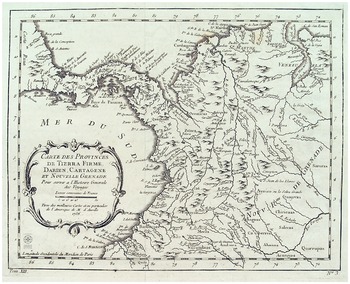
This book challenges traditional boundaries of region in Colombian historiography. Region dominates Colombian historiography.Footnote 45 Anthony McFarlane argues that eighteenth-century New Granada was “a fragmented entity, geographically dispersed and each [region] tended to become a distinctive cell.”Footnote 46 While New Granada’s regions had significant distinctions – eighteenth-century New Granada was the only South American colony on both the Caribbean and Pacific coasts – they were connected through a shared history of slavery and black freedom (Figure I.1). The Black Atlantic and Black Pacific intersected with one another through the mobility of African-descended persons, objects, and epistemologies. Both the Atlantic and Pacific are intrinsic parts of the African diaspora, and were spaces always intimately connected and producing one another. Black Catholic Worlds brings together the growing historical literature on the Black Pacific – a space also shaped by conquest, slavery, and oceanic exchange – to that of the Black Atlantic, by showing how the two coasts shaped the internal cultural geography of New Granada.

Figure I.1 Map of New Granada (1756)
Carte des provinces de Tierra Firme, Darién, Cartagene et Nouvelle Grenade, pour servir a ĺHistoire Generale des Voyages. Tiree des meilleures Cartes et en particulier de ĺAmerique de M. d́Anville (1756) AGN, MAPOTECA: SMP4, REF.X-8
The provinces of Santa Marta, Cartagena, Antioquia, Chocó, and Popayán were connected not only by land and waters but also by the movement of people, goods, and ideas. New Granada was a space where culture and capital flowed between different regimes of slavery and systems of free labour. Black mobilities played a crucial role in these connections. Scholars of the slave trade and slavery have demonstrated the key role of mobility in creating enslavement, black cultural politics, and the African diaspora, especially trans-Atlantic mobilities.Footnote 47 Much of the pioneering scholarship on black movement focuses on the Atlantic Ocean and revolution, war, and their afterlives.Footnote 48 Recent work emphasises that, despite the Viceroyalty’s geographic and political fragmentation, people of African descent traversed and connected these different regions through the slave trade but also by smaller-scale regional mobilities.Footnote 49 Bodies of water and movement through them ensured that New Granada was a trans-regional territory. Ernesto Bassi’s An Aqueous Territory defines New Granada as a trans-imperial and Caribbean space. Mobilities enabled by water transformed space into place and were crucial to the construction of transregional diasporic communities.Footnote 50 Religious geographies were made through the everyday mobility of both free and enslaved African-descended people and the movement and exchange of epistemologies and material culture between Atlantic and Pacific black communities. I focus on quotidian transformations that coerced and free black mobilities created throughout the eighteenth century, rather than on moments of intense revolutionary upheaval when the transformative political potential of these mobilities came into sharp relief.
While some historians of the Anglophone world neglect to include New Granada as part of the Caribbean or the Atlantic world, its long Caribbean coast, intimate connections with inter-continental trade, and high population of people of African descent made it so.Footnote 51 David Armitage’s concept of the “cis-Atlantic” has much to offer the study of Latin America. Cis-Atlantic approaches to distinct places seek to “define that uniqueness as the result of the interaction between local particularity and a wider web of connections (and comparisons).”Footnote 52 Given the divergent but interlinked histories of the different areas of New Granada, this concept is particularly useful as it “confronts such separations by insisting on commonalities … by studying the local effects of oceanic movements.”Footnote 53 Atlantic connections profoundly transformed local sites in New Granada, whether or not the Ocean’s shores touched them. Cis-Atlantic histories “protrude deep into the continents of the circum-Atlantic rim … as far as the goods, ideas, and people circulated.”Footnote 54 Similarly, scholars of slavery at sea, such as Stephanie Smallwood and Sowande Mustakeem, have demonstrated the centrality of transoceanic connections in shaping early modern black life.Footnote 55 The deep protrusions of the transoceanic Atlantic are instructive in thinking about how the human, capital, and cultural flows from of Caribbean Sea and the Atlantic and Pacific Oceans shaped the internal geographies of New Granada. In bringing together these three seas, Black Catholic Worlds charts early modern black geographies that existed for enslaved and free people through quotidian experience that rarely are the topic of sustained historical analysis.
Historical scholarship on the Black Pacific is a growing field.Footnote 56 The introduction to Sherwin Bryant, Rachel O’Toole, and Ben Vinson III’s Africans to Spanish America: Expanding the Diaspora makes key theorisations about the Black Pacific. They write that understanding the importance of slavery in Pacific locales such as Trujillo (Peru), Guayaquil (Ecuador), and Barbacoas (Colombia) makes clear “the ways that slavery and blackness impacted imperial attempts to restructure governance in the region.” While numerous sites along the Pacific Coast of Spanish America “were actually old landmarks of early modern diasporic experience … today they represent new nodal points that are receiving broader consideration by a current generation of scholars working on the African Diaspora to Spanish America.”Footnote 57 The Pacific trajectories of black captives add complexity to our understanding of African diasporic history, which is usually framed as Atlantic and Caribbean. Tamara Walker’s innovative work on eighteenth-century piracy, contraband slaving, and slave trading along the Caribbean coast and in the South Sea examines the trans-oceanic and transimperial connections.Footnote 58
The Black Atlantic and the Black Pacific were spaces with distinct natural geographies and histories of race in New Granada. However, scholarship has also re-examined the connections between Atlantic and Pacific New Granada.Footnote 59 Rutas de Libertad: 500 años de travesía suggests rooting this connected history in indigenous pre-Colombian river transport patterns.Footnote 60 It argues that the Caribbean and the Pacific were sites in conversation: “We cannot forget that the invention of America began with the invention of the Caribbean, which brought as a consequence the invisibilisation, but not the naturalisation of the Pacific.”Footnote 61 The connection between the two coasts has long been recognised by Afro-Colombians, which inspired the approach this book takes. Throughout the twentieth century, intellectuals, and activists challenged the real and imagined divisions between the Caribbean and Pacific coasts, developing platforms to promote black culture and history and mobilising against racial discrimination. Recent scholarship has charted black intellectual production and political mobilisation across region, most notably the work of Francisco Flórez Bolívar and Laura Correa Ochoa.Footnote 62
Understanding how the Caribbean was connected to the Pacific can illuminate and complicate the Black Atlantic, just as Atlantic world methodologies are instructive for the study of the Black Pacific.
Racialisation and Place in New Granada and Colombia
This book is not a study of the making of “race,” but rather charts how people racialised according to these categories used the religious to create new intellectual, social, and spiritual worlds. There is a mature body of scholarship that explores how these categories sought to impose difference prior to the late-eighteenth and nineteenth-century consolidation of the concept of race. I follow Sherwin Bryant’s definition of race as a “practice of colonial governance” that fundamentally shaped all conditions of black life in the colonial Americas, “less an ideology or a scientific notion predicated upon blood lineage, [race] proved to be a colonial governing practice that circumscribed black social life and interiority.” It “inscribed the juridico-political status of the enslaved and governed their movement, treatment, and life within the order. Suffering social death and gross alienation upon arrival, deracinated and enslaved Africans, otherwise marked as “black,” formed social lives as diminished, subjugated, and excluded subjects.”Footnote 63 These categories, including casta which as Rachel O’Toole shows, were far from fixed and failed to capture the complexities of black and indigenous collectivities.Footnote 64 Yet, as Bryant illustrates, “black” soon became synonymous with enslavable.
This book studies moments of the lives of people who colonial documentation recorded as being of African descent according to contemporary understandings. The Crown’s census categories were blancos (whites), indios (Indians), libres de todos colores (free people of all colours), and esclavos de todos colores (slaves of all colours).Footnote 65 The census category “free people of all colours” included free black people (negros libres), as well as those that Spanish racial language usually referred to as mulato/a, pardo/a (lighter-skinned people of mixed black and white ancestry), zambo/a, and mestizo/a (white and indigenous descent) in New Granada. The Spanish Crown ordered the first general census (padrón general) for all Spanish colonies in the 1770s, an Enlightenment project of enumeration and classification according to emerging racial taxonomies.
Racialising terms had geographically specific and fluid meanings across colonial Latin America. In New Granada, the most often used were negro/a, mulato/a, zambo/a, pardo/a, libre or liberto/a (freed), and less frequently, moreno/a,(brown), and these definitions also had shifting meanings based on local political economies.Footnote 66 In the early modern Iberian world, as David Wheat states, terminology such as negro and moreno was “mutable.” An individual could be described as either, for they were “social categories.”Footnote 67 The term bozal – a newly arrived person from Africa who did not speak Spanish or Portuguese and who was “unfamiliar with Iberian systems of meaning espoused in Catholic practices” – was frequently used in New Granada. “African” castas, tierras (lands), or naciones (nations) continued to be in use in documentation from this period. For Bryant, “Nation was a nonpejorative reference to sovereign claims over individuals that indexed practices, laws, and legal cultures within a given sovereign territory, which could be used to justify war, dispossession, and enslavement.”Footnote 68 Terms such as these, Congo or Arará, for example, were also in part the language of the slave trade and could often refer to port of embarkation as well as culturally and politically specific nomenclatures.Footnote 69
New Granada had a large population of African descent in the eighteenth century. According to the general census of 1778, the population of the Viceroyalty of New Granada, including territories within the modern countries of Colombia, Ecuador, Panama, and Venezuela, was 283,755 inhabitants. There were 4,562 people (0.35 per cent) of the ecclesiastical class and 320,333 whites (25 per cent). The indigenous population was 461,528 (36 per cent). By contrast, libres de todos colores numbered 432,314 (33.7 per cent) and there were 69,590 (5.4 per cent) enslaved people.Footnote 70 This census data should be used with caution, as it likely underrepresents the number of people of African descent. Thousands of black and mixed people lived in the monte (bush, mountain, or wilderness), in palenques and rochelas, and were not counted as living in Spanish settlements. The exception was San Basilio de Palenque, which was legally recognised and included in the census for the province of Cartagena.Footnote 71 Census takers also may have underreported population numbers in an attempt to project a racialised order, one that had a longer history through the idealised jurisdictions of the república de españoles and the república de indios.Footnote 72
In the early modern period, most of the black population resided in the Pacific and the Caribbean regions. While Colombia is frequently defined as a nation of regions, scholars increasingly are understanding the domination of the interior at the expense of its two coasts as the result of a political process of marginalisation.Footnote 73 The narrative of mestizaje in Colombia has had a distinct trajectory from that of Mexico, Brazil, and Cuba. According to Peter Wade, the imaginary Colombian nation is a “whitened mestizo nation,” one of Spanish and indigenous descent, “in which blackness and indianness are not only absorbed but also erased from the national panorama.”Footnote 74 Anthropologists Nina de Friedmann and Jaime Arocha Rodríguez characterised the political, social and spatial marginalisation of people of colour in Colombia as “the invisibility of blackness.”Footnote 75 After decades of political mobilisation, the 1991 Constitution recognised that “black people, like indigenous peoples, were a distinct ‘ethnic group’ whose right to collective territory was to be legally protected.” The 1993 Law of Black Communities, focusing on those in rural areas and especially the Pacific, allowed such communities to practice, in the words of Tianna Paschel, “ethnic education, alternative development, natural resources, political participation, and local autonomy … profoundly disrupt[ing] the way that the Colombian state had imagined the nation for nearly a century, as racially mixed and culturally homogenous.”Footnote 76 While in public discourse there has been a celebration of black culture since the Constitution, there were few meaningful changes in terms of economic or educational mobility prior to the 2022 election of Afro-Colombian Vice President, Francia Márquez Mina.Footnote 77
Elites have conventionally portrayed the Caribbean and Pacific regions as outside of the nation. Peter Wade argues that in Colombia, “black regions [are] seen as primitive and backward.”Footnote 78 The conceptualisation of the coasts as inherently distinct from the country’s interior region is rooted in a history of anti-blackness. The most common portrayals of costeños, people from the coasts, are of backwardness, characterising them as being overtly sexual and lazy.Footnote 79 The Pacific is often portrayed as undeveloped. The political construction of both southwestern Colombia and the Pacific region can be traced to a long history of institutionalised and strategic silencing of the area’s majority African-descended population.Footnote 80 La Costa (the Caribbean coast) and el Pacífico occupy different places in the national imaginary of race. The Caribbean is perceived as being more integrated into the nation and more ethnically mixed than the Pacific: “There is also opposition between the Atlantic and Pacific coast, the former not so black, poor, or peripheral as the latter.”Footnote 81
Methodologies and Sources
The lack of work on eighteenth-century black religion in New Granada is not due to a dearth of sources, which may be found in disparate and underutilised archival collections. Using documents from thirteen archival collections from across Colombia, Spain, and the United States, Black Catholic Worlds is principally based on three categories of sources: trial records from criminal and ecclesiastical courts, governmental and ecclesiastical correspondence, and parish records. Additional sources include censuses, complaints of mistreatment, laws, maps, notarial documents, pleas for manumission, published books, treaties, and travellers’ accounts. This research, conducted across regions, provided a rich source base with countless protagonists for in-depth analysis of how people of African descent made and practiced their religions. The focus on place in this book emerged due to the scattered nature of the archive of black Catholicisms and the fragments of diasporic cultural flows in judicial records. The Atlantic focus of current historiography on the subject reflects the preponderance of materials from Caribbean New Granada due to the large body of documents generated by the Inquisition and in the Spanish colonial archive in Seville. However, there are numerous other archives that reveal the Caribbean and Pacific worlds of black Catholicism.
One of the greatest difficulties in conducting this research was the question of how to reconstruct black Catholic life and culture from an archive whose creators intended to erase black religious traditions and silence their practitioners. I took guidance from the work of Michel-Rolph Trouillot, who wrote that the production of history occurs at four moments: “The moment of fact creation (the making of the sources); the moment of fact assembly (the making of archives); the moment of fact retrieval (the making of narratives) and the moment of retrospective significance (the making of history in the final instance).”Footnote 82 Writing narratives from the archive of slavery, an archive that was created to control, deny, or extinguish black social life, to quote Saidiya Hartman is “a history of an unrecoverable past; it is a narrative of what might have been or could have been; it is a history written with and against the archive.”Footnote 83 The fullness of that life cannot be recovered. Some stories emerge as mere brief fragments, yet the Spanish colonial archive is not a fragmentary archive. Spanish bureaucracy produced an abundance of documentation with multiple copies of correspondence stored in archives on either side of the Atlantic Ocean. Rather it is an archive of wreckage, slavery’s debris to be combed through.Footnote 84 The Spanish archive of slavery and especially trial records, with black people’s testimonies mediated through a notary, also document black cultural and knowledge production. A level of speculation is required when analysing this archive, what Yesenia Barragan calls “this endless ‘perhaps’ and ‘perhaps’ and ‘perhaps.’”Footnote 85 The testimony of enslaved and free people of African descent allows us to tentatively enter into the material and cultural places that they simultaneously inhabited, moved through, and created. Black religious geographies, charted through microhistory on the move, open up worlds of epistemological possibilities for understanding the production and circulation of knowledge.Footnote 86 By focusing on knowledge embedded within place and on the move, this book traces practice and ideas themselves and, more broadly, what they can tell us about the religious landscape of eighteenth-century Afro-Colombia.Footnote 87
The making of archives and their afterlives for the Inquisition of Cartagena de Indias was especially fraught. The Inquisition was famed for its meticulous record keeping. In the process, as Irene Silverblatt puts it, they “were generating statistics” to reconstruct life histories of heretics.Footnote 88 The Inquisition recorded the entirety of a defendant’s testimony, even where the evidence undermined the case against the accused.Footnote 89 The traces that these women and men left in the archives reflected their lack of power in the historical moment when the sources were made. White male inquisitors asked people of African descent formulaic questions and the answers notaries wrote down their responses. These voluminous records were stored in the local Inquisition archive during the colonial period, while copies of important cases, and summaries of many cases were sent to Madrid for review. Unfortunately, the records that remained in Cartagena, unlike the huge Mexico and less complete Lima Inquisition records, have been lost, so for the 1700s, it is largely only summaries (relaciones de causa de fe) held in Madrid that survive. The story of the loss of the Cartagena documentation has evolved into something of an urban legend among archivists and historians. One researcher told me that the volumes were thrown into the sea, and another that a zealous mayor recycled them in the 1970s (an indication of the potential power of politicians to marginalise afrodescendiente populations, in the past as in the present). Yet, I am more inclined to believe Moisés Álvarez Marín, the director of the Archivo Histórico de Cartagena and the Museo Histórico de Cartagena de Indias, housed in the former Palace of the Inquisition. He informed me that the tomes were lost when inquisitors fled the city during the wars of independence.Footnote 90
The intimate ties between politics, archives, and fact assembly are particularly potent in Colombia. Michael Taussig discusses how the power of enslavers continues to be felt in the physical spaces of the modern archive of the Archivo Central del Cauca:
The archive is located in a white colonial building that belonged to the Mosquera family, the same family that together with the Arboledas owned the slaves in San Vicente on the other side of the cordillera. Nobody lives in the house anymore. Old papers of state have replaced the people, but it is a sign of the Mosqueras’ power, even in death, that the history of the province is archived in their house.Footnote 91
The city of Popayán, known as the White City because of its white colonial buildings, he wrote “is little more than a monument to the aristocratic pretensions of the slave-owning past.” In 2004, Taussig imagined the encroachment of the war into the city: “Petrified like a fossil, the city is surrounded by mountains and forest, home of the guerrilla since almost forty years … The center of what had been a vast and complacent gold-mining empire converted into a guerrilla camp. How would the papers in the archive read then?”Footnote 92 Researching in archives situated in colonial buildings with their own troubling histories ensured the material presence of the past in the process of research, in the moment of fact retrieval. Archival itineraries and years spent in Colombia besides woods, forts, and islands thick with memories of the colonial past turned my attention to place, geographies, and materialities in a way I had not envisaged when I began this project.
The convergence between the power to silence African-descended voices in the past and that same power in the present was made obvious in my experience with the AHAP. Most of the records in the archbishopric’s archive were microfilmed and available for viewing at the AGN in Bogotá. However, there is an entry in the catalogue for the “abjuration and repentance of the free negra parda María Antonia Escobar. Crimes of sacrilege, blasphemy and demonic invocations.” While there is no date in the catalogue, the antecedent and subsequent records are from the early nineteenth century. The same catalogue entry states that: “Important documents about the Holy Inquisition [were] reviewed by Monseñor Samuel Silverio Buitrago Trujillo,” who was Archbishop of Popayán from 1976 to 1990. Documents related to María Antonia Escobar’s case were among an unknown number of these cases which, on the orders of the Monseñor, were “not microfilmed for security [reasons].”Footnote 93 The threat that María Antonia Escobar and her invocations posed led her to be investigated, likely by the Commissary of the Inquisition in Popayán, late in the colonial period. The entry “por seguridad no se microfilmó” was a late twentieth-century bishop’s attempt to silence an African-descended woman who had died some 200 years ago. While Escobar’s words remain hidden, this silencing exposes the continued fear of black women’s religious knowledge – for the Monseñor, these words still threatened white Catholic society in Popayán. Alas, her story thus does not appear in Black Catholic Worlds.
Outline of Chapters
Part One of the book, “Black Geographies,” charts the making of race and place throughout eighteenth-century New Granada. Chapter 1, “African Diasporic Worlds” analyses the intersection between the lives of people of African descent and the landscape, physical space, and political economy. It shows how seemingly distinct regions of New Granada were connected through a shared history of everyday black mobilities. Chapter 2, “Healing and Ritual on the Move,” examines black healing, poisoning, and ritual practice as captured through criminal and ecclesiastical trials and accusations throughout the eighteenth century. It demonstrates how African-descended healers constructed their diverse practices and sought out knowledge in and between the two coastal regions.
“Religion in Place,” the second part, focuses on how place shaped black experiences of Catholicism in distinct locales by moving chronologically through the early to mid-1700s. Chapter 3, “Black Catholic Knowledge in the Caribbean,” examines African diasporic knowledge production focusing on Catholic material culture in the Caribbean and urban spaces from the 1690s to the 1720s. This chapter demonstrates how people of African descent were deeply engaged with Christianity and actively produced and circulated religious knowledge and objects in a shared, albeit violent, Iberian cultural world. Chapter 4, “Spiritual Pasture in the Pacific,” centres on the gold mines, spaces of gruelling labour and inconsistent instruction in Catholicism, from the 1740s to the 1770s.
Part Three, “In the Interstices,” explores how enslaved and free people of African descent lived their lives by exploiting the openings that the colonial Church and physical environment allowed. Chapter 5, “Administering the Sacraments,” examines how through the practice of the sacraments – especially baptism, confirmation, confession, and marriage – black people simultaneously embraced, ignored, and transformed Catholicism in the 1770s to the 1790s. It is here we reconnect with the story of Bibiana, Antonino, and Tomasa and their religious worlds. This chapter and the Conclusion together illuminate how places and communities traditionally constructed as marginal are central to understanding Colombian history and its future.