


1 Introduction
The provision of safe drinking water provides a dramatic example of the inherent complexity involved in incorporating environmental justice (EJ) considerations into the implementation and enforcement of new environmental standards. The Safe Drinking Water Act (SDWA) requires the US Environmental Protection Agency (EPA) to set national standards that protect human health, and then requires public water systems (PWSs)Footnote 1 to meet these standards. More than 160,000 PWSs must implement these standards whether they supply drinking water to a few dozen taps or a few million.
Over the past decade, concerns over EJ have made the enforcement of environmental law, in general, and the selective enforcement of the SDWA, in particular, even more complex. EJ concerns may arise in one of two ways: (1) failure to enforce compliance with water quality standards may deny consumers the health benefits associated with less contaminated water,Footnote 2 or (2) forcing compliance may secure health benefits but at prohibitive cost.Footnote 3 The extent to which EJ considerations further complicate SDWA enforcement depends directly on the extent to which minority and/or low-income populations are disproportionately served by PWSs struggling to comply with new water quality standards.
Paradoxically, the decision to enforce compliance with a new drinking water standard may actually increase water rates significantly while lowering net health benefits for some low-income households. That is, from a public health perspective, the decision to enforce a new or revised drinking water standard may be counterproductive for some EJ communities. A substantial body of research has concluded that lower incomes are associated with higher mortality risks:
[ $\ldots$
] the mortality rate for individuals with higher incomes is less than that for individuals with lower incomes. Reasons for this relationship relate to, among other things, better nutrition, better sanitation, better health care, better education, and better socioeconomic status – all items that are easier to come by with money. This raises a key issue about whether the cost of a proposed regulation, which de facto reduces the disposable income of individuals available for other purposes, would increase mortality risks and therefore produce more premature deaths than those purported to be saved by the proposed legislation (Keeney, Reference Keeney1994, p. 95).
$\ldots$
] the mortality rate for individuals with higher incomes is less than that for individuals with lower incomes. Reasons for this relationship relate to, among other things, better nutrition, better sanitation, better health care, better education, and better socioeconomic status – all items that are easier to come by with money. This raises a key issue about whether the cost of a proposed regulation, which de facto reduces the disposable income of individuals available for other purposes, would increase mortality risks and therefore produce more premature deaths than those purported to be saved by the proposed legislation (Keeney, Reference Keeney1994, p. 95).
The regulatory concern is that higher water bills for low-income customers of small PWSs result in less disposable income for other goods and services like health care, food, energy, and other essential services. In the net, this trade-off may be welfare decreasing, not increasing. The regulatory challenge is summarized by Sunstein (Reference Sunstein2001):
If, for example, those who would bear $300 or more in increased annual costs are also disproportionately poor, there is good reason for government to hesitate before imposing the regulation. It is easy to imagine a situation in which water quality regulation is “regressive,” in the sense that its costs come down especially hard on poor people. Now that is not a decisive objection to the regulation, but it is certainly an important point to consider (Sunstein, Reference Sunstein2001, p. 49).
To promote substantive EJ implementation, policy must be concerned with the net risk reduction of the revised arsenic regulation. As Raucher et al. (Reference Raucher, Rubin, Crawford-Brown and Lawson2011, p. 9) point out: “If a regulation significantly decreases the disposable income of those affected by the regulation, it could wholly or partially offset the health benefits of the regulation itself.”Footnote 4 Increasing the cost of water service to a distressed household may increase the likelihood that the household will forego some other necessity, starting with health insurance, then dentist appointments, then doctor visits, then adequate nutrition, and finally to eviction or foreclosure on the home. Thus, the core EJ issue at the individual or household level is whether compliance costs of a drinking water rule outweigh the corresponding net health risk reduction benefit. To the extent that compliance costs can be made affordable, substantive EJ is promoted.
1.1 Organization of the paper
In the context of safe drinking water standards, the EJ question is straightforward: do more stringent drinking water standards result in negative net health benefits for low-income households? To assess this contention, it is first necessary to establish how drinking water surcharges impact the health-related expenditure decisions of low-income households. In the following sections, an empirical investigation of the consumption choices of low-income households is presented.
In Section 2, a review of the literature on the health trade-offs associated with reduced income is presented, as well as a discussion of the controversy over the need to incorporate trade-off considerations into conventional benefit-cost analysis. Section 3 describes the estimation techniques used in the case studies, techniques designed to evaluate the internal structure of U.S. consumption expenditures by income class. Section 4 presents the results for two case studies: (1) the health-expenditure trade-offs resulting from implementation of the recently revised drinking water standard for arsenic for the small community of Tubac, Arizona, which experienced compliance costs far exceeding EPA’s estimates, and (2) the expected health trade-offs resulting from the cumulative impact of drinking water regulations, including arsenic, over the 2006–2012 period. The empirical evidence provided by these case studies tends to support the contention that both health and food security concerns are exacerbated by drinking water surcharges.
2 Health–health analysis and standard setting
For many years there has been sustained interest in using direct measures of economic well-being to assess the welfare status of low-income households. Indicators have been developed over time to account for both monetary and nonmonetary elements of support, addressing such diverse items as the ability to pay bills, get needed health care, and food sufficiency.
An early study by Bauman (Reference Bauman1998) utilized data by the Census Bureau in the Survey on Income and Program Participation (SIPP) from a nationally representative sample to evaluate low-income household well-being. The intent of the study was to augment traditional poverty measures with “hardship” measures since official poverty measures fail to adequately account for a number of factors that are critical to household material well-being. The cost of work, health status, the cost of health care, and noncash government benefits are just a few examples of frequently neglected items. This analytical approach to poverty analysis argues that questionnaires designed to directly assess the degree to which families experience financial problems and budget shortfalls (i.e. experience hardship) are needed to address the central concern of poverty policy; namely, the degree to which families are able to meet their basic needs.
Three types of questions on material hardship are typically asked. These questions address a household’s ability to meet essential expenses such as rent, utility, and medical bills; the ability to see a doctor or dentist as needed; and the adequacy of food availability. Based on the Bauman (Reference Bauman1998) SIPP analysis, and similar hardship or financial distress studies, a hierarchy of household necessities can be constructed as shown in Figure 1 (Crawford-Brown et al., Reference Crawford-Brown, Raucher, Rubin and Lawson2009).
Hierarchy of household necessities. Sources: compiled by Raucher et al. (Reference Raucher, Rubin, Crawford-Brown and Lawson2011), based on Bauman (Reference Bauman1998, Reference Bauman1999), Energy CENTS Coalition (1999), and Boushey et al. (Reference Boushey, Gundersen, Brocht and Bernstein2001).

This empirically documented hierarchy lends some credibility to the concern that the cumulative impact of drinking water regulatory compliance costs may result in negative net health benefits for low-income households. Households that have trouble paying for all of their necessities will tend to do without health insurance first, followed by not seeing a dentist regularly, not being able to see a doctor as needed, and not getting enough to eat.Footnote 5
2.1 Health–health analysis
The research program of Health–Health Analysis (HHA) was initiated partly in response to financial distress studies and their documentation of the possible negative net health benefits of regulatory programs.Footnote 6 Keeney (Reference Keeney1994), one of the early developers of HHA, states the motivating research agenda in stark terms: the cost of regulations is passed on to individuals; regulators, legislators, lawyers, and judges that neglect the implications of regulatory costs on fatalities will likely support policies leading to unnecessary and preventable deaths (Keeney, pp. 108–109). More formally, HHA postulates a systematic relationship between people’s wealth and their health, measured, for example, by risks of mortality and morbidity and by general life expectancy. Compliance with costly regulations affects the consumption of risk-reducing goods and services in the same way as a wealth decline. Spending on compliance necessarily reduces the resources that may be spent on all other goods and services. The effective size of the pie being smaller, less of it is put to the purchase of health and safety. HHA seeks to quantify the expected declines in health and safety that may be ascribed to the costs of complying with a regulation.Footnote 7 It then compares these outcomes to the direct improvements in health and safety attributable to the regulation to test whether a government policy may be expected to generate positive net health benefits (Lutter & Morrall, Reference Lutter and Morrall III1994).Footnote 8
HHA is an explicit distributive equity or EJ test of a proposed regulation. Currently the EPA determines drinking water standards primarily based on allocative efficiency, not distributive equity. Allocative efficiency requires that the degree of contaminant abatement maximize the net benefits of control. A drinking water regulation constitutes a Potential Pareto Improvement (PPI) if the marginal benefits of its implementation exceed the marginal costs. In other words, a proposed standard would pass the PPI allocative efficiency test if the change in net benefits resulting from a movement from the status quo to the new standard is positive. The underlying normative proposition for adopting the PPI allocative efficiency criteria is that society should reject policies that generate more in costs than in benefits.
HHA, on the other hand, addresses an entirely different concern. Low-income households in small community water systems (CWSs) may be forced to forego other health services to finance rising water bills. Net health benefits for this group could be negative.Footnote 9 If so, should the proposed drinking water standard be abandoned, adjusted, or left unchanged? Viewed in this light, it is clear that the HHA criterion of positive health net benefits for low-income households is neither a necessary nor a sufficient condition for a policy proposal to constitute a PPI. A proposed drinking water standard could pass the PPI criterion and fail the HHA criterion, or pass the HHA criterion and fail the PPI criterion. The PPI allocative criterion attempts to channel scarce resources only into policies that generate more in benefits than costs while the equity HHA criterion attempts to highlight the EJ or distributive equity implications of adopting a proposed standard for low-income households.
2.2 The standard setting debate
The standard setting process conducted by the EPA for the treatment of drinking water contaminants is quite controversial. The idea of having enforceable, health-based drinking water standards is well accepted, but the underlying benefit-cost considerations that accompany the development of new standards are frequently the subject of intense debate. The revised arsenic standard is no exception in this regard. Following a detailed and protracted assessment process, a final rule was issued by EPA that established an enforceable arsenic maximum contaminant level (MCL) of 10 ppb for all CWSs and nontransient, noncommunity (NTNC) water systems. The effective date for the new standard of 10 ppb was February 22, 2002, and all water systems subject to the final rule were compelled to comply by January 23, 2006.
Both EPA benefit and cost estimates for the arsenic rule were sharply criticized.Footnote
10
Attacks ranged from faulty science and misinterpretation of key economic data to political agendas.Footnote
11
In part, the contentious reaction to the proposed rule was due to EPA’s own admission that the final rule does not pass a quantified benefit-cost test (i.e., benefits greater than costs). Even for the alternative MCL scenario of 20 ppb, where compliance costs are lowest, and using the upper bound estimate for benefits, expected net benefits were still negative. For the MCL scenario of 10 ppb, at which the standard was promulgated, estimated net benefits range from $-$
$66 million to
$-$
$66 million to $-$
$7.9 million dollars per year (in 1999 dollars).Footnote
12
However, the EPA argued that there were substantial “nonquantifiable” benefits of arsenic reduction that would make actual benefits exceed costs at the 10 ppb MCL,Footnote
13
hence EPA’s decision to finalize the proposal of a new arsenic standard of 10 ppb. Because of estimation uncertainties, it is ambiguous at best as to whether the adoption and implementation of the revised arsenic standard would constitute a Potential Pareto Improvement.
$-$
$7.9 million dollars per year (in 1999 dollars).Footnote
12
However, the EPA argued that there were substantial “nonquantifiable” benefits of arsenic reduction that would make actual benefits exceed costs at the 10 ppb MCL,Footnote
13
hence EPA’s decision to finalize the proposal of a new arsenic standard of 10 ppb. Because of estimation uncertainties, it is ambiguous at best as to whether the adoption and implementation of the revised arsenic standard would constitute a Potential Pareto Improvement.
Given the controversial nature of the revised arsenic standard, HHA plays a pivotal role in both standard setting and implementation. If the aggregate net benefits of the revised standard are marginal at best, and the net health benefits for small PWSs are negative, then the new standard could be rejected on strict efficiency grounds alone. If not, then negative net health benefits for small PWSs would still argue for possible relaxation of the arsenic standard for these small companies on efficiency grounds, or the implementation of ancillary programs designed to mitigate the cost impact on these systems.Footnote 14
3 Estimation of the health–health implications of the revised arsenic rule for drinking water
For HHA analysis to be relevant to setting and implementing drinking water standards, low-income households in small PWCs would have to forego important health services in response to rising drinking water bills. This proposition can be assessed by using data collected by the U.S. Bureau of Labor Statistics (BLS) to evaluate the internal structure of U.S. consumption expenditures (Taylor, Reference Taylor2013).Footnote 15 The estimation challenge is to determine how health expenditures respond to increasing water expenditures that result from rising compliance costs. If health expenditures fall significantly in response to rising drinking water expenditures, then HHA is vindicated as a policy-relevant check on drinking water regulation, otherwise not.
In Taylor (Reference Taylor2013),Footnote 16 a framework was developed that can be used to estimate the impact on a household’s expenditure decisions in different categories of consumption arising from increases in the cost of water. A short discussion of this framework is as follows:
Ordinarily when information in a household budget survey is considered, it is in terms of expenditures for different goods and services and how these relate to income, prices, and socio-demographic factors such as age, family size, and education. Allocation of expenditures amongst different categories of consumption is seen as being determined by tastes and preferences acting in conjunction with a constraint imposed by prices and income. The parameters thus obtained are obviously useful in analyzing the impact on consumption resulting from changes in income and prices (should the latter be available), but income and price elasticities, in themselves, say little about the internal structure of consumption spending. How expenditures for housing, transportation, and personal care – to pick three standard categories of consumption spending – are related to expenditures for water, for example, are, in general, not the direct focus of empirical study.
BLS consumption expenditure categories.

Source: U.S. Bureau of Labor Statistics, available at http://www.bls.gov/cex/csxgloss.htm.
For the framework developed in Internal Structure, an approach to the analysis of household consumption behavior is postulated in which direct relationships amongst different categories of consumption become both the focus and engine of analysis. For an exhaustive set of expenditure categories (see Table 1), expenditures in a category are related, in turn, in a sequence of regression equations, to expenditures in each of the other categories. In Internal Structure, this was done for 14 categories of expenditure for each of 40 quarters of data (1996 through 2005) from the ongoing BLS Survey of Consumer Expenditures. Mean values from the 40 sets of estimates are then taken as input for a matrix of “intrabudget” coefficients, seen as representing the conjunctive effects on household expenditures of household tastes and preferences together with the constraints imposed by prices and income. The matrix of intrabudget coefficients thus obtained can be used in a variety of ways to estimate what, in effect, are general-equilibrium consequences on all categories of consumption that arise from increases or decreases in expenditures in a particular category or from reallocation of expenditures from one category of consumption to another.Footnote
17 $^{,}$
Footnote
18
$^{,}$
Footnote
18
In the BLS quarterly consumer expenditure surveys, water is included in expenditures for housing. To evaluate the expenditure implications of drinking water surcharges, expenditures for water have been removed from overall housing expenditures and treated as a separate expenditure category.Footnote
19 $^{\text{ }}$
Moreover, since the focus in the estimation is on low-income households, food expenditures have been separated into food consumed at home and food consumed outside the home. Expenditures for gasoline and oil are separated from transportation as well. The result, accordingly, is a set of 17 categories of expenditure in the analysis to follow.
$^{\text{ }}$
Moreover, since the focus in the estimation is on low-income households, food expenditures have been separated into food consumed at home and food consumed outside the home. Expenditures for gasoline and oil are separated from transportation as well. The result, accordingly, is a set of 17 categories of expenditure in the analysis to follow.
Let $y_{\text{1}},\ldots ,y_{17}$
denote the exhaustive 17-category breakdown of expenditures just mentioned, and let
$y_{\text{1}},\ldots ,y_{17}$
denote the exhaustive 17-category breakdown of expenditures just mentioned, and let
 $$\begin{eqnarray}y_{i}=\unicode[STIX]{x1D6FC}_{i}+\mathop{\sum }_{j\neq i}\unicode[STIX]{x1D6FD}_{ji}y_{j}+u_{i}\quad i,j=1,\ldots ,17,\end{eqnarray}$$
represent the least-squares regression equation of expenditures in the $i$
th category on expenditures in the other 16 categories. Equation (1) has been estimated for each of the 17 categories for each of 28 BLS Quarterly Consumer Expenditure Surveys from 2006Q1 through 2012Q4. For illustration, the estimated coefficients from the 17 regression equations for 2012Q4 for households for which water is not included in rent are tabulated in Table 2.Footnote
20
Mean values of the resulting 28 vectors of coefficients are given in Table 3.Footnote
21
$i$
th category on expenditures in the other 16 categories. Equation (1) has been estimated for each of the 17 categories for each of 28 BLS Quarterly Consumer Expenditure Surveys from 2006Q1 through 2012Q4. For illustration, the estimated coefficients from the 17 regression equations for 2012Q4 for households for which water is not included in rent are tabulated in Table 2.Footnote
20
Mean values of the resulting 28 vectors of coefficients are given in Table 3.Footnote
21
Next, let $y=(y_{1},\ldots ,y_{17})$
denote a (column) vector of expenditures and let B be the
$y=(y_{1},\ldots ,y_{17})$
denote a (column) vector of expenditures and let B be the $17\times 18$
matrix:
$17\times 18$
matrix:
 $$\begin{eqnarray}B=[z,A],\end{eqnarray}$$
where $z$
denotes the (column) vector of intercepts from the last row in Table 3 and A denotes the transpose of the
$z$
denotes the (column) vector of intercepts from the last row in Table 3 and A denotes the transpose of the $17\times 17$
submatrix of “intrabudget” coefficients from the table. Hence:
$17\times 17$
submatrix of “intrabudget” coefficients from the table. Hence:
 $$\begin{eqnarray}y=z+Ay,\end{eqnarray}$$
or
 $$\begin{eqnarray}[I-A]y=z,\end{eqnarray}$$
so that
 $$\begin{eqnarray}y=[I-A]^{-1}z.\end{eqnarray}$$
Expressions (3) and (5) are referred to as the structural and reduced-form representations of the model, respectively. Both representations are used extensively in the exercises in Chapters 4 and 5 of Internal Structure, depending upon whether expenditures are assumed to be exogenous or endogenous. “Exogenous” in this context refers to a change in $z$
, while “endogenous” refers to a change in y. However, since only exogenous changes are the focus in the present analysis, details regarding endogenous changes need not be gone into. Footnote
22
Results for the estimations reported in the text (for households for which water is not included in rent) are measured against a “base” vector of expenditures that is obtained from Equation (5) using intercepts from the last row in Table 3 for
$z$
, while “endogenous” refers to a change in y. However, since only exogenous changes are the focus in the present analysis, details regarding endogenous changes need not be gone into. Footnote
22
Results for the estimations reported in the text (for households for which water is not included in rent) are measured against a “base” vector of expenditures that is obtained from Equation (5) using intercepts from the last row in Table 3 for $z$
. Additional details on computing own- and cross-price elasticities in this estimation framework are presented in Appendix A.
$z$
. Additional details on computing own- and cross-price elasticities in this estimation framework are presented in Appendix A.
Intra-budget regressions. 17 categories of U.S. consumption expenditure, 2012 Q4, bottom quintile (855 observations).

Means of intra-budget expenditures regression coefficients. 17 categories of U.S. consumption expenditure, bottom quintile, 2006 Q1–2012 Q4.

4 Net health impacts of the revised arsenic standard
In March of 2002, the EPA presented its report to Congress on small system arsenic implementation issues (U.S. EPA, 2002). Congress directed the EPA to review the agency’s affordability criteria for small PWS compliance. In responding, the EPA made it clear that the agency shared congressional concerns regarding small system compliance with drinking water regulations, in general, and with the recently promulgated arsenic rule, in particular.
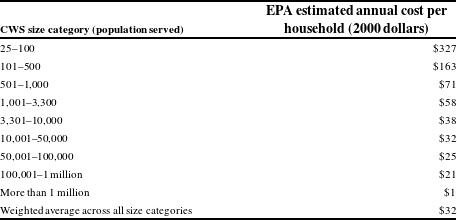
In their economic analysis of the arsenic drinking water rule, EPA explicitly addressed the affordability issue by estimating compliance costs per household by system size (U.S. EPA 2000). The results of this analysis are presented in Table 4. The potential magnitude of the affordability concerns is well illustrated by these estimates. While all PWS customers would receive health benefits from reducing arsenic concentrations in drinking water to 10 ppb, household compliance costs for small systems with fewer than 3,300 customers can be anywhere from 1.8 to over 10 times more expensive compared to the weighted average across all system size categories.
Mean annual costs per household of the arsenic MCL (10 ppb).
Notes: ppb $=$
parts per billion; Sources: U.S. EPA (2000, pp. 6–35).
$=$
parts per billion; Sources: U.S. EPA (2000, pp. 6–35).
The EPA made a variety of assistance programs available to small PWSs struggling to comply with the revised arsenic standard. These efforts constituted an extensive and consequential set of programs specifically designed to ease the burden on small PWSs trying to comply with the new water quality standard. Despite these efforts, compliance remained a complex and problematic undertaking for many small PWSs, as the experience of the small community of Tubac, Arizona illustrates.Footnote 23
4.1 The Tubac experience
Tubac is a census-designated place (CDP) located on the Santa Cruz River, approximately 45 miles south of Tucson, Arizona.Footnote 24 As of the 2010 Census, there were 1,183 individuals and 527 households residing in the CDP.Footnote 25 In total, the population of Tubac increased 25.5% between 2000 and 2010. The median age was 50 years with 22.3% of the residents over the age of 65. Residents who self-identified as having Hispanic ethnicity increased 42.2% from 2000 to 2010 and constituted 48.4% of the CDP population. Median household income in Tubac was $51,964 compared to $54,637 in Arizona and $55,970 in the U.S. However, due to 28.8% of the CDP households making more than $100,000 per year, per capita household income was $40,372 in Tubac compared to $26,996 in Arizona and $28,779 in the U.S. Importantly, nearly 1 in 4 households (23.5%) in Tubac have an annual income below $25,000, and 15.2% have incomes below $15,000 per year. Unemployment in the CDP was nearly 18% in 2010 with negative recent job growth.Footnote 26
The principal provider of drinking water in the Tubac CDP at the time of implementing the revised arsenic standard was the Arizona American Water Company (AAW). AAW was a large, technically sophisticated company providing water to over 300,000 customers in Arizona, and operating as a regulated utility in 20 states, serving over 15 million people across 30 states and parts of Canada.Footnote 27 In 2005, AAW had 532 customers in Tubac. After ruling out point-of-use and point-of-entry (POU/POE) treatment technologies as cost ineffective compared to centralized treatment, AAW then designed an arsenic treatment plant (ATP). Significant levels of treatment were required. The three groundwater wells servicing Tubac contained an average arsenic concentration of 25 ug/L, ranging from a low of 16 to a high of 36, making simple blending of water sources infeasible. To help defray ATP costs, AAW partnered with Tubac Marketplace, a small commercial development in the city, saving approximately $1 million in siting, storage, and pumping capacity expenditures. In the final design, one of the three wells was put out of service. The remaining two wells were then connected by a 4,900 ft. pipe of 12-inch diameter to the treatment plant itself. The plant was then able to treat arsenic to the safe levels prescribed by law (approximately 5 ug/L) and was capable of delivering 500 gallons per minute to customers. Additional storage of 500,000 gallons of water was also constructed.
Total cost of the plant was estimated to be $2.3 million, requiring a customer rate increase of approximately $78 per month. This rate increase was in addition to the 17% increase requested by AAW to cover other infrastructure investment and increased operating expenses incurred between 2001 and 2005. The net impact for Tubac water customers would be expending approximately 2.2% of the median Tubac level of income on drinking water, four times the U.S. average (Vandervoet, Reference Vandervoet2008, Reference Vandervoet2009).
Effects of a $234 quarterly increase in expenditures for water in the bottom quintile of total expenditure. (Total expenditure held constant).

Did compliance costs of $234 per quarter (costs that were approximately six times the expense estimated by the EPA) cause low-income households using AAW drinking water to jeopardize their health by foregoing needed health services? The estimated change in expenditure patterns is shown in Table 5 for both low-expenditure households who paid water bills directly and for households who pay through higher rents, holding total expenditure constant. Following the procedures detailed in Equations (1) through (5), expenditures for a representative household in both groups over the 2006–2012 period were estimated. For this scenario involving a $234 quarterly increase in the price of water for households falling in the bottom quintile of the distribution of total expenditure, the relevant intrabudget coefficient matrix is the one from Table 3. A $234 increase in the price of water is recorded, initially, as an exogenous addition of that amount to what the typical household in the bottom quintile spends on water, assuming no change in its total expenditure, which is to say that the intercept for water in Table 3 is increased from $115.90 to $349.90 ($115.90 $+$
$234). The other intercepts are all unchanged, as is the total expenditure of $4,393 per quarter for the water-bill surcharge group and the $3,053 per quarter for the rent surcharge group. Expression (5) is then solved for this “new” value of
$+$
$234). The other intercepts are all unchanged, as is the total expenditure of $4,393 per quarter for the water-bill surcharge group and the $3,053 per quarter for the rent surcharge group. Expression (5) is then solved for this “new” value of $z$
, resulting in a new vector of expenditures, say, y*, and a new implied level of total expenditure of $4762. The original budget constraint of $4393 is then imposed by multiplying y* by 0.92 (4383/4762), with results as shown in Table 5.Footnote
28
$z$
, resulting in a new vector of expenditures, say, y*, and a new implied level of total expenditure of $4762. The original budget constraint of $4393 is then imposed by multiplying y* by 0.92 (4383/4762), with results as shown in Table 5.Footnote
28
For discussion purposes, BLS categories of expenditures have been aggregated into five classes: spending on housing with water expenditures broken out; spending on food; nine categories of discretionary spending; three categories of security spending related to physical and financial well-being; and miscellaneous spending. Expenditure estimates are presented in four columns. The “base” column of Table 5 reports expenditures for a representative household in the bottom quintile before the rate increase. The next column shows how expenditures for this household were adjusted in response to the $234 increase in Tubac water bills. The last two columns present the corresponding category and class changes in spending, respectively.
Effects of a $348 quarterly increase in expenditures for water in the bottom quintile of total expenditure (total expenditure held constant).

* Constrained to be nonnegative.
4.1.1 Surcharge added to water-bill households
For the representative household in this group, total annual expenditures are $17,572, corresponding to about the 15th percentile of expenditures for U.S. households. Housing expenditures are decreased by $46.09, accommodating 19.7% of the $234 surcharge.Footnote 29 Spending on water amounts to $350.81. If the representative household failed to adjust their water consumption behavior in response to the surcharge, total spending on water would be $374.95 (base of $140.95 plus surcharge of $234.00). The savings due to water conservation amounts to $24.14 or approximately 10.3% of the $234 surcharge.Footnote 30 Food spending actually increases by $37.41 per quarter or $12.47 per month. While this adjustment is de minimis, it does illustrate that food security concerns are not exacerbated for this group. Approximately half of the water surcharge is accommodated by a net reduction in discretionary spending of $118.03. Nearly one third of the $234 surcharge is accommodated through a $77.32 reduction in security spending, with health spending reductions alone accounted for 12.4%. In percentage terms, this adjustment is striking since security spending only accounts for 15.9% of the original base budget. Finally, reductions in miscellaneous spending amounts to $6.05 or 2.6% of the water surcharge.
4.1.2 Surcharge added to rent group
For the representative household in this group, total annual expenditures are only $12,212.Footnote 31 Housing expenditures increased by $152.31 for this group of households in response to the $234 surcharge. If there were no change in housing-expenditure behavior, the new level of spending on housing would be $1,288.04. The difference of $81.69 (i.e., $1,288.04–$1,206.35) amounts to 34.9% of the water surcharge. Discretionary spending cuts again play an important role in adjusting to the increased rent. The reduction of $63.60 amounts to 27.2% of the water surcharge. Both food and health security concerns are exacerbated for this rental group of households. Food expenditures are reduced by $57.72, security expenditures are cut by $29.90, and spending on health goods and services are lowered by $10.88. These reductions account for 24.7%, 12.8%, and 4.6% of the $234 rent hike attributable to the water surcharge. Finally, cuts in miscellaneous spending are negligible.Footnote 32
4.1.3 Summing up
The $234 water surcharge is assumed to be passed on to customers either directly in their water bill or indirectly through higher rents. The expenditure implications for the two types of household differ in significant ways. Water conservation accommodates approximately 10% of the surcharge for water-bill households. Water conservation is ineffective for the rental group since reductions in water usage are unlikely to be reflected in future rents. Food security concerns are exacerbated for the rental group and unaffected for the water-bill group. Security spending reductions accommodate nearly 1/3 of the water surcharge for water-bill households, but only 12.8% for rental households. Health security concerns are impacted for both groups, but again the expenditure implications for the rental group are less in both absolute and percentage terms.
4.2 Secular impacts of safe drinking water standards
The implementation of a single MCL for drinking water may result in low-income households jeopardizing their overall health by reducing expenditures for other essential health-related goods and services. The central EJ policy concern in the context of providing safe drinking water, however, is that promulgation of new or revised MCLs over time may result in a regressive pattern of distributing benefits and costs. That is, SDWA programs may tend to promote the interests of higher income groups more than those of the poor. Yet given the substantial health and longevity benefits of safe drinking water, it is clear that the interests of society, including those of the poor, may justify substantial SDWA investment.
Implementing future MCLs for drinking water in a manner that promotes substantive EJ for low-income customers of small PWSs will continue to be a daunting proposition. The national primary drinking water regulations (NPSWR) promulgated by the EPA are legally enforceable standards that apply to all PWSs. These regulations limit drinking water contamination from organic chemicals, radionuclides, inorganic chemicals, microorganisms, disinfectants, and disinfection by-products. In 2011, the EPA was monitoring over 200 drinking water standards, compared to 19 MCLs in 1975 (U.S. EPA, 2011). Not surprising, the consumer price index (CPI) for water and sewer has surpassed the CPI for all items for the past 15 years, as illustrated in Figure 2.Footnote 33 Meanwhile poverty in the U.S. has remained an intractable problem. Census figures released in September 2013 confirmed that record-high numbers of households are living in poverty.Footnote 34 In 2012, 46.5 million people (one out of seven) were living in poverty in the U.S., the largest number in the 54 years the census has measured poverty. Almost one out of sixteen people in the U.S. (6.6% of the population) were living in deep poverty with incomes 50% below the poverty line. Racial and ethnic minorities were particularly vulnerable to poverty and deep poverty. Coupling ever-increasing drinking water regulationsFootnote 35 with a large and increasing resident population living in poverty dramatically illustrates the substantive EJ challenges facing the EPA in coming years.Footnote 36
To estimate the likely change in expenditure patterns for a representative low-income household in response to the cumulative impact of more stringent drinking water standards, the combined effects of the actual increase for arsenic abatement ($234) and an increase of $114 resulting from an increase in the CPI for water relative to the ALL items CPI for Urban Consumers of 44.7% over the 10 years 2004–2013 (December–December) has also been evaluated. The results for the combined $348 quarterly increase in expenditures for water by households in the bottom quintile of total expenditures are presented in Table 6.
U.S. Water Rate Increases. Source: US department of labor, bureau of statistics, consumer price index. Available at http://www.bls.gov/cpi/

4.2.1 Surcharge added to water-bill group
The financial stress of secular water-rate increases, coupled with stagnant growth in real income, forces households in the bottom quintile to intensify water conservation measures. Of the $348 total increase, $47.23 (i.e., a surcharge of $348 minus a category change of $300.77) is accommodated by water conservation measures, with an additional adjustment of $66.03 in other housing-related goods and services made as well. Taken as a whole, spending reductions in housing expenditures accommodates 32.5% of the surcharge (see Table 6). Food expenditures actually increased for this group by $53.62 so that food security issues remain unaffected. Discretionary spending plays a dominant role in accommodating the impact of the water surcharge. By reducing spending by $168.66 in this class, most of the increase in water and food expenditures can be incorporated into the household budget. Security spending reductions again play a disproportionate role in reacting to the imposition of this water surcharge. A spending reduction of $110.82 amounts to 31.8% of the surcharge while security spending accounts for only 15.9% of the original base expenditure budget. Finally, health-related expenditures fall by $41.69, or 12% of the surcharge.
4.2.2 Surcharge added to rent group
For these extremely low-expenditure households, rents cannot be lowered through water conservation since they do not receive a water bill directly. On the other hand, the $348 rent increase attributable to the per-household surcharge can be partially accommodated through reductions in housing spending generally. Under this scenario, housing expenditures are estimated to increase by $218.53 (see Table 6). If housing-expenditure behavior remained unchanged, total housing spending would have risen by $348. The difference of $239.47 accounts for 37.2% of the rent hike. Food security concerns for this low-income group are exacerbated by the rent increase. The reduction of $82.82 in food spending accommodates roughly 23.8% of the rent increase. Discretionary spending reductions accommodates 26.1% of the surcharge while security expenditure cuts account for an additional $42.91 or approximately 12.3% of the surcharge. Focusing on health-related expenditures directly, the reduction of $15.61 accommodates 4.9% of the surcharge by itself.
Expenditure accommodations for quarterly water surcharges in the bottom quintile of total expenditure (total expenditure held constant).

4.3 Summing up
A comparison of the two simulations, one estimating the impact of the revised arsenic standard in isolation, and the other evaluating the expenditure implications of rising real drinking water costs over the decade ending in 2013, is presented in Table 7. On average, the results support three general conclusions. First, about one third of drinking water surcharges are financed through reductions in food expenditures for extremely low-expenditure households (i.e., total annual expenditures of $12,212 annually) while there are no reductions in food expenditures for low-expenditure households (i.e., total annual expenditures of $17,572 annually) in response to the imposition of water surcharges. Second, about 12% of drinking water surcharges are accommodated by reductions in health-related goods and services in low-expenditure household while only 5% of the surcharge is accounted for by reductions in health expenditures in the extremely low-expenditure group. Third, reductions in security spending generally play a disproportionate role in adjusting to surcharges in low-expenditure households, accounting for nearly one third of the surcharge accommodation but only amounting to 16% of the original budget. For extremely low-expenditure households, only 5% of the surcharge is accommodated by reductions in health-related goods and services.
5 Conclusions
Advocates of HHA maintain that surcharges for improved drinking water will result in reductions in other health and food-related expenditures. In the net, enforcing drinking water standards may result in negative net health benefits for low-income households in small PWSs. The results of this evaluation of the internal structure of U.S. consumption expenditures lend empirical support to the contention that as real drinking water costs rise, health and food expenditures fall, assuming stagnant real income.
While the HHA proposition that policies intended to protect human health ought to result in positive net health benefits seems unassailable, the use of HHA in environmental standard setting has been controversial. In fact, Portney and Stavins (Reference Portney and Stavins1994) argue that in most applications the ancillary health impacts of regulatory compliance costs are unlikely to be significant. As a result, conventional benefit-cost (PPI) analysis should remain the principal tool of economic assessment for environmental laws and regulations. In general, slight real income losses are not likely to translate into aggregate health impacts of significance. Moreover, higher incomes and jobs created by regulation tend to translate into offsetting life-saving benefits.
The Portney–Stavins critique of HHA seems particularly valid when compliance costs are highly dispersed and low on a per-household basis. For drinking water regulations, however, the same households that benefit from the regulation typically bear the full compliance cost. In this context, Raucher et al. (Reference Raucher, Rubin, Crawford-Brown and Lawson2011) argue that negative health impacts arising from regulatory costs may appreciably offset the risk reduction of the drinking water regulation itself. That is, increasing the cost of water service to a distressed household will increase the likelihood that the household will forego some other health-related necessity. In the case of arsenic, the authors estimated that cost-associated health risks may be within the same order of magnitude as the EPA-estimated arsenic risk reduction for customers of small PWSs.Footnote 37
Based on the results presented here, security spending may be reduced by as much as 33% of any surcharge that must be imposed to comply with stricter water standards for customers in small systems, health expenditures by as much as 12%, and food expenditures by as much as 34%. Looking ahead, the net health impact of these accommodations will be determined by a complex set of factors including the effectiveness of EPA programs designed to minimize the surcharge impact on low-income households in small PWSs ,Footnote 38 and the funding and effectiveness of safety-net programs designed to ameliorate health and food security concerns.Footnote 39
Acknowledgments
The authors would like to thank Scott Rubin, Timothy Tardiff, two anonymous referees, and participants in the Environmental Law and Economics conference in Groningen in May 2015 for helpful comments.
Appendix A. Calculation of own- and cross-price elasticities of demand
Absent direct information on prices, it is not possible (short of heroic assumptions about the structure of preferences) to estimate price elasticities from household surveys of consumer expenditures in a framework of conventional demand analysis. Surprisingly, however, this is possible in the present framework, for both own- and cross-price elasticities can be obtained through simulation. The key for doing so is to note that changes in prices can be incorporated into the analysis through the “intercept” vector $z$
in equation (5). Equation (5) is solved for two different values of
$z$
in equation (5). Equation (5) is solved for two different values of $z$
, the first to establish a baseline set of expenditures and a second to reflect the assumed change (or changes) in price. The resulting price effects are then represented by the differences between the two solution vectors
$z$
, the first to establish a baseline set of expenditures and a second to reflect the assumed change (or changes) in price. The resulting price effects are then represented by the differences between the two solution vectors $y$
.
$y$
.
The procedure involved, using the entries in Table 1 of the text as parameters, will be illustrated for an assumed 10 percent increase in the price of food consumed at home.Footnote
40
The results are tabulated in Table A1. To begin with, baseline expenditures are obtained from equation (5) using the “intercepts” from the last row in Table 2 of the text for $z$
, that is, a value of $705 for food home $132 for food away for alcoholic beverages, etc. These are given in the first column of Table A1. The total expenditure implied by this value for
$z$
, that is, a value of $705 for food home $132 for food away for alcoholic beverages, etc. These are given in the first column of Table A1. The total expenditure implied by this value for $z$
is $4393.Footnote
41
Note that the base expenditure for food is $761. An increase in the price of food of 10 percent is represented as a 10 percent increase in this base expenditure, that is, an increase of $76. The intercept for food in
$z$
is $4393.Footnote
41
Note that the base expenditure for food is $761. An increase in the price of food of 10 percent is represented as a 10 percent increase in this base expenditure, that is, an increase of $76. The intercept for food in $z$
($706) is replaced by $782 ($706
$z$
($706) is replaced by $782 ($706 $+$
$76). All other elements of
$+$
$76). All other elements of $z$
remain the same. Call this new value of
$z$
remain the same. Call this new value of $z$
,
$z$
, $z^{\ast }$
. Equation (5) is then solved for
$z^{\ast }$
. Equation (5) is then solved for $z^{\ast }$
, with total expenditure held constant, with results as in columns 4 and 5 of the Table A1. Expenditures are seen to increase $67.22 for food at home, decrease $31.91 for housing, and so on and so forth. Table A1 also includes results for a 5 percent increase in the price of food.
$z^{\ast }$
, with total expenditure held constant, with results as in columns 4 and 5 of the Table A1. Expenditures are seen to increase $67.22 for food at home, decrease $31.91 for housing, and so on and so forth. Table A1 also includes results for a 5 percent increase in the price of food.
Own- & cross-price elasticities. For a 5 & 10 percent increase in price of food (total expenditure held constant).

Formally, own- and cross-price elasticities in the present framework are obtained as follows. In an obvious notation, the total-expenditure budget constraint will be given by
 $$\begin{eqnarray}\mathop{\sum }_{i=1}^{n}p_{i}q_{i}=y.\end{eqnarray}$$
Hence, for a change of $\unicode[STIX]{x1D6E5}p_{i}$
in the price of
$\unicode[STIX]{x1D6E5}p_{i}$
in the price of $q_{i}$
, with total expenditure
$q_{i}$
, with total expenditure $y$
held constant, we will have:
$y$
held constant, we will have:
 $$\begin{eqnarray}\unicode[STIX]{x1D6E5}(p_{i}q_{i})+\mathop{\sum }_{j\neq i}p_{j}\unicode[STIX]{x1D6E5}q_{j}=0.\end{eqnarray}$$
Then:
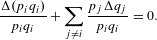 $$\begin{eqnarray}\frac{\unicode[STIX]{x1D6E5}(p_{i}q_{i})}{p_{i}q_{i}}+\mathop{\sum }_{j\neq i}\frac{p_{j}\unicode[STIX]{x1D6E5}q_{j}}{p_{i}q_{i}}=0.\end{eqnarray}$$
Consequently, in elasticities:
 $$\begin{eqnarray}\frac{\unicode[STIX]{x1D6E5}(p_{i}q_{i})}{p_{i}q_{i}}\bigg/\frac{q_{i}\unicode[STIX]{x1D6E5}p_{i}}{p_{i}q_{i}}+\mathop{\sum }_{j\neq i}\left(\left(\frac{p_{j}\unicode[STIX]{x1D6E5}q_{j}}{p_{j}q_{j}}\bigg/\frac{q_{i}\unicode[STIX]{x1D6E5}p_{i}}{p_{i}q_{i}}\right)\left(\frac{p_{j}q_{j}}{p_{i}q_{i}}\right)\right)=0.\end{eqnarray}$$
Since all of the quantities in this expression (A5) are observable, cross-price elasticities will therefore be given by
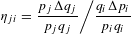 $$\begin{eqnarray}\unicode[STIX]{x1D702}_{ji}=\frac{p_{j}\unicode[STIX]{x1D6E5}q_{j}}{p_{j}q_{j}}\bigg/\frac{q_{i}\unicode[STIX]{x1D6E5}p_{i}}{p_{i}q_{i}}\end{eqnarray}$$
and the own-price elasticity byFootnote 42
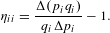 $$\begin{eqnarray}\unicode[STIX]{x1D702}_{ii}=\frac{\unicode[STIX]{x1D6E5}(p_{i}q_{i})}{q_{i}\unicode[STIX]{x1D6E5}p_{i}}-1.\end{eqnarray}$$
Thus, for a 10 percent increase for the price of food, the own-price elasticity for food [from expression (A6)] will be given by
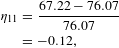 $$\begin{eqnarray}\displaystyle \unicode[STIX]{x1D702}_{11} & = & \displaystyle \frac{67.22-76.07}{76.07}\nonumber\\ \displaystyle & = & \displaystyle -0.12,\end{eqnarray}$$
while the cross-elasticity for housing (say) [from expression (A5)] will be given by
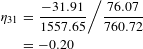 $$\begin{eqnarray}\displaystyle \unicode[STIX]{x1D702}_{31} & = & \displaystyle \frac{-31.91}{1557.65}\bigg/\frac{76.07}{760.72}\nonumber\\ \displaystyle & = & \displaystyle -0.20\end{eqnarray}$$
both as in column 5 of Table A1.Footnote 43
Application of expressions (A5) and (A6) to the expenditure changes posted in Tables 5 and 6 of the text associated with the price-increase scenarios of $234 and $348 yields the own- and cross-elasticities listed in Table A2. Own-elasticities for the two scenarios are indicated to be $-$
0.10 and
$-$
0.10 and $-$
0.14 for water purchased separately (columns 1 and 2) and
$-$
0.14 for water purchased separately (columns 1 and 2) and $-$
0.35 and
$-$
0.35 and $-$
0.37 for housing when water is included in rent (columns 3 and 4).Footnote
44
$-$
0.37 for housing when water is included in rent (columns 3 and 4).Footnote
44

Of obvious interest is how these estimates compare with those found in the literature. Dalhuisen et al. (Reference Dalhuisen, Raymond, de Groot and Nijkamp2003) obtain a mean own-price elasticity of 0.41 in a meta-analysis of almost 300 studies over the period 1963–1998, and in a similarly extensive survey of the water demand literature, Olmstead and Stavins (Reference Olmstead and Stavins2008) find that the price elasticity of residential demand varies substantially across place and time, but on average, in the U.S., a ten percent increase in the marginal price of water in the urban residential sector can be expected to diminish demand by about three to four percent. Finally, in another meta-analysis of the variation in estimates of price elasticities taken from 24 studies of residential water demand published in journals between 1967 and 1993, Espey et al. (Reference Espey, Espey and Shaw1997) noted that estimates of the elasticities ranged from $-$
0.02 to
$-$
0.02 to $-$
3.33, with a mean of
$-$
3.33, with a mean of $-$
0.51, and that 90 percent of the estimates fell between
$-$
0.51, and that 90 percent of the estimates fell between $-$
0.50 and
$-$
0.50 and $-$
0.75.
$-$
0.75.
Thus, while the own-price elasticities calculated in the present investigation would appear to be at the lower end of existing estimates, two mitigating factors are to be noted: (1) calculations in the present effort refer to extremely low-income households and (2) the full array of cross-elasticities is taken into account.Footnote 45
Appendix B. The Arizona arsenic experience
It is important to note that the issues addressed by EJ and HHA are interrelated, but not identical. The arsenic experience in the state of Arizona is illustrative in this regard.
Arsenic is a common pollutant in Arizona’s groundwater (Hendricks, Reference Hendricks1985). The impact of revising the arsenic drinking water standard was dramatic in the state with 334 PWSs needing to take corrective action to comply, 80 percent of which were small PWSs with fewer than 3,300 connections (see Table B1). In fact, the total number of systems in Arizona affected by the revised standard accounted for roughly 10 percent of the nation’s total number of PWSs needing to take corrective action. In terms of population, almost 4.5 million Arizona residents were affected by the new standard, accounting for approximately 35 percent of the national population estimated to be affected by the revised arsenic MCL of 10 ppb (U.S. EPA, 2006).
Public water systems in Arizona.

PWS customers reflect the diversity of the state in terms of race and income (see Table B2).
Summary statistics.
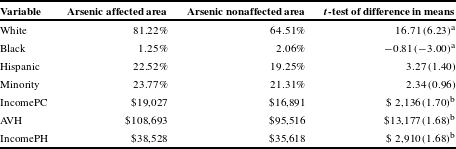
The percentage of black persons in contaminated areas is disproportionately lower (1.25%) than the percentage of black population in noncontaminated areas (2.06%). The difference between percentages of black persons in contaminated and noncontaminated areas is $-0.81\%$
, and it is statistically significant at 5% level of significance. The percentage of minority persons (black
$-0.81\%$
, and it is statistically significant at 5% level of significance. The percentage of minority persons (black $+$
Hispanic) in contaminated areas is approximately the same (23.77%) as in areas without contamination (21.31%). The difference between percentages of minority persons in contaminated and noncontaminated areas is 2.34%, and it is statistically insignificant. However, the percentage of white persons in arsenic contaminated area is disproportionately higher (81.22%) and statistically significant from the percentage of white persons in noncontaminated areas. The percentage of Hispanic persons in contaminated areas is greater (22.52%) than the percentage of Hispanic population in noncontaminated areas (19.25%), but the difference between the two is statistically insignificant. Moreover, per capita income, average housing value, and the income per household are each statistically greater in arsenic contaminated areas, as opposed to the corresponding figures in noncontaminated areas. These results suggest that the continued selective implementation and enforcement of the revised SDWA arsenic standard is not likely to disadvantage minority (i.e., black
$+$
Hispanic) in contaminated areas is approximately the same (23.77%) as in areas without contamination (21.31%). The difference between percentages of minority persons in contaminated and noncontaminated areas is 2.34%, and it is statistically insignificant. However, the percentage of white persons in arsenic contaminated area is disproportionately higher (81.22%) and statistically significant from the percentage of white persons in noncontaminated areas. The percentage of Hispanic persons in contaminated areas is greater (22.52%) than the percentage of Hispanic population in noncontaminated areas (19.25%), but the difference between the two is statistically insignificant. Moreover, per capita income, average housing value, and the income per household are each statistically greater in arsenic contaminated areas, as opposed to the corresponding figures in noncontaminated areas. These results suggest that the continued selective implementation and enforcement of the revised SDWA arsenic standard is not likely to disadvantage minority (i.e., black $+$
Hispanic population taken together) or low-income groups disproportionately in Arizona. In fact, these basic statistics suggest quite the opposite – there is a disproportionate impact of arsenic contamination on nonpoor and majority communities in Arizona.Footnote
46
$+$
Hispanic population taken together) or low-income groups disproportionately in Arizona. In fact, these basic statistics suggest quite the opposite – there is a disproportionate impact of arsenic contamination on nonpoor and majority communities in Arizona.Footnote
46
Implementation of the revised arsenic standard in Arizona was not complicated by EJ concerns since small PWSs requiring corrective action were not disproportionately low income or minority in their customer base.Footnote 47 The health concerns addressed by HHA, however, remained. The Tubac case study documented that higher water bills for low-income customers of small PWSs are likely to result in lower household expenditures for other goods and services like health care, food, energy, and other essential services. While this evidence supports the contention that the net health impact on low-income water consumers may be negative when rate hikes become onerous, the result that low-income households will be worse off is not inevitable. More generally, consumers will reallocate their budget across all goods and services to maximize their utility in the face of water-rate hikes. Some consumers may choose to forego health services while others may economize on other non-health-related items to accommodate higher drinking water bills. In either case, consumers may be worse off, particularly low-income consumers who spend a disproportionately large share of their total income on necessities, if their tastes and preferences do not change during the course of MCL implementation. A possible exception to this adverse impact can occur when low-income customers come to highly value the health benefits of a more stringent MCL, as benefit information is disseminated over the course of MCL implementation, and the accompanying rate hike is modest. In this special case, water customers are happy to secure the health benefits of safer drinking water at a modest price and are better off, so that no distributive justice problem exists.Footnote 48



