


Several studies have shown that people who are physically taller have more conservative political preferences. In addition, other studies have shown that taller people also enjoy enhanced financial well-being in the form of higher incomes. Connecting these two sets of results, Arunachalam and Watson (Reference Arunachalam and Watson2018, hereafter A&W) contend that the effect of height on political preferences works through – and only through – economic well-being. They argue that taller people are more conservative solely because of their higher socioeconomic status, thus ruling out innumerable common causes that affect both height and income. Because height has no direct effect on preferences, A&W contend that it can be used as an instrument for income, a useful option in datasets where reliable and valid measures of income are unavailable.
There are reasons to be skeptical about this conclusion. Most importantly, the authors overlook a host of early-life and genetic factors that could serve as confounders or mechanisms through which height appears to affect political preferences. For example, childhood environments such as parental socioeconomic resources may affect both height and political preferences. We address these oversights using a unique data source, the Wisconsin Longitudinal Survey (WLS), which allows us to test for many possible confounders. Unlike the surveys analyzed by A&W, the WLS includes measures of a variety of potential confounders. More importantly, the survey has the unique feature of collecting parallel data on siblings that were raised in the same households. Models that include fixed effects for these households provide an especially strong test for most unmeasured factors that link children within families, in particular genetic predispositions and child-rearing practices that could explain the connection between height and conservatism.
In this research note we use this approach and find that height is not a consistent predictor of political preferences in a sample of older Americans once confounders are addressed. It thus appears that aspects of the household environment are responsible for inducing a relationship between height and preferences. While identifying the precise pathways that connect height and political views must await future research with different data, we explore several possible substantive connections and conclude that researchers should remain cautious about employing height as an instrument for income.
1. The challenge
A&W contend that physical height is a predictor of conservative voting and policy opinions. This is because height affects income, which is the presumed driver of conservative political leanings. Based on prior research, the authors reason that taller people enjoy greater material wellbeing, which in turn leads to support for conservative viewpoints. They further argue that the mechanism that causes height to boost incomes and conservative tendencies is not health, cognitive ability, or parents' political orientations and social standings.
A&W state that for the instrumental variable (IV) model to work, “height's effect on political preferences operates only through its effect on income” (p. 12, emphasis added). They go on to say that “height is plausibly excludable” because it “is unlikely to direct affect…political behavior” and is “unlikely to directly affect the dependent variables of interest” (p. 13). This statement would imply that including both height and income in the same model should show no independent effect for health because its influence would be sub-subsumed by the “post-treatment” variable, income.
The A&W logic is compelling and methodologically convenient, but it depends on some strong assumptions that may be challenged. Specifically, for the instrument to work, one must believe that height does not influence political preferences except through income. It is worth quoting at length from Urbatsch's (Reference Urbatsch2014, 32) explanation about how it may be misguided to assume that height works only through income:
“After all, the whole course of the argument here is that childhood conditions may influence adult outcomes. Taking account of factors that arose later in life may mask the real effect of childhood circumstances by causing “endogeneity bias.” To take an analogy, consider the link between childhood nutrition and adult income. A better diet during one's youth could possibly affect not only mental qualities that lead to higher income but also adult height. Height has other causes, too, of course: genetics, for example. Moreover, height may independently influence income if employers are biased about personal appearance; if companies pay people more for being tall (consciously or not), height will have an effect on income over and above the extent to which it indirectly captures the effects of childhood nutrition. It is in consequence tempting to use height as an independent predictor of income. But insofar as childhood nutrition affects height, treating height as though it had a separate, independent effect will misleadingly reduce the seeming impact of childhood nutrition. That is, the effects are not wholly independent, and so the predicted difference between those with good and bad diet will appear to shrink to smaller than what it in reality is.”
Figure 1 provides a visual representation of the argument. The path assumed by A&W is represented by the solid arrows on the right side of the figure linking height to income to political preferences. We suggest there are probable confounders, detailed in the boxes on the left side of the figure, that could serve as the conduits linking height to political views. The first set of possible confounders is genetics and early life environments. Genetic and early life environments influence both height and income. Specifically, evidence from twin studies demonstrates that the relationship between height and income is influenced by both childhood environmental conditions, such as parental socioeconomic resources and parental socialization, and underlying genetic factors (Silventoinen et al., Reference Silventoinen, Kaprio and Lahelma2000; Lång and Nystedt, Reference Lång and Nystedt2018). There is also evidence that genetic factors and childhood environmental conditions, such as parental socioeconomic resources and parental socialization, influence political preferences. A rich array of political science literature has documented how family environments influence political beliefs and participation (Jennings et al., Reference Jennings, Stoker and Bowers2009). Moreover, studies using twin databases demonstrate evidence of heritability of political predispositions (Hibbing et al., Reference Hibbing, Smith and Alford2014). It is consequently probable that unmeasured genetic factors and early life family environments may confound the relationship between height, income, and political preferences.
Pathways connecting height and political preferences.
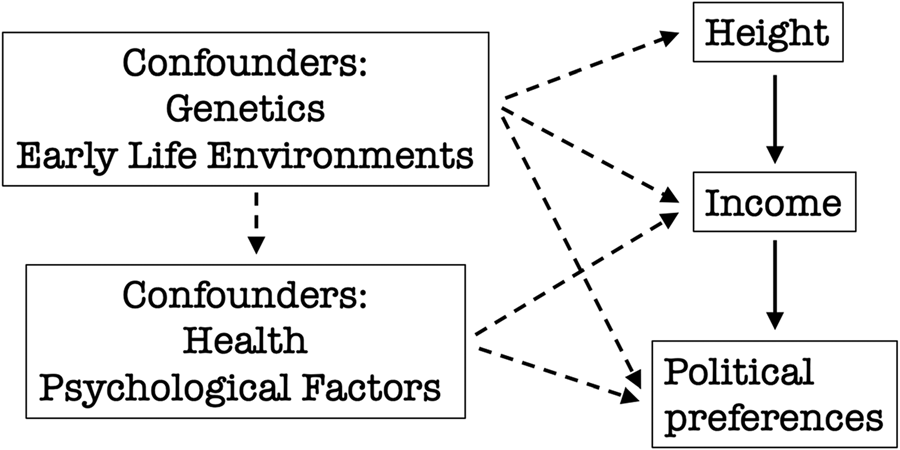
There are other possible unmeasured confounders. In particular, as shown in Figure 1, both psychological factors and health predict height, income, and political preferences. Variance in health, a product of both early life environments and genetics (Kelishadi and Poursafa, Reference Kelishadi and Poursafa2014), influences height (Bozzoli et al., Reference Bozzoli, Deaton and Quintana-Domenque2009), income (Cutler et al., Reference Cutler, Miller and Norton2007), and political participation (Burden et al., Reference Burden, Fletcher, Herd, Moynihan and Jones2017). As with health, variance in psychological factors is a product of both genetics and early life environments (Bouchard, Reference Bouchard1994), and psychological factors influence earnings and income (Nyhus and Pans Reference Nyhus and Pons2005) and political participation (Gerber et al., Reference Gerber, Huber, Doherty, Dowling and Ha2010). It is important to account for these factors when trying to estimate whether height affects political participation via its impact on income.
2. Method of analysis
To examine the relationship between height and political preferences, we utilize the WLS, a study of a random sample of 10,317 Wisconsin high school graduates from the class of 1957 (Herd et al., Reference Herd, Carr and Roan2014). These individuals have been surveyed repeatedly between 1957 and 2011. The sample is fairly representative of white, non-Hispanic high school graduates across the United States.
Importantly, the WLS also includes surveys of the original respondents' siblings.Footnote 1 This expands the ranges of ages represented from 45 to 87 in the 2005 survey wave on which we focus.Footnote 2 Most importantly, it allows us to control for a wide array of possible household effects due to parents or other pre-adult experiences (see Burden et al., Reference Burden, Herd, Jones and Moynihan2020). It also allows us to account for some, though not all, of potential genetic confounders. In short, sibling fixed effect models allow us to largely account for the genetic and early life confounders included in Figure 1. Further, WLS also includes detailed measures of both health and psychological covariates, the other key confounders included in Figure 1.
Additional advantages to WLS include its gold standard approach to measurement, which is critical for both the height and economic variables. The survey includes objective height, which was measured by professionals in a controlled environment.Footnote 3 We rely on measured rather than self-reported height because individuals mis-report height, particularly men (Rowland, Reference Rowland1990; Spencer et al., Reference Spencer, Appleby, Davey and Key2002; Merrill and Richardson, Reference Merrill and Richardson2009) who are also more conservative and have higher incomes.Footnote 4 The WLS also includes detailed measures of both income and wealth (Herd et al., Reference Herd, Carr and Roan2014), the latter of which is important to consider in the older populations represented in the WLS. In Appendix Table A4 we provide “first stage” regression models demonstrating that height is a robust correlate of both income and net worth in the WLS dataset.
The primary outcome in our analysis is party identification, collected in both 2005 and 2011, which classifies participants into five categories with higher values being more Republican.Footnote 5 As noted, height was measured by a field interviewer in the participant's home in 2011. The income measure includes both wage and investment income. It is a continuous measure expressed in $1,000s. Additional WLS measures allow us to account for other possible confounders. We include measured weight in one model, given its relationship with both height and income/wealth. Health is measured based on the Health Utilities Index (HUI), a reliable and valid summary measure that captures sensation (e.g., hearing), mobility, emotion (e.g., depression), cognition, self-care (e.g., ability to make food), and pain (Horsman et al., Reference Horsman, Furlong, Feeny and Torrance2003). We also include a measure of birth weight, which was self-reported in 2004, and could reflect parental background and the ability to thrive. The survey includes two additional kinds of psychological measures. One measure captures self-mastery, or the level of control one perceives they have over their environment (Herd et al., Reference Herd, Carr and Roan2014). The second set captures the “Big Five” personality measures, which include openness, conscientiousness, extraversion, agreeableness, and neuroticism (Herd et al., Reference Herd, Carr and Roan2014). Descriptive statistics for all variables are provided in Appendix Table A5.
Before conducting analysis to disentangle the causal relationship between height and political preferences, we first assess whether there is in fact a meaningful relationship that warrants disentangling. The correlation between height and the 2005 measure of party identification in the WLS is less than 0.06 for both genders and the box plot presented in Figure 2 shows a noisy and weak relationship. Although height is more strongly correlated with household income (0.17), the tenuous connection between height and political preferences raises questions about whether height would make a suitable instrument, even if its effect did operate only through income. The relationship in 2011 shows a similar pattern.
Box plot of height by party identification.
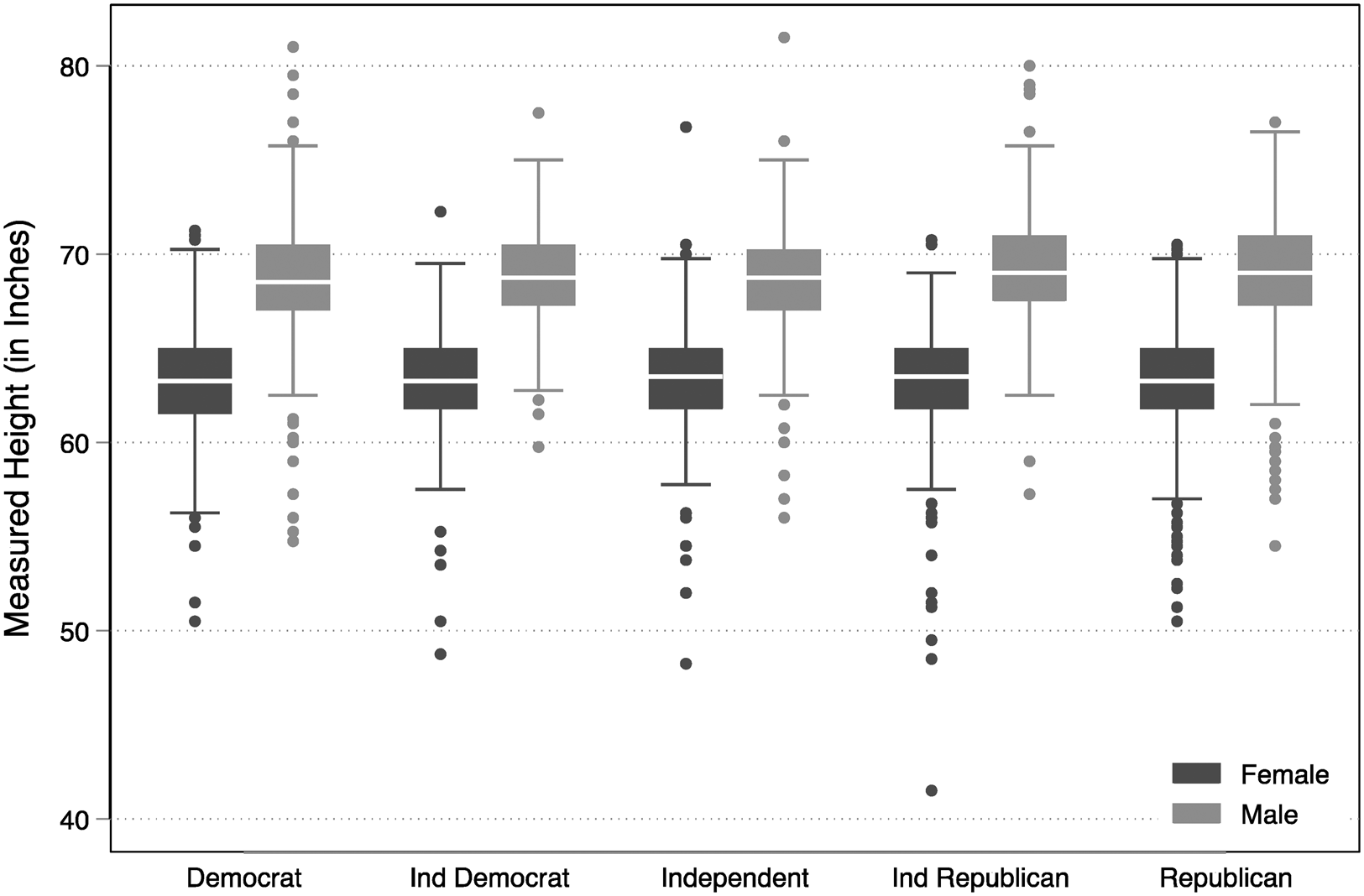
Although noisy, the relationship is sufficiently reliable in the WLS dataset to make the analysis informative about the A&W argument. This is because there is a robust correlation between height and party identification when sibling fixed effects are not controlled. Before implementing our preferred methodology to mitigate confounding relationships, we show in Appendix Table A1 that height is robust predictor of party identification, whether or not gender is controlled. This is true even when limiting the analysis to same-gender siblings. This further justifies the use of sibling fixed effects.
3. Multivariate analysis
Our methodological approach is to estimate ordered logit models of party identification with height as the key explanatory variable and (1) using fixed effects for siblings and (2) limiting the analysis to same-gender siblings. This is an admittedly conservative approach. However, given evidence that early life conditions, and potentially shared genetics, influence both height and political participation, sibling models are a powerful way to account for these potential confounders. Sibling fixed effects are stringent because they control for most unmeasured factors that could influence two brothers or two sisters, including influences such as parenting styles, household resources, partially shared genetic factors, and much more. This strategy best accounts for early life environments or endowments that might confound the relationship between height and political preference. Second, analyzing only same-gender pairs avoids spurious relationships due to the strong connection between height and gender. In our data, measured height is correlated with gender at 0.72. Height is also correlated with weight (0.49) and weight is in turn correlated with gender (0.44). This approach has the unfortunate side-effect of reducing the sample size available for analysis because the original respondents must have same-gender siblings who were also surveyed, but we believe the greater certainty that results from demonstrated causal effects is worth it.
Tables 1 and 2 report the effects of objectively measured height on party identification. As noted, all models rely on same-gender siblings, control for age, and include fixed effects for all pairs. The models begin simply with the bivariate effect of height in the 2005 survey and then elaborate that result to (1) control for income (which should knock out the effect of height if it is a proper instrument), (2) control for weight (a possible confound, although less so for the same gender sibling pairs we analyze), (3) estimate separate effects for men and women, (4) replicate the models using the 2011 survey. Note that we prefer to estimate separate models by gender instead of simply controlling for gender because it allows for different functional forms for men and women rather than simply shifting the outcome up or down.
Measured height and party identification

Models are ordered logit regressions including age and sibling fixed effects (not shown).
Data analysis limited to same-gender siblings.
*p < 0.05, ** p < 0.01, two-tailed tests.
Measured height and party identification—potential confounders
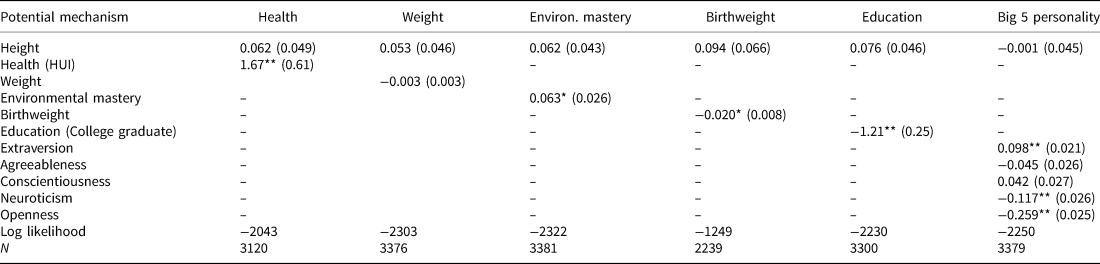
Models are ordered logit regressions including age and sibling fixed effects (not shown).
Data analysis limited to same-gender siblings.
*p < 0.05, ** p < 0.01, two-tailed tests.
In contrast to the models without sibling fixed effects reported in the Appendix, the tables provide little evidence that height has a causal effect on political preferences. This is evidence that accounting for unmeasured background factors is essential to identify a valid causal estimate. In most models the coefficient associated with the height variable is not close to statistically significant by conventional standards. The fixed effects are stringent because they are so numerous (equal to n/2 in each model). That likely causes standard errors to be inflated because of the high degree to which the models are able to determine outcomes. Although the fixed effects models are demanding, the coefficient of interest does not even consistently run in the expected positive direction in which being taller is associated with more Republican preferences, thus undermining the idea that wide confidence intervals are mainly responsible for null effects.
The only evidence of a causal effect occurs among women in two of the models from 2005. The effect was not present in 2011. Nonetheless, the findings from 2005 are surprising because existing research tends to find stronger relationship between height and income among men. In addition, the gender-specific analysis conducted by A&W points to stronger relationship between height and political preferences for men than women, although the relationship varies somewhat over time. We agree with A&W that apparent asymmetries between the genders deserve further study.
In Appendix Table A3 we report similar models but with ideological self-identification as the dependent variable. This relationship is also robust in the full sample but fails to be statistically significant when gender is controlled. It is possible that the less consistent effect on ideology is particular to the WLS sample and might limit the comparability of results with A&W.
4. Considering additional confounders
The sibling fixed effects approach controls for many early life household, environmental, and familial influences, both observed and unobserved, that might explain a relationship between height and political preferences. Nonetheless, there are observed characteristics that vary between siblings that could help us unpack the relationship between height and political preferences. A&W provide a rich 54-page appendix that includes some auxiliary analysis exploring some potential mechanisms linking height to conservatism. For example, they show that the effect of height is not altered when controlling for either health or prevalence for risk-taking.
Following this approach, we take advantage of an array of psychological, health, and demographic variables available in the WLS to offer at least a preliminary examination of whether the causal effect of height on political preferences is actually the result of some additional plausible measured factors. Here we mostly focus on health and psychological factors, as outlined in Figure 1, but we also test to ensure whether a few key demographic variables such as educational attainment alter the relationship between height and political preferences.
Table 2 reports six extensions of the baseline model that each control for a separate variable that might be a plausible confound. The main point of emphasis is that the relationship between height and political preferences is not statistically significant in any model.Footnote 6 Nonetheless, there are some interesting patterns. Table 2 demonstrates that health does directly predict political preferences: we find that those in better health, as measured by a lower HUI score or by higher birthweight, are more likely to identify as Democrats. But the inclusion of health variables does not alter the relationship between height and political preferences. There is no relationship of party identification with weight, but college education leads to more Democratic attachments.
The table reveals an intriguing relationship between personality and political views. Those with higher levels of extraversion and lower levels of openness and neuroticism are more likely to identify as Republican. Moreover, the inclusion of these personality variables does alter the relationship between height and political identity. In all of the other models in Table 2 the estimate effect of height is insignificant, but remains positive and of similar magnitude. This might lead one to conclude that height might in fact affect political preferences, but our models lack the statistical power to detect the relationship due to the larger number of sibling fixed effects. However, including the “Big Five” personality measures in the final column shrinks the height coefficient almost exactly to zero while three of the characteristics are highly significant. This does suggest that future research should consider if taller people might have more Republican preferences and earn higher incomes because of their extraversion, neuroticism, and openness to experience.
5. Conclusion
Prior empirical work has shown a relationship between height and political identity, specifically that taller individuals are more conservative—and this operates exclusively through higher income returns to taller people. We employ objective measures of height, same-gender pairings, and sibling fixed effect models to better account for potential early life and genetic confounders that might bias the relationship between height and political participation. We find no evidence of a robust relationship between height and political preferences after accounting for these confounders and point to personality characteristics that stems from genetic or environmental influences as possible points of connection.
Future research might also more complex relationships than are examined here. For example, one study has found preliminary evidence that height is positively associated with conservative economic preferences among those with high incomes but negatively associated with those preferences among those with low incomes (Richardson, Reference Richardson2021). Although our results based on stringent models do not provide much evidence for a causal effect of height – let alone one that works solely through income – is it possible that relationships are more complicated than can be modeled by available data.
Supplementary material
The supplementary material for this article can be found at https://doi.org/10.1017/psrm2018.2024.14. To obtain replication material for this article, https://dataverse.harvard.edu/dataset.xhtml?persistentId=doi:10.7910/DVN/E2BH6J
Acknowledgements
Authors are listed in alphabetical order by convention. We thank Jordan Hsu for prior collaboration and the Wisconsin Longitudinal Study for data. Neither is responsible for analyses or interpretations reported here. A previous version of this paper was presented at the 2022 annual meeting of the American Political Science Association. We thank Christoffer Hentzer Dausgaard for discussant comments at that meeting.


 Open access

