


3.1 Introduction
Corporations are entities with purposes and patrimonies separate to their membership, presenting to and acting upon the world with a single will and voice distinct from the wills of the membership.Footnote 1 The law inveterately uses images or metaphors to convey the function of a discrete, univocal, and integrated group will and action belonging to the entity. Thus we have the corporate persona, or mask or face; the corpore, or body aggregate, wielding a fund or universitatis being a collection of partitioned and dedicated assets, and so on. These juridical metaphors articulate how the corporation can be a site of social action distinct from the extra-corporate behaviour of its members. At one extreme of legal analysis a “corporation sole,” such as a monarch or bishop or another official, can act in an entirely different juridical and social space to the person who holds the office, and who will spend a good deal of life engaging in non-corporate activities outside the office; such persons have two bodies, or perhaps such bodies have two persons. At the other extreme we have the state or commonwealth, embracing a whole population within a single will and purpose gathered in the mind and body of a representative sovereign.
The extremes of the corporation sole as the vehicle of office and the state sovereign as universal representative are not our chief concern here, but rather the vast array of corporations aggregate that lie in between. Four historic models of corporate activity will be laid out, each searching for fresh metaphorical insight, and each feeding ideas into the modern conception of the corporation: the cathedral built by guilds, comprising organizations with a skilled membership self-regulating admissions and standards of conduct; the factory, connoting the classic hierarchical and bureaucratized corporation with highly specified division of labour and capital with membership determined contractually; the bazaar, being collations of nested or adjoining enterprises such as a chamber of commerce or a stock market, providing a platform for interacting traders; and the commune, being an organization with personalized bonds and common purposes, found most intensely in family and religious enterprise.
These ideal types are not mutually exclusive and can be found across different time periods pursuing radically different profit and non-profit objectives; and they each persist in pure or hybrid form into the modern age. They are all affected by coordination problems that arise when members of a group take decisions, whether by direction, representation, or some other deliberative system such as voting. We can next stipulate an inductive conclusion: a group attains corporate status when it functions as a univocal entity, directing and backing the actions of its agents and reciprocally attributing agent action to the corporation. Real corporation theory then postulates that in these conditions of integrated direction and attribution the corporation thinks, purposes, and behaves as an agent or entity distinct from its membership. Much attention is given in law to the attribution of decision and conduct by corporate directors and servants to the corporate person as responsible agent. Collective agency should be broken into two parts: there must be collective knowledge as a precondition of collective conduct. In other words, there must be a system for processing relevant information about member, agent, and counterparty conduct, joined to observation of more objective facts about the state of the world. The corporation must have protocols to act upon this shared information to decide conduct – it must, in other words, create a knowledge commons governance structure.
The key argument of this chapter is that the corporation (thinking/acting through individual actors within the corporation) must be able to interpret facts largely comprising observations of other agents’ conduct, both within and without the firm boundaries. In other words, the corporation must cultivate and embody common knowledge, allowing fissiparous agents with distinct levels of knowledge and contending goals to nonetheless successfully predict mutual conduct and evoke successful group heuristics (valuable knowledge-building canons) and thus have the capacity to form and execute plans that can deal with uncertainty and surprise founded on interactive rationalities. So we must look for two interlocking steps in the mental life of the corporation – hunting, gathering, and cultivating information about a world (including the corporation itself) populated by contending sentient agents (a knowledge commons), and then aligning interpretation of the fruits of the information harvest to permit mutual cooperation within and across firm boundaries (attaining common knowledge).
To articulate this framework of corporate analysis, we must move nimbly from legal and historical examples to more abstract tools of analytical philosophy and economics. The approach here links closely to the evolving Governing Knowledge Commons (GKC) framework (Madison et al. Reference Madison, Frischmann and Strandburg2010; Frischmann et al. Reference Frischmann, Madison and Strandburg2014; Strandburg et al. Reference Strandburg, Frischmann, Madison, Strandburg, Frischmann and Madison2017) derived from the seminal work of Elinor Ostrom, which examines cooperation through a matrix of rule-following, community attributes, and patterns of interactions (Ostrom Reference Ostrom1990, Reference Ostrom2005, Reference Ostrom2010, Reference Ostrom2011). The GKC framework can be tested and enriched by taking the legal-historical record of corporate development seriously, and the best way to do that is by pursuing a case study of an important corporation that has not only had ups and downs but also left very good records describing what happened. The business history of the Boeing Company demonstrates quite starkly how shifts in the internal dynamics of corporate knowing and acting, of authority and cooperation, of consensus, loyalty, and dissent, can determine the success or downfall of an organization.
3.2 Knowing and Acting: The Case of the Boeing Company
William Edward Boeing (1881–1956) founded and registered his airplane corporation in Washington State in 1916 as the Pacific Aero Products Company, with a share capital of $100,000 divided into $100 shares, of which he controlled 98% (Boeing Reference Boeing2024). He re-registered the enterprise in 1917 as the Boeing Airplane Company. He used the engineering resources of a boatbuilding yard he had acquired in 1910 on the Duwamish River on the outskirts of Seattle. There he could enjoy the benefit of abundant supplies of local spruce joined to a strong craft tradition in the workshop, enabling the factory to produce excellent seaplanes of wood with bi-foil construction (Cloud Reference Cloud2011; Reed Reference Reed2015; Robison Reference Robison2021).
The company soon diversified into mail-courier, passenger, and military planes, and sold training planes to the Navy when the United States entered the First World War. In the interwar period, Boeing innovated with larger aircraft, including a twelve-passenger three-engine Model 80 in 1928, a harbinger of mass consumer travel later in the century. The corporation combined sophisticated engineering skills from MIT graduates with local craft manufacturing skills, and as it grew, it reincorporated in Delaware to access eastern sources of loan and equity capital. Boeing merged his company with various rival carriers and manufacturers to create a national airline in 1929 using his own planes, but was forced by antitrust actions in 1934 to split manufacturing from commercial flight services. Accordingly, United Airlines was split off from the Boeing Corporation, the latter now headquartered in Seattle, though the two corporations remained close with tie-ins of equipment orders.
A commercial breakthrough for Boeing came with the mono-foil two-engine 247 passenger plane in 1933. The company then grew rapidly, its industrial and engineering bases placed well to build heavy bombers, transports, and fighters in large quantity during the Second World War. After 1945, Boeing fell behind rival manufacturers more prominent in the civil sector, and with military contracts tailing, the Seattle company shrank its workforce and factories. Company fortunes revived with the 707 passenger plane in 1958, and then the innovative 727 jet plane in 1960, which sold over a thousand units. By the 1960s Boeing’s engineering prowess and quality-assured manufacturing processes eclipsed its rivals. A host of technical innovations poured out of its Seattle laboratories, producing the ubiquitous 727 (1,823 units built) and the even more profitable 747 “Jumbo” jet (1,574 units built), the latter plane taking five years of investment and design effort to produce, including the building of a large bespoke manufacturing facility near Seattle. Remarkably, the 747 production ran from 1968 to 2023.
For engineers, scientists, and aviators, Boeing in the later twentieth century had become the premium workplace in the world, with engineering-led manufacturing sparing no cost to maintain technical excellence, and with staff encouraged to treat their work as a life-long vocation practised within intimate and loyal teams, buttressed by plentiful lifestyle benefits for workers and their families in the beautiful Northwest. The Boeing Company had become an exemplar of the American post-war imperial, economic, and lifestyle hegemony, ten times larger than that other exemplar of American technological prowess in the twentieth century, the National Aeronautics and Space Administration.
The fall of Boeing was seeded by the entry of rival manufacturers keen to challenge Boeing’s dominance, notably Airbus Industrie founded in 1970, which combined technical excellence with cost-reducing industrial techniques. Boeing fought back by studying the best Japanese manufacturing processes, and promoting talented and committed scientist and engineers to design an exemplary product that would nullify the Airbus advantage. The team, backed by an $11 billion order from industrial ally United Airlines, produced the advanced passenger jet dubbed the 777, to date the most successful wide-body commercial plane in history with 1,701 units delivered and many hundreds more ordered and in production. Boeing allowed the 777 engineers unlimited resources in the Seattle facility to design the technologies, manufacturing systems, testing, and training to make sure of success against the excellent Airbus rival products.
The 777 team leader was a pilot and engineer named Alan Mulally. He worked closely with a group of eight purchasing airlines to determine need and operational demands, and cultivated loosely controlled and overlapping design and engineering teams whose members were encouraged to be outspoken in identifying issues. Mulally’s managerial watchwords were “no secrets” and “the data will set you free.” Workers at every stage of design and manufacture felt they were listened to wherever they were in the hierarchy and encouraged to evoke problems and plough effort and resources into solutions. His second in command recalled of Mulally that “Accountability is huge with him. Burying things and letting them fester – Darth Vader comes out.” Less politely, an irate Mulally once threatened: “The only thing that will make me rip off your head and s**t down your neck is withholding information.”
To prevent the necessity of such information withdrawal, Mulally put powerful and expensive computer terminals on every engineers’ desk to enable complex 3D computer designs to be shared rapidly and worked on collectively. One of the installers of the comms network reflected: “No expense was spared. There was this feeling of camaraderie” (quotes from Robison Reference Robison2021, 4546). Mullally also called lengthy quarterly meetings of the entire team, encouraging face-to-face communication across all parts of the enterprise, hunting for ideas to pursue and problems to solve. He invited the Federal Aviation Administration (FAA) regulators in regularly to inspect and understand Boeing’s work, and he sought their feedback. Mulally swiftly absorbed all the details his system of information and audit fed through to him. He protected and advanced the team of skilled workers who entrusted their disclosures to him. Any prototype components or designs shown to have weakness were swiftly scrapped no matter the sunk costs. It was not only that an elaborate system of audit and report was in place; the staff were encouraged to produce meaningful, high-quality information identifying problems and solutions.
Meanwhile, as competition in aircraft manufacture intensified, Boeing management reacted to market pressures by merging in 1997 with McDonnell Douglas, a rival US manufacturer with a large military dimension but which had suffered humiliating civilian failures with the dangerously designed DC-10 large passenger carrier. The engraftment into Boeing of McDonnell Douglas executives who were used to ordering around their staff as dependent subordinates disrupted the close team or familial culture of the Seattle manufacturing headquarters, where collegiate relations ruled and where the best engineering solutions were sought regardless of time, source, or cost. The next step was the ingress of aggressive corporate executives drawn into the C-suite and mid-executive level from General Electric, 3M, and beyond that from the private equity world. These new executives typically had no connection to the engineering base of design and manufacture but were primed by the new business school cultures of financial assessment and manipulation of resources to yield shareholder value. The new executive class tended to see the firm labour and capital as fungible and always susceptible to reconfiguration in pursuit of profit; financial targets should lead engineering choices, not the other way round. Boeing’s governance was quickly transformed: R&D investment was slashed and profits steered into share buy backs enriching shareholders and stock rewards for executives. Time horizons for product development tightened, with targets for delivery and cost containment the paramount drivers. Workers were forced to compete for their jobs, with regular culls of the least productive 10 per cent often younger workers still learning, or experienced greyheads with much to teach.
The managerial and financial executives decamped from Seattle in 2001 to a new corporate headquarters in Chicago, where efforts were increasingly bent towards lobbying the Pentagon for sales and the Federal regulators to relax standards to speed up production. Manufacturing was dispersed to southern parts of the United States or abroad where Boeing could use low-wage non-unionized labour, often employed by outside contracting enterprises. The crucial activities of testing new machines and training pilots and crew were spun off into subsidiaries or sold to new cost-cutting ventures outside the firm and beholden to Boeing for contract renewal. Outsourcing was to be used wherever possible, so that union practices and craft traditions within the old firm could be evaded, and supply and demand made flexible without lengthy lock-ins. Contracts were redrawn with the core Seattle groups of engineers and test pilots, withdrawing benefits, tenure, and self-management, which in turn provoked renewed labour organization and strikes, further souring relations.
Worst of all, information flows were stymied as engineers feared reporting problems and asking for resources to distant executives, and workers failed to pass back data about component manufacturing problems coming from the factories and firms distant from Seattle. Outsourcing would often end up costing more than the old in-house production as specifications had to be very elaborate, there was no instant feedback between designers and makers, and mistakes required constant expensive revision and scrapping of useless inventory. Whistle-blowers pegging corruption and concealment in outsourcing, procurement, and sales were sacked, despite the management stating that they would run a clean company. In 2013, the latest Boeing CEO proudly told his alma mater, the Harvard Business School, “We understand that we are not going to get fiercely loyal people who will never leave like we did in the 1950s” (Robison Reference Robison2021, 134). Atomizing and distancing the workforce was seen as a win for the management.
Two different projects showed how the rot had set in, with information flows interrupted, and the gathered and common knowledge of key interlocking teams dissipated. A high-tech 787 superjumbo plane was to be developed with precisely defined funding and targeted delivery dates, to face down the market-winning Airbus 330. Technical innovations were consciously to be subjected to cost limits – a constraint never applied in the older design regime for large-scale Boeing planes. When problems with the elaborate battery power system for the 787 emerged, with considerable danger of onboard fire or explosion, the problems were buried by executive command who argued that the risks were too small to redesign the plane with heavy shielding that would reduce efficiency and delay final implantation. Mulally, the most senior engineering executive, was by now demoralized and marginalized and failed to object; his malaise may have expressed itself with an extramarital affair with a co-worker that cost him the succession to the CEO post. He departed to head Ford Motor Company in 2006, where he achieved great engineering success, a horizon that had been denied to him at Boeing. In a moment of potent symbolism, his banner outside his office “Working Together” came down. A senior engineer commented: “The idealism just went out. It was no longer about working together, it was about something else – I guess shareholder value” (Robison Reference Robison2021, 93). In due course, airplane fires caused by exploding batteries did blight the 787 causing recalls and expensive refits. Not only was money lost but also a system of trust and information exchange had been abandoned: get it out fast and cheap, spend on fixes if something goes wrong later, once the purchaser is locked in. A leading engineer and test pilot, Peter Morton, who had helped design with Mulally the successful 757 and 777 models, wrote from retirement to the Boeing executive that the company was now suffering from a “dysfunctional silo mentality” with “broken lines of communication … misunderstanding and confusion.” The executives in Chicago did not bother to reply (Robison Reference Robison2021, 239).
The tragic denouement came with the development of the 737-MAX (House Committee on Transportation and Infrastructure 2020). This plane model was maybe the tenth refurbishment by Boeing of a serviceable but veteran design for short and medium hauls, carrying 85–215 passengers in various configurations. The original 737 was a two-engine development of the 707 which had been introduced in 1956, and the 737 inherited the analogue instrumentation of the earlier plane. From 1967 over more than half a century, over 12,000 of these workhorses in various 737 model iterations were built, and many thousand remained in service into the next century, especially in poorer countries serviced by low-cost airlines. Pilots who grew up with the 737s were at home with the familiar flight technology, but the planes were heavy and fuel hungry, and again Boeing was losing out to newer and better Airbus and Bombardier models with modernized and computerized flight decks. The fateful decision was taken not to design a new smaller Boeing two-engine plane using advanced 777 and 787 technologies, but to drop new, fuel-efficient but heavy engines into the old 737 frame at a new forward position on the wings, adding in some updates to the plane’s cosmetics and facilities, and engrafting digital dials onto a fundamentally analogue legacy control system. The engineers protested that if one changed one big thing – the drive mechanism and weighting of the aircraft – then one had to change everything, but they were overruled. The executives driving the 737-MAX project had two overriding commercial objectives: avoiding certification and retraining costs by presenting the plane as a smart variation on the old, and catching up with Airbus whose new planes were edging Boeing out of this sector of the market.
Boeing introduced what seemed like a clever shortcut to make the old 737 design balance in-flight with the heavier fuel-efficient engines – the “Maneuvering Characteristics Augmentation System” (MCAS). This was a software-controlled rear aerofoil that would react to sensors to lower the nose of the plane automatically during high-speed turns when the plane would otherwise buck upwards. Test pilot returns evidenced that MCAS could kick in destructively at lower speeds and low altitudes, notably at take-off, but these results were initially downplayed or suppressed by management as insignificant, as was evidence that any sensor failure could cause the MCAS to kick in hard during take-off so as to make pilot override in real time very difficult. To compound the risks, Boeing resisted the call to retrain tens of thousands of pilots in how to override MCAS if it behaved badly, and it sold stripped-down versions of the 737-MAX lacking reporting instruments and backup when the normal sensors had gone wrong. Boeing then made the impossibly bad decision to not even inform pilots of the new MCAS system and its foibles, lest this led to a call for expensive new training and delay or inhibit sales. After attending meetings where executives insisted on the inauguration of the plane without patient and thoughtful training and study of emergent flight problems, one manager reflected: “It’s systemic. It’s culture. It’s the fact that we have a senior leadership team that understand very little about the business and yet are driving us to certain objectives. Its [sic] lots of individual groups that aren’t working closely and being accountable … Sometimes you have to let things fail big so that everyone can identify a problem” (Robison Reference Robison2021, 169). Some engineers surmised that they were not to communicate problems upwards in case this would leave a paper trail helping establish legal liability down the track, and so learned to keep silent; or at best to send in bland anonymized reports.
To make things worse, alongside these internal failings, there was no outside body to take audit and offer a second opinion. Under successive deregulating administrations, egged on by strident lobbying by airplane executives, including the Boeing team in Chicago, the FAA had been gutted of independent regulators charged to test and certify all new planes. Rather, the FAA staff were told to help manufacturers complete and sell units, and accept self-certification by the knowledgeable corporations who designed and made the machines. Any impedance to certification by an FAA officer had to be strongly justified, or would lead to withdrawn bonuses or even firing of that recalcitrant officer. Boeing’s contempt for the FAA was shown by the manner of their submission of the MCAS system for scrutiny. The third MCAS revision allowed for a half percentage point in the change of plane stabilization at high speed, and this version was put forward to the FAA – without revealing that it was not the third but a fifth revision of MCAS that had in fact been installed on the planes, being a more radical mechanism making up to a 4 per cent shift for purposes of low-speed adjustment. In other words, the FAA were invited to approve a mechanism with eight times the tolerance of the version put forward for licencing. “When they changed the design it drastically changed the potential criticality of the MCAS feature,” one FAA specialist said. “And that was not communicated to the FAA engineers who find compliance. In fact they didn’t even know about it” (House Committee 2020, 56–84; Robison Reference Robison2021, 39, 181). On the brink of launch, a senior engineer cognisant of the regulatory non-disclosures told his manager: “Frankly right now all my internal warning bells are going off. For the first time in my life, I’m sorry to say that I’m hesitant about putting my family on a Boeing airplane.” He pointed out that the military where he used to work would not tolerate the poor safety margins of such a plane. The manager replied: “The military isn’t a profit-making organization” (House Committee 2020, 85–137; Robison Reference Robison2021, 170).
The risk of take-off low-velocity plane dives caused by the enhanced – and basically untested – fifth iteration of MCAS soon emerged in flights of the new model from its launch in late 2016, but Boeing again buried the adverse information, hoping for the best. When a new 737-MAX crashed in Indonesia on take-off in October 2018, losing all on board, Boeing blamed the pilots, and sent their lawyers to negotiate aggressively in the wake of the crash to force grieving and shocked families of little means to sign away standard rights to full compensation. A second 737-MAX plane then crashed in Ethiopia in March 2019 killing all crew and passengers, exhibiting the exact same instability observed to have been caused by overcompensation by MCAS at low speed with poor feedback to the pilot. After a total of 346 deaths in two crashes within six months, the plane was grounded in all territories outside the United States, but Boeing continued to resist claims that the plane was unsafe, blaming pilot error and failing to acknowledge the MCAS vulnerability. Finally, even the captive FAA was forced to ground the plane in its home country as whistle-blower evidence emerged of the flawed MCAS design, inadequate pilot training, and ensuing cover up.
At a Senate inquiry into the crash in October 2019, the concealment of the MCAS problems was fully aired. Dennis Muilenberg, the chief executive of Boeing, claimed that the problem had never surfaced at the top layer of management, despite abundance evidence that warnings from pilots and engineers had been suppressed within the organization. He claimed that the responsible executives had lacked the intellectual tools to make the correct judgements; that the very complexity of financing, building, and selling modern aircraft would inevitably lead to errors; that no-one could have known that a series of efficiency-driven decisions to maintain Boeing’s commercial position would accumulate to cause the disasters; that lessons had been learned, and that every sympathy was felt for the grieving families. Senator Ted Cruz, hardly known for hostility to the corporate world, cut through Boeing’s defences, noting with disbelief that even after the crashes Boeing had not publicized the MCAS problems nor warned the airline industry, fearing lest orders be cancelled, and market position lost. Cruz made this stark denunciation in confrontation with Muilenberg:
You’re the CEO, the buck stops with you. How did your team not put it in front of you, run in with their hair on fire saying, ‘We’ve got a real problem here’? How did that not happen and what does that say about the culture at Boeing if they didn’t give it to you and you didn’t read it and say, ‘I want to see what happened!’ How did you not in February send out a 911 fire alarm to say we need to figure out exactly what happened, not after all the hearings, not after the pressure, but because 346 people have died and we don’t want another person to die?
In the wake of the scandal there was an exodus of senior management – but no clawback of bonuses, and no prosecutions or disqualifications. Boeing had to mothball its inventory of 737-MAXs, and endure cancelled and withdrawn orders it could ill afford as it had run down its capital stocks to pay out its executives and shareholders. Total losses of over $11 billion caused by the 737-MAX disaster could have been used by Boeing to implement a newly designed model built around the latest safe and efficient technologies, with cash left over. Informing and training pilots properly in the 737-MAX controls to curb the dangers presented by MCAS and correcting the sensor risks that destabilized the system would have amounted to the cost of just one plane. But cost calculus turned out to be inadequate to discipline the company, whether ex ante or ex post. The share price fluctuated between $300 and $400 dollars per share across the key decades of corporate failure – the market seemingly shrugged, calculating that putting out cheapened and badly built planes and then paying out for ensuing death and loss was a cost of business, observing that Boeing’s bottom line had remained strong throughout the 737-MAX saga. Boeing went on to lose half its corporate value in the travel freeze caused by Covid-19 and became a mendicant of the state via financial support to the prostrated airlines. The new executives hired to clean up the mess were almost grateful that the blows landed by the pandemic buried the news of Boeing’s gross failings and frauds in making the 737-MAX.
Reflecting on what had gone wrong during the crash inquiries in 2019, one Boeing employee messaged: “I still haven’t been forgiven by God for the covering up I did last year” (Robison Reference Robison2021, 168). But the company forgave itself. By 2023 it had rebuilt its workforce to almost pre-pandemic levels, and after posting a $5.64 billion loss in 2020 was making over $3 billion in profit on revenues over $70 billion in each of 2021 and 2022. But its recovery was fragile. In 2023, its order book was depleted, its profit reduced by a third, as its rival Airbus supplanted it in market share. Through 2024 the company was a constant generator of bad news and controversy. In February, a door system manufactured for Boeing by a spinoff company failed; more lax work on 737 doors and fuselages betokening, and inadequate testing and oversight, were again exposed to view; airlines grounded the affected Boeing planes and a whopping 20% of share value was wiped out in just two weeks. In August, the Boeing Starliner, built to ferry astronauts to the International Space Station as a prestigious exercise in aerospace engineering, was grounded with faults, putting the space mission at risk. At least in these latest bouts of engineering failure no-one was killed.
The latter part of the year was marred by massive worker disaffection and widespread industrial action, costing the company close to $6 billion in losses. Debt soared, as money was set aside to improve engineering and production and settle the strikes, further depressing the share price and company value. The corporate leadership acknowledged failings and apologized, executives were moved around or sacked, and new corporate discipline was promised. The latest managers had to stave off a credit downgrade by making a massive issue of fresh stock, raising some $24.3 billion, and the markets absorbed this development with only a small markdown of share price. Hitherto twelfth in the S&P 500 index, by late 2024 Boeing had fallen to ninety-fourth, and on some measures was the worst performing stock of 2024 within the index. Facing new tariff wars, as well as stiff competition from Chinese and European manufacturers and deep unrest in the demoralized workforce, Boeing faces an uphill struggle to recover reliability, reputation, and profitability, with the financial press suggesting that its recent problems may prove terminal for the company, closing a rich chapter of American manufacturing and business history.Footnote 2
Looking back over its proud history, Boeing could well claim to be one of the greatest of corporations of modern times, an exemplar of sophisticated enterprise in the era of American power and prestige. It was long regarded as the pre-eminent airplane manufacturer in the world, almost always leader in the market against its arch-rivals Douglas and Airbus. The corporation earned a superb reputation for engineering and safety, ascribed in large part to its internal organization and work cultures. Design and production teams were keenly focused on information flows and feedback between actors, overcoming the distinction between workers and decision-makers, and encouraging problem solving at all levels. Employees and managers considered themselves as stakeholders responsible for maintaining the corporate entity and enterprise, and were therefore prepared to share information generated from practice in order to construct a working knowledge commons. All of this was lost in the course of just one decade. In the wake of mergers bringing new managerial cultures from the mid 1990s, the independence and security of the workforce were reduced, and cooperation and information flows were disrupted with offshoring and dispersion of design and production – all changes made with a view to increasing shareholder value and executive profit. Lines of communication between teams were broken and worker initiative and input discouraged. Actors from the older information-sharing culture were pushed out, or retreated into internal exile.
Instead of investing in and advancing its proven work practices and technologies, in the 2000s Boeing cheapened all its processes and produced compromised aircraft designs, fraudulently concealing known risks in its products, and putting extraordinary efforts into subverting regulatory controls and cutting back on testing and training costs. Inquiries in the wake of the 737-MAX crashes showed how reduction of the corporation’s internal management to a network of antagonistic transactions had displaced the beneficial operation of the corporation as a knowledge commons, defined as an organizational form in which the production and uses of shared knowledge and information is governed collectively and collaboratively. The results were literally fatal. Cost-cutting mistakes were not detected, or not reported, or not acted upon, or intentionally suppressed, and so flaws in design and operation were compounded until major systems failures emerged. So entrenched were the attitudes of mind producing these failures that corrective action proved extremely difficult; destruction proved a lot easier than recovery and fresh creation.
The Boeing history is particularly interesting in demonstrating the importance of information collection, dissemination, and the way in which group minds act on available information. The story shows how important corporate cultures can be in permitting the corporation, as carried in the minds of its workers, directors, investors, and wider stakeholders, to know and think clearly, and to predicate well-judged collective action on properly integrated and weighted reasons. The rise and fall of the company may have been shaped by the course of technologies, military needs, consumer tastes, competitive rivals, and other factors specific to the aeronautics industry. But the Boeing history also illustrates transmogrifications in the very nature of the corporation. We need theoretical tools to work through how and why corporations exist, and how they evolve, using the tools of law, economics, philosophy, and history, going beyond the limits of a business case history.
3.3 The Legal Phenomenology of the Corporation
The corporation is an essentially contested concept (Gallie Reference Gallie1956) of legal theory, meaning theorists have proliferated models explaining what a corporation means and how it works, with each theory negating rival theories. We have well-developed fictive, concessionary, real, realist-functionalist, contractarian, proprietary, hierarchical, and fiduciary models of the corporation to choose from. But before this heated dispute can launch, theorists must tacitly agree certain premises that form the basis of everyday corporate life (Harris, Reference Harris2006; Gindis Reference Gindis2009; Micheler Reference Micheler2021). The corporation acts as an entity created or recognized by law, and bestowed with representational, transactional, and asset-holding capacities. As “an independent person with its rights and liabilities appropriate to itself,”Footnote 3 it is legally distinguished from its shareholders, managers, and employees; and the liabilities of the company are not coterminous with those of its members, so that even a single-member company concentrating action and control in a single individual erects a strong legal distinction between the corporate person and its controller. The single-person company can usefully be distinguished from the corporation sole as a governmental or ecclesiastical office; the existence of both casts into doubt the stability of the opposed category of “natural” persons (Getzler Reference Getzler2016a, b).
The corporate form permits lawyers to marshal and coordinate inputs of share and bond capital, management, and labour, and to distribute risk, profit, liability, and control across various participant classes. Historically, the law provided a variety of associational forms (partnerships, trusts, “firms” combining elements of each) that had many attributes of entities, including partial asset partitioning and elaborated governance structures (Getzler and Macnair Reference Getzler, Macnair, Brand, Costello and Osborough2005; Hansmann et al. Reference Hansmann, Kraakman and Squire2006). However, since the 1880s, with radical extensions of national and international trading, technology-intensive production, heightened division of labour, and intermediated finance, the corporation with discrete legal personality has grown to become the pre-eminent legal vehicle enabling collective enterprise and group decision-making, whether in the public, private, or voluntary spheres (Runciman Reference Runciman2023).
In the legal phenomenology of the corporation, we have noted how we typically deploy a distinctive metaphoric language to articulate the roles and responsibilities generated by group action. Juridical sources for this language include ecclesiastical bodies, factors and bailiffs, stewards and agents, trustees and partners, governmental organs, real and personal property forms, and a basic alphabet of private and public law (contract, tort, crime, fiduciaries, officers, etc.). Thus, we have a body corporate, founded or subscribed by members and run or operated by directors and servants, whose actions are attributed to the corporate person, which person may have a constitution with limiting and enabling purposes, powers, and capacities, residing in a seat but also enjoying freedom of movement. The corporate person is governed by a board, subject to account and audit, with steering and control from shareholders and stakeholders, and in extremis by receivers representing creditors, with corporate value embodied in capital denominated by equities and bonds, and with separate personality always maintained unless veil piercing can be justified.
All of these highlighted concepts are exactly metaphors – “removals” from one legal context to another to do fresh work in structuring collective action. These metaphors constitute the ideational reality in which corporate lawyers live and imagine, providing a means of communication and a reserve of rhetoric deployed to solve – or conceal – persistent problems in the distribution of risks, benefits, and burdens. The legal language is itself a type of common knowledge creating predictable cooperation. Yet problems cannot be wished away when metaphors collide, bringing doctrinal or decisional categories into conflict. For example, courts at the highest level have struggled to reconcile the theory of separate legal personality with the concepts of attribution and fraud-based veil-piercing.Footnote 4 Reliance on orthodox nominalist theories of legal meaningFootnote 5 has not provided any panacea as parties quarrel over directorial duties, principal–agent problems, conflicts of interest and tunnelling of value, distributional conflict between shareholders, creditors, employees and stakeholders, responsibility for corporate externalities in the physical and social world, and so on (Hart Reference Hart1954; see also Micheler Reference Micheler2021, Reference Micheler2024).
Granted that it is crucial to master the lawyers’ language games in understanding the institution of the corporation, we can usefully deploy social-scientific theories to understand the corporation as a site of social action, abstracting from legal form and consciousness (Deakin et al. Reference Deakin, Gindis and Hodgson2021). In what follows, various models of the types of group action that underpin the legal corporation are offered up, drawing from business and economic history, microeconomics, rational choice theory, and the GKC framework. The mutual exchange between legal theory and social scientific modelling can only benefit both modes of discourse (Gindis and Micheler Reference Micheler2024).
3.4 Cathedral or Factory, Bazaar or Commune?
The modern idea of the corporation emerges from Fordist models of corporate organization, identified by Adolf Berle and Gardiner Means on the cusp of the New Deal (Berle and Means Reference Berle and Means1932) and later studied in depth by Alfred Chandler (Chandler Reference Chandler1977, Reference Chandler1990). It connotes a hierarchical organization with stated purposes and capabilities, run by personnel with clearly specified roles and authority, with tradeable or substitutable joint stock capital structure separating management from ownership, and above all bestowed by state law with separate legal personality, allowing a stable and focussed legal framework for corporate activity no matter what the present membership of the group, and moreover promoting a rational distribution of risk, liability, and profit between investors, operatives, and creditor classes. The Berle and Means ideal model was a creature of its time, and is only one of many possibilities thrown into play by legal evolution. Business history teaches us to take a longer and broader view of the phenomena of corporate organization, and decentre the hierarchical limited liability company from our account of collective enterprise (Deakin Reference Deakin2012). The classic corporation then takes its place as one of maybe four ideal types: the cathedral, the factory, the bazaar, and the commune.Footnote 6
First imagine tightly knit work groups, embodying skills and craft built up by reiterative training and emulation, organized in self-regulating and cartelizing guilds, headed by the most senior and experienced workers with the knowledge and authority to plan joint effort – like the teams that built the great medieval cathedrals. The embedded skills and capital of the workforce take time to cultivate and are not interchangeable or easily summoned from the market, and so work relations must be consultative and cooperative (Epstein Reference Epstein1998). Cartel and craft traditions will guide admission to the group and the ensuing division of tasks and rewards and the maintenance of standards (Brentano Reference Brentano1870; see Ogilvie Reference Ogilvie2019); and there will be a strong ethos of shared values, rituals, and regard for colleagues holding the group together (Black Reference Black1984). In modern times, examples of such community governance may include a multiparty professional practice, an academic faculty or college, an orchestra, a joint venture, a closely held partnership.
A second class of enterprise will deploy a less-skilled workforce, stripped of craft and discretion, harnessed as contractually hired operatives of fixed-cost technologies. Such a labour force will surrender discretion and power to management, which is also contractually appointed, but on more advantageous terms. In the classical factory, the workforce submits to the organization in a centralized plant with strong monitoring and discipline to coordinate inputs, maintain chains of production, and repress shirking. As the corporate enterprise grows in scale and scope, it will seek capital from external sources and insiders will share some level of control and profit with outside investors. Division of control leads to juridification or specification of rules distributing levels of profit share, managerial power, residual claims, and risk as between the various factions providing capital and labour to the enterprise. Here we have the classic corporation with highly specified division of labour and rigid separation of labour and capital, with control distributed between managers and investors with differential levels of profit, risk, and residual claims set down by rules, often highly juridified (for neoclassical, radical, and game-theoretic accounts building on the Berle and Means model, see respectively Alchian and Demsetz Reference Alchian and Demsetz1972; Marglin Reference Marglin1974; Clark Reference Clark1994). The economic origins lie not only with the factory enterprise of early industrialism but also capital-intensive enterprises such as utilities and railways (Kostal Reference Kostal1997), then spreading across the economy by the early twentieth century as the conveniences of focused representation of the enterprise in the market as a capital-raising and contracting device become clear (Johnson Reference Johnson2010).
For our third ideal type, there are more open forms of group activity, uncoordinated and even rivalrous, with plenty of opportunities for voice, exit, and loyalty, yielding indeterminate personnel of varying commitment, together with changing assets, powers, and capabilities. For illustration take a bazaar or fair, comprising nested adjoining enterprises within a unifying market space and some acknowledged adjudicator to maintain standards (Milgrom et al. Reference Milgrom, North and Weingast1990). Examples can include construction and retail platforms, securities brokerages, and much of today’s digital and gig economy (Buttrick Reference Buttrick1952; Williamson Reference Williamson1975; Eccles Reference Eccles1981).
The fourth ideal type of communal organization is marked by personalized bonds and common purposes. It may be integrated by co-ownership, co-determination, and some level of shared life vision, often with the individual members subordinated to the power of a representative individual, such as the monastery of abbot and monks, the family with children and servants, the manorial or village community, the Roman universitatis, the ship and crew, military units and other arms of the state. Other forms may be less hierarchical, including various types of condominium from joint tenancies and associative trusts to cooperatives and kibbutzim (Ellickson Reference Ellickson1993).
These four types are not mutually exclusive; a guild may buttress its identity by associative marriage (model 1 plus 4); a family firm may provide the nucleus for a wider professional practice or industrial enterprise with outside private investors (model 4 plus 2); and so on. Historical determinants of corporate organization will include types of technology, extent of market trades, division of labour, capital needs, risk pooling, integration of supply chains, demand structure, and so on. Modern monopolistic corporations can create vast hybrids of all four ideal corporate types, driven by new embedded technologies of industrial production and digital communication. Legal form is probative but not conclusive: associational forms deploy contractual, proprietary, fiduciary, chartered and statutory rights, duties, liabilities, and powers in any manner of combination. And the production of rules and norms to govern the collective can be internal/private/market; external/impersonal/state; communal/local/ collective; or a hybridization of all elements (Dekker and Kuchař Reference Dekker and Kuchař2024).
Historical stylizing of group action using these ideal types contrasts with neoclassical economic models of the “firm,” which embraces almost any collective enterprise with a governance structure and representative agents, from a multinational corporation to a two-person household. The corporation is seen as a system to allow coordination and monitoring where reiterative contracting between sole agents cannot yield more complex and embedded cooperation (Coase Reference Coase1937; Jensen and Meckling Reference Jensen and Meckling1976; Becker Reference Becker1981; Williamson Reference Williamson1985). Corporate hierarchy replaces costly and incomplete market transactions, but competition between interacting parties – management, owners, labour, suppliers, creditors, consumers – continues inside the corporation, yielding constant dynamic change in the corporate structure of accountability and control. The basic model does not map or explain the wide array of corporate forms that flourish and persist across time. One way to explain this complexity is to investigate the specific historical determinants of firms on a sectoral basis, and then generalize by induction as to the types of law, administration, and bonding needed to maintain effective collective enterprise (Chandler Reference Chandler1977, Reference Chandler1990; Ostrom Reference Ostrom1990; Harris, Reference Harris2000 & Reference Harris2020; Hansmann et al. Reference Hansmann, Kraakman and Squire2006; Cheffins, Reference Cheffins2008, Reference Cheffins2018; Ribstein Reference Ribstein2010; Guinnane et al. Reference Guinnane, Harris and Lamoreaux2017). Another way is to proceed deductively, exploring the kind of coordination problems that fall to be solved by firm or corporation structures. A productive dialogue can then follow, measuring the logical problems of collective coordination against the historical evidence of legal and business organization. We continue next on the more analytical and deductive track.
3.5 Aggregating Preferences and Social Choice
Thomas Hobbes early isolated the rational defection problem with his observation that transacting parties will be incentivized to breach cooperative covenants in order to forestall reciprocal breach and exploitation by the counterparty. Private monitoring and enforcement is expensive and uncertain and can lead to a fruitless arms race and diversion of resources to protection and even warfare rather than cooperative production and trade. A strong enforcing state was the dominant solution needed to repress defections most efficiently, though that state might itself become a source of disutility (Hobbes Reference Hobbes1651, chs 17–22; see also Piccione and Rubinstein Reference Piccione and Rubinstein2007). Economists and political scientists have softened this étatist logic by propounding models of how beneficent market trades and complex cooperation may be guaranteed where basic entitlements to bodily integrity and security of assets are secured by a mix of law or custom (Ostrom et al. Reference Ostrom, Walker and Gardner1992).
Ronald Coase’s theory of the firm is a variant from or alternative to this post-Hobbesian school of thought. Economists such as Coase tend to use the term “firm” stylistically to mean any collective enterprise with a governance structure, from a family or a partnership to a multinational corporation or corporate group. For our purposes the firm and the corporation can be merged; the chief hallmark is the structured direction of resources, including labour inputs within the firm and univocal representation to counterparties without the firm, and it does not matter here that a firm may lack juridical corporate attributes such as perpetual succession, separate legal personality, limited liability, defensive asset partitioning, and so on; the law is apt to provide surrogate methods supplying the necessary tools (Hansmann et al. Reference Hansmann, Kraakman and Squire2006).
Coase’s seminal contribution to legal-institutional analysis was to identify transaction costs as intrinsic to the organization of collective action within the market economy. Bilateral and multilateral transacting may be impeded by search, negotiation, monitoring and enforcement costs, and beyond that by holdouts, free-riding, and incomplete contracting as impediments to efficient trades. Coase distanced himself from the rational defection or opportunism strand of analysis; people could rationally agree to cooperate if only given the right tools for the job. A limited state capable of providing the correct institutions for asset-definition enhancing production and trade should be devised as a constitutive order, for the citizenry themselves to then operate outside state discretion. The two pre-eminent solutions to transaction cost barriers identified by Coase were clear legal definition of assets to promote fluid trades and internalization of externalities, and the organization of more complex production through hierarchy within the firm. The first limb of fluid competition through trade would then discipline the larger corporate units summoned into existence under the second limb where it was necessary to displace contract entirely (Coase Reference Coase1988).
The Coasean firm can be conceived as a miniature version of Hobbes’ commonwealth, which solves the problems of fragile and ineffective covenanting by adding a factor of external enforcement by command, with the sovereign commonwealth itself constrained by competition with other like commonwealths. The genius of Coase was to create a suggestive and elegant model of how a combination of commercial and employment contracts with more hierarchical corporate governance could guarantee the liberal market economy without tipping into greater state regulation; his hostility to the state as expressed in his attack on Pigovian regulation of externalities does not extend to the state as a definer of property rights and guarantor of a private market for trading and reconfiguration of those rights.
Both the Hobbesian macro-model and the Coasean micro-model then regress to the question of how rational actors might aggregate preferences in the first place to make group action setting up the corporation/commonwealth as a form of durable cooperation. Even if we see the firm as a nexus of contracts taking place within a collective setting that makes complex multiplayer trades across time possible, we still have to explain how the group could be set up to discharge its mission in the first place, without defection, conflict, or chaos (cf. Posner Reference Posner1993, who suggests that Coase himself did not fully grasp the strategic bargaining issues implicit in his transaction cost theory). How can an ordered group emerge in the first place through a process of aggregation of wills in the absence of a command system imposing order? Coase explains the need for, but not the genesis of the corporation.
So we must return to the basic question of group agency – how a collection of disparate wills can act with a unified intentionality where there are mutual effects from any one individual’s decision-making in relation to others. Ostrom denoted interactive behaviour jointly producing outcomes as “action situations,” suggesting a wide array of techniques to see how institutional and social factors govern such behaviours (Ostrom Reference Ostrom2005, 32–68). One important caveat was evoked in Kenneth Arrow’s impossibility theorem, showing that collective action logically cannot be evolved by a simple aggregation of individual wants. His analysis predicts that group decision-making by summation of ordinal or ranked preferences must decline into sterile cycling of choices and self-veto, since any possible choice set is matched by equivalent choice sets; summation of contending preferences simply produces decisional noise (Arrow Reference Arrow1951, precursed by Condorcet Reference Condorcet1785). The collective fails because it cannot logically produce a collective will.
There are many solutions to the impossibility paradox, for example, a meta-choice architecture provided by compelling leadership, or a culture of give and take, or education and convergence of tastes. Furthermore, if preferences are given cardinal weights, then agents may sell or gift their lightly held choices to others and so build coalitions in order to achieve their weightier goals; a pricing mechanism is an obvious way to achieve this, permitting votes to be sold. Or A may wield charismatic (or traditional or rational or other species of) authority and persuade the others to emulate A’s preferences or simply fall into line; or A may enjoy a weighted vote as the creator of the group; or members of a group may agree to take turns directing the group in a reiterative play, and this week is A’s turn (Arrow Reference Arrow1974). The Arrovian model both articulates the frailty of aggregation as a foundation of collective choice, and hints at ways in which that frailty can be escaped and group action might emerge, and these insights have clear applications in understanding the functionality of the corporation. But we need more work to see how that function of successful aggregation can be achieved.
3.6 Collegial and Discursive Rationality
This theory, associated with Philip Pettit amongst others (List and Pettit Reference List and Pettit2011), goes beyond simple aggregation of wills as summative votes, instead postulating collegial decision-making by a group where any decision is passed through stages of simple voting concerning its articulated parts, a process denoted as “discursive rationality.” To illustrate, imagine three partners in an aeroplane engineering firm voting on whether to invest in the sequential production activities shown in Table 3.1.
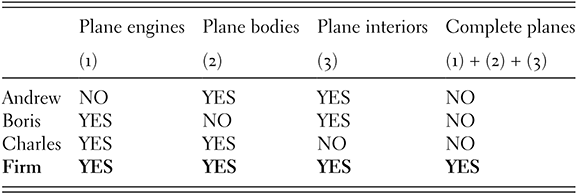
Table 3.1 Long description
The table has four main columns: Plane engines (1), Plane bodies (2), Plane interiors (3), and Complete planes (1 plus 2 plus 3). It reads as follows. Row 1. Andrew: NO; YES; YES; NO. Row 2. Boris: YES; NO; YES; NO. Row 3. Charles: YES; YES; NO; NO. Row 4. Firm: YES; YES; YES; YES.
We may stipulate as elements of the thought experiment that the members’ votes are rational, informed, and committed, rather than arbitrary, anonymous, private, and unsystematic in the sense of non-interdependent (no vote trading or discussion leading to imitation or herding). In the instant case, none of the members have voted for all three ingredients or predicates that when summed would yield the fourth aggregate decision. And consistently with their two-out-of-three staged votes for the components, none choose individually to vote for the complete plane option. But at each stage of the voting, a majority assents to the production of each of the component elements; and when these discursive elements subjected to staged group votes are added together along the bottom row, the group has seemingly voted for the aggregate, even though no individual in the group subjectively wants that aggregate. So at the same time the group objectively wills by voting to make the complete planes, but none of the members of the group taken as individuals want to do so. This discursive reasoning paradox has been applied to the very different terrains of collegial judgement aggregation (Kornhauser and Sager Reference Kornhauser and Sager1986, Reference Kornhauser and Sager1993; Chapman Reference Chapman1994, Reference Chapman1998), and to corporate decision-making (Rock Reference Rock2006, extended to unincorporated associations and trusts by Getzler Reference Getzler2008).
List and Pettit supply an external solution to the discursive rationality paradox based on a notion of the “group agent” (List and Pettit Reference List and Pettit2011). When a group cannot survive without speaking and acting as one in the world, minority reports are suppressed, that is, the group (or the external rule-maker constituting the group) does not allow dissents, splits, or vetoes by members negating aggregate decisions yielded by the discursive reasoning they each participated in; and as a result group responsibility for collective action is legitimated and enforced. To use a different nomenclature, loyalty not voice is the rule, perhaps with exit or dissolution of the group as a safety valve (Hirschman Reference Hirschman1970). The group that functions as a univocal united entity behaves and thinks as a distinct agent; a group mind emerges distinct from its component minds, and is capable of forming motivations and representing those motives through conduct addressed outwardly; and those representations and motivations compel the members’ accession and accountability even if not adopted by the members as individuals.
How this measure of univocalism as the essence of agenthood is generated may be an empirical question. There may be strong bonding conventions setting boundaries to the common sense action of the group, as in a religious community or guild or professional association, so that contrary thoughts cannot be formulated that are inconsistent with identity and belonging. Alternatively, there may be conditions of majoritarian dictatorship where minority reports and vetoes are suppressed coercively rather than suspended by agreement, and here no group mind truly emerges; only the leader’s mind is expressed with the subjects falling into line. Distinguishing such a collective based on a dictatorial and coercive power as opposed to a cooperative group with agency may be difficult. Groups, in business and production as well as in political life, may oscillate between conditions of free and dominated relations. At its best, the legally regulated corporation may be seen as a device to maintain freedom of association, communication, and ratiocination within durable groups, applying discursive rationality both to maintain internal debate and to discipline and contain group thought and action. The group agent may thereby attain a real if limited personhood, a distinct collective mind yielding agent responsibility for collective conduct (List and Pettit Reference List and Pettit2011, 170–185; Chiao Reference Chiao2014). The discursive rationality model thereby offers solutions to some impasses left by the Coasean standard model, namely, how a command structure can exist compatible with the plurality of wills of free participants in the corporation.
3.7 Forming Shared Knowledge to Found and Run the Firm
Another way to unpack the theory of the firm involves study of mechanisms for durable commitment of resources sufficient to attain larger collective goals over lengthier time frames (Offer Reference Offer2022). Not only capital has to be locked into firm structure but also personal attention and efforts of members of the corporation (Blair Reference Blair2003, Roberts Reference Roberts2004). Aligning scarce finance, fixed capital, know-how and technology, managerial and labour skills, and supply and distribution chains may require a stable, integrated corporation that slows circulation, builds and enforces loyalty, and regulates exit. Or to put the same point negatively, problems of strategic bargaining and defection can be limited if all parties must make an initial commitment of time and value to the group to join in the enterprise, and then police that commitment effectively (Alchian and Demsetz Reference Alchian and Demsetz1972). We can link this set of issues to the prior point about formation of a group agent – parties must know that there is a rewarding game to be played so that the effort of forming a group agent and then committing resources to it is worth more than the alternatives (just as committing to marriage and forming the “us” of a family can be superior to the freedom of continuous singlehood with constantly negotiated alliances).
This yields an epistemic problem: how can actors gather the information to conceive and construct a successful lock-in operation, and then make it run without disintegration? The problem can be divided into two steps: first, which information can be gathered to stipulate the form of corporation, its terrain of operation, and its necessary initial commitment of resources? And once up and running, how is information harvested by the corporate actors and rendered useful in the effective continuation of the corporation? Arguably, we need a theory of aggregation of information as a prior to a theory of successful group formation and administration. There are several theoretical possibilities, each with distinct implications for corporate organization.
3.7.1 Dispersed Knowledge: No-One Knows
Friedrich von Hayek postulated in 1945 that useful economic knowledge was dispersed through the economy in such chaotic or discontinuous bundles that it could not rationally be sampled, captured, processed, and computed by any single intelligence: “The peculiar character of the problem of a rational economic order is determined precisely by the fact that the knowledge of the circumstances of which we must make use never exists in concentrated or integrated form but solely as the dispersed bits of incomplete and frequently contradictory knowledge, which all the separate individuals possess” (Hayek Reference Hayek1945, 519).
This assertion of unknowability was partly a polemic against the omniscient state production planning and demand management advocated by socialists and social liberals, arguing that there could be no objective estimation of a knowable economic reality divorced from price observations cultivated by the spontaneous order of a market regulated wholly by the free interactions of supply and demand (Boettke et al. Reference Boettke, Shaeffer and Snow2010). Hayek’s price information epistemology took on a life of its own as a guide to economic life (Mirowski and Nik-Khah Reference Mirowski and Nik-Khah2017). For Hayekians the decentralized free market was the superb solution to the intrinsic unknowability of reality, which unfolds as actors incrementally experiment with trades that uncover and generate information useful locally to themselves and others. The complex adaptive system of the larger economy was comprised of sites of useful local knowledge, where entrepreneurs could link up separate networks of information to produce larger production systems, up to a limit where market information failed and inefficiencies set in (Vaughn Reference Vaughn1999). The brilliant model of decentralized experimentation with disordered and subjective knowledge, viewing cooperation between unknowing individuals as only possible through the price mechanism, perfected the Smithian metaphor of the invisible hand and gave renewed vigour to the anti-collectivist movement. The model explained away or ignored the salience of unpredictable and disruptive events, including wars, revolutions, market crashes, and natural disasters, or unforeseen ripples and cascades of reactive and interactive behaviour on a smaller or local scale.
Hayekian information economics does not instantly reveal reasons why the local processing of market information should be situated within vertically or horizontally integrated corporations. One answer is that the birth and death of firms is a constant exercise in group informational experimentation: when the group’s structure prevents it from discovering or predicting relevant price information in changing circumstances, the corporation dies or is displaced by newcomers.Footnote 7 Hayek goes so far as to describe a “natural selection” of groups, mirroring individual market competition but also shaped by cultural evolution. Uncertainty and risk in internal price information flows are an aspect of the principal–agent problem, and firms must calibrate internal relations within the firm to maintain incentives for price discovery without rivalries destroying trust and cooperation (Dew et al. Reference Dew, Velamuri and Venkatarama2004; Lewis Reference Lewis2017). To sum up, no-one knows all relevant information in any complete form, but the market as a sum of traders’ activities learning about each other’s reactions “knows” in a heuristic impersonal sense as a group mind; and corporations as a subset of the market gather, interpret, and act on information productively until they fail.
As a lemma to the Hayekian theory, all state action and regulation presuming to know better than individuals and corporations engaging and experimenting in markets to generate profits was doomed to failure or worse; étatism driven by sectoral interests and distributional justice claims would only repress good information flows about profitable activity and so produce misleading hypotheses about social reality. Yet Hayek did not clearly explain how an unguided and decentralized process of pricing would always yield useful information promoting efficient aggregate allocations; the negative attack on planning was matched by unwavering confidence in the virtues of the price mechanism (Sunstein Reference Sunstein2023).Footnote 8 This makes it difficult to account for the Coasean corporation displacing decentralized pricing with collective and hierarchical administration. Corporations might be useful simply by scaling up the automaticity of price arbitrage so that market cultures can be expanded into utilities and public goods more generally. But there remains doubt as to whether the scope and scale of the corporation can really be explained in a Hayekian world of dispersed knowledge as superior to a purely contractual world of individuals participating in factor markets, using principal–agent relations ad hoc rather than surrendering a good deal of freedom of contract by locking into corporate hierarchies. In a Hayekian world of dispersed knowledge, why does the corporation know what’s best for the many individuals who comprise the group? (Foss Reference Foss1999).
3.7.2 Distributed Knowledge: The Wise Person Knows
An alternative view of knowledge sees more room for both corporate–private-sphere and state–public-sphere aggregation and processing of information, yielding more fluent cooperation and rational planning based on that information. If we substitute distributed knowledge for Hayekian dispersed knowledge, we can model a set of actors who each have a degree of access to true and valuable information that they can interpret, providing them with a useful subset partaking of the total information that represents the opportunities and choices of the real economy. It is not that the world is an unknowable chaos; it is just difficult to assemble the interlocking information out there and process it into a rational account and basis for action. But a wise person (one skilled in interpretation of information, a kind of meta-knowledge as a basis of judgement) who is positioned at the central node of an organization receiving data from all the branches and extremities of the organization will be able to convert distributed and useless information into integrated and useful information, and then redistribute it to those who can use it best (Demsetz Reference Demsetz1988; Casson Reference Casson1994). Or actors within the corporation can more easily trade useful gathered and cultivated knowledge and so bind each into cooperation through mutually beneficial information sharing. This process of information exchange creates decision rules and practices that are themselves useful forms of internal corporate knowledge or meta-knowledge (knowledge about knowledge). The corporation as a bureaucratic hierarchy therefore exists as a mechanism to harvest and produce distributed knowledge and share its fruits effectively (Nickerson and Zenger Reference Nickerson and Zenger2004; Madison et al. Reference Madison, Frischmann and Strandburg2010).
As an extrapolation of this model, the state can itself be an effective corporation making decisions based on distributed knowledge across the gamut of production, consumption, and regulation. The dark side of the model is the problem of asymmetric information and limited knowledge leading to principal–agent problems and conflicted interests, a deformation of the internal knowledge rules of the firm. But healthy corporate cultures promoting knowledge commons may spur the parties as information collectors and knowledge sharers to keep on the right side of cooperation. Trusted information interpreters can provide leadership for the group that curbs defections and promotes further information contributing to the knowledge commons (Aghion and Tirole Reference Aghion and Tirole1997; Foss Reference Foss1999; Ostrom and Hess Reference Ostrom, Hess, Hess and Ostrom2007).
3.7.3 Common Knowledge: Any Fool Knows
The notion of common knowledge (which is quite distinct from the knowledge commons idea that closed the previous section) was developed by David Lewis, Robert Aumann, and John Harsyani in the mid twentieth century, and is a subtle tool of game theory addressing the problem of meta-knowledge. Common knowledge, sometimes described as nested knowledge, is defined by Ken Binmore as follows:
Something is common knowledge if everybody knows it; everybody knows that everybody knows it; everybody knows that everybody knows that everybody knows it; and so on. Game theorists usually assume that the rules of the game and the preferences of the players are common knowledge. … [T]hey typically need also to assume that the fact that all the players subscribe to appropriate rationality principles is also common knowledge.
Common knowledge theory teaches two incompatible lessons. First, no plurality of actors can cooperate if they do not have at least some common knowledge of each other’s rational principles for conduct, even if they do not share knowledge of the external world nor have congruent tastes and ambitions. The problem of finding cooperation between two actors whose minds are partially closed to each other is rapidly accelerated with multiple actors who may not be in bilateral proximity to all other members and must make delegations of trust to ensure that all parties in the group share basic protocols of rational action and cooperation/non-cooperation. If Johnny only has experience of people who predictably betray and expect others to betray, then he cannot easily cooperate with Mary, who naïvely believes that she will always be true and trustworthy and that others will reciprocate with trustworthiness. But how are parties like Mary to find other Marys to repose trust in – and how to avoid or sanction the low-trust Johnnys, who may simulate trust in order to practice the guile that comes more naturally? (Geanakoplos Reference Geanakoplos1992; Fagin et al. Reference Fagin, Halpern, Moses and Vardi1995).
To explore the selection problem that disturbs the production of common knowledge, let us divert to a story by Zhuangzi, an intellectual from the time of the Warring States in ancient China c. 300 BCE and a founder of Taoism (Zhuangzi Reference Zhuangzi2003, ch 17):
Zhuangzi and Huizi were enjoying themselves on the bridge over the Hao River. Zhuangzi said, “The minnows are darting about free and easy! This is how fish are happy.” Huizi replied, “You are not a fish. How do you know that the fish are happy?” Zhuangzi said, “You are not I. How do you know that I do not know that the fish are happy?” Huizi said, “I am not you, to be sure, so of course I don’t know about you. But you obviously are not a fish; so the case is complete that you do not know that the fish are happy.” Zhuangzi said, “Let’s go back to the beginning of this. You said, How do you know that the fish are happy; but in asking me this, you already knew that I know it. I know it right here above the Hao.”
As the friends probe each other’s mental equipment they realize they cannot establish the conditions of common knowledge. Indeed, they cannot agree in the possibility of mutually understood belief and action; even believable communication between differently constituted actors may be out of reach. Only the most basic of mutual knowledge is available to us in everyday life – the stuff that “any fool knows” – and such basic shared and known-to-be-shared information may not be rich enough to mount decent cooperation and inter-subjective belief.
Another surprising common knowledge result was uncovered by Aumann in 1976. His “Agreeing to Disagree” model states that when A and B agree as to the canons of interpretation they use in estimating the probability of events in the world – and each knows the other knows they hold that canon, and knows of that mutual canonic knowledge, and so on – then they cannot disagree as to their beliefs about some fact or decision eventuating, even if they use private or exclusive, non-shared information in arriving at those beliefs (Aumann Reference Aumann1976; Aoki Reference Aoki2010; Deakin Reference Deakin2011). They must each assume that the other person will rationally converge on the same answer as they gather in more facts to trial using their prior shared heuristic. Thus, two investors with the same mental equipment would assume that their pricing of a stock will come out the same given enough information to process – even if they use variant information.
If Aumann’s model is robust, then it disrupts Hayek’s dispersed knowledge hypothesis; parties need not hold on to the same information to find agreement provided they can generate sufficient common knowledge. But if the common knowledge model does pertain in real life, then it does not explain why there is so much interpretative disagreement about facts in the world, resulting in failures to reach potentially beneficial market trades, or even outright destructive conflict. One rejoinder (not a solution) to Aumann’s paradox is to acknowledge that there are not enough commonly known or shared heuristics in market society. A more menacing alternative conclusion is that there may be a good deal of common knowledge in the world, but that what is held in common is a mutual expectation that parties will be uncooperative or conflictual in their relationships. The challenge is then to evolve the shared heuristic so the parties can attain a common knowledge promoting cooperation.
Ostrom’s field work (Ostrom Reference Ostrom1990, Reference Ostrom2010) showed how groups can overcome the “social dilemma” that rational strangers competing for resources might share a sensible belief that they ought not to trust each other. She described a number of instances where groups learnt how to enjoy a common pool resource together where it was difficult to stint access and impossible to monitor investment in the pool, averting a tragedy of the commons. High trust cooperation became possible where certain conditions were in place: easy multilateral communication, obvious means of monitoring reputations and defections, observation of how defection caused mutual harm and how cooperation caused mutual benefit, ability to exit and so not feel trapped by the misbehaviour of others, and finally internal sanctions that worked by invoking self-policing through mental and emotional commitment and not just through fear of external punishment. Ostrom showed how effective governance of commons in turn deepened the common knowledge of its participants, their ability to buttress each other’s mutual belief in cooperation. The problem lies in finding how to engineer frameworks that promote such qualities and encourage the benign evolution and preservation of such a commons.
The corporation as a platform of communication (learning by speaking, and listening) and of exemplary interactive behaviours (learning by watching, and doing together) exists to establish a knowledge commons, which in turn cultivates common knowledge in the sense of trusted mutual prediction. The corporation as a knowledge commons thus makes complex cooperation possible where people know different things that they cannot explain to each other, yet can share sufficient mental equipment to help each other get along (Kogut and Zander Reference Kogut and Zander1996). The corporation makes business possible between those who would otherwise be strangers, extending the range of cooperation beyond tight family and friend memberships so as to embrace those distant to us in time, space, and culture. The corporation may be strongest when blurring the lines between cathedrals and factories, between bazaars and communes. The corporation succeeds as a knowledge commons with the key task of promoting common knowledge. It dies when the parties to the corporation no longer share what they know nor know what they share.
We began with the exemplary story of the rise and fall of Boeing. That story showed how important cooperative knowledge-sharing was in the long decades of success of the company, and how easily that success could be dissipated when information flows and frank communications were blocked, and fearless interpretations repressed. The knowledge commons was swiftly undone, and common knowledge within the corporation collapsed as participants fell into silent internal exile, blocking the potential for the group to recover itself.
3.8 Envoi
What do corporations do? Conventional legal and economic analysis looking for rules and incentives to foster cooperation may not reveal the epistemic dimensions of this question. Amongst other activities, corporations teach individuals to think, to know, to communicate, and to predict together as a prelude to durable cooperation. The healthiest organizations may combine elements of each of the four identified types of corporative association under one roof, permitting a variety of epistemic forms, and not allow an exaggerated version of type 2, the deskilled hierarchical corporation, to dominate. The past thirty years of the cult of shareholder value as the dominant corporate purpose, and the reduction of the corporation’s internal management to a network of antagonistic transactions, has caused obvious damage to the beneficial operation of corporations as information brokerages and decision vehicles. The self-evisceration of the Boeing Company demonstrates this decline all too starkly. We can multiply examples from the recent past of corporate failures to know and to act, and the inadequacy of regulation to maintain standards: Lehman and the rest of the rotten banking sector in 2008; Volkswagen in 2015; building cladding regulation in 2017; PPE procurement in 2019; and the British water industry now. The list of corporate pathologies is dauntingly long, but could it get worse? We face a world of transformed interconnectedness and information harvesting driven by the new data and media networks of the past two decades, shaped by algorithmic processing and machine learning that filters and orders social information in order to maximize profit and control for a corporate elite (Zuboff Reference Zuboff2019; Eidenmüller and Wagner Reference Eidenmüller and Wagner2021; Bant Reference Bant2023; Runciman Reference Runciman2023). It is possible to describe the new corporate world as an enclosure of the knowledge commons, yielding a common knowledge based not on respectful cooperation but on submission and hierarchy. Whether such a fifth type of corporation, whose ethos is spreading into the institutions of the state, can be durable or even workable will swiftly be put to the test.
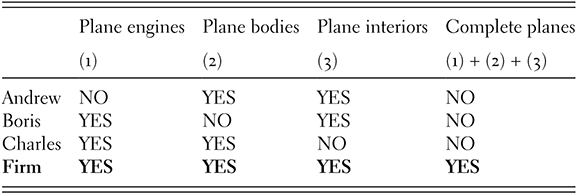

 Open access