


1. Introduction
The growth of urban populations and sprawl intensifies mobility demand, leading to significant pressure on the environment through climate change, air quality degradation, and resource depletion (Reference Papadakis, Savvides, Michael and MichopoulosPapadakis et al., 2024). The net-zero targets for 2050 have been introduced by the European Green Deal (EC, 2019), aiming to foster the transition to more efficient and low-carbon solutions, while promoting a paradigm shift from technology-based to service-based mobility (Reference Arsenio, Martens and Di CiommoArsenio et al., 2016). This vision is notably translated into embracing the concept of sustainable mobility, where the European Green Deal declares: “[…] putting users first and providing them with more affordable, accessible, healthier and cleaner alternatives to their current mobility habits” (European Commission, 2019). In this definition, not only is environmental sustainability emphasized, but also the social sustainability of current and future mobility patterns. Social inequalities, social exclusion, and health and safety issues pose significant challenges that are closely interconnected with environmental ones and should be further addressed through the design of future mobility (Reference Arsenio, Martens and Di CiommoArsenio et al., 2016; Reference Weberg, Lund, Fors and ResminiWeberg et al., 2025). While the integration of environmental and social issues in mobility planning faces organizational, financial, and methodological barriers, cities are crucial in developing networks and engaging stakeholders to facilitate the transition (Reference Baltazar, Bouillass, Vallet, Puchinger and PerryBaltazar et al., 2024). Frameworks such as the Sustainable Urban Mobility Plans (SUMP) introduced by the European Commission provide tools and guidance to support cities in developing their mobility plans (European Commission, 2023). SUMPs support cities in improving their mobility planning and implementing measures that contribute to the objectives of the European Green Deal (European Commission, 2019), including a 90% reduction in greenhouse gas emissions and a more comprehensive integration of sustainability considerations overall.
However, while several studies highlight the ongoing advances in the environmental sustainability of mobility planning (Reference Buhler and LethierBuhler & Lethier, 2020), social aspects remain uneven. This questions the ability of the designed mobility solutions to effectively contribute to social equity and wellbeing at the same level as the environmental dimension. In fact, Reference Weberg, Lund, Fors and ResminiWeberg et al. (2025) emphasize three main challenges for effectively addressing social sustainability in mobility planning: the lack of stakeholder engagement and citizen involvement, difficulties in using qualitative methods, and the absence of guidelines for incorporating social aspects into the design of mobility plans. Despite advances in environmental sustainability in mobility planning, social aspects remain unevenly addressed. The primary research question is: “How to contribute to sustainable mobility design while effectively accounting for health, wellbeing, and inclusivity considerations?”.
This paper is part of INFUSE (Innovate for Future Sustainable Environments), a two-year PHC (Hubert Curien Project) research programme conducted as a collaboration between CentraleSupélec-Paris-Saclay University (France) and The American University in Cairo (Egypt). The project examines the connections between multimodal mobility, health, well-being, and inclusivity across two major cities, namely, in Paris and Cairo, aiming to identify gaps, challenges, and opportunities. Focusing on Paris and Cairo’s dense urban areas, the ultimate goal is to bridge eco-innovation between North and South cities, with practical urban solutions to create more sustainable, equitable, and liveable cities while acknowledging that inequalities can take different forms depending on the regions of the world.
The paper is structured in five parts. Section 1 examines how social aspects are addressed in current mobility design practices by focusing on SUMP and mobility plans from Paris and Cairo. Section 2 highlights the key mobility dimensions related to health, well-being, and inclusivity, and explores their interrelationship. Section 3 introduces the dual workshop construction for Paris and Cairo. In Section 4, we focus on the parallel inputs generated during workshops for framing the mobility problems. We conclude by examining the similarities and differences in mobility issues reported in both cities. Section 5 presents the limits of the approach and lays the groundwork for a framework to address social mobility challenges that are valid in both the Global North and South. Finally, implications for research and designers involved in sustainable cities design are provided.
2. Uncovering social issues in sustainable mobility
2.1. Identification of social aspects in mobility plans from Paris and Cairo
To frame the investigation of social aspects in the mobility plans of Paris and Cairo, we first rely on the SUMP framework (Rupprecht Consult (editor), 2019). The SUMP guidelines define five main categories for social impact assessment: (1) accessibility, (2) movement and activity, (3) health-related outcomes (e.g., road causalities, air quality, mental health), (4) finance-related aspects (e.g., affordability), and (5) community-related aspects (e.g., safety, fear of crime). Assessment should consider the interconnected nature and distributional impacts, often modelled through a causal chain pathway to assess contribution to stakeholder wellbeing (Reference Martens, Bastiaanssen, Lucas, Lucas, Martens, Di Ciommo and Dupont-KiefferMartens et al., 2019). Methods identified for assessment include cost-benefit analysis (Reference Kolosz and Grant-MullerKolosz & Grant-Muller, 2015), multicriteria analysis (Reference Awasthi, Omrani and GerberAwasthi et al., 2018; Reference Gutiérrez, De Vicente Oliva and Romero-AniaGutiérrez et al., 2022; Reference Dadashzadeh, Sucu, Pangbourne and OuelhadjDadashzadeh et al., 2024), and socio-economic impact assessment. While the SUMP has been introduced in more than 400 European cities, all centralized within the Eltis database, some ongoing initiatives are under development in several African countries (e.g., Cameroon, Ghana, Morocco, Tunisia, Togo, and Tanzania).
An initiative from Transport Cairo was identified seeking to explore and provide recommendations on how to define sustainable mobility measures by relying on the SUMP framework. While specific transport initiatives exist, Cairo lacks a unified and centrally documented mobility strategy available for academic review, thus, the present research work relies on a study conducted by Transportation Cairo. Such a study identifies which sustainability aspects could be better addressed in Cairo’s local mobility plan, following the SUMP framework, and what measures could be adopted to support the transition. Hence, following the implementation of the four phases of the SUMP approach - namely, diagnosis, strategy development, measurement and planning, and implementation and monitoring - a set of 36 measures was proposed, integrating environmental and social aspects. Road accidents, travel experience (through travel time), users’ satisfaction rate, and public transport efficiency are identified as key social aspects to be considered. In parallel, the Paris mobility plan encompasses 18 action sheets to support the transition towards sustainable mobility by 2030. The action sheets outline various measures to be implemented and address multiple environmental and social aspects. Some key social issues that are identified include gender equality, accessibility, road safety, encouraging public transportation, and promoting active mobility through efficient infrastructure development.
2.2. Connecting health, well-being and inclusivity in urban mobility
Reflecting on the social issues emphasized in the mobility strategies of both Paris and Cairo, the development of efficient public transportation emerges as a shared priority. Ensuring such efficiency requires that accessibility, affordability, and service quality be effectively addressed throughout both the design and operation of mobility systems. Reference LitmanLitman (2022) emphasizes transport equity evaluation factors to reflect horizontal equity (i.e. between people with similar abilities) and vertical equity (i.e., serving differently disadvantaged people). Conversely, inefficient transportation systems can have significant negative impacts on users’ physical and psychological health. While the health benefits associated with the introduction of public transport and active mobility are well established in the literature (Reference Sarigiannis, Kontoroupis, Nikolaki, Gotti, Chapizanis and KarakitsiosSarigiannis et al., 2017; Reference TzvetkovaTzvetkova, 2020), several key challenges may hinder their adoption. These include issues related to inclusivity, perceived insecurity, affordability, ease of access, and availability of information (Reference L’Hostis, Chalkia, de la Cruz, Müller, Keseru, Müller and MeyerL’Hostis et al., 2019). At the same time, pedestrian and active mobility represent essential alternatives to private car use, yet their adoption strongly depends on cultural contexts and local policies (Reference Soliz, Carvalho, Sarmiento-Casas, Sánchez-Rodríguez and El-GeneidySoliz et al., 2023). This highlights the importance of incorporating an individual perspective, which helps account for geographical and social disparities, as well as equity considerations. Despite the well-documented positive health effects of walking, pedestrian mobility can be constrained by factors such as perceived insecurity, the inclusiveness of public infrastructure for vulnerable groups, local air quality, and, more broadly, the individual’s perceived mobility experience. Finally, these various social issues translate into long-term outcomes that shape both positive and negative aspects of wellbeing. In this paper, the concept of wellbeing follows the definition proposed by the IPCC, which distinguishes between objective and subjective dimensions: “It comprises an individual’s experience of their life as well as a comparison of life circumstances with social norms and values.” (CIEEM, 2021).
3. Research method
The research method proposed in this paper introduces a stakeholder-based approach to examine social issues related to mobility in Paris and Cairo, providing insights into designing more sustainable mobility solutions. Figure 1 illustrates the research design, including phase (1), where social issues are defined with mobility experts through two distinct online workshops, and phase (2), which consists of examining the defined social issues through two persona-based workshops organized in both Paris and Cairo.
Workflow of the research method, including the workshops organized in Paris and Cairo

Figure 1 Long description
The diagram represents a research method workflow divided into two phases. Phase 1 includes the identification of dimensions such as health, well-being, and equity, followed by a preparatory expert workshop targeting dimensions and methods. Phase 2 involves the construction of Workshop 1, which includes process and template generation, followed by human-centered problem framing workshops in Paris and Cairo. The diagram shows the flow of activities from the INFUSE team and experts to participants in both locations. It also includes a persona sample for the Paris workshop and a list of health-wellbeing-inclusivity dimensions leading to problem situations for personas.
Phase 1: Definition of social issues arising from urban mobility
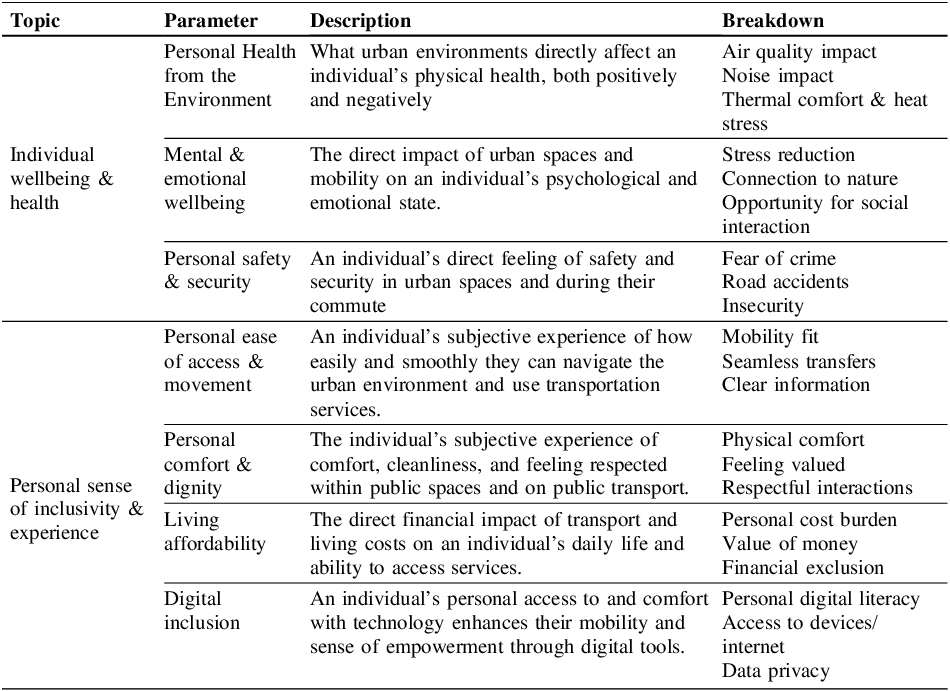
The first phase consisted of two preparatory expert workshops, each involving five mobility experts (N = 5), held online for approximately 1.5 hours. The objective of this preliminary stage was to discuss the dimensions related to health, wellbeing, and inclusivity identified in the literature, as well as to highlight meaningful cross-cutting dimensions. These dimensions were developed to serve as analytical lenses through which to examine the impact of current transportation systems and hubs on users’ physical and mental health, as well as their sense of inclusivity within these spaces. The main takeaway from these discussions was the importance of leveraging user clusters to identify different mobility user types in a person-centric manner, while also ensuring the inclusion of minority groups, including children, older adults, and individuals with mobility impairments. Building on these insights, a set of relevant social issues was defined, grouped under two overarching themes: health & wellbeing and inclusivity. Table 1 presents these two main topics, along with the key parameters encompassed within them. Following contextual research and expert feedback, these parameters were selected with careful consideration of potential overlaps and comparative insights between the Paris and Cairo contexts.
Phase 2: Human-centered problem framing for social issues in Cairo and Paris
The goal of this second phase is to describe problematic mobility situations experienced by different user types, drawing on the social aspects identified in Phase 1. Commonly implemented in user-centred design, a persona-based approach was adopted to examine these issues. A persona is defined as a fictitious, yet representative character that embodies the experiences and needs of a particular user group (Reference CooperCooper, 1999). In this study, personas were not intended to be statistically representative user profiles or co-produced artefacts generated during the workshops. Instead, they were developed by the research team through literature review, expert input, and contextual analysis, and introduced as boundary objects to scaffold human-centred problem framing during the workshops. This approach was deliberately adopted to ensure comparability across Paris and Cairo, to include user groups that are difficult to directly involve (e.g. informal workers, older adults), and to focus the workshops on experiential reflection rather than persona construction itself.
To translate this approach into practice, two workshops were held in Paris (June 2025, N = 20) and Cairo (September 2025, N = 15). Participants were recruited voluntarily through academic and professional networks, comprising PhD students, researchers, and consultants. The workshops were conducted primarily in English. Participants were invited to conduct in-depth, human-centered problem framing through the use of persona models. Participants did not define the personas themselves; instead, they critically inhabited and interrogated them, drawing on their own knowledge and experience to surface mobility-related tensions, exclusions, and trade-offs.Acting as designed personas, they actively explored and identified mobility challenges in both normal operating conditions and under predefined hazardous conditions. Three (Paris) and four (Cairo) pairs of male and female personas of identical age were formed, along with four family personas, balancing travel contexts between Paris-Saclay (France) and Downtown Cairo (Egypt). Data were systematically collected manually by participants, capturing details on individual wellbeing, health, personal sense of inclusivity, and specific situations encountered. Dedicated templates were developed prompting the participants to indicate: the related parameter; a text description of the problem; its location (e.g. trip or station); the importance or significance for his/her persona. All persona data sheets were transcribed into an Excel-type file and numbers of problem occurences were extracted.
Parameter definitions and breakdown

4. Results
In this section, results are structured across three main parts. First, insights are presented and discussed following the introduced persona-based approach for problem framing in social sustainability of mobility. These insights highlight disparities among the defined personas for better accounting of specific cultural and geographical contexts. Secondly, outcomes from the organized workshops in both Paris and Cairo are presented and discussed. Finally, a comparative analysis is provided emphasizing key differences in mobility-related social issues addressed in both cities.
4.1. Insights from the dual construction of personas for Paris and Cairo
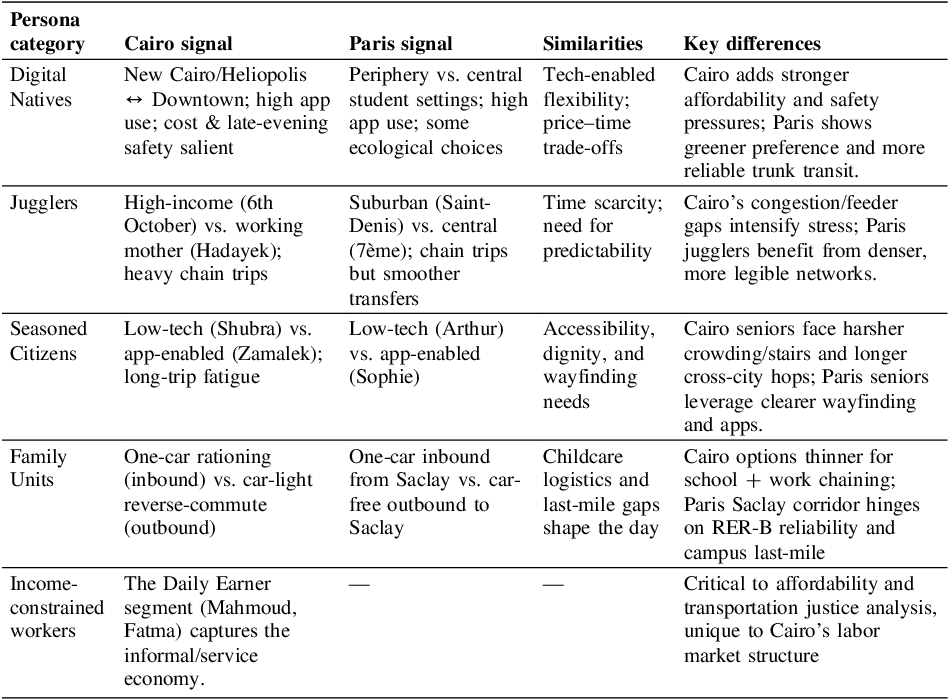
The dual typology of personas spanned economic standards and geographic location across both cities, allowing for comparative analysis through common lenses (affordability, access, safety, comfort/dignity, and digital inclusion) (Table 2).
Persona categories for Paris and Cairo

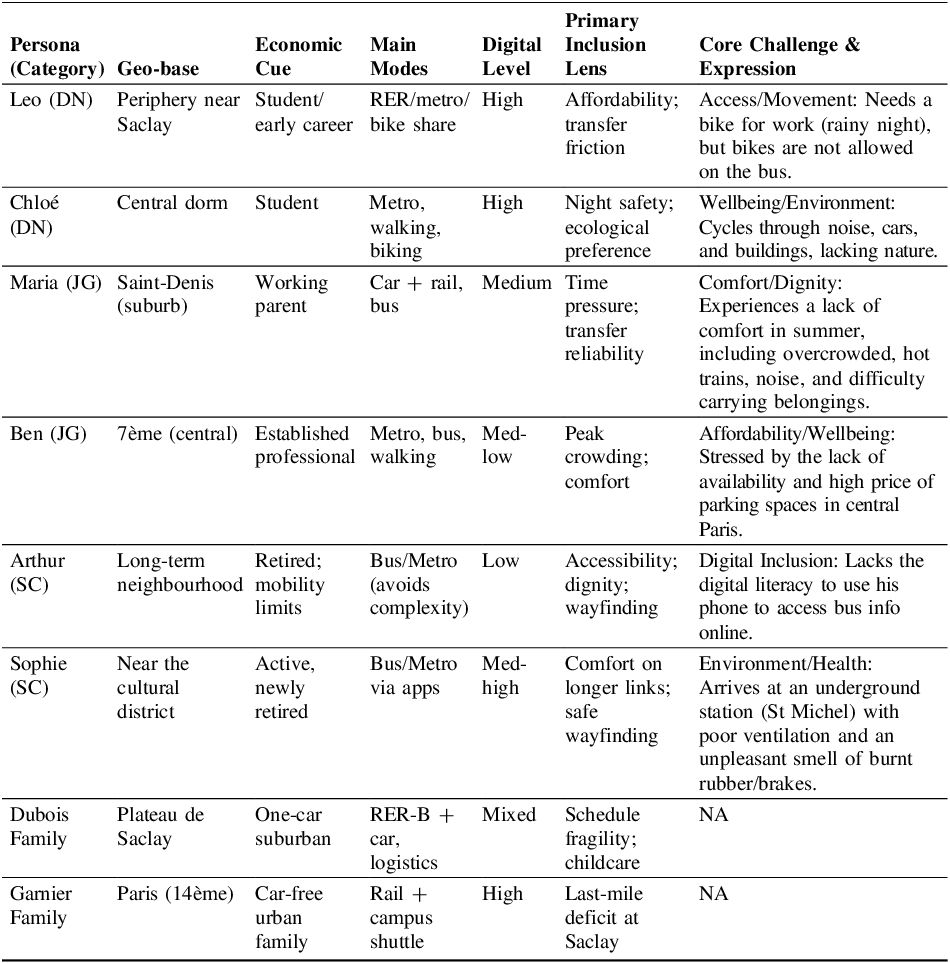
In Paris, the typology is anchored in the metropolitan logics of center–periphery and the rapid train (RER) Saclay corridor. Digital Natives (Leo, Chloé) capture app-enabled flexibility and different transaction costs associated with distance versus centrality. Jugglers (Maria, Ben) contrast time-sensitive chain trips from a working-class suburban family with streamlined central-city routines, foregrounding predictability and low-friction transfers. Seasoned Citizens (Arthur, Sophie) allow equity comparisons around accessibility, comfort/dignity, and digital inclusion in later life. The two family personas operationalize the bidirectional flows of Paris–Saclay: a one-car suburban household dictated by the RER-B train and school logistics, and a car-free urban household facing a persistent last-mile deficit.
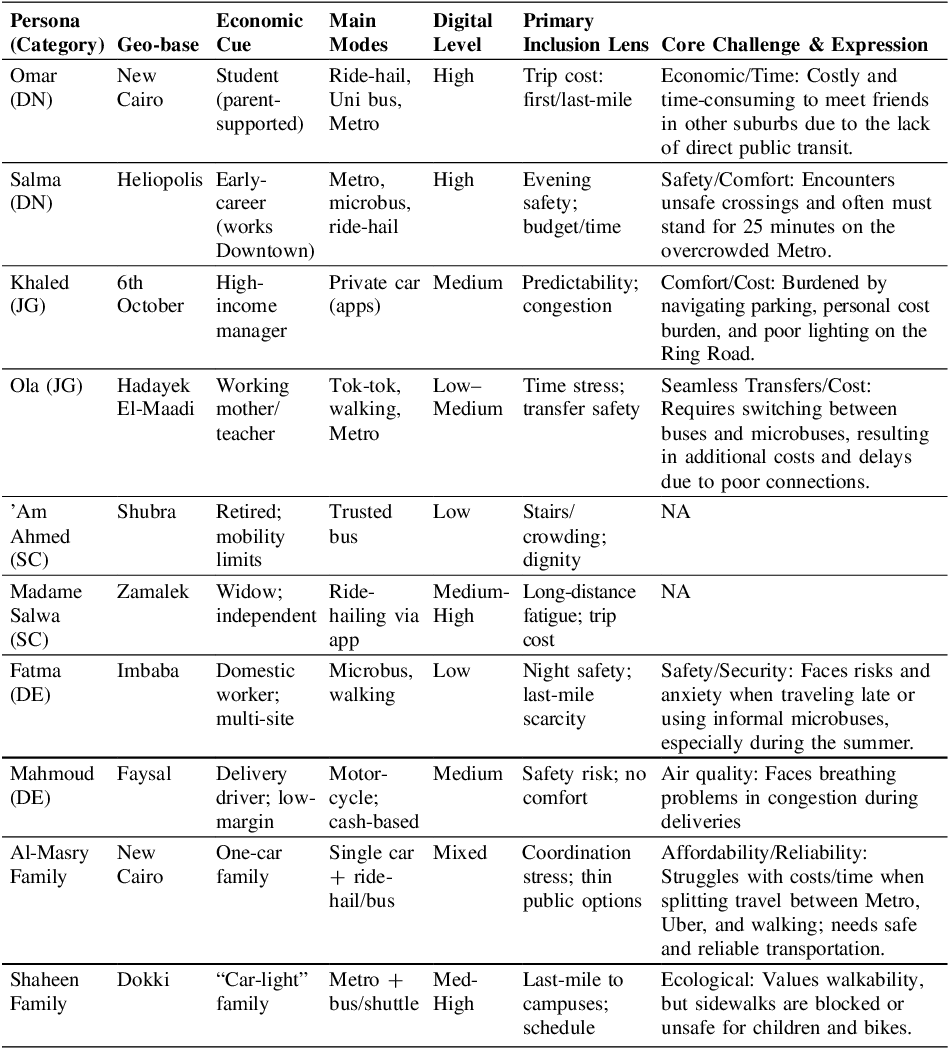
In Cairo, personas were purposively sampled to span diverse socio-economic positions and urban geographies, allowing for the examination of the comparative lenses through everyday mobility rather than only at the network level. Four archetypes, along with family units, structure the sample. Digital Natives reveal first- and last-mile frictions, price–time trade-offs, reliance on varied transit, as well as heightened concerns about safety after dark. Jugglers surface the time pressure of multimodal chaining and single-car rationing. Seasoned Citizens foreground accessibility and dignity constraints (e.g., stairs and crowding) and dependence on trusted bus drivers or door-to-door ride-hailing services for long cross-city trips. The unique Daily Earner segment represents the informal service economy, characterized by dense trip webs, cash-based micro-transit, and risk exposure, where livelihoods often take precedence over comfort. Family units often reveal negotiated one-car allocations, reverse commutes, and persistent last-mile gaps to industrial or university sites. Overall, the persona selection mirrors Cairo-specific conditions—including informal feeder dominance, thermal stress limiting walkability, gendered safety after dusk, and sidewalk quality—while aligning with the project’s comparative parameters. Tables 3 and 4 in Section 4.2 presents the full details of the Paris and Cairo personas, along with the results of the workshop.
4.2. Outcomes from the workshops: human-centred problem framing for personas
Firstly, the primary outcomes of the Paris workshop are reported, focusing on mobility situations in a regular context. Outcomes for the Garnier and Dubois families are excluded from the analysis for two reasons. First, these were only addressed in hazardous situations. The second most common results involve a single member of the family, which means the briefing failed to capture the family’s and children’s problems. A total of 38 occurring situations were captured for the six personas, ranging from four situations (Leo and Chloé) to 10 for Arthur. Examples of situations mentioned by participants are given in Table 3. In most cases, one persona situation is tagged with one parameter (for instance, fear of crime), and more rarely with two or three. The total occurrence of topics is 44, with an average of 7.3 per persona spread over 21 topics of interest (Figure 2). Content-wise, situations related to public transport (bus, train, metro) are dominant (23/38). Situations causing stress are the most frequent in the sample, followed by concerns about air quality, physical comfort, and seamless transfers. Privacy concerns, value for money, and perceived risks of accidents were not directly addressed.
Excerpt of problems for personas in Paris workshop (regular context); (digital native: DN; juggler: JG; seasoned citizen: SC; daily earner; DE)

Distribution of problem occurrences for Paris personas (regular context)

In Cairo, across the eight personas, a total of 42 situation occurrences were captured, with situation counts ranging from 3 (Omar) to 9 for Mahmoud. Most reported situations are tagged with a single topic (for example, Safety or Mobility), though in rare cases, two or three topics are relevant to a single described problem. The total frequency of problems reported is 54, with an average of 6.75 parameter topics per persona from a list of 22 key topics (see Figure 3). Table 4 provides examples of problem expressions for each persona. Most Cairo situations involve public and para-transit (bus, microbus, metro, or rideshare) or the hybrid personal-para modes (car/microbus, bike/bus). The most frequently reported challenges are fear of crime, concerns regarding personal safety, mobility fit (including access), and affordability/cost burden. Several topics, such as digital empowerment and privacy, were not directly addressed in this context.
Distribution of problem occurrences for Cairo personas (regular context)

Figure 3 Long description
A horizontal bar graph compares the number of occurrences of various problems for different personas in Cairo. The graph includes multiple horizontal bars, each representing a different problem category. The x-axis indicates the number of occurrences, ranging from 0 to 20. The y-axis lists the problem categories: Privacy concerns, Access to devices/Empowerment, Digital literacy, Financial exclusion, Value for money, Cost burden, Respectful interactions, Feeling valued, Physical comfort, Clear information, Seamless transfers, Mobility fit, Visibility and safety, Perceived risk of accidents, Fear of crime, Social interaction, Connection to nature, Stress, Thermal comfort, Noise, and Air quality. Each bar is color-coded to represent different personas: Mahmoud, Ola, Al-Masry Family, Fatma, Khaled, Omar, Salma, and Shaheen Family. Notable trends include a high number of occurrences for Fear of crime, Visibility and safety, and Physical comfort. The color scheme helps differentiate the contributions of each persona to the overall problem occurrences.
Excerpt of problems for Cairo personas (regular context); (digital native: DN; juggler: JG; seasoned citizen: SC; daily earner; DE)

5. Conclusion and further work
The initial research question of the paper was “How to contribute to sustainable mobility design while effectively accounting for health, wellbeing, and inclusive considerations?”. Through analysing scientific literature and SUMP reports, we first identified and clustered social dimensions associated with mobility situations in general urban contexts. The result was a set of eight clusters encompassing 21 parameters. In order to empirically investigate the topic comparatively in Paris and Cairo, we organized stakeholder-based workshops in both countries. In total, 35 participants were invited to discuss mobility-related social issues in Paris and Cairo for the aim of creating purposive persona models.
The results are twofold. We provide: (1) a structured method to dual persona development for Paris (Global North representative) and Cairo (Global South representative) following identical lines while taking into account local peculiarities; (2) an illustrated list of mobility-related social issues for various travellers’ profiles in both countries. Despite the richness of the comparative workshops, the purposive sampling strategy risks excluding broader demographic variability and specific mobility experiences, potentially narrowing the generalizability of the findings. Future stages of this research will extend the comparative framework to incorporate these situational extremes and explore the potential of making the personas’ archetypes more inclusive, notably concerning children and teenagers. Through the crossed analysis of both results from Cairo and Egypt, the next steps also focus on using co-design methods to explore sustainable mobility solutions adapted to the diverse socio-cultural and infrastructural realities of both Global North and South urban settings, exemplified through Paris and Cairo. While the persona-based approach proved effective for comparative problem framing, future work could explore hybrid formats in which personas are partially co-constructed or iteratively refined with participants, particularly in locally embedded or longitudinal studies.
This work provides a basis for reflection for designers of mobility solutions, such as digital apps, who need to accommodate users in different countries. Designers’ role is not to replace expert knowledge but to act as mediators, translating lived mobility experiences into forms that can enter expert-driven planning processes. Personas are deliberately used as structured boundary objects that render health, wellbeing, and inclusivity concerns legible to planners and policymakers by aligning them with existing planning logics. The work also contributes to advancing design for urban transition approaches, and to fostering collaboration between researchers in different urban and cultural contexts (in our case, between France and Egypt). This is indeed valuable for the research collaboration between the Global South and the North. This study makes a more precise contribution to sustainable design in the field of mobility between Africa (Egypt) and Europe (France), expanding the scope of previously identified design-related topics in the Design Society (Reference Barlow, Greene and PapalambrosBarlow, Greene, and Papalambros, 2020).
Acknowledgement
This work was partially supported by the “PHC Imhotep” program (project number: 50381SD), funded by the French Ministry for Europe and Foreign Affairs, the French Ministry for Higher Education, Research, and Innovation, and the Egyptian Academy of Scientific Research and Technology (ASRT). The authors wish to express their gratitude to the participants in Paris (June 2025) and Cairo (Sept. 2025) for their involvement and insightful comments; to Isabelle Nicolaï for her valuable advice and review.




 Open access

