

Rather than treating brands as if they were autonomous, self-regulating entities with their own performativity, decoupled from the actual activities of producers and consumers, recent work in semiotic anthropology (Moore Reference Moore2003; Foster Reference Foster2007; Manning Reference Manning2010) has approached branding in a more realistic fashion, recognizing it as an ensemble of practices and ideas centering on a highly unstable composite: “a relationship between [on the one hand] some set of brand instances, or tokens, and their (materialized) qualia … and [on the other hand] a brand identity, or type, and its (immaterialized) qualities (associated meanings, images, ‘personalities’, etc.)” (Nakassis Reference Nakassis2012, 627).
In 2007, Belfast City Council contracted with a London-based branding consultancy to develop a new brand identity for the city. The result was a new logo (a heart-shaped letter B), a bespoke typeface, and a set of brand guidelines designed to reflect “Belfast’s coming of age, the turning of a new page and the new shared enthusiasm which is palpable to all those who experience the city.” A key element of the rebranding was an official palette of 16 colors to be deployed in association with the logo. Nonprimary hues with low saturation predominate in the new color scheme, which is overlaid upon a complex preexisting system of vivid sectarian color contrasts that mark, among other things, the partitioning of space in a “divided city.”
In this article, I trace the dialogic entanglements between this recent city-branding effort and the city’s longer sectarian history, inscribed in the urban landscape in two separate and opposed but already mutually entangled iconographies, in both of which color plays a primary role. Many cities have been rebranded, and color schemes always play a central role in such efforts—but in no other case that I know of is the rebranding campaign designed to encompass, or supplant, an already existing regime in which two competing “brands” are already in place.
The case of Belfast, then, affords a rich opportunity to reflect on the semiotics of branding and its extensions into new brand ontologies. This case allows us to reflect upon what a brand is, as an empirical and theoretical question. How far can one make a city into a brand—especially when the city has already been “branded” twice?
In the normal or canonical brand situation, the brand is a set of proprietary marks and associated signs and qualia (taglines, trade dress, proprietary colors, etc.) that (a) indicates (points to) the source of a commodity, retail product, or service, and that (b) in so doing clearly differentiates that commodity, product, or service, from those of competitors, the clarity at issue being that in the “minds” of consumers or market participants. In this scenario, there is no great concern that the employees who make the thing reflect the brand values associated with the final product; rather, the products and the marketing should reflect/instantiate the brand, and thus by relay the corporation.
Developments in recent decades have turned this logic inward, in organizational terms, inserting market logics into labor discipline so as to create a highly charged environment in which employees are under a moral obligation to take on something of the brand identity, to instantiate it and embody it. Ritz-Carlton, for example, now sells its own organizational metaculture (Urban Reference Urban2001)—encapsulated in the mantra “Ladies and Gentlemen serving Ladies and Gentlemen”—to other organizations seeking to inculcate brand-based “leadership” in all employees at all levels, including especially “public-facing” ones (Koh Reference Koh2015).Footnote 1
But how can this logic of branding—even “internal” branding—be applied to places of human habitation: to cities, city-states (e.g., Singapore), polities, nation-states? In the imaginary of the city-brand, what is the relationship between the permanent residents of the city and the city’s brand? Does the brand somehow “reflect” them? Are they like consumers? Like employees? Spokespersons?
My specific concern is with colors, sensorially potent qualia that play a central role in linking brand instances (or tokens) to each other, and all of them to some kind of type-level ontology of the brand. I am specifically interested in the role of color in the branding of cities, and given that the city I’m concerned with is Belfast, a central question arises: How to construct a single brand for a city whose recent history and self-understanding have emerged in a context of conflict, whose citizens are engaged in a fundamental, indeed, metaphysical disagreement about which (of two) nations they are citizens of (neither of which actually exists)?
There are some added complexities in the present case. Northern Ireland, a statelet composed of six of the nine counties of the province of Ulster, is technically part of the United Kingdom but is governed by a devolved Parliament. As an institutional formation, the state is very weak in one sense (its link to the nation[s]), and very strong in another (its link to the economy and social welfare). Northern Ireland is what economists and policy makers call a “public sector region”: public spending accounts for just over 67 percent of GDP; roughly 20 percent of household income is “benefits derived”; though public sector employment is dropping, “the proportion of private sector jobs dependent on public spending (para-state jobs) remains high” (Gaffikin and Morrissey Reference Gaffikin and Morrissey2011, 222).
Northern Ireland is a place where the very word “community” implies not commonality but difference and division within society. In Northern Ireland, and especially in Belfast, “community” is a term of art, a keyword in a discourse that is not only about conflict, but an arena of conflict. The background of its use includes the continuation and intensification of social patterns of widespread endogamy and residential segregation—97 percent of children attend segregated schools—with continuing sporadic low-level violence especially in what are called “interface areas” (fig. 1; and see, e.g., Shirlow and Murtagh Reference Shirlow and Murtagh2006). Since the cessation of armed conflict, the two communities have lived in mostly peaceful conditions, but conditions that might be described as “coexistence without empathy.”Footnote 2
Map of Belfast

In what follows I briefly describe the recent effort to rebrand the city of Belfast, and the central role that color in public spaces plays in that effort. I then turn to a more detailed discussion of two preexisting systems of signification involving color in public spaces of the city: one associated with the Protestant/Unionist/Loyalist community, and one associated with the Catholic/Nationalist/Republican community.
The iconography of the Northern Ireland “Troubles”—notably including elaborate murals covering the gable ends of terraced houses—comprises a huge literature, only a few aspects of which I engage with here (murals, for example, will not be considered).Footnote 3 The focus here is on the semiotic function(s) of color itself, as a basis for comparing the recent rebranding of Belfast with the already existing (and still flourishing) practices of signification using color(s) in public parts of the city. I argue that colors in the preexisting system of sectarian symbolism function as emblems—like Peirce’s famous example of “a map of an island laid down upon the soil of that island”—cueing, via citation, two type-level objects: two flags, the Union Jack and the Irish Tricolour (see fig. 10). These performative “gestures” toward transcendent emblems of ethnosectarian belonging are themselves embedded in a calendric cycle of annual commemorations; perhaps the two most important of these are July 12, the anniversary of the defeat of the Jacobites by King William’s forces at the Boyne in 1690, celebrated with bonfires in Protestant/Unionist/Loyalist communities, and the movable holiday of Easter—sacred, of course, to all Christians, but of special importance to the Catholic/Nationalist/Republican community as the anniversary of the 1916 Easter Rising in Dublin. The two dates, one notes further, mark the beginning (Easter) and the zenith (July 12) of the summer “marching season,” during which flute-and-drum bands associated with the Unionist Loyal Orange Order parade through Protestant as well as Catholic neighborhoods, never without controversy.Footnote 4
Rebranding Belfast
City brandingFootnote 5 by its very nature is rebranding: it is almost always a project that aims to repair a damaged reputation. The classic example, of course, is the first: the “I [heart] New York” campaign devised by the designer Milton Glaser and the advertising firm of Wells, Rich, Greene in 1977 (Reference ChanChan 2008; Greenberg Reference Greenberg2008), which originated after the “Summer of Sam,” a period in which stories of lurid crime and citywide blackouts dominated national and international news coverage of New York. Closer to Belfast, several other medium-sized postindustrial cities in the United Kingdom have been recently rebranded, including Cardiff, Leeds (BBC News 2005), and Liverpool. These northern cities have much in common with Belfast—deindustrialization, urban concentrations of working-class communities, middle-class flight to the suburbs—and all are to varying extents oriented to an as yet unrealized aspiration: to replace a moribund manufacturing economy with new forms of work in a “knowledge economy.” But none of these cities shares Belfast’s history of sectarian conflict, and none nourishes a vibrant “grassroots” tradition of public art through which symbols and emblems of sectarian group identity are displayed, propitiated, and destroyed.
As Andy Graan has observed, city branding (and nation branding and place branding) is mostly targeted at “an elite public of tourism and investment capital. Mirroring the supposed character of this imagined audience,” Graan observes, “the marketing artifacts” produced in such projects emphasize the locality’s “modernity and dynamism, its sophisticated pleasures, and its ‘European’ character” (Graan Reference Graan2013a, Reference Graan2013b).
The rebranding of Belfast has three main components, all of them concentrated in Belfast City Centre: the Belfast Brand proper (under the auspices of Belfast City Council); the “2012: Our Time, Our Place” campaign (under the auspices of the Northern Ireland Tourist Board); and a city-dressing project, also undertaken for Belfast City Council, called “Patterns of the City.” In all of these a single palette of brand colors is the chief mechanism.
In 2007, Belfast City Council contracted with Lloyd Northover, a London-based branding consultancy, to develop a new brand identity for the city (see Heeley [Reference Heeley2011] and Northover [Reference Northover2010] for the views of branding experts; see Jewesbury [Reference Jewesbury2007], Neill [Reference Neill1992, Reference Neill1999, Reference Neill and Punter2010], and Shirlow and Pain [Reference Shirlow and Pain2003] for context and critical appraisals). “The challenge,” wrote one of the partners in the branding firm, Jim Northover, was “not only to build a brand that would reflect the city as it now is (with a significant investment in regenerating the physical environment and in the promotion of tourism, inward investment, and visitor numbers), but also one that would motivate and be ‘owned’ by its citizens, regardless of their backgrounds and beliefs” (Northover Reference Northover2010, 104; emphasis added).
At some point “the combined project team recognized the dangers of developing a brand without taking into account the views of the people of Belfast” (106), and recognized as well that “the nature of place branding is such that the issues it touches upon are often emotive and culturally sensitive” (108). And so the team embarked on “consultations” and “collaborations” with local people. Workshops were held in which “attendees were asked to envisage how Belfast could be in the future and to describe the elements and actions necessary to achieve a change” (109). The “key communities” that the project engaged with are listed as including “youth groups, local arts representatives, business people and those involved in tourism and hospitality” (109). “Observations were made by experiencing the city through a series of guided ‘political’ tours, tourist bus trips and individual walks through the city centre and the Shankill Road and Falls Road areas of West Belfast” (109).
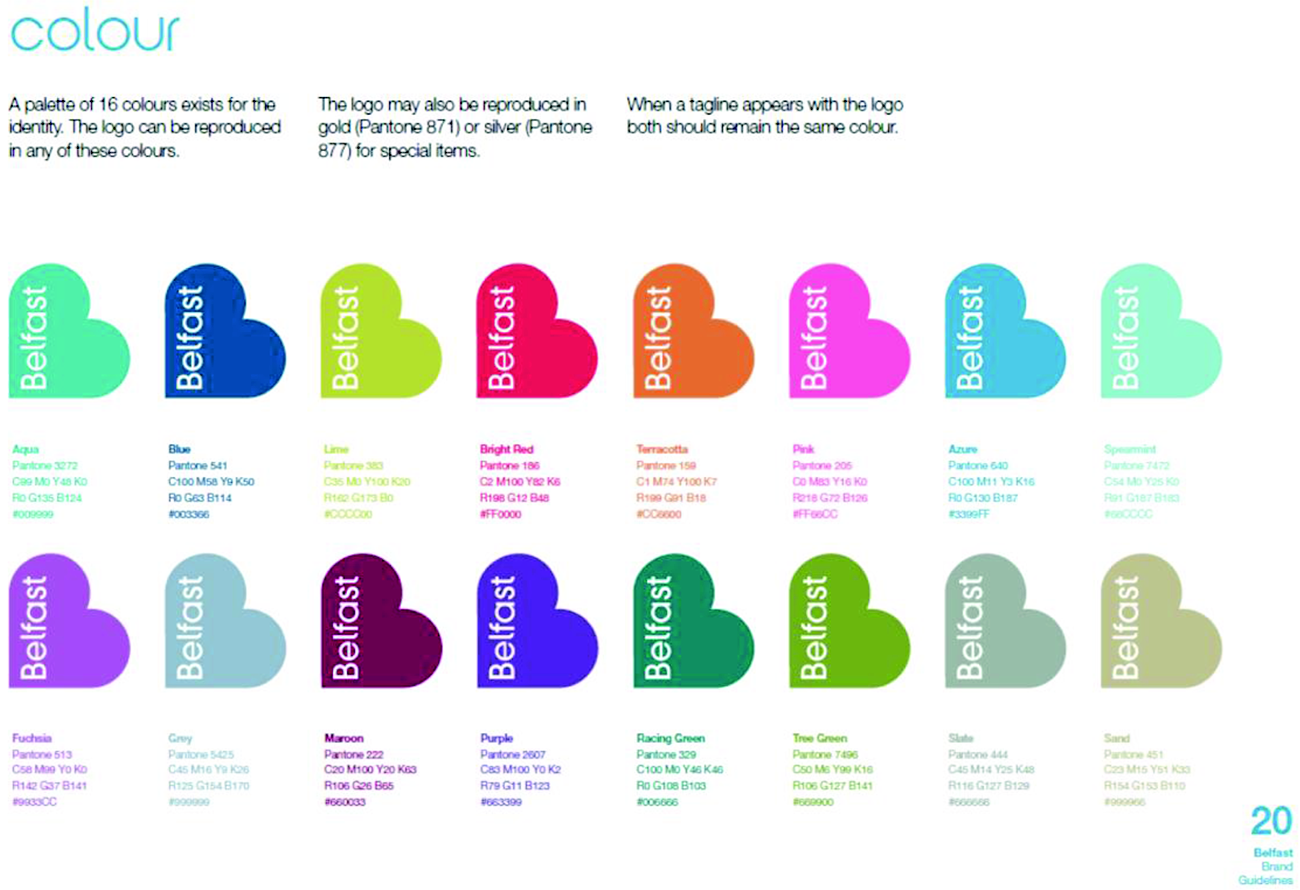
The result was a new logo (a heart-shaped letter B), a bespoke typeface (Moment), and a set of brand guidelines designed to reflect “Belfast’s coming of age, the turning of a new page and the new shared enthusiasm which is palpable to all those who experience the city” (see fig. 2).
Taglines
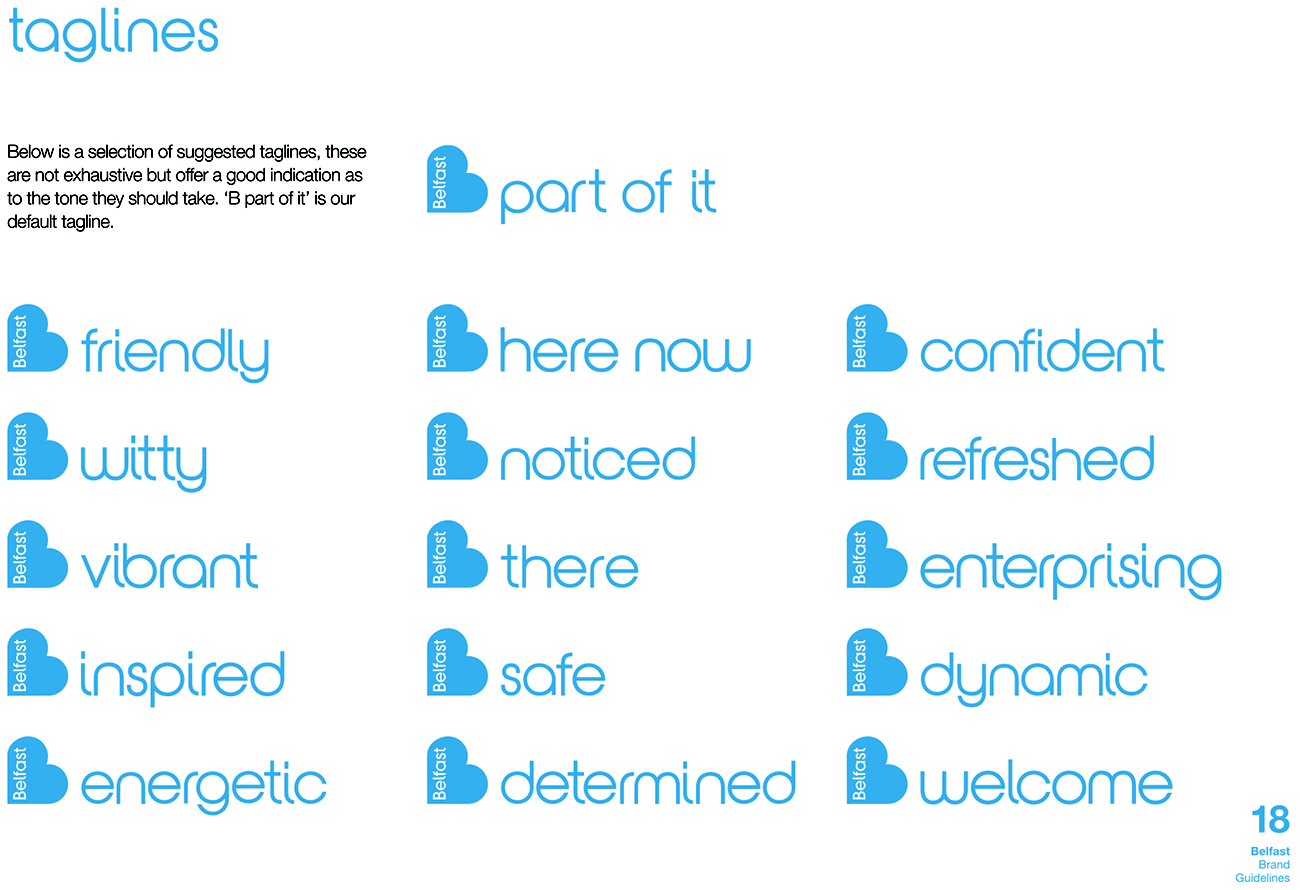
A key element of the rebranding was an approved palette of 16 colors to be deployed in association with the brand (see fig. 3). Pastels and matte finishes predominate: the closest one gets to orange is a dusky terracotta; a slightly grayish green does appear, but its associations are decidedly apolitical (“B green, as part of a recycling campaign,” the guidelines suggest). As one recent commentator rather glumly points out, the Belfast “B” brand “floats free from the product, making little connection with the realm of emotion: the level at which … true branding works” (Neill Reference Neill, Murray and Grist2014, 85).
Color palette
“It’s our time to shine!” announces the Our Time, Our Place campaign, sponsored by the Northern Ireland Tourist Board (see figs. 4 and 5). “2012 is going to be amazing! With so many events, celebrations, commemorations and amazing projects coming to completion, this is our time to turn the tide and confidently put Northern Ireland on the global tourism map.” This campaign was used across Northern Ireland in 2012 to promote tourism around a number of key dates and events, including the opening of the Titanic Belfast® building (to mark the 100th anniversary of that fateful journey) and a new visitor center at the Giant’s Causeway, the Olympic and Paralympic Games 2012 Torch Relay, and the centenary of the Titanic’s maiden voyage, among others. Here’s an example in situ in Belfast: according to Belfast City Council (BCC), “Patterns of the City is a city dressing project which brings colour and vibrancy to Belfast through innovative and colourful street banners. Four hundred colourful banners are being installed at nearly three hundred sites on 13 streets around Belfast city center. Based on designs inspired by places and objects in Belfast, the banners are bright, energetic, bold, dynamic, vibrant and eye catching. Over three hundred images taken by local community groups, provid[ed] the selection from which the final 12 banner patterns came”. The banners seem to be addressing both internal and external audiences; according to the BCC website, the banners aim to:
-
• offer a warm Belfast welcome to our visitors
-
• enhance local people’s knowledge and understanding of the City’s cultural heritage and future.
-
• create interest across different parts of the city
-
• instil pride in our citizens and communities
-
• create an atmosphere of celebration and special occasion across the city
Our Time, Our Place (Northern Ireland Tourist Board)

Our Time, Our Place—color palette

Belfast City Council is keen to highlight the fact that the banners were produced “through a series of workshops … with young people from across the city,” specifically 11–18-year-olds; workshops were held at the Glencairn Youth Initiative (in a mostly Protestant area of West Belfast), at Falls Youth Providers (in Catholic West Belfast), and at the Reach Project (in North Belfast). Young people “took photographs of both their own areas and areas in the city center to highlight what captivates them about Belfast. The groups worked together to suggest ideas and to talk through what Belfast means to them and what people visiting or living here may overlook—the end product being, the patterns for the banners” (Mr. Ulster Reference Ulster2011).
In the Belfast Telegraph, columnist Lindy McDowell (Reference McDowell2011) commented on the “Patterns of the City” banners:
The City Hall (a series of dome shapes), the shipyard (brightly coloured Hs and Ws) and starlings (birdy shapes again in primary hues) are more or less identifiable. But most of the rest are frankly baffling. They aren’t ugly. Just obscure. They look like wallpaper samples. Or sheets of the sort of gift wrap you’d use for a house warming present. Cheerful, but nondescript. They’re up there (in every sense) with the B banners from the last ‘branding’ exercise. You know—the B entertained, B welcome, B curious about how much this is costing the taxpayer stuff, again hung artistically from local lamp posts.
As in every other case of city branding, the “product” is a place that already has a name. One can see how “citationality” is important, as hundreds of banners announce Belfast over and over again, on the streets of Belfast itself (see fig. 6). Obviously these are not functioning to provide “information,” since everyone walking beneath those banners on the street—locals and visitors alike—presumably knows the name of the city they are in. The mantra-like incantatory effect of the banners—an attempt in effect to rename the city with its own name—is obviously part of a larger effort to attach to that old name a new set of brand associations. The city-dressing project in a similar way allows “iconic” Belfast sites to gesture toward each other. It’s very much a matter of laying down upon the existing grid of streets a blueprint for an idealized “new” Belfast—albeit one that would be unrecognizable to itself. What is it trying to replace?
Belfast streetscape with campaign artifacts visible. Our Time, Our Place—2012. © Aidan McMichael; http://www.flickr.com/photos/aidanmcmichael.

The “Prebranding” of Belfast
Rebranding Belfast was never going to be easy. The city had already been in a certain sense “branded” twice, and color symbolism was already overdetermined when the brand consultants arrived from London for their walking tours of the city. The use of color in public spaces—and indeed of colorful public pictorial art produced by citizens—is definitional of the urban landscape of Belfast, and a major tourist attraction. Consider the red, white, and blue painted curbstones of Protestant enclaves (see figs. 7 and 8), found all over Northern Ireland—and the inevitable orange-white-and-green ones in Catholic areas (see fig. 9). In the entrenched system of color-coded sectarianism—and in no sense is it “part of the past”—what matters is not colors as such, but colors that can achieve performativity insofar as they enter into relationships of citationality with certain type-level objects—most importantly, the two flags (see fig. 10): these are entities that have become not only sacred or semisacred symbols, but beings requiring propitiation.Footnote 6 Or, desecration.
Sandy Row, Belfast (2004). http://cain.ulst.ac.uk/cgi-bin/murals.pl, album no. 64, mural no. 2241. © Dr. Jonathan McCormick.

Cluan Place, Belfast. http://cain.ulst.ac.uk/cgi-bin/murals.pl, album no. 45, mural no. 1546. © Dr. Jonathan McCormick.
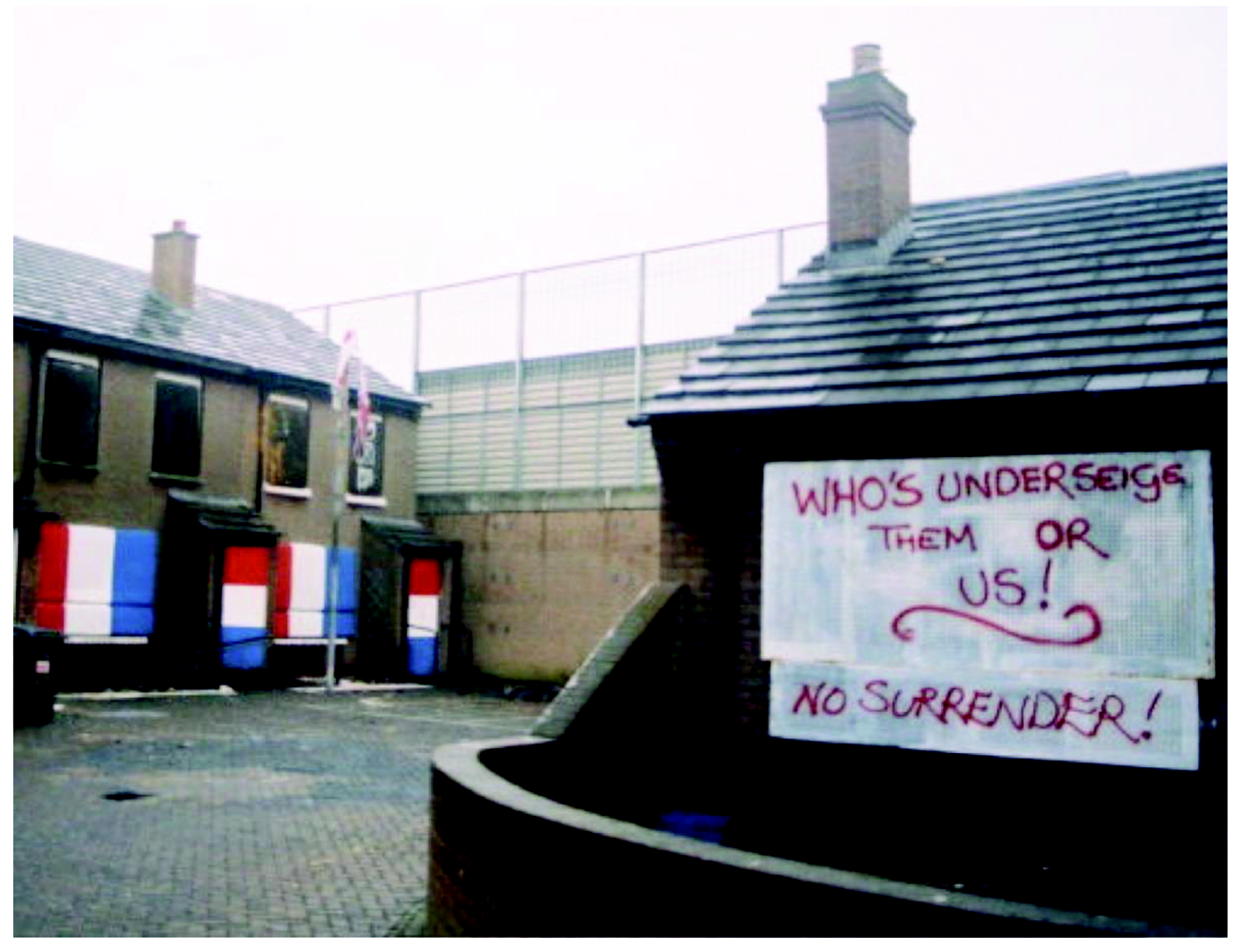
Levin Road, Kilwilke, Lurgan, Co. Armagh (2006). http://cain.ulst.ac.uk/mccormick/photos/no2930.htm#photo. © Dr. Jonathan McCormick.

Irish Tricolour and Union Jack

And here is a key point: these symbols of group identity, and the colors that compose them, achieve their power—their performativity-in-citationality, we might say—on a ritual calendar, a schedule of display (propitiation) and/or destruction (desecration), an annual cycle of commemorative holidays and ritual reenactments that take place at certain times, in certain places. Every year, during the Protestant/Loyalist/Unionist “marching season,” children and young people are outside with paint and brushes, touching up the red, white, and blue curbstones that mark off Protestant areas (see fig. 7). Every year, huge bonfires are constructed in both communities, festooned with the sacred symbols of the opposing group, and then set alight on the night of July 11th. On Protestant/Unionist/Loyalist bonfires one finds the Irish Tricolour, Glasgow Celtics gear, campaign posters of Sinn Féin candidates, and the occasional Catholic votive object; on Catholic/Nationalist/Republican bonfires, Union Jacks, Glasgow Rangers gear, campaign posters of the various Unionist political parties, and the occasional image of the Queen. There are many more Protestant bonfires than Catholic ones; it’s partly a matter of not wanting to let down the side.
If the system of sectarian color symbolism is overdetermined, it is also overregulated. Northern Ireland has been subject to an unusual number of laws designed specifically to regulate the public display of (usually nationalist or republican) identity symbols. Regulation by the state of the public display of flags or emblems provides an especially good example of the “institutional thickness” that Neill (Reference Neill and Punter2010, 307) identifies in Northern Ireland generally:
-
• 1850 Party Processions Act banning all (Orange) parades (repealed 1872)
-
• 1920 Restoration of Order in Ireland Act, 1920
-
• 1922 Civil Authorities (Special Powers) Act, April 1922
-
• 1951 Public Order Act
-
• 1954 Flags and Emblems (Display) Act (Northern Ireland)
-
• 1987 Article 9, Public Order (Northern Ireland) Act (bans “threatening, abusive or insulting words or behavior” if it “intends thereby to stir up hatred or arouse fear” or if same is “likely to be aroused thereby”)
-
• 1998 Section 75 of the Northern Ireland Act 1998
-
• 2000 Flags and Regulations (Northern Ireland) 2000
Expressions of “cultural identity” are legally protected. But the same symbols of “cultural identity,” when put on display at interface areas—whether the static kind represented by “Peace Walls,” or the dynamic kind created by parading—can be (legally) construed as “threatening, abusive or insulting words or behavior … intended to stir up hatred or arouse fear,” or if same is “likely to be aroused thereby,” to quote from Article 9 of the Public Order Act of 1987, still in force. And this applies whether those symbols are being propitiated, or ritually desecrated (Bryan and Gillespie Reference Bryan and Gillespie2005, 17, 23, 24).
A brief consideration of a few key colors in the preexisting system will confirm, I think, the point about the sensorial qualia of color only achieving performative efficacy under chronotopically—one is tempted to say chroma-topically—mediated conditions, in which they are understood, reflexively, as citations (Nakassis Reference Nakassis2013b).
For Protestants, the white of King Billy’s horse is essential (see fig. 11):
The colour of the horse is the most critical feature of any representation of King William for Protestants. The style and detail of the painting, the structure of the composition and the colour scheme for William’s dress may vary, but there is no flexibility with regard to the colour of his horse. No definitive record exists about the colour of the horse he rode at the Boyne, and in some early oil paintings he is depicted riding a dark horse. But for Ulster Protestants, no other colour but white is acceptable. In 1950 Belfast [City] Councillors vetoed the purchase of a painting of William by Jan Wyck because he was mounted on a brown horse. (Jarman Reference Jarman1997, 176)
King Billy and his white horse. http://cain.ulst.ac.uk/cgi-bin/murals.pl, album no. 55, mural no. 1932. © Dr. Jonathan McCormick.

There is also white in the Irish Tricolour, of course, and this white symbolizes peace between the Protestant (orange) and Catholic (green) communities. King Billy’s horse must be white, and the middle section of the Tricolour likewise must be white. Both are white, both are Pantone “FFFF,” but they are not the same color. The orange of Ian Paisley in this 1960s silkscreen print (see fig. 12) is the same as the orange in the Irish Tricolour flag insofar as they both “literally” signify the Protestant community—but they are not the same color. The context is different: in the Tricolour, Protestant orange is positioned on the other side of peaceful white from green Catholicism (see fig. 10). This image of Paisley is an all-over orange image—there’s even an all-orange Union Jack in the background. This helps to explain why people in the Republic of Ireland sometimes insist that “gold” is the name of this color in the Irish Tricolour—and they have a point. Regardless of the “objective” characteristics of color (PANTONE 151), it’s not the same color, so it really should have a different name. The use of the color orange as a symbol of Unionism-Loyalism-Protestantism, one should note, is rooted in language—more precisely, in the aristocratic title carried by King William and others, which refers to the medieval European principality (and eponymous noble House) of Orange in southern France. The word came first, the color later, in other words.
Rev. Ian Paisley, silkscreen poster, 1960s Troubled Images exhibition catalog (Linen Hall Library, 2001). Poster attributed to Patrick McGrath.

Colors also enter into dynamic relationships with other colors. Consider white versus red. The way that these two colors are embodied in material artifacts within the realm of clothing, where they are displayed in the lapels of men’s coats in accordance with a calendrically mediated system of holiday (ritual) observances, reveals their oppositional value: the white lily, worn in the lapel of a man’s jacket at Easter, achieves a double commemoration: of Christ’s resurrection, and of the Irish uprising of Easter Week in 1916, and performatively identifies the wearer as Nationalist-Republican-Catholic. The red poppy, worn in the lapel of a man’s jacket on Remembrance Day (November 11), commemorates the British soldiers who died in another conflict during the same historical period—World War I (never mind that many Ulster Catholics served with bravery in the British Army at the time), and hence performatively identifies its wearer as Unionist-Loyalist-Protestant. Here, the oppositional symbols engage with botanical and chromatic “codes,” but only as mediated by historical chronotopes organized and anchored in distinct and opposed national imaginaries—and annually reengaged in and through the chronotopic calibration of the ritual calendar. One might add that the use of the red poppy to commemorate the British war dead of World War I has its origins in language—to be precise, a literary text, the popular poem “In Flanders Fields.”
In fact, a tradition of explicit metadiscourse involving sectarian colors is as old as the system itself. “In Humphries v. Connor (1864) a policeman removed an Orange lily from a woman walking in a Catholic area on the basis that it would lead to a breach in the peace” (Bryan and Gillespie Reference Bryan and Gillespie2005, 29).
The period of the early 1950s, following the passing of the Public Order Act 1951, was one in which the police turned their attention especially to “symbolic displays of the Tricolour” (Jarman and Bryan Reference Jarman, Bryan and Fraser2000, 102). This produced some remarkable achievements of metacommunication using colors. “The 150th anniversary of Robert Emmet’s Rising in September 1953,” Jarman and Bryan note, “was marked by a large parades in Belfast and Downpatrick. In Downpatrick the processionists carried a green and white flag and a placard proclaiming ‘Orange forbidden in the Six Counties’ after they had been prevented from carrying a Tricolour” (Jarman and Bryan Reference Jarman, Bryan and Fraser2000, 103).
Conclusion
I suggested above that public uses of color in marking off sectarian enclaves in Belfast mobilized what I called, using a kind of citational portmanteau, chromatopes. It may be useful in conclusion to treat this proposal more seriously. Bakhtin’s (Reference Bakhtin1981) term “chronotope” names a narrative mechanism that renders texts intelligible by projecting a socially peopled time-space through which the characters and the narrator move, which movement makes palpable to the readers of a novel the phenomenological envelope its characters inhabit; style indirect libre accomplishes something similar within the scope of single sentences (Banfield Reference Banfield1982). This textual chronotope is further embedded in a chronotope of reading (uptake)—think of Benedict Anderson’s (Reference Anderson1983) famous arguments about how a reading public can come to consciousness of itself as a nation.
It’s not enough to observe that both of the older sectarian chromatopes and the more recent branding chromatopes are underlain by a similar logic of citationality; in fact, they are citationally entangled with each other, and asymmetrically so: the new rebranding campaign cites, in explicit silence and implicit iconism, the history of the two sectarian chromatopes and their citational entanglement with each other. Perhaps it cites that entanglement by promising to transcend it.
Having described the two mutually entangled sectarian chromatopes and the more recent city-branding scheme somewhat as self-contained systems in equilibrium, almost in the fashion of Lévi-Strauss, it is now worthwhile to ask: What’s the analogy, in the Belfast case, to this second chronotope of reading as an activity in real time? Perhaps the analogy would be moving through the color-coded sectarian enclaves of working-class Belfast on foot, “reading” the city closely and choosing one’s path accordingly. For at least some people growing up in Belfast during the Troubles, making their way between home and school on foot, the Tricolour elements and red, white, and blue curbstones served as way-finding aids.
Colors are good to think. So argues Marshall Sahlins (Reference Sahlins1976, 16), updating the maxim of his sometime teacher Claude Lévi-Strauss.Footnote 7 Sahlins’s point is that colors “are only the raw materials of cultural production, remaining latently available and incompletely realized until a meaningful content is attributed” to them: “Objectifying itself, then, in a system of colors, a human group accomplishes the essential cultural act of making a conceptual order out of a natural order. But such a code must be socially accessible: the success of the cultural project depends on the collective appropriation of objective features and relations that are generally present to the senses” (Sahlins Reference Sahlins1976, 16).
It wouldn’t be correct to treat the entrenched system of sectarian color symbolism in Northern Ireland as an example of branding: the flags and emblems of the two communities are not privately owned, nor are they trademarks for any good or service, nor are they part of any commercial enterprise; they are outside the market, just as the color symbolism of the new rebranding means to take Belfast further into the market. The difference is not one between two commodities or services competing in a marketplace, but rather between two irreconcilably different definitions of the world and where Belfast is located in it. Nor is this really an “argument” of images: neither “side” to the conflict is trying to convince the other of anything. And yet both the entrenched system of sectarian color display and the new rebranding of Belfast in a rainbow of nonsectarian colors share an underlying semiotic logic of citationality.
Both the Be-Happy rebranding and the already existing system for the calendrically mediated display and desecration of one another’s sectarian sacraments are regimes of visually and chromatically mediated interdiscursivity: token sites bearing significant color configurations gesture to each other as each and all gesture toward a type-level source of taxonomic identity. In both systems, the signs can be displayed in places and can be worn on the bodies of persons. Indeed, the best description of the colors composing the new official color palette of the rebranding of Belfast would probably be business casual: it’s precisely the color palette of the workday uniform of knowledge workers and the “creative classes”—the very type of postsectarian citizens that the new branding hopes to conjure into existence. The hip, metrosexual male represented in the (re)branding brief (see fig. 13) is miles away from images of traditional male working-class identity in Belfast. The dignity of industrial work has been replaced by the playfulness and flexibility of “the new economy.”
From the Belfast rebranding brief

But by gesturing away from the sectarian colors, the rebranding cannot help but gesture toward them—a perfect example of the surfeit of social meaning that Nakassis (Reference Nakassis2013a) locates at the center of the brand.



