


1. Introduction
Previous work has shown that the electrical properties of polar ice are completely different from those of "pure" ice (Paren, unpublished; Reference HochsteinHochstein, 1967; Reference RöthlisbergerRöthlisberger, 1967). At first sight this is somewhat surprising, since the impurity content of polar ice is extremely low, Most of the impurities in the snow are also found in sea-water. Whereas Reference MurozumiMurozumi and others (1969) claimed that the impurities could be subdivided into dust and salts of marine origin, and when samples containing many years accumulation were analysed these marine salts were found in the same stoichiometric ratio as in sea-water, more recent experiments (Reference Ragone and FinelliRagone and Finelli, 1972; Reference RagoneRagone and others, 1972), and indeed smaller sample volumes studied by Murozumi and others, have shown that in particular the cationic ratios in the snow do not follow those in sea-water. We know very little about the ionic balance in samples of such low impurity content, since there are difficulties in measurements of their anionic components.
The dielectric properties of ice formed from pure supercooled water droplets are known to be different from those of ice formed by slow freezing of large water volumes (≈ 10−3 m−3). Whereas the electrical properties of ice droplets change markedly with the time elapsed since their nucleation at a low temperature (Reference Evrard and WhalleyEvrard, 1973), the properties of ice formed reversibly by slow freezing at 0° C show by comparison only minor ageing effects. Since the polar ice is initially derived from supercooled water droplets in the atmosphere, the dielectric behaviour of ice from the polar regions may be determined not by impurity content but by the way in which the ice forms.
This paper describes a series of experiments conducted on a number of ice samples cut from two ice cores drilled from "Byrd" station, Antarctica: a shallow core from 155 m depth, and a deep core from 1 424 m depth. Dielectric measurements were made at different temperatures in the frequency range 60 Hz to 10 kHz; since the attenuation of metre-length radio waves in polar ice sheets is determined primarily by the audio-frequency Debye dispersion (Reference EvansEvans, 1965; Paren, 1973) which falls in the frequency range studied here, the results obtained should be relevant to radio-echo sounding studies.
Recently, Rogers (unpublished; Rogers and Peden, 1973) has studied the electrical properties of ice in situ at "Byrd" station by lowering a dipole probe into the fluid-filled hole and measuring its input admittance. From the measurements he calculated the properties of the ice surrounding the drill hole by allowing for the contribution to the admittance from the fluids that are in contact with the probe, and he concludes that the audio-frequency dispersion of the surrounding ice is similar to that of pure ice at the same temperature.
2. Experimental
We used a General Radio 1620A Capacitance Measuring Assembly to measure accurately the direct capacitance between two elements each connected to the core of a co-axial cable. The Capacitance Measuring Assembly covers the frequency range 50 Hz to 10 kHz, and we used three differently constructed brass cells with gold-plated electrodes having diameters 56 mm, 36 ram, and 14 mm with guard electrodes. Ice samples ranging in thickness between 3 mm and 50 mm were studied. The thickest samples (thickness t > 20 mm) were cut from the entire cross-section of the ice core using a hacksaw, and the ends were "freeze-tapped" to give flat faces using the method of Reference Tobin and ItagakiTobin and Itagaki (1970). The thinnest samples (t 5 mm) were melted to length and trimmed using a hot-wire cutter to a diameter slightly greater than that of the smallest cell. A similar procedure was carried out to prepare the samples for the 36 mm diameter cell. The ice samples were either frozen or pressed onto the electrodes of the cells and placed in a variable temperature enclosure. Temperatures between —6° C and — 120° C could be reached, but we concentrated mainly on the range —6° C to — 6o° C.
In order to derive the values of the relative permittivity and conductivity of the samples, the value of the air capacitance of the dielectric cell was required. For the smallest cell the ice could be melted leaving the electrode spacing unchanged and the air capacitance measured directly. As will be seen later, the absolute values of the permittivity and conductivity obtained for these smallest samples were consistent with each other. However, for the larger samples the air capacitance C 0 was calculated from the formula

where ɛ0 is the electric constant, A the measured electrode area, and t the measured sample thickness. For the thickest samples there is a considerable spread in the values of the permittivity and conductivity observed. This is probably because the above formula is inapplicable when the width of the guard ring is significantly less than the thickness of a sample with a high relative permittivity.
The effect of melting and refreezing the polar samples was also investigated. The polar ice was placed in an air-tight cylinder made from "Perspex" (polymethylmethacrylate) of dimensions 1 800 mm2 X 20 mm, and the ice melted. The "Perspex" container was then placed in a cold room at —6° C to refreeze; the resulting ice appeared to have a similar bubble content to the ice from 155 m depth at "Byrd". Dielectric tests were then carried out on these refrozen samples.
Frequency dependence of (a) the conductivity σ and (b) the relative permittivity ɛ’ for several different temperatures.

3. Results
Temperature, dependence of the conductivity σ10 for a "Byrd" sample. The continuous and dotted tines represent the results obtained by Paren (1973) for Mendsnhall and Greenland ice respectively

Typical results are shown in Figure 1 for a thin sample of deep ice for which measurements to 100 kHz were possible. It is seen that the conductivity is still increasing with frequency at 10 kHz, but tends to level off by 100 kHz. The relative permittivity reaches a limiting value too at high frequencies (typically at -60° C, ɛ ∞ = 3.13±0.02), whilst at lower frequencies the value is far higher than the value of about 90 expected for the Debye dispersion of pure ice. Figure 2 shows the measured 10 kHz conductivity (σ10) of this sample plotted logarithmically as a function of reciprocal temperature, and on the same graph are shown: the σ100 values observed at too kHz for ice from the Mendenhall Glacier which shows a similar dielectric response to "pure" ice, and the mean values for ice from "Camp Century" and "Site 2", Greenland, observed by Paren (1973)· Figure 3 is a similar plot for all fifteen samples, including ice from both 155 m and 1 424 m, and, after corrections for air content, no difference in behaviour of the ice from the two depths was detectable. The spread in the values obtained may be attributed to the method used to get absolute values for the largest cell (as mentioned above). It is seen that the activation energy obtained from all the data points is comparable with, but slightly lower than, the value for ice from "Camp Century" and "Site 2", Greenland studied by Paren (1973)·
At temperatures below about —50° C the slope of the σ|0 graph changes slightly towards lower activation energies, but at higher temperatures the mean activation energy E obtained by fitting

was found from the fifteen samples investigated to be 23.4±3.2 kJ mol−1 compared with 24.6±1.1 kJ mol−1 for Greenland ice (Paren, 1973). The value obtained for σ°, the conductivity at the melting temperature T0, for the nine samples in the smallest cell was (4.6±0.5) X 10−5 Ω−1 m−1 which may be compared to the values found at 100 kHz for ten Greenland samples of (4.50±0.22) X 105 Ω−1 m−1 and the value for Mcndcnhall ice of 4.41 X 10⁻⁵ Ω−1 m−1. This apparent coincidence, which was first noticed in the Greenland samples by Paren (unpublished), is confirmed by our measurements.
Temperature dependence of the conductivities σ10 for fifteen samples investigated.

Figure 4 shows some results obtained by melting and subsequently refreezing a typical "Byrd" sample, and comparison with Figure 1 shows that the results obtained are substantially different from those of the original samples. In fact the permittivity and conductivity for the refrozen samples strongly resemble those of "pure" ice. The low-frequency permittivity of the Debye dispersion has a value of around 90, whilst the high-frequency permittivity ϵ∞= 3.18±O.01 at — 50 ° C Figure 5 shows σ10 for two samples logarithmically plotted as a function of reciprocal temperature, and there is a great similarity to the values for the high-frequency conductivity of "pure" ice. In fact, all the melted and refrozen samples behaved like ice very lightly doped with HF. According to Reference CamplinCamplin and Glen (1973) the concentration of HF required to produce the same effect would be less than 5 X 10⁻⁷ mol 1−1.
4. Analysis of the audio-frequency dielectric dispersion
Frequency dependence of the conductivity a and the dielectric permittivity ɛ' at different temperatures for a melted and refrozen sample

Temperature dependence of the high-frequency conductivities σ10 for two melted and refrozen samples

In an attempt to analyse the results obtained in this experiment, a model capable of describing two relaxation processes in ice, a Debye dispersion (dispersion 1) and a space-charge dispersion (dispersion 2), was considered. Each dispersion was assumed to satisfy the Debye relaxation equations. The complex relative permittivity can then be. written:

where ∆∆1 and ∆∆2 are the dispersion strengths of dispersions 1 and 2, τi is the relaxation time of the ith dispersion and 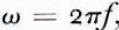 , where ∫ is the frequency. The conductivity change through each dispersion Δσί is given by

At high frequencies as the permittivity approaches ϵ∞ 3.2, the conductivity becomes independent of frequency (σ∞). The low-frequency conductivity of the first dispersion σ0 (σ0 = σ∞— Δσi) is, we believe, the true direct-current conductivity that would be observed in the absence of electrode effects which give rise to the space-charge dispersion.
The experimental data were fitted to this model using a least-squares iterative technique. It was observed that for the "Byrd" samples the d.c. conductivity σ0 had the same activation energy as σoα, and the value extrapolated to the melting point is given by σ0° = (2.1 ±0.3) X X 10−5 Ω−1 m−1, a value similar to that obtained for Greenland ice by Paren (1973). However, in general the fit to the experimental data was not particularly good (an error of 10% at —40 ° C) and in consequence another model was investigated to see if the fit to the data improved.
Experiments by Reference Watt and MaxwellWatt and Maxwell (1960) on temperate glacier ice, by Fujino (1967) and Reference AddisonAddison (1970) on sea ice and by Paren (unpublished) on rim in Axel Heiberg Island, Canada, have shown that a low-frequency behaviour given by

is often experimentally observed. This behaviour is derived from an impedance Z* given by

Since

A necessary consequence is that

is independent of frequency in the range for which the model holds.
The experimental data were fitted to a model having a complex relative permittivity given by

and the same least-squares procedure as before was used. The results of this computation gave a better fit to the data, (an error of 4% at —40° C). However, the calculations give the relaxation frequency (f=1/2πτI) of the first dispersion to be about 100 Hz, which is surprisingly low and cannot be related to the Debye dispersion known in "pure" ice. The conductivity increases as a function of frequency with exponent (1—m), and the values obtained for m were about 0.8. Therefore in our experiments

which implies that the value of the conductivity extrapolated to the MHz region is several times the value of the conductivity obtained at 10 kHz. However, the extrapolation far beyond the measured frequencies may not be justified.
Another model having a spread of relaxation times was also considered, in which the complex relative permittivity is given by

The computed fit to the experimental data using this model was good (an error of 1% at —40° C), and the conductivity at high frequencies derived from this model was again found to increase with frequency with exponent α, which was typically 0.2 (Fitzgerald, unpublished).
The results obtained for the melted and refrozen samples were fitted to the first model having a Debye and space-charge dispersion and excellent fits were obtained (an error of 1% at —40° C). Good Cole-Cole semi-circles were obtained, and the computed fits closely resembled those expected for very lightly doped HF ice.
5. Discussion
It has been shown that the electrical behaviour observed in the ice from "Byrd" station is very similar to that observed for other polar samples, and is thus at variance with the measurements made in the "Byrd" drill hole by Rogers (unpublished; Rogers and Peden, 1973). However, recently Von Reference Von HippelHippel and others (1974) have shown that if ice samples doped with HF are contaminated by methanol vapour the effect of F− doping is essentially neutralized since methanol is an avid proton acceptor, and the ice behaves as "pure" ice. Since trichloroethylene is also a proton acceptor and is present in large amounts in the drill hole at "Byrd", the properties of the surrounding ice may have been modified. Melting and refreezing of the
We need more detailed studies of the variation of absorption with location in the future if we are to confirm the representative nature of a temperature-depth profile for the surrounding region. Clearly, there is no evidence at present which would favour the suggestion that convection occurs in polar ice sheets as proposed by Hughes (1971). If convection within the ice sheet did occur, we would expect the resultant temperature pattern to produce rapid variations of absorption with location, and this would result in rapid changes in the depth from which internal reflections are recorded. In addition, the continuity and parallel nature of such reflecting surfaces would be broken by the existence of convection. Evidence of the lack of convection in an ice sheet, in spite of the existence of favourable conditions pointed out by Hughes, should be of interest to those concerned with the possibility of convection in the Earth's mantle.
Reflecting horizons within the ice mass
We have already drawn attention to the significance of the continuity of internal reflections. Their continuity over long distances in Greenland and the presence of strong echoes from internal layering at centres of outflow in Antarctica both favour the idea that these horizons are depositional features. If these main internally reflecting horizons can be confirmed as relics of earlier surfaces of the ice sheet, as discussed earlier, then we have an important parameter displayed on our radio-echo records that can be related to past accumulation and ice movement. The position of past surfaces, or "isochrons" as they have been called, have been calculated and are shown in the computer prints of Budd and others (1971).
Polarization
Evidence of polarization of radio echoes in polar ice sheets has been produced by Bogorodskiy and others (1970[a]) and by Jiracek and Bentley (1971). Since transmitted pulses are usually polarized at the source, the problem in making observations is to study the processes of depolarization. There are two significant factors: the effect of anisotropy within the ice mass, and the process of reflection. The problems will be discussed elsewhere in this symposium and readers should refer to Bentley (1975) and p. 442.
Ice movement
If radio-echo fading patterns of bedrock echoes are fixed in space, then these patterns may be used as a fixed reference frame against which one can determine ice movement. If the fading patterns are due entirely to the irregularities of the bedrock surface and are not affected by inhomogeneities that move with the ice mass, such as moving morainal material or dielectric variations in the main ice mass, then it is reasonable to expect them to form a suitable reference frame. The time scale involved in developing and testing this concept will serve to illustrate the lime gap between producing an idea and applying it.
The concept of using the fading pattern was first suggested by the reviewer at a colloquium in the Scott Polar Research Institute in 1969, but the initial conclusion was that the frequency dependence of the fading pattern would require a high degree of stability of radio frequency and band-width in the equipment. In view of other commitments for the research group, the idea was not pressed until J. F. Nye raised the matter in a personal discussion in February 1971, when he pointed out that frequency stability requirements were not as stringent as had been thought and could readily be met. It was agreed that Nye's group in Bristol should pursue this line of work.
Short field trials of the method were then made in the 1971-72 season, using the conventional radio-echo equipment (SPRI Mark II) on Fleming Glacier, Antarctic Peninsula. In spite of some operational difficulties, the first results on this glacier (Walford, 1972) showed an ice movement of 38±3 cm d−1 (radio echo) compared with an ice movement of 46±5 cm d−1 after making corrections for vertical strain, determine how much ice has melted off the surface as a function of disLance from the equilibrium line. Then, if one knows the velocity of movement, one can convert this into an ablation rate. The method appears particularly attractive for determination of the bottom melting beneath ice shelves, especially the Ross Ice Shelf, where considerable knowledge of the ice movement has been, and is being, acquired. Unfortunately, efforts to record suitable internal layering of ice shelves by radio-echo sounding have not been successful so far, but the value of these observations is such that efforts should continue.
iii Temperature
Ice temperature is the parameter that has been a central consideration in the development of radio-echo sounding, since the large variation of dielectric absorption with temperature would make the method of echo sounding impracticable on polar ice sheets if a large fraction of the ice column were at the melting point. It was shown by Robin and others (1969) that the bottom echo strength recorded at Camp Century, Greenland, was such that no substantial thickness of ice near bedrock could be at the melting point, although the accuracy of theory and observation did not enable one to be sure whether the ice-rock contact was frozen or at the melting point.
Several observers (Bailey and Evans, 1968; Bogorodskiy and others, 1970[b]) have used a useful though crude parameter, the mean absorption temperature. This is determined by dividing the observed absorption by the path length through ice (twice the depth), and converting this figure from Westphal's curve to a temperature. Owing to the non-linear relationship between absorption and temperature, the answer is not close to the true mean temperature, but it is useful in discussing radio-echo sounding performance. In general, the mean absorption temperature will be appreciably—and possibly substantially—warmer than the true mean temperature of the ice.
Il appears likely that once a better understanding of the processes causing internal reflections of radio waves in polar ice sheets has been gained, it may be possible to make quantitative estimates of temperature and absorption gradients at depths below 2 000 m in polar ice sheets. This arises from work of Paren and Robin (in preparation) showing that the main reflection process at greater depth is due to changes of dielectric loss (i.e. tan δ) between different layers, so that the reflection coefficient itself is very temperature-dependent. This applies only below 1 500 to 2 000 m at the site studied. At depths of less than 1 500 m, the reflections appear to be due to density or similar variations, and although absorption still plays a part in determining the recorded echo strength of internal reflections, it may prove difficult to isolate the absorption losses from the other factors so as to produce satisfactory estimates of temperature. Nevertheless, as our understanding of the physical processes causing internal reflections improves, it appears likely that we may be able to gather much more detailed information on temperature distribution within ice masses than is given by the mean absorption temperatures. In turn this information may let us draw indirect conclusions on accumulation rates at the surface along lines indicated previously. The potential accuracy will not however be great enough to replace the precise temperature measurements in bore holes that are necessary when relating present-day temperature profiles to the past surface temperatures.
We should not conclude this section without pointing out again that the whole progress of radio-echo sounding has been dependent on our understanding of temperature distribution within polar ice sheets. The successful development of radio-echo sounding methods in itself provided confirmation of our theoretical models of temperature distribution before more direct evidence was given by results from deep drilling at Camp Century in Greenland and "Byrd" station in Antarctica. ice in the immediate neighbourhood of the hole due to the added ethylene glycol may also have modified these properties. It is of interest that the measurements of Rogers on the surface snow of density 0.4 Mg -3 at "Byrd" at 10 and 12.8 kHz (Reference Webber and PedenWebber and Peden 1970; Peden and Rogers, 1971) are very similar to those measured on firn oi density 0.43 Mg m-3 at 20 kHz by Pareil (unpublished) in Axel Heiberg Island. Glen and Paren (1975) have shown that the firn and snow measurements are in agreement with the deep polar ice samples after the effect of the air component in the snow has been accounted for.
The behaviour of pure ice has been explained by the presence of two types of defects, ionic and Bjerrum defects (Reference JaccardJaccard, 1959), which are thermally created in the pure ice lattice. The observation of higher conductivity in polar ice samples suggests that one or both of the electrical defects are more numerous in polar ice than in pure ice. Paren (unpublished, 1973), showed that since the static conductivity was raised, the increase in conductivity was due to the ionic defects, and the presence of a zero activation energy for the ionic conductivity at high temperatures suggested that H3O+ ions rather than OH- ions were responsible The behaviour was very similar to that observed by Camplin and Glen (1973) for HF-doped ice containing approximately 10-5 mol l-I. It is difficult to see how the necessary numbers of H3O+ ions can be generated from the known impurity concentrations in polar samples if the impurities are salts stoichiometrically incorporated.
This view is strengthened by the measurements on the melted and refrozen samples, where the behaviour was similar to HF-dopcd ice containing 5 X 10⁻⁷ mol 1-I. The Cl- concentration at "Byrd" is 2 X 10⁻⁶ mol 1-I, but the cations present would ensure that the resultant H3O+ ion concentration would be less than that in ice derived from HCl with the same Cl- concentration (Paren, 1973). Even allowing for impurity rejection during refreezing and the loss of a few per cent of the sample volume during the mounting of the electrodes, it is difficult to reconcile the differences, unless the impurities are not equally effective in generating electrical defects in the two types of ice or the growth conditions of the original polar ice samples are what determine the electrical behaviour.
Recently Evrard (1973) has studied ice emulsions that have been obtained by the nucleate of small supercooled water droplets at -41° C. He observed that the dielectric behaviour changed with time when the ice emulsion was maintained at a constant temperature. The activation energy for the relaxation time was found to decrease discontinuously in jumps of 6 7 kJ mol-I and the relaxation time extrapolated from lower temperatures always intersected the "pure" ice value at the melting point. During the course of his experiment the activation energy changed from about 48.1 kJ mol-I to 22.4 kJ mol-3.
The high-frequency conductivity σ ∞ obtained for the polar samples extrapolates back to the "pure" ice value near the melting point. This implies that it is possible that the mechanism for the observed behaviour in polar ice is similar to that responsible for the behaviour observed by Evrard (1973). He has shown that there is a unique relationship between the discrete temperatures at which supercooled water freezes spontaneously and the discrete spectrum of activation energies which are observed for the relaxation time in ice formed by the nuclealion of supercooled water droplets. Reference BroutBrout (1965) and Reference SchneiderSchneider (1971) suggest that the first-order transition involved in the freezing of water is preceded by co-operative effects within the liquid state, but the precise mechanism responsible for the evolution of the dielectric properties with time is, at present, unknown.
Acknowledgements
We would like to thank the Snow and Ice Branch of the U.S. Army Corps of Engineers Cold Regions Research and Engineering Laboratories (Dr C. C. Langway, Chief) which provided the two cores from "Byrd" station. One of us (W.J.F.) thanks the Natural Environment Research Council for a research studentship held during the course of this work under the supervision of Dr J. W. Glen to whom we also offer our thanks.



