


Introduction
On February 6, 2023, 2 devastating earthquakes (Mw 7.7 and Mw 7.6) struck southeastern Türkiye, resulting in more than 50,000 deaths and widespread destruction across 11 provinces. Emergency Medical Services (EMS) were among the first responders, working under challenging conditions. While much of the existing disaster literature focuses on victims, limited empirical research exists on the experiences of EMS workers who operate at the frontline of catastrophic events.Reference Naushad, Bierens and Nishan 1
Previous research on large-scale disasters, such as the Great East Japan, Wenchuan, and Haiti earthquakes, has documented how infrastructure damage, resource scarcity, and coordination problems undermine effective responses.Reference Naushad, Bierens and Nishan 1 –Reference Zhang, Liu and Li 3 However, despite this growing body of evidence, limited systematic data are available from Türkiye, a disaster-prone country with a unique EMS structure. Following the Kahramanmaraş earthquakes, preliminary field reports from the Emergency Medicine Association of Türkiye indicated severe shortages in logistics and coordination,Reference Yılmaz, Karakayali and Yilmaz 4 yet comprehensive qualitative insights from EMS workers remain scarce. Moreover, a recent systematic review highlighted that medical rescue teams across various disaster contexts face organizational, logistical, individual, and communication-related challenges, underscoring the global relevance of findings.Reference Kuday, Özcan and Çalışkan 5
This study, therefore, aimed to describe the challenges faced by EMS personnel during the 2023 earthquakes and provide insights to inform disaster preparedness and response planning.
Methods
A qualitative phenomenological study was conducted. Fourteen EMS workers who served within the first 72 hours after the earthquakes were recruited through purposive and snowball sampling. Semi-structured interviews were conducted online between April and August 2023 (Table 1). All interviews were audio-recorded, transcribed verbatim, and analyzed through inductive content analysis.
Descriptive information of the participants

Two researchers independently coded the transcripts. Codes were grouped into categories, and themes were finalized through a consensus process. Representative quotes were selected to illustrate key findings. Ethical approval was obtained from the Ege University Scientific Research Ethics Committee (approval no: 2023-1075). Written informed consent was obtained from all participants.
Results
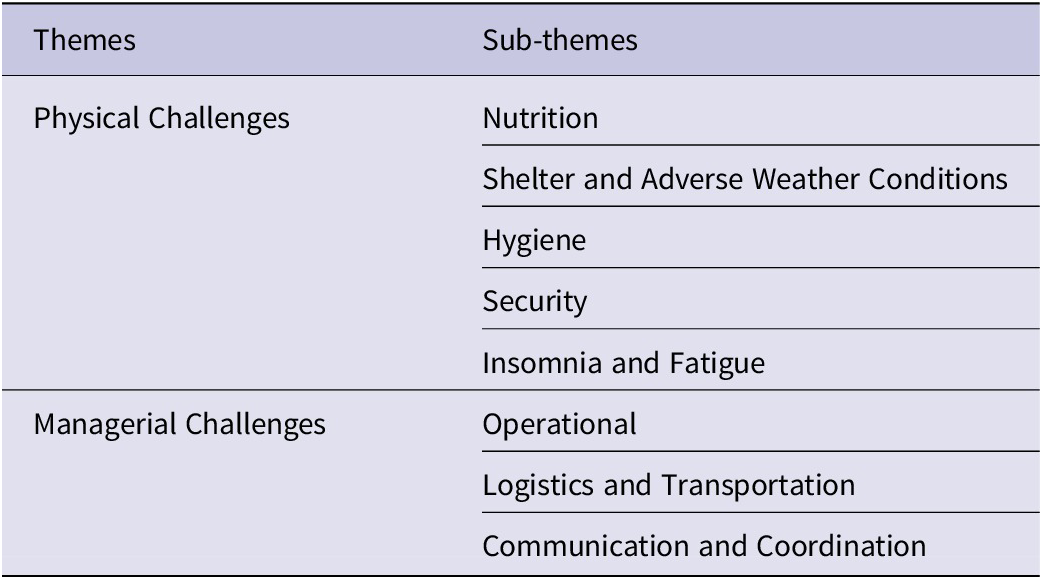
Two main themes and 8 sub-themes emerged (Table 2).
Themes and sub-themes

Participants consistently reported a lack of access to food and drinking water, severe shelter and hygiene problems, and exposure to cold weather. Many had to sleep in ambulances due to the absence of safe accommodation. Safety risks were evident, as EMS workers often entered unstable buildings to retrieve medical supplies or rescue victims. Fatigue from prolonged work without rest impaired concentration and decision-making.
Organizational issues included insufficient medical and rescue equipment, logistical delays due to damaged infrastructure, and significant communication failures. For example, overlapping dispatches of multiple teams to the same site were reported, while other areas remained underserved.
Representative quotes:
“Ambulance crews had to sleep in their vehicles due to lack of shelter (Female, aged 36, arrival at the 12th hour).”
“When the second earthquake hit, we were on top of the ruins … we could have been trapped under the debris. That was the moment I was most frightened (Female, aged 28, arrival at the 6th hour).”
“We rescued about 60-70 casualties in 6 hours, but we could not transfer them. The number of ambulances was enough, yet the collapsed buildings blocked the roads (Male, aged 39, arrival at the 16th hour).”
“Communication was disrupted, leading to multiple teams being dispatched to the same case (Female, aged 27, arrival at the 30th hour).”
Limitations
This qualitative study included only 14 participants, and findings cannot be generalized. Results reflect the experiences of EMS workers in one disaster context. Responses were based on participants’ subjective perspectives, which may vary across individuals.
Discussion
This study highlights that EMS workers during the Kahramanmaraş earthquakes faced both physical and organizational challenges that significantly limited their ability to respond effectively. These findings are consistent with prior disaster research, which emphasizes how unmet basic needs, fatigue, and poor coordination undermine emergency response.
International literature reinforces these results. Comparable findings have also been reported in South Korea, where EMS crews described heavy stress, organizational inefficiencies, and insufficient resources as key barriers undermining both disaster preparedness and the effectiveness of response.Reference Choi and McAleavy 6 A recent systematic review further emphasized that frontline health care workers frequently experience burnout during disasters, with negative consequences for their physical and mental health, work performance, and quality of care.Reference Alzailai, Barriball and Xyrichis 7 Similar challenges were documented in the United Kingdom following mass casualty incidentsReference Skryabina, Betts and Reedy 8 and in Iran, where EMS staff reported logistical and organizational constraints.Reference Sorani, Tourani and Khankeh 9 Consistent with these observations, a systematic review synthesizing evidence from multiple disaster settings identified 6 main categories of challenges for medical rescue teams, including organizational, logistical, and health-related barriers, which closely mirror the themes found in our study.Reference Kuday, Özcan and Çalışkan 5 Beyond these structural barriers, prior research also shows that their perceived preparedness and institutional support strongly influence health care providers’ willingness to work during disasters.Reference Sultan, Sørensen and Carlström 10
The implications for Türkiye are noteworthy. EMS workers demonstrated remarkable commitment; however, specific structural gaps constrained the overall response capacity. Future national disaster plans may benefit from incorporating strategies to enhance responder safety and well-being, while also strengthening logistics and communication systems. Addressing these areas could contribute to greater resilience in the face of future catastrophic events.
Conclusion
The findings indicate that in massive disasters, resource scarcity and the inability to meet basic physical needs negatively affect the performance and effectiveness of EMS workers within the response system. Ensuring the physical safety of EMS personnel emerges as a persistent challenge, particularly in large-scale earthquakes that cause severe structural damage. Many EMS workers were observed to operate in unsafe environments, often surrounded by debris and unstable infrastructure. The lack of resilient physical infrastructure, frequently discussed in the literature as a factor that amplifies disaster impact, also hinders the development of effective solutions to resource shortages. Therefore, disaster preparedness efforts should more comprehensively assess the vulnerabilities and structural fragility of high-risk areas when developing national response and preparedness plans.
Author contribution
AHA: Conceptualization; data collection; analysis; writing. AE: Conceptualization; methodology; analysis; writing; supervision; and reviewing. SG: Analysis; reviewing.
Funding statement
This study has not been funded by any institution.
Competing interests
None.


 Open access

