

1. Introduction
The subduction zone plays a crucial role in the interaction of convergent plates resulting in various magmas and serving as a typical accretion orogenic system. A comprehensive understanding of the evolution of subduction zones, including its initiation and termination, as well as associated magmatic, metamorphic and tectonic processes, is essential for revealing crustal growth and circulation, palaeogeographic reconstruction and long-term evolution of the Earth’s structure (Crameri et al. Reference Crameri, Magni, Domeier, Shephard, Chotalia, Cooper, Eakin, Grima, Gürer, Király, Mulyukova, Peters, Robert and Thielmann2020; Soret et al. Reference Soret, Bonnet, Agard, Larson, Cottle, Dubacq, Kylander–Clark, Button and Rividi2022). The Central Asian Orogenic Belt (CAOB) lies between the Siberian Craton to the north and the Tarim and North China Cratons (NCC) to the south (Şengör et al. Reference Şengör, Natal’in and Burtman1993; Fig. 1a). It is the longest and most complex typical Phanerozoic accretionary orogenic belt on Earth, and it is composed of a wide range of tectonic units, including micro-continents, magma arc, ophiolites, relics of fore-arc and back-arc basins and subduction-accretion complexes (Şengör et al. Reference Şengör, Natal’in and Burtman1993; Wilde et al. Reference Wilde, Zhang and Wu2000; Xiao et al. Reference Xiao, Windley, Hao and Zhai2003, Reference Xiao, Windley, Sun, Li, Huang, Han, Yuan, Sun and Chen2015; Zhang et al. Reference Zhang, Wang, Liu, Xu, Li, Xuan, Gao and Wang2022). Typically, Solonker-Xar Moron-Changchun-Yanji Suture (SXCYS) was regarded to be a sign of the closure of the PAO (Wu et al. Reference Wu, Jahn, Wilde and Sun2000, Reference Wu, Zhao, Sun, Wilde and Yang2007a, Reference Wu, Sun, Ge, Zhang, Grant, Wilde and Jahn2011; Xiao et al. Reference Xiao, Windley, Hao and Zhai2003, Reference Xiao, Windley, Sun, Li, Huang, Han, Yuan, Sun and Chen2015; Liu et al. Reference Liu, Li, Ma, Feng, Guan, Li, Chen, Liang and Wen2021; Fig. 1b).
(a) Simplified tectonic sketch map of the eastern Central Asian Orogenic Belt (modified after Sengör et al. Reference Şengör, Natal’in and Burtman1993; Zhang et al. Reference Zhang, Wang, Liu, Xu, Li, Xuan, Gao and Wang2022); (b) Simplified tectonic sketch map of Northeast China (modified after Liu et al. Reference Liu, Li, Feng, Wen, Neubauer and Liang2017).

In Paleozoic, the North-east (NE) China, which is part of the eastern CAOB, underwent closure of the Paleo-Asian Ocean (PAO) and amalgamation of the NCC with several microcontinental massifs, from west to east, including the Erguna, Xing’an, Songliao-Xilinhot and Jiamusi blocks (Liu et al. Reference Liu, Li, Feng, Wen, Neubauer and Liang2017, Reference Liu, Feng, Jiang, Jin, Li, Guan, Wen and Liang2019; Windley et al. Reference Windley, Alexeiev, Xiao, Kröner and Badarch2007; Fig. 1b). Some researchers argued that it also consists of a curved Erguna-Jiamusi continent ribbon, early Paleozoic Xing’an-Zhangguancailing accretionary terranes and late Paleozoic Songliao accretionary terranes with some Precambrian micro-block relics in the core area of the orocline (Liu et al. Reference Liu, Li, Ma, Feng, Guan, Li, Chen, Liang and Wen2021, Reference Liu, Ma, Feng, Li, Li, Guan, Chen, Zhou and Fang2022, Reference Liu, Xiao, Ma, Li, Peskov, Chen, Zhou and Guan2023). However, the tectonic evolution history in the eastern CAOB is still debated, and there is no consensus on the closure time of the PAO and its branches, which range from the Devonian (Xu et al. Reference Xu, Charvet, Chen, Zhao and Shi2013; Zhao et al. Reference Zhao, Xu, Tong, Chen and Faure2016) to the Late Permian-Early Triassic (Jia et al. Reference Jia, Hu, Lu and Qiu2004; Jian et al. Reference Jian, Liu, Kröner, Windley, Shi, Zhang, Zhang, Miao, Zhang and Tomurhuu2010; Cao et al. Reference Cao, Xu, Pei, Wang, Wang and Wang2013; Xue, Reference Xue2021). Furthermore, more tectonic models have been proposed to explain the tectonic affiliation of the eastern PAO during the Permian. These models include the continental rift model (Shao et al. Reference Shao, Tian and Zhang2015), continent-continent collision model (Zhang et al. Reference Zhang, Zhang and Qiu2007), post-orogenic extension model (Zhang et al. Reference Zhang, Zhang and Qiu2007; Zhao et al. Reference Zhao, Li, Li and Chen2008), slab break-off model (Yuan et al. Reference Yuan, Zhang, Xue, Lu and Zong2016) and slab roll-back model (Li et al. Reference Li, Wilde, Wang, Xiao and Guo2016, Reference Li, Chung, Wilde, Jahn, Xiao, Wang and Guo2017).
In this paper, we present zircon U-Pb dating, major and trace elements of whole-rock and zircon Hf isotope of the Shanmen pluton, combined with various data of Permian chronological and geochemical data in the Changchun-Kaiyuan area, to analyse the activity times, rock combination, tectonic environment and the relationship with the PAO.
2. Geological background
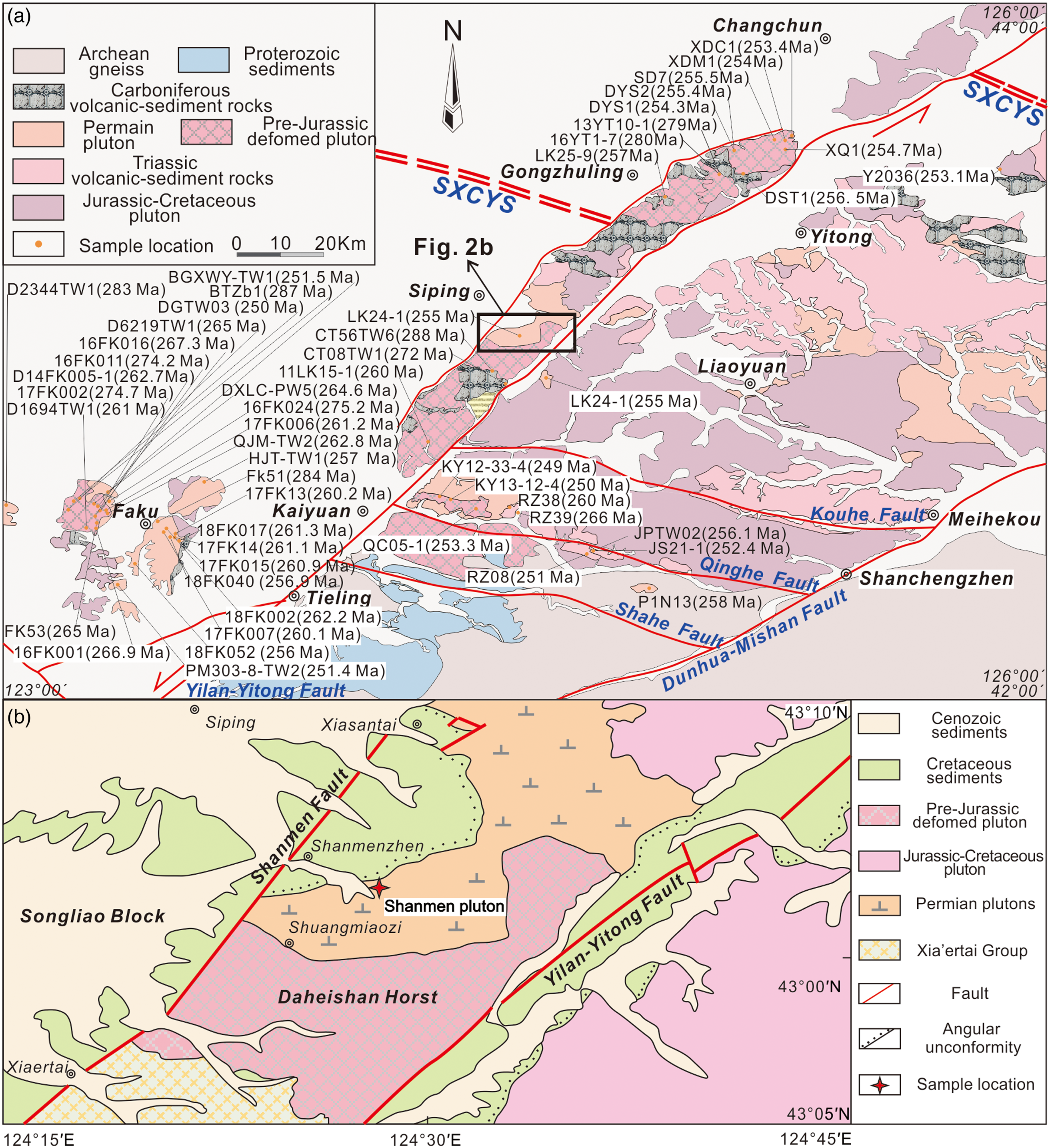
The Shanmen area in Jilin Province is located at the intersection of Daheishan Horst and SXCYS, bounded by the Shanmen Fault (Siping-Changchun-Dehui Fault) and Yilan-Yitong Fault, which belongs to the eastern part of the northern margin of the NCC (Fig. 2a). Owing to the alteration and destruction caused by magmatic activity during the Mesozoic, the study area has relatively limited remaining Palaeozoic stratigraphic formations. In the study area, the intrusive rocks primarily consist of Mesozoic granites and late Paleozoic intrusions (Fig. 2b). The Mesozoic granites mainly comprise Jurassic monzonitic granites and granodiorites. The late Paleozoic intrusive rocks are formed in the Middle Permian, and the lithology includes quartz diorite, syenite granite and granite. Initially, due to the lack of accurate isotope dating data, it was believed that the late Paleozoic intrusions were formed in the Ordovician. However, as the study progressed, 262 ± 2 Ma (Cao, Reference Cao2013) and 264-260 Ma (this study) were obtained in the study area. In the southern part of the study area, a large area of ‘Xia’ertai Group’ is distributed, and the overall pattern is spread in a NE direction in a back-shaped pattern (Zhang, Reference Zhang2021). In addition, Mesozoic Cretaceous volcanic sedimentary strata and Cenozoic strata developed in the Songliao Basin (Fig. 2b).
(a) Simplified regional geologic map of the Changchun-Kaiyuan showing the distribution of the Permian igneous rocks. All these reported age locations were presented in Table 4; (b) Geological sketch map of the shanmenzhen region, with the sample locations shown. SXCYS: Solonker-Xar Moron-Changchun -Yanji Suture.
3. Field relationships and sample description
3.a. Field relationships
The Shanmen pluton in this paper was discovered in the Shanmen Reservoir (124° 28′ 13′′ E, 43° 03′ 20′′ N), which is just ∼20 km southeast of Siping. It is mainly composed of quartz diorite, syenite granite and granite. Field observation revealed that the left side of the pluton is a slip fault, with an occurrence of 284/85. Moreover, the mylonitic fine-grained granite intrusions can be observed in the form of veins within the quartz diorite, and both of them underwent metamorphic deformation (Fig. 3a, b).
(a, b) Field photos of the Shanmen pluton. (c) Microscopic photos for the quartz diorite (SM18-1). (d) Microscopic photos for the quartz diorite (SM21-2). (e) Microscopic photos for the mylonitic granite (SM21-1). Mineral abbreviations: Pl-plagioclase; Bt-biotite; Qtz-quartz.

3.b. Petrography
The quartz diorite from SM18-1 is medium-grained with grey-black and composed of plagioclase (70%–80%), quartz (∼5%) and biotite (∼15%), with minor hornblende (Streckeisen Reference Streckeisen1976; Fig. 3c).
The quartz diorite from SM21-2 is fine-grained and composed of plagioclase (70%–80%), quartz (∼5%) and biotite (∼15%) (Streckeisen Reference Streckeisen1976; Fig. 3d). The deformation of sample SM21-2 is more intense, and the mineral elongation orientation is obvious and more broken.
The mylonitic granite is white-grey with a typical granitic texture and comprises mainly quartz (∼30%), plagioclase (∼65%) and biotite (< 5 %) (Fig. 3e). Most quartz and feldspar minerals are elongated and oriented.
4. Analytical methods
4.a. Zircon U-Pb dating
The separation of zircon was performed in the Keda Rock Mineral Separation Company in Langfang City, Hebei Province. The samples were first crushed and then separated using gravitational and magnetic separation methods. Laser ablation inductively coupled plasma mass spectrometry (LA–ICP–MS) U–Pb zircon dating was carried out at the Key Laboratory of Mineral Resources Evaluation in NE Asia, Ministry of Natural Resources, Jilin University, Changchun, China. The correction for common Pb was made following the method of Andersen (Reference Andersen2002). The data were processed using the ISOPLOT (Version 3.0) programme (Ludwig, Reference Ludwig2003).
4.b. Major and trace elements analyses
Major and trace elements were analysed at the premises of ALS Chemex Co. Ltd. in Guangzhou. Major elements were measured by X–ray fluorescence spectrometry from prepared glass discs. Trace elements were instead analysed using ICP–MS after melting the samples at 1025 °C and digesting them using a HNO3 + HCL + HF mixture.
4.c. In situ zircon Hf isotopic analyses
In situ zircon Hf isotopic analyses for sample (SM18-1) were undertaken using a Neptune multi-collector (MC) ICP-MS, equipped with a 193 nm ArF Excimer laser system at the Tianjin Institute of Geology and Mineral Resources in Tianjin, China. Details of the analytical procedures are described by Wu et al. (Reference Wu, Yang, Xie, Yang and Xu2006).
Experiments of in situ Hf isotope ratio analysis for sample (SM21-1, SM21-2) were conducted using a Neptune Plus MC-ICP-MS (Thermo Fisher Scientific, Germany) in combination with a Geolas HD excimer ArF laser ablation system (Coherent, Göttingen, Germany) that was hosted at the Wuhan Sample Solution Analytical Technology Co., Ltd, Hubei, China. Detailed instrument operating conditions and analysis methods can be referred to (Hu et al. Reference Hu, Liu, Gao, Liu, Zhang, Tong, Lin, Zong, Li, Chen, Zhou and Yang2012).
5. Results
5.a. Zircon U-Pb dating
Samples SM18-1 and SM21-2 were collected from different positions within the Shanmen pluton, as shown in Fig. 3a. The zircon grains are transparent and subhedral with elongation ratios ranging from 1:1 to 2:1. In cathodoluminescence images, most of the grains exhibit oscillatory growth zoning with high Th/U ratios (0.34–1.13), suggesting a magmatic origin (Koschek, Reference Koschek1993; Fig. 4). The zircons show significant depletion of LREE, enrichment of HREE and prominent negative Eu anomalies, which are typical characteristics of magmatic zircons (Belousova et al. Reference Belousova, Griffin, O’Reilly and Fisher2002; Hoskin, Reference Hoskin2005; Fig. 5d).
Representative cathodoluminescence images of selected zircons of the quartz diorite and mylonitic granite.

(a, b, c) U-Pb concordia diagrams showing zircon ages obtained by LA-ICP-MS. The weighted mean age and MSWD are shown in each figure; (d) chondrite-normalised REE patterns for zircons from the quartz diorite and mylonitic granite.

Seventeen zircons from sample SM18-1 give a range of 206Pb/238U ages from 267 to 260 Ma (Table 1) and yield a weighted mean age of 263.7 ± 2.7 Ma (MSWD = 0.3, n = 17). This weighted mean age is interpreted as the crystallisation age of the rock (Fig. 5a).
LA-ICPMS U-Pb zircon data for the Middle-Late Permain Shanmen pluton

The 206Pb/238U ages from 23 analyses for the sample SM21-2 vary from 275 Ma to 256 Ma (Table 1), yielding a weighted mean age of 263.5 ± 1.9 Ma (MSWD = 1.2, n = 23; Fig. 5b), which is interpreted as the crystallisation age of the quartz diorite.
A total of fifteen analytical spots for the sample SM21-1 have 206Pb/238U ages varying from 269 to 255 Ma (Table 1), with a weighted mean age of 259.6 ± 1.9 Ma (MSWD = 0.79, n = 15). The age represents the emplacement age of mylonitic granite (Fig. 5c).
5.b. Whole-rock geochemical compositions
Table 2 shows the results of analyses of trace and major elements of the representative samples.
Major (wt%) and trace (ppm) elements of the Middle-Late Permian Shanmen pluton

The quartz diorite samples have SiO2 = 56.08 wt.% – 61.69 wt.%, Al2O3 = 16.20 wt.% – 17.08 wt.%, K2O = 1.37 wt.% – 1.88 wt.%, Na2O = 4.06 wt.% – 4.55 wt.% and MgO = 2.26 wt.% – 4.37 wt.%, with Mg# [=100 Mg2+/(Mg2++TFe2+)] values of 45 – 56, which indicates that the samples are mostly high-Mg Na-enriched diorite. The samples are classified as medium-K calc-alkaline diorites on the total alkalis versus silica and K2O vs. SiO2 diagrams (Fig. 6a, b). They exhibit metaluminous affinity, with A/CNK values [molar Al2O3/ (CaO + Na2O + K2O)] ranging from 0.82 to 0.93 (Fig. 6c). Moreover, these samples are enriched in LILEs (e.g., Rb, Sr and Ba) and depleted in HFSEs (e.g., Nb, Ta, and Ti) with no negative Eu anomalies (σEu = 0.99 – 1.05; Fig. 7).
Plots of (a) (Na2O + K2O) vs. SiO2 diagram (TAS; Irvine & Baragar, Reference Irvine and Baragar1971); (b) SiO2 vs. K2O diagram (Peccerillo & Taylor, Reference Peccerillo and Taylor1976); (c) A/NK [molar ratio Al2O3/ (Na2O + K2O)] vs. A/CNK [molar ratios Al2O3/ (CaO + Na2O + K2O)] diagram (Maniar & Piccoli, Reference Maniar and Piccoli1989) of the quartz diorite and mylonitic granite. The data of Permian magmatic rocks distributed in the Changchun-Kaiyuan area are from Cao. (Reference Cao2013); Jing et al. (Reference Jing, Ge, Dong, Yang, Ji, Bi, Zhou and Xing2021); Liu et al. (Reference Liu, Zhang, Liu, Yin, Zhao, Yu, Chen, Tian and Dong2020); Song et al. (Reference Song, Han, Gao, Geng, Li, Meng, Han, Zhong, Li, Du, Yan and Liu2018); Shi et al. (Reference Shi, Liu, Liu, Shi, Wei, Yang and Gao2019); and Yuan et al. (Reference Yuan, Zhang, Xue, Lu and Zong2016).

Chondrite-normalised REE patterns (a, c; normalisation values from Boynton, Reference Boynton1984) and primitive mantle-normalised trace element spider diagram (b,d; normalisation values from Sun & McDonough, Reference Sun, McDonough, Saunders and Norry1989) of the quartz diorite and mylonitic granite.

The mylonitic granite samples have high SiO2 (73.59 wt% – 75.88 wt%) and K2O (1.25 wt% – 3.11 wt%) contents, relatively high Sr (272 ppm – 323 ppm), low Y (7.9 ppm – 9.5 ppm) and Yb (0.97 ppm – 1.02 ppm) contents, as well as high Sr/Y ratios of 29 – 40. However, the granite samples have low MgO contents (0.28 wt% – 0.47 wt%) and Mg# values (28 – 36). These samples belong to the tholeiite and calc-alkaline series (Fig. 6b). On the A/NK vs. A/CNK diagram, A/CNK values of these samples range from 1.02 to 1.04, indicating a peraluminous nature (Fig. 6c). Furthermore, the studied granite samples illustrate strong Eu anomalies (σEu = 0.67 – 0.76; Fig. 7a). In primitive mantle-normalised patterns, these samples involve enrichment in Rb, Ba, Th, K and LREEs and depletion in Nb, Ta, Ti, P and HREEs (Fig. 7b).
5.c. In situ zircon Hf isotopic compositions
In situ zircon Hf isotopic compositions of the Shanmen pluton are listed in Table 3. Sixteen analyses of the samples (SM18-1, SM21-2) possess homogeneous initial 176Hf/177Hf ratios (0.282777 – 0.282956), with ε Hf(t) values varying from +5.71 to +12.20 (Fig. 8). Ten zircons from the granite sample (SM21-1) show homogeneous initial 176Hf/177Hf ratios (0.282832 – 0.282899), with ε Hf(t) values ranging from +7.79 to +10.15 (Fig. 8).
In situ zircon Hf isotopic compositions for the Middle-Late Permian Shanmen pluton

Plot of zircon εHf(t) vs. U/Pb age. Shaded areas represent the granitoid from the east CAOB and YFTB (data from Yang et al. Reference Yang, Wu, Shao, Wilde, Xie and Liu2006; Wu et al. Reference Wu, Li, Zheng and Gao2007b). CAOB = the Central Asian Orogenic Belt; YFTB = Yanshan Fold-and-Thrust Belt.

6. Discussion
6.a. Petrogenesis of the Shanmen Pluton
6.a.1. Quartz diorite
The quartz diorites in this paper have SiO2 = 56.08 wt.% – 61.69 wt.%, Al2O3 = 16.20 wt.% – 17.08 wt.% and MgO = 2.26 wt.% – 4.37 wt.%. Moreover, an obvious characteristic of the quartz diorite is the depletion of Y (11.6 ppm – 16.0 ppm) and Yb (1.00 ppm – 1.62 ppm), enrichment of Sr (819 ppm – 1145 ppm), resulting in high Sr/Y (51.19–90.87) and (La/Yb)N (7.82–13.62) ratios. These geochemical data suggest that it has the characteristics of adakite, as described by Defant & Drummond (Reference Defant and Drummond1990). In the (La/Yb)N vs. YbN diagram (Fig. 9a), the samples are plotted in the overlapping range. Conversely, in the Sr/Y vs. Y diagram (Fig. 9b), the samples generally fall within the adakite area. Generally, there are four models to explain the formation of the adakites, as follows: (1) Partial melting of subducting oceanic crust (Defant & Drummond, Reference Defant and Drummond1990; Rapp et al. Reference Rapp, Shimizu, Norman and Applegate1999); (2) Fractional crystallisation processes of parental basaltic magmas (Defant & Drummond, Reference Defant and Drummond1990; Castillo et al. Reference Castillo and Janney1999); (3) Partial melting of the thickened basaltic lower crust (Kay & Kay, Reference Kay and Kay2002; Xu et al. Reference Xu, Shinjo, Defant, Wang and Rapp2002; Xu et al. Reference Xu, Gao, Wang, Wang and Liu2006); and (4) Partial melting of the delaminated basaltic lower crust (Kay and Kay, Reference Kay and Kay1993; Xu et al. Reference Xu, Shinjo, Defant, Wang and Rapp2002).
(a) (La/Yb)N vs. YbN diagram (Defant &Drummond, Reference Defant and Drummond1990); (b) Sr/Y vs. Y diagram (Defant & Drummond, Reference Defant and Drummond1990); (c) SiO2 vs. MgO diagram; (d) Th vs. Th/Ce; (e) MgO vs. SiO2 diagram (blue and grey region from Wang et al, Reference Wang, Xu, Jian, Bao, Zhao, Li, Xiong and Ma2006); and (f) SiO2 vs. FeO*/MgO diagram (Jing et al. Reference Jing, Ge, Santosh, Dong, Yang, Ji, Bi, Zhou and Xing2022a) of the quartz diorite and mylonitic granite. HMA: High-Mg andesites, MA: Mg andesites; LF-CA: low iron calc-alkaline series; CA: calc-alkaline series; TH: tholeiitic series.

Based on the spatial and temporal correlation between adakite and more abundant mafic rocks, a fractional crystallisation model is proposed (Macpherson et al. Reference Macpherson, Dreher and Thirwall2006; Jing et al. Reference Jing, Ge, Santosh, Dong, Yang, Ji, Bi, Zhou and Xing2022a). However, the scarcity of mafic magmatic rocks and the variable La/Sm and Zr/Sm ratios also reveal that fractional crystallisation is not the primary mechanism, as shown in Fig. 10a, b. The lack of Eu anomalies of the Shanmen adakitic diorites indicates that fractional crystallisation is not the main genetic mechanism of the rocks (Jing et al. Reference Jing, Ge, Santosh, Dong, Yang, Ji, Bi, Zhou and Xing2022a; Macpherson et al. Reference Macpherson, Dreher and Thirwall2006; Cao et al. Reference Cao, Xu, Pei, Wang, Wang and Wang2013). Adakites derived from the partial melting of thickened lower crust typically exhibit low Cr, Ni and Mg# values (< 40). In contrast, the studied quartz diorite demonstrates high-Mg# values (44.93–55.55), and Cr (30 ppm – 110 ppm) contents indicate that they cannot be formed by the partial melting of the thickened lower crust. In addition, the samples have a high Na2O/K2O ratio of 2.37–3.10, which is the characteristic of Na-rich and K-poor. This aligns with the characteristics that they are formed by the partial melting of the subducted oceanic crust in an oceanic subduction zone, rather than by the delamination of the basaltic lower crust. (Fig. 9c, d; Defant & Drummond, Reference Defant and Drummond1990; Zhang et al. Reference Zhang, Qian, Wang, Wang, Zhao, Hao and Guo2001; Wang et al. Reference Wang, Zhao, Bai, Xiong, Mei, Xu, Bao and Wang2003, Reference Wang, Xu, Jian, Bao, Zhao, Li, Xiong and Ma2006).
(a) Zr/Sm vs. Zr diagram; (b) La/ Sm vs. La diagram (Allègre & Minster, Reference Allègre and Minster1978); (c) TFeO/MgO vs. (Zr + Nb + Ce + Y) diagram; and (d) Zr vs. 1000*Ga/Al diagram. FG: fractionated M-, I-, and S-type granite; OTG: unfractionated M-, I- and S-type granite.

The interaction between slab melt and mantle wedge is also an important mechanism for the intermediate rocks with high Mg and Sr/Y ratios (Sen & Dunn, Reference Sen and Dunn1994; Kelemen, Reference Kelemen1995; Rapp & Watson, Reference Rapp and Watson1995; Rapp et al. Reference Rapp, Shimizu, Norman and Applegate1999; Wood and Turner, Reference Wood and Turner2009; Jing et al. Reference Jing, Ge, Santosh, Dong, Yang, Ji, Bi, Zhou and Xing2022a). In the MgO vs. SiO2 and SiO2 vs. FeO*/ MgO diagrams (Fig. 9e, f), the samples belong to low iron calc-alkaline (LF-CA) Magnesian Andesits, which are similar to the geochemical characteristics of magmatic rocks formed by the interaction of subducted slab and melt-mantle wedge (Deng et al. Reference Deng, Flower, Liu, Mo, Su and Wu2009). Furthermore, the zircon εHf(t) values of the quartz diorites recommend that the magma could have originated from metasomatized depleted lower mantle, further supporting this perspective. The above characteristics indicate that the quartz diorite is the product of the interaction between different degrees of slab melt and the overlying mantle wedge.
6.a.2. Mylonitic granite
The geochemical characteristics of the granite are consistent with the syenogranite found in the Shanmen region (Cao, Reference Cao2013). The studied samples exhibit high SiO2 (73.59 wt% – 75.88 wt%), Al2O3 (12.94 wt% – 13.90 wt%) and K2O (1.25 wt% – 2.68 wt%), as well as low MgO contents. They also display low Mg# values and enrich in LREEs and LILEs and deplete in HREEs and HFSEs, which illustrates that our studied granites must have originated from crustal materials (Sun & McDonough, Reference Sun, McDonough, Saunders and Norry1989; Rudnick & Gao, Reference Rudnick, Gao, Holland, Turekian and Rudnick2003). Moreover, the similarities in geochemical characteristics between these granites and I-type granites are further supported by the (Zr + Nb + Ce + Y) vs. TFeO/MgO and Zr vs. 1000*Ga/Al diagrams (Whalen et al. Reference Whalen, Currie and Chappell1987; Fig. 10c, d). The zircon εHf(t) values of the granite provide further evidence that the magma originated from the juvenile lower crust. The granite samples demonstrate depletion in Eu anomalies, which is consistent with the partial melting of source rocks with the plagioclase left as a residual mineral. The compelling depletion of Nb, Ta and Ti further confirms that rutile may be another residual mineral (Fig. 7d). Based on these indications, we propose that the granites originated from the partial melting of the intermediate-basic lower crust.
6.b. Tectonic implications
6.b.1. Diversified sources in the generation of the Permian magmatism
In the eastern CAOB, the northern margin of NCC experienced the subduction of the PAO and the collision of related microcontinental blocks, resulting in widespread Late Paleozoic magmatism. In recent years, numerous Permian magmatic rocks have been discovered in the Changchun-Kaiyuan (Fig. 2a; Table 4). These Permian (ca. 265–250 Ma) rocks mainly consist of high-K calc-alkaline intermediate rocks and granitic intrusions with a metaluminous to weak peraluminous affinity (Fig. 6). The intermediate rocks, including gabbro, gabbro diorite, monzo-diorite, monzonite and quartz diorite, exhibit characteristics of arc magmatic rocks. They are enriched in LILE and LREE, while depleted in HFSE such as Nb, Ta, Ti and HREE (Fig. 7). The granitic intrusions consist of syenogranite, monzogranite and granodiorite. Most of them display characteristics of I-type granites, although a small amount illustrates characteristics of A-type granites (Fig. 10c, d). These intrusions are the result of partial melting of crust at different depths and are closely related to the underplating of mantle-derived magma. This study highlights that the quartz diorites and I-type granites together with the Permian magmatism along SXCYS constitute a significant Permian arc magmatic belt. This belt is closely related to the southward subduction of the PAO.
Reported geochronological data for the Permian magmatic rocks in the Changchun-Kaiyuan area

6.b.2. Implications for the Middle-Late Permian tectonic evolution of the Solonker-Changchun suture zone
In general, it is usually difficult for large-scale partial melting of subducted slabs in the oceanic subduction zone (Hernández-Uribe et al. Reference Hernández-Uribe, Hernández-Montenegro, Cone and Palin2020; Jing et al. Reference Jing, Ge, Santosh, Dong, Yang, Ji, Bi, Zhou and Xing2022a). Our petrogenesis suggests that the adakitic diorite in the Shanmen area most likely originates from partial melting of the subducting oceanic crust, indicating a connection with the tectonic setting associated with the subduction of PAO. There are usually several geodynamic environments for the generation of adakite in the subduction zone: (1) the initiation of subduction; (2) partial melting of young and hot oceanic crust; (3) ridge subduction; and (4) slab break-off (Defant & Drummond, Reference Defant and Drummond1990; Sajona et al. Reference Sajona, Maury, Bellon, Cotton, Defant, Pubellier and Rangin1993; Yogodzinski et al. Reference Yogodzinski, Kay, Volynets, Koloskov and Kay1995; Guivel et al. Reference Guivel, Lagabrielle, Bourgois, Maury, Fourcade, Martin and Arnaud1999; Calmus et al. Reference Calmus, Aguillon-Robles, Maury, Bellon, Benoit, Cotton, Bourgois and Michaud2003; Jian et al. Reference Jian, Liu, Kröner, Windley, Shi, Zhang, Zhang, Miao, Zhang and Tomurhuu2010; Castillo, Reference Castillo2012). The CAOB is usually considered to have undergone prolonged subduction and accretion until the Early-Middle Triassic (Eizenhöfer et al. Reference Eizenhöfer, Zhao, Zhang and Sun2014; Eizenhöfer & Zhao, Reference Eizenhöfer and Zhao2018; Li et al. Reference Li, Zhou and Wilde2022b; Xiao et al. Reference Xiao, Windley, Hao and Zhai2003; Jing et al. Reference Jing, Ge, Dong, Yang, Ji, Bi, Zhou and Xing2020, Reference Jing, Ge, Dong, Yang, Ji, Bi, Zhou and Xing2021; Huang et al. Reference Huang, Yan, Piper, Zhang, Yi, You and Zhou2018; Wu et al. Reference Wu, Sun, Ge, Zhang, Grant, Wilde and Jahn2011). Therefore, the first and second assumptions are not suitable.
The concept of slab windows was originally introduced by Dickinson and Snyder (Reference Dickinson and Snyder1979), who associated them with the subduction of obliquely or orthogonally converging oceanic ridges and the process of transforming faults descending into oceanic trenches. The slab break-off can also lead to the slab windows. The upwelling of the asthenospheric mantle through slab windows induces decompression melting, generating mafic melts that interact with the lower crust, leading to the formation of extensive granite. Partial melting of the edge of the subducting slab produces distinctive rock assemblages (Yogodzinski et al. Reference Yogodzinski, Kay, Volynets, Koloskov and Kay1995). It is worth noting that the upwelling of the asthenosphere often triggers significant extension of the overlying lithosphere, which aligns with the tectonic environment conducive to the formation of A-type granite in the Permian. Recently, the presence of slab windows during the Permian has been proposed in the southwestern and southeastern parts of the CAOB (Windley et al. Reference Windley, Alexeiev, Xiao, Kröner and Badarch2007; Yin et al. Reference Yin, Yuan, Sun, Long, Zhao, Wong, Ge and Cai2010). Numerous ca. 250 Ma adakites, Nb-rich basalts and high-Mg andesites (HMAs) were reported in the Faku-Kaiyuan area, further clarifying the existence of slab windows (Yuan et al. Reference Yuan, Zhang, Xue, Lu and Zong2016; Liu et al. Reference Liu, Zhang, Liu, Yin, Zhao, Yu, Chen, Tian and Dong2020; Jing et al. Reference Jing, Ge, Santosh, Dong, Yang, Ji, Bi, Zhou and Xing2022a).
Along the SXCYS, there is an east-west trending belt of Permian arc magmatic belt and Late Permian-Early Triassic high-Mg andesites (Yuan et al. Reference Yuan, Zhang, Xue, Lu and Zong2016; Liu et al. Reference Liu, Wang, Wang, He, Zong, Gao, Hu and Gong2012; Li et al. Reference Li, Zhang, Miao, Xie and Xu2007; Shen et al. Reference Shen, Chen, Li, Sun, Zhao, Zheng and Liu2020; Fu et al. Reference Fu, Sun, Zhang, Wei and Gou2010). This belt roughly parallels the SXCYS. Although the subduction of the mid-ocean ridge parallel to the trench can also explain this belt, most of the mid-ocean ridges and subduction zones are oblique or orthogonal. Additionally, there was no regional metamorphism of high temperature and low pressure during the Late Permian to the Early-Middle Triassic in the study area. Based on the evidence, we propose that the formation of the Shanmen pluton can be attributed to the upwelling of hot asthenospheric, which is closely connected to the slab break-off mechanism (Fig. 11).
Schematic models show the geodynamic evolution of the eastern Palaeo-Asian Ocean during the Permian.

7. Conclusions
-
1. LA-ICP-MS zircon U-Pb dating indicates the Shanmen pluton in the eastern part of the CAOB emplaced in the Middle-Late Permian (263–259 Ma).
-
2. The quartz diorite is the product of the interaction between different degrees of slab melt and the overlying mantle wedge.
-
3. The mylonitic granite is veined exposed in diorite, representing the product of partial melting of the intermediate-basic lower crust.
-
4. The Shanmen pluton formed in an active continental margin setting, in response to southward subduction of the PAO, which is closely linked to the slab break-off mechanism.
Acknowledgements
We gratefully acknowledge the constructive suggestions and comments by Prof. Peter Clift and two anonymous reviewers who helped improve the manuscript. We are also sincerely grateful to the Institute of Geology and Mineral Resources in Tianjin, China, and the Wuhan Sample Solution Analytical Technology Co., Ltd, Wuhan, China, during the zircon Lu-Hf isotope analyses. We also thank the staff of the ALS Minerals-ALS Chemex (Guangzhou, China) for their help in major and trace elements analytical works.
Financial support
This work was financially supported by the Natural Science Foundation of China (41872203) and the Graduate Innovation Fund of Jilin University (2022101 and 2023CX103).
Competing interests
The authors declare that they have no known competing financial interests or personal relationships that could have appeared to influence the work reported in this paper.


 Open access

