


Leaders play an important role for employee mental health and well-being (Arnold, Reference Arnold2017; Montano, Reeske, Franke, & Hüffmeier, Reference Montano, Reeske, Franke and Hüffmeier2017). For instance, employees who have a positive relationship with their supervisors experience higher levels of energy (Atwater & Carmeli, Reference Atwater and Carmeli2009) and lower levels of emotional exhaustion (Gregersen, Vincent-Höper, & Nienhaus, Reference Gregersen, Vincent-Höper and Nienhaus2016). Past research on the relationship between leadership on the one hand and subordinate mental health and well-being on the other hand has focused on explicit leadership behaviors such as transformational or task-oriented leadership as positive leadership behaviors and destructive leadership as a negative leadership behavior (Montano et al., Reference Montano, Reeske, Franke and Hüffmeier2017). However, engaging in explicit leadership behaviors might not be the only way through which leaders impact their subordinates. Subordinates’ mental health and well-being in general and their job-related strain symptoms in particular may be influenced by other aspects of a leader’s behavior as well. Building on the stressor-detachment model (Sonnentag & Fritz, Reference Sonnentag and Fritz2015) that emphasizes the role of psychological detachment from work during nonwork time, we argue that the ways of how leaders experience their personal nonwork time may matter for their subordinates’ exhaustion and need for recovery – two important indicators of job-related strain and poor well-being (Bakker, & Demerouti, Reference Bakker and Demerouti2007; van Veldhoven & Broersen, Reference van Veldhoven and Broersen2003). More specifically, we look at leaders’ psychological detachment from work during nonwork time (i.e., their “sense of being away from the work situation”, Etzion, Eden, & Lapidot, Reference Etzion, Eden and Lapidot1998, p. 579) and examine how it relates to subordinates’ detachment from work and to subordinates’ exhaustion and need for recovery. In more detail, we propose that leader psychological detachment from work during nonwork time is related to subordinate exhaustion and need for recovery via subordinate psychological detachment from work during nonwork time. Figure 1 displays our research model.
Conceptual model.
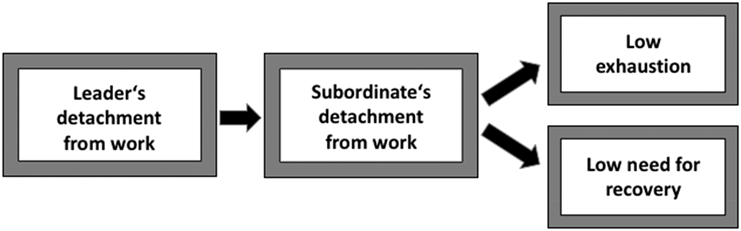
Our study contributes to the literature in several ways. First, it adds to research on job-stress recovery in general (Sonnentag, Venz, & Casper, Reference Sonnentag, Venz and Casper2017) and on research on psychological detachment in particular (Sonnentag & Fritz, Reference Sonnentag and Fritz2015) by testing leader psychological detachment from work as one potentially important predictor of employee detachment. Research has looked at individual factors as well as job stressors and resources (Bennett, Bakker, & Field, Reference Bennett, Bakker and Field2018; Wendsche & Lohmann-Haislah, Reference Wendsche and Lohmann-Haislah2017) but has largely neglected the role of leaders for employee detachment from work (for an exception, Bennett, Gabriel, Calderwood, Dahling, & Trougakos, Reference Bennett, Gabriel, Calderwood, Dahling and Trougakos2016). By examining leader psychological detachment as a potential predictor of employee psychological detachment, our study will help to better understand the factors that are important for psychological detachment from work as one core predictor of employee well-being.
Second, our study contributes to the growing literature on the role of leaders for employee mental health and well-being (Montano et al., Reference Montano, Reeske, Franke and Hüffmeier2017) by demonstrating that not only the behavior that a leader shows at work is relevant for employees, but also how the leader relates to his or her own work during nonwork time. Moreover, our study adds to the broader literature on the trickle-down model of organizational processes in which behaviors and experiences at one hierarchical level influence similar behaviors and experiences at lower hierarchical levels (Ambrose, Schminke, & Mayer, Reference Ambrose, Schminke and Mayer2013).
The Detachment Concept
Etzion et al. (Reference Etzion, Eden and Lapidot1998) introduced the concept of psychological detachment from work to the recovery and respite literature. Psychological detachment refers to the experience of gaining mental distance to one’s work while being away from the actual work situation, for instance during a free evening or during a weekend. Research has shown that psychological detachment from work during nonwork time is an important recovery experience (Sonnentag & Fritz, Reference Sonnentag and Fritz2007) and that it is positively related to employee well-being and negatively related to strain symptoms (Bennett et al., Reference Bennett, Bakker and Field2018; Wendsche & Lohmann-Haislah, Reference Wendsche and Lohmann-Haislah2017).
The Role of Leader Psychological Detachment from Work for Subordinate Detachment from Work
We propose that leader psychological detachment from work during nonwork time is positively related to subordinate psychological detachment. When a leader succeeds in gaining mental distance from work during leisure time, subordinates may feel entitled to detach themselves from work as well. When a leader, however, stays mentally connected to his or her work, subordinates will be less likely to detach as well.
Why should leader psychological detachment from work be related to subordinate psychological detachment? Although we will not be able to empirically test the underlying mechanisms that link leader psychological detachment to subordinate psychological detachment, we argue that there might be three distinct processes that help to explain why leader psychological detachment from work during nonwork time should be related to subordinate psychological detachment: (a) leader well-being, (b) refraining from actual intrusions into subordinates’ nonwork life, and (c) role modeling.
First, leader psychological detachment may be positively related to subordinate psychological detachment via leader well-being. Numerous studies have shown that psychological detachment from work is associated with positive well-being indicators, whereas lack of detachment is associated with negative well-being indicators and strain symptoms such as fatigue, impaired affect, and low vigor (Bennett et al., Reference Bennett, Bakker and Field2018; Wendsche & Lohmann-Haislah, Reference Wendsche and Lohmann-Haislah2017). These previous findings imply that leaders who detach from work during their nonwork time, they will experience a better well-being and lower strain symptoms themselves. Thus, when detaching from work during nonwork time and when being in a positive energetic state when back at work, leaders can create a favorable work environment that helps the subordinates to get work done and to perform well, what, in turn, should enable the subordinates to better detach from work after the end of the workday (Rodríguez-Muñoz, Sanz-Vergel, Antino, Demerouti, & Bakker, Reference Rodríguez-Muñoz, Sanz-Vergel, Antino, Demerouti and Bakker2018).
When leaders do not detach from their work, however, they will experience elevated strain symptoms such as fatigue or high negative affect and may lack a positive, energetic outlook on their work. When being in such a suboptimal negatively toned affective state, leaders will be less able to create a positive environment for the subordinates, they may even engage in interpersonal behaviors that their subordinates experience as stressful (Barnes, Lucianetti, Bhave, & Christian, Reference Barnes, Lucianetti, Bhave and Christian2015). Working in a demanding, stressful environment will make it less likely that subordinates detach from work (Sonnentag & Fritz, Reference Sonnentag and Fritz2015), for instance because subordinates become negatively aroused themselves.
Second, when leaders psychologically detach from work they are – by definition – mentally occupied with other activities and thoughts, for instance family activities, household chores or an enjoyable hobby. Being occupied with nonwork activities and thoughts makes it unlikely that leaders engage in job activities that could intrude into their subordinates’ nonwork life such as calling them or sending them an e-mail. When leaders, however, do not detach from work, they may be more inclined to continue working and to contact their subordinates by phone or by e-mail. Such intrusions into subordinates’ nonwork life, in turn, will make it more difficult for subordinates to detach from work (Park, Fritz, & Jex, Reference Park, Fritz and Jex2011). It might not only be the actual calls and e-mails – which in fact might happen only irregularly – that impede subordinates’ detachment processes. Even the possibility of an incoming call or an e-mail will make it more likely that subordinates stay mentally connected to their work and do not detach from it.
Third, by psychologically detaching from work during nonwork time, leaders will serve as role models for their subordinates. For instance, Koch and Binnewies (Reference Koch and Binnewies2015) have shown that when leaders segment between their own work and home life, subordinates perceive these leaders as good role models of work-life balance what in turn is related to subordinates’ own segmentation behavior between work and home. A similar process might occur for psychological detachment from work. Of course, in most instances, subordinates will not be able to directly observe their leaders mentally detaching from work. Leaders who do detach from work, however, may send signals such as telling about leisure activities they are engaging in or by refusing to read “overnight” a report that a subordinate has prepared. Relatedly, leaders who do not detach may send signals about not detaching such as telling about a new plan that developed “yesterday night”, responding to e-mails late at night or by inviting phone calls during the evening. By sending these detachment or non-detachment signals leaders communicate expectations about what is (in)appropriate behavior during free evenings or weekends. Subordinates will pick up these signals and try to meet their leaders’ expectations. Thus, even when not actively and openly intruding into their subordinates’ nonwork lives, supervisors might send subtle cues about how employees should relate to work during nonwork time. Based on this reasoning, we propose:
Hypothesis 1. Leader psychological detachment from work during nonwork time is positively related to subordinate psychological detachment from work during nonwork time.
Subordinate Psychological Detachment from Work and Subordinate Strain Symptoms
We suggest that the more subordinates psychologically detach from work during nonwork time, the lower will be the likelihood that they suffer from job-related strain symptoms. More specifically, we argue that lack of detachment will be associated with the strain symptoms exhaustion and need for recovery. Exhaustion refers to “general feelings of emptiness, overtaxing from work, a strong need for rest, and a state of physical exhaustion” (Demerouti, Bakker, Nachreiner, & Schaufeli, Reference Demerouti, Bakker, Nachreiner and Schaufeli2001, p. 503). Need for recovery refers to early fatigue symptoms that develop when employees do not find enough rest after work (van Veldhoven & Broersen, Reference van Veldhoven and Broersen2003). Need for recovery is characterized by symptoms such as “temporary feelings of overload, irritability, social withdrawal, lack of energy for new effort, and reduced performance” (p. i3). Although there is some conceptual overlap between exhaustion and need for recovery, exhaustion can be seen as a more long-term consequence of exposure to stressful and overtaxing situations, need for recovery is a more short-term indicator of overtaxing experiences.
When psychologically detaching from work, employees refrain from job-related thoughts during nonwork time and experience a “mental break” from work. According to the effort-recovery model (Geurts & Sonnentag, Reference Geurts and Sonnentag2006; Meijman & Mulder, Reference Meijman, Mulder, Drenth and Thierry1998) this mental break is important so that strain levels that did become elevated during the day at work are reduced and that negative arousal decreases, allowing the organism to unwind and recuperate from the demands at work. Thus, recovery occurs when actual stressors are not present any longer and when activation is reduced. When activation, however, is prolonged, no recovery can occur. Most obviously, employees’ activation is prolonged when they continue to think, worry, and ruminate about work-related matters – in other word when they do not detach from work. In such instances of prolonged pre-occupation with work (i.e., low detachment), no unwinding and recuperation can occur. Over time, continued high strain levels and arousal are depleting and the need to recover is not satisfied. Lack of detachment might even impair the quality of sleep (Wendsche & Lohmann-Haislah, Reference Wendsche and Lohmann-Haislah2017) what in turn will contribute to exhaustion and a high need for recovery over time (Armon, Shirom, Shapira, & Melamed, Reference Armon, Shirom, Shapira and Melamed2008; Diestel, Rivkin, & Schmidt, Reference Diestel, Rivkin and Schmidt2015). Empirical research has demonstrated that poor psychological detachment from work indeed is related to exhaustion and a high need for recovery (Sonnentag, Kuttler, & Fritz, Reference Sonnentag, Kuttler and Fritz2010).
Hypothesis 2. Subordinate psychological detachment from work during nonwork time is negatively related to (a) subordinate exhaustion and (b) subordinate need for recovery.
Linking Hypothesis 1 with Hypothesis 2, we propose that leaders’ psychological detachment from work during nonwork time is indirectly related low strain symptoms in their subordinates by stimulating psychological detachment in subordinates:
Hypothesis 3. Leader psychological detachment from work during nonwork time is negatively related to (a) subordinate exhaustion and (b) subordinate need for recovery, via subordinate psychological detachment from work.
Control Variables
When testing our hypotheses, we will control for leader-member exchange (LMX) because it may have an impact both on psychological detachment from work (Bennett et al., Reference Bennett, Gabriel, Calderwood, Dahling and Trougakos2016) and on subordinate mental health and well-being (Montano et al., Reference Montano, Reeske, Franke and Hüffmeier2017). In addition, we will control for leader negative affectivity because negative affectivity may both impede leaders’ (Wendsche & Lohmann-Haislah, Reference Wendsche and Lohmann-Haislah2017) as well as subordinates’ psychological detachment from work, for instance, by increasing social conflicts at work that, in turn, make psychological detachment from work more difficult (Sonnentag, Unger, & Nägel, Reference Sonnentag, Unger and Nägel2013). Finally, we will control for subordinate negative affectivity, because it might related to subordinates’ low detachment from work (Wendsche & Lohmann-Haislah, Reference Wendsche and Lohmann-Haislah2017) and to strain symptoms (DeNeve & Cooper, Reference DeNeve and Cooper1998)Footnote 1.
Method
Procedure and Sample
We recruited the focal study participants in Germany (i.e., the “subordinates”) by posting on social media sites (e.g., Facebook, Xing), distributing study leaflets, contacting small to medium-sized companies, and approaching personal contacts. A total of 209 persons expressed interest in the study by registering for participation. Eventually, 149 persons completed parts of a first survey, and 137 persons (65.6% of those you expressed initial interest in the study) provided data on the core study variables assessed in the first survey at Time 1 (psychological detachment from work, LMX, negative affectivity, demographic data). When completing the first survey, participants were asked to provide the e-mail address of their direct supervisor. The survey softwareFootnote 2 sent automated e-mail messages to these supervisors and created a code so that the data provided the focal participants and their respective supervisors could be matched without compromising anonymity. A total of 77 supervisors completed the supervisor survey (51.7% of the 149 persons who completed parts of the first survey), and the data of 59 supervisors could be matched to the data from the 137 focal participants. Thus for 59 focal participants, supervisory data were available. The data of each single supervisor could be match to exactly one focal participant (no nestedness in the data). One week after having completed the first survey, focal participants (i.e., “subordinates”) received an e-mail link to the second survey that assessed exhaustion and need for recovery (Time 2). Out of the 137 persons who provided valid data in the first survey, 112 persons completed this second survey (81.8% of the 137 participants at Time 1, and 53.6% of the 209 persons who initially had expressed interest in the study).
Among the 137 focal study participants, 59.9% were female. Focal participants were on average 33.1 years old (SD = 10.4) and had an organizational tenure of 5.4 years (SD = 7.1). Participants were highly educated (54.0% had a high school degree, “Abitur”) and worked in diverse range of jobs and industry types. Most participants worked between 35 and 40 hours (32.1%) or more than 40 hours per week (44.5%). On average, participants worked with their current supervisor for 3.3 years (SD = 4.1) and most of them had contact with the supervisors several times per day (73.0%) or once daily (11.7%).
Among the supervisors, 39% were female. Supervisors were on average 44.6 years old (SD = 10.5) and had a supervisory position since 9.7 years (SD = 8.2). Average span of control was 14.0 subordinates (SD = 24.1). Most supervisors worked between 35 and 40 hours (30.5%) or more than 40 hours per week (64.4%).
Although subordinates whose supervisors participated in the study were a bit older, had a longer organizational tenure and longer work relationships with their supervisors than subordinates whose supervisors did not participate in the study, none of these differences was significant. Also in terms of gender, educational background, and contact frequency between subordinates and supervisors subordinates whose supervisors participated in the study did not differ significantly from subordinates whose supervisors did not participate.
Measures
We assessed our variables with a leader and a subordinate survey administered online. All items were in German. For all scales we used the original German items or translations into German that had been used in earlier research.
Leader psychological detachment . We measured leader psychological detachment from work with the four detachment items from the Recovery Experience Questionnaire (Sonnentag & Fritz, Reference Sonnentag and Fritz2007), using a 5-point response format ranging from 1 = I fully disagree to 5 = I fully agree. A sample item is “During my free time, I forget about work” Cronbach’s alpha was .92.
Subordinate psychological detachment. We assessed subordinate psychological detachment from work with the same four items and the same response format that we used for measuring leader psychological detachment. Cronbach’s alpha was .81.
Subordinate exhaustion . We measured subordinate exhaustion with eight items from the Oldenburg Burnout Inventory (Demerouti et al., Reference Demerouti, Bakker, Nachreiner and Schaufeli2001) that allows for assessing exhaustion in a broad range of different jobs. We used a five-point response format ranging from 1 = I fully disagree to 5 = I fully agree. A sample item is “At my work, I feel increasingly drained emotionally”. Cronbach’s alpha was .81.
Subordinate need for recovery . We measured subordinate need for recovery with the 11-item scale by van Veldhoven and Broersen (Reference van Veldhoven and Broersen2003). We used a four-point response scale ranging between 1 = never and 4 = always. A sample item is “Generally, I need more than an hour before I feel completely recuperated after work”. Cronbach’s alpha was .86.
Control variables . As control variables we assessed subordinates’ perception of leader-member exchange (LMX), leader negative affectivity, and subordinate negative affectivity. Specifically, we assessed leader-member exchange with the German version (Schyns, Reference Schyns2002) of the seven-item LMX 7 scale (Graen & Uhl-Bien, Reference Graen and Uhl-Bien1995). Participants answered items such as “How well does your immediate supervisor understand your problems and needs?” on a five-point response scale ranging from 1 = not much to 5 = a great deal (the wording of the five-point response options matched the wording of the specific items and were therefore not uniform for all seven items). Cronbach’s Alpha was .87.
For assessing negative affectivity, we used the negative-affect items of the Positive and Negative Affect Schedule (PANAS; Watson et al., Reference Watson, Clark and Tellegen1988). Leaders and subordinates reported how they had felt during the last two weeks (e.g., “irritable”, “nervous”), answering the items on a five-point response scale ranging from 1 = not at all to 5 = very much. Cronbach’s alpha was .85 for leader negative affectivity and .82 for subordinate negative affectivity.
Construct validity. We used confirmatory factor analysis to examine if the scales used in the subordinate survey represent distinct constructs. Because of the relatively small sample size we used item parceling and created two two-item parcels for psychological detachment, three exhaustion parcels with two or three items each, three need-for-recovery parcels with three to four items each, and three negative-affectivity parcels with three to four items each. A five-factor model (psychological detachment, exhaustion, need for recovery, LMX, negative affectivity) with all parcels loading on the respective factors had an acceptable fit, χFootnote 2 = 107.436, df = 67, p < .001, CFI = .961, TLI = .947, RMSEA = .064. This five-factor model fit the data better than alternative models including the best-fitting four-factor model with exhaustion and need-for-recovery parcels loading on one common factor, ΔχFootnote 2 = 11.188, Δdf = 4, p = .0245, another four-factor model with detachment parcels and need-for-recovery parcels loading on one common factor, ΔχFootnote 2 = 56.973, Δdf = 4, p < .001, and a one-factor model, ΔχFootnote 2 471.551, Δdf = 10, p < .001.
Results
We tested our hypotheses in one overall path model in Mplus 7.4. To make full use of the available data (supervisory data were not available for all focal participants and not all participants provided data at Time 2), we used the MLR estimator. Table 2 shows the findings. Leader psychological detachment from work was positively related to subordinate psychological detachment, B = .323, SE = 0.095, t = 3.394, p < .01. None of the control variables was significant. Subordinate psychological detachment from work was negatively related to exhaustion, B = –.202, SE = 0.067, t = –3.009, p < .001, and to need for recovery, B = –.186, SE = 0.051, t = –3.648, p < .001, when controlling for subordinate negative affectivity. Subordinate negative affectivity in itself was strongly related both to exhaustion, B = .363, SE = 0.089, t = 4.081, p < .001, and to need for recovery, B = .323, SE = 0.065, t = 4.968, p < .001. Overall, findings are in line with Hypotheses 1, 2a, and 2b.
The indirect effect from leader psychological detachment to subordinate exhaustion via subordinate psychological detachment was –0.093, SE = 0.043, 95% CI [–0.176, –.009], providing support for Hypothesis 3a. Similarly, the indirect effect from leader psychological detachment to subordinate need for recovery via subordinate psychological detachment was –0.091, SE = 0.035, 95% CI [–0.160, –0.022], providing support for Hypothesis 3b.
Discussion
Our study shows that leader psychological detachment from work during nonwork time is related to subordinate psychological detachment. Moreover, it relates to subordinate strain symptoms (exhaustion, need for recovery) via subordinate psychological detachment from work. This finding highlights leader psychological detachment from work as one additional source of employee detachment as well as employee mental health and well-being. Interestingly, leader psychological detachment from work was a predictor of subordinate psychological detachment (and was indirectly related to subordinate exhaustion and need for recovery) whereas LMX was not. Although this finding needs to be replicated, it seems to suggest that previous research that has emphasized leader behaviors at work as predictors of employee mental health well-being (Montano et al., Reference Montano, Reeske, Franke and Hüffmeier2017) might have missed an important aspect of leaders’ influence on employee outcomes, namely leaders’ own psychological detachment from work during nonwork time. Possibly – similar to other role-modeling behaviors (Koch & Binnewies, Reference Koch and Binnewies2015; Kranabetter & Niessen, Reference Kranabetter and Niessen2017) – leaders set the tone for employee recovery in general and for psychological detachment from work in particular.
Our finding that LMX was not related to subordinate psychological detachment from work tends to be in contrast with earlier research by Bennett et al. (Reference Bennett, Gabriel, Calderwood, Dahling and Trougakos2016) who found that employees with a pondering-about-work profile had higher LMX scores than employees who had a leaving-work-behind profile. It might be that LMX has opposite influences on subordinate psychological detachment from work: As argued by Bennett et al., subordinates with a high LMX “are counted on more and have more critical tasks” (p. 1645), and are, therefore, less likely to detach from work during nonwork time. Subordinates with a high LMX, however, can trust in their supervisors and do not need to worry if there might be any problems in their relationship with their supervisors. Accordingly, they will find it easier to detach from work. It might be that, ultimately, the two processes cancel out one another, not resulting in a substantive correlation between LMX and subordinate psychological detachment from work during nonwork time. Future studies might want to disentangle the various processes that might link LMX to psychological detachment from work – or the lack thereof.
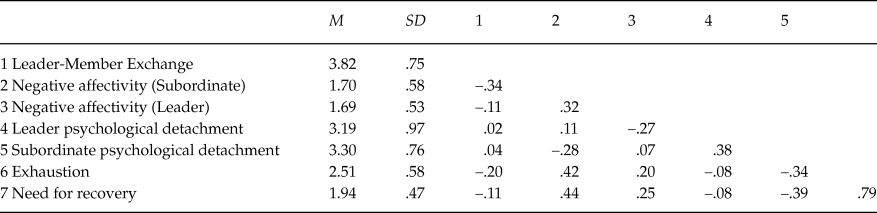
Interestingly, leader negative affectivity was positively associated with subordinate psychological detachment from work in the path model – although the two variables were unrelated when looking at the zero-order correlation (Table 1). This pattern of findings suggests a suppression effect with leader negative affectivity becoming positively related to subordinate detachment when controlling for leader detachment. Thus, when taking into account that leader lack of detachment might undermine subordinate detachment, leader negative affectivity seems to stimulate employees to detach from work, maybe in an effort to mentally withdraw from an unpleasant work situation that a leader with a high level of negative affectivity might create. Low leader negative affectivity, however, might make it desirable for subordinates to stay mentally connected to their work, even during nonwork time.
Means, Standard Deviations, and Zero-Order Correlations between Study Variables
Findings from Path Analysis Predicting Subordinate Psychological Detachment, Exhaustion, and Need for Recovery
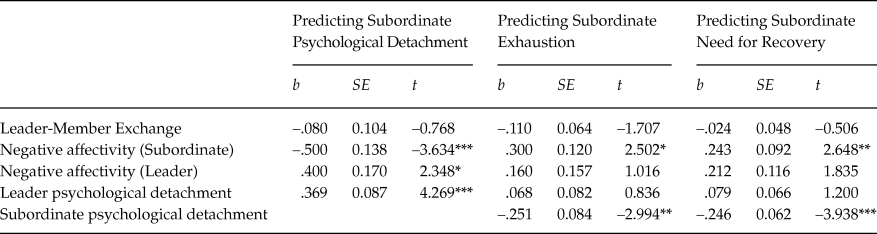
Note. b = Unstandardized coefficient; SE = Standard error.
* p < .05. ** p < .01. *** p < .001.
Our study is not without limitations. A first limitation refers to our relatively small convenience sample. Particularly with respect to the leader subsample, sample size was small. However, we made full use of the available data by using the MLR estimator in our model test. Without doubt, replication of our findings in a larger sample is needed. However, because our study participants came from a broad variety of occupational backgrounds, we are confident that our findings will generalize to some degree.
Second, our study design does not allow for causal inferences. To rule out some threads associated with common method bias (Podsakoff, MacKenzie, & Podsakoff, Reference Podsakoff, MacKenzie and Podsakoff2012), we collected the strain data one week after the other variables had been assessed. However, this time-lagged assessment does not allow any conclusions about causality. For instance, it could not only be that strain symptoms hinder employees to detach from work, it might also be that leaders who have highly exhausted team members find it more difficult to detach from work because they worry about these team members’ health or about performance problems associated with team members’ high exhaustion levels (Kranabetter & Niessen, Reference Kranabetter and Niessen2016). Therefore, future studies should implement a true longitudinal design or should try to establish causality by using an experimental approach.
After we have shown that leader psychological detachment from work during nonwork time is related to subordinate psychological detachment, future research may want to start examining the mediating pathways underlying this association. We have suggested that leader well-being, intrusions into subordinates’ nonwork life, and role modeling might play a role. For instance, future studies might examine in greater detail the specific processes that occur when subordinates accept their leaders as role models for not detaching from work (Bandura, Reference Bandura1977). Particularly because it is unlikely that subordinates directly observe their leaders in not detaching from work, it would be interesting to identify the specific non-detachment cues that leaders send so that subordinates pay attention to them, remember them, and reproduce them in their own behavior.
In addition, future research might want to explore if exposure to the same stressful work environment can account for the association between leader and subordinate psychological detachment from work during nonwork time. In the context of strain crossover, Westman (Reference Westman2001) has suggested that common stressors may cause strain reactions in two persons who share the same environment, resulting in similar strain levels in both persons. A similar process might happen with respect to the link between leader and subordinate psychological detachment from work: when both are facing similar context stressors (for instance high time pressure), they both might experience a low level of psychological detachment from work during nonwork time.
Future studies may also want to examine boundary conditions of the association between leader and subordinate psychological detachment from work. For instance, when subordinates experience low job involvement they might be less affected by their leaders’ level of psychological detachment from work. Moreover, subordinate mindfulness might play a role as well (Haun, Nübold, & Bauer, Reference Haun, Nübold and Bauer2018). When subordinates are highly mindful they might find it more easy to detach from work during nonwork time, even when their leaders stay mentally connected to work. Possibly, also leader characteristics play a role as moderators between leader and subordinate psychological detachment from work. For instance, extraverted leaders might be more likely to tell their subordinates about their work-related thoughts during nonwork time, whereas more introverted leaders might be more reluctant in disclosing their lack of psychological detachment from work.
As our research does not allow any conclusions about causality, recommendations need to be considered as preliminary. However, because our study shows that the way how leaders relate to their work during nonwork time is associated with subordinate detachment from work and subordinate strain, it is important that leaders become aware of how their lack of detachment from work during nonwork time might impact on their subordinates. A consequence could be that leaders try to achieve more psychological detachment from work, for instance by engaging in absorbing leisure activities (Hahn, Binnewies, & Haun, Reference Hahn, Binnewies and Haun2012) or by engaging in some mindfulness practice. In case leaders are unable to psychologically detach from work, they might want to find strategies about how to protect their subordinates from contagion effects, for instance by refraining from intruding into their subordinates’ nonwork life or by not telling them that they do not detach. A first important step could be that leaders become aware of their own difficulties to detach so that they can be mindful in their communication with their subordinates. Particularly during these days when many employees stay technically connected to their jobs also during after-work hours (Schlachter, McDowall, Cropley, & Inceoglu, Reference Schlachter, McDowall, Cropley and Inceoglu2018), it seems important that leaders do not encourage this constant connectivity, but instead refrain from engaging from job-related online communication.


 Open access

