


The purpose of the Pennsylvania Longitudinal Study of Parents and Children (PALSPAC) Twin Registry is to establish a population-based twin sample of multiple birth children born in Pennsylvania (PA) to address central questions of development related to mental and physical health. We are especially interested in understanding and describing the development of positive and negative health outcomes and prosocial traits through the life course, accounting for the interplay of genes and environments.
The population of PA is unique in a number of important ways that make establishing a population-based longitudinal twin registry, beginning from infancy and following children through adulthood, especially important. First, the proportion of individuals living rurally in PA is among the highest in states with large populations. In fact, due to its combination of large total population and a high percentage of rural residents (over 20%), PA has one of the largest rural populations of the USA (U.S. Census Bureau, 2012; U.S. Department of Agriculture, 2018). Thus, a PA-based twin registry will have substantial numbers of urban and rural twin-pairs — facilitating examination of life influences on developmental processes across these critically different environments. This is especially important as there has been very little genetically informed research on rural populations to date (e.g., Connolly et al., Reference Connolly, Lewis and Boisvert2017; Davis et al., Reference Davis, Natta and Slutske2017; Dick et al., Reference Dick, Bernard, Aliev, Viken, Pulkkinen, Kaprio and Rose2009; Legrand et al., Reference Legrand, Keyes, McGue, Iacono and Krueger2008). Second, PA’s level of out-migration is among the lowest in the USA, with approximately 72% of the residents being born in PA (U.S. Census Bureau, 2010, 2017). Simply put, people who are born in PA tend to stay here. This stability in the population throughout the state provides an important opportunity to follow research participants across the lifespan. In the context of behavioral genetic research, this population stability provides an especially promising opportunity to examine the influences of childhood experiences on later outcomes, with the ability to estimate relative genetic and environmental influences. Building a population-based registry in PA will facilitate research addressing how specific aspects of context, such as being in neighborhoods with low access to healthy food options, can affect the development of health problems, such as obesity.
Twin Family Recruitment
The PALSPAC Twin Registry has used two recruitment efforts with the goal of obtaining population representative samples of adolescent and child twins. The first recruitment effort was used from 2012 to 2014 and was focused on recruiting adolescent twins. The second recruitment effort is currently ongoing in partnership with the PA Department of Health (PA DOH) to recruit families with young children born in 2016–2017 (begun January 2019). During the adolescent recruitment effort, families were recruited via PA junior high/middle and high schools. We identified school districts throughout the state using a two-step approach. First, we systematically categorized schools based on population density, and then we randomly selected schools to contact within the different categories. Once the schools were identified, they were contacted by a research assistant who provided information about the registry and sought permission to provide study recruitment materials to the families of twins enrolled at that school. Schools that agreed provided the number of twin-pairs enrolled in the school, and research staff sent the recruitment materials to the school, to be sent home with the twins (recruitment letter, consent form and enrollment form). Families who were interested in participating could do so by returning the paper enrollment form or by enrolling online. Once parents completed the enrollment form, the parents and multiples were added into the registry. During this recruitment, we collaborated with individuals at other PA universities in order to increase our recruitment. One such successful collaboration was with the Pittsburgh Registry of Infant Multiples (Strassberg et al., Reference Strassberg, Peters, Marazita, Ganger, Watt-Morse, Murrelle and Vanyukov2002), which recruited families of twins from birth records at a Pittsburgh hospital. In addition, our online registry website and enrollment form enable families to find us via web searches or other means and to complete the enrollment form at any time. As time has passed, many of our twins are no longer minors, so we have modified enrollment to allow twins over the age of 18 to be a part of the registry. This recruitment approach has yielded 450 families.
The current recruitment began in 2019 in collaboration with the PA DOH. The PA DOH identified all multiple births that had occurred in PA between August 2007 and August 2017. Names and addresses of all of the mothers of twins or other multiples were extracted from these birth records. The total number of multiple births between 2007 and 2017 was approximately 50,000. We began our recruitment by selecting a random sample of 1000 families with multiple births between 2016 and 2017. Parents of twins were sent a letter about the PALSPAC: Children’s study along with the PALSPAC twin registry. We request that they complete the brief survey and registry enrollment via mail or web. Parents are sent $10 for completing the survey. The response rate from our first mailing was 13%, with 88% of those responding agreeing to become part of the PALSPAC Twin Registry. We have completed the first mailing and are in the process of attempting the two follow-up contacts permitted by our agreement with the PA DOH. For families for whom we can find a phone number or email address, we will use an alternative strategy of contact for our second and/or third contact attempt. Each subsequent contact occurs approximately a month after a prior attempt. Our second recruitment effort (ongoing) has currently enrolled 115 families. Once we have completed our pilot recruitment of 1000 families of multiples, we will evaluate our success in recruiting a sample representative of PA families (e.g., urbanicity, race and poverty). Given our early results, we anticipate continued success and will expand our registry to include more birth years. We are currently not collecting DNA for either effort.
Zygosity Determination
Zygosity is determined through parent reporting of the similarity of the twins using eight items. The measure includes how similar they are (‘as alike as two peas in a pod’ or ‘of a normal family likeness’), the probability of the twins being fraternal or identical and global similarity ratings (i.e., the extent that they cannot be told apart: family, teachers and strangers; Nichols & Bilbro, Reference Nichols and Bilbro1966).
Demographic information for our enrolled families

Note: Parent information is for mothers. MZ = monozygotic, DZ = dizygotic, GED = General Educational Development.
a Other: multiracial, don’t know.
b (1) Less than $20k, (2) more than $20k, less than $35k, (3) more than $35k, less than $60k, (4) more than $60k, less than $100k, (5) more than $100k, less than $150k and (6) more than $150k.
Data Collection Projects
The PA Twins Adolescent study was conducted from 2016 to 2017 using twins recruited from schools and collaborations with researchers at the University of Pittsburgh. The main purpose of this study was to investigate genetic and environmental influences on adolescents’ and young adults’ family and peer relationships and socioemotional adjustment outcomes (e.g., substance use, depression, problem behavior and wellbeing). Twins between the ages of 9 and 23 who were fluent in English were recruited into this study. Families were sent recruitment letters via mail or email and completed the survey via mail or web. Parents and twins over 18 provided consent and twins under 18 years of age provided assent after parental consent was obtained. Measures were focused on psychosocial development, substance use and related behaviors, interpersonal relationships, physical health and pubertal development (Table 2). Of the 327 families eligible to participate, 65% could be contacted (n = 214), and of those, 78% of parents completed the survey for both twins (n = 167) and 50% of twins completed surveys (n = 91 complete pairs). Demographic characteristics of the participating twin families are consistent with the enrolled families from the first recruitment effort (see Table 1).
Description of measures in the PA Twins Adolescent Study and PALSPAC Study
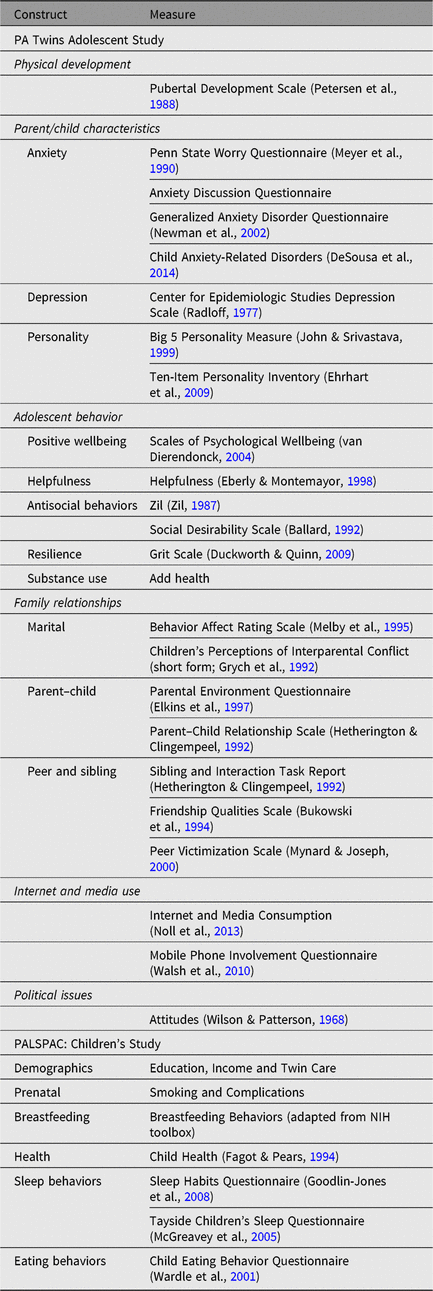
With the PA DOH recruitment, families were contacted to complete a survey with the purpose of understanding genetic and environmental influences on young children’s health. Data collection is ongoing; measures are listed in Table 2.
Demographics for Families with Multiple Births
Using data provided from the PA DOH, we examined the demographic characteristics of multiple births in PA to provide some context for our anticipated recruitment. As noted earlier, PA has a large population, with 700,391 births through the state from 2013 to 2017. During that time, 20,012 of those births were multiple births (2.9%). Using the Penn State University (PSU) Office of Management and Budget categorizations for urban and rural, we determined that approximately 12% of those multiple births were in rural areas. As expected, race and ethnicity distributions for multiple births are consistent with statewide distributions, with 72% Caucasian, 16% Black, 9% other (primarily Asian) and 3% unknown. Six percent of families with a multiple birth between 2013 and 2017 identify as Hispanic. As can be seen in Table 2, these demographics are consistent with the subset that has been recruited to date.
Data Management, Registry Access and Collaboration
The PALSPAC Twin Registry is maintained at PSU. During the recruitment phase, we ask families whether they are willing to share their information to be recruited for additional studies and investigators outside of PSU; therefore, our registry and access to the current data collection are open to other investigators, and we welcome future collaborations. We have successfully completed one such collaboration with Dr Bucan at the University of Pennsylvania who recruited twins from our first recruitment effort to participate in an actigraphy study (Gehrman et al., Reference Gehrman, Ghorai, Goodman, McCluskey, Barilla, Almasy and Bucan2019).
Future Directions
Although the PALSPAC Twin Registry is at the beginning of its enrollment, its potential as a resource for understanding rural versus urban influences is unique. Many of the twins enrolled in the first recruitment effort are nearing early adulthood (40% are 16 or older), allowing researchers to address important questions surrounding how early-life environments influence the development of health lifestyles into adulthood. Our second recruitment effort will continue to recruit families with twin children in early childhood and middle childhood. This will allow us to follow infants, children and preadolescents longitudinally. We hope to collaborate with other researchers interested in assessing these families across time to explicate the development of positive and negative health trajectories through the life course, accounting for genes and environment and their interplay. We are especially eager to incorporate the role of neighborhood context, including a nuanced assessment of rural and urban neighborhoods, and their distinct influences on the mental and physical health of children and their families.
Acknowledgements
We would like to thank all the families participating in the registry as well as research staff who have helped to manage and recruit families into the registry.
Financial support
This work was supported by institutional grants from PSU’s Social Science Research Institute, and the Center for Human and Evolutionary Diversity, and from internal research funds of Drs Neiderhiser and Cleveland.
Conflict of interest
None.
Ethical standards
The authors assert that all procedures contributing to this work comply with the ethical standards of the relevant national and institutional committees on human experimentation and with the Helsinki Declaration of 1975, as revised in 2008.



