

Introduction
[F]or in his stock a man not only finds the material content of his life but also the supreme means whereby to express and maintain his social interests and development
(Gulliver Reference Gulliver1955, 3)The value of live animals as wealth must be considered anywhere there are domestic animals
(Russell Reference Russell2012, 297)Much discussion of animal domesticates in Near Eastern Neolithic societies has centered on their use as a means of daily subsistence. While livestock certainly play a vital role in human diets, they also possess symbolic and social meanings that, in many cases, overshadow their caloric significance. Livestock are not just food; they are also wealth. To that end, we explore the value of livestock and contemplate animal wealth in the Pre-Pottery Neolithic B (PPNB) of the southern Levant (Makarewicz Reference Makarewicz2013a,Reference Makarewiczb; Rollefson Reference Rollefson, Bienert, Gebel and Neef2004, 149). The PPNB was an extended period of human experimentation with animal management that culminated in the intensification of caprine herding by the late eighth millennium bc (LPPNB), a development that coincided with a shift in how societies organized the flow of labour and surplus, especially in southern Jordan. Earlier during the ninth–early eighth millennia bc when people hunted game and tended cultivars, the central units of production and distribution were grounded in community-oriented institutions, most visible as communal structures used for ritual performance, interring the dead, and storage (Finlayson et al. Reference Finlayson, Mithen, Najjar, Smith, Maričević, Pankhurst and Yeomans2011; Makarewicz & Finlayson Reference Makarewicz and Finlayson2018). By the LPPNB, extended households replaced the community as the main organizational units of production and distribution (e.g. Banning Reference Banning2003; Finlayson Reference Finlayson, Finlayson and Makarewicz2014).
We argue that the increased importance of livestock in the LPPNB was causally connected to the broader political economic transformations—that wealth in livestock facilitated the development of the extended household as a social institution. To understand this process, we start by applying a Marxian theory of value to livestock and reflecting on the particular nature of wealth in livestock as seen in ethnographic accounts. We then borrow from African anthropology the concept of ‘wealth in people’, which refers to how household heads mobilize resources to acquire kin, clients and influence (Guyer Reference Guyer1995; Kopytoff & Miers Reference Kopytoff, Miers, Miers and Kopytoff1977; Kusimba Reference Kusimba2020). We posit that in agropastoral societies defined by household control of surplus and labour, wealth in livestock can act as a particular moment in the process of the reproduction of wealth in people.
Wealth in livestock
A Marxian theory of value
If wealth can be defined simply as accumulated value, the definition of value is far more complicated and fraught (see Graeber Reference Graeber2001; Mazzucato Reference Mazzucato2018). From the perspective of production, the value of a thing or action is constituted by the costs of creating or engaging in it, as well as the impetus for incurring such costs in the first place. The physiocrats and classical economists (including Marx) sought the source of value in land and labour, respectively. Viewing value from the perspective of exchange, Simmel (Reference Simmel1978) equated it with sacrifice. From the perspective of consumption, value reduces to desire. Hence the stress in neoclassical economics on marginal utility and scarcity. Holistically, value reflects a complex intersection of costs, desire, necessity, social needs and values (such as honour or aesthetics) and, indeed, alienation from those desires, costs and needs (see Graeber Reference Graeber2001, 76). Value, as a concept, is an abstraction that indicates these aspects of human existence, while at the same time connecting action to meaning, the past to the future.
The theory of value is perhaps most thoroughly discussed in Marx's Capital. Informed by Hegelian relational epistemology and following Aristotle (Politics, 1.1257a–1258b) as well as the political economists of his day, Marx focused on the forms in which value appears to people in a market economy as a result of the ways in which commodities are exchanged for one another (Marx Reference Marx1867, 34–53). These ‘value forms’ can be thought of as variants of exchange value (generally speaking, the price for which a commodity can be sold; Marx often referred to exchange value simply as ‘value’). These forms of exchange value played a role in the much more important and basic distinction between exchange value and use value (the physical utility of an object) (Marx Reference Marx1867, 27–30). The dialectic between these two forms of value,Footnote 1 use value and exchange value, within a commodity lies at the centre of Marxian political economics. Under capitalism, Marx saw the exchange value of commodities emerging as function of socially necessary labour time once the use value of labour power was employed by capital (Marx Reference Marx1867, 35). In the process, exchange value comes to dominate use value. Marx was not the first to identify use value and exchange value—the distinction dates back to Aristotle (Politics, 1.1257a)—he uncovered how these two forms related to one another within commodities and how the circulation of wealth involved the transmutation of one form into another.
Marx was critiquing the political economy on its own terms and was not writing a universal theory of value applicable to all cultural contexts across time and space. Thus, anthropologists have had to reconcile the theory of value laid out by Marx with the ethnographic observations that, beginning with Mauss's ([Reference Mauss1925] 2002), indicate that value goes beyond the use value/exchange value dialectic and the more specific forms of exchange value that Marx described. Anthropologists have referred to these other forms of value in different ways, but here we explicitly focus on the role of symbolic value and social value in constructing wealth. Godelier (Reference Godelier1999, 138) identified symbolic value as that which ‘realize[s] the synthesis of the real and the imaginary which make up man's social being’. The symbolic value of things connects people to religious/ritual ideas, mythological heroes and aspects of social identity. The Great Mosque of Samarra, a tallit and Nestor's cup in the Iliad all have significant symbolic value. ‘Social value’ is the capacity of something to facilitate meaningful relations between people (cf. Kusimba Reference Kusimba2021, 8). A shared meal or a gift from one's in-laws each has social value. (If these terms sound familiar, it is because they parallel the ‘social capital’ and ‘symbolic capital’ described by Bourdieu (Reference Bourdieu and Richardson1986)).
If our Marxist approach to value appears unorthodox, it is because the concepts of social value and symbolic value do not figure in Marx's work. They were not germane to his analysis of the political economy of capitalism, nor even to his less rigorous treatments of feudalism and other modes of production. We neverthelessFootnote 2 argue that these forms of value operate in every mode of production and cultural setting. Social and symbolic value are particularly dominant, as the ethnographic record shows, in political economies based around gift exchange rather than commodity exchange. Following Gregory (Reference Gregory2015), we argue that a Marxian analysis of gift economies must account for social and symbolic value, even if such an analysis may appear to stray from a strictly materialist conception of society.
Social and symbolic forms of value, while not explicitly defined as such, were crucial to Gregory's (Reference Gregory2015) Marxian/Sraffian analysis of the circulation of wealth and the reproduction of social relations in the gift economies of New Guinea. To Gregory, the key difference between gifts and commodities lies in the distinction between social value and exchange value. Gifts are inalienable, tying people together in more-or-less permanent relationships; commodities are alienable, their exchange (in theory) precludes personal relations (Gregory Reference Gregory2015, 37). This is because in gift giving, the goal is not to obtain things per se (although that is a partial goal), but to establish particular relations between the giver and receiver, namely domination of the receiver by the giver (see Gregory Reference Gregory2015, 46–7). Gifts such as pigs or shells are not reckoned quantitatively as exchange values, as commodities would be. Their value is dominated by social value, the particular relationship created by the act of giving, and symbolic value, the unique status of the shell or pig. And while these statuses can be ranked, they cannot be arithmetically reckoned such that X high-status tusked pigs equals Y regular pigs.
Forms of value can subordinate one another, as exchange value does to use value under capitalism and social and symbolic value do to use value within gift economies. But to Marx, the forms of value also exist dialectically entangled with one another in a Hegelian totality (Harvey Reference Harvey2010, 24). The apparent transformation of one form of value into another is a crucial feature, arguably the most crucial feature, of the political economic process. Thus, within a capitalist mode of production:
the daily cost of maintaining [labour-power], and its daily expenditure in work, are two totally different things. The former determines the exchange-value of the labour-power, the latter is its use-value. The fact that half a day's labour is necessary to keep the labourer alive during 24 hours, does not in any way prevent him from working a whole day. Therefore, the value of labour-power, and the value which that labour-power creates in the labour-process, are two entirely different magnitudes; and this difference of the two values was what the capitalist had in view, when he was purchasing the labour-power. (Marx Reference Marx1867, 135)
In other words, capitalists purchase labour power, foregrounding its exchange value. They then switch the lenses, as it were, and focus on the use value of labour power, monitoring it and putting it to hard work so that surplus value can be extracted from the labourer. Such a process is, by definition, exploitative. That exploitation is facilitated by, and hidden by, the shift from one form of value into another.
These lessons are important to keep in mind as we examine the value of livestock in human societies, past and present. In brief, value is multifaceted and appears to consist of different forms that are often in contradiction with one another. Moreover, it is the circulation of value, and the subtle transformation or subordination of one form into another, that lies at the heart of the political economy.
The value of livestock
A Marxian approach to value acknowledges that the value of livestock is contextual, operating differently across and within political economies. Indeed, the relation of one form of value to another is key to the constitution and reproduction of modes of production. For instance, domesticated livestock embody numerous subsistence-oriented use-values, their meat and marrow providing substantial calories for household consumption and their milk providing a seasonally renewable food source. Fibre, skin and bone, animal materials used to fashion textiles, storage and tools, provide an important means to non-caloric use values. But animals and their products can also be exchanged for money or other commodities. Is it the relationship between these use values and exchange values that plays such a determinative role in production strategies, butchery practices, consumption patterns?
Social and symbolic forms of value also inhere within livestock and their products. The skin, hair, or teeth of animals can be fashioned into prestige goods brimming with symbolic value, such as circular pig tusks in Melanesia (e.g. Bedford Reference Bedford, Langley, Litster, Wright and May2018). Meat, which has an obvious use value, can take on additional social and symbolic value at feasts, thereby serving as a means to remake political relations (Fiddes Reference Fiddes1991; Wiessner Reference Wiessner, Dietler and Hayden2001). While durable items potentially supply important reservoirs of symbolic value that can be stored, circulated and destroyed, and meat and fat can be rapidly mobilized laden with social meaning and intent, we stress, following Russell (Reference Russell2012, 297), that living animals in themselves are frequently embodiments of symbolic and social value, a fact demonstrated by the ethnographic data from every continent—from cattle in southern Africa to sheep in Southwest Asia to camelids in the Andes. As sacrificial victims, their symbolic value reproduces relations between humans and deities. As gifts, loans and bridewealth, their social value reproduces meaningful relations between people (e.g. Bohannan Reference Bohannan1959; Comaroff & Comaroff Reference Comaroff and Comaroff2006, 117; Evans-Pritchard Reference Evans-Pritchard1940; Wiessner Reference Wiessner, Dietler and Hayden2001). The symbolic value of livestock is sometimes such that owning certain animals becomes an essential element of social identity, to the point that animals become deeply intertwined with a group's self-conception—e.g. sheep among Diné (Navajo) herders (Campbell Reference Campbell2021) or zebu among Fulbe pastoralists (Pelican Reference Pelican, Khazanov and Schlee2012, 214–16).
The value of livestock is also influenced by two other features. First, wealth in livestock is mobile in ways that other forms of wealth are not. Animals’ natural mobility makes them suitable to physical translocation and transfer between people. Selling surplus offspring, giving them away as gifts, or granting rights to animals in exchange for labour are often components of effective herd management—as well as means by which the exchange value or social value of livestock is realized. No less significant is the expandability of animal herds. Although losses due to predation, disease, lost animals and theft limit growth (Salzman Reference Salzman1999), the ratio of livestock to people nevertheless has the potential to increase exponentially. The expandability of wealth in livestock can make animals attractive targets of political economic strategy. Wiessner (Reference Wiessner, Dietler and Hayden2001) argues that Enga big men transitioned from exchanging shells, stone axes and salt to raising pigs precisely because pig husbandry offered a more expandable type of wealth.
As in commodities, the forms of value that livestock take on can co-create each other. For instance, the exchange value of cattle in a market might reflect the animals’ cultural significance (symbolic value). But forms of value can also contradict each other. In particular, the subordination of one form of value by another can reveal social contradictions and frictions. For example, in his discussion of the ‘bovine mystique’ in Lesotho, Ferguson (Reference Ferguson1985) demonstrates that senior men have a vested interest in amassing cattle as a ‘“social” form of wealth’ (Ferguson Reference Ferguson1985, 667), which allows them to reproduce their power over women and juniors. On the other hand, women often deride cattle-keeping as irrational and push for the conversion of these livestock into money, thereby attempting to mobilize exchange value to undercut and subordinate the social and symbolic value of cattle.
The particular forms of value that are most meaningful in any moment are both generative of and products of socio-political dynamics. Thus, forms of value are often expressions not only of desires, necessities and social values, but also social contradictions and domination. Ferguson (Reference Ferguson1985) shows that value is inherently political, as is the suppression of debates surrounding it. His analysis also shows that the tactical deployment of forms of value and the competition between them help constitute a mode of production (see also Appadurai Reference Appadurai and Appadurai1986).
Relations of livestock production
The forms of value in which livestock appear relate to the social conditions of animal husbandry, what Marx and Engels referred to as the ‘relations of production’ (for discussion, see Patterson Reference Patterson2003, 20–22). In a capitalist mode of production, livestock appear primarily as exchange values in the stockyard and the grocery store and as use values on the table because animal production is oriented towards the market, but the ethnographic record of non-capitalist agropastoral societies indicate a number of other relations of production. Because they are usually raised by labour organized at the household level, livestock tend to be household property. Livestock often constitute a significant portion of a household's heritable property. Livestock production can therefore lay the foundation for wealth-based inequalities to accumulate over time (Borgerhoff Mulder et al. 2010; but see Salzman Reference Salzman1999; Schlee Reference Schlee, Khazanov and Schlee2012, 265).
On the other hand, while animals are usually the private property of the (male) household head, different family members, affines, kin, clan elders, political elites and stock friends may possess certain rights to those animals such that the nominal owners do not possess full usus, fructus, or abusus rights to ‘their’ animals (e.g. Evans-Pritchard Reference Evans-Pritchard1940, 17; Gulliver Reference Gulliver1955, 49–63; Khazanov & Schlee Reference Khazanov, Schlee, Khazanov and Schlee2012; Schlee Reference Schlee, Khazanov and Schlee2012). They may not be able to slaughter or sell animals without first consulting the tangled web of relations that bind together people, livestock and communities. Such intra- and extra-household relations are often the source of social value in animals—indeed, livestock may offer the primary means by which people build meaningful relations with each other (Gulliver Reference Gulliver1955, 3).
Wealth in people, wealth in livestock
We suggest that within many agropastoral modes of production, the cycling between use value, social value and symbolic value enables wealth in livestock to play a particularly prominent role in the political economy. The reason is that wealth in livestock can function to reproduce what Africanist anthropologists refer to as ‘wealth in people’, which can be thought of as a sort of congelation of social value. Wealth in people (cf. ‘relational wealth’ in Borgerhoff Mulder et al. Reference Borgerhoff Mulder, Bowles and Hertz2009) entails the ‘usually mutual, but seldom equal’ (Kopytoff & Miers Reference Kopytoff, Miers, Miers and Kopytoff1977, 7) obligations between individuals stemming from formally recognized interpersonal and typically kinship-oriented relations. Examples include the rights existing between parents and children, husbands and wives, or patrons and clients. Those who acquire wealth in people build status, assemble unique skills and gain access different forms of knowledge (Guyer Reference Guyer1995). The accumulation of wealth in people by household heads figures prominently in many societies characterized by a lack of stratification, low population density, simple means of production and no administrative apparatuses (Meillassoux Reference Meillassoux and Seddon1978; Reference Meillassoux1981, 44–5).
In her discussion of wealth in people, Kusimba (Reference Kusimba2020) stresses process as opposed to ontology—what wealth in people does rather than what it is. This perspective complements Marx's process-based theory of capital. To Marx, capital is not money, as it is often understood, but rather money is but a moment in the reproduction of capital. Capital is the circulation of use values and exchange values, which are augmented by surplus value appropriated from (the use values of) alienated labour (Marx Reference Marx1867, 107). Thus, in his M-C-M’ formula for capital, money (M) is converted into commodities (C), which are converted back (M’) into more money (Marx Reference Marx1867, 104–6).
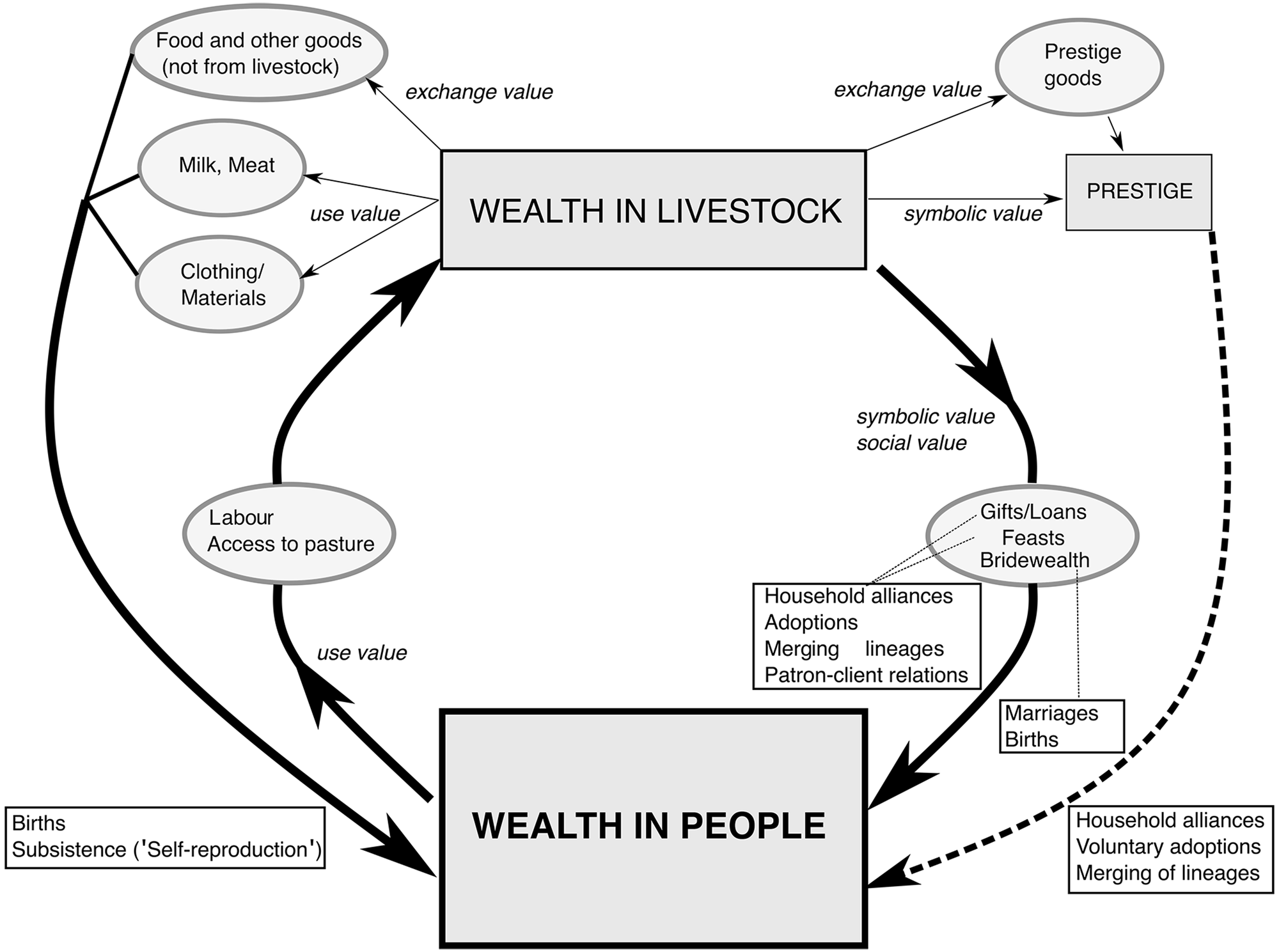
Similarly, households fluidly cycle back and forth between wealth in people and wealth in livestock or materials. Each can be thought of as distinct moments in the reproduction of wealth within a system that places emphasis ultimately on the creation of lasting (and unequal) relations between people (Kopytoff & Miers Reference Kopytoff, Miers, Miers and Kopytoff1977; Kusimba Reference Kusimba2021, 52; Meillassoux Reference Meillassoux1981, 72). The value of wealth in livestock is mobilized to acquire rights-in-people. But wealth in people plays a crucial role in building stock as it is people who provide the labour, skills and knowledge necessary for herding. In fact, labour tends to be the limiting factor in stock-keeping (Bates Reference Bates1973, 144–89; Schlee Reference Schlee, Khazanov and Schlee2012; Schneider Reference Schneider, Galaty, Aronson, Salzman and Chouinard1981). Thus, while ‘cattle beget children’, as the Zulu expression goes (Tambiah Reference Tambiah1989, 424), children, wives and clients enable the raising of cattle (Schlee Reference Schlee, Khazanov and Schlee2012, 266). In other words: wealth in people (P) is reproduced through its reciprocal relationship with wealth in livestock (L): P-L-P’ (see Figure 1).
Schematic model of the reproduction of wealth in people and wealth in livestock. Italics indicate form of value mobilized, shaded ovals indicate material significance, squares indicate means by which wealth in people or wealth in livestock is reproduced (for ethnographic parallels, see Ferguson Reference Ferguson1985, 658; Schneider Reference Schneider, Galaty, Aronson, Salzman and Chouinard1981, 216–17). For example, the use-values of livestock are mobilized in the form of milk and meat, which feed people in a household and allow for more births and thus reproduce wealth in people. The symbolic value of owning livestock generates prestige, which can reproduce wealth in people via household alliances, adoptions, or merging/grafting of lineages.
One recurring theme in the anthropological literature is that livestock are often the most significant form of wealth for the reproduction of wealth in people. Feasting provides one avenue: livestock are gathered, slaughtered and often elaborately displayed to augment one's prestige as a generous individual worthy of a following (Hayden Reference Hayden, Dietler and Hayden2001; Wiessner Reference Wiessner, Dietler and Hayden2001). Live animals can also be given as ‘loans’ or gifts to distant kin or non-kin. Gifts in livestock can support many types of relationships. For example, in Wiessner's (Reference Wiessner, Dietler and Hayden2001) ethnographic retelling of Enga oral traditions, pigs served as a form of partially alienable wealth gifted across kinship groups by big men in Tee cycles. Gifting pigs conferred status on the giver and shame on the receiver. Comaroff and Comaroff (Reference Comaroff and Comaroff1990, 205) describe how cattle were gifted outright by Tshidi chiefs to their followers; cattle could also be delivered as ‘loans’ (mahisa) by which the recipient obtained use-rights to milk and the giver received support in public life. Receivers of gifts or loans may thus effectively become clients of the ‘creditor’ (e.g. Comaroff & Comaroff Reference Comaroff and Comaroff2006, 113; Schlee Reference Schlee, Khazanov and Schlee2012).
But perhaps the most conspicuous use of livestock in the reproduction of wealth in people is bridewealth. Examples include cattle in Africa (Bohannan Reference Bohannan1959; Comaroff & Comaroff Reference Comaroff and Comaroff1990; Guyer Reference Guyer1995; Kusimba Reference Kusimba2020; Schneider Reference Schneider, Galaty, Aronson, Salzman and Chouinard1981), pigs in New Guinea (Feil Reference Feil1981; Modjeska Reference Modjeska and Strathern1982; Wiessner Reference Wiessner, Dietler and Hayden2001), or sheep and camels in the Middle East and north Africa (Bates Reference Bates1973; Peters Reference Peters, Beck and Keddie1978). Bridewealth obligations situate livestock squarely in the reproduction of wealth in people. As Kusimba puts it (2021, 55), ‘Cattle were, and are, a store of wealth-in-people held by extended family groups’.
Yet the process of cycling back and forth between wealth in livestock and wealth in people is not seamless. It tends to rely on the subordination of use values beneath social and symbolic value. For example, in Bohannan's (Reference Bohannan1959) famous description of Tiv ‘spheres of exchange’, cattle were a prestige good that could be ‘conveyed’ into other prestige goods such as iron bars or given as bridewealth to expand wealth in people. But cattle could also be milked, slaughtered, or bartered away for mundane things, such as grain or chickens. The ability to take on many forms of value makes livestock a particularly versatile ‘bank’, but it can also expose social contradictions when people disagree about which forms of value should take priority (Ferguson Reference Ferguson1985).
From community to household in the MPPNB and LPPNB
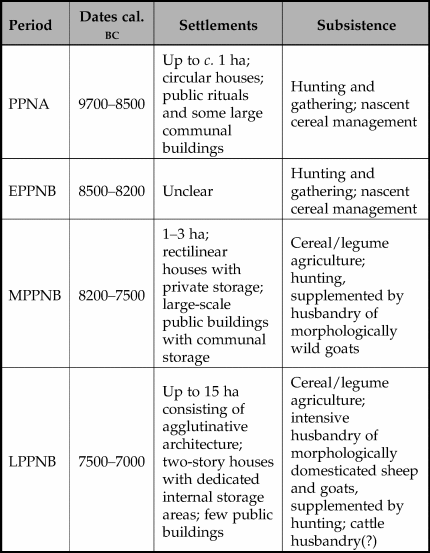
Having discussed the value of livestock within the framework of a Marxian theory of value, we now turn to the southern Levant in the Pre-Pottery Neolithic B, focusing in particular on the Jordanian highlands (Fig. 2; Table 1). Here, architectural evidence pertaining to storage and ritual activity indicates major transitions in social organization and the political economy.
Map of southern Levant MPPNB (•) and LPPNB (■) sites mentioned in the text.

Neolithic chronology of the southern Levant. Dates after Goring-Morris & Belfer-Cohen (Reference Goring-Morris and Belfer-Cohen2020).
The foundations of PPNB society in the southern Levant extend to the early Holocene, when, across the region, Pre-Pottery Neolithic A communities experimented with managing cereals, legumes and figs while continuing to gather wild plants and hunt wild ungulates, small game and birds (Arranz-Otaegui et al. Reference Arranz-Otaegui, Colledge, Zapata, Teira-Mayolini and Ibáñez2016; Horwitz et al. Reference Horwitz, Simmons, Lernau, Tchernov, Bar-Yosef, Goring-Morris and Gopher2010; Kislev et al. Reference Kislev, Hartmann and Bar-Yosef2006; White & Makarewicz Reference White and Makarewicz2012). Raising and replanting crops requires storage of seed and surplus. PPNA settlements supported large, communal granaries such as those found at Dhra’ and WF16 characterized by specially designed raised floors, presumably for storing grain (Kuijt & Finlayson Reference Kuijt and Finlayson2009). Other varied forms of communal architecture present in PPNA settlements include mortuary installations and large buildings designed for performance (Finlayson et al. Reference Finlayson, Mithen, Najjar, Smith, Maričević, Pankhurst and Yeomans2011; Kuijt & Finlayson Reference Kuijt and Finlayson2009).
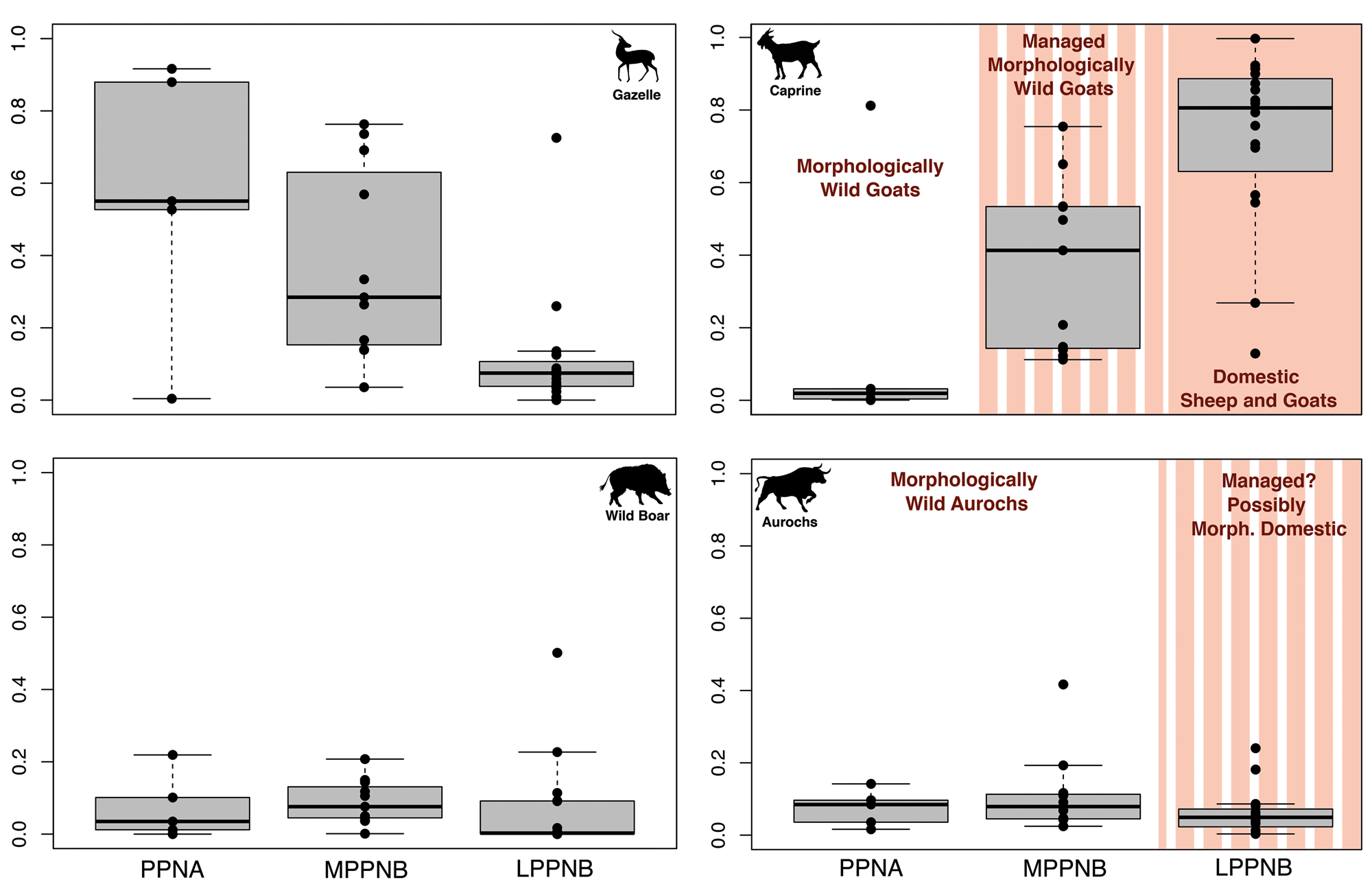
The Early PPNB in the southern Levant remains poorly understood, but by the Middle PPNB, people lived in somewhat larger settlements (up to around 3 ha in size). Among other changes, a profound shift in human-animal relationships was under way (Fig. 3), marked by increased exploitation of morphologically wild goats in the Mediterranean zone (Horwitz & Lernau Reference Horwitz and Lernau2003; Makarewicz Reference Makarewicz, Finlayson and Makarewicz2014; Makarewicz & Tuross Reference Makarewicz and Tuross2012; Munro et al. Reference Munro, Bar-Oz, Meier, Sapir-Hen, Stiner and Yeshurun2018; Wasse Reference Wasse2002).
Percentage NISP values for major ungulate species at PPNA (n=5), MPPNB (n=11) and LPPNB (n=16) sites based on published data collated by C. Makarewicz. PPNA: Gilgal I, WF16, Jericho, Nahal Oren, Hatoula; MPPNB: Abu Ghosh, Ain Ghazal, Tell Aswad, Jericho, Kfar Hahoresh, Michmar HaEmeq, Motza, Nahal Oren, Qumran Cave, Shkarat Mzeid, Yiftahel; LPPNB: Ain Abu Nukhyela, Ain Ghazal, Ain Jammam, Ba'ja, Basta, el-Hemmeh, es-Sifiya, Fidan A, Ghoraife II, Kfar Hahoresh, Khirbet Hammam, Tel Ro'im West, Tel Tifdan, Wadi Shuieb.
Meanwhile, architectural features in the MPPNB indicate shifting cultural and political economic realities. Houses appear somewhat larger and are sometimes rectilinear rather than circular or ovoid. There was also more extensive use of private storage in or near domestic units (Kuijt Reference Kuijt, Bocquet-Appel and Bar-Yosef2008b), which indicates that relations of production shifted, with individual households, rather than the community as a whole, playing a more prominent role in negotiating the flow of value and the organization of labour. Nevertheless, communal activity and storage maintained strong extra-household bonds during the MPPNB. In some places, this is manifested in architecture, particularly in southern Jordan at sites such as Beidha (Finlayson Reference Finlayson, Finlayson and Makarewicz2014; Makarewicz & Finlayson Reference Makarewicz and Finlayson2018). Further north and west of the Jordan Valley, the curation, caching and plastering of skulls may have served to reduce social differentiation and integrate households into the community (Kuijt Reference Kuijt1996; Reference Kuijt2008a).
Beginning around 7500 bc, settlements up to 15 ha in size (sometimes called ‘megasites’) consisting of agglutinative, two-storey architecture were constructed east of the Jordan Valley (Fig. 4). As settlements are more modest west of the Jordan River, some have speculated a widespread migration or at least population movement from west to east in the middle of the eighth millennium (Rollefson Reference Rollefson and Benz2010). In any event, in highland Jordan, for the first time, hundreds of people inhabited the same settlement. While people could “locate” their co-residents genealogically and socially, they would not have been able to know everyone personally, a situation that may perhaps have precipitated marked alienation within communities. This process of population expansion and settlement aggrandizement in Jordan coincided with the introduction of domesticated sheep from the north, morphological evidence of domestic sheep and goats, the intensification of caprine herding (including seasonal pasturing and provisioning with fodder), and perhaps incipient cattle husbandry (Makarewicz Reference Makarewicz, Finlayson and Makarewicz2014; Reference Makarewicz2020; Rollefson Reference Rollefson and Benz2010).
Domestic architecture illustrating the changes in household layout and social structure between the MPPNB and LPPNB. Sites include: Shkarat Msaied (image kindly provided by M. Kinzel); Ba'ja (redrawn from Gebel & Bienert Reference Gebel, Bienert, Gebel, Kafafi and Rollefson1997, 236); Basta (redrawn from Nissen et al. Reference Nissen, Muheisen and Gebel1991, 16); and Es-Sifiya (redrawn from Mahasneh Reference Mahasneh, Gebel, Kafafi and Rollefson1997, 206).
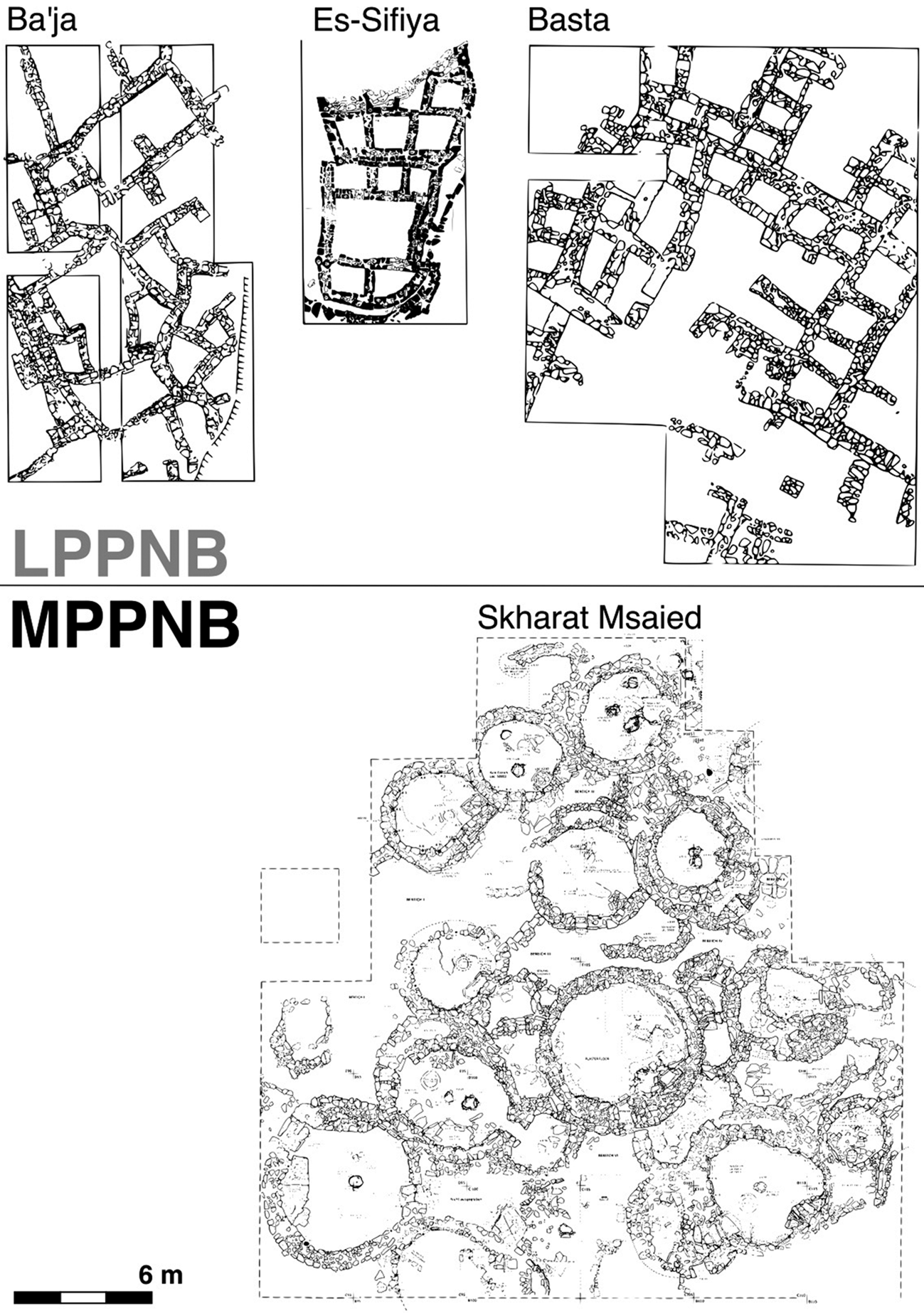
Interestingly, the LPPNB witnessed the disappearance of communal ritual structures in southern Jordan and skull plastering or caching elsewhere (Makarewicz & Finlayson Reference Makarewicz and Finlayson2018; Rollefson Reference Rollefson, Benz, Gebel and Watkins2017). The ritual structures that did exist were small and, to date, identified only at ‘Ain Ghazal in the form of 15–30 sq. m ‘shrines’ that were probably restricted to a few families (Finlayson Reference Finlayson, Finlayson and Makarewicz2014; Kuijt & Goring-Morris Reference Kuijt and Goring-Morris2002; cf. Rollefson Reference Rollefson and Benz2010). Meanwhile, larger and multi-roomed complexes indicate greater investment in domestic architecture. Many houses also contain stairways leading to second stories as well as small rooms (c. 2 sq. m), presumably for storage, hidden from public view. Compared to previous periods, LPPNB houses east of the Jordan River were more closed off from one another and space within them was devoted to storage (Byrd Reference Byrd1994; Kuijt Reference Kuijt, Bocquet-Appel and Bar-Yosef2008b).
Neolithic settlements across Eurasia were probably sites of dynamic tension between household and community institutions (e.g. Halstead Reference Halstead2014, 316). The archaeological evidence suggests that extended households had, by the LPPNB, become the dominant institution within the domains of ritual and storage. Kinship links, including those of fictive kinship, and household alliances became the primary social safety nets and means of acquiring status. Wealth in people became the dominant ‘currency’.
Thus, the LPPNB social landscape as a whole was probably defined by a good deal of inter-household competition over wealth in people, probably creating differential status among households and planting the seeds of inequality (Banning Reference Banning2003). These seeds did not, apparently, sprout. There is no clear evidence for wealth inequality in LPPNB. Exceptional individuals were able to achieve status or possibly even inherit it over the short term, as the individual in the richly furnished grave at Ba'ja might indicate (Benz et al. Reference Benz, Gresky and Štefanisko2019), but over the long term, status did not translate into heritable wealth-based inequality. Instead, individuals with non-hereditary status, perhaps first-among-equals—‘big men’ and quite possibly ‘big women’—probably competed via the accumulation of wealth in people in their lifetimes.
While there are many ways to understand the socio-cultural transformations taking place in the PPNB, the Marxist perspective would frame it as a revolution in the mode of production. This term has a complex history in anthropology and archaeology (e.g. Patterson Reference Patterson2003, 18–22; Rosenswig & Cunningham Reference Rosenswig, Cunningham, Rosenswig and Cunningham2017; Sahlins Reference Sahlins1972, 41–148), and therefore we wish to make clear how we use it. In the work of Marx and Engels, a mode of production specifically refers to how raw materials, tools, labour and the relations between people give structure to socio-economic systems, culture and even intellectual life. Modes of production are dynamic:
In the social production of their existence, [people] inevitably enter into definite relations, which are independent of their will […] The totality of these relations of production constitutes the economic structure of society, the real foundation, on which arises a legal and political superstructure and to which correspond definite forms of social consciousness […] At a certain stage of development, the material productive forces of society come into conflict with the existing relations of production […] Then begins an era of social revolution (Marx Reference Marx1859, 2)
In a Marxian framework, then, it is ‘material productive forces’ that are, in the final analysis, the prime movers of long-term social change. We suggest that in the PPNB, the main ‘material productive forces’ were those involving livestock production, which was gradually introduced in the MPPNB but became dominant in the LPPNB. That major social changes in the LPPNB occurred alongside the expansion of caprine herding and perhaps cattle husbandry is, we argue, no coincidence—as indeed others have suggested in passing (e.g. Rollefson Reference Rollefson, Bienert, Gebel and Neef2004, 149). Specifically, we suggest that livestock production taking place at the household level presented a contradiction to a pre-existing mode of production in which the community, acting almost as an institution, collectively appropriated resources, in particular those involving food production, and dominated ritual life. With the development of the livestock sector of the economy, the primary locus of surplus accumulation and labour mobilization shifted to the household.
What tipped the scales was the reciprocal circulation of wealth in livestock and wealth in people.Footnote 3 We suggest that this circulation—and not animals’ use values, per se—was the major draw of livestock production: it provided a means to translate wealth in livestock into wealth in people within a context of increasing population size and alienation within communities. This translation back and forth between the two types of wealth was made possible by the value of livestock regularly shifting between use value and social/symbolic value (Fig. 1).
Within the broader archaeological discourse surrounding the PPNB, zooarchaeologists and non-specialists alike recognize the profound impact of domestication and livestock keeping on human subsistence and dietary intake. However, while much attention is paid to precisely how husbanding animals rather than hunting them shifted human access to meat and fats, there is surprisingly little discussion exploring how other forms of value may have accrued in herd animals.
Hypothesizing wealth in livestock in the PPNB
In this section, we lay the groundwork for determining if livestock were household wealth in the LPPNB. We then turn to what we suspect were the three main uses of wealth in livestock in the LPPNB: feasting, gifts and bridewealth exchanges. The notion that livestock were household property during the LPPNB is central to hypothesizing wealth in livestock within these communities, yet admittedly difficult to establish. Nevertheless, there are archaeological correlates that would suggest the household ownership of animals (see e.g. Halstead Reference Halstead2014, 316–17). Zooarchaeological data sets, in particular, may offer some insights into whether or not ancient herd animals were vehicles for wealth accumulation, negotiation, and transfer. No line of evidence, by itself, can provide a clear indication of wealth in livestock. Yet the assemblage of multiple lines of evidence could be used to make a strong case for it in the prehistoric past.
If livestock were important sources of wealth in PPNB societies, one would expect substantial increases in the relative abundance of livestock relative to hunted animals and a general intensification of livestock husbandry. However, one could not rule out subsistence stress in driving these changes. Another possible indicator of livestock constituting wealth is body-size reduction, a consequence of herders attempting to increase the density of stock per unit area (Russell Reference Russell2012, 332). Kill-off data could also indicate the use of animals as wealth, as herders would be reluctant to slaughter their animals and thus produce a kill-off curve in which older animals are more frequently represented than expected (Russell Reference Russell2012, 332).
Feasting
One can frame feasting as ‘productive consumption’ (Marx Reference Marx1867, 130) in which animal use values (meat) are, through social negotiations instigated through the acquisition of livestock, their maintenance, and the very feast itself, subordinated under animals’ symbolic and social values, thereby converting wealth in livestock into wealth in people. The social relations forged via feasting also reflect the relations of production more broadly. For instance, community participation was likely to be quite high when large wild animals such as aurochs, used in MPPNB feasts (Goring-Morris & Horwitz Reference Goring-Morris and Horwitz2007; Meier et al. Reference Meier, Goring-Morris and Munro2017,), were hunted and processed. By assembling the labour for the hunt, gathering fuel, preparing a performative stage for communal cooking and breaking down carcasses, the community as a whole was directly linked into the process of feasting. Feasts on aurochs may therefore have served to reproduce the power of community institutions.
Unlike the more community-oriented ‘feasting process’ associated with large prey, we suggest that feasting processes involving domesticated sheep and goats, the primary species husbanded during the LPPNB east of the Jordan Valley, involved a much smaller pool of participants, reflecting the relations of production involved in caprine herding. Feasts involving sheep and goats might reasonably have served to build the prestige, and thus wealth in people, of the host household or household head, providing an avenue for the emergence and development of intra-community competition, rather than cooperation that marked earlier PPNB societies, for particular social relationships. Indeed, the level of community participation involved with the hunting, processing and consumption of aurochs may have been antithetical to the goals of low-level feasting, which may have focused more on cross-household negotiation and alliance-building.
Unfortunately, an important implication is that LPPNB feasts, taking place at the household level rather than that of the community, may not have entailed spectacular displays of meat and animal body parts—thus limiting archaeological detection. Unless intentionally placed in a structured deposit, discard from small-scale feasts could be erased by secondary disposal of waste, something perhaps necessary in the more crammed quarters of some LPPNB settlements.
Gifts (including bridewealth)
Gifts in livestock would have allowed LPPNB household heads to build wealth in people in a number of ways. They could reproduce their status as generous individuals, create relations of dependency among kin and non-kin and ease tensions with neighbours or slighted kin. Moreover, by drawing in clients and dependents from distant kin and non-kin, household heads could also gain access to pasture and additional labour needed to manage large or divided herds. Bridewealth is a particularly important form of gift-giving that negotiates the movement of women between patriarchal and patrilineal households and serves as a token of future matrimonial exchanges (see Gregory Reference Gregory2015, 67–8). If bridewealth existed in the LPPNB, it would have constituted an important means by which households could have assembled diverse skills and knowledge sets, increased the supply of surplus labour and ensured socially proper sexual reproduction (Guyer Reference Guyer1995; Meillassoux Reference Meillassoux1981; Tambiah Reference Tambiah1989).
Admittedly, gift-giving is difficult to detect archaeologically. But it is not a hopeless pursuit. For example, the movement of animals can be assessed isotopically, especially via strontium isotopes. Sjörgen and T.D. Price (Reference Sjörgen and Price2013) used strontium isotopes to infer higher rates of mobility among cattle and sheep compared to humans and pigs in Neolithic Sweden. They interpreted this as evidence of the circulation of bovid livestock among communities. Similarly, in a previous paper, we (Price et al. Reference Price, Rowan, Kersel and Makarewicz2020) suggested that unexpectedly low δ 13C values in cattle at Chalcolithic Marj Rabba indicated foddering in the Jordanian Valley and possibly the movement of these animals as gifts. Bridewealth would be particularly difficult to detect with these methods, but could potentially be determined if some human females showed complementary isotopic signatures to a small number of domestic animals across multiple sites. That is, if one could find evidence that people and animals were being translocated in opposite directions, it would support the hypothesis of bridewealth.
The case for wealth in livestock in the LPPNB
We have built a theoretical model describing how wealth in livestock may have functioned within LPPNB political economies to reproduce wealth in people. Here, we provide evidence to support the model. Invariably, as in most exercises in archaeological inference, the evidence is beset by issues of equifinality. Once we begin thinking of PPNB animal husbandry in terms of social and symbolic values, the data offer tantalizing hints of an economy in which wealth in livestock played a central role.
Wealth in livestock in the LPPNB
Architectural data offer the clearest indication that livestock were owned by households. LPPNB settlements indicate an emphasis on protecting household property and privacy—agglutinative architecture containing, in addition to larger living spaces, spaces large enough only for storage, and second storeys. There is no clear evidence for communal storage, nor for large centrally located pens for keeping animals held in common. In fact, it remains to be determined where animals were kept. At Aşıklı Höyük in Anatolia, animal pens were identified adjacent to houses via recovery of in situ dung and fetal caprines (Stiner et al. Reference Stiner, Özbaşaran and Duru2021). Animals may also have been kept in ephemeral pens located outside major settlements and along commonly used daily/seasonal routes toward pasture and water (cf. Campbell Reference Campbell2021). The latter scenario might be particularly relevant to the LPPNB, as Makarewicz's (Reference Makarewicz2017) work has shown seasonal pastoralism and broader foddering practices (Makarewicz Reference Makarewicz2013a; Makarewicz & Tuross Reference Makarewicz and Tuross2012). Currently, however, there is an absence of excavation external to LPPNB architectural complexes, but future microarchaeological work might reveal much of the spatiality of livestock keeping.
In terms of zooarchaeological data, one notable change over the course of the PPNB is the progressive increase in caprine husbandry compared to hunting. Morphologically wild goats were first managed in the MPPNB (Horwitz & Lernau Reference Horwitz and Lernau2003; Horwitz et al. Reference Horwitz, Tchernov, Ducos, Becker, von den Driesch, Martin and Garrard1999; Munro et al. Reference Munro, Bar-Oz, Meier, Sapir-Hen, Stiner and Yeshurun2018; von den Driesch & Wodtke Reference von den Driesch, Wodtke, Gebel, Kafafi and Rollefson1997), but their relative contribution to the animal economy was small (Fig. 3). The expansion of caprine husbandry in the LPPNB (accounting for a median of c. 80 per cent NISP), particularly in the Jordanian highlands, coincided with the appearance of morphologically domestic goats (with twisted horn cores and reduced body size) along with the first appearance in the region of morphologically domestic sheep (von den Driesch & Wodtke Reference von den Driesch, Wodtke, Gebel, Kafafi and Rollefson1997).
Resource stress, specifically on wild animal prey, is often framed as the primary impetus for the increase in caprine relative abundance throughout the PPNB. That is, growing Neolithic villages ramped up caprine husbandry to feed their burgeoning populations (e.g. Munro et al. Reference Munro, Bar-Oz, Meier, Sapir-Hen, Stiner and Yeshurun2018). Without denying the importance of subsistence pressure, we question whether animal use values (calories) were the only factor. We suggest that a part of the reason for the uptick in caprine husbandry in the LPPNB relates to the social and symbolic values of these animals, particularly in the context of the household eclipsing the community as the primary social institution.
Caprine kill-off data offer more tantalizing hints of wealth in livestock. By c. 7500 bc, herders across Southwest Asia practised young male kill-off, slaughtering over 90 per cent of males before 2–3 years of age (Arbuckle & Atici Reference Arbuckle and Atici2013). This harvesting practice reflects a strategy focused on maximizing the use values of meat (or, in market economies, meat's exchange value). Young male kill-off optimizes resource inputs in the form of fodder and pasture against meat yield, while also reducing overall risk to herds (e.g. Arbuckle & Atici Reference Arbuckle and Atici2013). The data from the LPPNB east of the Jordan Valley do not always conform to this pattern. Some sites, such as el-Hemmeh, do indeed show a young male kill-off pattern (Makarewicz Reference Makarewicz2013a). But at other settlements, slaughter was delayed (Fig. 5). For example, at Basta, tooth-wear data indicate c. 46 per cent of caprines were killed after reaching four years in age (wear stage G or later). At ‘Ain Ghazal and Ba'ja, herders focused on culling caprines six months to four years in age (wear stages C–F) (Makarewicz Reference Makarewicz2013a; Wasse Reference Wasse2002). Epiphyseal fusion data from these sites confirm delayed slaughter, often with sheep surviving longer than goats (Makarewicz Reference Makarewicz2013a, 251).
Kill-off patterns for caprines from LPPNB sites. Age classes (after Payne Reference Payne1973) are as follows: (A) 0–2 months; (B) 2–6 months; (C) 6–12 months; (D) 1–2 years; (E) 2–3 years; (F) 3–4 years; (G) 4–6 years; (H) 6–8 years; (I) >8 years.
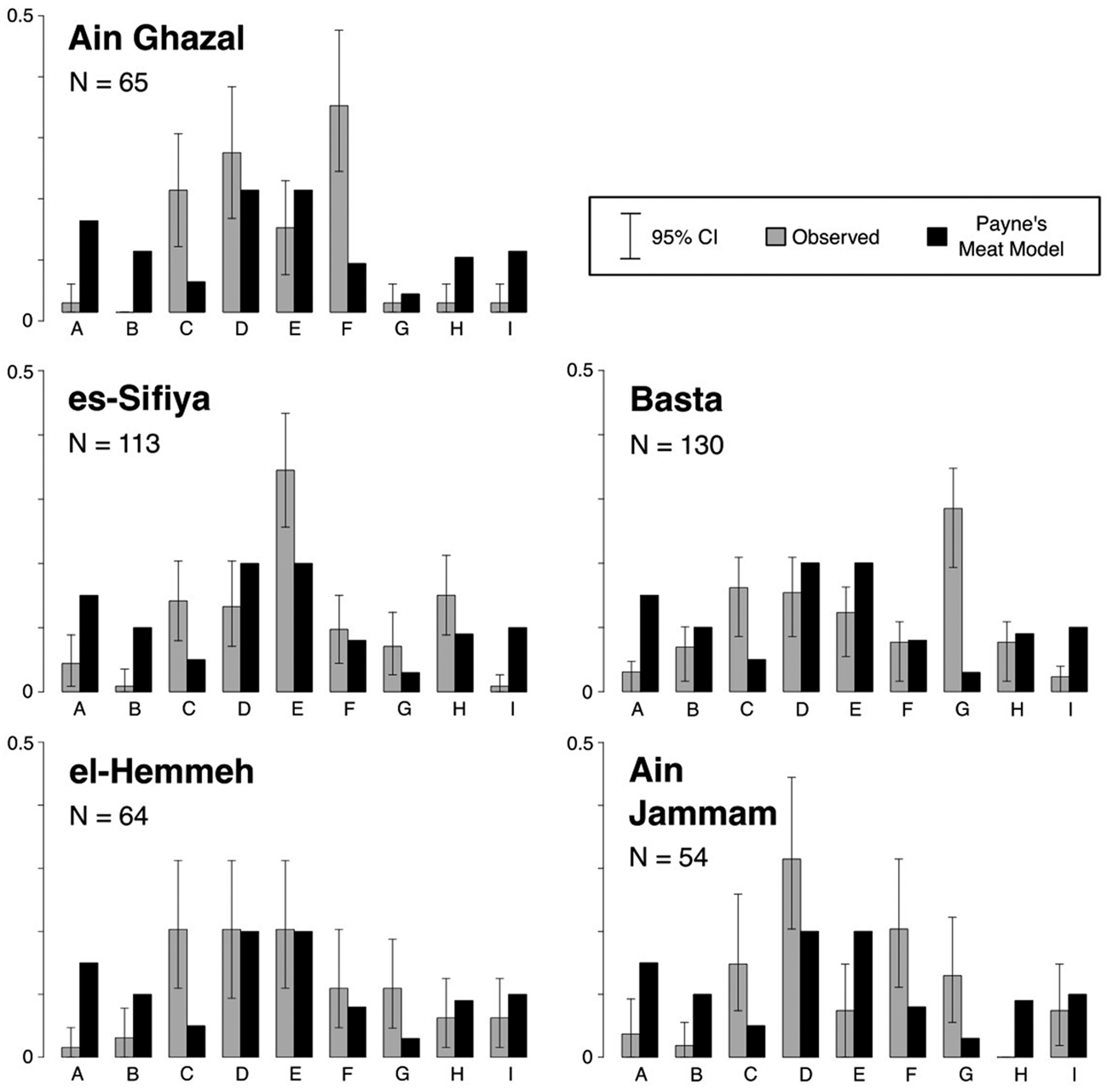
The kill-off data are consistent with Payne's (Reference Payne1973) model of intensive hair/wool production, but we find that unlikely given the lack of artifactual evidence for spinning or weaving and the lack of markets for woollen textiles in the Neolithic. We posit instead that the ‘late’ kill-off of sheep and goats at LPPNB sites in Jordan reflects a situation in which the social and symbolic value of livestock were, in some cases, subordinating the use values of those same animals. In other words, the imperative to avoid slaughtering the household's wealth led herders to delay culling their animals by several years.
Evidence for feasting, gifts and bridewealth
There is scattered evidence for feasting in the Pre-Pottery Neolithic (Goring-Morris & Horwitz Reference Goring-Morris and Horwitz2007; Meier et al. Reference Meier, Goring-Morris and Munro2017; Twiss Reference Twiss2008), but all the evidence predates the LPPNB. Prime examples come from the MPPNB mortuary site of Kfar HaHoresh, where funerary feasts focused on aurochs (Horwitz & Goring-Morris Reference Horwitz and Goring-Morris2004; Meier et al. Reference Meier, Goring-Morris and Munro2017). In contrast, there is no clear evidence for large-scale feasting on cattle or other animals during the LPPNB, with the possible exception of the burial of a pregnant cow and her fetus at Basta (Becker Reference Becker, Buitenhuis, Choyke, Mashkour and Al-Shiyab2002). Rather than reading this as evidence that feasting did not occur in the LPPNB, we suggest that it did, but on a scale small enough to limit archaeological detection. Indeed, there are some indications of small-scale feasting in the LPPNB, such as the caches of animal bones between walls at Ba'ja (Gebel Reference Gebel2002).
Gifts may be difficult to detect archaeologically, but the ethnographic record provides every indication that gift economies predominate in lieu of market economies (Gregory Reference Gregory2015). Some have speculated that shells (Bar-Yosef Mayer Reference Bar-Yosef Mayer2005) and stone beads (Benz et al. Reference Benz, Gresky and Štefanisko2019) circulated as gifts during the PPNB. If so, perhaps livestock flowed in the opposite direction, or perhaps livestock, shells and stone beads were used together to accumulate rights in people, just as shells, axes and pigs were included in bridewealth exchanges in New Guinea (e.g. Strathern Reference Strathern1979, 26). An important first step in understanding the nature of a gift economy involving livestock would be the documentation of the movement of animals. There has yet to be a large-scale study of strontium isotopes of caprines in the LPPNB, although strontium isotope ratios measured from a small sample of cattle remains recovered from Basta were interpreted to indicate limited mobility taking place near the settlement (Alt et al. Reference Alt, Benz and Müller2013). Carbon and oxygen isotope data from sheep and goats from LPPNB Ain Jammam and el-Hemmeh suggest seasonal pastoral movements along an elevational cline (Makarewicz Reference Makarewicz2017). While not indicative of gift-giving per se, such regular mobility of herds may have offered opportunities for herders to come into contact with distant kin, affines, or stock associates and reaffirm their relationships via gifts of animals.
Bridewealth is probably the most difficult use of animal wealth to identify in the archaeological record. Human skeletons from Basta exhibited high rates of congenitally missing upper lateral incisors and strontium isotopic values that were largely, although not entirely, consistent with the local geology (Alt et al. Reference Alt, Benz and Müller2013). Both types of data suggest endogamy within this LPPNB ‘megasite’, thus limiting the potential of employing isotopic evidence to document bridewealth. Beyond isotopes—and more speculatively—some have suggested that clay figurines depicting horned bovids and women from Pre-Pottery and Pottery Neolithic sites might relate to bridewealth (Orrelle & Gopher Reference Orrelle, Gopher and Kuijt2000, 304; Russell Reference Russell2012, 338), although such figurines may have alternatively been used in hunting magic or as toys (Rollefson Reference Rollefson, Bocquet-Appel and Bar-Yosef2008).
Discussion and conclusion
The widespread expansion of domesticated caprine husbandry during the LPPNB east of the Jordan Valley coincided with significant architectural and settlement that probably reflect a shift in the mode of production to one in which surplus labour was organized by extended households. We have proposed a model for how these two seemingly unrelated phenomena may have been linked. Specifically, and drawing upon the ethnographic literature of agropastoral societies, we suggest that in certain agropastoral modes of production, wealth in livestock can serve as a moment in the reproduction of wealth in people. Such cycling between forms of wealth depends on cycling between forms of value. Just as Marx saw commodities and labour shifting between use value and exchange value in the process of expanding wealth in a capitalist mode of production, we suggest, broadly following Gregory (Reference Gregory2015), that the alternation in social, symbolic and use values allowed livestock to reproduce wealth in people in many agropastoral settings in which households are the predominant socio-economic institutions.
In the ethnographic literature, feasting, bridewealth and gift-giving serve as the major means by which wealth in livestock is converted into wealth in people. By submerging use values beneath the symbolic and social value of livestock, household heads can pursue status and influence, marry off their sons/daughters, adopt new members and gain allies. These social forms of reproduction are just as important to consider as the biological necessity of subsistence, the latter of which has traditionally been the domain of zooarchaeological interest. Meanwhile, wealth in people provides households with surplus labour with which to expand their herds. A theme pervading much of the ethnographic literature is the limitations to herd growth posed by the lack of available labour. Wealth in people—as household dependents, stock friends, affines, or kin—provide a means of overcoming this barrier (see e.g. Gulliver Reference Gulliver1955, 126).
We argue that the political economic changes taking place between the MPPNB and LPPNB were both cause and effect of livestock keeping. If domestic caprines were indeed owned by households rather than collectively—a pattern that predominates through the ethnographic record—it would have undercut the basis of community appropriation of surplus (see Halstead Reference Halstead1992; Reference Halstead2014, 316–20). The mobilization of wealth in livestock in the pursuit of wealth in people would have shifted the locus of social reproduction from the community to the household. The competition for wealth in people may have been quite fierce in a social landscape defined by increasing alienation, atomization and privatization. Yet, paradoxically, the increased importance of inter-household relations and the promotion of population growth created larger, but increasingly fractionated, communities that we see archaeologically as the densely packed LPPNB ‘megasites’ in Jordan.
Livestock provided an important means by which households could accumulate surplus. Rollefson is probably correct that ‘[I]n the absence of irrigation agriculture, pastoralism was probably the only way to amass something approaching surplus wealth’ (2004, 149). However, wealth that is not in motion, not in the process of continual reproduction and transformation, grows stale; it loses the ability to act as a store of value. The key to wealth in livestock is the ways in which it can be translated into wealth in people. In doing so, they may have facilitated new forms of exploitation of the kind that Meillassoux (Reference Meillassoux1981) identified in West Africa. It is likely that household dependents, poor kin, women and even many young men in the LPPNB experienced profound levels of exploitation and mistreatment.
It is easy to imagine how competition between households for wealth in people materialized through livestock production could lay the foundations of inequality (e.g. Borgerhoff Mulder et al. Reference Borgerhoff Mulder, Fazzio and Irons2010). But several factors may have limited this development in the LPPNB, which has produced few indications of inequality. Ethnographically, expectations of mutual support, taboos against accumulating too much wealth or power and the imperative to give bridewealth in relation to one's holdings (for it is often supposed to feel like a burden) may all conspire to curtail the development of inequalities (Gulliver Reference Gulliver1955, 69; Salzman Reference Salzman1999; Schlee Reference Schlee, Khazanov and Schlee2012, 265). In the LPPNB, population densities were still probably low enough to prevent circumscription. Those frustrated with the social system could move to new pastures, so to speak. Crucially, perhaps the most important factor in limiting the development of inequality is that wealth in people is unstable. It relies on the charisma and cunning of individuals, which are difficult to pass on intergenerationally. Were livestock able to be converted with any frequency into more durable forms of wealth, such as prestige goods or media of exchange, animals might have allowed for greater economic and social stratification—as, indeed, they have in other societies (e.g. Hämäläinen Reference Hämäläinen2003). Lacking an abundance of prestige goods, high-value commodities and markets, would-be LPPNB leaders probably found themselves stuck, unable to convert any amassed wealth in livestock into anything except wealth in people.
Wealth in livestock, too, comes with its own internal contradictions. For one, herds can grow exponentially, but in the process, they undermine their future by depleting local environments and fostering resentments within communities (Boyd Reference Boyd1985; Wiessner Reference Wiessner, Dietler and Hayden2001). Moreover, the symbolic and social values of livestock can be mobilized to serve purposes other than the aggrandizement of wealth in people—e.g. sacrifices to household ancestors. Animals also possess a number of use values, the exploitation of which may come into conflict with the mobilization of symbolic and social values. You cannot, as it were, have your goat and eat it too. Disputes over status within households, inheritance and the contradictions between animals’ use values and their social/symbolic values (Ferguson Reference Ferguson1985) may have complicated the simple reciprocal generation of wealth in livestock and wealth in people shown in Figure 1. Perhaps these contradictions in wealth in people and wealth in livestock contributed to the failure of the LPPNB experiment around 7000 bc and the abandonment of most of the so-called ‘megasites’ in the Jordanian highlands.
Acknowledgements
We wish to thank Noa Corcoran-Tadd for helpful comments on an early draft of the manuscript and two anonymous reviewers for their constructive feedback. Special thanks to Moritz Kinzel for providing the architectural plan for Shkarat Msaied.


 Open access

