

Introduction
In the thriving archaeological and art historical discourse on miniaturization, the affective properties of tiny things are understood primarily through a lens of interiority and intimacy (Meskell Reference Meskell2015; Stewart Reference Stewart1984). The small details of miniature objects are thought to encourage close looking and handling, invoking experiences of familiarity, affection and attachment, and inducing a ‘dreamy reverie of contemplation, gaze, touch, and desire’ (Lloyd & Sloan Reference Lloyd and Sloan2008, 39; see also Grootenboer Reference Grootenboer2012, 180). Their accessible, non-threatening physical presence puts the user at ease. Reducing the powerful people, animals, gods, or institutions that dominate the life-size world to hand-held scale makes those authoritative forces seem less intimidating. When placed in proximity to our own, larger bodies, miniature things provide us with the chance to feel big and influential, able to rule and control ‘a daydream of a life within a life’ (Bachelard [Reference Bachelard1958] 1994; see also Bailey Reference Bailey2005, 33). In my previous work, I have utilized this intimacy approach to explain the broad appeal of figurines throughout Hellenistic Babylonia (Langin-Hooper Reference Langin-Hooper2015). In particular, I argued that the intimacy of figurines made them accessible and non-threatening role models for individuals who were processing social change and remaking their personal identities in the face of Greek immigration and widespread cross-cultural interaction in southern Iraq during the Seleucid and Parthian periods (c. 323 bce—ce 224).
Yet despite its interpretive usefulness, I argue in this article that there are also limitations to the intimacy approach to understanding miniaturization. My concern arises from a careful study of the visual characteristics of Hellenistic Babylonian figurines, primarily the way in which they were routinely covered with fingerprints, mould lines and other traces of their manufacture. These marks were noticeable evidence that the figurine was an object that was created by and existed within the life-size world. This would seem to disrupt the illusionistic potential of the miniature; yet, as will be discussed in this article's first case study, these marks were clearly intentional and thus demand an explanation. In building that explanation, I examine the figurines alongside other groups of miniature objects popularly used in Hellenistic Babylonia—coins, seals and seal impressions, and jewellery—in order to deduce commonalities in the way miniaturization was constructed, understood, and experienced in this particular society. Yet despite the Hellenistic Babylonian specificity of my case studies, I suggest that many miniature objects from other cultures and time periods have similar features and thus might benefit from similar interpretive strategies. My proposition is that wonder, in addition to intimacy, should be used as an analytical lens to explore the affective properties and effects of miniature objects.
In making this proposal, I am drawing heavily upon recent scholarship that interprets Hellenistic miniature artworks in light of Hellenistic-era texts—most particularly the Lithika poem series by Posidippus—that describe the unique sensory and emotional experiences created by small-scale objects. In analysing these poems, Kathryn Gutzwiller (Reference Gutzwiller and Gutzwiller2005, 302–3) has argued that a primary value of such miniature imagery for a Hellenistic audience was the way it compressed large-scale themes, such as the physical nature of the cosmos, into an accessible, observable size. Michael Squire (Reference Squire2011, 248) in his analysis of miniature Iliad tablets has similarly remarked on the ‘thoroughly Hellenistic concern with combining the minute with the massive’. James Porter (Reference Porter, Erskine and Llewellyn-Jones2011, 285) proposes that the appeal of such juxtapositions was not simply about small-scale refinement, but also the tension produced through the paradoxical contrast of opposites. Tension and paradox is also a theme in Verity Platt's analysis, as she argues that the miniature images on Hellenistic seals demand intimacy in viewing, but the careful study they require allows the significance of the tiny images to expand until they occupy ‘huge dimensions within the mind’ (Platt Reference Platt2006, 237). Details of these images can challenge or even elude sensory perception altogether, as Posidippus describes in the case of a carved stone where ‘you wouldn't see the chariot, except in the imprint, or feel a crease on the surface’ (Posidippus II, 39–III, 7: see Nisetich Reference Nisetich and Gutzwiller2005, 20). I have previously described such dilemmas as a refusal of intimacy by the object (Langin-Hooper Reference Langin-Hooper2020, 18–24); Squire presents them as a paradox of authority, wherein the human user exerts both physical dominance and an omnipotent viewpoint on the object, while the miniature retains the power to challenge that authority and ‘slips through our fingers’ (Squire Reference Squire2011, 247–8). Because miniatures are so small, and thus the physical properties of their materials are proportionally so large, the tension between representation and materiality is also particularly noticeable with small-scale objects. Richard Neer (Reference Neer and Elsner2020, 15) discusses this as the doubleness of beholding that is also the doubleness of wonder: the miniature ‘should seem simultaneously alien and familiar, far and close, inert and alive, absent and present’. Yet, useful as these scholarly discussions have been, they have not been unified into a coherent conceptual approach to analysing miniature objects as a corpus.
I argue that the sensory and perceptual effects of miniatures that are highlighted by Hellenistic craftsmanship and discussed by Hellenistic writers are not unique to Hellenistic small-scale art. Rather, I propose that the Hellenistic artists and writers—and the modern scholars who analyse them—have revealed something fundamental about how miniaturization works in general, which can be labelled as ‘wonder’. Wonder is created when miniature objects are sufficiently small, delicate and detailed to suggest the possibility of an intimate encounter, but also include reminders that the miniature is an object created in the life-size world, thus complicating the possibility of immersive escapism and creating an unexpected and destabilizing experience.Footnote 1 The characteristics that create such paradoxes include the compression of gigantic subject matter into a small-scale object, a significant aesthetic impact of the object despite its small size, marks of the artist's tools or hands, emphasis on the materiality of the object, scalar inconsistency within the small-scale imagery, or a resistance of miniature imagery to full sensory exploration despite the user's possession of the object as a whole. The requisite combination of scales necessary to make an object a miniature means that such paradoxical features, of one sort or another, are almost unavoidable—and thus if wonder-provoking features are intrinsic to miniaturization, then the experience of wonder with miniatures may be nearly as universal. Indeed, I argue that the push–pull tension between the closeness of intimacy and the distance of wonder is necessary for miniatures to function effectively as an object class. Miniatures are ‘miniature’, rather than just small, only if they are relational to the life-size world, and reminders of that relationality—and thus of the simultaneous existence of two different scales, and the miniature's unusual ability to exist within both as a ‘dynamic of extremes, not a choice between them’ (Porter Reference Porter, Erskine and Llewellyn-Jones2011, 288)— account not only for the appeal of miniature objects but also their social power.
In making this latter claim, I draw upon the work of Alfred Gell in his foundational discussion of the technology of enchantment.Footnote 2 Although his research was not concerned with Hellenistic art, nor with miniatures as an object type, one of Gell's primary examples of enchantment is a miniature: a scale model of the Salisbury Cathedral made from matchsticks (Gell Reference Gell, Coote and Shelton1992, 47–9). Gell explains his enchantment with the object as stemming from its familiarity and accessibility—due to his intimate knowledge of the potentials and limitations of matchsticks and glue as building materials—combined with the distancing realization that he neither possessed nor fully understood the skill and labour it took to create. In this way, the wonder created by miniatures is related to, but also distinct from, the wonder created by large-scale monuments, which is often described in ancient sources as a stunned, instantaneous response to an object that conspicuously displays evidence of the massive resources used in its making (see Hunzinger Reference Hunzinger, Destrée and Murray2015; Winter Reference Winter and Nelson2000). In contrast, miniatures require close looking and sustained contemplation to reveal the considerable skill and labour that underlies their creation—and the simple accessibility of the object's size deepens the paradox that the creation of the object is not also easily comprehensible. Gell argues that from this intersection of the accessible and the unknown emerges a desire for intellectual possession and understanding. The inability of the viewer to resolve that desire by solving the mystery creates an enduring experience of wonder, and encourages continual, repeated engagement with the object. I argue that it is this cycle of interaction between user and miniature object that underlies the mechanism by which miniatures can have widespread social impacts: every time a person is drawn into sustained contemplation of the miniature as an object, they also continually encounter the subject matter of the miniature and whatever social pressures and priorities motivated its creation. Gell's concept of enchantment is also social, for in the recognition of skill and labour, the object's viewer is also compelled to acknowledge (even indirectly) the existence of the artist, as well as the wider social world in which both the artist and the artwork participated.
This article is a meditation on adding this framework of wonder to the existing toolkit that archaeologists, anthropologists and art historians use to interpret the affective properties and social role of miniature objects. The specific case studies discussed in this article will illuminate how miniatures in Hellenistic Babylonia worked through a combination of intimacy and wonder. These case studies are presented in four groups, based on object type: figurines, coins, seals and seal impressions, and jewellery. Discussions of each object are not comprehensive in terms of their meaning, function, and archaeological context; rather, emphasis is placed on investigating how each of these miniatures could inspire wonder by disrupting a user's expectations of intimacy with the small scale. As this article will demonstrate, these manufactured strategies of wonder, and their social consequences, were as diverse as the objects themselves. It is therefore through an interpretive lens of wonder that we can better understand the nuanced and complicated social agency of miniatures—in Hellenistic Babylonia and, as I will suggest in this article's conclusion, in other times, places and cultures as well.
The quintessential miniature: figurines
Hellenistic Babylonian figurines were particularly personal miniatures. As small three-dimensional bodies, figurines allowed the human form to be caressed, manipulated and enveloped in a nearly complete way, seen and touched from all angles. Most figurines in Hellenistic Babylonia facilitated such encounters by conforming easily in size, shape, texture and durability to the human hand's ability to touch and grasp. Personal connection was also suggested by the motifs of Hellenistic Babylonian figurines, many of which evoked the idea of the everyday: mothers with babies, romantic couples, horse riders, musicians, theatrical performers, and solitary men, women and children predominated, with only a limited selection of deities or supernatural figures (Langin-Hooper Reference Langin-Hooper2020). Excavated primarily from homes and domestic refuse, this privacy makes figurines all the more personal (Menegazzi Reference Menegazzi2014). Thus, figurines were perhaps the most quintessential type of miniature in Hellenistic Babylonia—ideally suited to be experienced, and understood, as intimate.
Yet, I suggest that this intimacy was more of a seductive possibility than an automatic feature of figurines—and that the ways in which Hellenistic Babylonian figurines could create, and then disrupt, the illusion that they were intimate invitations into tiny worlds provoked the distancing sensation of wonder. Close looking and touching revealed small details on terracotta figurines, but also visible fingerprints and mould lines. The disconcerting effect of such marks can be seen on a standing female figurine (Fig. 1). The raised line of the mould join is clearly visible, marking where the front and back halves of the double moulded figurine were sealed together before firing. This indicates a less than ideal fit between those two moulded pieces of clay. Some attempt was made to smooth the join, especially at the lower legs and elbow. However, the result of this effort introduced an unnatural bluntness to the point of the elbow, a flattening which is also seen in the frontal view. Additionally, even if the two halves of this figurine had been joined more accurately and the seam disguised, the depth of the figurine would still have been greater than would be convincing for a female body of this narrow frontal width.
Front and side view of female figurine, third century bce–ce second century, Nippur (modern Iraq). Terracotta, height 11.7 cm. University of Pennsylvania Museum, B16671. (Photograph: courtesy Richard Zettler, Penn Museum.)

We might consider that mould lines, fingerprints and smoothed edges on terracotta figurines evidenced the creation of the miniature object by larger-scale human hands. This intrusion disrupted the illusion of intimacy: even if a user handled the figurine in private, the artist remained noticeably and persistently present. Mould marks in particular also signalled the mass-produced nature of a figurine that was serially manufactured in a workshop and publicly sold, thereby reminding the user that the parameters of his or her experience with the miniature object were shared by other members of the community. The elaborate swathed clothing and high double-bun hairstyle worn by the standing female figurine not only introduced fashions common across the Hellenistic world into a Babylonian home (Dillon Reference Dillon, James and Dillon2012, 265); it also suggested that many other people in the community were similarly admiring and engaging with these trends.
I argue that the unpredictable aspects of wonderment were crucial in inducing the communities of Hellenistic Babylonia to accept and use such figurines—and, in the process, to accept and internalize the particular versions of social life that the figurines represented. The figurine seen in Figure 2 offers a seemingly intimate window onto an affectionate scene of a mother cradling her baby. The nursing-mother motif had been popular among Mesopotamian figurines since the third millennium bce (Van Buren Reference Van Buren1930, xlv). But in its depiction of a contrapposto pose and complex drapery folds, this figurine was also in close dialogue with other kourotrophos [child-carrying] figurines of the broader Hellenistic world (Bonfante Reference Bonfante1984). Such iconographic hybridity opened space in Hellenistic Babylonian society for women, particularly mothers, and the children they raised also to formulate new, multicultural identities.
Front and back view of woman and child figurine, third century bce–ce second century, Babylon (modern Iraq). Terracotta, height 15.5 cm. British Museum, BM 91800. (Photograph: © Trustees of the British Museum.)
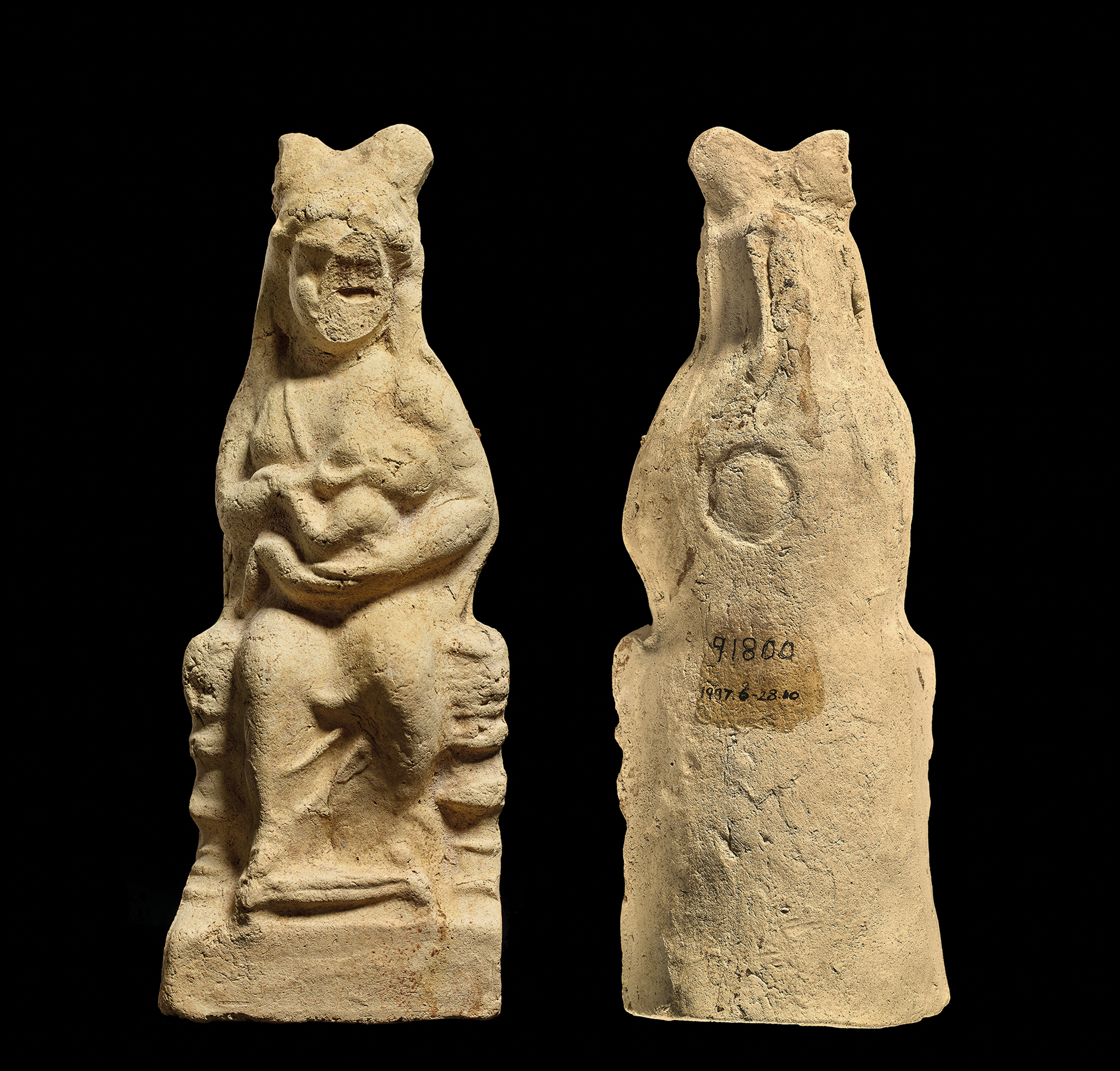
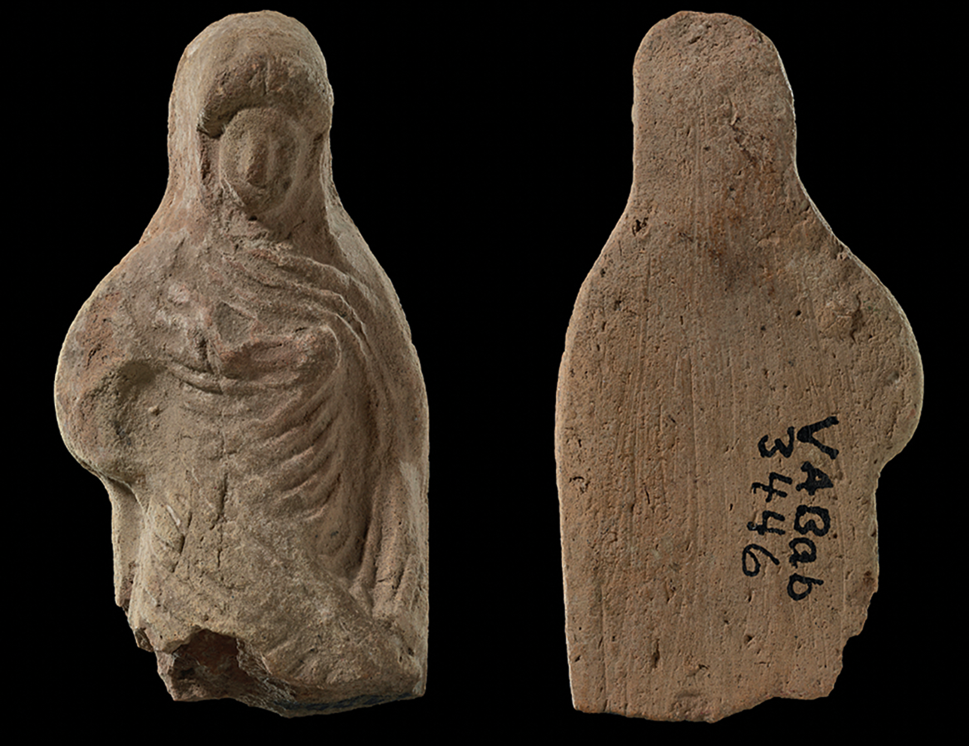
Yet the warmth and inclusiveness seen in the frontal view of this figurine was strikingly contrasted by the back. Although made in a double mould that would have allowed for elaboration, the back of the object follows only the vaguest contours of the human figure. In this, the figurine echoes earlier Babylonian traditions of single-moulded figurines that were detailed on the front but flat and unmodelled on the back. Such single-moulded figurines were still made and used in Hellenistic Babylonia, as seen in Figure 3. The mother and child figurine seen in Figure 2 is thus hybrid not only in motif and style, but also technology: a Greek double-mould was used to make a figurine that was (more or less) like the product of a Babylonian single-mould.Footnote 3 That this was a cross-cultural negotiation between technologies is particularly highlighted by the circular impression on the figurine's back. This is a cutting guideline used on double-moulded figurines which, if perforated, would have allowed hot air to escape the hollow figurine during firing. Yet this guideline was neither cut nor smoothed away. The figurine's back remained solid, like a Babylonian figurine, but with visible traces of a potential (yet unrealized) hole as a reminder of Greek technologies and craft traditions. Bearing witness to its artist's negotiation of two cultures colliding, this figurine compelled its user similarly to juggle a paradox of opposites: Greek versus Babylonian, the closeness and stability of maternal love versus evolving geo-politics and shifting social dynamics, the intimacy offered by a small-scale figure versus the distancing reminders of the life-size world and its complications.
Front and back view of female figurine, third century bce–ce second century, Babylon (modern Iraq). Terracotta, height 7.6 cm. Vorderasiatisches Museum, Berlin VA Bab 3446. (Photograph: courtesy of the Vorderasiatisches Museum.)
I propose that such paradoxes were what brought Hellenistic Babylonian people back to the figurines again and again. The prospect of intimacy with these most quintessential miniatures encouraged the human user to bring the figurine into his or her personal space—into the palm of the hand, within inches of the eyes—in the hope and expectation that the tiny thing might reveal its secrets. Yet this intimacy was not completely reciprocated by the figurine. Distant and beguiling, figurines were stubbornly insistent on their place within the social landscape as manufactured beings with the capability of real-world action. This scalar duality was alluring—as well as agentive. The motifs and iconography of Hellenistic Babylonian figurines offered carefully negotiated suggestions for acceptable personal identities and social roles, which were often culturally hybrid in form and sensitive to both Greek and Babylonian traditions. Wonder was what transformed those tiny suggestions into real-world realities. The figurine's ability to act and exist in the real world implied that its multiculturalism was already real, located simultaneously ‘out there’ in the community as well as ‘in here’ within the world of the tiny. Figurines allowed experimentation with intimate concepts such as fashion and self-presentation, aspirations and dreams, interpersonal relationships and the structure of family life—but the mould marks and fingerprints reminded their users that these personal identity formations were taking place against the backdrop of community values and trends. It was probably comforting to know that other people were experimenting with the same new ideas, negotiating cultural tensions and experiencing the same worries, wondering in the same ways.
Propaganda in your pocket: coin images of kings and gods
In contrast to figurines, coins are not usually discussed by scholars as being ‘miniatures’. Indeed, the miniaturization on coins is quite different: a largely two-dimensional image on a functional object offers haptic and visual engagements—as well as affective experiences—that differ from those provided by three-dimensional figurines. The social forces responsible for the imagery on coins also differed from figurines: with designs dictated by the palace and produced in one of the royal mints, coins were the miniatures that the king and his court wanted people to use. The people of Hellenistic Babylonia may have been particularly attuned to seeing their coins as images, and as miniatures, particularly in the early years of the Seleucid era. Prior to Alexander the Great's conquests, the Babylonian economy was based on the exchange of raw silver; Hellenistic coins thus represented the introduction of a new—and foreign—monetary instrument, which may have been held in suspicion by the local population (Erickson Reference Erickson2019; Lorber & Iossif Reference Lorber and Iossif2009). In that social moment, how faces and bodies were shown on coins might have mattered almost as much as to whom those faces and bodies belonged. The identity of the king was already known to all, but how one should relate to that king, how one should see him, was another question entirely—a question for which coins were an easy place for people to look for answers (Gariboldi Reference Gariboldi, Rollinger and Ulf2004, 366). Honorific statues might also have embodied the king in highly visible and public forms, but those statues were spatially fixed (Sheedy Reference Sheedy and Sheedy2007, 15). Coins could travel—indeed, as currency, they encouraged people to take them and move them—and thus they localized the king's portrait everywhere and nowhere simultaneously, an apparition existing across the geographic expanses of empire.
The trademark coin type of the Seleucid dynasty, especially in its eastern mints such as at their Babylonian capital city, Seleucia-on-the-Tigris, was the silver tetradrachm that featured a profile bust portrait of the king on the obverse, with the reverse depicting the god Apollo. An example of this coin type, a tetradrachm of Antiochus I, depicts the king's head in rigid profile (Fig. 4). The expressive eyes, thick wavy hair and fluttering diadem were features all shared in common with most coin portraits of the Seleucid kings, and of the Hellenistic kings more widely, while the sharply pointed nose and strong chin were characteristic portrait features of Antiochus I (Erickson & Wright Reference Erickson, Wright and Holmes2011, 164). This personal specificity of the coin image suggests an alluring offer of intimacy with the king, while the intense focus on the king's head, which seems scarcely contained within the pictorial space of the metallic disk, conveys a thrill of immediate royal presence. His tiny face was here, within the user's grasp, to be jangled in the purse, caressed by the thumb, hidden for safekeeping, or exchanged in the marketplace. To a certain degree, the connection and control that coins offered was real. Despite being made of durable metals, coins regularly wore down with use. Exchange after exchange, the rubbing of fingers across the king's visage gradually reduced his features to a cartoonish outline (Boardman Reference Boardman2016, 205). A coin like that in Figure 4, that still preserves the crispness of the mint, is a functionless coin, intact because it did not do much, if any, work to power the exchange economy. The king presumably wanted his face to be touched, used, earned and spent, with the inevitable result that it would, eventually, be worn away.
Tetradrachm of Antiochus I, depicting royal portrait (obverse) and seated Apollo (reverse), 281–261 bce, Seleucia-on-the-Tigris (modern Iraq). Silver, diameter 2.5 cm. Getty Museum, Villa 80.NH.2.27. (Photograph: courtesy J. Paul Getty Museum, Villa Collection, Malibu, California, Gift of Chester B. Franz.)
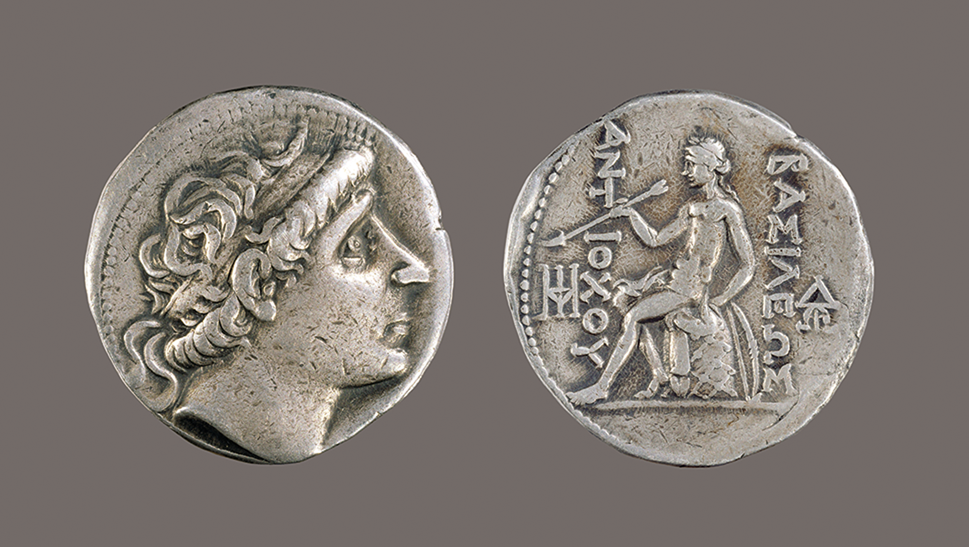
Yet the illusion of royal access was not unfettered; coin imagery also placed limitations on the user's imagined control of the king in miniature. For instance, the neck of the royal portrait is finished-off or deliberately cut. This conceit of portraiture makes clear that the image was, in fact, an artificial and partial representation of the royal person, rather than a window onto his complete body. Miniaturization compounded this effect by making the situation difficult to assess at first glance. Lured into engagement with the coin by the promise of royal connection, it is only upon close inspection that the viewer realized the nature of the illusion. This artificiality of Seleucid royal coin portraits differs sharply from earlier Mesopotamian depictions of the king, which present the entire royal body as a means to demonstrate and ensure the health and completeness of the royal person. Seen through Babylonian eyes, the sliced neck of the king's coin portrait, along with his lack of a body, could have been interpreted as a suggestion of trauma and death. Even on Achaemenid Persian coins, small numbers of which circulated in Babylonia prior to Alexander's conquests, the Persian king was depicted in either full-length view, fully contained by the coin, or in a half-length view that appeared to continue unruptured off the coin's pictorial plane (Garrison Reference Garrison, Curtis and Simpson2010). The Seleucid coins thus introduced to Babylonia not only new ways of seeing the king, but also new ways of wonderment—or, perhaps more accurately, wondering. Was the king's body really flawed, at risk, or even absent? The distant gaze of the king further contributed to this tension. Any attention paid to the image, any attempt at initiating eye-contact or intimacy with the figure, would not be reciprocated. Divinity, rather than mortality, occupied the king's gaze: if his line of sight were to be followed around the edge of the coin it would meet the gaze of the god on the opposite side. This distancing operated in uneasy tension with the first-glance illusion of direct access. The intensity of the king's large, ever-present face compared with his severed neck and absent body—these paradoxical features elided admiration and suspicion, charmed astonishment and disappointed revulsion.
The most common of the Seleucid deity reverse types, especially in coins minted in the eastern part of the Seleucid Empire that included Babylonia, was the Apollo Toxotes (offering/holding a bow or arrows) seen on the coin in Figure 4 (Erickson & Wright Reference Erickson, Wright and Holmes2011, 163–8). Framed on either side by the name and title (‘Basileos’) of the king, the nude Apollo lounges on his netted omphalos stone (‘navel’ of the world and symbol of Apollo's cult centre at Delphi, Greece), with a bow in his lap and holding an arrow in his outstretched right hand. While, like the king, the god did not meet the user's gaze, Apollo's relaxed, nude body was provided for the user's inspection, ownership and control—provided one could see it. Indeed, these coins are intricately detailed but difficult to fully appreciate without artificial magnification. Apollo here is several degrees of magnitude smaller than Antiochus, reduced in scale so that his entire body is easily contained, fitting comfortably in a space that is full to bursting with the king's head on the other side. The singling out of divine bodies on coins for maximal miniaturization that eludes human perception took them out of the realm of the intimately accessible and challenged the authority of the viewer.
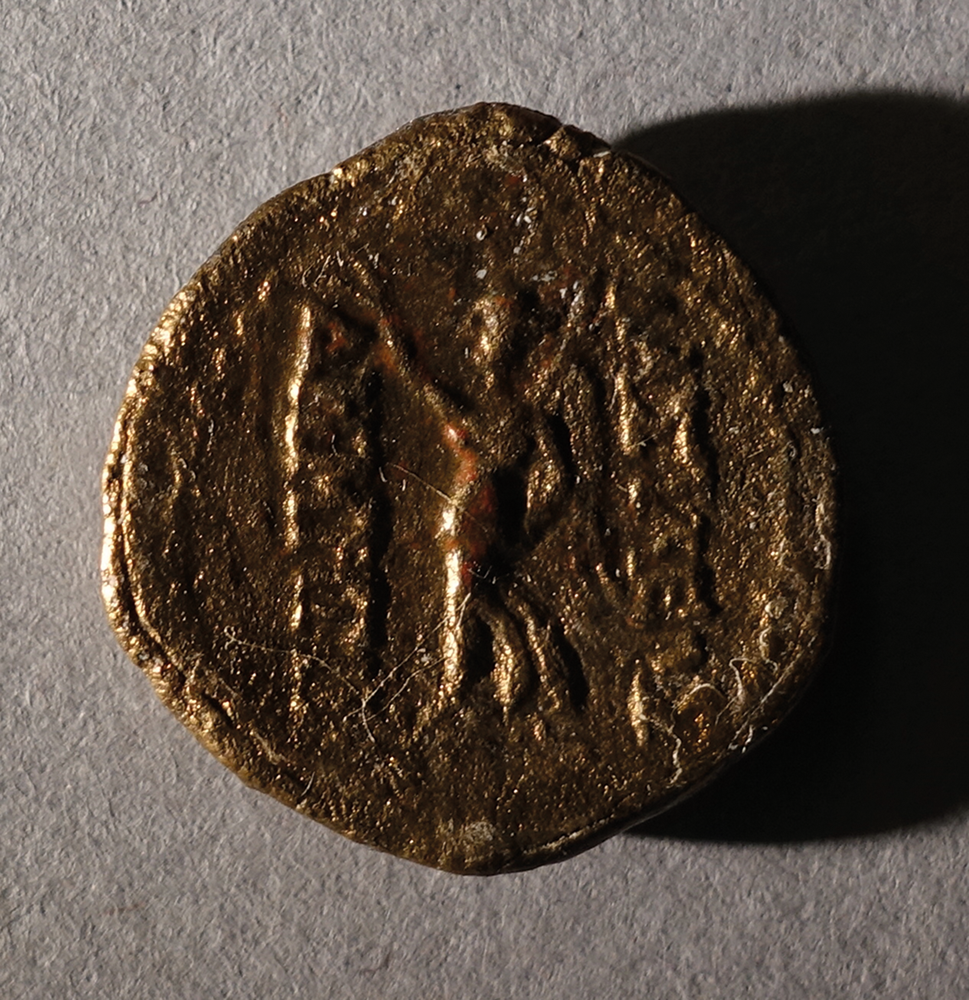
Yet, at the same time that the figure of Apollo shrinks almost beyond sight, his outstretched arm positions his arrow to slice neatly through the text of the king's name, which appears as part of the coin legend. The third letter (the Greek tau) and fourth letter (the Greek iota) in ‘Ἀντίοχος’ move apart to allow Apollo's arrow to pass, while Apollo's right hand, which holds the arrow, seems to nudge against the tau with sufficient force to push it slightly out of alignment (further down/to the viewer's left) as compared with the first two letters in the name. In this spatial flexibility, the inscription seems to function almost as a three-dimensional object in the scene, and yet it seems unlikely that viewers imagined the king's name to exist at god-like scale, hovering before the deity. Rather, this interaction of god with text must be taking place on the surface of the coin itself. An even more obvious example of this visual play with scale and surface can be seen in a bronze coin minted by Demetrius I (Fig. 5). On the coin's obverse, the winged goddess Nike reaches up to crown the king's name with a victory wreath—an action that does not exist in the real (or even supernatural) world, but can only exist on, and as part of, the coin as object. This forceful presentism of the image implies—or at least raises the possibility—that the god or goddess is actually miniature, and not just small as a necessity of the pictorial space. The contradiction offered by such coins was thus that Nike and Apollo were literally here, tethered to a coin and small enough to fit in your pocket, and yet also quite firmly were there, barely perceivable in an unidentifiable no-place outside the normal laws of reality.Footnote 4
Reverse of coin of Demetrius I, depicting Nike, 161–150 bce, Seleucia-on-the-Tigris (modern Iraq). Bronze. Kelsey Museum of Archaeology, KM 1985.04.0049.001. (Photograph: courtesy Kelsey Museum of Archaeology.)
Paradox was thus central to how Hellenistic Babylonian coins functioned as miniature artworks—and, to some extent, how they functioned as monetary instruments. As the surfaces of officially produced, publicly traded currency, coin miniatures were not an obvious place for an ancient viewer to look for intimacy. Yet the visual details of these images suggest that they were carefully crafted to provide such unexpected access to, and connection with, the faces and bodies of kings and gods. I argue that this alluring intimacy of coin miniatures was deliberately deployed by Seleucid kings eager to entice Babylonians into using coinage.Footnote 5 And yet, full intimacy with coin miniatures was not encouraged: the deliberate artifice of these tiny images, representations of bodies shown existing in ways no living human could approximate (sliced at the neck, consorting with inscriptions), created distance between miniature and viewer. This tension of charming enticement and unsettling distance is the pleasure–pain of wonder, and it kept people coming back for more—in this case, returning to these objects as an attractive form of currency that replaced older Babylonian systems based on weights of raw, undecorated metal. The unresolvable intrigue of the coin as miniature thus became a powerful tool to control economic behaviour and persuasively construct political power.
Impressing community: seals as tools of world-building
In between the home-based privacy of figurines and the official government-sanctioned coins existed privately owned, publicly used seals. Hellenistic Babylonian seals themselves, either intaglio rings (with the seal design engraved directly into the metal) or carved seal stones set into a metal ring, are infrequently preserved. Yet evidence from surviving seal impressions, which number in the tens of thousands and have been recovered from archives in palaces, temples, administrative buildings and private residences in Hellenistic Babylonia, attests to the widespread popularity and use of this type of miniature object by private individuals wealthy enough to participate in relatively high-value economic transactions. Economic contracts were still sometimes written in Akkadian, and then sealed, on clay cuneiform tablets, particularly in the cities of Uruk and Babylon. The practice of impressing in clay was also adapted to parchment and papyrus documents written in Greek and Aramaic: the strings that tied such documents could be encased with clay and sealed, or the whole document could be wrapped with a ‘napkin ring’ of clay (called a bulla), which would be sealed by the transaction's participants.
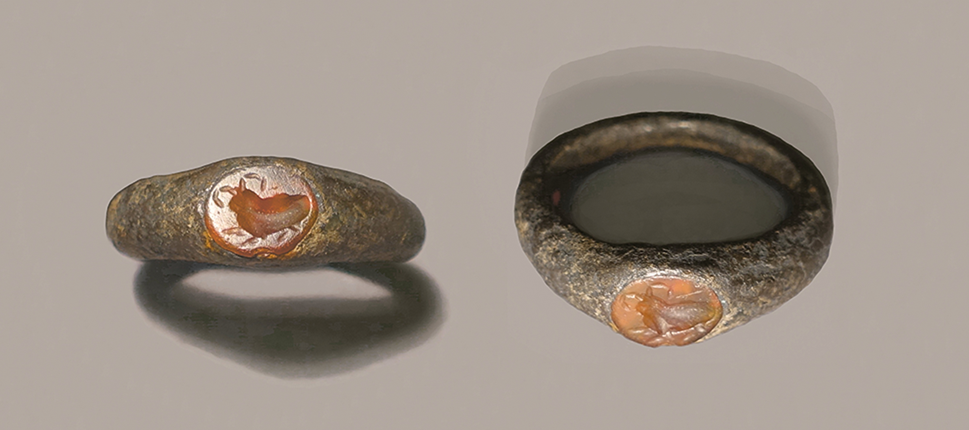
Governmental seals used for administrative purposes were usually non-figurative, bearing an inscription only; however, the design of nearly every privately owned seal in Hellenistic Babylonia contained a miniature image (Wallenfels Reference Wallenfels2016, 17–19). On the seal itself, as seen with the carved seal stone in Figure 6, the miniature image was inverted, appearing as a surface indentation. Indeed, it can be particularly hard to see—and, especially, to identify fine details—on a seal unless the light is hitting the stone or metal at precisely the correct angle. Instead, seals were only fully realized—both as miniature images and in their functional capacity—when impressed into the clay of a cuneiform tablet or bulla. The power to create images in infinite replication, such as repeated impressions from a single seal, held cosmic significance in Mesopotamia (Bahrani Reference Bahrani2014, 115–44; Platt Reference Platt2006, 239). I argue that the fact that the imagery on Hellenistic Babylonian seals was miniaturized would have intensified this sense of god-like authority. Seals not only enabled their users to bring forth a divine presence, wherever and as often as they liked, but also granted their users scalar superiority and dominance over the god that was produced.
Two views of ring, set with red stone seal depicting ram facing left, c. 312 bce–ce 200, Seleucia-on-the-Tigris (modern Iraq). Bronze and stone, width of seal 6 mm. Kelsey Museum of Archaeology, KM 2018.01.0572. (Photograph courtesy Kelsey Museum of Archaeology.)
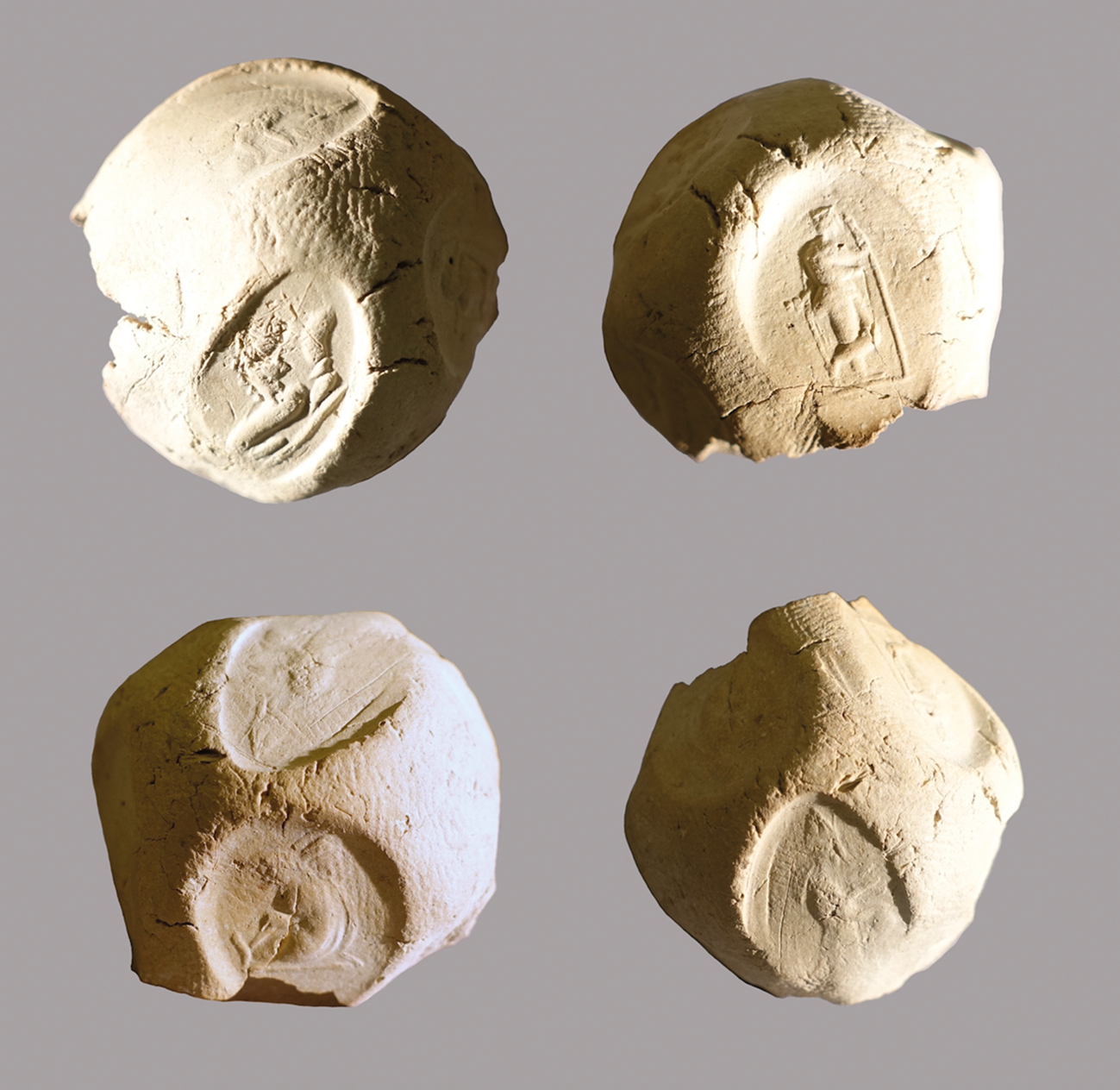
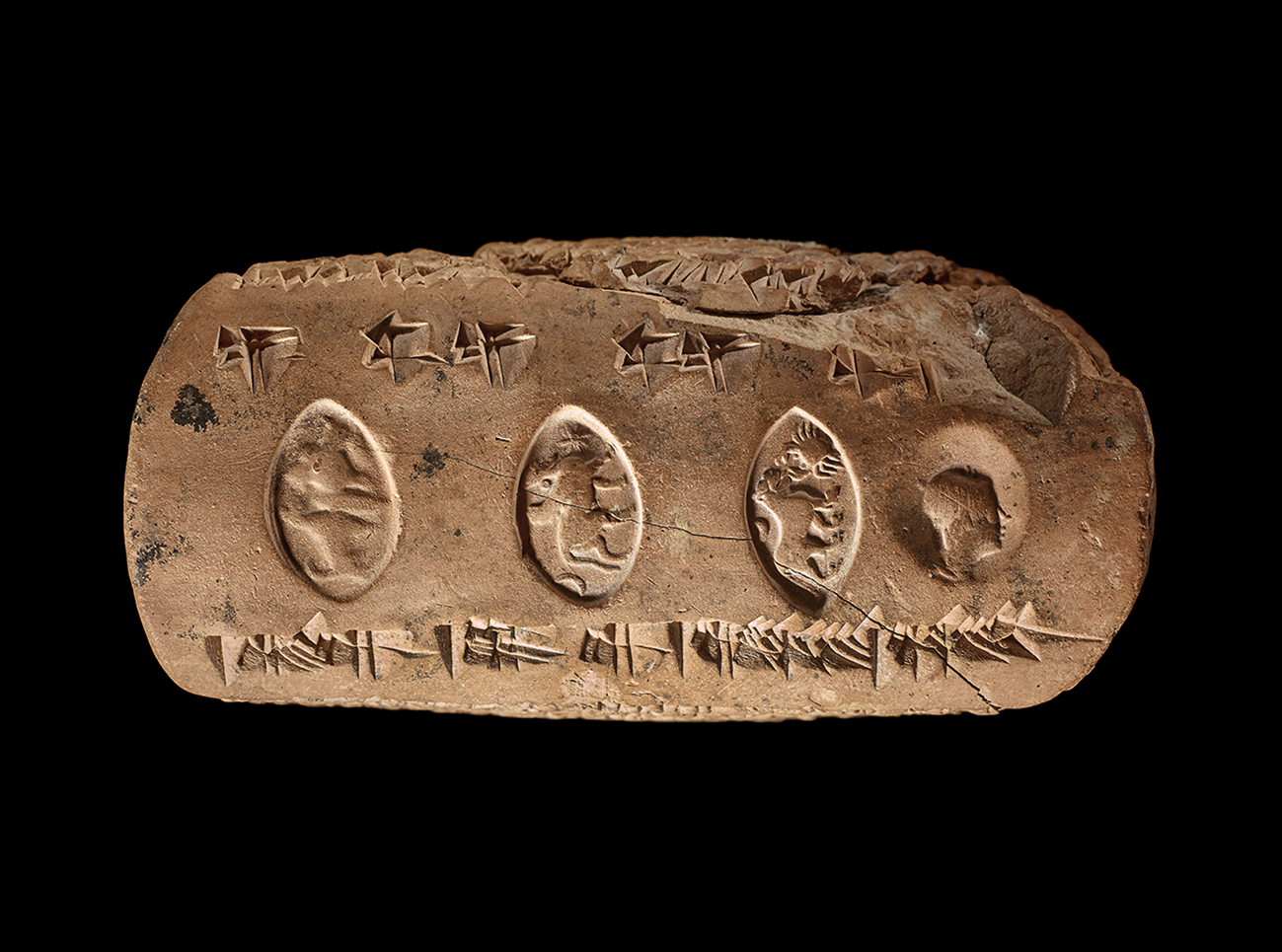
Yet even in their final, impressed form, seals as miniatures still did not offer self-contained visual completeness nor invite full entry into their tiny worlds. Rather, their materiality on bullae and tablets continually disrupted the illusion of miniaturization, issuing forceful reminders of real-scale people and their social life. Fingerprints and other marks of manufacture cover the bullae; see, for instance, the noticeable ridges and swirls that surround the image of Odysseus in Figure 7. Rather than surface imperfections on the miniature, as in the case of figurines, such fingerprints on tablets and bullae reminded the user that the seal miniatures were themselves surface marks, similarly created through touch and pressure. Insufficient pressure, a worn seal, an unsteady hand, or carelessness easily resulted in a blurry or partial seal impression (seen, for instance, on the far left in Figure 8), which further disrupted the illusionistic potential of the miniature and reminded the viewer of the imperfect human process of creating the impressed images. The alignment of seal impressions on tablets and bullae similarly produced this kind of exteriority, as their miniaturized landscapes were without narrative arc or consistency of scale; indeed, seal impressions on bullae often lack visual logic to the orientation and placement of the seals—and, thus, of the tiny figures.
Four views of a bulla with multiple seal impressions (clockwise from top left: recumbent lion, Odysseus, a Babylonian priest, Psyche), 294–141 bce, Seleucia-on-the-Tigris (modern Iraq). Clay. Kelsey Museum of Archaeology, KM 35740. (Photograph: courtesy Kelsey Museum of Archaeology.)
Edge of cuneiform tablet with four seal impressions (from left: two animals facing each other, winged lamassu with star and crescent, lion and crab with crescent (constellations Leo and Cancer), profile portrait), 323–63 bce, Uruk (modern Iraq). Clay, width 8.59 cm. British Museum, BM 109955. (Photograph © Trustees of the British Museum.)
This absence of visual coherence had a positive functional resonance; it prevented any illusion of spatial recession within the images of the seal impressions from challenging the physical integrity of the tablet or bulla as object. The pleasure of the surface is a pleasure of immediacy; images that are created as surface-level veneers focus attention on exteriority and point towards the outside world (Hay Reference Hay2010, 91). Handling and rotating a bulla or tablet brought new impressions into view, with new orientations and scales, further reinforcing this sense of a non-illusionistic landscape. The clay surface became a wonderland, a no-place—reinforcing the reality of the life-size hands that made it, rather than the tiny gods and supernatural creatures who populated it. This power of world-making was, perhaps, the ultimate wonder: a surprising and awe-inspiring ability of seal users to create, in collaboration with other people and other seals, realms that paradoxically could not be entered, or even fully understood, by their makers. Such acts of impressing a seal constituted new ‘communities’ at both the miniature scale—across the surface of a tablet or bulla—and in the life-size real world. The clay of Hellenistic Babylonian tablets and bullae had to be sealed relatively quickly by 10–20 participants in the transaction before the clay dried and became impermeable (Messina Reference Messina, Bellotto and Ponchia2009). Substantial groups of people, united in common purpose, were assembled to participate—a creation of community that was mobilized (indeed, demanded) in part by the materiality of the objects themselves. This world-building capability of seals would have been particularly urgent, noticeable and real in Hellenistic Babylonia. In the second half of the first millennium bce, the Mesopotamian practice of writing in Akkadian on cuneiform tablets was dying out; the Hellenistic-era tablets represent a last effort to keep the tradition alive (Wallenfels Reference Wallenfels, Boussac and Invernizzi1996). On the other hand, the widespread use of bullae, including by government administrators and tax collectors, adjusted the ancient Mesopotamian practice of sealing in clay to suit the needs of a new era of paper-based administration. The community-building resonance of the act of sealing in this environment of social change may explain why Hellenistic Babylonian economic record-keeping practices differed from earlier periods, in which far fewer witnesses to transactions, and thus fewer seal impressions on tablets, were required (Baker & Wunsch Reference Baker, Wunsch, Hallo and Winter2001). The facility of seals to create illusory no-place worlds in miniature suggested that tablets and bullae were in fact places where worlds—even the real social world—could be made.
The wonder of the miniature also made these communities, and their multiculturalism, more permanent and enduring. The imagery used on Hellenistic Babylonian seals was diverse in cultural origin, much like the actual human communities that produced the impressions. The motifs of individual seals were usually either Greek or Mesopotamian, rather than culturally hybrid, and replicated publicly acceptable symbols of power from royal, monumental and official cult practice. But, on the bullae seen in Figure 7, Odysseus and Psyche, figures from Greek mythology, literally rub shoulders with Babylonian priests and astrological beasts. On the cuneiform tablet edge seen in Figure 8, a winged lamassu (protective creature most closely associated with northern Mesopotamian art of the Neo-Assyrian period) strides alongside symbols of Babylonian temple astronomy (constellations Leo and Cancer) and a Greek-style portrait. Even though individual seal owners were mostly unwilling to personally commit to hybrid images of cultural identity in such a public and enduring format, the tiny disoriented worlds they assembled by impressing that seal alongside the seals of others did reflect multiculturalism.
Long after the original participants in these transactions were no longer living, their children and grandchildren might consult these impressed texts to verify land ownership or divide inheritance. The idea that seal imagery continues to signal personal identity even as it travels outside the physical orbit or lifespan of the original owner has been understood by many scholars through the construction of extended personhood (Anderson Reference Anderson2016, 51–2; Aruz Reference Aruz, Bleibtreu and Steymans2014; Feldman Reference Feldman2014, 118). I argue that the wonder-provoking qualities of miniaturization intensified this effect. The prospect of intimacy attracted people to study the tiny images closely, absorbing the cultural and social messages embedded in the seal owners’ choice of motifs. Yet upon the close scrutiny required to see the miniature images, the surface features of the impressions would emerge, highlighting the seal owner as a person: their fingerprints, their choices of where and how deep into the clay to impress the seal, the broader kaleidoscope of neighbouring seals belonging to their friends and business partners. By eluding full intimacy and introducing paradoxical tensions of scale, Hellenistic Babylonian seal impressions called attention to the fact that it was not just miniature gods and heroes but also the life-size human community that remained visible, accessible and relevant across the passage of time.
Jewellery: delightful objects, ambiguous miniatures
Most Hellenistic Babylonian jewellery items did not include representational miniature imagery. This feature differentiates jewellery from the other Hellenistic Babylonian objects examined in this article, for which miniaturized imagery was either a core defining property (figurines) or so ubiquitous as to be nearly a requirement (coins and seals). Because jewellery miniaturization was optional, it is particularly worthwhile to ask what miniaturization added to the Hellenistic Babylonian jewellery experience. The answer, I suggest, is wonder. This enchantment is particularly intense because jewellery is already designed, in both its material properties and social roles, to be wondrous.Footnote 6 The promise of pleasures is exquisite, a layering of the attractive effects of miniaturization onto an already rich bouquet of sensory delights, suggesting the existence of entire tiny worlds of sparkling enchantment available for exploration. But jewellery also has perhaps the greatest potential for visual tension between the representational imagery of the miniature and the appealing qualities of its material support. Indeed, as the Hellenistic poet Posidippus himself remarked, the appearance of a gem—and whether it was easier to see a carved lion on the surface of a stone, or the radiant colour of the stone itself—could vary due to lighting conditions and whether the stone was smeared with oil (II, 29–32; see Nisetich Reference Nisetich and Gutzwiller2005, 20). It is difficult to see, not to mention appreciate, both miniature and materiality at the same time. The tension between the two is both alluring and frustrating, enticing people to interact repeatedly with the object—and thus absorb the personal and social messages that motivated its creation.
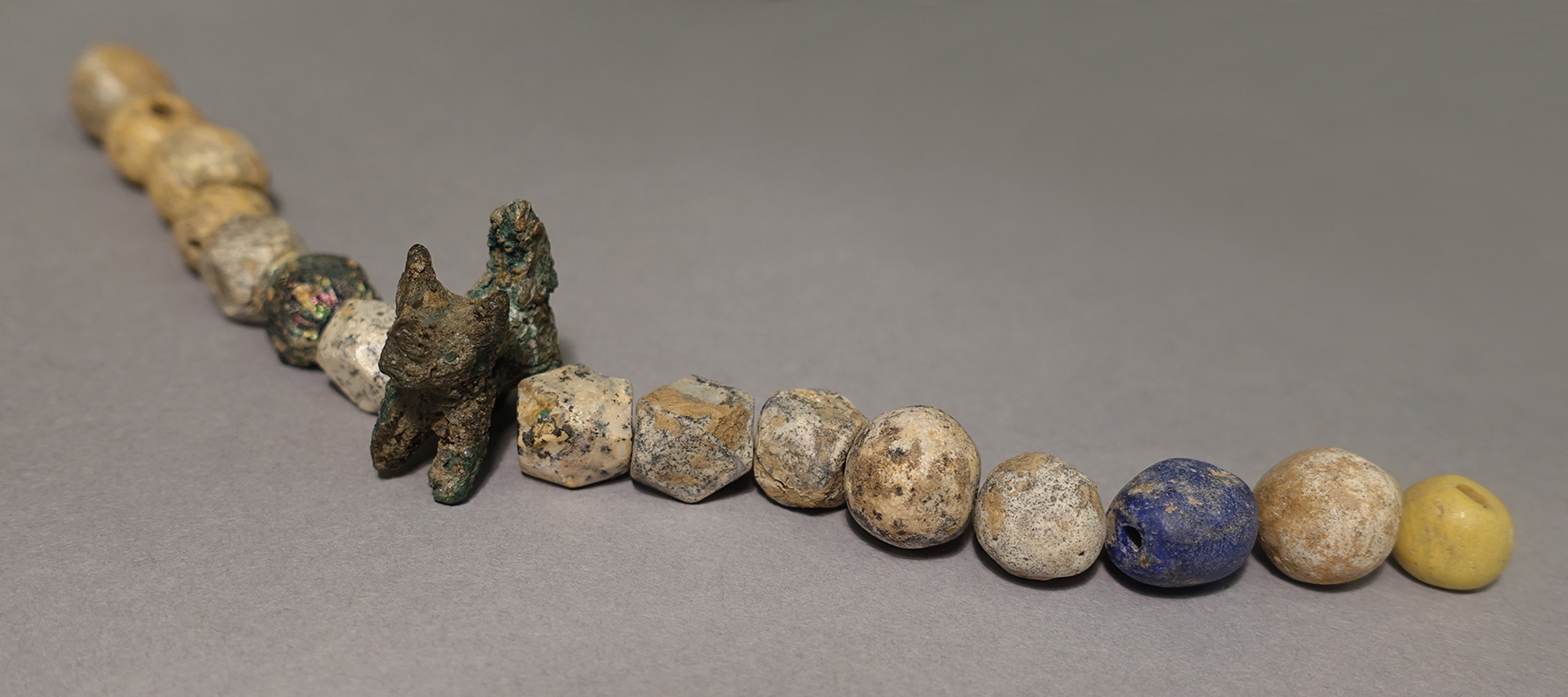
As seen in Figure 9, a string of beads designed to stimulate the senses with their diverse colours and shapes (some round and smooth, some angular) were augmented by a miniature bronze pendant of an animal, possibly a dog. Not only would the glistening metallic sheen of the bronze have added visual contrast and variety to the beads, but the tiny animal as a miniature called to mind additional sensory pleasures that the jewellery piece, as an object, could not have provided. The dog's most prominent and noticeable features imply sensory perception and interaction in the small-scale world: the forward-facing ears are pricked to listen, while the big bushy tail almost seems to wag and encourage stroking of its soft fur. Yet as much as the jewellery miniature stimulates the senses—both in the real world, and in the mind's eye—I argue that it also eludes them. Most Hellenistic Babylonian jewellery miniatures are truly tiny, making them difficult to grasp or examine; the dog pendant only measures 2 cm tall at its highest point. Close scrutiny had the potential to be painful, either due to the squinting smallness of the miniature or the blinding opulence of materials like bronze or gold (Benzel Reference Benzel, Pongratz-Leisten and Sonik2015; Elsner Reference Elsner2014). Even if successful, such close looking did not always reveal miniaturized detail but rather re-emphasized the material properties of the object and redirected attention to the jewellery item's effects at life-size scale. Although the bronze surface of the dog pendant is now corroded, it is clear that the dog never had articulated paws; even the facial features might always have been vague abstractions. The feast for the senses offered by jewellery miniatures could end in frustration, with satisfaction just out of reach.
Set of beads (20 total, not all pictured) and pendant depicting miniature animal, possibly a dog (modern assembly), c. ce 100–200, Seleucia-on-the-Tigris (modern Iraq). Bronze (pendant), glass, clay, lapis lazuli, and shell (beads), height of pendant 2 cm. Kelsey Museum of Archaeology, KM 2018.01.0447+KM 34188. (Photograph courtesy Kelsey Museum of Archaeology.)
The pierced earring in Figure 10, originally one of a pair found in a family burial vault, features an elaborately sculpted human head measuring only 1.1 cm tall. Facial features were produced through intricate carving at minute scale: the prominent ridged brow, the deeply inset and inlaid eyes, pronounced tear-ducts, arching eyebrows that meet above the nose, sunken cheeks, slightly parted lips and receding chin. But most of these details elude easy visual and tactile inspection. For the caressing finger, this object's exceeding smallness makes the carved bumps and ridges difficult to individually detect and interpret as facial features. Among the only facial features visually noticeable without magnification are the tiny figure's eyes, inlaid with white shell against the rich red and purple hues of the garnet. This particular stone was probably selected, at least in part, to give a dark skin tone to the miniature person whose face is represented in a manner similar to Greek depictions of people of African descent. When such faces are depicted on Greek ceramic vessels, they are often accompanied by inscriptions labelling the figures as beautiful (Martin Reference Martin and McInerney2014). Yet the directional mounting of this earring prevented the viewer from clearly seeing the attractive miniature details. The face is more easily legible in profile view, but the earring's flat back and vertical pierced hole indicate that it was intended to be seen from the front—an orientation, and a viewing impediment, that was also a feature of the dog pendant. Both miniatures directly faced their viewers, with an outward confrontational stare that was, paradoxically, difficult to observe and recognize. I suggest that this potential frustration could be desirable and advantageous to the earring's wearer, in that it conferred the power similarly to exclude and enchant others. Spatial proximity indicates association, even similarity; the fact that the tiny earring was a (stone, miniature) head worn on a (living, larger) head, a face seen next to a face, made the equivalency particularly direct and obvious. Thus the extreme tininess of the carving on this earring, a beautiful face which eluded both sight and touch even when inspected at very close range, implied through its slippery insistence on mystery that the person who wore it was similarly beguiling, even to his or her dearest friends, family members, or lovers.Footnote 7 To wear this jewellery miniature was therefore to both embody and perform enchantment.
Front and side view of earring, depicting the head of a person of African descent, ce 43–116, Seleucia-on-the-Tigris (modern Iraq). Garnet with shell inlay, height 1.1 cm. Kelsey Museum of Archaeology, KM 94544. (Photograph courtesy Kelsey Museum of Archaeology.)
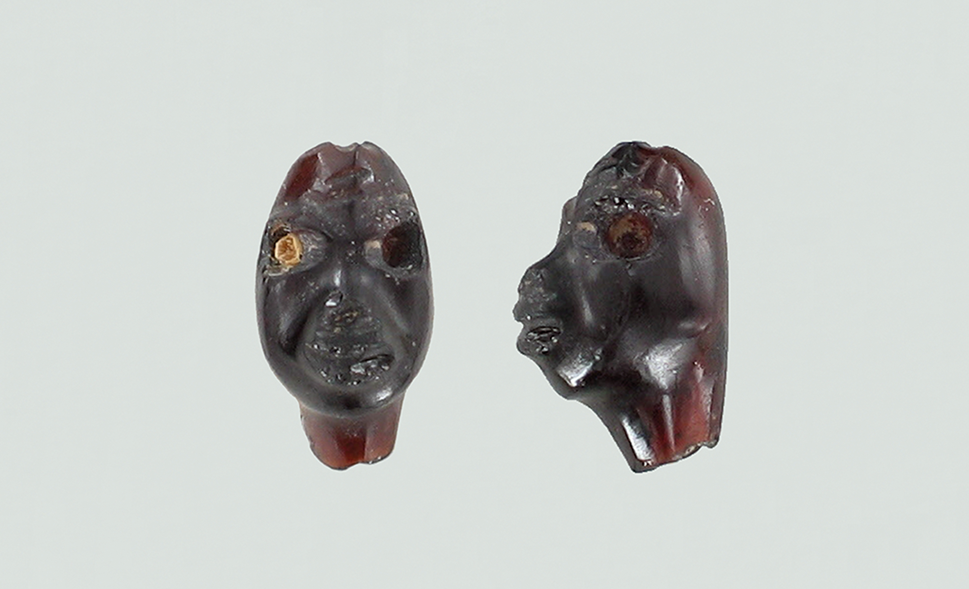
In addition to the directionality of the mount, the carving of the earring itself was not designed to highlight the aesthetic beauty of the figure's facial features. Instead, the stone's striking colour variations distract attention from the carving, while subtle translucency encourages the play of light through the stone—a pleasant visual effect, but one that focuses attention on the hue and radiance of the stone as object rather than the miniature as human face (Elsner Reference Elsner2014, 160–61). In addition to being luxury goods of economic and social value, particular gemstones (including garnet) were prized in the ancient world for their amuletic, apotropaic and prophylactic properties (Entwistle & Adams Reference Entwistle and Adams2011). This is not to suggest that the miniaturized imagery was meaningless; indeed, the forward-looking, confrontational face fits well within both Greek and Mesopotamian traditions of apotropaic imagery. Rather, I suggest that the wondrous effect of miniaturization added to the object's efficacy. It continually drew the user back to the jewellery item in a dynamic cycle of curiosity and exclusion. Attempts to examine the miniature image more closely would have reactivated and strengthened its magic by reemphasizing its mystery.
In fixing user attention on their material properties and functional purposes, jewellery miniatures emphasized their existence in the life-size social world. But their impact on that social world was culturally ambiguous. Tiny animals, such as dogs, common to both Greece and Babylonia, were often depicted without markers of a culturally specific style. Such generic imagery allowed the wearer similarly to demonstrate a familiarity and affinity for both cultures without committing to a (public declaration of) singular and exclusive positionality. The motif of the garnet earring was derived from the Greek artistic tradition, but specifically one that was used to explore both beauty and alterity—thereby potentially situating its wearer both inside and outside a Greek identity. Jewellery miniatures thus helped to construct a social identity and public persona for their wearers that demonstrated a versatility across multiple cultural forms, but like the miniature itself, ultimately excluded the audience from closer inspection, leaving them to wonder.
Conclusion
In this article, I have demonstrated how archaeologists and art historians can use a framework of wonder and enchantment to understand the affective properties and social consequences of miniature objects. While this approach builds upon current scholarly theorizations of miniatures as inherently intimate, it also accounts for the ways in which small-scale artworks can, and do, elude their user's attempts at full sensory access and immersive escapism. This desire-provoking tension between intimacy and distance—which lures users into a small-scale encounter only to insist upon the object's life-size existence—is what gives miniature objects their social relevance, and the ability not only to reflect, but also to influence, the real world. This article explored how Hellenistic Babylonian miniatures created this wonder through a variety of strategies. Figurines displayed interactive features, fingerprints and marks of making to give social importance to private negotiations of identity, while emphasis on the materiality and micro-miniaturization of jewellery allowed wearers to hide their identities in plain sight. Coins enabled kings to enchant the populace into absorbing royal propaganda, while seals aided their users in building communities with each act of impression. But what unites all of these case studies is that they showed how wonder enabled these objects to have social consequences—something that intimacy alone, with its restricted focus on the personal sphere, does not explain.
Although this interpretive framework was developed through the analysis of Hellenistic Babylonian miniatures, I propose that this approach can also be productively applied to miniature objects from other cultures and time periods. All miniatures are relational, bridging the disjuncture between life-size and small-scale worlds; some degree of tension and paradox thus seems intrinsic to miniaturization itself. But to truly inspire wonder, I argue that miniatures must first suggest the possibility of intimacy by being sufficiently small (hand-held size or smaller), delicate and detailed to require close looking and sustained attention. This creates the illusion of a small-scale world—and tantalizingly opens the prospect of human access to that microcosm. Wonder is created when such miniatures also include reminders that they are objects created in the life-size world, forcing their viewers to negotiate the tension between scales, as well as the tension between representation and materiality. Objects that emphasize both minute detail and marks of manufacture, that both encourage and defy sensory perception, suggest that their creators and users are attracted to them and are using them to think about the real-scale world.
I suggest that another metric by which to assess if the miniatures used by a particular culture are a good candidate for this interpretive approach is whether or not those objects are diverse in their type, form, motifs and/or style. Such variation demonstrates that the people who owned those miniatures were looking closely at them—if the subject matter of any individual object could not be assumed, using it would of necessity entail visual inspection and evaluation. Detailed examination of the miniature is the crucial precursor to experiencing the sorts of intimacy, tension, paradox and wonder that this article has explored. The benefit to using an interpretive framework of wonder in such situations is that it helps explain not just how those miniature objects were being experienced, but why a particular community might have made and used them at all. Several archaeologists have previously correlated high levels of diversity of miniature objects found in an archaeological context with communities in the midst of widespread social change, especially at the level of personal identity.Footnote 8 Although the working assumption has been that miniature objects were made in response to that social change, the mechanism by which miniatures were useful in this capacity has not been fully explained. I argue that wonder—the tension between intimacy and distance, which attracted viewers to study the miniature but also insisted on that miniature's relevance to the life-size world—is what made miniature objects a potent tool for people who were in the process of negotiating and reshaping their social world.


 Open access

