


1. Introduction
Smart products are instrumental in materialising the concept of the Internet of Things (IoT). In the IoT paradigm, they can be regarded as nodes with communication, computing and data collection capabilities (Reference Perera, Zaslavsky, Christen and GeorgakopoulosPerera et al., 2014). From an engineering perspective, they result from the multidisciplinary collaboration of mechanical, electronics, electrical and software engineering (Reference Guérineau, Bricogne, Rivest and DuruptGuérineau et al., 2022, Reference Guérineau, Rivest and Bricogne2025). They therefore comprise both physical and digital elements that pose environmental challenges throughout the product life cycle. For instance, the manufacturing of smart products depends on mining extraction, especially of rare-earth elements for electronic component fabrication. Another example of impact is the power consumption of the product and its associated information and communication technology infrastructure during the use phase (Reference Belkhir and ElmeligiBelkhir & Elmeligi, 2018). End-of-life challenges, which are often precipitated by programmed obsolescence and lack of repairability, as well as the dismantling and recycling of highly integrated designs and the management of electronic waste (Reference Baldini, Chessa and BrogiBaldini et al., 2023; Reference Suppipat and HuSuppipat & Hu, 2022) are yet other examples of the challenges at hand.
Product development, which spans from “the first idea” to “the complete documentation of all further steps within the lifecycle of the product”, plays a fundamental role in reducing these environmental impacts (Reference Bhamra and HernandezBhamra & Hernandez, 2021; Reference Bocken, De Pauw, Bakker and Van Der GrintenBocken et al., 2016; Reference Vajna, Clement, Jordan and BercseyVajna et al., 2005). The methodological aspects of product development, such as the concepts and techniques used, influence the design choices and characteristics of the product (Reference Guérineau, Rivest and BricogneGuérineau et al., 2025). In this paper, the expression “concepts and techniques” encompasses the approaches, processes, methods and tools that structure product development. There exist a plethora of concepts and techniques specific to sustainable product development in an effort to reduce a product’s environmental impacts (Reference Rossi, Germani and ZamagniRossi et al., 2016; Reference Schäfer and LöwerSchäfer & Löwer, 2020). They are often grouped as sets of methods or in toolboxes. The term “sustainable concepts and techniques” (SCTs) is used going forward to collectively refer to them and terms pertaining to circular principles, circular design and eco-design. Some notable examples of SCTs are the Eco-design approach, Life Cycle Assessment (LCA), Design for Sustainability, Design for Environment, and sustainable development guidelines and checklists (Reference Rossi, Germani and ZamagniRossi et al., 2016). However, their adoption by industry remains low (Reference Faludi, Hoffenson, Kwok, Saidani, Hallstedt, Telenko and MartinezFaludi et al., 2020; Reference Mallalieu, Isaksson Hallstedt, Isaksson, Watz and AlmefeltMallalieu et al., 2024; Reference Schäfer and LöwerSchäfer & Löwer, 2020).
This low adoption has motivated researchers to further explore the industrial landscape using surveys, interviews and case studies. A number of empirical studies pertaining to sustainable product development have been conducted in individual sectors, including health technology (Reference Moultrie, Sutcliffe and MaierMoultrie et al., 2015; Reference Rivard, Lehoux and MillerRivard et al., 2020), aerospace (Reference Léonard, Hallstedt, Isaksson, Kipouros and MallalieuLéonard et al., 2025) and manufacturing (Reference Vilochani, Borgianni, McAloone and PigossoVilochani et al., 2024), as well as with various organisations across different sectors (Reference Van Der Marel, Björklund, Štorga, Škec, Martinec and MarjanovićVan Der Marel & Björklund, 2022; Reference Villamil and HallstedtVillamil & Hallstedt, 2021) and specifically small and medium-sized enterprises (Reference Bugali, Gulari, Lawlor, Reilly, Simpson, Ring, Kovacevic, McGrath, Ion, Tormey, Bohemia, McMahon and ParkinsonBugali & Gulari, 2013; Reference Mura, Longo and ZanniMura et al., 2020). Some of these studies have enumerated the sustainable product development practices and SCT companies have used (Reference Bugali, Gulari, Lawlor, Reilly, Simpson, Ring, Kovacevic, McGrath, Ion, Tormey, Bohemia, McMahon and ParkinsonBugali & Gulari, 2013; Reference Villamil and HallstedtVillamil & Hallstedt, 2021; Reference Vilochani, Borgianni, McAloone and PigossoVilochani et al., 2024). Studies have also documented barriers to their adoption (Reference Moultrie, Sutcliffe and MaierMoultrie et al., 2015), which has led to the proposal of a descriptive framework (Reference Mallalieu, Isaksson Hallstedt, Isaksson, Watz and AlmefeltMallalieu et al., 2024) and a roadmap to improve the industrial adoption of SCTs (Reference Faludi, Hoffenson, Kwok, Saidani, Hallstedt, Telenko and MartinezFaludi et al., 2020). Together, these contributions deepen our practical understanding of sustainable product development and SCT adoption by industry. However, the existing literature appears to pay limited attention to SCTs in the context of smart product development.
This article aims to address this gap by focusing on the development of smart products by start-ups. This choice is driven by not only the abovementioned environmental impacts of smart products but also the fact that start-ups play a significant role in the transition towards more sustainable business models (Reference Klofsten, Kanda, Bienkowska, Bocken, Mian and LamineKlofsten et al., 2024). In principle, their capacity to innovate and their “agility” (Reference Kanda, Bienkowska, Klofsten, Marvin, Hjelm, Pereira, Krus and KlofstenKanda et al., 2023) also tend to facilitate the integration – or exploration – of SCTs in product development. This paper’s main objective is therefore to investigate the adoption of SCTs by start-ups in Quebec for smart product development. The research objective is supported by the following two research questions (RQs) that serve as the basis for new practical insights to further our understanding:
-
• RQ1: What approaches, processes, methods and tools do start-ups use to develop their smart products?
-
• RQ2: What SCTs and sustainable practices do start-ups use in their smart product development?
These RQs are explored through semi-structured interviews conducted with 11 start-ups that develop smart products. The qualitative research methodology used is presented in detail in Section 2, with the interview results presented in Section 3, and a discussion and concluding remarks provided in Section 4.
2. Methodology
The qualitative methodology adopted comprises three main steps: data collection, sample constitution, which corresponds to the selection of participating start-ups, and data representation and analysis. Each of these steps is presented below.
2.1. Data collection
Data was collected through semi-structured interviews. This choice was informed by the suitability of this type of interview for this study, as its open-ended questions facilitate the expression of different perspectives by participants (Reference RowleyRowley, 2012), which aligns with the RQs. Interviews were conducted in-person or remotely between March and June 2025 and lasted between 60 and 120 minutes. They were recorded with participants’ prior consent and then transcribed into detailed reports with verbatim excerpts. An interview guide was developed prior to conducting the interviews. It is presented next.
2.1.1. Preparation of the interview guide
The interview guide served to present the project and its research objectives, the topics covered and the guiding questions. The guide was developed to structure the interviews and was tested in a pilot interview with a start-up. The questions were organised into four main themes: who, what, how and why. The first theme outlines each start-up’s profile, including its location, mission, workforce, and interviewee(s) role and personal level of environmental awareness. The second focuses on the smart product developed, the people involved in its development, its target market, and the availability of any repair or recycling services. The third aims to document, in accordance with a four-level model (Reference Guérineau, Rivest, Bricogne, Durupt, Eynard, Marjanović, Štorga, Pavković and BojčetićGuérineau et al., 2018), the actual concepts and techniques the start-up uses in the development of its smart product(s). This model is presented below. Finally, the fourth theme identifies the motivations for and barriers against adopting SCTs. While this theme is not the primary focus of this paper, motivations and barriers are utilised in the discussion to enrich the results analysis.
2.1.2. Structuring product development: a four-level model
The four-level model proposed by Reference Guérineau, Rivest, Bricogne, Durupt, Eynard, Marjanović, Štorga, Pavković and BojčetićGuérineau et al. (2018) is illustrated in Figure 1 and analyses how a company can structure its product development in terms of four hierarchical levels, namely approach, process, method and tool. Product development can be envisioned as being based on an approach, organised by a process, and technically implemented using methods that are supported by tools.
The four-level product development model proposed by Reference Guérineau, Rivest, Bricogne, Durupt, Eynard, Marjanović, Štorga, Pavković and BojčetićGuérineau et al. (2018)

Figure 1 Long description
Panel A: A flowchart depicting the product development process. The flowchart includes stages labeled as Approach, Process, Method, and Tool. Each stage is represented by a series of steps or components, with arrows indicating the flow from input to output. The stages are connected by resources and time duration, showing the progression from abstraction to operationalization. Panel B: A pyramid diagram representing the abstraction levels of product development. The pyramid is divided into four layers labeled as Approach, Process, Method, and Tool, with the base representing specific tasks and the top representing project and overarching goals. The pyramid illustrates the relationship between time duration and abstraction levels, indicating that higher abstraction levels correspond to longer time durations.
In essence, the approach can be regarded as a philosophy predicated upon a set of high-level principles that guide product development on a macroscopic scale. The process organises product development into a series of steps that ultimately lead to the creation of a product. A method is a set of engineering rules and practices to carry out a technical procedure in order to achieve a result. Finally, a tool is used at a specific point in product development to support a method or process-specific task. This model was used to structure the third theme (how) by organising its related questions in accordance with the model’s levels. The decision tree proposed by Reference Guérineau, Bricogne, Rivest and DuruptGuérineau et al. (2022) was employed to classify the concepts and techniques mentioned by the start-ups. Concepts and techniques were classified based on their definition and use context.
This four-level model was chosen because it incorporates related definitions and a decision tree. It has also been used in previous mapping research (Reference Guérineau, Bricogne, Rivest and DuruptGuérineau et al., 2022, Reference Guérineau, Rivest and Bricogne2025), which provides additional application guidance.
2.2. Sample constitution
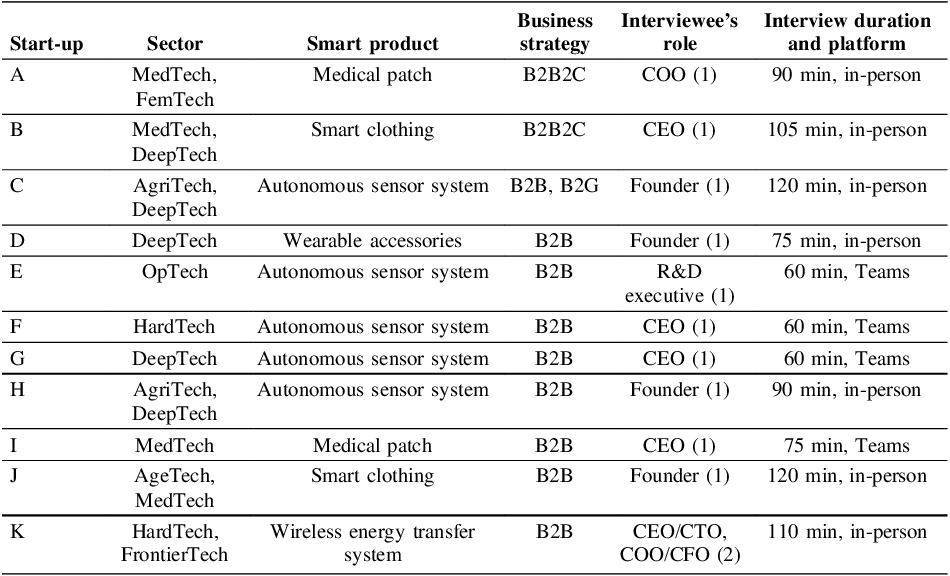
To ensure alignment with the research objective, specific selection criteria were established prior to choosing the start-ups and interviewees involved in the project (Table 1). Participating start-ups had to be from the technology sector and be developing or have developed at least one smart product. They also had to have existed for at least two years to ensure that they had moved beyond the ideation stage and reached a certain level of maturity with their product development. The interviewees selected had to occupy roles directly related to the company’s strategic vision and/or product development. The positions targeted included founders, C-level executives – notably chief executive officers (CEOs), chief product officers (CPOs) and chief technology officers (CTOs) – research and development (R&D) executives, and, to a certain extent, chief operating officers (COOs).
With regard to classification, the majority of the start-ups self-identified as belonging to the medical technology (MedTech) and deep technology (DeepTech) sectors. Other sectors mentioned include agricultural technology (AgriTech), optical technology (OpTech), frontier technology (FrontierTech), technology for the ageing population (AgeTech), technology for women (FemTech), and hardware-based technology (HardTech). The HardTech sector here involves both hardware and software developed in-house, with an emphasis on hardware.
The business strategies employed by the participating start-ups were business-to-business (B2B), business-to-government (B2G) and business-to-business-to-consumer (B2B2C).
Overview of the participating start-ups

2.3. Data representation and analysis
A map representation was chosen to facilitate data interpretation and analysis by visually organising the various approaches, processes, methods and tools; their links; and the SCTs the start-ups used to support smart product development. A separate map was created for each start-up, for a total of 11 maps. The legend for the maps is provided in Figure 2.
The legend explains the graphical elements and colour coding used in the maps. A block with a solid border indicates the interviewee(s) explicitly mentioned the concept or technique during the interview. On the other hand, a block with a dotted border denotes that the concept or technique was not explicitly mentioned by the interviewee(s) but was interpreted as having been used from their comments and descriptions. Each line connecting blocks indicates an explicitly mentioned association between the concepts and techniques in question, which may reflect complementarity, process articulation, or simultaneous application.
Legend for the maps

The 11 maps offer an overview of the actual concepts and techniques the start-ups use to support their smart product development. As part of the research methodology, the maps were validated by the interviewees to ensure that the concepts and techniques had been accurately captured. The section that follows presents the maps and their analyses.
3. Results
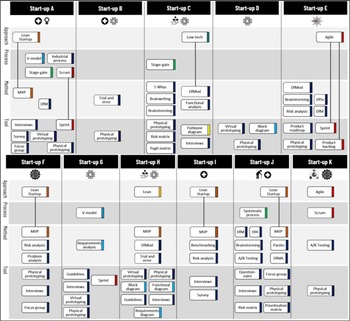
This section presents the study’s results. The 11 maps developed from the how-themed question responses are presented in Figure 3 and document the concepts and techniques and the SCTs the start-ups used in their smart product development.
3.1. Mapping the concepts and techniques used for smart product development
The 11 maps are shown below. Each start-up structures its product development differently. Even those operating in the same sector of activity or developing the same type of smart product use unique combinations of concepts and techniques. Start-up C stands out for being the only one to formalise all four levels in its development structure, while start-up D has only formalised tools. The process level was the least represented, with half of the start-ups not formalising any processes. Some concepts and techniques recurred frequently, such as the Lean Startup approach in the MedTech sector and the Prototyping tool overall. It was also observed that all the start-ups that use the Lean Startup approach also incorporate its associated Minimum viable product (MVP) method (Reference RiesRies, 2011). The sections that follow examine each level in detail, starting with approach.
Maps of the concepts and techniques the start-ups used for smart product development

Figure 3 Long description
A diagram comparing the concepts and techniques used by different start-ups for smart product development. The diagram is divided into two rows, each containing five columns labeled Start-up A to Start-up K. Each column represents a different start-up and is further divided into four sections: Approach, Process, Method, and Tool. Each section contains various labels and annotations specific to the start-up's product development techniques. The diagram shows the diversity in approaches, processes, methods, and tools used by the start-ups, highlighting the methodological aspects of product development.
3.2. Approaches used by start-ups for smart product development
Lean Startup was as the most frequently discussed approach and was used by four start-ups, three of which belonged to the MedTech sector. Start-up A’s use of Lean Startup was interpreted from its COO’s mention of developing an MVP and focusing on the validation of assumptions (Reference RiesRies, 2011). Start-up F mentioned Lean Startup in combination with “rapid gain” and “low cost”, which are two of its guiding principles (Reference RiesRies, 2011). For start-up J, Lean Startup allows for rapid iteration to achieve gains as quickly as possible with a limited budget. Finally, start-up I’s use of it was inferred from comments.
The Agile approach ranked second and was used by two start-ups. Start-up E’s interviewee mentioned Agile is applied only to the development of its product’s software, not its hardware. Conversely, start-up K expressly mentioned using “Agile for hardware”.
Two other approaches were also identified. Start-up H’s founder referred to the Lean approach, which is distinct from Lean Startup. Finally, start-up C’s founder is strongly committed to the Low-tech approach (Reference Gaultier, Masclet and BoujutGaultier et al., 2024), which they consider central to their smart product development. As they explained, “The more we increase the technological level, the more we reduce this effect of collaboration” in defence of a certain degree of “appropriability” (Reference Gaultier, Masclet and BoujutGaultier et al., 2024). The process level is detailed in the next section.
3.3. Processes used by start-ups for smart product development
Stage-gate was the process most frequently used by start-ups with a formalised process, particularly start-ups A and C. However, in the case of start-up C, its use is considered “semi-formal” because the company does not follow the process rigorously, but rather applies some of its phases and gates: initial or preliminary design, detailed design, and go/no-go decision. Start-up J uses a process that is inspired by the one proposed by the Ordre des ingénieurs du Québec and is structured around the ideation, preliminary design and detailed design stages. The process was interpreted to be a “systematic process”. The V-model process was interpreted to be used by start-ups A and G based on their interviewees’ comments and gestures. For example, start-up A’s COO used a “V” hand gesture while mentioning “V-development” to describe the process they use with their manufacturing partners. They also mentioned their partner’s “industrial process” that can be broken down into Engineering Validation Test (EVT), Design Validation Test (DVT), and Production Validation Test (PVT) stages. These three stages were said to constitute the preliminary testing and design phases before MVP development. In addition, the mention of using Jira to organise work and structuring work in weekly sprints – rapid iterations – suggests the use of Scrum by start-ups A and K, although this process was not explicitly named. Start-up K’s development iterations last between 2 days and 2 weeks. The method level is detailed next.
3.4. Methods used by start-ups for smart product development
Methods can be employed at the beginning of a design process to generate, structure and clarify ideas. Start-up C uses Brainstorming and Brainwriting, while start-ups E and J use only Brainstorming. Some start-ups use more formal methods to identify needs and define product features, such as Functional analysis, which is employed by start-up C to translate needs into functions. Start-up G applies the Requirements analysis method to structure and formalise stakeholder needs and product technical specifications. Finally, start-up I’s CEO mentioned Benchmarking.
In the context of this study, the term “MVP” refers to not only the deliverable, but also the method used to design and deliver it. The MVP method (Reference Dennehy, Kasraian, O’Raghallaigh, Conboy, Sammon and LynchDennehy et al., 2019), which is generally associated with the Lean Startup approach, was indicated to be widely used by the participating start-ups. Start-ups A, F, I and J use it to quickly test and validate their products with users. Start-up H mentioned the MVP method without making any link to Lean Startup. Other methods to test and validate products with users were also said to be used by start-ups. Start-ups B and H rely on empirical “trial and error”, while start-ups J and K use A/B testing, which involves choosing between two prototype variants with users.
In addition, when start-ups are faced with development difficulties, some rely on evaluation methods. Risk analysis is used by start-ups E, F and I to anticipate electronic component failure and prevent the risk of non-compliance. For example, start-up F undertakes Risk analyses for robotics certification and uses a “Problem analysis” method – without further precision – as part of its development. Start-up C uses the 5 Whys method to identify the root causes of problems, while start-up J uses the Pareto method (the 80/20 rule) to prioritise problems according to their interviewees.
Finally, Design for X (DfX) methods were mentioned by a number of interviewees or interpreted to be used based on their comments. Start-ups A, E and J rely on Design for Manufacturing (DfM), which aims to adapt products to manufacturing constraints and reduce costs (Reference Herrmann, Cooper, Gupta, Hayes, Ishii, Kazmer, Sandborn and WoodHerrmann et al., 2004). Start-ups C, E and H design their products in a modular way according to their interviewees, which was interpreted as applying a Design for Modularity (DfMod) method that structures products into interchangeable modules for ease of adaptation, repair and reuse (Reference ErixonErixon, 1996). Start-up C in particular does so to enable modules to be removed and reprogrammed by others in the spirit of co-creation in line with the Low-tech approach. On the other hand, start-up E’s goal of facilitating maintenance was interpreted as applying the Design for Serviceability (DfSv) method, which simplifies inspection, repair and replacement to reduce downtime and overall maintenance costs (Reference Gobbo Junior and BorsatoGobbo Junior & Borsato, 2021). Finally, start-up J uses the Design for Assembly (DfA) and Design for Manufacturing and Assembly (DfMA) methods to optimise its manufacturing and assembly processes. Some of these methods can be considered to be SCTs. The next section details the tool level.
3.5. Tools used by start-ups for smart product development
Many of the participating start-ups use qualitative tools to gather user feedback or explore user needs. According to the interviewees, start-ups A, C, F, G, H, I and J make use of Interviews, while start-ups A, I and J also utilise paper-based Questionnaires and online Surveys to obtain data on a larger scale. In addition, start-ups A, F and J employ Focus groups to identify collective needs, test concepts with users and validate certain design choices. All the participating start-ups except start-up I explicitly develop prototypes as deliverables. Most are physical, but start-ups A, D, G and H also create virtual prototypes, which suggests that Virtual and Physical prototyping are essential tools for product development.
Various matrix-based tools exist to facilitate comparing, prioritising or evaluating solutions. Start-ups C and J use a Risk matrix to assess and prioritise the risks associated with electronic components. Start-up C also utilises the Pugh matrix, which makes it possible to compare different design alternatives with a reference solution based on predefined criteria, while start-up J instead uses a Prioritisation matrix. Some tools serve to graphically represent the different elements driving their product development. Start-ups D and H use Block diagrams to schematically represent the architecture of their products. Start-up H also makes use of a Requirements diagram and a Functional diagram.
Tools derived from the Agile approach were also mentioned. Start-ups A, E and G were said to make use of Sprint. Start-up E also utilises a Product backlog to plan and track the features to be developed for its smart product. Finally, some start-ups rely on framing tools to guide design. Start-up G uses Guidelines, while start-up H relies on Checklists to ensure that its product’s various design requirements are considered. Start-up C, for its part, makes use of the Fishbone diagram – also known as the Ishikawa diagram – to identify potential causes of a problem. Finally, start-up E utilises the Product roadmap to visualise its key product development objectives and initiatives over time.
3.6. Sustainable practices used by start-ups for smart product development
The maps in Figure 3 reveal a low number of formalised SCTs are used by the participating start-ups, but this observation must be qualified. It was observed during the interviews that some SCTs are known but not necessarily implemented. For instance, start-ups C, E, F, H and K are familiar with LCA but do not implement it. LCA is perceived by start-up C to be a “complicated process to implement” and by start-up F to introduce “many challenges” according to their interviewees. The interviews also revealed some start-ups implement a variety of sustainable initiatives. Although the initiatives were not always explicitly tied to sustainability, it remains important to highlight them in order to shed light on concrete practices that contribute, sometimes intuitively or informally, to reducing the environmental impact of start-ups’ products and activities.
Start-up B appears to be one of the participating start-ups that is most committed to sustainable product development. It has adopted practices to take environmental issues into account from the design phase onwards in order to reduce the environmental impact of its product throughout its life cycle. Actions it has adopted include using local suppliers, encouraging teleworking to limit employee travel, selecting organic and certified textile materials, and selecting electronic components based on their environmental labels or certifications. The company has also undertaken to change its cloud hosting provider to one that is committed to reducing its carbon footprint and optimising energy use. Furthermore, the CEO conducted a self-assessment of the start-up’s environmental impact against B Corp guidelines to evaluate the company’s compliance with social and environmental standards. These initiatives demonstrate a commitment to integrate sustainability considerations in the start-up’s operations and represent a first step towards sustainable smart product development. The CEO stated, “Environmental issues are values I hold in my personal life, so they were naturally transferred to my company”, which highlights that this commitment is rooted in personal values as much as business strategy.
In addition, start-up F designs and manufactures 80% of its product locally and prefers short supply chains, which it perceives as “much less complex” and reducing transport-related emissions. Start-up E, for its part, gives more weight to ease of serviceability so that customers or suppliers can replace defective parts themselves, which reduces the environmental impact of technical interventions. Some of its design choices have been carefully considered, such as the absence of heavy metals and the possibility of retrofitting old units by replacing printed circuit boards. Furthermore, its team prefers to buy local and avoids buying on marketplace platforms. Several participating start-ups, including start-ups C, H and K, also prefer to purchase components that comply with the RoHS directive.
Regarding the end-of-life management of smart products, start-up F offers an after-sales service that incorporates product repair if necessary, and all functional components that are no longer needed for the original product are donated to student projects.
Most of the initiatives participating start-ups have launched focus on reducing the environmental impact of smart products’ hardware through component sourcing, material selection, serviceability or modularity. Few address their digital footprint. Start-up B, which considers the environmental footprint of its data centres, and start-up K, which tends to avoid relying on artificial intelligence given its associated energy consumption, are the only ones to have done so. No other concrete actions were identified that limit the environmental footprint of the digital-related aspects of smart products.
4. Discussion and conclusion
In accordance with the findings of previous studies, the industrial adoption of SCTs appears to remain limited (Reference Faludi, Hoffenson, Kwok, Saidani, Hallstedt, Telenko and MartinezFaludi et al., 2020; Reference Schäfer and LöwerSchäfer & Löwer, 2020), and start-ups appear to be no exception. Despite the absence of SCT formalisation, a number of participating start-ups have devised strategies to mitigate the environmental impact of their smart products. However, the absence of a structured way of doing so or a systemic approach to quantify impacts and make informed decisions calls into question the effectiveness of the informal ways adopted. A few start-ups justify the low adoption of sustainability considerations – whether formalised with SCTs or not – by citing their nascency and low production volumes. The interviewees indicated their intention to integrate sustainable considerations in future versions of their products that are expected to be manufactured in larger numbers and could potentially have a greater environmental impact if not addressed.
Some why-related elements are discussed here to further comment on this lack of adoption. The why-themed questions focused on motivations for and barriers against SCT adoption, and more broadly, environmental considerations. A few things about this theme are worth mentioning in light of the results as they could help direct future research and better understand the start-ups’ perspective. When interviewees were asked why SCTs were – or, in this case, were not – adopted, they mentioned financial motives and the perception eco-design entails additional cost and is time-consuming. Some of these barriers echo ones identified in previous studies (Reference Léonard, Hallstedt, Isaksson, Kipouros and MallalieuLéonard et al., 2025; Reference Moultrie, Sutcliffe and MaierMoultrie et al., 2015).
To pursue on the “why”, it is important to stress the role training and access to information play in method and tool adoption, which is also discussed in Reference Schäfer and LöwerSchäfer and Löwer (2020). For instance, start-up J’s founder explained that they did not know “what to do in terms of eco-design”. Start-up F’s CEO stated that they would like to integrate eco-design practices but admitted that they lacked the tools and training needed to make informed choices. The training courses made available by incubators are considered too general and high-level, though they are of interest. The environmental, social and governance courses geared for start-ups are predominantly strategy- and marketing-oriented, and therefore less relevant to product development. In light of these observations, two potential research directions emerged. First, the role incubators, and more broadly, the ecosystem, play in supporting start-ups with SCT adoption should be further investigated. This research direction resonates with the work of Reference Klofsten, Kanda, Bienkowska, Bocken, Mian and LamineKlofsten et al. (2024) on supporting circular start-ups. Second, another potential research direction is to propose an “eco-design toolbox” tailored for start-ups.
The above results should be considered in light of the research methodology’s limitations, which can be attributed to choosing to use semi-directed interviews. A declarative mode is inherently subject to the possibility that some concepts and techniques may be omitted or differ in their application from the literature. Furthermore, the concepts and techniques explicitly mentioned during the interviews are contingent on the interviewees knowing about them and being able to name them. To mitigate this, interpretations have been included, and the interpreted concepts and techniques are indicated in the maps. Future research could address this limitation by using complementary data collection techniques.
In conclusion, start-ups can take advantage of the IoT paradigm by leveraging digital and connectivity technologies to address business opportunities in various areas through the design and manufacturing of smart products. However, these products pose certain environmental challenges. In terms of scientific contribution, this study contributes to the existing scientific knowledge on engineering design and sustainable product development by documenting the approaches, processes, methods and tools 11 start-ups use in their smart product development (RQ1). Lean Startup and Agile appear to be the preferred approaches and can be supported by prototyping, the MVP method, and other methods and tools that focus on gathering user feedback and identifying user needs. Using interviews made it possible to explore the different SCTs that have been formalised by the start-ups, and more broadly, the often-informal sustainable practices they have adopted to support their smart product development (RQ2). Notable examples include the Low-tech approach and methods such as Design for Modularity and Design for Serviceability, both of which can be considered SCTs. Most of the other sustainable product development practices that were mentioned are informal. Additionally, for start-ups that take into account environmental considerations, the focus remains mostly on hardware-related aspects and reducing the environmental impacts of the physical components through material selection, component sourcing, modularity to ease product repairability or upgradability, with less attention given to smart products’ digital-related aspects. Therefore, this preliminary study serves as an invitation to further explore SCTs in the context of start-ups and smart product development.
Acknowledgment
The authors would like to thank the interviewees for their time and valuable contribution to the study.



 Open access

