

There is a small but growing body of academic literature pertaining to the social, economic, and political dimensions of the commercial fishing industry in Nunavut. Scholars have published case studies of specific community fisheries (Baird, Reference Baird2019; Galappaththi et al., Reference Galappaththi, Ford, Bennett and Berkes2019; Rodon, Reference Rodon, Abele and Southcott2015; Mason & Dana, Reference Mason and Dana2007/Reference Mason and Dana2009), gendered analyses of Nunavut’s fishing industry (Kafarowski, Reference Kafarowski and Kafarowski2009; Tyrrell, Reference Tyrrell and Kafarowski2009; Shannon, Reference Shannon and Kafarowski2009), papers examining fisheries management in Nunavut (Boudreau and Fanning, Reference Boudreau and Fanning2015; Roux et al., Reference Roux, Tallman and Lewis2011; Harris & Milerd, Reference Harris and Milerd2010; Kristofferson & Berkes, Reference Kristofferson, Berkes, Berkes, Huebert, Fast, Manseau and Diduk2005), and analyses of consumer perceptions of seafood from the Canadian Arctic (Yang et al., Reference Yang, Hobbs and Natcher2020). There is no recent research examining the political economy of Nunavut’s fisheries at a regional scale. Moreover, there is no recent scholarly research that centres the relationship between commercial fishing and colonialism in Nunavut. This gap is significant, given the attention paid to the colonial aspects of fisheries in other Canadian jurisdictions (King, Reference King2013; Todd, Reference Todd2014/Reference Todd2018; Woodman and Menzies, Reference Woodman, Menzies and Wilson2016), as well as in other Arctic states (Helander-Renvall, Reference Helander-Renvall and Kafarowski2009; Kuokkanen, Reference Kuokkanen2020; Voinot-Baron, Reference Voinot-Baron2020).
This paper addresses these gaps in academic literature by examining the relationship between commercial fishing and the colonisation of Nunavut. More specifically, I consider the degree to which the concept of ‘internal colonialism’ accurately describes the political economy of Nunavut’s fisheries. I also consider whether political struggle on the part of Inuit has resulted in changes to colonial relationships over time.
Research for this paper focused on the analysis of publicly available documents. Key sources of information included regulatory and court documents, annual reports from fishing companies, reports and policy papers published by government and Indigenous organisations, and secondary academic sources. My analysis of these documents focused on ascertaining the degree to which Nunavut’s commercial fisheries are controlled by institutions based outside of Nunavut and disproportionately benefit external interests.
This paper proceeds in five parts. It begins with an overview of the concept of internal colonialism and its application to Indigenous peoples in Northern Canada, followed by a discussion of the Nunavut Agreement and its provisions for fisheries management. In the third section, I examine the offshore shrimp and turbot fisheries in Nunavut and consider the degree to which internal colonialism accurately captures the historic development and contemporary reality of the offshore fishing industry. Next, I repeat this analysis for inshore char and turbot fisheries. In the fifth and final section, I discuss the relevance of my findings for analyses of the colonisation of the Arctic and fisheries management in Canada.
Internal colonialism
The concept of internal colonialism examines the parallels between the ‘external’ imperialist domination of the Global South and the colonial relationships that are ‘internal’ to nation states (Das, Reference Das and Kobayashi2020). While there is some variation in approach between scholars, most renderings of internal colonialism use a core-periphery model, wherein a country’s periphery is politically, economically, and culturally dominated by core/metropolitan regions. Because economic activities in peripheral regions tend to disproportionately benefit the core, internal colonial relationships are characterised by unequal exchange (Martinez-Alier et al., Reference Martinez-Alier, Demaria, Temper and Walter2016). A ‘cultural’ or ‘ethnic’ division of labour develops, whereby colonised people tend to occupy unskilled and poorly paid positions compared to workers from the dominant society (Allen, Reference Allen2015). Internal colonialism is therefore a theory of both uneven geographic development and socio-economic stratification. Originally developed in Latin America and the USA in the 1960s, internal colonialism theory has been used to explain the political and economic circumstances of Indigenous peoples in Latin America (Stavenhagen, Reference Stavenhagen1965; Frank, Reference Frank1969), Black and Latino peoples in the USA (Chavez, Reference Chávez2013; Allen, Reference Allen2015), Celtic peoples in the United Kingdom (Hechter, Reference Hechter1972), Quebecois, Acadian, and Indigenous peoples in Canada (Usher, Reference Usher1976; McRoberts, Reference McRoberts1979; McKee, 1987), tribal regions in India (Martinez-Alier et al., Reference Martinez-Alier, Demaria, Temper and Walter2016), and Black communities in South Africa (Wolpe, Reference Wolpe and Oxaal1975).
Internal colonialism theory was commonly used in academic analyses in the 1970s and 1980s. However, in recent decades, its use has declined significantly (Das, Reference Das and Kobayashi2020). The concept of ‘settler colonialism’ – which focuses on dispossession and erasure, rather than uneven development and social stratification – has dominated recent academic research in Indigenous contexts (Wolfe, Reference Wolfe2006; Veracini, Reference Veracini2010).
Scholars frequently used the concept of internal colonialism to examine Indigenous experiences with extractive industries in northern Canada in the 1970s and 1980s (Brody, Reference Brody1975; Usher, Reference Usher1976; Watkins, Reference Watkins1977; Dacks, Reference Dacks1981; Loxley, Reference Loxley1981), and some continue to utilise it in analyses of non-renewable resource extraction in northern Indigenous territories today (Bernauer, Reference Bernauer2019; Hall, Reference Hall2012; Gordon, Reference Gordon2010; Bone, Reference Bone2003). For these scholars, industrial extraction – including mining, hydroelectric generation, and oil and gas extraction – is a manifestation of internal colonialism because extractive economies can disrupt Indigenous subsistence practices, often require the legal dispossession of Indigenous land and resources, are dominated by institutions based in core regions, and primarily benefit non-Indigenous people and institutions based in the core.
Historically, northern extractive economies suffered from very high levels of economic leakage, as the vast majority of profits, rents, contract opportunities, and employment benefits were captured by southern regions (Watkins, Reference Watkins1977). While modern treaties and Indigenous-proponent agreements allow Indigenous communities to capture a larger share of this wealth than was hitherto possible, a substantial portion continues to flow to southern jurisdictions (Bone, Reference Bone2003; Slowey, Reference Slowey2008). Moreover, because Indigenous peoples mostly fill unskilled, semi-skilled, temporary, and on-call positions, the workforces at many northern extraction projects continue to be stratified along ethnic lines (Bernauer, Reference Bernauer2019). Like other colonial economies, northern extractive economies are ‘divergent’ insofar as production focuses on export markets and consumption depends mostly on imported goods (Loxley, Reference Loxley2010). As a result, the ‘economic multipliers’ associated with supplying equipment and provisions (‘backward linkages’) and value-added secondary production (‘forward linkages’) are lost to other jurisdictions (Watkins, Reference Watkins1977; Bone, Reference Bone2003).
The application of internal colonialism theory to northern Canada is not without its critics. For example, anthropologist Paul Nadasdy (Reference Nadasdy2003) rejects the core-periphery approach, arguing that it does not adequately account for either the state’s drive to assimilate Indigenous peoples or Indigenous resistance to assimilation. These criticisms have some merit, and Nadasdy’s work has provided useful insights into the ways state structures and processes like co-management and self-government subtly influence and change the ways Indigenous people relate to wildlife, the land, and each other. However, his approach to colonialism focuses entirely on Indigenous-state relations with no attention to extractive economies. As a result, he does not address the role of uneven development in the colonisation of Northern Canada, a phenomenon of central importance in the literature about internal colonialism.
Historian Adele Perry (Reference Perry2016) argues that Indigenous migration to urban areas in the late 20th century has complicated and rearranged the historic relationship between settler cities and Indigenous peripheries. This is certainly true, yet it is important to emphasise that many urban Indigenous communities do not participate equitably in the economic life of the cities in which they live. Moreover, urban Indigenous neighbourhoods often exhibit characteristics of internal colonies, including economic divergence, ethnic stratification of the workforce, and high levels of economic leakage (Deane, Reference Deane2006; Silver & Loxley, Reference Silver, Loxley, Loxley, Silver and Sexsmith2007). As such, moving from a northern reserve to an urban Indigenous community often does not entail a move from core to periphery, but rather from one part of the periphery to another.
Several scholars have also criticised the way in which the idea of internal colonialism has been applied to the specific context of Nunavut. While he does not reject the concept outright, Hicks (Reference Hicks2004) argues that applications of internal colonialism theory to Inuit communities need to pay more attention to class divisions in both the Inuit and dominant Canadian societies. According to Hicks, land claim agreements have created new class divisions within Inuit society and, as a result, Nunavut’s population is no longer strictly stratified along ethnic lines (see also: Mitchell, Reference Mitchell1995). While it is true that land claims have resulted in the development of new class dynamics in Inuit society, as I explain below, the relationship between Nunavut and southern Canada remains colonial.
Widdowson (Reference Widdowson2005) argues that the core-periphery model of internal colonialism is not an appropriate approach to the colonisation of Nunavut Inuit. Because the federal government spends more money administering Nunavut than it collects in royalties from Nunavut’s natural resources, Widdowson claims that Nunavut is not an internal colony but a ‘parasitical appendage’ of Canada that should be ‘depopulated’ (23). Setting aside the overtly colonial and assimilationist implications of Widdowson’s argument, her criticisms are based on a straw-man depiction of the core-periphery model. Royalty payments are one small aspect of the economic benefits generated by extraction in Nunavut, and there is ample empirical evidence that people and institutions in Southern Canada benefit substantially from mining in Nunavut.
Elsewhere (Bernauer, Reference Bernauer2019), I have shown that the core-periphery model of internal colonialism continues to be a useful framework for understanding the political economy of mineral and energy extraction in Nunavut. Political struggle by Inuit, especially the negotiation of the Nunavut Agreement, has resulted in more extensive Inuit participation in decisions about mining. Moreover, these struggles have resulted in a larger share of the wealth produced by mining remaining in Nunavut. Yet extractive industries in Nunavut continue to be dominated by institutions based in southern Canada, while most economic benefits continue to be captured by people and institutions based outside of Nunavut.
In this paper, I use the concept of internal colonialism to examine the commercial fishing industry in Nunavut. Drawing on publicly available information, I consider the degree to which the concept of internal colonialism accurately captures the political economy of Nunavut’s commercial fisheries. My analysis focuses on two integral aspects of internal colonial relationships: (1) the degree to which the fishing economy is controlled by institutions based outside of Nunavut and (2) the geographic distribution of wealth produced by Nunavut’s fisheries. In the process, I pay close attention to how these aspects of internal colonialism have been affected by political struggle, including the negotiation of Indigenous land claims, political lobbying, and litigation.
The Nunavut Agreement and fisheries management
In 1993, Nunavut Inuit and the Government of Canada signed and ratified the Nunavut Agreement. This modern treaty created a host of new governance institutions that are involved in the management of Arctic resources. The Government of Nunavut (GN) was established as a public government in which all residents of Nunavut can participate. Nunavut Tunngavik Incorporated (NTI) was created to represent Inuit rights and interests. NTI’s responsibilities are shared with three regional Inuit associations: the Kitikmeot Inuit Association, the Kivalliq Inuit Association, and the Qikiqtani Inuit Association. At the community level, local Hunters and Trappers Organizations (HTOs) were given a mandate to represent the interests of hunters.
The Nunavut Agreement also created a series of co-management boards for wildlife management, land use planning, impact assessment, and water licencing. Of these, the Nunavut Wildlife Management Board (NWMB) is the most relevant to fisheries management. While government retains the ultimate responsibility for wildlife management, the NWMB is the main regulator of access to wildlife in the Nunavut Settlement Area (the Nunavut Territory and marine waters within 12 miles of Nunavut’s coast). Established under Article 5 of the Nunavut Agreement, the NWMB has a nine-person board. Four members are appointed by Inuit organisations, four members are appointed by government, and a chairperson is nominated by the NWMB and appointed by government. NWMB’s primary responsibilities include establishing, modifying, and removing restrictions on the Total Allowable Harvest of different wildlife species in Nunavut, as well as determining how the Total Allowable Harvest should be allocated between subsistence, commercial, and recreational harvesting.
While the NWMB has the responsibility to make decisions about inshore and freshwater fisheries in Nunavut, the Department of Fisheries and Oceans (DFO) is the ultimate regulatory authority. The Northwest Territories Fisheries Regulations (C.R.C., c. 847) stipulates quotas, seasons, and other regulations pertaining to freshwater and inshore commercial fisheries in Nunavut. These fisheries are managed according to management plans developed by DFO and reviewed/approved by the NWMB (DFO, 2014).
The Nunavut Agreement contains several provisions directly related to the management of offshore fisheries. DFO is required to seek the advice of the NWMB before making management decisions in offshore-adjacent marine areas. The agreement also requires DFO to give special consideration to the residents of Nunavut in offshore commercial quota allocations, based on the principles of adjacency and dependence.
Government recognizes the importance of the principles of adjacency and economic dependence of communities in the Nunavut Settlement Area on marine resources, and shall give special consideration to these factors when allocating commercial fishing licences within Zones I and II. Adjacency means adjacent to or within a reasonable geographic distance of the zone in question. The principles will be applied in such a way as to promote a fair distribution of licences between the residents of the Nunavut Settlement Area and the other residents of Canada and in a manner consistent with Canada’s interjurisdictional obligations. (s. 15.3.7)
These provisions are some of the most expansive rights to commercial fisheries in any modern treaty in Canada (Harris & Milerd, Reference Harris and Milerd2010). However, as I explain below, the interpretation of these sections of the agreement has been controversial and the subject of repeated litigation.
DFO manages Nunavut’s offshore fisheries in accordance with the direction of the Northwest Atlantic Fisheries Organization and the provisions of the Atlantic Fisheries Regulations (SOR/86-21). In consultation with the NWMB and other stakeholders, DFO develops integrated management plans that apply to Nunavut’s offshore fisheries (DFO, 2018/2019a). Changes to quotas and allocations are made by DFO in consultation with the NWMB (DFO, 2019b/2021).
Offshore adjacent fisheries
Commercial fishing in Nunavut’s offshore-adjacent waters currently focuses on shrimp and turbot near the Qikiqtani region of Nunavut, in Baffin Bay, Davis Strait, and Hudson Strait. Nunavut’s offshore fisheries were originally harvested by foreign fishing fleets and later operated as an extension of Atlantic Canada’s fishing industry. However, in the early 21st century Nunavut fishers slowly established their role in the offshore fishery.
Today, there are three Nunavut-based companies that participate directly in the offshore-adjacent shrimp and turbot fisheries: Qikiqtaaluk Fisheries Corporation (QFC), Baffin Fisheries (BF), and the Arctic Fisheries Alliance (AFA). QFC was established by the Qikiqtani Inuit Association to facilitate Inuit involvement in offshore fisheries. Originally a joint-venture partnership with a Newfoundland-based company, in 2018 QFC became a wholly owned subsidiary of the Qikiqtaaluk Corporation (the for-profit business arm of the Qikiqtani Inuit Association) (QC, 2019).
BF (formerly Baffin Fisheries Coalition) is a coalition of community HTOs in Kimmirut, Iqaluit, Pangnirtung, Clyde River, and Pond Inlet. It was established in 2001 to allow these quota holders to pool resources and acquire the capital necessary to purchase factory freezer vessels and participate directly in offshore fisheries (BF, 2019). AFA is a similar coalition of HTOs and municipalities from Qikiqtarjuaq, Arctic Bay, Resolute Bay, and Grise Fiord (AFA, n.d.).
The concept of internal colonialism provides a useful framework for the academic study of the historical development of offshore fisheries in Nunavut, as well as scholarly understanding of contemporary conflicts over these fisheries. While the Nunavut Agreement established a role for Inuit participation in decisions about fisheries through the NWMB, the offshore fishery continues to be dominated by people and institutions based outside of Nunavut, including the federal government, Atlantic fishing companies, and many of the managers and consultants employed by Nunavut-based fishing companies. Nunavut Inuit were initially excluded from participating in the offshore fishing industry, as federal quota allocations focused on expanding and stabilising the fishing industry in Atlantic Canada. Decades of political struggle have resulted in a slow but steady growth of Inuit participation in offshore fisheries. However, most economic benefits continue to accrue to southern jurisdictions.
Conflicts over the allocation of offshore turbot quota
Commercial fishing in Davis Strait began in the 1960s when foreign fishing fleets began harvesting turbot. Canada did not exercise jurisdiction over this fishery until the early 1980s, when changes to international law gave Canada control over a new 200-mile exclusive economic zone off its coasts (DFO, 2019a). Through the 1980s, the Davis Strait turbot fishery continued to be dominated by foreign fleets, operating with the permission of the Government of Canada. This changed in 1990 when quotas were reallocated to fishing companies based in Atlantic Canada to offset the economic turmoil caused by the collapse of the North Atlantic cod fishery (Senate, 2004). In 1993, a small share of offshore turbot quota was awarded to Cumberland Sound Fisheries Ltd. – an inshore fishing company based in Pangnirtung (Senate, 2004).
Despite its provisions for quota allocation, conflicts over offshore turbot continued after the Nunavut Agreement was signed in 1993. In 1997, the Minister of Fisheries and Oceans announced an increase in the Davis Strait turbot quota, with only 10% of the new quota allocated to Nunavut (Senate, 2004). NTI challenged this decision in Federal Court, arguing that it violated key provisions of the Nunavut Agreement, most notably the requirement to consult the NWMB on decisions related to offshore resources. The judge ruled in favour of NTI and quashed the minister’s decision (Nunavut Tunngavik Inc v Canada, 1997). As a result, there was no change in turbot allocations that year.
The following year DFO again announced an increase in the Davis Strait quota, this time allocating 50% of the new quota to Nunavut. NTI again challenged the decision in Federal Court, arguing that the minister neglected to consider the principles of adjacency and dependence, and therefore failed to give Nunavut a fair share of turbot quota, as provided for in the Nunavut Agreement. NTI’s legal challenge was dismissed by the Federal Court. The judge concluded that, because Nunavut’s share of turbot quota had increased over time, DFO had considered the principles of dependence and adjacency (Nunavut Tunngavik Inc. v Canada, 1999). NTI challenged this decision at the Federal Court of Appeal, which upheld the initial ruling and dismissed NTI’s legal challenge (Nunavut Tunngavik Inc. v Canada, 2000). NTI applied to have the case heard by the Supreme Court of Canada. However, the court declined NTI’s application (NTI, 2001).
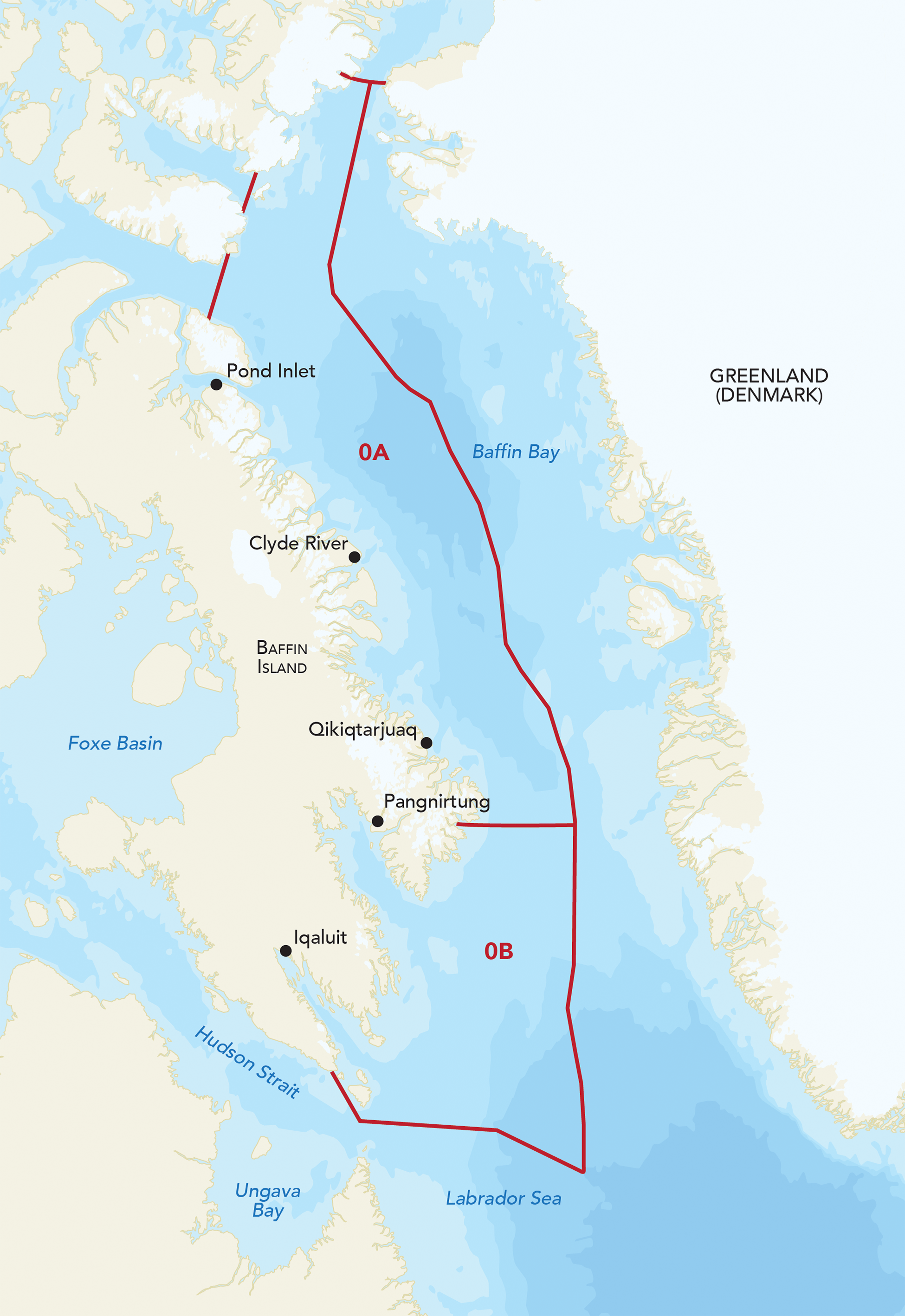
In 2000, DFO established a new turbot fishing area located north of the existing Davis Strait fishery (Senate, 2004). This new quota area was designated subarea 0A, while the existing Davis Strait fishery was designated subarea 0B (Figure 1). The entire quota for subarea 0A was allocated to Nunavut. As a result of this new allocation, Nunavut held 60% of turbot quota in the Canadian Baffin Bay and Davis Strait offshore fishery at the beginning of the 21st century (Table 1).
Arctic offshore turbot management areas in Canada’s exclusive economic zone in Baffin Bay and Davis Strait
[Map Credit: Julie Witmer Custom Map Design]

In 2010, DFO increased the quota for subarea 0B and allotted the majority of new quota to Nunavut (DFO, 2019b). This brought Nunavut’s total share of offshore turbot quota to 70%. Subsequent increases to 0B quota resulted in Nunavut holding 76% of offshore-adjacent turbot quota in 2019 (Table 1).
While Nunavut now holds a clear majority of turbot quota, its stake in the offshore-adjacent fishery is still less than that held by most other coastal jurisdictions in Canada, which usually capture 80–90% of offshore-adjacent quota (GN, 2016). Moreover, the value of the quota in subarea 0A and subarea 0B is not equal. Because subarea 0A (where Inuit hold 100% of the quota) is more remote, it involves high production costs and is therefore less profitable (Senate, 2009). As of 2021, Nunavut only holds 51% of the more profitable subarea 0B quota (DFO, 2019a).
Conflicts over the allocation of offshore shrimp quota
Shrimp fishing in Davis Strait began in the 1970s. After several years of exploratory fishing by DFO, commercial licences were issued to Atlantic fishing companies in 1978 (DFO, 2018). This fishery expanded into Baffin Bay and Hudson Strait in the 1980s, and a share of this new quota was allocated to a joint application from the Baffin Regional Inuit Association (the forerunner to QIA) and Makivik Corporation (the organisation that represents Inuit in northern Quebec) (Senate, 2009). In the late 1990s, the shrimp quota was expanded again, with some shares allocated to HTOs and small businesses on Baffin Island. By 2001, Nunavut held 18% of shrimp quota in offshore-adjacent waters (Table 1).
DFO expanded shrimp quotas in 2003. 51% of the new quota was allocated to Nunavut, bringing its share of offshore-adjacent shrimp to 31% (Table 1). The GN challenged the allocation in Federal Court, arguing that DFO’s decision ignored the principles of adjacency and dependence that are enshrined in the Nunavut Agreement. The court dismissed the GN’s appeal. Noting that the majority of new quota had been allocated to Nunavut, the judge found that DFO’s allocation was consistent with the Nunavut Agreement (Nunavut Territory v Canada, 2003).
Shrimp quotas were the subject of further litigation in 2009, when DFO approved the transfer of quota from one southern company to another. The NWMB challenged this decision in Federal Court, arguing that it ignored provisions in the Nunavut Agreement pertaining to adjacency and dependence. The court delivered a mixed verdict. On the one hand, the judge acknowledged that DFO’s approval of the quota was not consistent with the principles of adjacency and dependence, which require DFO to give Inuit priority access when quota becomes available. The judge also directed DFO to revise its policy on quota transfers to reflect this interpretation of the Nunavut Agreement. On the other hand, the court refused the NWMB’s request to overturn DFO’s approval of the quota transfer (Nunavut Wildlife Management Board v Canada, 2009).
Because of subsequent changes to quota allocations in 2013 and 2018, Nunavut now holds 38% of offshore-adjacent shrimp quota (Table 1). As with turbot, not all shrimp quota is of equal value. Some of the shrimp allocated to Nunavut is located in remote areas that are not profitable to exploit (Senate, 2009).
As of 2021, Nunavut holds a slim majority (52%) of the total combined quota for shrimp and turbot in offshore-adjacent waters (Table 1). This is far less than most other coastal jurisdictions in Canada. Nunavut’s offshore fishing companies estimate that increasing Nunavut’s share of offshore-adjacent quota to 90% would contribute an addition $62.7 million to Nunavut’s GDP (a 55% increase to offshore fisheries’ current contribution of $112 million) (Nunatsiaq News, 2020). The federal government’s approach to offshore quota allocation thus continues to manage offshore resources in a way that benefits southern jurisdictions at the expense of Nunavut.
Offshore fisheries and economic leakage
While companies based in Nunavut now hold a slim majority of offshore adjacent shrimp and turbot quota, Nunavut does not capture the full value this quota generates. Like mineral extraction and the construction industry, offshore commercial fisheries in Nunavut suffer from high levels of economic leakage (NEF, 2003/2013). Nunavut does capture a much larger share of the wealth produced by offshore fisheries today than it did 20 years ago (GN, 2016). However, a substantial share of profits, jobs, and economic multipliers continues to accrue to other jurisdictions.
When Nunavut-based organisations first acquired offshore quota, they lacked the capital to acquire offshore fishing vessels and participate directly in the fishery. As a result, they negotiated agreements with established producers who harvested Nunavut’s quota in return for royalty payments and employment benefits. The leakage of profits was therefore initially very high (Senate, 2004).
This began to change in 2005, when Qikiqtaaluk Corporation became part owner of a factory freezer ship called the Saputi through a joint venture partnership (Senate, 2009). BF, AFA, and QFC have since become sole owners of several offshore fishing ships. Today, all three companies fish their own quota from their own vessels and therefore collect profits directly.
A portion of these profits are allocated to Inuit communities and organisations. For example, both QFC and BF pay royalties and dividends to their member organisations (Because AFA are not publicly available, it is unclear whether or not AFA pays royalties to its member organizations or simply invests in community development initiatives). All three companies contribute to community development initiatives – including the establishment and expansion of community-based inshore fisheries – with financial, technical, and project management support (QC, 2019; BF, 2019; AFA, n.d.).
However, because Nunavut’s offshore fishing companies are private businesses, their financial statements are not publicly available. It is therefore unclear what proportion of profits remains in Nunavut and what amount is captured by other jurisdictions. Until recently, Nunavut’s offshore fishing fleet was owned through partnerships with southern companies (Senate, 2009). Some profits were thus captured by these southern firms. While Nunavut’s fishing companies are now sole owners of their fleets, factory freezer vessels are major capital expenditures that typically require financing. Insofar as Nunavut’s fishing companies likely pay interest on loans for the ships they own, a share of the profits generated by Nunavut’s fishing companies is captured by financial firms located outside of the territory.
Nunavut’s offshore fisheries originally struggled to hire substantial numbers of Inuit. The rate of Inuit employment has increased significantly over the past decade (NEF, 2013). For example, in 2009, annual wages to Inuit from Qikiqtaaluk Corporation’s fisheries division were less than $100,000. In 2018, Qikiqtaaluk Corporation paid Inuit over $2,200,000 in wages to Inuit working in its fisheries division (QC, 2018). However, most jobs in the offshore fisheries continue to be filled by non-Inuit that live outside of Nunavut. For example, QFC’s workforce was only 33% Inuit in 2018. Out of all of Qikiqtaaluk Corporation’s subsidiaries, QFC has the lowest levels of Inuit employment (QC, 2019).
Non-Inuit continue to fill most jobs on offshore fishing vessels (Table 2). The workforce on Nunavut’s offshore fishing fleet is also stratified. For example, in 2018 Inuit filled 90% of the entry-level factor jobs on QFC’s ships, despite only making up 37% of the overall crew on average (QC, 2019).

There is less information available regarding the onshore workforce for Nunavut’s fishing companies. However, many (and in some cases most) of the senior management for these companies are non-Inuit living outside of Nunavut. For example, in 2021 AFA’s general manager, operations manager, vessel manager, and controller all worked in Atlantic Canada (AFA, n.d.). Similarly, BF’s chief executive officer, chief financial officer, director of sales/marketing, operations manager, planning/logistics manager, crew coordinator, and health/safety coordinator were all based in Atlantic Canada (BF, n.d.).
Because of Nunavut’s lack of marine infrastructure, most of the economic multipliers associated with offshore fisheries are lost to other jurisdictions. Nunavut currently has no deep-sea ports. As a result, Nunavut’s offshore fishing fleet operates out of ports in Newfoundland. Most of the catch is processed at sea, landed in Newfoundland and Greenland, and sold to international markets (Senate, 2009; NEF, 2013). The wealth generated by repairing, servicing, and provisioning Nunavut’s offshore fleet – as well as that created by landing and shipping its catch – is therefore captured by other jurisdictions, especially Atlantic Canada.
The GN is in the process of building a new port in Iqaluit. However, it is unclear how the new port will affect fisheries development. The port was designed to facilitate the delivery of goods to Iqaluit, not to provide a base for offshore fishing. It will also be relatively small and unable to accommodate larger vessels (NTI, 2020). Moreover, the AFA argues that Iqaluit is poorly suited to provide a base for Nunavut’s offshore fishing fleet, due to its distance from the 0A fishing area (Figure 1). Instead, it has lobbied for the construction of a port in Qikiqtarjuaq, a concept also supported by the Qikiqtaaluk Corporation (AFA, 2018; QC, 2018).
Inshore and freshwater commercial fisheries
Nunavut’s inshore and freshwater commercial fisheries first developed in the 1960s as community development initiatives. Because of small profit margins and a lack of sustained government support, inshore commercial fishing was often short-lived and sporadic in most communities. As of 2021, there were inshore fisheries operating in all three regions of Nunavut, focused on the small-scale harvest of turbot and char.
The Cambridge Bay Arctic char fishery is the only commercial inshore fishery currently operating in the Kitikmeot region. Established in the 1960s by a community cooperative, Cambridge Bay’s fishery is now operated by Kitikmeot Foods Ltd (Kristofferson & Berkes, Reference Kristofferson, Berkes, Berkes, Huebert, Fast, Manseau and Diduk2005). In addition to char, Kitikmeot Foods also produces and markets caribou and muskox meat (NDC, 2018).
The Kivalliq region also has an active char fishery, with fish plants in Rankin Inlet, Chesterfield Inlet, and Whale Cove. Char from these communities is processed and marketed by Kivalliq Arctic Foods, a commercial harvesting venture operated out of Rankin Inlet. Like its counterpart in the Kitikmeot, Kivalliq Arctic Foods also produces caribou and muskox meat for commercial markets. Kivalliq Arctic Foods also regularly processes char from other communities and regions of Nunavut (Mason & Dana, Reference Mason and Dana2007/Reference Mason and Dana2009; NDC, 2018). A company called Papiruq Fisheries operates the fish plant in Whale Cove, with the catch sent to the Kivalliq Artic Foods plant in Rankin Inlet for further processing (NDC, 2018).
The community of Pangnirtung is home to the only consistently active inshore commercial fishery in the Qikiqtani region. A fish plant, operated by a locally owned company called Pangnirtung Fisheries Ltd., processes char and turbot harvested from Cumberland Sound. Established in the 1980s, Pangnirtung’s fishery is currently the largest and most productive inshore fishing venture in Nunavut (Rodon, Reference Rodon, Abele and Southcott2015; Baird, Reference Baird2019; Galappaththi et al., Reference Galappaththi, Ford, Bennett and Berkes2019).
There appears to be substantial room for the expansion of the inshore fishing industry. Only a small number of the lakes and rivers with char quotas are regularly fished for commercial purposes. The Northwest Territories Fisheries Regulations (C.R.C., c. 847) also establishes commercial quotas for trout and whitefish in many lakes and rivers in Nunavut that are not currently being utilised. Moreover, many communities are currently participating in research to determine the feasibility of various types of marine inshore fisheries, including the commercial harvest of crab, scallops, clams, turbot, and shrimp (NEF, 2013; GN, 2016).
Unlike offshore fisheries, inshore commercial fishing is not an example of internal colonialism. Most of the economic benefits from inshore fisheries remain in Nunavut. Moreover, Nunavut-based institutions like the NWMB exercise significantly more power in decisions about inshore fishing quotas. However, the federal government’s failure to adequately support the expansion of inshore fisheries is arguably a manifestation of internal colonialism, insofar as it is based on the unequal distribution of public infrastructure and fisheries research.
Inshore fisheries and community economic development
Nunavut’s inshore fisheries were established as community development initiatives to promote local well-being and economic stability in the face of crisis and change. Inshore char fisheries were established in several communities in the 1960s (Carder, Reference Carder1993). These operations were encouraged by the federal government, which was struggling to find an economic base for the permanent settlements it had encouraged (and in many cases coerced) Inuit to move to after the Second World War (Tester & Kulchyski, Reference Tester and Kulchyski1994; Mitchell, Reference Mitchell1995). The inshore turbot fishery in Pangnirtung was established in the 1980s (Rodon, Reference Rodon, Abele and Southcott2015), shortly after a European import ban caused the price of sealskins to collapse (Wenzel, Reference Wenzel1991).
Nunavut’s inshore fisheries are consistent with a convergence approach to community economic development (CED). As Silver and Loxley (Reference Silver, Loxley, Loxley, Silver and Sexsmith2007) explain, convergence differs from mainstream development strategies because it focuses on meeting local needs rather than attracting private investment. Originally used in the context of post-colonial national development in the Global South, the convergence strategy is designed to address the political and economic challenges associated with colonialism, including domination by external institutions and the leakage of economic benefits (Loxley, Reference Loxley2010).
[The convergence approach] seeks to produce to meet local needs, to hire locally, to purchase locally, to invest locally, and thus to create internal rather than external economic “linkages.” This approach emphasizes the importance of small-scale production, promoting backward, forward, and final-demand linkages between different sectors of local economies, minimizing leakages of income and replacing imports where possible (Silver & Loxley, Reference Silver, Loxley, Loxley, Silver and Sexsmith2007, p. 7).
Nunavut’s inshore fisheries share this focus on local employment and internal economic linkages, rather than profitability.
Inshore fisheries are labour rather than capital intensive and rely primarily on Inuit workers and fishers. As a result, they make substantial contributions to local economies through payments to harvesters and waged work at processing plants (Kristofferson & Berkes, Reference Kristofferson, Berkes, Berkes, Huebert, Fast, Manseau and Diduk2005; Rodon, Reference Rodon, Abele and Southcott2015; Baird, Reference Baird2019; Galappaththi et al., Reference Galappaththi, Ford, Bennett and Berkes2019). Employment in inshore fisheries is also more accessible than the offshore sector, because inshore fishing does not require extended time away from home (NEF, 2013). As a result, inshore fisheries are more gender inclusive than the offshore industry, employing a much higher proportion of Inuit women (Kafarowski, Reference Kafarowski and Kafarowski2009).
Nunavut captures more economic multipliers from inshore fisheries than it does from the offshore sector. There are more linkages between inshore fisheries and other sectors of Nunavut’s economy. Onshore processing allows Nunavut to capture ‘forward linkages’ from value-added secondary processing. While most turbot and some char are marketed abroad, a substantial amount of char is sold within Nunavut, including to restaurants and the mining industry (NDC, 2018). Nunavut therefore captures some final consumption linkages. Moreover, because Inuit hunters and in-shore fishers purchase some equipment and supplies within settlements – including at community cooperatives (Alsop, Reference Alsop, Southcott and Abele2016; MacPherson, Reference MacPherson and Southcott2015) – Nunavut also captures some backward linkages from inshore fisheries.
The strong synergy between inshore commercial fishing and subsistence production is perhaps the most important economic linkage associated with inshore fisheries. Because inshore fisheries and subsistence harvesting require similar skills and knowledge, inshore commercial fisheries promote the reproduction of land-based knowledge. The equipment used for commercial fishing and subsistence harvesting is also the same, and earnings from fisheries can finance subsistence activities. Inshore commercial fisheries can therefore help bolster the subsistence economy (Rodon, Reference Rodon, Abele and Southcott2015; Baird, Reference Baird2019; Galappaththi et al., Reference Galappaththi, Ford, Bennett and Berkes2019). Insofar as thriving subsistence economies are associated with Indigenous cultural continuity, food security, and economic resilience (Kulchyski, Reference Kulchyski2006; Abele, Reference Abele2009; Kuokkanen, Reference Kuokkanen2011, Hall, Reference Hall2021), the social benefits drawn from this multiplier are substantial.
Nunavut’s inshore fisheries are therefore not examples of internal colonialism. On the contrary, they are consistent with decolonising approaches to community development. However, as I explain below, the federal government’s failure to provide adequate support for the expansion of inshore fisheries is a manifestation of internal colonialism, given the grossly unequal distribution of federally funded infrastructure and research related to inshore fisheries at a national scale.
Barriers to growth
There are several barriers to the expansion of Nunavut’s inshore fisheries. One of the most significant is profitability. As in other northern jurisdictions (Boutet, Reference Boutet, Abele and Southcott2016), Nunavut’s inshore fisheries have always struggled with narrow profit margins, in part because of long distances to markets and associated high transportation costs (Kristofferson & Berkes, Reference Kristofferson, Berkes, Berkes, Huebert, Fast, Manseau and Diduk2005; Galappaththi et al., Reference Galappaththi, Ford, Bennett and Berkes2019). It is therefore not surprising that numerous historic attempts to establish inshore fishing ventures ended in failure (Mitchell, Reference Mitchell1995; Tyrrell, Reference Tyrrell and Kafarowski2009).
Today, most companies involved in Nunavut’s inshore fisheries are reliant on subsidies and usually operate at a loss. Kivalliq Arctic Foods, Kitikmeot Foods, and Papiruq Fisheries are all subsidiaries of the Nunavut Development Corporation (NDC) (a crown corporation of the GN, created to promote regional and community development). Pangnirtung Fisheries Ltd. was a majority-owned subsidy of the NDC until 2015, at which time the NDC divested from the company and it became entirely community-owned.
The NDC provides financial support to its subsidiaries, without which they would be unable to operate. Kivalliq Arctic Foods, Kitikmeot Foods, and Papiruk Fisheries consistently report either net losses or surpluses that are smaller than government subsidies. Historically, Pangnirtung Fisheries Ltd. reported occasional surpluses that exceeded subsidies. There is little publicly available information about PFL’s finances after 2015 (Table 3).

Rodon (Reference Rodon, Abele and Southcott2015) argues that we should assess inshore fisheries based on their contribution to community well-being, rather than profitability. Indeed, profitability is a common and inevitable problem for CED projects operating in the context of the modern capitalist economy. As Loxley and Lamb (Reference Loxley, Lamb, Loxley, Silver and Sexsmith2007, p. 205) explain,
CED ventures have to compete with other, often monopoly producers; CED initiatives often have to accept the prices these more powerful competitors fix, which are based on much larger scales of production and wages close to or below subsistence levels… In contrast, in CED projects, the scale of production is usually very small, overhead costs are relatively high, wage levels must be socially acceptable, and workers are often in need of training and facing social problems not necessarily experienced by the general labour force. For all these reasons…CED projects will find it difficult to prosper without some degree of subsidization.
Subsidising CED can be a fiscally sound investment that provides net increases in revenue for governments. For example, CED projects can reduce employment insurance and social assistance payments and create new sources of revenue from income, sales, and other taxes (Loxley & Lamb, Reference Loxley, Lamb, Loxley, Silver and Sexsmith2007; Lamb, Reference Lamb and Loxley2007). However, federal government support for the expansion of Nunavut’s inshore fisheries has been limited. This is most obvious in the slow pace and insufficient scale at which the government has funded fisheries infrastructure and research in Nunavut.
A lack of basic marine and processing infrastructure in most communities is a substantial barrier to the expansion of inshore fisheries.
Without the development of basic marine infrastructure, fisheries will continue to operate well below their potential and maximum levels of efficiency. A processing specific strategy is needed to identify where key fishery infrastructure can be established or expanded, such as processing plants (GN, 2016, p. 38).
This infrastructure deficit, and its role in impeding the expansion of inshore fisheries, has been articulated in numerous reports and policy documents by governments and Inuit organisations since the territory of Nunavut was created (NEF, 2003; Jackman et al., Reference Jackman, LeBlond, Munro and Newhouse2002; Senate, 2004; GN and NTI, 2005; Senate, 2009; GN, 2016; NTI, 2020).
A 2009 Senate report noted that, at the time, there were still no small craft harbours in Nunavut, and many communities lacked basic breakwaters to shelter boats from waves. There has been some progress towards closing this infrastructure gap since that time. A small craft harbour, funded by DFO, became operational in Pangnirtung in 2013. Two more small craft harbours are under construction in Pond Inlet and Iqaluit, funded by the GN. Additional DFO harbours are planned in Clyde River and Arctic Bay as part of an impact and benefit agreement for the Tallurutiup Imanga National Marine Conservation Area. While these are positive developments, the majority of Nunavut’s communities continue to lack the marine infrastructure necessary to establish or expand inshore fisheries (NTI, 2020). At present, only one of the 1008 small craft harbours operated by DFO is located in Nunavut.
A third barrier to expanding Nunavut’s inshore fisheries relates to research and baseline data. While numerous species of commercial interest have been identified in Nunavut waters – including shrimp, clams, sea cucumbers, scallops, and crabs – it is often unclear whether populations are large enough to sustain commercial harvest. As with the infrastructure deficit, the dearth of baseline data to support the expansion of inshore fisheries has been explained in numerous reports and policy documents dating back to the creation of Nunavut (Jackman et al., Reference Jackman, LeBlond, Munro and Newhouse2002; NEF, 2003; Senate, 2004; GN and NTI, 2005; Senate, 2009; GN, 2016; NTI, 2020).
There has been a significant expansion of fisheries research in Nunavut over the past decade. The GN, DFO, offshore fishing companies, and environmental organisations have funded and carried out exploratory fishing and baseline data collection to support the expansion of inshore fishing (GN, 2016; QC, 2019; BF, 2019; Ostroff, Reference Ostroff2020). However, it is unclear how long it will take to accumulate enough data to seriously expand commercial fishing in the territory.
Conclusions
Nunavut’s offshore-adjacent fisheries were originally developed to expand and later stabilise the Atlantic fishing industry. Because of decades of political struggle on the part of Inuit, Nunavut has established a role for itself in the offshore fishing industry. However, ongoing disputes over quota allocations demonstrate that institutions in Southern Canada – the federal government, federal judiciary, and Atlantic fishing companies – continue to dominate Nunavut’s offshore-adjacent fisheries. Current allocations and high levels of economic leakage allow southern jurisdictions to capture most of the economic benefits from Nunavut’s offshore fisheries. Federal government decisions – including quota allocations and infrastructure spending – play an important role in this loss of benefits. As such, a core-periphery model of internal colonialism, wherein Nunavut’s resources are used for the benefit of southern jurisdictions at the expense of Inuit, continues to accurately characterise the political economy of Nunavut’s offshore fisheries.
By contrast, Nunavut’s inshore fisheries were originally established as community development projects with the goal of promoting local economic stability and well-being. Institutions based in Nunavut – including the NWMB and HTOs – have much more control over the management of inshore fisheries. Most of the benefits of inshore commercial fishing also remain in Nunavut. However, the expansion of Nunavut’s inshore fisheries has been hampered by a lack of sustained government support, including subsidies, marine infrastructure development, and baseline data collection. The federal government’s failure to equitably fund marine infrastructure and research in support of inshore fisheries in Nunavut is a manifestation of internal colonialism, as this neglect has played an important role in impeding and limiting regional development.
Scholars interested in the colonisation of the Canadian Arctic should therefore pay more attention to the development and operation of commercial fisheries in Nunavut. At the same time, analyses of Nunavut’s fisheries should pay a greater attention to colonial relationships. Given the time, energy, and resources Inuit have invested in the fight for an equitable share of the benefits from commercial fisheries, scholarship on Arctic fisheries should reflect and articulate the economic and political relationships that give rise to conflicts over Nunavut’s marine resources.
The conflicts documented in this paper also shed light on the role of Atlantic Canada’s commercial fishing industry in the ongoing colonisation of Indigenous Peoples in Canada. The Atlantic commercial fishery has long been dominated by settlers. While a 1999 Supreme Court of Canada ruling recognised that a historic treaty gives the Indigenous Mi’kmaq a constitutionally protected treaty right to fish commercially, subsequent attempts to exercise these rights have been met with racialised violence (King, Reference King2013). Despite some progress towards including Mi’kmaq communities in commercial fisheries, Mi’kmaq leaders contend that their treaty rights to commercial fishing have yet to be meaningfully implemented (McMillan, Reference McMillan2019). The domination of Nunavut’s offshore-adjacent fishery by Atlantic fishing companies is another (largely unexplored) aspect of the Atlantic fishery’s role in Canadian colonialism.
Finally, my analysis of Nunavut’s fishing industry demonstrates that the core-periphery model of internal colonialism continues to be relevant to the study of the colonisation of the Canadian Arctic. The concept of settler colonialism dominates most recent scholarship on Canadian colonialism (Coulthard, Reference Coulthard2014; Peyton and Keeling, Reference Peyton and Keeling2017; Dorries et al., Reference Dorries, Henry, Hugill, McCreary and Tomiak2019; Camfield, Reference Camfield2019; Daigle, Reference Daigle2019; Shipley, Reference Shipley2020; Erickson, Reference Erickson2020; Youdelis et al., Reference Youdelis, Nakoochee, O’Neil, Lunstrum and Roth2020; Wheeler and Luedee, Reference Wheeler and Luedee2021; Wilson et al, Reference Wilson, Montoya, Arsenault and Curley2021) and has been used to produce helpful analyses of the colonisation of Inuit in Canada (Gombay, Reference Gombay2014; Cameron, Reference Cameron2015; Procter, Reference Procter2016/Reference Procter2020; Todd, Reference Todd2018; Metuzals & Hird, Reference Metuzals and Hird2018; Hird, Reference Hird2021). However, settler colonialism theory’s focus on dispossession and erasure underemphasises the aspects of the colonial relationship examined in this paper, including social stratification and uneven geographic development. Therefore, social scientists should continue to engage with both internal and settler theories of colonialism to understand and explain the political economy of the Inuit homeland in Canada.
Acknowledgements
The author would like to thank Clayton Tartak (Research Coordinator, Kivalliq Wildlife Board) for his advice and guidance in framing the research questions for this paper.
Conflicts of interest
None.


 Open access

