


Introduction
In his retrospective essay “Writing Reggae: Poetry, Politics, and Popular Culture” (2010), initially delivered as a lecture at Leeds University in 2005, Linton Kwesi Johnson (b. 1952, hereafter referred to as LKJ) describes how anti-colonial, anti-fascist, and anti-racist class struggles in the 1970s and 1980s went hand in hand with Black cultural creation. “In the beginning, writing verse was for me a political act and poetry a cultural weapon in the Black liberation struggle” (51). This chapter engages LKJ’s poems on policing, Black youth, and political resistance from the mid 1970s through the early 1980s in Dread Beat and Blood (Bogle-L’Ouverture, 1975), Inglan Is a Bitch (Race Today Publications, 1980), and his landmark poem on the 1981 Brixton Uprisings, “Di Great Insohreckshan,” first published in Race Today (February/March 1982).
My critical interest in reading LKJ’s poems of state violence and social unrest is, in part, motivated by ongoing forms of racial oppression in the twenty-first-century UK as in the US. As relevant as LKJ’s poems are to present-day concerns, my own approach situates his cultural productions in their time and place. As he remarks at the beginning of the 2021 BBC documentary Black Power: A British Story of Resistance: “I think the youngsters in the Black Lives Matter movement need to apprise themselves of what came before, so that we can draw some lessons from the battles we fought and won” (Amponsah) – and, I’m sure he would add, those we have still not won. These were the years of aggressive policing against Black people through sus laws under the 1824 Vagrancy Act, licensing police to stop and search civilians merely on “suspicion.” The criminalization of “Black youth” (here placed in quotes as a social category) became increasingly institutionalized through the concomitant powers of mainstream media and the judicial system, as in the trials of the Mangrove Nine (1970), the Stockwell Six (1972), the Oval Four (1972), the Brockwell Three (1974), and the Bradford Twelve (1981). While the state especially targeted young Black men, women were also subject to state violence. In 1985, twenty-year-old Jackie Berkeley was indiscriminately held by police, allegedly sexually violated, and sentenced to prison – a sentence that was suspended thanks to local campaigns in Manchester and the work of radical attorneys such as Ian Macdonald.1 LKJ was composing, recording, and politically organizing during the years of the Notting Hill Uprisings (1976), the Brixton Uprisings in April 1981 and England uprisings in July 1981, and the uprisings in Brixton and Broadwater (Tottenham) in 1985 in response to the murders of Black people by the Metropolitan Police.
These were also the years, I hasten to add, of intense grassroots political organization and Black radicalism. For instance, these years saw the rise of Black Power through the British Black Panthers Movement after Stokely Carmichael’s visit to the UK in July 1967; the formation of the Race Today Collective by Darcus Howe, Farrukh Dhondy, A. Sivanandan, and others in 1973; a flurry of radical publications such as The Abolitionist, The Black Liberator, and pamphlets from the Brixton Defense Campaign created in response to the 1981 Brixton Uprisings; and the organization of action groups such as the “Alliance” between the Black Parents Movement and the Black Youth Movement and the New Cross Massacre Action Committee, which organized the Black People’s Day of Action on March 2, 1981, when as many as 20,000 people marched from 439 New Cross Road through Fleet Street past Westminster to Hyde Park. LKJ was either directly involved in or closely affiliated with many of these organizations.
In turning to his poems on police violence and Black youth, this chapter pursues the ways in which LKJ’s experimentations in dub poetry mediate state-sanctioned racial violence and intervene in public discourses concerning racial injustice. In the process, his cultural productions enunciate forms of political resistance and collectivity during the turbulent years of the 1970s and early 1980s. As readers will likely recognize, my chapter’s title refers to Policing the Crisis: Mugging, the State, and Law and Order (1978), coauthored by Stuart Hall, Chas Critcher, Tony Jefferson, John Clarke, and Brian Roberts. As I discussed in this book’s Introduction, their insights on policing, Black youth, and deepening economic-political crisis in the 1970s form a key critical foundation for reading – and listening to – LKJ’s poems. Drawing on scholarship in dub poetry, my literary analysis places special emphasis on LKJ’s experiments in dub poetics as the aesthetic material through which his poems “sound the violence” of discursive oppression and political resistance of Black peoples, especially in his collections Dread Beat and Blood and Inglan Is a Bitch. From there, I turn to the inflammatory year of 1981, namely the Brixton Uprisings in April as they are reimagined in “Di Great Insohreckshan,” a poem that first appeared in the pages of Race Today in 1982. Reading his poem in its initial print context, I examine its internal political resonances, in form and content, and how its paratextual framings, accompanying articles, and layout contribute to the political interventions and activism of Race Today.
Across this chapter, I maintain that the very real social, political, and economic forces that Hall et al. theorize as the deepening “crisis” in 1970s Britain – and that were inflicted upon the category of “Black youth” through increasingly aggressive policing and anti-Black violence – flow through LKJ’s poems in dread form through his diverse uses of “riddim.” A capacious dub concept encompassing beat and sound, voice and intonation, repetition and refrain, narrative propulsion forward and lyrical loops and reverb, riddim constitutes a central aesthetic strategy through which his poetic personae “sound the violence.” Attending to uses of riddim in LKJ’s works opens up a critical space through which we can see and hear the nonidentical relationship between social realities of racial violence impacting his cultural productions and, conversely, the ways in which his poetic enactments re-sound the insurgency of “Black youth” in mediated form. His personae perform the ways in which the dread of Black life keeps getting dreader by attuning his readers and listeners to the radical possibilities of dub poetics and politics.
Dub, as an “art of poetry,” remains inseparable from what poet and scholar Phanuel Antwi calls “the art of living”: born out of the fires of colonial exploitation and racial oppression and situated and embodied within the day-to-day life of the internal colonies (or ghettoes) of London, as elsewhere (69). Dub is, Antwi says, “an artwork self-conscious of its relevance to community” (71). I likewise situate LKJ’s dub poetics within its embeddedness in Brixton-based social contexts and political community organizations, its aesthetic self-consciousness in performance connecting artists and audiences/readers, and its grounding in the body and the voice – in bodies and voices – in relation to, and in proximity with, one another communally, in friction and harmony. The emphasis on the body, sound, and voice in his poems brings into stark relief Carolyn Cooper’s notion of “noises in the blood”: the ways in which the “artist as griot” transmits Black cultural knowledge in ways that, however cacophonous or garrulous, signify “the accreted wisdom of generations” (4). My study reads for and listens to the noises of Black knowledge in LKJ, giving careful attention to the continuum animating and sustaining the tensions between the oral and the scribal, the verbal and the nonverbal, the aural and the visual, which become particularly prominent in dub aesthetics (Cooper, Reference Cooper4–5).
LKJ’s aesthetic innovations in dub are, of course, inseparable from his political vision of social transformation, or what he calls in his late poem “Di Anfinish Revalueshan.” Michael Bucknor has advanced a reading of voice as articulating “body-memory poetics” that carry revolutionary potential. Bucknor’s emphasis on “voice” – including “verbal rhythms, fluctuations, and pulses of Afro-Caribbean speech rituals” – becomes a powerful form of “discursive sedition” for challenging ongoing forms of colonialism, racism, and poverty (“Sounding Off,” Reference Bucknor56). For Bucknor, “aural disruption facilitates a way cultural retention becomes a revolutionary weapon against discursive oppression” (56). Like Bucknor’s, my readings of LKJ’s poems oscillate between “verbal reference” and “verbal rhythm,” listening for the ways in which his poems “sound the violence” of ongoing histories of racial oppression and economic deprivation even as they enunciate dissonant forms of collectivity and political resistance.
Similarly noting the site-specific and communal basis of his poetry, LKJ says in his 1996 interview with Burt Caesar that he came to writing poetry from “an urgency to express the anger and the frustrations and the hopes and the aspirations of my generation” living under state-sanctioned racism (“Interview,” Reference Johnson64). For him, this has meant remaining committed to writing in a style and a voice that would be accessible, as he says, to “ordinary folk” who could “pick up one of my poems, read it and understand it without having been immersed in the classical tradition, the so-called Great Tradition” (72). In these ways, LKJ openly acknowledges the ways in which the ideological category of “poetry” is laden with the inequities of education, class, and race. To write poetry about “Black experiences” requires an acknowledgment of the divisions of cultural capital and a very different set of decisions to give formal expression to Black social realities. What matters for him is sound and voice. “The distinction between performance and printed poetry, between oral and written, is superficial,” he says, and “all good poetry is meant to be read aloud, from Chaucer and the troubadours to T.S. Eliot and Ezra Pound” (“Revalueshanary Voice,” Reference Johnson71).
Traversing the nonidentical relationship between poetry and race, this chapter ultimately reads and listens to the ways in which LKJ’s various poetic personae – as they appear through riddim, sound, and voice – are shaped by and give shape to the economic, social, and political crises affecting Black youth through police violence, especially in Brixton during the 1970s and 1980s. My dialectical approach interprets LKJ’s poems as negotiating between the pressures of state violence and the necessities of Black poetic and political autonomy, thereby navigating the fraught demands of aesthetics and politics.
“Resistance” figures in his cultural productions, I argue, discursively in sound and language: disrupting the normative sounds and official discourses concerning Black youth in Britain during the 1970s and 1980s, laying bare their social contradictions, and resounding subversive forms of Black politics and collectivity. In her essay on LKJ’s “resistant vision,” Emily Taylor Merriman maintains that the poet delicately balances between his art’s protest against “racism, economic inequalities, and stunted warped lives” on the one hand and, on the other, his “vision of the human capacity for joy” as an unarguable human right (228). My critical approach follows Merriman’s lead but places emphasis on a poetics of resistance through form and sound: reading and listening to the ways in which his writing mediates the social-political-cultural discursive forces that subject Black British peoples, especially “Black youth,” to state violence. Like John McLeod, my readings emphasize “the forms and functions of [his poetry’s] aesthetic concerns” for negotiating and reimagining the world from which it arises (132). What’s more, we do not necessarily need to cast LKJ as an “inherently polemical poet,” as Louisa Lane has maintained in her study of his “sound-system” poems (161). Rather, his poems make manifest the “physical conditions” of state power that “target, attack, and limit the autonomy of Black artists, and against which these artists therefore have constantly to defend themselves.” And it is precisely through his uses of riddim, sound, and voice that his poems self-reflexively perform an aesthetics of violence, thereby self-consciously implicating his poems’ personae and readerships in the violence that his poems pattern. LKJ, as Peter Hitchcock has noted, “does not ‘give voice to the struggle’ so much as explore how the voice is structured from within by struggle as a material context, both as social oppression and as linguistic violence” (paragraph 20). My study extends Hitchcock’s observation by tracking the numerous ways in which his writing exhorts his readerships to delve deeper into the historical contexts and underlying contradictions structuring the production of LKJ’s voiced mediations of social violence as a necessary, albeit preliminary, step in enacting political transformation.
From the start, LKJ has been adamant that while his writings and recordings directly engage urgent political crises, they are also “never a substitute for concrete political action” (“Interview with Burt Caesar,” Reference Johnson77). As such, LKJ’s poetry compels his readers and listeners to shuttle back and forth between the social conditions that give rise to politically infused aesthetic expressions and, in turn, the formal mechanisms through which his poems re-script and re-sound the social-political world through the incantations of dub as they punctuate the rhythms of Black life. The beat goes on.
Policing the Crisis and the Aesthetics and Politics of Performance Poetry
Before turning to LKJ’s poetry and political involvements, I want to briefly situate my discussion within its broader social-political contexts of the policing of “Black youth” in 1970s Britain and the counter-hegemonic aesthetics and politics of Black British performance poetry. As I discussed in the Introduction, from 1971 onward there is a turn to a very particular target of ideological displacement for the “crisis”: the social category of “Black youth” coinciding with a moral panic over “mugging” (321). Readers familiar with Policing the Crisis will recall how the term “mugging” was initially imported in 1971 from US media to British newspapers, where the term becomes a catch-all for pickpocketing, pilfering, and hooliganism without a precise racial signification but spatially pinpointed in urban areas (322). In the coming years, the increasing prevalence of “mugging” in headlines and media discourse in the Daily Telegraph, Daily Express, Sun, London Evening News, and Sunday Times would contribute to, and shape, juridical discourse and penal policy regarding harder and heavier sentences for muggings (323). In 1973, a White Paper on police and immigrant relations was published and warned of deteriorating relations between “hard working, law-abiding citizens” and minority youth, drawing a clear distinction between the waged and Black wageless (323). And in 1975, the Metropolitan Police began recording the race and ethnicity of “victims” and “assailants,” creating statistical support for crime in densely populated Black urban areas with high rates of unemployment and housing crises (325).2 According to Hall et al., by 1975–1976 there was a full-scale “Black panic” stoked by the National Front’s march through the East End (October 1975), the Front’s winning of local council seats in May 1976, Metropolitan Police reports and statistics regarding the prevalence of Black and immigrant crime in Brixton, Enoch Powell’s proclamations regarding the “rising tide of immigrants” from South Asia, the murder of an eighteen-year-old Punjabi, Gurdip Singh Chaggar, by white youths in Southall and subsequent police crackdown on Asian peoples, and the Notting Hill Carnival Riot in August 1976 (329–30).
Hall and his coauthors repeatedly stress: The question is not whether (or not) young Black people living in urban areas commit offenses, which may well be quantitatively higher in the 1970s than in prior decades (331). Nor is it a question of how and why individual people, Black or white, “mug” (321). The question, instead, is a structural question over the language and meaning of “Black youth” and “Black crime,” whereby “the politics of mugging” becomes crystallized as a racial problem. Popular media discourse, by the mid 1970s, fuels the “moral social problem” of “Black youth.” The moral social problem of Black youth is then linked with a “policing-control” problem, which must be vigorously contained and disciplined (326–27). Between these two perspectives, the category of “race” appears as “the objective correlative of crisis – the arena in which … the totality of the crisis as a whole on the whole of society, can be most conveniently and explicitly projected and … ‘worked through’” (327).
As a result, West Indian communities develop what Hall et al. call “colony societies” (ghettoes): the physical space and material infrastructure through which community members can self-organize, self-direct, and transform their social world (380–81). These are also, though, internal, cultural enclaves and spaces through which Afro-Caribbean social life and culture would flourish during this period: the cross-pollinations of sound and music trafficking between the air waves of Kingston and Brixton, whether through dance hall, ska, rocksteady, or, especially for my purposes, reggae (350).
Reggae’s dread and driving rhythms, its apocalyptic rhetoric calling for the destruction of Babylon and deliverance of the dispossessed from suffering, and its proliferation of alternative collective, communal spaces through house parties and sound systems are perfectly suited for a politically conscious and culturally resistant Black youth (350). “In the wake of this cultural upheaval,” they write, “which inverts and transforms every sign of white domination into its negative and opposite, which rereads the culture of oppression from ‘the roots’ up as the culture of suffering and struggle, every activity touched is given a new content, endowed with a new meaning” (351). The aesthetics and social content of reggae, heard and lived and embodied in the urban quarters of colony life, carry within it “the seeds of an unorganised political rebellion” (351).
The early formation of Black British aesthetics, especially in the dub and performance poetry scenes, resulted from the confluence of several cultural, social, and political forces and flows. These include, as we have seen in Hall et al., the broadcast of Jamaican reggae over British airwaves and the prevalence of sound systems in houses, basements, and underground clubs; the influence of the US Black Arts Movement and Black Power Movement (especially after Stokely Carmichael’s visit to London in 1967); the Caribbean Arts Movement in the UK; radical Black organizations including the British Black Panthers and the Race Today Collective; and, of course, entrenched anti-Black, anti-Brown violence by police, the National Front, and daily racism by merely being a person of color in white British society. “The attack on black and Asian corporeality,” writes Henghameh Saroukhani in her study of Black British dub poetry, “reflected the troubled transformation of Britain’s increasingly visible multiethnic body politic, one that exposes protracted histories of racial violence and atrocity” (“Sonic Solidarities,” Reference Saroukhani, Nasta and Stein314).
As several scholars have established, the category of “performance poetry” was and remains a hotly disputed term. There are, though, a few tendencies and characteristics coalescing around oral poetry in and for performance, especially in 1970s and 1980s Black Britain. The uses of “nonstandard English” – whether dialect, vernacular, “nation language,” Jamaican English, creole, or patois – are overt political markers of linguistic difference, according to Paul Beasley, auditorily sounding “a key component in the poet’s individual and group identity, a defining element of difference, of what we are and where we are coming from” (29). Dialect and Jamaican speech rhythms in performance position the poet-as-griot, “situated in the front-line of self and community defence against immense and subtle pressure to assimilate, integrate, and eradicate difference” (29). For Beasley, performance poetry is closely aligned with – perhaps inseparable from – “protest poetry,” with the poet occupying an oppositional stance “against,” whether “against class, racial, sexual, or other oppression” (30). In taking on pressing matters or current affairs, performance poetry for Beasley refutes precepts of “universality” and “immortality” by instead unabashedly embracing its “disposability” and temporal ephemerality in a “commitment to the here and now” of spoken performance (31). And, of course, there is no “performance” poetry without “audience,” and in this sense, according to Beasley, it veers towards “reception theory” through “the active involvement of others” to whom “it solicits, conjoins, provokes, and incorporates” (32). For Beasley, performance poetry’s emphasis on linguistic difference, its topicality and stance of political opposition, its culturally representative status, its oral delivery in the here and now, and its basis in the interdependency of poet and audience – all of these features work together, dynamically, to create a circuit of interactive exchange between the public functions of the poet, the sounding words in their physicality before participatory audiences in open venues, and the social forces shaping poetic production, reception, and potential political action, however uncertain (34–35).
In the 1970s and 1980s, performance poetry took on a specifically political character as “a contestatory practice,” according to Cornelia Gräbner, “for the purpose of mobilising audiences through direct address and apostrophe” (206). In her discussion of the dub poetry of LKJ and Jean “Binta” Breeze, Gräbner posits that there is a particular form of “poetic license” suited to address political concerns in performance modes. Whereas for John Dryden, “poetic license” referred to the individual power of “poetic genius” to write poems in antagonistic relationship to poetry critics and literary establishments, for Gräbner performance poets take their “license” from their purported racial community for the sake of directly addressing political subject matter (206). The political impact of performance poetry is, clearly, without guarantees, but for Gräbner it of necessity is geared towards the responsiveness of an audience and, potentially, takes its aim at inciting listeners to action, or at the very least to renegotiate the terms of how and whether the audience’s poetic license “is claimed, granted and possibly, refused” (206). In this sense, the closing of the gap between poetic autonomy and political efficacy aligns performance poetry in the 1970s and 1980s with the militancy of the avant-garde. Performance poetry carries an indispensable public character, often taking place in youth clubs, community centers, pubs, music halls, or, as a well-known photo of LKJ attests, on city streets with the poet holding a megaphone in front of a police station. By speaking on behalf of the concerns of present listeners, the poet-performer stands in an embedded and embodied relationship to his/her/their community. What’s more, the performance of the spoken word calls further attention to the genre of poetry itself, heightening performance poetry’s aesthetic domain and political purchase in the public sphere (Gräbner, Reference Gräbner, Klawitter and Viol209).
With that said, the dub poetry of LKJ, Jean “Binta” Breeze, and Benjamin Zephaniah works in the tensions and the gaps between the oral and the written in ways that craft what Saroukhani calls “insurgent sonic solidarities” (313). By interweaving the energies of text and sound, their “poetry remains firmly located within the frame of the printed word and the materiality of the printed page in ways that are structured by the sonic and at times performative qualities of the poet” (316). Although writing in the context of 1990s poetry, Nicky Marsh’s insights on printed performance poetry could similarly apply to LKJ’s poems of the late 1970s and early 1980s. “The printed performances of black British poetry, the published text’s referencing of orality, of voice, of the poet’s body and of urban sound-scapes,” writes Marsh, “are clear interventions in a highly mediated culture rather than acts of authentic self-expression” (50). A careful attention to the dimensions of poetic mediation can clarify what Marsh calls “the cultural fault lines … that limit its aesthetic and political possibilities” (50).
My preceding discussion has sought to establish the ways in which Hall’s insights on “policing the crisis” critically inform and become aesthetically transmuted in LKJ’s dub poetics, which discursively “sound the violence” for the category of Black youth, no longer held in quotes. As we will see, LKJ furthermore innovates the poetics and politics of performance poetry; however, he does so not so much through the ephemerality of performance but through the deliberate interplay of sound and text in his poem’s printed forms. The subject matter of policing, anti-Black violence, and social unrest remains as relevant as ever not because of the universality or immortality of LKJ’s verse but because of the remarkable complexity through which his poetry mediates intractable historical, social, and political contradictions as they persist into the present day. In what follows, I focus on the ways in which LKJ’s poems self-consciously foreground the layers of mediation structuring the category of Black youth as the ideological displacement for the crises of the 1970s and early 1980s. His experimentations in “riddim” self-reflexively and self-critically call attention to dub as a highly mediated art form in which the roots of urban unrest reverberate in sound, voice, body, and the urban soundscapes of Brixton.
Sounding the Violence: LKJ’s Riddims of Black Youth, Police Violence, and Uprising
LKJ’s poems on Black youth and policing comprise one part of the poet’s broader conception of the politics of dub poetry as an aesthetics of violence, especially by exploiting the tensions between the oral and scribal as they take shape through sound and “riddim.” In an early essay on “The Politics of the Lyrics of Reggae Music” published in The Black Liberator (1975), LKJ describes reggae and dub poetry as “the spiritual and cultural expression” of the historical struggles of Black dispossession. Informed by the writings of Frantz Fanon, Aimé Césaire, and Marcus Garvey, the lyrics of reggae for him reflect the ideological contradictions of the socioeconomic and political contexts from which they spring, now particularly expressed through the racialized class conflicts between the bourgeoisie and impoverished Black masses (363). “The songs are songs of blood,” he writes, “songs of despair and desolation; songs of faith – songs of hope in the slimy pit of ‘sufferation’; songs of defiance; dub-poetry that ‘scatter matter shatter shock’” (363). Or, as he writes in his poem “Reggae Music,” the “sound music” of dub gives onomatopoetic expression to the “Shock-black bubble-doun-beat,” delving down into the “blood story”: “bass history is a moving / is a hurting black story” (Dread, Reference Johnson56). Punning on “bass” as both the deep driving sound and primary foundation of the Black dispossessed as the social “base,” “bass culture” sounds the “blood story” of Blackness in all its fluidity and dynamism.
For LKJ, reggae and dub music have important overlaps with dub poetry but also significant differences from one another, which have everything to do with the relative roles of “sound” and “word.” In reggae and dub, the deejay will often use spontaneous “talk over,” improvising lyrics on top of the music, whether through sound systems, prerecorded tracks, or musical bands. The spontaneous, improvisational lyricism of deejays aligns dub performers with “African oral poets,” according to LKJ in his interview with Meryn Morris (257). Still, the relative role of the deejay is to a degree subordinate to the sound system and the music “to liven up the dance” (257). Dub poetry, in contrast for him, begins with the primacy of language and the word already composed, without lyrical spontaneity and not necessarily with musical accompaniment (257). He credits some dub artists who have influenced his poetry, such as Big Youth, U-Roy, and Lee Perry, as having composed “talking tunes” that can stand as poetry (257). In his own process of poetic composition, LKJ says he has “the music in the back of my head with the words,” so that dub poetry carries within it “a beat” or “a bass line” that is “inherent in the poetry” (253). So while dub poetry grows out of the tradition of reggae, sound systems, and deejays, for LKJ dub poetry is nonetheless distinguished as a textual practice and craft “in its own right” through the sonic and aural elements of prosody and “riddim” (257).
Indeed, central to dub and arguably its defining feature is that of “riddim.” In Christian Habekost’s foundational study, Verbal Riddim, he explains how in reggae music, riddim refers to the syncopation of the recurring bass line and drumbeat, which create the rhythmical pattern for harmony and musical talk over (Habekost, Reference Habekost59). In dub poetry, though, riddim performs “the essential structural characteristic” and encompasses several sonic and verbal features bearing social, political, and cultural significance (91). First and foremost, dub poems comport an internal musical beat created through the arrangement of words, whether in vocal performance or on the page, such that words and sounds mutually reinforce one another (91–92). This can be created in a variety of ways. For instance, Habekost refers to the linguistic composition of poems in patois and creole which, when read aloud, produce forms of Jamaican speech rhythms and intonations (93). Dub’s complex rhyming patterns such as end rhyme, chain rhyme, internal rhyme, alliteration, and assonance often produce echo, reverb, and spiraling effects unique to the genre (93–94). And various forms of repetition – whether through words and phrases or refrains, call and response, “cuts” that skip back to the beginning, or “drops” through buildup and temporary omission and reintroduction of bass – both call attention to the repetitive riddim structuring the poem and further animate cyclical patterns and ongoing temporalities structuring Black musical forms (94–95). These poetic features of “riddim” furnish the aesthetic means for dub poetry to articulate social commentary and political discourse, giving expression to “dread experience” for the dispossessed, inciting incendiary rage against the “wicked” forces of “Babylon,” and instantiating revolutionary forms of as-yet-unrealized possibilities of collective emancipation for Black and white peoples (115–16).
The section of Dread Beat and Blood titled “Bass Culture” contains several of LKJ’s now most well-known “reggae poems,” including the collection’s title poem among several others. These poems are in many ways exemplary in enacting the poet’s conception of the aesthetics and politics of “riddim.” “Dread Beat An Blood,” for instance, creates a foreboding atmosphere of “brewing” violence at a house party “soaked in smoke” while a sound system pumps “a dread beat pulsing fire, burning” (55). At the start of the poem, the images of “fire” and “blood” and “burning” are, to a degree, merely metaphorical, in so far as they are recurrent emblems of reggae music and its lyrical content. LKJ, though, lends the “beat” of the “music” in the poem the capacity not only to metaphorically refer to violence but also to unleash it through “riddim.” The middle stanza reads:
“Music” in the poem – here imbued with repetition, heavy rhythmical stresses, and the rising and falling of cadence as it stops and starts and stops and starts again – contains and nearly becomes the “fire” and “blood” of “burning” violence dangling at the ends of these lines. The recurrence of present participles (“blazing, sounding, thumping,” “rocking, stopping, rocking,” “breaking out, bleeding out, thumping out”) further reinforces the poem’s conception of “music” and reggae lyrics as ongoing expressions of internal violence, which might break out at any moment.
Indeed, what begins as a metaphorical relationship between music and violence becomes literalized at the end of the poem as it builds towards frenzy:
In the heat of the moment of intracommunal violence, the “riddim” of these lines creates a contradictory sense of both rapid simultaneity (as if everything is happening at once) and cold, measured slowness. For instance, the unruly paratactic structure makes it seem as though the subjects in the poem bleed and blur into one another, from rocks to hearts, to rage, to a fist reaching for her, to the flash of a blade from one to another. The collapse of subjective boundaries and bodies is further reinforced on the level of sound, threading together the “hearts,” “heat,” and “hurt” that afflicts “a her,” “another,” and “a him.” At the same time, it is as if the immediacy of violence becomes suddenly slowed down, particularly through the preponderant number of unstressed possessive prepositions (“of the,” “of a,”), which has the effect of further distancing – and alienating and dehumanizing – the act of violence, whereby the violated body becomes further and further removed: “a dig of a flesh of a piece of a skin.” Within the poem, then, we can see how, in content, “Dread Beat An Blood” proceeds by reflecting upon the ways the “beat” of “dread music” carries the potential of unleashing acts of physical violence.
Formally, LKJ exploits the tensions of the oral and the scribal and, as a result, brings into stark relief his poetry’s self-reflexivity, in ways that Michael Bucknor has theorized: its abiding self-conscious recognition of its own performativity as an artifact, whether in public performance or in print, as crucial for marking the limits of its “ideological grounds” and, further, as a way of contesting and reconfiguring the discursive – and hence social and political – world from which it is made (“Dub Poetry,” Reference Antwi260–61). In form, LKJ’s self-reflexive uses of riddim – through Jamaican English, rhyme, repetition, heavy stress patterns, cadence, alliteration, syntax – further self-comment upon the ways music and lyrics encode, mediate, and reinscribe already existing, pervading, underlying forms of violence between “brothers and sisters,” which are themselves expressions of social alienation and dehumanization: the “rage rising out of the heat of the hurt” from which this music and poetry are born. The detached persona of the poem, in turn, arises from out of the riddim, taking on a vatic voice that channels, prophesies, and then choreographs and bears witness to the “dread beat an blood” to which the poem refers and re-sounds, “wailing blood, / and bleeding” without end.
Across his poems on policing and Black youth, LKJ’s various personae repeatedly humanize his subjects as belonging to social groups caught in the grip of state power and as political agents who desire freedom and collectivity, albeit in quite heterogeneous ways. As he writes in “Yout Rebels”:
LKJ invests his writing with the capacity to voice the “new shapes,” “new patterns,” “new links” already happening on the ground among the “yout” who, fueled with anger “blood risin surely,” are carving their circuitous path “forwud to freedom.” That is, his personae do not “speak for” the “yout rebels” but in different ways instead listen, overhear, record, pattern, and give shape to the forces, pressures, and collectivities that are already pulsating and at work, “creatin new links / linkin.” The progressive movement of LKJ’s project is not, however, without its own blockages, contradictions, and ambivalences.
In Dread Beat and Blood and Inglan Is a Bitch, LKJ’s personae take on a number of different stances and postures on Black youth, particularly as this social category has been mobilized – and criminalized – by mainstream public discourses. LKJ’s first strategy proceeds through his personae elevating and aestheticizing otherwise overlooked or degraded subjects of Black youth, whereby a Black aesthetics of the everyday in Brixton becomes repeatedly interrupted, broken, and invaded by state power. For instance, in “Yout Scene,” the opening poem of Dread Beat and Blood, the speaker takes on the persona of a flâneur deejay, idly walking the streets “doun a BRIXTON, / an see wha gwane” while using the lyrics of the poem to dub on top of the youth scene that the poem purportedly describes and eventually self-reflexively becomes (13). Marking the deep localization of the youth scene through capitalization, the speaker first encounters “de bredrin” hanging out outside a landmark record shop on Atlantic Road, all congregating:
The flash and flare of the youth, completely at ease and vibing to Jamaican music, is reinforced through the poem’s anaphora (dem a … dem a … dem a) and aesthetic self-reflexivity, where the bredrin’s “laaf,” “dread talk,” and dancing “shuffle dem feet” become lyrically performed and enacted in the riddim’s repetition, cadence, and metrical feet through the poem’s own “sweet MUSICAL BEAT.” The temporary haven of the urban space enveloped in sound, dance, and laughter becomes, however, immediately disrupted by the entrance of the police in the subsequent stanza:
Upon the police’s presence and invasion into the urban scene and into the poem, LKJ’s riddim violently shifts from the sweet sounds of the musical “beat” in the prior stanza to harsher, harder sounds (k, r, g, ung) and compressed metrical stresses. The “beat” of the poem gets tighter to accentuate the wanton policing, beating, arrest, and incarceration of Black youth now relegated “to prison walls of gloom.” And yet, despite or even because of the constraints placed upon Black youth due to state power, the poem concludes:
Similar to Hall et al., LKJ’s persona openly acknowledges that, surely, there are forms of illegal activity and petty theft among Black youth as there are among any population (“is packit dem a pick”). And, no, there is no denying the gender divisions among Black male youth and the deep-seated misogyny and violence against women (“is women dem a lick”). Within these limitations, the persona grants “de bredda” agency through their capacities for cunning duplicity (“scank”) and fugitivity (“run dem a run when de WICKED come”) as a social reaction to, and political refusal of, the all-consuming grip of state power as it encroaches upon the tightly enclosed streets and spaces of Brixton, as elsewhere.
A second strategy LKJ adopts proceeds by taking on the persona of a roaming sociologist, an informal reporter or insider walking among and “listening” to the experiences of Black youth, who then “gives voice” to their deprivation, criminalization, and burgeoning political consciousness. (This persona is likely informed by LKJ’s undergraduate study of sociology at Goldsmiths.) His poem “Want Fi Goh Rave” from Inglan Is a Bitch takes on this characteristic structure – of the persona “waakin doun de road,” hearing a “yout-man say,” followed by a stanza beginning “him seh” – to give fuller social context and human voice to the politics of mugging (16). As we read and listen, the poem features the voices of three young men: the first drifting “with no accamadaeshan,” the second hustling and “use to run a lickle rackit / but wha, di police dem di stap it,” and the third mugging and “haffi pick a packit” to survive. Each Black figure utters the poem’s central refrain: “mi haffi make a raze / kaw mi come af age / an mi want fi goh rave.” In this way, the arc of the poem traces the human dimensions of their increasingly dire circumstances of homelessness and feelings of helplessness (“mi life gat no meanin”), low-wage work (“mi naw wok fi noh pittance”), and lack of public assistance (“mi naw draw dem assistance”).
In the end, the persona-as-wandering-sociologist in “Want Fi Goh Rave” accounts for the ways in which the voice of “mugging” arises out of the prior voices of homelessness and hustling. The final stanza reads:
LKJ’s internal and end rhymes create a rich aural tapestry and soundscape through the repetition of “ah” sounds (haf, pack, wall, jack, crab, lack, pap, crack, chap, hatch) and the sinuous, almost sinister, lacing of “it” across these lines. Indeed, the common “it”-ness threading through “packit,” “wallit,” “jackit,” “crabit” (greedily), “lackit,” “pap it,” “crack it,” “chap it,” and “hatchit” calls into question the entire notion of who owns “it,” to whom does “it” belong, or, in conditions of destitution, isn’t “it” always up for grabs? The artistry of sound effects formally mimics – and pays homage to – the young Black figure’s subtle prestidigitation to pick a pocket, pop a lock, or crack a safe. LKJ’s speed of lyrical delivery further reinforces the speaker’s rapid sleight of hand as an art of survival.
LKJ’s creolized rendering of Black voices in “Want Fi Goh Rave” provides a sound portrait of the constraints and desires of this generation in ways that resonate with A. Sivanandan’s reflections in his landmark essay “From Resistance to Rebellion,” published in Race and Class in 1981. “Nowhere have the youth, black and white,” writes Sivanandan concerning the late 1970s, “identified their problems with unemployment alone. … They know, viscerally, that there will be no work for them, ever, no call for their labour” (150). What distinguishes this generation is not only the aftermath of recession, the automation of labor, the new era of austerity and evisceration of the welfare state under Prime Minister Margaret Thatcher. As Sivanandan notes, the youth “are not the unemployed, but the never employed,” without the protections of organized labor or belief in electoral politics. “Theirs,” he says, “is a different hunger – a hunger to retain the freedom, the life-style, the dignity which they carved out of the stone of their lives.” And it is out of this “different hunger” that LKJ’s title and refrain, “Want Fi Goh Rave,” finds its fullest significance by the end of the poem.
LKJ’s refrain re-sounds the ways in which this generation of Black youth comes to social consciousness concerning their structured subordination (“mi haffi mek a raze”) through the synchronization of race and class and to political consciousness, through which race becomes a key modality of protest and rebellion: “wi want fi goh rave.” There are further layers of sound and paronomasia in these lines. The economic necessity to “mek a raze” (raise money, make scratch) becomes the fuel for the figure to have to “raze” (that is, to level or abolish) the conditions that repeatedly, deliberately block his capacity to live. As a result, when the speaker expresses “mi want fi goh rave,” he conveys his irrepressible desire to rage upon the disorder of his social world. But LKJ is here likely also recalling how “rave” carries Jamaican origins of dance culture and underground rave parties, well before that word was taken up by house and techno music in the 1980s. In this sense, then, these speakers of Black youth desire a communal space of freedom to “want fi goh rave,” wholly free from the white social world and without the slightest cognizance of the police, a space in which dance, music, and sound become culturally expressive of experiences of anguish and rage at the same time as they furnish possibilities of collectivity and release. Whether through drifting, hustling, worklessness, mugging, or “raving,” these activities comprise for LKJ, as for Hall et al., some of the most important “survival strategies” for the reconstruction of West Indian culture, Black consciousness, and social life through a politics of refusal (Policing, Reference Bridges349). To be sure, such informal, “semi-legal” forms of economy separate from the wage are prone to their own precarity and will in turn become increasingly “criminalised” through the policing of the internal colony of the ghetto (345–46).
It is precisely the heightening criminalization of Blackness that compels his poems to take on a third posture and persona towards the category of Black youth: that of the hortatory prophet linking the suffering Black artist with the suffering Black collective – but now by adding (dubbing in) an apocalyptic language of revelation, judgment, and revolutionary violence as an endless and unfinished process towards emancipation. In the 1970s, LKJ conceived of dub lyrics as a discursive expression of open political rebellion: “The music responds to changes in the society so that as the society becomes more violent, more dread, more tense, the beat becomes more dread and the rhythm more taut” (“Jamaican Rebel Music,” Reference Johnson401).
LKJ’s vatic voice of revelation and revolution appears prominently, for instance, in “Time Come” through its exclamatory premonitions: “it soon come / it soon come / look out ! look out ! look out !” (Dread, Reference Johnson24). Similar to W. B. Yeats’s “The Second Coming,” the time of apocalypse is about to happen, is already happening before our eyes, and is, in the words of the speaker, “too late now.” In contrast to Yeats’s cyclical system of 2,000-year history, LKJ patterns violence through its structural embeddedness in decades of police violence and through its physical embodiment in the torture, detention, and death of Black lives, in their historical specificity:
In these lines, the speaker first refers to the death of David Oluwale, a British Nigerian immigrant who, while homeless and suffering mental illness, was repeatedly harassed, assaulted, and imprisoned by the Leeds police over several years. On April 17, 1969, two officers chased Oluwale (after beating him for sleeping on the street) and either he was thrown or he fell into the River Aire, where his drowned body was recovered a mile away on May 4.3 Oluwale’s death led to the first inquiry and prosecution of police officers in November 1971 for their repeated assault of Oluwale while in custody, an event that was widely covered by national media.
The speaker then refers to Joshua Francis, a middle-aged Black man who worked for London Transport and lived in Brixton. According to Darcus Howe, on the evening November 22, 1970, four police officers (one off-duty) broke into Francis’s home, beat him to the point of requiring hospitalization and thirty stitches, and, upon the arrival of the Brixton police, charged Francis with assaulting three officers (Howe, Reference Howe62). In response, Francis pursued a different, more radical path in seeking justice. Rather than working within the usual channels (filing a complaint, working with community organizations, or appealing to the local vicar), Francis coordinated with the Black Panthers, which, in the early 1970s, had a significant membership in Britain’s major cities, especially Brixton. This is likely why the speaker threatens “when you pick pan de Panthers / I did warn you.” Through leaflets, door-to-door canvassing, public meetings, pickets, and articles in their mainstay journal Freedom News, the Panthers created the “Joshua Francis Defense Committee.” The committee worked to raise funds for him and his family; to highlight his case, which was far from exceptional in the Black communities’ experiences of police malpractice in Brixton; and to demand that a jury of his peers would necessarily include Black people (Howe, Reference Howe63). Tragically, Francis was convicted of assault and sentenced to nine months. But his case mobilized and radicalized Black people in the 1970s onwards, just as policing became more and more aggressive in these years and deliberately targeted Black Panthers and other activists.
The instances of David Oluwale and Joshua Francis, among countless others, compel the hortatory persona to erupt in the final lines of “Time Come”:
Through a sensorium of sight, smell, and touch, the body of the speaker and the poem itself burst with incendiary rage, as if the “breat” of verse might itself spit fire. For the speaker, the “now” of “vialence, vialence” is hardly unanticipated but instead is the physical, embodied manifestation of an ongoing history whose “time” is, has, and was already destined to “come.”
As a harbinger of apocalypse, the prophetic persona in poems such as “Time Come,” “All Wi Doin Is Defendin,” and “Time to Explode” advances a politics of dub as an ideological weapon for total social transformation. “Consciously setting out to transform the consciousness of the sufferer, to politicize him culturally through music, song and poetry,” LKJ writes in “Jamaican Rebel Music, “the lyricist contributes to the struggle of the oppressed” (411). Or, as he writes in the final lines of “All Wi Doin Is Defendin”: “so set yu ready / fe war … war … / freedom is a very firm thing” (Dread, Reference Johnson27). Likely invoking the influence of Frantz Fanon, the speaker mobilizes his listeners by pronouncing that “war” and revolutionary violence are necessary in the struggle for freedom, whose “firmness” takes shape through the unwavering resolve of the oppressed – inflamed by the police beatings of people such as Joshua Francis and the death of David Oluwale.
The apocalyptic, revolutionary fervor that characterizes many of LKJ’s poems in Dread Beat and Blood becomes significantly tempered, however, in the opening poem of Inglan Is a Bitch, “Sonny’s Lettah (Anti-Sus poem).” This poem and dub track remains perhaps LKJ’s most famous instance for voicing – and penning – the perils of Black youth living under constant state violence during the 1970s. In part, “Sonny’s Lettah” was shaped and influenced by the poet’s own firsthand experience with police brutality and the arbitrary enforcement of sus laws. In November 1972, he witnessed three members of the Special Patrol unit choke a Black man nearly to death on the streets of Brixton. After asking for the name and address of the person being choked, LKJ and three others (two women and a man) were arrested for assaulting an officer and thrown in the back of a police van, handcuffed and forced to lie prone before being violently kicked and beaten (Phillips, Reference Phillips260). The charges were later dismissed, and the officers were transferred from Brixton station. Reflecting on that incident in Paris 1998, LKJ remarks: “This stuff is still going on back in Britain and here [France] as well. I don’t understand how people can say, ‘Everything is all right, it’s taken care of’” (Phillips, Reference Phillips261).
I mention this biographical background from 1972 and his later reflections in 1998 to highlight the indescribable rage that LKJ (the person) and members of his community experienced – and continue to experience – on a daily basis. But I also include this experience in my discussion to emphasize the artistic decisions and strategies that LKJ (the poet) deploys in transmuting ineffable anger into an epistolary poem and persona. By adopting the persona of Sonny, whose fictive experiences are recollected and transferred into “lettah” form, LKJ formally mediates the bewilderment, rage, violence and counter-violence, and eventual resignation and resolve that Sonny endures under sus. That is, the immediacy of Sonny’s experience is enveloped, as it were, through several layers of mediation. In doing so, LKJ opens a space for humanizing “Sonny” in print and voice. As readers and listeners, we are invited to reflect upon the tragedy of his circumstances and to forge an affective bond with him as we overread or overhear his lettah.
Readers familiar with the poem will recall how Sonny addresses his mother, writing “Dear Mama,” from the confines of his cell in “Brixton Prison, Jebb Avenue” and haltingly recounts how “I really doan know how fi tell y’u dis, / cause I did mek a salim pramis / fi take care a lickle Jim,” his younger brother (Inglan, Reference Johnson11). While they are waiting for a bus during “rush howah,” a police van pulls up and three constables detain the two brothers and proceed to violently beat Jim. True to his word to always protect Jim, Sonny intervenes and enacts counter-violence upon the officers:
If you were to listen to the musical recording of “Sonny’s Lettah” on his album Forces of Victory (1979), you would hear how LKJ sets Sonny’s counter-violence to an accelerating rhythm and rapid-paced cadence, which is further reinforced through heavy end rhymes (two couplets and four lines of monorhyme), and paratactic structure of “mi [jook/t’ump/kick/drop]” followed by “an’ him started to [cry/shout/spin/drap].” In certain ways, the constables’ bodily movements and physical reactions figure somewhat bathetically, almost as crybabies. Up to a point, LKJ’s accelerated riddim raises to a crescendo Sonny’s heightening prowess as he takes on all comers. As the fourth constable’s body falls “crash, / an’ de’d,” so too does the poem and song come to arresting silence.
LKJ’s strategic pauses and silence after “an’ crash / an’ de’d” represents, for Kwame Dawes, “a lapse in the poetic surface to create pathos and a certain thoughtfulness” (“Dichotomies,” Reference Dawes17). Musically speaking, this silence (or “tacet”) appears just before the “drop” in the dub track, which corresponds to the “dropping” body of the officer but also the complete disintegration of Sonny’s subjectivity and persona. In other words, when Sonny rightfully defends his brother by fighting the police, the death of the officer is merely incidental in the moment it occurs. But the pause in the track creates a space in which we might imaginatively enter into Sonny’s consciousness, in which we might momentarily glimpse how his life will change forever in this suspended moment of silence, the silence arrested between before and after.
And so in sitting with this silence, there are multiple “Sonny”s who come into auditory apprehension in my mind’s eyes and ears. For instance, we are reminded of the carefree Sonny, “waitin’ pan a bus, / nat causin’ no fus’” before the arrival of the police van. Here is also the indignant Sonny, witnessing the police kicking and beating Jim as he bleeds upon the ground. Here too is the ethical Sonny who stands up to police violence and inadvertently kills an officer in self-defense, for which he is beaten “to di grung” (13). And here now is the present Sonny, charged “fi murdah,” incarcerated in Brixton Prison, Jebb Avenue, writing his “Mama,” and whose “voiceprint,” in Gordon Roehler’s resonant phrasing, appears in epistolary form encased in the poem as a whole, “Sonny’s Lettah” (11). The “drop” in the poem’s music thus plunges the speaker and reader alike into the vertiginous spiral of “Sonny’s” subjectivity, which, however present and real in its moving pathos, remains in silence and so beyond full apprehension due to the utter senselessness of the wanton criminalization and incarceration of Black people such as Jim and Sonny.
In the final stanzas, Sonny consoles his Mama, telling her “doan fret, / doan get depres’ / an’ doun-hearted,” before penning his valediction:
These understated lines convey a welter of emotions that reside just under the surface of Sonny’s stoic persona and yet appear through the poem’s terse lineation, end commas, and play on the words “remain,” “son,” and “Sonny.” In one sense, Sonny’s “I” shores up the language of affirmation, consolation, and perseverance: that, no matter what, the affective bond between mother and son “remains.” The commas at the ends of these lines further give pause for the “I” to retain its personhood, its dignity, and its integrity both for himself – “Sonny” – and, I would argue, for others who have taken rightful action against police brutality of Black peoples under sus laws. And yet, by having written the poem in the mode of a dramatic monologue, LKJ invites the reader to look behind the mask of “your son, / Sonny.” As we peer through the veneer, we catch a glimpse of the ways in which Sonny’s stoic persona, his dutiful role as “your son,” and his abiding perseverance may all function as a performative strategy for contending with – and potentially masking, or at least holding at bay – the reality of his radical vulnerability, his brokenness, his shattered hopes and dreams for a livable future that have been stolen from him due to the criminality of state power and his ethical fight against it in the name of “lickle Jim.” Whatever “Sonny” that will “remain” during and after his incarceration within the walls of Brixton Prison is far from certain.
In these ways, we can see and hear the full force of LKJ’s aesthetics and politics of Black youth: “Sonny” is, precisely, in crystallized form the nonidentical relationship between race and poetry, poetry and race as they traverse one another in conditions of crisis. Through the epistolary form, LKJ encases “Sonny” – and all the Sonnys of Black youth – in layer upon layer of voiced mediation, making the tragedy of their lives all the more palpable: as textual remainders that appear in lettah form and as active reminders of Black lives that have been, could have been, and will be “Sonny” in his prior radiance but whose life is now held captive in the darkness of his cell, a darkness re-mediated in ink and re-sounded in performance and recording.
In various ways, these poems from Dread Beat and Blood and Inglan Is a Bitch give lyrical expression to the internal contradictions of Black youth: autonomous and sufficient unto itself, criminalized and overpoliced at every turn as the targets of “the crisis,” and inevitably generative of an incipient political rebellion. The “war … war” that his poems prophetically intone in the 1970s come to reach material fulfillment on the streets of England in 1981. LKJ composed three now watershed poems of 1981: one engaging the New Cross house fire in January (“New Cross Massakhah”), one the social unrest erupting across England in the summer (“Mekkin Histri”), and one the Brixton Uprisings of April 10–12, 1981 (“Di Great Insohreckshan”), the third of which is the focus of my remaining discussion here.
Before being released as a dub track on his album Making History (1983) or published in Tings and Times with Bloodaxe in 1991, “Di Great Insohreckshan” first appeared in the pages of Race Today in February–March 1982. In his essay “Print Version,” Hugh Hodges has examined a handful of LKJ’s poems published in Race Today, including “It Dread inna Inglan,” “Forces of Victory,” and “Man Free.” For Hodges, the print context of the poems in Race Today is crucial for understanding the “struggles” of the Race Today Collective “against the state (both on the streets of London and in the pages of the magazine) and their sometimes fractious relationship with Black Britain” (63). The “struggles” defining the Race Today Collective are, he says, precisely what “give the poetry its riddim and its music, and make it, in as true a sense as any stage version, performance poetry” (63). Extending Hodges’s cultural materialist approach, I here read “Di Great Insohreckshan” in Race Today’s print context, side by side with its accompanying cover photograph, feature story, lay out, and content.4 In doing so, we can see more clearly how LKJ’s poem discursively stages and performatively enacts, in its own ways, a political intervention into the 1981 Brixton Uprisings.
If you were to hold the February–March 1982 copy of Race Today, you would see the cover photo (taken by Chris Poole) of Brixton in the day or two after the April disturbances, shot from a few stories above and looking down upon a city street where a line of police officers stand shoulder to shoulder and cordon off the smoldering rubble from passersby checking out the scene (see Figure 1).
Race Today magazine cover image, February–March 1982.
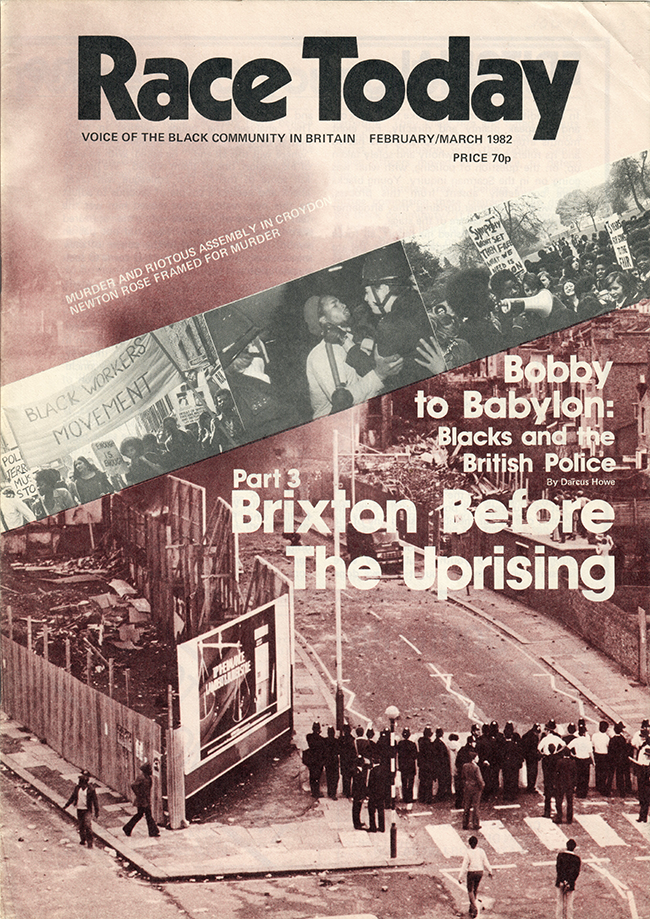
Figure 1 Long description
Cover image of the issue of Race Today, a leading voice of Black political thought in Britain, captures the tense social climate preceding the 1981 Brixton uprising. The cover features the headline Part 3: Brixton Before The Uprising and a collage of photographs showing a protest march with a BLACK WORKERS MOVEMENT banner, a confrontation between civilians and police, and a debris-strewn street scene. These images reflect the magazine’s commitment to documenting the lived experiences of Black communities and exposing systemic injustice. With contributions from figures like Darcus Howe, Race Today served as both a record and a rallying point for resistance, making this cover a powerful artifact of Black British activism in the early 1980s.
Superimposed upon the main photograph is a triptych featuring a march by the Black Workers Movement, a young Black man in hand-to-hand combat with the police, and a demonstration with a placard reading “Sympathy won’t set them free what we need is ACTION.” Emblazoned on the cover is the title of the feature article, “Bobby to Babylon: Brixton Before the Uprisings,” by Darcus Howe, the collective’s key cofounder and the magazine’s main editor. From the start, then, Race Today foregrounds a visual and textual conversation between the pressing immediacy of the uprisings and their deeper historical foundations, rooted in longstanding conflicts between police and Black peoples.5
Upon opening the cover, you’d then see Howe’s article on the very next page. He begins with an excerpt from a confidential Metropolitan Police report. According to the Met, between Friday, April 10, and Monday, April 13, “a large number of persons, predominantly black youths, attacked police, police vehicles (many of which were totally destroyed), attacked a Fire Brigade and damaged appliances, … looted, ransacked and damaged shops, and there is one instance of a white girl being raped in her flat by a black youth whilst the disorder occurred around them” (Howe, Reference Howe62). Howe refrains from commenting upon how the Met positions “black youths” as the subjects (and perpetrators) of unrest while the police, fire brigade, and private property become the recipients (and victims) of the disturbances. Nor does he comment upon the racist trope of oversexed Black youth as the ultimate threat, in the logic of the sentence, to whiteness-via-femininity and at the epicenter of disorder. He doesn’t have to: These stereotypes would have been taken for granted by the magazine’s readerships. What he does do, however, is situate the 1981 revolts of Black and white peoples against the police – beginning in April in Brixton and fanning out across England through the end of July – within the context of state power affecting Black political organizations on the one hand and the escalation of policing on the other, stretching back to the 1970s.
For instance, Howe credits the vibrancy and autonomy of the Black Power Movement from the late 1960s through the early 1970s, especially through the Panthers, in creating “public vigilance” regarding the Brixton police as well as employment, education, housing, and the broader internationalism of Black liberation struggles (62–63). For Howe, this period of Black radicalization culminated in the National Conference on the Rights of Black People in May 1971, when 800 representatives of various Black organizations convened at Alexandra Palace (63–64). This decisive moment led, however, to deliberate repressive mechanisms on the part of the state to eviscerate Black radical organizations. For instance, Prime Minister Harold Wilson would declare in 1971 that the Black Power Movement “across the Atlantic” as well as “here in Britain” are a “challenge” to democracy, which “survives as long as it is fought for” (quoted in Howe, Reference Howe64). (Fought by and for whom? we might ask.)
Along one line, the state weaponized the police against Black radicals. Howe cites instances of Special Branch officers raiding the Panthers’ headquarters in Brixton on the eve of the National Conference, stealing files and fundraising documents, and arresting Panther members who then became tied up in the justice system, consequently diminishing numbers and new recruits (64). Along another line, the government directed funds into the Urban Aid Programme, starting slowly in 1968 but by 1973 directing millions of pounds into the Inner City Partnerships and the Community Self-Help Programmes. “Young cadres, once headed into the Panthers,” writes Howe, “now gathered around government financed projects” (65). By the mid 1970s, with the Panthers all but disintegrated, the state funded a host of local community schemes and programs: Howe names the Brixton Neighborhood Centre, the Railton Youth Club, and the local Community Relations Council, among many others (67). For him, these state-funded programs were shaped in “the re-plastered colonial mould”: staffed by Black folks of an older generation, many of whom believed in the possibilities of upward mobility through government grants and university education, some of whom were “political entryists” seeking to recruit young Blacks into the channels of parliamentary democracy, and still others who became local Black representatives serving on the police liaison committee (67–68).
Concurrent with the state’s “atomization” and “organizational paralysis” (68) of Black activist movements was the “technological revolution” in policing and surveillance (66). I have already addressed the escalation of police power during the 1970s but it is worth noting, as Howe does, that these years saw the development of the Special Patrol group and the Vice Squad, giving police “unrestrained license” and “uncritical support” from magistrates and justices.6 At one and the same time, Howe reports that, from 1969 onwards, there were a series of corruption charges against the police, from drug rings and bank robbery to extortion and murder charges, as investigated by Operation Countryman between 1978 and 1982.
In between these dual constraints, Black revolt nonetheless persisted in the mid to late 1970s, although now without the organizational coherence of the recent past. Howe lists the Black Students Action Collective, formed to work toward the release of the three young men dubbed the Brockwell Three from prison for wrongful arrest and the charge of assaulting police officers (1974); the campaign to free George Lindo from false charges of robbery (1978); and 20,000 people marching on March 2, 1981, for the People’s Day of Action in response to the New Cross fire, in which thirteen Black teenagers perished due to what was thought to be a racist arson attack. “Revolt,” he says, “was alive and kicking and living in Brixton” leading up to April 1981 (68).
The point is that with as many as 55 percent of Black Brixton young men unemployed in the early 1980s (Peplow, Reference Peplow100) – combined with the state-sanctioned dismantling of organic Bl ack political activism, the acceleration of police power that arrested Black peoples without cause, the widespread corruption charges against the Met “in full view of the Black population” (Howe, Reference Howe67), and the emboldening of Black communities to refuse the status quo – the seeds of social unrest in Brixton were well sown and prepared to flourish. So while the cover photo of Race Today provides a snapshot of the urgency of the April uprisings and their fallout, Howe’s article deliberately frames what otherwise might appear as a “spontaneous” event (according to the mainstream media and political figures spanning Labour to Conservative) within a more than a decade-long conflict between indiscriminate policing against Black peoples and local struggles of the working class, grassroots political activists, and social justice movements as the real underlying causes of the April 1981 uprisings.
The timeliness of LKJ’s “Di Great Insohreckshan,” then, needs to be understood in the print context within which it appears and in conversation with the social-historical frameworks that Howe’s article delineates. Indeed, Howe’s editorial decision to use his article to open, and LKJ’s occasional poem to close, this issue of Race Today invites the magazine’s readerships to draw their own conclusions concerning how all-too-familiar struggles facing Black peoples in Brixton (and across England) become enflamed to the level of a “great insohreckshan.”
LKJ’s poem appears on the last page of the journal, before the back cover, and after two other poems, “Wat A Situashan” by Oku Onuora and “Natty Natty” by Michael (Mickey) Smith. The respective poems by Onuora and Smith appear with their titles in larger font and centered at the top of the page followed by the text of the poems beneath, all of which are set against a standard white background and framed by a thin black box outlining the poems. Their layout, in short, is unassuming and unadorned, typical of the ways one might expect poems to appear in a magazine. “Di Great Insohreckshan,” however, has a very different layout and appearance (see Figure 2).
Linton Kwesi Johnson, “Di Great Insohreckshan,” Race Today, February–March 1982, 80.
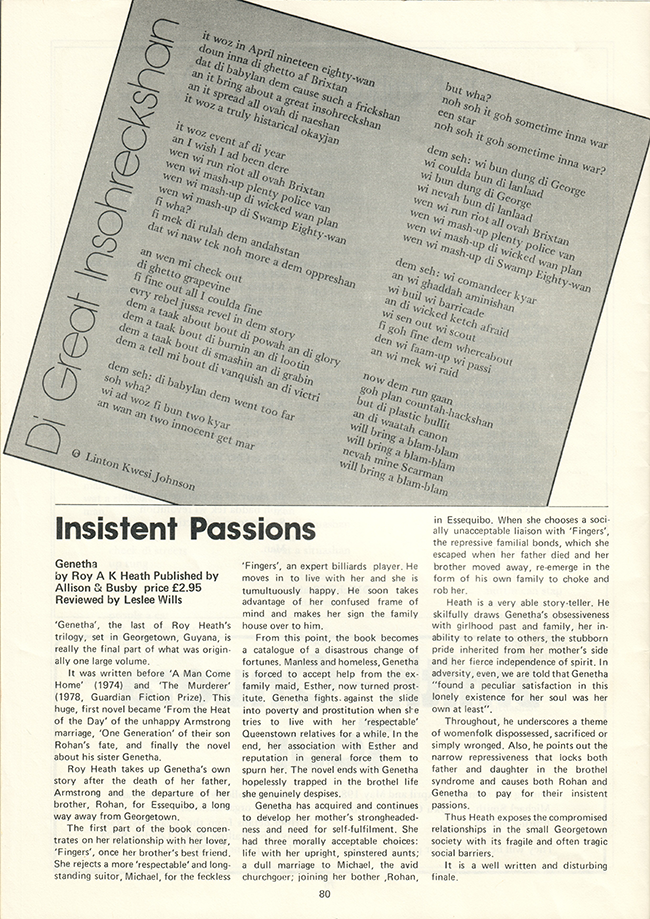
Figure 2 Long description
Linton Kwesi Johnson’s poem, Di Great Insohreckshan, appears at a diagonal and set against a background, making it seem as though the poem was written on distressed, burnt wood in the aftermath of the Brixton uprising in April 1981. The layout makes the poem resemble a charred remnant from the uprisings. Underneath the poem, there is a book review written by Leslee Wills titled: Insistent Passions, which covers Roy Heath's Guyanese novel, Genetha, published by Allison and Busby in 1981.
As you can see, LKJ’s poem is similarly framed by a black outline, but here the title appears along the left side of the page and the entire content is set against an ash gray background that is itself superimposed, and at a slant, against the white page of the magazine. The grainy, warped texture makes it appear as if the poem were composed on distressed wood from a burnt-out shop. This is, of course, a fiction. Visually, however, LKJ’s poem-in-print signals the ways in which “Di Great Insohreckshan” arises from fire, as if it had been picked up off the streets as a charred remainder and then submitted to Race Today, a still smoldering souvenir and hearkening back to the cover photo of Brixton in ruins. At the same time, the layout of the poem – literally a frame of the poem within the frame of the page – foregrounds layers of mediation and challenges required for LKJ to engage and give voice to the immediacy of the uprisings, which nonetheless ultimately remain at a remove in time and space but whose effects would continue to reverberate across Britain.
Like his other poems of revolutionary violence, “Di Great Insohreckshan” similarly takes on a vatic persona about the April disruptions, when as many as 5,000 people participated in the Brixton Uprisings:
The speaker deliberately counters the widespread stereotypes that the uprisings were an aberrant disruption led by a lawless minority of Black youth. In these opening stanzas, LKJ self-consciously creates a tension between the “I” who was not present at the time of the riots – LKJ was, in fact, on tour in Europe (Hodges, Reference Hodges76) – and the actions of the collective “wi,” as political agents taking power into their own hands and using social violence, according to the persona, as a speech act “fi mak di rulah andastan / dat wi naw tek no more of dem oppreshan.” In these ways, there is nothing senseless or lawless about the eruptions: the poem’s anaphora reinforces the ways in which the “mash-up” is the understandable manifestation of sustained police oppression against Black peoples, which by April 10 reached crisis point.
Indeed, in the first two stanzas the speaker firmly locates the causes of the “frickshan” in “Brixtan” as due to the forces of Babylon and “Operation Swamp 81,” which created an event of “histarical okayjan,” punning on a hysterical/historical event to which the speaker noddingly approves (“okayjan”) as violence spread from Brixton in April across the nation through the end of July. Beginning on Monday, April 5, the police launched Swamp 81, echoing Thatcher’s 1978 televised interview in which she stated her fears that Britain would be “swamped by people of a different culture.” Under Swamp 81, 120 plainclothes officers enforced sus laws to stop and search nearly 1,000 people in Brixton who appeared to be “suspicious,” of which “two-thirds were under 21 and over half were black” (Peplow, Reference Peplow109).7 Only 118 arrests were made and merely seventy-five charges resulted from the week (110). While the police claimed the operation was “a resounding success,” Swamp 81 also entailed raids on houses and cafes and regular harassment of Black peoples, including the public beating of a Black man outside a school, which made the front page of South London Press on Friday, April 10 (Editors, “Notes and Documents,” 224). That same evening, a young man, Michael Bailey, was stabbed and taken into a police car. Rumors spread quickly that the police were not assisting Bailey but further harming him. The car was surrounded by thirty to forty people and Bailey was released and ushered to hospital. But that event triggered the violence of Friday night, where two police cars were smashed in, sixty police reinforcements were called to the scene with riot gear and dogs, and people challenged police with stones and projectiles to the point that the police were forced to withdraw.
The following day, Saturday, police presence was even more robust in Brixton. After a minicab driver was searched, stopped, beaten, and taken into a police van on suspicion of possession of drugs (there were none), Brixton erupted on a scale “the like of which had previously not been seen in this century” (Scarman, Reference Benyon and Benyon13). Throwing bricks and petrol bombs at the police, lighting police cars on fire, burning down well-known racist establishments such as the Windsor Castle pub and The George pub, and looting jewelry stores, corner shops, and off-license liquor stores, the participants in the uprising made Brixton a no-go area, cordoned off by a three-mile square in the police’s attempt to contain the violence (Editors, 224). The uprisings continued Sunday, April 11, as a police commander’s car was petrol bombed and 250 people attempted to take over the police station. Meanwhile, 4,000 police were brought to the area, including reserves from South East England (Editors, 224–25). By the end of the weekend and into the week, sixty-three police vehicles were damaged or destroyed, 145 premises were damaged, and 286 people (mostly Black) were arrested (Editors, 225; Peplow, Reference Peplow114).
When read as part of a broader critical context surrounding 1981 and its aftermath, “Di Great Insohreckshan” disarticulates the normative sounds and official discourses regarding Brixton’s social unrest and the roles of Black youth, whether propounded by state leaders, news media, or social reformists who were “policing the crisis.” According to John Solomos and Tim Rackett, the government’s response to the riots maintained that they were due to “‘a lust for blood,’ an ‘orgy of thieving,’ ‘a cry for loot and not a cry for help,’” in the first instance, and, in the second, that the riots were “the outcome of a spiraling wave of crime and disorder in inner-city areas” (61). Scholars covering media portrayals of the disturbances, such as Greg Lanning and Simon Peplow, have shown how most mainstream media gave substantially more coverage to white authorities, such as images of bleeding officers or anti-immigrant statements by Conservative MPs, than to instances of how local residents were affected by the disorders (Lanning, Reference Lanning143; Peplow, Reference Peplow115).
LKJ’s speaker, in contrast, counters the discourse of Black criminality by placing responsibility squarely on the police as the source of the conflicts and by mobilizing the “wi” to carry out retribution for past injustices: “dem seh di babylan dem went too far / soh wha? / wi ad woz fi bun two kyar” (Race Today, 80). Likewise, the speaker distinguishes the “wi”’s destruction of property from that of persons, especially when it comes to the destruction of racist establishments such as The George pub: “dem seh: wi bun dung di George / wi coulda bun di lanlaad / wi bung di George / wi nevah bun di lanlaad.” To be sure, the poem is an upbeat celebration of the uprisings. When the speaker “check out / di ghetto grapevine / fi fine out all I coulda fine,” he hears the rebels “revel in dem story,” enjoying “di powah an di glory,” “di burnin an di lootin,” “di vanquish an di victri.” But this is not, merely, a lust for blood or a cry for loot.
On the contrary, what the speaker hears is the exhilaration of having momentarily stolen back the theft of Black life from the degradations of economic immiseration and police oppression. Home Secretary William Whitelaw would describe the scene in Brixton on Sunday, April 11, as “completely and utterly senseless,” and Metropolitan Police Commissioner Sir David McNee was quoted that same day as attributing the violence to outside left-wing agitators, a common maneuver to deflect attention away from police responsibility for, and local residents’ responses to, instances of social unrest (Benyon, Reference Benyon and Benyon3–4). LKJ’s persona, however, portrays the actions of the “wi” through deliberate guerilla tactics to outflank the police: “wi ghaddah aminishan,” “wi buil wi barricade,” “wi sen out wi scout,” “wi faam-up wi passi / an wi make wi raid” (Race Today, Reference Johnson80). As John McLeod has astutely observed, LKJ’s spelling of “wi” in print form “captures both the plural ‘we’ and the singular ‘I’ (and also recalls the Rastafarian invocation of ‘I and I’)” (133). In doing so, LKJ’s “wi” becomes heterogeneous and irreducible, at once singular and collective, internally divided and multiply attached, firming up and perpetually in flight. In these various ways, the poem’s initial “I” displaces itself, giving way to the unruly collective “wi”: the true historical agents of “Di Great Insohreckshan.”
In the final stanza, the poem concludes by sounding an apocalyptic warning that the April disorders in Brixton will be the continuation, not the conclusion, of even greater insurrection:
Immediately after the weekend’s events, Home Secretary Whitelaw charged Lord Scarman to conduct an inquiry into the cause and events of the disorders and recommendations going forward, which resulted (as many readers are aware) in the Scarman Report, published in November 1981. While Scarman denied the existence of “institutional racism” within the London Metropolitan Police, he acknowledged the existence of racial prejudice on the part of officers, hostile relations between police and young Black people, as well as “racial disadvantage” affecting ethnic communities living in Brixton. His report ultimately called for liberal reforms, such as recruitment of minority officers, training police in interacting with urban areas and ethnic minority communities, a police complaints procedure, and liaison committees between local communities and police forces.8 From the perspective of the poem, however, Scarman’s assessments and proposals are irrelevant (never mind Scarman) and could never speak from or for the perspectives of Black Brixtoners (never mine Scarman).
Ultimately, the poem knows that the disorders would give the police free reign to “plan countah-hackshan” through increasingly militarized power that “will bring a blam-blam.” Indeed, Thatcher’s administration largely ignored Scarman’s recommendations and equipped mainland police forces with CS gas, plastic bullets, water cannons, and riot guns from the Ministry of Defense.9 And yet the poem also knows that increased police oppression would not go without resistance. It is as if the poem on the pages of Race Today prophetically “will bring a blam-blam” of even further inflammatory violence on the part of Black and white peoples in their struggles against even more entrenched state power before spiraling crisis. For readers of Race Today, LKJ’s poem makes graphic in layout, legible in print, and audible in sound the undeniably “histerical okayjan” of Brixton’s “great insohreckshan,” which would snake its way across the country well into 1981. In the process, the poem carves out a space for pronouncing forms of cultural resistance and political refusal that, however cacophonous and dissonant (“a blam-blam”), nonetheless articulate – that is, “speak into existence” and “link together” – discursive models of intersubjective solidarity as an ongoing, unfinished revolutionary project before the realities of deepening dread.
Conclusion
In the ensuing years, LKJ would come to worldwide acclaim through performances and tours as well as his canonization in British letters. In 2001, he was approached by Ellah Allfrey, editor at Penguin, to be the first living Black poet listed on Penguin Modern Classics, which resulted in the publication of Mi Revalueshanary Fren in 2002 (LKJ, “Writing Reggae,” Reference Johnson51). In “Penguinizing Dub,” Henghameh Saroukhani has seen the poet’s canonization as salutary. The Modern Classics edition, for her, has marked his poetry as (rightly) “literary” and deserving of sustained poetic analysis, making it more “accessible” to wider audiences through footnotes and Penguin’s brand, and further widening the “historical and geographic specificity” of his political work on anti-racist class struggle in Black Britain to transnational dimensions (257–59). As Saroukhani explains, LKJ’s poems are decontextualized and recontextualized through Penguin’s “paratextual framings” (264). Under Allfrey’s editorial decisions, poems are grouped in the table of contents by decade, titled by “seventies verse,” “eighties verse,” and “nineties verse” (263). She does not signal or acknowledge in any way the poetry’s original appearance or publication history (263). For instance, Allfrey anachronistically lists “Mi Revalueshanary Fren” – published in 1991 and advancing an internationalist socialist politics after the collapse of totalitarian regimes in Eastern Europe – under “eighties verse.” Saroukhani uses Allfrey’s decision to her advantage, placing the Penguin Modern Classics title poem in conversation with “Di Great Insohreckshan.” For Saroukhani, this editorial decision reframes and “re-dubs” LKJ’s verses, inviting “a (re)reading of a local uprising through the lens of a global enunciation of resistance” (264). Much LKJ scholarship, for her, is overly “historically located and often hyper-contextualized” (257). Penguin’s Modern Classics text, from her perspective, however, updates LKJ for twenty-first-century readerships and “enunciates a poetic cosmopolitanism that imagines new connections and attachments between resistance movements from around the world” (258). I would like to return, though, to the 1982 print context of Race Today.
In my prior discussion of “Di Great Insohreckshan,” I noted that the poem’s initial publication in Race Today appears after Michael Smith’s “Natty Natty” and Oku Onuora’s “Wat A Situashan.” An excerpt of Onuora’s poem reads:
Race Today, as an autonomous, independent radical Black publication, could never have had the marketing, distribution, and brand appeal of Penguin. It never sought to, and that wasn’t the point. But by reading LKJ in his print context and, here, in paratextual conversation with Onuora’s verse, we can already see and hear in the early 1980s the cosmopolitanism punctuating dub’s poetics of incendiary insurgency and Black “liberashan” spanning Brixton, Kingston, and Soweto.
LKJ’s publication with Penguin is, indeed, salutary for expanding his readerships and rewriting Black British canon formations, a topic that I will discuss in more detail in Chapter 4. Nonetheless, it is essential to read this body of poetry in its initial print context to clarify the aesthetic nuances and political interventions his cultural productions make possible during the tumultuous years of the 1970s and early 1980s. This is precisely why I have so frequently returned to the critical insights of Policing the Crisis, which remain as relevant as ever for apprehending the ways in which the underlying economic, social, and political crises of the long downturn become weaponized through state violence against the racialized poor and working classes. I have further sought to illustrate the ways in which LKJ’s poems on policing and Black youth mediate the structural conditions of crisis, making audible and visible anti-Black violence and political resistance in aesthetic form. For me, this has meant reading LKJ in his time and place, including and especially in the pages of Race Today. Nevah mine Pingwing.
That said, if LKJ’s career begins in a mode of relative cultural autonomy before becoming recognized, absorbed, and canonized by mainstream institutions of British poetry, all the while nonetheless calling attention to the ways in which racial violence and social inequality persist in ever more dire forms every single day, his case exemplifies the arc of this book as a whole. Indeed, LKJ’s investment in the revolutionary potential of cultural production will be extended and transformed in the works of Bhanu Kapil and D. S. Marriott through their respective poetics of riot, as we will see in Chapter 5. The ensuing chapters pursue how, over the course of the coming decades, later British Black and Asian poets similarly invest their verbal art with the capacity to invent different forms of racial politics under changing conditions of social crisis.

 Open access