




The emergence of a “national language” has at least two different dimensions, each requiring a different sort of historical analysis. An emerging national language has an intellectual history, since texts written in “praise of the beloved language,”Footnote 1 to borrow Joshua Fishman’s phrase, can be studied both individually and comparatively. Yet linguistic nationalism also has a social history: an emerging national language can also be analyzed as a set of linguistic practices. Much as peasants in individual hamlets eventually come to imagine themselves as members of some broader community, so too is a patchwork of spoken local vernaculars first supplemented and then supplanted by a homogenous and homogenizing literary standard.
This essay argues that while the concept of a “Slovak language” had emerged by the 1850s, it existed in the minds of Slovak intellectuals long before the solidification of literary practices that collectively constitute the “Slovak language” as a social phenomenon. Mass literacy in a distinctively Slovak literary standard emerged only gradually. A long transition period, during which literary standards remained contestable, suggests that the ultimate success of the Slovak national movement, when analyzed from a social history perspective, was contingent.
No history of the Slovak language can be teleological. In general, “folk languages were ill-defined,” noted Ernst Gellner, and “in the case of the Slavonic languages, it was exceedingly hard, or impossible, to say where one dialect ended and another one began, or what was a language and what was a dialect.”Footnote 2 Sociolinguist Heinz Kloss once influentially distinguished Abstandsprachen (languages by distance) from Ausbausprachen (languages by development), proposing that while some “languages” differ from each other because of genetic or structural differences, others might have developed as a single language had historical actors made different choices. To illustrate the Ausbau situation, Kloss adduced the example of Slovak in relation to Czech: Slovak was the original Ausbausprache. Footnote 3
The history of textbooks and language teaching sheds light on both the intellectual and social history of a national “language.” While intellectual historians of nationalism have long studied textbooks for their ideological content, social historians might also consider the role of textbooks in establishing mass literacy. National ideologies come and go, but mass literacy in a particular literary standard, once established, generates a social interest group that persists even when ideological fashions change. While Eric Hobsbawm rightly warned scholars not to “reduce linguistic nationalism to a question of jobs,” he also profitably analyzed the class interest of what he memorably called “the lesser examination-passing classes.”Footnote 4 Students preparing for their examinations, however, study from textbooks, thus the content of textbooks warrants attention from a social historical perspective. This article, then, primarily analyzes grammar textbooks as tools for inculcating mass literacy. While it considers the nationalist fancies of individual patriot-grammarians, it does so mostly to explain their attitudes toward educational policy.
In those districts of northern Hungary that would eventually comprise the future Slovak Republic, establishing a school system capable of inculcating mass literacy proved a convoluted process. Before the Revolution of 1848, the orthographic debates of Slavic intellectuals held little interest for either the imperial bureaucracy or the Hungarian aristocracy. The educational reforms of Joseph II focused primarily on expanding the use of German at the expense of Latin.Footnote 5 Outraged Hungarian aristocrats first defended Latin but, starting in the 1820s, increasingly began promoting Hungarian.Footnote 6
Hungary’s Slavic intelligentsia, meanwhile, long discounted the importance of a single literary standard. The early nineteenth century witnessed the heyday of Habsburg Panslavism: Slavic intellectuals typically believed in one great “Slavic language,” and repeatedly characterized extant Slavic literary traditions, including the well-established Polish literary tradition and the well-established (Great) Russian literary tradition, as the literatures of “dialects.”Footnote 7 Slovak Lutheran theologian Ľudovít Šuhajda (1806–72), for example, explicitly imagined different literary traditions as both dialectical and part of a common Slavic heritage when he declared in 1834 that “everything which is written in any Slavic dialect belongs to every Slav.”Footnote 8 Several Lutheran Slovaks, furthermore, professed what might be called Czechoslovak “tribalism,” according to which Slovaks shared the same “dialect” with Bohemians and Moravians.Footnote 9
Conceptualizing Slavic literary traditions as “dialects” created a discrepancy between the terminology of Slavic linguistic nationalism and Habsburg legal jargon, since Habsburg bureaucrats typically conceptualized the medium of instruction or state administration as a “language.”Footnote 10 Panslav terminology also put Slovak intellectuals at odds with current linguistic jargon: many linguists currently define the word “dialect” using what might be called the “developmental approach,” arguing that literary codification is what elevates “dialects” into “languages.”Footnote 11 Whatever the benefits of the developmental approach in other contexts, Slavic intellectuals in northern Hungary used the word “dialect” in a different sense, since they believed in a great “Slavic language” that encompassed multiple literary standards.
Indeed, the assumption of a single Slavic language informed the political strategies of Slovak national awakeners. The influential Jan Kollár (1793–1852), for example, proposed that ardent Slavs should study all the “dialects” of the “Slavic language.” Kollár, a Lutheran clergyman and noted romantic poet, eschewed the term “Panslav.” He proposed instead the slogans “literary reciprocity,” “Slavic reciprocity,” or simply “reciprocity” (wzágemnost, subsequently vzájemnost), which he defined in an 1837 book as “the reciprocal purchase and perusal of writings or books published in all the Slavic dialects.” An educated Slav, he wrote,
must know only the four still living educated dialects, in which books are written and published, namely Russian, Illyrian, Polish and Czecho-Slovak. A learned and educated Slav of the second rank should also concern himself with the smaller dialects and sub-dialects.
Kollár also proposed various schemes through which Slavs could learn other dialects, such as book exchanges, lending libraries, and a “general trans-dialectal literary magazine, in which every new Slavic work will be shown and reviewed in the dialect in which it was written.”Footnote 12
Slovak intellectuals perhaps accepted orthographic diversity within the national “language” because their own literary culture was suffused with orthographic heterogeneity. If we disregard notions of a broader Panslav or Czechoslovak collective and anachronistically focus exclusively on Slavic northern Hungary, then we find that the ancestors of today’s Slovaks cultivated three distinct literary traditions.
The oldest tradition, employed mostly but not exclusively by Lutherans, ultimately derives from a sixteenth-century Bible translation from Kralice nad Oslavou, in Moravia. The so-called “Bibličtina” literary standard was taught in Lutheran Lyceums in Bratislava and Levoča; numerous Lutheran literati wrote grammars describing its conventions.Footnote 13 Kollár’s influential poetic works also belong to this tradition. Since the orthography of the Kralice Bible was also influential in Bohemia and Moravia, the Bibličtina tradition is sometimes misleadingly described as “Biblical Czech” or even as “Czech.” Advocates of Bibličtina, however, defended it not only as “Czech,” as “Czechoslovak,” or as “the written Czechoslovak dialect” but also as “Old Slovak” and as “our Church language.”Footnote 14 In the context of Slovak literary history, Bibličtina is most easily distinguished by the use of the letters {ě, ř, ů}, which only in the twentieth century become reliable shibboleths distinguishing Czech from Slovak.
At the end of the eighteenth century, however, Catholic clergymen started a new literary tradition. Anton Bernolák (1762–1813) codified a new literary standard in 1787; his multi-volume dictionary appeared posthumously in the 1820s.Footnote 15 Bernolák explicitly differentiated his standard from literary Czech, writing that he left “fully to his own will he who wishes to write in the Czech fashion.” At the same time, however, Bernolák still saw Slovak as part of a greater Slavic language.Footnote 16 By the 1840s, the literary corpus in so-called “Bernolákovčina” had become voluminous, but apart from the poetry of Ján Hollý consisted mostly of catechisms, prayer books, and other religious works.Footnote 17 The overwhelmingly Catholic nature of the Bernolákovčina tradition repulsed the influential Lutheran clergy, who saw it, in Peter Brock’s words, “as a peasant jargon unbecoming persons with any pretensions to refinement.”Footnote 18
The third literary tradition emerged in 1846, when Ľudovít Štúr (1815–56) published a new grammar and then a pamphlet justifying the new standard.Footnote 19 Štúr, as a Lutheran, had been educated in the Bibličtina tradition, and had even taught it while employed at the Lutheran Lyceum in Bratislava. In 1843, however, he lost his teaching post during a Slavophobe witch-hunt.Footnote 20 Štúr came to believe that Slavic literature would avoid persecution in Hungary only if it could claim autochthony.Footnote 21 He therefore devised a new particularist literary standard and used it in his influential newspaper, the Slovenskje Národňje novini (Slovak National News). In 1848, furthermore, Štefan Jančovič (1811–93) published a dictionary based on Štúr’s codification.Footnote 22 Štúr’s most visually striking innovations include the diphthong {uo} and the systematic replacement of the letters {y, ý} with {i, í}.Footnote 23
The Slovak national narrative has retroactively appropriated the literary traditions of both Bernolák and Štúr. Katarína Habovštiaková, for example, insisted in 1964 that “Bernolák’s Slovak and Štúr’s Slovak really represent two different forms of one and the same national language at different stages of development.”Footnote 24 By contrast, many Slovak national narratives dismiss Bibličtina as “Czech,” and thus foreign. Numerous secondary works claim, for instance, that Kollár “wrote in Czech.” Attacking Kollár’s “great ambition,” Stanislav Kirschbaum complained that “the Czech language apparently seemed to him a better vehicle than the Slovak to achieve his literary ambitions at the very least.”Footnote 25 Such efforts to efface the Bibličtina tradition from Slovak history disproportionately target Slovak Lutheran literary products and may arise in part from Catholic chauvinism. Bibličtina, in any event, is best understood not as “Czech” but as a literary tradition that united northern Hungary with Moravia and Bohemia. Many Bibličtina texts have as much claim to be “Slovak” as do texts written according to the conventions of Bernolák or Štúr.
The central point, though, is that when the Revolution of 1848 began the “Slovak” intelligentsia was divided: Slovak authors contributed to three different literary standards. Jonáš Záborský (1812–76) could legitimately reproach the Slavic intelligentsia that
Catholics mostly wrote according to Bernolák’s conventions; some Lutherans wrote in Bibličtina, other Lutherans wrote according to Štúr’s conventions.
Disputes concerning rival literary standards are difficult to resolve without state intervention. A particular standard may become firmly established if a government uses it in official life, or teaches it to schoolchildren. On the eve of the 1848 Revolution, however, no Slavic literary standard in northern Hungary enjoyed much official endorsement. The Habsburg central authorities had no strong opinions; and the assimilationist-minded Magyar elite opposed any and all forms of Slavic literary expression. Official attitudes, however, were transformed during the events of 1848–49.
The 1848 Revolution and Slavic Literary Standards
The Revolution of 1848, a major milestone of Central European history, marks among other things a turning point in Habsburg educational policy. During the heady excitement of the March days, linguistic demands featured prominently in petitions and manifestos, reflecting and articulating the class interest of the educated middle classes: as Louis Namier put it, the 1848 Revolution was a revolution of intellectuals.Footnote 27
Patriots of all stripes demanded official recognition for their language, which typically implied the introduction of that language into schools, both as an official subject and as the medium of instruction. Slavic educational demands, furthermore, sometimes reflected the influence of Panslavic ideas. The famous Slavic Congress in Prague, for instance, not only adopted Kollár’s slogan of “literary reciprocity,” but demanded in its draft program that “all Slavic dialects be taught in all secondary schools in all Slavic lands.”Footnote 28
The dynasty, desperate, found linguistic concessions relatively painless and committed itself to multilingualism. On 25 April 1848, when Ferdinand I proposed the Pillersdorf draft constitution, he conceded that “all ethnic groups (Volksstammen) are guaranteed sanctity of their nationality and language.”Footnote 29 A draft constitution composed by the Austrian Reichsrat in early 1849, remembered as the “Kremsier Draft,” similarly declared that “every ethnic group has an inviolable right to residence and the cultivation of its nationality generally and its language in particular” and required that provincial constitutions treat all customary languages equally.Footnote 30 On 4 March 1849, the new emperor Franz Joseph introduced yet another constitution, the “Imposed March Constitution,” which declared that “all nationalities are equal and each nationality has an inviolable right to preserve and further its nationality and language.”Footnote 31 All these constitutions granted equal rights to all the main “languages” spoken in the notoriously polyglot Habsburg domains. The proclamation, delineation, and contestation of linguistic rights would remain a central preoccupation of Habsburg political life as long as the monarchy endured.Footnote 32
After the 1848 Revolution failed, however, the Habsburg domains experienced a decade of counterrevolutionary neo-absolutism, normally remembered as the “Bach era” in reference to the interior minister Alexander Bach. The Bach era briefly pushed overt linguistic nationalism from the public sphere. During the 1850s, the so-called Sylvester-Patent, which superseded the Imposed March Constitution on 31 December 1851, made no explicit reference to linguistic rights.Footnote 33
During the 1850s, however, the Habsburg authorities chose to honor the dynasty’s commitment to official multilingualism. The opening paragraph of the Reichsgesetzblatt (Imperial Legal Gazette), a new legal gazette launched in 1850, declared that all laws would henceforth be published in “all customary provincial languages (landesüblichen Sprachen).” Not only were provincial governments responsible for publishing provincial laws in the relevant languages but also versions “in the various provincial languages (Landessprachen) were equally authentic.”Footnote 34
During the 1850s, therefore, scholarly squabbles over orthography and linguistic classification suddenly acquired new political significance. The government began conducting government business in several different languages. It also greatly expanded the teaching of Slavic, since the government needed to ensure a sufficient supply of future officials. But which Slavic literary standard or standards should be taught? The government sought the advice of Slavic philologists, who suddenly experienced new incentives to settle their differences and select a single literary standard.
Of the “customary provincial languages (landesübliche Sprachen)” acknowledged in the Reichsgesetzblatt, five were Slavic. The Reichsgesetzblatt taxonomy of Slavic however, contained many ambiguities. The taxonomy listed the “Serbian-Illyrian language” twice: one version used the “Serbian civil-script” in Cyrillic letters; another, equated with Croatian, used Latin letters. The “Bohemian language (böhmische Sprache)” encompassed the “Moravian and Slovak written language (Schriftsprache)”; the “Slovenian language” included the “Windic and Carniolan written language (Schriftsprache).”Footnote 35 The Reichsgesetzblatt ultimately listed ten Slavic glottonyms: Bohemian, Carniolan, Croatian, Moravian, Polish, Ruthenian, Serbian, Slovene, Slovak, and Windic. While this taxonomy did not invoke the language/dialect dichotomy, Helmut Slapnicka nevertheless commented that “it was doubtful what was to be seen as a language and what as merely a dialect.”Footnote 36 Given the aforementioned lack of consensus among Slavic savants, however, the Habsburg authorities could be forgiven some confusion as to which varieties to recognize.
Perhaps surprisingly, the Ministry of Religion and Education did not follow the Reichsgesetzblatt, but devised its own taxonomy of Slavic languages. Bohemian aristocrat Count Leo Thun (1811–88), who had helped organize the Slavic Congress in Prague, became Minister of Religion and Education in 1849.Footnote 37 His 1849 Lehrplan für die slavischen Sprachen als Muttersprachen (Teaching plan for the Slavic languages as mother tongues, hereafter the Lehrplan) differed from the Reichsgesetzblatt by dividing “Illyrian-Serbian” into “Illyrian” and “Serbian” and by recognizing Slovak as distinct from Czech. The Ministry of Religion and Education thus recognized seven Slavic languages (Sprachen). It explicitly acknowledged the difficulty of deciding “which dialect (Mundart) to use in secondary schools.”Footnote 38 The 1849 Lehrplan required students to learn both “individual Slavic languages” and “the nature of the Slavic languages in general.” Polish schools, for example, were to teach not only Polish, but “Ruthenian, as the other provincial language” used in Galicia. Slovene schools were to teach Illyrian.Footnote 39 During the Bach era, in other words, Slavic education theoretically involved learning more than one different literary standard.
As concerns Slavic northern Hungary, the Ministry for Religion and Education tended to lump Slovaks together with Bohemians and Moravians. “For the Slovaks in Hungary,” declared the 1849 Lehrplan, “in general everything said about Bohemian applies,” because any “divergences from the nature of the Slovak dialect and other special conditions can only be specified later.”Footnote 40 On 15 June 1851, the Ministry of Religion and Instruction also created a separate committee to specify pedagogical vocabulary for teaching in Slovak.Footnote 41 The committee, whose members included leading Czech academics Ladislav Čelakovský (1799–1852) and Václav Tomek (1818–1905), respectively professors of history and philology, met in Prague and recommended the use of their own textbooks. An 1853 law outlining the qualifications of Hungarian secondary school teachers, furthermore, specified that “candidates speaking the Slovak language cannot go without a knowledge of Czech language and literature.”Footnote 42
Official support for Panslav education proved transient. On 1 January 1855, Thun issued new regulations promoting German wherever possible. The new regulations permitted teaching another language if it was “the language of the great majority of the students,” yet required that “pupils whose mother tongue is not German are required, so far as it is possible for them to understand without great difficulty, to study in German with German textbooks.”Footnote 43 After the 1867 Compromise, the teaching of Slavic was further curtailed and Hungarian imposed instead.
In the early 1850s, however, Habsburg educational policy was being made by officials deeply influenced by Kollár’s ideal of Slavic reciprocity. Indeed, Kollár enjoyed considerable official favor in the final years of his life. Before the 1848 Revolution, he had condemned “demagogic agitation or revolutionary rioting against the government and ruler, from which only confusion and unhappiness result.”Footnote 44 He had withdrawn from public life during the 1848 Revolution itself. Such loyalty was rewarded: Kollár was appointed professor of Slavic antiquities at the University of Vienna and served on the committee for Czechoslovak legal terminology. Thun explicitly solicited Kollár’s advice; Kollár’s lengthy report on “the reorganization of schools and all popular education in the Austrian Monarchy and especially in Slovakia” recommended that secondary school students study their “native language” in part through “comparison with other dialects (Mundarten) and languages (Sprachen).”Footnote 45
Despite his fame and influence, however, Kollár, did not speak for all Slovak intellectuals. Many Slavs in northern Hungary had begun thinking of Slovak as linguistically distinct from Czech. Some wrote textbooks that reflected their ideas.
Four Textbooks for Slovak Pupils
Slovak textbooks specifying divergences from Czech were quick to appear: no fewer than four Slovak grammar textbooks were written in the years 1850–52. A profit motive cannot be excluded, since successful textbooks found a consistent market and went through several editions. In the immediate aftermath of the 1848 Revolution, however, historians can safely assume that Slovak authors also wrote at least in part from patriotic feeling. Plowing peasants may have remained nationally indifferent, but Slovak philologists were literate and interested in linguistic questions. Whether inclined to Slovak particularism, Czechoslovakism, or Panslavism, Slovak philologists formed the core constituency for linguistic nationalism in Slavic northern Hungary.
The first of the four textbooks appeared in 1850, when Andrej Radlinský (1817–79), priest, linguist, journalist, and all-around polymath, published his Prawopis slowenský s krátkou mluwnici (Slovak Orthography with Short Grammar, hereafter Prawopis slowenský). Radlinský had received a Catholic education in Bernolákovčina. As late as November 1849, he had edited the journal Cyrill a Method according to Bernolákovčina conventions. Lamenting the “unhappy schism in our literature, which lasted from 1787 to 1849,” however, Radlinský in 1850 abandoned Bernolákovčina and embraced the Bibličtina tradition.Footnote 46 On the title page, he even wrote his first name “Ondřej,” complete with the letter {ř}.
Radlinský did not, however, espouse Czechoslovakism. His grammar posited “the Slovak language” throughout. The introduction described the Bibličtina orthography as “Old Slovak,” and the opening page included {ě, ř, ů} when listing the letters of the “Slovak language (Řeč slowenská).”Footnote 47 Radlinský even included a short section listing “divergences which separate Slovaks from Bohemians and Moravians in orthography,” e.g., “in place of nej, Slovaks write naj, so najpěknější (instead of nejpěknější [prettiest]).” A 1967 study by Eugen Jóna disapprovingly wrote that Radlinský had promoted “Old Slovak, respectively Czech, in schools.”Footnote 48 Yet Radlinský’s grammar, by espousing the Bibličtina tradition from Slovak particularism, suggests that in 1850 the letters {ě, ř, ů} had still not yet become reliable signifiers of Czechness.
While endorsing Bibličtina, Radlinský acknowledged literary works in both Bernolákovčina and Štúrovčina as part of “Slovak” national literature. His textbook explains some salient differences to prospective students. It noted, for example, that the letter {ů} appears “everywhere where according to Štúr uo and according to Bernolák ó is written: kuoň, koň = kůn (horse), nuoz, nóz = nůz (knife).”Footnote 49 Radlinský thus imagined “Slovak” as encompassing several literary traditions.
A second textbook from 1850 was never published, but exists in manuscript. As the title suggests, the “Krátká Mluvnice Česko-Slovenská s Pravopisem pro školsé dítky” (Short Czecho-Slovak grammar for the use of Schoolchildren, hereafter the “Krátká Mluvnice Česko-Slovenská”),Footnote 50 imagined a Czechoslovak literary standard. It described the letters {ě, ř, ů} as “Czecho-Slovak.” Separate sections provide a “Czecho-Slovak orthography” and a “Czecho-Slovak grammar.”Footnote 51
The “Krátká Mluvnice Česko-Slovenská” situated this “Czechoslovak” literary standard within a broader Slavic context. Toward the end of the book, the author gave various “proverbs from Slavic life,” divided by region of origin. A list of “Czecho-Slovak” proverbs preceded a list of “Russo-Polish” proverbs.Footnote 52 The author reproduced the Russo-Polish proverbs in Bibličtina transliteration, much as Čelakovský had transliterated Russian and Polish folk songs in his 1822 songbook.Footnote 53 Štúr’s 1853 songbook would follow a similar procedure.Footnote 54 Slovak pupils, apparently, were to learn about broader Slavic culture through the “Czechoslovak” orthography.
Despite its imagined Czechoslovak geography and concessions to Panslav thinking, however, the “Krátká Mluvnice Česko-Slovenská” was clearly intended for pupils in the Kingdom of Hungary. The textbook ends by explaining epistolary conventions, providing several sample letters written at different levels of formality. The imaginary letters are overwhelmingly written from Slovak towns, including Hron, Bardejov, Modra, Košice, Orlov, and Rokycany.Footnote 55
A third textbook appeared the following year, when Vincenc Málik (1819–73) published the Slovensko-česká mluvnica dla zásad Hattalových (Slovak-Czech grammar according to Hattala’s principles, hereafter Slovensko-česká mluvnica). Málik worked as a parish priest and taught geography, Greek, Latin, and Slavic at the Catholic gymnasium in Banská Štiavnica. He based his 1851 textbook on a scholarly grammar that Martin Hattala (1821–1903) had published in Latin the previous year. Hattala published in Banská Štiavnica; Málik may have had access to Hattala’s manuscript while composing his textbook.
Málik’s Slovensko-česká mluvnica, following Hattala, clearly distinguished Slovak from Czech. Hattala had listed Czech and Slovak forms separately in his declension and conjugation tables, and on one noun declension table had even contrasted his proposed forms with both Czech forms and Bernolák’s forms.Footnote 56 Málik ignored Bernolákovčina, but followed Hattala in contrasting Slovak and Czech usage. Discussing phonology, for example, he noted “Czechs use the letters ě and ř. Slovaks however pronounce them softly, e.g., vděk = vdiek (vďek), tobě = tobie, pekně = pekňe, řad = riad.”Footnote 57 Yet while Málik did not include the letters {ě, ř, ů} in his “Slovak” alphabet, he explained where they appeared in Czech, e.g., in the vocative: “bratr, bratře; kmotr, kmotře.”Footnote 58
Málik espoused an explicit Slovak particularism. Where the manuscript Krátká Mluvnice Česko-Slovenská had posited an essentially homogenous Czechoslovak whole, Málik repeatedly posited a distinct “Slovak language.” The first page of the book, for example, explains that “Slovak eloquence is the art of reading, writing, and speaking Slovak correctly.” Nevertheless, in an appendix summarizing “the main differences that distinguish the Czech dialect [nárečie] from the Slovak” Málik apparently presupposed a single “Slavic language” in the Panslav sense.Footnote 59
The fourth and most important textbook, the Krátka mluvnica slovenská (Brief Slovak Grammar), has a complicated provenance. It was jointly written by Hattala and Michael Hodža (1811–70), and is thus often known as the “Hattala-Hodža codification.” Its ultimate instigator, however, was Štúr. Štúr had been unusually active during the 1848 Revolution: he distinguished himself by his energetic defense of Slovak interests at the Slavic Congress in Prague, and subsequently helped organize a Slovak militia to fight in Hungary’s civil war. Under the Bach regime, Štúr found himself under official suspicion and police surveillance. Though Štúr continued to petition the government on Slovak affairs,Footnote 60 once to demand that “in the lower and higher schools of the Slovak districts [slowakischen Kreise], the Slavic language [Slavische Sprache] become the general language of instruction,”Footnote 61 he found he had little influence. The Habsburg authorities distrusted Štúr’s radical politics and preferred to consult with Kollár.
Štúr and his collaborators, insisting on a distinctly Slovak literary standard, were unsatisfied with the Religion and Education Committee’s 1849 Lehrplan, which had specified that “for the Slovaks in Hungary, in general everything said about Bohemian applies.”Footnote 62 Yet Slovak patriots could hardly demand that Habsburg authorities introduce “Slovak” in public life when the Slovak intelligentsia itself could not agree on which literary standard to use. Štúr reasoned that the central government could only be persuaded to introduce a distinctively Slovak literary standard if that standard enjoyed pan-confessional support. In October 1851, therefore, Štúr organized a meeting in Bratislava between Štúr and his Lutheran supporters and various prominent Catholic literati. The consensus reached at the Bratislava meeting ultimately resulted in the Krátka mluvnica slovenská, which was a pan-confessional project from the outset: Hattala was Catholic, Hodža was Lutheran.
The Krátka mluvnica slovenská was published anonymously, but began with a pan-confessional endorsement from six prominent Slovak intellectuals. The six names included the Lutherans Štúr and Hurban; the Catholic names included the aforementioned Radlinský, who thus implicitly disavowed his own 1850 grammar.Footnote 63 Štúr would later refer to the literary standard codified in Krátka mluvnica slovenská as “united Slovak.”Footnote 64
The Krátka mluvnica slovenská ultimately existed because of Štúr’s desire to establish a Slovak particularist literary tradition. It presented itself as having codified a “written language for the beautiful lands of Slovakia,” and justified its Slovak particularism in part by citing Štúr’s 1846 grammar. However, it also expressed the desire for good relations with “brother Czechs.” Finally, it situated Slovak within a broader Slavic context, e.g., when proclaiming that “Slovak, like Slavic generally, does not have any definite articles.”Footnote 65
The authors of these four Slovak grammars mostly agreed on most issues: noun and adjective declensions, verb conjugations, pronoun declensions, and so forth are recognizably similar. All, for example, list several first-person singular verb conjugations ending in -m, with various connecting vowels depending on the verb stem.Footnote 66 In this respect, however, Slovak grammarians also agreed with their Czech counterparts: Tomek’s Krátká mluvnice česká pro Čechy, Václav Hanka’s Mluvnice českého jazyka, and Tomiček’s 1850 Česká mluvnice all propose -m as first-person singular verb conjugation.Footnote 67
At the same time, however, the Slovak textbook authors from the 1850s also differed from each other on numerous petty orthographic or grammatical issues. For example, the first-person singular conjugation of “love” (i.e., “I love”) appears differently in different grammars: the Krátka mluvnica slovenská proposed milujem, Málik milujem or miluji, and Radlinský miluji or miluju. The infinitive (‘to love’) also varied: the Krátka mluvnica slovenská gave milovať, Radlinský milovati, while Málik permitted both: “milovať (milovati).”Footnote 68 The word for “child” appears in Štúr and Jančovič as ďjeťa, in Radlinský as dítě, in Málik as dieťä, and in the Krátka mluvnica slovenská as dieťa. Footnote 69 And so on.
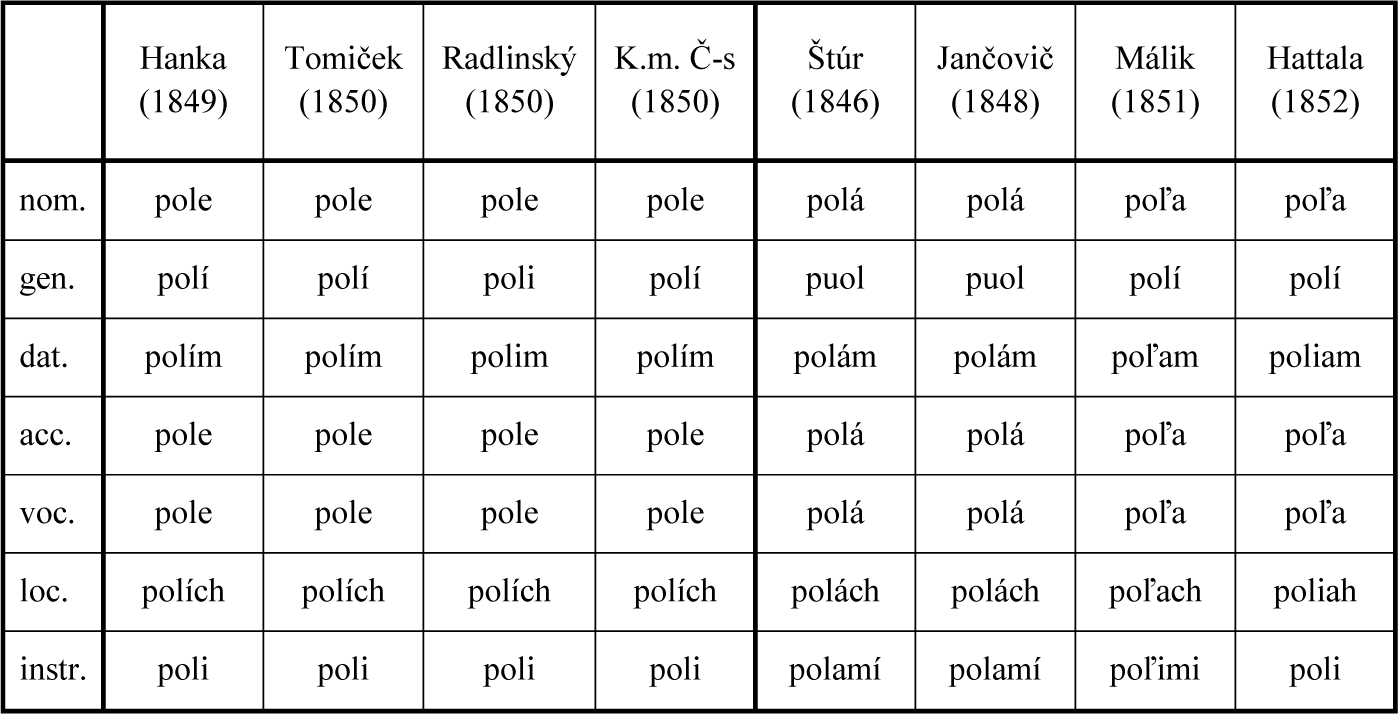
Space limitations exclude an exhaustive linguistic description of the various textbooks, but a comparison of noun declinations suggests that literati promoting a particularist Slovak literary standard in the 1850s were less able to reach consensus than literati within the Bibličtina tradition. All four of the Bach-era Slovak particularist grammars used the word pole (field) as a paradigm when illustrating the conjugation of a certain class of neuter nouns. The word pole also appears as a paradigm in Štúr’s 1846 grammar, in the brief grammar attached to Jančovič’s 1848 dictionary, in Hanka’s 1849 Czech grammar, and in Tomiček’s 1850 Czech grammar.Footnote 70 The relevant declensions are shown in Figure 1, though if grammars permit multiple forms, Figure 1 depicts only the first form listed.
The plural declensions of pole in four Bibličtina and four “Slovak” grammars. In case of multiple forms, only the first form is shown. Hanka, Mluvnice českého jazyka, 105; Tomiček, Česká mluvnice, 47; Radlinský, Prawopis slowenský 14; “Krátká Mluvnice Česko-Slovenská,” 36; Štúr, Nauka reči slovenskej, 148; Jančovič, Noví maďarsko slovenskí a slovensko maďarskí slovňík, xxvi; Málik, Slovensko-česká mluvnica, 34; Hattala, Hodža, Krátka mluvnica slovenská, 17.

Figure 1 suggests that the Bibličtina/Czech grammars mostly agreed with each other, while Slovak particularist grammars differed more often than they agreed. Málik listed two alternative instrumental plural declinations for pole, namely polamí and poľimi. Though Málik worked from Hattala’s Latin grammar, neither of his options can be found in Hattala’s Krátka mluvnica slovenská, which instead proposed three options: poli, poliami, polmi. Hattala’s 1850 Latin-language grammar, incidentally, had given poĺmi, poĺí, poĺmi, though the use of accented {ĺ} rather than palatalized {ľ} apparently derived from a publisher’s error.Footnote 71
Extending this analysis of declensions of the word pole into the 1860s, 1870s, and 1880s suggests that Slovak grammarians only reached a consensus about the noun declensions in the 1870s. Figure 2, showing the plural declensions of pole in various post-1861 Slovak grammars, suggests that Slovak intellectuals essentially settled on Hattala’s forms. Institutional backing from the influential Matica Slovenská probably explains the emerging consensus: as Elena Mannová and Roman Holec put it, “only the cooperation of Catholic and Lutheran scholars in the framework of the Matica Slovenská (1863–75) contributed to the acceptance of a single written language.”Footnote 72
The plural declension of pole in post-1861 “Slovak” Grammars. In case of multiple forms, only the first form is shown. Cf. Samo Hroboň, “Slovenčina,” fourth unnumbered page, manuscript in the LAMS, signatura 44 U 6; Anton Halúzky, Krátka Mluvnica a Pravopis (Short grammar and orthography) (Banská Bystrica, 1863), 15; Fraňo Mráz, Slovenská mluvnica pre Gymnasia, Reálky, Praeparandie (Slovak grammar for Gymnasia, Real schools, and Praeparandie) (Vienna, 1864), 61; Daniel Koppa, Krátka mluvnica a pravopis jazyka slovenského s pripojenými koncovkami biblickými (Short grammar and orthography of the Slovak language with supplemental Biblical endings) (Banská Bystrica, 1871) 9; Ján Kožehuba, Cvičebná kniha Slovenskej Mluvnice (Martin, 1873), 23; Ján Bežo, Tretia čitanka a mluvnica: pre vyssie triedy evanjelickych a v národnych skôl (Third reader and grammar: for Protestant secondary and national schools) (Vienna, 1882), 333; Ján Burian, Slovenská mluvnica pre pospolité s̆koly (Slovak Grammar for Secondary Schools) (Martin, 1899), 16.

In the 1870s, however, any putative consensus about Hattala’s codification faced a new challenge from Adolf Urbán (1820–1909), a Lutheran schoolteacher in Spišské Hanušovce. In 1875, Urbán proposed a new literary standard based on what he elsewhere called the “Šariš dialect (narečie).”Footnote 73 Urbán’s literary standard differed from other Slovak codifications in innumerable petty ways. Urbán did not use pole as a sample word, so his proposals cannot be directly compared to those of other grammarians. Urbán’s adjective declensions, however, diverged from Hattala’s in eight out of twenty-one (38 percent) of all possibilities.Footnote 74
Conclusion: The Status of Slovak Particularism in the 1850s
Analyzing Slovak textbooks from the perspective of intellectual history might suggest that Slovak particularist linguistic nationalism was widespread during the early Bach era. Poetry published in Slovak textbooks provides evidence of its vitality. Consider the didactic “Verní Slovák [The Faithful Slovak],” which August Škultéty (1819–92) included in an 1851 reader intended “for Slovak schools”:
An intellectual history approach might conclude from these and other similar effusions that Slovak linguistic nationalism was firmly established in the 1850s.
The social historical approach to Slovak language textbooks, however, tells a more nuanced story. The various textbooks disagree on innumerable petty issues. If textbook authors cannot agree about the finer points of grammar, teachers have no hope of instilling the sort of advanced literacy that generates linguistic nationalism.
No textbooks, furthermore, can instill mass literacy unless they are actually used in classrooms. Statistics published by the Ministry of Religion and Instruction in 1854 suggest that across Slavic northern Hungary only one secondary school, the gymnasium in Trenčin, used Slovak as its primary medium of instruction, though another three gymnasia in Banská Bystrica, Banská Štiavnica, and Prešov employed German and Slovak as dual languages of instruction. Of the 946 Slovak students attending secondary school in Hungary, 82 percent attended a school that did not use any form of Slavic as a medium of instruction.Footnote 76
Even those few schools offering Slovak pupils some instruction in their mother tongue, furthermore, obeyed the Ministry of Religion and Instruction’s Panslav/Czechoslovak guidelines. The 1849 Lehrplan had required Slovak pupils to learn from Bohemian school textbooks, and specifically, “the one by Tomek; more complete is Tomiček grammar, expected to come out later this year.”Footnote 77 In 1854/55, the Lutheran gymnasium in Prešov taught Slovak pupils their “Slavic mother tongue (Szláv anyanyelv)” from Tomek.Footnote 78 A year earlier, the Lutheran gymnasium in Bratislava had taught Slovak pupils the “Slavic language (Szláv nyelv)” using Tomek and Tomiček.Footnote 79 The Bratislava gymnasium, admittedly, claimed to be teaching the “Slovak language (Tót nyelv)” in 1858, but which Slovak language? A passing reference to the “Biblical Slovak language (Bibliai tót nyelv)” suggests the Bibličtina tradition, as one might expect from a Lutheran gymnasium.Footnote 80
Slovak Catholics had traditionally shown less interest in the Bibličtina tradition, yet the Catholic Gymnasium in Banská Štiavnica also followed ministry guidelines. The aforementioned grammarian Málik declared himself professor of “Slavic (Slavisch)” on the gymnasium’s 1852 staff list,Footnote 81 but the 1854 curriculum suggests that Málik taught the “Czechoslavic language (Čechoslavische Sprache)” mostly from Bohemian textbooks: students in their seventh and eighth years used the Králodvorský Rukopis, a famous forgery by Václav Hanka (1791–1861), and an anthology of readings compiled by the poet František Čelakovský.Footnote 82 Both Hanka and Čelakovský lived in Prague. Students in their third to sixth year studied from Čelakovský’s anthologies and the grammars of Tomek and Tomiček. Second-year students studied from Tomek’s Czech grammar, supplemented with “translation exercises” from Hattala. These translation exercises were the only concession to Slovak grammatical particularism.Footnote 83 Most importantly, however, the 1854 Banská Štiavnica curriculum offered Slavic language instruction for only two hours a week. Both Latin and German received more attention. First year students, for example, spent five hours a week studying German, and eight hours a week studying Latin. In their final year, students spent three hours weekly on German, five hours on Latin, and five hours on Greek.Footnote 84
Rudimentary instruction with Czech textbooks could not create mass literacy in a distinctively Slovak literary tradition. Consequently, Slovak literacy remained rudimentary. The Kingdom of Hungary’s official statistics on literacy, admittedly, are not directly relevant to the question of literary standards. Hungarian census-takers first asked about literacy in 1880. They measured a Slovak literacy rate of 33 percent; the figure rose steadily thereafter.Footnote 85 Hungary’s census takers, however, defined literacy as the ability to sign one’s name, as opposed to simply making an X. Such a rudimentary test cannot differentiate between, e.g., the Bibličtina tradition, Hattala’s codification, or Urbán’s codification.
A few scholars, however, have estimated the size of the Slovak intelligentsia in 1918/19, at the moment when the Czechoslovak Republic emerged. R. W. Seton-Watson guessed that the number of “educated and nationally conscious Slovaks—as apart from the neglected and unrepresented masses” was somewhere from “750 to 1000.”Footnote 86 László Szarka more optimistically estimated that in 1918 as many as 3,304 “Slovak intellectuals” had mastered literary Slovak.Footnote 87 Even if such figures were multiplied by ten; however, they would remain insignificant as a percentage of the total Slovak population. Ivan Dérer, a Slovak politician who from 1929 to 1934 served as Czechoslovakia’s Minister for Schools and National Enlightenment, recalled of the early republican era that “a Slovak intellectual class of officials, priests, teachers, and so forth was lacking.”Footnote 88 An educated social class lacking in 1919 must also have been lacking during the Bach era.
In the 1850s, furthermore, even the demographically minuscule Slovak intelligentsia could not agree on which literary standard to promote. The lack of consensus in Slovak textbooks suggests that even those highly atypical intellectuals who took a particular interest in philological questions disagreed about various petty issues. In light of interwar Czechoslovakism, furthermore, it deserves particular emphasis that in the 1850s “Slovak” intellectuals had not yet made a decisive break with the Bibličtina tradition. Of the four textbooks written in northern Hungary during 1850–52, two frankly promoted Bibličtina, while the other two presented Slovak particularist forms alongside Bibličtina forms, which were presented as “Czech.” By using Bohemian textbooks with Slovak students, finally, Slovak teachers in effect promoted Czechoslovakism in practice.
Slovak textbooks continued to teach Bibličtina forms throughout the nineteenth century. In 1882, for instance, Ján Bežo published a textbook for Lutheran pupils employing both Bibličtina and Hattala’s orthography. The volume begins with Biblical passages in Bibličtina, complete with {ě, ř, ů} in a Blackletter typeface; subsequent readings alternate between Hattala’s orthography and Bibličtina. Passages on biology, physics, and agriculture mostly appear in Hattala’s orthography; historical events related to Christian history mostly in Bibličtina. The book concluded with a short grammar summarizing both Bibličtina and Hattala’s standard.Footnote 89 As late as 1921, furthermore, Slovak politician Anton Štefánek (1877–1964), Czechoslovakia’s future minister of education, attended an exhibition of school textbooks in Bratislava. Štefánek observed several Lutheran textbooks following the Bibličtina tradition, characterizing them as “printed in schwabach and in the Czech language (reč).” The Czechoslovak-minded Štefánek hoped such textbooks would “preserve the cultural unity of Slovaks and Czechs.”Footnote 90
No literary standard can claim to be firmly established until a demographically significant percentage of the target population has mastered its finer details. On the territory of the future Slovak republic, the educational apparatus to inculcate any form of mass literacy simply had not yet been established. During the Bach era, the absence of consensus in “Slovak” grammars suggests that no particular literary standard had established itself even in the minds of intellectuals. Scholars might disagree about the relative strength of the various Slovak literary traditions in the 1850s, but their absolute weakness is clear.
The discrepancy between the intellectual history approach and the social history approach problematizes questions of chronology. David Short once characterized Kollár’s 1846 polemic attacking Štúrovčina and defending Bibličtina as “a serious case of locking the stable door after the horse had bolted.”Footnote 91 Slovak textbooks of the Bach regime, however, suggest that in the 1850s, the horse of the Bibličtina tradition was still demonstrably thriving in the stable of northern Hungary. However patriotically Škultéty and others may have composed poems in praise of the beloved Slovak language, Slovak-particularist minded intellectuals were still struggling to establish a Slovak orthography and decide the conventions of Slovak grammar. Only in the 1930s would the educational system of the First Czechoslovak Republic create homogenous mass literacy in a distinctively Slovak literary standard.
Competing interests
The author declares no competing interests.


 Open access

