




Even if it does not capture as much attention as waves of democracy (or autocracy), the world has seen a sustained trend towards decentralisation. Subnational authorities play increasingly active roles in governance, gaining new powers and responsibilities. Part of this trend is a rise in territorial autonomy, special forms of self-government for geographically concentrated minorities. There has been a parallel rise in Indigenous sovereignty movements aimed at regaining power over culture, land, and law. Territorial autonomy and Indigenous self-government have much in common. They involve not just ethnic minorities, but minority nations seeking to recapture sovereignty as part of decolonisation. However, in theory and practice, these trends towards self-government have largely evolved separately. Experts on territorial autonomy rarely examine Indigenous regions, or at least overlook their distinctive qualities, while Indigenous activists and scholars rarely look to autonomous regions for lessons, inspiration, or allies. These parallel forms of self-government have evolved in isolation, to the detriment of each.
This paper frames Indigenous autonomy as a distinct form of territorial autonomy and one potential realisation of Indigenous sovereignty. Indigenous autonomous regions have many unique elements, namely a juridical approach, an emphasis on communal land rights, leadership by elders and public corporations, and decentralised governance. They often feature territorial governments serving all residents and corporate bodies serving status Indigenous peoples, mixing territorial and non-territorial autonomy. Despite sharing other aspects of mainstream territorial autonomy, such features make Indigenous autonomy distinctive.
While the study of territorial autonomy tends to focus on Western cases, and the growing study of Indigenous autonomy on Latin American and Arctic regions, this paper looks to Asia. It is in many ways a plausibility probe (Levy Reference Levy2008), mapping the cases and potential for Indigenous autonomy in Asia. I identify four groups of cases: Existing autonomous regions rarely understood as Indigenous (Indonesia’s Papua provinces, Guangxi in China), Indigenous sub-regions within special provinces/states (northeast India, Myanmar, the interiors of Aceh and Mindanao), special subnational units rarely seen as Indigenous or autonomous (Malaysia’s Borneo states, northeast India), and recognised Indigenous peoples lacking self-government (Ainu, Taiwan, the Philippine Cordillera). My goal in applying the lens of Indigenous autonomy is to help reimagine these cases and their governance challenges, primarily speaking to scholars, although perhaps also informing Indigenous leaders across Asia.
Concepts: Territorial Autonomy and Indigenous Sovereignty
The world is seeing a sustained trend towards decentralisation, with governance shifting downwards (Arzaghi and Henderson Reference Arzaghi and Henderson2005; Schakel Reference Schakel and Lago2021). This exists across world regions and regime types, with important effects for well-being and representation (Mookherjee Reference Mookherjee2015). Decentralisation takes many forms. While scholars might assume powers distributed uniformly across subnational units, some degree of asymmetry is unavoidable, and in some cases, by design. Datasets measuring a country’s decentralisation average out and thus obscure asymmetries, making it essential to focus on the powers of subnational units, not the decentralisation of national governments (Hooghe et al. Reference Hooghe, Marks, Schakel, Niedzwiecki, Osterkatz and Shair-Rosenfield2016). Shifting our units of analysis to subnational units changes relevant terms and concepts. While federalism and decentralisation are qualities of countries, self-government and autonomy are qualities of regions.
Asymmetrical decentralisation provides special powers to territorially concentrated minorities. This is known as territorial autonomy— technically ‘special’ or ‘ethnic’ autonomy, since all decentralisation provides autonomy. Ghai (Reference Ghai and Ghai2000: 8) defines territorial autonomy as “a device to allow ethnic or other groups claiming a distinct identity to exercise direct control over affairs of special concern to them, while allowing the larger entity those powers which cover common interests.” Territorial autonomy is a widespread though underappreciated political system to accommodate difference, often to stymy separatism. The powers sought by autonomous regions are myriad, ranging from control over language and education to different political systems, fiscal power, resource management, security arrangements, and international relations. Above all, territorial autonomy represents a compromise between incorporation into the host country and independence from it, one preferred by neither the national government nor regional group, at least not initially (Barter Reference Barter2026).
Territorial autonomy links research on federalism and decentralisation, multiculturalism, and minority rights. Research often takes the form of edited volumes, mostly case studies from Western democracies (Anderson and Choudhry Reference Anderson and Choudhry2019; Ghai and Woodman Reference Ghai and Woodman2013; Keating and McGarry Reference Keating and McGarry2001; Safran and Máiz Reference Safran and Máiz2000). Scholars find that autonomous governments are especially active in local economies and culture (Laforest and Lecours Reference Laforest and Lecours2016), pursue subnational nation-building (Keating Reference Keating1996), and perform better when powers are dynamic rather than fixed (Lecours Reference Lecours2021). Cases include Åland, Catalonia, Quebec, Scotland, South Tyrol, and Wales. Another area of scholarship sees autonomy as a method to resolve violent secessionist conflicts (Cederman et al. Reference Cederman, Hug and Wucherpfennig2022; Lapidoth Reference Lapidoth1997; Weller and Nobbs Reference Weller and Nobbs2010). More than other concessions and forms of power-sharing, territorial autonomy is difficult to rescind, even if many central governments try (Jarstad and Nilsson Reference Jarstad and Nilsson2008; Martin Reference Martin2013). This set of cases is global, including Aceh, the Basque Region, Bougainville, Kurdistan, Mindanao, Northern Ireland, and Papua.
Autonomy is typically found in regions with histories of sovereignty, incorporated into larger countries through conquest or fiat. Autonomy is not just for ethnic minorities, but minority nations, peoples with a sense of sovereignty. Autonomy enables a national minority to see itself as a regional majority, a tool of decolonisation for peoples enduring exclusion, assimilation, and violence. It is puzzling, then, that concepts derived from territorial autonomy are rarely applied to Indigenous sovereignty.
Indigenous Sovereignty & Self-Government
Just as minorities seeking or enjoying territorial autonomy should be seen as nations, the same is true of Indigenous peoples, on account of prior claims to territory and sovereignty. This is evident in the term First Nations, which signifies being prior, plural, and political. While status as a member of an ethnic minority may be an issue of self-definition, cultural difference, or physiology, Indigenous status has special legal relevance; “Indigenous peoples can claim minority rights under international law, but specific international mandates and mechanisms also exist to protect the individual and collective rights of indigenous peoples” (UN 2018: 97-98).Footnote 1
In the face of colonial expansion and migration, Indigenous communities have by no means been passive ‘vanishing races’. From violent resistance to peaceful civil rights activism, Indigenous peoples have mobilised against exclusion, assimilation, and historical injustices. Examples include the American Indian Movement and Dakota Access Pipeline (Smith and Warrior Reference Smith and Warrior1996); Meech Lake, the Oka Crisis, and Idle No More (Coates Reference Coates2015); #LandBack movements (Spang Reference Spang2022); and uprisings in Chiapas Mexico, Guatemala, and Bolivia (Warren and Jackson Reference Warren and Jackson2002)—to name a few. Indigenous peoples have used various forms of activism to voice their demands, rooted locally and connected globally (Carlson and Berglund Reference Carlson and Berglund2021). Indigenous movements often voice their demands in terms of sovereignty and self-determination (Wunder Reference Wunder1997). For Moreton-Robinson (Reference Moreton-Robinson and Moreton-Robinson2020: 3), “Despite the continued disavowal” by settler states, declarations of “Indigenous sovereignty” are common grounds for Indigenous communities. Article 3 of the UN Declaration of the Rights of Indigenous Peoples (UNDRIP 2007) states that “Indigenous peoples have the right to self-determination.”
What this means in practice, though, varies. Many Indigenous activists reject self-government as insufficient or oppressive. For Taiaiake Alfred (Reference Alfred2005: 31), First Nations have been “coopted into movements of ‘self-government’ and ‘land claims settlements,’ which are goals defined by the colonial state.” Legacies of reservation governments dominated by federal agencies and staffed by pliant chiefs have led Indigenous activists to reject self-government as insufficient in the pursuit of full decolonisation. Indigenous communities have long endured settler states using tribal governments as systems of domination rather than representation. For some, sovereignty means something more radical, perhaps the cessation of settler control, revolutionary socioeconomic transformation, or dispossessing settler property. Coulthard rejects the politics of recognition, arguing that self-government reproduces colonial hierarchies. Echoing Fanon, self-government without revolution fails to be “truly self-determining… as the creators of the terms and values by which they are to be recognized” (Reference Coulthard2007: 450). Coulthard sees self-government as falling far short of self-determination, preserving “the ultimate sovereign authority” of settler states (Reference Coulthard2014: 123). Loukacheva (Reference Loukacheva2007: 52) notes that many Indigenous peoples see self-government as “voluntary colonialism”, retaining Western governance and dependency. Rather than accept or even negotiate self-government with settler states, Indigenous peoples may prefer to carry on with de facto informal governments operating beyond state recognition and control (Burguete Cal y Mayor Reference Cal, Mayor, González, Funaki, Cal, Mayor and Ortiz-T2023; Champagne Reference Champagne2013: 12). For Indigenous communities, “Self-determination is usually understood as a means of gaining distance from, rather than inclusion in, state institutions” (Murphy Reference Murphy2008: 185).
Indigenous activists may be suspicious of electoral politics and government, although it is unclear if this understandable scepticism is towards government in general or institutions created by (and for) settler states. While perhaps sympathetic to radical demands, many Indigenous peoples seek concrete ways to protect their cultures, address social issues, and represent their nations through self-government. Indigenous communities are often pragmatic, seeing potential to work within settler colonialism to create new models of governance (Wilson and Alcantara Reference Wilson and Alcantara2012: 784). And while there may be similar voices in Asian autonomous regions, these critiques and critics are focused on Indigenous self-government in American settler colonialism. Powerful autonomous self-government is never offered freely by settler governments, but instead won and sustained through struggle. As Papillion (Reference Papillon2012: 290) observes, “Indigenous autonomy faces considerable institutional resistance”, growing only through communities “asserting their political autonomy and establishing the legitimacy and authority of their governments.” Just as territorial autonomy is typically granted only after protest and conflict, the ability of Indigenous communities to manage their own legal systems, communal lands, social services, and resources is a result of sustained activism rather than a gift from enlightened national authorities.
Towards Indigenous Autonomy
In theory and practice, territorial autonomy and Indigenous sovereignty rarely speak to one another, even though both involve minority nations seeking to regain sovereignty from host states. It is possible that many Indigenous peoples fear being seen by host states as secessionist, and scholars may not want to imperil these communities by linking them to separatism, especially in Asia. Of course, territorial autonomy is not secession, but rather an alternative to it. Building from a right to Indigenous self-determination in Article 3, UNDRIP’s Article 4 states that Indigenous peoples possess “the right to autonomy or self-government in matters relating to their internal and local affairs, as well as ways and means for financing their autonomous functions.” This right to self-determination through autonomous self-government has no equivalent for other minorities.
Scholars typically see autonomy as different than Indigenous government, especially in the form of reservation governments (Benedikter Reference Benedikter2009: 15). Rezvani (Reference Rezvani2014: 204) writes off reservation governments as “sham federacies” that control Indigenous peoples, although he notes that Nunavut has achieved partial independence and sovereignty (208). Lapidoth (Reference Lapidoth1997: 5-6) hesitantly separates Indigenous self-determination from territorial autonomy, lying beyond her book’s scope. Research on territorial autonomy only sometimes includes references to Indigenous autonomous regions. It is not uncommon for edited volumes to include Nunavut or Greenland, seen as akin to Quebec or Scotland, with limited reflection on their distinctive Indigenous elements. Hannum (Reference Hannum1990) includes a chapter on Indigenous rights, framing territorial autonomy as an ideal mechanism for Indigenous self-determination. The Regional Authority Index (RAI), the dominant measure of subnational government power, includes a special dataset for Indigenous autonomy, defined as “general purpose jurisdiction created with the explicit purpose to provide governance for an indigenous people or peoples” (Shair-Rosenfield et al. Reference Shair-Rosenfield, Schakel, Niedzwiecki, Marks, Hooghe and Chapman-Osterkatz2021). Some research on territorial autonomy thus examines Indigenous self-government, but with a vague sense of what makes it distinctive.
Some studies of Indigenous self-government refer to territorial autonomy, especially in Latin America and the Arctic, developing models of Indigenous autonomy. González (Reference González2015) analyses early Indigenous autonomous regions in Panama and Nicaragua. Panama’s Guna Yala has practised self-government for over a century, with smaller self-governing Indigenous regions created in subsequent years. Perhaps because they use the term ‘autonomy’ in their names, Nicaragua’s RAAN (Región Autónoma de la Costa Caribe Norte) and RAAS (Región Autónoma de la Costa Caribe Sur) are often studied as autonomous regions (Baracco Reference Baracco2019; Sánchez Reference Sánchez2007). In Bolivia, Postero and Tockman (Reference Postero and Tockman2020) analyze the Charagua Indigenous autonomous government and potential for new regions going forward. Although critical of the limited results, Anthias (Reference Anthias2022: 130) identifies pathways to “Indigenous autonomy” in the Bolivian constitution. An especially valuable volume is Indigenous Territorial Autonomy and Self-Government in the Diverse Americas (González et al. 2023), which provides detailed discussions of Indigenous autonomy across Latin America (see also Blaser et al. Reference Blaser, de Costa, McGregor and Coleman2010).
Arctic regions also see growing scholarship on Indigenous autonomy. Studies compare Inuit autonomy in Greenland and Nunavut (Loukacheva Reference Loukacheva2007), third-tier nested autonomy in Northern Canada (White Reference White2023; Wilson et al. Reference Wilson, Alcantara and Rodon2020), and the evolution of autonomy in Nunavut (Henderson Reference Henderson2007). A special issue of The Polar Journal (Jakobsen et al. Reference Jakobsen, Larsen and Stewart2024) charts the evolution of Indigenous self-government in Greenland, Sami communities, Nunavut, and third-tier Inuit regions in Canada. Kuokkanen (Reference Kuokkanen2017: 193) observes how Indigenous ideas of self-determination diverge from the Westphalian nation-state, with Indigenous autonomy “pushing the boundaries” of sovereignty. Examining Indigenous governance across Canada, Greenland, and the Sami of Scandinavia, Kuokkanen (Reference Kuokkanen2019) suggests that an emphasis on political autonomy too often comes at the expense of gender equality, suggesting that Indigenous autonomy is incomplete.
The above studies frame Indigenous autonomy as a more assertive form of native self-government. It differs from mainstream territorial autonomy in key dimensions, summarised in Table 1, although not all cases feature each of these traits. Above all, the titular communities in Indigenous autonomy must be self-identified Indigenous peoples, typically small-scale sovereign communities. While autonomous regions tend to be negotiated with host states, Indigenous autonomy also involves juridical approaches, using courts to reclaim unceded lands and government powers. This is because Indigenous autonomy involves claims that predate the host state, often on lands that were never formally ceded, and because Indigenous self-government is enshrined in international law. Many of the powers emphasised in Indigenous autonomous regions focus on reclaiming ancestral lands (collective ownership and stewardship) and managing hunting/fishing resources. Indigenous autonomy prioritises language and cultural revival, with a central place for elders, oral histories, and Indigenous pedagogies to overcome legacies of assimilationist schooling (Nakata et al. Reference Nakata, Nakata, Keech and Bolt2012). Another aspect relates to citizenship, developing rules for recognizing Indigenous status persons and then extending special rights, thus incorporating aspects of non-territorial autonomy. While most autonomous regions see governments led by separatist parties, either elected against national parties or former rebels, Indigenous autonomous regions often eschew party competition, with leadership derived from local communities, traditional chiefs, and elders. Governance is also frequently carried out by public corporations, sometimes serving status Indigenous persons while the autonomous government serves all residents (Wilson, Alcantara, and Rodon Reference Wilson, Alcantara and Rodon2020).
Key Dimensions of Mainstream Territorial Autonomy and Indigenous Autonomy

Table 1: Long description
The table compares two autonomy models across constituents, origins, powers, leadership, and scale. Territorial autonomy applies to former independent kingdoms or countries and typically arises from negotiations with national governments. Its powers emphasize culture and language, fiscal authority, and control over natural resources, and leadership is often through separatist or nationalist parties. Indigenous autonomy applies to self-defined Indigenous, self-governing, usually non-state peoples and often develops through legal recognition and court-won rights. Its powers are wider and more community-centered, including collective land ownership, hunting and fishing, policing, culture and language, limits on migration, and rules for citizenship or status, with leadership commonly by chiefs and elders or public corporations. In scale, territorial autonomy is framed as a single subnational unit, whereas Indigenous autonomy is described as multi-level and decentralized to communities, sometimes forming confederations and maintaining transnational or global links. The comparison highlights that territorial autonomy is more state-territory focused, while Indigenous autonomy is more people- and rights-based, though real-world arrangements can overlap.
Indigenous autonomy also stands out for its distinctive scale, exemplifying Multi-Level Governance (MLG). While other autonomous regions are former independent states, Indigenous autonomy involves diverse non-state peoples. And while autonomous regions are typically centralised, emulating the nation-state (Barter Reference Barter2018), Indigenous autonomy tends to be decentralised. Indigenous autonomy prioritises community governance, sometimes under larger regional governments tasked with external affairs. Many Indigenous autonomous regions associate as part of larger confederacies, most famously the Iroquois, but also in Latin America; the Bolivian Constitution provides Indigenous municipalities the right to amalgamate into confederacies (Postero and Tockman Reference Postero and Tockman2020: 7). Governance sometimes spans subnational and international borders. For instance, Guna Yala in Panama includes governance for smaller Guna regions in Panama as well as Guna in Colombia, while Sami peoples in Scandinavia have national as well as pan-Arctic institutions. Indigenous autonomy is uniquely global, engaging with the UN (especially UNDRIP and the UN Working Group on Indigenous Populations) and International Labour Organisation (ILO) alongside other Indigenous regions.
These features speak to the importance of seeing Indigenous autonomy as a distinct form of territorial autonomy. This said, there are important continuities. Both feature minorities with territorial claims and a sense of sovereignty, often forcibly incorporated into colonial states. Both seek to protect local culture and manage natural resources. While some autonomous regions are settler communities (i.e., Quebec), most feature a sense of nativism and autochthony, with titular groups present since time immemorial. Some Western autonomous regions include features resembling Indigenous autonomy, such as Åland’s citizenship regime or language revitalisation in Wales. Although Indigenous peoples are distinct from ‘ethnic minorities’, they resemble minorities seeking or wielding autonomy. For Champagne (Reference Champagne2013: 13), ethnic minorities “have collective human rights, but they do not claim to have territorial rights and rights to self-government”; this said, “submerged nations” such as Scotland and Catalonia, whose sovereignty was taken by larger states, resemble Indigenous experiences, even if they are somewhat different on account of historical statehood. Indigenous and minority nations typically see demands for full independence, with autonomy serving as a reluctant compromise.
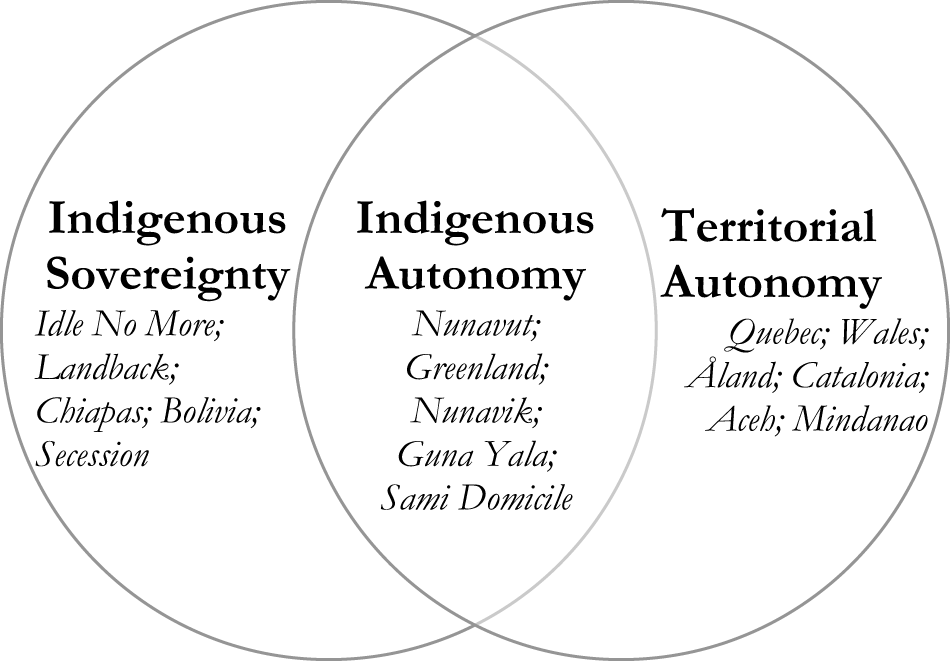
Figure 1 provides a basic schema, locating Indigenous autonomy as the overlapping space between Indigenous sovereignty on the one hand, and territorial autonomy on the other. I do not seek to simply subsume Indigenous autonomy as a form of autonomy, nor deny broader, more radical demands for Indigenous sovereignty from social movements or larger national programs (such as Bolivia’s constitution), including seeking total secession from a larger state (Inuit Ataĸatigî Party in Greenland) or rejecting formal state institutions (Chiapas). Instead, I frame Indigenous autonomy as one potential realisation of Indigenous self-determination as well as a unique form of territorial autonomy.
Indigenous Autonomy in Relation to Indigenous Sovereignty and Territorial Autonomy.

Figure 1: Long description
The Venn diagram consists of three sets labeled Indigenous Sovereignty, Indigenous Autonomy, and Territorial Autonomy. The Indigenous Sovereignty set includes the elements Idle No More, Landback, Chiapas, Bolivia, and Secession. The Territorial Autonomy set contains Quebec, Wales, Åland, Catalonia, Aceh, and Mindanao. The overlapping region between Indigenous Sovereignty and Territorial Autonomy is labeled Indigenous Autonomy, which includes Nunavut, Greenland, Nunavik, Guna Yala and Sami Domicile. Each set and overlapping region is clearly defined with specific elements listed under them.
Indigenous Autonomy in Asia
Having introduced territorial autonomy and Indigenous sovereignty and theorised Indigenous autonomy, my second goal is to apply this lens to Asian cases. Scholarship on territorial autonomy tends to focus on Western democracies, underappreciating autonomy in different world regions and regimes.Footnote 2 The growing literature on Indigenous autonomy tends to focus on Latin America and the Arctic. Scholars only sometimes step outside of the ‘New World’ to analyze Indigenous autonomy in Africa, the Middle East, or Asia. This exclusion is not for a lack of material. ‘Old World’ countries are home to many unique regions that might be approached in terms of Indigenous autonomy, including instances of settler colonialism.
First, I should situate the idea of Indigeneity in Asia, a concept with a different meaning outside of European settler states. Defining Indigeneity in European settler states is challenging, rooted in ideas of race and blood quantum. It is even more challenging in Asia, where majorities are also usually native, and there is limited difference in physiology. Many Asian countries reject the idea that their remote minorities are Indigenous peoples. Almost all Asian governments signed UNDRIP, doing so with the idea that it may not apply to them, as ‘Indigenous’ was seen as relating to overseas European colonialism. China asserts that all ethnic groups, including the Han, are equally Indigenous, so the term has no relevance (Hathaway Reference Hathaway2010: 302). India recognises Adivasi and tribal peoples, but does not recognise Indigenous peoples per se, seeing all Indians as Indigenous (IWGIA n.d.). Across Asia, many governments see all non-migrants as Indigenous (Simon Reference Simon2023: 55). This said, some Asian governments (Japan, the Philippines, Nepal, and Taiwan) recognise Indigenous peoples, and others recognise similar groups, namely Adivasi, Orang Asli, tribal, and customary communities.
While in settler countries, ‘native’ and ‘Indigenous’ may be synonyms, in Africa and Asia, Indigeneity involves living in smaller, marginalised, often rural, traditional non-state communities. Thus, to be Igbo in Nigeria or Javanese in Indonesia is to be native, but not Indigenous, as these dominant groups held precolonial and postcolonial political power, sometimes seen by minorities as internal colonisers. Indigenous people are historically non-state peoples, those at the peripheries of pre- and post-colonial states. In Asia, Indigeneity refers in large part to various ‘hill tribes’ and nomadic peoples at the peripheries of lowland states. In China, Miao can be seen as Indigenous peoples, contrasting Tibetans, who have a history of statehood, world religions, and large-scale national identity. Indigenous peoples typically sustain non-state traditional cultural practices in the face of encroachment. The Philippines’ Indigenous Peoples Rights Act (IPRA 1997) defines Indigenous peoples as those living continuously in a territory and maintaining traditional beliefs in the face of colonial cultural change, becoming differentiated from the rest of the country by virtue of being less Hispanicised. Indigeneity typically involves autochthony—direct ties to the land from time immemorial. However, Morton, Wang, and Li (Reference Morton, Wang and Haiying2016) remind us that many Indigenous communities are mobile, perhaps due to nomadic lifestyles or forced displacement, with groups such as the Akha being both migrant and Indigenous. Indigenous peoples in Asia are not always ‘first peoples’, but are instead non-state marginal groups colonised by larger states (Gray Reference Gray, Barnes, Gray and Kingsbury1995). Although Indigeneity may be different in Asia, with many grey areas and less physical distinction from dominant groups, it is nonetheless a useful concept, identifying tribal peoples facing domination, in-migration, loss of land and resources, cultural assimilation, and extinguished sovereignty.
Asian governments vary in the extent to which they recognise Indigenous peoples. Some provide constitutional recognition or recognise ancestral lands, but fall short in terms of self-government. In Southeast Asia, Inguanzo (Reference Inguanzo2014: 47-48) notes that governments vary in recognizing Indigenous rights (laws, lands, language, and education). Especially important is the presence of self-government, a step which makes these rights more meaningful, but also triggers resistance from dominant groups. Only the Philippines provides rights to Indigenous self-government, however implementation falls short, limited to some basic village-level government functions. The Philippines fares much better in terms of Indigenous status and land rights.
Below, I identify four clusters of cases from across Asia that may better be approached in terms of Indigenous autonomy, rather than being seen as ordinary autonomous regions, as minorities, ordinary subnational units, or just having Indigenous status. The features common in Indigenous autonomy have the potential to reimagine the following clusters of cases, perhaps encouraging local leaders to pursue new forms of governance.
Existing Autonomous Regions: Papua and Guangxi
Territorial autonomy tends to be found in regions with histories of sovereign statehood. But some autonomous regions did not feature states, home to largely non-state spaces prior to incorporation. Such regions tend to be geographically remote and mountainous, home to exceptional ethno-linguistic diversity and localised identities. They typically face encroachment through settler colonialism, with traditional lands appropriated by settlers and corporations. Several cases have formal autonomous status, often compared to other autonomous regions in the same country, but should be understood in terms of Indigenous autonomy.
Indonesia’s Papua provinces provide clear examples. While Indonesian authorities approach Papua as akin to Aceh, with autonomy arrangements on the country’s edges using much of the same language of combating secessionism, Papua is different. Aceh has a proud history of sovereign statehood and large-scale national identity, including a language spoken throughout most of the province. Papua has no such statist history or unified identity, with the island considered “the most ethnically fragmented society in the world” (Reilly Reference Reilly2001: 163). West Papua sees a degree of shared national identity, such as colonial resistance and the morning star flag, but also competing local identities, various armed groups, and different languages (Farneubun (Reference Farneubun2019). Following Indonesia’s annexation of West Papua from Dutch colonisers in 1962, the province saw sustained low-scale separatist conflict and abusive counterinsurgency operations. Rebels have targeted settler migrants, including Javanese settled by state agencies, but especially urban migrants from nearby Sulawesi (Barter and Côté Reference Barter and Côté2015). After the Fall of Suharto, in 2002, Indonesia granted the region special autonomy, known as Otsus (Otonomi Khusus), modeled on Aceh’s initial autonomy law. While Aceh’s rebels rejected this version of autonomy, later negotiating a more robust arrangement, Papua retained Otsus, without a peace agreement. Otsus is widely considered a failure, consisting mostly of economic transfers to coopt local elites, with almost no power to pass local legislation (Barter and Wangge Reference Barter and Wangge2022). Immediately after granting autonomy, Indonesia divided Papua into two provinces, and in 2022, carved out four more, supposedly to better reflect Papuan diversity and popular demands.
Seeing the Papua provinces in terms of Indigenous autonomy, different from Aceh or other post-conflict autonomous regions, is an important step towards understanding its challenges and improving its autonomous governance. The current autonomy laws (replicated in all six provinces) have some unique Indigenous aspects, namely Papuan People’s Councils, upper houses intended to represent traditional chiefs and “open only to Indigenous Papuans” (Aspinall Reference Aspinall2011: 310). While a step towards crafting self-government around Indigenous identity, this body has few powers and limited legitimacy. Understanding Papua in terms of Indigenous autonomy invites comparisons with other Indigenous autonomous regions. Papua may benefit from bodies dedicated to governance for Indigenous peoples alongside territorial government for all residents (as in Nunavut), an emphasis on community policing and local language instruction, collective land rights, restrictions on domestic in-migration and land sales (as in Guna Yala, Panama), and Indigenous stewardship over local resources. Perhaps the most important aspect involves scale. Rather than seeing Papua as one or several provinces, it might be seen as a single confederation decentralised to districts serving localised identities. Minimally, Indigenous autonomy provides a new lens to rethink a failing experiment in territorial autonomy.
A similar case is China’s Guangxi Zhuang Autonomous Region. As a non-democratic country, meaningful autonomy in China is limited. Then again, Indonesian Papua is hardly democratic, and even autocratic autonomy may bring some benefits. On paper, Guangxi resembles China’s other Autonomous Regions (ARs), including Tibet. But while Tibet has a sense of historical sovereignty and a common national culture linked to language and religion, Guangxi has no such historical state or collective identity. Guangxi is majority Han, with the largest native group being the Zhuang, a term created by China to refer to a highly diverse group of Tai speakers, along with dozens of smaller Indigenous peoples (Kaup Reference Kaup2000). While Tibet has a unified provincial administration, alongside Tibetan autonomous counties outside of Tibet AR, Guangxi AR contains twelve autonomous counties and ten autonomous cities serving smaller minorities. The presence of nested autonomous regions for smaller groups resembles Indigenous autonomy. Guangxi could be understood as an Indigenous autonomous region serving diverse tribal peoples, one very different from Tibet. Seeing Guangxi this way might help to make more sense of its internal autonomous units, perhaps formalised as a confederation.
Nested Indigenous Autonomy: Northeast India, Myanmar, Aceh, and Mindanao
One of the most distinct aspects of Indigenous autonomy is its localised nature. The realities of settler dispossession and diverse Indigenous identities mean that Indigenous autonomy is often rooted in third- or fourth-tier administrative units. The previous group of cases involved diverse Indigenous peoples in larger territorial units. The next group entails smaller Indigenous regions within special second-tier administrative units dominated by larger minority groups. These cases introduce “nested” autonomy, whose smaller scale is often more consistent with Indigenous identification. This also brings complications, as leaders must deal with two layers of government above them (Wilson et al. Reference Wilson, Alcantara and Rodon2020). I identify two types of cases: Existing districts with Indigenous autonomy within subnational federal units (India and Myanmar) and Indigenous peoples seeking autonomy within autonomous regions (Gayo and Alas in Aceh, Lumad in Mindanao).
India is home to several states created to represent tribal peoples, but also smaller autonomous tribal entities within these states. Hausing (Reference Hausing2022) identifies two types: 10 federally recognised tribal autonomous district councils (in Assam, Meghalaya, Mizoram, and Tripura) and 19 recognised by state governments (in Assam, Manipur, Ladakh, and West Bengal). Councils have powers related to land, culture, law, and taxation. Their political dynamics are especially complex due to their fluid ethnic identities and varied relations with state governments. For example, Mizoram gained statehood in 1987 as a homeland for the Mizo people. Fears of Mizo dominance then sparked mobilisation among smaller minorities. The Pawi–Lakher Regional Council (PLRC) was formed in the 1950s, when part of Assam, later fragmenting into three separate tribal councils within the new Mizoram state (Roluahpuia 2021). These small areas have moderate formal powers, sometimes facing resistance from internal minorities, leading to calls to both deepen self-government powers and create new councils (Singh Reference Singh and Singh2022).
Neighbouring Myanmar is also home to several smaller autonomous areas within minority states. Its six Self-Administered Communities include one special division (Wa State) and five self-administered zones (Danu, Kokang, Naga, Pa Laung, and Pao). These smaller regions were created to recognise smaller groups within ethnic states, but also to reward loyalty to Myanmar. Four of the six are located within the rebellious Shan state, allowing Myanmar to undermine separatists and trade with neighbouring China. Wa State is especially unique, home to a large army that is not clearly a rebel group or pro-state, carving out considerable de facto autonomy (Ong Reference Ong2023). While Indigenous self-governance in contemporary Myanmar is unique, with murky ethnic armed groups and unclear ties to the military government, the localised nature of power and desire for autonomy is consistent with Indigenous autonomy.
While several district councils and zones enjoy formal autonomy within subnational units in northern India and Myanmar, nested autonomy can potentially support Indigenous peoples within existing autonomous regions. This is especially important because autonomy provides titular groups the power to nation-build, policies that often threaten smaller minorities. Aceh was an historical state incorporated by colonisers, gaining autonomy after a sustained struggle. Mindanao is similar, although here, Sulu and Maguindanao were historical states with different ethnic groups, later represented by rival separatist groups. Aceh and Mindanao both contain distinctive Indigenous peoples in their hilly interiors—Gayo and Alas in Aceh, and Lumad in Mindanao. Centuries ago, ethnic Gayo fled Acehnese kings into the interior. Alas are more closely related to North Sumatran Batak, sharing similar clan systems (marga). During Aceh’s secessionist conflict, these groups largely resisted Acehnese rebels, sometimes forming defensive militias (Barter Reference Barter2015). Towards the end of the conflict, Gayo and Alas leaders campaigned to separate from Aceh and form their own province, and under Acehnese autonomy, they have faced exclusion and landlessness. In Mindanao, Lumad is a collective term for diverse hill communities. Largely Christian Lumad peoples have long faced Moro settlers and rebels, as well as Filipino settlers and militias (Parades Reference Paredes2015; Yambao et al. Reference Yambao, Wright, Theriault and Castillo2022). Lumad often speak in terms of a nation (Bangsa), at a broader level through shared colonial experiences, but also in terms of localised nations (Tiu Reference Tiu2009). Lumad have faced landlessness and exclusion both from the host state and the regional Moro majority, during conflict and under autonomy, especially as autonomy enables centralisation and nation-building. Perez (Reference Perez2021: 70) refers to their “double marginalisation”; although the Bangsamoro government considered reserved Lumad legislative seats, such initiatives have been sidelined from autonomous governments created for Moro peoples. Lumad are able to obtain control over local lands through Ancestral Domain, but are not able to form governments to represent their interests.
To protect Indigenous groups within these autonomous regions, it is possible to provide Gayo, Alas, and Lumad districts with recognition and cultural protections. Indigenous autonomy is suitable for smaller-scale autonomous regions within larger ones. It is not uncommon for distinctive communities within autonomous regions to be granted some self-government. Examples include the Aranese Valley of Catalonia, the Ladin regions in South Tyrol, and Nunavik in Quebec.Footnote 3 Some degree of Indigenous recognition and self-government for Gayo, Alas, and Lumad peoples has the potential to protect local culture and reduce ethnic tensions, making for more just, peaceful, autonomous governance.
Indigenous-Majority States and Provinces: Borneo, Myanmar, India, and Yunnan
A third group of cases involves states and provinces with Indigenous majorities that lack formal autonomous status, even if they have some de facto and de jure special powers on account of their ethnic distinctiveness. While Papua and Guangxi already have formal autonomy, their distinctive Indigenous elements have been overlooked; the following cases are Indigenous regions not typically seen in terms of territorial autonomy.
Sabah and Sarawak are large, Indigenous-majority regions that have some special powers on account of their Indigeneity, but are rarely approached in terms of autonomy, let alone Indigenous autonomy. The northern coast of Borneo was the eastern edge of the Brunei Sultanate, as well as the western edge of the Sulu Sultanate, both spreading Islam to coastal Borneo. Colonialism brought missionaries in the 19th century, converting many animist groups. After WWII, Sabah and Sarawak were under British rule before joining Malaysia in 1963. They did so with special rights enshrined in the 20-Point Agreement, providing a degree of political autonomy, recognition of Indigenous customs and courts, and Indigenous collective land rights. The states retained immigration powers, preventing the sparsely populated territories from being overrun by Malay and Chinese settlers. Additional special protections relate to religion and culture, with exceptions to national Islamic and Malay-language laws (Inguanzo Reference Inguanzo2024: 596-597). Malaysian politics are draped in nativism, with Malay sons of the soil (Bumiputra) contrasted to Malaysians descended from Chinese and Indian settlers. Borneo natives are non-Malay but autochthonous, thus also Bumiputra. Borneo natives differ from Malays, who have a history of Islamic trade and large Sultanates. Sabah and Sarawak natives are ‘Orang Asal’ (Original People).Footnote 4 Sabah and Sarawak have exceptional ethnic diversity, with 58% of Sabah and 70% of Sarawak identifying as Orang Asal, which feature many subgroups and intersected by different religions. In Sabah, political power revolves around competition between Indigenous Muslims on the east coast and Christian Kadazan-Dusun on the north coast, with smaller Murut, Rungus, and other communities provided limited recognition. It is often noted that ‘Kadazundusun’ is a broad ethnic construct linking very different groups and excluding others (Bagang, Puyok, and Mersat Reference Bagang, Puyok and Mersat2025). This is a common challenge for Indigenous peoples in larger regions, where identity is pushed to fit oversized administrative containers, leading larger groups to project their identities as common and smaller groups to resist.
Recognizing Sabah and Sarawak as Indigenous autonomous regions would clarify their status and encourage learning from other Indigenous regions. Sabah might benefit from decentralizing power to smaller communities rather than seeking to construct a broader Kadazandusun (or KDM) ethnic group. In many ways, the states already have autonomy and special Indigenous rights, so this would be more about formalizing these aspects. For example, Sabah features the quasi-governmental Kadazan Dusun Cultural Center (KDCA), a “non-political Association of 45 indigenous ethnic communities” created in 1963 to protect Indigenous cultural heritage (KDCA 2023). The KDCA is linked to the Huguan Siou (paramount chief), a sort of Sabahan Head of State intended to represent Indigenous peoples. Such arrangements resemble MLG in Indigenous autonomy, with quasi-government corporations governing Indigenous peoples and protecting Indigenous cultures. Only here, the KDCA speaks for only some Indigenous groups, ruled by coastal Kadazan peoples. Formalizing Indigenous autonomy might involve creating similar bodies for other Indigenous peoples, perhaps an Upper House representing diverse Indigenous communities.
Other ethno-linguistic regions with some de facto autonomy might be considered in terms of Indigenous autonomy. Myanmar presents a complex ethnic landscape, complicated further by ongoing armed conflicts and military rule. Myanmar has a formal ethnofederal design, with states representing Chin, Kachin, Kayah, Kayin, Mon, Rakhine, and Shan peoples. While the Mon and Rakhine share writing and religion with the Burmese and were part of precolonial states, other regions have traditionally been home to diverse non-state peoples (Scott Reference Scott2009). Myanmar’s ethnofederal model is currently in flux due to the coup and ongoing civil wars. Going forward, it may be useful to see the Karen/Kayin, Shan, and Kachin regions in terms of Indigenous autonomy, perhaps decentralizing internal power. This might better reflect local identities, as groups such as the Karen are highly diverse with unclear edges (Thawnghmung Reference Thawnghmung2012). While separatists might see their language groups as unified nations, they increasingly refer to Indigenous rights, both to gain global support and to reflect local diversity (Dunford Reference Dunford2019).
Bordering Myanmar, northeastern India is home to a vast range of ethnic groups, sometimes dubbed “Tribalstan” (Hausing Reference Hausing2022: 127). India’s native Adivasi and Scheduled Tribes are recognised in the fifth and sixth constitutional schedules, providing degrees of self-government to hundreds of groups. Tribal communities have mobilised against internal migration and exclusion, creating Indigenous-majority states. Mountainous, diverse, and rebellious regions such as Nagaland, Manipur, and Meghalaya became Indian states, having been part of autonomous Assam. Gaining statehood in 1987, Arunachal Pradesh is majority (68%) scheduled tribes, with none of its 12 tribal groups being even a quarter of the state’s population. Mizoram was created in 1987 in the aftermath of a native rebellion, carved from Assam to represent the Mizo people. These tribal-majority states are not formally autonomous, but rather ordinary states created for peoples that happen to be tribal, what Hausing (Reference Hausing2022: 123) refers to as “Homeland State Autonomy”. This said, they possess some special powers related to culture, internal minorities, and residency, so they could be seen in terms of Indigenous autonomy (Singh Reference Singh and Singh2022: 3-4). One of the more contentious areas involves restricting internal migration. This is rooted in British colonial ‘Line Systems’, which control migration into Frontier areas. Today, permits are required for Indian citizens wishing to enter northeastern tribal states (Barua Reference Barua2017). Thus, while India does not formally recognise Indigenous peoples and lacks formal Indigenous autonomous regions, it is home to tribal-majority states with special legal status.
Finally, some mention should be made of Yunnan. While Guangxi has formal autonomy and contains autonomous districts, it is China’s second-most diverse province. Located between two ARs, half of China’s 56 recognised ethnic groups reside in Yunnan. Mullaney (Reference Mullaney2004) documents Chinese efforts to classify ethnic groups in Yunnan, initially enumerating hundreds of different groups until government teams with tight deadlines reduced this number to 20. It is puzzling that Yunnan never gained autonomy with Guangxi, especially given its diversity and resistance to Chinese rule (Giersch Reference Giersch2006: 74). Internally, Yunnan features several autonomous regions, including 8 autonomous prefectures and 29 autonomous counties. Yunnan might be approached as a confederation of Indigenous autonomous districts, as it is already internally decentralised to smaller autonomous entities for smaller tribal minorities.
Indigenous Recognition without Self-Government: Hokkaido, Taiwan, and Luzon
The next group of cases involves peoples recognised by their host states as Indigenous, provided rights and cultural protections, and sometimes land rights, but without self-government. Only a handful of Asian governments recognise Indigenous peoples, including the Philippines, Japan, and Taiwan. Recognition matters in its own right, especially since these countries are UNDRIP signatories, giving recognised Indigenous peoples special rights and protections. Although UNDRIP guarantees a right to autonomous self-government, these recognised Indigenous peoples do not yet have self-government.
While imagining itself as a homogenous nation-state, Japan recognises Ainu as Indigenous peoples.Footnote 5 The Ainu have traditionally been clan-based, state-resistant, and highly mobile peoples across what is now northern Japan, especially Hokkaido and Sakhalin. After years of Japanese migration, Hokkaido was formally annexed in 1869, with Ainu peoples facing state-sponsored settler colonialism and forced into sedentary lifestyles, including prohibitions against Ainu fishing and hunting in favour of commercial industries. Japanese colonial policy in Ainu territories was guided by American advisers previously involved in Indian removal acts, replicating Western systems of settler colonialism (Grunow et al. Reference Grunow, Nakamura, Hirano, Ishihara, Lewallen, Lightfoot, Mayunkiki, Williams-Davidson and Yahata2019: 603). Japanese state education worked to erase the Ainu languages. Today, Ainu are so assimilated that it is hard to identify who is Ainu, with many Hokkaido residents unaware of or refusing to recognise Ainu heritage (Komai Reference Komai2022). Such thorough colonial erasure complicates the prospects for Indigenous self-government. Still, creating some special status for Hokkaido or specific districts with stronger Ainu identities would help to ensure Japan’s compliance with UNDRIP and promote Ainu culture for all residents. Especially useful could be the Sami example, whose partly non-territorial governance was created for Indigenous peoples that do not form a majority in any specific territory (Kuokkanen Reference Kuokkanen2019). The recent creation of Ainu cultural centres and museums, Ainu studies programs, and efforts to save the language from extinction would be reinforced with a political body for Indigenous peoples.
More than most Asian countries, Taiwan has gone a long way to recognise Indigenous peoples. Indigenous peoples comprise 3-5% of Taiwan’s population, although estimates are challenging due to assimilation and intermarriage. Taiwan’s Indigenous peoples are Austronesian, related to Malays and Filipinos. Taiwan has endured Chinese settler colonialism, with the 17-19th century migration of Hokkein and Hakka speakers from southern China joined by Mandarin speakers after the 1949 revolution. Concentrated in the central plains and eastern hills, Taiwan created Indigenous townships as early as the 1950s, followed by reserved Indigenous seats in the national legislature, three for mountain communities and three for plains natives. In 1997, Taiwan recognised Indigenous peoples in its constitution and created a Council of Indigenous Peoples, tasked with protecting Indigenous interests and cultures. The Council manages the formal recognition of tribes, growing from 9, to 11, and now 16. Taiwan’s Indigenous politics have always resembled Indigenous politics in settler countries, partly because it is a case of settler colonialism (Simon Reference Simon2023: 39), but also because Indigenous leaders have worked through church networks to cooperate with Indigenous peoples in the Americas, including identifying as nations (guo) instead of tribes (Simon Reference Simon2023: 14). Taiwan’s Indigenous peoples have long mobilised demanding hunting and fishing rights, land title, and territorial autonomy. In 2010, Indigenous protests led Taiwan to promise self-government (Loa Reference Loa2010). In 2020, the Indigenous Taiwan Self-Determination Alliance held a conference to demand an Indigenous government, conceived as a confederacy (Hugu Reference Hugu2020). On several occasions, the Council has sent draft autonomy legislation to the Taiwan government, only to see the bills fail or be ignored (CIP 2022). While autonomy has still not been granted, Taiwan has an especially developed Indigenous movement and vision for autonomy.
The Philippines generally stands out as a bright spot for Indigenous politics and rights in Asia (Eder and McKenna Reference Eder, McKenna and Duncan2004: 56; Inguanzo Reference Inguanzo2014). Indigenous politics are rooted in colonial experiences, with Spanish colonisers failing to control mountain regions. Informed by experiences with American Indians, US colonial officials governed highland communities separately from lowland Catholic Filipinos (Xu Reference Xu2023: 86). Independence intensified assimilation, including state-supported domestic migration to Indigenous regions, pushing many Igorot peoples towards communist insurgents. After democratisation, a new political space led to the IPRA in 1997 and a National Commission on Indigenous Peoples. IPRA involves processes to recognise Indigenous groups and collective lands, with Chapter IV enshrining a “right to self-governance.” The central aspect of Indigenous governance has been Ancestral Domain, with Indigenous peoples struggling to reclaim lands long occupied by Filipino settlers. Activists debate whether to focus on land rights or political autonomy first, addressing courts or presidents (Gaymaytan Reference Gatmaytan2007). While Filipino officials fear that Indigenous recognition will weaken the country, McMurry (Reference McMurry2022) finds that successful land titling increases Indigenous compliance and identification with the Philippine state. Despite progress in terms of Indigenous land rights, self-government remains limited, with inconsistent powers, unclear relations with Philippine authorities, and no ability to amalgamate into larger Indigenous regions. In Luzon, there have been efforts to create large-scale autonomy for Igorot peoples. In 1987, President Aquino established the Cordillera Administrative Region.Footnote 6 On two occasions, in 1990 and 1998, the Philippines offered autonomy in a referendum, only for Indigenous groups to reject what many see as weak provisions; for many activists, the region needs “much more radical autonomy and socio-political transformation” (Bertrand Reference Bertrand2021: 198). Another factor was that smaller Indigenous communities feared domination by larger groups that would control the autonomous government. Igorot peoples are diverse, with contrasting views and claims of autonomy. Rather than being compared to Mindanao, the Cordilleran region would benefit from engagements with other Indigenous autonomous regions, with decentralised models and collective land title.
Analysis & Conclusions
This paper had two goals. First, it identified Indigenous autonomy as one form of territorial autonomy and one pathway for Indigenous sovereignty. Indigenous autonomy has many distinctive qualities, including its origins and powers. It may include citizenship regimes, perhaps controlling migration or land, or separate governance for titled natives. Rather than regional parties, we see leadership roles for chiefs, elders, and public corporations. Indigenous autonomy involves MLG, with governance decentralised to smaller communities and various quasi-state bodies, while also connecting to international legal rights and networks.
Second, this paper has used the concept of Indigenous autonomy to identify potential cases in Asia, typically at the periphery of research on Indigenous self-government. While Indigenous politics and the pursuit of self-government are an essential part of decolonisation in the Americas, it has potential for empowering tribal communities elsewhere. I identified four groups of cases: Autonomous regions that might be recast in terms of Indigeneity, smaller Indigenous regions nested within special provinces, Indigenous-majority provinces with some degree of autonomy, and recognised Indigenous peoples seeking territorial governments. Seeing these cases in terms of Indigenous autonomy may help to develop forms of governance more suited to titular groups. This may mean thinking of the Papua provinces and Guangxi as Indigenous areas instead of regular autonomous areas, introducing powers and institutions found in Indigenous autonomous regions such as Nunavut or northeast Indian Councils. It could entail pushing for new forms of autonomy to protect minorities in Aceh and Mindanao, recognizing the unique powers and identities of Sabah and Sarawak alongside states in northeast India, or strengthening demands for self-government in Hokkaido, eastern Taiwan, and the interior of Luzon. This also means rethinking scholarship, encouraging new comparisons based on types of autonomy rather than geographic regions. The cases discussed in this article might be more usefully compared to one another or to Indigenous regions in the Americas than to Aceh or Tibet, where large minority nations with histories as sovereign states.
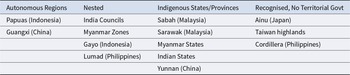
Comparing across South, East, and Southeast Asia, major cases are summarised in Table 2. Additionally, one could consider forms of Indigenous autonomy for Hmong in highland Laos, the Chittagong Hill Tracts in Bangladesh, or Gorno-Badakhshan Tajikistan. Expanding the geographic scope could also include Bougainville in Papua New Guinea, Rotuma in Fiji, or minority regions in Siberia.
Summarizing Forms of Indigenous Autonomy in Asia

Table 2: Long description
The table categorizes examples of Indigenous autonomy in Asia into four forms: autonomous regions, nested arrangements, Indigenous states or provinces, and recognition without a territorial government. Autonomous regions listed are the Papua provinces in Indonesia and Guangxi in China. Nested arrangements include India councils, Myanmar zones, and Indigenous groups noted under this category such as Gayo in Indonesia and Lumad in the Philippines. The Indigenous states or provinces category contains Sabah and Sarawak in Malaysia, Myanmar states, Indian states, and Yunnan in China, making it the most populated column. Recognition without a territorial government includes Ainu in Japan, Taiwan, and Cordillera in the Philippines.
Despite its potential, Indigenous autonomy involves several challenges. As in any form of autonomy, one concern relates to minorities within autonomous regions. “Second-order minorities” may include members of settler communities, international migrants, persons of mixed descent, persons from other Indigenous communities, women, gender minorities, and other groups (Barter Reference Barter2015). We cannot assume that Indigenous autonomy will always pursue progressive, inclusive politics. Indigenous communities tend to feature diverse, fluid identities predisposed to fragmentation into sub-groups claiming separate status and fearing domination. For example, in Taiwan, efforts by Taroko peoples (themselves previously classified as part of the Atayal tribe) to gain formal autonomy were undermined by Sejiq tribes opposing Taroko rule (Simon Reference Simon2023: 269). The decentralised nature of Indigenous autonomy already provides some protections for Indigenous sub-groups, but perhaps not for gender and ethnic minorities. Indigenous regions may be led by conservative male elders enforcing traditional values. Cultural revitalisation may come with xenophobia, homophobia, and patriarchy, even where there exist more inclusive precolonial Indigenous traditions. To protect such groups, host states will likely favour central constitutional oversight. While important, this undermines autonomy and makes second-order minorities seem like agents of the host state. It is essential, then, to encourage charters, constitutions, and other rights mechanisms within Indigenous autonomous regions, especially for larger confederate governments. One benefit of this approach is that regional leaders might be keen to craft such documents, as doing so may bolster sovereignty while depriving host states of opportunities for intervention.
Another potential problem relates to defining who is Indigenous. Unlike other forms of territorial autonomy, Indigenous regions have a sense of citizenship, often including separate government bodies and rights for those with Indigenous status. At the individual level, the onus should be on Indigenous governments to establish criteria, presumably incorporating self-identification, descent, residency, and/or culture. At the group level, it can be unclear who the Indigenous peoples are, with considerable intermarriage and migration in each direction, so that cultural lines blur, with no major physiological distinctions. Baird (Reference Baird2013) notes that in Cambodia, Indigenous land rights led upland Khmer to identify as Indigenous, coming out of the proverbial woodwork. In Sabah, there are important mixed communities such as Sino-Kadazan and Malay-Bajau, groups that play important bridging roles, but whose status may be unclear. This suggests the importance of criteria to determine who is Indigenous, perhaps working with transnational organisations, alongside local and self-definitions.
Clearly, there are many challenges for those seeking Indigenous autonomy in Asia. Applying the idea of Indigenous autonomy to Asia’s Indigenous peoples has the potential to rethink their challenges and what might be possible. Much can be drawn from examples in the Americas, and hopefully, these cases can learn from Asian experiences, inviting inspiration and solidarity. By recognizing Indigenous regions as parts of the broader world of territorial autonomy, I hope that this helps to normalise shared sovereignty through minority self-government, helping so-called nation-states to recognise Indigenous nations.
Acknowledgements
The author would like to thank several especially helpful discussants and panelists that provided feedback on this paper, including Ian Baird, Nina McMurry, Oona Paredes, Carolyn Podruchny, Nancy Postero, and others. Thanks also to Garyn Wilson at UNBC and the anonymous reviewers, whose comments were much appreciated. Thank you to my students and research assistants at Soka University of America, especially Angad Singh Kahlon, Wren Biggers, and Wakana Kinoshita, as well as my colleague James Spady.
Competing Interests
The author declares none.


 Open access

