

This article identifies performance art from the Dominican Republic as a privileged site for the definition of what it is to be contemporary in the context of Hispaniola, the Caribbean island that Haiti and the Dominican Republic share. Understanding contemporary art, with Terry Smith, as art “capable of calibrating several distinct but related ways of being in or with time, even of being, at once, in and apart from time” (Smith Reference Smith2019, 254), the essay explores the work of three Dominican performance artists, Karmadavis, Sayuri Guzmán, and José Ramia. These three artists provide a good example of how art is becoming a fertile ground to think in critical terms about what it means to be contemporary. The artistic work that Karmadavis, Guzmán, and Ramia develop highlights how racialization is intrinsically linked to the pressures of neoliberalization, which should be seen as a context-sensitive (and therefore not universal) project whose implications reach far beyond the economic (see Brown Reference Brown2015; Deckard and Shapiro Reference Deckard and Shapiro2019; and Harvey Reference Harvey2011). The performance art projects examined in this article challenge the idea of neoliberal time as the only possible alternative, making evident the complex ways in which residual modernism, the temporariness of tourism, and the rapid rhythm of neoliberal exchanges coexist. A leveraged and context-sensitive interpretation of artistic experimentalism (and performance art in this case) is required if we are to grasp the multitemporal and multilayered logic of contemporaneity. Estructura completa, Trenzados, and En El Conde, the artistic actions examined in this article, are part of a genealogy of insurgent Dominican artistic practices seeking to map the coordinates of an asynchronous present time, one in which the continuities of modernism are still visible but where the critical potentiality for alternative temporal imagination is also possible.
Recent developments in Dominican studies increasingly question the main premises around which contemporary Dominican identity is defined. A wide array of authors including Dixa Ramírez, Maja Horn, Silvio Torres-Saillant, Milagros Ricourt, and Raj Chetty are expanding the meaning of dominicanidad (Dominicanness) by critically confronting the present situation, which is often simplistically reduced to an image of the Dominican Republic opposed to Haiti, favorable to economic modernization and reluctant to deal with its own Blackness. These scholars are urging for a reconceptualization of dominicanidad beyond the stereotype that makes all Dominicans not able to deal with Blackness. These authors, among many others, are expanding our understanding of Dominican contemporaneity by exploring in context-sensitive ways how subversive traditions and alternative futurities are powerfully complicating what it is to be Dominican in the present moment, and what it is to be contemporary in non-universal ways.
Following Dixa Ramírez (Reference Ramírez2018b, 8; see also Ramírez Reference Ramírez2016, Reference Ramírez2018a), I argue that performance art is crucial to demonstrate that the “present-day commonplaceness obscures—but does not eradicate entirely—the strangeness of prior centuries.” I read Dominican cultural production, and more specifically performance art, as part of a broader set of decisive cultural and critical interventions. It is this indeterminacy that shapes the best of Dominican artistic practices within recent decades. In this case, we can see that the performance work of Karmadavis, Guzmán, and Ramia delineates the political economy of Dominican artistic production in relation to elite and official visions of dominicanidad while engaging a largely repressed genealogy of emancipative articulations of race, space, and citizenship.
Drawing from such an expanded understanding of dominicanidad that problematizes the relationship between Dominican national and cultural identity, and accepting, with Diana Taylor (Reference Taylor2007; see also Taylor and Costantino Reference Taylor and Costantino2003), that performance art from the Americas remains a privileged vehicle for cultural memory, this article’s main objectives are twofold. First, it seeks to understand that Dominican artists have acknowledged (perhaps better than historians or art critics) the importance of historicizing the transit from the modern to the contemporary according to the genealogies of imperial domination and resistance in Hispaniola. Dominican performance artists such as Karmadavis, Guzmán, and Ramia reject ahistorical categorizations of dominicanidad associated to anti-Blackness or anti-Haitianism. They frame cultural relationships in Hispaniola not so much in relation to “how Dominicans refuse to engage with the West” (referring to Haiti) in the present (Hermann Reference Hermann, Bailey, Cummins, Lapp and Thompson2012). Instead, the three artists examined in this article, among many others, use several means, among them performance, to contextualize the tense relationships between the two countries as part of the longue durée of colonial and neoliberal interventions in the island that have largely determined the processes of racialization that shapes citizenship on both sides of Hispaniola. The work of Dominican performance artists therefore problematizes the straightforward identification of “contemporary art” with art being produced now, postnational art, or art dealing with the consequences of globalization. Instead, following a recent critical trend seeking to define the contemporary in critical terms (see Smith Reference Smith2011, Reference Smith2012a, Reference Smith2012b, Reference Smith2019; Osborne Reference Osborne2013; Scott Reference Scott2013; and Wainwright Reference Wainwright2012), the artists examined in this article are exemplary because of their capacity to problematize contemporaneity by paying attention to the specific continuities and antinomies between multiple and occasionally conflicting temporalities.
The second objective of this essay has to do with examining the ways in which the critical understanding of contemporaneity advanced by Dominican performance art goes beyond the simplistic representation of dominicanidad and Haitianness as a perfectly defined binomial, thus problematizing restrictive national historical interpretations. Although the works of Karmadavis, Guzmán, and Ramia include references to the broader landscape of Hispaniola, the work of these three artists is singular in refusing to ascribe Blackness to Haiti. Significantly, it also rejects the official view that associates dominicanidad with modernity, anti-Blackness, and racism. In fact, the public dimension of Dominican performance art makes it particularly suitable for providing a renewed frame of reference for a critical reappraisal of the relationship between time and racialization. Dominican Blackness has always played a central role in the histories of Caribbean emancipation, this experience being a receptacle that contemporary artists keep tapping into to problematize the present.Footnote 1 Already in the seventeenth century, Blackness started to be stigmatized by the Spanish colonial authorities as a synonym of (desirable) slavery or (undesirable) subversion (Torres-Saillant Reference Torres-Saillant1998, 130–134). Blackness was seen then in economic terms, as a synonym of productive force to be exploited, to the extent of likening the absence of Blacks with the absence of slaves (Torres-Saillant Reference Torres-Saillant1998, 135). The crucial point Torres-Saillant makes is that anti-Blackness in the Dominican Republic is not a synonym of atavistic anti-Haitianism. Rather, it primarily emerges as a consequence of an economic dynamic of colonial dependency, one that made modernity and productivity dependent of the exploitation of Black individuals (see Chetty and Rodríguez Reference Chetty and Rodríguez2015). From this perspective, anti-Blackness emerges not as an essential, ahistorical prejudice, but rather as a non-universal historical process of deracialization: “Gradually, the sphere of blackness became associated exclusively with slavery and subversion, fostering a conceptual space that permitted free blacks and mulattos in Santo Domingo to step outside the racial circumscription of their blackness in configuring their identities or aligning themselves politically” (Torres-Saillant Reference Torres-Saillant1998, 135). The main consequence of this epistemic reduction of the meaning of Blackness is that Dominicans “lacked a material frame of reference in which to construct a concept of identity based on racial self-differentiation, that is, on affirmation of their blackness” (Torres-Saillant Reference Torres-Saillant1998, 135). In relation to these debates, the work of Karmadavis, Guzmán, and Ramia is strongly linked to the present: the three are attentive to the pressing situation derived from the 2010 earthquake that impacted Haiti and Sentence 168-13 passed by the Dominican Republic Constitutional Court, which establishes that every “foreigner” born after 1929 who lacks the corresponding documents to prove her nationality is not considered to be a Dominican citizen. At the same time, however, I interpret Dominican performance art as not just “art from the present.” Instead, Dominican performance attests to the ways in which artists are challenging universal and normalized understandings of the contemporary.
Dominican art’s politics of time
Many consequences derive from the acceptance of the critical definition of the contemporary advanced in the introduction. Such an approach reveals how the works of Karmadavis, Guzmán, and Ramia unsettle any facile adscription to the present. A common element running through their work is that it is simultaneously historical (the result of events in the past) and asynchronous. Although they arise from specific circumstances in the present, all the performances this article analyzes recur to the artists’ own bodies or to the active collaboration of part of the audience to refer to a more complicated temporality, one that fuses past, present, and futures in alternative ways, hinting at equally radical rearrangements of race, nation, and citizenship that refer both to the past and to the future (see Thornton and Ubiera Reference Thornton and Ubiera2019). To understand how performance art unsettles notions of time and temporality, a brief analysis of how the cultural politics of modern and contemporary art in the Dominican Republic have dealt with time is in order.
A first step toward any problematization of modernity and contemporaneity in the context of the Dominican Republic would unavoidably have to depart from the fact that the Dominican nation was formed “not as a single historical trajectory of sociocultural dynamics and racial identity formation, but rather as a series of overlapping tendencies always in contradiction” (Ricourt Reference Ricourt2016, 5). What Milagros Ricourt asserts about politics also fully applies to the artistic medium. The emergence of modern art in the context of the US occupation of the country between 1916 and 1924 stands among the most overlooked episodes in Caribbean art. Crucially, this first modernist period remains unexplored despite the fact that it could provide fertile ground for the kind of critical engagement with temporality that the authors mentioned at the beginning of this article are attempting to develop. The work of the modernist precursors Celeste Woss y Gil, Yoryi Morel, Darío Suro, and Jaime Colson is highly expressive of the complexities of the process of nation building in the Dominican Republic. Morel’s attention to the rural landscapes of Santiago de los Caballeros or Colson’s engagement with the popular (as in his well-known painting Merengue) should be examined through the lens of Spanish and US imperialism in the country and therefore not just as a national process. At the same time, Colson’s and Suro’s connections with Mexican muralism demonstrate how pre-Trujillo Dominican artists were active participants within artistic and political transnational progressive networks.Footnote 2 Although Trujillismo would attempt to nationalize and Hispanicize this first stage of Dominican modernism, it is worth remembering that Woss y Gil, Morel, Suro, and Colson represent an alternative modernist temporality to that imposed by the 1930 dictatorship.
The last stage of modernism will be shaped by the politics of Hispanization and Europeanization and the consequent erasure of Blackness developed during the dictatorship of Rafael Leónidas Trujillo and through the successive stages of the Joaquín Balaguer government. The fact that the Dominican national art biennial was created as early as 1942, the same year as the Escuela Nacional de Bellas Artes, demonstrates the weight of official institutions in the configuration of the national art system during the Trujillo dictatorship. As the curator Sara Hermann (Reference Hermann, Bailey, Cummins, Lapp and Thompson2012, 93) argues, “a good part of the history of the arts of this nation is tied to this recent institutionalization.” A major episode in this history took place in the late 1970s with the configuration of the Plaza de la Cultura, a modernist project that included the creation of the Museo de Arte Moderno, the Museo del Hombre Dominicano, the Teatro Nacional, and the Museo de Historia Natural. These institutions sought to play a central role in the definition of a modern and Hispanic view of dominicanidad. The use of International Style architecture to reinforce the sense of modernity of the new cultural site, the highlighting of Indian heritage, and the erasure of all references to Dominican Blackness were the three main pillars of the Plaza de la Cultura project (Dardashti Reference Dardashti2016, 263; see also Dardashti Reference Dardashti2017; Candelario Reference Candelario2007). What is interesting for our purposes here is that the Museo de Arte Moderno, the main arbiter of modern and contemporary aesthetics in the context of the Dominican Republic, was born as part of the Plaza de la Cultura project. Although it has evolved to become a hub of creative innovation and cultural transgression, it still occupies a central space both physically and symbolically as a regulator of taste. In particular, the divisions and hierarchy across diverse creative media (with painting being considered quintessentially Dominican and performance or installation art finding more reluctant responses) were part of the logic normalized through this process of creation of art institutions. More than this, a crucial part of this normalized logic has to do with the imposition of the temporal demands of an art system based on the periodic rhythm of large-scale, competitive exhibitions. This system not only demands from artists a constant renewal of original work but also imposes criteria of originality measured according to the logic of biennials.
The curator Myrna Guerrero, who developed an exhaustive study of the historical evolution of biennials and concursos, highlights the consequences that this exhibition format can have at a personal level: “It may seem that there are artists that only work for art contests, and when they achieve success in this system, the economic award system provokes an excessive interest in joining the art market at the expense of artistic research and transcendent creativity. Many young talents are lost because of this” (Guerrero Reference Guerrero and Ginebra2009, 14, author’s translation). Her view is crucial for our interests here; it dismantles the idea of artistic practice as an idyllic locus of resistance in contraposition to oppressive art institutions and explains why some artists are increasingly adopting the role of curator and cultural organizer. In fact, we can see how periodic exhibitions perpetuate the modernist expectations of the Dominican art system, compelling us to explore the consequences of that continuity of the modern in the contemporary.
This has profound implications when it comes to performance art. Within this system, performance art was frequently downplayed in comparison to object-based mediums such as painting, at least until the 1990s. In part, this has to do with the specificities of a national artistic milieu much more regulated and institutionalized than many of its Caribbean counterparts. With the public Museo de Arte Moderno (MAM) in Santo Domingo and the private Centro de Arte León Jimenes in Santiago de los Caballeros as the two main regulators of contemporary art, national biennials (organized by MAM) and Concursos (organized by Centro León) determine art’s critical value in the country. Both types of event relied on a similar logic: they were periodic exhibitions that categorized artworks according to their medium (this practice stopped being applied in 1998; see Hermann Reference Hermann and Ginebra2009) and awarded economic prizes to a selection of projects from each category (see Garrido Castellano Reference Garrido Castellano2019). These prizes were a source of national recognition and economic compensation and implied a powerful boost in the internationalization of some artists’ careers. In this context, performance was often relegated to a second category. The fact that performance art was included in the categoría libre, a catchall section encompassing a wide sort of “unclassifiable” artistic proposals that stayed in place until very recently, speaks volumes of how performance was critically measured.
It would be misleading, however, to overstate the weight of the state in the configuration of the Dominican modern. Dominican artists, in other words, did not comply with the regulation of a highly institutionalized art system. Instead, they criticized art institutions at the same time as they made use of them. More than this, they also challenged medium-based categorizations, breaking with the primacy of traditional forms of painting and sculpture. Nor would it be productive to simply identify Dominican museums, such as the Museo de Arte Moderno, with conservative values. On the contrary, especially in recent times, both the Museo de Arte Moderno and the Centro de Arte León Jimenes have pioneered bold curatorial, educational, and creative interventions that critically respond to modernist normalizations of creative practice in the country.Footnote 3 In other words, the role of the Museo de Arte Moderno and the Centro de Arte León Jimenes, the two main art institutions in the country, is nuanced: on one hand, they still rely on the modernist weight of biennials and concursos; on the other, both institutions have championed a wide array of creative strategies to challenge the weight of large-scale, periodic exhibitions.
At least since the late 1990s, Dominican art critics and curators have started to challenge the idea that art should be measured according to its success in biennials and concursos. Alanna Lockward, Sara Hermann, Clara Caminero, Myrna Guerrero, and Danilo de los Santos, among others, have championed performance art as simultaneously a source of cultural innovation and a critical tool to explore what contemporaneity means in the terms advanced in the introduction. The titles of survey and reference publications on art from the Dominican Republic in which performance art features prominently, including the edited volumes Arte contemporáneo dominicano (Jarne Reference Jarne2002), Arte dominicano joven: Márgenes, género, interacciones y nuevos territorios (Ginebra Reference Ginebra2009), and Alanna Lockward’s Apremio: Apuntes sobre el pensamiento y la creación contemporánea desde el Caribe (Reference Lockward2006), emphasize the contemporary as a distinctive feature of visual production from the Dominican Republic. Moreover, two of these further highlight the newness of this production, as in “joven” (young) (Ginebra Reference Ginebra2009) or “apremio” (urgency) (Lockward Reference Lockward2006).
These views therefore imply a substantial change vis-à-vis modernist, medium-based artistic categorizations.Footnote 4 This reappraisal of performance art has been highly positive and has challenged conservative interpretations of national identity. It has helped overcome restrictive, medium-based classifications, offering multimedia, experimental practice as the lingua franca of Dominican contemporaneity.Footnote 5 It has also made visible labor and economic issues lying behind the production of art (see Garrido Castellano Reference Garrido Castellano2017, Reference Garrido Castellano2019). Finally, performance has been crucial for reclaiming popular culture and narrowing down the distance between experimental art and popular forms of creativity. As we will see, the critical valorization of performance is also critical to understand how contemporary art from the Dominican Republic problematizes straightforward understandings of the contemporary as what happens in the present.
Performance art and Dominican contemporaneity
History and time are fortunately becoming more and more an active part of a more nuanced wave of art criticism dealing with art from the Dominican Republic, within and beyond the context of Hispaniola.Footnote 6 For Abigail Lapin Dardashti, for example, the performance actions developed by Dominican artists Scherezade García and Charo Oquet across the Haitian-Dominican border “challenge historical notions of Dominican racial identity” (Dardashti Reference Dardashti2016, 253, emphasis added). By inscribing performance as part of a “vernacular record” that “contradict[s] the one created by Trujillo’s hired historians” (267), Dardashti hints at an alternative historicity that calls into question the grounds of the process of nation building developed by Trujillo and Balaguer. Dardashti also points to the fact that the drastic division suggested by the wall is the result of a historical process of normalization (of which the 2013 law is just the last episode in a longer chain of events) that implied “propagating the myth of a purely Catholic heritage” (254). Under this view, the border emerges not so much from an organic process of nation building but rather from a far more complicated one of historical erasure that involved whitewashing the centuries-long tradition of miscegenation and crossing between Haiti and the Dominican Republic. Importantly, this also implies reassessing the legacy of the Haitian Revolution (and by extension, that of revolutionary politics) in broader, transnational terms. In this sense, if we accept the fact that “contemporary art examining the Haitian Revolution is thus not merely a story about Haiti, but rather about Hispaniola as a whole” (Dardashti Reference Dardashti2018, 6), then any interpretation of the contemporary as a synonym of “the result of modernization” or of “what’s present” loses ground. The examples discussed by Dardashti provide something more than an embodied challenge to the territorial delimitation imposed by the border. They also introduce the possibility of a radically different art historical discourse in the context of Hispaniola.
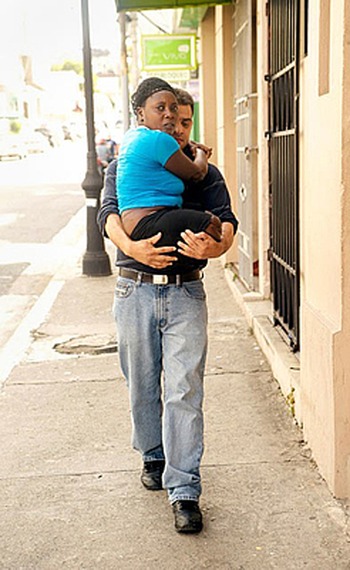
This is the case of Karmadavis’s Estructura completa (2010), which was staged shortly after the earthquake that devastated Haiti and provoked a humanitarian and diplomatic crisis in the island. For this performance, the artist hired a blind Dominican man and a physically impaired Haitian woman to walk their way through the streets of Santiago de los Caballeros, Bávaro, and Santo Domingo (see figures 1 and 2). As the man speaks Spanish and the woman speaks Creole, their movement is conditioned by the need to adapt to and understand each other. At least since 2005, Karmadavis (b. 1976, Santo Domingo) started using performance to explore the porosity of Haitian-Dominican relationships along the border dividing Hispaniola.
David Pérez “Karmadavis,” Estructura completa. Santiago de los Caballeros, Dominican Republic, 2010.

David Pérez “Karmadavis,” Estructura completa. Santiago de los Caballeros Dominican Republic, 2010.

Estructura completa has been analyzed mostly in relation to “the Haitian question.” The performance is part of a number of artistic, filmic, and literary works that examine the conflictive interaction between the two countries inhabiting Hispaniola. Maria Cristina Fumagalli, who has analyzed the work of Karmadavis in detail, explains that the main critical potential of Estructura completa lies in understanding that the urgency of the earthquake “can become a key moment in border relations only if it is seen in the context of the island’s history and not as an isolated event, a ‘natural’ disaster with no solutions other than emergency (hence temporary) ‘Good Samaritanesque’ ones” (Fumagalli Reference Fumagalli2013, 436). Fumagalli links Estructura completa with post-earthquake (cultural) geopolitics in Hispaniola, explaining that the earthquake was seen as an opportunity to prefigure a different relationship between both countries. Unfortunately, the window opened by the natural disaster was soon closed by the Dominican Republic’s mass deportation of Haitians that ultimately led to the 2013 law. Crucially, the deportations were wrongly justified on the grounds that Haitian migrants were a potential cause of cholera, as fear of an epidemic arose after a Haitian man working in the construction in Bávaro was diagnosed with the disease (Fumagalli Reference Fumagalli2013, 433–434). This point is crucial in that it allows us to historicize the contemporaneity of the 2010 Haitian earthquake while revealing how negative stereotypes are used to reproduce and normalize an image of Haiti as backward and out of history, in permanent need of economic aid to “catch up” with the modernity allegedly represented by the other side of the island.
At the same time, however, further examination is required to understand the institutional context in which Estructura completa was produced. The action was presented to the Concurso de Artes Visuales León Jimenes, one of the two main periodic exhibitions marking the pace of contemporary art in the Dominican Republic, along with the biennial organized by the Santo Domingo–based Museo de Arte Moderno; the performance also represented the Dominican Republic in the 2011 edition of the Venice Biennale. On one hand, we have a work of art involving bodily collaboration and actively investing in redefining racial and sociocultural relationships at a local level, in the context of post-earthquake Hispaniola. On the other hand, Karmadavis’s performance exemplifies the articulation of art-institutional dynamics at local, regional, and global levels. After all, Estructura completa cannot be reduced to a representation of a particular state of things in the present. On the contrary, we can see in Estructura completa a powerful example on how performance art is challenging neoliberal time in the island. In effect, the temporal dimension that lies at the heart of Estructura completa is one of imperfect synchronicity. The movement of the two performers as they find their way amid the streets of Santiago de los Caballeros is the result of their capacity to cooperate and understand each other. As both actors have to improvise following the same rhythm, their journey implies a process of simultaneous adaptation for which neither of them is more fitted than the other. Importantly, Karmadavis does not supress the differences between the performers; the dependence of each on the other is what allows them to overcome the obstacles found. The fact that both performers are equally “lost” without each other, therefore, dismantles the developmentalist assumptions still at play in the Dominican Republic, which turn Haiti into a peripheral territory depending on humanitarian aid and migration to a more modern “center.” The irony comes from the fact that Haitians workers are the ones building Dominican cities and providing the backbone for a tourism-dependent process of economic growth that remains largely unsustainable and precarious. The “structural” dimension of the cooperation of both performers that Estructura completa alludes to can be interpreted in historical terms. The creation of a single body through cooperation highlights that both countries’ problems and possibilities were the result of systemic relationships across time.
It is possible to interpret Estructura completa from a different perspective. I believe that Karmadavis’s performance demonstrates one of the most demanding challenges Dominican artists face: that of defining what it means to make art of and in the present while remaining attentive to the temporal specificities of modernity in the context of Hispaniola. From such a multilayered and context-sensitive approach to contemporaneity, art projects such as Estructura completa compel us to redefine cultural production from Hispaniola in new terms. They require a critical vocabulary other than that deriving from the simplistic binary opposition of two nation-states divided across a stable borderline. They situate and problematize contemporary art, and more particularly performative actions, as a fertile space of negotiation where artists and a wide range of other cultural producers invest in “reconceptualizing Hispaniola” in ways that go far beyond oppositional racial or national divides. Of course, Estructura completa does not simply exemplify an artistic tendency, nor is it bound to the mentioned institutional context. It is rather the result of Karmadavis’s genuine, rare, and decades-long interest in exploring the cultural relationships between Haiti and the Dominican Republic. At the same time, however, Karmadavis’s action is exemplary in many senses, among them its capacity to point to the particular experience of contemporaneity in the context of the Dominican Republic.
Like Karmadavis, Sayuri Guzmán (b. 1976, Santo Domingo) started using performance art as a means of expression at the beginning of the 2000s. By that time, Guzmán had realized that despite the relatively large number of art institutions in the country, the spaces and opportunities for performance artists were limited. Because of this, in 2004 she cofounded Arte-Estudio in partnership with the curator Clara Caminero. Arte-Estudio provided support for performance artists dealing with the practicalities of securing spaces, negotiating with institutions, and managing legal issues. We can see the creation of Arte-Estudio as a direct response to the limitations of a bureaucratized art system. Through its focus on organizational and collaborative initiatives, it also emerges as a challenge to the logic of immediacy and “newness” of periodic exhibitions and concursos.
Guzmán’s individual work also challenges this logic. Her performances are often slow-paced and intimate, demanding that the viewer slow down and pay additional attention. Although they deal with pressing matters such as the impact of urbanization and urban transformation, racism and antiracism, and migration, they do so in a tangential, not obvious way, asking the spectator to embrace the ritualistic pace of Guzmán’s performative actions and to remain attentive to small but significant variations. This multilayered approach to the present is important for Guzmán: it allows her to offer timely responses to contemporary issues and also complicates any straightforward identification of these issues as merely belonging to the present time.
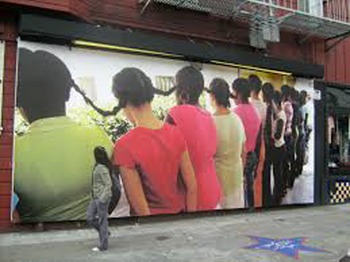
Trenzados, a performance developed in 2009, is exemplary in this sense. The action is apparently simple: Guzmán hired a Haitian performer to braid together the hair of eight Haitian and eight Dominican women, “chaining” them through their hair in one straight line. The use of Haitian and Dominican women does not work in oppositional terms; what matters for the artist is not who the participants are or what their nationality is, but rather what role beauty salons play in the construction of personal identities and the making and unmaking of racial tropes. Instead of categorizing Blackness as a synonym of Haitianness, Trenzados critically elaborates on the specificities of racialization spanning both sides of the border of Hispaniola (see figures 3 and 4). The action can thus be seen as a comment on the politics of Indianization and of whitewashing Blackness from the Dominican official record, and the importance of individual identity. At the same time the importance of individual self-definition is highlighted as a determinant aspect in this performance. Relying on the voluntary participation of the clients of the beauty shop, Trenzados simultaneously emerges as a celebration of Blackness that complicates simplistic racial identification according to the nationality of the participants. In this sense, the performance relies on challenging hegemonic racial categorizations and the idea that racial politics in the Dominican Republic are directly attuned to official anti-Haitian and anti-Black politics.
Sayuri Guzmán, Trenzados, 2009.

Sayuri Guzmán, Trenzados, 2009.

By underscoring how racial prejudices are reproduced and challenged in the context of personal care, Trenzados makes evident how racialized citizenship is actively produced and inserted into the personal through hair care. Trenzados therefore reinforces Ginetta Candelario’s argument on the role of the beauty shop in shaping identity in Hispaniola. For Candelario (Reference Candelario2000, 128), beauty shops are spaces where “the degrees, types, and technologies of artifice and alteration required by beauty are mediated by racial, sexual class, political, and geographic cultures and locations.” From a critical perspective sensitive to the temporal issues discussed in this article, to this we can add the fact that beauty shops are places where identity is updated and renewed. Sayuri Guzmán’s Trenzados captures well the temporal dimension of beauty shops. At the same time, the performance emphasizes the productive, process-based side of identity making. The performance addresses the racial component of hair politics (the idea of “pelo bueno” or “pelo malo”) from a perspective sensitive to the longue durée of racialization in Hispaniola.Footnote 7 Trenzados refuses to deal with Haitian-Dominican relationships in the reductive terms of official border politics. Staged in 2009, one year before the earthquake that devastated Haiti, the action imposes its own slow temporality to that of the actuality of politics and the impact of the media in the configuration of images and stereotypes about one’s own and alien communities. As we have seen in the case of Estructura completa, since 2010 the circulation of rumors and stereotyped images of the neighbor have mediated the relationship between Haitians and Dominicans. This view often leaves aside the everyday experience of many inhabitants of Hispaniola for whom identity and the border arise as fluid. By plunging art into the everyday exchanges taking place in beauty shops, Guzmán contraposes the rhythm of everyday personal exchanges to that of the immediacy and the artificial sense of urgency of the media. In this sense, Trenzados emphasizes the personal, continuous, and relational dimension of racialization.
The work of José Ramia (b. 1984, Santiago de los Caballeros) provides us a final example of how useful performativity can be to dismantle restricted identifications of the contemporary with what is happening now, or what belongs to the present. In 2014, Ramia and Clara Caminero organized a cultural program called Hello krisis. The title was taken from a painting by Ramia that referred to the difficulties in finding a space to exhibit work outside of the mainstream institutional circuit of Santo Domingo. What started as an inquiry into the institutional conditions of the Dominican art system expanded into a broader consideration of the relationship between culture and crisis. Hello krisis involved several performance actions, talks, and exhibitions, including a series of three exhibitions simultaneously taking place in the workspaces of José Ramia, Lina Aybar, and Evelyn Lima (see figure 5).
Clara Caminero (curator), Hello krisis exhibition, Lina Aybar’s apartment. 2013.
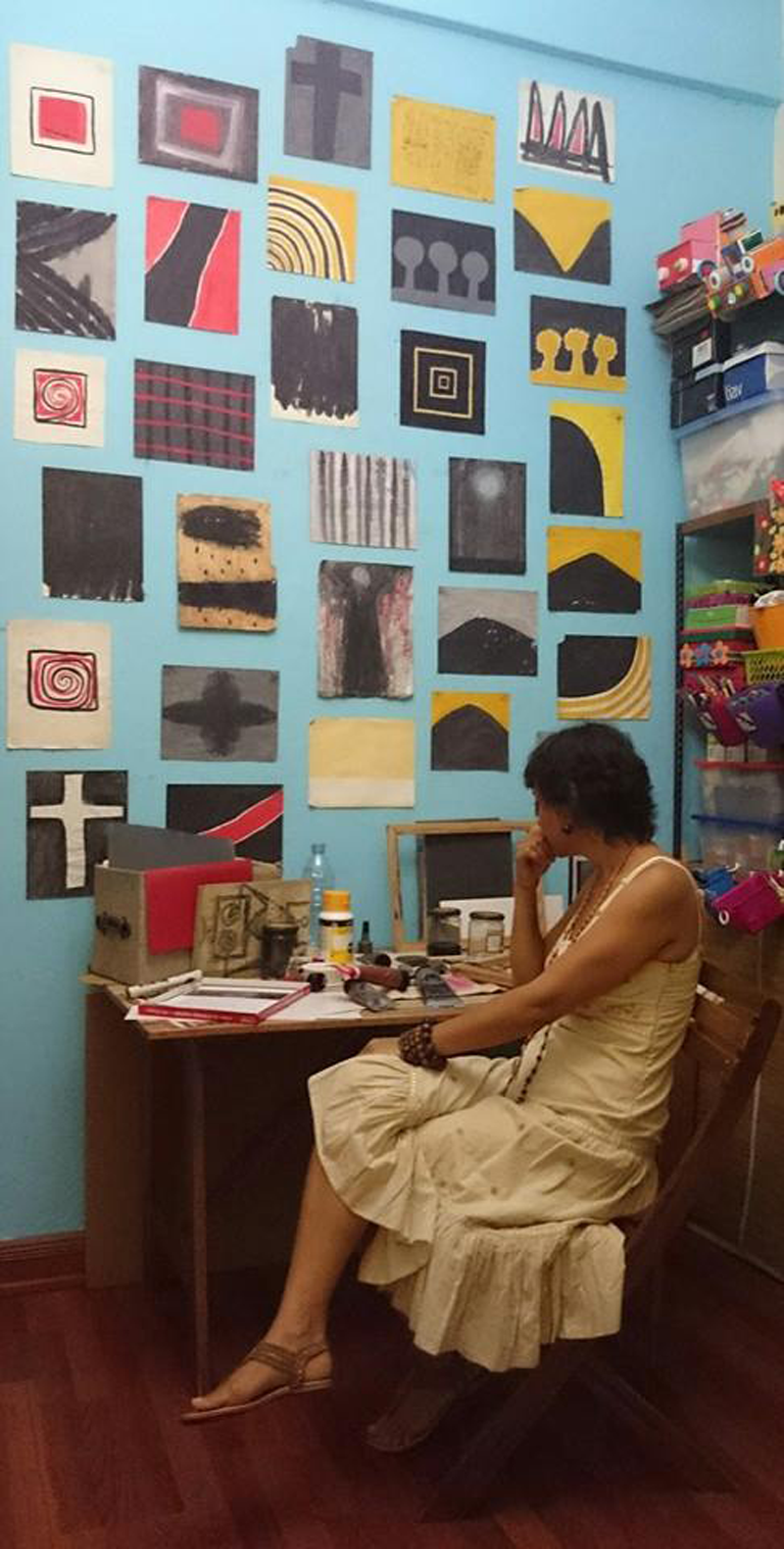
Hello krisis is interesting for many reasons: it challenges the centrality of museums and art galleries as spaces for the display of contemporary art in the country; it forces art audiences to take a closer look at the working conditions of artists; and it understands the crisis of the art system as part of a broader malaise, which is dealt with as a multifaceted situation involving many agents, and avoids placing all responsibility on the government. The fact that Hello krisis happened in the same year that the polemical Sentence 168-13 was passed strengthens the main curatorial point of the project, identifying crisis as an ever-present, all-encompassing situation in no way reducible to one specific issue.
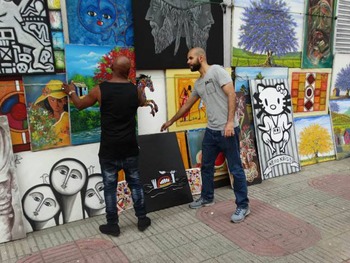
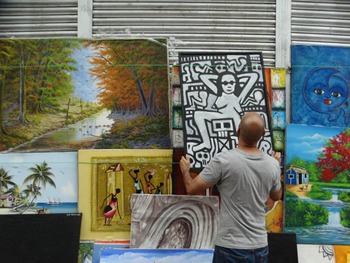
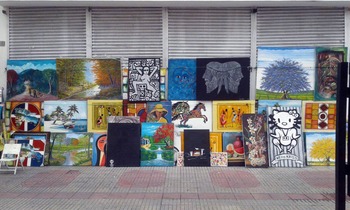
As part of follow-up conversations arising from Hello krisis, in 2017 Ramia and Caminero produced En El Conde, a daylong performance in which they rented the space of a street vendor selling “tourist art” in Santo Domingo’s touristic and cultural hotspots (see figures 6, 7, and 8). This action is particularly useful for understanding how performance art complicates stable definitions of the contemporary by directly engaging the contradictions of the Dominican art system. The main objective of En El Conde was to explore the coexistence of several aesthetic criteria and “art spaces” within the urban landscape of Santo Domingo. Caminero and Ramia negotiated the lease of a street vendor post, although this proved to be more difficult than they expected. Being habitués of the Dominican contemporary art world, Caminero and Ramia were unknown to the street vendors, who distrusted the project’s scope and especially the implications of any potential damage or theft of artworks. After finally agreeing on a six-hour-long rental with one of the street vendors, Ramia and Caminero camouflaged the painter’s work among other art objects.Footnote 8
José Ramia and Clara Caminero, En El Conde, 2017.

José Ramia and Clara Caminero, En El Conde, 2017.

José Ramia and Clara Caminero, En El Conde, 2017.

The choice of Calle El Conde is strategic: El Conde is the only pedestrian street in all Santo Domingo and one of the city’s main arteries, linking the touristic Ciudad Colonial with the official space of the Parque Independencia square. The surroundings of Parque Independencia also gather informal transportation, turning the zone into an active hub frequented by a heterogeneous population of passersby. Calle El Conde is also emblematic of the disparate effects of neoliberalism in the city. Once populated by cinemas, commerce, and Art Deco buildings, nowadays informal trade, derelict buildings, and souvenirs shops coexist there. Calle El Conde is therefore a clear symbol of the city’s modernization and the uneven consequences of this process. The selling of “popular art” to tourists is one of the most common activities of the avenue. Many of the artworks sold in these shops are imported from Haiti or produced by Haitian artists living in the Dominican Republic, although some of the works are by Dominican artists. In all cases, however, this art is indiscriminately labeled as Dominican. This fact is particularly interesting for analyzing the relationship between art and temporality: these artworks provide a vision of Hispaniola’s human and natural elements removed from time, conceived for the eyes of a tourist who often travels to the island to escape from the routine of the present (Thompson Reference Thompson2006; Sheller Reference Sheller2003). As these are hardly the only artworks from Haiti arriving into the space of Santo Domingo, this phenomenon of “popular” or “amateur” art is exemplary of how criteria of backwardness and modernity are artificially produced across national divides.
En El Conde engages with this multilayered temporal reality at different levels. The action provides an alternative appreciation of Calle El Conde for the audiences of contemporary art in Santo Domingo, who are accustomed to conceiving this space as a popular context dominated by amateur and tourist-led art selling. It also challenges the main logic beneath biennials and concursos, where originality is defined in individual and competitive terms and where a neat separation between contemporary and amateur art largely remains unquestioned. More importantly, the occupation of a place traditionally used for selling “tourist art” acquires a critical dimension if we compare it with the role of Dominican art institutions and museums in the construction of dominicanidad during the longue durée of the Trujillato and conservative politics in the country.
A second goal of Ramia and Caminero’s occupation has to do with teasing out the institutional system of valorization determining what is contemporary and what is not. Both artist and curator wanted to explore if Ramia’s stylish and conceptual work could pass undercover among artworks that are related to more traditional painting. Directly addressing the role that museums and art institutions play in the configuration of separate art worlds while asserting the potential of performance art in the Americas to “reconquer” public spaces (Fusco Reference Fusco and Fusco2006), Ramia’s intervention in Calle El Conde challenges the official Dominican historical narrative of progress and modernization. By focusing on the institutional and economic structures that regulate how art is valued, the action also urges a rewriting of art history in Hispaniola. We can compare En El Conde to other public art interventions such as Operación espejos, developed by the Quintapata Collective in 2014. Operación espejos also occupied the space of Calle El Conde, although on this occasion the focus was on the derelict state of preservation of three landmark modernist buildings, the Baquero, Cerame, and Saviñón. The Quintapata Collective organized a public call to develop an artistic and activist occupation of El Conde, asking participants to bring a mirror and to project light on elements of the buildings in need of repair. As in the case of En El Conde, we can link Operación espejos to the complex history of modernity and modernization in the Dominican Republic: the use of mirrors recovers a guerrilla tactic employed by the democratic resistance to blind the bombers threatening to attack Santo Domingo to impede the April Revolution of 1965.Footnote 9 Among the consequences of the defeat of the 1965 revolution were the deposition of Juan Bosch and the beginning of the second presidential mandate of Joaquín Balaguer, which implied the continuation of Trujillismo and the modernist reurbanization of Santo Domingo that included the Plaza de la Cultura project.
Ramia’s artistic occupation of Calle El Conde develops a temporal rearrangement that is linked to Dominican modernism and official elite aesthetics. En El Conde is clear about the historical process of fabricating national authenticity through a selective view of the popular. In the same way, this action is revealing of the neoliberal erasure of the complexities of modernity and modernization in the context of the Dominican Republic, and can be contextualized within the contradictions of neoliberalization in Hispaniola. En El Conde engages the touristic euphoria that followed 1992, the year of the fifth centennial of Columbus’s arrival to the Americas (see Viala Reference Viala2014). The 1990s was a decade of historical celebration, which included the declaration of Santo Domingo’s Ciudad Colonial in the UNESCO World Heritage List and the visit of Pope John Paul II. Surely, the urban and architectonical transformation of the Santo Domingo city center can be linked to the ghost of hispanidad that prevailed over late Balaguerism in the early 1990s, and to the continuities with the history of colonialism in Hispaniola. For many Dominicans, 1992 also represented a watershed for the incorporation of the country into neoliberal economies through tourism. The redefinition of the Ciudad Colonial was magnified to stand for the entire country, thus continuing the hegemonic racial classifications of elite discourses as if they affected and were shared by the entire Dominican society in equal terms. At the same time, however, this mobilization of hispanidad was linked to the tourism industries (including the selling of Haitian tourist art presented as Dominican) that repurposed the Dominican Republic as a major tourist destination for Spaniards and Europeans during the 1990s.
Ramia’s action is therefore subtler than a simple act of laying bare how Haitianness is silenced and made invisible in Dominican tourist industries. En El Conde implies the use of a place traditionally associated with “popular” and “tourist” art. By making his own position as a “contemporary artist” part of the debate, Ramia hints at art as a field of negotiation where the naturalization of modernism and racial and colonial difference intersects the neoliberal, tourist-driven space of the Ciudad Colonial. In En El Conde, José Ramia and Clara Caminero use interventionist tactics to engage a complex dynamic of visual commodification that is the result of neoliberal rearrangements in the present and not just the teleological consequence of colonial continuities. At the same time, the action makes evident the uneven labor and material conditions at play in Hispaniola, positing art not just as a space for the representation of such unevenness but also as a system actively and simultaneously producing and rejecting it.
Conclusions
Estructura completa, Trenzados, Hello krisis, and En El Conde are multilayered interventions that critically discuss the complexities of the contemporary. They pose unavoidable questions for Caribbean art historiography. The consequences of this association between performance art and contemporaneity have been underexplored. Of course, this is not a problem exclusive to the Dominican Republic. One of the most common assumptions in art criticism is that contemporary Caribbean art would be art incorporated into the rapid network of exchanges of an increasingly globalized art world. Particularly in large-scale exhibitions that display the art of the region, an emphasis on the global and the transnational has overshadowed the complex and multifaceted ways in which contemporaneity can be materialized. This is important because contemporaneity is in some cases seen as a given, and the critic’s task is assumed to be that of inventorying the ways in which Caribbean artists working now express the contemporary.
Caribbean art can teach us many things about time and the contemporary. Dominican performance art provides a useful tool to challenge the consolidation of a rhetoric of progress and modernization that owes to the consolidation of neoliberal socioeconomic values in the aftermath of the Trujillato. The work of David Pérez “Karmadavis,” Sayuri Guzmán, and José Ramia offers fertile entry points to think about contemporaneity as a contested terrain. Their performative practices allow us to analyze the invention of new critical categories that could transcend outmoded associations of art to specific nation-states, but also uncritical celebrations of the transnational and the global that largely ignore the “charged situatedness” of the contemporary. This is particularly useful for problematizing the Western-centrism of histories of performance art (see Goldberg Reference Goldberg2001; Cullen et al. Reference Cullen, Maris Bustamante, Fuentes and Iovino2008; and Kelley and Kester Reference Kelley and Kester2017). The performance works by Karmadavis, Guzmán, and Ramia help us assess art’s capacity to historicize the contemporary and challenge the specific arrangement of neoliberal time in La Hispaniola, a temporal logic of neoliberalism that naturalizes racialized exclusion and the exoticism promoted by tourism.
Furthermore, performance art also provides fertile ground for interventions into the temporal politics of race and racialization in Hispaniola. The three examples analyzed in this article dismantle simplistic identifications of Dominicanness with anti-Blackness. More than this, these performance actions situate the process of racialization in the context of the Dominican Republic as the result of complex and multilayered exchanges that go beyond the contours of Hispaniola and plunge into the rich and singular history of modernity and modernization in the country. This has profound consequences for the analysis of Dominican art, for it reveals how entangled art is in the production and regularization of the modern and the contemporary. As we have seen, time plays a central role in that process: the imposition of the urgency of newness and artistic renovation at play in biennials and concursos echoes modernist aspirations to eternal progress. In this context, the works of Karmadavis, Guzmán, and Ramia force the audience to question assumed notions of time beyond such a one-sided modernist inheritance.



 Open access

