


Introduction
Opposition is an essential component of democratic representation (Dahl, Reference Dahl1966). While opposition challenge to the government's policy agenda can further promote “pluralist party competition” (Sartori, Reference Sartori1976) and “popular sovereignty and political equality” (Dahl, Reference Dahl1971), which dynamically fosters policy responsiveness when public attitudes change (Stimson et al., Reference Stimson, MacKuen and Erikson1995), the government plays a dominant role in the policy‐making process of parliamentary democracies (Döring, Reference Döring and Döring1995, Reference Döring2001). Particularly when government majority and legislative majority coincide (as is often the case in parliamentary systems), the government's dominance is strong and leads to a very high passage rate of government bills (Brunner, Reference Brunner2013; Olson & Norton, Reference Olson and Norton1996). This dominance explains why comparative research so far has mainly focused on related themes, such as the degree of government control of the parliamentary policy‐making process (Cox, Reference Cox2005; Döring, Reference Döring and Döring1995; Laver & Shepsle, Reference Laver and Shepsle1996; Lijphart, Reference Lijphart1999; Tsebelis, Reference Tsebelis2002), factors that determine the diversity of a government's policy agenda (Jennings et al., Reference Jennings, Bevan, Timmermans, Breeman, Brouard, Chaques‐Bonafont, Green‐Pedersen, John, Mortensen and Palau2011; Mortensen et al., Reference Mortensen, Green‐Pedersen, Breeman, Chaqués‐Bonafont, Jennings, John, Palau and Timmermans2011), and conditions that may constrain the government's potential for promoting policy changes (Bräuninger & König, Reference Bräuninger and König1999; Diermeier & Feddersen, Reference Diermeier and Feddersen1998; Tsebelis, Reference Tsebelis1999; Tsebelis & Money, Reference Tsebelis and Money1997) and how the government overcomes these constraints (Fortunato et al., Reference Fortunato, König and Proksch2013). Surprisingly, there is little empirical research that systematically investigates the role of the opposition and how it may affect the government's policy agenda dominance in parliamentary democracies.
In this study, we examine the conditions under which government bills are challenged in the parliamentary policy‐making process, bringing a previously unexplored factor – opposition support to partisan committee chairmanship – into consideration. For theoretical and methodological reasons, we approximate challenges to government bills by employing the initiation of amendment proposals, which is an observable variable that signals incompleteness of government bills and underscores accountability for challenging a bill. Even though amendment proposals do not always lead to policy changes, these challenges may impose various costs on government partiesFootnote 1 and bring electoral benefits to the partisan challengers who are responsible for such proposals (Fortunato, Reference Fortunato2021; Russell et al., Reference Russell, Gover, Wollter and Benton2017).Footnote 2
Following the proposition that parliamentary institutions empower parties in the parliamentary policy‐making process (Fortunato et al., Reference Fortunato, Martin and Vanberg2019; Powell, Reference Powell2000; Strøm, Reference Strøm1990), we conceive the role of the committee chair as a mediator who has the power to foster or hinder challenges (i.e. amendment proposals) to government bills. As suggested by the recent literature on legislative review and party differentiation in coalition governments (Fortunato, Reference Fortunato2021; Fortunato et al., Reference Fortunato, Martin and Vanberg2019), we expect that government bills are more likely to receive amendment proposals when policy disagreement between the ministerial party and the party chairing the reviewing committee escalates. In addition to the level of policy disagreement between the minister and the committee chair, we further posit that opposition support to the committee leadership makes challenges to government bills through amendment proposals more or less likely.
Unsurprisingly, when committee chairmanship is under the control of the ministerial party, the chair can use her powers to prevent challenges targeting bills of her own party as this creates potential reputation costs for the party. Yet, when an opposition party chairs the committee that reviews a government bill, opposition support to the opposition chair should make the presence of amendment proposals more likely. This also applies to multiparty opposition, as doing so can help the opposition undermine the image of a dominant government policy agenda in the eyes of the voters and present the opposition as a credible alternative (Andeweg, Reference Andeweg, Müller and Narud2013; Blondel, Reference Blondel1997; Hohendorf et al., Reference Hohendorf, Saalfeld, Sieberer, Bukow and Jun2020; Whitaker & Martin, Reference Whitaker and Martin2021). On the contrary, when the coalition partner controls the chair of the reviewing committee, the likelihood of opposition support rather motivates the partner chair to hinder amendment proposals; otherwise, the partner chair risks providing reputation gains for the opposition and suffering costs from coalition tensions. In this case, the ministerial office‐holder may also learn the partner's competitive type, which can exacerbate the principal‐agent problems within coalition governments (König et al., Reference König, Lin, Lu, Silva, Yordanova and Zudenkova2022).
To examine our argument, we construct a new dataset that includes information on all government bills and partisanship of committee leaderships in three parliamentary democracies where the power of committees is considered strong: Denmark (2004–2015), Germany (1980–2012), and the Netherlands (1998–2015). Our findings, drawn from about 7400 government bills, show that opposition support is an important factor that helps us understand challenges to government dominance of the policy agenda in the parliamentary policy‐making process. Underlining the importance of partisan committee chairmanship, we show that a government bill is more likely to be challenged (i.e. receive amendment proposals), the further (in terms of policy disagreement) the proposing minister is to the opposition chair, who is supported by the opposition parties. By contrast, when the chair is controlled by a coalition partner, the government bill is only more likely to be challenged when the likelihood of opposition support to the partner chair is low (i.e. the preference divergence between the partner chair to the other opposition parties is high). Overall, our findings shed new light on democratic representation, the government's policy‐making dominance and the role of the opposition in parliamentary democracies.
Opposition influence on the parliamentary policy‐making process
As Dahl (Reference Dahl1966, p. xviii) famously argued, the existence of the opposition is ‘nearly the most distinctive characteristic of democracy’. In parliamentary democracies, since government and parliamentary majorities often coincide,Footnote 3 the opposition is expected to function as a player who constantly checks the government and the parliamentary majority the government controls. The main task of the opposition is to scrutinize a variety of government activities, criticize the government's policy agenda and present credible alternatives to government proposals (Helms, Reference Helms2008). Surprisingly, while the role of the opposition seems to be fundamental to the functioning of democracy and its tasks are very specific, scholars have paid little attention to a systematic examination of the role of the opposition, its behaviour and its influence in the parliamentary policy‐making process (see, e.g., Garritzmann, Reference Garritzmann2017, for a detailed review).
In the existing, yet scant literature that empirically evaluates the role of opposition in the parliamentary policy‐making process, the attention largely focuses on whether the opposition exerts any impact on policy outputs. Taking a policy‐seeking perspective, this literature often considers the opposition as the main policy competitor to the government and examines whether the opposition can get their preferred policies implemented or can force the government to alter its own policy agenda. Particularly, one strand of this literature studies the passage rate of bills as an assessment of opposition influence (Andeweg & Nijzink, Reference Andeweg, Nijzink and Döring1995; Arter, Reference Arter1985; Griffith, Reference Griffith1974; Kerrouche, Reference Kerrouche2006; Zubek, Reference Zubek2011). For instance, Brunner (Reference Brunner2013) investigates the success rate of government against parliamentary bills and demonstrates that government bills on average enjoyed a much higher passage rate than parliamentary bills in 14 parliamentary democracies in the period between 1945 and 2005.Footnote 4 The imbalance in passage rates between government and opposition bills, therefore, led to the impression that the opposition plays a fairly marginal role or is even negligible in parliamentary democracies, and that the government is dominant in setting and controlling the policy agenda.
Similar results have been discovered in another body of research that examines the conditions under which the opposition may constrain the government's policy‐making dominance in parliament. This strand of the literature shows that the influence of the opposition in the parliamentary policy‐making process is limited, and only under certain circumstances, particularly where the number of partisan veto players increases (Tsebelis, Reference Tsebelis2002), has the opposition a chance to get policies implemented in its preferred shape. For instance, scholars have found that government parties may be constrained under situations where legislative majorities are not congruent in bicameral systems (Manow & Burkhart, Reference Manow and Burkhart2007; Tsebelis & Money, Reference Tsebelis and Money1997), policy disagreement exists within the government (Bräuninger & Debus, Reference Bräuninger and Debus2009) and when divided (Bräuninger et al., Reference Bräuninger, Debus and Wüst2017) or minority governments (Strøm, Reference Strøm1990) take place. These empirical studies, again, conclude that the government is the dominant actor in the parliamentary policy‐making process.
Challenging this impression, some scholars, following the proposition that parliamentary institutions empower parties (Copeland & Patterson, Reference Copeland and Patterson1994; Gamm & Huber, Reference Gamm, Huber, Katznelson and Milner2002; Mattson & Strøm, Reference Mattson, Strøm and Döring1995; Mezey, Reference Mezey and Finifter1993; Strøm, Reference Strøm1990), attempt to turn the scholarly attention to the variation in the design of parliamentary institutions, with a special focus on committee systems. They argue that whether the opposition is granted access to institutional powers, such as committee chairs or the power to amend government bills through parliamentary committees, determines the influence the opposition may exert (Powell, Reference Powell2000; Strøm, Reference Strøm1990). Indeed, the parliament offers ‘a whole “arsenal” of different tools to extract information from governments, to monitor their activities and to induce them to defend their decisions’ (Saalfeld, Reference Saalfeld2000, p. 365).
Empirically, Fortunato et al. (Reference Fortunato, Martin and Vanberg2019) find that government bills are more likely to be altered (i.e. the contents being substantively edited between the introduction and the conclusion of the legislative process) when the opposition rather than the partner party controls the committee chairmanship.Footnote 5 Without aiming at introducing policy changes, opposition parties can challenge government bills to highlight to voters the government's incompetence, the inconsistency and incompleteness of the government's policy agenda and potential alternatives they can offer (Hohendorf et al., Reference Hohendorf, Saalfeld, Sieberer, Bukow and Jun2020; Russell et al., Reference Russell, Gover, Wollter and Benton2017; Whitaker & Martin, Reference Whitaker and Martin2021; Williams, Reference Williams2011). Likewise, coalition partners may do so for policy differentiation or reputation purposes (Fortunato, Reference Fortunato2021; Martin & Vanberg, Reference Martin and Vanberg2008). Building on this literature, we propose to take a vote‐maximizing perspective to better understand partisan committee chairmanship in the parliamentary policy‐making process.Footnote 6 We ask and investigate under which conditions government bills are more likely to be challenged under different partisan control of committee chairs, and we contend that the likelihood of support of the opposition to the partisan committee chair affects whether government bills are more or less likely to receive such challenges.
Committee chairmanship, opposition support and challenges to government bills
In most parliamentary democracies, the committee system is the most readily available institution that grants parties varied powers to perform activities such as scrutinizing the government's activities (Krehbiel, Reference Krehbiel1991; Martin, Reference Martin2004; Martin & Vanberg, Reference Martin and Vanberg2005) and revising government bills (Döring, Reference Döring and Döring1995; Döring & Hallerberg, Reference Döring and Hallerberg2004; Martin & Vanberg, Reference Martin and Vanberg2011). With powers to schedule public hearings, to consult policy experts and societal groups, and to subpoena relevant documents on government bills, committee deliberations can help parliamentary parties extract relevant policy information and thus reduce information deficits vis‐à‐vis the privileged ministerial office‐holder (Kim & Loewenberg, Reference Kim and Loewenberg2005; Mattson & Strøm, Reference Mattson, Strøm and Döring1995; Mezey, Reference Mezey and Finifter1993). In particular, committee chairs have privileges – be they formal or informal – to determine the agenda of the committee and to affect the overall committee deliberations. As a result, it has been argued that chairing committees can help coalition partners to monitor and scrutinize government bills when ministerial drift is more likely due to diverging policy preferences between coalition parties (Carroll & Cox, Reference Carroll and Cox2012; Kim & Loewenberg, Reference Kim and Loewenberg2005; Krauss et al., Reference Krauss, Praprotnik and Thürk2021).Footnote 7
Indeed, controlling access to committee chairmanship may provide political parties with greater influence over the policy‐making process (Dach, Reference Dach, Schneider and Zeh1989). Particularly important, the committee leadership might allow opposition parties to exert institutional powers to challenge the government's dominance in the parliamentary decision‐making process (Powell, Reference Powell2000; Strøm, Reference Strøm1990). As Fortunato et al. (Reference Fortunato, Martin and Vanberg2019) recently demonstrate, government bills receive more substantial changes when opposition parties chair relevant reviewing committees. That said, the relationship between chairing committees and challenges government bills receive may not be as straightforward as it looks. While Fortunato et al. (Reference Fortunato, Martin and Vanberg2019) also reveal that committee chairs controlled by the coalition partner do not increase the number of alterations made to government bills, Fortunato (Reference Fortunato2021) instead shows that under partner chairmanship amendment proposals are more likely to be introduced when coalition partners attempt to differentiate from one another in the eyes of the voters and less likely when the opposition plays a pivotal role in the policy‐making process such as under minority governments.
Suggesting an explanation for these apparently inconsistent findings, we bring into consideration a previously unexplored factor to understand government bill challenges, that is the opposition support to committee chairmanship. By distinguishing between the chairmanship of ministerial, partner and opposition parties, we examine whether opposition support conditions the likelihood of government bills receiving amendment proposals. From a vote‐maximizing perspective, opposition support may explain why the likelihood of amendment proposals – as compared to the ministerial party chairing the committee – increases under opposition chairmanship and why it decreases under partner chairmanship. This view expands the role of the opposition by taking a closer look at the interaction between different partisan controls of committee chairmanship and opposition support.Footnote 8 Instead of focusing only on policy disagreement between the ministerial party and the chairing party, we highlight the interaction between committee chairs from different parties and opposition support from a vote‐maximizing perspective. To understand the mechanism, we consider different motivations chairing parties possess when acting as a mediator – that is fostering or hindering amendment proposals made to government bills – under scenarios that might benefit the opposition, both in terms of policy and votes.
According to Fortunato et al. (Reference Fortunato, Martin and Vanberg2019), the greater the policy disagreement between the chairman's partisan preference and the ministerial party, the higher the incentive of the chairman to foster an amendment proposal to the government bill. We take this incentive as a necessary condition, which only partially identifies the mechanism of challenges government bills receive through opposition chairmanship. These challenges, however, do not always attempt to alter the content of government bills. While opposition parties may do so to promote their own electoral profile (Russell et al., Reference Russell, Gover, Wollter and Benton2017) and to impose political costs on government parties, a partner party may challenge government bills to protect the party's own brand in the eyes of the electorate (Fortunato, Reference Fortunato2021). Still, protecting the partner party's brand may also improve the electoral fortune of the opposition as these challenges may lead to tensions among coalition parties. This tension may become more severe when a challenge initiated by the partner chair is supported by opposition parties. On the contrary, when the opposition as a whole supports the challenge initiated by the opposition chair, both the opposition chair and the other opposition parties might extract benefits from acting as a unified opposition. Accordingly, we argue that the decision of committee chairs to foster or impede challenges depends on the calculus of electoral costs and benefits their decision produces, and that opposition support shapes this calculation.
Let p define the probability that opposition parties will support an amendment proposal under the chairmanship of a party and $1-p$ the likelihood that the opposition parties will not support such a bill challenge. Given the policy disagreement of the chairman with the government bill, we expect that a high probability of support by opposition parties will (1) foster the presence of amendment proposals when the chairman is from the opposition, but, (2) hinder the presence of amendment proposals when the chairman is from the coalition partner. Therefore, according to our argument opposition support impacts partisan committee chairs differently. First, we expect a higher likelihood of amendment proposals under a unified opposition – that is, the lower the preference divergence between the opposition chair and the other opposition parties. Figure 1 depicts our expectation for this scenario (i.e. under opposition chairmanship).
Centripetal move of opposition parties towards opposition chair (increasing the likelihood of opposition support) leads to more amendment proposals.

Where $gb$ stands for the government bill, $o$c stands for opposition chair and $op_{1}$ and $op_{2}$ are opposition parties. The grey arrows above $op_{1}$ and $op_{2}$ depict the centripetal move of opposition parties towards the opposition chair – that is the greater the likelihood of opposition support to the opposition chair. The thick black line depicts the policy distance between $gb$ and $o$c. Hence, according to our first empirical implication:
Hypothesis 1. The greater the policy distance between the party of the opposition chair and the government bill, and the higher the likelihood of opposition support, the more likely the government bill is to be challenged.
Second, we expect a higher likelihood of amendment proposals under a partner chairmanship only when the likelihood of opposition support is low (i.e. when the partner chairmanship can expect that the opposition cannot extract political and electoral benefits from the challenge). On closer inspection, while coalition partners proposing amendments to government bills may prevent ministerial drift of their peers (Martin & Vanberg, Reference Martin and Vanberg2005, Reference Martin and Vanberg2011) or distinguish themselves from one another (Fortunato, Reference Fortunato2021), doing so when the opposition supports the challenge may raise coalition tensions and improve opposition parties' electoral profiles. Even if the proposed amendments end up not being implemented, opposition support under the chair of the partner party may signal to voters a divided coalition and a cohesive opposition alternative to the current coalition.Footnote 9 Expressly, we contend that a partner party has to trade off costs from drift (or differentiation) and costs imposed by opposition support under its chairmanship. This trade‐off leads to the empirical implication that challenges under partner chairmanship are less likely when the opposition parties support the partner party in challenging the government bill. Figure 2 depicts our empirical expectation for this scenario (i.e. under partner chairmanship).
Centrifugal move of opposition parties away from the partner chair (decreasing the likelihood of opposition support) leads to more amendment proposals.

Challenges under partner chairmanship will become more likely when opposition parties move away from the partner chair ( $p$c). The grey arrows above $op_{1}$ and $op_{2}$ represent this centrifugal move – that is the smaller the likelihood of opposition support of the party of the partner chair. The thick black line now depicts the policy distance between $gb$ and $p$c. According to our second empirical implication:
Hypothesis 2. The greater the policy distance between the party of the partner chair and the government bill, and the lower the likelihood of opposition support, the more likely the government bill is to be challenged.
Data and research design
To examine the conditions under which partisan committee chairmanship and opposition support foster challenges to government bills, we construct a new dataset that includes all government bills in three parliamentary democracies, covering the following period: Denmark (2004–2015), Germany (1980–2012) and the Netherlands (1998–2015). These countries are selected not only due to data availability but also because of the strong institutional powers embedded in these countries' committee systems (Martin & Vanberg, Reference Martin and Vanberg2011; Mattson & Strøm, Reference Mattson, Strøm and Döring1995; Powell, Reference Powell2000). In particular, committee chairs in these parliamentary democracies are proportionally allocated based on seat shares controlled by parliamentary parties, ensuring the opposition's holding of committee chairmanship. With 7416 government bills – 1949 from Denmark, 3038 from Germany and 2429 from the Netherlands – we examine comprehensive data assembled on government bills in parliamentary democracies with strong parliamentary institutions.Footnote 10 In our data, government bills enjoy high success rates – 91% in Germany, and 97% in both Denmark and the Netherlands.Footnote 11 This is consistent with the conventional wisdom of government dominance of the policy agenda in parliamentary democracies.
From a qualitative policy‐seeking perspective, studying the role of the opposition would require data not only on whether an amendment proposal initiated by the opposition was successfully altered but also in which partisan direction it changed a government bill.Footnote 12 However, besides measurement problems, changes coming from coalition parties can be a result of the pressure made by opposition parties, and in countries such as Germany, the partisan origins of amendment proposals are not available. We, therefore, focus on amendment proposals, which are observable challenges that signal incompleteness of government bills. Moreover, simply counting the number of amendments proposed by the opposition potentially overlooks the strategic influence a committee chair might exert on other parties.Footnote 13 As we are interested in whether the opposition can challenge the government's policy agenda dominance, we investigate whether a government bill receives any amendment proposal during the parliamentary decision‐making process. Thus, our dependent variable is a dummy variable that is coded as ‘1’ when a government bill receives at least one amendment proposal (regardless of its success), and as ‘0’ otherwise.Footnote 14
To investigate the effects of committee chairmanship, we categorize parliamentary committees into three categories.Footnote 15Opposition chair is a binary variable coded as ‘1’ when the committee chair of a review committee is held by an opposition party and coded as ‘0’ when the chair is from a government party. Partner chair is a binary variable coded as ‘1’ when the committee chair of a review committee is held by a coalition partner party, and coded as ‘0’ when the chair is either from the opposition or from the same party of the minister that initiated the bill. The reference category indicates the chairs held by the ministerial party.Footnote 16 Information about committee chairs is available in the committee reports of each bill in Denmark. German committee chair data are obtained from Datenhandbuch zur Geschichte des Deutschen Bundestages, 1949 bis 1999 for the years from 1949 to 1998. For the years after 1998, we extract the relevant information from the Bundestag website. Dutch committee chair data are mostly gathered through the website of Tweede Kamer and Parlement & Politiek,Footnote 17 that provides us with MP‐level information. We also rely on committee reports when necessary. In order to identify which party is in government, we use the dataset on governments collected by Seki and Williams (Reference Seki and Williams2014) that we updated for the years after 2013. After capturing the partisanship of review committees on a daily basis,Footnote 18 we match the data with the initiation date of government bills to determine which committee and its chairing party review a given government bill. In the cases where we could not identify the partisanship of committee chairs on the date of bill initiation, we use the date of bill passage in the lower house to match a bill with the committee chair.Footnote 19
A key variable in research on the coalition policy‐making process concerns the degree of policy disagreement between the government bill and the party chairing the committee that reviews the proposed bill. Following Martin and Vanberg (Reference Martin and Vanberg2011, Reference Martin and Vanberg2014), we use expert surveys (Benoit & Laver, Reference Benoit and Laver2006; Laver & Hunt, Reference Laver and Hunt1992) to measure both ideological position and issue saliency for the preference of each party in a given policy area.Footnote 20 Instead of assuming that the ministerial party always introduces bills that reflect her own preferences, we distinguish between two types of bills, radical and moderate bills, as Martin and Vanberg (Reference Martin and Vanberg2011) specified in their theoretical model. The radical bill reflects the preference of the ministerial party, while the moderate bill proposes coalition compromise as a (bargained) preference located in‐between the preferences of the coalition parties. This distinction allows us to investigate what bill challenges are going after the policy disagreement between the ministerial party and the committee chairing party, or potential coalition tensions between coalition parties. While making this distinction does not change our main conclusion, we present the main results based on radical bills and show the estimated results using moderate bills in the Supporting Information. We measure bill‐chair policy disagreement by calculating the absolute ideological distance between each type of bill and the party that controls the committee. This distance measure is further weighted by the relative issue saliency of the party chairing the committee.Footnote 21
Our argument suggests that opposition parties are more likely to support a committee chair when the policy disagreement between them and the chairing party decreases. To examine the empirical implications of our argument, we create the variable opposition support to measure the likelihood of opposition support to the party chairing the committee. We calculate this variable by summing up the absolute ideological distance between the party of the committee chair and each opposition party, and then weight the sum by the relative issue saliency of the chairing party of the committee.Footnote 22 To simplify the interpretation of our multiplicative interaction analyses, we transform opposition support into a binary measurement, where ‘1’ (depicting high likelihood of opposition support) is assigned for cases below the mean value of 5.92, that is, lower levels of policy disagreement between the chairing party of the committee and other opposition parties; ‘0’ (depicting low likelihood of opposition support) is assigned for cases equal or above the mean value of 5.92, that is, higher levels of chair‐opposition policy disagreement. This transformation also allows for controlling possible nonlinear interaction effects and safeguards our estimation against extrapolation.Footnote 23
In addition to the variables of interest described above, we control for a number of factors that might influence our response variable and regressors, as identified in previous research (Bräuninger et al., Reference Bräuninger, Debus and Wüst2017; Fortunato, Reference Fortunato2021; Martin & Vanberg, Reference Martin and Vanberg2011, Reference Martin and Vanberg2014). Seat share of the committee chair accounts for the potential resources at the chair's disposal for managing (i.e., blocking or fostering) challenges to the government's policy agenda. Number of reviewing committees counts the number of committees to which a government bill was referred. Besides taking bill complexity into account, a government bill is more likely to receive amendment proposals if it is examined in multiple committees. Minority government is a binary variable that takes a value of ‘1’ if the seat share of the government party (or parties) is less than or equal to 50% of the total seats in the lower chamber, and 0 otherwise. Also, we control for country fixed‐effects by introducing two binary variables for Germany and the Netherlands (i.e., Denmark as a reference).
Results
Since our dependent variable is dichotomous and about half of the government bills in each country received at least one amendment proposal, we estimate a logistic regression model to test our hypotheses. Two models are estimated based on the following general specification, where, type of chair can be either opposition chair or partner chair. $X^{\prime }$ is a vector of observations on our control variables with parameter estimates vector ϕ, and ε is the error term:
 $$\begin{eqnarray*} P \left(Amendment\_Proposal \right) &=& \beta _{0}+\beta _{1}[Opposition\_Chair] + \beta _{2}[Partner\_Chair]\\ && +\; \beta _{3}[Bill\text{-}Chair\_Disagreement]\\ && +\;\beta _{4}[Type\_of\_Chair*Bill\text{-}Chair\_Disagreement] \\ &&+\; \beta _{5}[Opposition\_Support]\\ && +\; \beta _{6}[Opposition\_Support*Type\_of\_Chair] \\ &&+\;\beta _{7}[Opposition\_Support*Bill\text{-}Chair\_Disagreement] \\ &&+\;\beta _{8}[Opposition\_Support*Type\_of\_Chair *\\ && \quad Bill\text{-}Chair\_Disagreement] + \bm{\phi } X^{\prime } + \epsilon . \end{eqnarray*}$$
In Model 1, we test how the interaction between bill‐chair disagreement and opposition support condition the effect of opposition chairmanship on bill challenges. In Model 2, we test the effect of coalition partner chairmanship on bill challenges under the same conditions, replacing opposition chair with partner chair.Footnote 24 For the interpretation of our results, we present the estimated probabilities of amendment proposals according to each of our hypotheses graphically.Footnote 25
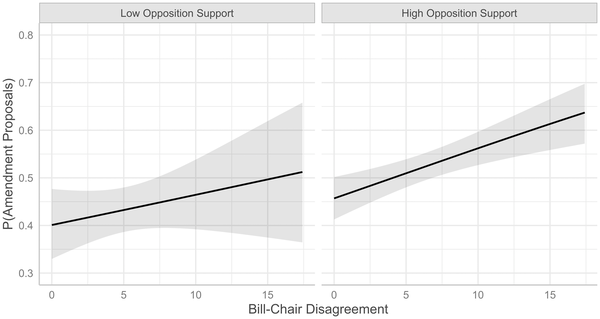
According to our argument, opposition support is an important, yet neglected factor that can explain bill challenges under both opposition and partner committee chairmanship. Figure 3 depicts the predicted probabilities of a government bill being challenged by the reviewing committee controlled by the opposition given different levels of policy disagreement between the government bill and the chairing party. The left panel specifies the scenario where opposition support is low, and the right panel represents the scenario where opposition support is high.
Predicted probabilities of amendments by opposition support, opposition chair and bill‐chair policy disagreement (model 1 of Table B1 in the Supporting Information).
Dependent variable: Amendment proposal.
Confidence intervals at 95%. N = 7416.

Compared to the low likelihood of opposition support, the high likelihood of opposition support significantly increases the probability of amendment proposals under opposition chairmanship. Hence, when opposition parties are likely to share the views of the opposition party holding the relevant chair, government bills are more likely to receive amendment proposals. This supports our first hypothesis, the higher the likelihood of opposition support to the opposition chair – that is a unified opposition – the more likely government bills are to be challenged by amendment proposals.
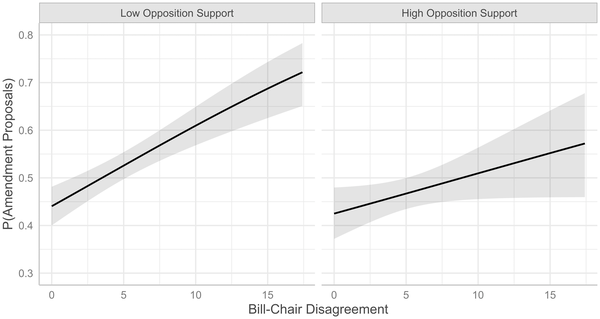
In support of our second hypothesis, Figure 4 suggests an opposite effect when committee chairs are controlled by partner parties. Considering the role of the opposition, when opposition parties are likely to support the partner party holding the chair, a higher disagreement of the partner chair with the government bill does not increase the probabilities of government bills being challenged. Yet, when the opposition is unlikely to support challenges under the chair of the partner party, the probability for government bills to receive amendment proposals increases with greater disagreement between the bill and the partner party holding the chair. This effect underlines the importance of opposition support for better understanding of the conditions under which government bills are challenged by coalition partners. Specifically, it supports our expectation that, as the policy disagreement between the government bill and the chairing partner increases, a lower likelihood of opposition support to the partner chair increases the likelihood of bill challenges.
Predicted probabilities of amendments by opposition support, partner chair, and bill‐chair policy disagreement (model 2 of Table B1 in the Supporting Information).
Dependent variable: Amendment proposal.
Confidence intervals at 95%. N = 7416.

Moderate bills and robustness checks
Our results highlight the importance of considering opposition support to understand the effects partisan committee chairmanship exert on challenges to government bills, and particularly, under which conditions the likelihood of those challenges increases for radical bills – that is, bills that deviate from the coalition compromise – when the partner party chairs the committee.Footnote 26 Because radical bills represent the policy position of the minister's party at the expense of the coalition compromise, these bills provide stronger incentives for partner parties to foster challenges. As a further test of our argument, we conduct our main empirical tests using moderate bills – that is, bills that reflect a policy compromise between government parties – by replacing bill‐chair policy disagreement with compromise bill‐chair policy disagreement.Footnote 27
Replicating our previous results by measuring the location of government bills differently does not change our findings (the results are presented in Appendix C of the Supporting Information). In other words, regardless of the type of the government bill – that is, radical or moderate – as the disagreement of the chairing party with the bill increases, the high likelihood of opposition support increases the probability of observing amendment proposals under opposition chairmanship. Also as predicted, the likelihood of amendment proposals under partner chairmanship only increases for moderate bills when the likelihood of opposition support is low.
To further test the consistency of our findings, we have conducted several robustness checks presented in the Supporting Information,Footnote 28 such as the replication of our models controlling for policy areas fixed‐effects (Appendix E), employing opposition support as a continuous variable (Appendix F), and using an alternative measurement of opposition support (Appendix G).Footnote 29 The results from these robustness checks strengthen the main findings of this study on the importance of considering the role of the opposition in challenging the dominance of the government's policy agenda in parliamentary democracies.
Conclusion
The government dominates the policy agenda in parliamentary democracies. This impression is largely driven by the empirical regularity that opposition parties can hardly receive policy‐seeking benefits through successful implementation of their own bills or altering the content of government bills in their favour. Compared to this policy‐seeking perspective, we introduce a vote‐maximizing argument highlighting the role of opposition support in parliamentary democracies. Instead of reducing the role of the opposition to a policy‐seeking actor who frequently fails at passing its bills or altering government bills, we investigate the role of the opposition as a supporter of the committee chairmanship, which can foster or hinder challenges to government bills in the parliamentary policy‐making process. These challenges can promote and reveal coalition conflict or be employed by parties as a signaling device for party differentiation purposes and also serve as a tool that opposition parties may employ to present themselves to voters as a credible alternative to the existing coalition government.
With evidence from roughly 7400 government bills in Denmark, Germany and the Netherlands, our findings provide a nuanced account of the role of the opposition in parliamentary democracies. We demonstrate that the opposition plays a more important role in parliamentary democracies than conventionally suggested,and that opposition support affects when the government's agenda dominance is challenged. In this sense, our argument is consistent with some existing findings but also makes novel predictions by taking a closer look at the impact of opposition support. While our empirical results corroborate that the role of opposition is strengthened by committee chairmanship (Powell, Reference Powell2000; Strøm, Reference Strøm1990), neither policy disagreement with the bill nor chairmanship alone are sufficient conditions to explain challenges made to government bills (Fortunato et al., Reference Fortunato, Martin and Vanberg2019). In addition to chairmanship and policy disagreement, our findings show that the opposition supports conditions whether government bills are more or less likely to be challenged by amendment proposals. Compared to a higher likelihood of opposition support under opposition chairmanship, a lower likelihood of opposition support promotes amendment proposals under coalition partner chairmanship. This applies to both radical and moderate types of government bills.
Our findings also speak to the literature on coalition governance. Although committee chairmanship is considered an important institutional prerogative among various devices coalition partners may use to overcome their principal‐agent problems (Carroll & Cox, Reference Carroll and Cox2012; Hallerberg, Reference Hallerberg, Strauch and von Hagen2000; Martin & Vanberg, Reference Martin and Vanberg2011), as our results suggest the costs of using these devices can become more pronounced for the partner when the opposition is likely to support her decision to challenge government bills.
While further research is needed to generalize our argument on opposition support from a broader comparative perspective, we believe that our study is a useful starting point for better understanding government dominance and the role of opposition in challenging this dominance in parliamentary democracies. In particular, as we include both successful and failed amendment proposals – instead of using only successful alterations – future investigation may refine how opposition support promotes or hinders changes in favour of particular opposition parties in parliamentary policy‐making processes and extend our argument to understand the variation and intensity of bill challenges. In our view, opposition support can also provide a useful perspective for future work that employs data on parliamentary speeches and roll call votes, which can also be seen as important signal devices to inform voters.
Acknowledgements
We thank the editor and the anonymous reviewers of EJPR for their thorough comments and suggestions. We also thank Katsunori Seki for helping with data collection. The authors contributed equally, and their names are ordered alphabetically.
The first author acknowledges funding support from the German Research Foundation (grant number 139943784) via Collaborative Research Center (SFB) 884, ‘The Political Economy of Reforms’ at the University of Mannheim. The second author acknowledges funding support from the Taiwan Ministry of Science and Technology (grant number 110‐2628‐H‐001‐002‐SS3). The third author acknowledges funding support from the German Research Foundation (grant number 139943784) via Collaborative Research Center (SFB) 884, ‘The Political Economy of Reforms’ at the University of Mannheim.
Open access funding enabled and organized by Projekt DEAL.
Data Availability Statement
The replication file and the data that support the findings of this study are openly available in Harvard Dataverse, at https://doi.org/10.7910/DVN/TKGTOO.
Online Appendix
Additional supporting information may be found in the Online Appendix section at the end of the article:
Table A1: Rates of Bill Passage in Denmark, Germany and the Netherlands
Table A2: Variables and Descriptive Statistics
Table A3: Rates of Amendment Proposals by Bill Passage in Denmark, Germany and the Netherlands
Table A4: Rates of Amendment Proposals by Either Opposition, Coalition Partner, or Minister Chairmanship
Table B1: The Effects of Opposition Support on Government Bill Challenge
Table C1: The Effects of Opposition Support on Government Bill Challenge Robustness Check: Compromise Bill
Figure C1: Predicted Probabilities of Amendments by Opposition Support, Opposition Chair, and Compromise‐Chair Policy Disagreement (Model 1 of Table C1)
Figure C2: Predicted Probabilities of Amendments by Opposition Support, Partner Chair, and Compromise‐Chair Policy Disagreement (Model 2 of Table C1)
Figure D1: Predicted Probabilities of Amendments by Committee Chair [a. Opposition or b. Partner] and Bill‐Chair Policy Disagreement (Model 1 of Table B1)
Figure D2: Predicted Probabilities of Amendments by Committee Chair [a. Opposition or b. Partner] and Moderate Bill‐Chair Policy Disagreement (Model 2 of Table B1)
Table E1: The Effects of Opposition Support on Government Bill Challenge Robustness Check: Policy Areas Fixed‐Effects
Figure E1: Predicted Probabilities of Amendments by Opposition Support, Opposition Chair, and Minister‐Chair Policy Disagreement. Robustness Check: Policy Areas Fixed‐Effects. (Model 1 of Table E1)
Figure E2: Predicted Probabilities of Amendments by Opposition Support, Partner Chair, and Minister‐Chair Policy Disagreement. Robustness Check: Policy Areas Fixed‐Effects. (Model 2 of Table E1)
Table F1: The Effects of Opposition Support on Government Bill Challenge Robustness Check: Opposition Support as a Continuous Variable (From High Support to Low Support)
Figure F1: Predicted Probabilities of Amendments by Opposition Support, Opposition Chair, and Minister‐Chair Policy Disagreement.
Figure F2: Predicted Probabilities of Amendments by Opposition Support, Partner Chair, and Minister‐Chair Policy Disagreement.
Table G1: The Effects of Opposition Support on Government Bill Challenge Robustness Check: Alternative Measurement of Opposition Support
Figure G1: Predicted Probabilities of Amendments by Opposition Support, Opposition Chair, and Minister‐Chair Policy Disagreement.
Figure G2: Predicted Probabilities of Amendments by Opposition Support, Partner Chair, and Minister‐Chair Policy Disagreement.






 Open access

