

Research programme
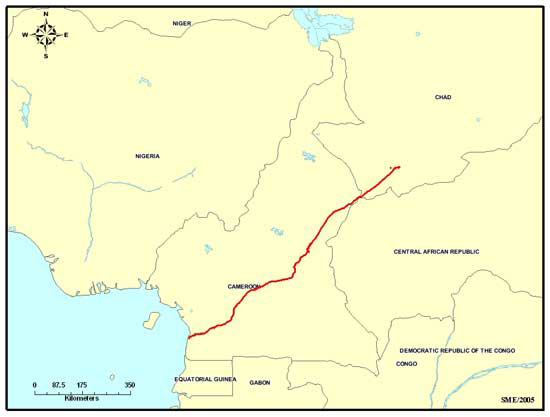
Over the last five years, a cultural heritage management programme has been carried out in areas of Chad and Cameroon impacted by construction work associated with the Chad Export Project. This project has involved construction of oilfield facilities around Doba in southern Chad, a 1069-kilometre pipeline running from Doba through Cameroon to the Atlantic coast (Figure 1), and a marine terminal off the Cameroonian coast at Kribi. It has been undertaken by a consortium of international oil companies, with World Bank and national government involvement, and the Environmental Master Plan has included a significant archaeological component.
The Chad - Cameroon Oil Pipeline in regional context.

Sites along the pipeline right-of-way.

CHM strategies that have as their only goal the avoidance of sites may not be appropriate in contexts where archaeological research resources are few and data limited (cf. Goodland & Webb 1987: 8-21; Reference McintoshMcIntosh 1993). The objectives of the CEP heritage management programme thus included: protection of the cultural heritages of Cameroon and Chad; support for archaeological research resources in both countries; and contribution to our knowledge of Central African prehistory. The research programme comprised: (a) pre-construction survey, with prioritisation of sites in areas to be impacted by construction; (b) post-discovery site treatment, depending on priority and impacts; (c) construction monitoring, and impact mitigation when cultural resources were encountered during construction; (d) laboratory treatment; and (e) training of CEP, sub-contractor and other personnel.

Project results
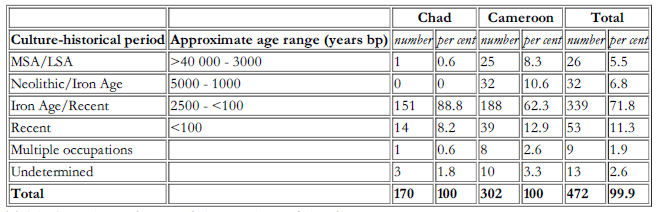
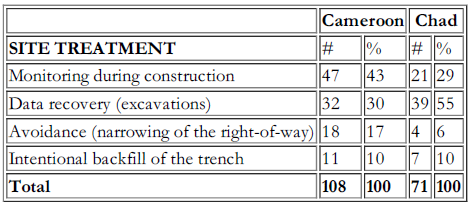
A total of 472 archaeological sites were located by the end of 2003 (Figure 2); 302 in Cameroon and 170 in Chad. Sites were located along the length of the pipeline right-of-way, albeit at lower densities in some areas. The majority of sites date to the Iron Age and Recent periods, the last 2000 - 2500 years (Table 1), with less then ten per cent identified as Neolithic/early Iron Age (c. 5000 - 1000 BP). Middle/Late Stone Age sites (>40 000 - 4000 BP) make up approximately six per cent of the sample, and were mostly found in erosional contexts north of the Mbéré River in eastern Cameroon. Little material was located dating to the 5000 - 3000 BP period of the early Bantu Expansion, possibly indicating that the beginnings of this phenomenon took place in north-western Cameroon, with Bantu-speaking farmers moving south only around 3000 BP (Reference LavacheryLavachery 1998). The proportions of different treatments used on these sites are shown in Table 2.
Distribution of furnace and pit sites.


This project has generated data on a variety of topics, including occupation of the tropical forest of southern Cameroon. Ndtoua Rock Shelter (ECA-68) yielded a two-metre stratigraphic sequence, including four cultural levels spanning the period between 5500 - 700 BP. This sequence shows a change from a mid-Holocene macrolithic tool assemblage, to a late-Holocene microlithic assemblage with the progressive addition of ceramics and iron. The site was probably occupied by foragers, living in relative proximity to agricultural populations before 2000 BP. Excavations at Shum Laka (Reference LavacheryLavachery 2001: 233-235) show a similar late survival of lithics associated with iron and ceramics.
The best-known archaeological sites in southern Cameroon are concentrations of somewhat enigmatic pit features, until now most frequently encountered in the area around Yaoundé (Reference de Maretde Maret 1994; Reference MbidaMbida 1992). These features are 1.5 - 3m deep; their deposits often include ceramics, faunal remains and charred plant remains, with lithics, iron and slag in some cases. They appear to represent the remains of substantial villages, occupied between c. 2900 - 1400 BP. During project fieldwork, 29 pit sites were discovered in the forest zone of Cameroon, from west of Belabo to the Atlantic coast at Kribi, a considerably wider distribution than had been earlier known (Figure 3). There is evidence for internal differentiation in both space and time in this sample, with what appears to be two periods of occupation (2900-2000 BP and 1700-1400 BP) between Kribi and Yaoundé, while sites between Mbandjok and Belabo have different ceramic assemblages and are dated to 2800-2000 BP and around 1700 BP. Slag was recovered from a pit dated to approximately 2600 BP on the Zili (ECA-323) site, while Makouré (ECA-124), close to the Atlantic coast, yielded furnace and tuyère fragments, as well as slag. Makouré dates to approximately 2200 BP.
In the wooded savanna and forest-savanna mosaic zones of eastern Cameroon and Chad, other types of site predominate. Large surface sites, characterised by low-density scatters of ceramics, slag, grindstone fragments and other artefacts, were found in Chad and near the Mbéré River just across the border in Cameroon. These sometimes extended for more than a kilometre along the pipeline right-of-way. These sites have yielded recent to modern dates, probably reflecting mobile settlement strategies during the late pre-colonial and colonial periods. Older, large settlement sites with much higher artefact densities have been found in sub-surface contexts in Chad. A number of large Iron Age habitation sites, including Sokorta Manga (ECA-43) and Beka Petel (ECA-243), were located on hilltop features north of the Mbéré River in Cameroon, occupied between approximately 1000 - 750 BP.
Named sites along the pipeline right-of-way.

Forty iron-working sites were found in the course of CEP archaeological fieldwork, 35 of them in southern Chad and eastern Cameroon (Figure 3). These consist of varying combinations of furnace remains, slag heaps and surface distributions of materials associated with iron-working, with little evidence for domestic architecture or habitation. A larger number of sites yielded slag, sometimes in conjunction with habitation remains; these may reflect smithing activities. Remains of two well-preserved furnaces, along with high densities of slag, tuyères and furnace fragments, were discovered during excavations at Djaoro Mbama (ECA-47), dated to 1800 - 2000 BP. There is a striking cluster of radiocarbon determinations from Chadian iron-working sites over the period 1100 - 800 BP, indicating substantial iron production at that time, with much less evidence between 1800 - 1200 BP and after 800 BP. Many of these sites are found in two distinct spatial clusters along the north-eastern extension of the pipeline right-of-way in Chad, around Komé and between Kagopal and Gadjibian. In eastern Cameroon, furnace sites are spread more evenly along the right-of-way.
Research implications
Analysis of material discovered during the CEP cultural heritage management programme continues, but some preliminary implications of the research are apparent. Pit sites of the third and second millennia BP are distributed over a larger area of southern Cameroon than previously realised, implying significant populations of farmers in that region. Concentrations of iron-working sites in Chad, and the restricted range of radiocarbon dates associated with many of these sites, indicate a florescence in iron production in that area about 1000 years ago, possibly with some local specialisation in its production. Most broadly, we have gathered significant data on areas of Africa more or less archaeologically unknown until now, over a continuous transect almost 1100 kilometres long.
On the research front, much remains to be done. As important for future work, however, will be efforts to reinforce and regularise the status of cultural heritage management programmes in Africa, and to increase the potential for African archaeologists to participate in such programmes. These researchers should obviously predominate among archaeologists working on African cultural heritage management programmes. It only remains to provide the resources and training that would allow that happy situation to come about.