







1 Introduction
In this article, we study systematically the family of subsets of a given topological space X which can be realized as sets of $\mathcal {I}$
-limit points of some sequences taking values in X, where
$\mathcal {I}$
-limit points of some sequences taking values in X, where $\mathcal {I}$
is an ideal on the nonnegative integers
$\mathcal {I}$
is an ideal on the nonnegative integers $\omega $
. To be more precise, let us recall some definitions and known results from the literature.
$\omega $
. To be more precise, let us recall some definitions and known results from the literature.
1.1 Ideals
A family $\mathcal {I}\subseteq \mathcal {P}(\omega )$
is an ideal if it is closed under subsets and finite unions. Unless otherwise stated, it is also assumed that
$\mathcal {I}\subseteq \mathcal {P}(\omega )$
is an ideal if it is closed under subsets and finite unions. Unless otherwise stated, it is also assumed that $\mathcal {I}$
is admissible, that is, it contains
$\mathcal {I}$
is admissible, that is, it contains $\mathrm {Fin}=[\omega ]^{<\omega }$
while
$\mathrm {Fin}=[\omega ]^{<\omega }$
while $\omega \notin \mathcal {I}$
. Let
$\omega \notin \mathcal {I}$
. Let $\mathcal {I}^+=\mathcal {P}(\omega )\setminus \mathcal {I}$
be the family of
$\mathcal {I}^+=\mathcal {P}(\omega )\setminus \mathcal {I}$
be the family of $\mathcal {I}$
-positive sets and denote by
$\mathcal {I}$
-positive sets and denote by $\mathcal {I}^\star =\{S\subseteq \omega : \omega \setminus S \in \mathcal {I}\}$
the dual filter of
$\mathcal {I}^\star =\{S\subseteq \omega : \omega \setminus S \in \mathcal {I}\}$
the dual filter of $\mathcal {I}$
. An ideal
$\mathcal {I}$
. An ideal $\mathcal {I}$
is a P-ideal if for every sequence
$\mathcal {I}$
is a P-ideal if for every sequence $(A_n)$
with values in
$(A_n)$
with values in $\mathcal {I}$
there exists
$\mathcal {I}$
there exists $A \in \mathcal {I}$
such that
$A \in \mathcal {I}$
such that $A_n\setminus A$
is finite for all
$A_n\setminus A$
is finite for all $n \in \omega $
(see, e.g., [Reference Farah14]). Informally, ideals represent the family of “small subsets” of
$n \in \omega $
(see, e.g., [Reference Farah14]). Informally, ideals represent the family of “small subsets” of $\omega $
. We will also consider ideals on countably infinite sets, which are defined analogously. Identifying each subset of
$\omega $
. We will also consider ideals on countably infinite sets, which are defined analogously. Identifying each subset of $\omega $
with its characteristic function, ideals can be regarded as subsets of the Cantor space
$\omega $
with its characteristic function, ideals can be regarded as subsets of the Cantor space $2^{\omega }$
, hence we can speak about their topological complexity. For instance,
$2^{\omega }$
, hence we can speak about their topological complexity. For instance, $\mathrm {Fin}$
and the summable ideal
$\mathrm {Fin}$
and the summable ideal
 $$ \begin{align*}\mathcal{I}_{1/n}=\left\{S\subseteq \omega: \sum_{n\in S} \frac{1}{n+1}<\infty\right\} \end{align*} $$
are $F_\sigma P$
-ideals, while the family of asymptotic density zero sets
$F_\sigma P$
-ideals, while the family of asymptotic density zero sets
 $$ \begin{align*}\mathcal{Z}=\left\{S\subseteq \omega: \lim_{n\to \infty}\frac{|S\cap [0,n)|}{n}=0\right\} \end{align*} $$
is an $F_{\sigma \delta } P$
-ideal which is not
$F_{\sigma \delta } P$
-ideal which is not $F_\sigma $
. As another example, the family of Banach density zero sets
$F_\sigma $
. As another example, the family of Banach density zero sets
 $$ \begin{align} \mathcal{B}=\left\{S\subseteq \omega: \lim_{n\to \infty}\max_{k \in \omega}\,\frac{|S\cap [k,k+n)|}{n}=0\right\} \end{align} $$
is an $F_{\sigma \delta }$
-ideal which is not a P-ideal. Finally, maximal ideals, namely, the complements of free ultrafilters on
$F_{\sigma \delta }$
-ideal which is not a P-ideal. Finally, maximal ideals, namely, the complements of free ultrafilters on $\omega $
, are not analytic, hence not Borel.
$\omega $
, are not analytic, hence not Borel.
1.2 $\mathcal {I}$
-limit points
$\mathcal {I}$
-limit points

Given a sequence $ x =(x_n: n \in \omega )$
taking values in a topological space X and an ideal
$ x =(x_n: n \in \omega )$
taking values in a topological space X and an ideal $\mathcal {I}$
on
$\mathcal {I}$
on $\omega $
, we say that
$\omega $
, we say that $\eta \in X$
is an
$\eta \in X$
is an $\mathcal {I}$
-limit point of
$\mathcal {I}$
-limit point of $ x $
if there exists
$ x $
if there exists $S \in \mathcal {I}^+$
such that the subsequence
$S \in \mathcal {I}^+$
such that the subsequence $ x \upharpoonright S=(x_n: n \in S)$
is convergent to
$ x \upharpoonright S=(x_n: n \in S)$
is convergent to $\eta $
. Accordingly, define
$\eta $
. Accordingly, define
 $$ \begin{align*}\Lambda_{ x }(\mathcal{I})=\left\{\eta \in X: \eta \text{ is an }\mathcal{I}\text{-limit point of } x \right\}. \end{align*} $$
In the literature, $\mathcal {Z}$
-limit points of real sequences have been usually called “statistical limit points” (see, e.g., [Reference Connor and Kline9, Reference Fridy19, Reference Kostyrko, Mačaj, Šalát and Strauch31, Reference Miller40]). The topological nature of the sets of
$\mathcal {Z}$
-limit points of real sequences have been usually called “statistical limit points” (see, e.g., [Reference Connor and Kline9, Reference Fridy19, Reference Kostyrko, Mačaj, Šalát and Strauch31, Reference Miller40]). The topological nature of the sets of $\mathcal {I}$
-limits points
$\mathcal {I}$
-limits points $\Lambda _{ x }(\mathcal {I})$
has been studied in [Reference Balcerzak, Gła̧b and Leonetti1, Reference Balcerzak and Leonetti3, Reference Das10, Reference He, Zhang and Zhang20, Reference He, Zhang and Zhang21, Reference di Maio and Kočinac38]. Here, we continue along this line of research. Following [Reference Balcerzak, Gła̧b and Leonetti1], we introduce our main definition.
$\Lambda _{ x }(\mathcal {I})$
has been studied in [Reference Balcerzak, Gła̧b and Leonetti1, Reference Balcerzak and Leonetti3, Reference Das10, Reference He, Zhang and Zhang20, Reference He, Zhang and Zhang21, Reference di Maio and Kočinac38]. Here, we continue along this line of research. Following [Reference Balcerzak, Gła̧b and Leonetti1], we introduce our main definition.
Definition 1.1. Let X be a topological space and $\mathcal {I}$
be an ideal on
$\mathcal {I}$
be an ideal on $\omega $
. Denote by
$\omega $
. Denote by $\mathscr {L}_X(\mathcal {I})$
the family of sets of
$\mathscr {L}_X(\mathcal {I})$
the family of sets of $\mathcal {I}$
-limit points of sequences
$\mathcal {I}$
-limit points of sequences ${ x }$
taking values in X together with the empty set, that is,
${ x }$
taking values in X together with the empty set, that is,
 $$ \begin{align} \mathscr{L}_X(\mathcal{I})=\left\{A\subseteq X: A=\Lambda_{ x }(\mathcal{I}) \text{ for some sequence }{ x } \in X^\omega\right\}\cup \{\emptyset\}. \end{align} $$
If the topological space X is understood, we write simply $\mathscr {L}(\mathcal {I})$
.
$\mathscr {L}(\mathcal {I})$
.
As remarked in [Reference Balcerzak, Gła̧b and Leonetti1], the addition of $\{\emptyset \}$
in (2) avoids the repetition of known results in the literature and adds further subcases based on the topological structure of the underlying space X. As we will see in our main results, if one avoids the empty set case, then it is possible to characterize
$\{\emptyset \}$
in (2) avoids the repetition of known results in the literature and adds further subcases based on the topological structure of the underlying space X. As we will see in our main results, if one avoids the empty set case, then it is possible to characterize $\mathscr {L}(\mathcal {I})$
for a large class of topological spaces. In any case, we will study in Section 5 conditions on X and
$\mathscr {L}(\mathcal {I})$
for a large class of topological spaces. In any case, we will study in Section 5 conditions on X and $\mathcal {I}$
which ensure the existence of a sequence
$\mathcal {I}$
which ensure the existence of a sequence $ x $
such that
$ x $
such that $\Lambda _{ x }(\mathcal {I})=\emptyset $
.
$\Lambda _{ x }(\mathcal {I})=\emptyset $
.
1.3
$\mathcal {I}$
-cluster points

Along a similar direction, given a sequence $ x $
taking values in a topological space X and an ideal
$ x $
taking values in a topological space X and an ideal $\mathcal {I}$
on
$\mathcal {I}$
on $\omega $
, we say that
$\omega $
, we say that $\eta \in X$
is an
$\eta \in X$
is an $\mathcal {I}$
-cluster point of
$\mathcal {I}$
-cluster point of $ x $
if
$ x $
if $\{n \in \omega : x_n \in U\}\notin \mathcal {I}$
for all open neighborhoods U of
$\{n \in \omega : x_n \in U\}\notin \mathcal {I}$
for all open neighborhoods U of $\eta $
. Then, we write
$\eta $
. Then, we write
 $$ \begin{align*}\Gamma_{ x }(\mathcal{I})=\left\{\eta \in X: \eta \text{ is an }\mathcal{I}\text{-cluster point of } x \right\}. \end{align*} $$
We are going to use throughout the well-known fact that every $\mathcal {I}$
-limit point is necessarily an
$\mathcal {I}$
-limit point is necessarily an $\mathcal {I}$
-cluster point, namely,
$\mathcal {I}$
-cluster point, namely, $\Lambda _{ x }(\mathcal {I})\subseteq \Gamma _{ x }(\mathcal {I})$
for every sequence
$\Lambda _{ x }(\mathcal {I})\subseteq \Gamma _{ x }(\mathcal {I})$
for every sequence $ x $
; moreover, if X is first countable, then
$ x $
; moreover, if X is first countable, then $\Lambda _{ x }(\mathrm {Fin})=\Gamma _{ x }(\mathrm {Fin})$
(see, e.g., [Reference Leonetti and Maccheroni37, Lemma 3.1]). On the other hand, it is important to note that, even in the case of real bounded sequences,
$\Lambda _{ x }(\mathrm {Fin})=\Gamma _{ x }(\mathrm {Fin})$
(see, e.g., [Reference Leonetti and Maccheroni37, Lemma 3.1]). On the other hand, it is important to note that, even in the case of real bounded sequences, $\mathcal {I}$
-cluster points and
$\mathcal {I}$
-cluster points and $\mathcal {I}$
-limit points may behave really differently. For instance, it is known [Reference Fridy19, Example 4] that if
$\mathcal {I}$
-limit points may behave really differently. For instance, it is known [Reference Fridy19, Example 4] that if ${ x }$
is an equidistributed sequence with values in
${ x }$
is an equidistributed sequence with values in $[0,1]$
, then
$[0,1]$
, then
 $$ \begin{align*}\Lambda_{ x }(\mathcal{Z})=\emptyset \quad \text{ and }\quad \Gamma_{ x }(\mathcal{Z})=[0,1]. \end{align*} $$
In analogy with Definition 1.1, we also introduce the following.
Definition 1.2. Let X be a topological space and $\mathcal {I}$
be an ideal on
$\mathcal {I}$
be an ideal on $\omega $
. Denote by
$\omega $
. Denote by $\mathscr {C}_X(\mathcal {I})$
the family of sets of
$\mathscr {C}_X(\mathcal {I})$
the family of sets of $\mathcal {I}$
-cluster points of sequences
$\mathcal {I}$
-cluster points of sequences ${ x }$
taking values in X together with the empty set, that is,
${ x }$
taking values in X together with the empty set, that is,
 $$ \begin{align} \mathscr{C}_X(\mathcal{I})=\left\{B\subseteq X: B=\Gamma_{ x }(\mathcal{I}) \text{ for some sequence }{ x } \in X^\omega\right\}\cup \{\emptyset\}. \end{align} $$
If the topological space X is understood, we write simply $\mathscr {C}(\mathcal {I})$
.
$\mathscr {C}(\mathcal {I})$
.
It is known that $\mathcal {I}$
-cluster points behave better than
$\mathcal {I}$
-cluster points behave better than $\mathcal {I}$
-limit points, see, e.g., Lemma 1.3, letting their study be substantially easier. Several characterizations of sets of
$\mathcal {I}$
-limit points, see, e.g., Lemma 1.3, letting their study be substantially easier. Several characterizations of sets of $\mathcal {I}$
-cluster points may be found in [Reference Leonetti and Maccheroni37]. Regarding the addition of the empty set in (3), it turns out that there exists a sequence
$\mathcal {I}$
-cluster points may be found in [Reference Leonetti and Maccheroni37]. Regarding the addition of the empty set in (3), it turns out that there exists a sequence $ x $
such that
$ x $
such that $\Gamma _{ x }(\mathcal {I})=\emptyset $
if and only if X is not compact (the if part being a folklore result) (see Proposition 5.1 below).
$\Gamma _{ x }(\mathcal {I})=\emptyset $
if and only if X is not compact (the if part being a folklore result) (see Proposition 5.1 below).
1.4 Notations
Given a set X, denote by $[X]^{\kappa }$
the family of all subsets of X which have the cardinality
$[X]^{\kappa }$
the family of all subsets of X which have the cardinality $\kappa $
. Moreover, we write
$\kappa $
. Moreover, we write $ [X]^{<\kappa }=\bigcup \{[X]^\mu : \mu <\kappa \}$
and
$ [X]^{<\kappa }=\bigcup \{[X]^\mu : \mu <\kappa \}$
and $[X]^{\le \kappa }=\bigcup \{[X]^\mu : \mu \le \kappa \}$
. In particular,
$[X]^{\le \kappa }=\bigcup \{[X]^\mu : \mu \le \kappa \}$
. In particular, $[X]^{\leq \omega }$
stands for the family of all countable (finite or infinite) subsets of X. We write
$[X]^{\leq \omega }$
stands for the family of all countable (finite or infinite) subsets of X. We write $s^\frown t$
to denote the concatenation of two sequences
$s^\frown t$
to denote the concatenation of two sequences $s\in X^{<\omega }$
and
$s\in X^{<\omega }$
and $t\in X^{<\omega }\cup X^\omega $
(and
$t\in X^{<\omega }\cup X^\omega $
(and $s^\frown a$
in place of
$s^\frown a$
in place of $s^\frown (a)$
for
$s^\frown (a)$
for $a\in X$
). We also use the notation
$a\in X$
). We also use the notation $ (\ldots ,b,a^k,c,\ldots ) = (\ldots ,b,a,\dots ,a,c,\ldots ), $
where a appears k times and
$ (\ldots ,b,a^k,c,\ldots ) = (\ldots ,b,a,\dots ,a,c,\ldots ), $
where a appears k times and $a^\infty = (a,a,\ldots )$
, i.e.,
$a^\infty = (a,a,\ldots )$
, i.e., $a^\infty $
denotes the infinite constant sequence with the value a. Also,
$a^\infty $
denotes the infinite constant sequence with the value a. Also, $a^0$
is the empty sequence. We denote by
$a^0$
is the empty sequence. We denote by $\mathbb {Q}(2^\omega )$
the set of all
$\mathbb {Q}(2^\omega )$
the set of all $x\in 2^\omega $
such that
$x\in 2^\omega $
such that $x_n=0$
for all but finitely many n.
$x_n=0$
for all but finitely many n.
Given a topological space X and an ordinal $1\le \alpha <\omega _1$
, we use the standard Borel pointclasses notations
$1\le \alpha <\omega _1$
, we use the standard Borel pointclasses notations $\Sigma ^0_\alpha (X)$
and
$\Sigma ^0_\alpha (X)$
and $\Pi ^0_\alpha (X)$
, so that
$\Pi ^0_\alpha (X)$
, so that $\Sigma ^0_1(X)$
stands for the open sets of X,
$\Sigma ^0_1(X)$
stands for the open sets of X, $\Pi ^0_1(X)$
for the closed sets,
$\Pi ^0_1(X)$
for the closed sets, $\Sigma _2^0(X)$
for the
$\Sigma _2^0(X)$
for the $F_\sigma $
-sets,
$F_\sigma $
-sets, $\Pi ^0_3(X)$
for the
$\Pi ^0_3(X)$
for the $F_{\sigma \delta }$
-sets, etc.; we denote by
$F_{\sigma \delta }$
-sets, etc.; we denote by $\Delta ^0_\alpha (X)=\Sigma ^0_\alpha (X) \cap \Pi ^0_\alpha (X)$
the ambiguous classes; also, if X is a Polish space,
$\Delta ^0_\alpha (X)=\Sigma ^0_\alpha (X) \cap \Pi ^0_\alpha (X)$
the ambiguous classes; also, if X is a Polish space, $\Sigma ^1_1(X)$
stands for the analytic sets,
$\Sigma ^1_1(X)$
stands for the analytic sets, $\Pi ^1_1(X)$
for the coanalytic sets, etc. (see, e.g., [Reference Kechris29, Section 11.B]). Again, we suppress the reference to the underlying space X if it is clear from the context.
$\Pi ^1_1(X)$
for the coanalytic sets, etc. (see, e.g., [Reference Kechris29, Section 11.B]). Again, we suppress the reference to the underlying space X if it is clear from the context.
For a topological space X, we consider $X^\omega $
as a topological space endowed with the product topology. For instance, taking
$X^\omega $
as a topological space endowed with the product topology. For instance, taking $X=2=\{0,1\}$
or
$X=2=\{0,1\}$
or $X=\omega $
with the discrete topology, we obtain the Cantor space
$X=\omega $
with the discrete topology, we obtain the Cantor space $2^\omega = \{0,1\}^\omega $
or the Baire space
$2^\omega = \{0,1\}^\omega $
or the Baire space $\omega ^\omega $
. (As usual, a positive integer n is identified with
$\omega ^\omega $
. (As usual, a positive integer n is identified with $\{0,1,\ldots ,n-1\}$
.) For a finite sequence
$\{0,1,\ldots ,n-1\}$
.) For a finite sequence $s\in 2^{<\omega }$
[
$s\in 2^{<\omega }$
[ $s\in \omega ^{<\omega }$
, resp.] we denote by
$s\in \omega ^{<\omega }$
, resp.] we denote by $|s|$
its length and by
$|s|$
its length and by $[s]$
the set of all
$[s]$
the set of all $x\in 2^\omega $
[
$x\in 2^\omega $
[ $x\in \omega ^\omega $
, resp.] such that
$x\in \omega ^\omega $
, resp.] such that $x\restriction |s|=s$
: hence, if
$x\restriction |s|=s$
: hence, if $s=(s_0,\ldots ,s_k)$
is a finite sequence then
$s=(s_0,\ldots ,s_k)$
is a finite sequence then $s \in 2^{k+1}$
,
$s \in 2^{k+1}$
, $|s|=k+1$
, and
$|s|=k+1$
, and $[s]$
is the set of all
$[s]$
is the set of all $x \in 2^\omega $
such that
$x \in 2^\omega $
such that $x\restriction |s|=(x_0,\ldots ,x_k)=s$
; in addition,
$x\restriction |s|=(x_0,\ldots ,x_k)=s$
; in addition, $x\restriction 0=\emptyset $
. Then sets of the form
$x\restriction 0=\emptyset $
. Then sets of the form $[s]$
for
$[s]$
for $s\in 2^{<\omega }$
[
$s\in 2^{<\omega }$
[ $s\in \omega ^{<\omega }$
, resp.] form a basis of the topology of
$s\in \omega ^{<\omega }$
, resp.] form a basis of the topology of $2^\omega $
[
$2^\omega $
[ $\omega ^\omega $
, resp.]. We will use facts that the Cantor space is homogeneous, i.e., for every points
$\omega ^\omega $
, resp.]. We will use facts that the Cantor space is homogeneous, i.e., for every points $x,y\in 2^\omega $
there is a homeomorphism
$x,y\in 2^\omega $
there is a homeomorphism $f:2^\omega \to 2^\omega $
such that
$f:2^\omega \to 2^\omega $
such that $f(x)=y$
, and countable dense homogeneous, i.e., for every countable dense sets
$f(x)=y$
, and countable dense homogeneous, i.e., for every countable dense sets $A,B\subseteq 2^\omega $
there is a homeomorphism
$A,B\subseteq 2^\omega $
there is a homeomorphism $f:2^\omega \to 2^\omega $
such that
$f:2^\omega \to 2^\omega $
such that $f[A]=B$
(see, e.g., [Reference Willard48, Problem 30A(2)] and [Reference Engelking13, Exercise 4.3.H(e)]), respectively).
$f[A]=B$
(see, e.g., [Reference Willard48, Problem 30A(2)] and [Reference Engelking13, Exercise 4.3.H(e)]), respectively).
A topological space X, or any of its subsets, is discrete if it contains only isolated points. Given a set $A\subseteq X$
, we denote by
$A\subseteq X$
, we denote by $A^{\,|}$
the set of its accumulation points, that is, the set of all
$A^{\,|}$
the set of its accumulation points, that is, the set of all $\eta \in X$
such that every neighborhood U of
$\eta \in X$
such that every neighborhood U of $\eta $
contains a point of A which is different from
$\eta $
contains a point of A which is different from $\eta $
. The family of isolated points of A is denoted by
$\eta $
. The family of isolated points of A is denoted by $\mathrm {iso}(A)$
.
$\mathrm {iso}(A)$
.
We denote by $B(\eta ,r)$
and
$B(\eta ,r)$
and $\overline {B}(\eta ,r)$
the open and closed balls of radius
$\overline {B}(\eta ,r)$
the open and closed balls of radius $r>0$
centered at a point
$r>0$
centered at a point $\eta $
in a metric space X, respectively. Lastly, for a set
$\eta $
in a metric space X, respectively. Lastly, for a set $A\subseteq X$
and
$A\subseteq X$
and $r>0$
, we write
$r>0$
, we write $B(A,r)$
for the open ball of radius r around A, i.e.,
$B(A,r)$
for the open ball of radius r around A, i.e., $B(A,r) = \bigcup \{B(\eta ,r): \eta \in A\}$
.
$B(A,r) = \bigcup \{B(\eta ,r): \eta \in A\}$
.
1.5 Literature results
We list below several known results about the families $\mathscr {L}(\mathcal {I})$
and
$\mathscr {L}(\mathcal {I})$
and $\mathscr {C}(\mathcal {I})$
introduced in Definitions 1.1 and 1.2.
$\mathscr {C}(\mathcal {I})$
introduced in Definitions 1.1 and 1.2.
Lemma 1.3. Let X be a topological space and $\mathcal {I}$
be an ideal on
$\mathcal {I}$
be an ideal on $\omega $
. Then
$\omega $
. Then $\mathscr {C}(\mathcal {I})\subseteq \Pi ^0_1$
.
$\mathscr {C}(\mathcal {I})\subseteq \Pi ^0_1$
.
Proof. See [Reference Leonetti and Maccheroni37, Lemma 3.1(iv)]; cf. also [Reference Kostyrko, Šalát and Wilczyński32, Theorems 4.1(i)] for metric spaces.
Conversely, a characterization of the equality $\mathscr {C}(\mathcal {I})=\Pi ^0_1$
will be given in Theorem 6.2. It is worth noting that it is possible that the family
$\mathscr {C}(\mathcal {I})=\Pi ^0_1$
will be given in Theorem 6.2. It is worth noting that it is possible that the family $\mathscr {C}(\mathcal {I})$
is a proper subset of
$\mathscr {C}(\mathcal {I})$
is a proper subset of $\Pi ^0_1$
, even if X is a compact Polish space: indeed, this is always the case, e.g., if X is Hausdorff with
$\Pi ^0_1$
, even if X is a compact Polish space: indeed, this is always the case, e.g., if X is Hausdorff with $|X|\ge 2$
and
$|X|\ge 2$
and $\mathcal {I}$
is maximal (see Proposition 2.2 below).
$\mathcal {I}$
is maximal (see Proposition 2.2 below).
Roughly, Lemma 1.3 explains why the families $\mathscr {C}(\mathcal {I})$
are easier than the families
$\mathscr {C}(\mathcal {I})$
are easier than the families $\mathscr {L}(\mathcal {I})$
, hence we will focus mainly on the latter ones.
$\mathscr {L}(\mathcal {I})$
, hence we will focus mainly on the latter ones.
At this point, we recall the following results.
Theorem 1.4. Let X be a first countable Hausdorff space where all closed sets are separable, and let $\mathcal {I}$
be an ideal on
$\mathcal {I}$
be an ideal on $\omega $
. Then the following hold:
$\omega $
. Then the following hold:
-
(i) if
$\mathcal {I}$
is an
$F_\sigma $
-ideal then
$\Lambda _{ x }(\mathcal {I})=\Gamma _{ x }(\mathcal {I})$
for every sequence
$ x $
; -
(ii) if
$\mathcal {I}$
is an
$F_\sigma $
-ideal then
$\mathscr {L}(\mathcal {I})=\mathscr {C}(\mathcal {I})=\Pi _1^0$
; -
(iii) if
$\mathcal {I}$
is an analytic P-ideal and X is nondiscrete then
$\Lambda _{ x }(\mathcal {I})=\Gamma _{ x }(\mathcal {I})$
for every sequence
$ x $
if and only if
$\mathcal {I}$
is an
$F_\sigma $
-ideal; -
(iv) if
$\mathcal {I}$
is an analytic P-ideal and X is locally compact then each isolated point in
$\Gamma _{ x }(\mathcal {I})$
belongs to
$\Lambda _{ x }(\mathcal {I})$
for every sequence
$ x $
; -
(v) if
$\mathcal {I}$
is an analytic P-ideal which is not
$F_\sigma $
then
$\mathscr {L}(\mathcal {I})=\Sigma _2^0$
.


Proof. It follows by [Reference Balcerzak and Leonetti3, Theorems 2.2, 2.3, 2,5, 2.7, 2.8, and 3.4].
It is worth to recall that there are no $G_\delta $
-ideals [Reference Meza-Alcántara39, Proposition 1.2.1], and that analytic P-ideals are necessarily
$G_\delta $
-ideals [Reference Meza-Alcántara39, Proposition 1.2.1], and that analytic P-ideals are necessarily $F_{\sigma \delta }$
(see, e.g., [Reference Farah14, Lemma 1.2.2 and Theorem 1.2.5]). Hence Theorem 1.4 studies the relationship between
$F_{\sigma \delta }$
(see, e.g., [Reference Farah14, Lemma 1.2.2 and Theorem 1.2.5]). Hence Theorem 1.4 studies the relationship between $\mathcal {I}$
-cluster points and
$\mathcal {I}$
-cluster points and $\mathcal {I}$
-limit points for ideals
$\mathcal {I}$
-limit points for ideals $\mathcal {I}$
with low topological complexity.
$\mathcal {I}$
with low topological complexity.
In the special case of the ideal $\mathcal {Z}$
, finer connections are known: if
$\mathcal {Z}$
, finer connections are known: if $A,B$
are nonempty subsets of a Polish space X such that
$A,B$
are nonempty subsets of a Polish space X such that $A\subseteq B$
, A is an
$A\subseteq B$
, A is an $F_\sigma $
-set, B is closed, and A contains the isolated points of B, then there exists a sequence
$F_\sigma $
-set, B is closed, and A contains the isolated points of B, then there exists a sequence $ x $
such that
$ x $
such that $\Lambda _{ x }(\mathcal {Z})=A$
and
$\Lambda _{ x }(\mathcal {Z})=A$
and $\Gamma _{ x }(\mathcal {Z})=B$
(see [Reference Balcerzak and Leonetti3, Corollary 3.3]). In particular, in Polish spaces, we have
$\Gamma _{ x }(\mathcal {Z})=B$
(see [Reference Balcerzak and Leonetti3, Corollary 3.3]). In particular, in Polish spaces, we have
 $$ \begin{align*}\mathscr{L}(\mathcal{Z})=\Sigma^0_2 \quad \text{ and }\quad \mathscr{C}(\mathcal{Z})=\Pi^0_1. \end{align*} $$
Note that the first equality can also be obtained by Theorem 1.4(v) since $\mathcal {Z}$
is an analytic P-ideal which is not
$\mathcal {Z}$
is an analytic P-ideal which is not $F_\sigma $
.
$F_\sigma $
.
To state the next result, we recall some further definitions. An ideal $\mathcal {I}$
has the hereditary Baire property if the restriction
$\mathcal {I}$
has the hereditary Baire property if the restriction $\mathcal {I}\upharpoonright A=\{S\cap A: S \in \mathcal {I}\}$
has the Baire property for every
$\mathcal {I}\upharpoonright A=\{S\cap A: S \in \mathcal {I}\}$
has the Baire property for every $A \in \mathcal {I}^+$
(see Section 2.2 below for details). Also, an ideal
$A \in \mathcal {I}^+$
(see Section 2.2 below for details). Also, an ideal $\mathcal {I}$
on
$\mathcal {I}$
on $\omega $
is said to be a
$\omega $
is said to be a $P^+$
-ideal if, for every decreasing sequence
$P^+$
-ideal if, for every decreasing sequence $(A_n)$
with values in
$(A_n)$
with values in $\mathcal {I}^+$
, there exists
$\mathcal {I}^+$
, there exists $A \in \mathcal {I}^+$
such that
$A \in \mathcal {I}^+$
such that $A\setminus A_n$
is finite for all
$A\setminus A_n$
is finite for all $n \in \omega $
. This notion will be studied, together with two weaker variants, in Section 3. It is known that all
$n \in \omega $
. This notion will be studied, together with two weaker variants, in Section 3. It is known that all $F_\sigma $
-ideals are
$F_\sigma $
-ideals are $P^+$
-ideals (see [Reference Just and Krawczyk27]). On the other hand, as remarked in [Reference Hrušák, Meza-Alcántara, Thümmel and Uzcátegui25, p. 2031],
$P^+$
-ideals (see [Reference Just and Krawczyk27]). On the other hand, as remarked in [Reference Hrušák, Meza-Alcántara, Thümmel and Uzcátegui25, p. 2031], $P^+$
-ideals may have arbitrarily high Borel complexity (cf. Theorem 10.12 and its proof below).
$P^+$
-ideals may have arbitrarily high Borel complexity (cf. Theorem 10.12 and its proof below).
Moreover, an ideal $\mathcal {I}$
is called a Farah ideal if there exists a sequence
$\mathcal {I}$
is called a Farah ideal if there exists a sequence $(K_n)$
of hereditary (i.e., closed under taking subsets of its elements) compact subsets in
$(K_n)$
of hereditary (i.e., closed under taking subsets of its elements) compact subsets in $\mathcal {P}(\omega )$
such that
$\mathcal {P}(\omega )$
such that $S \in \mathcal {I}$
if and only if for all
$S \in \mathcal {I}$
if and only if for all $n \in \omega $
there exists
$n \in \omega $
there exists $k \in \omega $
such that
$k \in \omega $
such that $S\setminus k \in K_n$
. It is known that all analytic P-ideals are Farah and that all Farah ideals are
$S\setminus k \in K_n$
. It is known that all analytic P-ideals are Farah and that all Farah ideals are $F_{\sigma \delta }$
(see [Reference Hrušák and Meza-Alcántara24, pp. 199–201]). In addition, the ideal
$F_{\sigma \delta }$
(see [Reference Hrušák and Meza-Alcántara24, pp. 199–201]). In addition, the ideal $\mathcal {B}$
defined in (1) and
$\mathcal {B}$
defined in (1) and
 $$ \begin{align*}\mathrm{nwd}=\left\{S\subseteq \mathbb{Q}: S \text{ is nowhere dense in }\mathbb{R}\right\} \end{align*} $$
are Farah ideals which are not analytic P-ideals.
Theorem 1.5. Let X be a first countable Hausdorff space, and let $\mathcal {I}$
be an ideal on
$\mathcal {I}$
be an ideal on $\omega $
. Then the following hold:
$\omega $
. Then the following hold:
-
(i) if
$\mathcal {I}$
is
$P^+$
-ideal then
$\mathscr {L}(\mathcal {I}) \subseteq \Pi ^0_1$
; -
(ii) if
$\mathcal {I}$
has the hereditary Baire property and X is nondiscrete metrizable then
$\mathcal {I}$
is a
$P^+$
-ideal if and only if
$\mathscr {L}(\mathcal {I}) \subseteq \Pi ^0_1$
; -
(iii) if
$\mathcal {I}$
is a Farah ideal then
$\mathscr {L}(\mathcal {I}) \subseteq \Sigma ^0_2$
.


If, in addition, X is second countable, then:
-
(iv) if
$\mathcal {I}$
has the hereditary Baire property then
$\Pi ^0_1 \subseteq \mathscr {L}(\mathcal {I})$
; -
(v) if
$\mathcal {I}$
has the hereditary Baire property and is not a
$P^+$
-ideal then
$\Sigma ^0_2 \subseteq \mathscr {L}(\mathcal {I})$
.


Proof. It follows by [Reference He, Zhang and Zhang20, Corollary 3.9, and Theorem 4.5] and [Reference He, Zhang and Zhang21, Corollary 2.5 and Theorems 2.4, 2.8, and 2.10].
Along the same lines, we also have the next results.
Theorem 1.6. Let X be a first countable Hausdorff space and let $\mathcal {I}$
be an ideal on
$\mathcal {I}$
be an ideal on $\omega $
. Then the following hold:
$\omega $
. Then the following hold:
-
(i) if
$\mathcal {I}$
is a
$G_{\delta \sigma }$
-ideal then
$\mathscr {L}(\mathcal {I})=\Pi ^0_1$
; -
(ii) if
$\mathcal {I}$
has the hereditary Baire property then
$\mathscr {L}(\mathcal {I})\subseteq \Pi ^0_1$
or
$\Sigma ^0_2\subseteq \mathscr {L}(\mathcal {I})$
; -
(iii) if
$\mathcal {I}$
is coanalytic and X is a Polish space then
$\mathscr {L}(\mathcal {I})\subseteq \Sigma ^1_1$
.


Proof. It follows by [Reference Balcerzak, Gła̧b and Leonetti1, Theorem 2.6, Corollary 2.9, and Proposition 4.1]: cf. also [Reference Balcerzak and Leonetti3, Proposition 4.1] and [Reference He, Zhang and Zhang21, Theorem 4.1] for item (iii).
We remark that item (iii) also holds in first countable spaces, for a suitable notion of analyticity in topological spaces, see [Reference Balcerzak, Gła̧b and Leonetti1, Definition 3.2].
Lastly, given (possibly nonadmissible) ideals $\mathcal {I}$
and
$\mathcal {I}$
and $\mathcal {J}$
on two countably infinite sets Z and W, respectively, we define their Fubini product by
$\mathcal {J}$
on two countably infinite sets Z and W, respectively, we define their Fubini product by
 $$ \begin{align} \mathcal{I}\otimes \mathcal{J}=\{S\subseteq Z\times W\colon \{n \in Z: \{k\in W: (n,k)\in S\}\notin \mathcal{J}\}\in \mathcal{I}\}, \end{align} $$
which is an ideal on the countably infinite set $Z\times W$
(see, e.g., [Reference Farah14, Chapter 1]). Hence, recursively,
$Z\times W$
(see, e.g., [Reference Farah14, Chapter 1]). Hence, recursively, $\mathrm {Fin}^{\alpha }=\mathrm {Fin}\otimes \mathrm {Fin}^{\alpha -1}$
for all integers
$\mathrm {Fin}^{\alpha }=\mathrm {Fin}\otimes \mathrm {Fin}^{\alpha -1}$
for all integers $\alpha \ge 2$
is an ideal on
$\alpha \ge 2$
is an ideal on $\omega ^\alpha $
. With the usual abuse of notation, we write
$\omega ^\alpha $
. With the usual abuse of notation, we write $\emptyset \otimes \mathcal {I}$
in place of
$\emptyset \otimes \mathcal {I}$
in place of $\{\emptyset \}\otimes \mathcal {I}$
.
$\{\emptyset \}\otimes \mathcal {I}$
.
The next result proves that the families $\mathscr {L}(\mathcal {I})$
may attain large Borel complexities.
$\mathscr {L}(\mathcal {I})$
may attain large Borel complexities.
Theorem 1.7. Let X be a Polish space and let $\alpha \ge 1$
be an integer. Then the following hold:
$\alpha \ge 1$
be an integer. Then the following hold:
-
(i)
$\mathrm {Fin}^\alpha $
is a
$\Sigma ^0_{2\alpha }$
-ideal and
$\mathscr {L}(\mathrm {Fin}^\alpha )= \Pi ^0_{2\alpha -1}$
; -
(ii)
$\emptyset \otimes \mathrm {Fin}^\alpha $
is a
$\Pi ^0_{2\alpha +1}$
-ideal and
$\mathscr {L}(\emptyset \otimes \mathrm {Fin}^\alpha )= \Sigma ^0_{2\alpha }$
.


Proof. See [Reference Balcerzak, Gła̧b and Leonetti1, Theorem 2.5].
In this work, we continue on the line of research of the above results. We provide below an outline of the structure of the manuscript.
1.6 Plan of the article
We start in Section 2 with the study of some basic properties of ideals as [nowhere] maximality and characterizations of [hereditary] Baire property, together with the operations of Fubini sums and products. In addition, we collect some basic results on preorders of ideals, $\mathcal {I}$
-cluster points, and
$\mathcal {I}$
-cluster points, and $\mathcal {I}$
-limit points.
$\mathcal {I}$
-limit points.
In Section 3, we investigate two weaker variants of the notion of $P^+$
-ideal and show that they are the combinatorial properties which characterize several connections between sets of
$P^+$
-ideal and show that they are the combinatorial properties which characterize several connections between sets of $\mathcal {I}$
-cluster points and
$\mathcal {I}$
-cluster points and $\mathcal {I}$
-limit points: for instance, the case where
$\mathcal {I}$
-limit points: for instance, the case where $\Gamma _{ x }(\mathcal {I})=\Lambda _{ x }(\mathcal {I})$
for every sequence
$\Gamma _{ x }(\mathcal {I})=\Lambda _{ x }(\mathcal {I})$
for every sequence $ x $
(which leads to the inclusion
$ x $
(which leads to the inclusion $\mathscr {L}(\mathcal {I})\subseteq \Pi ^0_1$
by Lemma 1.3), or where every isolated point in
$\mathscr {L}(\mathcal {I})\subseteq \Pi ^0_1$
by Lemma 1.3), or where every isolated point in $\Gamma _{ x }(\mathcal {I})$
belongs to
$\Gamma _{ x }(\mathcal {I})$
belongs to $\Lambda _{ x }(\mathcal {I})$
for every
$\Lambda _{ x }(\mathcal {I})$
for every $ x $
.
$ x $
.
In Section 4, we introduce and study several classes of ideals related to certain $\mathcal {I}$
-schemes (which are Cantor trees of
$\mathcal {I}$
-schemes (which are Cantor trees of $\mathcal {I}$
-positive sets) (see Definition 4.6).
$\mathcal {I}$
-positive sets) (see Definition 4.6).
With the above premises, the next sections have simple objectives:
-
(i) In Section 5, we study the existence of a sequence
$ x $
which has no
$\mathcal {I}$
-cluster points or no
$\mathcal {I}$
-limit points. -
(ii) In Section 6, we characterize the connections between the families
$\mathscr {C}(\mathcal {I})$
,
$\mathscr {L}(\mathcal {I})$
, and the class of closed subsets of X. -
(iii) In Sections 7–9, we study the inclusion and the equality between
$\mathscr {L}(\mathcal {I})$
and the classes
$\Sigma ^0_2$
,
$\Pi ^0_3$
, and
$\Sigma ^1_1$
, respectively (note that, e.g., if there exists a
$\Sigma ^0_2$
set which is not closed, then equality
$\mathscr {C}(\mathcal {I})=\Sigma ^0_2$
fails by Lemma 1.3; in particular, the analogues for
$\mathscr {C}(\mathcal {I})$
are void).


We conclude in Section 10 with several applications and open questions:
-
(i) We show that there are no ideals
$\mathcal {I}$
such that
$\mathscr {L}(\mathcal {I})=\Pi ^0_2$
or
$\mathscr {L}(\mathcal {I})=\Sigma ^0_3$
. -
(ii) We study the equalities
$\mathscr {L}(\mathcal {I})=\Pi ^0_1$
and
$\mathscr {L}(\mathcal {I})=\Sigma ^0_2$
. -
(iii) We prove that if
$\mathcal {I}$
is a
$\Pi ^0_4$
ideal then exactly one of the following cases holds:
$\mathscr {L}(\mathcal {I})=\Pi ^0_1$
or
$\mathscr {L}(\mathcal {I})=\Sigma ^0_2$
or
$\mathscr {L}(\mathcal {I})=\Sigma ^1_1$
. However we do not have an example of a
$\Pi ^0_4$
ideal with
$\mathscr {L}(\mathcal {I})=\Sigma ^1_1$
—we leave it as our main open question. -
(iv) We give an explicit example of a coanalytic ideal
$\mathcal {I}$
such that
$\mathscr {L}(\mathcal {I})=\Sigma ^1_1$
.


2 Preliminaries
Let us start with a simple lemma.
Lemma 2.1. Pick an integer $n\ge 1$
. Let X be a Hausdorff space and let
$n\ge 1$
. Let X be a Hausdorff space and let $\mathcal {I}$
be an ideal on
$\mathcal {I}$
be an ideal on $\omega $
such that
$\omega $
such that $|X|\ge n$
and there exists a partition
$|X|\ge n$
and there exists a partition $\{S_0,\ldots ,S_{n-1}\}$
of
$\{S_0,\ldots ,S_{n-1}\}$
of $\omega $
into
$\omega $
into $\mathcal {I}$
-positive sets. Then
$\mathcal {I}$
-positive sets. Then
 $$ \begin{align*}[X]^{\le n}\subseteq \mathscr{L}(\mathcal{I})\cap \mathscr{C}(\mathcal{I}). \end{align*} $$
Proof. Pick $0\leq k<n$
and distinct points
$0\leq k<n$
and distinct points $\eta _0,\ldots ,\eta _{k} \in X$
and define the sequence
$\eta _0,\ldots ,\eta _{k} \in X$
and define the sequence $ x =(x_i: i \in \omega )$
such that
$ x =(x_i: i \in \omega )$
such that $x_i=\eta _j$
if
$x_i=\eta _j$
if $i \in S_j$
for some
$i \in S_j$
for some $j\leq k$
and
$j\leq k$
and $x_i=\eta _k$
if
$x_i=\eta _k$
if $i \in \bigcup _{k<j<n}S_j$
. Then
$i \in \bigcup _{k<j<n}S_j$
. Then $\Lambda _{ x }(\mathcal {I})=\Gamma _{ x }(\mathcal {I})=\{\eta _0,\ldots ,\eta _{k}\}$
.
$\Lambda _{ x }(\mathcal {I})=\Gamma _{ x }(\mathcal {I})=\{\eta _0,\ldots ,\eta _{k}\}$
.
2.1 Maximality
An ideal $\mathcal {I}$
on
$\mathcal {I}$
on $\omega $
is maximal if there is no ideal
$\omega $
is maximal if there is no ideal $\mathcal {J}$
on
$\mathcal {J}$
on $\omega $
such that
$\omega $
such that $\mathcal {I}\subseteq \mathcal {J}$
and
$\mathcal {I}\subseteq \mathcal {J}$
and $\mathcal {I}\neq \mathcal {J}$
. In other words,
$\mathcal {I}\neq \mathcal {J}$
. In other words, $\mathcal {I}$
is maximal if its dual filter
$\mathcal {I}$
is maximal if its dual filter $\mathcal {I}^\star $
is a free ultrafilter on
$\mathcal {I}^\star $
is a free ultrafilter on $\omega $
. It is useful to recall that
$\omega $
. It is useful to recall that $\mathcal {I}$
is maximal if and only if either S or
$\mathcal {I}$
is maximal if and only if either S or $S^c=\omega \setminus S$
belongs to
$S^c=\omega \setminus S$
belongs to $\mathcal {I}$
for each
$\mathcal {I}$
for each $S\subseteq \omega $
(see, e.g., [Reference Jech26, Lemma 7.4]).
$S\subseteq \omega $
(see, e.g., [Reference Jech26, Lemma 7.4]).
Proposition 2.2. Let X be a Hausdorff space with $|X|\ge 2$
and let
$|X|\ge 2$
and let $\mathcal {I}$
be an ideal on
$\mathcal {I}$
be an ideal on $\omega $
. Then the following are equivalent:
$\omega $
. Then the following are equivalent:
-
(i)
$\mathcal {I}$
is a maximal ideal; -
(ii)
$\mathscr {L}(\mathcal {I})=\mathscr {C}(\mathcal {I})= \{\{\eta \}: \eta \in X\}\cup \{\emptyset \}$
; -
(iii)
$\mathscr {C}(\mathcal {I})=\{\{\eta \}: \eta \in X\}\cup \{\emptyset \}$
; -
(iv)
$\mathscr {L}(\mathcal {I})=\{\{\eta \}: \eta \in X\}\cup \{\emptyset \}$
.


Proof. (i) $\implies $
(ii). It follows by Lemma 2.1 and by the definitions of
$\implies $
(ii). It follows by Lemma 2.1 and by the definitions of $\mathscr {C}(\mathcal {I})$
and
$\mathscr {C}(\mathcal {I})$
and $\mathscr {L}(\mathcal {I})$
that
$\mathscr {L}(\mathcal {I})$
that $\{\{\eta \}: \eta \in X\}\cup \{\emptyset \}$
is contained both in
$\{\{\eta \}: \eta \in X\}\cup \{\emptyset \}$
is contained both in $\mathscr {C}(\mathcal {I})$
and
$\mathscr {C}(\mathcal {I})$
and $\mathscr {L}(\mathcal {I})$
. Conversely, if there exists
$\mathscr {L}(\mathcal {I})$
. Conversely, if there exists $B \in \mathscr {C}(\mathcal {I})$
with
$B \in \mathscr {C}(\mathcal {I})$
with $|B|\ge 2$
, then there are distinct
$|B|\ge 2$
, then there are distinct $\eta _1,\eta _2 \in B$
and a sequence
$\eta _1,\eta _2 \in B$
and a sequence $ x $
such that
$ x $
such that $\Gamma _{ x }(\mathcal {I})=B$
. Pick disjoint neighborhoods
$\Gamma _{ x }(\mathcal {I})=B$
. Pick disjoint neighborhoods $U_1,U_2$
of
$U_1,U_2$
of $\eta _1,\eta _2$
, respectively. Hence
$\eta _1,\eta _2$
, respectively. Hence $\{n \in \omega : x_n \in U_1\}$
and
$\{n \in \omega : x_n \in U_1\}$
and $\{n \in \omega : x_n \in U_2\}$
are two disjoint
$\{n \in \omega : x_n \in U_2\}$
are two disjoint $\mathcal {I}$
-positive sets, which contradicts the maximality of
$\mathcal {I}$
-positive sets, which contradicts the maximality of $\mathcal {I}$
by [Reference Jech26, Lemma 7.4]. This proves that
$\mathcal {I}$
by [Reference Jech26, Lemma 7.4]. This proves that $\mathscr {C}(\mathcal {I})\subseteq \{\{\eta \}: \eta \in X\}\cup \{\emptyset \}$
. The inclusion
$\mathscr {C}(\mathcal {I})\subseteq \{\{\eta \}: \eta \in X\}\cup \{\emptyset \}$
. The inclusion $\mathscr {L}(\mathcal {I})\subseteq \{\{\eta \}: \eta \in X\}\cup \{\emptyset \}$
goes similarly (see, e.g., [Reference He, Zhang and Zhang20, Proposition 1.4]). Therefore
$\mathscr {L}(\mathcal {I})\subseteq \{\{\eta \}: \eta \in X\}\cup \{\emptyset \}$
goes similarly (see, e.g., [Reference He, Zhang and Zhang20, Proposition 1.4]). Therefore $\mathscr {L}(\mathcal {I})=\mathscr {C}(\mathcal {I})=\{\{\eta \}: \eta \in X\}\cup \{\emptyset \}$
.
$\mathscr {L}(\mathcal {I})=\mathscr {C}(\mathcal {I})=\{\{\eta \}: \eta \in X\}\cup \{\emptyset \}$
.
(ii) $\implies $
(iii). It is obvious.
$\implies $
(iii). It is obvious.
(iii) $\implies $
(iv). By the definition of
$\implies $
(iv). By the definition of $\mathscr {L}(\mathcal {I})$
and by Lemma 2.1,
$\mathscr {L}(\mathcal {I})$
and by Lemma 2.1, $\mathscr {L}(\mathcal {I})$
contains all singletons and the empty set. Suppose that
$\mathscr {L}(\mathcal {I})$
contains all singletons and the empty set. Suppose that $\mathscr {L}(\mathcal {I})$
contains a set
$\mathscr {L}(\mathcal {I})$
contains a set $\Lambda _{ x }(\mathcal {I}) \subseteq X$
with
$\Lambda _{ x }(\mathcal {I}) \subseteq X$
with $|\Lambda _{ x }(\mathcal {I})|\ge 2$
. Since
$|\Lambda _{ x }(\mathcal {I})|\ge 2$
. Since $\Lambda _{ x }(\mathcal {I})\subseteq \Gamma _{ x }(\mathcal {I})\in \mathscr {C}(\mathcal {I})$
, hence
$\Lambda _{ x }(\mathcal {I})\subseteq \Gamma _{ x }(\mathcal {I})\in \mathscr {C}(\mathcal {I})$
, hence $\mathscr {C}(\mathcal {I})$
would contain a set with cardinality
$\mathscr {C}(\mathcal {I})$
would contain a set with cardinality $\ge 2$
.
$\ge 2$
.
(iv) $\implies $
(i). Suppose that
$\implies $
(i). Suppose that $\mathcal {I}$
is not maximal. Then there exists a partition
$\mathcal {I}$
is not maximal. Then there exists a partition $\{S_0,S_1\}$
of
$\{S_0,S_1\}$
of $\omega $
into
$\omega $
into $\mathcal {I}$
-positive sets. It follows by Lemma 2.1 that
$\mathcal {I}$
-positive sets. It follows by Lemma 2.1 that $[X]^{\le 2}\subseteq \mathscr {L}(\mathcal {I})$
.
$[X]^{\le 2}\subseteq \mathscr {L}(\mathcal {I})$
.
An ideal $\mathcal {I}$
on
$\mathcal {I}$
on $\omega $
is nowhere maximal if the restriction
$\omega $
is nowhere maximal if the restriction $\mathcal {I}\restriction S$
is not maximal for every
$\mathcal {I}\restriction S$
is not maximal for every $S\in \mathcal {I}^+$
. Note that, in [Reference Kadets, Seliutin and Tryba28, Definition 3.12], the authors use the term extremely not min-representable for dual filters of nowhere maximal ideals. The proof of the next result is straightforward (hence, details are omitted).
$S\in \mathcal {I}^+$
. Note that, in [Reference Kadets, Seliutin and Tryba28, Definition 3.12], the authors use the term extremely not min-representable for dual filters of nowhere maximal ideals. The proof of the next result is straightforward (hence, details are omitted).
Proposition 2.3. Let $\mathcal {I}$
be an ideal on
$\mathcal {I}$
be an ideal on $\omega $
. Then the following are equivalent:
$\omega $
. Then the following are equivalent:
-
(i)
$\mathcal {I}$
is nowhere maximal; -
(ii) for every
$S\in \mathcal {I}^+$
there exists an infinite partition of S into
$\mathcal {I}$
-positive sets.


Related characterizations can be found in Proposition 4.3.
2.2 Baire property
Let us recall that a subset S of a topological space X has the Baire property if there exists an open set $U\subseteq X$
such that the symmetric difference
$U\subseteq X$
such that the symmetric difference $S\triangle U$
is meager, that is, it is contained in a countable union of closed sets with empty interior. The following result characterizes ideals on
$S\triangle U$
is meager, that is, it is contained in a countable union of closed sets with empty interior. The following result characterizes ideals on $\omega $
with the Baire property.
$\omega $
with the Baire property.
For, let $\mathcal {I}$
and
$\mathcal {I}$
and $\mathcal {J}$
be two ideals on two countably infinite sets Z and W, respectively. Then we say that
$\mathcal {J}$
be two ideals on two countably infinite sets Z and W, respectively. Then we say that $\mathcal {I}$
is below
$\mathcal {I}$
is below $\mathcal {J}$
in the Rudin–Blass ordering, shortened as
$\mathcal {J}$
in the Rudin–Blass ordering, shortened as $\mathcal {I} \le _{\mathrm {RB}} \mathcal {J}$
, if there is a finite-to-one map
$\mathcal {I} \le _{\mathrm {RB}} \mathcal {J}$
, if there is a finite-to-one map $\phi : W\to Z$
such that
$\phi : W\to Z$
such that $S \in \mathcal {I}$
if and only if
$S \in \mathcal {I}$
if and only if $\phi ^{-1}[S] \in \mathcal {J}$
for all subsets
$\phi ^{-1}[S] \in \mathcal {J}$
for all subsets $S\subseteq Z$
. The restriction of these orderings to maximal ideals
$S\subseteq Z$
. The restriction of these orderings to maximal ideals $\mathcal {I}$
, and the Borel complexity of the quotients
$\mathcal {I}$
, and the Borel complexity of the quotients $\mathcal {P}(Z)/\mathcal {I}$
have been extensively studied (see, e.g., [Reference Comfort and Negrepontis8, Reference Hjorth and Kechris22, Reference Kechris30] and the references therein).
$\mathcal {P}(Z)/\mathcal {I}$
have been extensively studied (see, e.g., [Reference Comfort and Negrepontis8, Reference Hjorth and Kechris22, Reference Kechris30] and the references therein).
Theorem 2.4. Let $\mathcal {I}$
be an ideal on
$\mathcal {I}$
be an ideal on $\omega $
. Then the following are equivalent:
$\omega $
. Then the following are equivalent:
-
(i)
$\mathcal {I}$
has the Baire property; -
(ii)
$\mathcal {I}$
is meager; -
(iii)
$\mathcal {I}\restriction A$
has the Baire property for some
$A\in \mathcal {I}^+$
; -
(iv)
$\mathrm {Fin}\leq _{\mathrm {RB}}\mathcal {I}$
.


Proof. It follows by [Reference Bartoszyński and Judah5, Theorem 4.1.1] and [Reference Talagrand46, Théorème 21, Proposition 22].
Using the above characterization one can easily show that if ideals $\mathcal {I}$
and
$\mathcal {I}$
and $\mathcal {J}$
are isomorphic (that is, there exists a bijection
$\mathcal {J}$
are isomorphic (that is, there exists a bijection $\phi :\omega \to \omega $
such that
$\phi :\omega \to \omega $
such that $S\in \mathcal {I}$
if and only if
$S\in \mathcal {I}$
if and only if $\phi ^{-1}[S]\in \mathcal {J}$
for all
$\phi ^{-1}[S]\in \mathcal {J}$
for all $S\subseteq \omega $
), then
$S\subseteq \omega $
), then $\mathcal {I}$
has the Baire property if and only if
$\mathcal {I}$
has the Baire property if and only if $\mathcal {J}$
has the Baire property. We refer to [Reference Balcerzak, Gła̧b and Leonetti2] for further characterizations of meager ideals based on
$\mathcal {J}$
has the Baire property. We refer to [Reference Balcerzak, Gła̧b and Leonetti2] for further characterizations of meager ideals based on $\mathcal {I}$
-limit points and
$\mathcal {I}$
-limit points and $\mathcal {I}$
-cluster points of sequences.
$\mathcal {I}$
-cluster points of sequences.
Recall that an ideal $\mathcal {I}$
on
$\mathcal {I}$
on $\omega $
has the hereditary Baire property if the restriction
$\omega $
has the hereditary Baire property if the restriction $\mathcal {I}\restriction A$
has the Baire property for each
$\mathcal {I}\restriction A$
has the Baire property for each $A\in \mathcal {I}^+$
. Ideals with the hereditary Baire property were considered in [Reference Staniszewski44] in the context of ideal quasi-normal convergence of sequences of functions. It is not difficult to show that all Borel ideals, and more generally all analytic and coanalytic ideals, have the hereditary Baire property (cf. [Reference Kadets, Seliutin and Tryba28, Theorem 3.13] and [Reference Staniszewski44, Proposition 2.3]). In addition, there exist ideals with the Baire property but without the hereditary Baire property (see, e.g., [Reference Staniszewski44, Proposition 2.1]).
$A\in \mathcal {I}^+$
. Ideals with the hereditary Baire property were considered in [Reference Staniszewski44] in the context of ideal quasi-normal convergence of sequences of functions. It is not difficult to show that all Borel ideals, and more generally all analytic and coanalytic ideals, have the hereditary Baire property (cf. [Reference Kadets, Seliutin and Tryba28, Theorem 3.13] and [Reference Staniszewski44, Proposition 2.3]). In addition, there exist ideals with the Baire property but without the hereditary Baire property (see, e.g., [Reference Staniszewski44, Proposition 2.1]).
Proposition 2.5. Every ideal with the hereditary Baire property is nowhere maximal. In particular, analytic ideals and coanalytic ideals are nowhere maximal.
Proof. For each $A\in \mathcal {I}^+$
, the ideal
$A\in \mathcal {I}^+$
, the ideal $\mathcal {I}\restriction A$
has the Baire property. Hence, it is folklore that it cannot be maximal (cf. [Reference Sierpiński42]).
$\mathcal {I}\restriction A$
has the Baire property. Hence, it is folklore that it cannot be maximal (cf. [Reference Sierpiński42]).
To distinguish between some properties of ideals considered in the article, we will use examples constructed with the aid of Fubini products and Fubini sums. For, given (possibly nonadmissible) ideals $\mathcal {I}$
and
$\mathcal {I}$
and $\mathcal {J}$
on two countably infinite sets Z and W, respectively, their Fubini product
$\mathcal {J}$
on two countably infinite sets Z and W, respectively, their Fubini product $\mathcal {I} \otimes \mathcal {J}$
is an ideal on
$\mathcal {I} \otimes \mathcal {J}$
is an ideal on $Z\times W$
which has already been defined in (4). Moreover, their Fubini sum
$Z\times W$
which has already been defined in (4). Moreover, their Fubini sum $\mathcal {I}\oplus \mathcal {J}$
is an ideal on the countably infinite set
$\mathcal {I}\oplus \mathcal {J}$
is an ideal on the countably infinite set $(\{0\}\times Z) \cup (\{1\}\times W)$
defined by
$(\{0\}\times Z) \cup (\{1\}\times W)$
defined by $S \in \mathcal {I}\oplus \mathcal {J}$
if and only if
$S \in \mathcal {I}\oplus \mathcal {J}$
if and only if
 $$ \begin{align*}\{z \in Z: (0,z) \in S\} \in \mathcal{I} \,\,\text{ and }\,\,\{w \in W: (1,w) \in S\} \in \mathcal{J}, \end{align*} $$
see, e.g., [Reference Farah14, Chapter 1]. For instance, if $\mathcal {I}$
is an ideal on
$\mathcal {I}$
is an ideal on $\omega $
, then
$\omega $
, then $\mathcal {I} \oplus \mathcal {P}(\omega )$
is an ideal on
$\mathcal {I} \oplus \mathcal {P}(\omega )$
is an ideal on $2\times \omega $
. The next result will be used to verify the Baire property of ideals in Example 3.5.
$2\times \omega $
. The next result will be used to verify the Baire property of ideals in Example 3.5.
Proposition 2.6. Let $\mathcal {I},\mathcal {J}$
be ideals on
$\mathcal {I},\mathcal {J}$
be ideals on $\omega $
. Then the following hold:
$\omega $
. Then the following hold:
-
(i)
$\mathcal {I}\oplus \mathcal {J}$
has the Baire property if and only if
$\mathcal {I}$
or
$\mathcal {J}$
has the Baire property; -
(ii)
$\mathcal {I}\otimes \emptyset $
and
$\mathcal {I}\otimes \mathrm {Fin}$
have the Baire property; -
(iii)
$\emptyset \otimes \mathcal {I}$
has the Baire property if and only if
$\mathrm {Fin}\otimes \mathcal {I}$
has the Baire property if and only if
$\mathcal {I}$
has the Baire property.


Proof. (i) The If part follows by [Reference Staniszewski44, Proposition 2.1]. To prove the Only If part, suppose that $\mathcal {I} \oplus \mathcal {J}$
has the Baire property. Thanks to Theorem 2.4 we have that
$\mathcal {I} \oplus \mathcal {J}$
has the Baire property. Thanks to Theorem 2.4 we have that $\mathrm {Fin}\le _{\mathrm {RB}} \mathcal {I} \oplus \mathcal {J}$
, hence there exists a finite-to-one function
$\mathrm {Fin}\le _{\mathrm {RB}} \mathcal {I} \oplus \mathcal {J}$
, hence there exists a finite-to-one function $f:\{0,1\}\times \omega \to \omega $
such that
$f:\{0,1\}\times \omega \to \omega $
such that $A\in \mathrm {Fin}$
if and only if
$A\in \mathrm {Fin}$
if and only if $f^{-1}[A]\in \mathcal {I}\oplus \mathcal {J}$
for every
$f^{-1}[A]\in \mathcal {I}\oplus \mathcal {J}$
for every $A\subseteq \omega $
. For each
$A\subseteq \omega $
. For each $i\in \{0,1\}$
, define the map
$i\in \{0,1\}$
, define the map $f_i:\omega \to \omega $
by
$f_i:\omega \to \omega $
by $ f_i(n)=f(i,n) $
for every
$ f_i(n)=f(i,n) $
for every $n \in \omega $
. By construction, both
$n \in \omega $
. By construction, both $f_0$
and
$f_0$
and $f_1$
are finite-to-one. If
$f_1$
are finite-to-one. If $f_0$
is a witnessing map for
$f_0$
is a witnessing map for $\mathrm {Fin}\leq _{\mathrm {RB}}\mathcal {I}$
, then
$\mathrm {Fin}\leq _{\mathrm {RB}}\mathcal {I}$
, then $\mathcal {I}$
has the Baire property by Theorem 2.4, so the claim holds. In the opposite, there exists an infinite set
$\mathcal {I}$
has the Baire property by Theorem 2.4, so the claim holds. In the opposite, there exists an infinite set $B\subseteq \omega $
such that
$B\subseteq \omega $
such that $f_0^{-1}[B]\in \mathcal {I}$
. Since B is an infinite set, we have that
$f_0^{-1}[B]\in \mathcal {I}$
. Since B is an infinite set, we have that
 $$ \begin{align*}f^{-1}[B] = (\{0\}\times f_0^{-1}[B])\cup (\{1\}\times f_1^{-1}[B])\notin \mathcal{I}\oplus\mathcal{J}, \end{align*} $$
which implies that $A=f_1^{-1}[B]\notin \mathcal {J}$
. To conclude the proof, it would be enough to show that
$A=f_1^{-1}[B]\notin \mathcal {J}$
. To conclude the proof, it would be enough to show that $g=f_1\restriction A$
is a witnessing map for
$g=f_1\restriction A$
is a witnessing map for $\mathrm {Fin}\leq _{\mathrm {RB}} \mathcal {J}\restriction A$
, which would imply that
$\mathrm {Fin}\leq _{\mathrm {RB}} \mathcal {J}\restriction A$
, which would imply that $\mathcal {J}\restriction A$
has the Baire property and, hence,
$\mathcal {J}\restriction A$
has the Baire property and, hence, $\mathcal {J}$
as well by Theorem 2.4. Note that g is also finite-to-one. Suppose for the sake of contradiction that there is an infinite set
$\mathcal {J}$
as well by Theorem 2.4. Note that g is also finite-to-one. Suppose for the sake of contradiction that there is an infinite set $C\subseteq B$
such that
$C\subseteq B$
such that $g^{-1}[C]\in \mathcal {J}\restriction A$
. Since
$g^{-1}[C]\in \mathcal {J}\restriction A$
. Since $A=f_1^{-1}[B]$
and
$A=f_1^{-1}[B]$
and $C\subseteq B$
, we get
$C\subseteq B$
, we get $f^{-1}_1[C]=g^{-1}[C]$
. It follows that
$f^{-1}_1[C]=g^{-1}[C]$
. It follows that
 $$ \begin{align*}f^{-1}[C] \subseteq (\{0\}\times f^{-1}_0[B])\cup(\{1\}\times g^{-1}[C])\in \mathcal{I}\oplus\mathcal{J}, \end{align*} $$
which is the required contradiction.
(ii) Note that $\mathcal {I}\otimes \emptyset \subseteq \mathcal {I}\otimes \mathrm {Fin}$
. Since an ideal has the Baire property if and only if it is meager by Theorem 2.4 and the family of meager sets is closed under subsets, it is enough to show that
$\mathcal {I}\otimes \emptyset \subseteq \mathcal {I}\otimes \mathrm {Fin}$
. Since an ideal has the Baire property if and only if it is meager by Theorem 2.4 and the family of meager sets is closed under subsets, it is enough to show that $\mathcal {I}\otimes \mathrm {Fin}$
has the Baire property. For, we proceed as in the proof of [Reference Kadets, Seliutin and Tryba28, Proposition 3.15]: Set
$\mathcal {I}\otimes \mathrm {Fin}$
has the Baire property. For, we proceed as in the proof of [Reference Kadets, Seliutin and Tryba28, Proposition 3.15]: Set $A_n=\{0,1,\ldots ,n\} \times \{n\}$
for each
$A_n=\{0,1,\ldots ,n\} \times \{n\}$
for each $n \in \omega $
, so that
$n \in \omega $
, so that $(A_n)$
is a sequence of finite disjoint subsets of
$(A_n)$
is a sequence of finite disjoint subsets of $\omega ^2$
. At this point, it would be enough to show that
$\omega ^2$
. At this point, it would be enough to show that $A_M=\bigcup _{n \in M}A_n \notin \mathcal {I}\otimes \mathrm {Fin}$
for each infinite
$A_M=\bigcup _{n \in M}A_n \notin \mathcal {I}\otimes \mathrm {Fin}$
for each infinite $M\subseteq \omega $
, which would imply that
$M\subseteq \omega $
, which would imply that $\mathcal {I}\otimes \mathrm {Fin}$
is meager by Theorem 2.4. To this aim, recall that
$\mathcal {I}\otimes \mathrm {Fin}$
is meager by Theorem 2.4. To this aim, recall that
 $$ \begin{align*}\mathcal{I}\otimes \mathrm{Fin}=\{S\subseteq \omega^2: \{n\in \omega: S \cap (\{n\}\times \omega)\in \mathrm{Fin}^+\} \in \mathcal{I}\}. \end{align*} $$
To conclude, fix $M \in \mathrm {Fin}^+$
. Hence
$M \in \mathrm {Fin}^+$
. Hence $A_M \cap (\{n\}\times \omega )=\{(n,m): m \in M\cap [n,\infty )\}$
for all
$A_M \cap (\{n\}\times \omega )=\{(n,m): m \in M\cap [n,\infty )\}$
for all $n \in \omega $
. It follows that
$n \in \omega $
. It follows that $A_M \notin \mathcal {I}\otimes \mathrm {Fin}$
, completing the proof.
$A_M \notin \mathcal {I}\otimes \mathrm {Fin}$
, completing the proof.
(iii) Let $\mathcal {I}$
be an ideal on
$\mathcal {I}$
be an ideal on $\omega $
. For each
$\omega $
. For each $n\in \omega $
, define the ideal
$n\in \omega $
, define the ideal
 $$ \begin{align*}\mathcal{I}_{(n)}=\{A\subseteq \omega^2: \{k\in \omega:(n,k)\in A\}\in \mathcal{I}\}. \end{align*} $$
Since the ideals $\mathcal {I}_{(n)}\restriction (\{n\}\times \omega )$
and
$\mathcal {I}_{(n)}\restriction (\{n\}\times \omega )$
and $\mathcal {I}$
are isomorphic, then
$\mathcal {I}$
are isomorphic, then $\mathcal {I}$
has the Baire property if and only if
$\mathcal {I}$
has the Baire property if and only if $\mathcal {I}_{(n)}$
has the Baire property for some n. Now, observe that
$\mathcal {I}_{(n)}$
has the Baire property for some n. Now, observe that
 $$ \begin{align} \emptyset\otimes\mathcal{I} = \bigcap\nolimits_{n\in \omega} \mathcal{I}_{(n)} \quad \text{ and }\quad \mathrm{Fin}\otimes\mathcal{I} = \bigcup\nolimits_{n\in \omega}\bigcap\nolimits_{k\geq n} \mathcal{I}_{(k)}. \end{align} $$
First, suppose that $\mathcal {I}$
does not have the Baire property (or, equivalently, it is not meager by Theorem 2.4). In [Reference Talagrand46, Proposition 23], Talagrand proved that the intersection of countably many nonmeager ideals is not meager. It follows by (5) that
$\mathcal {I}$
does not have the Baire property (or, equivalently, it is not meager by Theorem 2.4). In [Reference Talagrand46, Proposition 23], Talagrand proved that the intersection of countably many nonmeager ideals is not meager. It follows by (5) that $\emptyset \otimes \mathcal {I}$
is not meager.
$\emptyset \otimes \mathcal {I}$
is not meager.
Second, since $\emptyset \otimes \mathcal {I}\subseteq \mathrm {Fin}\otimes \mathcal {I}$
, if
$\emptyset \otimes \mathcal {I}\subseteq \mathrm {Fin}\otimes \mathcal {I}$
, if $\emptyset \otimes \mathcal {I}$
is not meager then
$\emptyset \otimes \mathcal {I}$
is not meager then $\mathrm {Fin}\otimes \mathcal {I}$
is not meager.
$\mathrm {Fin}\otimes \mathcal {I}$
is not meager.
Third, since the union of countably many meager sets is meager, we obtain by (5) that if $\mathcal {I}$
is meager, then
$\mathcal {I}$
is meager, then $\mathrm {Fin}\otimes \mathcal {I}$
is meager as well. This concludes the proof of the equivalences.
$\mathrm {Fin}\otimes \mathcal {I}$
is meager as well. This concludes the proof of the equivalences.
Remark 2.7. As a special case of item (iii), we recover [Reference Kadets, Seliutin and Tryba28, Proposition 2.11] where it is shown that, if $\mathcal {I}$
is a maximal ideal, then
$\mathcal {I}$
is a maximal ideal, then $\mathrm {Fin}\otimes \mathcal {I}$
does not have the Baire property. In particular, ideals with the hereditary Baire property are not the only ones which are nowhere maximal. A stronger claim on the ideal
$\mathrm {Fin}\otimes \mathcal {I}$
does not have the Baire property. In particular, ideals with the hereditary Baire property are not the only ones which are nowhere maximal. A stronger claim on the ideal $\mathrm {Fin}\otimes \mathcal {I}$
(namely,
$\mathrm {Fin}\otimes \mathcal {I}$
(namely, $\mathrm {Fin}\otimes \mathcal {I} \notin P(\Pi ^0_1)$
, see details in Section 4) can be found in Proposition 4.8(vi) below.
$\mathrm {Fin}\otimes \mathcal {I} \notin P(\Pi ^0_1)$
, see details in Section 4) can be found in Proposition 4.8(vi) below.
On the other hand, with the same arguments, $\emptyset \otimes \mathcal {I}$
is an ideal without the Baire property, which is not nowhere maximal.
$\emptyset \otimes \mathcal {I}$
is an ideal without the Baire property, which is not nowhere maximal.
2.3 Some basic properties
We conclude this preliminary section with some standard properties of families $\mathscr {C}(\mathcal {I})$
and
$\mathscr {C}(\mathcal {I})$
and $\mathscr {L}(\mathcal {I})$
related to Fubini sums, products, and Rudin–Blass orderings. (Hereafter,
$\mathscr {L}(\mathcal {I})$
related to Fubini sums, products, and Rudin–Blass orderings. (Hereafter, $\limsup _n A_n=\bigcap _{n\ge 0} \bigcup _{k\ge n}A_k$
.)
$\limsup _n A_n=\bigcap _{n\ge 0} \bigcup _{k\ge n}A_k$
.)
Proposition 2.8. Let X be a topological space, let $\mathcal {I}, \mathcal {J}$
be ideals on
$\mathcal {I}, \mathcal {J}$
be ideals on $\omega $
, and fix
$\omega $
, and fix $\alpha <\omega _1$
. Then the following hold:
$\alpha <\omega _1$
. Then the following hold:
-
(i) if
$\mathcal {I}\leq _{\mathrm {RB}}\mathcal {J}\restriction A$
for some
$A\in \mathcal {J}^+$
, then
$\mathscr {L}(\mathcal {I}) \subseteq \mathscr {L}(\mathcal {J}\restriction A)\subseteq \mathscr {L}(\mathcal {J})$
; -
(ii) if
$\mathcal {I}\le _{\mathrm {RB}} \mathcal {J}$
and
$\mathcal {J}$
is
$\Sigma ^0_\alpha $
[resp.
$\Pi ^0_\alpha $
], then
$\mathcal {I}$
is
$\Sigma ^0_\alpha $
[resp.
$\Pi ^0_\alpha $
]; -
(iii)
$\mathscr {L}(\emptyset \otimes \mathcal {I})=\left \{\bigcup _n A_n: A_0,A_1,\ldots \in \mathscr {L}(\mathcal {I})\right \}$
; -
(iv) if X is first countable,
$\mathscr {L}(\mathrm {Fin} \otimes \mathcal {I})=\left \{\limsup _n A_n: A_0,A_1,\ldots \in \mathscr {L}(\mathcal {I})\right \}$
; -
(v)
$\mathscr {L}(\mathcal {I}\oplus \mathcal {J})=\{A\cup B: A \in \mathscr {L}(\mathcal {I}), B \in \mathscr {L}(\mathcal {J})\}$
.


Proof. (i) The inclusion $\mathscr {L}(\mathcal {I}) \subseteq \mathscr {L}(\mathcal {J}\restriction A)$
is shown in [Reference He, Zhang and Zhang20, Proposition 3.8] (note that although in the statement of this result the space X is assumed to be first countable, the proof actually works in every topological space). For the second inclusion: if
$\mathscr {L}(\mathcal {I}) \subseteq \mathscr {L}(\mathcal {J}\restriction A)$
is shown in [Reference He, Zhang and Zhang20, Proposition 3.8] (note that although in the statement of this result the space X is assumed to be first countable, the proof actually works in every topological space). For the second inclusion: if $ x =(x_n: n \in A)$
is a sequence with nonempty
$ x =(x_n: n \in A)$
is a sequence with nonempty $W=\Lambda _{ x }(\mathcal {J} \restriction A)$
and
$W=\Lambda _{ x }(\mathcal {J} \restriction A)$
and $\eta \in W$
, then the sequence
$\eta \in W$
, then the sequence $ y =(y_n: n \in \omega )$
defined by
$ y =(y_n: n \in \omega )$
defined by $y_n=x_n$
if
$y_n=x_n$
if $n \in A$
and
$n \in A$
and $y_n=\eta $
if
$y_n=\eta $
if $n\notin A$
satisfies
$n\notin A$
satisfies $\Lambda _{ y }(\mathcal {J})=W$
. Therefore
$\Lambda _{ y }(\mathcal {J})=W$
. Therefore $\mathscr {L}(\mathcal {J}\restriction A)\subseteq \mathscr {L}(\mathcal {J})$
.
$\mathscr {L}(\mathcal {J}\restriction A)\subseteq \mathscr {L}(\mathcal {J})$
.
(ii) Let $f:\omega \to \omega $
be a finite-to-one function such that
$f:\omega \to \omega $
be a finite-to-one function such that $A\in \mathcal {I}$
if and only if
$A\in \mathcal {I}$
if and only if $f^{-1}[A]\in \mathcal {J}$
. Define the map
$f^{-1}[A]\in \mathcal {J}$
. Define the map $\phi :\mathcal {P}(\omega )\to \mathcal {P}(\omega )$
by
$\phi :\mathcal {P}(\omega )\to \mathcal {P}(\omega )$
by $\phi (A)= f^{-1}[A]$
for all
$\phi (A)= f^{-1}[A]$
for all $A\subseteq \omega $
. Observe that
$A\subseteq \omega $
. Observe that $\phi $
is continuous because f is finite-to-one. Since
$\phi $
is continuous because f is finite-to-one. Since $\mathcal {I} = \phi ^{-1}[\mathcal {J}]$
, the Borel complexity of
$\mathcal {I} = \phi ^{-1}[\mathcal {J}]$
, the Borel complexity of $\mathcal {I}$
is the same as the complexity of
$\mathcal {I}$
is the same as the complexity of $\mathcal {J}$
.
$\mathcal {J}$
.
(iii) See [Reference Balcerzak, Gła̧b and Leonetti1, Corollary 2.3].
(iv) See [Reference Balcerzak, Gła̧b and Leonetti1, Corollary 2.4].
(v) Pick a nonempty set $S \in \mathscr {L}(\mathcal {I}\oplus \mathcal {J})$
. Pick a sequence
$S \in \mathscr {L}(\mathcal {I}\oplus \mathcal {J})$
. Pick a sequence $ x =(x_{(k,n)}: (k,n) \in \{0,1\}\times \omega )$
such that
$ x =(x_{(k,n)}: (k,n) \in \{0,1\}\times \omega )$
such that $\Lambda _{ x }(\mathcal {I}\oplus \mathcal {J})=S$
. For each
$\Lambda _{ x }(\mathcal {I}\oplus \mathcal {J})=S$
. For each $k \in \{0,1\}$
, define the sequence
$k \in \{0,1\}$
, define the sequence $x^{(k)}=(x_n^{(k)}: n \in \omega )$
by
$x^{(k)}=(x_n^{(k)}: n \in \omega )$
by
 $$ \begin{align} x^{(k)}_n=x_{(k,n)} \quad \text{ for each } n\in \omega. \end{align} $$
By the definition of $\mathcal {I}\oplus \mathcal {J}$
, it is clear that
$\mathcal {I}\oplus \mathcal {J}$
, it is clear that $S=\Lambda _{x^{(0)}}(\mathcal {I}) \cup \Lambda _{x^{(1)}}(\mathcal {J})$
. Hence
$S=\Lambda _{x^{(0)}}(\mathcal {I}) \cup \Lambda _{x^{(1)}}(\mathcal {J})$
. Hence $\mathscr {L}(\mathcal {I}\oplus \mathcal {J})$
is contained in
$\mathscr {L}(\mathcal {I}\oplus \mathcal {J})$
is contained in $\{A\cup B: A \in \mathscr {L}(\mathcal {I}), B \in \mathscr {L}(\mathcal {J})\}$
. For the opposite inclusion: given two sequences
$\{A\cup B: A \in \mathscr {L}(\mathcal {I}), B \in \mathscr {L}(\mathcal {J})\}$
. For the opposite inclusion: given two sequences $x^{(0)}$
and
$x^{(0)}$
and $x^{(1)}$
, define
$x^{(1)}$
, define $ x =(x_{(k,n)}: (k,n) \in \{0,1\}\times \omega )$
as the unique sequence which satisfies (6) for each
$ x =(x_{(k,n)}: (k,n) \in \{0,1\}\times \omega )$
as the unique sequence which satisfies (6) for each $k \in \{0,1\}$
. The conclusion goes similarly.
$k \in \{0,1\}$
. The conclusion goes similarly.
Corollary 2.9. Let X be a first countable Hausdorff space, and let $\mathcal {I}$
be an ideal on
$\mathcal {I}$
be an ideal on $\omega $
. Then the following hold:
$\omega $
. Then the following hold:
-
(i)
$[X]^{\le \omega } \subseteq \mathscr {L}(\emptyset \otimes \mathcal {I})\subseteq \mathscr {L}(\mathrm {Fin} \otimes \mathcal {I})$
; -
(ii) if
$\mathcal {I}$
is maximal then
$$ \begin{align*}\mathscr{L}(\emptyset \otimes \mathcal{I})=\mathscr{L}(\mathrm{Fin}\otimes \mathcal{I})=[X]^{\le \omega}. \end{align*} $$



Proof. (i) First, it is clear that $\{\{\eta \}: \eta \in X\}\subseteq \mathscr {L}(\mathcal {I})$
. The first inclusion follows by Proposition 2.8(iii). For the second inclusion, pick a nonempty
$\{\{\eta \}: \eta \in X\}\subseteq \mathscr {L}(\mathcal {I})$
. The first inclusion follows by Proposition 2.8(iii). For the second inclusion, pick a nonempty $A \in \mathscr {L}(\emptyset \otimes \mathcal {I})$
. Again by Proposition 2.8(iii), there exist
$A \in \mathscr {L}(\emptyset \otimes \mathcal {I})$
. Again by Proposition 2.8(iii), there exist $A_0,A_1,\ldots \in \mathscr {L}(\mathcal {I})$
such that
$A_0,A_1,\ldots \in \mathscr {L}(\mathcal {I})$
such that $A=\bigcup _nA_n$
. Let also
$A=\bigcup _nA_n$
. Let also $f: \omega \to \omega $
be a surjective map such that
$f: \omega \to \omega $
be a surjective map such that $f^{-1}(\{n\})$
is infinite for all
$f^{-1}(\{n\})$
is infinite for all $n \in \omega $
. Note that the sequence
$n \in \omega $
. Note that the sequence $(A_{f(n)}: n \in \omega )$
satisfies
$(A_{f(n)}: n \in \omega )$
satisfies $A=\limsup _n A_{f(n)}$
. Therefore
$A=\limsup _n A_{f(n)}$
. Therefore $A \in \mathscr {L}(\mathrm {Fin}\otimes \mathcal {I})$
by Proposition 2.8(iv).
$A \in \mathscr {L}(\mathrm {Fin}\otimes \mathcal {I})$
by Proposition 2.8(iv).
(ii) By the previous item, it is enough to show that $\mathscr {L}(\mathrm {Fin}\otimes \mathcal {I})\subseteq [X]^{\le \omega }$
. For, thanks to Propositions 2.2 and 2.8(iv), we have
$\mathscr {L}(\mathrm {Fin}\otimes \mathcal {I})\subseteq [X]^{\le \omega }$
. For, thanks to Propositions 2.2 and 2.8(iv), we have
 $$ \begin{align*}\mathscr{L}(\mathrm{Fin} \otimes \mathcal{I})=\left\{\limsup_{n\to \infty}\, \{\eta_n\}: \eta_0,\eta_1,\ldots \in X\right\}, \end{align*} $$
and the latter set is precisely $[X]^{\le \omega }$
.
$[X]^{\le \omega }$
.
We remark that all inclusions in item (i) can be strict: indeed, if X is Polish and $\mathcal {I}=\mathrm {Fin}$
then
$\mathcal {I}=\mathrm {Fin}$
then $\mathscr {L}(\emptyset \otimes \mathrm {Fin})=\Sigma ^0_2$
and
$\mathscr {L}(\emptyset \otimes \mathrm {Fin})=\Sigma ^0_2$
and $\mathscr {L}(\mathrm {Fin}^2)=\Pi ^0_3$
by Theorem 1.7.
$\mathscr {L}(\mathrm {Fin}^2)=\Pi ^0_3$
by Theorem 1.7.
Corollary 2.10. Let X be a first countable Hausdorff space where all closed sets are separable. Also, let $\mathcal {I}$
be a maximal ideal and
$\mathcal {I}$
be a maximal ideal and $\mathcal {J}$
be an
$\mathcal {J}$
be an $F_\sigma $
-ideal. Then
$F_\sigma $
-ideal. Then
 $$ \begin{align*}\mathscr{L}((\emptyset \otimes \mathcal{I})\oplus \mathcal{J})=\mathscr{L}((\mathrm{Fin} \otimes \mathcal{I})\oplus \mathcal{J})=\{A\cup B: A \in [X]^{\le \omega}, B \in \Pi^0_1\}.\end{align*} $$
Lastly, we conclude with a slight extension of Proposition 2.2.
Proposition 2.11. Pick an integer $n\ge 1$
. Let X be a Hausdorff space with
$n\ge 1$
. Let X be a Hausdorff space with $|X|\ge n+1$
and let
$|X|\ge n+1$
and let $\mathcal {I}$
be an ideal on
$\mathcal {I}$
be an ideal on $\omega $
. Then the following are equivalent:
$\omega $
. Then the following are equivalent:
-
(i)
$\mathcal {I}$
is isomorphic to
$\mathcal {I}_0\oplus \cdots \oplus \mathcal {I}_{n-1}$
for some maximal ideals
$\mathcal {I}_0,\ldots ,\mathcal {I}_{n-1}$
; -
(ii)
$\mathscr {L}(\mathcal {I})=\mathscr {C}(\mathcal {I})= [X]^{\le n}$
; -
(iii)
$\mathscr {C}(\mathcal {I})=[X]^{\le n}$
; -
(iv)
$\mathscr {L}(\mathcal {I})=[X]^{\le n}$
.


Proof. (i) $\implies $
(ii). Suppose that
$\implies $
(ii). Suppose that $\mathcal {I}$
is isomorphic to
$\mathcal {I}$
is isomorphic to $\mathcal {I}_0\oplus \cdots \oplus \mathcal {I}_{n-1}$
for some maximal ideals
$\mathcal {I}_0\oplus \cdots \oplus \mathcal {I}_{n-1}$
for some maximal ideals $\mathcal {I}_0,\ldots ,\mathcal {I}_{n-1}$
. It follows by induction using Propositions 2.2 and 2.8(v) that
$\mathcal {I}_0,\ldots ,\mathcal {I}_{n-1}$
. It follows by induction using Propositions 2.2 and 2.8(v) that $\mathscr {L}(\mathcal {I})=[X]^{\le n}$
. The equality
$\mathscr {L}(\mathcal {I})=[X]^{\le n}$
. The equality $\mathcal {C}(\mathcal {I})=[X]^{\le n}$
follows similarly as in the proof of Proposition 2.2, considering that there are no
$\mathcal {C}(\mathcal {I})=[X]^{\le n}$
follows similarly as in the proof of Proposition 2.2, considering that there are no $n+1$
pairwise disjoint
$n+1$
pairwise disjoint $\mathcal {I}$
-positive sets.
$\mathcal {I}$
-positive sets.
(ii) $\implies $
(iii)
$\implies $
(iii) $\implies $
(iv). It goes as in the proof of Proposition 2.2.
$\implies $
(iv). It goes as in the proof of Proposition 2.2.
(iv) $\implies $
(i). Assume that
$\implies $
(i). Assume that $\mathscr {L}(\mathcal {I})=[X]^{\le n}$
. Let
$\mathscr {L}(\mathcal {I})=[X]^{\le n}$
. Let $k \in \omega \cup \{\infty \}$
be the maximal cardinality of a partition of
$k \in \omega \cup \{\infty \}$
be the maximal cardinality of a partition of $\omega $
into
$\omega $
into $\mathcal {I}$
-positive sets.
$\mathcal {I}$
-positive sets.
First, suppose that $k\le n-1$
. Let
$k\le n-1$
. Let $\{S_0,\ldots ,S_{k-1}\}\subseteq \mathcal {I}^+$
be a partition of
$\{S_0,\ldots ,S_{k-1}\}\subseteq \mathcal {I}^+$
be a partition of $\omega $
. By the maximality of k, each
$\omega $
. By the maximality of k, each $S_i$
cannot be partitioned into two
$S_i$
cannot be partitioned into two $\mathcal {I}$
-positive sets. This implies that each
$\mathcal {I}$
-positive sets. This implies that each $\mathcal {I}\restriction S_i$
is maximal, hence
$\mathcal {I}\restriction S_i$
is maximal, hence $\mathcal {I}$
is the Fubini sum of k maximal ideals. It follows by the proof of the first implication above that
$\mathcal {I}$
is the Fubini sum of k maximal ideals. It follows by the proof of the first implication above that $\mathscr {L}(\mathcal {I})=[X]^{\le k}$
, which is different from
$\mathscr {L}(\mathcal {I})=[X]^{\le k}$
, which is different from $[X]^{\le n}$
since X has at least n points.
$[X]^{\le n}$
since X has at least n points.
Second, suppose that $k \ge n+1$
. Hence there exists a partition
$k \ge n+1$
. Hence there exists a partition $\{S_0,\ldots ,S_{n}\}$
of
$\{S_0,\ldots ,S_{n}\}$
of $\omega $
into
$\omega $
into $n+1 \mathcal {I}$
-positive sets. It follows by Lemma 2.1 that
$n+1 \mathcal {I}$
-positive sets. It follows by Lemma 2.1 that $[X]^{\le n+1}\subseteq \mathscr {L}(\mathcal {I})$
, which contradicts the standing hypothesis
$[X]^{\le n+1}\subseteq \mathscr {L}(\mathcal {I})$
, which contradicts the standing hypothesis $\mathscr {L}(\mathcal {I})=[X]^{\le n}$
.
$\mathscr {L}(\mathcal {I})=[X]^{\le n}$
.
The above cases imply that $k=n$
. Hence there exists a partition
$k=n$
. Hence there exists a partition $\{S_0,\ldots ,S_{n-1}\}$
of
$\{S_0,\ldots ,S_{n-1}\}$
of $\omega $
into
$\omega $
into $\mathcal {I}$
-positive sets, and each
$\mathcal {I}$
-positive sets, and each $S_i$
cannot be partitioned into two
$S_i$
cannot be partitioned into two $\mathcal {I}$
-positive sets. Therefore
$\mathcal {I}$
-positive sets. Therefore $\mathcal {I}$
is isomorphic to the Fubini sum of
$\mathcal {I}$
is isomorphic to the Fubini sum of $k=n$
maximal ideals.
$k=n$
maximal ideals.
3 P-like properties
Let us start recalling the definition of $P^+$
-ideal, together with two weaker variants.
$P^+$
-ideal, together with two weaker variants.
Definition 3.1. Let $\mathcal {I}$
be an ideal on
$\mathcal {I}$
be an ideal on $\omega $
. We say that
$\omega $
. We say that $\mathcal {I}$
is a:
$\mathcal {I}$
is a:
-
(i)
$P^+$
-ideal if for every decreasing sequence
$(A_n:n \in \omega )$
of
$\mathcal {I}$
-positive sets there exists
$A\in \mathcal {I}^+$
such that
$A\setminus A_n$
is finite for every
$n \in \omega $
; -
(ii)
$P^-$
-ideal if for every decreasing sequence
$(A_n:n \in \omega )$
of
$\mathcal {I}$
-positive sets with
$A_n\setminus A_{n+1}\in \mathcal {I}$
for every n there exists
$A\in \mathcal {I}^+$
such that
$A\setminus A_n$
is finite for every
$n \in \omega $
; -
(iii)
$P^{\,|}$
-ideal if for every decreasing sequence
$(A_n:n \in \omega )$
of
$\mathcal {I}$
-positive sets with
$A_n\setminus A_{n+1}\in \mathcal {I}^+$
for every n there exists
$A\in \mathcal {I}^+$
such that
$A\setminus A_n$
is finite for every
$n \in \omega $
.


It is worth noting that $P^-$
-ideals and
$P^-$
-ideals and $P^{\,|}$
-ideals are also called “hereditary weak P-ideals” and “weakly
$P^{\,|}$
-ideals are also called “hereditary weak P-ideals” and “weakly $P^+$
-ideals,” respectively (see, e.g., [Reference Kwela33] and [Reference He, Zhang and Zhang21, Definition 2.1]).
$P^+$
-ideals,” respectively (see, e.g., [Reference Kwela33] and [Reference He, Zhang and Zhang21, Definition 2.1]).
The following theorem and examples summarize the relationships between P-like properties and the topological complexity of ideals. These properties and examples are graphically summarized in Figure 1 below.
P-like properties and the Baire property among ideals on $\omega $
.
$\omega $
.

For, recall that an ideal $\mathcal {I}$
is countably generated if there is a countable family
$\mathcal {I}$
is countably generated if there is a countable family $\mathcal {C}\subseteq \mathcal {P}(\omega )$
such that
$\mathcal {C}\subseteq \mathcal {P}(\omega )$
such that $\mathcal {I}=\{A\subseteq \omega : A\subseteq \bigcup \mathcal {C}'\text { for some }\mathcal {C}'\in [\mathcal {C}]^{<\omega }\}$
. Moreover, if
$\mathcal {I}=\{A\subseteq \omega : A\subseteq \bigcup \mathcal {C}'\text { for some }\mathcal {C}'\in [\mathcal {C}]^{<\omega }\}$
. Moreover, if $\mathcal {I}$
and
$\mathcal {I}$
and $\mathcal {J}$
are two ideals on two countably infinite sets Z and W, respectively, then we say that
$\mathcal {J}$
are two ideals on two countably infinite sets Z and W, respectively, then we say that $\mathcal {I}$
is below
$\mathcal {I}$
is below $\mathcal {J}$
in the Katětov ordering, shortened as
$\mathcal {J}$
in the Katětov ordering, shortened as $\mathcal {I} \le _{\mathrm {K}} \mathcal {J}$
, if there is a map
$\mathcal {I} \le _{\mathrm {K}} \mathcal {J}$
, if there is a map $\phi : W\to Z$
such that
$\phi : W\to Z$
such that $\phi ^{-1}[S] \in \mathcal {J}$
for all
$\phi ^{-1}[S] \in \mathcal {J}$
for all $S \in \mathcal {I}$
. (Of course, this notion is weaker than Rudin–Blass ordering.)
$S \in \mathcal {I}$
. (Of course, this notion is weaker than Rudin–Blass ordering.)
Proposition 3.2. Let $\mathcal {I}$
be an ideal on
$\mathcal {I}$
be an ideal on $\omega $
. Then the following hold:
$\omega $
. Then the following hold:
-
(i)
$\mathcal {I}$
is
$P^+$
if and only if it is both
$P^{\,|}$
and
$P^-$
; -
(ii) each countably generated ideal is
$\Sigma ^0_2$
; -
(iii) each
$\Sigma ^0_3$
ideal is
$P^+$
; -
(iv) each analytic P-ideal is
$\Pi ^0_3$
; -
(v) each
$\Pi ^0_4$
ideal is
$P^-$
; -
(vi) if
$\mathcal {I}$
is an analytic ideal, then it can be extended to a
$P^+$
-ideal if and only if it can be extended to a
$\Sigma ^0_2$
ideal; -
(vii) if
$\mathcal {I}$
is nowhere maximal, then
$\mathcal {I}$
is
$P^+$
if and only if it is
$P^{\,|}$
; -
(viii) if
$\mathcal {I}$
has the hereditary Baire property, then
$\mathcal {I}$
is
$P^+$
if and only if it is
$P^{\,|}$
; -
(ix) if
$\mathcal {I}$
has the hereditary Baire property and
$\mathcal {I}$
is not
$ P^{\,|}$
, then
$\emptyset \otimes \mathrm {Fin} \leq _{\mathrm {RB}} \mathcal {I}$
; -
(x)
$\mathcal {I}$
is
$P^-$
if and only if
$\mathrm {Fin}^2\not \leq _{\mathrm {K}} \mathcal {I}\restriction A$
for every
$A\in \mathcal {I}^+$
. In particular, every ideal extending
$\mathrm {Fin}^2$
is not
$P^-$
.


Proof. (i) The Only If part is clear from Definition 3.1, hence let us prove the If part. Fix a decreasing sequence $(A_n: n\in \omega )$
of
$(A_n: n\in \omega )$
of $\mathcal {I}$
-positive sets and define
$\mathcal {I}$
-positive sets and define $S=\{n \in \omega : A_n\setminus A_{n+1} \in \mathcal {I}^+\}$
. First, suppose that S is finite. Since
$S=\{n \in \omega : A_n\setminus A_{n+1} \in \mathcal {I}^+\}$
. First, suppose that S is finite. Since $\mathcal {I}$
is
$\mathcal {I}$
is $P^-$
and the sequence is decreasing, there exists
$P^-$
and the sequence is decreasing, there exists $A \in \mathcal {I}^+$
such that
$A \in \mathcal {I}^+$
such that $A\setminus A_n$
is finite for all
$A\setminus A_n$
is finite for all $n\in \omega $
. In the opposite, S is infinite. Let
$n\in \omega $
. In the opposite, S is infinite. Let $(s_n: n \in \omega )$
be the increasing enumeration of S, so that
$(s_n: n \in \omega )$
be the increasing enumeration of S, so that $A_{s_{n+1}}\setminus A_{s_n} \in \mathcal {I}^+$
for all
$A_{s_{n+1}}\setminus A_{s_n} \in \mathcal {I}^+$
for all $n \in \omega $
. Since
$n \in \omega $
. Since $\mathcal {I}$
is
$\mathcal {I}$
is $P^{\,|}$
, there exists
$P^{\,|}$
, there exists $A \in \mathcal {I}^+$
such that
$A \in \mathcal {I}^+$
such that $A\setminus A_{s_n}$
is finite for all
$A\setminus A_{s_n}$
is finite for all $n\in \omega $
. The stronger claim that
$n\in \omega $
. The stronger claim that $A\setminus A_{n}$
is finite for all
$A\setminus A_{n}$
is finite for all $n\in \omega $
follows from the fact that
$n\in \omega $
follows from the fact that $(A_n: n \in \omega )$
is decreasing.
$(A_n: n \in \omega )$
is decreasing.
(ii) Let $\mathcal {C}=\{C_n:n\in \omega \}\subseteq \mathcal {P}(\omega )$
be a countable family which generates the ideal
$\mathcal {C}=\{C_n:n\in \omega \}\subseteq \mathcal {P}(\omega )$
be a countable family which generates the ideal $\mathcal {I}$
, so that
$\mathcal {I}$
, so that
 $$ \begin{align*}\mathcal{I}=\bigcup_{n \in \omega} \, \left\{S\subseteq \omega:m \notin S \text{ for all }m \in \omega\setminus (C_0\cup \cdots \cup C_{n})\right\}. \end{align*} $$
Therefore $\mathcal {I}$
is a countable union of closed sets. More precisely, an ideal on
$\mathcal {I}$
is a countable union of closed sets. More precisely, an ideal on $\omega $
is countably generated if and only if it is isomorphic to
$\omega $
is countably generated if and only if it is isomorphic to $\mathrm {Fin}$
or
$\mathrm {Fin}$
or $\mathrm {Fin} \otimes \emptyset $
or
$\mathrm {Fin} \otimes \emptyset $
or $\mathrm {Fin} \oplus \mathcal {P}(\omega )$
, see [Reference Farah14, Proposition 1.2.8] and [Reference Leonetti36, Remark 2.16], and the latter ones are
$\mathrm {Fin} \oplus \mathcal {P}(\omega )$
, see [Reference Farah14, Proposition 1.2.8] and [Reference Leonetti36, Remark 2.16], and the latter ones are $\Sigma ^0_2$
.
$\Sigma ^0_2$
.
(iii) See [Reference Balcerzak, Gła̧b and Leonetti1, Corollary 2.7]; cf. also [Reference Just and Krawczyk27, Lemma 1.2] for the folklore case of $\Sigma ^0_2$
ideals (however, there exists a
$\Sigma ^0_2$
ideals (however, there exists a $\Delta ^0_3$
-ideal on
$\Delta ^0_3$
-ideal on $\omega $
which is not
$\omega $
which is not $\Sigma ^0_2$
, see [Reference Solecki43, p. 345] and [Reference van Engelen12]).
$\Sigma ^0_2$
, see [Reference Solecki43, p. 345] and [Reference van Engelen12]).
(iv) See [Reference Farah14, Lemma 1.2.2 and Theorem 1.2.5].
(v) See [Reference Kwela33, Proposition 4.9].
(vi) See [Reference Hrušák, Meza-Alcántara, Thümmel and Uzcátegui25, Theorem 3.7].
(vii) By item (i), every $P^+$
-ideal is
$P^+$
-ideal is $P^{\,|}$
. Conversely, let
$P^{\,|}$
. Conversely, let $\mathcal {I}$
be a nowhere maximal ideal which is
$\mathcal {I}$
be a nowhere maximal ideal which is $P^{\,|}$
. We will show that
$P^{\,|}$
. We will show that $\mathcal {I}$
is
$\mathcal {I}$
is $P^-$
, which will complete the proof by item (i). Take a decreasing sequence
$P^-$
, which will complete the proof by item (i). Take a decreasing sequence $(A_n: n \in \omega )$
of
$(A_n: n \in \omega )$
of $\mathcal {I}$
-positive sets such that
$\mathcal {I}$
-positive sets such that $A_n\setminus A_{n+1}\in \mathcal {I}$
for each
$A_n\setminus A_{n+1}\in \mathcal {I}$
for each $n\in \omega $
. Thanks to Proposition 2.3, there is an infinite partition
$n\in \omega $
. Thanks to Proposition 2.3, there is an infinite partition $\{B_n:n \in \omega \}$
of
$\{B_n:n \in \omega \}$
of $A_0$
into
$A_0$
into $\mathcal {I}$
-positive sets. Define
$\mathcal {I}$
-positive sets. Define $C_n=A_n\cap B_n$
and
$C_n=A_n\cap B_n$
and $D_n=\bigcup _{k\ge n}C_k$
for each
$D_n=\bigcup _{k\ge n}C_k$
for each $n \in \omega $
. Since
$n \in \omega $
. Since $A_0\setminus A_n\in \mathcal {I}$
for each n, we have
$A_0\setminus A_n\in \mathcal {I}$
for each n, we have $C_n=B_n\setminus (A_0\setminus A_n)\in \mathcal {I}^+$
. Then
$C_n=B_n\setminus (A_0\setminus A_n)\in \mathcal {I}^+$
. Then $(D_n: n \in \omega )_{n\in \omega }$
is a decreasing sequence of
$(D_n: n \in \omega )_{n\in \omega }$
is a decreasing sequence of $\mathcal {I}$
-positive sets such that
$\mathcal {I}$
-positive sets such that $D_{n}\setminus D_{n+1}=C_n\in \mathcal {I}^+$
. Since
$D_{n}\setminus D_{n+1}=C_n\in \mathcal {I}^+$
. Since $\mathcal {I}$
is
$\mathcal {I}$
is $P^{\,|}$
, there exists
$P^{\,|}$
, there exists $D\in \mathcal {I}^+$
such that
$D\in \mathcal {I}^+$
such that $D\setminus D_n$
is finite for each
$D\setminus D_n$
is finite for each $n\in \omega $
. Considering that
$n\in \omega $
. Considering that $D_n=\bigcup _{k\ge n}(A_k\cap B_k) \subseteq \bigcup _{k\ge n}A_k = A_n$
, we obtain that
$D_n=\bigcup _{k\ge n}(A_k\cap B_k) \subseteq \bigcup _{k\ge n}A_k = A_n$
, we obtain that $D\setminus A_n\subseteq D\setminus D_n$
. Hence
$D\setminus A_n\subseteq D\setminus D_n$
. Hence $D\setminus A_n$
is finite for each
$D\setminus A_n$
is finite for each $n\in \omega $
. This shows that
$n\in \omega $
. This shows that $\mathcal {I}$
is
$\mathcal {I}$
is $P^-$
.
$P^-$
.
(viii) It follows from Proposition 2.5 and item (vii); for a different (direct) proof, see also [Reference He, Zhang and Zhang21, Theorem 2.8].
(ix) Since $\mathcal {I}$
is not a
$\mathcal {I}$
is not a $P^{\,|}$
-ideal, there exists a decreasing sequence
$P^{\,|}$
-ideal, there exists a decreasing sequence $(A_n:n\in \omega )$
of subsets of
$(A_n:n\in \omega )$
of subsets of $\omega $
such that
$\omega $
such that $A_n\setminus A_{n+1}\in \mathcal {I}^+$
for each
$A_n\setminus A_{n+1}\in \mathcal {I}^+$
for each $n \in \omega $
and, for every
$n \in \omega $
and, for every $B\in \mathcal {I}^+$
, there is
$B\in \mathcal {I}^+$
, there is $k\in \omega $
with
$k\in \omega $
with $B\setminus A_k \notin \mathrm {Fin}$
. Accordingly, define
$B\setminus A_k \notin \mathrm {Fin}$
. Accordingly, define
 $$ \begin{align*}B_0 = (A_0\setminus A_1)\cup (\omega\setminus A_0)\cup \bigcap_{n\in \omega}A_n \quad \text{ and } \quad B_n = A_n\setminus A_{n+1} \text{ for all }n\ge 1. \end{align*} $$
Then $\{B_n: n\in \omega \}$
is a partition of
$\{B_n: n\in \omega \}$
is a partition of $\omega $
into
$\omega $
into $\mathcal {I}$
-positive sets. Thanks to Theorem 2.4, for each
$\mathcal {I}$
-positive sets. Thanks to Theorem 2.4, for each $n\in \omega $
there exists a finite-to-one map
$n\in \omega $
there exists a finite-to-one map $\phi _n:B_n\to \omega $
such that
$\phi _n:B_n\to \omega $
such that $C\in \mathrm {Fin}$
if and only if
$C\in \mathrm {Fin}$
if and only if $\phi _n^{-1}[C]\in \mathcal {I}\restriction B_n$
for each
$\phi _n^{-1}[C]\in \mathcal {I}\restriction B_n$
for each $C\subseteq \omega $
. We define a function
$C\subseteq \omega $
. We define a function $f:\omega \to \omega ^2$
by
$f:\omega \to \omega ^2$
by $f(k)= (n,\phi _n(k))$
for every
$f(k)= (n,\phi _n(k))$
for every $k\in B_n$
and
$k\in B_n$
and $n\in \omega $
. It is not difficult to see that the function f is a witnessing function for
$n\in \omega $
. It is not difficult to see that the function f is a witnessing function for $\emptyset \otimes \mathrm {Fin}\leq _{\mathrm {RB}} \mathcal {I}$
, so the proof is finished.
$\emptyset \otimes \mathrm {Fin}\leq _{\mathrm {RB}} \mathcal {I}$
, so the proof is finished.
(x) See [Reference Hrušák, Meza-Alcántara, Thümmel and Uzcátegui25, Theorem 3.8].
In the following examples, all considered properties either follow from Proposition 3.2 or we provide an appropriate reference, or otherwise they are straightforward.
Example 3.3.
-
(i)
$\mathrm {Fin}$
is a
$\Sigma ^0_2$
ideal which is
$P^+$
. -
(ii)
$\mathcal {Z}$
is a
$\Pi ^0_3$
ideal, see [Reference Farah14, Example 1.2.3], hence it is
$P^-$
by Proposition 3.2(v). But it is not
$P^{\,|}$
: for, it is enough to consider the witnessing sequence
$(S_k: k \in \omega )$
, with
$S_k=\{n \in \omega : 2^{k+1} \text { divides } n-2^k\}$
for each
$k \in \omega $
. -
(iii)
$\mathrm {Fin}^2$
is a
$\Sigma ^0_4$
ideal, see Theorem 1.7, but it is neither
$P^-$
nor
$P^{\,|}$
. It follows by Proposition 3.2(v) that
$\mathrm {Fin}^2$
is not
$\Pi ^0_4$
.


Example 3.4.
-
(i) Every maximal ideal is
$P^{\,|}$
, see [Reference He, Zhang and Zhang21, Proposition 2.6]. In particular, there is no maximal ideal which is
$P^-$
but not
$P^+$
. -
(ii) There exists a maximal ideal which is not
$P^+$
(hence
$P^{\,|}$
but not
$P^-$
): for instance, any maximal ideal extending
$\mathrm {Fin}^2$
is not
$P^-$
(see, e.g., [Reference Jech26, p. 76]). -
(iii) It is consistent (e.g., assuming the Continuum Hypothesis) that there exists a maximal ideal which is
$P^+$
(see [Reference Rudin41]). However, it is also consistent that there are no maximal ideals which are
$P^+$
(see [Reference Wimmers49]).


In the following example, the Baire property of ideals is verified with the aid of Proposition 2.6, and the other properties are straightforward.
Example 3.5. Let $\mathcal {M},\mathcal {M}_p,\mathcal {M}_{n}$
be maximal ideals on
$\mathcal {M},\mathcal {M}_p,\mathcal {M}_{n}$
be maximal ideals on $\omega $
such that
$\omega $
such that $\mathcal {M}_p$
is
$\mathcal {M}_p$
is $P^+$
and
$P^+$
and $\mathcal {M}_{n}$
is not
$\mathcal {M}_{n}$
is not $P^+$
(the same notation is used in Figure 1 below). Note that, by Example 3.4(iii), the existence of
$P^+$
(the same notation is used in Figure 1 below). Note that, by Example 3.4(iii), the existence of $\mathcal {M}_p$
is independent of ZFC axioms.
$\mathcal {M}_p$
is independent of ZFC axioms.
-
(i)
$\mathcal {M}_p\oplus \mathcal {M}_p$
is a
$P^+$
-ideal, is not maximal, and does not have the Baire property. -
(ii)
$\mathcal {M}\oplus \mathcal {M}_{n}$
is
$P^{\,|}$
, is not
$P^-$
, is not maximal, and does not have the Baire property. -
(iii)
$\mathcal {M}_p\oplus \mathrm {Fin}$
is
$P^+$
, has the Baire property, and does not have the hereditary Baire property. In addition, it is immediate that it is not nowhere maximal. -
(iv)
$\mathcal {M}_{n}\oplus \mathrm {Fin}$
is
$P^{\,|}$
, is not
$P^-$
, has the Baire property, and does not have the hereditary Baire property. -
(v)
$\emptyset \otimes \mathcal {M}_p$
is
$P^-$
, is not
$P^{\,|}$
, and does not have the Baire property. -
(vi)
$\mathrm {Fin}\oplus (\emptyset \otimes \mathcal {M}_p)$
is
$P^-$
, is not
$P^{\,|}$
, and has the Baire property. -
(vii)
$\emptyset \otimes \mathcal {M}_{n}$
is not
$P^-$
, is not
$P^{\,|}$
, and does not have the Baire property. -
(viii)
$\mathrm {Fin}^2\oplus \mathcal {M}_{n}$
is not
$P^-$
, is not
$P^{\,|}$
, has the Baire property, and does not have the hereditary Baire property.


Finally, we show how the combinatorial properties given in Definition 3.1 allow to characterize several relationships between $\mathcal {I}$
-cluster points and
$\mathcal {I}$
-cluster points and $\mathcal {I}$
-limit points. For the sake of simplicity, most of the next results are formulated in the setting of metric spaces, even though some of them can be easily generalized to first countable spaces. (Recall that
$\mathcal {I}$
-limit points. For the sake of simplicity, most of the next results are formulated in the setting of metric spaces, even though some of them can be easily generalized to first countable spaces. (Recall that $A^{\,|}$
stands for the set of accumulation points of a set A.)
$A^{\,|}$
stands for the set of accumulation points of a set A.)
Proposition 3.6. Let X be a nondiscrete metric space and let $\mathcal {I}$
be an ideal on
$\mathcal {I}$
be an ideal on $\omega $
. Then the following conditions are equivalent:
$\omega $
. Then the following conditions are equivalent:
-
(i)
$\mathcal {I}$
is
$P^{\,|}$
; -
(ii)
$\Gamma _{ x }(\mathcal {I})^{\,|}\subseteq \Lambda _{ x }(\mathcal {I})$
for all sequences
$ x $
; -
(iii)
$\Lambda _{ x }(\mathcal {I})$
is closed for all sequences
$ x $
, i.e.,
$\mathscr {L}(\mathcal {I})\subseteq \Pi ^0_1$
.


Proof. (i) $\implies $
(ii). Let
$\implies $
(ii). Let $ x =(x_i)_{i\in \omega }$
be a sequence with values in X and take a one-to-one sequence
$ x =(x_i)_{i\in \omega }$
be a sequence with values in X and take a one-to-one sequence $ y =(y_n)_{n\in \omega }$
in
$ y =(y_n)_{n\in \omega }$
in $\Gamma _{ x }(\mathcal {I})$
which converges to a point
$\Gamma _{ x }(\mathcal {I})$
which converges to a point $\eta \in X$
. We need to show that
$\eta \in X$
. We need to show that $\eta \in \Lambda _{ x }(\mathcal {I})$
. Let
$\eta \in \Lambda _{ x }(\mathcal {I})$
. Let $(r_n: n \in \omega )$
be a sequence of positive reals such that
$(r_n: n \in \omega )$
be a sequence of positive reals such that $\lim _n r_n=0$
and, in addition, the open balls
$\lim _n r_n=0$
and, in addition, the open balls $B(y_n,r_n)$
are pairwise disjoint. Define
$B(y_n,r_n)$
are pairwise disjoint. Define
 $$ \begin{align*}A_n= \{i\in \omega: x_i\in B (y_n,r_n)\} \quad \text{ and }\quad B_n=\bigcup_{k\ge n}A_k \end{align*} $$
for all $n \in \omega $
. It follows by construction that
$n \in \omega $
. It follows by construction that $\{A_n: n \in \omega \}$
is a family of pairwise disjoint
$\{A_n: n \in \omega \}$
is a family of pairwise disjoint $\mathcal {I}$
-positive sets, and that
$\mathcal {I}$
-positive sets, and that $(B_n: n \in \omega )$
is a decreasing sequence such that
$(B_n: n \in \omega )$
is a decreasing sequence such that $B_n\setminus B_{n+1}\notin \mathcal {I}$
for every
$B_n\setminus B_{n+1}\notin \mathcal {I}$
for every $n\in \omega $
. Since
$n\in \omega $
. Since $\mathcal {I}$
is
$\mathcal {I}$
is $P^{\,|}$
, there exists
$P^{\,|}$
, there exists $B\in \mathcal {I}^+$
such that
$B\in \mathcal {I}^+$
such that $B\setminus B_n$
is finite for each
$B\setminus B_n$
is finite for each $n\in \omega $
. This implies that the subsequence
$n\in \omega $
. This implies that the subsequence $(x_i: i\in B)$
converges to the point
$(x_i: i\in B)$
converges to the point $\eta $
, therefore
$\eta $
, therefore $\eta $
is an
$\eta $
is an $\mathcal {I}$
-limit point of
$\mathcal {I}$
-limit point of $ x $
.
$ x $
.
(ii) $\implies $
(i). For each sequence
$\implies $
(i). For each sequence $ x $
, the set
$ x $
, the set $\Gamma _{ x }(\mathcal {I})$
is closed by Lemma 1.3, hence
$\Gamma _{ x }(\mathcal {I})$
is closed by Lemma 1.3, hence $\{\Gamma _{ x }(\mathcal {I})^{\,|}, \mathrm {iso}(\Gamma _{ x }(\mathcal {I}))\}$
is a partition of
$\{\Gamma _{ x }(\mathcal {I})^{\,|}, \mathrm {iso}(\Gamma _{ x }(\mathcal {I}))\}$
is a partition of $\Gamma _{ x }(\mathcal {I})$
. Hence item (ii) can be rewritten equivalently as
$\Gamma _{ x }(\mathcal {I})$
. Hence item (ii) can be rewritten equivalently as $\Gamma _{ x }(\mathcal {I}) \setminus \mathrm {iso}(\Gamma _{ x }(\mathcal {I})) \subseteq \Lambda _{ x }(\mathcal {I})$
for all sequences
$\Gamma _{ x }(\mathcal {I}) \setminus \mathrm {iso}(\Gamma _{ x }(\mathcal {I})) \subseteq \Lambda _{ x }(\mathcal {I})$
for all sequences $ x $
.
$ x $
.
At this point, fix a decreasing sequence $(A_n: n\in \omega )$
of subsets of
$(A_n: n\in \omega )$
of subsets of $\omega $
such that
$\omega $
such that $A_n\setminus A_{n+1}\in \mathcal {I}^+$
for all
$A_n\setminus A_{n+1}\in \mathcal {I}^+$
for all $n \in \omega $
. If
$n \in \omega $
. If $A=\bigcap _n A_n \notin \mathcal {I}$
, we are done (because A satisfies the
$A=\bigcap _n A_n \notin \mathcal {I}$
, we are done (because A satisfies the $P^{\,|}$
-property for the sequence
$P^{\,|}$
-property for the sequence $(A_n)$
). Otherwise, assume hereafter that
$(A_n)$
). Otherwise, assume hereafter that $A\in \mathcal {I}$
.
$A\in \mathcal {I}$
.
Since X has a nonisolated point, there is a one-to-one sequence $ y =(y_n)_{n\in \omega }$
which converges to some
$ y =(y_n)_{n\in \omega }$
which converges to some $\eta \in X\setminus \{y_n:n\in \omega \}$
. Define the sequence
$\eta \in X\setminus \{y_n:n\in \omega \}$
. Define the sequence $ x =(x_i: i \in \omega )$
by
$ x =(x_i: i \in \omega )$
by
 $$ \begin{align*}x_i = \begin{cases} \,y_0 &\text{if } i\in \omega\setminus A_0, \\ \,\eta &\text{if } i\in A,\\ \,y_n&\text{if } i\in A_n\setminus A_{n+1}. \end{cases} \end{align*} $$
Notice that each $y_n$
is an
$y_n$
is an $\mathcal {I}$
-cluster point of
$\mathcal {I}$
-cluster point of $ x $
: indeed, if U is an open neighborhood of
$ x $
: indeed, if U is an open neighborhood of $y_n$
, then
$y_n$
, then $\{i\in \omega :x_i\in U\}\supseteq A_n\setminus A_{n+1}\in \mathcal {I}^+$
. In addition, it follows by Lemma 1.3 that
$\{i\in \omega :x_i\in U\}\supseteq A_n\setminus A_{n+1}\in \mathcal {I}^+$
. In addition, it follows by Lemma 1.3 that $\eta $
is an
$\eta $
is an $\mathcal {I}$
-cluster point as well. Consequently,
$\mathcal {I}$
-cluster point as well. Consequently, $\eta $
is a nonisolated point of
$\eta $
is a nonisolated point of $\Gamma _{ x }(\mathcal {I})$
, hence
$\Gamma _{ x }(\mathcal {I})$
, hence $\eta \in \Lambda _{ x }(\mathcal {I})$
. This means that there exists
$\eta \in \Lambda _{ x }(\mathcal {I})$
. This means that there exists $C\in \mathcal {I}^+$
such that the subsequence
$C\in \mathcal {I}^+$
such that the subsequence $(x_i: i\in C)$
converges to
$(x_i: i\in C)$
converges to $\eta $
, therefore
$\eta $
, therefore $C\setminus A_n$
is finite for every
$C\setminus A_n$
is finite for every $n\in \omega $
.
$n\in \omega $
.
(i) $\Longleftrightarrow $
(iii). See [Reference He, Zhang and Zhang21, Theorem 2.4].
$\Longleftrightarrow $
(iii). See [Reference He, Zhang and Zhang21, Theorem 2.4].
An additional characterization of the inclusion $\mathscr {L}(\mathcal {I})\subseteq \Pi ^0_1$
, in the case of ideals with the hereditary Baire property, will be given in Corollary 10.5 below.
$\mathscr {L}(\mathcal {I})\subseteq \Pi ^0_1$
, in the case of ideals with the hereditary Baire property, will be given in Corollary 10.5 below.
Similarly, we characterize the $P^-$
-property as the case where every isolated
$P^-$
-property as the case where every isolated $\mathcal {I}$
-cluster point is necessarily an
$\mathcal {I}$
-cluster point is necessarily an $\mathcal {I}$
-limit point.
$\mathcal {I}$
-limit point.
Proposition 3.7. Let X be a locally compact nondiscrete metric space and let $\mathcal {I}$
be an ideal on
$\mathcal {I}$
be an ideal on $\omega $
. Then the following conditions are equivalent:
$\omega $
. Then the following conditions are equivalent:
-
(i)
$\mathcal {I}$
is
$P^-$
; -
(ii)
$\mathrm {iso}(\Gamma _{ x }(\mathcal {I})) \subseteq \Lambda _{ x }(\mathcal {I})$
for all sequences
$ x $
.


Proof. (i) $\implies $
(ii). Let
$\implies $
(ii). Let $\eta $
be an isolated
$\eta $
be an isolated $\mathcal {I}$
-cluster point of a sequence
$\mathcal {I}$
-cluster point of a sequence $ x $
. Then there exists
$ x $
. Then there exists $n_0\in \omega $
such that
$n_0\in \omega $
such that $\overline {B}(\eta ,2^{-n_0})\cap \Gamma _{ x }(\mathcal {I})=\{\eta \}$
and
$\overline {B}(\eta ,2^{-n_0})\cap \Gamma _{ x }(\mathcal {I})=\{\eta \}$
and $\overline {B}(\eta ,2^{-n_0})$
is compact (since X is locally compact). For each
$\overline {B}(\eta ,2^{-n_0})$
is compact (since X is locally compact). For each $n\geq n_0$
, define
$n\geq n_0$
, define
 $$ \begin{align*}A_n= \{i\in \omega: x_i\in \overline{B}(\eta,2^{-n})\}. \end{align*} $$
Then $A_n\in \mathcal {I}^+$
. Moreover,
$A_n\in \mathcal {I}^+$
. Moreover, $A_n\setminus A_{n+1}\in \mathcal {I}$
for every
$A_n\setminus A_{n+1}\in \mathcal {I}$
for every $n\geq n_0$
: indeed, suppose for the sake of contradiction that there is
$n\geq n_0$
: indeed, suppose for the sake of contradiction that there is $n\ge n_0$
with
$n\ge n_0$
with $A_n\setminus A_{n+1}\in \mathcal {I}^+$
. Then
$A_n\setminus A_{n+1}\in \mathcal {I}^+$
. Then $K= \overline {B}(\eta ,2^{-n})\setminus B(\eta ,2^{-n-1})$
is compact and
$K= \overline {B}(\eta ,2^{-n})\setminus B(\eta ,2^{-n-1})$
is compact and $\{i\in \omega :x_i\in K\} \supseteq A_n\setminus A_{n+1}\in \mathcal {I}^+$
. Now, we can use [Reference Das10, Theorem 6] to obtain the existence of some
$\{i\in \omega :x_i\in K\} \supseteq A_n\setminus A_{n+1}\in \mathcal {I}^+$
. Now, we can use [Reference Das10, Theorem 6] to obtain the existence of some $\mathcal {I}$
-cluster point
$\mathcal {I}$
-cluster point $\eta ^\prime $
of
$\eta ^\prime $
of $ x $
which belongs to K. By the definition of K, we have
$ x $
which belongs to K. By the definition of K, we have $\eta ^\prime \neq \eta $
and
$\eta ^\prime \neq \eta $
and $\eta ^\prime \in K\subseteq \overline {B}(\eta ,2^{-n})\subseteq \overline {B}(\eta ,2^{-n_0})$
. This is the required contradiction.
$\eta ^\prime \in K\subseteq \overline {B}(\eta ,2^{-n})\subseteq \overline {B}(\eta ,2^{-n_0})$
. This is the required contradiction.
At this point, since $\mathcal {I}$
is
$\mathcal {I}$
is $P^-$
, there exists
$P^-$
, there exists $A\in \mathcal {I}^+$
such that
$A\in \mathcal {I}^+$
such that $A\setminus A_n$
is finite for every
$A\setminus A_n$
is finite for every $n\geq n_0$
. Hence the subsequence
$n\geq n_0$
. Hence the subsequence $(x_i: i \in A)$
is convergent to
$(x_i: i \in A)$
is convergent to $\eta $
, i.e.,
$\eta $
, i.e., $\eta \in \Lambda _{ x }(I)$
.
$\eta \in \Lambda _{ x }(I)$
.
(ii) $\implies $
(i). The proof goes on the same lines of the implication (ii)
$\implies $
(i). The proof goes on the same lines of the implication (ii) $\implies $
(i) of Proposition 3.6, the unique difference being that each
$\implies $
(i) of Proposition 3.6, the unique difference being that each $y_n$
is not an
$y_n$
is not an $\mathcal {I}$
-cluster point of
$\mathcal {I}$
-cluster point of $ x $
, while
$ x $
, while $\eta \in \Gamma _{ x }(\mathcal {I})$
(since every neighborhood of
$\eta \in \Gamma _{ x }(\mathcal {I})$
(since every neighborhood of $\eta $
contains
$\eta $
contains $y_n$
for all large n). Hence
$y_n$
for all large n). Hence $\eta $
is an isolated
$\eta $
is an isolated $\mathcal {I}$
-cluster point, and the conclusion follows similarly.
$\mathcal {I}$
-cluster point, and the conclusion follows similarly.
Note that, in the proof above, the assumption of local compactness is used only in the implication (i) $\implies $
(ii). However, it cannot be completely dropped from the statement as it is shown in the following example.
$\implies $
(ii). However, it cannot be completely dropped from the statement as it is shown in the following example.
Example 3.8. Let $(r_n: n \in \omega )$
be a strictly decreasing sequence of positive reals with
$(r_n: n \in \omega )$
be a strictly decreasing sequence of positive reals with $\lim _n r_n=0$
. Define
$\lim _n r_n=0$
. Define $I_n=(r_{n+1},r_n)$
for every
$I_n=(r_{n+1},r_n)$
for every $n\in \omega $
and consider
$n\in \omega $
and consider $X=\{0\}\cup \bigcup _{n\in \omega } I_n$
endowed with the Euclidean metric. Note that X is not locally compact as witnessed by the point
$X=\{0\}\cup \bigcup _{n\in \omega } I_n$
endowed with the Euclidean metric. Note that X is not locally compact as witnessed by the point $0$
.
$0$
.
Pick an ideal $\mathcal {I}$
which is
$\mathcal {I}$
which is $P^-$
but not
$P^-$
but not $P^{\,|}$
(for instance,
$P^{\,|}$
(for instance, $\mathcal {I}=\mathcal {Z}$
by Example 3.3(ii)). Hence there exists a decreasing sequence
$\mathcal {I}=\mathcal {Z}$
by Example 3.3(ii)). Hence there exists a decreasing sequence $(A_n: n \in \omega )$
such that
$(A_n: n \in \omega )$
such that $A_0=\omega $
,
$A_0=\omega $
, $A_n\setminus A_{n+1}\in \mathcal {I}^+$
for each n and there is no
$A_n\setminus A_{n+1}\in \mathcal {I}^+$
for each n and there is no $A\in \mathcal {I}^+$
with
$A\in \mathcal {I}^+$
with $A\setminus A_n$
finite for each n (in the case
$A\setminus A_n$
finite for each n (in the case $\mathcal {I}=\mathcal {Z}$
, one can choose
$\mathcal {I}=\mathcal {Z}$
, one can choose $A_n=\{2^nm: m \in \omega \}$
for each n). Note that
$A_n=\{2^nm: m \in \omega \}$
for each n). Note that $\bigcap _n A_n \in \mathcal {I}$
.
$\bigcap _n A_n \in \mathcal {I}$
.
For each n, pick a strictly decreasing sequence $x^{(n)}=(x^{(n)}_i: i\in A_n\setminus A_{n+1})$
with values in the interval
$x^{(n)}=(x^{(n)}_i: i\in A_n\setminus A_{n+1})$
with values in the interval $I_n$
which has the limit
$I_n$
which has the limit $r_{n+1}$
(note that
$r_{n+1}$
(note that $r_{n+1}\notin X$
, hence this sequence is not convergent in X). Now define a sequence
$r_{n+1}\notin X$
, hence this sequence is not convergent in X). Now define a sequence $ x =(x_i: i\in \omega )$
by
$ x =(x_i: i\in \omega )$
by $x_i=x^{(n)}_i$
for each
$x_i=x^{(n)}_i$
for each $i\in A_n\setminus A_{n+1}$
and
$i\in A_n\setminus A_{n+1}$
and $n\in \omega $
, and
$n\in \omega $
, and $x_i=0$
for each
$x_i=0$
for each $i\in \bigcap _n A_n$
.
$i\in \bigcap _n A_n$
.
It follows that $\Gamma _{ x }(\mathcal {I})=\{0\}$
and, in particular,
$\Gamma _{ x }(\mathcal {I})=\{0\}$
and, in particular, $0$
is an isolated point of
$0$
is an isolated point of $\Gamma _{ x }(\mathcal {I})$
. To conclude, we show that
$\Gamma _{ x }(\mathcal {I})$
. To conclude, we show that $0\notin \Lambda _{ x }(\mathcal {I})$
. Suppose that there exists
$0\notin \Lambda _{ x }(\mathcal {I})$
. Suppose that there exists $A\in \mathcal {I}^+$
such that
$A\in \mathcal {I}^+$
such that $(x_i: i\in A)$
is convergent to
$(x_i: i\in A)$
is convergent to $0$
. Then for every n we have
$0$
. Then for every n we have $x_i\notin I_n$
for all but finitely many
$x_i\notin I_n$
for all but finitely many $i\in A$
. Consequently,
$i\in A$
. Consequently, $A\setminus A_n$
is finite for every n, which is the claimed contradiction.
$A\setminus A_n$
is finite for every n, which is the claimed contradiction.
As an immediate consequence of the previous results, we have the following.
Corollary 3.9. Let X be a locally compact nondiscrete metric space and let $\mathcal {I}$
be a
$\mathcal {I}$
be a $\Pi ^0_4$
ideal on
$\Pi ^0_4$
ideal on $\omega $
. Then
$\omega $
. Then $\mathrm {iso}(\Gamma _{ x }(\mathcal {I})) \subseteq \Lambda _{ x }(\mathcal {I})$
for all sequences
$\mathrm {iso}(\Gamma _{ x }(\mathcal {I})) \subseteq \Lambda _{ x }(\mathcal {I})$
for all sequences $ x $
.
$ x $
.
In particular, Corollary 3.9 holds for analytic P-ideals (since the latter are $\Pi ^0_3$
by Proposition 3.2(iv)), hence recovering [Reference Balcerzak and Leonetti3, Theorem 2.8].
$\Pi ^0_3$
by Proposition 3.2(iv)), hence recovering [Reference Balcerzak and Leonetti3, Theorem 2.8].
Proposition 3.10. Let X be a nondiscrete metric space and let $\mathcal {I}$
be an ideal on
$\mathcal {I}$
be an ideal on $\omega $
. Then the following conditions are equivalent:
$\omega $
. Then the following conditions are equivalent:
-
(i)
$\mathcal {I}$
is
$P^+$
; -
(ii)
$\Gamma _{ x }(\mathcal {I})=\Lambda _{ x }(\mathcal {I})$
for all sequences
$ x $
.


Proof. In [Reference He, Zhang and Zhang20, Theorem 3.4], the authors prove the claim for $X=\mathbb {R}$
. The proof in the general case goes verbatim (we omit details).
$X=\mathbb {R}$
. The proof in the general case goes verbatim (we omit details).
In particular, since $\mathcal {Z}$
is not a
$\mathcal {Z}$
is not a $P^+$
-ideal, there exists a sequence
$P^+$
-ideal, there exists a sequence $ x $
such that
$ x $
such that $\Gamma _{ x }(\mathcal {I})\neq \Lambda _{ x }(\mathcal {I})$
. This recovers [Reference Fridy19, Example 3] in the real case.
$\Gamma _{ x }(\mathcal {I})\neq \Lambda _{ x }(\mathcal {I})$
. This recovers [Reference Fridy19, Example 3] in the real case.
Corollary 3.11. Let X be a nondiscrete metric space and let $\mathcal {I}$
be a
$\mathcal {I}$
be a $\Sigma ^0_3$
ideal on
$\Sigma ^0_3$
ideal on $\omega $
. Then
$\omega $
. Then $\Gamma _{ x }(\mathcal {I})=\Lambda _{ x }(\mathcal {I})$
for all sequences
$\Gamma _{ x }(\mathcal {I})=\Lambda _{ x }(\mathcal {I})$
for all sequences $ x $
.
$ x $
.
A direct proof of Corollary 3.11 for $\Sigma ^0_2$
ideals can be found in [Reference Balcerzak and Leonetti3, Theorem 2.3].
$\Sigma ^0_2$
ideals can be found in [Reference Balcerzak and Leonetti3, Theorem 2.3].
4 Ideal schemes
Definition 4.1. Let $\mathcal {I}$
be an ideal on
$\mathcal {I}$
be an ideal on $\omega $
. A family
$\omega $
. A family $\{A_s:s\in 2^{<\omega }\}$
of subsets of
$\{A_s:s\in 2^{<\omega }\}$
of subsets of $\omega $
is called an
$\omega $
is called an $\mathcal {I}$
-scheme if the following properties hold for every
$\mathcal {I}$
-scheme if the following properties hold for every $s\in 2^{<\omega }$
:
$s\in 2^{<\omega }$
:
-
(i)
$A_s\in \mathcal {I}^+$
; -
(ii)
$A_{s^\frown 0}\cap A_{s^\frown 1}=\emptyset $
; -
(iii)
$A_{s^\frown 0}\cup A_{s^\frown 1}\subseteq A_s$
.


In addition, it is said to be full if $A_\emptyset =\omega $
and
$A_\emptyset =\omega $
and $A_{s^\frown 0}\cup A_{s^\frown 1} = A_s$
for every
$A_{s^\frown 0}\cup A_{s^\frown 1} = A_s$
for every $s\in 2^{<\omega }$
.
$s\in 2^{<\omega }$
.
Example 4.2. It is not difficult to see that full $\mathrm {Fin}$
-schemes exist. For instance, one can define the family
$\mathrm {Fin}$
-schemes exist. For instance, one can define the family $\{A_s:s\in 2^{<\omega }\}$
as it follows:
$\{A_s:s\in 2^{<\omega }\}$
as it follows: $A_\emptyset =\omega $
and
$A_\emptyset =\omega $
and
 $$ \begin{align*}A_s=\left\{n \in \omega: 2^{k+1} \,\text{ divides }\, n-\sum_{i=0}^k 2^is_i\right\} \end{align*} $$
for each nonempty $s=(s_0,\ldots ,s_k) \in 2^{<\omega }$
(hence
$s=(s_0,\ldots ,s_k) \in 2^{<\omega }$
(hence $|s|=k+1)$
.
$|s|=k+1)$
.
It is also immediate to see that, if $\mathcal {I}$
is a nowhere maximal ideal, then it admits an
$\mathcal {I}$
is a nowhere maximal ideal, then it admits an $\mathcal {I}$
-scheme. We remark that full
$\mathcal {I}$
-scheme. We remark that full $\mathcal {I}$
-schemes have been used in [Reference Bhaskara Rao and Bhaskara Rao6, Theorem 1] to characterize quotient Boolean algebras
$\mathcal {I}$
-schemes have been used in [Reference Bhaskara Rao and Bhaskara Rao6, Theorem 1] to characterize quotient Boolean algebras $\mathcal {P}(\omega )/\mathcal {I}$
which carry a non-zero positive bounded non-atomic finitely additive measures on it (see also [Reference Bhaskara Rao and Bhaskara Rao7, Theorem 5.3.2]).
$\mathcal {P}(\omega )/\mathcal {I}$
which carry a non-zero positive bounded non-atomic finitely additive measures on it (see also [Reference Bhaskara Rao and Bhaskara Rao7, Theorem 5.3.2]).
Proposition 4.3. Let $\mathcal {I}$
be an ideal on
$\mathcal {I}$
be an ideal on $\omega $
. Then the following are equivalent:
$\omega $
. Then the following are equivalent:
-
(i) there exists a full
$\mathcal {I}$
-scheme; -
(ii) there exists an
$\mathcal {I}$
-scheme; -
(iii) there exists an infinite partition of
$\omega $
into
$\mathcal {I}$
-positive sets; -
(iv) there exists an infinite family of pairwise disjoint
$\mathcal {I}$
-positive sets; -
(v)
$\mathcal {I}$
is not a Fubini sum of finitely many maximal ideals; -
(vi) there exists an infinite Hausdorff space X such that
$\mathscr {L}_{X}(\mathcal {I})\neq [X]^{\le n}$
for all
$n \in \omega $
; -
(vii) for all infinite Hausdorff spaces X, it holds
$\mathscr {L}_{X}(\mathcal {I})\neq [X]^{\le n}$
for all
$n \in \omega $
.


Proof. It is clear that (i) $\iff $
(ii) and (iii)
$\iff $
(ii) and (iii) $\iff $
(iv).
$\iff $
(iv).
(ii) $\implies $
(iv). Let
$\implies $
(iv). Let $\{A_s:s\in 2^{<\omega }\}\subseteq \mathcal {I}^+$
be an
$\{A_s:s\in 2^{<\omega }\}\subseteq \mathcal {I}^+$
be an $\mathcal {I}$
-scheme. Define
$\mathcal {I}$
-scheme. Define $B_{n}=A_{(1^n)^\frown 0}$
for all
$B_{n}=A_{(1^n)^\frown 0}$
for all $n\geq 1$
. Then
$n\geq 1$
. Then $\{B_n: n\geq 1\}$
is an infinite family of pairwise disjoint
$\{B_n: n\geq 1\}$
is an infinite family of pairwise disjoint $\mathcal {I}$
-positive sets.
$\mathcal {I}$
-positive sets.
(iii) $\implies $
(i). Let
$\implies $
(i). Let $\{B_n:n\in \omega \}$
be an infinite partition of
$\{B_n:n\in \omega \}$
be an infinite partition of $\omega $
into
$\omega $
into $\mathcal {I}$
-positive sets. Pick a full
$\mathcal {I}$
-positive sets. Pick a full $\mathrm {Fin}$
-scheme
$\mathrm {Fin}$
-scheme $\{A_s:s\in 2^{<\omega }\}\subseteq \mathrm {Fin}^+$
(for instance, the one given in Example 4.2), and define
$\{A_s:s\in 2^{<\omega }\}\subseteq \mathrm {Fin}^+$
(for instance, the one given in Example 4.2), and define $B_s=\bigcup _{n\in A_s}B_n$
. Then
$B_s=\bigcup _{n\in A_s}B_n$
. Then $\{B_s: s\in 2^{<\omega }\}\subseteq \mathcal {I}^+$
is a full
$\{B_s: s\in 2^{<\omega }\}\subseteq \mathcal {I}^+$
is a full $\mathcal {I}$
-scheme.
$\mathcal {I}$
-scheme.
(iv) $\implies $
(v). Let
$\implies $
(v). Let $\mathcal {I}_0,\ldots ,\mathcal {I}_{n-1}$
be maximal ideals for some
$\mathcal {I}_0,\ldots ,\mathcal {I}_{n-1}$
be maximal ideals for some $n\ge 1$
and suppose for the sake of contradiction that
$n\ge 1$
and suppose for the sake of contradiction that $\mathcal {I}=\mathcal {I}_0\oplus \cdots \oplus \mathcal {I}_{n-1}$
, i.e.,
$\mathcal {I}=\mathcal {I}_0\oplus \cdots \oplus \mathcal {I}_{n-1}$
, i.e.,
 $$ \begin{align*}\mathcal{I}= \left\{A\subseteq n\times\omega: \{i\in\omega: (k,i)\in A\}\in\mathcal{I}_k \text{ for all }k \in n\right\}. \end{align*} $$
Suppose also that there exist $n+1$
disjoint
$n+1$
disjoint $\mathcal {I}$
-positive sets
$\mathcal {I}$
-positive sets $A_0,\dots ,A_{n}$
. Then there is
$A_0,\dots ,A_{n}$
. Then there is $k_0\in n$
and distinct
$k_0\in n$
and distinct $m,m^\prime \in n+1$
such that
$m,m^\prime \in n+1$
such that
 $$ \begin{align*}S=\{i\in\omega: (k_0,i)\in A_{m}\} \in \mathcal{I}_{k_0}^+ \quad \text{ and }\quad S^\prime=\{i\in\omega: (k_0,i)\in A_{m^\prime}\} \in \mathcal{I}_{k_0}^+. \end{align*} $$
But $S\cap S^\prime =\emptyset $
and
$S\cap S^\prime =\emptyset $
and $\mathcal {I}_{k_0}$
is maximal, which is a contradiction.
$\mathcal {I}_{k_0}$
is maximal, which is a contradiction.
(v) $\implies $
(iv). Note that, if we have finitely many pairwise disjoint
$\implies $
(iv). Note that, if we have finitely many pairwise disjoint $\mathcal {I}$
-positive sets, then one of them can be splitted into two
$\mathcal {I}$
-positive sets, then one of them can be splitted into two $\mathcal {I}$
-positive sets (since
$\mathcal {I}$
-positive sets (since $\mathcal {I}$
is not a Fubini sum of finitely many maximal ideals). Hence, we can construct inductively an infinite sequence of pairwise disjoint
$\mathcal {I}$
is not a Fubini sum of finitely many maximal ideals). Hence, we can construct inductively an infinite sequence of pairwise disjoint $\mathcal {I}$
-positive sets.
$\mathcal {I}$
-positive sets.
Lastly, the equivalences (v) $\iff $
(vi)
$\iff $
(vi) $\iff $
(vii) follow by Proposition 2.11.
$\iff $
(vii) follow by Proposition 2.11.
Further characterization of $\mathcal {I}$
-schemes will be given later in Theorem 6.2.
$\mathcal {I}$
-schemes will be given later in Theorem 6.2.
For each $\mathcal {I}$
-scheme
$\mathcal {I}$
-scheme $\mathcal {A}$
, it will be useful to define certain subsets of
$\mathcal {A}$
, it will be useful to define certain subsets of $2^\omega $
.
$2^\omega $
.
Definition 4.4. Given an ideal $\mathcal {I}$
on
$\mathcal {I}$
on $\omega $
and an
$\omega $
and an $\mathcal {I}$
-scheme
$\mathcal {I}$
-scheme $\mathcal {A}=\{A_s:s\in 2^{<\omega }\}$
, define
$\mathcal {A}=\{A_s:s\in 2^{<\omega }\}$
, define
 $$ \begin{align*}B_{\mathcal{I}}(\mathcal{A})= \left\{x\in 2^\omega: \forall C\in\mathcal{I}^+ \, \exists n\in\omega \,( C\setminus A_{x\restriction n}\in \mathrm{Fin}^+)\right\} \end{align*} $$
and
 $$ \begin{align*}C_{\mathcal{I}}(\mathcal{A})= \left\{x\in 2^\omega: \forall C\in\mathcal{I}^+ \, \exists n\in\omega \, (C\setminus A_{x\restriction n}\in \mathcal{I}^+)\right\}. \end{align*} $$
Of course, it follows by definition that $C_{\mathcal {I}}(\mathcal {A})\subseteq B_{\mathcal {I}}(\mathcal {A})$
. The following result will be used repeatedly in the next sections.
$C_{\mathcal {I}}(\mathcal {A})\subseteq B_{\mathcal {I}}(\mathcal {A})$
. The following result will be used repeatedly in the next sections.
Lemma 4.5. Let X be a nondiscrete metric space and $\mathcal {I}$
be an ideal on
$\mathcal {I}$
be an ideal on $\omega $
.
$\omega $
.
-
(i) Let
$H\subseteq 2^\omega $
be a set with empty interior. Suppose that there exist a set
$P \in \mathscr {L}(\mathcal {I})$
and a continuous injection
$f:2^\omega \to X$
such that (7)Then there exists an
$$ \begin{align} f[H]\subseteq X\setminus P \quad \text{ and } \quad f[2^\omega\setminus H] \subseteq P. \end{align} $$
$\mathcal {I}$
-scheme
$\mathcal {A}$
such that
$B_{\mathcal {I}}(\mathcal {A})=H$
.
-
(ii) Suppose that there exist a set
$P \in \mathscr {L}(\mathcal {I})$
and an embedding
$f:2^\omega \to X$
such that
$f^{-1}[P]$
is dense in
$2^\omega $
. Then there exists an
$\mathcal {I}$
-scheme
$\mathcal {A}$
such that
$$ \begin{align*}B_{\mathcal{I}}(\mathcal{A})=f^{-1}[X\setminus P]. \end{align*} $$
-
(iii) Suppose that there exist a set
$P \in \mathscr {L}(\mathcal {I})$
and a homeomorphic copy of the Cantor space
$C\subseteq X$
such that
$C\cap P$
is dense in C. Then there exists an
$\mathcal {I}$
-scheme
$\mathcal {A}$
such that
$B_{\mathcal {I}}(\mathcal {A})$
is homeomorphic to
$C\setminus P$
.


Proof. (i) Let H, f, and P be as in the statement. Then there is a sequence $ y =(y_i)_{i\in \omega }$
with values in X such that
$ y =(y_i)_{i\in \omega }$
with values in X such that $\Lambda _{ y }(\mathcal {I})=P$
. Note that, for each
$\Lambda _{ y }(\mathcal {I})=P$
. Note that, for each $n\in \omega $
, the family
$n\in \omega $
, the family $\{f[[s]]: s\in 2^n\}$
consists of pairwise disjoint nonempty compact subsets of X. Thus there is
$\{f[[s]]: s\in 2^n\}$
consists of pairwise disjoint nonempty compact subsets of X. Thus there is $r_n>0$
such that the balls
$r_n>0$
such that the balls $B(f[[s]],r_n)$
, for
$B(f[[s]],r_n)$
, for $s\in 2^n$
, are pairwise disjoint. Without loss of generality, we can assume that the sequence
$s\in 2^n$
, are pairwise disjoint. Without loss of generality, we can assume that the sequence $(r_n: n \in \omega )$
is decreasing and convergent to zero. At this point, define
$(r_n: n \in \omega )$
is decreasing and convergent to zero. At this point, define
 $$ \begin{align*}A_s=\{i\in\omega: y_i\in B(f[[s]], r_{|s|})\} \end{align*} $$
for each $s\in 2^{<\omega }$
. We claim that
$s\in 2^{<\omega }$
. We claim that $\mathcal {A}=\{A_s: s \in 2^{<\omega }\}$
is an
$\mathcal {A}=\{A_s: s \in 2^{<\omega }\}$
is an $\mathcal {I}$
-scheme. For, it is easy to see that
$\mathcal {I}$
-scheme. For, it is easy to see that $A_{s^\frown 0}\cap A_{s^\frown 1}=\emptyset $
and
$A_{s^\frown 0}\cap A_{s^\frown 1}=\emptyset $
and $A_{s^\frown 0}\cup A_{s^\frown 1}\subseteq A_s$
for each
$A_{s^\frown 0}\cup A_{s^\frown 1}\subseteq A_s$
for each $s \in 2^{<\omega }$
. Now, fix
$s \in 2^{<\omega }$
. Now, fix $s\in 2^{<\omega }$
and let us check that
$s\in 2^{<\omega }$
and let us check that $A_s\in \mathcal {I}^+$
. Since H has empty interior, there exists
$A_s\in \mathcal {I}^+$
. Since H has empty interior, there exists $x^\star \in [s]\setminus H$
. Since
$x^\star \in [s]\setminus H$
. Since $x^\star \notin H$
, it follows by (7) that
$x^\star \notin H$
, it follows by (7) that $f(x^\star )\in P$
, hence there is
$f(x^\star )\in P$
, hence there is $D\in \mathcal {I}^+$
such that the subsequence
$D\in \mathcal {I}^+$
such that the subsequence $(y_i: i\in D)$
converges to
$(y_i: i\in D)$
converges to $f(x^\star )$
. Moreover,
$f(x^\star )$
. Moreover, $x^\star \in [s]$
implies
$x^\star \in [s]$
implies $f(x^\star ) \in B(f[[s]], r_{|s|})$
. Since the latter set is open, we get
$f(x^\star ) \in B(f[[s]], r_{|s|})$
. Since the latter set is open, we get $y_i\in B(f[[s]], r_{|s|})$
for all sufficiently large
$y_i\in B(f[[s]], r_{|s|})$
for all sufficiently large $i\in D$
. Thus
$i\in D$
. Thus $D\setminus F \subseteq A_s$
for some finite set
$D\setminus F \subseteq A_s$
for some finite set $F\subseteq \omega $
, which implies that
$F\subseteq \omega $
, which implies that $A_s\in \mathcal {I}^+$
.
$A_s\in \mathcal {I}^+$
.
To complete the proof, we need to show that $B_{\mathcal {I}}(\mathcal {A})=H$
. With the same reasoning as above, if
$B_{\mathcal {I}}(\mathcal {A})=H$
. With the same reasoning as above, if $x\in 2^\omega \setminus H$
then there exists
$x\in 2^\omega \setminus H$
then there exists $D_x \in \mathcal {I}^+$
such that for every
$D_x \in \mathcal {I}^+$
such that for every $n\in \omega $
we have
$n\in \omega $
we have $y_i \in B(f(x),r_n)$
for all large
$y_i \in B(f(x),r_n)$
for all large $i \in D_x$
. In particular, for every
$i \in D_x$
. In particular, for every $n \in \omega $
, we have
$n \in \omega $
, we have
 $$ \begin{align*}y_i\in B(f[[x\restriction n]],r_n) \end{align*} $$
for all large $i \in D_x$
. Therefore
$i \in D_x$
. Therefore $x\notin B_{\mathcal {I}}(\mathcal {A})$
, which proves that
$x\notin B_{\mathcal {I}}(\mathcal {A})$
, which proves that $B_{\mathcal {I}}(\mathcal {A})\subseteq H$
.
$B_{\mathcal {I}}(\mathcal {A})\subseteq H$
.
Conversely, suppose that $x\in 2^\omega \setminus B_{\mathcal {I}}(\mathcal {A})$
. Then there is
$x\in 2^\omega \setminus B_{\mathcal {I}}(\mathcal {A})$
. Then there is $D\in \mathcal {I}^+$
such that
$D\in \mathcal {I}^+$
such that $D\setminus A_{x\restriction n}$
is finite for every
$D\setminus A_{x\restriction n}$
is finite for every $n\in \omega $
. Consequently,
$n\in \omega $
. Consequently, $y_i\in B(f[[x\restriction n]],r_{n})$
for all but finitely many
$y_i\in B(f[[x\restriction n]],r_{n})$
for all but finitely many $i\in D$
. Since
$i\in D$
. Since $\lim _n r_n=0$
, we obtain that
$\lim _n r_n=0$
, we obtain that
 $$ \begin{align*}\bigcap_{n\in \omega} B(f[[x\restriction n]],r_{n}) = \{f(x)\},\end{align*} $$
hence $f(x)$
is the limit of the subsequence
$f(x)$
is the limit of the subsequence $(y_i: i\in D)$
. Thus
$(y_i: i\in D)$
. Thus $f(x) \in \Lambda _{ y }(\mathcal {I}) = P$
. It follows by (7) that
$f(x) \in \Lambda _{ y }(\mathcal {I}) = P$
. It follows by (7) that $x\notin H$
, which proves the converse inclusion
$x\notin H$
, which proves the converse inclusion $H\subseteq B_{\mathcal {I}}(\mathcal {A})$
.
$H\subseteq B_{\mathcal {I}}(\mathcal {A})$
.
(ii) Set $H=f^{-1}[X\setminus P]$
. Since
$H=f^{-1}[X\setminus P]$
. Since $f^{-1}[P]$
is dense, H has empty interior. In addition, both inclusions (7) hold with equality. Hence the claim follows by item (i).
$f^{-1}[P]$
is dense, H has empty interior. In addition, both inclusions (7) hold with equality. Hence the claim follows by item (i).
(iii) Set $H=f^{-1}[C\setminus P]$
, where
$H=f^{-1}[C\setminus P]$
, where $f: 2^\omega \to C$
is a homeomorphism. Since P is relatively dense in C, H has empty interior. Moreover,
$f: 2^\omega \to C$
is a homeomorphism. Since P is relatively dense in C, H has empty interior. Moreover, $f[H]=C\setminus P$
and
$f[H]=C\setminus P$
and $f[2^\omega \setminus H]=C\cap P$
, hence inclusions (7) hold. The claim follows by item (i).
$f[2^\omega \setminus H]=C\cap P$
, hence inclusions (7) hold. The claim follows by item (i).
Let us define now four classes of ideals through the families $B_{\mathcal {I}}(\mathcal {A})$
and
$B_{\mathcal {I}}(\mathcal {A})$
and $C_{\mathcal {I}}(\mathcal {A})$
introduced in Definition 4.4. Recall that
$C_{\mathcal {I}}(\mathcal {A})$
introduced in Definition 4.4. Recall that $\mathbb {Q}(2^\omega )=\{x\in 2^\omega : \exists n_0\in \omega \, \forall n\ge n_0\, (x_n=0)\}$
.
$\mathbb {Q}(2^\omega )=\{x\in 2^\omega : \exists n_0\in \omega \, \forall n\ge n_0\, (x_n=0)\}$
.
Definition 4.6. Let $\mathcal {I}$
be an ideal on
$\mathcal {I}$
be an ideal on $\omega $
. We write:
$\omega $
. We write:
-
(i)
$\mathcal {I}\in P(\Pi ^0_1)$
if there is an
$\mathcal {I}$
-scheme
$\mathcal {A}$
with
$B_{\mathcal {I}}(\mathcal {A})=\emptyset $
; -
(ii)
$\mathcal {I}\in P(\Sigma ^0_2)$
if there is an
$\mathcal {I}$
-scheme
$\mathcal {A}$
with
$B_{\mathcal {I}}(\mathcal {A})=\{0^\infty \}$
; -
(iii)
$\mathcal {I}\in P(\Pi ^0_3)$
if there is an
$\mathcal {I}$
-scheme
$\mathcal {A}$
with
$B_{\mathcal {I}}(\mathcal {A})=\mathbb {Q}(2^\omega )$
; -
(iv)
$\mathcal {I}\in P^?(\Sigma ^1_1)$
if there is an
$\mathcal {I}$
-scheme
$\mathcal {A}$
with
$B_{\mathcal {I}}(\mathcal {A})=C_{\mathcal {I}}(\mathcal {A})=\mathbb {Q}(2^\omega )$
.


We anticipate here that the reason for the notation $P^?(\Sigma ^1_1)$
is that, if
$P^?(\Sigma ^1_1)$
is that, if $\mathcal {I}$
belongs to this class and X is sufficiently nice, then
$\mathcal {I}$
belongs to this class and X is sufficiently nice, then $\Sigma ^1_1 \subseteq \mathscr {L}(\mathcal {I})$
, see Theorem 9.1 below; on the other hand, we do not know whether the converse holds, hence we leave as an open question whether
$\Sigma ^1_1 \subseteq \mathscr {L}(\mathcal {I})$
, see Theorem 9.1 below; on the other hand, we do not know whether the converse holds, hence we leave as an open question whether $\mathcal {I} \in P^?(\Sigma ^1_1)$
is equivalent to the inclusion
$\mathcal {I} \in P^?(\Sigma ^1_1)$
is equivalent to the inclusion $\Sigma ^1_1 \subseteq \mathscr {L}(\mathcal {I})$
.
$\Sigma ^1_1 \subseteq \mathscr {L}(\mathcal {I})$
.
We start below characterizing the first three classes of Definition 4.6, and proving that each class is contained into the other. (Hereafter, the addition of two sequences in $2^\omega $
or in
$2^\omega $
or in $2^{<\omega }$
is meant coordinate-wise modulo
$2^{<\omega }$
is meant coordinate-wise modulo $2$
, provided they have the same length.)
$2$
, provided they have the same length.)
Proposition 4.7. Let $\mathcal {I}$
be an ideal on
$\mathcal {I}$
be an ideal on $\omega $
. Then:
$\omega $
. Then:
-
(i)
$\mathcal {I}\in P(\Pi ^0_1)$
if and only if there is a full
$\mathcal {I}$
-scheme
$\mathcal {A}$
with
$B_{\mathcal {I}}(\mathcal {A})=\emptyset $
; -
(ii)
$\mathcal {I}\in P(\Sigma ^0_2)$
if and only if there is an
$\mathcal {I}$
-scheme
$\mathcal {A}$
such that
$|B_{\mathcal {I}}(\mathcal {A})|=1$
; -
(iii)
$\mathcal {I}\in P(\Pi ^0_3)$
if and only if there is an
$\mathcal {I}$
-scheme
$\mathcal {A}$
such that
$B_{\mathcal {I}}(\mathcal {A})$
is countable and dense; -
(iv)
$P^?(\Sigma ^1_1)\subseteq P(\Pi ^0_3)\subseteq P(\Sigma ^0_2)\subseteq P(\Pi ^0_1)$
.


Proof. (i) The If part is obvious, so let us show the Only If part. Let $\mathcal {A}=\{A_s:s\in 2^{<\omega }\}$
be an
$\mathcal {A}=\{A_s:s\in 2^{<\omega }\}$
be an $\mathcal {I}$
-scheme with
$\mathcal {I}$
-scheme with $B_{\mathcal {I}}(\mathcal {A})=\emptyset $
. Define
$B_{\mathcal {I}}(\mathcal {A})=\emptyset $
. Define $\mathcal {B}=\{B_s:s\in 2^{<\omega }\}$
recursively as it follows:
$\mathcal {B}=\{B_s:s\in 2^{<\omega }\}$
recursively as it follows: $B_\emptyset = \omega $
,
$B_\emptyset = \omega $
, $B_s=A_s$
for every nonempty
$B_s=A_s$
for every nonempty $s\in 2^{<\omega }$
ending with
$s\in 2^{<\omega }$
ending with $1$
, and
$1$
, and $B_{s^\frown 0} = B_s\setminus B_{s^\frown 1}=B_s\setminus A_{s^\frown 1}$
for every
$B_{s^\frown 0} = B_s\setminus B_{s^\frown 1}=B_s\setminus A_{s^\frown 1}$
for every $s\in 2^{<\omega }$
. Then
$s\in 2^{<\omega }$
. Then $\mathcal {B}$
is a full
$\mathcal {B}$
is a full $\mathcal {I}$
-scheme and, in addition,
$\mathcal {I}$
-scheme and, in addition, $B_{\mathcal {I}}(\mathcal {B})=\emptyset $
.
$B_{\mathcal {I}}(\mathcal {B})=\emptyset $
.
(ii) The Only If part is obvious, so let us show the If part. For, we assume that $\mathcal {A}=\{A_s:s\in 2^{<\omega }\}$
is an
$\mathcal {A}=\{A_s:s\in 2^{<\omega }\}$
is an $\mathcal {I}$
-scheme with
$\mathcal {I}$
-scheme with $B_{\mathcal {I}}(\mathcal {A})=\{x^\star \}$
, for some
$B_{\mathcal {I}}(\mathcal {A})=\{x^\star \}$
, for some $x^\star \in 2^\omega $
. Then define
$x^\star \in 2^\omega $
. Then define $B_s = A_{s+x^\star \restriction |s|}$
for each
$B_s = A_{s+x^\star \restriction |s|}$
for each $s\in 2^{<\omega }$
. Then
$s\in 2^{<\omega }$
. Then $\mathcal {B}=\{B_s:s\in 2^{<\omega }\}$
is an
$\mathcal {B}=\{B_s:s\in 2^{<\omega }\}$
is an $\mathcal {I}$
-scheme with
$\mathcal {I}$
-scheme with $B_{\mathcal {I}}(\mathcal {B})=\{0^\infty \}$
.
$B_{\mathcal {I}}(\mathcal {B})=\{0^\infty \}$
.
(iii) The Only If part is obvious, so let us show the If part. Let $\mathcal {A}=\{A_s:s\in 2^{<\omega }\}$
be an
$\mathcal {A}=\{A_s:s\in 2^{<\omega }\}$
be an $\mathcal {I}$
-scheme with countable and dense
$\mathcal {I}$
-scheme with countable and dense $B_{\mathcal {I}}(\mathcal {A})$
and let
$B_{\mathcal {I}}(\mathcal {A})$
and let $\{x^n:n\in \omega \}$
be an enumeration without repetitions of
$\{x^n:n\in \omega \}$
be an enumeration without repetitions of $B_{\mathcal {I}}(\mathcal {A})$
. At this point, define the map
$B_{\mathcal {I}}(\mathcal {A})$
. At this point, define the map $g:2^{<\omega }\setminus \{\emptyset \}\to 2^{<\omega }$
by
$g:2^{<\omega }\setminus \{\emptyset \}\to 2^{<\omega }$
by
 $$ \begin{align*}g(s)=(s_0,s_1,\ldots,s_{|s|-2},s_{|s|-1}+1) \end{align*} $$
for each $s\in 2^{<\omega }\setminus \{\emptyset \}$
, so that
$s\in 2^{<\omega }\setminus \{\emptyset \}$
, so that $g(s)$
is actually the sequence s with the last digit changed. Also, for each
$g(s)$
is actually the sequence s with the last digit changed. Also, for each $s\in 2^{<\omega }$
, define recursively
$s\in 2^{<\omega }$
, define recursively $t_s\in 2^{<\omega }$
so that:
$t_s\in 2^{<\omega }$
so that:
-
(a)
$t_\emptyset =\emptyset $
; -
(b)
$t_{\,0^n}=x^0\restriction n$
for all
$n\geq 1$
; -
(c) if
$s\in 2^{<\omega }\setminus \{\emptyset \}$
ends with
$1$
(i.e.,
$s_{|s|-1}=1$
) and
$t_{g(s)}$
is already defined, let
$k_s\in \omega $
be minimal integer such that
$x^{k_s}\in [g(t_{g(s)})]$
and put
$$ \begin{align*}t_{s^\frown 0^n}=x^{k_s}\restriction (|s|+n) \end{align*} $$


for all $n\in \omega $
(in particular,
$n\in \omega $
(in particular, $t_s=x^{k_s}\restriction |s|$
). It follows by construction that
$t_s=x^{k_s}\restriction |s|$
). It follows by construction that $\mathcal {B}=\{A_{t_s}:s\in 2^{<\omega }\}$
is an
$\mathcal {B}=\{A_{t_s}:s\in 2^{<\omega }\}$
is an $\mathcal {I}$
-scheme. In addition, it is not difficult to see that
$\mathcal {I}$
-scheme. In addition, it is not difficult to see that $B_{\mathcal {I}}(\mathcal {B})=\mathbb {Q}(2^\omega )$
.
$B_{\mathcal {I}}(\mathcal {B})=\mathbb {Q}(2^\omega )$
.
(iv) First, let us show the inclusion $P(\Sigma ^0_2)\subseteq P(\Pi ^0_1)$
. For, pick an ideal
$P(\Sigma ^0_2)\subseteq P(\Pi ^0_1)$
. For, pick an ideal $\mathcal {I}\in P(\Sigma ^0_2)$
and an
$\mathcal {I}\in P(\Sigma ^0_2)$
and an $\mathcal {I}$
-scheme
$\mathcal {I}$
-scheme $\mathcal {A}=\{A_s:s\in 2^{<\omega }\}$
with
$\mathcal {A}=\{A_s:s\in 2^{<\omega }\}$
with $B_{\mathcal {I}}(\mathcal {A})=\{0^\infty \}$
. Then
$B_{\mathcal {I}}(\mathcal {A})=\{0^\infty \}$
. Then $\mathcal {B}=\{A_{(1)^\frown t}: t \in 2^{<\omega }\}$
is an
$\mathcal {B}=\{A_{(1)^\frown t}: t \in 2^{<\omega }\}$
is an $\mathcal {I}$
-scheme with
$\mathcal {I}$
-scheme with $B_{\mathcal {I}}(\mathcal {B})=\emptyset $
. Hence
$B_{\mathcal {I}}(\mathcal {B})=\emptyset $
. Hence $\mathcal {I}\in P(\Pi ^0_1)$
.
$\mathcal {I}\in P(\Pi ^0_1)$
.
Second, let us prove the inclusion $P(\Pi ^0_3)\subseteq P(\Sigma ^0_2)$
. Pick an ideal
$P(\Pi ^0_3)\subseteq P(\Sigma ^0_2)$
. Pick an ideal $\mathcal {I} \in P(\Pi ^0_3)$
and let
$\mathcal {I} \in P(\Pi ^0_3)$
and let $\mathcal {A}=\{A_s:s\in 2^{<\omega }\}$
be an
$\mathcal {A}=\{A_s:s\in 2^{<\omega }\}$
be an $\mathcal {I}$
-scheme with
$\mathcal {I}$
-scheme with $B_{\mathcal {I}}(\mathcal {A})=\mathbb {Q}(2^\omega )$
. For each sequence
$B_{\mathcal {I}}(\mathcal {A})=\mathbb {Q}(2^\omega )$
. For each sequence $s\in 2^{<\omega }$
, define a sequence
$s\in 2^{<\omega }$
, define a sequence $t_s\in 2^{<\omega }$
so that:
$t_s\in 2^{<\omega }$
so that:
-
(a)
$t_\emptyset =\emptyset $
; -
(b)
$t_{0^n}=0^{2n}$
for all
$n\ge 1$
; -
(c) for each nonempty
$s \in 2^{<\omega }\setminus \{0^n: n\ge 1\}$
, set
$$ \begin{align*}t_{s} = {t_{s\restriction (|s|-1)}}^\frown (s_{|s|-1},1).\end{align*} $$


Note that $|t_s|=2|s|$
for all
$|t_s|=2|s|$
for all $s \in 2^{<\omega }$
and that if
$s \in 2^{<\omega }$
and that if $s_i=1$
and
$s_i=1$
and $t_s=(a_0,a_1,\ldots ,a_{k})$
then
$t_s=(a_0,a_1,\ldots ,a_{k})$
then $a_j=1$
for all odd
$a_j=1$
for all odd $j\in [i,k]$
(so that
$j\in [i,k]$
(so that $k=2|s|-1$
). At this point, define
$k=2|s|-1$
). At this point, define $C_s = A_{t_s}$
for each
$C_s = A_{t_s}$
for each $s\in 2^{<\omega }$
. It is not difficult to see that
$s\in 2^{<\omega }$
. It is not difficult to see that $\mathcal {C}=\{C_s:s\in 2^{<\omega }\}$
is an
$\mathcal {C}=\{C_s:s\in 2^{<\omega }\}$
is an $\mathcal {I}$
-scheme. We also need to show that
$\mathcal {I}$
-scheme. We also need to show that $B_{\mathcal {I}}(\mathcal {C})=\{0^\infty \}$
. Since
$B_{\mathcal {I}}(\mathcal {C})=\{0^\infty \}$
. Since $0^\infty \in B_{\mathcal {I}}(\mathcal {A})$
and
$0^\infty \in B_{\mathcal {I}}(\mathcal {A})$
and $C_{0^n}=A_{0^{2n}}$
for each
$C_{0^n}=A_{0^{2n}}$
for each $n\ge 1$
, we obtain that
$n\ge 1$
, we obtain that $0^\infty \in B_{\mathcal {I}}(\mathcal {C})$
. Next, pick
$0^\infty \in B_{\mathcal {I}}(\mathcal {C})$
. Next, pick $x\in 2^\omega \setminus \{ 0^\infty \}$
and let
$x\in 2^\omega \setminus \{ 0^\infty \}$
and let $y\in 2^\omega $
be the unique sequence such that
$y\in 2^\omega $
be the unique sequence such that $y\restriction 2n= t_{x\restriction n}$
for all
$y\restriction 2n= t_{x\restriction n}$
for all $n \in \omega $
. Then
$n \in \omega $
. Then $y \in 2^\omega \setminus \mathbb {Q}(2^\omega )$
, so
$y \in 2^\omega \setminus \mathbb {Q}(2^\omega )$
, so $y\notin B_{\mathcal {I}}(\mathcal {A})$
. Thus there is
$y\notin B_{\mathcal {I}}(\mathcal {A})$
. Thus there is $A\in \mathcal {I}^+$
such that
$A\in \mathcal {I}^+$
such that $A\setminus A_{y\restriction n}$
is finite for each
$A\setminus A_{y\restriction n}$
is finite for each $n\in \omega $
. Since
$n\in \omega $
. Since $C_{x\restriction n} = A_{t_{x\restriction n}} = A_{y\restriction 2n}$
for each
$C_{x\restriction n} = A_{t_{x\restriction n}} = A_{y\restriction 2n}$
for each $n\in \omega $
, we obtain that
$n\in \omega $
, we obtain that $A\setminus C_{x\restriction n}$
is finite for each
$A\setminus C_{x\restriction n}$
is finite for each $n\in \omega $
. Therefore
$n\in \omega $
. Therefore $x\notin B_{\mathcal {I}}(\mathcal {C})$
.
$x\notin B_{\mathcal {I}}(\mathcal {C})$
.
Lastly, the inclusion $P^?(\Sigma ^1_1)\subseteq P(\Pi ^0_3)$
is obvious.
$P^?(\Sigma ^1_1)\subseteq P(\Pi ^0_3)$
is obvious.
In the following result, we study some properties of the class $P(\Pi ^0_1)$
.
$P(\Pi ^0_1)$
.
Proposition 4.8. Let $\mathcal {I}, \mathcal {J}$
be ideals on
$\mathcal {I}, \mathcal {J}$
be ideals on $\omega $
. Then the following hold:
$\omega $
. Then the following hold:
-
(i) if
$\mathcal {I}$
is a
$P^+$
-ideal and there exists an
$\mathcal {I}$
-scheme, then
$\mathcal {I} \in P(\Pi ^0_1)$
; -
(ii) if
$\mathcal {I} \in P(\Pi ^0_1)$
then there exists an
$\mathcal {I}$
-scheme; -
(iii) if
$\mathcal {I}\subseteq \mathcal {J}$
and
$\mathcal {J} \in P(\Pi ^0_1),$
then
$\mathcal {I} \in P(\Pi ^0_1)$
; -
(iv) if
$\mathcal {J}\le _{\mathrm {RB}} \mathcal {I}$
and
$\mathcal {J} \in P(\Pi ^0_1),$
then
$\mathcal {I} \in P(\Pi ^0_1)$
; -
(v) if
$\mathcal {I}$
has the Baire property, then
$\mathcal {I} \in P(\Pi ^0_1)$
; -
(vi) if
$\mathcal {I}$
is maximal, then the ideals
$\mathcal {J}_1=\emptyset \otimes \mathcal {I}$
and
$\mathcal {J}_2=\mathrm {Fin}\otimes \mathcal {I}$
are not in
$P(\Pi ^0_1)$
, even though there are a
$\mathcal {J}_1$
-scheme and a
$\mathcal {J}_2$
-scheme; -
(vii) under the Continuum Hypothesis, there exists an ideal in
$P(\Pi ^0_1)$
without the Baire property.


Proof. (i) Suppose that $\mathcal {I}$
is a
$\mathcal {I}$
is a $P^+$
-ideal and that there exists an
$P^+$
-ideal and that there exists an $\mathcal {I}$
-scheme
$\mathcal {I}$
-scheme $\mathcal {A}=\{A_s: s \in 2^{<\omega }\}$
. Fix
$\mathcal {A}=\{A_s: s \in 2^{<\omega }\}$
. Fix $x \in 2^\omega $
and note that
$x \in 2^\omega $
and note that $(A_{x\restriction n}: n \in \omega )$
is a decreasing sequence of
$(A_{x\restriction n}: n \in \omega )$
is a decreasing sequence of $\mathcal {I}$
-positive sets. Hence there exists
$\mathcal {I}$
-positive sets. Hence there exists $A \in \mathcal {I}^+$
such that
$A \in \mathcal {I}^+$
such that $A\setminus A_{x\restriction n}$
is finite for all
$A\setminus A_{x\restriction n}$
is finite for all $n \in \omega $
. Hence
$n \in \omega $
. Hence $x\notin B_{\mathcal {I}}(\mathcal {A})$
. This implies that
$x\notin B_{\mathcal {I}}(\mathcal {A})$
. This implies that $B_{\mathcal {I}}(\mathcal {A})=\emptyset $
, i.e.,
$B_{\mathcal {I}}(\mathcal {A})=\emptyset $
, i.e., $\mathcal {I} \in P(\Pi ^0_1)$
.
$\mathcal {I} \in P(\Pi ^0_1)$
.
(ii) This is obvious.
(iii) Let $\mathcal {A}=\{A_s: s \in 2^{<\omega }\}$
be a
$\mathcal {A}=\{A_s: s \in 2^{<\omega }\}$
be a $\mathcal {J}$
-scheme such that
$\mathcal {J}$
-scheme such that $B_{\mathcal {J}}(\mathcal {A})=\emptyset $
. Since
$B_{\mathcal {J}}(\mathcal {A})=\emptyset $
. Since $\mathcal {I}\subseteq \mathcal {J}$
,
$\mathcal {I}\subseteq \mathcal {J}$
, $\mathcal {A}$
is also an
$\mathcal {A}$
is also an $\mathcal {I}$
-scheme and
$\mathcal {I}$
-scheme and $B_{\mathcal {I}}(\mathcal {A})\subseteq B_{\mathcal {J}}(\mathcal {A})=\emptyset $
.
$B_{\mathcal {I}}(\mathcal {A})\subseteq B_{\mathcal {J}}(\mathcal {A})=\emptyset $
.
(iv) Since $\mathcal {J}\leq _{RB}\mathcal {I}$
, there is a finite-to-one function
$\mathcal {J}\leq _{RB}\mathcal {I}$
, there is a finite-to-one function $f:\omega \to \omega $
such that
$f:\omega \to \omega $
such that $A\in \mathcal {J}$
if and only if
$A\in \mathcal {J}$
if and only if $f^{-1}[A]\in \mathcal {I}$
for every
$f^{-1}[A]\in \mathcal {I}$
for every $A\subseteq \omega $
. Let
$A\subseteq \omega $
. Let $\mathcal {B}=\{B_s:s\in 2^{<\omega }\}$
be a
$\mathcal {B}=\{B_s:s\in 2^{<\omega }\}$
be a $\mathcal {J}$
-scheme with
$\mathcal {J}$
-scheme with $B_{\mathcal {J}}(\mathcal {B})=\emptyset $
. Then it is not difficult to see that
$B_{\mathcal {J}}(\mathcal {B})=\emptyset $
. Then it is not difficult to see that $\mathcal {A}=\{f^{-1}[B_s] :s\in 2^{<\omega }\}$
is an
$\mathcal {A}=\{f^{-1}[B_s] :s\in 2^{<\omega }\}$
is an $\mathcal {I}$
-scheme with
$\mathcal {I}$
-scheme with $B_{\mathcal {I}}(\mathcal {A})=\emptyset $
.
$B_{\mathcal {I}}(\mathcal {A})=\emptyset $
.
(v) Since $\mathrm {Fin}$
is a
$\mathrm {Fin}$
is a $P^+$
-ideal which admits an
$P^+$
-ideal which admits an $\mathcal {I}$
-scheme (see Example 4.2), then
$\mathcal {I}$
-scheme (see Example 4.2), then $\mathrm {Fin} \in P(\Pi ^0_1)$
by item (i). Now, the Baire property of
$\mathrm {Fin} \in P(\Pi ^0_1)$
by item (i). Now, the Baire property of $\mathcal {I}$
is equivalent to
$\mathcal {I}$
is equivalent to $\mathrm {Fin}\le _{\mathrm {RB}} \mathcal {I}$
by Theorem 2.4. The claim follows by item (iv).
$\mathrm {Fin}\le _{\mathrm {RB}} \mathcal {I}$
by Theorem 2.4. The claim follows by item (iv).
(vi) Define $A_n=\{n\}\times \omega $
for all
$A_n=\{n\}\times \omega $
for all $n \in \omega $
and note that
$n \in \omega $
and note that $\{A_n: n \in \omega \}$
is a partition of
$\{A_n: n \in \omega \}$
is a partition of $\omega ^2$
into
$\omega ^2$
into $\mathcal {J}_1$
-positive sets, so there is an
$\mathcal {J}_1$
-positive sets, so there is an $\mathcal {J}_1$
-scheme by Proposition 4.3.
$\mathcal {J}_1$
-scheme by Proposition 4.3.
Now, let us show that $\mathcal {J}_1 \notin P(\Pi ^1_0)$
. Suppose for the sake of contradiction that there exists a
$\mathcal {J}_1 \notin P(\Pi ^1_0)$
. Suppose for the sake of contradiction that there exists a $\mathcal {J}_1$
-scheme
$\mathcal {J}_1$
-scheme $\mathcal {A}=\{A_s:s\in 2^{<\omega }\}\subseteq \mathcal {J}_1^+$
such that
$\mathcal {A}=\{A_s:s\in 2^{<\omega }\}\subseteq \mathcal {J}_1^+$
such that $B_{\mathcal {J}_1}(\mathcal {A})=\emptyset $
, and define
$B_{\mathcal {J}_1}(\mathcal {A})=\emptyset $
, and define
 $$ \begin{align*}B_s=\{n \in \omega: \{k \in \omega: (n,k) \in A_s\} \in \mathcal{I}^+\} \end{align*} $$
for each $ s \in 2^{<\omega }$
. We claim that
$ s \in 2^{<\omega }$
. We claim that $\mathcal {B}=\{B_s: s \in 2^{<\omega }\}$
is a
$\mathcal {B}=\{B_s: s \in 2^{<\omega }\}$
is a $\mathrm {Fin}$
-scheme. Indeed, since
$\mathrm {Fin}$
-scheme. Indeed, since $\mathcal {I}$
is maximal and
$\mathcal {I}$
is maximal and $A_{s^\frown 0}\cap A_{s^\frown 1}=\emptyset $
, we obtain
$A_{s^\frown 0}\cap A_{s^\frown 1}=\emptyset $
, we obtain $B_{s^\frown 0}\cap B_{s^\frown 1}=\emptyset $
. Since
$B_{s^\frown 0}\cap B_{s^\frown 1}=\emptyset $
. Since $A_s\in \mathcal {J}_1^+$
, we obtain
$A_s\in \mathcal {J}_1^+$
, we obtain $B_s\neq \emptyset $
for each
$B_s\neq \emptyset $
for each $s\in 2^{<\omega }$
. Moreover, since
$s\in 2^{<\omega }$
. Moreover, since $B_t\subseteq B_s$
for all
$B_t\subseteq B_s$
for all $t\subseteq s$
, we obtain that each
$t\subseteq s$
, we obtain that each $B_s$
is infinite. Note that we can fix
$B_s$
is infinite. Note that we can fix $x\in 2^\omega $
such that
$x\in 2^\omega $
such that $\bigcap _n B_{x\restriction n}=\emptyset $
: indeed, in the opposite, we could find continuum many elements in
$\bigcap _n B_{x\restriction n}=\emptyset $
: indeed, in the opposite, we could find continuum many elements in $\omega $
.
$\omega $
.
At this point, $B_{\mathcal {J}_1}(\mathcal {A})=\emptyset $
implies that there is
$B_{\mathcal {J}_1}(\mathcal {A})=\emptyset $
implies that there is $A\notin \mathcal {J}_1$
such that
$A\notin \mathcal {J}_1$
such that $A\setminus A_{x\restriction n}$
is finite for each
$A\setminus A_{x\restriction n}$
is finite for each $n\in \omega $
. Since
$n\in \omega $
. Since $A\in \mathcal {J}_1^+$
, there is
$A\in \mathcal {J}_1^+$
, there is $k_0\in \omega $
such that
$k_0\in \omega $
such that $S=\{n \in \omega : (k_0,n) \in A\}\in \mathcal {I}^+$
. Moreover,
$S=\{n \in \omega : (k_0,n) \in A\}\in \mathcal {I}^+$
. Moreover, $\bigcap _n B_{x\restriction n}=\emptyset $
implies that there exists
$\bigcap _n B_{x\restriction n}=\emptyset $
implies that there exists $n_0\in \omega $
such that
$n_0\in \omega $
such that $k_0\notin B_{x\restriction n_0}$
, that is,
$k_0\notin B_{x\restriction n_0}$
, that is,
 $$ \begin{align*}T=\{n \in \omega: (k_0,n) \in A_{x\restriction n_0}\}\in \mathcal{I}. \end{align*} $$
It follows that $S\setminus T\in \mathcal {I}^+$
. Therefore
$S\setminus T\in \mathcal {I}^+$
. Therefore $A\setminus A_{x\restriction n_0}\in \mathcal {J}_1^+$
; in particular, the latter set is infinite, which is the claimed contradiction.
$A\setminus A_{x\restriction n_0}\in \mathcal {J}_1^+$
; in particular, the latter set is infinite, which is the claimed contradiction.
As a consequence, we also cover the case of the ideal $\mathcal {J}_2$
: indeed,
$\mathcal {J}_2$
: indeed, $\mathcal {J}_1\subseteq \mathcal {J}_2$
and
$\mathcal {J}_1\subseteq \mathcal {J}_2$
and $\mathcal {J}_1 \notin P(\Pi ^0_1)$
, hence
$\mathcal {J}_1 \notin P(\Pi ^0_1)$
, hence $\mathcal {J}_2 \notin P(\Pi ^0_1)$
by item (iii); in addition,
$\mathcal {J}_2 \notin P(\Pi ^0_1)$
by item (iii); in addition, $\mathcal {J}_2$
is nowhere maximal (cf. Remark 2.7), hence it admits a
$\mathcal {J}_2$
is nowhere maximal (cf. Remark 2.7), hence it admits a $\mathcal {J}_2$
-scheme by Proposition 4.3.
$\mathcal {J}_2$
-scheme by Proposition 4.3.
(vii) Let $\mathcal {A}=\{A_s:s\in 2^{<\omega }\}$
be a
$\mathcal {A}=\{A_s:s\in 2^{<\omega }\}$
be a $\mathrm {Fin}$
-scheme (for instance, the one constructed in Example 4.2). Let also
$\mathrm {Fin}$
-scheme (for instance, the one constructed in Example 4.2). Let also $\mathscr {F}$
be the family of finite-to-one functions
$\mathscr {F}$
be the family of finite-to-one functions $f : \omega \to \omega $
. Considering that
$f : \omega \to \omega $
. Considering that $\mathscr {F}\subseteq \omega ^\omega $
and that
$\mathscr {F}\subseteq \omega ^\omega $
and that $\mathscr {F}$
contains the subset of all functions f with
$\mathscr {F}$
contains the subset of all functions f with $f(n) \in \{n,n+1\}$
for all
$f(n) \in \{n,n+1\}$
for all $n \in \omega $
, it follows that
$n \in \omega $
, it follows that $|\mathscr {F}|=\mathfrak {c}$
. Hence, we can pick enumerations
$|\mathscr {F}|=\mathfrak {c}$
. Hence, we can pick enumerations $\{x_\alpha :\alpha <\mathfrak {c}\}$
and
$\{x_\alpha :\alpha <\mathfrak {c}\}$
and $\{f_\alpha :\alpha <\mathfrak {c}\}$
of all elements of
$\{f_\alpha :\alpha <\mathfrak {c}\}$
of all elements of $2^\omega $
and
$2^\omega $
and $\mathscr {F}$
, respectively.
$\mathscr {F}$
, respectively.
We are going to construct by transfinite induction sets $\{A_\alpha : \alpha < \mathfrak {c}\}$
and
$\{A_\alpha : \alpha < \mathfrak {c}\}$
and $\{C_\alpha : \alpha < \mathfrak {c}\}$
such that the following conditions are satisfied for each
$\{C_\alpha : \alpha < \mathfrak {c}\}$
such that the following conditions are satisfied for each $\alpha <\mathfrak {c}$
:
$\alpha <\mathfrak {c}$
:
-
(a)
$A_\alpha $
and
$C_\alpha $
are infinite subsets of
$\omega $
; -
(b)
$A_\alpha \setminus A_{x_\alpha \restriction n}$
is finite for every
$n\in \omega $
; -
(c)
$\mathcal {I}_\alpha \cap \mathcal {A}_\alpha =\emptyset $
, where
$\mathcal {I}_\alpha $
stands for the smallest (admissible) ideal on
$\omega $
containing
$\{f_\beta ^{-1}[C_\beta ]: \beta <\alpha \}$
and
$\mathcal {A}_\alpha = \mathcal {A}\cup \{A_\beta :\beta <\alpha \}$
for each
$\alpha \le \mathfrak {c}$
.


Assuming for the moment that the above sets are constructed, let us show that the ideal $\mathcal {I}_{\mathfrak {c}}$
satisfies the required claim.
$\mathcal {I}_{\mathfrak {c}}$
satisfies the required claim.
First, let us show that $\mathcal {A}$
is an
$\mathcal {A}$
is an $\mathcal {I}_{\mathfrak {c}}$
-scheme. To this aim, since
$\mathcal {I}_{\mathfrak {c}}$
-scheme. To this aim, since $\mathcal {A}$
is a
$\mathcal {A}$
is a $\mathrm {Fin}$
-scheme, we only need to show that
$\mathrm {Fin}$
-scheme, we only need to show that $A_s\notin \mathcal {I}_{\mathfrak {c}}$
for each
$A_s\notin \mathcal {I}_{\mathfrak {c}}$
for each $s\in 2^{<\omega }$
. Suppose for the sake of contradiction that
$s\in 2^{<\omega }$
. Suppose for the sake of contradiction that $A_s\in \mathcal {I}_{\mathfrak {c}}$
for some
$A_s\in \mathcal {I}_{\mathfrak {c}}$
for some $s\in 2^{<\omega }$
. Then there exists a finite set
$s\in 2^{<\omega }$
. Then there exists a finite set $F\subseteq \mathfrak {c}$
such that
$F\subseteq \mathfrak {c}$
such that $A_s\setminus \bigcup \{f^{-1}_{\beta }[C_{\beta }]:\beta \in F\}$
is finite. It follows that
$A_s\setminus \bigcup \{f^{-1}_{\beta }[C_{\beta }]:\beta \in F\}$
is finite. It follows that $\max (F)<\mathfrak {c}$
and
$\max (F)<\mathfrak {c}$
and $A_s\in \mathcal {I}_{\max (F)+1}$
, a contradiction with condition (c). Notice that, with the same reasoning, we have that
$A_s\in \mathcal {I}_{\max (F)+1}$
, a contradiction with condition (c). Notice that, with the same reasoning, we have that
 $$ \begin{align} A_\alpha\notin \mathcal{I}_{\mathfrak{c}} \text{ for each } \alpha<\mathfrak{c}. \end{align} $$
Second, let us show that $\mathcal {I}_{\mathfrak {c}} \in P(\Pi ^0_1)$
. Fix
$\mathcal {I}_{\mathfrak {c}} \in P(\Pi ^0_1)$
. Fix $\alpha <\mathfrak {c}$
and observe that
$\alpha <\mathfrak {c}$
and observe that $A_\alpha \notin \mathcal {I}_{\mathfrak {c}}$
by (8) and
$A_\alpha \notin \mathcal {I}_{\mathfrak {c}}$
by (8) and $A_\alpha \setminus A_{x_\alpha \restriction n}$
is finite for every
$A_\alpha \setminus A_{x_\alpha \restriction n}$
is finite for every $n\in \omega $
by condition (b). Therefore
$n\in \omega $
by condition (b). Therefore $B_{\mathcal {I}_{\mathfrak {c}}}(\mathcal {A})=\emptyset $
.
$B_{\mathcal {I}_{\mathfrak {c}}}(\mathcal {A})=\emptyset $
.
Third, let us show that $\mathcal {I}_{\mathfrak {c}}$
does not have the Baire property. Thanks to Theorem 2.4, it is sufficient to show that for every function
$\mathcal {I}_{\mathfrak {c}}$
does not have the Baire property. Thanks to Theorem 2.4, it is sufficient to show that for every function $f\in \mathscr {F}$
there is some infinite set
$f\in \mathscr {F}$
there is some infinite set $C\subseteq \omega $
such that
$C\subseteq \omega $
such that $f^{-1}[C]\in \mathcal {I}_{\mathfrak {c}}$
. For, pick
$f^{-1}[C]\in \mathcal {I}_{\mathfrak {c}}$
. For, pick $\alpha <\mathfrak {c}$
and note that
$\alpha <\mathfrak {c}$
and note that $C_\alpha $
is infinite by condition (a), while
$C_\alpha $
is infinite by condition (a), while $f_\alpha ^{-1}[C_\alpha ]\in \mathcal {I}_{\alpha +1}\subseteq \mathcal {I}_{\mathfrak {c}}$
by condition (c).
$f_\alpha ^{-1}[C_\alpha ]\in \mathcal {I}_{\alpha +1}\subseteq \mathcal {I}_{\mathfrak {c}}$
by condition (c).
Lastly, we show how to construct sets $A_\alpha $
and
$A_\alpha $
and $C_\alpha $
which satisfy conditions (a)–(c). Suppose that
$C_\alpha $
which satisfy conditions (a)–(c). Suppose that $\alpha <\mathfrak {c}$
and the sets
$\alpha <\mathfrak {c}$
and the sets $A_\beta $
and
$A_\beta $
and $C_\beta $
have been constructed for all
$C_\beta $
have been constructed for all $\beta <\alpha $
. Under CH, it is possible to pick enumerations
$\beta <\alpha $
. Under CH, it is possible to pick enumerations $\{B_i:i<\omega \}$
and
$\{B_i:i<\omega \}$
and $\{D_j:j<\omega \}$
of
$\{D_j:j<\omega \}$
of $\mathcal {A}_\alpha $
and
$\mathcal {A}_\alpha $
and $\{f^{-1}_\beta [C_\beta ]:\beta <\alpha \}\cup \mathrm {Fin}$
, respectively.
$\{f^{-1}_\beta [C_\beta ]:\beta <\alpha \}\cup \mathrm {Fin}$
, respectively.
Since $B_i\notin \mathcal {I}_\alpha $
by condition (c) and
$B_i\notin \mathcal {I}_\alpha $
by condition (c) and $D_j\in \mathcal {I}_\alpha $
for each
$D_j\in \mathcal {I}_\alpha $
for each $i,j<\omega $
, the set
$i,j<\omega $
, the set $B_i\setminus \bigcup \{D_j:j<k\}$
is infinite for every
$B_i\setminus \bigcup \{D_j:j<k\}$
is infinite for every $i,k<\omega $
. The function
$i,k<\omega $
. The function $f_\alpha $
is finite-to-one, so the set
$f_\alpha $
is finite-to-one, so the set $f_\alpha [B_i\setminus \bigcup \{D_j:j<k\}]$
is infinite for every
$f_\alpha [B_i\setminus \bigcup \{D_j:j<k\}]$
is infinite for every $i,k<\omega $
as well. Thus, we can inductively pick pairwise distinct elements
$i,k<\omega $
as well. Thus, we can inductively pick pairwise distinct elements $y_{i,k}\in f_\alpha [B_i\setminus \bigcup \{D_j:j<k\}]$
and
$y_{i,k}\in f_\alpha [B_i\setminus \bigcup \{D_j:j<k\}]$
and $z_{i,k}\in \omega $
.
$z_{i,k}\in \omega $
.
Define $C_\alpha =\{z_{i,k}:i,k<\omega \}$
. Then
$C_\alpha =\{z_{i,k}:i,k<\omega \}$
. Then $C_\alpha $
is infinite and we claim that
$C_\alpha $
is infinite and we claim that
 $$ \begin{align*}\mathcal{I}_{\alpha+1}\cap \mathcal{A}_\alpha=\emptyset.\end{align*} $$
Indeed, suppose for the sake of contradiction that $\mathcal {I}_{\alpha +1}\cap \mathcal {A}_\alpha \neq \emptyset $
. Since
$\mathcal {I}_{\alpha +1}\cap \mathcal {A}_\alpha \neq \emptyset $
. Since $\mathcal {I}_{\alpha +1}$
is the smallest ideal containing
$\mathcal {I}_{\alpha +1}$
is the smallest ideal containing $\{f^{-1}_\alpha [C_\alpha ]\}\cup \{D_j:j<\omega \}$
, there are
$\{f^{-1}_\alpha [C_\alpha ]\}\cup \{D_j:j<\omega \}$
, there are $i,k<\omega $
such that
$i,k<\omega $
such that $B_i\subseteq f^{-1}_\alpha [C_\alpha ] \cup \bigcup \{D_j:j<k\}$
. Then
$B_i\subseteq f^{-1}_\alpha [C_\alpha ] \cup \bigcup \{D_j:j<k\}$
. Then $f_\alpha [B_i \setminus \bigcup \{D_j:j<k\}]\subseteq C_\alpha $
. On the other hand,
$f_\alpha [B_i \setminus \bigcup \{D_j:j<k\}]\subseteq C_\alpha $
. On the other hand, $y_{i,k}\in f_\alpha [B_i \setminus \bigcup \{D_j:j<k\}]$
and
$y_{i,k}\in f_\alpha [B_i \setminus \bigcup \{D_j:j<k\}]$
and $y_{i,k}\notin C_\alpha $
since
$y_{i,k}\notin C_\alpha $
since $y_{i,k}\neq z_{j,l}$
for all
$y_{i,k}\neq z_{j,l}$
for all $i,k,j,l\in \omega $
, which is the required contradiction.
$i,k,j,l\in \omega $
, which is the required contradiction.
Now, we are going to define $A_\alpha $
. Since
$A_\alpha $
. Since $\mathcal {I}_{\alpha +1}$
is countably generated (under CH), it is a
$\mathcal {I}_{\alpha +1}$
is countably generated (under CH), it is a $P^+$
-ideal by Proposition 3.2. Taking into account that
$P^+$
-ideal by Proposition 3.2. Taking into account that $(A_{x_\alpha \restriction n}: n\in \omega )$
is a decreasing sequence of
$(A_{x_\alpha \restriction n}: n\in \omega )$
is a decreasing sequence of $\mathcal {I}_{\alpha +1}$
-positive sets (because
$\mathcal {I}_{\alpha +1}$
-positive sets (because $\mathcal {I}_{\alpha +1}\cap \mathcal {A}_\alpha =\emptyset $
and
$\mathcal {I}_{\alpha +1}\cap \mathcal {A}_\alpha =\emptyset $
and $\mathcal {A}\subseteq \mathcal {A}_\alpha $
), there exists
$\mathcal {A}\subseteq \mathcal {A}_\alpha $
), there exists $A_\alpha \notin \mathcal {I}_{\alpha +1}$
such that
$A_\alpha \notin \mathcal {I}_{\alpha +1}$
such that $A_\alpha \setminus A_{x_\alpha \restriction n}$
is finite for every
$A_\alpha \setminus A_{x_\alpha \restriction n}$
is finite for every $n\in \omega $
. It follows that
$n\in \omega $
. It follows that $A_\alpha $
is infinite and
$A_\alpha $
is infinite and $\mathcal {I}_{\alpha +1}\cap \mathcal {A}_{\alpha +1}=\emptyset $
. This shows that
$\mathcal {I}_{\alpha +1}\cap \mathcal {A}_{\alpha +1}=\emptyset $
. This shows that $A_\alpha $
and
$A_\alpha $
and $C_\alpha $
satisfy the required conditions (a)–(c), completing the proof.
$C_\alpha $
satisfy the required conditions (a)–(c), completing the proof.
We summarize in Figure 2 below the relationships related to the class $P(\Pi ^0_1)$
, Baire property, nowhere maximality, and existence of
$P(\Pi ^0_1)$
, Baire property, nowhere maximality, and existence of $\mathcal {I}$
-schemes. Notice that all missing arrows are false: for instance, there exists an ideal
$\mathcal {I}$
-schemes. Notice that all missing arrows are false: for instance, there exists an ideal $\mathcal {I}$
which admits an
$\mathcal {I}$
which admits an $\mathcal {I}$
-scheme and it is not nowhere maximal (indeed, in the opposite, the Baire property implies
$\mathcal {I}$
-scheme and it is not nowhere maximal (indeed, in the opposite, the Baire property implies $P(\Pi ^0_1)$
which implies the existence of an
$P(\Pi ^0_1)$
which implies the existence of an $\mathcal {I}$
-scheme which implies nowhere maximality, but we know that it cannot be true by Example 3.5(iii)).
$\mathcal {I}$
-scheme which implies nowhere maximality, but we know that it cannot be true by Example 3.5(iii)).
Relationships between Baire property, nowhere maximality, $P(\Pi ^0_1)$
, and
$P(\Pi ^0_1)$
, and $\mathcal {I}$
-schemes. Dashed arrows represent false implications.
$\mathcal {I}$
-schemes. Dashed arrows represent false implications.

We conclude this section with additional properties of the remaining classes.
Proposition 4.9. Let $\mathcal {I}$
be an ideal on
$\mathcal {I}$
be an ideal on $\omega $
. Then the following hold:
$\omega $
. Then the following hold:
-
(i) if
$\mathcal {I}$
is a
$P^+$
-ideal, then
$\mathcal {I} \notin P(\Sigma ^0_2)$
; -
(ii) if
$\mathcal {I}$
is a
$P^+$
-ideal with the Baire property, then
$\mathcal {I} \in P(\Pi ^0_1)\setminus P(\Sigma ^0_2)$
; -
(iii) if
$\mathcal {I}$
is a
$P^-$
-ideal, then
$B_{\mathcal {I}}(\mathcal {A})=C_{\mathcal {I}}(\mathcal {A})$
for every
$\mathcal {I}$
-scheme
$\mathcal {A}$
; -
(iv) if
$\mathcal {I}$
is a
$P^-$
-ideal, then
$\mathcal {I} \in P(\Pi ^0_3)$
if and only if
$\mathcal {I} \in P^?(\Sigma ^1_1)$
.


Proof. (i) Suppose that $\mathcal {I}$
is a
$\mathcal {I}$
is a $P^+$
-ideal. If there is no
$P^+$
-ideal. If there is no $\mathcal {I}$
-scheme, then the claim is obvious. Otherwise, let
$\mathcal {I}$
-scheme, then the claim is obvious. Otherwise, let $\mathcal {A}=\{A_s: s \in 2^{<\omega }\}$
be an
$\mathcal {A}=\{A_s: s \in 2^{<\omega }\}$
be an $\mathcal {I}$
-scheme. It follows from the proof of Proposition 4.8(i) that
$\mathcal {I}$
-scheme. It follows from the proof of Proposition 4.8(i) that $B_{\mathcal {I}}(\mathcal {A})=\emptyset $
. Therefore
$B_{\mathcal {I}}(\mathcal {A})=\emptyset $
. Therefore $\mathcal {I} \notin P(\Sigma ^0_2)$
.
$\mathcal {I} \notin P(\Sigma ^0_2)$
.
(ii) It follows by Proposition 4.8(v) and item (i).
(iii) Let $\mathcal {I}$
be a
$\mathcal {I}$
be a $P^-$
-ideal and fix an
$P^-$
-ideal and fix an $\mathcal {I}$
-scheme
$\mathcal {I}$
-scheme $\mathcal {A}=\{A_s: s \in 2^{<\omega }\}$
. It is obvious that
$\mathcal {A}=\{A_s: s \in 2^{<\omega }\}$
. It is obvious that $C_{\mathcal {I}}(\mathcal {A})\subseteq B_{\mathcal {I}}(\mathcal {A})$
. Conversely, fix
$C_{\mathcal {I}}(\mathcal {A})\subseteq B_{\mathcal {I}}(\mathcal {A})$
. Conversely, fix $x \in 2^\omega \setminus C_{\mathcal {I}}(\mathcal {A})$
. Then there is
$x \in 2^\omega \setminus C_{\mathcal {I}}(\mathcal {A})$
. Then there is $C\in \mathcal {I}^+$
such that
$C\in \mathcal {I}^+$
such that $C\setminus A_{x\restriction n}\in \mathcal {I}$
for all
$C\setminus A_{x\restriction n}\in \mathcal {I}$
for all $n\in \omega $
. Since
$n\in \omega $
. Since $C\in \mathcal {I}^+$
and
$C\in \mathcal {I}^+$
and $C\setminus A_{x\restriction n}\in \mathcal {I}$
, it follows that
$C\setminus A_{x\restriction n}\in \mathcal {I}$
, it follows that $(C\cap A_{x\restriction n}: n \in \omega )$
is decreasing sequence of
$(C\cap A_{x\restriction n}: n \in \omega )$
is decreasing sequence of $\mathcal {I}$
-positive sets. In addition,
$\mathcal {I}$
-positive sets. In addition, $(C\cap A_{x\restriction n})\setminus (C\cap A_{x\restriction n+1})\subseteq C\setminus A_{x\restriction n+1}\in \mathcal {I}$
for all
$(C\cap A_{x\restriction n})\setminus (C\cap A_{x\restriction n+1})\subseteq C\setminus A_{x\restriction n+1}\in \mathcal {I}$
for all $n \in \omega $
. Since
$n \in \omega $
. Since $\mathcal {I}$
is
$\mathcal {I}$
is $P^-$
, there is
$P^-$
, there is $D\subseteq C$
such that
$D\subseteq C$
such that $D\in \mathcal {I}^+$
and
$D\in \mathcal {I}^+$
and $D\setminus A_{x\restriction n}$
is finite for all
$D\setminus A_{x\restriction n}$
is finite for all $n\in \omega $
. This implies that
$n\in \omega $
. This implies that $x\notin B_{\mathcal {I}}(\mathcal {A})$
. Therefore the opposite inclusion
$x\notin B_{\mathcal {I}}(\mathcal {A})$
. Therefore the opposite inclusion $B_{\mathcal {I}}(\mathcal {A})\subseteq C_{\mathcal {I}}(\mathcal {A})$
also holds.
$B_{\mathcal {I}}(\mathcal {A})\subseteq C_{\mathcal {I}}(\mathcal {A})$
also holds.
(iv) On the one hand, $P^?(\Sigma ^1_1)\subseteq P(\Pi ^0_3)$
by Proposition 4.7(iv). On the other hand, let
$P^?(\Sigma ^1_1)\subseteq P(\Pi ^0_3)$
by Proposition 4.7(iv). On the other hand, let $\mathcal {I}$
be a
$\mathcal {I}$
be a $P^-$
-ideal which belongs to
$P^-$
-ideal which belongs to $P(\Pi ^0_3)$
. Then there exists an
$P(\Pi ^0_3)$
. Then there exists an $\mathcal {I}$
-scheme
$\mathcal {I}$
-scheme $\mathcal {A}$
such that
$\mathcal {A}$
such that $B_{\mathcal {I}}(\mathcal {A})=\mathbb {Q}(2^\omega )$
. Hence
$B_{\mathcal {I}}(\mathcal {A})=\mathbb {Q}(2^\omega )$
. Hence $B_{\mathcal {I}}(\mathcal {A})=C_{\mathcal {I}}(\mathcal {A})=\mathbb {Q}(2^\omega )$
by item (ii), which implies that
$B_{\mathcal {I}}(\mathcal {A})=C_{\mathcal {I}}(\mathcal {A})=\mathbb {Q}(2^\omega )$
by item (ii), which implies that $\mathcal {I} \in P^?(\Sigma ^1_1)$
.
$\mathcal {I} \in P^?(\Sigma ^1_1)$
.
As a practical consequence of the previous results, we obtain the following corollary.
Corollary 4.10. Let $\mathcal {I}$
be an ideal on
$\mathcal {I}$
be an ideal on $\omega $
. Then the following hold:
$\omega $
. Then the following hold:
-
(i) if
$\mathcal {I}$
is
$\Sigma ^0_3$
, then
$\mathcal {I} \in P(\Pi ^0_1)\setminus P(\Sigma ^0_2)$
; -
(ii) if
$\mathcal {I}$
is
$\Pi ^0_4$
, then
$\mathcal {I} \in P(\Pi ^0_3)$
if and only if
$\mathcal {I} \in P^?(\Sigma ^1_1)$
.


5 Case: Empty set
In this section, we study the existence of a sequence $ x $
with no
$ x $
with no $\mathcal {I}$
-cluster points or with no
$\mathcal {I}$
-cluster points or with no $\mathcal {I}$
-limit points. In fact, the former case is straightforward.
$\mathcal {I}$
-limit points. In fact, the former case is straightforward.
Proposition 5.1. Let X be a metric space and let $\mathcal {I}$
be an ideal on
$\mathcal {I}$
be an ideal on $\omega $
. Then there exists a sequence
$\omega $
. Then there exists a sequence $ x $
such that
$ x $
such that $\Gamma _{ x }(\mathcal {I})=\emptyset $
if and only if X is not compact.
$\Gamma _{ x }(\mathcal {I})=\emptyset $
if and only if X is not compact.
Proof. Only If part. See [Reference Das10, Theorem 6].
If part. Suppose that X is not compact. Since X is metric, it is not sequentially compact, hence there is a sequence $ x $
with values in X without a convergent subsequence. Therefore
$ x $
with values in X without a convergent subsequence. Therefore $\Gamma _{ x }(\mathcal {I})\subseteq \Gamma _{ x }(\mathrm {Fin})=\Lambda _{ x }(\mathrm {Fin})=\emptyset $
(cf. [Reference Leonetti and Maccheroni37, Lemma 3.1]).
$\Gamma _{ x }(\mathcal {I})\subseteq \Gamma _{ x }(\mathrm {Fin})=\Lambda _{ x }(\mathrm {Fin})=\emptyset $
(cf. [Reference Leonetti and Maccheroni37, Lemma 3.1]).
Considering that every $\mathcal {I}$
-limit point is always an
$\mathcal {I}$
-limit point is always an $\mathcal {I}$
-cluster point, we get immediately the following corollary in the case of noncompact spaces.
$\mathcal {I}$
-cluster point, we get immediately the following corollary in the case of noncompact spaces.
Corollary 5.2. Let X be a noncompact metric space and let $\mathcal {I}$
be an ideal on
$\mathcal {I}$
be an ideal on $\omega $
. Then there exists a sequence
$\omega $
. Then there exists a sequence $ x $
such that
$ x $
such that $\Lambda _{ x }(\mathcal {I})=\emptyset $
.
$\Lambda _{ x }(\mathcal {I})=\emptyset $
.
Hence, the interesting cases for the study of the existence of a sequence $ x $
with no
$ x $
with no $\mathcal {I}$
-limit points are the compact metric spaces.
$\mathcal {I}$
-limit points are the compact metric spaces.
For, we will use the ideal
 $$ \begin{align*}\mathrm{conv} = \{S\subseteq \mathbb{Q}\cap [0,1]: S \text{ has at most finitely many limit points}\}. \end{align*} $$
Ideals $\mathcal {I}$
satisfying
$\mathcal {I}$
satisfying $\mathrm {conv}\leq _{K}\mathcal {I}$
have been extensively studied in [Reference Meza-Alcántara39]. It is known that
$\mathrm {conv}\leq _{K}\mathcal {I}$
have been extensively studied in [Reference Meza-Alcántara39]. It is known that $\mathrm {conv}\leq _K\mathrm {Fin}^2$
: in fact, there is a set
$\mathrm {conv}\leq _K\mathrm {Fin}^2$
: in fact, there is a set $A\in \mathrm {conv}^+$
such that
$A\in \mathrm {conv}^+$
such that $\mathrm {conv}\restriction A$
is isomorphic to
$\mathrm {conv}\restriction A$
is isomorphic to $\mathrm {Fin}^2$
(see, for instance, [Reference Hrušák23]).
$\mathrm {Fin}^2$
(see, for instance, [Reference Hrušák23]).
We need to recall a weaker property than $P^-$
: an ideal
$P^-$
: an ideal $\mathcal {I}$
on
$\mathcal {I}$
on $\omega $
is a
$\omega $
is a $P^-(\omega )$
-ideal if for every decreasing sequence
$P^-(\omega )$
-ideal if for every decreasing sequence $(A_n: n\in \omega )$
of
$(A_n: n\in \omega )$
of $\mathcal {I}$
-positive sets such that
$\mathcal {I}$
-positive sets such that $A_0=\omega $
and
$A_0=\omega $
and $A_n\setminus A_{n+1}\in \mathcal {I}$
for every
$A_n\setminus A_{n+1}\in \mathcal {I}$
for every $n\in \omega $
there is
$n\in \omega $
there is $A\in \mathcal {I}^+$
for which
$A\in \mathcal {I}^+$
for which $A\setminus A_n$
is finite for every
$A\setminus A_n$
is finite for every $n\in \omega $
. This property has been introduced in [Reference Hrušák, Meza-Alcántara, Thümmel and Uzcátegui25, p. 2030]. In [Reference Laflamme35, Definition 1.2], see also [Reference Šupina45], the author introduced the weak P property, which coincides with
$n\in \omega $
. This property has been introduced in [Reference Hrušák, Meza-Alcántara, Thümmel and Uzcátegui25, p. 2030]. In [Reference Laflamme35, Definition 1.2], see also [Reference Šupina45], the author introduced the weak P property, which coincides with $P^-(\omega )$
, thanks to [Reference Filipów, Kowitz and Kwela15, Proposition 6.1]. Moreover, the property
$P^-(\omega )$
, thanks to [Reference Filipów, Kowitz and Kwela15, Proposition 6.1]. Moreover, the property $P^-(\omega )$
is equivalent to
$P^-(\omega )$
is equivalent to $\mathrm {Fin}^2\not \leq _K\mathcal {I}$
as was shown in [Reference Laczkovich and Recław34, Lemma 2] and [Reference Barbarski, Filipów, Mrożek and Szuca4, Example 4.1].
$\mathrm {Fin}^2\not \leq _K\mathcal {I}$
as was shown in [Reference Laczkovich and Recław34, Lemma 2] and [Reference Barbarski, Filipów, Mrożek and Szuca4, Example 4.1].
Proposition 5.3. Let X be a nondiscrete compact metric space and let $\mathcal {I}$
be an ideal on
$\mathcal {I}$
be an ideal on $\omega $
. Then the following hold:
$\omega $
. Then the following hold:
-
(i) if
$\mathrm {Fin}^2 \le _{\mathrm {K}} \mathcal {I}$
then
$\Lambda _{ x }(\mathcal {I})=\emptyset $
for some sequence
$ x $
; -
(ii) if
$\Lambda _{ x }(\mathcal {I})=\emptyset $
for some sequence
$ x $
then
$\mathrm {conv} \le _{\mathrm {K}} \mathcal {I}$
; -
(iii) if X is uncountable,
$\mathrm {conv} \le _{\mathrm {K}} \mathcal {I}$
if and only if
$\Lambda _{ x }(\mathcal {I})=\emptyset $
for some sequence
$ x $
; -
(iv) if
$\mathrm {conv} \le _{\mathrm {K}} \mathcal {I}$
then
$\mathcal {I}$
is not
$P^+$
.


Proof. (i) Suppose that $\mathrm {Fin}^2\leq _K\mathcal {I}$
. Then
$\mathrm {Fin}^2\leq _K\mathcal {I}$
. Then $\mathcal {I}$
is not
$\mathcal {I}$
is not $P^-(\omega )$
(by [Reference Laczkovich and Recław34, Lemma 2] and [Reference Barbarski, Filipów, Mrożek and Szuca4, Example 4.1]), so there is a decreasing sequence
$P^-(\omega )$
(by [Reference Laczkovich and Recław34, Lemma 2] and [Reference Barbarski, Filipów, Mrożek and Szuca4, Example 4.1]), so there is a decreasing sequence $(A_n: n\in \omega )$
of
$(A_n: n\in \omega )$
of $\mathcal {I}$
-positive sets such that
$\mathcal {I}$
-positive sets such that $A_0=\omega $
,
$A_0=\omega $
, $A_n\setminus A_{n+1}\in \mathcal {I}$
for every
$A_n\setminus A_{n+1}\in \mathcal {I}$
for every $n\in \omega $
, and for every
$n\in \omega $
, and for every $A\in \mathcal {I}^+$
there is
$A\in \mathcal {I}^+$
there is $n\in \omega $
such that
$n\in \omega $
such that $A\setminus A_n$
is infinite. Since X is nondiscrete, there is an injective convergent sequence
$A\setminus A_n$
is infinite. Since X is nondiscrete, there is an injective convergent sequence $ y =(y_n:n \in \omega )$
with values in X. Set
$ y =(y_n:n \in \omega )$
with values in X. Set $\eta =\lim _n y_n\in X$
and define the sequence
$\eta =\lim _n y_n\in X$
and define the sequence $ x =(x_i: i \in \omega )$
as it follows:
$ x =(x_i: i \in \omega )$
as it follows: $x_i=y_n$
for all
$x_i=y_n$
for all $i\in A_{n}\setminus A_{n+1}$
and
$i\in A_{n}\setminus A_{n+1}$
and $n\in \omega $
, and
$n\in \omega $
, and $x_i=\eta $
for all
$x_i=\eta $
for all $i\in \bigcap _n A_n$
. It follows that
$i\in \bigcap _n A_n$
. It follows that $A\in \mathcal {I}$
for every convergent subsequence
$A\in \mathcal {I}$
for every convergent subsequence $(x_i: i \in A)$
. Therefore
$(x_i: i \in A)$
. Therefore $\Lambda _{ x }(\mathcal {I})=\emptyset $
.
$\Lambda _{ x }(\mathcal {I})=\emptyset $
.
Before we proceed to the proof of the next items, we show that the following conditions are equivalent:
-
(a)
$\mathrm {conv}\le _{\mathrm {K}}\mathcal {I}$
; -
(b) there exists a sequence
$ x $
with values in
$[0,1]$
such that
$\Lambda _{ x }(\mathcal {I})=\emptyset $
; -
(c) there exists a sequence
$ x $
with values in
$2^\omega $
such that
$\Lambda _{ x }(\mathcal {I})=\emptyset $
.


(We remark that, in the literature, an ideal $\mathcal {I}$
which does not satisfy condition (b) is said to have the
$\mathcal {I}$
which does not satisfy condition (b) is said to have the $\mathrm {FinBW}$
-property, see, e.g., [Reference Barbarski, Filipów, Mrożek and Szuca4, Reference Filipów, Mrożek, Recław and Szuca16] for a discussion and applications of this property.)
$\mathrm {FinBW}$
-property, see, e.g., [Reference Barbarski, Filipów, Mrożek and Szuca4, Reference Filipów, Mrożek, Recław and Szuca16] for a discussion and applications of this property.)
(a) $\Longleftrightarrow $
(b). This has been proved in [Reference Meza-Alcántara39, Section 2.7] (see also [Reference Barbarski, Filipów, Mrożek and Szuca4, Proposition 6.4]).
$\Longleftrightarrow $
(b). This has been proved in [Reference Meza-Alcántara39, Section 2.7] (see also [Reference Barbarski, Filipów, Mrożek and Szuca4, Proposition 6.4]).
(b) $\implies $
(c). Let us suppose that there exists a sequence
$\implies $
(c). Let us suppose that there exists a sequence $ x $
taking values in
$ x $
taking values in $[0,1]$
such that
$[0,1]$
such that $\Lambda _{ x }(\mathcal {I})=\emptyset $
. Since there exists a continuous surjection
$\Lambda _{ x }(\mathcal {I})=\emptyset $
. Since there exists a continuous surjection $g: 2^\omega \to [0,1]$
, see, e.g., [Reference Kechris29, Theorem 4.18], we conclude that
$g: 2^\omega \to [0,1]$
, see, e.g., [Reference Kechris29, Theorem 4.18], we conclude that $\Lambda _{ y }(\mathcal {I})=\emptyset $
, where
$\Lambda _{ y }(\mathcal {I})=\emptyset $
, where $ y $
is an arbitrary sequence with values in
$ y $
is an arbitrary sequence with values in $2^\omega $
such that
$2^\omega $
such that $y_n \in g^{-1}[\{x_n\}]$
for every
$y_n \in g^{-1}[\{x_n\}]$
for every $n\in \omega $
.
$n\in \omega $
.
(c) $\implies $
(b). Suppose that there exists a sequence
$\implies $
(b). Suppose that there exists a sequence $ x $
taking values in
$ x $
taking values in $2^\omega $
such that
$2^\omega $
such that $\Lambda _{ x }(\mathcal {I})=\emptyset $
. Since the Cantor space
$\Lambda _{ x }(\mathcal {I})=\emptyset $
. Since the Cantor space $2^\omega $
and the Cantor ternary set C are homeomorphic and C is a closed subset of
$2^\omega $
and the Cantor ternary set C are homeomorphic and C is a closed subset of $[0,1]$
, there exists an embedding
$[0,1]$
, there exists an embedding $f:2^\omega \to [0,1]$
. In other words,
$f:2^\omega \to [0,1]$
. In other words, $[0,1]$
contains a homeomorphic copy of
$[0,1]$
contains a homeomorphic copy of $2^\omega $
. It follows that
$2^\omega $
. It follows that $ y =(f(x_n): n \in \omega )$
is a sequence taking values in the closed set C such that
$ y =(f(x_n): n \in \omega )$
is a sequence taking values in the closed set C such that $\Lambda _{ y }(\mathcal {I})=\emptyset $
.
$\Lambda _{ y }(\mathcal {I})=\emptyset $
.
(ii) Let X be a nonempty compact metric space and suppose that there exists a sequence $ x $
taking values in X such that
$ x $
taking values in X such that $\Lambda _{ x }(\mathcal {I})=\emptyset $
. Since X is a continuous image of the Cantor space
$\Lambda _{ x }(\mathcal {I})=\emptyset $
. Since X is a continuous image of the Cantor space $2^\omega $
, see again [Reference Kechris29, Theorem 4.18], it follows as in the proof (b)
$2^\omega $
, see again [Reference Kechris29, Theorem 4.18], it follows as in the proof (b) $\implies $
(c) above that there exists a sequence
$\implies $
(c) above that there exists a sequence $ y $
taking values in
$ y $
taking values in $2^\omega $
such that
$2^\omega $
such that $\Lambda _{ y }(\mathcal {I})=\emptyset $
. Hence condition (c) holds. The claim follows by the equivalence (a)
$\Lambda _{ y }(\mathcal {I})=\emptyset $
. Hence condition (c) holds. The claim follows by the equivalence (a) $\Longleftrightarrow $
(c).
$\Longleftrightarrow $
(c).
(iii) Let X be an uncountable compact metric space. The If part follows by item (ii). Conversely, for the Only If part, again by the equivalence (a) $\Longleftrightarrow $
(c), there exists a sequence
$\Longleftrightarrow $
(c), there exists a sequence $ x $
taking values in
$ x $
taking values in $2^\omega $
such that
$2^\omega $
such that $\Lambda _{ x }(\mathcal {I})=\emptyset $
. Since X contains a homeomorphic copy of the Cantor space
$\Lambda _{ x }(\mathcal {I})=\emptyset $
. Since X contains a homeomorphic copy of the Cantor space $2^\omega $
, see, e.g., [Reference Kechris29, Corollary 6.5], it follows as in the proof (c)
$2^\omega $
, see, e.g., [Reference Kechris29, Corollary 6.5], it follows as in the proof (c) $\implies $
(b) above that there exists a sequence
$\implies $
(b) above that there exists a sequence $ y $
taking values in X such that
$ y $
taking values in X such that $\Lambda _{ y }(\mathcal {I})=\emptyset $
.
$\Lambda _{ y }(\mathcal {I})=\emptyset $
.
(iv) Suppose that $\mathcal {I}$
is a
$\mathcal {I}$
is a $P^+$
-ideal. It follows by [Reference Filipów, Mrożek, Recław and Szuca18, Corollary 5.6] that condition (b) fails (cf. also [Reference Filipów, Mrożek, Recław and Szuca17, Proposition 2.8]). Thanks to the equivalence (a)
$P^+$
-ideal. It follows by [Reference Filipów, Mrożek, Recław and Szuca18, Corollary 5.6] that condition (b) fails (cf. also [Reference Filipów, Mrożek, Recław and Szuca17, Proposition 2.8]). Thanks to the equivalence (a) $\Longleftrightarrow $
(b), we conclude that
$\Longleftrightarrow $
(b), we conclude that $\mathrm {conv}\not \le _{\mathrm {K}} \mathcal {I}$
.
$\mathrm {conv}\not \le _{\mathrm {K}} \mathcal {I}$
.
A graphical representation of the implications stated in Proposition 5.3 is given in Figure 3 below.
Relationships between $P^+$
,
$P^+$
, $P^-$
,
$P^-$
, $P^-(\omega )$
-ideals, and sequences with no
$P^-(\omega )$
-ideals, and sequences with no $\mathcal {I}$
-limit points in the case of a compact metric space X.
$\mathcal {I}$
-limit points in the case of a compact metric space X.

6 Case: Closed sets
In this section we characterize the inclusions $\Pi ^0_1\subseteq \mathscr {C}(\mathcal {I})$
and
$\Pi ^0_1\subseteq \mathscr {C}(\mathcal {I})$
and $\Pi ^0_1\subseteq \mathscr {L}(\mathcal {I})$
, namely, the cases where all closed sets can be realized as sets of
$\Pi ^0_1\subseteq \mathscr {L}(\mathcal {I})$
, namely, the cases where all closed sets can be realized as sets of $\mathcal {I}$
-cluster points and
$\mathcal {I}$
-cluster points and $\mathcal {I}$
-limit points, respectively.
$\mathcal {I}$
-limit points, respectively.
6.1 Closed sets vs.
$\mathcal {I}$
-cluster points

Let us recall that all sets of $\mathcal {I}$
-cluster points are closed, so that
$\mathcal {I}$
-cluster points are closed, so that $\mathscr {C}(\mathcal {I})\subseteq \Pi ^0_1$
by Lemma 1.3. Of course, the converse inclusion does not always hold, as we already know by Proposition 2.11. The following example shows that the same happens in the nonseparable case.
$\mathscr {C}(\mathcal {I})\subseteq \Pi ^0_1$
by Lemma 1.3. Of course, the converse inclusion does not always hold, as we already know by Proposition 2.11. The following example shows that the same happens in the nonseparable case.
Example 6.1. Suppose that X is a nonseparable topological space. Then, for every sequence $ x $
taking values in X and for every ideal
$ x $
taking values in X and for every ideal $\mathcal {I}$
on
$\mathcal {I}$
on $\omega $
, we have
$\omega $
, we have
 $$ \begin{align*} \Gamma_{ x }(\mathcal{I})\subseteq \Gamma_{ x }(\mathrm{Fin})\subseteq \overline{\{x_n: n \in \omega\}}\neq X. \end{align*} $$
In particular, $X\notin \mathscr {C}(\mathcal {I})$
.
$X\notin \mathscr {C}(\mathcal {I})$
.
The above example shows that the equality $\mathscr {C}(\mathcal {I})=\Pi ^0_1$
can be realized only in separable spaces. In the following result, we characterize such property.
$\mathscr {C}(\mathcal {I})=\Pi ^0_1$
can be realized only in separable spaces. In the following result, we characterize such property.
Theorem 6.2. Let X be an infinite separable metric space and let $\mathcal {I}$
be an ideal on
$\mathcal {I}$
be an ideal on $\omega $
. Then the following are equivalent:
$\omega $
. Then the following are equivalent:
-
(i) there exists an
$\mathcal {I}$
-scheme; -
(ii)
$\Pi ^0_1\subseteq \mathscr {C}(\mathcal {I})$
; -
(iii)
$\mathscr {C}(\mathcal {I})=\Pi ^0_1$
; -
(iv)
$X \in \mathscr {C}(\mathcal {I})$
; -
(v)
$\mathscr {C}(\mathcal {I})$
contains an infinite subset of X; -
(vi)
$\mathscr {C}(\mathcal {I})\neq [X]^{\le n}$
for all
$n \in \omega $
.


Proof. (i) $\implies $
(ii). Thanks to Proposition 4.3, there exists an infinite partition of
$\implies $
(ii). Thanks to Proposition 4.3, there exists an infinite partition of $\omega $
into
$\omega $
into $\mathcal {I}$
-positive sets. This implies, thanks to [Reference Kostyrko, Šalát and Wilczyński32, Theorems 4.1(ii)], that every nonempty closed subset can be realized as a set of
$\mathcal {I}$
-positive sets. This implies, thanks to [Reference Kostyrko, Šalát and Wilczyński32, Theorems 4.1(ii)], that every nonempty closed subset can be realized as a set of $\mathcal {I}$
-cluster points, i.e.,
$\mathcal {I}$
-cluster points, i.e., $\Pi ^0_1\subseteq \mathscr {C}(\mathcal {I})$
.
$\Pi ^0_1\subseteq \mathscr {C}(\mathcal {I})$
.
(ii) $\implies $
(iii). It follows by Lemma 1.3.
$\implies $
(iii). It follows by Lemma 1.3.
(iii) $\implies $
(iv)
$\implies $
(iv) $\implies $
(v)
$\implies $
(v) $\implies $
(vi). They are obvious.
$\implies $
(vi). They are obvious.
(vi) $\implies $
(i). Let us suppose that
$\implies $
(i). Let us suppose that $\mathscr {C}(\mathcal {I})\neq [X]^{\le n}$
for all
$\mathscr {C}(\mathcal {I})\neq [X]^{\le n}$
for all $n \in \omega $
. Since X is infinite, it follows by Proposition 2.11 that
$n \in \omega $
. Since X is infinite, it follows by Proposition 2.11 that $\mathcal {I}\neq \mathcal {I}_0\oplus \cdots \oplus \mathcal {I}_{n-1}$
for all
$\mathcal {I}\neq \mathcal {I}_0\oplus \cdots \oplus \mathcal {I}_{n-1}$
for all $n \in \omega $
and maximal ideals
$n \in \omega $
and maximal ideals $\mathcal {I}_0,\ldots ,\mathcal {I}_{n-1}$
. Hence there is some
$\mathcal {I}_0,\ldots ,\mathcal {I}_{n-1}$
. Hence there is some $\mathcal {I}$
-scheme, thanks to Proposition 4.3.
$\mathcal {I}$
-scheme, thanks to Proposition 4.3.
6.2 Closed sets vs.
$\mathcal {I}$
-limit points

Next, we characterize ideals $\mathcal {I}$
for which
$\mathcal {I}$
for which $\Pi ^0_1 \subseteq \mathscr {L}(\mathcal {I})$
. Among several additional equivalent conditions, it turns out that the inclusion holds if and only if
$\Pi ^0_1 \subseteq \mathscr {L}(\mathcal {I})$
. Among several additional equivalent conditions, it turns out that the inclusion holds if and only if $\mathcal {I} \in P(\Pi ^0_1)$
.
$\mathcal {I} \in P(\Pi ^0_1)$
.
Theorem 6.3. Let X be an uncountable Polish space and $\mathcal {I}$
be an ideal on
$\mathcal {I}$
be an ideal on $\omega $
. Then the following are equivalent:
$\omega $
. Then the following are equivalent:
-
(i)
$\mathcal {I}\in P(\Pi ^0_1)$
; -
(ii)
$\Pi ^0_1\subseteq \mathscr {L}(\mathcal {I})$
; -
(iii)
$\Delta ^0_1\subseteq \mathscr {L}(\mathcal {I})$
; -
(iv)
$X\in \mathscr {L}(\mathcal {I})$
; -
(v)
$\mathscr {L}(\mathcal {I})$
contains an uncountable analytic set; -
(vi) there exists
$P\in \mathscr {L}(\mathcal {I})$
containing a homeomorphic copy of the Cantor space.


Before we proceed to the proof of Theorem 6.3, we prove the next two intermediate results. The proof of the first one is straightforward (hence, we omit it).
Lemma 6.4. Let $\mathcal {I}$
be an ideal on
$\mathcal {I}$
be an ideal on $\omega $
which admits an
$\omega $
which admits an $\mathcal {I}$
-scheme
$\mathcal {I}$
-scheme $\mathcal {A}=\{A_s:s\in 2^{<\omega }\}$
such that
$\mathcal {A}=\{A_s:s\in 2^{<\omega }\}$
such that $B_{\mathcal {I}}(\mathcal {A})=\emptyset $
. Define
$B_{\mathcal {I}}(\mathcal {A})=\emptyset $
. Define $\mathcal {B}=\{B_t: t\in \omega ^{<\omega }\}$
by
$\mathcal {B}=\{B_t: t\in \omega ^{<\omega }\}$
by $B_\emptyset = A_\emptyset $
and
$B_\emptyset = A_\emptyset $
and $B_t=A_{(0^{t_0},1,0^{t_1},1,\dots 0^{t_{k}},1)}$
for every nonempty
$B_t=A_{(0^{t_0},1,0^{t_1},1,\dots 0^{t_{k}},1)}$
for every nonempty $t=(t_0,\ldots ,t_k)\in \omega ^{<\omega }$
. Then the following hold:
$t=(t_0,\ldots ,t_k)\in \omega ^{<\omega }$
. Then the following hold:
-
(i)
$B_t\in \mathcal {I}^+$
for all
$t\in \omega ^{<\omega }$
; -
(ii)
$B_{t^\frown n}\subseteq B_t$
for all
$t\in \omega ^{<\omega }$
and
$n\in \omega $
; -
(iii)
$B_{t^\frown n}\cap B_{t^\frown m}=\emptyset $
for all
$t\in \omega ^{<\omega }$
and distinct
$n,m\in \omega $
; -
(iv)
$\forall y\in \omega ^\omega \, \exists x\in 2^\omega \, \forall n\in \omega \, \exists k_n\in \omega \, (B_{y\restriction n} = A_{x\restriction k_n})$
; -
(v)
$\forall y\in \omega ^\omega \, \exists B\in \mathcal {I}^+ \, \forall n\in \omega \,\, (B\setminus B_{y\restriction n}\in \mathrm {Fin})$
.


Lemma 6.5. Let X be an uncountable Polish space and let $\mathcal {I}$
be an ideal on
$\mathcal {I}$
be an ideal on $\omega $
which admits an
$\omega $
which admits an $\mathcal {I}$
-scheme
$\mathcal {I}$
-scheme $\mathcal {A}=\{A_s:s\in 2^{<\omega }\}$
such that
$\mathcal {A}=\{A_s:s\in 2^{<\omega }\}$
such that $B_{\mathcal {I}}(\mathcal {A})=\emptyset $
.
$B_{\mathcal {I}}(\mathcal {A})=\emptyset $
.
Then, for every nonempty closed set $F\subseteq X$
, there exists a sequence
$F\subseteq X$
, there exists a sequence $ x =(x_n: n \in A_\emptyset )$
with values in F such that
$ x =(x_n: n \in A_\emptyset )$
with values in F such that $ \Lambda _{ x }(\mathcal {I}\restriction A_\emptyset )=F$
.
$ \Lambda _{ x }(\mathcal {I}\restriction A_\emptyset )=F$
.
Proof. Fix a nonempty closed set $F\subseteq X$
. Then F is an analytic subset of a Polish space, hence there exists a continuous surjection
$F\subseteq X$
. Then F is an analytic subset of a Polish space, hence there exists a continuous surjection $f:\omega ^\omega \to F$
(see, e.g., [Reference Kechris29, p. 85]). Let
$f:\omega ^\omega \to F$
(see, e.g., [Reference Kechris29, p. 85]). Let $\mathcal {B}=\{B_t:t\in \omega ^{<\omega }\}$
be the family defined as in Lemma 6.4 (recall that
$\mathcal {B}=\{B_t:t\in \omega ^{<\omega }\}$
be the family defined as in Lemma 6.4 (recall that $A_\emptyset =B_\emptyset $
).
$A_\emptyset =B_\emptyset $
).
Proceeding by the induction on the length of $t\in \omega ^{<\omega }$
, define the sequence
$t\in \omega ^{<\omega }$
, define the sequence $ x =(x_i: i\in B_\emptyset )$
with values in X as it follows: if
$ x =(x_i: i\in B_\emptyset )$
with values in X as it follows: if $i = \min (B_t\setminus \{\min (B_{t\restriction k}): k<|t|\})$
or
$i = \min (B_t\setminus \{\min (B_{t\restriction k}): k<|t|\})$
or $i\in B_t\setminus (\{\min (B_{t\restriction k}): k<|t|\}\cup \bigcup \{B_{t^\frown k}:k<\omega \})$
, set
$i\in B_t\setminus (\{\min (B_{t\restriction k}): k<|t|\}\cup \bigcup \{B_{t^\frown k}:k<\omega \})$
, set
 $$ \begin{align*}x_i = f(t^\frown 0^\infty).\end{align*} $$
Note that, since for a fixed $t\in \omega ^{<\omega }$
there are only finitely many sets
$t\in \omega ^{<\omega }$
there are only finitely many sets $B_{t\restriction k}$
with
$B_{t\restriction k}$
with $k<|t|$
, then
$k<|t|$
, then $x_i \in f[[t]]$
for all but finitely many
$x_i \in f[[t]]$
for all but finitely many $i\in B_t$
. Hence, it follows by construction that
$i\in B_t$
. Hence, it follows by construction that
 $$ \begin{align} \forall t \in \omega^{<\omega} \, \exists F_t \in \mathrm{Fin} \, \forall i \in B_t\setminus F_t \, \exists s_i \in \omega^{<\omega} \, (x_i=f(t^\frown s_i^\frown 0^\infty)). \end{align} $$
To conclude the proof, we claim that $\Lambda _{ x }(\mathcal {I}\restriction A_\emptyset )=F$
.
$\Lambda _{ x }(\mathcal {I}\restriction A_\emptyset )=F$
.
Since the inclusion $\Lambda _{ x }(\mathcal {I}\restriction A_\emptyset )\subseteq F$
is obvious (as
$\Lambda _{ x }(\mathcal {I}\restriction A_\emptyset )\subseteq F$
is obvious (as $x_i\in F$
for each
$x_i\in F$
for each $i\in B_\emptyset $
and F is closed), we only need to show the converse inclusion. For, pick some
$i\in B_\emptyset $
and F is closed), we only need to show the converse inclusion. For, pick some $\eta \in F$
. Since f is surjective, there is
$\eta \in F$
. Since f is surjective, there is $y\in \omega ^\omega $
such that
$y\in \omega ^\omega $
such that $f(y)=\eta $
. Thanks to Lemma 6.4, there is
$f(y)=\eta $
. Thanks to Lemma 6.4, there is $B\in \mathcal {I}^+$
such that
$B\in \mathcal {I}^+$
such that $B\setminus B_{y\restriction n}$
is finite for every
$B\setminus B_{y\restriction n}$
is finite for every $n\in \omega $
. Since
$n\in \omega $
. Since $B\setminus B_\emptyset $
is finite, we can assume without loss of generality that
$B\setminus B_\emptyset $
is finite, we can assume without loss of generality that $B\subseteq B_\emptyset $
. We claim that
$B\subseteq B_\emptyset $
. We claim that $\eta $
is the limit of the subsequence
$\eta $
is the limit of the subsequence $(x_i: i\in B)$
. For, pick an open neighborhood U of
$(x_i: i\in B)$
. For, pick an open neighborhood U of $\eta $
. Since f is continuous and
$\eta $
. Since f is continuous and $f(y)=\eta \in U$
, there exists
$f(y)=\eta \in U$
, there exists $n_U\in \omega $
such that
$n_U\in \omega $
such that $f[[t]]\subseteq U$
, where
$f[[t]]\subseteq U$
, where $t=y\restriction n_U$
. Pick
$t=y\restriction n_U$
. Pick $i \in B_{t}\setminus F_{t}$
. Taking into account (9) and since
$i \in B_{t}\setminus F_{t}$
. Taking into account (9) and since $t^\frown s_i^\frown 0^\infty \in [t]$
, we obtain
$t^\frown s_i^\frown 0^\infty \in [t]$
, we obtain $x_i = f(t^\frown s_i^\frown 0^\infty ) \in f[[t]] \subseteq U$
. Since
$x_i = f(t^\frown s_i^\frown 0^\infty ) \in f[[t]] \subseteq U$
. Since $B\setminus B_{t}$
is finite, it follows that
$B\setminus B_{t}$
is finite, it follows that $\{i\in B: x_i\notin U\}$
is finite, so that
$\{i\in B: x_i\notin U\}$
is finite, so that $\eta =\lim _{i \in B}{x_i}$
. Therefore the opposite inclusion
$\eta =\lim _{i \in B}{x_i}$
. Therefore the opposite inclusion $F\subseteq \Lambda _{ x }(\mathcal {I}\restriction A_\emptyset )$
holds.
$F\subseteq \Lambda _{ x }(\mathcal {I}\restriction A_\emptyset )$
holds.
We now proceed to the proof of Theorem 6.3.
Proof of Theorem 6.3
(i) $\implies $
(ii). Let F be a nonempty closed subset of X and let
$\implies $
(ii). Let F be a nonempty closed subset of X and let $\mathcal {A}=\{A_s: s \in 2^{<\omega }\}$
be an
$\mathcal {A}=\{A_s: s \in 2^{<\omega }\}$
be an $\mathcal {I}$
-scheme such that
$\mathcal {I}$
-scheme such that $B_{\mathcal {I}}(\mathcal {A})=\emptyset $
. Thanks to Proposition 4.7(i), we can assume without loss of generality that
$B_{\mathcal {I}}(\mathcal {A})=\emptyset $
. Thanks to Proposition 4.7(i), we can assume without loss of generality that $\mathcal {A}$
is a full
$\mathcal {A}$
is a full $\mathcal {I}$
-scheme, hence
$\mathcal {I}$
-scheme, hence $A_\emptyset =\omega $
. It follows by Lemma 6.5 that there exists a sequence
$A_\emptyset =\omega $
. It follows by Lemma 6.5 that there exists a sequence $ x =(x_n: n \in \omega )$
with values in F such that
$ x =(x_n: n \in \omega )$
with values in F such that $\Lambda _{ x }(\mathcal {I})=F$
. Therefore
$\Lambda _{ x }(\mathcal {I})=F$
. Therefore $\Pi ^0_1\subseteq \mathscr {L}(\mathcal {I})$
.
$\Pi ^0_1\subseteq \mathscr {L}(\mathcal {I})$
.
(ii) $\implies $
(iii)
$\implies $
(iii) $\implies $
(iv)
$\implies $
(iv) $\implies $
(v). They are obvious.
$\implies $
(v). They are obvious.
(v) $\implies $
(vi). It follows by the fact that every uncountable analytic set contains a homeomorphic copy of the Cantor space (see, e.g., [Reference Kechris29, Exercise 14.13]).
$\implies $
(vi). It follows by the fact that every uncountable analytic set contains a homeomorphic copy of the Cantor space (see, e.g., [Reference Kechris29, Exercise 14.13]).
(vi) $\implies $
(i). It follows by Lemma 4.5(iii).
$\implies $
(i). It follows by Lemma 4.5(iii).
Remark 6.6. Recall that ideals with the Baire property necessarily belong to $P(\Pi ^0_1)$
, thanks to Proposition 4.8(v). It follows by Theorem 6.3 that, if
$P(\Pi ^0_1)$
, thanks to Proposition 4.8(v). It follows by Theorem 6.3 that, if $\mathcal {I}$
has the Baire property, then
$\mathcal {I}$
has the Baire property, then $\Pi ^0_1\subseteq \mathscr {L}(\mathcal {I})$
, recovering [Reference He, Zhang and Zhang20, Corollary 3.9] (see Theorem 1.5
1.5).
$\Pi ^0_1\subseteq \mathscr {L}(\mathcal {I})$
, recovering [Reference He, Zhang and Zhang20, Corollary 3.9] (see Theorem 1.5
1.5).
However, our result is stronger since, under CH, there exists an ideal $\mathcal {I}\in P(\Pi ^0_1)$
which does not have the Baire property by Proposition 4.8(vii): hence, there exists an ideal
$\mathcal {I}\in P(\Pi ^0_1)$
which does not have the Baire property by Proposition 4.8(vii): hence, there exists an ideal $\mathcal {I}$
without the Baire property for which the inclusion
$\mathcal {I}$
without the Baire property for which the inclusion $\Pi ^0_1 \subseteq \mathscr {L}(\mathcal {I})$
is still valid.
$\Pi ^0_1 \subseteq \mathscr {L}(\mathcal {I})$
is still valid.
Corollary 6.7. Let X be an uncountable Polish space and let $\mathcal {I}$
be an ideal on
$\mathcal {I}$
be an ideal on $\omega $
. Then the following hold:
$\omega $
. Then the following hold:
-
(i) if
$\mathcal {I} \in P(\Pi ^0_1)$
, then
$\Pi ^0_1=\mathscr {C}(\mathcal {I})\subseteq \mathscr {L}(\mathcal {I})$
; -
(ii) if
$\mathcal {I}$
does not admit an
$\mathcal {I}$
-scheme, then
$\mathscr {C}(\mathcal {I})=\mathscr {L}(\mathcal {I})=[X]^{\le n}$
for some
$n \in \omega $
.


Proof. (i) If $\mathcal {I} \in P(\Pi ^0_1)$
then there exists an
$\mathcal {I} \in P(\Pi ^0_1)$
then there exists an $\mathcal {I}$
-scheme by Proposition 4.8(ii). The claim follows by Theorems 6.2 and 6.3.
$\mathcal {I}$
-scheme by Proposition 4.8(ii). The claim follows by Theorems 6.2 and 6.3.
(ii) Since there are no $\mathcal {I}$
-schemes, then
$\mathcal {I}$
-schemes, then $\mathcal {I}$
is a Fubini sum of finitely many maximal ideals, thanks to Proposition 4.3. The conclusion follows by Proposition 2.11.
$\mathcal {I}$
is a Fubini sum of finitely many maximal ideals, thanks to Proposition 4.3. The conclusion follows by Proposition 2.11.
Remark 6.8. Due to Corollary 6.7, one may be tempted to conjecture that $\mathscr {C}(\mathcal {I})\subseteq \mathscr {L}(\mathcal {I})$
for every ideal
$\mathscr {C}(\mathcal {I})\subseteq \mathscr {L}(\mathcal {I})$
for every ideal $\mathcal {I}$
. However, in general, there is no inclusion between the families
$\mathcal {I}$
. However, in general, there is no inclusion between the families $\mathscr {C}(\mathcal {I})$
and
$\mathscr {C}(\mathcal {I})$
and $\mathscr {L}(\mathcal {I})$
: indeed, set
$\mathscr {L}(\mathcal {I})$
: indeed, set $X=[0,1]$
and let
$X=[0,1]$
and let $\mathcal {J}$
be a maximal ideal on
$\mathcal {J}$
be a maximal ideal on $\omega $
. Then
$\omega $
. Then $\mathcal {I}=\mathrm {Fin}\otimes \mathcal {J}$
is a nowhere maximal ideal, hence it admits an
$\mathcal {I}=\mathrm {Fin}\otimes \mathcal {J}$
is a nowhere maximal ideal, hence it admits an $\mathcal {I}$
-scheme (cf. Remark 2.7). It follows by Theorem 6.2 and Corollary 2.9(ii) that
$\mathcal {I}$
-scheme (cf. Remark 2.7). It follows by Theorem 6.2 and Corollary 2.9(ii) that
 $$ \begin{align*}\mathscr{C}(\mathcal{I})=\Pi^0_1 \quad \text{ and }\quad \mathscr{L}(\mathcal{I})=[X]^{\le \omega}. \end{align*} $$
In particular, $\mathscr {C}(\mathcal {I})\not \subseteq \mathscr {L}(\mathcal {I})$
and
$\mathscr {C}(\mathcal {I})\not \subseteq \mathscr {L}(\mathcal {I})$
and $\mathscr {L}(\mathcal {I})\not \subseteq \mathscr {C}(\mathcal {I})$
.
$\mathscr {L}(\mathcal {I})\not \subseteq \mathscr {C}(\mathcal {I})$
.
The same example shows, in addition, that we cannot replace “uncountable” by “nonempty” or even by “infinite” in item (v) of Theorem 6.3.
Corollary 6.9. Let X be an uncountable Polish space and $\mathcal {I}$
be an ideal on
$\mathcal {I}$
be an ideal on $\omega $
. Then
$\omega $
. Then
 $$ \begin{align*}\mathscr{L}(\mathcal{I})=\Pi^0_1 \end{align*} $$
if and only if $\mathcal {I}$
is a
$\mathcal {I}$
is a $P^{\,|}$
-ideal and
$P^{\,|}$
-ideal and $\mathcal {I} \in P(\Pi ^0_1)$
.
$\mathcal {I} \in P(\Pi ^0_1)$
.
In Corollary 10.5, in the case of ideals with the hereditary Baire property, we will give another characterization of $\mathscr {L}(\mathcal {I})=\Pi ^0_1$
, which instead of
$\mathscr {L}(\mathcal {I})=\Pi ^0_1$
, which instead of $P^{\,|}$
uses the property
$P^{\,|}$
uses the property $P(\Sigma ^0_2)$
(which is more similar to
$P(\Sigma ^0_2)$
(which is more similar to $P(\Pi ^0_1)$
and allows to extend this approach to the case
$P(\Pi ^0_1)$
and allows to extend this approach to the case $\mathscr {L}(\mathcal {I})=\Sigma ^0_2$
).
$\mathscr {L}(\mathcal {I})=\Sigma ^0_2$
).
7 Case:
$F_\sigma $
-sets

In this section, we characterize ideals $\mathcal {I}$
for which
$\mathcal {I}$
for which $\mathscr {L}(\mathcal {I})$
contains all
$\mathscr {L}(\mathcal {I})$
contains all $F_\sigma $
-sets and their relationship with the family
$F_\sigma $
-sets and their relationship with the family $P(\Sigma ^0_2)$
.
$P(\Sigma ^0_2)$
.
Theorem 7.1. Let X be an uncountable Polish space and let $\mathcal {I}$
be an ideal on
$\mathcal {I}$
be an ideal on $\omega $
. Then the following are equivalent:
$\omega $
. Then the following are equivalent:
-
(i)
$\mathcal {I}\in P(\Sigma ^0_2)$
; -
(ii)
$\Sigma ^0_2 \subseteq \mathscr {L}(\mathcal {I})$
; -
(iii)
$\Sigma ^0_1 \subseteq \mathscr {L}(\mathcal {I})$
; -
(iv)
$\mathscr {L}(\mathcal {I})$
contains an open set which is not the union of a closed set and a countable set; -
(v)
$\mathscr {L}(\mathcal {I})$
contains an analytic set which is not the union of a closed set and a countable set; -
(vi) there exists
$P\in \mathscr {L}(\mathcal {I})$
and a homeomorphic copy of the Cantor space
$C\subseteq X$
such that
$|C\setminus P|=1$
.


If, in addition, $\mathcal {I}$
has the hereditary Baire property (e.g., if
$\mathcal {I}$
has the hereditary Baire property (e.g., if $\mathcal {I}$
is Borel, analytic, or coanalytic), then the above conditions are also equivalent to:
$\mathcal {I}$
is Borel, analytic, or coanalytic), then the above conditions are also equivalent to:
-
(vii)
$\mathscr {L}(\mathcal {I})\not \subseteq \Pi ^0_1$
, that is,
$\mathscr {L}(\mathcal {I})$
contains a set which is not closed; -
(viii)
$\mathscr {L}(\mathcal {I})\neq \Pi ^0_1$
; -
(vi)
$\mathcal {I}$
is not
$P^{\,|}$
; -
(ix)
$\mathcal {I}$
is not
$P^+$
; -
(x)
$\Lambda _{ x }(\mathcal {I})\neq \Gamma _{ x }(\mathcal {I})$
for some sequence
$ x $
; -
(xi)
$\emptyset \otimes \mathrm {Fin}\leq _{\mathrm {RB}}\mathcal {I}$
.


Before we proceed to the proof of Theorem 7.1, we need to show an auxiliary lemma. For, recall that a point p in a topological space X is called a condensation point of a set $A \subseteq X$
if
$A \subseteq X$
if $U\cap (A\setminus \{p\})$
is uncountable for every neighborhood U of p. The set of all condensation points of A is denoted by
$U\cap (A\setminus \{p\})$
is uncountable for every neighborhood U of p. The set of all condensation points of A is denoted by $A^\star $
.
$A^\star $
.
Lemma 7.2. Let X be an uncountable Polish space. Then there exists an open subset of X which is not the union of a closed set and a countable set.
Proof. Since X is an uncountable Polish space, the set $X^\star $
of all condensation points of X is nonempty. In addition, thanks to Cantor–Bendixson theorem, see, e.g., [Reference Kechris29, Theorem 6.4], its complement
$X^\star $
of all condensation points of X is nonempty. In addition, thanks to Cantor–Bendixson theorem, see, e.g., [Reference Kechris29, Theorem 6.4], its complement $X\setminus X^\star $
is countable and open. Pick a point
$X\setminus X^\star $
is countable and open. Pick a point $\eta \in X^\star $
and define
$\eta \in X^\star $
and define $U=X\setminus \{\eta \}$
. In particular, U is an uncountable open set and it does not contain
$U=X\setminus \{\eta \}$
. In particular, U is an uncountable open set and it does not contain $\eta $
. Let us suppose for the sake of contradiction that there are a closed set F and a countable set C such that
$\eta $
. Let us suppose for the sake of contradiction that there are a closed set F and a countable set C such that $U = F\cup C$
. Since
$U = F\cup C$
. Since $\eta $
is a condensation point of X, we can pick
$\eta $
is a condensation point of X, we can pick $x_n\in B(\eta ,2^{-n})\setminus (C\cup \{\eta \})$
for every
$x_n\in B(\eta ,2^{-n})\setminus (C\cup \{\eta \})$
for every $n\in \omega $
. Then
$n\in \omega $
. Then $x_n \in F$
for each
$x_n \in F$
for each $n\in \omega $
and F is closed. Hence
$n\in \omega $
and F is closed. Hence $\eta \in F\subseteq U$
, which is the claimed contradiction.
$\eta \in F\subseteq U$
, which is the claimed contradiction.
Remark 7.3. Let X be an uncountable Polish space. As it follows by Corollary 2.10, if $\mathcal {I}$
is a maximal ideal and
$\mathcal {I}$
is a maximal ideal and $\mathcal {J}=(\emptyset \otimes \mathcal {I})\oplus \mathrm {Fin}$
, then
$\mathcal {J}=(\emptyset \otimes \mathcal {I})\oplus \mathrm {Fin}$
, then
 $$ \begin{align*}\mathscr{L}(\mathcal{J})=\{A\cup B: A \in [X]^{\le \omega}, B \in \Pi^0_1\}. \end{align*} $$
Thanks to Lemma 7.2, there exists an (uncountable) open set which is not the union of a closed set and a countable set. And, of course, there is a countable nonclosed set. Therefore $\Pi ^0_1 \subsetneq \mathscr {L}(\mathcal {J})\subsetneq \Sigma ^0_2$
. It follows by Theorems 6.3 and 7.1 that
$\Pi ^0_1 \subsetneq \mathscr {L}(\mathcal {J})\subsetneq \Sigma ^0_2$
. It follows by Theorems 6.3 and 7.1 that $\mathcal {J}\in P(\Pi ^0_1)\setminus P(\Sigma ^0_2)$
. Notice that
$\mathcal {J}\in P(\Pi ^0_1)\setminus P(\Sigma ^0_2)$
. Notice that $\mathcal {J}$
does not have the hereditary Baire property (see Proposition 4.8(v) and (vi)).
$\mathcal {J}$
does not have the hereditary Baire property (see Proposition 4.8(v) and (vi)).
The above example shows that item (iv) cannot be weakened to the existence of an uncountable open set in $\mathscr {L}(\mathcal {I})$
(in fact,
$\mathscr {L}(\mathcal {I})$
(in fact, $X \in \mathscr {L}(\mathcal {I})$
). It also shows that the equivalence with item 7.1 fails without the additional hypothesis that the ideal is hereditary Baire.
$X \in \mathscr {L}(\mathcal {I})$
). It also shows that the equivalence with item 7.1 fails without the additional hypothesis that the ideal is hereditary Baire.
We now proceed to the proof of Theorem 7.1.
Proof of Theorem 7.1
(i) $\implies $
(ii). Let F be a nonempty
$\implies $
(ii). Let F be a nonempty $F_\sigma $
-set and let
$F_\sigma $
-set and let $\{F_n: n \in \omega \}$
be nonempty closed sets such that
$\{F_n: n \in \omega \}$
be nonempty closed sets such that $F = \bigcup _nF_n$
.
$F = \bigcup _nF_n$
.
Since $\mathcal {I} \in P(\Sigma ^0_2)$
there exists an
$\mathcal {I} \in P(\Sigma ^0_2)$
there exists an $\mathcal {I}$
-scheme
$\mathcal {I}$
-scheme $\mathcal {A}=\{A_s:s\in 2^{<\omega }\}$
such that
$\mathcal {A}=\{A_s:s\in 2^{<\omega }\}$
such that $B_{\mathcal {I}}(\mathcal {A})=\{0^\infty \}$
. For every
$B_{\mathcal {I}}(\mathcal {A})=\{0^\infty \}$
. For every $n\in \omega $
, the family
$n\in \omega $
, the family $\mathcal {A}_n = \{A^n_s:s\in 2^{<\omega }\}$
with
$\mathcal {A}_n = \{A^n_s:s\in 2^{<\omega }\}$
with $A^n_s=A_{(0^n,1)^\frown s}$
is an
$A^n_s=A_{(0^n,1)^\frown s}$
is an $\mathcal {I}$
-scheme with
$\mathcal {I}$
-scheme with $B_{\mathcal {I}}(\mathcal {A}_n)=\emptyset $
. Thus, for every
$B_{\mathcal {I}}(\mathcal {A}_n)=\emptyset $
. Thus, for every $n\in \omega $
, it follows by Lemma 6.5 that there exists a sequence
$n\in \omega $
, it follows by Lemma 6.5 that there exists a sequence $ y ^n=(y^n_i: i\in A^n_\emptyset )$
with values in
$ y ^n=(y^n_i: i\in A^n_\emptyset )$
with values in $F_n$
such that
$F_n$
such that $\Lambda _{ y ^n}(\mathcal {I}\restriction A^n_\emptyset )=F_n$
. At this point, pick an element
$\Lambda _{ y ^n}(\mathcal {I}\restriction A^n_\emptyset )=F_n$
. At this point, pick an element $\eta _0 \in F$
and define the sequence
$\eta _0 \in F$
and define the sequence $ x =(x_i: i \in \omega )$
by
$ x =(x_i: i \in \omega )$
by $x_i=y^n_i$
for all
$x_i=y^n_i$
for all $i \in A^n_\emptyset $
and
$i \in A^n_\emptyset $
and $n \in \omega $
, and
$n \in \omega $
, and $x_n=\eta _0$
for all
$x_n=\eta _0$
for all $i\in \omega \setminus \bigcup _n A^n_\emptyset $
.
$i\in \omega \setminus \bigcup _n A^n_\emptyset $
.
To conclude the proof, it will be enough to show that $\Lambda _{ x }(\mathcal {I})=F$
. Since
$\Lambda _{ x }(\mathcal {I})=F$
. Since $A^n_\emptyset \in \mathcal {I}^+$
, we have
$A^n_\emptyset \in \mathcal {I}^+$
, we have $F_n = \Lambda _{ y ^n}(\mathcal {I}\restriction A^n_\emptyset )\subseteq \Lambda _{x}(\mathcal {I})$
for every
$F_n = \Lambda _{ y ^n}(\mathcal {I}\restriction A^n_\emptyset )\subseteq \Lambda _{x}(\mathcal {I})$
for every $n\in \omega $
, hence
$n\in \omega $
, hence $F\subseteq \Lambda _{ x }(\mathcal {I})$
. Conversely, pick
$F\subseteq \Lambda _{ x }(\mathcal {I})$
. Conversely, pick $\eta \in \Lambda _{ x }(\mathcal {I})$
and
$\eta \in \Lambda _{ x }(\mathcal {I})$
and $D\in \mathcal {I}^+$
such that
$D\in \mathcal {I}^+$
such that $\eta $
is the limit of the subsequence
$\eta $
is the limit of the subsequence $(x_n: n \in D)$
. We have three cases:
$(x_n: n \in D)$
. We have three cases:
-
(a) if
$D\setminus \bigcup _n A^n_\emptyset $
is infinite, then
$\eta =\eta _0\in F$
; -
(b) if
$D\cap A^n_\emptyset $
is infinite for some
$n\in \omega $
, then
$\eta \in F_n\subseteq F$
since
$F_n$
is closed; -
(c) if
$D \setminus \bigcup _n A^n_\emptyset $
is finite and
$D\cap A^n_\emptyset $
is finite for every n, then
$D\setminus A_{0^n}$
is finite for every
$n\in \omega $
. However, this case is impossible by hypothesis
$0^\infty \in B_{\mathcal {I}}(\mathcal {A})$
.


Therefore the opposite inclusion $\Lambda _{ x }(\mathcal {I})\subseteq F$
also holds.
$\Lambda _{ x }(\mathcal {I})\subseteq F$
also holds.
(ii) $\implies $
(iii). It is obvious.
$\implies $
(iii). It is obvious.
(iii) $\implies $
(iv). It follows by Lemma 7.2.
$\implies $
(iv). It follows by Lemma 7.2.
(iv) $\implies $
(v). It is obvious.
$\implies $
(v). It is obvious.
(v) $\implies $
(vi). Let
$\implies $
(vi). Let $P\in \mathscr {L}(\mathcal {I})$
be an analytic set which is not the union of a closed set and a countable set. Recall that
$P\in \mathscr {L}(\mathcal {I})$
be an analytic set which is not the union of a closed set and a countable set. Recall that $P^\star $
is perfect and
$P^\star $
is perfect and $P\setminus P^\star $
is countable. It follows that
$P\setminus P^\star $
is countable. It follows that $P\cap P^\star = P\setminus (P\setminus P^\star )$
is not closed. Hence, there exists an injective sequence
$P\cap P^\star = P\setminus (P\setminus P^\star )$
is not closed. Hence, there exists an injective sequence $(p_n: n \in \omega )$
with values in
$(p_n: n \in \omega )$
with values in $P\cap P^*$
which is convergent to some limit
$P\cap P^*$
which is convergent to some limit $\eta \notin P^\star \setminus P$
. In particular,
$\eta \notin P^\star \setminus P$
. In particular, $\eta \notin P$
. Also, let
$\eta \notin P$
. Also, let $(r_n: n\in \omega )$
be a sequence of positive reals which is convergent to zero such that the balls
$(r_n: n\in \omega )$
be a sequence of positive reals which is convergent to zero such that the balls $B_n = B(p_n,r_n)$
are pairwise disjoint. Since
$B_n = B(p_n,r_n)$
are pairwise disjoint. Since $p_n$
are condensation points, sets
$p_n$
are condensation points, sets $P\cap B_n$
are uncountable, and consequently we can find a homeomorphic copy of the Cantor space
$P\cap B_n$
are uncountable, and consequently we can find a homeomorphic copy of the Cantor space $C_n\subseteq P\cap B_n$
. Thus we can find a homeomorphism
$C_n\subseteq P\cap B_n$
. Thus we can find a homeomorphism $f_n: [({0^{n}}, 1)]\to C_n$
for each n. Define the map
$f_n: [({0^{n}}, 1)]\to C_n$
for each n. Define the map $f:2^\omega \to X$
by
$f:2^\omega \to X$
by $f(0^\infty )=\eta $
and
$f(0^\infty )=\eta $
and $f(x) = f_n(x)$
for each
$f(x) = f_n(x)$
for each $x\in [({0^{n}},1)]$
and
$x\in [({0^{n}},1)]$
and $n\in \omega $
. Then f is a continuous injection such that
$n\in \omega $
. Then f is a continuous injection such that $f(0^\infty )\notin P$
and
$f(0^\infty )\notin P$
and $f[2^\omega \setminus \{0^\infty \}]\subseteq P$
, so that
$f[2^\omega \setminus \{0^\infty \}]\subseteq P$
, so that $C=f[2^\omega ]$
. In addition, the inverse of f is continuous thanks to [Reference Kechris30, Proposition 4.1(v)].
$C=f[2^\omega ]$
. In addition, the inverse of f is continuous thanks to [Reference Kechris30, Proposition 4.1(v)].
(vi) $\implies $
(i). It follows from Lemma 4.5(iii) and Proposition 4.7(ii).
$\implies $
(i). It follows from Lemma 4.5(iii) and Proposition 4.7(ii).
At this point, we know that items (i)–(vi) are equivalent. To conclude the proof, let us suppose hereafter that $\mathcal {I}$
has the hereditary Baire property.
$\mathcal {I}$
has the hereditary Baire property.
(v) $\implies $
(vii)
$\implies $
(vii) $\implies $
(vii). They are obvious.
$\implies $
(vii). They are obvious.
(viii) $\implies $
(vii). Since
$\implies $
(vii). Since $\mathcal {I}$
has the hereditary Baire property, then
$\mathcal {I}$
has the hereditary Baire property, then $\mathcal {I}\in P(\Pi ^0_1)$
by Proposition 4.8(v). It follows by Theorem 6.3 that
$\mathcal {I}\in P(\Pi ^0_1)$
by Proposition 4.8(v). It follows by Theorem 6.3 that $\Pi ^0_1\subseteq \mathscr {L}(\mathcal {I})$
. By hypothesis
$\Pi ^0_1\subseteq \mathscr {L}(\mathcal {I})$
. By hypothesis $\mathscr {L}(\mathcal {I})\neq \Pi ^0_1$
, therefore
$\mathscr {L}(\mathcal {I})\neq \Pi ^0_1$
, therefore $\mathscr {L}(\mathcal {I})\not \subseteq \Pi ^0_1$
.
$\mathscr {L}(\mathcal {I})\not \subseteq \Pi ^0_1$
.
(vii) $\implies $
(i). Assume that
$\implies $
(i). Assume that $\mathcal {I}$
has the hereditary Baire property and fix a set
$\mathcal {I}$
has the hereditary Baire property and fix a set $F\in \mathscr {L}(\mathcal {I})$
which is not closed. Let also
$F\in \mathscr {L}(\mathcal {I})$
which is not closed. Let also $ y =(y_n: n\in \omega )$
be a sequence with values in X such that
$ y =(y_n: n\in \omega )$
be a sequence with values in X such that $F = \Lambda _{ y }(\mathcal {I})$
.
$F = \Lambda _{ y }(\mathcal {I})$
.
Since F is not closed, there is an injective sequence $(p_n: n\in \omega )$
with values in F which is convergent to some limit
$(p_n: n\in \omega )$
with values in F which is convergent to some limit $\eta \notin F$
. Let
$\eta \notin F$
. Let $(r_n: n\in \omega )$
be a sequence of positive reals which is convergent to zero such that the open balls
$(r_n: n\in \omega )$
be a sequence of positive reals which is convergent to zero such that the open balls $B_n = B(p_n,r_n)$
are pairwise disjoint. For each
$B_n = B(p_n,r_n)$
are pairwise disjoint. For each $n\in \omega $
, define
$n\in \omega $
, define $A^n = \{i\in \omega : y_i\in B_n\}$
. Then the sets
$A^n = \{i\in \omega : y_i\in B_n\}$
. Then the sets $A^n$
are pairwise disjoint since
$A^n$
are pairwise disjoint since $B_n$
are so. In addition, each
$B_n$
are so. In addition, each $A_n$
is
$A_n$
is $\mathcal {I}$
-positive because
$\mathcal {I}$
-positive because $p_n$
is an
$p_n$
is an $\mathcal {I}$
-limit point of
$\mathcal {I}$
-limit point of $ y $
, hence also an
$ y $
, hence also an $\mathcal {I}$
-cluster point. Since
$\mathcal {I}$
-cluster point. Since $\mathcal {I}$
has the hereditary Baire property,
$\mathcal {I}$
has the hereditary Baire property, $\mathcal {I}\restriction A^n$
has the Baire property, hence
$\mathcal {I}\restriction A^n$
has the Baire property, hence $\mathcal {I}\restriction A^n \in P(\Pi ^0_1)$
by Proposition 4.8(v). Thanks to Proposition 4.7(i), there exists a full
$\mathcal {I}\restriction A^n \in P(\Pi ^0_1)$
by Proposition 4.8(v). Thanks to Proposition 4.7(i), there exists a full $(\mathcal {I}\restriction A^n)$
-scheme
$(\mathcal {I}\restriction A^n)$
-scheme $\mathcal {A}^n = \{A^n_s:s\in 2^{<\omega }\}$
such that
$\mathcal {A}^n = \{A^n_s:s\in 2^{<\omega }\}$
such that $B_{\mathcal {I}\restriction A^n}(\mathcal {A}^n)=\emptyset $
. In particular,
$B_{\mathcal {I}\restriction A^n}(\mathcal {A}^n)=\emptyset $
. In particular, $A^n_\emptyset = A^n$
for each
$A^n_\emptyset = A^n$
for each $n \in \omega $
.
$n \in \omega $
.
Now we define a family $\mathcal {A}=\{A_s:s\in 2^{<\omega }\}$
as it follows:
$\mathcal {A}=\{A_s:s\in 2^{<\omega }\}$
as it follows:
-
(a)
$A_\emptyset = \bigcup _n A^n_\emptyset $
; -
(b)
$A_{0^k} = \bigcup _{n\ge k} A^n_\emptyset $
for every
$k\geq 1$
; -
(c)
$A_{(0^k,1)^\frown s} = A^k_s$
for every
$k\geq 0$
and
$s\in 2^{<\omega }$
.


It follows by construction that $\mathcal {A}$
is an
$\mathcal {A}$
is an $\mathcal {I}$
-scheme. To complete the proof, it is sufficient to show that
$\mathcal {I}$
-scheme. To complete the proof, it is sufficient to show that $B_{\mathcal {I}}(\mathcal {A})=\{0^\infty \}$
. For, fix
$B_{\mathcal {I}}(\mathcal {A})=\{0^\infty \}$
. For, fix $x\in 2^\omega $
. If
$x\in 2^\omega $
. If $x\neq 0^\infty $
, then there is the smallest
$x\neq 0^\infty $
, then there is the smallest $n\in \omega $
with
$n\in \omega $
with $x_n=1$
. Since
$x_n=1$
. Since $B_{\mathcal {I}\restriction A^n}(\mathcal {A}^n)=\emptyset $
, we obtain
$B_{\mathcal {I}\restriction A^n}(\mathcal {A}^n)=\emptyset $
, we obtain $x\notin B_{\mathcal {I}}(\mathcal {A})$
. Lastly, assume that
$x\notin B_{\mathcal {I}}(\mathcal {A})$
. Lastly, assume that $x=0^\infty $
and suppose for the sake of contradiction that
$x=0^\infty $
and suppose for the sake of contradiction that $x\notin B_{\mathcal {I}}(\mathcal {A})$
. Then there exists
$x\notin B_{\mathcal {I}}(\mathcal {A})$
. Then there exists $D\in \mathcal {I}^+$
such that
$D\in \mathcal {I}^+$
such that $D\setminus A_{0^n}$
is finite for every
$D\setminus A_{0^n}$
is finite for every $n\in \omega $
. Then the subsequence
$n\in \omega $
. Then the subsequence $(y_i: i\in D)$
has only finitely many values in each
$(y_i: i\in D)$
has only finitely many values in each $B_n$
, so it is convergent to
$B_n$
, so it is convergent to $\eta $
. Since
$\eta $
. Since $D\in \mathcal {I}^+$
, we obtain
$D\in \mathcal {I}^+$
, we obtain $\eta \in \Lambda _{ y }(\mathcal {I})=F$
, which is the claimed contradiction.
$\eta \in \Lambda _{ y }(\mathcal {I})=F$
, which is the claimed contradiction.
(vii) $\iff $
(ix). See Proposition 3.6.
$\iff $
(ix). See Proposition 3.6.
(ix) $\iff $
(x). See Proposition 3.2(viii).
$\iff $
(x). See Proposition 3.2(viii).
(x) $\iff $
(xi). See Proposition 3.10.
$\iff $
(xi). See Proposition 3.10.
(ix) $\implies $
(xii). See Proposition 3.2(ix).
$\implies $
(xii). See Proposition 3.2(ix).
(xii) $\implies $
(ii). Thanks to Theorem 1.7, we have
$\implies $
(ii). Thanks to Theorem 1.7, we have $\mathscr {L}(\emptyset \otimes \mathrm {Fin})=\Sigma ^0_2$
. We conclude by Proposition 2.8(i) that
$\mathscr {L}(\emptyset \otimes \mathrm {Fin})=\Sigma ^0_2$
. We conclude by Proposition 2.8(i) that $\mathscr {L}(\emptyset \otimes \mathrm {Fin})\subseteq \mathscr {L}(\mathcal {I})$
(cf. also [Reference Balcerzak, Gła̧b and Leonetti1, Corollary 2.9]).
$\mathscr {L}(\emptyset \otimes \mathrm {Fin})\subseteq \mathscr {L}(\mathcal {I})$
(cf. also [Reference Balcerzak, Gła̧b and Leonetti1, Corollary 2.9]).
Corollary 7.4. $\mathcal {I}\in P(\Sigma ^0_2)$
for every ideal with the hereditary Baire property which is not
$\mathcal {I}\in P(\Sigma ^0_2)$
for every ideal with the hereditary Baire property which is not $P^+$
. In particular,
$P^+$
. In particular, $\mathcal {I}\in P(\Sigma ^0_2)$
for every analytic P-ideal
$\mathcal {I}\in P(\Sigma ^0_2)$
for every analytic P-ideal $\mathcal {I}$
which is not
$\mathcal {I}$
which is not $F_\sigma $
.
$F_\sigma $
.
8 Case:
$F_{\sigma \delta }$
-sets

On the same lines of Section 7, here we characterize ideals $\mathcal {I}$
for which
$\mathcal {I}$
for which $\mathscr {L}(\mathcal {I})$
contains all
$\mathscr {L}(\mathcal {I})$
contains all $F_{\sigma \delta }$
-sets and their relationship with the family
$F_{\sigma \delta }$
-sets and their relationship with the family $P(\Pi ^0_3)$
.
$P(\Pi ^0_3)$
.
Theorem 8.1. Let X be an uncountable Polish space and let $\mathcal {I}$
be an ideal on
$\mathcal {I}$
be an ideal on $\omega $
. Then the following are equivalent:
$\omega $
. Then the following are equivalent:
-
(i)
$\mathcal {I}\in P(\Pi ^0_3)$
; -
(ii)
$\Pi ^0_3\subseteq \mathscr {L}(\mathcal {I})$
; -
(iii)
$\Pi ^0_2\subseteq \mathscr {L}(\mathcal {I})$
; -
(iv)
$\mathscr {L}(\mathcal {I})$
contains an analytic set which is not
$\Sigma ^0_2$
; -
(v) there exists
$P\in \mathscr {L}(\mathcal {I})$
and a homeomorphic copy of the Cantor space
$C\subseteq X$
such that
$C\setminus P$
is countable dense in C.


Before we proceed with the proof of Theorem 8.1, we need to prove a representation of $F_{\sigma \delta }$
-sets as superior limits of certain sequences. For, recall that a family
$F_{\sigma \delta }$
-sets as superior limits of certain sequences. For, recall that a family $\mathscr {F}$
of subsets of a topological space X is said to be locally finite if for every
$\mathscr {F}$
of subsets of a topological space X is said to be locally finite if for every $x\in X$
there exists a neighborhood U of x such that the set
$x\in X$
there exists a neighborhood U of x such that the set $\{F\in \mathcal {F}: U\cap F\neq \emptyset \}$
is finite.
$\{F\in \mathcal {F}: U\cap F\neq \emptyset \}$
is finite.
Lemma 8.2. Let X be a separable metric space. Then for every $F_{\sigma \delta }$
-set
$F_{\sigma \delta }$
-set $P\subseteq X$
there exists a family
$P\subseteq X$
there exists a family $\{C_k:k\in \omega \}$
of closed sets such that:
$\{C_k:k\in \omega \}$
of closed sets such that:
-
(i)
$P=\limsup _k C_k$
; -
(ii)
$\lim _k \mathrm {diam}(C_{n_0} \cap \cdots \cap C_{n_k})=0$
for every strictly increasing sequence of integers
$(n_i)$
such that
$\bigcap _i C_{n_i}\neq \emptyset $
; -
(iii)
$P \cap C_k \neq \emptyset $
for every
$k \in \omega $
.



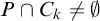

Proof. Let P be an $F_{\sigma \delta }$
-subset of X. Thanks to [Reference Kechris29, Exercise 23.5(i)], there is a family
$F_{\sigma \delta }$
-subset of X. Thanks to [Reference Kechris29, Exercise 23.5(i)], there is a family $\{P_n:n\in \omega \}$
of closed sets such that
$\{P_n:n\in \omega \}$
of closed sets such that $P=\limsup _n P_n$
.
$P=\limsup _n P_n$
.
Since every metric space is paracompact, see, e.g., [Reference Engelking13, Theorem 5.1.3], and every metric separable space is Lindelöf, see, e.g., [Reference Engelking13, Theorem 3.8.1], for every $\varepsilon>0$
there is a locally finite open cover
$\varepsilon>0$
there is a locally finite open cover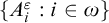 $\{A^\varepsilon _i:i\in \omega \}$
of X such that
$\{A^\varepsilon _i:i\in \omega \}$
of X such that $\mathrm {diam}(A^\varepsilon _i)<\varepsilon $
for every
$\mathrm {diam}(A^\varepsilon _i)<\varepsilon $
for every $i\in \omega $
. Let
$i\in \omega $
. Let $B^\varepsilon _i$
be the closure of
$B^\varepsilon _i$
be the closure of $A^\varepsilon _i$
for every
$A^\varepsilon _i$
for every $\varepsilon $
and i. It follows that
$\varepsilon $
and i. It follows that $\{B^\varepsilon _i:i\in \omega \}$
is a locally finite closed cover of X such that
$\{B^\varepsilon _i:i\in \omega \}$
is a locally finite closed cover of X such that $\mathrm {diam}(B^\varepsilon _i)<\varepsilon $
for every
$\mathrm {diam}(B^\varepsilon _i)<\varepsilon $
for every $i\in \omega $
(see, e.g., [Reference Engelking13, Theorem 1.1.13]).
$i\in \omega $
(see, e.g., [Reference Engelking13, Theorem 1.1.13]).
Let $(r_n)$
be a decreasing sequence of positive reals which is convergent to
$(r_n)$
be a decreasing sequence of positive reals which is convergent to $0$
. For each
$0$
. For each $n,i \in \omega $
, define
$n,i \in \omega $
, define $D^n_i=P_n\cap B^{r_n}_i$
. Then the sets
$D^n_i=P_n\cap B^{r_n}_i$
. Then the sets $D^n_i$
are closed,
$D^n_i$
are closed, $P_n=\bigcup _i D^n_i$
, and the family
$P_n=\bigcup _i D^n_i$
, and the family $\{D^n_i:i\in \omega \}$
is locally finite for every
$\{D^n_i:i\in \omega \}$
is locally finite for every $n\in \omega $
. We claim that
$n\in \omega $
. We claim that $\{D^n_i:n,i\in \omega \}$
is a family which satisfies conditions (i) and (ii).
$\{D^n_i:n,i\in \omega \}$
is a family which satisfies conditions (i) and (ii).
Condition (i). Fix $x \in X$
. We need to show that
$x \in X$
. We need to show that $x \in P$
if and only if there are infinitely many pairs
$x \in P$
if and only if there are infinitely many pairs $(n,i)\in \omega ^2$
such that
$(n,i)\in \omega ^2$
such that $x\in D^n_i$
. First, suppose that
$x\in D^n_i$
. First, suppose that $x\in P$
. Then there are
$x\in P$
. Then there are $n_0<n_1<\cdots $
such that
$n_0<n_1<\cdots $
such that $x\in P_{n_k}$
for every
$x\in P_{n_k}$
for every $k\in \omega $
. Then for every k there is
$k\in \omega $
. Then for every k there is $i_k\in \omega $
with
$i_k\in \omega $
with $x\in D^{n_k}_{i_k}$
. Conversely, suppose that there exist infinitely many pairs
$x\in D^{n_k}_{i_k}$
. Conversely, suppose that there exist infinitely many pairs $(n_k,i_k)$
such that
$(n_k,i_k)$
such that $x \in D^{n_k}_{i_k}$
for every
$x \in D^{n_k}_{i_k}$
for every $k \in \omega $
, and define
$k \in \omega $
, and define $N=\{n_k: k \in \omega \}$
. If N is finite, then there exists
$N=\{n_k: k \in \omega \}$
. If N is finite, then there exists $n_\star \in N$
such that
$n_\star \in N$
such that $x \in D^{n_\star }_i$
for infinitely many
$x \in D^{n_\star }_i$
for infinitely many $i\in \omega $
, but this would contradict the fact that
$i\in \omega $
, but this would contradict the fact that $\{D^{n_\star }_i: i \in \omega \}$
is locally finite. Hence N has to be infinite, so that there exists a sequence
$\{D^{n_\star }_i: i \in \omega \}$
is locally finite. Hence N has to be infinite, so that there exists a sequence $((n_{k_j},i_{k_j}): j \in \omega )$
with
$((n_{k_j},i_{k_j}): j \in \omega )$
with $n_{k_j}<n_{k_{j+1}}$
for all
$n_{k_j}<n_{k_{j+1}}$
for all $j \in \omega $
and
$j \in \omega $
and $x \in D^{n_{k_j}}_{i_{k_j}}$
for all
$x \in D^{n_{k_j}}_{i_{k_j}}$
for all $j \in \omega $
. Therefore
$j \in \omega $
. Therefore $x \in P_n$
for infinitely many
$x \in P_n$
for infinitely many $n\in \omega $
.
$n\in \omega $
.
Condition (ii). It is enough to show that for every injective sequence $((n_k,i_k): k \in \omega )$
such that
$((n_k,i_k): k \in \omega )$
such that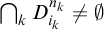 $\bigcap _k D^{n_k}_{i_k}\neq \emptyset $
, we have
$\bigcap _k D^{n_k}_{i_k}\neq \emptyset $
, we have
 $$ \begin{align*}\lim_{k\to \infty}\, \mathrm{diam}\left(D^{n_0}_{i_0}\cap \cdots \cap D^{n_k}_{i_k}\right)=0. \end{align*} $$
We proceed similarly as in the previous step. If $N=\{n_k: k \in \omega \}$
is finite, then there exist
$N=\{n_k: k \in \omega \}$
is finite, then there exist $n_\star \in N$
and a strictly increasing sequence
$n_\star \in N$
and a strictly increasing sequence $({k_j}: j\in \omega )$
such that
$({k_j}: j\in \omega )$
such that $(n_\star , i_{k_j})=(n_{k_j},i_{k_j})$
. In such case,
$(n_\star , i_{k_j})=(n_{k_j},i_{k_j})$
. In such case, $\emptyset \neq \bigcap _k D^{n_k}_{i_k}\subseteq \bigcap _j D^{n_\star }_{i_{k_j}}$
, which contradicts again the fact that
$\emptyset \neq \bigcap _k D^{n_k}_{i_k}\subseteq \bigcap _j D^{n_\star }_{i_{k_j}}$
, which contradicts again the fact that $\{D^{n_\star }_i: i \in \omega \}$
is locally finite. Thus N is infinite, and there exists a subsequence
$\{D^{n_\star }_i: i \in \omega \}$
is locally finite. Thus N is infinite, and there exists a subsequence $((n_{k_j}, i_{k_j}): j \in \omega )$
such that
$((n_{k_j}, i_{k_j}): j \in \omega )$
such that $n_{k_j}<n_{k_{j+1}}$
for all
$n_{k_j}<n_{k_{j+1}}$
for all $j\in \omega $
. Therefore
$j\in \omega $
. Therefore
 $$ \begin{align*}\mathrm{diam}\left(D^{n_{k_0}}_{i_{k_0}}\cap \cdots \cap D^{n_{k_m}}_{i_{k_m}}\right)\subseteq \mathrm{diam}\left(B^{r_{n_{k_0}}}_{i_{k_0}}\cap \cdots \cap B^{r_{n_{k_m}}}_{i_{k_m}}\right)\le r_{n_{k_m}} \end{align*} $$
for all $m \in \omega $
, which implies that
$m \in \omega $
, which implies that $\{D^n_i:n,i\in \omega \}$
satisfies condition (ii).
$\{D^n_i:n,i\in \omega \}$
satisfies condition (ii).
To complete the proof it is enough to let $(C_k: k \in \omega )$
be an enumeration of the family
$(C_k: k \in \omega )$
be an enumeration of the family $\{D^n_i: P\cap D^n_i \neq \emptyset \}$
. Indeed, it is straightforward to check that
$\{D^n_i: P\cap D^n_i \neq \emptyset \}$
. Indeed, it is straightforward to check that $\limsup _k C_k$
is precisely the set of all
$\limsup _k C_k$
is precisely the set of all $x \in X$
such that
$x \in X$
such that $x \in D^n_i$
for infinitely many pairs
$x \in D^n_i$
for infinitely many pairs $(n,i)$
, so that
$(n,i)$
, so that $\limsup _k C_k=P$
. Hence the sequence
$\limsup _k C_k=P$
. Hence the sequence $(C_k: k \in \omega )$
satisfies condition (i). Lastly, it is clear that it also satisfies conditions (ii) and (iii).
$(C_k: k \in \omega )$
satisfies condition (i). Lastly, it is clear that it also satisfies conditions (ii) and (iii).
Let us now proceed to the proof of Theorem 8.1.
Proof of Theorem 8.1
(i) $\implies $
(ii). Let
$\implies $
(ii). Let $\mathcal {A}=\{A_s:s\in 2^{<\omega }\}$
be an
$\mathcal {A}=\{A_s:s\in 2^{<\omega }\}$
be an $\mathcal {I}$
-scheme with
$\mathcal {I}$
-scheme with $B_{\mathcal {I}}(\mathcal {A})=\mathbb {Q}(2^\omega )$
. Fix a nonempty set
$B_{\mathcal {I}}(\mathcal {A})=\mathbb {Q}(2^\omega )$
. Fix a nonempty set $P\in \Pi ^0_3$
and some
$P\in \Pi ^0_3$
and some $p_0\in P$
. Thanks to Lemma 8.2, it is possible to pick a sequence
$p_0\in P$
. Thanks to Lemma 8.2, it is possible to pick a sequence $\{C_n:n\in \omega \}$
of closed subsets of X which satisfies conditions (i)–(iii) of Lemma 8.2. In addition, for each finite sequence
$\{C_n:n\in \omega \}$
of closed subsets of X which satisfies conditions (i)–(iii) of Lemma 8.2. In addition, for each finite sequence $s=(s_0,\ldots ,s_m)\in 2^{<\omega }$
define the (possibly empty) set
$s=(s_0,\ldots ,s_m)\in 2^{<\omega }$
define the (possibly empty) set
 $$ \begin{align*}R_s=\bigcap \,\{(C_k \cap P): k \in \{0,1,\ldots,m\} \text{ such that }s_k=1\} \end{align*} $$
(here, the intersection of the empty family is defined to be the empty set). For every $s\in 2^{<\omega }$
with
$s\in 2^{<\omega }$
with $R_s\neq \emptyset $
pick any
$R_s\neq \emptyset $
pick any $r_s\in R_s$
.
$r_s\in R_s$
.
Now, define $i_s\in \omega $
for all
$i_s\in \omega $
for all $s\in 2^{<\omega }$
proceeding by induction on the length of s: First, set
$s\in 2^{<\omega }$
proceeding by induction on the length of s: First, set $i_\emptyset = \min (A_\emptyset )$
. Then, assume that
$i_\emptyset = \min (A_\emptyset )$
. Then, assume that $n\geq 1$
and
$n\geq 1$
and $i_s$
have been defined for all s with length smaller than n. Then for each sequence
$i_s$
have been defined for all s with length smaller than n. Then for each sequence $s\in 2^{<\omega }$
of length n, define
$s\in 2^{<\omega }$
of length n, define $i_s = \min (A_s\setminus \{i_{s\restriction k}:k<n\})$
. This completes the construction of
$i_s = \min (A_s\setminus \{i_{s\restriction k}:k<n\})$
. This completes the construction of $i_s$
for all
$i_s$
for all $s\in 2^{<\omega }$
. Note that each integer
$s\in 2^{<\omega }$
. Note that each integer $j\in \omega $
either is equal to
$j\in \omega $
either is equal to $i_s$
for some
$i_s$
for some $s\in 2^{<\omega }$
or belongs to
$s\in 2^{<\omega }$
or belongs to
 $$ \begin{align*}S=(\omega\setminus A_\emptyset)\cup\bigcup \{D_s: s\in 2^{<\omega}\}, \quad \text{ where }\quad D_s=A_{s}\setminus (A_{s^\frown 0} \cup A_{s^\frown 1}). \end{align*} $$
Indeed, if $j\notin S$
, then there is
$j\notin S$
, then there is $x\in 2^\omega $
such that
$x\in 2^\omega $
such that $j\in A_{x\restriction n}$
for all
$j\in A_{x\restriction n}$
for all $n\in \omega $
. Hence, in such case, we would have
$n\in \omega $
. Hence, in such case, we would have $j= i_{x\restriction n}$
for some nonnegative integer
$j= i_{x\restriction n}$
for some nonnegative integer $n\leq j$
.
$n\leq j$
.
Now, let us define the sequence $ y =(y_i: i \in \omega )$
with values in X as it follows:
$ y =(y_i: i \in \omega )$
with values in X as it follows:
-
(a)
$y_{i} = p_0$
if
$i=i_\emptyset $
or
$i \in \omega \setminus A_\emptyset $
; -
(b)
$y_i=r_s$
if
$i=i_s$
for some nonempty
$s=(s_0,\ldots ,s_m)\in 2^{<\omega }$
such that
$s_m=1$
and
$R_s\neq \emptyset $
; -
(c)
$y_i=y_{i_{s\restriction m}}$
if
$i=i_s$
for some nonempty
$s=(s_0,\ldots ,s_m)\in 2^{<\omega }$
such that
$s_m=0$
or
$R_s= \emptyset $
; -
(d)
$y_i=y_{i_s}$
for all
$i \in D_s\setminus \{i_t: |t|<|s|\}$
and
$s \in 2^{<\omega }$
.


Note that $y_i \in P$
for all
$y_i \in P$
for all $i \in \omega $
. It also follows by construction that if
$i \in \omega $
. It also follows by construction that if $s=(s_0,\ldots ,s_m)\in 2^{<\omega }$
is nonempty and
$s=(s_0,\ldots ,s_m)\in 2^{<\omega }$
is nonempty and $s_m=1$
then there are two possibilities:
$s_m=1$
then there are two possibilities:
-
1. if
$R_s\neq \emptyset $
, then
$y_i \in C_m$
for all but finitely many
$i\in A_s$
; -
2. if
$R_s=\emptyset $
, then there is
$p'\in P$
such that
$y_i=p'$
for all but finitely many
$i\in A_s$
.


Claim: $P\subseteq \Lambda _{ y }(\mathcal {I})$
. Fix
$P\subseteq \Lambda _{ y }(\mathcal {I})$
. Fix $p\in P$
. Then there exists a strictly increasing sequence
$p\in P$
. Then there exists a strictly increasing sequence $(n_k: k\in \omega )$
of positive integers such that
$(n_k: k\in \omega )$
of positive integers such that $p \in \bigcap _{j} C_{n_j}$
. In particular, the latter intersection is nonempty, hence the diameter of
$p \in \bigcap _{j} C_{n_j}$
. In particular, the latter intersection is nonempty, hence the diameter of $\bigcap _{j\leq k}C_{n_j}$
goes to zero as
$\bigcap _{j\leq k}C_{n_j}$
goes to zero as $k\to \infty $
by Lemma 8.2. Define
$k\to \infty $
by Lemma 8.2. Define $x\in 2^\omega $
by
$x\in 2^\omega $
by $x_n=1$
if and only if
$x_n=1$
if and only if $n=n_k$
for some
$n=n_k$
for some $k\in \omega $
. Since
$k\in \omega $
. Since $x\notin \mathbb {Q}(2^\omega )=B_{\mathcal {I}}(\mathcal {A})$
, there exists
$x\notin \mathbb {Q}(2^\omega )=B_{\mathcal {I}}(\mathcal {A})$
, there exists $A\in \mathcal {I}^+$
such that
$A\in \mathcal {I}^+$
such that $A\setminus A_{x\restriction n}$
is finite for all
$A\setminus A_{x\restriction n}$
is finite for all $n\in \omega $
. By the above observations on the sequence
$n\in \omega $
. By the above observations on the sequence $ y $
, we obtain that
$ y $
, we obtain that
 $$ \begin{align*}\{i \in A: y_i \notin C_{n_0} \cap \cdots \cap C_{n_k}\} \in \mathrm{Fin} \end{align*} $$
for every $k \in \omega $
. Since the sets
$k \in \omega $
. Since the sets $C_{n_j}$
are closed and
$C_{n_j}$
are closed and $\bigcap _{j} C_{n_j}=\{p\}$
, it follows that the subsequence
$\bigcap _{j} C_{n_j}=\{p\}$
, it follows that the subsequence $(y_i: i\in A)$
is convergent to p. Therefore
$(y_i: i\in A)$
is convergent to p. Therefore $p \in \Lambda _{ y }(\mathcal {I})$
Claim: $\Lambda _{ y }(\mathcal {I})\subseteq P$
. Fix
$\Lambda _{ y }(\mathcal {I})\subseteq P$
. Fix $p\in \Lambda _{ y }(\mathcal {I})$
. Hence there is
$p\in \Lambda _{ y }(\mathcal {I})$
. Hence there is $A\in \mathcal {I}^+$
such that the subsequence
$A\in \mathcal {I}^+$
such that the subsequence $(y_i: i\in A)$
is convergent to p. We need to show that
$(y_i: i\in A)$
is convergent to p. We need to show that $p \in P$
. To this aim, we split the remaining proof into three cases.
$p \in P$
. To this aim, we split the remaining proof into three cases.
First, suppose that $A\setminus A_\emptyset $
is infinite. Then
$A\setminus A_\emptyset $
is infinite. Then $y_i=p_0$
for infinitely many
$y_i=p_0$
for infinitely many $i\in A$
. Since
$i\in A$
. Since $(y_i: i\in A)$
is convergent to p, we obtain
$(y_i: i\in A)$
is convergent to p, we obtain $p=p_0\in P$
.
$p=p_0\in P$
.
Second, suppose that there is $s\in 2^{<\omega }$
such that
$s\in 2^{<\omega }$
such that $A\cap D_s$
is infinite. Then
$A\cap D_s$
is infinite. Then $y_i = y_{i_{s}}$
for infinitely many
$y_i = y_{i_{s}}$
for infinitely many $i\in A$
. Since
$i\in A$
. Since $(y_i: i\in A)$
is convergent to p, it follows that
$(y_i: i\in A)$
is convergent to p, it follows that $p=y_{i_{s}}\in P$
.
$p=y_{i_{s}}\in P$
.
Third, suppose that the above cases fail, that is, $A\setminus A_\emptyset $
is finite and
$A\setminus A_\emptyset $
is finite and $A\cap D_s$
is finite for all
$A\cap D_s$
is finite for all $s \in 2^{<\omega }$
. Then there exists
$s \in 2^{<\omega }$
. Then there exists $x\in 2^\omega $
such that
$x\in 2^\omega $
such that $B_n=A\cap A_{x\restriction n}\in \mathcal {I}^+$
for all
$B_n=A\cap A_{x\restriction n}\in \mathcal {I}^+$
for all $n\in \omega $
, and define
$n\in \omega $
, and define $N=\{n \in \omega : x_n=1\}$
.
$N=\{n \in \omega : x_n=1\}$
.
If N is infinite, or equivalently $x \notin \mathbb {Q}(2^\omega )$
, it follows by the observations above on the sequence
$x \notin \mathbb {Q}(2^\omega )$
, it follows by the observations above on the sequence $ y $
that there are two possibilities:
$ y $
that there are two possibilities:
-
1. Suppose first that
$R_{x\restriction (n+1)}\neq \emptyset $
for all
$n\in \omega $
. Then for every
$$ \begin{align*}\{i \in B_{n+1}: y_i\notin C_n\} \in \mathrm{Fin} \end{align*} $$
$ n \in N$
. Since each
$C_n$
is closed and
$(y_i: i\in B_{n+1})$
is a subsequence of the sequence
$(y_i: i \in A)$
(which is convergent to p), we obtain that
$p\in C_{n}$
for all
$n\in N$
. This implies that
$p\in \limsup _n C_n=P$
.
-
2. Suppose now that
$R_{x\restriction (n+1)}=\emptyset $
for some
$n\in \omega $
. Then there is
$p'\in P$
such that
$y_i=p'$
for all but finitely many
$i\in B_{n+1}$
. Since
$(y_i: i\in B_{n+1})$
is a subsequence of the sequence
$(y_i: i \in A)$
(which is convergent to p), we obtain that
$p=p'\in P$
.


Lastly, suppose that N is finite, that is, $x \in \mathbb {Q}(2^\omega )$
. Set
$x \in \mathbb {Q}(2^\omega )$
. Set $k=\max N$
. Recall that
$k=\max N$
. Recall that $B_n\in \mathcal {I}^+$
and
$B_n\in \mathcal {I}^+$
and $B_n\setminus A_{x\restriction j}$
is empty for every
$B_n\setminus A_{x\restriction j}$
is empty for every $j\leq n$
and
$j\leq n$
and $n \in \omega $
. Since
$n \in \omega $
. Since $x\in B_{\mathcal {I}}(\mathcal {A})$
, for each
$x\in B_{\mathcal {I}}(\mathcal {A})$
, for each $n>k$
there exists an integer
$n>k$
there exists an integer $m_n>n$
such that
$m_n>n$
such that $B_n\cap A_{{x\restriction m_n}^\frown 1}$
is infinite. Without loss of generality we can assume that the sequence
$B_n\cap A_{{x\restriction m_n}^\frown 1}$
is infinite. Without loss of generality we can assume that the sequence $(m_n)_{n>k}$
is strictly increasing. Similarly as above, we have two possibilities:
$(m_n)_{n>k}$
is strictly increasing. Similarly as above, we have two possibilities:
-
1. Suppose first that
$R_{{x\restriction m_n}^\frown 1}\neq \emptyset $
for all
$n>k$
. Then for every
$$ \begin{align*}\{i \in B_n\cap A_{{x\restriction m_n}^\frown 1}: y_i\notin C_{m_n}\} \in \mathrm{Fin} \end{align*} $$
$n>k$
. Since each
$C_{m_n}$
is closed and
$(y_i: i\in B_n\cap A_{{x\restriction m_n}^\frown 1})$
is a subsequence of the sequence
$(y_i: i \in A)$
,
$p\in C_{m_n}$
for all
$n>k$
. It follows that
$p\in \limsup _n C_n=P$
.
-
2. Suppose now that
$R_{{x\restriction m_n}^\frown 1}=\emptyset $
for some
$n>k$
. Then there is
$p'\in P$
such that
$y_i=p'$
for all but finitely many
$i\in B_n\cap A_{{x\restriction m_n}^\frown 1}$
. Since
$(y_i: i\in B_n\cap A_{{x\restriction m_n}^\frown 1})$
is a subsequence of the sequence
$(y_i: i \in A)$
(which is convergent to p), we obtain that
$p=p'\in P$
.


Therefore $P=\Lambda _{ y }(\mathcal {I})$
, completing the proof of the implication.
$P=\Lambda _{ y }(\mathcal {I})$
, completing the proof of the implication.
(ii) $\implies $
(iii). It is obvious.
$\implies $
(iii). It is obvious.
(iii) $\implies $
(iv). This follows by the fact that there exists a set in
$\implies $
(iv). This follows by the fact that there exists a set in $\Pi ^0_2\setminus \Sigma ^0_2 $
(which is, of course, analytic) (see, e.g., [Reference Kechris29, Theorem 22.4]).
$\Pi ^0_2\setminus \Sigma ^0_2 $
(which is, of course, analytic) (see, e.g., [Reference Kechris29, Theorem 22.4]).
(iv) $\implies $
(v). Pick an analytic set
$\implies $
(v). Pick an analytic set $P\in \mathscr {L}(\mathcal {I})$
which is not
$P\in \mathscr {L}(\mathcal {I})$
which is not $\Sigma ^0_2$
. Thanks to [Reference Kechris29, Theorem 21.18], there exists a homeomorphic copy of the Cantor space
$\Sigma ^0_2$
. Thanks to [Reference Kechris29, Theorem 21.18], there exists a homeomorphic copy of the Cantor space $C\subseteq X$
such that
$C\subseteq X$
such that $C\setminus P$
is countable dense in C.
$C\setminus P$
is countable dense in C.
(v) $\implies $
(i). Fix
$\implies $
(i). Fix $P\in \mathscr {L}(\mathcal {I})$
and let
$P\in \mathscr {L}(\mathcal {I})$
and let $C\subseteq X$
be a homeomorphic copy of the Cantor space such that
$C\subseteq X$
be a homeomorphic copy of the Cantor space such that $C\setminus P$
is countable dense in C. Since the Cantor space is countable dense homogeneous, we can find a homeomorphism
$C\setminus P$
is countable dense in C. Since the Cantor space is countable dense homogeneous, we can find a homeomorphism $f:2^\omega \to C$
such that
$f:2^\omega \to C$
such that $f[\mathbb {Q}(2^\omega )]=C\setminus P$
. Observe that the latter implies that
$f[\mathbb {Q}(2^\omega )]=C\setminus P$
. Observe that the latter implies that $f^{-1}[C\cap P]$
is dense in
$f^{-1}[C\cap P]$
is dense in $2^\omega $
. We conclude by Lemma 4.5(ii) that there exists an
$2^\omega $
. We conclude by Lemma 4.5(ii) that there exists an $\mathcal {I}$
-scheme
$\mathcal {I}$
-scheme $\mathcal {A}$
such that
$\mathcal {A}$
such that $B_{\mathcal {I}}(\mathcal {A})=f^{-1}[C\setminus P]=\mathbb {Q}(2^\omega )$
.
$B_{\mathcal {I}}(\mathcal {A})=f^{-1}[C\setminus P]=\mathbb {Q}(2^\omega )$
.
Corollary 8.3. Let $\mathcal {I}$
be an analytic P-ideal on
$\mathcal {I}$
be an analytic P-ideal on $\omega $
. Then
$\omega $
. Then $\mathcal {I}\notin P(\Pi ^0_3)$
.
$\mathcal {I}\notin P(\Pi ^0_3)$
.
Proof. Let X be an uncountable Polish space. Thanks to [Reference Balcerzak and Leonetti3, Theorem 2.2], we have $\mathscr {L}(\mathcal {I})\subseteq \Sigma ^0_2$
(see also [Reference Kostyrko, Mačaj, Šalát and Strauch31, Theorem 1] for the case
$\mathscr {L}(\mathcal {I})\subseteq \Sigma ^0_2$
(see also [Reference Kostyrko, Mačaj, Šalát and Strauch31, Theorem 1] for the case $\mathcal {I}=\mathcal {Z}$
). Since there exists a set in
$\mathcal {I}=\mathcal {Z}$
). Since there exists a set in $\Pi ^0_2\setminus \Sigma ^0_2$
, see, e.g., [Reference Kechris29, Theorem 22.4], the claim follows by Theorem 8.1.
$\Pi ^0_2\setminus \Sigma ^0_2$
, see, e.g., [Reference Kechris29, Theorem 22.4], the claim follows by Theorem 8.1.
For the next remark, recall that an ideal $\mathcal {I}$
on
$\mathcal {I}$
on $\omega $
is said to be tall if every infinite set
$\omega $
is said to be tall if every infinite set $S\subseteq \omega $
contains an infinite subset which belongs to
$S\subseteq \omega $
contains an infinite subset which belongs to $\mathcal {I}$
.
$\mathcal {I}$
.
Remark 8.4. Let X be an uncountable Polish space and let $\mathcal {I}$
be an ideal on
$\mathcal {I}$
be an ideal on $\omega $
with the hereditary Baire property. Thanks to Theorem 2.4, Proposition 4.8(v), and Theorem 6.3, we obtain that
$\omega $
with the hereditary Baire property. Thanks to Theorem 2.4, Proposition 4.8(v), and Theorem 6.3, we obtain that $\mathrm {Fin}\le _{\mathrm {RB}} \mathcal {I}$
and
$\mathrm {Fin}\le _{\mathrm {RB}} \mathcal {I}$
and $\Pi ^0_1\subseteq \mathscr {L}(\mathcal {I})$
. In particular, trivially,
$\Pi ^0_1\subseteq \mathscr {L}(\mathcal {I})$
. In particular, trivially,
 $$ \begin{align*}\mathrm{Fin}\le_{\mathrm{RB}} \mathcal{I} \quad \text{ if and only if }\quad \Pi^0_1\subseteq \mathscr{L}(\mathcal{I}). \end{align*} $$
Moreover, it follows by Theorem 7.1 that
 $$ \begin{align*}\emptyset \otimes \mathrm{Fin}\le_{\mathrm{RB}} \mathcal{I} \quad \text{ if and only if }\quad \Sigma^0_2\subseteq \mathscr{L}(\mathcal{I}). \end{align*} $$
At this point, one may be tempted to conjecture that
 $$ \begin{align} \mathrm{Fin}^2\le_{\mathrm{RB}}\mathcal{I} \quad \text{ if and only if } \quad \Pi^0_3\subseteq \mathscr{L}(\mathcal{I}). \end{align} $$
Then the Only If part holds, thanks to Theorem 1.7 and Proposition 2.8(i). However, the If part of (10) does not hold: note that $\mathscr {L}(\mathrm {Fin}^2\oplus \mathrm {Fin})=\Pi ^0_3$
by Theorem 1.7 and Proposition 2.8(v). On the other hand,
$\mathscr {L}(\mathrm {Fin}^2\oplus \mathrm {Fin})=\Pi ^0_3$
by Theorem 1.7 and Proposition 2.8(v). On the other hand, $\mathrm {Fin}^2$
is tall and
$\mathrm {Fin}^2$
is tall and $\mathrm {Fin}^2\oplus \mathrm {Fin}$
is not tall. This implies that
$\mathrm {Fin}^2\oplus \mathrm {Fin}$
is not tall. This implies that $\mathrm {Fin}^2\not \le _{\mathrm {RB}} \mathrm {Fin}^2\oplus \mathrm {Fin}$
, as it is easy to check that if
$\mathrm {Fin}^2\not \le _{\mathrm {RB}} \mathrm {Fin}^2\oplus \mathrm {Fin}$
, as it is easy to check that if $\mathcal {I} \le _{\mathrm {RB}} \mathcal {J}$
with
$\mathcal {I} \le _{\mathrm {RB}} \mathcal {J}$
with $\mathcal {I}$
tall then also
$\mathcal {I}$
tall then also $\mathcal {J}$
has to be tall.
$\mathcal {J}$
has to be tall.
9 Case: Analytic sets
In this section, we show that the condition $\mathcal {I}\in P^?(\Sigma ^1_1)$
implies that all (nonempty) analytic sets can be realized as sets of
$\mathcal {I}\in P^?(\Sigma ^1_1)$
implies that all (nonempty) analytic sets can be realized as sets of $\mathcal {I}$
-limit points.
$\mathcal {I}$
-limit points.
Theorem 9.1. Let X be an uncountable Polish space and let $\mathcal {I}\in P^?(\Sigma ^1_1)$
be an ideal on
$\mathcal {I}\in P^?(\Sigma ^1_1)$
be an ideal on $\omega $
. Then
$\omega $
. Then $\Sigma ^1_1\subseteq \mathscr {L}(\mathcal {I})$
.
$\Sigma ^1_1\subseteq \mathscr {L}(\mathcal {I})$
.
Proof. Let $\mathcal {A}=\{A_s:s\in 2^{<\omega }\}$
be an
$\mathcal {A}=\{A_s:s\in 2^{<\omega }\}$
be an $\mathcal {I}$
-scheme such that
$\mathcal {I}$
-scheme such that $B_{\mathcal {I}}(\mathcal {A})=C_{\mathcal {I}}(\mathcal {A})=\mathbb {Q}(2^\omega )$
. Let
$B_{\mathcal {I}}(\mathcal {A})=C_{\mathcal {I}}(\mathcal {A})=\mathbb {Q}(2^\omega )$
. Let $P\subseteq X$
be a nonempty analytic set and fix
$P\subseteq X$
be a nonempty analytic set and fix $p_\star \in P$
. Thanks to [Reference Kechris29, Theorem 25.7], there exists a Souslin scheme
$p_\star \in P$
. Thanks to [Reference Kechris29, Theorem 25.7], there exists a Souslin scheme $\{P_t:t\in \omega ^{<\omega }\}$
of nonempty closed sets such that
$\{P_t:t\in \omega ^{<\omega }\}$
of nonempty closed sets such that
 $$ \begin{align*}P = \bigcup_{x\in \omega^\omega}\bigcap_{n\in \omega}P_{x\restriction n}. \end{align*} $$
In addition, it can be assumed that $P_s\supseteq P_t$
whenever
$P_s\supseteq P_t$
whenever $s\subseteq t$
for all
$s\subseteq t$
for all $t,s\in \omega ^{<\omega }$
and
$t,s\in \omega ^{<\omega }$
and $\lim _n \mathrm {diam}(P_{x\restriction n})=0$
for all
$\lim _n \mathrm {diam}(P_{x\restriction n})=0$
for all $x \in \omega ^\omega $
. Note that, since X is complete, for each
$x \in \omega ^\omega $
. Note that, since X is complete, for each $x\in \omega ^\omega $
there exists
$x\in \omega ^\omega $
there exists $p_x\in X$
such that
$p_x\in X$
such that $\bigcap _{n} P_{x\restriction n} = \{p_x\}$
. Hence
$\bigcap _{n} P_{x\restriction n} = \{p_x\}$
. Hence $P=\{p_x:x\in \omega ^\omega \}$
.
$P=\{p_x:x\in \omega ^\omega \}$
.
Define the map $\phi :2^{<\omega }\to \omega ^{<\omega }$
by
$\phi :2^{<\omega }\to \omega ^{<\omega }$
by
 $$ \begin{align*}\phi(0^n)=\emptyset \quad \text{ and }\quad \phi(0^{t_0},1,0^{t_1},\dots,0^{t_{k}},1,0^n) =t \end{align*} $$
for every $n\in \omega $
and nonempty
$n\in \omega $
and nonempty $t=(t_0,\ldots ,t_k)\in \omega ^{<\omega }$
. It follows by construction that
$t=(t_0,\ldots ,t_k)\in \omega ^{<\omega }$
. It follows by construction that $\phi (s)\subseteq \phi (s^\prime )$
and
$\phi (s)\subseteq \phi (s^\prime )$
and $P_{\phi (s)}\supseteq P_{\phi (s^\prime )}$
for every
$P_{\phi (s)}\supseteq P_{\phi (s^\prime )}$
for every $s,s^\prime \in 2^{<\omega }$
with
$s,s^\prime \in 2^{<\omega }$
with $s\subseteq s^\prime $
.
$s\subseteq s^\prime $
.
At this point, for each $s \in 2^{<\omega }$
define
$s \in 2^{<\omega }$
define $i_s \in \omega $
and
$i_s \in \omega $
and $D_s$
exactly as in the proof of the implication (i)
$D_s$
exactly as in the proof of the implication (i) $\implies $
(ii) of Theorem 8.1. Let us define the sequence
$\implies $
(ii) of Theorem 8.1. Let us define the sequence $ y =(y_i: i \in \omega )$
with values in X as it follows:
$ y =(y_i: i \in \omega )$
with values in X as it follows:
-
(a)
$y_i=p_{0^\infty }$
if
$i=i_\emptyset $
; -
(b)
$y_{i} = p_\star $
for all
$i \in \omega \setminus A_\emptyset $
; -
(c)
$y_i=p_{\phi (s)^\frown 0^\infty }$
if
$i=i_s$
for some nonempty
$s=(s_0,\ldots ,s_m)\in 2^{<\omega }$
with
$s_m=1$
; -
(d)
$y_i=y_{i_{s\restriction m}}$
if
$i=i_s$
for some nonempty
$s=(s_0,\ldots ,s_m)\in 2^{<\omega }$
with
$s_m=0$
; -
(e)
$y_i=y_{i_s}$
for all
$i \in D_s\setminus \{i_t: |t|<|s|\}$
and
$s \in 2^{<\omega }$
.


Note that $y_i \in P$
for all
$y_i \in P$
for all $i \in \omega $
. It follows also by construction that if
$i \in \omega $
. It follows also by construction that if $s=(s_0,\ldots ,s_m)\in 2^{<\omega }$
is nonempty and
$s=(s_0,\ldots ,s_m)\in 2^{<\omega }$
is nonempty and $s_m=1$
then
$s_m=1$
then $y_i \in P_{\phi (s)}$
for all but finitely many
$y_i \in P_{\phi (s)}$
for all but finitely many $i\in A_s$
.
$i\in A_s$
.
Claim: $P\subseteq \Lambda _{ y }(\mathcal {I})$
. Fix
$P\subseteq \Lambda _{ y }(\mathcal {I})$
. Fix $p\in P$
. Let
$p\in P$
. Let $x\in \omega ^\omega $
be such that
$x\in \omega ^\omega $
be such that $p=p_x$
and define
$p=p_x$
and define $t = (0^{x_0},1,0^{x_1},1,\ldots )$
. Since
$t = (0^{x_0},1,0^{x_1},1,\ldots )$
. Since $t\in 2^\omega \setminus \mathbb {Q}(2^\omega )$
, there is
$t\in 2^\omega \setminus \mathbb {Q}(2^\omega )$
, there is $A\in \mathcal {I}^+$
such that
$A\in \mathcal {I}^+$
such that $A\setminus A_{t\restriction n}$
is finite for every
$A\setminus A_{t\restriction n}$
is finite for every $n\in \omega $
. It will be enough to show that the subsequence
$n\in \omega $
. It will be enough to show that the subsequence $(y_i: i \in A)$
is convergent to p. For, fix
$(y_i: i \in A)$
is convergent to p. For, fix $\varepsilon>0$
. Since
$\varepsilon>0$
. Since $\lim _k \mathrm {diam}(P_{x\restriction k})=0$
, there exists
$\lim _k \mathrm {diam}(P_{x\restriction k})=0$
, there exists $k_\star \in \omega $
such that
$k_\star \in \omega $
such that $p\in P_{x\restriction k}\subseteq B(p,\varepsilon )$
for every
$p\in P_{x\restriction k}\subseteq B(p,\varepsilon )$
for every $k\geq k_\star $
. In addition, for every
$k\geq k_\star $
. In addition, for every $n\in \omega $
there exists
$n\in \omega $
there exists $k_n\in \omega $
such that
$k_n\in \omega $
such that $\phi (t\restriction (n-1))=x\restriction k_n$
. It is clear that
$\phi (t\restriction (n-1))=x\restriction k_n$
. It is clear that $(k_n)$
is non-decreasing and divergent to
$(k_n)$
is non-decreasing and divergent to $+\infty $
as
$+\infty $
as $n\to \infty $
. Take n such that
$n\to \infty $
. Take n such that $k_n \geq k_\star $
and
$k_n \geq k_\star $
and $t\restriction (n-1)$
ends with one. By the observations above, the set
$t\restriction (n-1)$
ends with one. By the observations above, the set $A\setminus A_{t\restriction n}$
is finite and
$A\setminus A_{t\restriction n}$
is finite and $y_i\in P_{\phi (t\restriction (n-1))}$
for all but finitely many
$y_i\in P_{\phi (t\restriction (n-1))}$
for all but finitely many $i\in A_{t\restriction n}$
, hence
$i\in A_{t\restriction n}$
, hence $y_i\in P_{\phi (t\restriction (n-1))} = P_{x\restriction k_n} \subseteq B(p,\varepsilon )$
for all but finitely many
$y_i\in P_{\phi (t\restriction (n-1))} = P_{x\restriction k_n} \subseteq B(p,\varepsilon )$
for all but finitely many $i\in A$
. Therefore
$i\in A$
. Therefore $\lim _{i \in A}y_i=p$
, so that
$\lim _{i \in A}y_i=p$
, so that $p \in \Lambda _{ y }(\mathcal {I})$
.
$p \in \Lambda _{ y }(\mathcal {I})$
.
Claim: $\Lambda _{ y }(\mathcal {I})\subseteq P$
. Fix
$\Lambda _{ y }(\mathcal {I})\subseteq P$
. Fix $p\in \Lambda _{ y }(\mathcal {I})$
. Hence there is
$p\in \Lambda _{ y }(\mathcal {I})$
. Hence there is $A\in \mathcal {I}^+$
such that the subsequence
$A\in \mathcal {I}^+$
such that the subsequence $(y_i: i\in A)$
is convergent to p. We need to show that
$(y_i: i\in A)$
is convergent to p. We need to show that $p \in P$
. If
$p \in P$
. If $A\setminus A_\emptyset $
is infinite or if
$A\setminus A_\emptyset $
is infinite or if $A \cap D_s$
is infinite for some
$A \cap D_s$
is infinite for some $s \in 2^{<\omega }$
, we proceed as in the proof of Theorem 8.1. Otherwise, let us suppose hereafter that
$s \in 2^{<\omega }$
, we proceed as in the proof of Theorem 8.1. Otherwise, let us suppose hereafter that $A\setminus A_\emptyset $
is finite and
$A\setminus A_\emptyset $
is finite and $A\cap D_s$
is finite for all
$A\cap D_s$
is finite for all $s \in 2^{<\omega }$
. Let us define a sequence
$s \in 2^{<\omega }$
. Let us define a sequence $(B_n: n \in \omega )$
of
$(B_n: n \in \omega )$
of $\mathcal {I}$
-positive sets and a sequence
$\mathcal {I}$
-positive sets and a sequence $(k_n) \in \omega ^\omega $
by induction as it follows:
$(k_n) \in \omega ^\omega $
by induction as it follows:
-
(i) Set
$B_0=A\cap A_\emptyset $
, which belongs to
$\mathcal {I}^+$
since
$A\notin \mathcal {I}$
and
$A\setminus A_\emptyset $
is finite. -
(ii) Since
$0^\infty \in C_{\mathcal {I}}(\mathcal {A})$
, it is possible to fix
$k_0\in \omega $
such that
$B_1=B_0\cap A_{(0^{k_0},1)}\in \mathcal {I}^+$
. -
(iii) Suppose that
$B_0,\ldots ,B_{n} \in \mathcal {I}^+$
and
$k_0,\ldots ,k_{n-1}\in \omega $
have been defined for some
$n\in \omega $
and satisfy
$B_{i+1}=B_{i}\cap A_{(0^{k_0},1,0^{k_1},1,\ldots ,0^{k_{i}},1)}\in \mathcal {I}^+$
for all
$i<n$
. Since
$(0^{k_0},1,0^{k_1},1,\ldots ,0^{k_{n-1}},1,0^\infty )\in C_{\mathcal {I}}(\mathcal {A})$
, it is possible to fix
$k_{n} \in \omega $
such that
$$ \begin{align*}B_{n+1}=B_{n}\cap A_{(0^{k_0},1,0^{k_1},1,\ldots,0^{k_{n}},1)} \in \mathcal{I}^+. \end{align*} $$


Now, define $x= (0^{k_0},1,0^{k_1},1,\dots ,0^{k_{n}},1,\ldots )$
and
$x= (0^{k_0},1,0^{k_1},1,\dots ,0^{k_{n}},1,\ldots )$
and $m_n=k_0+\cdots +k_n+n+1\in \omega $
for all
$m_n=k_0+\cdots +k_n+n+1\in \omega $
for all $n \in \omega $
, so that
$n \in \omega $
, so that $x\restriction m_n=(0^{k_0},1,0^{k_1},1,\dots ,0^{k_{n}},1)$
. Then
$x\restriction m_n=(0^{k_0},1,0^{k_1},1,\dots ,0^{k_{n}},1)$
. Then $x\in 2^\omega \setminus \mathbb {Q}(2^\omega )$
and
$x\in 2^\omega \setminus \mathbb {Q}(2^\omega )$
and $A\cap A_{x\restriction m_n}\in \mathcal {I}^+$
for every
$A\cap A_{x\restriction m_n}\in \mathcal {I}^+$
for every $n\in \omega $
. It follows by construction that, for each
$n\in \omega $
. It follows by construction that, for each $n \in \omega $
, there are infinitely many
$n \in \omega $
, there are infinitely many $i \in A$
such that
$i \in A$
such that
 $$ \begin{align*}y_i\in P_{\phi(x\restriction m_n)}=P_{(k_0,k_1,\ldots,k_n)}. \end{align*} $$
Since the sets $P_n$
are closed and p is the limit of the subsequence
$P_n$
are closed and p is the limit of the subsequence $(y_i: i\in A)$
, we obtain that
$(y_i: i\in A)$
, we obtain that $p \in \bigcap _n P_{(k_0,k_1,\ldots ,k_n)}= \{p_{(k_0,k_1,\ldots )}\}$
, hence
$p \in \bigcap _n P_{(k_0,k_1,\ldots ,k_n)}= \{p_{(k_0,k_1,\ldots )}\}$
, hence $p=p_{(k_0,k_1,\dots )}\in P$
.
$p=p_{(k_0,k_1,\dots )}\in P$
.
Therefore $P=\Lambda _{ y }(\mathcal {I})$
, which finishes the proof.
$P=\Lambda _{ y }(\mathcal {I})$
, which finishes the proof.
We end this section with our first open question.
Question 9.2. Let X be an uncountable Polish space and let $\mathcal {I}$
be an ideal on
$\mathcal {I}$
be an ideal on $\omega $
. Is it true that
$\omega $
. Is it true that $\mathcal {I}\in P^?(\Sigma ^1_1)$
if and only if
$\mathcal {I}\in P^?(\Sigma ^1_1)$
if and only if $\Sigma ^1_1\subseteq \mathscr {L}(\mathcal {I})$
?
$\Sigma ^1_1\subseteq \mathscr {L}(\mathcal {I})$
?
10 Applications and open questions
In this section, we collect some consequences of our results, and we conclude with some open questions.
Remark 10.1. Note that the properties $P(\Pi ^0_1)$
,
$P(\Pi ^0_1)$
, $P(\Sigma ^0_2)$
,
$P(\Sigma ^0_2)$
, $P(\Pi ^0_3),$
and
$P(\Pi ^0_3),$
and $P^?(\Sigma ^1_1)$
are purely combinatorial. Hence, for instance:
$P^?(\Sigma ^1_1)$
are purely combinatorial. Hence, for instance:
-
(i) it follows from Theorem 6.3 that if there is some uncountable Polish space X such that
$\mathscr {L}_X(\mathcal {I})$
contains an uncountable analytic set, then
$\Pi ^0_1(Y)\subseteq \mathscr {L}_Y(\mathcal {I})$
for every uncountable Polish space Y; -
(ii) it follows from Theorem 7.1 that if there is some uncountable Polish space X such that
$\mathscr {L}_X(\mathcal {I})$
contains an analytic set which is not the union of a closed set and a countable set, then
$\Sigma ^0_2(Y)\subseteq \mathscr {L}_Y(\mathcal {I})$
for every uncountable Polish space Y; -
(iii) it follows from Theorem 7.1 that if
$\mathcal {I}$
has the hereditary Baire property and there is some uncountable Polish space X such that
$\mathscr {L}_X(\mathcal {I})$
contains a set which is not closed, then
$\Sigma ^0_2(Y)\subseteq \mathscr {L}_Y(\mathcal {I})$
for every uncountable Polish space Y; -
(iv) it follows from Theorem 8.1 that if there is some uncountable Polish space X such that
$\mathscr {L}_X(\mathcal {I})$
contains an analytic set which is not
$\Sigma ^0_2(X)$
, then
$\Pi ^0_3(Y)\subseteq \mathscr {L}_Y(\mathcal {I})$
for every uncountable Polish space Y.


10.1 Which families can be obtained as
$\mathscr {L}(\mathcal {I})$
?

Corollary 10.2. Let X be an uncountable Polish space and let $\mathcal {I}$
be an ideal on
$\mathcal {I}$
be an ideal on $\omega $
. Then the following hold:
$\omega $
. Then the following hold:
-
(i)
$\mathscr {L}(\mathcal {I})\not \subseteq \Sigma ^0_1$
. In particular,
$\mathscr {L}(\mathcal {I})\neq \Sigma ^0_1$
. -
(ii)
$\Sigma ^0_1\subseteq \mathscr {L}(\mathcal {I})$
if and only if
$\Sigma ^0_2\subseteq \mathscr {L}(\mathcal {I})$
. In particular,
$\mathscr {L}(\mathcal {I})\neq \Pi ^0_2$
. -
(iii)
$\Pi ^0_2\subseteq \mathscr {L}(\mathcal {I})$
if and only if
$\Pi ^0_3\subseteq \mathscr {L}(\mathcal {I})$
. In particular,
$\mathscr {L}(\mathcal {I})\neq \Sigma ^0_3$
.


Proof. (i) Pick an accumulation point $\eta \in X^{\,|}$
. Thus,
$\eta \in X^{\,|}$
. Thus, $\{\eta \}$
is not open. It follows by Lemma 2.1 that
$\{\eta \}$
is not open. It follows by Lemma 2.1 that $\{\eta \} \in \mathscr {L}(\mathcal {I})$
. Therefore
$\{\eta \} \in \mathscr {L}(\mathcal {I})$
. Therefore $\mathscr {L}(\mathcal {I})\not \subseteq \Sigma ^0_1$
.
$\mathscr {L}(\mathcal {I})\not \subseteq \Sigma ^0_1$
.
(ii) The If part is clear. To show the Only If part, let us suppose that $\Sigma ^0_1\subseteq \mathscr {L}(\mathcal {I})$
. Thanks to Theorem 7.1, we also get
$\Sigma ^0_1\subseteq \mathscr {L}(\mathcal {I})$
. Thanks to Theorem 7.1, we also get $\Sigma ^0_2\subseteq \mathscr {L}(\mathcal {I})$
. The last sentence follows by the facts that
$\Sigma ^0_2\subseteq \mathscr {L}(\mathcal {I})$
. The last sentence follows by the facts that $\Sigma ^0_1\subseteq \Pi ^0_2$
and
$\Sigma ^0_1\subseteq \Pi ^0_2$
and $\Sigma ^0_2\setminus \Pi ^0_2\neq \emptyset $
(see, e.g., [Reference Kechris29, Theorem 22.4]).
$\Sigma ^0_2\setminus \Pi ^0_2\neq \emptyset $
(see, e.g., [Reference Kechris29, Theorem 22.4]).
(iii) The proof goes as in item (ii), replacing Theorem 7.1 with Theorem 8.1.
Remark 10.3. We remark that the proof of Corollary 10.2(i) actually works in every nondiscrete Hausdorff space.
On the one hand, thanks to Theorem 1.7, all families of the type $\Pi ^0_{2\alpha -1}$
and
$\Pi ^0_{2\alpha -1}$
and $\Sigma ^0_{2\alpha }$
, with
$\Sigma ^0_{2\alpha }$
, with $\alpha $
positive integer, can be realized as some
$\alpha $
positive integer, can be realized as some $\mathscr {L}(\mathcal {I})$
. On the other hand, it follows by Corollary 10.2 that there are no ideals
$\mathscr {L}(\mathcal {I})$
. On the other hand, it follows by Corollary 10.2 that there are no ideals $\mathcal {I}$
on
$\mathcal {I}$
on $\omega $
such that
$\omega $
such that $\mathscr {L}(\mathcal {I})=\Sigma ^0_1$
or
$\mathscr {L}(\mathcal {I})=\Sigma ^0_1$
or $\mathscr {L}(\mathcal {I})=\Pi ^0_2$
or
$\mathscr {L}(\mathcal {I})=\Pi ^0_2$
or $\mathscr {L}(\mathcal {I})=\Sigma ^0_3$
. This leads to the next open question.
$\mathscr {L}(\mathcal {I})=\Sigma ^0_3$
. This leads to the next open question.
Question 10.4. Let X be an uncountable Polish space. Do there exist an ideal $\mathcal {I}$
on
$\mathcal {I}$
on $\omega $
and a positive integer
$\omega $
and a positive integer $\alpha $
such that
$\alpha $
such that
 $$ \begin{align*}\mathscr{L}(\mathcal{I})=\Sigma^0_{2\alpha-1} \quad \text{ or }\quad \mathscr{L}(\mathcal{I})=\Pi^0_{2\alpha}\,\,? \end{align*} $$
10.2 Coanalytic ideals
Recall that by Corollary 6.9, $\mathscr {L}(\mathcal {I})=\Pi ^0_1$
is equivalent to
$\mathscr {L}(\mathcal {I})=\Pi ^0_1$
is equivalent to $\mathcal {I}\in P^{\,|}$
and
$\mathcal {I}\in P^{\,|}$
and $\mathcal {I} \in P(\Pi ^0_1)$
. However, in the case of ideals with the hereditary Baire property,
$\mathcal {I} \in P(\Pi ^0_1)$
. However, in the case of ideals with the hereditary Baire property, $\mathcal {I}\in P^{\,|}$
can be replaced with
$\mathcal {I}\in P^{\,|}$
can be replaced with $\mathcal {I} \notin P(\Sigma ^0_2)$
, which is a more similar property to
$\mathcal {I} \notin P(\Sigma ^0_2)$
, which is a more similar property to $\mathcal {I}\in P(\Pi ^0_1)$
and allows to extend this approach to the case
$\mathcal {I}\in P(\Pi ^0_1)$
and allows to extend this approach to the case $\mathscr {L}(\mathcal {I})=\Sigma ^0_2$
.
$\mathscr {L}(\mathcal {I})=\Sigma ^0_2$
.
Corollary 10.5. Let X be an uncountable Polish space and let $\mathcal {I}$
be an ideal on
$\mathcal {I}$
be an ideal on $\omega $
. Then the following hold:
$\omega $
. Then the following hold:
-
(i) Assume that
$\mathcal {I}$
has the hereditary Baire property. Then
$\mathscr {L}(\mathcal {I})\subseteq \Pi ^0_1$
if and only if
$\mathcal {I}\notin P(\Sigma ^0_2)$
. In particular,
$\mathscr {L}(\mathcal {I})= \Pi ^0_1$
if and only if
$\mathcal {I} \in P(\Pi ^0_1)\setminus P(\Sigma ^0_2)$
. -
(ii) Assume that
$\mathcal {I}$
is coanalytic. Then
$\mathscr {L}(\mathcal {I})\subseteq \Sigma ^0_2$
if and only if
$\mathcal {I}\notin P(\Pi ^0_3)$
. In particular,
$\mathscr {L}(\mathcal {I})= \Sigma ^0_2$
if and only if
$\mathcal {I} \in P(\Sigma ^0_2)\setminus P(\Pi ^0_3)$
.


Proof. (i) The first part is just a rewriting of the equivalence (i) $\Longleftrightarrow $
7.1 in Theorem 7.1. The second part follows by Theorem 6.3.
$\Longleftrightarrow $
7.1 in Theorem 7.1. The second part follows by Theorem 6.3.
(ii) If part. Suppose that $\mathscr {L}(\mathcal {I})\not \subseteq \Sigma ^0_2$
and pick a set
$\mathscr {L}(\mathcal {I})\not \subseteq \Sigma ^0_2$
and pick a set $P \in \mathscr {L}(\mathcal {I})\setminus \Sigma ^0_2$
. Thanks to Theorem 1.6(iii), we have
$P \in \mathscr {L}(\mathcal {I})\setminus \Sigma ^0_2$
. Thanks to Theorem 1.6(iii), we have $\mathscr {L}(\mathcal {I})\subseteq \Sigma ^1_1$
, hence P is analytic. The claim follows from the equivalence (i)
$\mathscr {L}(\mathcal {I})\subseteq \Sigma ^1_1$
, hence P is analytic. The claim follows from the equivalence (i) $\Longleftrightarrow $
(iv) in Theorem 8.1
$\Longleftrightarrow $
(iv) in Theorem 8.1
Only If part. Suppose that $\mathcal {I} \in P(\Pi ^0_3)$
. It follows by Theorem 8.1 that
$\mathcal {I} \in P(\Pi ^0_3)$
. It follows by Theorem 8.1 that $\Pi ^0_3\subseteq \mathscr {L}(\mathcal {I})$
. Since
$\Pi ^0_3\subseteq \mathscr {L}(\mathcal {I})$
. Since $\Pi ^0_3\setminus \Sigma ^0_3$
is nonempty, see, e.g., [Reference Kechris29, Theorem 22.4], we get
$\Pi ^0_3\setminus \Sigma ^0_3$
is nonempty, see, e.g., [Reference Kechris29, Theorem 22.4], we get $\mathscr {L}(\mathcal {I})\not \subseteq \Sigma ^0_3$
. In particular,
$\mathscr {L}(\mathcal {I})\not \subseteq \Sigma ^0_3$
. In particular, $\mathscr {L}(\mathcal {I})\not \subseteq \Sigma ^0_2$
.
$\mathscr {L}(\mathcal {I})\not \subseteq \Sigma ^0_2$
.
The second part follows by Theorem 7.1.
Corollary 10.6. Let X be an uncountable Polish space and let $\mathcal {I}$
be a coanalytic ideal on
$\mathcal {I}$
be a coanalytic ideal on $\omega $
. Then exactly one of the following cases occurs:
$\omega $
. Then exactly one of the following cases occurs:
-
(i)
$\mathcal {I} \in P(\Pi ^0_1)\setminus P(\Sigma ^0_2)$
and
$\mathscr {L}(\mathcal {I})= \Pi ^0_1$
; -
(ii)
$\mathcal {I} \in P(\Sigma ^0_2)\setminus P(\Pi ^0_3)$
and
$\mathscr {L}(\mathcal {I})= \Sigma ^0_2$
; -
(iii)
$\mathcal {I} \in P(\Pi ^0_3)$
and
$\Pi ^0_3\subseteq \mathscr {L}(\mathcal {I})\subseteq \Sigma ^1_1$
.


Proof. Let $\mathcal {I}$
be a coanalytic ideal. Then
$\mathcal {I}$
be a coanalytic ideal. Then $\mathcal {I}$
has the hereditary Baire property, so
$\mathcal {I}$
has the hereditary Baire property, so $\mathcal {I}\in P(\Pi ^0_1)$
by Proposition 4.8(v). Recall also that
$\mathcal {I}\in P(\Pi ^0_1)$
by Proposition 4.8(v). Recall also that $ P(\Pi ^0_3)\subseteq P(\Sigma ^0_2)\subseteq P(\Pi ^0_1), $
thanks to Proposition 4.7(iv). Hence:
$ P(\Pi ^0_3)\subseteq P(\Sigma ^0_2)\subseteq P(\Pi ^0_1), $
thanks to Proposition 4.7(iv). Hence:
-
(i) if
$\mathcal {I} \in P(\Pi ^0_1)\setminus P(\Sigma ^0_2)$
then
$\mathscr {L}(\mathcal {I})=\Pi ^0_1$
, see Corollary 10.5(i); -
(ii) if
$\mathcal {I} \in P(\Sigma ^0_2)\setminus P(\Pi ^0_3)$
then
$\mathscr {L}(\mathcal {I})=\Sigma ^0_2$
, see Corollary 10.5(ii); -
(iii) if
$\mathcal {I} \in P(\Pi ^0_3)$
then
$\Pi ^0_3\subseteq \mathscr {L}(\mathcal {I})\subseteq \Sigma ^1_1$
, see Theorems 8.1 and 1.6(iii).


In the case of $P^-$
-ideals we can do even better: there are only three possibilities for the family
$P^-$
-ideals we can do even better: there are only three possibilities for the family $\mathscr {L}(\mathcal {I})$
.
$\mathscr {L}(\mathcal {I})$
.
Theorem 10.7. Let X be an uncountable Polish space and let $\mathcal {I}$
be a coanalytic
$\mathcal {I}$
be a coanalytic $P^-$
-ideal on
$P^-$
-ideal on $\omega $
. Then exactly one of the following cases occurs:
$\omega $
. Then exactly one of the following cases occurs:
 $$ \begin{align*}\mathscr{L}(\mathcal{I})=\Pi^0_1 \quad \text{ or }\quad \mathscr{L}(\mathcal{I})=\Sigma^0_2 \quad \text{ or }\quad \mathscr{L}(\mathcal{I})=\Sigma^1_1. \end{align*} $$
In particular, this applies to all $\Pi ^0_4$
ideals.
$\Pi ^0_4$
ideals.
Proof. Let $\mathcal {I}$
be a coanalytic
$\mathcal {I}$
be a coanalytic $P^-$
-ideal. Then
$P^-$
-ideal. Then $\mathcal {I}\in P(\Pi ^0_3)$
is equivalent to
$\mathcal {I}\in P(\Pi ^0_3)$
is equivalent to $\mathcal {I}\in P^?(\Sigma ^1_1)$
by Proposition 4.9(iv), so Corollary 10.6 and Theorem 9.1 finish the proof.
$\mathcal {I}\in P^?(\Sigma ^1_1)$
by Proposition 4.9(iv), so Corollary 10.6 and Theorem 9.1 finish the proof.
The last part follows by the fact that every $\Pi ^0_4$
ideal is
$\Pi ^0_4$
ideal is $P^-$
(see Proposition 3.2(v)) and, of course, analytic.
$P^-$
(see Proposition 3.2(v)) and, of course, analytic.
As an application, we prove that the case $\mathscr {L}(\mathcal {I})=\Sigma ^1_1$
is indeed possible.
$\mathscr {L}(\mathcal {I})=\Sigma ^1_1$
is indeed possible.
Theorem 10.8. There exists a coanalytic $P^-$
-ideal
$P^-$
-ideal $\mathcal {I}$
such that
$\mathcal {I}$
such that
 $$ \begin{align*}\mathscr{L}(\mathcal{I})=\Sigma^1_1 \end{align*} $$
in every uncountable Polish space X.
Proof. Let $ x =(x_n: n \in \omega )$
be an enumeration of
$ x =(x_n: n \in \omega )$
be an enumeration of $\mathbb {Q}(2^\omega )$
. For each nonempty subset
$\mathbb {Q}(2^\omega )$
. For each nonempty subset $W\subseteq 2^\omega $
, define the ideal
$W\subseteq 2^\omega $
, define the ideal
 $$ \begin{align*}\mathcal{I}_W=\left\{S\subseteq \omega: \Lambda_{ x \restriction A}(\mathrm{Fin})\cap W=\emptyset \text{ for all infinite }A\subseteq S\right\}. \end{align*} $$
Thanks to [Reference He, Zhang and Zhang20, Theorem 2.2(i)], we have $W \in \mathscr {L}(\mathcal {I}_W)$
(cf. also [Reference Balcerzak, Gła̧b and Leonetti1, Theorem 4.1]).
$W \in \mathscr {L}(\mathcal {I}_W)$
(cf. also [Reference Balcerzak, Gła̧b and Leonetti1, Theorem 4.1]).
In addition, let us show that every ideal of the form $\mathcal {I}_W$
is
$\mathcal {I}_W$
is $P^-$
. Indeed, suppose that
$P^-$
. Indeed, suppose that $(A_n: n \in \omega )$
is a decreasing sequence of
$(A_n: n \in \omega )$
is a decreasing sequence of $\mathcal {I}_W$
-positive sets such that
$\mathcal {I}_W$
-positive sets such that $A_n\setminus A_{n+1}\in \mathcal {I}_W$
for all
$A_n\setminus A_{n+1}\in \mathcal {I}_W$
for all $n \in \omega $
. Since
$n \in \omega $
. Since $A_0 \notin \mathcal {I}_W$
, we can fix a subset
$A_0 \notin \mathcal {I}_W$
, we can fix a subset $A \subseteq A_0$
such that the subsequence
$A \subseteq A_0$
such that the subsequence $(x_n: n \in A)$
is convergent to some limit
$(x_n: n \in A)$
is convergent to some limit $\eta \in W$
. Then
$\eta \in W$
. Then $A\in \mathcal {I}_W^+$
and for each
$A\in \mathcal {I}_W^+$
and for each $n \in \omega $
we have
$n \in \omega $
we have
 $$ \begin{align*}B_n=A\setminus A_n\subseteq A_0\setminus A_n=\bigcup_{i<n}A_i\setminus A_{i+1} \in \mathcal{I}_W. \end{align*} $$
Suppose that $B_n$
is infinite for some
$B_n$
is infinite for some $n \in \omega $
. Then the subsequence
$n \in \omega $
. Then the subsequence $(x_n: n \in B_n)$
would be convergent to
$(x_n: n \in B_n)$
would be convergent to $\eta \in W$
, so that
$\eta \in W$
, so that $A_0\setminus A_n \notin \mathcal {I}_W$
. It follows that
$A_0\setminus A_n \notin \mathcal {I}_W$
. It follows that $B_n$
is finite for every n, which proves the claim.
$B_n$
is finite for every n, which proves the claim.
At this point, set $\mathcal {I}=\mathcal {I}_{W_{\mathrm {irr}}}$
, where
$\mathcal {I}=\mathcal {I}_{W_{\mathrm {irr}}}$
, where $W_{\mathrm {irr}}=2^\omega \setminus \mathbb {Q}(2^\omega )$
. By the previous observations,
$W_{\mathrm {irr}}=2^\omega \setminus \mathbb {Q}(2^\omega )$
. By the previous observations, $\mathcal {I}$
is a
$\mathcal {I}$
is a $P^-$
-ideal such that
$P^-$
-ideal such that $\mathscr {L}_{2^\omega }(\mathcal {I})$
contains the set
$\mathscr {L}_{2^\omega }(\mathcal {I})$
contains the set $W_{\mathrm {irr}}$
, which is analytic and not
$W_{\mathrm {irr}}$
, which is analytic and not $F_\sigma $
. By Theorem 8.1,
$F_\sigma $
. By Theorem 8.1, $\mathcal {I}$
is
$\mathcal {I}$
is $P(\Pi ^0_3)$
. Moreover, it has been shown in [Reference Balcerzak, Gła̧b and Leonetti1, Section 4] that the ideal
$P(\Pi ^0_3)$
. Moreover, it has been shown in [Reference Balcerzak, Gła̧b and Leonetti1, Section 4] that the ideal $\mathcal {I}$
is coanalytic (and not analytic). Thanks to Corollary 10.6 and Theorem 10.7, we conclude that
$\mathcal {I}$
is coanalytic (and not analytic). Thanks to Corollary 10.6 and Theorem 10.7, we conclude that $\mathscr {L}_X(\mathcal {I})=\Sigma ^1_1$
for every uncountable Polish space X.
$\mathscr {L}_X(\mathcal {I})=\Sigma ^1_1$
for every uncountable Polish space X.
10.3 Main open question
As a rather informal heuristic from our results, one might notice that the topological complexity of the family $\mathscr {L}(\mathcal {I})$
is smaller than the complexity of the ideal
$\mathscr {L}(\mathcal {I})$
is smaller than the complexity of the ideal $\mathcal {I}$
itself. For instance, it has been already asked in [Reference He, Zhang and Zhang20, Question 2.11] whether
$\mathcal {I}$
itself. For instance, it has been already asked in [Reference He, Zhang and Zhang20, Question 2.11] whether $\mathscr {L}(\mathcal {I})$
is a Borel class for every Borel ideal
$\mathscr {L}(\mathcal {I})$
is a Borel class for every Borel ideal $\mathcal {I}$
(cf. also [Reference He, Zhang and Zhang20, Question 3.11]). Thus, one may expect that there are no
$\mathcal {I}$
(cf. also [Reference He, Zhang and Zhang20, Question 3.11]). Thus, one may expect that there are no $\Pi ^0_4$
ideals
$\Pi ^0_4$
ideals $\mathcal {I}$
for which
$\mathcal {I}$
for which $\mathscr {L}(\mathcal {I})=\Sigma ^1_1$
, which would imply that either
$\mathscr {L}(\mathcal {I})=\Sigma ^1_1$
, which would imply that either $\mathscr {L}(\mathcal {I})=\Pi ^0_1$
or
$\mathscr {L}(\mathcal {I})=\Pi ^0_1$
or $\mathscr {L}(\mathcal {I})=\Sigma ^0_2$
for
$\mathscr {L}(\mathcal {I})=\Sigma ^0_2$
for $\Pi ^0_4$
ideals
$\Pi ^0_4$
ideals $\mathcal {I}$
(see Theorem 10.7).
$\mathcal {I}$
(see Theorem 10.7).
Hence, we formulate the following conjecture.
Question 10.9. Let X be an uncountable Polish space and let $\mathcal {I}$
be a
$\mathcal {I}$
be a $\Pi ^0_4$
ideal on
$\Pi ^0_4$
ideal on $\omega $
. Is it true that either
$\omega $
. Is it true that either $\mathscr {L}(\mathcal {I})=\Pi ^0_1$
or
$\mathscr {L}(\mathcal {I})=\Pi ^0_1$
or $\mathscr {L}(\mathcal {I})=\Sigma ^0_2$
?
$\mathscr {L}(\mathcal {I})=\Sigma ^0_2$
?
To substantiate the above hypothesis, recall that an ideal $\mathcal {I}$
on
$\mathcal {I}$
on $\omega $
is a Farah ideal [Reference Hrušák and Meza-Alcántara24, p. 199] if there is a family of hereditary compact sets
$\omega $
is a Farah ideal [Reference Hrušák and Meza-Alcántara24, p. 199] if there is a family of hereditary compact sets $\{K_n : n \in \omega \}$
such that
$\{K_n : n \in \omega \}$
such that
 $$ \begin{align*}\mathcal{I} = \{S \subseteq \omega : \forall n \in \omega \, \exists k \in \omega \, (S \setminus k \in K_n)\}.\end{align*} $$
It is known [Reference Hrušák and Meza-Alcántara24, Theorem 3.8] that every Farah ideal is $\Pi ^0_3$
. Farah conjectured [Reference Hrušák and Meza-Alcántara24, p. 199] that every
$\Pi ^0_3$
. Farah conjectured [Reference Hrušák and Meza-Alcántara24, p. 199] that every $\Pi ^0_3$
ideal is a Farah ideal.
$\Pi ^0_3$
ideal is a Farah ideal.
Remark 10.10. Let X be an uncountable Polish space and let $\mathcal {I}$
be an ideal on
$\mathcal {I}$
be an ideal on $\omega $
. Then the following hold:
$\omega $
. Then the following hold:


Thanks to Remark 10.10(ii), a positive answer to Farah’s conjecture would imply a positive solution of Question 10.9 in the case of $\Pi ^0_3$
ideals. In addition, a positive answer to Question 10.9 would solve in the affirmative [Reference He, Zhang and Zhang20, Question 4.9], which asks whether
$\Pi ^0_3$
ideals. In addition, a positive answer to Question 10.9 would solve in the affirmative [Reference He, Zhang and Zhang20, Question 4.9], which asks whether $\mathscr {L}(\mathcal {I})\subseteq \Sigma ^0_2$
for every
$\mathscr {L}(\mathcal {I})\subseteq \Sigma ^0_2$
for every $\Pi ^0_3$
ideal.
$\Pi ^0_3$
ideal.
Another way to make precise the above heuristic is the next open question.
Question 10.11. Consider $X=2^\omega $
and let
$X=2^\omega $
and let $\mathcal {I}$
be an ideal on
$\mathcal {I}$
be an ideal on $\omega $
. Is it true that
$\omega $
. Is it true that
 $$ \begin{align*}\mathcal{I}\notin \mathscr{L}_{2^\omega}(\mathcal{I})\,? \end{align*} $$
Even weaker, we do not know whether there exists an ideal $\mathcal {I}$
such that
$\mathcal {I}$
such that $\mathcal {L}(\mathcal {I})=\mathcal {P}(X)$
.
$\mathcal {L}(\mathcal {I})=\mathcal {P}(X)$
.
Note that a positive solution of Question 10.11 implies a positive solution of Question 10.9 (by Remark 10.1).
10.4 Higher Borel classes
As we are going to show below, the family of ideals $\mathcal {I}$
for which
$\mathcal {I}$
for which $\mathscr {L}(\mathcal {I})$
attains a given Borel class may have arbitrarily high Borel complexity. In particular, ideals
$\mathscr {L}(\mathcal {I})$
attains a given Borel class may have arbitrarily high Borel complexity. In particular, ideals $\mathcal {I}$
for which
$\mathcal {I}$
for which $\mathscr {L}(\mathcal {I})=\Pi ^0_1$
may attain arbitrarily high Borel complexity.
$\mathscr {L}(\mathcal {I})=\Pi ^0_1$
may attain arbitrarily high Borel complexity.
Theorem 10.12. Let X be a Polish space and let $\alpha $
be a positive integer and
$\alpha $
be a positive integer and $\beta $
be an ordinal such that
$\beta $
be an ordinal such that $\beta \ge \alpha +2$
. Then the following hold:
$\beta \ge \alpha +2$
. Then the following hold:
-
(i) if
$\alpha $
is odd, there exist ideals
$\mathcal {I} \in \Sigma ^0_{\beta }\setminus \Pi ^0_{\beta }$
and
$\mathcal {J} \in \Pi ^0_{\beta }\setminus \Sigma ^0_{\beta }$
such that
$$ \begin{align*}\mathscr{L}(\mathcal{I})=\mathscr{L}(\mathcal{J})=\Pi^0_{\alpha};\end{align*} $$
-
(ii) if
$\alpha $
is even, there exist ideals
$\mathcal {I} \in \Sigma ^0_{\beta }\setminus \Pi ^0_{\beta }$
and
$\mathcal {J} \in \Pi ^0_{\beta }\setminus \Sigma ^0_{\beta }$
such that
$$ \begin{align*}\mathscr{L}(\mathcal{I})=\mathscr{L}(\mathcal{J})=\Sigma^0_{\alpha}.\end{align*} $$


Proof. (i) First, let us prove the claim for $\alpha =1$
. For, suppose that
$\alpha =1$
. For, suppose that $\beta \ge 3$
and pick sets
$\beta \ge 3$
and pick sets $S_\beta ,P_\beta \subseteq 2^\omega $
such that
$S_\beta ,P_\beta \subseteq 2^\omega $
such that $S_\beta \in \Sigma ^0_{\beta }\setminus \Pi ^0_{\beta }$
and
$S_\beta \in \Sigma ^0_{\beta }\setminus \Pi ^0_{\beta }$
and $P_\beta \in \Pi ^0_\beta \setminus \Sigma ^0_\beta $
(see, e.g., [Reference Kechris29, Theorem 22.4]). Let
$P_\beta \in \Pi ^0_\beta \setminus \Sigma ^0_\beta $
(see, e.g., [Reference Kechris29, Theorem 22.4]). Let $\mathcal {I}_{S_\beta }$
be the smallest ideal on
$\mathcal {I}_{S_\beta }$
be the smallest ideal on $2^{<\omega }$
containing
$2^{<\omega }$
containing $\mathcal {A}_{S_\beta }=\{\{x\restriction n: n \in \omega \}: x \in S_\beta \}$
, and define
$\mathcal {A}_{S_\beta }=\{\{x\restriction n: n \in \omega \}: x \in S_\beta \}$
, and define $\mathcal {I}_{P_\beta }$
and
$\mathcal {I}_{P_\beta }$
and $\mathcal {A}_{P_\beta }$
analogously. Hence
$\mathcal {A}_{P_\beta }$
analogously. Hence
 $$ \begin{align*}\mathcal{I}_{S_\beta} \in \Sigma^0_{\beta}\setminus \Pi^0_{\beta}\quad \text{ and }\quad \mathcal{I}_{P_\beta} \in \Pi^0_\beta\setminus \Sigma^0_\beta, \end{align*} $$
see [Reference Kechris29, Exercise 23.4 with its solution at p. 362]. Since $\mathcal {A}_{S_\beta }$
and
$\mathcal {A}_{S_\beta }$
and $\mathcal {A}_{P_\beta }$
are almost disjoint families (that is, a family of infinite subsets of
$\mathcal {A}_{P_\beta }$
are almost disjoint families (that is, a family of infinite subsets of $2^{<\omega }$
with finite pairwise intersections), it follows by [Reference Todorcevic47, Example 2 and Lemma 1 in Section 9] that both ideals
$2^{<\omega }$
with finite pairwise intersections), it follows by [Reference Todorcevic47, Example 2 and Lemma 1 in Section 9] that both ideals $\mathcal {I}_{S_\beta }$
and
$\mathcal {I}_{S_\beta }$
and $\mathcal {I}_{P_\beta }$
are
$\mathcal {I}_{P_\beta }$
are $P^+$
. In addition, since they are Borel, they have the hereditary Baire property. It follows by Theorem 7.1 that
$P^+$
. In addition, since they are Borel, they have the hereditary Baire property. It follows by Theorem 7.1 that
 $$ \begin{align} \mathscr{L}(\mathcal{I}_{S_\beta})=\mathscr{L}(\mathcal{I}_{P_\beta})=\Pi^0_1. \end{align} $$
Hence, let us suppose hereafter that $\alpha \ge 3$
is odd and
$\alpha \ge 3$
is odd and $\beta \ge \alpha +2$
. Note that
$\beta \ge \alpha +2$
. Note that $\gamma =\frac {1}{2}(\alpha +1)$
is an integer such that
$\gamma =\frac {1}{2}(\alpha +1)$
is an integer such that $2\le \gamma $
and
$2\le \gamma $
and $2\gamma =\alpha +1< \beta $
. Set
$2\gamma =\alpha +1< \beta $
. Set $\mathcal {I}=\mathrm {Fin}^{\gamma }\oplus \mathcal {I}_{S_\beta }$
and
$\mathcal {I}=\mathrm {Fin}^{\gamma }\oplus \mathcal {I}_{S_\beta }$
and $\mathcal {J}=\mathrm {Fin}^\gamma \oplus \mathcal {I}_{P_\beta }$
. Regarding
$\mathcal {J}=\mathrm {Fin}^\gamma \oplus \mathcal {I}_{P_\beta }$
. Regarding $\mathrm {Fin}^\gamma $
as a
$\mathrm {Fin}^\gamma $
as a $\Sigma ^0_{\alpha +1}$
(see Theorem 1.7) ideal on
$\Sigma ^0_{\alpha +1}$
(see Theorem 1.7) ideal on $\omega $
, it easily follows that
$\omega $
, it easily follows that $\mathcal {I}$
is a
$\mathcal {I}$
is a $\Sigma ^0_\beta $
ideal. In addition, notice that the map
$\Sigma ^0_\beta $
ideal. In addition, notice that the map $\pi : \mathcal {P}(\{0,1\}\times \omega ) \to \mathcal {P}(\omega )$
defined by
$\pi : \mathcal {P}(\{0,1\}\times \omega ) \to \mathcal {P}(\omega )$
defined by $\pi (A)=\{k \in \omega : (1,k) \in A\}$
is open. Considering that
$\pi (A)=\{k \in \omega : (1,k) \in A\}$
is open. Considering that $\mathcal {I}_{S_\beta } \notin \Pi ^0_\beta $
and that
$\mathcal {I}_{S_\beta } \notin \Pi ^0_\beta $
and that $\pi [\mathcal {I}]=\mathcal {I}_{S_\beta }$
, we obtain that
$\pi [\mathcal {I}]=\mathcal {I}_{S_\beta }$
, we obtain that $\mathcal {I}\notin \Pi ^0_\beta $
. With an analogous reasoning, we get
$\mathcal {I}\notin \Pi ^0_\beta $
. With an analogous reasoning, we get $\mathcal {J}\in \Pi ^0_\beta \setminus \Sigma ^0_\beta $
. Lastly, it follows by Theorem 1.7, and Proposition 2.8(v), and Equation (11) that
$\mathcal {J}\in \Pi ^0_\beta \setminus \Sigma ^0_\beta $
. Lastly, it follows by Theorem 1.7, and Proposition 2.8(v), and Equation (11) that
 $$ \begin{align*}\mathscr{L}(\mathcal{I})=\mathscr{L}(\mathcal{J})=\{A\cup B: A \in \Pi^0_\alpha, B \in \Pi^0_1\}=\Pi^0_\alpha. \end{align*} $$
(ii) Fix an even integer $\alpha \ge 2$
, so that
$\alpha \ge 2$
, so that $\delta =\alpha /2$
is an integer and
$\delta =\alpha /2$
is an integer and $3\le 2\delta +1=\alpha +1< \beta $
. The proof proceeds verbatim as in item (i), by setting
$3\le 2\delta +1=\alpha +1< \beta $
. The proof proceeds verbatim as in item (i), by setting $\mathcal {I}=(\emptyset \otimes \mathrm {Fin}^\delta )\oplus \mathcal {I}_{S_\beta }$
and
$\mathcal {I}=(\emptyset \otimes \mathrm {Fin}^\delta )\oplus \mathcal {I}_{S_\beta }$
and $\mathcal {J}=(\emptyset \otimes \mathrm {Fin}^\delta )\oplus \mathcal {I}_{P_\beta }$
.
$\mathcal {J}=(\emptyset \otimes \mathrm {Fin}^\delta )\oplus \mathcal {I}_{P_\beta }$
.
Remark 10.13. In the case $\beta =\alpha +1$
, with the same proof as above, we can show that:
$\beta =\alpha +1$
, with the same proof as above, we can show that:
-
(a) if
$\alpha $
is odd, there exists an ideal
$\mathcal {I} \in \Sigma ^0_{\alpha +1}\setminus \Pi ^0_{\alpha +1}$
such that
$\mathscr {L}(\mathcal {I})=\Pi ^0_{\alpha }$
; -
(b) if
$\alpha $
is even, there exists an ideal
$\mathcal {J} \in \Pi ^0_{\alpha +1}\setminus \Sigma ^0_{\alpha +1}$
such that
$\mathscr {L}(\mathcal {J})=\Sigma ^0_{\alpha }$
.


Alternatively, both items are also a consequence of Theorem 1.7 (choosing $\mathcal {I}=\mathrm {Fin}^\gamma $
and
$\mathcal {I}=\mathrm {Fin}^\gamma $
and $\mathcal {J}=\emptyset \otimes \mathrm {Fin}^\delta $
, with the above notations): indeed, it is known that
$\mathcal {J}=\emptyset \otimes \mathrm {Fin}^\delta $
, with the above notations): indeed, it is known that $\mathrm {Fin}^\alpha \notin \Pi ^0_{2\alpha }$
and
$\mathrm {Fin}^\alpha \notin \Pi ^0_{2\alpha }$
and $\emptyset \otimes \mathrm {Fin}^\alpha \notin \Sigma ^0_{2\alpha +1}$
for all
$\emptyset \otimes \mathrm {Fin}^\alpha \notin \Sigma ^0_{2\alpha +1}$
for all $\alpha \ge 1$
(see [Reference Debs and Saint Raymond11, Corollary 1.2] and [Reference Kechris29, Exercise 23.3]).
$\alpha \ge 1$
(see [Reference Debs and Saint Raymond11, Corollary 1.2] and [Reference Kechris29, Exercise 23.3]).
To complete the picture of Remark 10.13 in the case $\beta =\alpha +1$
as in the statement of Theorem 10.12, we also consider the following:
$\beta =\alpha +1$
as in the statement of Theorem 10.12, we also consider the following:
-
(a′) if
$\alpha $
is odd, there exists an ideal
$\mathcal {I} \in \Pi ^0_{\alpha +1}\setminus \Sigma ^0_{\alpha +1}$
such that
$\mathscr {L}(\mathcal {I})=\Pi ^0_{\alpha }$
; -
(b′) if
$\alpha $
is even, there exists an ideal
$\mathcal {J} \in \Sigma ^0_{\alpha +1}\setminus \Pi ^0_{\alpha +1}$
such that
$\mathscr {L}(\mathcal {J})=\Sigma ^0_{\alpha }$
.


However, both items (a′) and (b′) fail in general. Indeed, if $\alpha =1$
, it is folklore that
$\alpha =1$
, it is folklore that $\Pi ^0_2$
ideals
$\Pi ^0_2$
ideals $\mathcal {I}$
do not exist (see, e.g., [Reference Meza-Alcántara39, Proposition 1.2.2]). In addition, if
$\mathcal {I}$
do not exist (see, e.g., [Reference Meza-Alcántara39, Proposition 1.2.2]). In addition, if $\alpha =2$
, then every
$\alpha =2$
, then every $\Sigma ^0_3$
ideal
$\Sigma ^0_3$
ideal $\mathcal {J}$
satisfies
$\mathcal {J}$
satisfies $\mathscr {L}(\mathcal {J})=\Pi ^0_1$
, thanks to Remark 10.10(i). However, we do not know what happens in the case
$\mathscr {L}(\mathcal {J})=\Pi ^0_1$
, thanks to Remark 10.10(i). However, we do not know what happens in the case $\alpha \ge 3$
. Hence, we state it as an open question.
$\alpha \ge 3$
. Hence, we state it as an open question.
Question 10.14. Let X be an uncountable Polish space and let $\mathcal {I}$
be an ideal on
$\mathcal {I}$
be an ideal on $\omega $
. Is it true that, if
$\omega $
. Is it true that, if $\alpha $
is odd and
$\alpha $
is odd and $\mathcal {I} \in \Pi ^0_{\alpha +1}\setminus \Sigma ^0_{\alpha +1}$
, then
$\mathcal {I} \in \Pi ^0_{\alpha +1}\setminus \Sigma ^0_{\alpha +1}$
, then $\mathscr {L}(\mathcal {I})\neq \Pi ^0_{\alpha }$
? Is it true that, if
$\mathscr {L}(\mathcal {I})\neq \Pi ^0_{\alpha }$
? Is it true that, if $\alpha $
is even and
$\alpha $
is even and $\mathcal {J} \in \Sigma ^0_{\alpha +1}\setminus \Pi ^0_{\alpha +1}$
, then
$\mathcal {J} \in \Sigma ^0_{\alpha +1}\setminus \Pi ^0_{\alpha +1}$
, then $\mathscr {L}(\mathcal {J})\neq \Sigma ^0_{\alpha }$
?
$\mathscr {L}(\mathcal {J})\neq \Sigma ^0_{\alpha }$
?
Relationships between the topological complexity of Borel ideals $\mathcal {I}$
and the families
$\mathcal {I}$
and the families $\mathscr {L}(\mathcal {I})$
.
$\mathscr {L}(\mathcal {I})$
.

A positive answer to Question 10.9 would lead to a positive answer to Question 10.14 in the case $\alpha =3$
.
$\alpha =3$
.
Remark 10.15. We remark that the ideal $\mathcal {I}_{P_3}$
, as defined in the proof of Theorem 10.12, is Farah and it is not an analytic P-ideal. Indeed, it is not a P-ideal as witnessed by the sequence of sets
$\mathcal {I}_{P_3}$
, as defined in the proof of Theorem 10.12, is Farah and it is not an analytic P-ideal. Indeed, it is not a P-ideal as witnessed by the sequence of sets $(\{x_k\restriction n: n \in \omega \}: k \in \omega )$
, where
$(\{x_k\restriction n: n \in \omega \}: k \in \omega )$
, where $(x_k: k \in \omega )$
is any injective sequence with values in
$(x_k: k \in \omega )$
is any injective sequence with values in $P_3$
. Next, let us show that
$P_3$
. Next, let us show that $\mathcal {I}_{P_3}$
is Farah. For, let
$\mathcal {I}_{P_3}$
is Farah. For, let $(C_n: n \in \omega )$
be a sequence of
$(C_n: n \in \omega )$
be a sequence of $\Sigma ^0_2$
-sets such that
$\Sigma ^0_2$
-sets such that $P_3=\bigcap _n C_n$
. Moreover, for each
$P_3=\bigcap _n C_n$
. Moreover, for each $B\subseteq 2^{<\omega }$
, we write
$B\subseteq 2^{<\omega }$
, we write
 $$ \begin{align*}\widehat{B}=\{x\in 2^\omega: |B \cap \{x\restriction n: n \in \omega\}|=\infty\}. \end{align*} $$
Note that $\mathcal {I}_{2^\omega }$
is equal to the set of all
$\mathcal {I}_{2^\omega }$
is equal to the set of all $B\subseteq 2^{<\omega }$
which can be covered by finitely many branches. In particular,
$B\subseteq 2^{<\omega }$
which can be covered by finitely many branches. In particular, $B \in \mathcal {I}_{2^\omega }$
if and only if
$B \in \mathcal {I}_{2^\omega }$
if and only if $\widehat {B}$
is finite. Since
$\widehat {B}$
is finite. Since $P_3=\bigcap _n C_n$
, it follows that
$P_3=\bigcap _n C_n$
, it follows that
 $$ \begin{align*} \begin{aligned} \mathcal{I}_{P_3}&=\mathcal{I}_{2^\omega} \cap \{B\subseteq 2^{<\omega}: \widehat{B}\subseteq P_3\}\\ &=\bigcap_{n\in \omega} \left(\mathcal{I}_{2^\omega} \cap \{B\subseteq 2^{<\omega}: \widehat{B}\subseteq C_n\}\right)=\bigcap_{n\in \omega} \, \mathcal{I}_{C_n}. \end{aligned} \end{align*} $$
Observe that each $\mathcal {I}_{C_n}$
is an ideal (hence, hereditary and closed under finite changes) which is
$\mathcal {I}_{C_n}$
is an ideal (hence, hereditary and closed under finite changes) which is $\Sigma ^0_2$
because
$\Sigma ^0_2$
because $C_n\in \Sigma ^0_2$
, see again [Reference Kechris29, Exercise 23.4 with its solution at p. 362]. We conclude by [Reference Hrušák and Meza-Alcántara24, Proposition 3.6] that
$C_n\in \Sigma ^0_2$
, see again [Reference Kechris29, Exercise 23.4 with its solution at p. 362]. We conclude by [Reference Hrušák and Meza-Alcántara24, Proposition 3.6] that $\mathcal {I}_{P_3}$
is Farah.
$\mathcal {I}_{P_3}$
is Farah.
We conclude with Figure 4, which shows the relationships between classes of Borel ideals and their families of $\mathcal {I}$
-limit points. Here, Exh stands for the family of analytic P-ideals, while
$\mathcal {I}$
-limit points. Here, Exh stands for the family of analytic P-ideals, while $\mathcal {I}_{S_\beta }$
and
$\mathcal {I}_{S_\beta }$
and $\mathcal {I}_{P_\beta }$
for the ideals defined in the proof of Theorem 10.12.
$\mathcal {I}_{P_\beta }$
for the ideals defined in the proof of Theorem 10.12.
Funding
The second-listed author was supported by the Polish National Science Centre project OPUS No. 2024/53/B/ST1/02494.


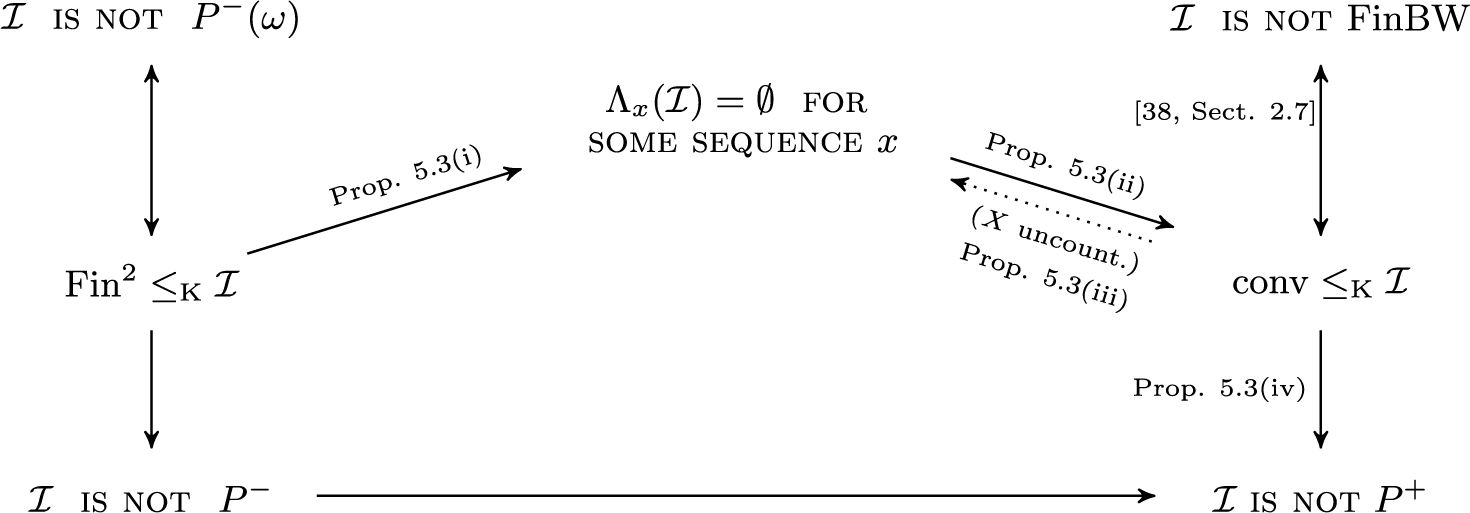


 Open access

