


Introduction
The study of human immunologic responses to infection relies on robust partnerships between basic scientists conducting experiments and clinicians caring for patients. In the United States, pediatric urgent care clinics are an evolving model of ambulatory care that offer an accessible, cost-effective option for the diagnosis and treatment of low-acuity illnesses in children [Reference Sankrithi and Schor1,Reference Conners, Kressly and Perrin2]. Because pediatric urgent care providers see a high volume of patients seeking care for respiratory infections [Reference Sankrithi and Schor1, 3, Reference El Feghaly, Sainz and Lee4], these settings are opportune for the recruitment and enrollment of children and their families into studies examining real-time immune responses. Yet pediatric urgent care settings are underutilized in clinical research and their overall viability as research sites is not well understood. As a follow-up to recent work showing robust T cell responses in breastmilk following maternal SARS-CoV-2 mRNA vaccination [Reference Armistead, Jiang and Carlson5], we sought to evaluate the response and function of breastmilk immune cells and antibodies during and after respiratory infection in infants and their mothers. Seattle Children’s Hospital Urgent Care (SCHUC) clinics provided a unique opportunity to meet this need. Like many other pediatric hospital-affiliated urgent care systems in the United States [Reference Sankrithi and Schor1, Reference El Feghaly, Sainz and Lee4, Reference Tennyson6], Seattle Children’s has multiple urgent care clinical sites that are utilized by populations across a broad geographic region. Further, SCHUC clinics see on average 35 infants per month 3 months of age or younger who present for care with symptoms consistent with respiratory infection. However, prior to our study, limited research infrastructure existed to recruit, enroll, and collect specimens from pediatric patients and their families seeking care in this setting.
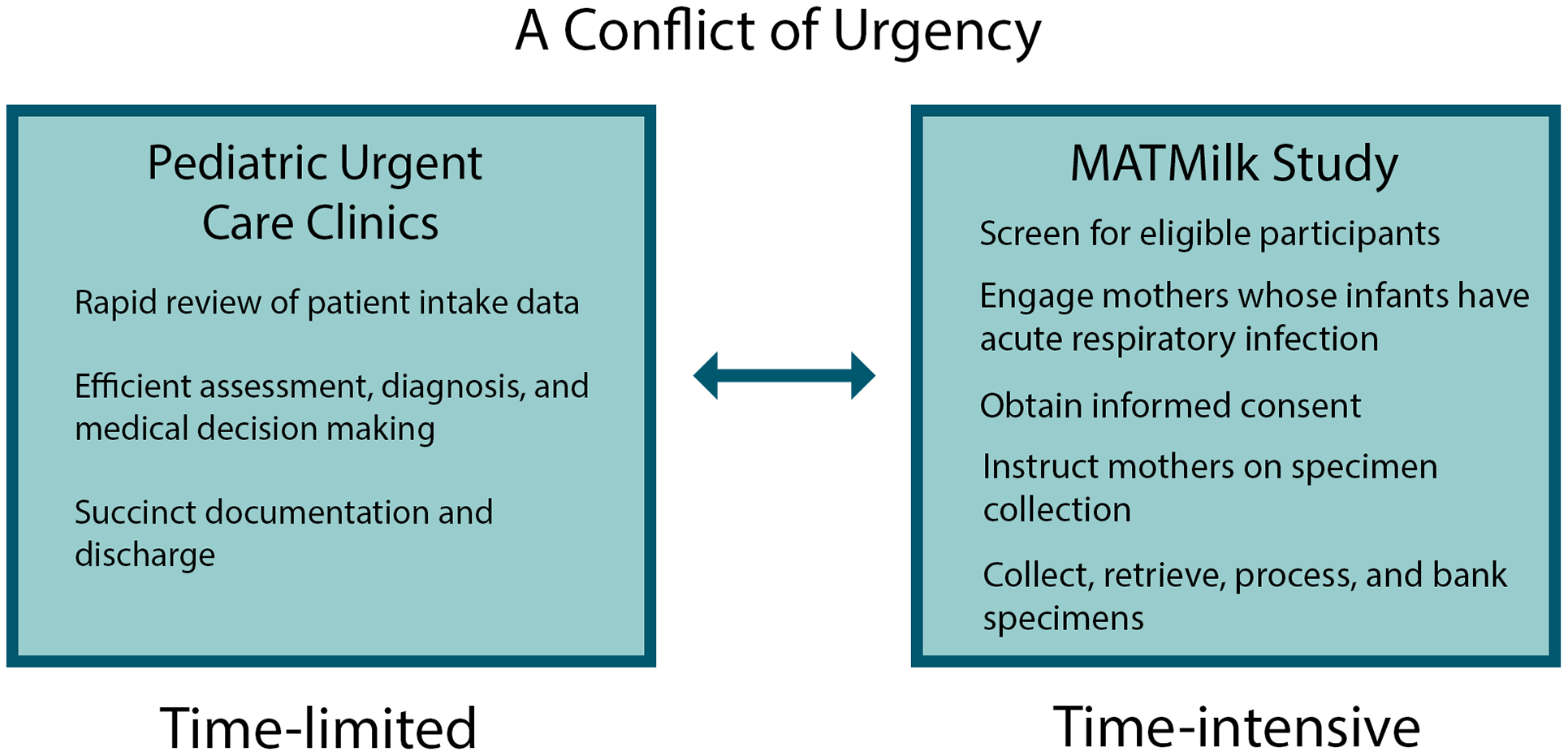
In this paper, we discuss designing and implementing our study (hereafter referred to as the MATMilk study) and building capacity for research within SCHUC clinics as a part of a broader effort to close the clinical-research gap. We present the challenges encountered through a central conceptual framework: a conflict of urgency, in which a fundamental tension exists between urgent care clinical workflow [Reference Montazeri, Multmeier, Novorol, Upadhyay, Wicks and Gilbert7, Reference Ross, S. and E.8] and the often-lengthy processes of participant recruitment, enrollment, and specimen collection (Figure 1). We share specific strategies that we used to resolve this problem, including team organization and task assignment as well as our two-phased study design that allowed for fully remote participant engagement. We report our enrollment to date and discuss the limitations and remaining challenges of our study. In sharing this work, our goal is to promote continued research partnerships between urgent care clinicians and basic scientists across many disciplines.
A conflict of urgency. The central challenge in implementing the MATMilk into the pediatric urgent care clinics was to manage contradicting priorities of urgency in the clinical versus human subjects research setting.

Methods
Study overview
To address the study’s scientific aims, we sought to enroll maternal-infant pairs who fell into one of three scenarios: 1) acute respiratory infection in infant but not mother; 2) acute respiratory infection in both infant and mother; and 3) no respiratory infection in either infant or mother. From each enrolled maternal-infant dyad, we aimed to collect breastmilk, nasal swabs from mother and infant, and infant saliva. All specimens needed to be transferred to the laboratory for processing within 8 hours of collection to preserve specimen viability. Because the frequency of immune cells in human milk is highest early in lactation [Reference Hassiotou, Geddes and Hartmann9–Reference Ballard and Morrow11] and to control for time since delivery, we chose to restrict enrollment to maternal-infant pairs within 3 months of delivery. Inclusion criteria were that the mother was 18 to 45 years of age with an infant child 3 months of age or younger and that the mother was lactating/producing milk. Exclusion criteria were primary or secondary immunodeficiency. Because our scientific question was based on understanding the dynamics of breastmilk immunological components during acute respiratory infection and later after recovery, we sought to enroll and receive specimens from maternal-infant pairs within 3 days of their urgent care encounter and collect follow-up samples from enrolled maternal-infant pairs 2 weeks after enrollment. In addition, we were motivated to capture a study population that reflected the racial and ethnic demographics of the community residing in the greater Puget Sound region, and we therefore targeted enrollment across the four SCHUC, namely Central Clinic (Seattle, WA), North Clinic (Everett, WA), East Clinic (Bellevue, WA), and South Clinic (Federal Way, WA).
Clinical-research team and responsibilities
We established a study team consisting of a clinical arm and a research arm. The clinical lead was a practicing physician who serves as the head of Seattle Children’s Division of Urgent Care. He acted as the liaison to clinical staff across the four SCHUC clinics and led the integration of the study into the Epic Electronic Medical Record (EMR) system to support study recruitment. This included implementing a Best Practice Advisory (BPA) to alert urgent care clinicians of potentially eligible participants in real time, standardizing documentation of recruitment discussions through custom SmartPhrases, and developing an Epic Workbench Report (RWB) to identify potentially eligible participants who received care at the SCHUC clinics within the previous 48 hours. The two research leads were principal investigators of basic science research laboratories at Seattle Children’s Center for Global Infectious Disease Research. They were responsible for managing the study’s administrative and laboratory frameworks, including drafting the Institutional Review Board (IRB) protocol and the project timeline, overseeing laboratory personnel, and standardizing specimen processing and banking for later experimental analyses. Bridging the clinical and research arms were the clinical research coordinators (CRCs), who contacted potentially eligible participants, conducted remote screening and enrollment, provided guidance to enrolled participants in the self-collection of specimens, and coordinated specimen transport to the laboratory. Study team members met weekly during study development and enrollment.
Two-phase study design
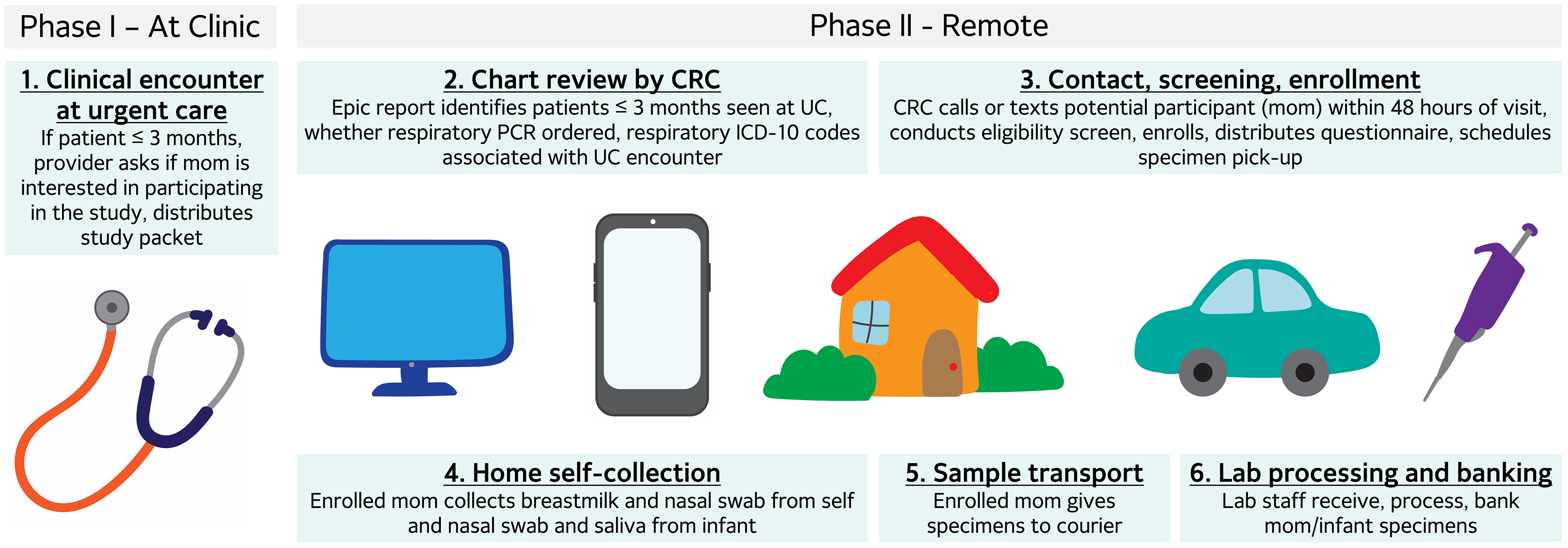
To capture the target population and specimens with minimal interruption of the urgent care workflow, we implemented a two-phase study design, which allowed participants to have a brief introduction to the study during their urgent care clinic visit and then complete enrollment and specimen collection remotely from their homes (Figure 2).
MATMilk study design. The two phases of the study allowed participants to engage in the study remotely without interruption to the urgent care encounter.

Phase I: Initial screening and engagement at the clinical site
Potential participants who met study enrollment criteria were first introduced to the study by the clinical provider during the urgent care encounter. Briefly, at each urgent care (UC) during the study period, a BPA populated the patient’s EMR if the patient was 3 months of age or younger and being treated at any of the four SCHUC sites. The BPA prompted the clinician to briefly introduce the patient’s mother (if she was in attendance) to the MATMilk study, ask if she was interested in participating, and if she answered in the affirmative, provide her with a study packet and record whether a study packet was given in the patient’s EMR using an Epic SmartPhrase. Each study packet contained materials for specimen collection at the acute infection timepoint (i.e., “Kit 1”) and two weeks later (i.e., “Kit 2”), after recovery from infection. In addition, each study packet contained a brief informational flyer about the study as well as instructions for collection of each specimen type. Specimen collection materials were pre-labeled with a unique study identification number, including a code that differentiated maternal samples from infant samples. Finally, the clinician informed the mother that a CRC would follow up with her about the study within the next 2 to 3 days, and the clinical encounter proceeded as usual. We estimated that using this approach, all study-related business could be completed by the clinician in less than one minute, with minimal disruption to the clinical workflow.
Phase II: Remote screening, outreach, enrollment, and specimen collection
We utilized the Epic RWB every 1–2 days to generate a list of patients 3 months of age or younger who presented for care at any of the four SCHUC clinics in the past 48 hours. For each potential participant, the CRC then entered the patient chart to determine whether permission to contact for research was granted. The CRC abstracted a contact number, any International Statistical Classification of Diseases and Related Health Problems, Tenth Revision (ICD-10) codes that were recorded in the chart from the patient encounter, whether a study packet was given, and whether a diagnostic respiratory PCR panel was ordered (and the result if documented). The CRC subsequently contacted each mother via phone call or text message (Appendix 1) via a web-based messaging system (Mosio, Inc.) to assess her interest in the study and to schedule a follow-up phone call. If requested, the CRC utilized Seattle Children’s Hospital interpreter services line to communicate by phone in a language other than English. On the call, the CRC confirmed that the mother met inclusion criteria and, if she was interested in participating, obtained informed consent and enrolled her and her infant in the study. If the participant had not received a study packet at her infant’s urgent care visit, one was scheduled to be delivered to her home via courier (Delivery Express Logistics, Inc.) on the same day.
After reviewing specimen collection instructions via phone, the CRC next scheduled the courier service to pick up Kit 1 from the participant’s home within 24 hours of enrollment and sent her an electronic enrollment questionnaire to complete on the same day as specimen collection via REDCap. The enrollment questionnaire included questions about maternal and infant symptoms in the past 48 hours, date of respiratory and other symptom onset, method and frequency of breastfeeding, and maternal and infant demographics. The courier retrieved the samples from the participant’s home and delivered them to the laboratory for processing and banking. After two weeks, the CRC recontacted the participant via phone call or text message, scheduled a second specimen (i.e., Kit 2) collection, at-home pick-up, and transfer to the lab, and sent her an electronic follow-up questionnaire. The follow-up questionnaire collected information on maternal and infant symptoms and breastfeeding methods/frequency in the time elapsed since enrollment. The CRC distributed a $25 cash card (Advarra, Inc.) to the mother for each kit donation via postal service.
Informed consent and study approval
The study was approved by Seattle Children’s Institutional Review Board (IRB #STUDY00005319). All mothers provided verbal informed consent for themselves and their infants.
Data analysis
Enrollment data were collected and stored in a secure REDCap database. De-identified data were analyzed and visualized using R Studio Pro (sf [Reference Pebesma12], tigris [13], ggplot2 [Reference Wickham14] packages) and GraphPad Prism.
Results
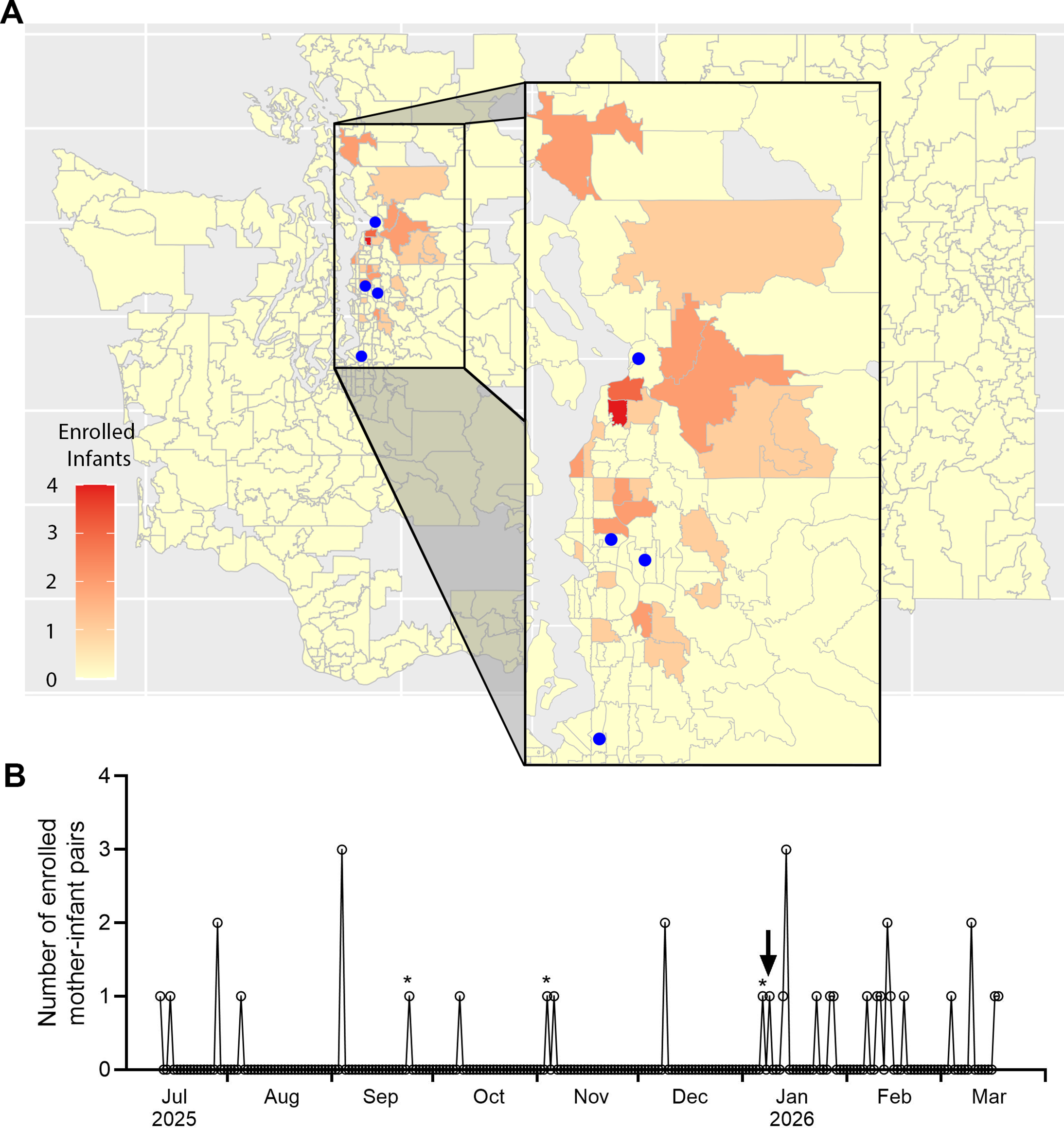
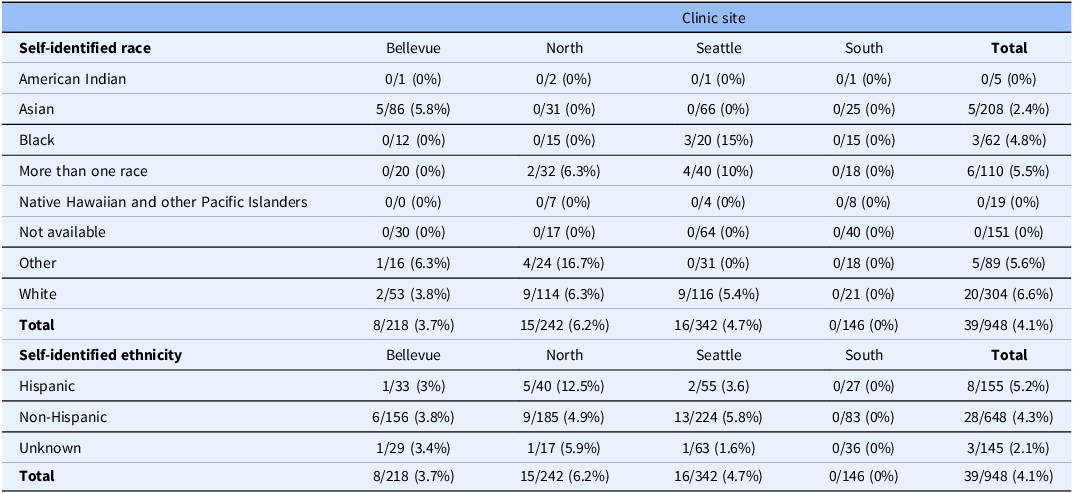
To evaluate the efficacy of our two-phase study design in enrolling the target population and obtaining the specimens required for the MATMilk study to date, we performed chart abstraction to compare the frequency and characteristics of potentially eligible participants to enrolled participants. Epic RWBs using the specified criteria from 7 July 2025 to 15 March 2026 generated a list of n = 948 unique infants. In this time frame, we enrolled 39 infants and 36 mothers into the MATMilk study, including three pairs of twins. Most of the potentially eligible infants were seen at the Seattle Urgent Care clinic location (n = 342), of whom 16 (4.7%) were enrolled in the study, along with their mothers. At the North clinic, 15 of the 242 (6.2%) potentially eligible infants were enrolled in the study with their mothers, and at the Bellevue clinic, 8 of the 218 (3.7%) potentially eligible infants were enrolled in the study with their mothers. None of the 146 potentially eligible infants who were seen at the South clinic or their mothers were enrolled in the study. Despite no enrollments from those who sought care at the South clinic, enrolled maternal-infant pairs resided across the Puget Sound region (Figure 3(A)), emphasizing our study’s broad catchment. In addition, the population of potentially eligible infants seen at the four SCHUC clinics were racially and ethnically diverse, which is reflected in our enrolled cohort to date (Table 1).
Enrollment in the MATMilk study to date. (A) Distribution of mothers enrolled in the MATMilk study by United States ZIP codes relative to Seattle Children’s Urgent Care clinic sites (blue dots). (B) Number of enrolled maternal-infant pairs over time. Asterisks represent twins. Downward arrow shows when method for contacting mothers after their infant’s urgent care visit was switched from phone call to text messaging.

Figure 3. Long description
Panel A: A map shows the distribution of mothers enrolled in the MATMilk study by United States ZIP codes relative to Seattle Children’s Urgent Care clinic sites, marked with blue dots. The map uses a color gradient to indicate the number of enrolled infants, ranging from light yellow (0 infants) to dark red (4 infants). Panel B: A line graph displays the number of enrolled maternal-infant pairs over time from July 2025 to March 2026. The x-axis represents the months, and the y-axis represents the number of enrolled pairs. Asterisks mark the enrollment of twins, and a downward arrow indicates when the method for contacting mothers was switched from phone calls to text messaging.
Self-identified racial and ethnic demographics of infants who were enrolled in the MATMilk study relative to those who were identified in Epic RWBs. Data are expressed as enrolled infants/potentially eligible infants (%)

When we evaluated enrollment of mother-infant pairs over time, we found that over half of maternal-infant pairs within the defined timeframe were enrolled after January 2026 (Figure 3(B)). Notably, the increased rate of enrollment coincided with changing our primary method of contacting mothers from phone to text message. Among enrolled participants, 7 infants and 6 mothers (one set of twins) were lost to follow-up after enrollment and either did not contribute a set of specimens for Kit 1 or did not complete the enrollment questionnaire. The average time between urgent care visit and study enrollment was 3 days (minimum 0, maximum 9), and the average time between urgent care visit and Kit 1 specimen delivery to the laboratory was 8 days (minimum 2, maximum 22).
Based on maternal symptomatic report and PCR of maternal and infant nasal swabs (BioFire Respiratory 2.1 Panel, bioMérieux), n = 6 maternal-infant pairs were assigned to the study group, “acute respiratory infection in infant but not mother,” n = 15 infants (two sets of twins) and their mothers (n = 13) were assigned to the study group, “acute respiratory infection in both infant and mother,” and n = 11 maternal-infant pairs were assigned to the control group, “no respiratory infection in either infant or mother.” Of the pairs designated to a study group, 2 were lost to follow-up and did not contribute a set of specimens for Kit 2 and did not complete the follow-up questionnaire. To date, we have collected complete sample sets (i.e., Kit 1 and Kit 2 specimens plus enrollment and follow-up questionnaires) from 30 infants (two sets of twins) and 28 mothers.
Discussion
Pediatric urgent care clinics are often a frontline for treating low-acuity infant infections [Reference Sankrithi and Schor1, 3, Reference El Feghaly, Sainz and Lee4] and are therefore an opportune setting to recruit and enroll participants to participate in basic science research related to maternal-child health, immunology, and infectious diseases. Yet they are underutilized for the recruitment of participants for research, likely in part due to the conflicting time demands of urgent care clinical practice and human subjects research (Figure 1). Through the implementation of the MATMilk study, we demonstrate that pediatric urgent care clinics are feasible sites for basic science-clinical research partnerships that can be integrated with minimal disruption to clinical workflows.
Central to the study’s viability was our team structure, which addressed the unique demands of both the pediatric urgent care and laboratory. The presence of a clinical lead was essential for garnering buy-in from frontline clinical staff and ensuring that the research protocols were complementary to, rather than competitive with, the clinical workflow. The CRCs served as critical liaisons between the clinical encounter and remote research phases of the study, helping resolve the inherent conflict of urgency between the clinical and research settings by facilitating complete remote participation. Finally, the research leads ensured that the infrastructure was in place to process and bank specimens on an intermittent basis, which was dictated by the unpredictable nature of enrollment and specimen delivery.
While the biphasic study design (i.e., the “at clinic” and “remote” phases) primarily served to avoid disruption to the clinical care workflows and preserve human subjects research methods, they offered additional benefits to our study. For instance, enrolled mothers were able to express breastmilk and collect nasal and saliva swabs privately from their homes at the time of their choosing. This removed several barriers to participation, including being asked to stay after their infant’s urgent care encounter to enroll and collect specimens, to use pumping equipment unfamiliar to them, or to return for in-person visits. In addition, our study design removed the need for onsite presence of a CRC, enabling simultaneous recruitment across four distinct urgent care sites, which expanded our participant catchment area and diversity (Figure 3, Table 1). Despite the high cost of the courier service for study packet transport across a large region, we were able to incorporate this specimen delivery model into our study due to reduced personnel costs; because the CRC was not physically present in the clinics, we were able to allocate 0.4 CRC full-time equivalent (FTE), resulting in a substantial reduction in personnel costs typically required for multi-site human subjects research [Reference Tyson, Harvey, Forney and Brinton15].
Even with these strengths, our study design brought distinct challenges. At the early phases of our study, we found that it was difficult to engage potential participants through traditional phone calls. Transitioning to text-based outreach substantially improved enrollment, emphasizing its utility for engaging parents of infants following an acute care visit. A recent study found that text messaging is accessible to and frequently used by >90% of caregivers of young children recruited from pediatric primary care offices [Reference Wynn, Fiks and Localio16], further underscoring the value of text messaging in reaching diverse populations and reducing barriers to study enrollment in pediatric care settings. In addition, in most instances we fell short of our goal to enroll and collect Kit 1 specimens from participants within 3 days of the urgent care clinical encounter, largely due to logistical delays in scheduling specimen pick-up from participants’ homes and delivery to the laboratory. These delays, along with our inability to directly capture maternal history through chart abstraction, emphasize the necessity of utilizing both symptom- and diagnostic-test-based approaches to confirm the placement of participants into our study groups of interest. Finally, the lack of enrollment from the South Clinic remains an area for further investigation. Hypotheses explaining this gap include differing sociodemographic barriers to remote outreach, our text message script being available only in English, and variations in clinical staff engagement with potential participants.
Conclusion
The MATMilk two-phase study design demonstrates a scalable, resource-efficient approach to integrating basic science research into the pediatric urgent care setting and is particularly relevant to children’s hospital systems seeking to promote clinical research partnerships.
Supplementary material
The supplementary material for this article can be found at https://doi.org/10.1017/cts.2026.10773.
Acknowledgements
Gemini 3 (Alphabet Inc.) was utilized as a tool to assist with command syntax for RStudio Pro. The authors are entirely responsible for the scientific content of this article. We thank Dr Janet Englund and Dr Eileen Klein for their guidance and mentorship during the design of our study. We also thank our study participants and the SCHUC staff.
Author contributions
John J. Santos: Conceptualization, Funding acquisition, Methodology, Project administration, Resources, Supervision, Writing-review & editing, Alexandra C. Keefe: Data curation, Formal analysis, Validation, Writing-review & editing, Richard Torres: Investigation, Methodology, Project administration, Gerson Zaragoza: Investigation, Methodology, Project administration, Caitlin Ginn: Investigation, Methodology, Nia Barr-Jeffrey: Investigation, Methodology, Holly Barrett: Investigation, Methodology, Writing-review & editing, Phoenicia Quach: Investigation, Methodology, Katherine Grubb: Investigation, Methodology, Whitney E. Harrington: Conceptualization, Funding acquisition, Methodology, Project administration, Resources, Supervision, Writing-review & editing, Blair Armistead: Conceptualization, Data curation, Formal analysis, Funding acquisition, Investigation, Methodology, Project administration, Resources, Supervision, Validation, Visualization, Writing-original draft, Writing-review & editing.
Funding statement
This work was supported by the United States National Institutes of Health (BA, grant K99AI182458); the Seattle Children’s Research Institute Career Development Award (BA); and the Seattle Children’s Clinical & Research Synergy Pilot Award Program (JJS, WEH).
Competing interests
The authors declare none.


 Open access

