


1. Foundations for adaptive prosthesis design and stakeholder collaboration
The design, development, and management of prosthetic devices require a complex interplay of technical innovation, stakeholder collaboration, and user-centred approaches. Amputees, prosthetists, physiotherapists, designers, and technicians each bring distinct expertise to meet the evolving physical, emotional, and functional needs of users. However, current prosthesis design and development remains largely fragmented, relying on manual processes and isolated stakeholder decision-making. This lack of effective frameworks for integrating stakeholder collaboration (Reference Gavette, McDonald, Kostick-Quenet, Mullen, Najafi and FincoGavette et al., 2023) and real-time data from smart prosthetics, results in inefficiencies, higher costs, and reduced user satisfaction.
Despite advances in materials and embedded sensors (Alluhydan et al., Reference Alluhydan, Siddiqui and Elkanani2023; AlQahtani et al., Reference AlQahtani, Al-Naib and Althobaiti2024; Guo et al., Reference Guo, Lu, Wu, Hu and Yang2024), the integration of real-time data and stakeholder collaboration throughout the prosthesis life-cycle remains limited. Prosthetists, engineers, and healthcare providers often operate in silos limiting collaboration, making reactive adjustments based on patient feedback rather than data-driven, proactive optimisation. While technologies such as sensor-based monitoring, AI-driven analysis, and digital twins have emerged, they are typically used in isolation, lacking a unified decision-support. This results in inefficiencies, increased costs, misaligned patient requirements and suboptimal outcomes. The dynamic nature of amputee needs, shaped by physical changes, emotional well-being, and lifestyle demands, further complicates development.
Effectively addressing the complexities of prosthesis design and management to cater for evolving amputee needs, necessitates an integrated, adaptive approach that bridges interdisciplinary collaboration and leverages real-time insights from advanced prosthetic technologies. Grounded in ontology-driven design principles, stakeholder-centred frameworks formalise relationships among concepts, stakeholders, and processes, fostering a shared understanding that supports informed decision-making and user-centric outcomes.
To address these challenges, this paper introduces the Ontology-Driven Consequence Mapping Model (ODCMM), a component of the Adaptive Prosthesis Life-Cycle Service System (adProLiSS) framework (Reference Patiniott, Borg, Francalanza, Vella, Zammit, Gatt and Paetzold-ByhainPatiniott, Borg, Francalanza, Vella, Zammit, Gatt, & Paetzold, 2023). The ODCMM provides a structured ontology-driven methodology to support real-time, evidence-based decision-making, stakeholder collaborative design (Boukhris et al., Reference Boukhris, Fritzsche and Möslein2017; Robert et al., Reference Robert, Donetto and Williams2021; Sanders & Stappers, Reference Sanders and Stappers2008; Steen et al., Reference Steen, Manschot and De Koning2011), AI-based insights, and consequence mapping in prosthesis design. While adProLiSS integrates collaborative design, cyber-physical systems (Reference Seppich, Tacca, Chao, Akim, Hidalgo-Carvajal, Pozo Fortunić, Tödtheide, Kühn and HaddadinSeppich et al., 2022), Product-Service Systems (PSS) principles in healthcare (Haber & Fargnoli, Reference Haber and Fargnoli2021; Mittermeyer et al., Reference Mittermeyer, Njuguna and Alcock2011), and ontology-driven methodologies (Baclawski et al., Reference Baclawski, Chan, Gawlick, Ghoneimy, Gross, Hua Liu and Zhang2017; Haridy et al., Reference Haridy, Ismail, Badr and Hashem2023; McMahon & Van Leeuwen, Reference McMahon and Van Leeuwen2009; Nico, Reference Nico1997) into a unified framework, the ODCMM specifically enables stakeholders to visualise and evaluate the design, development, maintenance, and operational decisions in real time. This is achieved through real-time data from smart prosthetics, consequential knowledge (Reference Borg and FarrugiaBorg & Farrugia, 2014) from design synthesis, and knowledge from stakeholders, collectively forming experiential knowledge (Reference KolbD. A. Kolb, 2014).
By integrating experiential knowledge, digital modelling, and live patient-prosthesis data, the ODCMM bridges the gap between intuition-driven traditional prosthesis design and data-driven decision-making (Reference Patiniott, Borg, Francalanza, Vella, Zammit, Gatt and Paetzold-ByhainPatiniott et al., 2024), the ODCMM fosters better communication, aligns multidisciplinary efforts, and ensures prostheses remain adaptable, cost-efficient, and user-centred. This approach enhances functionality, adaptability, cost management, and aftercare while supporting the user’s evolving physical and emotional needs through complementary services such as maintenance, rehabilitation, and emotional support.
2. Literature review: positioning the research
This section reviews the state-of-the-art in prosthesis design methodologies, ontology-driven frameworks, and decision-making models, highlighting key challenges and advancements.
2.1. Limitations of traditional prosthesis design
Traditional prosthesis design follows a manual and experience-based approach (Reference BlijBlij, 2024; Reference MaroneyMaroney, 2016), relying on prosthetists’ craftsmanship and intuition rather than structured, data-driven methodologies. While this expertise-driven approach allows for customisation, it lacks systematic evaluation frameworks that incorporate real-time data and predictive modelling. As a result, prosthesis design process remains highly iterative and reactive, relying on patient feedback to guide modifications post-fitting. This leads to extended adjustment periods, increased costs, and inconsistent outcomes, as refinements are based on subjective assessment rather than objective performance metrics. Additionally, the absence of a formal decision-support system means that critical factors, such as prosthesis wear patterns, biomechanical alignment, and physiological responses, are overlooked. This increasing the risk of discomfort, improper fit, and long-term complications for amputees.
2.2. Advancements in digital prosthesis development
Recent innovations in smart prosthetics, digital twins, and ontology-based frameworks have significantly improved prosthesis monitoring and adaptation. Companies such as Ossur, which offers advanced prosthetic solution (Our Products. Ossur. Com, 2025), and SnapformTech, which utilises 3D scanning technology for more precise socket fitting (Reference Andersen and BorresenAndersen & Borresen, 2019), integrate sensor-based monitoring and computational design techniques to enhance prosthesis development. These technologies reduce reliance on trial-and-error modifications, enabling data-driven, personalised solutions for amputees. However, despite these advancements, existing digital tools remain largely isolated from the decision-making process and prosthesis life-cycle management, limiting their impact on stakeholder collaboration and long-term prosthesis performance.
2.3. The need for an ontology-driven approach
While digital innovations improve prosthesis design, they lack a structured framework for capturing design consequences across multiple disciplines. The Ontology-Driven Consequence Mapping Model (ODCMM) in Figure 1, addresses this gap by providing a systematic, ontology-driven methodology for informed decision-making. Unlike prior models, ODCMM integrates real-time patient-prosthesis data, stakeholder expertise, and consequence evaluation into a dynamic, data-driven framework, ensuring prosthesis design evolves proactively rather than reactively.
The Ontology-Driven Consequence Mapping Model

3. The Ontology-Driven Consequence Mapping Model
The Ontology-Driven Consequence Mapping Model (ODCMM) in Figure 1, represents a significant advancement in integrating ontological frameworks and artificial intelligence (AI) into prosthesis development. Building on previous work (Reference Patiniott, Borg, Francalanza, Vella, Zammit, Gatt and Paetzold-ByhainPatiniott, Borg, Francalanza, Vella, Zammit, Gatt, & Paetzold-Byhain, 2023), the ODCMM enhances decision-making by providing a structured ontology-driven methodology with an AI-driven implementation (Reference Patiniott, Borg, Francalanza, Vella, Zammit, Gatt and Paetzold-ByhainPatiniott et al., 2024). It defines complex relationships, processes, and data, improving communication and consistency among stakeholders, including prosthesis designers, engineers, healthcare providers, and patients (Reference GruberGruber, 1993). The ODCMM process was initially derived from existing literature on design methodologies (Reference Agius, Farrugia and FrancalanzaAgius et al., 2021; Reference BorgBorg, 1999) but was adapted to address deficiencies identified through stakeholder discussions with prosthetists, amputees and other key decision-makers. These refinements ensure the model better aligns with real-world decision-making challenges, enhancing its applicability within the prosthesis development life-cycle.
The adProLiSS Intelligent Knowledge Base System (aIKBS) (Reference Patiniott, Borg, Francalanza, Vella, Zammit, Gatt and Paetzold-ByhainPatiniott et al., 2024) processes foundational data in real-time, making insights accessible to stakeholders and enabling collaborative evaluation of design, maintenance, and operational decisions and their potential consequences, during prosthesis development. By offering real-time insights into design implications, the ODCMM allows stakeholders to evaluate trade-offs and refine their decisions, optimising the prosthesis life-cycle.
3.1. Defining the structure of the Ontology-Driven Consequence Mapping Model
Traditional prosthesis design and development follows a linear, reactive process, where prosthetists collaborate with amputees to assess their current needs and propose solutions composed of standardised sub-systems (such as prosthetic knees, ankles, and feet) and a customised socket. Adjustments are made reactively after the amputee identifies an issue, limiting the role of prosthetists and other stakeholders, in addition to data-driven insights (Reference Patiniott, Borg, Francalanza, Vella, Zammit, Gatt and Paetzold-ByhainPatiniott, Borg, Francalanza, Vella, Zammit, Gatt, & Paetzold, 2023) during the design and decision-making process. This reactive process lacks systematic evaluation frameworks, excluding valuable insights and experience from key stakeholders.
The ODCMM (Figure 1) facilitates a collaborative and multidisciplinary approach, addressing these limitations by integrating experiential knowledge into prosthesis design and development allowing key stakeholders to make informed choices based on collective expertise and real-time data. The model systematically captures both intended and unintended consequences of past design decisions, operational interactions with stakeholders and live patient-prosthesis data. This ensures an adaptive, data-driven, multidisciplinary approach that improves patient-centred outcomes (Reference Roozenburg and EekelsRoozenburg & Eekels, 1995). This provides stakeholders with a dynamic and evolving understanding of the functional, emotional, and systemic impacts of their decisions, ensuring a proactive, data-informed approach to prosthesis development, promoting more adaptable and patient-centred outcomes.
3.1.1. The design phase in prosthesis development: a collaborative and iterative approach
The Design Phase in product development, as outlined by (Reference Roozenburg and EekelsRoozenburg & Eekels, 1995), follows a structured and iterative approach to solving complex design challenges. This process involves problem analysis, synthesis, evaluation, and decision-making, translating abstract needs into functional solutions. In prosthetic design, it ensures that key decision-makers, including amputees, their families, prosthetists, prosthesis technicians, designers and physiotherapists, collaborate to collectively understand and address both technical prosthesis requirements and evolving amputee needs.
The initial stage, Analysis of Amputee Needs, involves key decision-makers collaboratively assessing amputee specific physical and emotional requirements, and technical prosthesis requirements to define the design criteria. This being essential for framing the problem and establishing the criteria that will guide subsequent design choices. The key decision-makers then evaluate the available design options, seeking the best-fit solutions that align with the identified needs of the amputee.
The process then moves to Synthesis Decision Commitment (Reference Agius, Farrugia and FrancalanzaAgius et al., 2021), where alternative designs are generated, analysed, and refined. During this stage, different inputs (such as functional needs, aesthetic preferences, and technical limitations) are synthesised to form a range of potential solutions. These options are then critically evaluated by the decision-makers, selecting options that best address the amputee’s requirements. The concept of commitment here refers to the collective endorsement of a particular design, ensuring that it will be carried forward for further development. For example, when designing a prosthetic knee, the synthesis decision commitment might involve selecting a design concept that balances durability with weight considerations. This step is critical for ensuring that decisions are based on comprehensive analysis, which reduces the likelihood of unintended consequences later in the development process.
This is followed by the Decision Commitment Action (Reference Agius, Farrugia and FrancalanzaAgius et al., 2021), where decisions made during the earlier phases are translated into concrete actions. This transition from the deliberative phase to the operational phase is crucial for ensuring that the chosen prosthesis design moves forward into realisation. The decision commitment action phase requires a deliberate allocation of resources, time, and effort to execute the selected solution. For example, in prosthesis socket material selection, the decision commitment action involves procuring the material, adapting manufacturing processes, and initiating production. This phase ensures that the theoretical design decisions are effectively implemented in practice, bridging the gap between conceptual planning and the physical realisation of the prosthesis. It is essential for maintaining the momentum of the design process and ensuring that the prosthesis is developed in line with the goals and requirements identified in earlier stages.
Thus, the systematic approach to the Design Phase, including stages such as problem analysis, synthesis decision commitment, and decision commitment action, ensures that prosthesis design is not only driven by technical considerations but also considers the multifaceted needs of the amputee. By involving key stakeholders at each stage, this process fosters collaboration, informed decision-making and reduces unintended consequences, supporting the development of prosthetic devices that are functional, comfortable, and responsive to the changing needs of the user.
3.1.2. The prosthesis artefact model
According to Pahl and Beitz (Reference Pahl, Beitz, Feldhusen, Grote, Wallace and BlessingPahl et al., 2007), engineering artefacts are dynamic systems that evolve through iteration and testing, following stages of concept generation, design specification, prototyping and refinement, to meet both functional and emotional user needs. A prosthesis fits this definition, as it is shaped by engineers, designers, healthcare provides, and the patient, integrating functional design (e.g., joint articulation, weight distribution) with sensory feedback systems (e.g., real-time monitoring of residual limb health and alignment) necessary for effective and adaptive use by the amputee. This aligns with Buchanan’s Reference Buchanan(1992) “wicked problems” concept, where prosthesis design requires iterative, user-centred development, involving stakeholder collaboration and continuous feedback loops to optimise the artefact. As a cyber-physical system, a prosthesis combines embedded sensors, smart materials, and digital representations, allowing for prosthesis performance simulations under different conditions and environments and real-time adjustments. The integration of real-time patient data with digital twins enables designers and clinicians to refine the prosthesis and its supporting systems, ensuring adaptability to the amputee’s evolving needs. This iterative, feedback-driven process allows the prosthesis to evolve as an artefact through each stage of the life cycle, from initial design through to long-term aftercare.
Beyond the physical device, the prosthesis artefact encompasses the entire system in which it operates, including data systems, support structures, the relationships between the user and the prosthesis, and ongoing prosthesis maintenance and adaptation. The prosthesis artefact is a dynamic object that bridges both the physical and digital worlds. Cross Reference Cross(2021) highlights that engineering artefacts are shaped by human needs, societal context, and technological constraints. In prosthetic design, these factors are critical, the artefact must not only be functional but also enhance the amputee’s quality of life, addressing their emotional, social and psychological needs.
3.1.3. Real time Patient-Prosthesis Data
Real-time Patient-Prosthesis Data is continuously acquired through embedded sensors within the prosthetic device. These sensors monitor both amputee health parameters (such as residual limb condition and weight distribution) and prosthesis performance (such as joint articulation, structural integrity, and alignment accuracy), providing a comprehensive understanding of the dynamic interaction between the patient and the prosthesis. This data is processed and analysed by the adProLiSS Intelligent Knowledge-Based System (aIKBS) (Reference Patiniott, Borg, Francalanza, Vella, Zammit, Gatt and Paetzold-ByhainPatiniott et al., 2024), using algorithms and knowledge modelling techniques to convert raw sensor data into actionable insights. These insights support a personalised and adaptive service framework, addressing patient needs in real time by enabling swift adjustments or interventions to optimise prosthesis functionality and patient comfort.
Additionally, real-time data integration facilitates the use of digital twins (Reference BattyBatty, 2018) in the design, development and management of lower-limb prostheses. Digital twins (virtual replicas of physical systems) can simulate and predict prosthesis performance under various real-world conditions. The integration of live data makes it possible to test design modifications, predict potential failures, and optimise functionality in the design phase before implementing changes to the physical prosthesis. This approach not only enhances the efficiency of the prosthesis development process but also supports continuous improvement by iteratively refining both the physical and digital systems in response to patient needs.
3.1.4. Decision consequences
Effective decision-making during the design phase of a prosthetic device has long-term implications for both the amputee and the prosthesis throughout the entire prosthesis life-cycle (Abrams, Reference Abrams2002; Borg et al., Reference Borg, Yan and Juster2000; Couturier et al., Reference Couturier, Lô, Imoussaten, Chapurlat and Montmain2014; Walsh et al., Reference Walsh, Dong and Tumer2019). Each decision involves selecting a range of potential design options, each aimed at achieving a specific set of desired outcomes (intentional consequences), such as optimised functionality, enhanced user comfort, and improved cost-efficiency. However, these outcomes are not always predictable (unintended consequences), as external and interdependent factors, and meeting experiences (Reference Eckert, Maier and McMahonEckert et al., 2005; Reference Huet, McMahon, Sellini, Culley, Fortin, S, M and PHuet et al., 2007) influence their effectiveness. These factors include environmental conditions, patient-specific physiological changes, and unforeseen patient-prosthesis interactions. Consequently, decision-makers (such as prosthetists, amputee and physiotherapists) must navigate inherent uncertainties when selecting solutions, as unintentional consequences can arise, leading to reduced durability, increased discomfort, or heightened maintenance requirements, negatively impacting amputees’ overall quality of life. Both intentional and unintended consequences, observed by various stakeholders, provide valuable insights, enabling evidence-based refinements in future design iterations. By systematically evaluating these consequences, stakeholders can develop more adaptive, user-centred prosthetic solutions that minimise risks and enhance long-term usability and patient well-being.
3.1.5. Resulting experiential knowledge
The integration of Real-Time Patient-Prosthesis Data and the observed Decision Consequences contributes to the development of Experiential Knowledge (A. Y. Kolb & Kolb, Reference Kolb and Kolb2009; D. A. Kolb, Reference Kolb2014; Long et al., Reference Long, Yen and Van Hanh2020; Mechouat, Reference Mechouat2024), capturing cumulative insights from past prosthesis design. This experiential knowledge forms a comprehensive record of the stakeholder interactions and meetings with the prosthesis (Reference Eckert, Maier and McMahonEckert et al., 2005; Reference Huet, McMahon, Sellini, Culley, Fortin, S, M and PHuet et al., 2007), and live operational feedback. These interactions involve collaboration among amputees, prosthetists, prosthesis technicians, physiotherapists, and engineers, as well as the integration and performance of prosthetic sub-systems. By embedding experiential knowledge into the decision-making process, key stakeholders gain data-driven insights, enabling more informed, evidence-based decisions. The framework also serves as an educational tool, allowing decision-makers to explore the complexities of prosthesis design and aftercare challenges through ‘what-if’ scenarios, enabled by the framework’s digital twin capabilities (Reference BattyBatty, 2018). These simulations model real-world conditions and outcomes of various design choices, highlighting intended and unintended consequences, and further understanding evolving amputee needs throughout each stage of the prosthesis life-cycle. This real-time feedback loop bridges the gap between theoretical knowledge and applied practice, supporting continuous improvement throughout design and re-design phases. By minimising unintended consequences, this approach fosters the development of adaptive, resilient prosthetic solutions that align with amputees’ evolving physical, emotional, and functional needs.
4. Implications of the Ontology-Driven Consequence Mapping Model
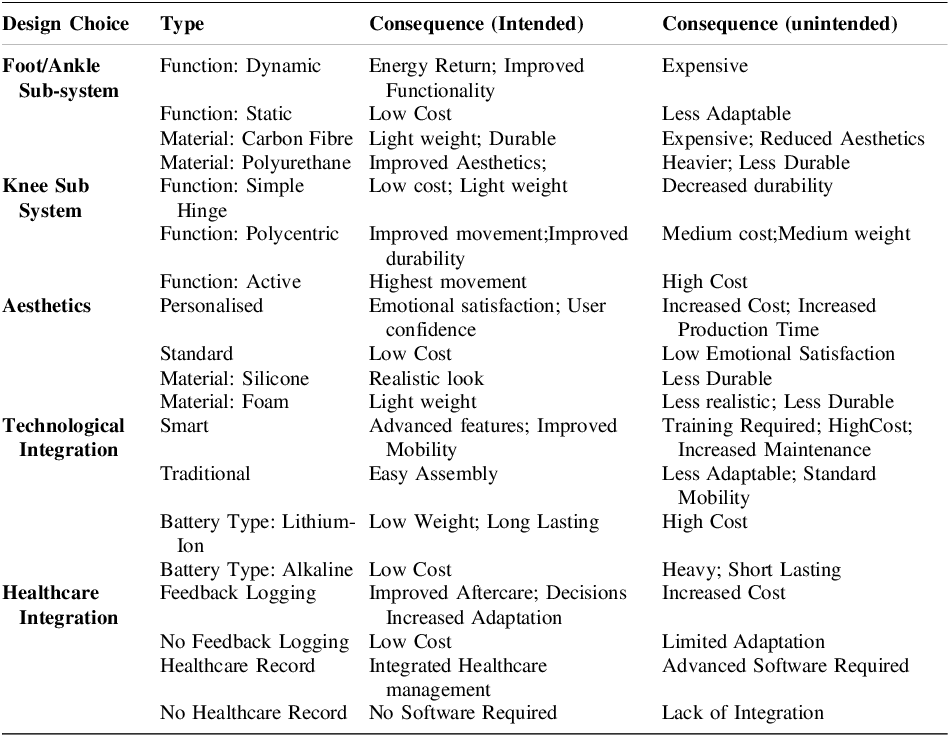
The Ontology-Driven Consequence Mapping Model (ODCMM) integrates experiential knowledge into the decision-making process, enabling key prosthesis designers and stakeholders to make more informed, effective choices. Table 1 presents a representative subset of the numerous design decisions involved in prosthesis development, illustrating how each choice impacts functionality, comfort, durability and user experience. The decision-making process begins with selecting a prosthesis sub-system, which determines subsequent design choices, such as functionality type and material selection. Once decisions are made, stakeholders receive insights into both intended and unintended consequences, allowing them to anticipate potential trade-offs and adjust their choices accordingly.
Design choice consequences

4.1. Trade-offs in prosthesis design
Figure 2 illustrates the foot/ankle sub-system as an example of how design trade-offs shape prosthesis performance. A dynamic function provides enhanced energy return and adaptability, making it ideal for active users, but comes at a higher cost. Conversely, a static function lowers costs but sacrifices adaptability, limiting usability for individuals with varying activity levels. Material selection further demonstrates these trade-offs. Carbon fibre enhances mobility and durability but increases cost and may reduce aesthetic appeal. Polyurethane, on the other hand, provides a more natural appearance but introduces increased weight and lower durability. These choices highlight how technical, economic, and user-centred factors must be carefully balanced.
Decision choice consequence tree

4.2. Enhancing Decision-Making through the ODCMM
The ODCMM supports stakeholders in visualising the consequences of their decisions, ensuring a comprehensive understanding of how each choice influences the prosthesis life-cycle. By surfacing both intended and unintended consequences, the model fosters an iterative, data-driven approach to prosthesis design, reducing trial-and-error modifications. By integrating real-time data, stakeholder expertise, and consequence analysis, the ODCMM ensures prosthesis designs are not only technically optimised but also aligned with the evolving physical, emotional and functional needs of amputees. This systematic design-support tool enhances collaboration, improves users’ satisfaction, and minimises costly design errors, contributing to more adaptable and patient-centred prosthetic solutions
5. Concluding remarks: impact and future work
The ODCMM within the adProLiSS framework represents a significant advancement in prosthetic design, development, and management. By integrating real-time data sharing and collaborative decision-making, adProLiSS addresses the fragmentation typical in traditional prosthesis design, ensuring that stakeholders no longer work in isolation. This interdisciplinary approach improves communication, aligns design decisions with user needs, and supports more informed, data-driven. A key advantage of ODCMM is its ability to model both intended and unintended consequences, allowing for proactive decision-making regarding cost, comfort, and functionality. Additionally, the adaptive nature of adProLiSS ensures that prosthetic devices evolve in response to changes in user needs. Smart prosthetic data enables timely modifications, such as adjusting socket alignment to maintain comfort when residual limb changes occur. This adaptability improves long-term prosthesis functionality, enhances user satisfaction, and fosters a sense of security and well-being.
Beyond functionality, the cost-efficiency of is another major benefit. The data-driven approach mitigates high development and maintenance costs by using predictive maintenance and real-time monitoring to detect potential issues early. Simulating alternative design choices before implementation further reduces unnecessary expenses, ensuring quality, functionality, and affordability in prosthetic solutions.
To validate adProLiSS in real-world applications, future work will focus on integrating advanced digital modelling tools, such as Knowledge-Intensive CAD (KICAD) systems (Ramos Barbero et al., Reference Ramos Barbero, Melgosa Pedrosa and Castrillo Peña2018; Tomiyama’ & He~, Reference Tomiyama’ and He~2000; Yip\ et al., Reference Yip, Law, Cheng and Lau2004; Zhang & Wang, Reference Zhang and Wang2024). These tools enable stakeholders, including prosthetists, designers, and amputees, to visualise and evaluate prosthetic designs in real-time, supporting collaborative decision-making. By incorporating such tools, the adProLiSS framework can support real-time simulations of design modifications, allowing decision-makers to assess both intended and unintended consequences dynamically. This integration would also streamline development, reduce errors, and improve final prosthesis outcomes through continuous feedback loops. Evaluating adProLiSS across diverse patient profiles and prosthetic requirements will further ensure its adaptability and effectiveness in real-world settings. By refining adProLiSS and integrating advanced digital modelling tools, this framework can drive a paradigm shift in prosthesis design, enhancing patient outcomes and interdisciplinary collaboration, ensuring more efficient, cost-effective, and user-centred solutions for amputees worldwide.
Acknowledgements
The research reported in this paper is funded through R&I-2024-013L as part of the project PREMIERTOGO.



 Open access

