1.1 What Is Motivation?
The term ‘motivation’ refers to the processes that give energization and direction to behaviour (Korn & Elliot, Reference Korn, Elliot and Wright2015). It describes what moves an animal into action and the strength and persistence of such action (‘exertion of effort’). The goal-directed nature of behaviour is a manifestation of motivation, expressed in behaviour’s purposive and flexible nature. Motivation plays a role in determining which goal will take control of behaviour (‘instigation’), sometimes in the face of obstacles and competition (Salamone & Correa, Reference Salamone and Correa2024). Motivation is also associated with ‘arousal’ and ‘activation’, as expressed most clearly in the dimension of sleep and wakefulness (Kaźmierczak & Nicola, Reference Kaźmierczak and Nicola2022).
Motivation can be divided into two types: approach and avoidance. This dichotomy has had a very long history (Korn & Elliot, Reference Korn, Elliot and Wright2015). The fundamental ‘design’ characteristic that animals approach some things and avoid others can be seen from the simplest to the most complex. The principal topic of the present book is approach motivations, though reference will also be made to avoidance motivations.
This book describes a wide range of motivations: that is, those underlying attachment, feeding, drinking, aggression, pain avoidance, sexual, security, exploration, drug taking, and escape from fear. A rat investigating a novel object or running a maze for the reward of food is said to be showing motivation, as is a pigeon pecking a key for food. Peculiarly human motivations are exemplified by someone playing a roulette wheel, preparing a meal, or studying for an exam.
Is it possible to find common principles exhibited by all such motivations? The theme of the present book is that some common and identifiable principles of motivation do exist. In each case, motivation arises from the combination of internal and external factors. Internal factors, such as nutrient and hormone levels, and external factors, such as food or a mate, play a role in determining motivation.
The task of this book is to understand how, for a range of motivations, combinations of internal and external factors are processed by the brain and motivate action. Although a trigger, such as food, is in the external world, of course it can only exert an effect after information on it falls upon the sense organs and undergoes processing by the brain. The level of processing varies from relatively simple and rapid to complex and slow.
Based upon understanding such a combination of factors, Chapter 2 looks at several models (‘theories’) of motivation. Each of these has an important contribution to make in helping our understanding.
1.2 Drive and Motivation
The terms ‘drive’ and ‘motivation’ have a long history of association. Drive also has a popular use outside psychology, as in ‘she is very driven’ or ‘he shows no drive’. It is also employed widely within psychology (Bandhu et al., Reference Bandhu, Mohan, Nittala, Jadhav, Bhadauria and Saxena2024; Baumeister et al., Reference Baumeister, Catanese and Vohs2001). For example, a high hunger drive suggests:
a strong desire to feed
considerable amounts are ingested
a range of different foods are accepted
feeding takes a high priority with regard to choice and time spent
it is difficult to decline food.
For another example, from the expression ‘high sex drive’ one might conclude that an individual shows one or more of the following (Baumeister et al., Reference Baumeister, Catanese and Vohs2001):
thinks a lot about sex and has many sexual fantasies
searches extensively for sexual opportunities
is frustrated when thwarted
has difficulty foregoing sex.
As such, the term ‘drive’ can be a convenient summary of a series of observations (Grant & Chamberlain, Reference Grant and Chamberlain2023). However, it is also associated with confusion. Specifically examining sex, Baumeister et al. (Reference Baumeister, Catanese and Vohs2001) (p. 244) write:
As we understand the term, the sex drive refers to the sexual motivation, usually focused on craving for sexual activity and sexual pleasure.
They use ‘drive’ and ‘motivation’ to mean the same thing, which raises the issue of whether we need both concepts, discussed in Chapter 3. Baumeister et al. argue that by a number of criteria, women have a lower sex drive than men. Chapter 3 will take a critical look at such arguments and suggest that only for some very limited purposes, drive might be employed as something distinct from motivation.
1.3 Some Properties of Motivation
1.3.1 Basic Principles
A combination of factors produces motivation. For example, a low level of body nutrients tends to increase feeding motivation, as does the presence of tempting food. Such things as food, drugs, and sexual stimuli constitute incentives, and they, together with internal factors, form our focus. Following a period of food deprivation, a rat pressing a lever for food is motivated by the combination of the depleted nutrient state of its body and the incentive available as reward for lever pressing. Conditional stimuli associated with food presentation (e.g. the sound of food being presented) also play a role. The focus of Chapter 4 is on incentives and how their power is modulated by events inside the animal.
The variability of behaviour is one reason that we need a concept of motivation. For example, sometimes we have a strong motivation towards a particular food, but after considerable ingestion of it, the motivation declines to zero. We might even find the prospect of ingesting more of it to be unpleasant. Understanding what causes such changes in reactivity to an incentive forms an important part of the present study.
In, for example, feeding, drinking, and sex, the term appetitive phase of motivation and behaviour is used to describe the behaviour leading to a goal (Salamone & Correa, Reference Salamone and Correa2024). This is in distinction to the consummatory phase of actually eating, drinking, or copulating, that is, after the goal has been reached. For the appetitive phase, Epstein (Reference Epstein and Pfaff1982) uses the term individuation; that is, individuals can exploit a variety of means to achieve their goal. The consummatory phase is usually more stereotyped.
Motivation can arise both internally within the brain and externally in the environment. Imagine that you form a goal in your conscious mind and then pursue it, that is, purposive goal-directed behaviour. For example, you might get a sudden desire to eat chocolate and search for it. Chapter 5 looks at this goal-directed aspect of motivation and links it to the role of incentives.
1.3.2 Distinction with Reflexes and Instincts
To form a contrast with motivation, Epstein (Reference Epstein and Pfaff1982) reminds us of what reflexes are (p. 25):
… innate, they lack spontaneity, are stimulus bound, and stereotyped.
The pupil light reflex of the eye and the knee-jerk reflex are examples. Epstein asks what the adequate stimuli are to trigger three behaviours seen in rats: sleeping, grooming. and locomotion. He poses two questions and suggests an answer (p. 26):
Are they bound in frequency and form to a particular kind of afferent input? And do they have no spontaneity? On the contrary, they all exhibit impressive freedom from external stimulus control.
As Epstein acknowledges, external factors can exert a powerful role in the control of each of these behaviours. However, where it concerns motivation, external stimuli do not simply elicit stereotyped behaviour from a passive nervous system. The animal can also instigate flexible goal-directed behaviour.
At times, external stimuli will take a commanding role in behaviour (e.g. presentation of attractive food to a hungry rat, appearance of a predator), while at other times, internal factors can dominate. Examples of such internal factors include representations of events in the world held in memory and the process underlying apparently spontaneous instigation of behaviour.
When psychologists speak of external factors triggering behaviour, an important complication needs to enter the picture. The action of external factors is determined in part by internal factors. For example, the capacity of food to trigger feeding depends upon:
the level of body nutrients, as already noted;
the associations formed with the particular food; for example, an otherwise acceptable food can be devalued if illness following its ingestion is experienced (Chapter 9).
Epstein distinguishes between motivation and instinct. In instincts, an animal is not sensitive to the consequences of its behaviour. It might get stuck into repeating the same unsuccessful motor pattern, while the observer can see that a different motor pattern would have permitted reaching the functional goal. For example, feeding flies were said to employ a rigid pattern of mechanical acts.
Motivation is associated with the two fundamental qualities of (i) expectations of what will appear at the goal and (ii) affect (e.g. human pleasure at reaching the goal).
1.3.3 The Fly as a Simple Model
The blowfly can illustrate some basic properties of motivation, albeit not its flexibility (Dethier, Reference Dethier1966; Moss & Dethier, Reference Moss and Dethier1983). Researchers studied the activity of the fly’s chemoreceptors when presented with a sugar solution. Several characteristics of motivation can be exemplified (Dethier, Reference Dethier1966; Moss & Dethier, Reference Moss and Dethier1983).
Motivation is based upon internal and external factors.
There is a variability of responding to nutrients. Following ingestion, the animal’s sensory neurons still respond to the signal set up by the chemoreceptors at the mouth. However, after substantial ingestion, the fly no longer reacts to this signal with feeding.
Ingestion changes the internal state, switching off feeding behaviour. In this species, inhibition is based upon gut fullness.
With food deprivation, the fly becomes less discriminating and as satiety approaches it becomes more discriminating (‘finicky’).
1.3.4 Competition for Control
Doing one thing is often incompatible with doing something else. So, there is often competition for the control of behaviour.
Consider first competition within a given motivation. You might have no intention to eat chocolate, even trying to resist it. However, your eyes spot some and you are drawn to this incentive and ingest it. In some cases, such ‘capture’ might well have been instigated at a level below your conscious awareness, so the expression ‘automatic’ would apply (Heatherton & Wagner, Reference Heatherton and Wagner2011). A major task in the study of motivation is how conscious goal-directed behaviour and the ‘magnetic pulling’ of behaviour towards attractive incentives jointly determine behaviour (Chapter 5).
An example of this is the marshmallow effect (Mischel, Reference Mischel2014). Here the competition is between responding to the immediately available incentive of one marshmallow or waiting patiently for the better incentive (e.g. two marshmallows) that is only available after a delay (Chapter 5).
Let us turn now to competition between motivations. The relative strengths of different candidate motivations determine which is expressed in behaviour and which is/are inhibited. For example, a rat might need both food and water but has to go to different locations to obtain them. A low level of body nutrients and/or the availability of attractive food would tend to exert a bias towards expressing feeding motivation. So, there is a process of prioritization and making choices as a feature of the goal-directed nature of motivation.
1.3.5 Sensitization of Responses
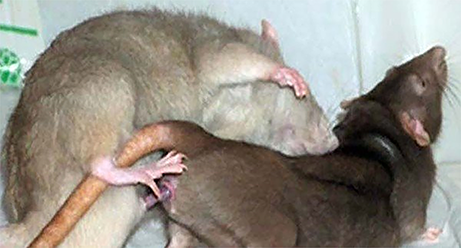
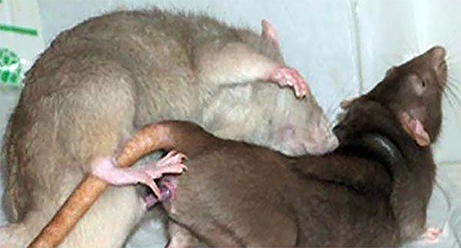
As noted, with flexible goal-directed behaviour the nature of the behaviour shown can vary very widely according to circumstances. However, a given motivation can also sensitize particular species-typical responses. These are the relatively stereotyped responses that have proven to be adaptive to the species in its evolutionary history (Gallistel, Reference Gallistel1980; Hinde, Reference Hinde1966). For example, in the presence of a male rat, a sexually receptive (‘motivated’) female rat will show darting movements and ear-wiggling. These are followed by a stereotyped body-arching response, known as the lordosis posture, which facilitates intromission (Beach, Reference Beach1947) (Figure 1.1). In fear, where escape is not possible, a rat will show a species-typical response of freezing (Bolles, Reference Bolles1970).
1.3.6 The Link to Instrumental Behaviour and Reinforcement
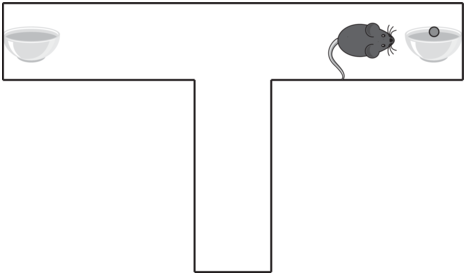
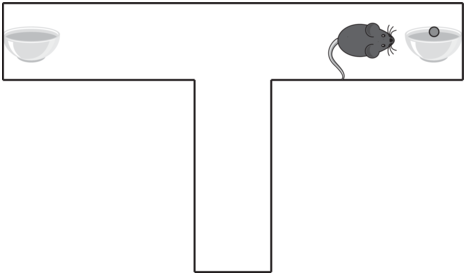
The term instrumental conditioning describes a form of conditioning in which behaviour is sensitive to the past consequences of showing the behaviour. The maze can exemplify this. First, a rat is deprived of food for, say, 24 hours, to increase its motivation towards food. The rat is placed at the start of a T-maze, and it runs along the initial arm. As shown in Figure 1.2, if it turns right, it gets food. If it turns left, it gets to an empty dish.Footnote 1 Over a number of trials, hungry rats reliably come to turn right each time. They also increase their speed of running, indicative of increased motivation towards the goal. The procedure of giving food is said to reinforce the behaviour of turning right.Footnote 2 The animal’s behaviour is literally instrumental in determining the outcome.
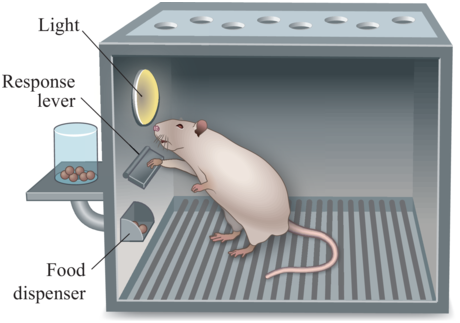
Now consider the Skinner box (Figure 1.3), which has been extensively tested with rats and pigeons. Suppose that, when a hungry animal presses a lever or pecks a key to earn food, the consequence is one of increasing its tendency to repeat this behaviour in the future. Researchers measure the reinforcement value of the food by observing that the frequency of lever pressing or key pecking increases over days. The food would be described as ‘positive reinforcement’, since it is something appetitive that is given conditional upon (often expressed as ‘contingent upon’) the behaviour.
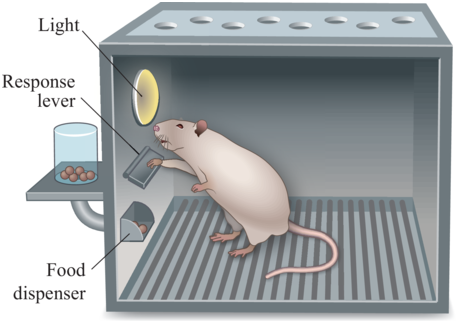
Now suppose that the Skinner box is made into a very noisy environment, where a non-hungry rat is placed. The rat learns to lever-press, with each press terminating the noise for just a few seconds. The noise would be described as ‘negative reinforcement’ since behaviour is strengthened by the removal of this aversive stimulus.
Consider a hungry rat placed in a Skinner box. If the rat presses the lever, a pellet of food drops into the food tray. In principle, over a series of daily trials, one could deprive the rat of food for 23 hours, leave it in the box for an hour each day, and see what happens. The rat might ‘accidentally’ press the lever on occasion and obtain a pellet of food. However, it could take a long time for behaviour to come under the control of the food (‘reinforcement’), and so the process is speeded up by means of shaping.
The term ‘shaping’ derives from an analogy with a potter shaping a vase. An unformed lump of clay is spun on a wheel and the potter gradually shapes it into a well-formed vase. By analogy, the rat is shaped by the careful timing of when food pellets are given, such that an ‘unformed’ (‘naïve’) rat comes to achieve mastery over lever pressing.
First, the rat is given some free rewards. Then receiving a reward is contingent upon the rat’s responses. The rat is shaped by being given a reward each time it is near to the lever. After that, the rat needs to contact the lever, lower the lever, and then make a full press of the lever. At this stage, control is in the hands of the rat.
As with the maze, the Skinner box exemplifies instrumental conditioning. However, it is a special form of instrumental conditioning, known as operant conditioning. Contrast the maze and the Skinner box. With the maze, the experienter needs to place the rat at the start box and lift it out at the goal box. By contrast, following training, the animal in the Skinner box determines its own actions with no intervention by the experimenter.
Teitelbaum (Reference Teitelbaum and Honig1966) wrote:
When we speak of purposive acts, we mean behaviour that is directed toward a goal and is accompanied by a corresponding motivation to obtain that goal.
According to Teitelbaum, the defining requirement underlying a purposive act is the existence of a motivational state. This state determines the strength of the tendency to pursue a particular goal. So, what does this rule out as an example of motivation? Behaviour that is the predictable consequence of a given stimulus. Teitelbaum (Reference Teitelbaum, Honig and Staddon1977) argues:
To infer motivation we must break the fixed reflex connection between stimulus and response.
Teitelbaum uses the combination of operant behaviour and the notion of reinforcement as the criterion for the existence of motivation. According to him, such evidence is obtained when operant behaviour is directed to an appropriate goal object. He claims that this criterion rules out the existence of motivation in the case of feeding in the fly (described in Section 1.3.3).Footnote 3 However, with advances in technology, there are claims that flies can show operant conditioning (Brembs, Reference Brembs2011).
1.3.7 Wanting, Pleasure, and Displeasure
Human motivation is tied closely to notions of wanting, pleasure, and displeasure. There is the wanting phase of motivation and then often pleasure when the goal is attained. Failure to attain a goal can be associated with displeasure. Chapter 6 will discuss such wanting and pleasure/displeasure. It will suggest that with suitable caution these terms can be extrapolated to non-humans. Pleasure comes into focus when we examine how behaviour (e.g. drinking) is controlled and bodily parameters (e.g. level of body fluids) are regulated. The term affect refers to positive states of psychological pleasure or negative states of displeasure (e.g. pain) and will be employed extensively. This is the topic of Chapter 7.
1.4 Motivation and Emotion
Emotions form the basis of some motivations (e.g. fear, anger, and disgust). For other motivations, while not forming their basis, emotions interact with them. For example, disgust can strongly interact with feeding and sex motivations. Chapter 8 will examine the relationship between motivation and emotion. The intention is to present just enough information on emotions to allow the links with motivation to be better understood.
Following Chapter 8, Chapters 9–18 look at individual motivations, for example, feeding, drinking sex, and so on.
1.5 Types of Explanation
This book is in the mould of psychology. However, a richer understanding can be gained by also considering another perspective, which addresses the topic of motivation, described next.
1.5.1 An Ethological Approach
The study of animal behaviour from a zoological perspective is known as ‘ethology’.Footnote 4 Within this science, the idea was developed that there are four different types (‘levels’) of explanation that can be brought to a given observation of behaviour (Tinbergen, Reference Tinbergen1963).
1. Causal explanation This describes what causes behaviour in the here-and-now. It is in terms of the causation by events in the environment that impinge upon the animal’s sense organs and events in the body. It is sometimes expressed in terms of the physiology of the brain.
2. Functional explanation This type of explanation is offered to account for how a given behaviour emerged in evolution in terms of the advantage that it conferred on genetic perpetuation.
3. Evolutionary explanation This is in terms of the presence of a particular behaviour in the repertoire of a given species. In which related species is it present or absent?
4. Developmental/learning explanation This concerns the history of behaviour in terms of the life of an individual animal. For example, did the behaviour simply unfold with increasing age or was learning required for it to appear?
In the present study, the emphasis is upon the causal level of explanation. However, in order to gain a more complete picture, occasionally reference will be made to one or more of the other levels.
Two examples illustrate how more than one level can be brought to explain a given phenomenon. First, there is the hypothesis termed evolutionary mismatch. This refers to the fact that evolution happened in an environment very different from the contemporary one. In many respects, our brains reflect what worked in the early environment. For example, we tend to fear snakes and spiders more than cars or guns (Chapter 13).
So, in this particular case:
a causal explanation is in terms of the brain’s mechanisms of processing frightening images and the production of a response;
an evolutionary explanation is in terms of the kind of environment in which this tendency evolved, and which species exhibit it;
a functional explanation concerns the advantage served by such a process;
a developmental/learning explanation is in terms of whether learning is needed for such fears to be expressed.
As the second example, the term taste-aversion learning (the ‘Garcia effect’) refers to the situation where an animal ingests a particular substance, and some minutes or even hours later suffers gastric upset (Garcia & Koelling, Reference Garcia and Koelling1966). Typically, after this experience, the animal will be reluctant to ingest the substance again.
Taste-aversion learning can exemplify the false dichotomy of presenting evolution and learning as competitive explanations (Al-Shawaf, Reference Al-Shawaf2025). The underlying specialized mechanism represents an evolutionary adaptation: that is, something that contributes to the animal’s evolutionary success. However, exactly what is learned depends upon the individual animal’s experience with foods, that is, what made it sick. Given the vast array of different potential toxins associated with food, there is no way that evolutionary processes could yield a solution on exactly what to avoid.
At the level of causation, what was ranked as a positive incentive loses its value, so the substance no longer triggers an approach response. The substance typically acquires aversive properties and triggers rejection. The developmental/learning explanation is in terms of the experience of illness and the formation of an association with taste. There can be a long delay between taste and nausea. Following the experience, the animal’s memory is reorganized. At a functional level, this behaviour serves the advantage that in future the animal avoids ingesting a substance that could prove harmful or even lethal.
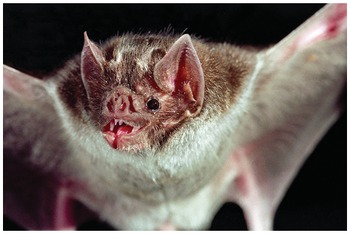
At an evolutionary level, consider the very wide range of species that exhibit this phenomenon, including rats and humans. It is also insightful to investigate whether there exist species that do not exhibit taste-aversion learning. One such species is the vampire bat (Ratcliffe et al., Reference Ratcliffe, Fenton and Galef2003), hardly a pleasing choice to meet in Chapter 1 but one that delivers much insight (Figure 1.4).

How might we make sense of this exception? Vampire bats live by sucking the blood of living animals. Therefore, seen in evolutionary history, it was unlikely that the blood that they ingested had ‘gone bad’. Related species of bat, which live from eating fruit and insects, do exhibit taste-aversion learning.
1.5.2 The Approach Adopted Here
My approach to explanation is something of a hybrid. It is based mainly in terms of observable phenomena: for example, behaviour and brain processes. That is to say, objective terms. However, subjective terms, such as pleasure and mood are also used in the explanations. This allows a more complete picture.
It is possible to develop theories of how motivation works without reference to the physical brain. However, such an approach has shortcomings.
A theory might be proposed that seems to fit well to the behavioural observations. However, it might be incompatible with an understanding of brain processes. Clearly, it is desirable that so-called psychological models and theories are compatible with what is known about the brain.
A good psychological theory can provide valuable insights into how brains work.
Hence, the present study will provide links to neural processes.
1.5.3 A Caution
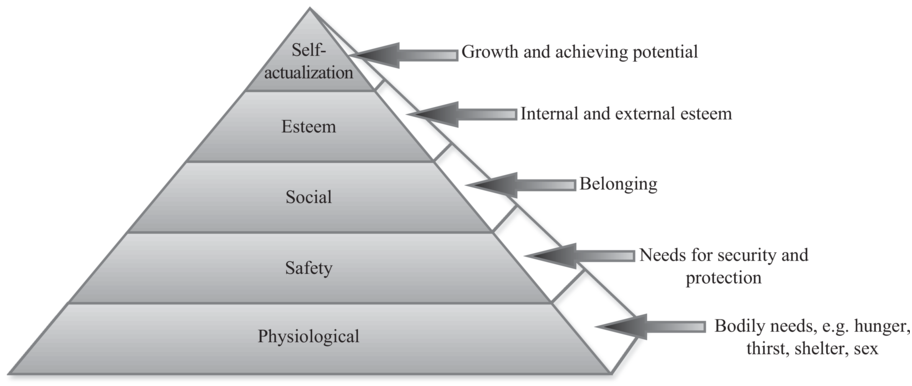
In psychology, one of the most cited articles of all time is that of Maslow (Reference Maslow1943) in which he describes a hierarchy of needs (Figure 1.5). At the bottom of the pyramid (i.e. physiological level) are hunger, thirst, and shelter, all of which are needed for bodily survival. However, sex, which is not needed for bodily survival, is also placed at the bottom. Towards the top is ‘belongingness’, even though some people would place this above sex as a need (Baumeister & Leary, Reference Baumeister and Leary1995). The pyramid seems to confuse causation and function. Sex is needed but for genetic perpetuation not bodily survival.
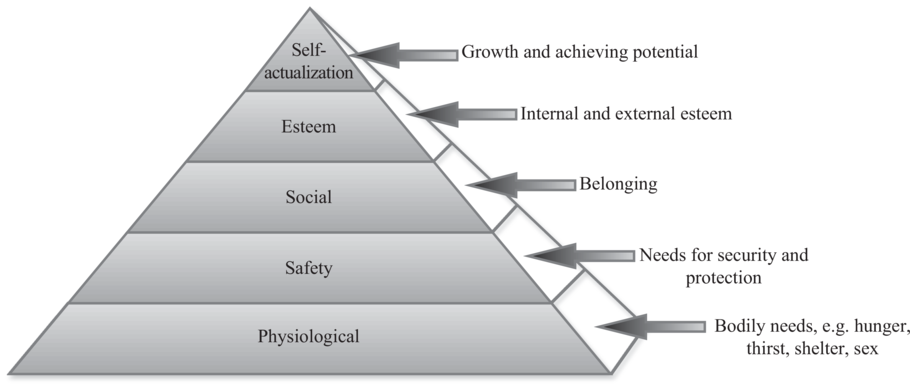
Figure 1.5 Long description
At the base of the pyramid are physiological needs, bodily needs, example, hunger, thirst, shelter, sex, above the base level are safety needs, needs for security and protection, above this are social needs, belonging, second from top in the pyramid are esteem needs, internal and external esteem. Finally at the top of the pyramid are needs for self-actualization, growth and achieving potential.
1.6 What Is the Value of the Concept of Motivation?
The concept of motivation is valuable for understanding several features of behaviour, often with profound health and social implications. In some cases, motivation is excessive, arising from inadequate inhibition. In other cases, motivation is inadequate, for example, over-inhibited. Sections 1.6.1–1.6.5 give samples of these cases
1.6.1 Abnormal Motivation towards an Incentive
Obesity presents a serious problem for many people. Evidence points to the normal motivational processes underlying feeding being stretched abnormally. Interventions (e.g. surgical, pharmacological) can be sought to lower feeding motivation (Chapter 9). To be tolerable to patients, these need to be selective to feeding motivation and not act through some non specific route, such as creating nausea. Conversely, there can be serious problems of undereating as in anorexia nervosa, for which theories based on principles of motivation have been advanced (Loizou et al., Reference Loizou, Panagiotou, Zanos and Paraskevopoulos2024).
Addictions of various sorts present major personal, social, legal, and health problems (Chapters 17 and 18). Addictions reflect aberrations of basic motivational processes that evolved to deal with such things as feeding and sex. Based upon insights into motivation, psychologists understand how such hijacking of basic processes occurs (Felix & Flagel, Reference Felix and Flagel2024; Robinson & Berridge, Reference Robinson and Berridge2024). Treatments can be usefully informed by an understanding of these motivational processes.
1.6.2 Anger and Aggression
Sadly, violence is ever-present both within a society and between nations. Various theories have been proposed to account for this (Chapters 2 and 14). Lorenz (Reference Lorenz1950) argued that the internal contribution to the motivation of aggression can be modelled by the increase in pressure within a tank containing fluid (Chapter 2). This leads to the suggestion that acts of mock violence, for example, punching a pillow or playing violent video games, can lower such pressure and thereby lower the tendency to aggression. This belief is reflected in the folk recommendation to ‘let off steam’. However, modern theories suggest that the pressure model represents a false analogy, and that aggression begets aggression.
1.6.3 Loss of Motivation
Apathy represents a loss of motivation and can be better understood in terms of theories of motivation (Sinha et al., Reference Sinha, Manohar and Husain2013). In cases of severe depression, there might be a near total loss of motivation, not even enough to get the individual out of bed. There is now insight into how this condition arises in terms of loss of motivation and the role of the neurochemical dopamine (DA) (Treadway & Salamone, Reference Treadway, Salamone and Pizzagalli2022).
1.6.4 Incidental Spin-offs
Research into motivation that was based primarily upon drugs and feeding (Robinson & Berridge, Reference Robinson and Berridge1993) has provided some valuable insights into phenomena rarely described before under the heading of ‘motivation’ (Felix & Flagel, Reference Felix and Flagel2024). Some examples include attention (Grignolio et al., Reference Grignolio, Acunzo and Hickey2024) and autism (Kohls et al., Reference Kohls, Chevallier, Troiani and Schultz2012). Other examples are where there is suffering and help is needed, such as pain (Bruneau et al., Reference Bruneau, Frimerman, Verner, Sirois, Fournier, Scott, Perez, Shir and Martel2021), obsessive-compulsive disorder (Albertella et al., Reference Albertella, Le Pelley, Chamberlain, Westbrook, Fontenelle, Segrave, Lee, Pearson and Yücel2019), attention-deficit hyperactivity disorder (Rode et al., Reference Rode, Runnamo, Thunberg and Msghina2023), schizophrenia (Kapur, Reference Kapur2003), and Parkinson’s disease (Politis et al., Reference Politis, Loane, Wu, O’Sullivan, Woodhead, Kiferle, Lawrence, Lees and Piccini2013).
1.6.5 Pain
Pain was once regarded as something simply linked to tissue damage. The greater the tissue damage, the greater the pain; and, if the damage heals, the pain is lifted. Subsequent research has revealed the inadequacy of this explanation (Melzack & Wall, Reference Melzack and Wall1988). Of course, tissue damage is a principal contributor to pain. However, there can be tissue damage but little or no pain and, conversely, there can be serious pain with little evidence of any accompanying tissue damage.
Motivational factors play a role in pain (Chapter 15). Concepts of motivation and reward/ reinforcement are increasingly appearing in the literature on pain (Bolles & Fanselow, Reference Bolles and Fanselow1980; Fields, Reference Fields, Flor, Kalso and Dostrovsky2006; Rizvi et al., Reference Rizvi, Gandhi and Salomons2021).
1.7 Final Word
The chapter has described what is meant by the term ‘motivation’. It has advanced some of its essential features.
An internal contribution to motivation that varies widely, for example, that deriving from low nutrient and fluid levels.
An external contribution to motivation, that is, an incentive such as food or water.
Motivation is associated with goal direction, also expressed as behaviour being ‘purposive’ and ‘intentional’.
Motivational systems are associated with flexible behaviour and instrumental conditioning in the service of achieving their goal.
The chapter described a distinction between (i) motivation and (ii) reflexes and instincts. However, with further advances, we need to be sensitive to the possibility of grey areas appearing instead of rigid dichotomies.
Motivation exerts top-down control over the sensitivity of certain reflexes, that is, their functional tuning. An example of this is the mating reflexes (e.g. lordosis) in female rats, the timing of which is under the control of a motivational state and the male’s approaches.
Chapter 2 looks at how scientists have employed the notion of motivation and have proposed explanatory models of it.