


1. Introduction and related work
Sustainability has become an important element of modern engineering design, driven by the urgent need to reduce environmental and social impacts across product life cycles (European Commission and Directorate, 2021). Life Cycle Assessment (LCA) is an established methodology for quantifying these environmental impacts across product systems. The ISO 14040/14044 standards define the principles and framework of LCA and specify detailed requirements for goal and scope definition, life cycle inventory, life cycle impact assessment, and interpretation (DIN EN ISO 14040, 2006; DIN EN ISO 14044, 2006). Multiple categories cover a broad spectrum of environmental impacts, from ecotoxicity to human health and climate change (Reference Huijbregts, Steinmann, Elshout, Stam, Verones, Vieira, Zijp, Hollander and Van ZelmHuijbregts et al., 2017). Driven by governmental regulations such as the European Green Deal (European Commission and Directorate, 2021), industry aims to achieve CO2 neutrality by 2050 at the latest. To support this goal, LCA is an important tool for assessing processes, products, and services and for evaluating improvement measures.
Despite methodological maturity and acceptance, conducting an LCA and turning its results into design actions remains challenging. Detailed LCAs require extensive data and are time-intensive, while obstacles to seamless implementation include dependence on specialist skills and expertise, as well as limited data availability (Reference Hauschild, Rosenbaum and OlsenHauschild et al., 2018; Reference Schneider, Jordan, Dietz, Zaeh and ReinhartSchneider et al., 2023). The interpretation of LCA results can be highly technical, complex, and time-consuming (Reference HeiskanenHeiskanen, 2000; Reference Otto, Mueller and KimuraOtto et al., 2003). Consequently, LCA results are often insufficiently considered in design.
The latest technological progress of Large Language Models (LLMs) offers great potential to overcome these obstacles. LLMs enable semantic interpretation, content generation, and the facilitation of innovative ideation for assistance in engineering (Reference Makatura, Foshey, Wang, Hähnlein, Ma, Deng, Tjandrasuwita, Spielberg, Owens, Chen, Zhao, Zhu, Norton, Gu, Jacob, Li, Schulz and MatusikMakatura et al., 2024). Recent studies have begun to explore the use of LLMs in the fields of LCA and design. For LCA, tools address tasks such as inventory analysis (Reference Foschi, Pennino, Gislon, Grossi, Mantino, Barbanera, Marconi, Cesarini, Rossi, Vitali, Sandrucci, Zucali, Bava, Finocchi, Mele and LaceteraFoschi et al., 2025), environmental impact estimation (Reference Preuss, Alshehri and YouPreuss et al., 2024; Reference Zhang, Metzger, Mei, Hähnlein, Englhardt, Cheng, Abowd, Patel, Schulz and IyerZhang et al., 2025), and interpretation of the results (Reference Goridkov, Wang and Goucher-LambertGoridkov et al., 2024). Reference Kumar, Nazemi, Kodamana, Ramteke and BakshiKumar et al. (2025) propose a framework to retrieve inventory and environmental impact data from scientific literature to support LCA practitioners in data collection. In design automation, AskNatureGPT (Reference Chen, Cai, Cheang, Long, Sun, Childs and ZuoChen et al., 2025) generates bio-inspired design concepts based on the AskNature dataset (Reference Deldin, Schuknecht, Goel, McAdams and StoneDeldin & Schuknecht, 2014), while the work of Reference Cui, Zheng, Ren and YanCui et al. (2026) uses AskNature in combination with multiple other datasets for design generation. Reference Ashkbous, Côté and KeivanpourAshkoush et al. (2025) generate sustainable design recommendations based on the LLM’s pre-trained general knowledge and on additional data from LCA databases. Multi-agent systems are implementing multiple LLMs for automated design generation and evaluation (Reference Chen, Cai, Zhou, Yao, Li, You and SunChen et al., 2026; Reference Ding, Chen, Fang, Liu, Qiu and ChaiDing et al., 2023).
The listed approaches rely on fixed datasets, meaning that the training data were collected up to a specific point in time. Consequently, more recent data are not available to LLMs. Given the continuous stream of new scientific publications offering potential solutions, a gap emerges between usable knowledge and available knowledge. In the research field of automated literature searches, several contributions aim to bridge this gap by using LLMs to query academic literature databases and retrieve relevant papers; however, they do not link these approaches to design research (Reference Chow, Guo, Chow, Chia, Li and HuangChow et al., 2024; Reference Gorenshtein, Shihada, Sorka, Aran and ShellyGorenshtein et al., 2025). For this reason, we introduce an LLM-driven pipeline that interprets LCA hotspots, systematically explores recent scientific literature, and derives feasible, research-backed design alternatives.
2. Research gap and objectives
Although LCA is a mature framework and widely adopted in engineering, translating LCA findings into concrete design actions remains challenging (Reference Le Pochat, Bertoluci and FroelichLe Pochat et al., 2007). Furthermore, responsibility is often split between LCA practitioners, who identify environmental hotspots, and design engineers, who must interpret the results and develop technical improvement solutions based on expert knowledge and literature review (e.g., Reference Peitzmeier, Ertem, Henke, Traechtler and SeibelPeitzmeier et al., 2025). This siloed workflow hinders efficient, informed, and timely decision-making in sustainable product development. The absence of a systematic and easy-to-use link between LCA results and the latest scientific research limits the ability to incorporate state-of-the-art sustainability strategies into design decisions.
Recent AI contributions in the LCA domain improve inventory and impact estimation as well as report interpretation, rather than extending into the derivation of design recommendations (Reference Foschi, Pennino, Gislon, Grossi, Mantino, Barbanera, Marconi, Cesarini, Rossi, Vitali, Sandrucci, Zucali, Bava, Finocchi, Mele and LaceteraFoschi et al., 2025; Reference Goridkov, Wang and Goucher-LambertGoridkov et al., 2024; Reference Preuss, Alshehri and YouPreuss et al., 2024; Reference Zhang, Metzger, Mei, Hähnlein, Englhardt, Cheng, Abowd, Patel, Schulz and IyerZhang et al., 2025). Simultaneously, AI-supported approaches for design generation focus on ideation and knowledge synthesis (Reference Ashkbous, Côté and KeivanpourAshkbous et al., 2025; Reference Chen, Cai, Cheang, Long, Sun, Childs and ZuoChen et al., 2025; Reference Cui, Zheng, Ren and YanCui et al., 2026; Reference Ding, Chen, Fang, Liu, Qiu and ChaiDing et al., 2023), but are limited to findings derived from their respective LLM training datasets or domain-specific knowledge bases. They do not connect to the ever-evolving state of research knowledge. Reliance on fixed data sets limits coverage to specific time periods, requires frequent updates, and risks overlooking recent scientific breakthroughs. Recent approaches from the field of LLM-supported literature searches (Reference Chow, Guo, Chow, Chia, Li and HuangChow et al., 2024; Reference Gorenshtein, Shihada, Sorka, Aran and ShellyGorenshtein et al., 2025) have not yet found application in design automation. Accordingly, the research gap lies in the lack of methods that link product LCA hotspot information and research-backed design strategies for product optimization while taking current data into account.
Therefore, the research question of this work is defined as:
“How can an LLM-based pipeline automatically translate LCA hotspot information into research-backed design strategies that support sustainable product development?”
Guided by this question, this work pursues the following objectives:
-
• to propose an LLM-driven pipeline that automatically interprets LCA reports to identify environmental hotspots and retrieves mitigation solutions from recent scientific literature,
-
• to demonstrate its feasibility through a case study on an automotive headlight control unit,
-
• to assess its usefulness via expert evaluation.
By introducing a pipeline that dynamically leverages up-to-date scientific literature rather than relying on fixed datasets, this work contributes a novel methodological link between quantitative environmental assessment and practical engineering decision-making. By reducing manual effort and ensuring alignment with the latest research, the pipeline aims to accelerate the adoption of sustainability principles in engineering practice. Furthermore, it aims to be a design-support tool informed by LCA outputs, rather than as an LCA modelling tool. It uses LCA results as inputs to guide design-relevant scientific paper retrieval and synthesis.
3. Proposed approach
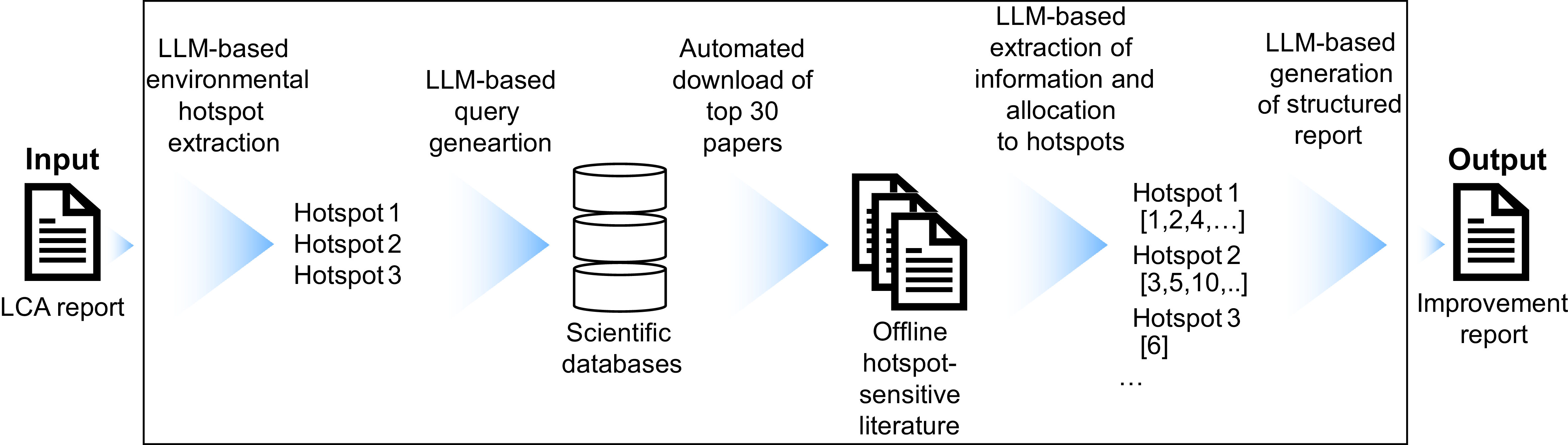
To support the collaboration of LCA experts and design engineers, this work proposes a novel approach that automatically enriches LCA results with actionable guidance for product development. The Python-based pipeline, illustrated in Figure 1, leverages LLMs to process complete LCA reports of technical products and identify environmental hotspots. Based on these insights, the system formulates targeted queries and searches scientific databases for optimization opportunities, such as alternative materials, processes, and design strategies. The information gathered is then compiled into a structured and comprehensible report.
The pipeline is implemented in Python using publicly available libraries and the open-source LLM Qwen3-235B-A22B, a long-context LLM available through our institutional access. It provides the best performance among accessible models for multi-document reasoning and full-report processing. The Qwen3 model family is openly available (Qwen, 2026). Other models such as GPT, Claude, Llama, and Mistral were considered but not selected due to cost, as the pipeline demands multiple requests per run. Nevertheless, Claude Sonnet 4.5 was used for data pre-processing, as the cost difference was negligible.
The methodology is designed to be reproducible, and the codebase will be made available upon reasonable request. Claude Sonnet 4.5 is employed for interpreting LCA results and generating targeted search queries, whereas Qwen3 is responsible for resource-intensive in-depth literature analysis and solution extraction due to its extended context window and reasoning capabilities. The integration of LCA interpretation, literature mining, and extraction of alternative design solutions represents a significant step towards automated sustainable design.
Proposed end-to-end pipeline for automated identification of sustainable product improvements

Figure 1 Long description
A flowchart illustrating an automated pipeline for identifying sustainable product improvements using life cycle assessment reports. The process begins with an input of an LCA report. The first step involves LLM-based environmental hotspot extraction, identifying hotspots labeled as Hotspot 1, Hotspot 2, and Hotspot 3. Next, LLM-based query generation is used to search scientific databases. The top 30 relevant papers are then automatically downloaded. These papers undergo offline hotspot-sensitive literature review. Following this, LLM-based extraction of information occurs, allocating the extracted data to the respective hotspots. Finally, an LLM-based structured report is generated, summarizing the improvements for each hotspot. The output is an improvement report.
The pipeline is designed to process any type of text-based document containing LCA results, including assessments covering different system boundaries such as cradle-to-gate or cradle-to-grave.
Out of the provided data, an LLM is used to transfer relevant information into a single JSON file. This file contains general properties including the product name, the LCA scope, the functional unit, impact category values such as Global Warming Potential (GWP), and the product’s weight. Furthermore, the LLM extracts the impact category values depending on the granularity of the provided LCA. This can be either at the level of individual life cycle phases (manufacturing, use phase, distribution, and end of life), or, in more detail, at the level of components, material, process, or functions. Therefore, this work defines a “hotspot” as a life-cycle element with a measurable share to the overall environmental impact.
For each hotspot, its name, contribution percentage, impact value, and a short description are listed. The hotspots are ranked based on their relative contribution to the total impact. In summary, the link between each hotspot and its environmental footprint is taken directly from the component-level impact values reported in the original LCA. The pipeline extracts these figures without introducing additional allocation rules, ensuring that each hotspot reflects the LCA’s data-driven component contributions.
The JSON file including the hotspots now forms the basis for automated LLM-based hotspot-specific query generation. This process ensures that each environmental hotspot is addressed through targeted literature searches. As environmental emissions in the manufacturing phase include raw material extraction and processing, component production, assembly processes, and indirect emissions, a single search query is not sufficient to cover all of them equally. Therefore, the manufacturing phase is covered by four queries focusing on process optimization of used processes, alternative manufacturing processes, optimization of material utilization, and sustainable material alternatives. For each remaining life cycle phase for use, transportation, and end-of-life, a single query is generated.
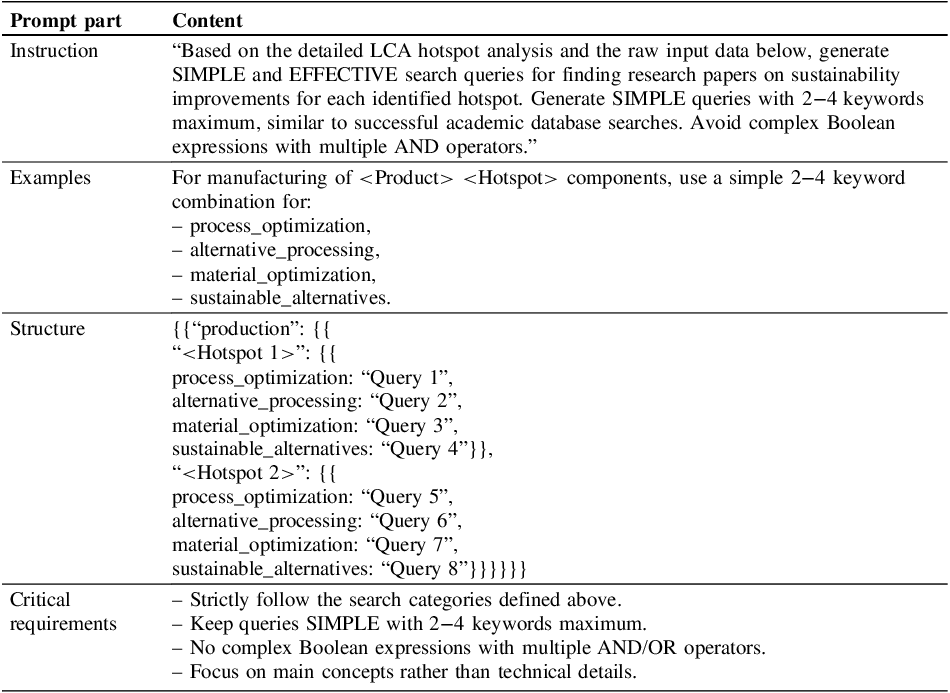
The prompt design for generating search queries includes an instruction, several examples for guidance, a defined output structure in JSON format, and critical requirements that must be followed by the LLM (see Table 1). The term “sustainable alternatives” within the instruction refers to an improvement in the impact category of the reported hotspot.
Prompt design for hotspot-specific search queries

For the automated retrieval of open-access scientific papers, the API of the Semantic Scholar database is accessed. A search query results in a list of potential papers sorted by Semantic Scholar’s relevance ranking algorithm. The proposed approach automatically attempts to download the top- $k$
publications including the metadata for each search query. If a paper is not available, its Digital Object Identifier (DOI) is searched for in other databases, such as OpenAlex, Unpaywall, and CORE. These databases offer a wide range of publications with a focus on open access. In this work, the number of retrieved publications is set to
$k$
publications including the metadata for each search query. If a paper is not available, its Digital Object Identifier (DOI) is searched for in other databases, such as OpenAlex, Unpaywall, and CORE. These databases offer a wide range of publications with a focus on open access. In this work, the number of retrieved publications is set to $k = 30$
per query to find a balance between comprehensiveness and data volume. Preliminary tests show that this range captures most relevant and citable studies. Adding more papers increases processing time and a lower number resulted in insufficient assignments of publications to the individual hotspots. However,
$k = 30$
per query to find a balance between comprehensiveness and data volume. Preliminary tests show that this range captures most relevant and citable studies. Adding more papers increases processing time and a lower number resulted in insufficient assignments of publications to the individual hotspots. However, $k$
is not fixed and can be increased or decreased depending on future improvements in model context length, retrieval quality, and available computational resources. This ensures that the pipeline remains scalable and adaptable as LLM and hardware capabilities evolve.
$k$
is not fixed and can be increased or decreased depending on future improvements in model context length, retrieval quality, and available computational resources. This ensures that the pipeline remains scalable and adaptable as LLM and hardware capabilities evolve.
The next step is to preprocess the papers and metadata to make them accessible to the LLM as a curated, hotspot-specific literature collection. Therefore, the text from the PDFs is extracted with the publicly available Python library PyMuPDF. The references of each paper are removed to reduce data size and to focus the analysis on the core content. Unicode normalization is applied to improve data quality. Two JSON files are created, one containing the consolidated content of all papers and the other containing the respective metadata (title, authors, abstract, DOI, year, and source).
The final step, which proposes technical optimizations based on the literature, involves Qwen3. The LLM, with a context window of 222k tokens, iterates through each hotspot and identifies solutions in the retrieved literature. The solution generation employs a two-stage temperature strategy. Initial generation uses a temperature of 0.7 to enable creative exploration of research findings and comprehensive solution extraction. Subsequently, the temperature is reduced to 0.2 for quality refinement, during which the model removes repetitive information, ranks statements by relevance, eliminates superficial content, and ensures component-specific focus while preserving all quantitative data. This approach balances exploratory analysis with precise quality control.
For each hotspot, up to five potential solutions are identified and referenced via the DOI. A short bullet point description indicates how the respective publication could lead to an improvement in GWP. If no suitable solution is found, it is explicitly stated. The generated sections are converted into a PDF using the Python library ReportLab.
The final report, provided in PDF format, includes a brief summary of the hotspot inputs, an overview of the analysis with the number of retrieved publications, and a list of design alternatives for each hotspot with links to the corresponding source publications. This report serves as a decision-support tool for design engineers, enabling informed and sustainable product development.
4. Case study
To validate the pipeline, a case study is conducted using a real-world LCA report of a technical product. The case study focuses on the electronic control unit of an automotive headlamp, presented in Figure 2, with cradle-to-grave GWP analysis based on the work of Reference Peitzmeier, Ertem, Henke, Traechtler and SeibelPeitzmeier et al. (2025). For the product, the pipeline identifies GWP hotspots, generates targeted literature queries, and extracts up to five research-backed design alternatives.
Design and components of the headlamp control unit examined in the case study (Reference Peitzmeier, Ertem, Henke, Traechtler and SeibelPeitzmeier et al., 2025)

The original LCA is provided as a structured PDF document, and manual verification was conducted to confirm that the extracted hotspot values matched the numerical results in the report.
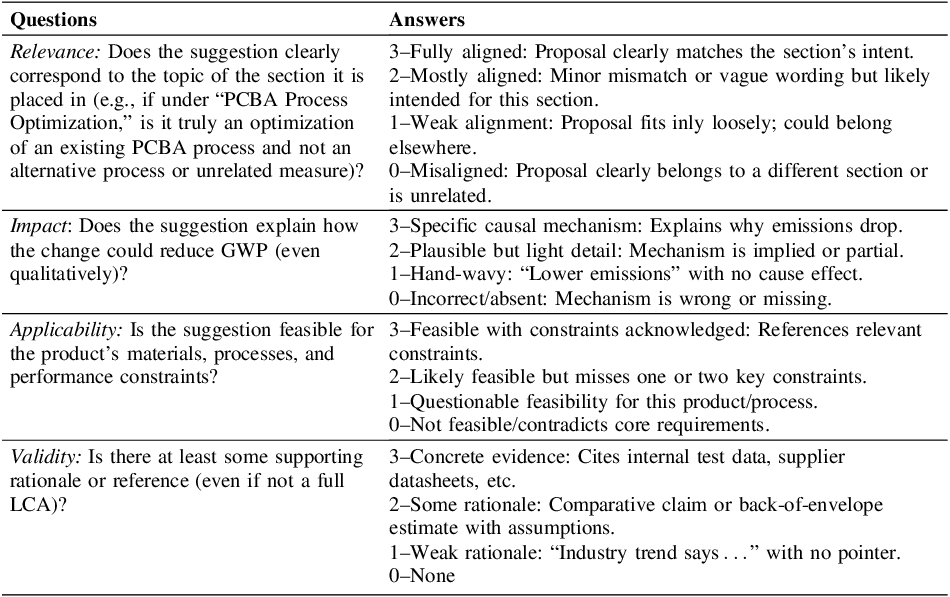
The relevance and quality of these alternatives are evaluated by two PhD students and one master student from the domains of sustainable design, electrical engineering, and LCA. The participants are asked to complete a structured questionnaire using a 4-point Likert scale (0 = not suitable, 3 = suitable) to rate each alternative on the dimensions of relevance, impact, applicability, and validity. The questions and answer options are shown in Table 2.
Questionnaire to assess the quality of provided alternatives

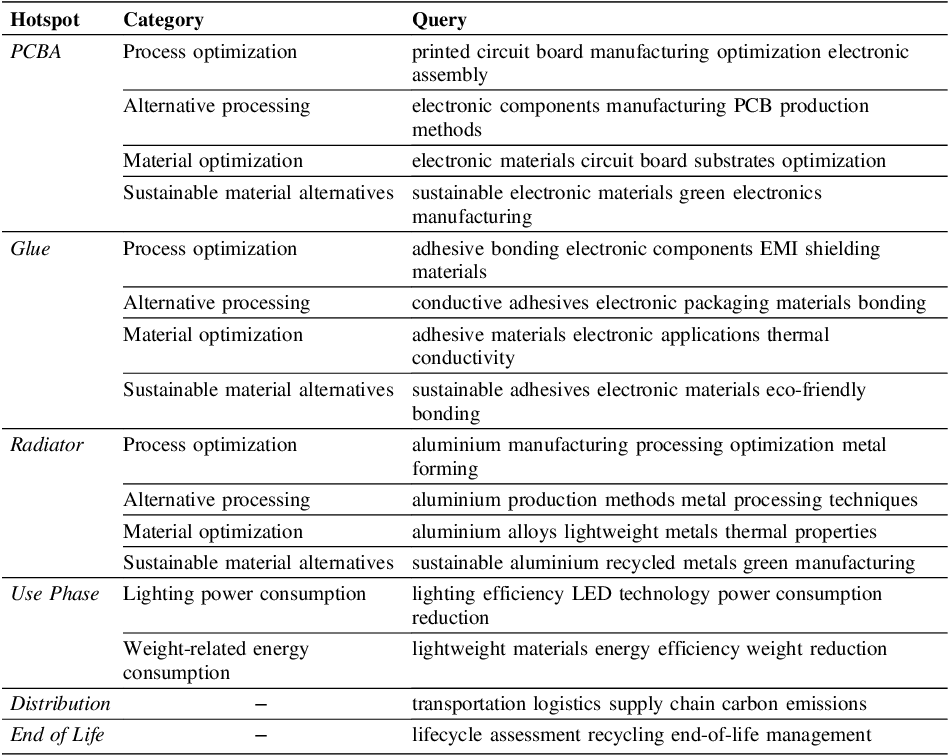
The LCA conducted in Reference Peitzmeier, Ertem, Henke, Traechtler and SeibelPeitzmeier et al. (2025) analysed the cradle-to-grave GWP of an automotive electronic control unit, identifying the use phase as the most impactful life cycle phase. The component-wise observation in the manufacturing phase reveals the printed circuit board assembly, the aluminium radiator, and the glue as major contributors. The proposed pipeline extracts hotspots, generates queries, and retrieves literature to identify alternatives. Figure 3 shows an excerpt from the identified and ranked hotspots, which serves as baseline for query generation. The search queries generated based on the methodical approach are displayed in Table 3.
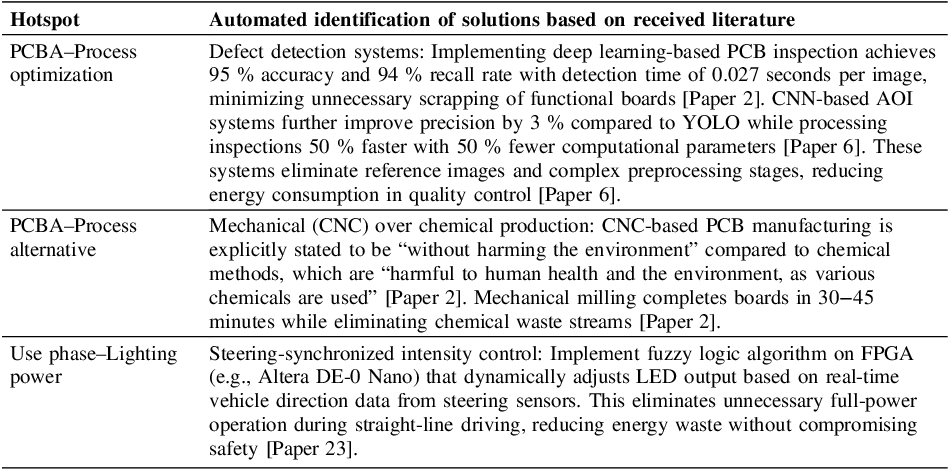
The use of search queries resulted in a total of 207 scientific papers being identified and downloaded, each related to the environmental hotspots of the control unit. The LLM-based assignment to the hotspots is performed in an automatically generated report, which is provided as a PDF. In this report, the key statements of the scientific publications are assigned to the respective optimization categories. Excerpts from the report with optimization suggestions are available in Table 4.
Excerpt from the JSON file created by Claude Sonnet 4.5 with ranked hotspots, their source of impact, quantitative effects, and a brief description

Search queries generated by Claude Sonnet 4.5 for literature collection

Exemplary excerpts from the report with optimization suggestions

5. Evaluation
All provided solutions are evaluated by three individuals with domain knowledge: two PhD students and one master student, each specializing in one of the fields sustainable design, electrical engineering, or LCA. The evaluators used a structured questionnaire with a 4-point Likert scale (0 = not suitable, 3 = suitable) to assess each alternative along four dimensions: applicability, impact, relevance, and validity.
Figure 4 illustrates the scores for each dimension across all proposed hotspot solutions for PCBA, Glue, Radiator, Use phase–Lighting, Use phase–Weight, End-of-life, and Distribution. For each hotspot, the mean values of the expert ratings were calculated and complemented by averaged minimum and maximum scores to indicate the range of agreement. In terms of applicability, consensus among all evaluators is shown. Only the proposals for Glue and Distribution achieved values below 2, while the rest achieved scores between 2 and 2.67. Nonetheless, it must be said that the deviation between the minimum and maximum values is high. Accordingly, applicability must be examined more closely in the future. It is notable that the experts’ opinions differ about the solutions’ impact, as indicated by the significantly greater deviations in the minimum and maximum values. The proposed solutions at component level show only a low impact in the manufacturing phase for the PCBA and the Glue (1.42 and 1.5). While hotspots such as Distribution and End-of-life achieved higher scores, the overall trend suggests that experts perceive the pipeline’s influence on outcomes as moderate, highlighting an area for further refinement. Regarding relevance, all solutions score between 2.25 and 3, indicating a strong alignment with the specified topics. The narrow gap between minimum and maximum scores for all hotspots, particularly Use Phase–Lighting and Distribution, suggests strong consensus among experts. The results for validity are more consistent across participants. The deviations between minimum and maximum values are notably smaller, and in the weight-related use phase and distribution phase, all experts even provided identical scores.
Overall, the evaluation confirms that the pipeline is able to generate relevant, technically grounded, and applicable design alternatives based on LCA hotspot data.
Evaluation of the expert survey results on applicability, impact, relevance, and validity over all identified hotspots

Figure 4 Long description
Panel A: A line graph showing evaluation results for PCBA. The horizontal axis represents different criteria: Applicability, Impact, Relevance, and Validity. The vertical axis ranges from 0 to 3.5. The graph includes three lines representing Average, Min, and Max values. The Average line shows values around 2.33 to 2.42, the Min line shows values around 1.42 to 1.75, and the Max line shows values around 2.75 to 3. Panel B: A line graph showing evaluation results for Glue. The horizontal axis represents different criteria: Applicability, Impact, Relevance, and Validity. The vertical axis ranges from 0 to 3.5. The graph includes three lines representing Average, Min, and Max values. The Average line shows values around 1.83 to 2.25, the Min line shows values around 0.75 to 1.5, and the Max line shows values around 2.75 to 3. Panel C: A line graph showing evaluation results for Radiator. The horizontal axis represents different criteria: Applicability, Impact, Relevance, and Validity. The vertical axis ranges from 0 to 3.5. The graph includes three lines representing Average, Min, and Max values. The Average line shows values around 1.67 to 2.33, the Min line shows values around 1.25 to 1.75, and the Max line shows values around 2.75 to 3. Panel D: A line graph showing evaluation results for Use phase Lighting. The horizontal axis represents different criteria: Applicability, Impact, Relevance, and Validity. The vertical axis ranges from 0 to 3.5. The graph includes three lines representing Average, Min, and Max values. The Average line shows values around 2.33, the Min line shows values around 2, and the Max line shows values around 3. Panel E: A line graph showing evaluation results for Use phase Weight. The horizontal axis represents different criteria: Applicability, Impact, Relevance, and Validity. The vertical axis ranges from 0 to 3.5. The graph includes three lines representing Average, Min, and Max values. The Average line shows values around 2, the Min line shows values around 1, and the Max line shows values around 3. Panel F: A line graph showing evaluation results for End-of-life. The horizontal axis represents different criteria: Applicability, Impact, Relevance, and Validity. The vertical axis ranges from 0 to 3.5. The graph includes three lines representing Average, Min, and Max values. The Average line shows values around 1.67 to 2.67, the Min line shows values around 1 to 2, and the Max line shows values around 2.67 to 3. Panel G: A line graph showing evaluation results for Distribution. The horizontal axis represents different criteria: Applicability, Impact, Relevance, and Validity. The vertical axis ranges from 0 to 3.5. The graph includes three lines representing Average, Min, and Max values. The Average line shows values around 2 to 2.33, the Min line shows values around 2, and the Max line shows values around 3.
6. Discussion and conclusion
The aim of this work is to enable designers and engineers to minimize the environmental impacts of technical products by automatically finding solutions grounded in recent scientific literature. Therefore, a novel LLM-driven pipeline for automated identification of sustainable design alternatives based on LCA hotspot analysis is introduced. By integrating semantic interpretation, targeted online literature mining, and structured evaluation, the approach enables actionable insights with minimal manual effort and knowledge. This addresses the existing expertise gap in interpreting LCA results and the usage of sustainable design tools (Reference Le Pochat, Bertoluci and FroelichLe Pochat et al., 2007; Reference Otto, Mueller and KimuraOtto et al., 2003).
This work implements the idea of automated scientific knowledge retrieval from online databases with the use of LLMs (Reference Chow, Guo, Chow, Chia, Li and HuangChow et al., 2024; Reference Gorenshtein, Shihada, Sorka, Aran and ShellyGorenshtein et al., 2025). This enables considerations of the latest scientific findings and complements existing approaches with access to fixed datasets (e.g., Reference Ashkbous, Côté and KeivanpourAshkbous et al., 2025; Reference Chen, Cai, Zhou, Yao, Li, You and SunChen et al., 2026; Reference Cui, Zheng, Ren and YanCui et al., 2026). Because scientific databases emphasize novel contributions, the retrieved literature may include emerging approaches. This aligns with the pipeline’s goal of identifying state-of-the-art improvement strategies. A case study on an automotive electronic control unit demonstrates the pipeline’s ability to extract relevant hotspots from LCA reports, generate effective search queries, and compile research-backed optimization proposals.
The resulting solutions were evaluated by domain experts using a structured survey, showing promising results in terms of relevance, impact, applicability, and validity. Relevance assessed whether the solution addressed the identified hotspot (average score: 2.2), indicating good alignment. Impact measured the potential to reduce the GWP (2.1), showing plausible impact. Applicability evaluated feasibility within the product’s technical constraints (2.2), suggesting that practicable implementation is likely. Finally, validity examined whether the solution was supported by evidence or references (2.2), reflecting good scientific grounding.
While the findings confirm the pipeline’s potential to support sustainable product development, certain limitations remain. The evaluation was based on a single case study and a small expert panel consisting of three people. This limited sample size restricts statistical interpretability and highlights the need for broader expert involvement and additional qualitative input with interviews or focus groups on future assessments. The latter can also be used to evaluate risks of sub-optimization, trade-offs, and burden shifting. In addition, the proposed solutions should be incorporated into new product designs and subsequently evaluated through an additional LCA to quantify the results. Future work should include additional case studies and broader expert validation to further assess generalizability and robustness. It should also be possible to incorporate not only open-access literature but also subscription-based content to increase the scope and technical depth of the retrieved research. The knowledge field can be extended to incorporate additional databases, allowing creative solutions from other areas to complement science-based contributions. The focus on GWP is also a limitation and should be extended to multiple other impact categories, as these are essential for a holistic evaluation. This is particularly important, as different impact categories may reveal entirely different hotspot patterns and therefore require different design interventions. Nonetheless, the proposed method represents a significant step towards scalable, AI-assisted design optimization grounded in environmental impact data.
Acknowledgements
The authors used DeepL and ChatGPT (OpenAI) for language improvement and to assist with minor coding tasks (e.g., generating or debugging code snippets). All core research content, data analysis, and conclusions are the original work of the authors.




 Open access

