

Introduction
The political year 2023 in Bulgaria ended with the infamous sglobka (makeshift) Citizens for European Development of Bulgaria (GERB–We Continue the Change–Democratic Bulgaria (PP-DB) coalition Cabinet in power, which experienced challenges from the parliamentary opposition and society at large (Spirova Reference Spirova2024). During 2024, political instability returned and intensified with the failure of the Cabinet, two new rounds of national elections, and a caretaker Cabinet still in power on 31 December 2024. Polarization continued with more nationalist parties making it into Parliament, and social ambivalence toward Russia, LGBTQ+ rights, and migration.
At the same time, Bulgaria made progress toward its European Union integration: It became a member of the Schengen Area for air and sea travel on 31 March 2024, with checks at air and sea borders being lifted. After a process that lasted more than a decade, the entry of the country into the Eurozone also came closer, despite substantial domestic debate.
Election report
European Parliament (EP) elections
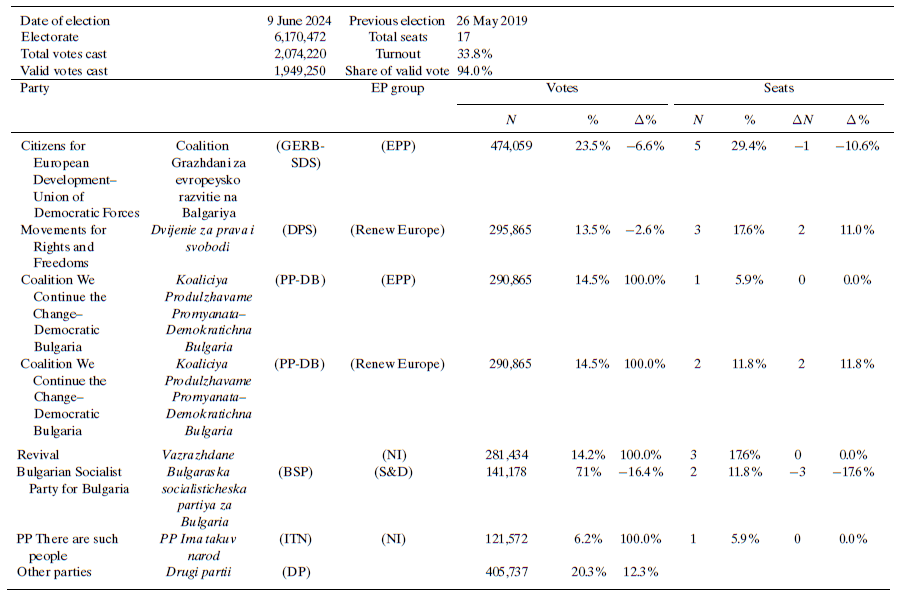
EP elections were held on June 9, together with the first early elections for the national Parliament. This allowed the EP elections to benefit in terms of turnout, which, at 33.78 per cent, was slightly lower than for the national elections but maintained similar levels to the last 2019 EP elections (32.64 per cent). Thirty-one parties competed for 17 seats in the EP, and results largely mirrored the national elections outcome (Table 1).Footnote 1 All in all, Bulgaria sent six MEPs to the European People's Party, three to the liberal Renew Europe, three to the Europe of Sovereign Nations group, two to the Socialists & Democrats, one to the European Conservatives and Reformists group, and two MEPs remained non-affiliated (European Parliament 2025). More than usual, competition for the EP seats was dominated by the issues of the national elections, as the saga of four years of never-ending elections would suggest.

Notes:
1. There is no distinction of where the votes of PP-DB went. Therefore, no information about how many to EPP and how many to Renew Europe.
2. 2024 is the year with least percentage of women elected (23.43%), compared to 2009 with 44%.
3. There is a difference of two spots between the constitutive session and the outgoing Parliament.
Parliamentary elections
June elections
Two rounds of early parliamentary elections took place during 2024, putting the tally of elections at seven for the 2021–2024 period, of which six were early elections. In March 2024, the sglobka Cabinet fell apart (see section on Cabinet). With other parties unable to produce a Cabinet, on 9 April, President Rumen Radev called an early election and began consultations to appoint a caretaker Prime Minister.
The Central Election Commission started the registration process for political parties participating in both the national and EP elections on 15 April. Parties were required to submit at least 2500 valid voter signatures and could use a single list for both elections. Thirty-two parties registered and competed for the votes of 34.41 per cent (2,268,849) of the Bulgarian electorate. The failure of the GERB-SDS/PP-DB sglobka Cabinet impacted the two constituents in a different way. The campaign continued to be dominated by the conflicts between the two parties, but GERB-SDS seemed to emerge stronger, while PP-DB seemed to have disappointed its supporters by both joining and leading the coalition and declined in popularity (Petrov Reference Petrov2024).
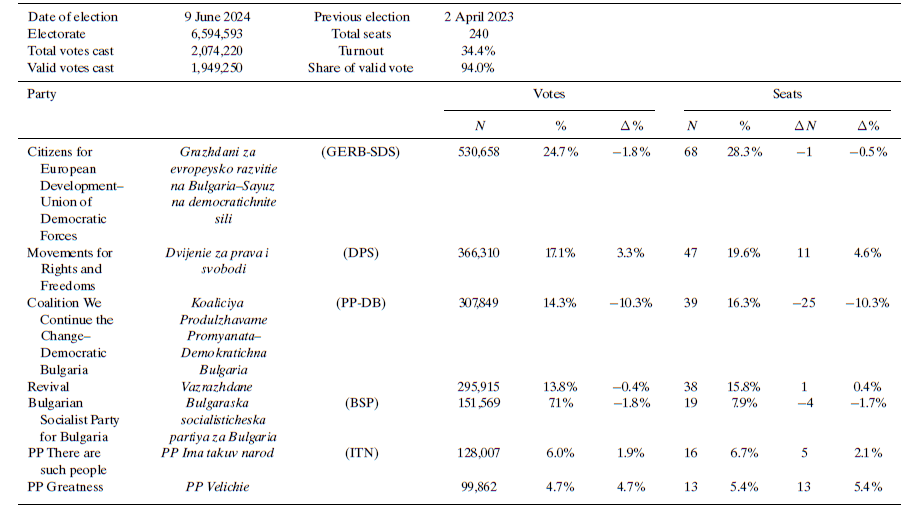
Seven parties crossed the electoral threshold to enter the 50th National Assembly (Table 2). Six of them had been in the previous Parliament. GERB-SDS secured the highest share of votes, at 24.70 per cent, and maintained its plurality position in the National Assembly. The Turkish-dominated Movement for Rights and Freedoms (DPS) emerged as the second parliamentary group with 17.07 per cent of the votes, leaving PP-DB with 14.33 per cent in third place. PP-DP lost about half of the votes it had held in 2023, clearly suffering from its participation in the sglobka Cabinet. Nationalist and pro-Russian Vazrazhdane lost a bit but maintained a solid 13.78 per cent and kept its substantial presence in Parliament. At 7.06 per cent the Bulgarian Socialists (BSP) continued its downward trend (it received 15.01 per cent in April 2021), while There is Such a People (ITN) increased its vote share to 5.96 per cent, but both generally maintained their positions from the previous legislature. Among Bulgarians voting abroad, DPS emerged as the leading political force, securing 31.74 per cent of the overseas vote, followed by PP-DB with 19.69 per cent (see Spirova Reference Spirova2024, for details on the parties).

Source: Central Election Commission (2024; https://results.cik.bg/europe2024/rezultati/index.html).
The big surprise of the elections was the entry of Velichie (Greatness) in Parliament, with 4.65 per cent of the votes. The party that had not even appeared as a potential option to support in the opinion polls, as nobody had seen it as promising to reach the 4 per cent electoral threshold, needed to enter Parliament. It was formed around the personality of Ivelin Mihaylov, a businessman from the Varna region, who had developed a historical patriotic amusement park in the village of Neofit Rilski, near Varna. Allegedly, he and his followers had organized to stop the building of a wind electric turbine. The party campaigned on patriotism, EU skepticism, and populism (Zapryanov Reference Zapryanov2023).
Given this distribution of mandates in Parliament and the continuing unresolved animosities among the parties, Cabinet negotiations promised to be difficult. Cabinet formation failed again, with neither GERB-SDS nor any of the other leading party factions able to secure the political support for its proposed Cabinets. On 27 August, President Radev scheduled new early elections for 27 October 2024.
October elections
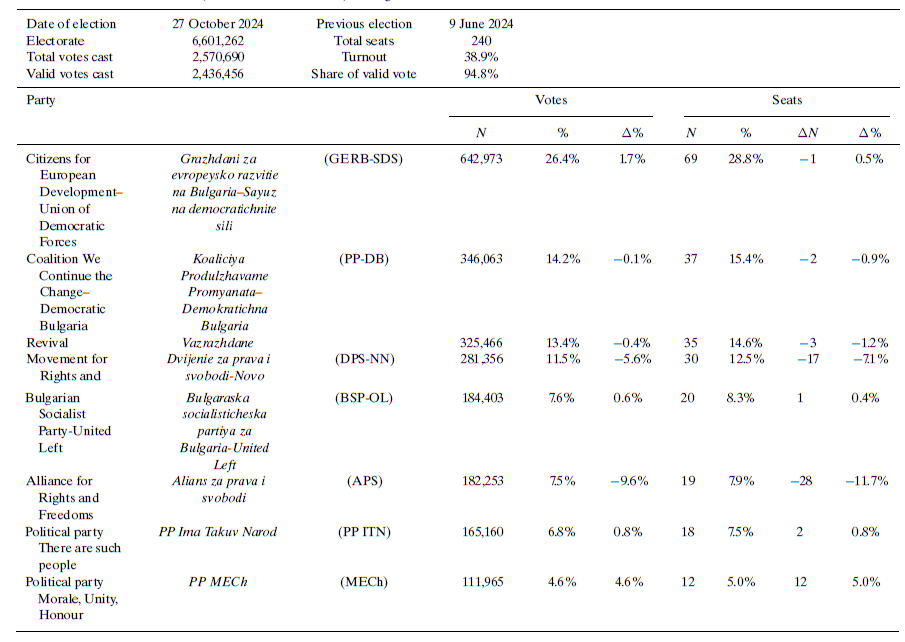
Twenty-nine parties competed at the elections in October, and eight entered Parliament, one more than in JuneFootnote 2 (Table 3). Turnout was 38.94 per cent, slightly up from June. Election Day proceeded without major disruptions, and the Central Electoral Commission reported no significant violations. Technical issues with voting machines were reported in a small number of polling stations—95 machines in total (91 in Bulgaria and four abroad) were taken out of use due to malfunctions such as printing errors, paper jams, or startup failures. In all affected locations, voting continued using paper ballots.

Notes:
1. DPS split since the last election to DPS-NN and APS. Calculated by new party result − old party. In other words, numbers of those parties refer to APS result − DPS result and DPS-NN result − DPS result.
2. BSP-OL was previously called BSP for Bulgaria.
Source: Central Election Commission (2024; https://results.cik.bg/pe202410/rezultati/index.html).
The effective number of parliamentary parties remained above seven (7.55 in June and 7.2 in October), signaling a highly fragmented Parliament and a difficult government formation situation. There were two main reasons for the sustained and even further fragmentation of Parliament.The first one was the major split in one of the few perennial parties in Bulgaria—the party traditionally representing the Turkish minority, DPS. Following a major leadership crisis in the summer of 2024 (see Political Party Report), two entities competed in October 2024:DPS–New Beginning, led by the Delyan Peevski, and Alliance for Rights and Freedoms (APS), led by the DPS founder Ahmed Dogan. Both parties did well and increased their combined share of votes and percentage points. However, bitter personal and organizational disputes tarnished even further the image of the party in the political system.
The other reason was the continued fragmentation in the extreme right segment of the political system. In the 2023 elections, Vazrazhdane (Revival) was the only party of an openly nationalist position in Parliament, but in 2024, two parties took away from its votes and made it into Parliament: Velichie in June and Moral, Edinstvo, Chest/Morality, Unity, Honor (MECh, meaning sword in Bulgarian) in October. The newest entry into Parliament, MECh, is a nationalist, populist and euroskeptic party founded earlier in 2024 by Rosen Vasilev, former MP from ITN and PP. Similar to Velichie, MECh obtained a lot of votes among the younger voters, using TikTok to promote its anti-establishment messages. The story of MECh is very typical of new party formations in the country.
Cabinet report
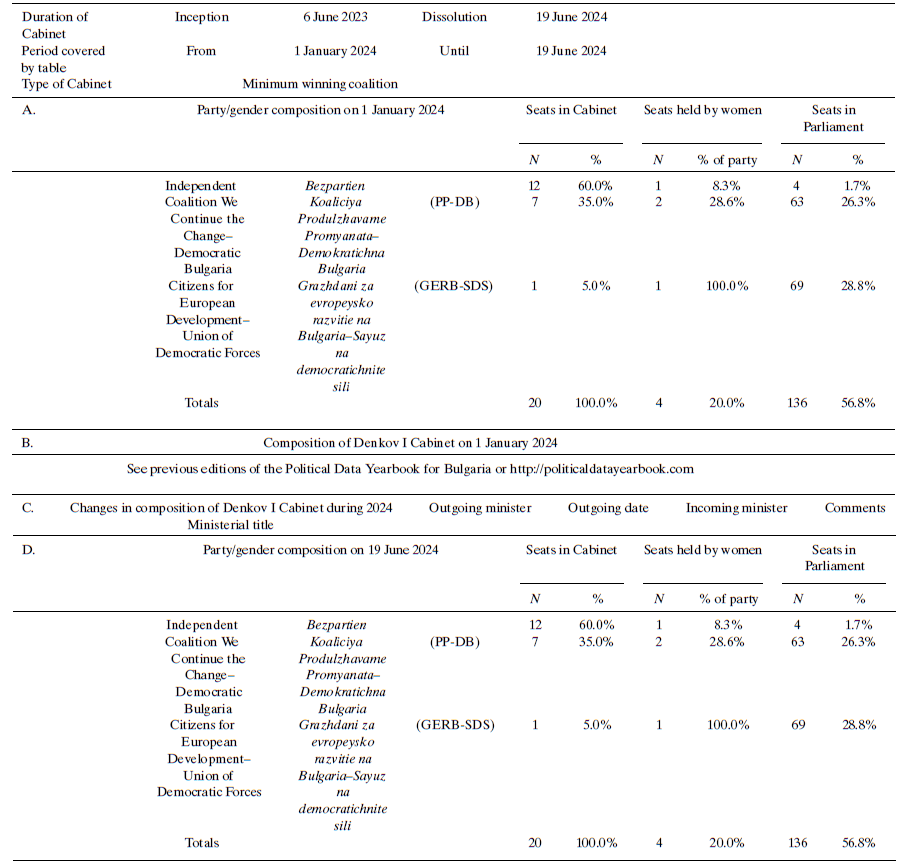
Cabinet instability and a new mechanism of appointing caretaker Cabinets were the most important aspects of Bulgaria's politics in 2024. The Denkov Cabinet (Table 4) was an unusual and innovative set-up: a rotating Prime Minister formula was introduced, with PP-DB's Nikolay Denkov serving as PM and GERB-SDS's Maria Gabriel as Vice PM for the first nine months, then set to swap roles in March 2024. From the start, the coalition faced skepticism due to the parties’ prior pledges not to govern together, with critics—especially BSP, ITN, and Vazrazhdane—dismissing it as a fragile, foreign-influenced arrangement (see Spirova Reference Spirova2024, for details). Nicknamed the sglobka Cabinet, it became synonymous with political collusion.

Sources: Government website (2024; www.gov.bg/); previous table from 2024 (2023 data).
When the time for the rotation came in March, trouble also started within the coalition. As the constitution does not allow for the power-sharing set-up that was created, Denkov had to resign for Gabriel to be appointed as PM. GERB-SDS used the opportunity to try to re-negotiate the agreed manner of distributing seats in the Cabinet, as well the major regulatory bodies. Also of significance, although unspoken and of importance, was the role permitted for DPS-affiliated people to play in the government. On 19 March, Gabriel submitted a proposal for a Cabinet that was not approved by PP-DB. Follow-up negotiations failed, and on 25 March, GERB-SDS declared that its attempt to form a coalition was unsuccessful. Following constitutional procedure, ITN received the third mandate to form a new Cabinet, but returned it unfulfilled to the President, officially confirming that Bulgaria was heading for another early parliamentary election (see June Elections).
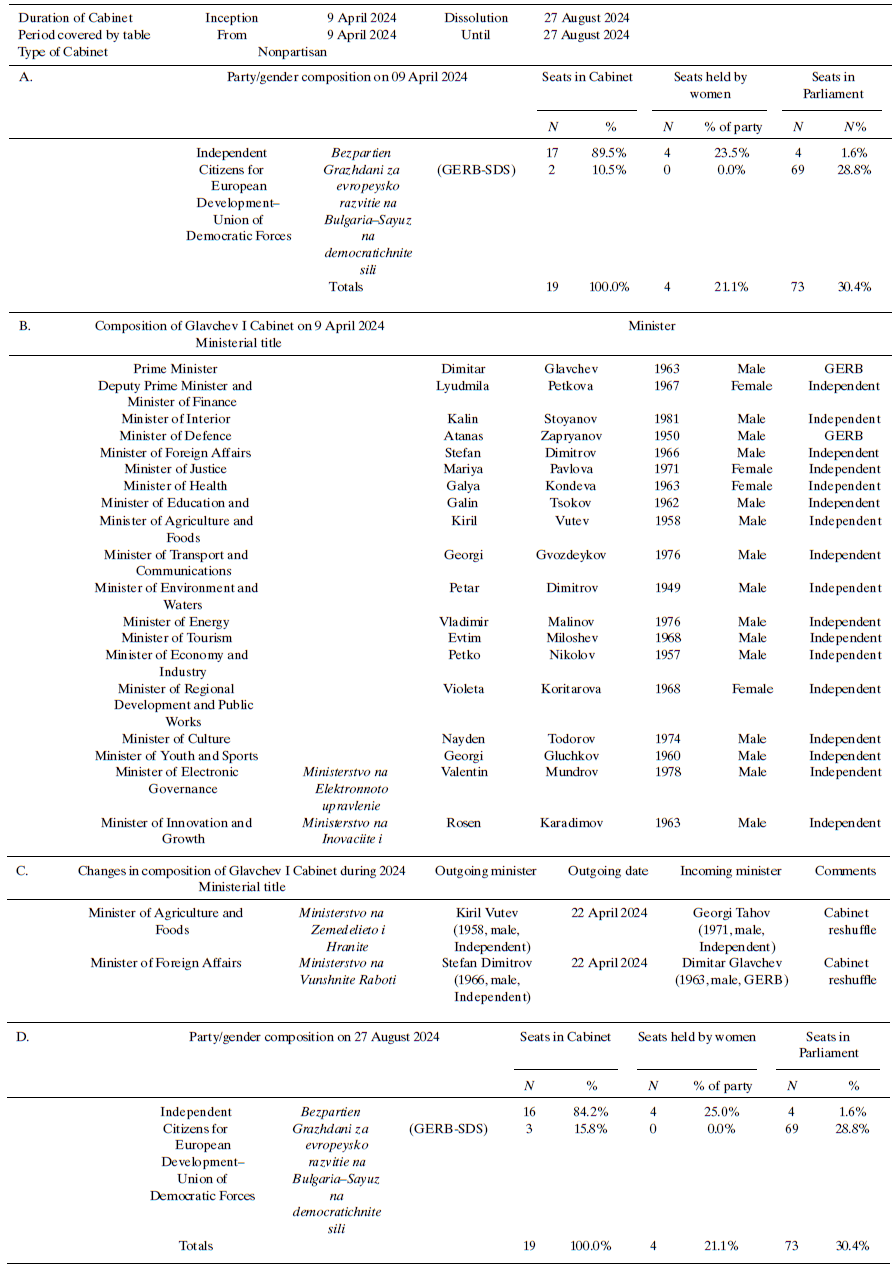
A new caretaker Cabinet had to be appointed by the President, and for the first time under the new constitutional rules, was adopted in December 2023 (Spirova Reference Spirova2024). The constitutional amendments significantly limited the President's options for appointing a caretaker Prime Minister, as only specific officeholders—such as the Speaker of Parliament, the Governor or Deputy Governor of the Bulgarian National Bank, members of the National Audit Office leadership, and the Ombudsman or their deputies—could be appointed to the role. This constraint raised concerns about potential delays in organizing the elections, especially if a suitable candidate could not be promptly identified or willing to serve, and also concerns, of course, about the party leaning of these candidates, most of whom are appointed to their original positions by Parliament. On 9 April, caretaker PM Glavchev was appointed by Radev. Glavchev had been GERB MP in previous Parliaments, and since July 2023, was chairman of the National Audit Office. For the first time in the post-1990s political history of the country, the President openly appointed a politician of the governing party as caretaker PM rather than a figure of their own choosing.
Two ministers of Glavchev I were replaced within a week of the Cabinet taking office. GERB's deputy chairman, Daniel Mitov, replaced Stefan Dimitrov as Foreign Minister, while Georgi Takhov, considered close to President Rumen Radev, replaced Kiril Vatev as Agriculture Minister. This effectively gave GERB control of the Foreign Ministry, while President Radev gained influence of the Agriculture Ministry, which distributes major EU funds. Vice President Iliana Yotova expressed concerns about the changes, suggesting that if the caretaker Cabinet proved to be partisan rather than independent, suspicions would grow (Mediapool 2024).
On 1 July, following the June legislative elections, GERB party leader Boyko Borissov proposed a minority government with Rosen Zhelyazkov as Prime Minister, including key ministers from the current caretaker government. The proposal was unsuccessful. On 22 July, PP-DB received the second mandate to form a Cabinet and returned it unfulfilled to President Rumen Radev, as it did not receive support for the coalition's proposed package of anti-corruption measures and solutions. The third mandate was given to ITN, which also returned it unfulfilled after five days of negotiations for a possible regular Cabinet (Ficheva Reference Ficheva2024). This opened the door for a second caretaker Cabinet for the year and new elections.
More drama followed in early August, again demonstrating the changing relations between GERB and the DPS, led by Peevski. In early August, Rumen Radev refused to sign the decree with the Cabinet composition proposed by Goritsa Grancharova-Kozhareva, the nominated caretaker Prime Minister. The refusal was brought around by the retention of Interior Minister Kalin Stoyanov in his position. His appointment, which GERB-SD had insisted upon, was seen as an open link to DPS. The head of state offered Kozhareva more time to reconsider the decision and propose a new candidate for Interior Minister, but she refused. In an unprecedented step, Radev had to choose a new candidate as caretaker PM (Capital 2024).
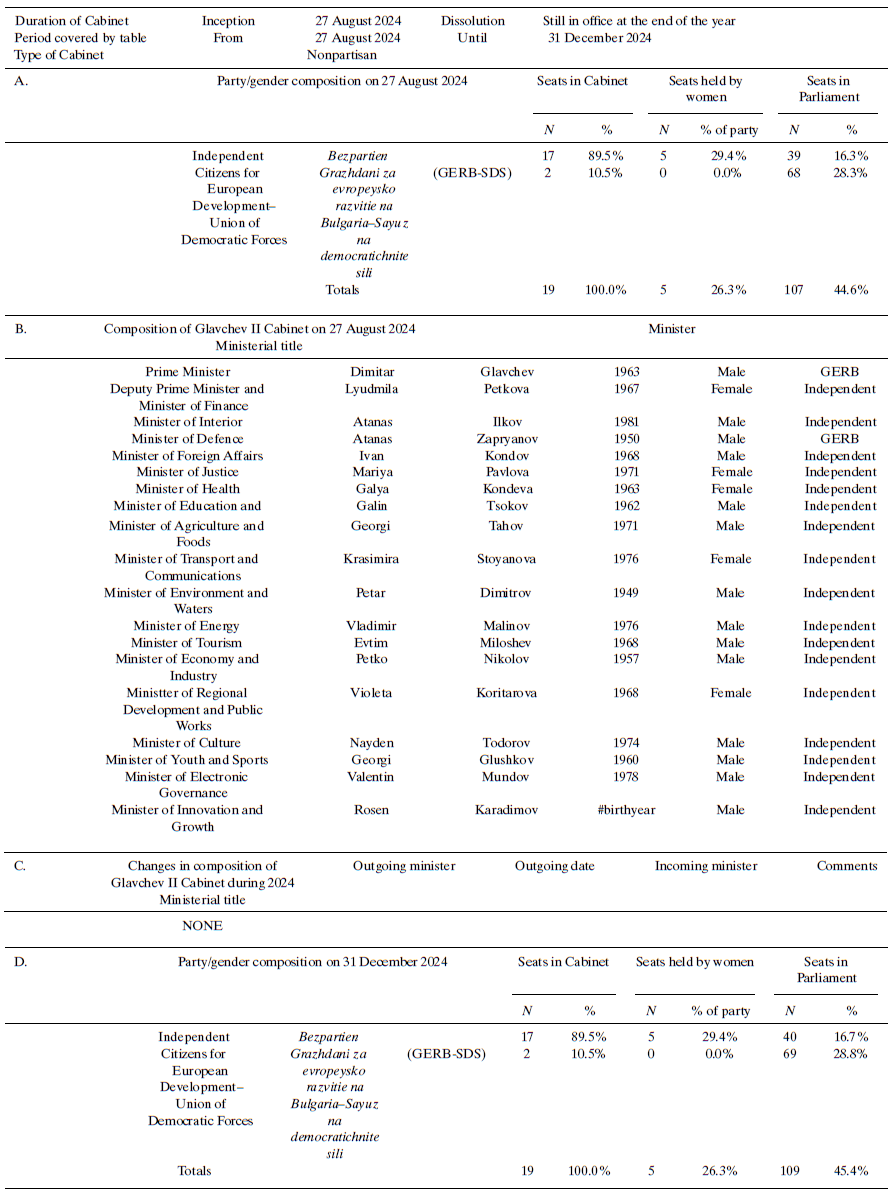
Ultimately, Glavchev remained as PM, and Glavchev II was formed as caretaker Cabinet until the October elections (Tables 5 and 6). Ministerial portfolios were reshuffled, but the make-up of the Cabinet remained mostly unchanged.

Source: Government website (2024; www.gov.bg/).

Source: Government website (2024; www.gov.bg/).
Parliament report
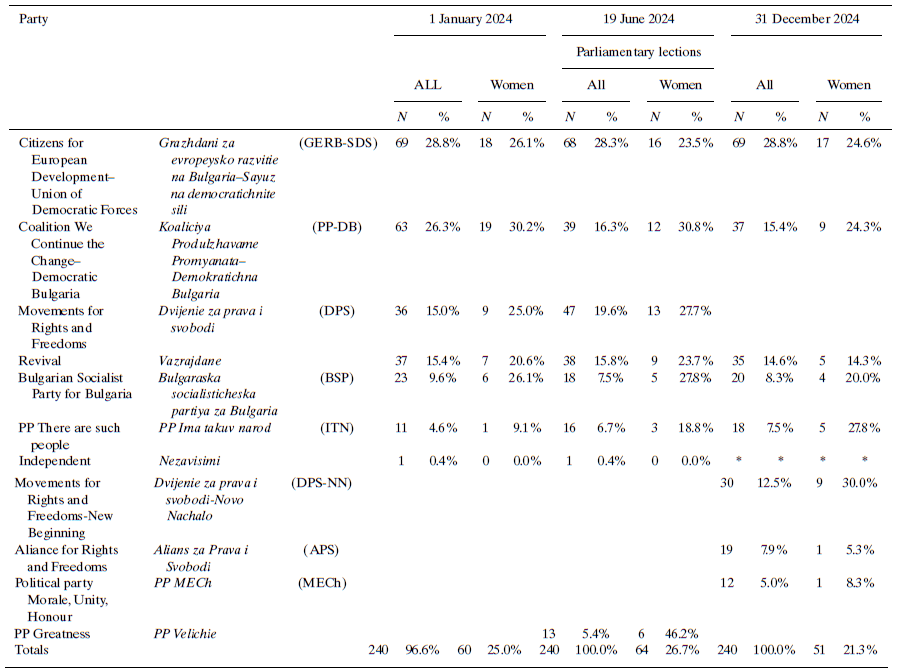
The year 2024 saw three separate Parliaments: the tail end of the 49th National Assembly, the short-lived 50th Parliament, and the 51st one, elected in late October. Unlike previous years with prolonged caretaker Cabinets, the Parliament remained in session, in compliance with the 2023 constitutional amendments. Despite this, parliamentary activity was relatively limited. The make-up of the legislature remained mostly similar throughout the year, as the same parties returned at both elections (Table 7). The percentage of female MPs declined, however, across all party factions to just over 21 per cent overall. Control over the executive was limited to questions to the Cabinet. All in all, legislative activity reflected the political instability and infighting among the leading parties.

Notes:
*. By the start of the 51st National Assembly, the count of Independents rose to 40 people (from 1 in the beginning). This is due to the division of DPS as two parties. The rest are people from PP Greatness.
1. A second change was due to elections in October. The 49th National Assembly ended on 19 June, 50th National Assembly ended on 11 November.
2. BSP was later renamed BSP-United Left (in June/October).
3. DPS was divided into DPS-NN and APS
Source: Parliament Bg (2024 ; www.parliament.bg/en/MP).
Maybe most indicative of the difficult political situation was the election of the Chair of the 51st National Assembly. The Chair is usually elected from within the largest parliamentary faction in the first session of Parliament. This time, it took 26 days, 11 elections, including second rounds, and re-counts to find a political compromise that would be supported by a majority of MPs. Natalya Kiselova, proposed by the Socialists and supported by GERB-SDS, PP-DB, BSP, and APS-Dogan, was elected on 6 December (Dariknews 2024). Key to her election was an agreement to form a cordon sanitaire around Delyan Peevski and his DPS-New beginning. The long period of unsuccessful attempts further strengthened public distrust in the legislature among the Bulgarian public.
Political party report
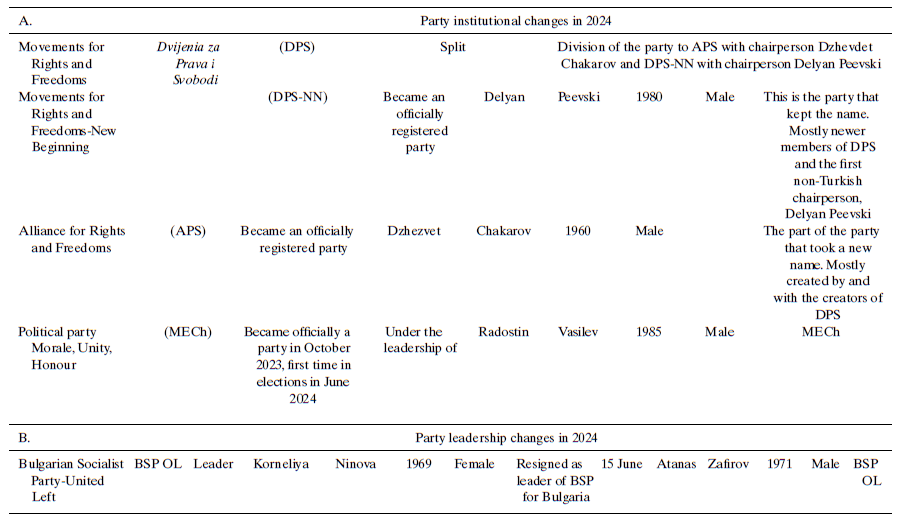
The year 2024 was also more tumultuous than most other years in terms of party development in Bulgaria (Table 8). In addition to the emergence of a brand new party, MECh, already described in the Election Report, the BSP experienced a leadership change and, probably most significant of all, the DPS split into two organizations. Moreover, in June 2024, Hristo Ivanov resigned as leader of the Yes, Bulgaria party and co-chair of the DB coalition, also giving up his parliamentary seat due to the poor election results of the PP-DB coalition in the June elections.

Note: BSP OL and BSP are the same party.
Source: Deutsche Welle (2024; www.dw.com/bg/noviat-vozd-na-dps-brutalna-sila-no-trudno-novo-nacalo/a-71142332); Мediapool (2024; www.mediapool.bg/prevrat-v-bsp-noviyat-vremenen-lider-atanas-zafirov-uspokoi-che-nyama-ryazane-na-glavi-news360198.html).
In a significant step, in February 2024, Delyan Peevski, a provocative politician with alleged corrupt networks, was elected co-chair of DPS. By the summer, he was in open conflict with Ahmed Doga, the founder and honorary Chairman of the party. In July, Peevski expelled 17 deputies loyal to Ahmed Dogan from the DPS, reducing the group's size in Parliament and leading to losing its status as the second-largest party faction. Further conflicts between Dogan and Peevski continued, with the party ultimately splitting in two. Open battles over the party name, organization, property and communication channels ensued, and at the October elections, two separate DPS offshoots had emerged. Peevski managed to preserve the original name and registered his party as Movement for Rights and Freedoms-New Beginning. The camp of Honorary Chairman Ahmed Dogan submitted documents for the registration of the coalition APS. At the October elections, the DPS votes split between the two formations with ethnic Turks favouring Dogan at a higher rate while non-Turkish DPS supporters favoured Peevski. Peevski appeared to have the upper hand, gathering a higher percentage of the vote (see Election report), but both parties preserved a significant presence in Parliament.
On the BSP front, Ninova resigned as party Chairperson on June 11 2024, and Atanas Zafirov was elected as acting Chairman. In September and following court battles between the two about who can represent the BSP, Zafirov was granted the right to represent the BSP and Ninova was expelled from the party.
Institutional change report
There were no major new institutional changes in the country during 2025. On 26 July 2024, the Constitutional Court struck down most of the judicial provisions that had been adopted with the 2023 constitutional amendments (Spirova Reference Spirova2024), while allowing dual-citizenship measures and caretaker government rules to remain.
Issues in national politics
Politics in Bulgaria during 2024 did not differ much from 2023. Political instability, fragmentation, corruption and public distrust in the government continued to plague the political process. Following the failure of the GERB-SDS/PP-DP coalition and two rounds of elections, GERB managed to preserve its plurality position in the party system, while PP-DB shrunk in influence substantially. The other, smaller parties suffered from various leadership and organizational issues, making a governing coalition very difficult to form and maintain.
The main issue of contention that impacted party relations was the position of DPS leader Delyan Peevski. Peevski had long been associated with various corruption scandals, and in early 2023 had been put on the infamous Magnitsky list by the United States. Despite this, he continued to play a very important role in Bulgarian politics: as a leader of the DPS and as a politician who officially calls many other shots in the political process. Cooperating with him or not remains the most important divide in Bulgarian party politics.
During 2024, Bulgaria made major strides toward EU integration, with its membership in Schengen a reality and progress on the admission to the Eurozone. However, EU skepticism also increased with quite a few of the Bulgarian parties taking an openly or covertly pro-Russian stance, displaying an ambivalent attitude toward Ukraine, and remaining critical of Brussels. Divisions within the country on LGBTQ+ rights, migration, minority rights and domestic violence continued to plague political discourse and create social tensions. Economically, the country continued to experience sustained inflation and declining standards of living, which further contributed to domestic skepticism about the potential impact of the introduction of the euro in 2026.

 Open access

