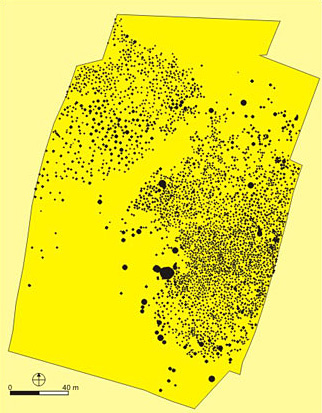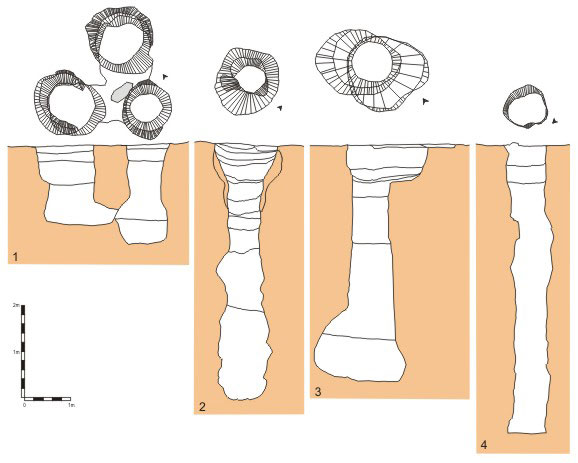


The Neolithic flint mine of Casa Montero was discovered as a result of the Archaeological Impact Assessment of Madrid's M-50 highway belt (Figure 1). The site is located south-east of Madrid, in the centre of Iberia. An open-area excavation of 4.2 ha has documented over 3500 vertical shafts (Figure 2), with a mean width of 1m and depths of up to 7m (Figure 3). The site is located in a river bluff, where no contemporary Neolithic settlements are known. It seems to be the result of reiterative short-term seasonal expeditions. Shafts rarely cut previous extracting pits, suggesting that the time-span of all mining activity was relatively short, perhaps less than a few centuries. The flint lacks evident aesthetic qualities. Its petrological composition and knapping qualities vary both horizontally and vertically throughout the four flint layers documented in the site. Flint was mined and knapped in order to obtain blades and occasionally flakes, products that would be finally transported off-site. The remaining waste was dumped back into the shafts.
Location of the flint mine of Casa Montero in Iberia and aerial view of current excavations.

Map showing the distribution of shafts at Casa Montero.

Several types of shafts documented at Casa Montero.

Geological context
Casa Montero is located in sedimentary rocks from the Intermediate Unit of the Miocene. The stratigraphic column is composed of beds of clay, dolomite and silica rocks. Deep sections show the existence of four major silicification episodes, each consisting of one or more silica levels. The nodule and lenticular levels are less than 40cm thick. Cherts and opals are interbedded with assorted kinds of magnesic clays and dolomites originally deposited in lacustrine and palustrine environments. The silicifications were developed in relation to a palaeo-groundwater level below the surface.
Chronology
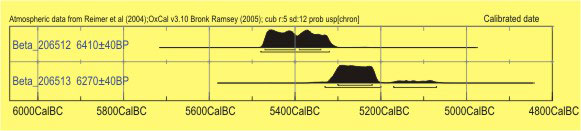
Only 29 out of the 123 shafts dug during the first field season contained pottery fragments. A small quantity of them are diagnostic, mainly impressed wares. Their characteristics suggest an Early Neolithic chronology (c. 5400-5000 cal BC), which is confirmed by radiocarbon dating of wood charcoal recovered from two shafts. Casa Montero is one of the earliest Neolithic flint mines in Europe, and the earliest in Iberia (Figure 4).
Calibrated radiocarbon chronology obtained from wood charcoal recovered in two different shafts.

Petrology
Silica rocks types were determined by analysing selected rocks through X-Ray Diffraction (XRD) and Polarised Light Microscopy. Three petrologic types have been defined considering their mineralogy: chert, opal and opaline chert. Cherts are constituted only by quartz and locally minor amounts of moganite (new silica polymorph with a similar bonding to quartz). Opals contain Opal CT (interlayered low tridymite and cristobalite), Mg-smectites and minor quartz. Opaline cherts have identical minerals as opals, but their quartz proportion is higher than 25 per cent. All three silica rocks reproduce bioturbation structures, as well as other structures found in their host rocks (magnesian smectites and dolomites).
The silica levels at the base of the stratigraphic sequence are constituted exclusively by chert, and were formed by the silicification of nodular and lenticular dolomite levels. Upper levels are composed of opal and opaline chert, and were formed by silicification of Mg-smectites. Opaline cherts frequently have an outer part with higher contents in opal CT and clay relicts, whereas the inner part is mainly microcrystalline quartz. The different composition of the inner part is a result of the recrystallisation of opal CT to form quartz (aging), producing a fine-grained quartz core (Figure 5).
The aging process of Casa Montero's cherts: X-Ray diffraction pattern of opal and opaline chert obtained from the same nodule.

Flint miners would have benefited from two specific qualities of these opaline levels: as a consequence of their inclusion in between claystone levels, shafts would have been easy to excavate, while the aging process favoured the formation of nodule cores with good knapping qualities. Although silica levels in claystones are common in the central area of the Madrid Basin, aging processes are not frequent.
Operational chains
The exploitation of chert nodules is responsible for almost all recovered lithic remains. Its main goal was blade production, although some flake production does exist. The best represented phases are decortication and configuration of the flaking surface. In order to minimise transport effort, selection and first exploitation tasks took place on site. Rejected by-products were discarded, while blanks were transported off-site.
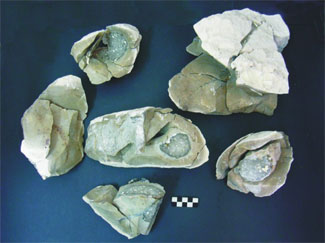
Chert exploitation strategies are widely represented at Casa Montero due to the morphological variability of cores. These have been recovered in all possible stages of reduction, from testing to exhaustion (Figure 6).
The aging process of Casa Montero's cherts: X-Ray diffraction pattern of opal and opaline chert obtained from the same nodule.

Flakes were obtained from bifacial cores. Flaking surfaces are complex, and may be hierarchical or not. Products are predetermined: discoid and Levallois.
Blade production variability depends on core blank selection. A prismatic system develops whenever a complete nodule is chosen. It begins with a bifacial cresting, and minimal configuration of a striking platform that is conditioned while production is taking place. Previous decortication is almost absent. The greater versatility of cores obtained from big flakes lead to different reduction sequences. Three blading methods have been recognised, two in volume and one on surface.
-
• The first begins with a unifacial crest on the flake edge, followed by a preparation of the striking platform through the removal of the proximal end. The process ends with recurrent blade production with re-conditioning moments.
-
• The second requires the complete conditioning of the distal end as a semicircular crest. The proximal end is eliminated with a transversal blow in order to create a striking platform. The exploitation starts using the already mentioned crest. These cores are thin, and particularly suitable for pressure flaking.
-
• The last allows surface blading requiring a very complex flaking surface configuration, similar to a livre de beurre core reduction. Resulting products are wider and more resistant. They are not appropriate for microlith production.
Perspectives
The evidence recovered at Casa Montero opens promising lines of research. On the one hand, flint-tool production and use is probably the only complete craft we can track from procurement to final disposal, something almost impossible to assess for other aspects of Neolithic economy. On the other, the study of extraction methods may shed some light on the manner and scale in which labour was mobilised. Considering the size of Neolithic groups, and the resulting population densities, one would expect cooperative social mechanisms in order to both mobilise work-groups and distribute the resulting products. Finally, the early radiocarbon dates suggest that the spread throughout central Iberia of Neolithic features, and not just the so-called 'package', was much faster than previously thought.