

INTRODUCTION
Natural-resource management routinely relies on incomplete or imperfect programmes for monitoring, assessment and enforcement. Thus, many conservation plans are guided by limited data about system structure, function, responsiveness to local management actions and sensitivity to larger scale influences. Given these information limitations, decision makers often depend upon simplified indicators of system status, dynamics and responses to management. Examples of commonly used indicator variables include estimates of standing biomass, resource-user effort, harvest and discard rates, and prey availability. Once knowledge of an indicator variable is identified as important for effective management, a monitoring programme is generally used to consider responses of indicator variables as representative of anticipated or achieved performance of a management strategy. Sometimes the choice of an ecological or environmental variable to monitor is based on selecting a metric that can be routinely surveyed, although true interests lay with much more complex underlying processes occurring in nature. For instance, the contribution of herbivorous fishes to total fish biomass could be monitored in relatively straightforward fashion by implementing an appropriate combination of sampling design and gear for a particular management question and ecosystem. This metric (for example, the ratio of herbivorous biomass to total biomass) could then be used as an indication of herbivore pressure, as well as secondary production available to top predators (McClanahan et al. Reference McClanahan, Graham, MacNeil, Muthiga, Cinner, Bruggeman and Wilson2011). Even when indicator variables are presumed to provide valuable information to managers, these metrics are usually much simpler than the actual mechanisms operating within the system (such as depensatory mechanisms, niche replacement or changes in size selectivity over time).
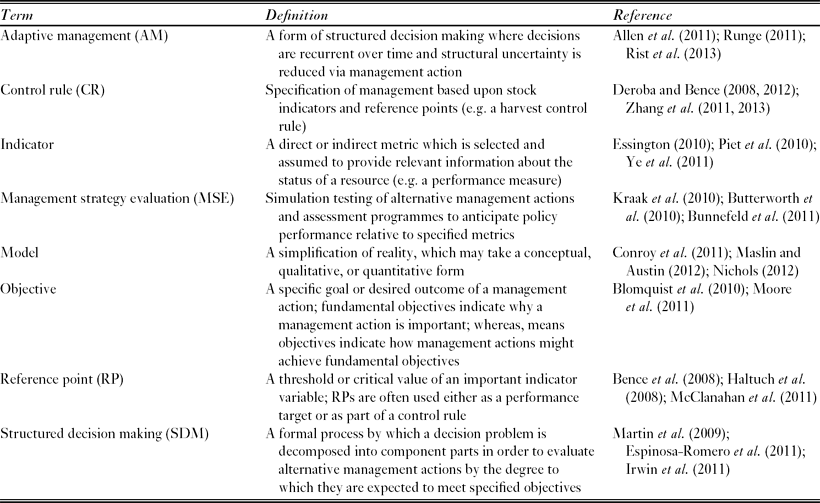
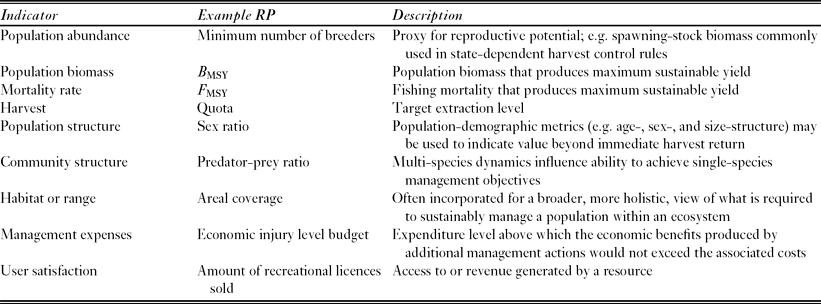
Monitored indicators are often either qualitatively or quantitatively summarized to compare with cultural, ecological, economic or other resource values (Metcalf et al. Reference Metcalf, Pember and Bellchambers2011; Ye et al. Reference Ye, Cochrane and Qiu2011). Specifically, reference points (RPs) are defined to reflect critical values of indicators that are believed to have biological or management significance (see Tables 1 and 2; Prager et al. Reference Prager, Porch, Shertzer and Caddy2003; Caddy Reference Caddy2004; Butterworth Reference Butterworth, Nielsen, Dodson, Friedland, Hamon, Musick and Verspoor2008). For instance, RPs can reflect a minimally acceptable abundance of breeders in a harvested population or a target mortality rate for that population (Seijo & Caddy Reference Seijo and Caddy2000; Deroba & Bence Reference Deroba and Bence2009). Reliance on indicator-based RPs in harvest management and natural-resource conservation is not new, and dependence on simplified indicators of system status is not likely to disappear as natural-resource management efforts become more stakeholder driven and embrace more holistic multi-species or ecosystem-based philosophies (Metcalf et al. Reference Metcalf, Pember and Bellchambers2011; Ye et al. Reference Ye, Cochrane and Qiu2011). In particular, multiple-objective decision making requires an ability to evaluate potential trade-offs between sometimes conflicting values represented by RPs when choosing among available management actions (Irwin et al. Reference Irwin, Wilberg, Bence and Jones2008; McClanahan et al. Reference McClanahan, Graham, MacNeil, Muthiga, Cinner, Bruggeman and Wilson2011). As a result, natural-resource management is increasingly turning to structured and participatory processes for providing science-based decision support. This movement has prompted a recent and ongoing convergence of like-minded approaches for conducting formal options analysis (for example, management strategy evaluation and structured decision making; Table 1) in support of conservation and management of resources ranging from severely data-limited to extremely economically valuable (Dowling et al. Reference Dowling, Smith, Knuckey, Smith, Domaschenz, Patterson and Whitelaw2008; Bunnefeld et al. Reference Bunnefeld, Hoshino and Milner-Gulland2011; Ye et al. Reference Ye, Cochrane and Qiu2011; Zhang et al. Reference Zhang, Chen, Zhu, Tian and Chen2013).
Brief descriptions of selected key terms and recent articles that provide elaboration.

Examples of various types of indicator metrics with examples of reference points (RPs) that could be specified and brief descriptions of use or recognition of importance in the management of renewable resources.
We have found it helpful to consider the use of RPs from the perspective of structured decision making (SDM) and adaptive management (AM), especially for identifying situations in which RPs relate to different concepts within a decision-making context. Our current aim is to discuss how the definition of RPs (and management based upon their use) can benefit from a SDM/AM-perspective. Because the use of RPs and formal decision-making frameworks can pose conceptual and technical challenges, we present some definitions and brief summaries of the key elements that exist between defining RPs and applying AM (Tables 1 and 2), along with several relevant supporting references throughout. We also provide an overview of the SDM approach for dynamic systems (Appendices 1 and 2, see supplementary material at Journals.cambridge.org/ENC) and describe how RPs and models function as hypotheses when considered within an AM framework (Appendix 3, see supplementary material at Journals.cambridge.org/ENC). We believe that such treatment can aid managers in being explicit about how, why and when RPs are used within natural-resource management, and we suggest that viewing both RPs and models as hypotheses should support more efficient application of AM in RP-based management programmes. In total, we hope the assembled information will improve adaptive learning and implementation of formal decision-making processes with RP-based management.
VIEWING RPs FROM A SDM PERSPECTIVE
We consider the use of RPs from the perspective of optimal decision making in stochastic systems to achieve stated resource goals. The combined use of RPs and SDM is an admission that we are interested in finding the best use of available information to get from point A (where we are) to point B (where we want to be) in an efficient and transparent way (Irwin et al. Reference Irwin, Wilberg, Jones and Bence2011). We consider AM to be a special case of SDM where the decision maker strives to achieve specified outcomes via recurrent choices of alternative management actions, while both recognizing key uncertainties and seeking to reduce them via management.
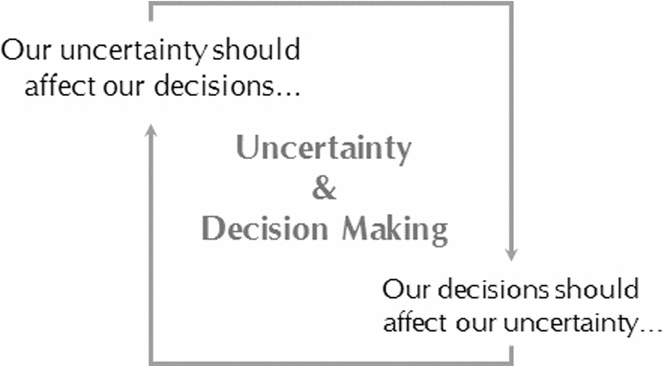
In real-world settings, numerous sources of uncertainty in both ecological (for example, what is the future reproductive potential of the population?) and social (for example, how will human behaviours affect compliance?) dimensions have overshadowed the application of AM (Rist et al. Reference Rist, Campbell and Frost2013), and are also relevant for viewing RPs. The various forms of uncertainty encountered in natural-resource management (for example Hilborn Reference Hilborn1987; Johnson et al. Reference Johnson, Moore, Kendall, Dubovsky, Caithamer, Kelley and Williams1997; Landres et al. Reference Landres, Morgan and Swanson1999; Regan et al. Reference Regan, Colyvan and Burgman2002; Gore & Kahler Reference Gore and Kahler2012; Kujala et al. Reference Kujala, Burgman and Moilanen2013) include some that are largely irreducible (such as natural variability) as well as others that can be reduced via directed management actions (such as structural uncertainty). These multiple forms of uncertainty compel assumptions throughout the management process, even if both the amount of uncertainty and its composition vary across management scenarios. When RPs are treated as critical values of indicators of system status, they transmit the effects of these (often implicit) uncertainties into the decision-making process. Thus, recognition of uncertainty and making informed decisions are not separate undertakings when considered in terms of AM of renewable resources (Fig. 1). In practice, RPs may be only crudely related to the underlying system states of interest. In turn, the response of indicators (representing the underlying state of interest) to alternative management actions may be predictable only with great uncertainty. Typically, AM focuses on the reduction of structural (model) uncertainty, which we discuss below.
Recognition that decision making and treatment of uncertainty can be integrated in natural resource management.
In our opinion, ubiquitous forms of uncertainty, which are particularly relevant for connecting RP-based management with SDM, include partial observability (namely observation or assessment uncertainty), partial controllability (such as outcome or implementation uncertainty), and linguistic uncertainty (see Kujala et al. Reference Kujala, Burgman and Moilanen2013 for a recent and thorough review of the treatment of uncertainty in conservation). Both partial observability and partial controllability can affect achievement of management objectives because they allow for discrepancies between what is thought to be occurring and what is actually occurring (Williams et al. Reference Williams, Johnson and Wilkins1996, Reference Williams, Nichols and Conroy2002, Reference Williams, Szaro and Shapiro2009). When RPs are used to indicate the status of a resource, managers should recognize that partial observability results in observed system states that differ from reality due to bias, imprecision, or both. For instance, observed indicator values are commonly assumed to be proportional to actual population values. However, this assumption may be violated due to changes in the relationship between the index and actual population over time, space, or because of differences among observers (Williams et al. Reference Williams, Nichols and Conroy2002). Organismal count data are known to be potentially misleading for a number of reasons (for example retrospective bias, species misidentification, changes in catchability or heterogeneous detection; Punt et al. Reference Punt, Smith and Cui2001; Williams et al. Reference Williams, Nichols and Conroy2002; Elphick Reference Elphick2008; Wilberg et al. Reference Wilberg, Thorson, Linton and Berkson2010). Likewise, many factors can cause the actual outcomes of a management action to differ from its intended consequences, leading to partial controllability (Williams et al. Reference Williams, Nichols and Conroy2002; Conroy & Peterson Reference Conroy and Peterson2013). Linguistic uncertainty (Regan et al. Reference Regan, Colyvan and Burgman2002; Conroy & Peterson Reference Conroy and Peterson2013) further clouds the use of RPs, in part because the terminology used to define RPs is often a combination of statistical and biological meanings (for example setting a target optimal yield RP below a maximum sustainable yield [MSY] limit RP), with relatively complex derivations that are potentially confusing to stakeholders or even experienced managers (Gabriel & Mace Reference Gabriel, Mace and Restrepo1999; Essington Reference Essington2001; Cadrin & Pastoors Reference Cadrin and Pastoors2008). In fact, the presence of linguistic uncertainty influences our preference for terminology such as partial observability over other similar descriptions such as measurement error or observational error due to the varying interpretations with which stakeholders might view a need to reduce ‘measurement error’.
THE ROLES OF RPs IN DECISION MAKING
With few exceptions, natural resource management involves making recurrent decisions about dynamically (and stochastically) evolving systems; in other words, optimal control (Appendix 2, see supplementary material at Journals.cambridge.org/ENC). Under optimal control, feedback from monitoring informs decision makers about the current state of the system, and whether the system is trending toward or away from desired states. In this sense, RPs may be used in decision making to assist with finding a single ‘optimal’ policy (a policy that maximizes a single objective or utility function) or a suite of policies that are considered robust to specific uncertainties and are in line with the collective risk tolerance of affected managers and stakeholders. Furthermore, RPs may also be used in defining how a policy is made operational (for example through harvest control rules; Bence et al. Reference Bence, Dorn, Irwin and Punt2008; Zhang et al. Reference Zhang, Chen, Zhu, Tian and Chen2013). Thus, from an AM perspective, RPs can serve either as: (1) a comparative value to gauge policy performance (a management target) or (2) a component of a defined control rule (a ‘trigger’). When a RP is treated as a target value, managers may strive to either achieve a particular RP (for example indicating population recovery) or avoid undesirable conditions (such as indicating a critical tipping-point threshold for the population), which the RP's value would reflect (Katsukawa Reference Katsukawa2004). Alternatively, RPs are perhaps more often used as triggers, such that the RP primarily corresponds to information that is used when choosing among possible management actions. In either case, the RPs themselves are based, to varying degrees, upon observations and are sensitive to the uncertainties described above.
When RPs are treated as ‘targets’ in a decision-making context, then these RPs primarily correspond to values that are objective driven. Thus, target RPs can be further considered as representations of either fundamental or means objectives (Table 1; Conroy & Peterson Reference Conroy and Peterson2013). When a RP corresponds to a fundamental management objective, the presumption is that fulfilment of the RP directly results in achievement of one or more attributes of the fundamental objective. Thus, a fundamental objective is of primary importance to a decision maker, representing why a particular outcome of a management action is important. In the context of a means objective, achievement of the RP is presumed to lead to fulfilment of a fundamental objective. A means objective represents a path by which, or how, a fundamental objective may be achieved. This distinction is important, because, by definition, a fundamental objective relates to a core value of the decision maker or stakeholders; whereas, multiple means (for example, actions) may achieve a fundamental objective (Wilson & Arvai Reference Wilson and Arvai2011; Conroy & Peterson Reference Conroy and Peterson2013). For instance, the specification of an economic injury level (EIL) provides a decision maker with a justifiable target, which is based upon costs of management actions and corresponding expected benefits (namely, a dollar spent on pest control is worthwhile so long as it produces at least a dollar in yield benefits). As an example, an overall goal (a fundamental objective) of the sea lamprey control programme in the Laurentian Great Lakes could be viewed as balancing the economic costs of control efforts with the economic value gained by avoiding fishery damages. Thus, EILs could be viewed as target RPs related to the amount of control effort to expend on each lake (Irwin et al. Reference Irwin, Liu, Bence and Jones2012). Other examples of target RPs that appear to be equivalent to fundamental objectives include performance values related to employment, economic gain from harvest and avoidance of species extinction. Natural resource management commonly involves weighing multiple objectives; therefore, the evaluation of a suite of target RPs may be required, which sometimes may only be obtained at the cost of reduced measurement precision for individual RPs (Caddy Reference Caddy1999).
In contrast, a trigger RP itself does not necessarily relate to a fundamental or means objective when its primary management function is as a threshold value within a decision rule. Such RP-based control rules can be ad hoc, or they can be formally derived (for example via dynamic optimization approaches). For instance, many harvest management programmes use RPs to set annual allowable take (Johnson et al. Reference Johnson, Williams, Hines, Kendall, Smith and Caithamer1993; Williams et al. Reference Williams, Johnson and Wilkins1996; Nichols et al. Reference Nichols, Runge, Johnson and Williams2006; Martin et al. Reference Martin, Runge, Nichols, Lubow and Kendall2009). Zhang et al. (Reference Zhang, Chen and Wilson2011, p. 1521) note the fundamental role of biological reference points (BRPs) in deriving a harvest control rule (HCR) by stating ‘we cannot define HCRs without including BRPs.’ More specifically, a state-dependent (for example biomass-based) HCR is used to adjust an allowable harvest rate based on a population metric such as spawning-stock biomass (Deroba & Bence Reference Deroba and Bence2008; Irwin et al. Reference Irwin, Wilberg, Bence and Jones2008; Wilberg et al. Reference Wilberg, Irwin, Jones and Bence2008). In this case, a reference level of spawning-stock biomass would likely be treated as serving as an indication of acceptably maintaining the harvested population's productivity potential. That is, managers are likely more concerned with how harvest will affect the population's future reproductive capacity rather than its current biomass per se. For a given indicator (for example an abundance index), a RP value thus may sometimes be interpreted as being indicative of reaching a management objective (namely a target, such as avoidance of a level of stock depletion) while also being used as a component of a decision control rule (namely a trigger, such as ‘B lim’ in a biomass-based harvest policy). Note that the contrast between the use of target and trigger RPs described here can differ from attempting to capture uncertainty by specifying upper and lower limit values within an indicator's observable range.
HYPOTHESIS-DRIVEN DECISION MAKING
In the previous section, we considered the role of RPs in informing optimal resource control. Under such an approach, models may be used to guide decision making, but they may or may not be cast as hypotheses. Even if management involves the use of multiple models, this structural uncertainty may not be explicitly recognized, and even if recognized, its reduction may not be contemplated as a role for management. By contrast, in AM, viewing alternative system models as alternative hypotheses of resource structure or function is necessarily explicit. Structural uncertainty simply reflects that multiple models reasonably describe observed relationships. Alternative system models often reflect unknowns about processes (such as, is density dependence operating?), and how to represent them with sub-models (for example alternative stock-recruitment models could be fit to parent-offspring data) and associated parameters (such as, is detectability varying over time?). In practice, AM involves explicitly entertaining multiple alternative system models (as hypotheses), which ultimately may differ with respect to what would be identified as an optimal management policy.
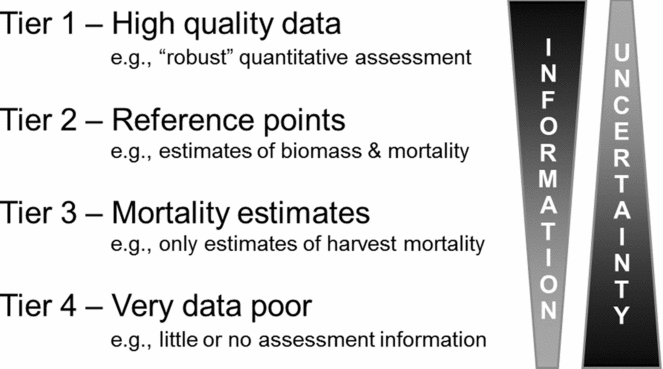
Discrimination among alternative hypotheses (the potential models) begins with accepting learning as a necessary part of the decision-making process. By ‘learning’ we mean the reduction of sources of uncertainty that impair the ability to identify a preferred management choice (Fig. 2; Appendix 3, see supplementary material at Journals.cambridge.org/ENC). Learning occurs when knowledge about how a resource system functions can be used to drive the evidentiary weights of a model or subset of models toward 1, thus driving the weights associated with others toward 0. Reduction of uncertainty should enhance the ability to achieve objectives (Fig. 3), with a theoretical maximum gain given by the expected value of perfect information (EVPI; Lindley Reference Lindley1985; Williams et al. Reference Williams, Nichols and Conroy2002; Conroy & Peterson Reference Conroy and Peterson2013). In this way, learning is a central feature of AM and has direct value to resource decision making, as measured in the currency of the resource objective. Thus, AM is a special case of optimal control (Appendix 2, see supplementary material at Journals.cambridge.org/ENC) in which feedback about the plausibility of alternative system models is provided via monitoring.
A simplistic representation of how decision makers might experience different potential combinations of information quantity and quality. An adaptive management approach would emphasize identification and reduction of key uncertainties in order to progress to a more learned state (for example one with more informative data). Examples of the implementation of a tiered approach to resource management can be found in Dowling et al. (Reference Dowling, Smith, Knuckey, Smith, Domaschenz, Patterson and Whitelaw2008) and Smith et al. (Reference Smith, Smith, Tuck, Klaer, Punt, Knuckley, Prince, Morison, Kloser, Haddon, Wayte, Day, Fay, Pribac, Fuller, Taylor and Little2008).
A simplistic representation of how decision makers might attempt to balance uncertainty with precautionary management to maintain an ‘accepted’ level of risk (for example to resource sustainability). For example, a precautionary approach to harvest regulation would tend to emphasize restriction of exploitation in cases where uncertainty remains large. Alternatively, a risk level could be reduced via reduced uncertainty and maintaining precautionary management.
In much the same way as models exist as simplifications of reality, target RPs exist as simplified metrics representing achievement of an objective. Thus, viewing RPs as performance targets is also relevant here, but must be approached with careful attention to: (1) whether the RP represents a fundamental or a means objective, and (2) if the latter, what assumptions are required to get from means to fundamental. However, recognizing how trigger RPs connect to assumptions about underlying system dynamics or achievement of management objectives is even more complex. Trigger RPs, whether they are derived in ad hoc fashion or by means of optimization algorithms, ordinarily involve relying on implicit hypothesized systems models. The challenge of distinguishing between targets and triggers can be illustrated by way of a simple dynamic harvest example (described in Appendix 2, see supplementary material at Journals.cambridge.org/ENC). In that example, stock size relates to a trigger RP, in that different stock sizes dictate different rates of exploitation. This also illustrates that sometimes a trigger RP is observable through monitoring, but the target RP is not (in this case, it is predictable, but only observable retrospectively). The concepts converge under equilibrium conditions, in which case the triggering stock level, N*, has a simple mathematical relationship to the target RP (in this case, MSY). Thus, trigger RPs or other decision-rule values cannot be considered as isolated from hypotheses about how ecological systems function, although such hypotheses often go unstated. In a decision-making context, the presence of unstated hypotheses, besides being non-transparent, adds unexpressed (and potentially unacceptable) risk. In our opinion, trigger RPs are in many ways conceptually and operationally more complex than target RPs, because the triggering value typically relates to an objective or critical state of the managed system by way of a series of assumptions. Keeping a clear distinction between RPs that truly serve as targets versus values that serve as triggers should help managers recognize and prioritize the possibilities of reducing uncertainty through AM, wherein RPs are not simply waypoints to the achievement of management objectives, but themselves provide feedback into improving decision making.
CONCLUDING REMARKS
In our view, consideration of RPs from a SDM/AM vantage point is helpful, as it provides context to illuminate both potential strengths and pitfalls of using RPs for natural resource decision making. We emphasize that it can be useful for managers to clarify how, why and when they are using RPs in support of natural resource management, and, in particular, whether they will be interpreting a particular RP more in the context of a target or as a trigger. Even when RPs are transferable across systems, the types of policies acceptable to stakeholders may vary substantially (such as effort limits versus area closures; McClanahan et al. Reference McClanahan, Graham, MacNeil, Muthiga, Cinner, Bruggeman and Wilson2011). Defining meaningful RPs will often require the application of a structured approach to specifying objectives and decision alternatives, and sorting fundamental from means objectives (Appendix 1, see supplementary material at Journals.cambridge.org/ENC; Lyons et al. Reference Lyons, Runge, Laskowski and Kendall2008; Martin et al. Reference Martin, Runge, Nichols, Lubow and Kendall2009; Irwin et al. Reference Irwin, Wilberg, Jones and Bence2011; Conroy & Peterson Reference Conroy and Peterson2013). Such an approach will frequently reveal discrepancies between stated objectives and the metrics being used to guide management to achieve those objectives. Identification of such disconnects may help lead to more refined RPs, and importantly, those target RPs that are indicative of policy performance as it corresponds to achieving management objectives. A structured analysis should also help to reveal otherwise unstated hypotheses behind the use of RPs to guide decision making, which may include assumptions that: (1) trigger RPs follow a deterministic relationship with an underlying system state, (2) management responses will be sufficiently prompt to trigger RPs, (3) attaining target RPs will fulfil fundamental objectives, (4) scientific advice will be incorporated into decision making, or (5) that policy compliance will be achieved. We also concur with Martin et al. (Reference Martin, Runge, Nichols, Lubow and Kendall2009), in that casting RPs and ecological thresholds in a decision-making context clarifies why (or whether) a particular metric is appropriate, and often will force elucidation of underlying untested assumptions.
Effective AM relies on identifying important known unknowns that can be reduced via management actions, and then incorporating what has been learned into the decision-making process in a timely fashion. Even when reduction of uncertainty (namely learning) is emphasized as part of the management process, when and how management responds to trigger RPs remain critical. When management policies are designed to respond to trigger RPs, time delays can occur in between the detection of the triggered RP and implementation of the management response. If decision makers fail to account for such delays in policy adjustment relative to identification of a trigger RP being actuated, then the probabilities of reduced resource utility or other undesirable outcomes are likely to increase (Shertzer & Prager Reference Shertzer and Prager2006). Some decision makers advocate bet hedging (such as right-shoulder strategies using MSY curves) as an attempt to avoid undesirable outcomes due to uncertainty, even if all uncertainties cannot be accounted for. Likewise, the mere presence of uncertainty may be used by some individuals as a reason for delaying management responses. In an AM framework, emphasis is placed on identifying critical sources of uncertainty and reducing them, rather than reducing the ability of managers to respond to indicators.
ACKNOWLEDGEMENTS
We thank Clint Moore, Julien Martin, and two anonymous reviewers for comments and suggestions that substantially improved this manuscript. We thank Michael Jones for motivating Figure 1 and Cecil Jennings for proposing Figure 3. We thank the SE Climate Science Center (USGS) and the National Park Monitoring Program (USGS) for support. The Georgia Cooperative Fish and Wildlife Research Unit is sponsored jointly by the US Geological Survey, the Georgia Department of Natural Resources, the US Fish and Wildlife Service, the University of Georgia, and the Wildlife Management Institute.