





1. Introduction
Causality is a key category in human cognition and language (Baillargeon et al., Reference Baillargeon, Kotovsky, Needham, Sperber, Premack and Premack1995; Corrigan & Denton, Reference Corrigan and Denton1996; Piaget, Reference Piaget1927). By inferring causality, humans manage to understand the interrelations between entities (Pearl, Reference Pearl2009; Trabasso & Van Den Broek, Reference Trabasso and Van Den Broek1985). The ability of causal inference is attested in human infants as early as 6 months (Leslie & Keeble, Reference Leslie and Keeble1987). Later on, causal expressions become a crucial component of children’s language. Learning how causality is expressed in language is an early challenge for first-language learners. Verbs take center stage in this process (Bartsch & Wellman, Reference Bartsch and Wellman1995; Dunn, Reference Dunn, Bruner and Haste2010). The goal of the present study is to test which cues impact the learning of causatives in a naturalistic setting.
Languages vary in the types of verbal constructions they use to express causality. Two main types of causatives are prevalent in the languages of the world (Dixon, Reference Dixon2000; Shibatani, Reference Shibatani2002). First, there are verbs, which only express causality via their inherent semantics. These verbs are known as lexical causatives. Lexical causatives commonly exist across languages. They have no specific formal marker expressing causality (e.g., “raise” in English, denoting “cause to rise”; “yak” in Turkish, denoting “set on fire,” namely “cause to be on fire”). Lexical words pertaining to this category, such as “open,” “close,” and “raise,” convey an event that causes a change of state in the patient (Shibatani, Reference Shibatani2002). For instance, the verb “raise” in “I raise the chair” entails the event “the chair rises,” that is, a change of state occurs in the patient, therefore making “raise” a lexical causative. Most studies, when defining lexical causatives, emphasise the involvement of two events and the presence of both the agent and the patient of the verb (Comrie & Polinsky, Reference Comrie and Polinsky1993; Haspelmath, Reference Haspelmath, Haspelmath, König, Oesterreicher and Raible2001). To learn about the common meaning of lexical causatives, children have to rely on the immediate linguistic context and the extra-linguistic context.
Hence, one would expect that the processing of lexical causatives, by definition, fundamentally relies on the recognition of the two arguments in the utterance, especially for the patient who experiences the change. Acquiring lexical causatives can thus be a difficult process, where children have to disentangle the agent–patient information in the speech they hear to achieve causal understanding. Second, some verbs formally mark causation, usually by affixation. Turkish, for instance, renders non-causative verbs into causatives by adding a suffix (e.g., the suffix -Ar changes çık “go off” to çıkar “take off”). Such causativised verbs are called morphological causatives, which exist in many morphologically complex languages, such as Japanese, Korean, Inuktitut, and Turkish. Children acquiring these languages thus have access to the additional formal marking to infer the causal meaning.
The two types of causatives provide different learning challenges. Lexical causatives can be challenging because the causal meaning is implicit and the meaning needs to be inferred from verb external cues such as the extralinguistic context or the linguistic meaning of the utterance as a whole. Morphological causatives might be challenging because causative markers are usually affixes that are not necessarily salient and, hence, tend to escape notice. Thus, the question remains as to how and when children learn about causatives or, more broadly, the expression of causality. As Piaget (Reference Piaget1955) first pointed out decades ago, understanding the causal link between events may not mature even for children up to 8 years of age, and such understanding is often achieved with careful guidance by adults. But how do they extract this information? It is well known that language learning is an implicit process, and also, in learning about causatives, children have to rely on their surrounding language to develop (Bonawitz et al., Reference Bonawitz, Ferranti, Saxe, Gopnik, Meltzoff, Woodward and Schulz2010; Callaghan et al., Reference Callaghan, Moll, Rakoczy, Warneken, Liszkowski, Behne and Tomasello2011; Ger et al., Reference Ger, Stuber, Küntay, Göksun, Stoll and Daum2021; Legare et al., Reference Legare, Sobel and Callanan2017). Here, we focus on the role of linguistic cues in the learning process. Linguistic cues in adult–child interaction, such as the surrounding nominals and the respective argument structure have been claimed crucial for inferring the semantics of causatives (e.g., Fisher et al., Reference Fisher, Gertner, Scott and Yuan2010; Gleitman, Reference Gleitman1990). This cue-based acquisition, however, becomes problematic for languages that allow pervasive omission of linguistic units, that is, ellipsis. So far, it has been unclear how the reliability of these cues impacts the acquisition of causatives. In the present study, we test (i) whether the input in the two types of causatives differs with respect to the distributions of object ellipsis and (ii) whether the acquisition of lexical and morphological causatives differs. We choose Turkish because it constitutes an ideal natural laboratory to test these questions, with both types of causatives extensively used to convey causality.
Previous studies have focused on the structural information that accompanies lexical causatives in their acquisition (Gleitman, Reference Gleitman1990; Naigles, Reference Naigles1996). Naigles (Reference Naigles1996) tested children’s comprehension of causal events upon hearing structural frames that contained different numbers of arguments in speech. They found that children capitalised on such structures to discriminate between causal and non-causal events. Others have followed this track to suggest the important role of syntactic frames in verb learning (Lidz et al., Reference Lidz, Waxman and Freedman2003; Messenger et al., Reference Messenger, Yuan and Fisher2015; Yuan et al., Reference Yuan, Fisher and Snedeker2012). In Turkish, particularly, Göksun et al. (Reference Göksun, Küntay and Naigles2008) tested the role of the number of noun phrases (NPs) for Turkish preschool children (up to age 5) in the causal enactment upon linguistic prompts. The results showed that the number of NPs in an utterance was a predictor for causal enactment, although the effect was weaker than that in English (Naigles et al., Reference Naigles, Gleitman and Gleitman1993). These results suggest that children’s lexical learning relies on at least some syntactic structures, either granted as innate capability or developed in an item-specific manner (Bates & Goodman, Reference Bates and Goodman1997; Fisher, Reference Fisher2002; Tomasello, Reference Tomasello2003; Yang, Reference Yang2004). Either way, children are believed to infer, or activate, the structural rules from the input they hear to support further verb learning (e.g., Tomasello, Reference Tomasello2003). A critical issue arises that syntactic structures can lack consistency and reliability when used as a cue for linguistic interpretation (Bates et al., Reference Bates and MacWhinney1989). For instance, the word order of arguments in German is not a reliable cue for determining the subject and the object of a verbal construction (e.g., “ich” [1SG.NOM] as the subject in both “Ich mag das” [1SG.NOM like.PRS.1SG 3NSG.ACC] and “Das mag ich” [3NSG.ACC like.PRS.1SG 1SG.NOM]). Such arguments can even be elided in many languages, resulting in unreliable elliptical structures for linguistic interpretation.
In Turkish, for example, both the agent and the patient of a causal event can be omitted in an utterance without rendering the sentence ungrammatical. While the information about the omitted agent may be retrieved from the subject agreement in the verb, the discourse, or the extra-linguistic context, there is a lack of morphological marking to indicate the omitted patient. Such missing patients can only be referenced in discourse and extra-linguistic contexts (Şener & Takahashi, Reference Şener and Takahashi2010), making the processing rather implicit.
(1)
(sen
o-nu)
Aç-acak
mı-sın?
(2SG
3G-ACC)
open-FUT
Q–2SG
“Will (you) open (it)?”
For instance, in example (1), the object “it” that bears the caused event is missing, similar to an intransitive construction. Thus, the argument structure here is implicit, and no formal marking can be capitalised on to make further causal inferences. The causal inference might be possible from the discourse, such as a preceding utterance “Bak, burada bir kutu var (Look, there is a box here),” where the object “it” can be recovered as “box” in the discourse context. When an object of a transitive verb is evident in context, object ellipsis can extensively occur, even in child-directed speech (CDS) in Turkish as evidenced in corpus studies (Küntay & Slobin, Reference Küntay, Slobin, Slobin, Guo and Kyratzis1996; Sofu & Diser, Reference Sofu and Diser2018). Nevertheless, the ellipsis of objects may still pose a great challenge for processing the causal meaning in lexical causatives as recovering objects from the surrounding context in discourse requires attention beyond the sentence frame. Consequently, even if argument structure is facilitative for causal inference, it is unlikely to be the primary source children capitalise on for inferring causal meaning. It has been claimed that cues lacking reliability might severely compromise the learning of related linguistic aspects (Bates et al., Reference Bates and MacWhinney1989; Bates & MacWhinney, Reference Bates, MacWhinney and MacWhinney1987; Dittmar et al., Reference Dittmar, Abbot-Smith, Lieven and Tomasello2008). The question, therefore, arises whether ellipsis affects children’s acquisition of lexical causatives.
In addition to argument structure, previous studies have explored other morpho-syntactic and pragmatic cues that may facilitate children’s verb learning (Allen, Reference Allen2000; Clancy et al., Reference Clancy, Du Bois, Kumpf, Ashby, Du Bois, Kumpf and Ashby2003; Göksun et al., Reference Göksun, Küntay and Naigles2008; Huang, Reference Huang2012; Narasimhan et al., Reference Narasimhan, Budwig and Murty2005). For instance, in the same study where the number of NPs was tested, Göksun et al. (Reference Göksun, Küntay and Naigles2008) also examined the morphological cues. They found a significant effect of accusative marking for acting out causal actions. Also, Narasimhan et al. (Reference Narasimhan, Budwig and Murty2005) revealed that despite substantial argument ellipsis in Hindi CDS, 3–4 year olds managed to produce error-free transitive constructions thanks to their exploitation of multiple cues such as the context in discourse, verbal morphology, and extra-linguistic cues. Similar discourse cues have been found to play a role in other typologically diverse languages as well, such as Inuktitut (Allen, Reference Allen2000), Korean (Clancy et al., Reference Clancy, Du Bois, Kumpf, Ashby, Du Bois, Kumpf and Ashby2003), and Mandarin (Huang, Reference Huang2012). With various cues, it is plausible that children can remedy the issue of unreliable syntactic frames for their causal inference. Yet, little evidence has been supplied regarding the potential hindrance by ellipsis for the development of lexical causatives for Turkish children.
Ellipsis concerns the acquisition of morphological causatives as well. In addition to lexical causatives, morphologically complex languages such as Turkish employ morphological constructions to express causal meaning. For instance, the suffixes “-Ir/Ar” and “-DIr”Footnote 1 can directly causativise a non-causative verb. As in “düşürmek” (to drop, to make something fall off), “-Ir” marks the causal meaning as opposed to “düşmek” which denotes the non-causal meaning “to fall off.” Examples (2) and (3) show how such morphological causativisation is concretely realised.
(2)
ayakkabı-m
ayağ-ım-dan
düş-tü
shoe-POSS.1SG
foot-GEN-ABL
fall.off-PST.3SG
“My shoe fell off my foot.”
(3)
ayakkabı-m-ı
düş-ür-dü-m
shoe-POSS.1SG-ACC
fall.off-CAUS-PST.1SG
“I dropped my shoe.”
The non-causative verb düştü in example (2) has only one argument ayakkabım (my shoe in English). With the causative marker -Ir, which surfaces as -ür, in example (3), the verbal construction now can take my shoe as the patient and express that someone is causing my shoe to fall off, namely I as the agent. In this example, a valency change (i.e., a change in the number of verbal arguments) can be seen.
To showcase the productive use of causative markers in Turkish, example (4) displays a sentence involving secondary causation rendered by -t. That is, causativisation with morphological marking is permissive even for verbs that already involve causal meaning, such as düşür (drop).
(4)
(ban-a)
ayakkabı-m-ı
düş-ür-t-tü
(1SG-DAT)
shoe-POSS.1SG-ACC
fall.off-CAUS-CAUS-PST.3SG
“S/he made (me) drop my shoe.”
Eliding the arguments, especially the patients, in the morphological causative constructions above can jeopardise causal inference in the same way as in lexical causative constructions if inferring causality of both causatives relies on the recognition of the agent and the patient. For instance, if ayakkabımı in example (3) is dropped, the causal relation becomes opaque without the presence of a patient. Concretely, if ayakkabımı is dropped in example (3), namely if given only the verb form düşürdüm, without knowing the causative marker, no semantic difference can be established between this causativised verb and the non-causative form düştü for a language learner. Both düşür (with an elided patient) and düş can stand alone in an utterance without linguistic context, and the causal meaning of düşür is difficult to be distinguished from the non-causal meaning of düş, if the causative marker -ür is not known. Children may recognise the same verb stem in both forms, but with the patient ellipsis, the discrimination of causal meaning lacks syntactic support. Teasing apart the meaning of düş and düşür here thus becomes almost as challenging as for lexical pairs in distinct forms such as düş (non-causative) and aç (causative; translated as “open” in English).
Even in the situation with secondary causation in example (4), ellipsis poses a similar, if not more severe, issue for processing the causal meaning. Here, the morphological causative düşür (drop, make it fall off) is attached with a second causative marker -t, and this introduces an extra dative argument that bridges two agent-patient relations, namely s/he & me and me & my shoe. If the intermediary argument bana is elided in this construction, as shown in example (4), there is a lack of cues for differentiating the resulting sentence ayakkabımı düşürttü (he/she made me drop my shoe) from ayakkabımı düşürdü (he/she dropped my shoe).
Without reliable arguments in the context, the acquisition of the causal meaning of morphological causative markers in Turkish might be delayed (e.g., Bates et al., Reference Bates and MacWhinney1989). In fact, previous studies have supplied mixed results regarding the development of morphological causative, perhaps also indicating the different stages of morphological development. For instance, Aksu-Koç and Ketrez (Reference Aksu-Koç, Ketrez and Bittner2003) and Ketrez (Reference Ketrez1999) both found that children’s productivity of causative marking emerges at around 2 years of age using a corpus of Turkish child speech (CS). Ger et al. (Reference Ger, Küntay, Göksun, Stoll and Daum2022a) found that 3- to 4-year-old Turkish-learning children inferred causality from sentences containing pseudo-verbs marked with a morphological causative marker, even when the object argument was elided. Yet, Ger et al. (Reference Ger, You, Küntay, Göksun, Stoll and Daum2022b) found the abstract understanding of morphological causatives to emerge in experimental settings using pseudo-verbs only at 5 years. Moreover, Göksun et al. (Reference Göksun, Küntay and Naigles2008) revealed no facilitation of causative marking up to 5 years of age for the task of enactment of causal actions. Such a delay of acquisition has been shown for essential morphemes such as the evidential marker as well, whose comprehension was not attested in experimental settings until about 6–7 years of age (Ozturk & Papafragou, Reference Ozturk and Papafragou2016). Another interesting observation by Ketrez (Reference Ketrez1999) was that children produced wrong argument structures for morphological causatives, even for those without complex secondary causation, whereas they had no difficulty uttering simplex lexical words with appropriate argument structures. There is also recent evidence that Turkish-speaking parents use more lexical causatives than morphological causatives with their 1.5-year-old children (Aktan-Erciyes & Göksun, Reference Aktan-Erciyes and Göksun2023), suggesting a potential explanation as to why children might be erring more in the argument structure of morphological causatives and abstracting them rather late. However, we do not know so far if the argument structure in which parents use these causatives differs or not, which would shed more light on these possibilities. If argument structure is indeed a factor for causal inference, ellipsis should exert an equally large influence on the learning of both lexical and morphological causatives. Moreover, as Bates et al. (Reference Bates and MacWhinney1989) would predict in the competition model, the more reliable cue of explicit morphological marking, with its productive use in the Turkish language, should aid the acquisition of morphological causatives. Hence, it is worth asking to what extent ellipsis occurs in both causatives so that it could hint at the development of causatives.
So far, we know very little about the extent of the ellipsis of arguments, especially the ellipsis of objects, and its potential effect on the learning of causal meaning. It is also largely unknown how object ellipsis with its effect varies between morphological and lexical causatives. Whereas ellipsis has not been clearly quantified as of yet, several corpus studies have examined the development of causatives, albeit without concretely depicting the developmental trajectories. For example, Ketrez (Reference Ketrez1999) evaluated children’s productivity of morphological causatives, with a focus on the causativisation upon verbs within the same recording session of spontaneous speech (i.e., both the non-derived verb form and the form with a causative marker should exist in the same session, such as düş and düş-ür). However, this scenario rarely occurs in that it requires particular contexts and a substantial amount of speech. In a different vein, Aksu-Koç and Slobin (Reference Aksu-Koç, Slobin and Slobin1985) and Nakipoğlu et al. (Reference Nakipoğlu, Uzundağ and Sarigül2022) looked at overregularisation as an indication of children’s productivity of causative marking. Both approaches limit the scope to specific lexical items only and thus do not reflect the general development of causative use. Hence, we know little about the generalisation of causative marking.
Here, we rely on entropy estimation to depict the developmental trajectory of both lexical and morphological causatives in naturalistic data. The entropy measure helps to quantify the variability of the use of linguistic units, as pioneered by Prado Martín et al. (Reference Prado Martín, Kostić and Baayen2004) and employed in many previous studies, especially on morphological paradigms (e.g., Ackerman & Malouf, Reference Ackerman and Malouf2013; Stoll et al., Reference Stoll, Bickel, Lieven, Banjade, Bhatta, Gaenszle, Paudyal, Pettigrew, Rai, Rai and Rai2012). Concretely, the entropy measure does not look at the units in isolation but rather quantifies their probabilities in a distribution and gauges the uncertainty of units from such a distribution. This takes into account both types and tokens of units, which avoids the bias of specific items in traditional measures (Mazara & Stoll, Reference Mazara, Stoll, Goel, Seifert and Freksa2019). Thus, the entropy measure is useful for examining how flexibly children use lexical and morphological causative constructions. The flexibility in verb use denotes the use of verbs in diverse forms and contexts (Tomasello, Reference Tomasello2003). The flexibility measured from naturalistic data can indicate the proficiency of causative use (Stoll et al., Reference Stoll, Bickel, Lieven, Banjade, Bhatta, Gaenszle, Paudyal, Pettigrew, Rai, Rai and Rai2012), namely the overall generalised use of causatives, even in unseen scenarios and contexts. This is particularly helpful for comparing the extent of children’s causative acquisition and adults’ fully proficient use of causatives. The widely used empirical Shannon entropy (Shannon, Reference Shannon1948), however, could result in severe underestimation when the observed data are under-sampled (Chao & Shen, Reference Chao and Shen2003). As an example, longitudinal acquisition corpora, including the corpus we use in this study (Küntay et al., Reference Küntay, Koçbaş and Sabri Taşçıunpublished), are often collected with a small sample size. Without compensation for the unseen data, such sampled data cannot fully reflect the situation of the entire population. Thus, we employ a new measure, namely the Nemenman–Shafee–Bialek (henceforth referred to as NSB) entropy estimator (Nemenman et al., Reference Nemenman, Shafee, Bialek, Dietterich, Becker and Ghahramani2001), which tackles the under-sampling issue in our naturalistic data. The NSB estimator, by employing a Bayesian framework in its estimation, remedies this issue and has shown desirable results (Nemenman et al., Reference Nemenman, Shafee, Bialek, Dietterich, Becker and Ghahramani2001). With this estimator, we seek to maximally capture the extent of the generalisation of causative use despite the challenge posed by the small data size.
We quantify the extent of object ellipsis in both causative constructions to look into the impact of ellipsis on the development of causatives. To investigate the role of ellipsis in Turkish children’s development of both causatives, we aim to answer the following two questions: (1) How often is the patient argument in lexical and morphological causatives elided in CDS? and (2) How do Turkish children acquire these two types of causatives over time?
2. Methods
2.1. Data
Our data come from a longitudinal corpus of Turkish child language (Küntay et al., n.d.; Moran et al., Reference Moran, Schikowski, Pajović, Hysi, Stoll, Calzolari, Choukri, Declerck, Goggi, Grobelnik, Maegaard, Mariani, Mazo, Moreno, Odijk and Piperidis2016), which includes the naturalistic speech of 8 target children and their respective surrounding speakers, predominantly caregivers. The recordings cover an age span from 8 to 36 months (see corpus details in Table 1). Here, we included the data of 7 children and left out the data of one child whose recordings stopped before 2;0. The recordings were made in children’s home setting for 1 hour every 2 weeks over a period of 29 months (8–36 months of age). Four of the children came from a low socioeconomic background (parents with 5 or 8 years of education), and three came from a high socioeconomic background (parents with 11 or 15 years of education). At the beginning of the data collection, mothers had a mean age of 25.5 (SD = 4.7, range = 21–34) and fathers had a mean age of 29 (SD = 3.5, range = 26–35)Footnote 2. None of the children had siblings.
Basic information of the Turkish longitudinal corpus

Table 1. Long description
The table consists of seven columns and eight rows including the header. The primary headers are Child, Sex, Hours of recordings, C D S (Child-Directed Speech), and C S (Child Speech). Both C D S and C S are sub-divided into Utterances and Words.
* Child 1: Female, 57 hours, C D S (15,121 utterances, 53,073 words), C S (12,061 utterances, 23,224 words).
* Child 2: Male, 40.5 hours, C D S (25,272 utterances, 81,484 words), C S (17,118 utterances, 32,526 words).
* Child 3: Female, 51 hours, C D S (27,610 utterances, 105,653 words), C S (17,472 utterances, 32,601 words).
* Child 4: Female, 56 hours, C D S (34,241 utterances, 105,966 words), C S (19,561 utterances, 30,473 words).
* Child 5: Male, 41.75 hours, C D S (20,600 utterances, 67,259 words), C S (15,547 utterances, 25,755 words).
* Child 6: Female, 46 hours, C D S (30,192 utterances, 103,689 words), C S (15,495 utterances, 32,342 words).
* Child 7: Female, 51 hours, C D S (31,371 utterances, 102,033 words), C S (16,107 utterances, 23,725 words).
2.2. Automatic and manual annotation
The corpus was transcribed by native speakers. With the transcribed texts, we employed an automatic parser, the ITU Turkish Natural Language Processing Pipeline (Eryiğit, Reference Eryiğit, Wintner, Tadić and Babych2014), to add the annotation part-of-speech (POS), morphological analysis, and dependency parsing, thus obtaining the information of causative marking and argument structure of verbs.
We focused only on the ellipsis of objects and not the intermediary agents because, conceptually, the presence of an object is equally essential in all cases of morphological causatives to infer at least one causal event. In addition, because our focus was on object ellipsis, we checked the performance of the parser with respect to the annotation of objects in the dependency parsing. We randomly extracted a subset of 100 utterances with at least one verb in each utterance and manually examined the object ellipsis of all verbal constructions. A total of 133 verb tokens were correctly POS-tagged in these 100 sample utterances, and 32 out of the 133 tokens came with an object argument. All these 133 tokens were used in the evaluation. The evaluation was only for the parsing of objects, so other aspects of the parse were ignored. The parsing results reached a micro F1-score of 0.82 (see more details in Supplementary Table S1), ensuring the reliability of the ellipsis analyses.
Our analyses of entropy estimation were based on the verb stems. Hence, after the POS tagging by the ITU NLP pipeline, we extracted all the tokens tagged as verbs (864 stem types) that appeared in both CS and CDS. Subsequently, the second author (a native Turkish speaker) checked all the verb stems and removed 51 wrongly tagged stems (non-verbs). There were also 53 stems that were, in fact, only partially parsed for morphological markers. These were further manually parsed, especially for causative and passive marking. These manual checks resulted in a total of 763 unique verb stems, and the corrected parsed data were included in our analyses.
To identify lexical causatives among the verbs, we used Shibatani’s criterion (Shibatani, Reference Shibatani2002) that a lexical causative has to entail a change of state in its object (including a location state, a form state, and a psychological state in our categorisation). Relying on this criterion, the second author (a Turkish native speaker) and another native speaker manually coded the verbs that occurred in the corpus for causatives or non-causatives. The coding was done for each verb type, independent of the utterances it was situated in. The agreement was 88.9% (Kappa = .76).
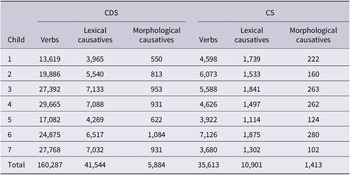
Table 2 shows the numbers of tokens for different verb groups in the corpus summarised from the annotations. It should be noted that the utterances transcribed in the corpus were intonational units that did not necessarily contain verbs (e.g., an utterance can be made up of just one interjection such as “hey” in English). Hence, the number of verb tokens shown in Table 2 is generally much lower than the number of utterances reported in Table 1, especially in child speech. The development of the numbers of tokens and types over age for different verb categories is reported in Supplementary Figures S1 and S2.
Summary of the Turkish longitudinal corpus: Number of tokens for different verb groups

Table 2. Long description
The table is organized into seven columns. The first column identifies the Child (numbered 1 through 7). The next three columns fall under the primary header C D S, and the final three columns fall under the primary header C S. Both primary headers contain sub-headers for Verbs, Lexical causatives, and Morphological causatives.
* Child 1: C D S (13,619 Verbs, 3,965 Lexical, 550 Morphological); C S (4,598 Verbs, 1,739 Lexical, 222 Morphological).
* Child 2: C D S (19,886 Verbs, 5,540 Lexical, 813 Morphological); C S (6,073 Verbs, 1,533 Lexical, 160 Morphological).
* Child 3: C D S (27,392 Verbs, 7,133 Lexical, 953 Morphological); C S (5,588 Verbs, 1,841 Lexical, 263 Morphological).
* Child 4: C D S (29,665 Verbs, 7,088 Lexical, 931 Morphological); C S (4,626 Verbs, 1,497 Lexical, 262 Morphological).
* Child 5: C D S (17,082 Verbs, 4,269 Lexical, 622 Morphological); C S (3,922 Verbs, 1,114 Lexical, 124 Morphological).
* Child 6: C D S (24,875 Verbs, 6,517 Lexical, 1,084 Morphological); C S (7,126 Verbs, 1,875 Lexical, 280 Morphological).
* Child 7: C D S (27,768 Verbs, 7,032 Lexical, 931 Morphological); C S (3,680 Verbs, 1,302 Lexical, 102 Morphological).
* Total: C D S (160,287 Verbs, 41,544 Lexical, 5,884 Morphological); C S (35,613 Verbs, 10,901 Lexical, 1,413 Morphological).
2.3. Entropy estimation
Shannon (Reference Shannon1948) originally proposed the entropy measure for quantifying the variability of a population. The entropy can be calculated as below:
 $$ H=-\sum \limits_{i=1}^N{p}_i\;\log\;{p}_i, $$
where $ N $
is the number of types in the population and
$ N $
is the number of types in the population and $ {p}_i $
is the probability of the
$ {p}_i $
is the probability of the $ i $
-th type.
$ i $
-th type.
In practice, the estimation is done in a plug-in manner, namely the observed probability of each type, and the observed total number of types are plugged into the formula 1 to determine the estimate. In our case of the present study, take a simple sample of just two verb stem types (i.e., $ N=2 $
) with two tokens each, such as (“çık,” “çık,” “gül,” “gül”), both “çık” and “gül” have an observed probability of 0.5 (i.e.,
$ N=2 $
) with two tokens each, such as (“çık,” “çık,” “gül,” “gül”), both “çık” and “gül” have an observed probability of 0.5 (i.e., $ {p}_1={p}_2=0.5 $
), respectively. The resulting plug-in entropy estimation, based on the formula 1, would thus be calculated as
$ {p}_1={p}_2=0.5 $
), respectively. The resulting plug-in entropy estimation, based on the formula 1, would thus be calculated as $ -\log 0.5 $
. It has been shown that the negative bias of this plug-in estimator is inevitable, and it can be particularly severe if there are unobserved types (e.g., Chao & Shen, Reference Chao and Shen2003). The NSB entropy estimator (Nemenman et al., Reference Nemenman, Shafee, Bialek, Dietterich, Becker and Ghahramani2001) was therefore proposed to remedy the under-sampling issue and showed desirable results. NSB is a Bayesian estimator that employs a mixture of Dirichlet distributions as its priors, which are later updated by the observed counts in the sample to yield the posterior estimate. Simply put, an NSB entropy estimator could be seen to smooth the estimate of the entropy of the population by performing integration over continuous parameter space instead of a discrete one. It is particularly helpful when there is a large number of unseen types in the sample, since the cardinality can be set for the priors to enable estimation of the unseen types, thus compensating for the overall entropy estimation. It has been shown by Archer et al. (Reference Archer, Park and Pillow2014) that NSB can stably estimate the entropy of a population with a sample size as low as 10. You et al. (Reference You, Rüst, Stoll and Baroni2024) further supplied evidence that NSB best estimates the true entropy of a population even under the extremely under-sampled regime with a sample size of less than 10.
$ -\log 0.5 $
. It has been shown that the negative bias of this plug-in estimator is inevitable, and it can be particularly severe if there are unobserved types (e.g., Chao & Shen, Reference Chao and Shen2003). The NSB entropy estimator (Nemenman et al., Reference Nemenman, Shafee, Bialek, Dietterich, Becker and Ghahramani2001) was therefore proposed to remedy the under-sampling issue and showed desirable results. NSB is a Bayesian estimator that employs a mixture of Dirichlet distributions as its priors, which are later updated by the observed counts in the sample to yield the posterior estimate. Simply put, an NSB entropy estimator could be seen to smooth the estimate of the entropy of the population by performing integration over continuous parameter space instead of a discrete one. It is particularly helpful when there is a large number of unseen types in the sample, since the cardinality can be set for the priors to enable estimation of the unseen types, thus compensating for the overall entropy estimation. It has been shown by Archer et al. (Reference Archer, Park and Pillow2014) that NSB can stably estimate the entropy of a population with a sample size as low as 10. You et al. (Reference You, Rüst, Stoll and Baroni2024) further supplied evidence that NSB best estimates the true entropy of a population even under the extremely under-sampled regime with a sample size of less than 10.
We hence used this estimator to measure the flexibility of causative use in this article. As mentioned above, NSB requires information on the cardinality of the prior distribution. This cardinality means the total number of types in the population for which we estimate the entropy. In the context of the present study, cardinality means the total number of verb stem types in the population, including the types not seen in the sample. We thus further employed the Smoothed Good–Toulmin estimator (SGT) (Orlitsky et al., Reference Orlitsky, Suresh and Wu2016) to help estimate this cardinality, which is important, especially for data with low variability in the severely under-sampled regime.
For lexical and morphological constructions, the cardinality estimated from SGT was based on different observations. For lexical causatives, the potential number of verb stem types was estimated with the observed lexical causatives. By contrast, the cardinality for morphological causatives should be the number of verb stem types that can theoretically take a morphological marker. Thus, the second author examined the verb stems in the corpus and ruled out a small number of stems that are ineligible to take a causative marker (26 stems, including equipollent or suppletive pairs and some reflexive verbs). The tokens of the remaining eligible stems were used to estimate the cardinality for the entropy estimation for morphological causatives.
2.4. Analyses
We conducted two analyses to investigate the object ellipsis of both causative constructions in CDS and children’s individual developmental trajectories of both constructions.
Analysis 1: Ellipsis in CDS. We first analysed the object ellipsis of both causative constructions in CDS. The idea was to quantify the proportion of object ellipsis in causative constructions that children hear, thus examining the reliability of the argument structure for causal inference. We excluded verb tokens used in passive voice, as the passive construction raises the patient to the subject position and might exhibit a different pattern of ellipsis (only 1.89% of the tokens were excluded; 3,697 out of 195,900). For each session, the causative constructions were bootstrapped (with replacement) for 1,000 iterations, with 1,000 samples in each iteration. We examined the change in ellipsis level over age and took the bootstrapped mean of ellipsis level in each session for the statistical analysis.
A multi-level Bayesian model of zero/one inflated beta regression (with children as the group effect) was then built to test the difference between the ellipsis rate in lexical causative constructions and that in morphological causative constructions. More specifically, the ellipsis rate was the dependent variable of the regression model, and the type of causative constructions was the only independent variable, for which dummy coding was applied with the lexical causatives as the reference level. Both the random intercept and the random slope were included in the model.
Analysis 2: Development of causative constructions in children’s speech. We applied the entropy estimation in both CDS and CS, and later calculated the ratio of the entropy estimate in CS to that in CDS (henceforth referred to as “developmental ratio”) (Mazara & Stoll, Reference Mazara, Stoll, Goel, Seifert and Freksa2019; Stoll et al., Reference Stoll, Bickel, Lieven, Banjade, Bhatta, Gaenszle, Paudyal, Pettigrew, Rai, Rai and Rai2012), to examine to which extent children’s production has reached the respective adults’ level. The adults’ entropy level, as the denominator, could also indicate how variable the use is for a measured verb group generally in the Turkish language. We first measured this developmental ratio for the causative use. Then, to better position the development of causatives in the general picture of verb learning, we also measured the ratio for two other verb groups, namely non-causatives (e.g., bak (look), çık (come out), düş (fall off), gül (laugh)), and all verbs. More concretely, we gathered all verb tokens, which were first put in a full category called “all verbs,” and then grouped them into categories of lexical causatives, morphological causatives, and a third category, non-causatives (which included both intransitives and non-causative transitives). We stripped the inflections in the verb tokens afterwards to obtain the verb stems, based on which we measured the entropy for each group. The raw entropy measures in CDS and CS before the ratio calculation are reported in Supplementary Figures S3 (CDS) and S4 (CS).
Preliminary data analysis of local regression (see Supplementary Figures S5–S8) revealed a stage-like development of verbs for many individuals, where the child rapidly approaches the adults’ level after an initial flat growing stage before s/he again stabilises the development. We thus employed segmented analysis, using the libraries segmented in R (Muggeo, Reference Muggeo2020; Muggeo et al., Reference Muggeo2008), to identify the breakpoints for such developmental trajectories. Concretely, we treated the developmental ratio as the dependent variable and the age as the independent variable, while searching for the existence of breakpoints with hypothesis testing implemented by the segmented library. We primarily modelled the trajectories with two breakpoints, with one breakpoint as the alternative when a second change of slope did not occur. We refrained from searching for more than two break points due to the short time span of our data. These breakpoints formed piece-wise regression lines, where we examined when major changes of development occurred in different verb groups.
3. Results
3.1. Analysis 1
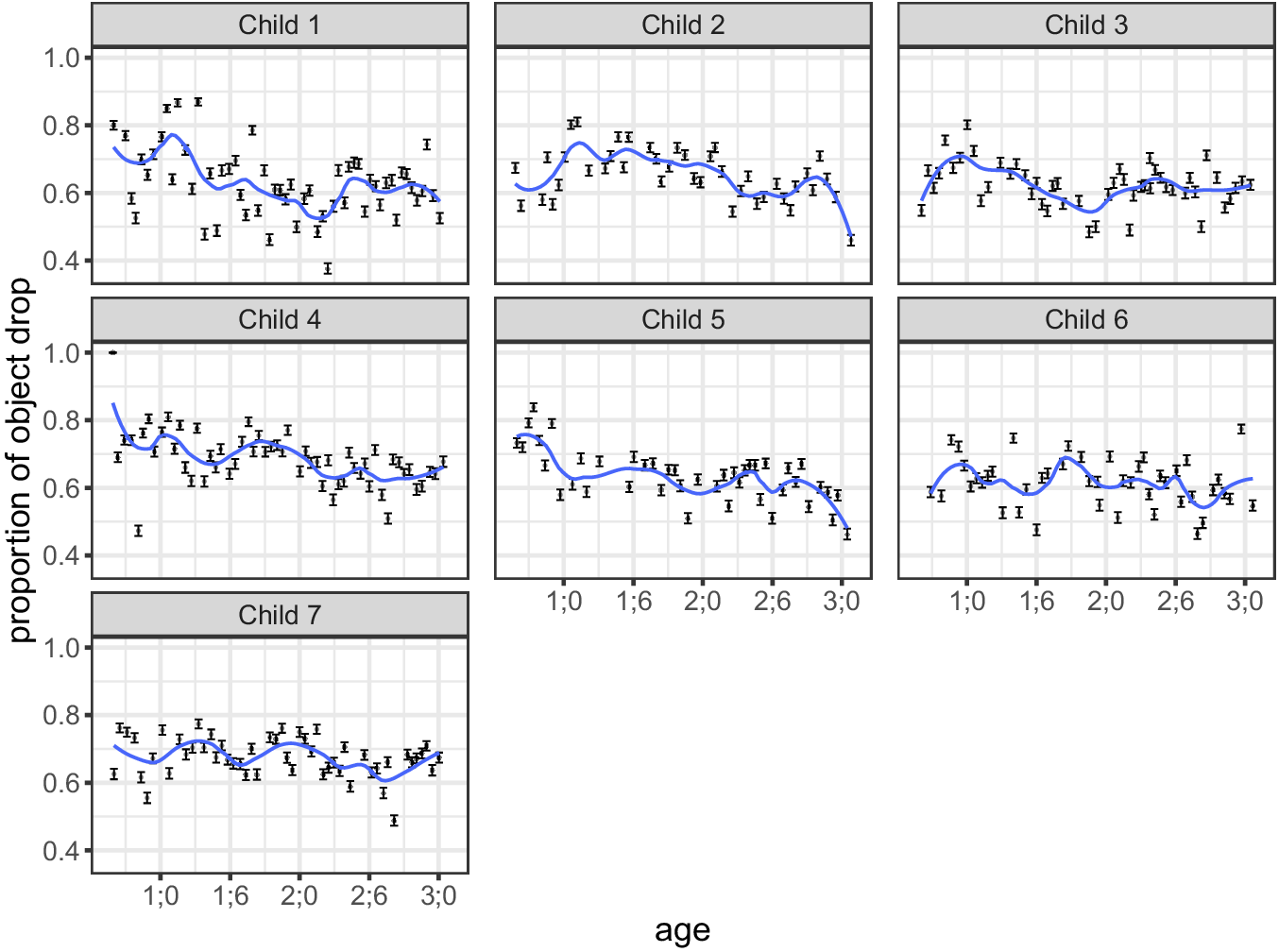
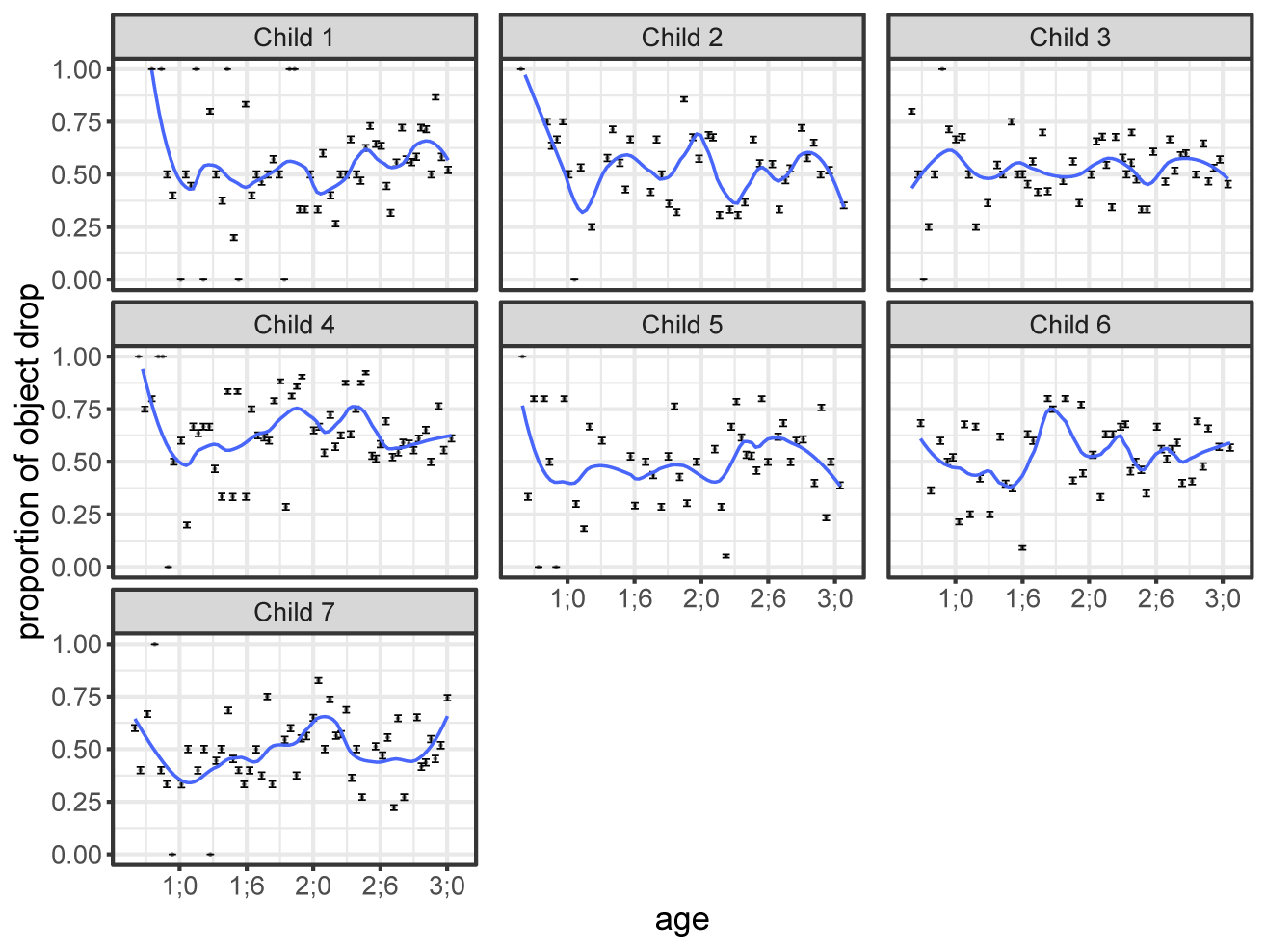
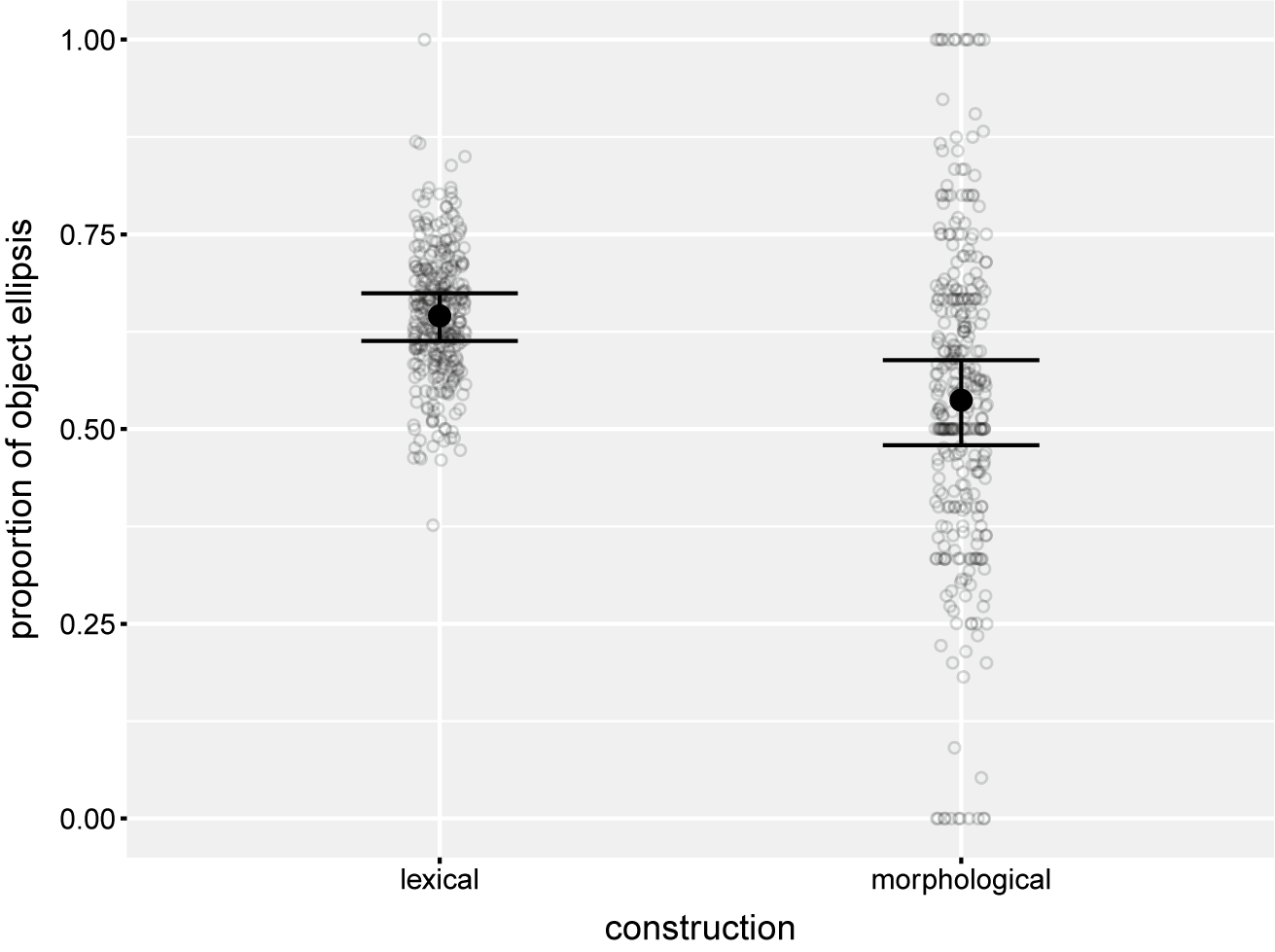
Ellipsis in CDS is shown to be pervasive in both constructions (lexical: M = .65, SD = .08; morphological: M = .54, SD = .20). Figures 1 and 2 show the ellipsis levels for each child at each age for lexical and morphological causatives, respectively. As shown in Figure 3, with the bootstrapped means of ellipsis levels, the multi-level Bayesian model of zero/one inflated beta regression exhibits a substantially lower ellipsis rate for morphological causatives than lexical causatives. The difference is confirmed by the 95% credible interval of (−0.63, −0.27) (i.e., a negative interval excluding the null effect) for the posterior distribution of the coefficient for the effect of morphological causatives, compared with the lexical causatives as the reference level.
Object ellipsis of lexical causatives in child-directed speech.
Note. The line represents the local regression of the ellipsis level, with the span set to 0.3. The points are the means of the bootstrapped ellipsis levels, with the error bars showing the bootstrapped standard deviations.

Figure 1. Long description
The multi-panel graph consists of seven individual plots arranged in a three-row grid. The first two rows contain three panels each, and the third row contains one panel on the left. Each panel is titled Child 1 through Child 7.
All panels share a common Y-axis labeled proportion of object drop, ranging from 0.4 to 1.0 in increments of 0.2. The X-axis is labeled age, with markers for 1 semicolon 0, 1 semicolon 6, 2 semicolon 0, 2 semicolon 6, and 3 semicolon 0.
Each panel contains black data points with vertical error bars representing bootstrapped standard deviations. A blue local regression line with a span of 0.3 is overlaid on the points to show the trend over time.
* Child 1: Shows a fluctuating trend starting near 0.7, peaking around 0.8, and ending near 0.6.
* Child 2: Displays a wavy pattern starting at 0.6, peaking at 0.75, and dropping sharply toward 0.45 at age 3.
* Child 3: Shows a relatively stable trend oscillating around the 0.6 mark.
* Child 4: Starts high at 1.0 and 0.8, then gradually declines to settle around 0.6.
* Child 5: Begins around 0.75 and shows a steady downward trend, ending near 0.5.
* Child 6: Exhibits a highly variable, wavy trend centered around 0.6.
* Child 7: Shows a stable, slightly oscillating trend maintaining a level between 0.6 and 0.7 throughout the age range.
Object ellipsis of morphological causatives in child-directed speech.
Note. The line represents the local regression of the ellipsis level, with the span set to 0.3. The points are the means of the bootstrapped ellipsis levels, with the error bars showing the bootstrapped standard deviations.

Figure 2. Long description
The multi-panel graph consists of seven individual plots arranged in three rows. The first two rows contain three panels each, and the final row contains one panel on the left. All panels share a common Y axis labeled proportion of object drop, ranging from 0.00 to 1.00 in increments of 0.25. The X axis is labeled age and ranges from approximately 1 semicolon 0 to 3 semicolon 0.
Each panel represents a different subject labeled Child 1 through Child 7. The data in each panel includes black points with vertical error bars representing bootstrapped means and standard deviations. A blue regression line with a span of 0.3 shows the local trend for each child.
* Child 1. Starts with a high proportion near 1.00, drops sharply to 0.50, and then fluctuates between 0.40 and 0.65.
* Child 2. Shows a sharp initial drop from 1.00 to 0.30, followed by an oscillating trend between 0.30 and 0.70.
* Child 3. Displays a more stable but wavy trend, oscillating primarily between 0.40 and 0.60.
* Child 4. Starts near 1.00, drops to 0.50, and then shows a gradual upward oscillation toward 0.75 before leveling off near 0.60.
* Child 5. Begins near 0.75, drops to 0.40, and maintains a relatively low, oscillating trend between 0.40 and 0.60.
* Child 6. Shows a fluctuating trend starting near 0.60, dipping to 0.40, peaking near 0.75 at age 2 semicolon 0, and then settling near 0.50.
* Child 7. Starts near 0.60, dips to 0.35, and then oscillates with a peak near 0.65 around age 2 semicolon 0.
Comparison of object ellipsis between causative constructions.
Note. 95% credible interval of the posterior draws of the mean of the posterior predictive distribution is displayed for each construction. Lexical: (0.61, 0.68); morphological: (0.47, 0.59). The plotted points stand for the original data points.

Figure 3. Long description
The y-axis is labeled proportion of object ellipsis and ranges from 0.00 to 1.00 in increments of 0.25. The x-axis is labeled construction and contains two categories.
On the left, the lexical construction shows a dense vertical cluster of light gray circles centered around 0.65. A solid black dot represents the mean, with horizontal error bars indicating a 95 percent credible interval spanning approximately 0.61 to 0.68.
On the right, the morphological construction shows a more vertically dispersed cluster of light gray circles ranging from 0.00 to 1.00. The mean black dot is lower than the lexical group, positioned at approximately 0.53, with horizontal error bars indicating a 95 percent credible interval spanning approximately 0.47 to 0.59.
3.2. Analysis 2
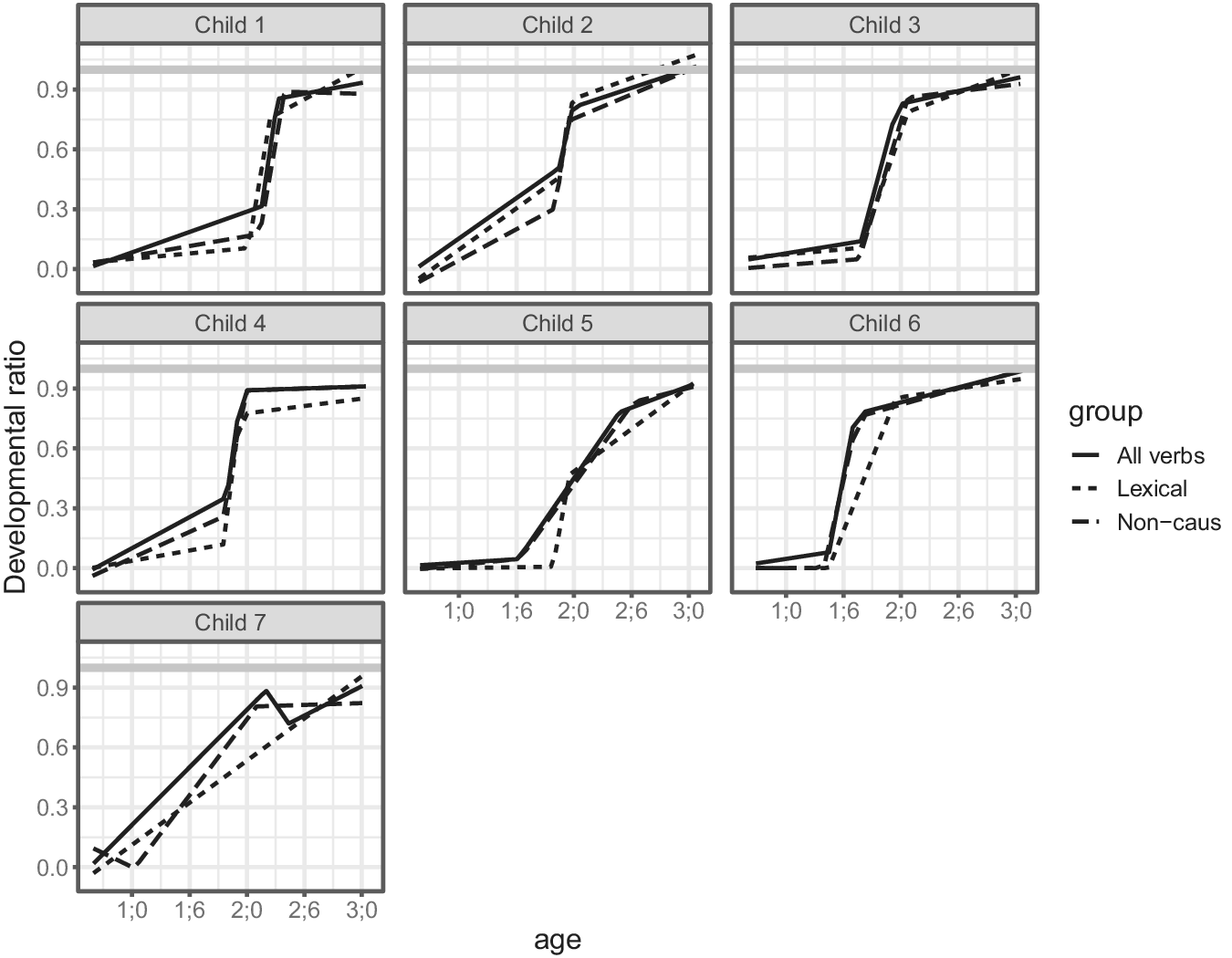
First, we compared lexical causatives with two other groups: non-causatives and all verbs. The development of lexical causatives shows little difference from the other two groups in terms of the breakpoints and developmental rate in each stage. All three groups generally experience a 3-stage development for each child. For some children, nonetheless, the development of lexical causatives can exhibit a slight time lag or a slower developmental rate (see Child 4, 5, and 6 in Figure 4: the development slope of lexical causatives in the first phase for Child 4 is slightly flatter; Child 5 starts the rapid development of lexical causatives a bit later than the other two groups; Child 6’s second phase of development is slower than the other two groups). It should also be noted that the development of all three groups stabilises at a ratio close to 1.0 from the age of around 2;2, which suggests an adult-like level of generalisation of lexical causative semantics.
Development of entropy ratio for all 7 children: lexical causatives, non-causatives, and all verbs.

Figure 4. Long description
A multi-panel line graph grid with seven panels labeled Child 1 through Child 7.
Axes and Legend
* The vertical Y axis is labeled Developmental ratio with increments from 0.0 to 0.9.
* The horizontal X axis is labeled age with time points at 1 forward slash 0, 1 forward slash 6, 2 forward slash 0, 2 forward slash 6, and 3 forward slash 0.
* A legend on the right identifies three groups. All verbs represented by a solid black line, Lexical represented by a dashed line, and Non-caus represented by a dash-dot line.
* A thick horizontal gray bar is positioned near the top of each panel at the 1.0 ratio level.
Data Trends
* Child 1. All three lines show a slow increase until age 2 forward slash 0, followed by a sharp vertical spike toward 0.9, then plateauing.
* Child 2. Shows a steady linear increase for all groups, with a steeper inflection point at age 2 forward slash 0.
* Child 3. Features a very sharp, nearly vertical increase for all groups between age 1 forward slash 6 and 2 forward slash 0, reaching a plateau near 0.9.
* Child 4. Similar to Child 3, with a sharp rise at age 2 forward slash 0. The Lexical dashed line remains slightly lower than the other two groups after the rise.
* Child 5. All groups remain near 0.0 until age 1 forward slash 6, followed by a steep, consistent climb toward 0.9 by age 3 forward slash 0.
* Child 6. Shows a sharp rise starting just after age 1 forward slash 6. The Lexical dashed line lags behind the others, rising sharply only after age 2 forward slash 0.
* Child 7. Displays more volatility. All groups rise toward age 2 forward slash 0, followed by a slight dip and recovery for the solid and dash-dot lines, while the Lexical dashed line continues a steady upward slope.
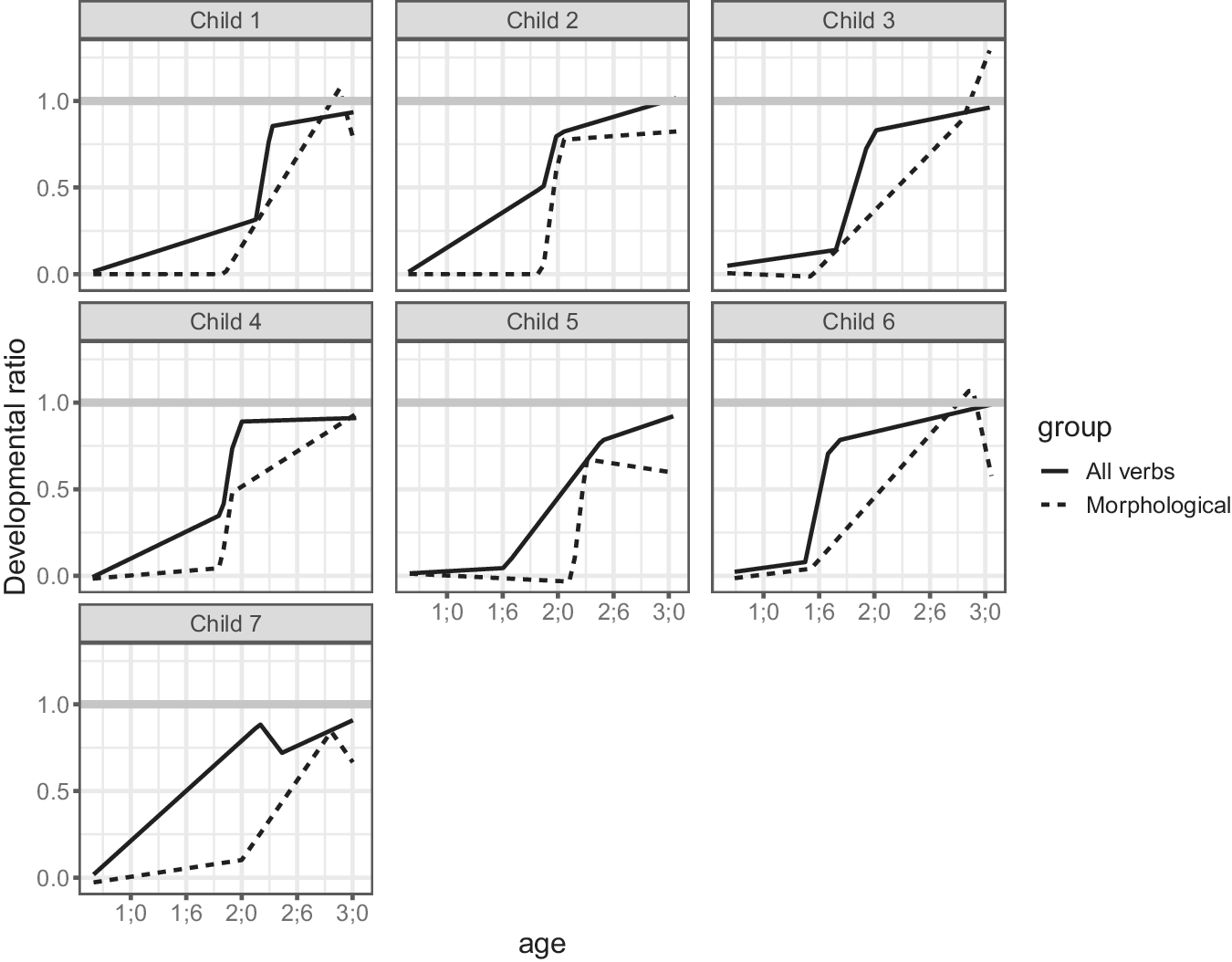
Second, we compared morphological causatives with all verbs. The development of morphological causatives displays a clear difference compared with the overall development of the verb lexicon (see Figure 5). First, in the corpus, the observed onset of flexibility in the use of morphological causatives (i.e., morphological causatives occurring with two different verb stem types) is usually much later (ranging from 1;10 to 2;3) than that of general verb use (ranging from 0;8 to 1;2). Secondly, two major patterns of developmental trajectories are shown among different individuals. For Children 2 and 5, there is a clear stabilisation phase of development in the end, but the developmental ratio for morphological causatives stays lower than that for all verbs, and this gap remains in the final phase. For the other children, there is not yet a stabilisation phase for the development of morphological causatives (e.g., for Children 1, 6, and 7, the ratio still fluctuates at around 3;0). Instead, there seems to be steady development, eventually approaching the level of the development of all verbs. Additionally, an alternative segmented analysis with BIC (Bayesian Information criterion), which tends to select a more parsimonious model, also corroborated the distinct developmental trajectory of morphological causatives compared with other verb groups (see Supplementary Section S4 and Supplementary Figures S9 and S10).
Development of entropy ratio for all 7 children: Morphological causatives versus all verbs.

Figure 5. Long description
The multi-panel figure consists of seven individual line graphs labeled Child 1 through Child 7.
Axes and Legend:
* The vertical Y-axis represents Developmental ratio, ranging from 0.0 to 1.0, with a thick gray horizontal reference line at 1.0.
* The horizontal X-axis represents age, with markers at 1 semicolon 0, 1 semicolon 6, 2 semicolon 0, 2 semicolon 6, and 3 semicolon 0.
* A legend on the right identifies two groups: a solid black line for All verbs and a dashed black line for Morphological.
Data Trends:
* Child 1: All verbs show a steady increase to 0.9. Morphological remains at 0 until age 2, then rises sharply to cross the 1.0 line before dipping.
* Child 2: All verbs rise steadily to 1.0. Morphological remains at 0 until age 2, then jumps to 0.8 and plateaus.
* Child 3: All verbs rise to 1.0. Morphological remains at 0 until age 2, then climbs steeply to exceed 1.0 by age 3.
* Child 4: All verbs show a sharp inflection point at age 2, reaching 0.9. Morphological stays at 0 until age 2, then rises linearly to 0.9.
* Child 5: All verbs rise after age 1 semicolon 6 to reach 0.9. Morphological stays at 0 until age 2, then jumps to 0.6 and plateaus.
* Child 6: All verbs rise sharply at age 1 semicolon 6 to reach 1.0. Morphological stays near 0 until age 1 semicolon 6, then rises to peak above 1.0 before a final drop.
* Child 7: All verbs show a fluctuating rise to 0.9. Morphological stays near 0 until age 2, then rises to 0.8 before a slight final dip.
4. Discussion
Overall, our results suggest that children learning Turkish develop their causative use in their first 3 years of life, despite the pervasive ellipsis in the speech they hear. In the first analysis of object ellipsis, we found a large proportion of such ellipsis for both lexical and morphological causative constructions in CDS. More than half of the causative constructions, in either category, elide their object. Such ellipsis of arguments poses a great challenge for children to rely on argument structure as a cue to infer the causativity (Bates et al., Reference Bates and MacWhinney1989; Bates & MacWhinney, Reference Bates, MacWhinney and MacWhinney1987; Kempe & MacWhinney, Reference Kempe and MacWhinney1998). However, no substantial delay in learning was observed for either lexical or morphological causatives, although the pattern of development differs. It is, therefore, unclear whether argument structure is an essential cue in children’s early acquisition of causatives.
The unhindered development is especially prominent for lexical causatives. Our Analysis 2 shows no major difference between the developmental trajectories of lexical causatives, non-causatives, and all verbs. Children’s use of lexical causatives by the age of 3 years becomes nearly as flexible as observed in adult use. As for morphological causatives, we observed deviated development from the growth of overall verb use. Overall, there was a lag in the development of morphological causatives, and they thus did not seem to benefit from the explicit causative marking. It should be noted that the entropy of morphological causatives in CDS was not low at all compared with other verb groups (see Figure S3). Hence, morphological causatives are commonly and flexibly used by adults in the Turkish language, and the pattern of the developmental ratio as seen in Figure 5 is likely a result of lagged development of morphological causative use in child speech. In other words, morphological causatives, as a common device for expressing causality, have not consistently become a substantial part of children’s linguistic causal repertoire by the age of 3 years. Interestingly, as shown in Figure 3, morphological causative constructions, in fact, involve less object ellipsis, which theoretically provides a more consistent and reliable cue for acquiring causal meaning (e.g., Bates & MacWhinney, Reference Bates, MacWhinney and MacWhinney1987). However, it should be noted that the level of object ellipsis for morphological causatives is, by no means, negligible. Both the difficulty of generalising the causative marking as conveying causal meaning and the pervasive ellipsis in a naturalistic speech environment add more challenges to the learning condition. To understand morphological causatives, a child has to infer causality from the many variants of causative morphology situated in various contexts as well as the frequently incomplete argument structure. This might account for the slower development found in the present study. At the very least, it can be assured that the joint cues of argument structure and explicit marking do not show clear facilitation for the acquisition of morphological causatives. This is consistent with the previous finding that 3-year-old Turkish-learning children were as good at deriving causal meaning from a combination of argument structure and morphological cues as from only argument structure cues or only morphological cues (Ger et al., Reference Ger, Küntay, Göksun, Stoll and Daum2022a).
It cannot be ruled out, though, that the syntactic knowledge of argument structure might still be extracted from elliptical verbal constructions, at a certain stage of the learning process, thus indirectly helping with the causative acquisition. However, this requires a presumptive extra layer of syntactic learning, whereas many other cues support a more direct inference of causal semantics. For instance, there exist other morphological cues, such as the accusative marker (Göksun et al., Reference Göksun, Küntay and Naigles2008; Ural et al., Reference Ural, Yuret, Ketrez, Koçbaş and Küntay2009) in Turkish, that may explicitly support verb learning. Although patients are often elided in lexical causative constructions, their appearances are usually accompanied by an accusative marker, which highlights the existence of the patient argument and, therefore, helps children understand the causal meaning of causatives. Further, as others have previously pointed out (Huang, Reference Huang2012; Narasimhan et al., Reference Narasimhan, Budwig and Murty2005), discourse and extra-linguistic cues might be relevant to the acquisition of lexical causative meaning as well. As introduced earlier, objects retrieved in discourse (e.g., in previous utterances) or detected in the physical environment can remedy the missing essential units in the current linguistic expression.
For discourse contextual cues, in particular, supportive evidence includes the emergence of semantic and structural regularities from simple linear word co-occurrences (Mintz et al., Reference Mintz, Newport and Bever2002; Perfors et al., Reference Perfors, Regier and Tenenbaum2006; You et al., Reference You, Bickel, Daum and Stoll2021). Inference of causative regularities might not necessarily rely on the explicit presence of the patient, but rather raw contextual linguistic units (i.e., co-occurrences of surface forms of linguistic tokens) in discourse without presumptive syntactic knowledge such as part-of-speech generalisation and hierarchical relations. For instance, the repetition of lexemes across situations in the same discourse,Footnote 3 often referred to as variation sets (Küntay & Slobin, Reference Küntay, Slobin, Slobin, Guo and Kyratzis1996; Onnis et al., Reference Onnis, Waterfall and Edelman2008), are prevalent across typologically diverse languages (Moran et al., Reference Moran, Lester, Gordon, Küntay, Pfeiler, Allen, Stoll, Brown and Dailey2019). These repetitive patterns, with the semantics conveyed by the linguistic tokens thereof, can facilitate statistical inference that helps children discriminate causatives from other semantic categories. Fully-specified argument structure on the surface might not necessarily be a prerequisite of causative learning.
Importantly, the present study, based on naturalistic data, has the advantage of revealing the acquisition of morphological causatives at an earlier age. Also, naturalistic recordings, especially in home settings where parents are free to engage in a wide range of activities, cover a large variety of speech contexts. This helps to maximally include causative verbs, the use of which largely depends on the type of context (Aktan-Erciyes & Göksun, Reference Aktan-Erciyes and Göksun2023). By contrast, experimental studies, while helping uncover different factors at work, typically reveal later ages of achievement for a structure because they pose extra cognitive load with their task demands and can only be performed with a limited range of contexts. Nonetheless, the lag of morphological causative development we found in our corpus study well resonates with findings from previous experimental studies. For example, Göksun et al. (Reference Göksun, Küntay and Naigles2008) found in their experimental study on causal enactment with causative markers that, up to at least 5 years of age, children acquiring Turkish are still developing their causative morphology, thus being not fully capable of comprehending the morphological constructions. This has been recently corroborated by Ger et al. (Reference Ger, You, Küntay, Göksun, Stoll and Daum2022b), where they found late abstraction (at around age 4;10) of causative morphology for Turkish children in an experimental study using pseudo-verbs, and by Aktan-Erciyes et al. (Reference Aktan-Erciyes, Ger and Göksun2024), who showed that 5-year-old monolingual Turkish children, but not 7- and 9-year-olds, performed better with lexical causative verbs than with morphological causative verbs in an experimental causative verb production task. Similar late development of causative morphology has been observed in other morphologically complex languages as well, such as Quechua (Courtney, Reference Courtney2002) and Inuktitut (Allen, Reference Allen1998).
We suggest that the synergy of cues and the development of different linguistic aspects is likely the key to verb learning. For instance, Göksun et al. (Reference Göksun, Küntay and Naigles2008) found facilitation of accusative marking for children learning Turkish in acting out causal actions, potentially supporting the overall causative acquisition. However, morphological markers can be acquired at different times due to the complexity of their syntactic or phonological forms (e.g., number of allomorphs) and the semantics being conveyed (e.g., number of meanings an affix bears) (Clark, Reference Clark2017). In fact, Turkish-learning children are found to have not yet mastered the more complex nuances of case marking by the age of 6 years (Ketrez, Reference Ketrez2005), making this cue less reliable. Even if case marking is fully acquired, cases alone might not suffice for causal interpretation. Murasugi et al. (Reference Murasugi, Hashimoto and Kato2003), for example, looked into the Japanese morphological causative “-(s)ase” along with the case marking. While the accusative and dative markers are helpful for teasing apart the semantic roles, they are, in many cases, not sufficient for identifying the agent of the action conveyed by the causatively marked verb. Ultimately, the disambiguation relies on the semantics of all components in the context, such as the animacy of the arguments and the plausibility of the agent-patient scenario in real-world (e.g., a doll cannot act on itself to push a chair). In a similar vein, Booij (Reference Booij, Booij and van Marle1996) attributed the late acquisition of contextual inflections, such as person and number agreement markers, to their strong correlation with semantics like agent and patient roles in context, as evidenced in experiments on children acquiring German inflections (Clahsen, Reference Clahsen1986). In our present study, too, some children (Child 2, 5, 7 in Figure 5) only start to develop their causative marking when the lexical knowledge is established, as indicated by the almost stabilised development of all verbs. Also, many children (Child 1, 3, 4, 6, 7) keep the growth of morphological causatives at a moderate rate after the overall lexical developmental rate stabilises, before eventually reaching the adult-like level. It is likely that morphological development is heavily contingent on semantic grounds. Advanced semantic understanding of lexical words might have to precede the generalisation of morphological marking. Such lexical ground for grammatical development has been found in previous studies as well (Devescovi et al., Reference Devescovi, Caselli, Marchione, Pasqualetti, Reilly and Bates2005; Hoff et al., Reference Hoff, Quinn and Giguere2018; Marchman et al., Reference Marchman, Martínez-Sussmann and Dale2004; Parra et al., Reference Parra, Hoff and Core2011).
This link to semantics could, in turn, partly explain why morphological causative constructions in CDS render less object ellipsis. As Shibatani and Pardeshi (Reference Shibatani and Pardeshi2002) suggested, the causal relation expressed by morphological constructions is less direct than lexical words, thus lacking semantic saliency and requiring structural amendment. This can be exemplified by the sentence (bana) ayakkabımı düşürttü (s/he made me drop my shoe) in example (4), where secondary causation is involved. Here, the causee “me” serves as the agent of the action of “drop,” bridging two causal relations. The complete causal meaning in this sentence can be difficult to infer without specifying either the intermediary agent “me” or the patient “my shoe.” Hence, both the intermediary agent and the patient could be less often elided to facilitate the inference and make the causal meaning more transparent. The scenarios with intermediary agents, in particular, could lead to greater difficulty in comprehending causal relations. However, due to the constraints of both the size of data (hence containing few occurrences of intermediary agents) and the accuracy of automatic taggers for complex sentences, our investigation was not extended to address the learning of secondary causation. Future studies can track the ellipsis of intermediary agents and that of patients to further examine the interplay between the multiple cues of semantic arguments.
To summarise, we have found no hindrance of pervasive object ellipsis for Turkish children to acquire causatives. Moreover, the lower level of ellipsis for morphological causatives in CDS shows no facilitation in children’s development of causative morphology. Together, these findings reveal that argument structure is an unreliable cue in naturalistic input due to a large ellipsis in Turkish and might be a less crucial facilitator for the development of causative constructions than previously claimed. We suggest that many other cues, often more explicit in their forms, could play equally important roles in the acquisition. Our general conclusion is that children learning Turkish, by the age of 3 years, acquire causative constructions despite the challenge posed by pervasive ellipsis. Future studies might benefit from paying more attention to discourse, morphological, and extra-linguistic cues that might better facilitate causative acquisition.
Abbreviations
- 1
-
first person
- 2
-
second person
- 3
-
third person
- ABL
-
ablative
- ACC
-
accusative
- CAUS
-
causative
- DAT
-
dative
- FUT
-
future
- GEN
-
genitive
- N
-
neuter
- NOM
-
nominative
- POSS
-
possessive
- PRS
-
present
- PST
-
past
- Q
-
question particle
- SG
-
singular
Supplementary material
The supplementary material for this article can be found at http://doi.org/10.1017/S0305000925000200.
Data availability statement
Codes and anonymised data can be accessed at https://osf.io/u5f4m/.
Funding statement
The results of this research are part of the project “The role of causality in early verb learning: language-specific factors vs. universal strategies” (Swiss NSF Grant agreement No. 100015_169712; Stoll, Daum), the project “Acquisition processes in maximally diverse languages: Min(ding) the ambient languages (ACQDIV)” that has received funding from the European Research Council (ERC) under the European Union’s Seventh Framework Programme FP7-2007-2013 (Grant agreement No. 615988; Stoll), and the NCCR Evolving Language, Swiss National Science Foundation Agreement No. 51NF40_180888.
Competing interests
The authors declare none.



 Open access

