





Introduction
Scholars have traditionally compared two views on party organisational evolution. The declinist perspective sees the drop in party membership, rising voter volatility, and growing disengagement as evidence of organisational decay (Katz and Mair Reference Katz and Mair1995; Janda and Colman Reference Janda and Colman1998; Bardi, Bartolini, and Trechsel Reference Bardi, Bartolini and Trechsel2014a; Whiteley Reference Whiteley2011; van Biezen, Mair, and Poguntke Reference van Biezen, Mair and Poguntke2012; Ignazi Reference Ignazi2017). Conversely, others have emphasised party resilience, arguing that institutional embedding, public funding (Katz and Mair Reference Katz and Mair1995; Reference Katz and Mair2018; Piccio and van Biezen Reference Piccio and Van Biezen2018), and diversified participation mechanisms such as multispeed memberships and intraparty democracy (Rahat and Hazan Reference Rahat and Hazan2001; Bardi, Bartolini, and Trechsel Reference Bardi, Bartolini and Trechsel2014b; Scarrow Reference Scarrow2015) have enabled parties to adapt effectively to contemporary social and electoral contexts (Norris Reference Norris2001; Bardi, Bartolini, and Trechsel Reference Bardi, Bartolini and Trechsel2014b).
Building upon these debates, recent scholarship has moved beyond the examination of digital-native parties to examine the integration of digital tools in mainstream parties (Sandri et al., Reference Sandri, Lupato, Meloni, von Nostitz and Barberà2025; Lisi Reference Lisi2025), investigating how digitalisation shapes internal party dynamics (Barberà, Sandri, Correa et al. Reference Barberà, Sandri, Correa and Rodríguez-Teruel2021). These studies argue that digitalisation should be understood not as a linear trajectory, but as a cyclical process, marked by alternating phases of rapid innovation and retrenchment, shaped by organisational structures and contextual contingencies, and leading to diverse organisational outcomes (Meloni and García Lupato Reference Meloni and García Lupato2022). This body of literature traces a shift from early cyber-optimism, which anticipated greater transparency and intraparty democracy (Margetts Reference Margetts, Katz and Crotty2006; Lachapelle and Maarek Reference Lachapelle and Maarek2015), to empirical evidence indicating that digital tools often consolidate internal centralisation, strengthening leadership control at the expense of grassroots activists (Löfgren and Smith Reference Löfgren, Smith, Gibson, Nixon and Ward2003; Gibson, Greffet, and Cantijoch Reference Gibson, Greffet and Cantijoch2017; Dommett Reference Dommett2020; Vittori Reference Vittori2020; Fowler, Franz, Martin et al. Reference Fowler, Franz, Martin, Peskowitz and Ridout2021; Gerbaudo Reference Gerbaudo2021).
This evolution raises a crucial question. Do digital tools merely reflect evolving communication habits and organisational routines, or do they provide parties with effective means to address their legitimacy deficits by re-engaging members and revitalising internal democratic practices?
Despite notable advances in this field, two key gaps persist. Systematic analyses of how established mass-based parties experience and assess digital-driven organisational change remain limited (Deseriis and Vittori Reference Deseriis and Vittori2019; Dommett, Kefford, and Power Reference Dommett, Kefford and Power2021a; García Lupato and Meloni Reference García Lupato and Meloni2023), while theoretical frameworks that explicitly examine how digital transformations enable traditional parties to confront crises of legitimacy – by leveraging digital tools to rebuild citizen trust and engagement – are still underdeveloped (Raniolo, Tarditi, and Vittori Reference Raniolo, Tarditi and Vittori2021). Drawing on the literature on party legitimacy, we highlight how traditional parties, faced with declining trust, must identify new avenues to reconnect with citizens (Ignazi Reference Ignazi2014), with digital tools potentially serving as instruments of (re)legitimation. Second, the concept of multispeed membership illustrates how digitalisation enables differentiated modes of participation, allowing parties to engage members with varying levels of commitment and resources (Scarrow Reference Scarrow2015). Moreover, the concept of multispeed membership illustrates how digitalisation fosters differentiated modes of participation, enabling parties to engage members with varying levels of commitment and resources. Finally, the Technology Acceptance Model (Marangunić and Granić Reference Marangunić and Granić2015) explains variation in members’ willingness to adopt digital tools, thereby shaping the effectiveness of organisational innovation. Together, these perspectives allow us to investigate whether digital technologies operate as mechanisms of substantive renewal or simply as symbolic responses to organisational strain.
Empirically, we rely on original web-survey data from over 4000 members of Italy’s Partito Democratico (PD), a major party formed in 2007 from the merger of two traditional parties (Bordandini, Di Virgilio, and Raniolo Reference Bordandini, Di Virgilio and Raniolo2008). We investigate whether the integration of digital tools within conventional party structures merely reflects evolving digital behaviours or actively contributes to the reconstruction of party legitimacy. Consistent with recent bottom-up analyses of digital party engagement (Biancalana and Vittori Reference Biancalana and Vittori2023; Gherghina and Marian Reference Gherghina and Marian2024; Soare, Tap, Gherghina et al. Reference Soare, Tap, Gherghina and Boldrini2025; Ziegler, Borucki, and Weissenbach Reference Ziegler, Borucki and Weissenbach2025), which emphasise the importance of understanding members’ perceptions rather than relying solely on elite-driven narratives, our approach foregrounds the attitudes and experiences of ordinary affiliates as the interpretive lens for assessing organisational change. In doing so, it enables the assessment of how ordinary members (rather than party elites) interpret and respond to digital organisational change, thereby uncovering the microfoundations of legitimacy restoration and participatory innovation.
The remainder of the paper is structured as follows. The second section reviews the literature on party digitalisation and outlines our hypotheses. The third section discusses methodological issues and details the survey design and analytical variables. The fourth section presents the empirical results and their implications. The concluding section situates our findings within the broader theoretical debate on contemporary party transformations, highlighting implications for intraparty democracy and the strategic integration of digital tools. In particular, we reflect on how digitalisation recalibrates internal power dynamics, reshapes participatory hierarchies, and influences parties’ capacity to restore legitimacy and inclusiveness in an evolving political environment.
Theoretical framework
The literature on party digitalisation has been shaped to a significant extent by normative expectations rather than systematic evidence – what Barberà, Sandri, Correa et al. (Reference Barberà, Sandri, Correa and Rodríguez-Teruel2021: 12) aptly describe as a divide between cyber-optimist and cyber-pessimist perspectives, often more influential than empirically grounded assessments. For decades, scholarship has focused primarily on the external ramifications of information and communication technology (ICT) – such as innovations in campaign communication, interparty competition, and citizen engagement – while paying comparatively little attention to its internal organisational consequences (Resnick Reference Resnick, Toulouse and Luke1998; Stromer-Galley Reference Stromer-Galley2014; Koc-Michalska, Lilleker, and Vedel Reference Koc-Michalska, Lilleker and Vedel2016; Koiranen, Koivula, Saarinen et al. Reference Koiranen, Koivula, Saarinen and Keipi2020; Boulianne Reference Boulianne2020; Oser, Grinson, Boulianne et al. Reference Oser, Grinson, Boulianne and Halperin2022). More recently, however, the organisational dimension has returned to the forefront of scholarly debates, following the electoral rise of new parties that have partially or fully replaced traditional bureaucratic infrastructures with digital platforms (Vittori Reference Vittori2020). The advent of the first so-called digital parties – also termed as cyber, platform, or connective parties – has renewed academic interest in intraparty dynamics and internal organisational change (Margetts Reference Margetts, Katz and Crotty2006; Gerbaudo Reference Gerbaudo2019; Reference Gerbaudo2021; Deseriis Reference Deseriis2020; Biancalana and Vittori Reference Biancalana, Vittori, Barberà, Sandri, Correa and Rodríguez-Teruel2021; García Lupato and Meloni Reference García Lupato and Meloni2023). Building on earlier theoretical debates, recent empirical studies have turned their attention to examining how established, pre-digital parties integrate ICT into their organisational structures. In addition to this emerging research, broader comparative work has begun to analyse how digital adoption varies across party families and institutional settings (Bloquet, Borucki, and Höhne Reference Bloquet, Borucki and Höhne2022; González-Cacheda and Cancela Outeda Reference González-Cacheda and Cancela Outeda2024; Sandri et al., Reference Sandri, Lupato, Meloni, von Nostitz and Barberà2025; Lisi Reference Lisi2025), offering macro-level insights that complement the micro-level focus on member attitudes developed in this study. Furthermore, a growing body of research has shifted attention to party members’ perspectives, exploring how affiliates perceive, adapt to, and evaluate these ongoing digital transformations (Gherghina and Marian Reference Gherghina and Marian2024; Correa, Rodríguez-Teruel, and Barberà Reference Correa, Rodríguez-Teruel and Barberà2025; Soare, Tap, Gherghina et al. Reference Soare, Tap, Gherghina and Boldrini2025; Ziegler, Borucki, and Weissenbach Reference Ziegler, Borucki and Weissenbach2025).
Despite increasing scholarly interest, research on the effects of ICT within party organisations remains theoretically and empirically fragmented, often still framed through the binary lens of cyber-optimism versus cyber-pessimism (Barberà, Sandri, Correa et al. Reference Barberà, Sandri, Correa and Rodríguez-Teruel2021: 4). On the one hand, pessimistic accounts contend that digital tools have failed to democratise party life. For example, Lusoli and Ward (Reference Lusoli and Ward2004: 466) argue that the digital tools are unable ‘to radically alter the profile of party membership or activists’. Consequently, ICT would ‘display a limited potential to widen party membership and to assist parties in reaching new groups, notably less engaged, younger citizens’. However, the study by Lusoli and Ward dates to the early stage of development of new digital tools (the so-called Web 1.0 era), when their potential in terms of interaction and communication was still rather limited. Similar pessimistic arguments emerge from another strand of literature investigating the impact of digital technologies on the internal operations of party organisations. Digital tools have often proven weak in empowering processes of democratisation, inclusiveness, and participation. More frequently, they have contributed to dynamics of centralisation that strengthen leadership roles to the detriment of mid-level elites or local party branches typically devoted to establishing and nurturing the relationship with the grassroots (Deseriis and Vittori Reference Deseriis and Vittori2019; Vittori Reference Vittori2020; Deseriis Reference Deseriis2020; Raniolo and Tarditi Reference Raniolo and Tarditi2020; Gerbaudo Reference Gerbaudo2021).
On the other hand, more optimistic perspectives highlight how digital innovations can expand participatory repertoires, enhance civic engagement, and foster member inclusion – especially among younger, previously disengaged citizens (Hendricks and Denton Reference Hendricks and Denton2010; Gil de Zúñiga, Ardèvol-Abreu, and Casero-Ripollés Reference Gil de Zúñiga, Ardèvol-Abreu and Casero-Ripollés2021). Party digitalisation ‘may revitalize their direct linkage with the electorate, a revitalization which may be regarded as particularly important in light of declining membership figures’ (Pedersen and Saglie Reference Pedersen and Saglie2005: 362). In a similar vein, Pedersen (Reference Pedersen2012: 12) argues that ICT allows parties ‘to both revitalize their existing party activities and add new colors to the palette’, thus making parties more attractive to the electorate and, accordingly, more likely to survive in a context in which traditional forms of engagement have given way to ‘lighter’, more flexible and customisable engagement repertoires. In this sense, it can be said that there exists an ‘elective affinity between digital media and post-material engagement’ (Chadwick and Stromer-Galley Reference Chadwick and Stromer-Galley2016: 286) that parties, whether established or ‘genuinely new’ (Sikk Reference Sikk2005), aim to intercept.
When shifting the focus to party membership, the literature reveals even less consensus. For instance, Gibson, Greffet, and Cantijoch (Reference Gibson, Greffet and Cantijoch2017) argued that digital technologies facilitate the consolidation of multispeed membership dynamics – a concept initially introduced by Scarrow (Reference Scarrow2015) to describe the differentiated and increasingly flexible forms of affiliation that political parties have adopted to adapt to members’ diverging levels of involvement. ICT provides low-threshold channels for engagement, which can accommodate individuals with varying levels of time, resources, and commitment. This adaptability potentially allows parties to reach broader segments of the electorate, particularly younger or previously disengaged citizens (Keating and Melis Reference Keating and Melis2017; Gil de Zúñiga, Ardèvol-Abreu, and Casero-Ripollés Reference Gil de Zúñiga, Ardèvol-Abreu and Casero-Ripollés2021). However, while scholars broadly recognise the mobilising potential of ICT, particularly in diversifying participation opportunities (Vaccari and Valeriani Reference Vaccari and Valeriani2016; more recently, Gherghina and Marian Reference Gherghina and Marian2024), empirical evidence on their actual effects remains relatively limited, making it difficult to fully assess their contribution to party organisational renewal from the members’ perspective.
Moreover, organisational openness may also introduce new tensions. As parties increasingly rely on digital modes of interaction, long-standing members, those socialised more via face-to-face, territorially embedded participation, may feel sidelined. These dynamics suggest the emergence of potential divisions within the membership base, rooted in diverging expectations about the party’s role and internal functioning. Empirical studies on digital-native parties support this view, showing that digital tools have contributed to redefining party membership, enabling more frequent yet often superficial interactions (Vittori Reference Vittori2020). Still, over time their participatory impact appears to have been limited, with online platforms falling short of fostering sustained deliberation or meaningful inclusion in decision-making (Deseriis and Vittori Reference Deseriis and Vittori2019; Biancalana and Vittori Reference Biancalana and Vittori2023).
Party members and digital organisational tools
The earliest research addressing the organisational implications of digital tools focuses specifically on the membership dimension (Ward, Lusoli, and Gibson Reference Ward, Lusoli and Gibson2002; Ward and Gibson Reference Ward, Gibson, Chadwick and Howard2009; Gibson, Greffet, and Cantijoch Reference Gibson, Greffet and Cantijoch2017), and in this context, digital technologies represent an important recruitment tool for political parties. Indeed, new digital media enable political parties to interact with a wider base. This means that digital tools allow parties to attract additional supporters to political organisations and contribute to diversifying the social base of membership. Likewise, participatory platforms have the potential to be configured in ways that reach supporters beyond formal membership. This implies that it would be possible for individuals lacking formal enrolment to engage with party activities, messages, and information. Therefore, digital technologies may serve as strategic tools capable of boosting the participation of individuals seeking less demanding (and formal) modes of party involvement. This could result in reinforcing trends towards multispeed membership, ultimately blurring the differences between members and sympathisers (Power and Dommett Reference Power and Dommett2020).
In the same vein, it is worth noting that digital technologies are said to broaden the participatory repertoire within political parties by encouraging member involvement in intraparty activities. Aside from external individuals interested in less engaging partisan involvement or even people who, despite their membership, have few material and immaterial resources to invest in intraparty activities, digital tools could serve as environments that broaden the normal participative opportunities within a political party. Traditional participatory opportunities such as monthly meetings, annual conferences, or one-time events indeed could be limited and sometimes inefficient. Conversely, new online environments have the potential to facilitate a continuous and timely dialogue between members, and between organisational elites and sympathisers (Ward and Gibson Reference Ward, Gibson, Chadwick and Howard2009: 30). Given the broadening of participation opportunities, digital implications could also be found in terms of intraparty functioning and the quality of the internal debate. ICT is said to have the potential to enhance and broaden internal party debates, as well as to foster effective deliberation on party manifestos or other strategic decisions. The combination of new and larger environments for participation and activism with greater and more timely information not only produces more transparent communication and greater awareness of the party functioning but also promotes greater accountability of elite-level decision-making (Ward and Gibson Reference Ward, Gibson, Chadwick and Howard2009).
The (few) empirical analyses conducted in this field have provided ambivalent findings. While it is true that ‘ICTs might widen participation, by increasing party recruitment, and broaden the membership profile by attracting new groups to parties’ (Lusoli and Ward Reference Lusoli and Ward2004: 457), it is also true that new digital media ‘may allow parties to blur further the distinction between formal members and informal supporters’. For example, mirroring digital-native parties, parties such as the UK Labour party have shown considerable interest in the potential of digital technology for engaging their membership, while others, such as the Scottish National party, have experimented with online engagement mechanisms to involve supporters without the need for formal party membership (Dommett, Temple, and Seyd Reference Dommett, Temple and Seyd2021b). Recent contributions also highlight the importance of attitudinal factors in shaping members’ acceptance of digital tools. Gherghina and Marian (Reference Gherghina and Marian2024) emphasise that support for party digitalisation is not primarily driven by members’ technical skills, digital habits, or age, but rather by their political engagement and contextual knowledge within the party organisation. This implies that evaluations of digital tools are likely to depend on how these tools intersect with members’ habits and experience within the party organisation. Likewise, Ziegler, Borucki, and Weissenbach (Reference Ziegler, Borucki and Weissenbach2025) observe that, during the pandemic, the increased reliance on digital technologies undeniably enabled the continuation of organisational activities during a moment of crisis, functioning as a practical facilitator. However, it was also perceived as an imperfect substitute that disrupted more traditional organisational routines. These insights are consistent with the Technology Acceptance Model (TAM), which posits that individuals’ willingness to adopt a given technology is largely driven by their perceptions of its usefulness and ease of use (Marangunić and Granić Reference Marangunić and Granić2015). Applied to party organisations, this suggests that members’ evaluations of ICT are likely influenced not only by organisational factors or previous political engagement but also by subjective attitudes towards the expected utility and usability of these tools.
However, while the adoption of digital tools can potentially lead to a broadening of the supporter base for political parties, the implications for party members who are already actively engaged and committed within party organisations are less clear. As Pedersen and Saglie’s (Reference Pedersen and Saglie2005) analysis revealed, the assessment of the role of ICT ‘varies between organisational strata’ and among different categories of activists. Differences may lie in the diverse experiences that affiliates have (or have had) with the party organisation. In other words, seen from party members’ viewpoint, ICT opportunities may create a divide within the party organisation: While long-time party activists are socialised to more traditional forms of grassroots activism, new joiners would be more prone to engage less frequently offline but more assiduously online. These differentiated expectations are likely shaped by members’ prior experiences and organisational socialisation. Long-standing activists, more accustomed to face-to-face modes of participation, may be less inclined to view digital technologies as legitimate or effective tools of engagement. This distinction may also intersect with generational divides (Oser, Grinson, Boulianne et al. Reference Oser, Hooghe and Marien2013), as younger members – often more accustomed to digital environments – might be more receptive to online tools, whereas older activists may experience them as disruptive to familiar interactional norms.
These differentiated perceptions do not emerge in a vacuum but reflect how organisational transformations, such as the shift towards digital infrastructures, interact with individuals’ embeddedness in party routines. As traditional forms of activism are challenged by new digital repertoires, some members may interpret innovation as a threat to established participatory norms, while others perceive it as a channel for inclusion, responsiveness, or efficiency. The concept of multispeed membership captures this fragmentation by showing how digital tools accommodate low-intensity and high-commitment engagement. Yet, this flexibility can also destabilise the internal balance of power, especially where digital centralism (Gibson, Greffet, and Cantijoch Reference Gibson, Greffet and Cantijoch2017; Gerbaudo Reference Gerbaudo2021) reinforces top-down control. In turn, individual support for these tools is not simply a function of technical skill or generational belonging, but hinges on the perceived usefulness and ease of use. This is consistent with how the Technology Acceptance Model has been extended to political settings. Indeed, studies on citizens’ engagement with digital democracy, e-government, and online participation (Bakker and De Vreese Reference Bakker and De Vreese2011; Koenig Reference Koenig2024; Vliegenthart, Vrielink, Dommett et al. Reference Vliegenthart, Vrielink, Dommett, Gibson, Bon, Chu, de Vreese, Lecheler, Matthes, Minihold, Otto, Stubenvoll and Kruikemeier2024) have illustrated that technology reliance emerges not simply from usability or efficiency but from the congruence between digital instruments and users’ normative expectations, trust orientations, and experiential familiarity.
In the light of the above, we argue that party membership is not only a matter of formal affiliation but also of long-term exposure to specific organisational cultures and participatory routines. Accordingly, individuals who have been members for longer periods or have prior party experience are often socialised into more traditional, offline forms of activism. As such, they may be less inclined to perceive digital tools as legitimate or effective instruments of intraparty engagement, particularly if these tools disrupt established hierarchies or participatory expectations. Thus, we put forward the following hypothesis (H):
H1: Party members with greater organisational experience are more likely to express scepticism towards the role of ICT within party organisations.
As discussed above, digital tools offer political parties the opportunity not only to broaden their outreach to new supporters but also to diversify and expand their participatory strategies. As shown by Gibson, Greffet, and Cantijoch (Reference Gibson, Greffet and Cantijoch2017), online participatory modes do not substitute for traditional forms of involvement, but instead coexist alongside them. Rather than displacing conventional activism, these new participatory avenues become particularly meaningful for individuals previously hesitant or disengaged while simultaneously expanding the opportunities available to already active members. A substantial body of scholarship has sought to distinguish between online and offline forms of political participation. The literature emphasises that online and offline participation should be conceptualised as analytically distinct modalities (Gibson and Cantijoch Reference Gibson and Cantijoch2013). In this respect, several studies offer empirical evidence that online and offline participation are associated with distinct sociopolitical profiles (Oser, Grinson, Boulianne et al. Reference Oser, Hooghe and Marien2013; Vissers and Stolle Reference Vissers and Stolle2014a), personality traits (Quintelier and Theocharis Reference Quintelier and Theocharis2013), and motivational drivers (Lilleker and Koc-Michalska Reference Lilleker and Koc-Michalska2017). Nonetheless, there is broad scholarly consensus that online and offline participation are deeply interconnected. Individuals often integrate both modes into their participatory repertoires, and spillover dynamics are observed between the two environments (Gibson and Cantijoch Reference Gibson and Cantijoch2013; Vissers and Stolle Reference Vissers and Stolle2014b; Boulianne and Theocharis Reference Boulianne and Theocharis2020). Studies investigating the potential of ICT to enhance party activism have shown that the most positive evaluations come from what Lusoli and Ward (Reference Lusoli and Ward2004) termed the ‘digital rank-and-file’: members who are already accustomed to using the party’s digital channels – such as visiting the website, receiving emails, or participating in electronic debates – and who express greater support for these tools compared with other members. Additional studies reach similar conclusions, highlighting that frequent exposure to the party’s online channels is positively associated with perceptions of organisational renewal and the party’s capacity to attract new members (Bode Reference Bode2012; Vaccari and Valeriani Reference Vaccari and Valeriani2016). Moreover, existing research indicates that individuals already engaged in offline participation are more likely to incorporate digital tools into their participatory repertoires, suggesting a reinforcing dynamic between traditional and digital forms of activism (Gibson and Cantijoch Reference Gibson and Cantijoch2013; Boulianne and Theocharis Reference Boulianne and Theocharis2020). Furthermore, research suggests that digital channels may serve as entry points for individuals who are typically less inclined to engage through traditional participatory avenues (Gibson, Greffet, and Cantijoch Reference Gibson, Greffet and Cantijoch2017). Given that ICT facilitates the diversification and expansion of participatory opportunities within parties, assessing their implications requires examining members’ perceptions in light of their engagement levels across digital and traditional platforms.
We contend that party digitalisation strategies do not affect all members uniformly, but interact with individual experiences, resources, and participatory repertoires. As suggested by Scarrow’s (Reference Scarrow2015) idea of multispeed membership and Lusoli and Ward’s (Reference Lusoli and Ward2004) notion of the digital rank and file, members’ attitudes towards ICT are shaped by how they engage with the party online and offline. These dynamics underline that digital innovation, while potentially fostering inclusiveness and responsiveness, may also deepen stratification within the membership base – posing strategic challenges for parties seeking to balance renewal with cohesion. Moreover, while traditional analogue participatory strategies often required sustained involvement and material investment, digital tools may lower the threshold for engagement, offering more flexible and diversified avenues for participation. Thus, we posit the following hypotheses:
H2a: Party members who are actively engaged in traditional (offline) intraparty activities are more likely to hold favourable views of ICT.
H2b: Party members who frequently interact with the party through digital channels (eg website, social media, email) are more inclined to evaluate ICT positively.
Data, variables, and methods
Our study is based on an online survey administered to Italian PD members between 25 January 2022 and 13 March 2022, for a total of 8 weeks. More precisely, once the research team drafted and finalised the questionnaire, it was uploaded to the party’s platform, commonly used to communicate with affiliates. In parallel, the party’s central office sent an official email inviting all members to complete the survey. About three weeks later, a second reminder email was sent, reminding those who had not yet responded to the questionnaire to do so. The final reminder was sent 10 days before the survey closed. At the survey’s conclusion, a total of 4452 party members participated, filling out the full questionnaire. However, calculating the response rate is difficult despite the sample size. In fact, national party officials directly managed the survey administration and, unfortunately, released only approximate membership figures. According to the PD information, about 5 – 6% of the entire population responded to the survey. Inevitably, these survey data do, at least in principle, have some shortcomings (Mercer, Kreuter, Keeter et al. Reference Mercer, Kreuter, Keeter and Stuart2017). While the self-selected nature of the sample and the web modality necessarily produce bias (Greenacre Reference Greenacre2016), researchers lacked control over the sampling procedure and quotas in this specific case. Nonetheless, even acknowledging potential bias, one should consider that, as this was a survey addressed to party members, other surveying methods would have been much less feasible. First, given the necessity to comply with General Data Protection Regulation (GDPR) principles, the party leadership agreed to run the survey under the sole condition of handling the survey administration directly, avoiding any risk of privacy violation. Second, resorting to surveys based on probabilistic samples would also have presented several methodological biases. Indeed, given that there are no public registers of party members, it is de facto impossible to compose a probabilistic sample truly representative of the surveyed population. In essence, the sample of interviews collected allows for (the only) reliable data processing and analysis (Lehdonvirta, Oksanen, Räsänen et al. Reference Lehdonvirta, Oksanen, Räsänen and Blank2021).
Our hypotheses test ICT’s potential for participation and engagement of the rank and file at different levels. From an external perspective, digital tools could strengthen individual citizen participation by offering new environments for political engagement and thus enhancing affiliates’ participation within political parties and recruiting new party members (Ward, Lusoli, and Gibson Reference Ward, Lusoli and Gibson2002). From an internal perspective, ICT may have an impact on the (perceived) quality of intraparty life, providing new opportunities for intraparty participation to members and sympathisers and offering new channels for member-to-member and member-to-elite communication (Lusoli and Ward Reference Lusoli and Ward2004). Likewise, digital tools are also said to improve the quality of intraparty decision-making by enhancing the transparency of roles, discussions, and deliberations (Lioy, Del Valle, and Gottlieb Reference Lioy, Del Valle and Gottlieb2019; Barberà, Sandri, Correa et al. Reference Barberà, Sandri, Correa and Rodríguez-Teruel2021).
According to these premises, to better understand the diverse and multifaceted potential impact of ICT on party organisations, we rely on a logistic regression model, where the dependent variable is represented by respondents’ agreement with the following item: ‘Digital tools provide more room for discussion among members’. The statement was assessed through a Likert scale from 1 to 4, where code 1 meant ‘not at all agree’ and code 4 meant ‘totally agree’. The item was then recoded as binary variables, as a value of 0 was assigned to respondents declaring to be ‘not at all/little agree’, while a score of 1 was applied for respondents indicating a ‘enough/complete agreement’.
To test H1, postulating that more experienced members would be less enthusiastic about digital tools, we have used two different variables operationalising affiliates’ experience within the party from different perspectives. First, membership experience has been considered in terms of duration of affiliation, namely the amount of time the individual has spent as a party member. Long membership would denote more extensive expertise in and understanding of party dynamics. Therefore, we used a continuous variable measuring the length of membership in number of years since first enrolment. Likewise, being an active member in other parties could be used as a further indicator of membership experience. Thus, we included a second dichotomous variable accounting for the respondent’s previous enrolment in other parties.
H2a postulated that affiliates’ engagement in party activities through offline channels would have an impact on their assessment of the digital tools within the party organisation. On the one hand, we expect that party members more engaged in intraparty activities by means of traditional modes (ie participation in local branch activities) would be less likely to appreciate digital channels. Conversely, among those affiliates who use digital tools more frequently for interacting with their own party, we expect a more positive evaluation of these instruments. Accordingly, we have assessed affiliates’ engagement and commitment in intraparty activities through a categorical variable measuring the weekly intraparty activity. More precisely, we have divided respondents into four categories: (a) those who are not engaged in any intraparty activity, (b) those devoting less than 2 hours per week to party life, (c) those reporting between 2 and 10 hours per week, and (d) those engaged in intraparty life for more than 10 hours per week. To capture the multifaceted nature of digital engagement within party life, we operationalise four separate dichotomous indicators corresponding to distinct tools provided by the PD: (a) use of the official website, (b) interaction through social media platforms (eg Facebook, Twitter, Instagram), (c) communication via email with party organisation (at local and national levels), and (d) registration to the party newsletter. These indicators reflect distinctions in the interactive and participatory affordances of each tool. Specifically, the website and newsletter primarily function as unidirectional information channels, offering top-down communication from the party to its members. By contrast, social media and email allow for reciprocal and individualised interaction, enabling members to actively engage with peers and elites (Milan Reference Milan2018). In all four dichotomous variables, code 1 has been applied to those responding that they used or rely on such digital tools, while code 0 registered those who do not.
In addition, the logistic model includes a series of control variables. Along with the affiliates’ organisational background, a factor which relates more specifically to the individual’s familiarity with the use of these tools should be noted. On this aspect, the literature suggests that digital habits affect the evaluations and assessments of ICT within party organisations. Indeed, several studies have shown how perceptions towards the potential for ICT-facilitated party renewal vary across social strata and, in particular, in relation to members’ media habits. Arguably, those who already use digital media more frequently in their private lives may also look favourably upon the adoption of these tools in intraparty activities. Thus, we have taken into consideration the degree of individual knowledge and familiarity with digital tools. This dimension has been operationalised through an ordinal variable assessing the daily time spent on the web. Precisely, the item wording was as follows: ‘In everyday life – except for work-related issues – how many hours do you spend on the internet?’. Codes applied were 0 for respondents declaring that they did not surf the web at all or used it less than 1 hour per day; 1 for those surfing the internet between 1 and 4 hours per day; 2 for respondents spending from 4 to 8 hours per day on the internet; and 3, identifying those who spent more than 8 hours per day on the internet.
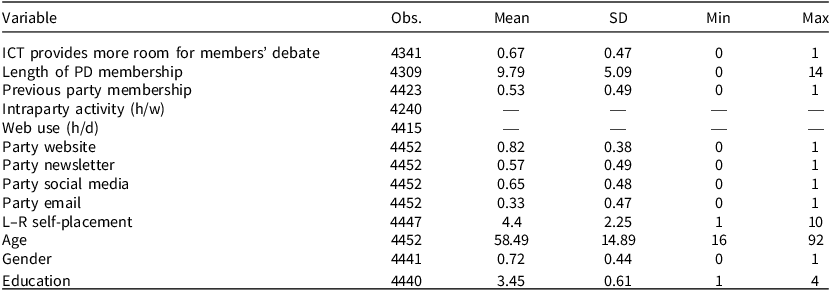
H2b focuses on affiliates’ usage of digital tools for interacting with their party. The model also includes an indicator of ideological self-placement (1 – 10 scale, where 1 means left-wing and 10 means right-wing positioning). In regard to the socio-demographic profile of respondents, we have used a continuous variable measuring respondents’ age. Gender was included as a dichotomous variable where 0 referred to women and 1 to men. Finally, education was controlled through an ordinal variable where 1 was applied for those with low education (primary education), 2 for respondents with lower secondary education, 3 for those holding upper secondary education, and 4 for tertiary education. Table 1 displays the descriptive statistics for all variables included in our statistical model.Footnote 1

Empirics: Analysis and discussion of the results
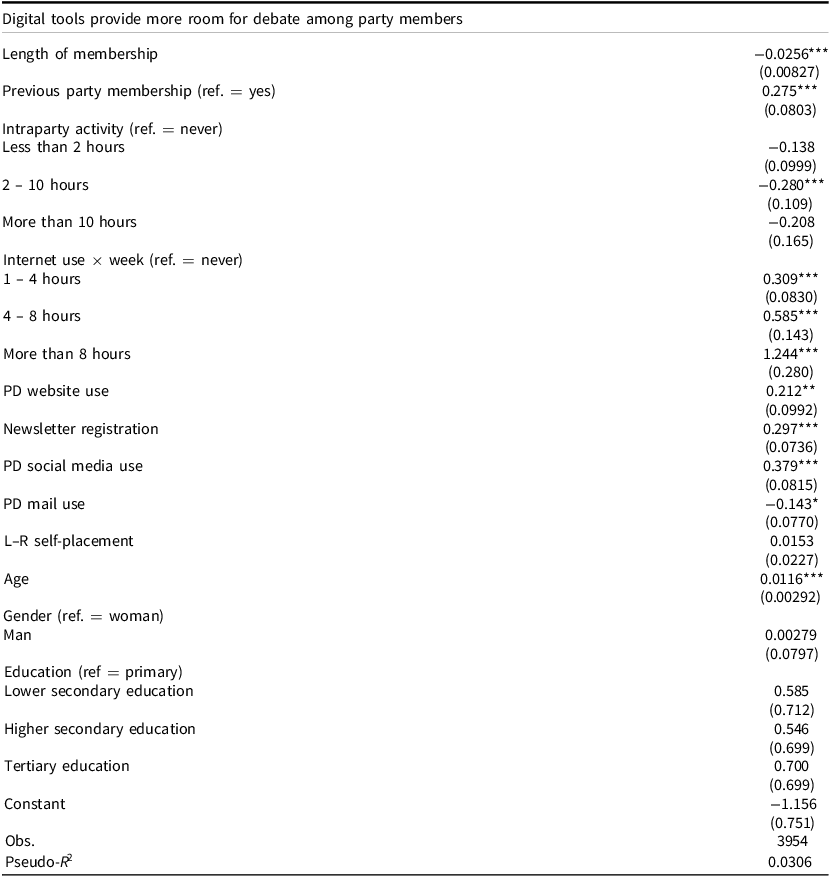
This section discusses the main statistical results drawn from our analysis. The three hypotheses were examined through the statistical model discussed above and are detailed in Table 2. The results essentially confirm our expectations regarding H1, which posits that more experienced affiliates would be less enthusiastic about digital tools. Nonetheless, we have also identified some nuanced results depending on the dimension of experience taken into consideration. Indeed, regarding the length of party membership, we find consistent results. Regression coefficients are negative, indicating that long-standing members had a lower probability of holding a positive opinion about digital tools.
Logistic model

Note: Robust standard errors in parentheses. L–R, left-wing–right-wing; Obs., observations; ref., reference category. *p < 0.1, **p < 0.05, ***p < 0.01
Figure 1, which reports the predicted probabilities considering the length of membership, provides an even more effective assessment of this finding. Among individuals who maintained their membership in the party for a longer period, the likelihood of interpreting digital tools as a potential enlargement of venues for party members’ discussion and interaction decreased. The same pattern can be observed by examining results on the variable accounting for respondents’ previous activism in other parties. In this case, the trend was positive and significant, suggesting that, compared with those who had previously been involved in other parties, native PD members are more likely to give a positive assessment of the impact of ICT on their own organisation in terms of broadening the avenues for interaction and discussion among affiliates.
Predicted probabilities: membership length.

When moving to H2a and H2b, which examine the impact of intraparty activism by differentiating between offline and online practices, such as participating in traditional intraparty activities or engaging with the party through digital tools, the results become more ambiguous. In comparison to individuals who did not participate in party activities, individuals who reported a higher level of engagement in weekly party activities also exhibited a higher degree of scepticism. However, as clearly shown in Figure 2, this association is nonlinear. In fact, the degree of dedication to conventional intraparty engagement exhibited a negative trend, indicating that, as individual activism increased, the probability of having a positive evaluation of digital tools decreased. However, the coefficient reached statistical significance only among individuals who reported devoting 2 – 10 hours per week to party activities. This result is intriguing, as it confirms that there is a variation in perceptions regarding digital tools based on an individual’s level of participatory commitment. Nevertheless, this pattern did not hold true for individuals who declared a high degree of engagement in party life. Among individuals reporting more than 10 hours per week of activism, there appears to be a shift indicating a greater likelihood of having a positive perspective on digital tools.
Predicted probabilities: traditional intraparty activity.

Coefficients referring to actual use of digital tools provided by the party revealed interesting patterns. With the sole exception of the use of email for communicating with the party organisation, website use, social media use, and newsletter registration showed an increase in the odds of holding positive opinions on digital technologies. As illustrated in Figure 3, a consistent and statistically significant positive association emerged, although the magnitude of this effect somewhat varied – use of these platforms fostered more optimistic evaluations regarding the participatory affordances of ICT. These results align with the expectation in H2b, supporting the idea that familiarity with and exposure to digital tools within party life reinforce positive assessments of their deliberative potential. In contrast, the bottom-right panel, focusing on email communication, exhibits a slightly negative trend, indicating that those who reported using party email as a mode of interaction were, on average, less likely to perceive ICT as enhancing internal discussion. This divergence may reflect the comparatively formalised nature of email exchanges within party communication, which may not be perceived as fostering horizontal deliberation to the same extent as more interactive or public-facing platforms such as social media.
Predicted probabilities: digital intraparty activity.

Concluding remarks
The scientific literature is virtually unanimous in reporting trends of change within political parties, and most of it points to a progressive fading of party organisations (Katz and Mair Reference Katz and Mair1995; 2018; Janda and Colman Reference Janda and Colman1998; Bardi, Bartolini, and Trechsel Reference Bardi, Bartolini and Trechsel2014a; Ignazi Reference Ignazi2017). The combination of lower membership rates and higher electoral volatility is interpreted as empirical evidence of the party’s organisational crisis (Whiteley Reference Whiteley2011; van Biezen, Mair, and Poguntke Reference van Biezen, Mair and Poguntke2012).
However, an alternative strand of literature emphasises that many adaptive strategies have been deployed and contribute to reshaping how political organisations operate and survive. Political parties are indeed transforming the modalities through which they liaise with members and sympathisers, enhancing a renewal process in increasingly complex socio-political contexts (Norris Reference Norris2001; Bardi, Bartolini, and Trechsel Reference Bardi, Bartolini and Trechsel2014b). At this juncture, ICT constitutes a new frontier for party organisations. It enables more direct and instant connections with sympathisers, helping mitigate organisational flaws, such as fewer resources and less capillary presence on the ground (Scarrow and Gezgor Reference Scarrow and Gezgor2010; Gauja Reference Gauja2015). In this context, the relationship between online and offline modes of participation has been widely investigated in the literature, revealing the capacity of digital environments to activate and mobilise new participatory resources. Research on the role of new technology within party organisations has recently received considerable attention from scholars, even though research findings are sometimes mixed, suggesting that the impact of ICT may not be so pronounced.
This paper has focused on the impact of ICT in a traditional, mainstream party organisation by adopting a bottom-up perspective, considering how party members perceive digital technologies and how they assess the role of such tools within their organisations. Employing original survey data, we have investigated the opinions of members of the Italian PD, which is one of the main political parties in Italy and, most importantly, one of the few maintaining a relatively robust organisation at the central and local levels.
More specifically, we have analysed the opinion of PD members about digital tools’ capacity to broaden the space of internal activism, given that digital environments provide members with new opportunities and modalities for participation and confrontation. The main finding is that previous membership experience has an impact on affiliates’ opinions. More precisely, individuals with a long history of party membership were found to be more sceptical about the potential of ICT than newcomers. In other words, long-term members, who have had more extensive experience with traditional modes of participation within the party, were characterised by less trust in digital tools’ impact on the party organisation.
Regarding participatory practice, our findings were more ambiguous. On the one hand, as expected, the reliance on digital tools for interacting with the party led to a greater likelihood of having an optimistic view of their impact on party organisations. This pattern suggests that greater organisational investment in such digital tools would improve members’ overall assessment of the functioning of their party. On the other hand, when considering the potential impact of traditional intraparty activism, results turned out to be mixed. While there was a negative trend suggesting that individuals more committed to traditional ways of activism are less likely to have a positive assessment of digital tools, these findings were statistically robust only for an intermediate degree of activism. These findings only partially support our argument, but they may also suggest that, beyond certain levels of activism – and, more precisely, among the most engaged – digitalisation is seen as a way of broadening the venues for participation and thus having a potentially positive impact on the organisation and party membership.
Hence, this paper contributes to broadening the knowledge on the role of digital technologies within party organisations and, more specifically, on the impact these tools may have on party members. In addition, our findings provide opportunities to explore new avenues of research concerning, on the one hand, the possible asymmetries of organisational power that the introduction of digital tools create between long-standing (older) members who are opposed to digitisation and newcomers who are in favour of creating an increasingly digitised organisational infrastructure, and on the other hand, the impact that new ICTs have on party strategies of adaptation to the new digital ecosystem in a context where different party strata have different positions on digitisation processes. Both of these lines of inquiry deserve further theoretical and empirical investigation from a comparative perspective.
Our analysis is not free from limitations, though. On the one hand, the sample of respondents and the computer-assisted web interviewing (CAWI) survey technique also suffer from self-selection bias. However, this aspect remains very difficult to tackle adequately, and this study remains one of the few that address these issues using original data at the individual level. Moreover, the availability of data for only one case may limit the scope of the inferences to which this study leads. It would therefore be valuable for future research on these issues to have access to comparative data across parties within the same political system, controlling for a party’s contextual variables (ie party size, ideology, age, leadership role, etc.). In addition, future research should be devoted to investigating organisational commitment regarding the use of digital technologies at the subnational level, which would enable consideration of variations across parties and within the same party organisation, and examination of the impact that new ICTs have on the faltering processes of intraparty democratisation.
Supplementary material
The supplementary material for this article can be found at https://doi.org/10.1017/S168209832510009X.
Funding statement
The research has been funded by the Italian Ministry for Research and Higher Education, Prin 2022 ‘Italian PArties Digitalization – IPAD’ (2022XN3SCN).
Competing interests
On behalf of all authors, the corresponding author states that there is no conflict of interest.
Antonella Seddone is Associate Professor at the University of Turin. Her research interests focus on political parties and organisational changes. She also conducts research in the field of political communication, with specific reference to election campaigns, public debate, and populist communication. She is Co-convenor of the Italian Politics Specialist Group within the UK Political Studies Association, and she is Co-chair of the Conference Group on Italian Politics and Society of the American Political Science Association. She has recently published in International Journal of Press/Politics, Acta Politica, Parliamentary Affairs, European Politics and Society, and Government & Opposition. Recently, she co-edited (with G. Sandri) the volume New Paths for Selecting Political Elites: Investigating the Impact of Inclusive Candidate and Party Leader Selection Methods (Routledge 2021).
Marco Valbruzzi is Assistant Professor of Political Science at the University of Naples-Federico II and Adjunct Professor at the Gonzaga University in Florence, Italy. He is the author of Primarie. Partecipazione e leadership (Bononia University Press, 2005) and co-editor, with G. Pasquino, of Il potere dell’alternanza. Teorie e ricerche sui cambi di governo (Bononia University Press, 2011). His most recent books are Collective Leadership and Divided Power in West European Parties (with D. Campus and N. Switek, Palgrave 2021) and Come votano le periferie. Comportamento elettorale e disagio sociale nelle città italiane (Il Mulino 2021).


 Open access

