

A Principled Approach
Working with technology in any kind of language setting is imperative in today’s world. The number of potential technological tools that are available to help us work more efficiently and effectively as language revitalizers, teachers, materials developers, language documenters, language advocates, administrators, and learners is quite impressive, even overwhelming. This chapter will attempt to weave together some of the main considerations that many of us encounter when dealing with technology in our day-to-day professional activities. We will look at the set of skills necessary for working with technology, talk about how to get started when incorporating technology, cover some of the domains of technology use, discuss the creation of materials, and finally look at special considerations when working with technology in language revitalization. But before we begin, let’s start by discussing a principled approach for incorporating new technology into the language learning environment.
Principles, Not Tools
Perhaps it is best to start with a counter example, one that too many technology consumers and language teachers use as a default strategy when incorporating new technology. It goes something like this: I found this great new app online for my phone/tablet/computer; it can do this amazing thing; now I want to see how I can find a way to use it in my upcoming lesson next week.
This approach can be called ‘app driven’ or ‘tool driven’. An app-driven approach prioritizes technology while moving learning needs into the background. Although in some cases this approach may lead to a successful use of technology for learning, more often than not it is gimmicky and has limited pedagogical success. You might say it is putting the cart before the horse: a solution looking for a problem.
A more sound approach would reverse the roles of learning and technology, and place the learning in the foreground, something that might be called a ‘needs-based’ approach. To give a real-life example, Rosanne, an Ichishkíin language teacher who is not very confident in using technology, had just introduced a unit on using conversations at the breakfast table. She would like her learners to create, practice, and then record a dialogue so she can listen to their speech and give feedback on their pronunciation and vocabulary use, but she is not sure how best to go about this. Once the need has been identified, the search for the best technology solution can begin. So, in looking for an audio recording option, from talking with other people, Roseanne is considering: (1) the free recording program Audacity, with students uploading a file to a shared folder online such as One drive, Dropbox, or Google Drive; (2) an online recording program called Vocaroo that learners can use to record, save, and send audio files to the teacher; or (3) a preloaded app on the students’ cell phones (there are numerous apps for Android or iPhone, such as Voice Recorder or Voice Memos that come preinstalled) so that they can send the teacher their audio file in an email or text from their phone.
Now that the options have been identified, Roseanne can decide which one works best for her learning context, weighing the pros and cons of each potential tool. From the three options above, perhaps the students have access to only one class computer, which would rule out option one. Vocaroo for phones requires a download and a little training, and Roseanne decides that there isn’t enough time for that in her already busy curriculum, so option two is ruled out. All of Roseanne’s students have cell phones that already have audio recording apps, so after considering various factors Roseanne feels option three is the best choice. By using this needs-based approach, Roseanne is more likely to find the best tool for her particular purpose and context.
To take another example, Paulo, a language program manager and someone generally skilled in using technology, wants to build a short, online course for people interested in learning Tolowa-Dee-Ni’. He wants to have many audio files of common phrases included in the website and has a very modest budget, but he is not sure which is the best website builder to use. Now that he has defined his need he looks for a solution. One option he is considering is Google Sites. He knows it is free, easy to use and that he can invite people to view the website so he can control who is able to use it. However, it would require maintaining the user permissions list of people as well as adding and deleting people. He has heard about Wix and thinks their websites look particularly nice and easy to build, but the free plan uses a ‘wix’ domain name; he could try the starter plan at roughly US $4.00 per month, but it still contains ads on the site, which he doesn’t want. He also considers WordPress. The only cost he can see is for hosting, which also runs at about US $4.00 per month, but he thinks he might be able to host the site on his department server. He can password protect the website with a single password, thus avoiding maintaining a user list. While some people complain that WordPress is not powerful, it can easily host audio with a player, which is the main technical goal he has for this website. After weighing the advantages and disadvantages, he chooses WordPress for his project.
A Necessary Skill Set
So what does a language revitalizer need to be able to do in order to complete her job effectively in today’s technology-dependent world? Is there a set of basic standards or a specified skill set for those working with endangered languages? For English language teachers, for example, a set of standards have been developed by Healey and her colleagues at TESOL, most of which are also applicable to language revitalization. Some of the standards for teachers they have identified include:
(1) knowledge of various essential tools and how to use them;
(3) incorporation of technology into assessment such as feedback and record keeping; and
(4) use of technology to improve opportunities for communication and collaboration.
Each of these areas will be discussed separately.
Knowledge of Various Essential Tools
Neither Roseanne nor Paulo were experts in all technological areas; no one can be. Yet, is there an ideal skill set that would help them perform their jobs better? A definitive list of essential tools is difficult to specify because of the wide variety of tasks that a language revitalizer is required to perform. Yet any list would likely include the following as a start: word processing programs (e.g. Word, Google Docs, or Open Office); presentation programs (Powerpoint, Keynote, or Prezi); spreadsheet programs (Excel, Open Office Calc, or Google Sheets); video and audio playback programs (Quicktime, Windows Media Player, or Vlc); and search engines (Chrome, Firefox, or Safari). Language workers should ideally feel comfortable using these programs and in creating language materials and classroom supplements. They should also feel confident in training learners to use such programs or in troubleshooting students’ issues.
To someone new to technology, like Roseanne, a list of skills and tools like the above could feel daunting. More important than being ‘good at X’ program or expertly knowing specific tools, however, is the ability to feel comfortable with technology generally. Feeling comfortable with trying out and adapting to new technology will go a long way as tools are in a constant state of change. For example, software developers often add new features, change the location of menus and options, or even remove features altogether after updates. Not only are existing tools in flux, but new tools keep being developed while old tools become obsolete or unsupported. One example of this constant change is MS Word. Since its release in 1989 Word has undergone at least fourteen different major versions, with additional minor versions released in-between. While ten years ago you may have been an expert at version 12.0 of Word, many features have changed with the latest release.
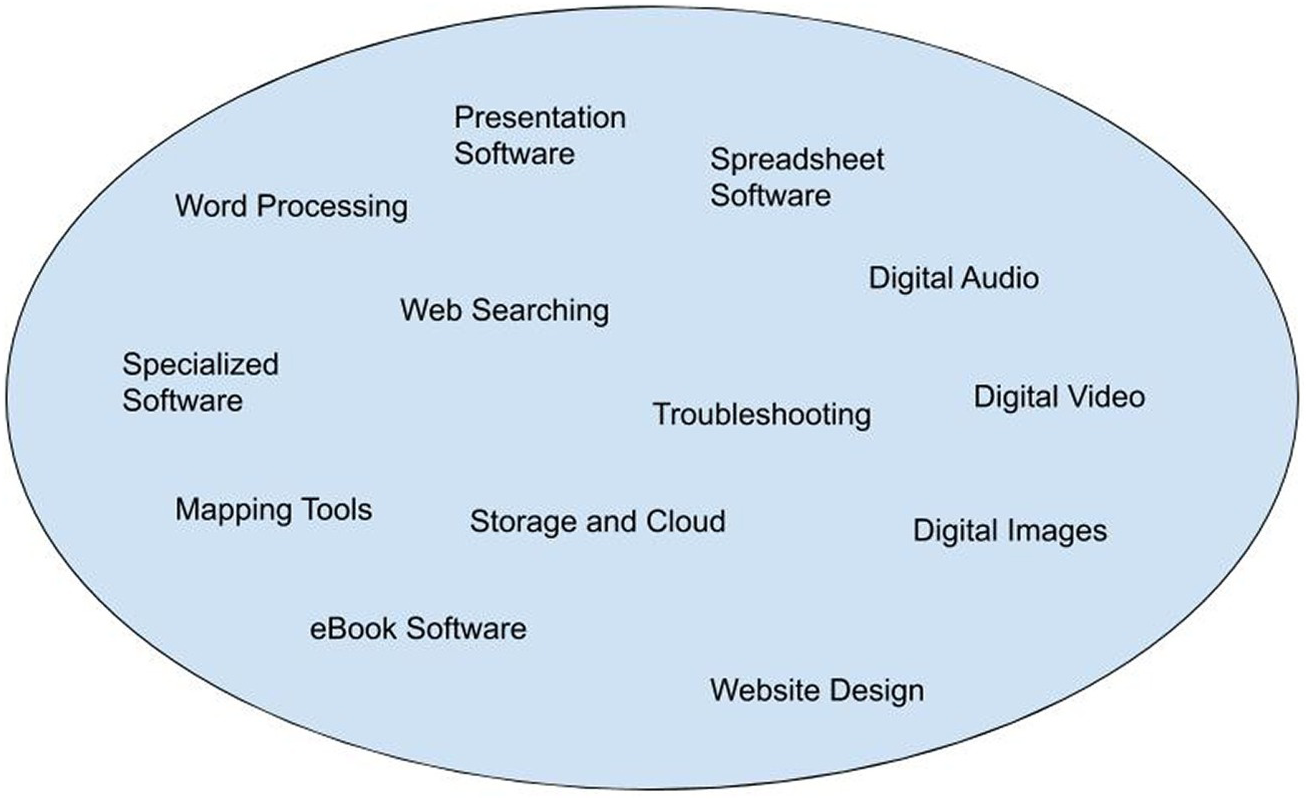
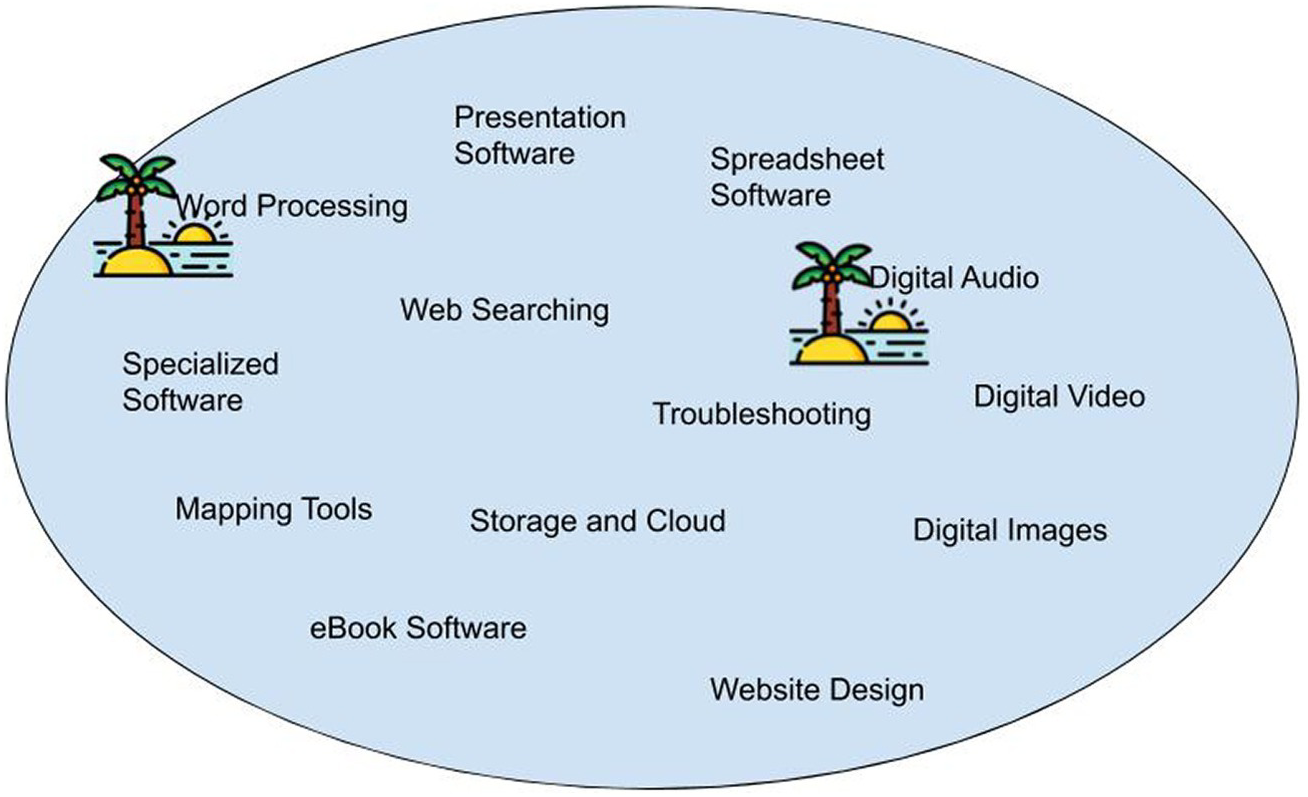
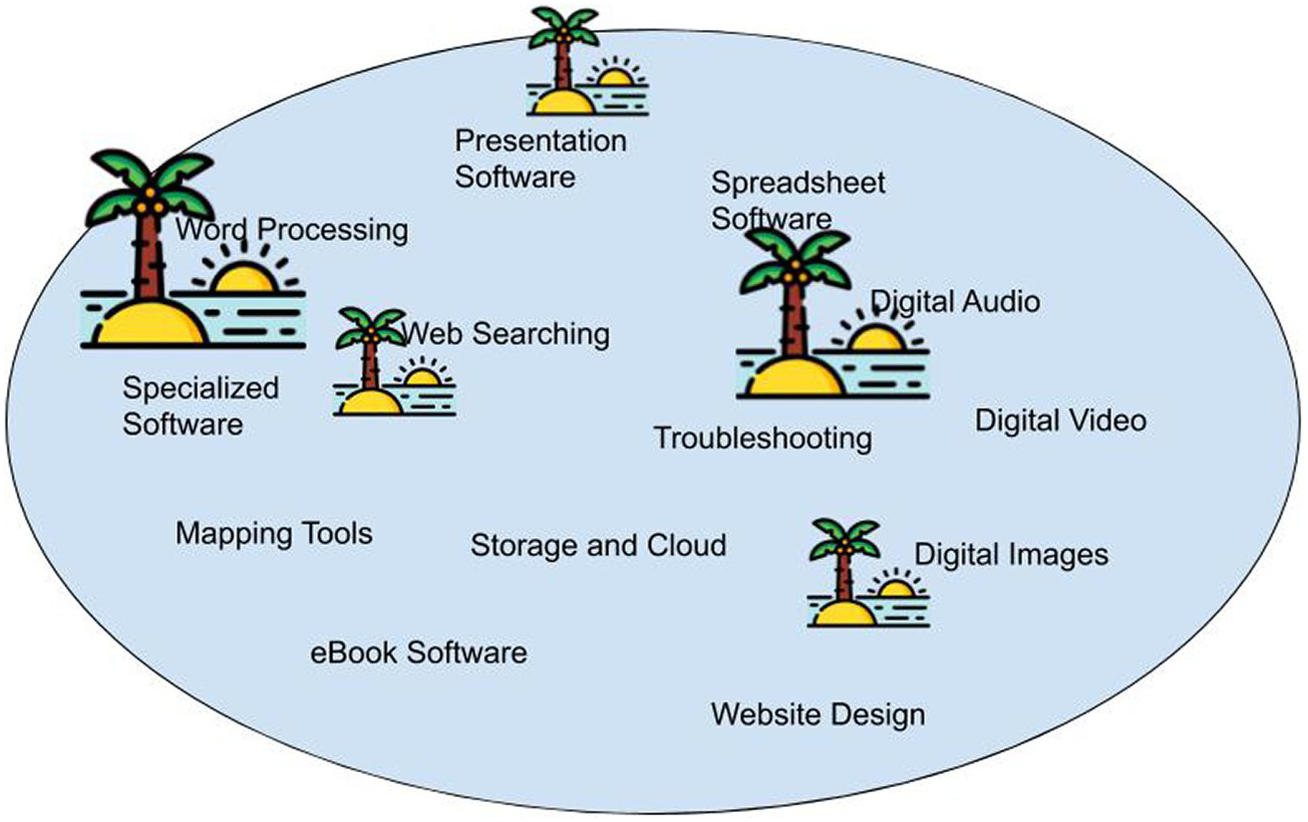
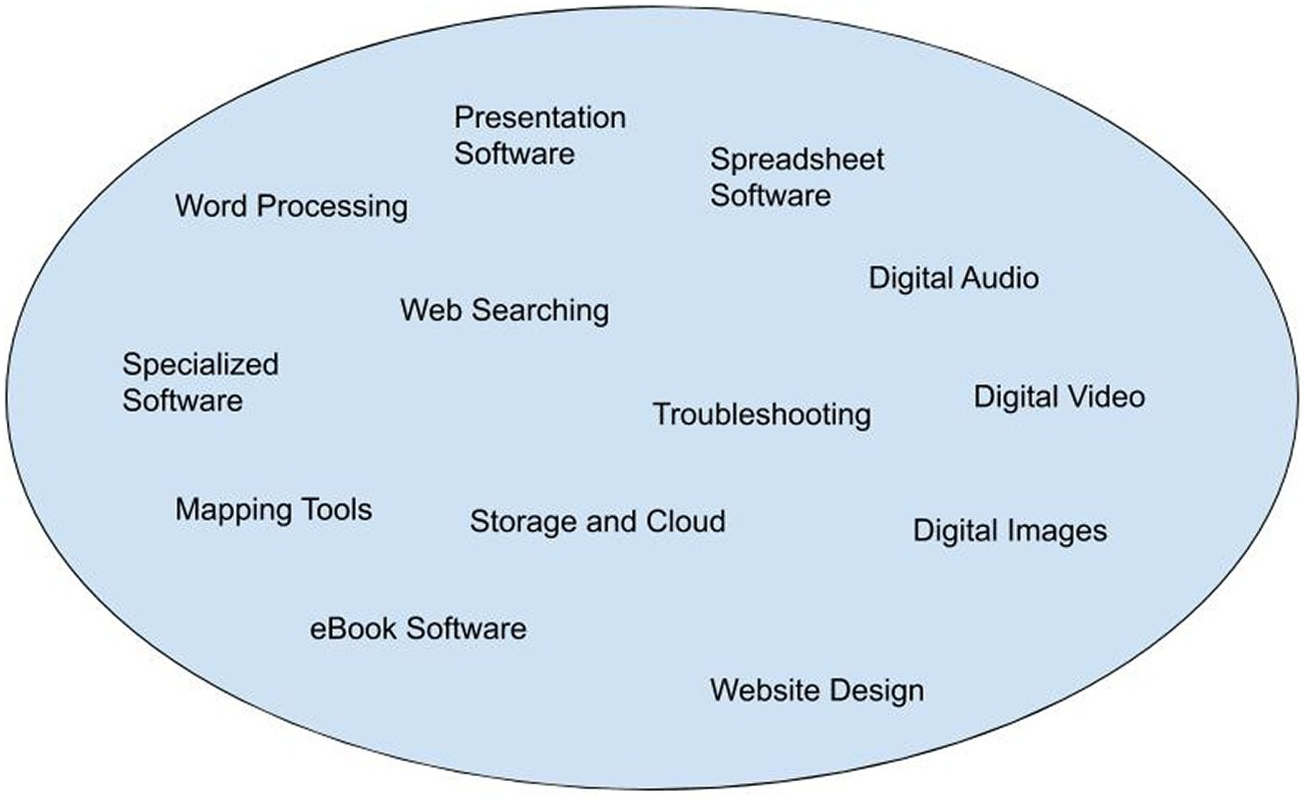
While it would be ideal to have language revitalization workers competent in all essential technological skills and confident in their abilities to troubleshoot and help others, the reality is that the ‘World of Apps’ and related necessary skills are vast (see Figure 17.1). One way to handle this daunting task is to start small with current needs, and then build out into what some have called ‘islands of competence’. That is, someone desiring to increase their skill set can begin with what they already know, or start with a small area that is most in need, learning only a few new things at a time. Over time, they can slowly build their skills and expand their knowledge into new or related areas (see Figures 17.2 and 17.3). In Roseanne’s case, she originally knew very little about digital audio, but has now learned a bit after her experience of getting her students to make recordings on their phones, so she has built a small island of competence. The next time she does a similar activity she might even build further on her skills and have students do some basic editing of their audio files. In Paulo’s case, he already had many islands of competence, but he ventured out into a new one, learning how to use WordPress and adding a new island to his skill set.
The Wide World of Apps. A possible sea of uncharted ‘Apps’ relevant to language revitalization workers. Developing expertise in all areas is daunting, perhaps even an impossible task
Islands of Competence. Rather than feel overwhelmed by the vast number of areas that need to be learned, users can start small, building ‘islands of competence’ in a few specific skill sets
Expanding Islands of Competence. Over time, a user can expand their islands of competence, forming larger islands, chains of islands or even turning islands into entire continents
Integrating Technology into Teaching
Integrating technology into your work or class means intimately knowing your curriculum, your students, and your own teaching style. Although increasingly younger learners are more comfortable with technology, often they are unaware of how to use technology for language learning. While many of today’s students may be adept at using technology generally, their use often falls into very specific areas that are not language-learning related; a skilled language revitalization worker will know how to use technology specifically to foster language learning, and know how to share that knowledge.
When integrating technology into language teaching, it is important to be aware of the curriculum, learning goals, and objectives. For example, if the objective is to have students talk about what they did yesterday in the past tense in the language, this will dictate what types of tools the teacher would consider. In addition, teachers should know whether the equipment and space available is suitable for the goals of the lesson or class. A class based project, for example, that included audio would likely necessitate instructing the students in how to make the audio recordings. The quality of these recordings would be greatly improved by having access to headphones to limit the ambient noise of the other students making recordings at the same time. In turn, this might influence the type of recording technology chosen. Additionally, a teacher leading a lesson that incorporates technology would want to be sure that she is comfortable enough with the software so that she could troubleshoot or work around any problems encountered. This usually means testing out the technology before the class; even if the teacher is familiar with the tool, testing can work out kinks and help to successfully integrate the technology into the lesson. As an added resource, in many cases the teacher can call upon her technologically savvy students to help those that are having trouble.
Assessment
A final way to use technology is during assessments. Assessments can be formative or summative, and technology can be used to enhance assessment and feedback for any of the four common skills: listening, speaking, reading, or writing. In addition, there are numerous ways to create interactive tasks, activities, and quizzes, which can be used to assess learning and will be discussed later in this chapter. Finally computers offer a way to keep track of attendance and grades, sometimes through the use of a Learning Management System (e.g. Canvas www.canvaslms.com/), or grading software (e.g. Thinkwave www.thinkwave.com/), or, when these are not available, in teacher created spreadsheets (e.g. Excel or Google Sheets).
Evaluating Potential Technology
Before selecting a particular technological tool it is useful to go through an intentional evaluation process. Listing your priorities or relevant issues is a good place to start and requires knowledge of the strengths and the constraints of your particular context.
There are two types of issues that you might find on your list: general issues and context-specific issues. General issues that are likely to be important in nearly all language contexts include cost, ease of use, powerfulness of the tool, and availability. Specific items unique to your context might include ease of use, appropriateness to the age of users, appropriateness to the culture of users, and compatibility of fonts to the orthography of your language.
Free and Open Source Tools
Nearly all language revitalization contexts operate on a tight budget. Free tools, or tools with free versions, are most likely to be valuable in such situations. Luckily there are numerous suitable resources to consider, though one may need to be a bit creative in adapting the tool to the local context. Also, caution should be taken when evaluating ‘free’ apps; they may limit the length of time you can use it, stop you using it after a set number of times, contain watermarking or advertising on the product, or other deal-breaking problems.
To take one example, MS Word is standard for most computers, but costs money. Free and open source alternatives to Word include WPS Office Free, Libre Office, and Google Docs among others. Specific adaptations, such as installing fonts from a source like ‘Language Geek,’ may be required to get your word processor to work for your language. In another example, while some computers may include built-in audio editors as part of a bundle, Audacity is a free, open source audio editor that has some surprisingly powerful features. To export your files as smaller MP3 files, an extension (LAME encoder) may need to be installed as an adaption.
Iterative Process of Incorporating Technology
Incorporating technology into your work should be seen as an ongoing process; rather than finding a definitive, immediate solution, incorporating technology is better viewed as something that happens over time. In most cases, a proposed technology solution has some glitches, tradeoffs, or downsides, or it doesn’t work as smoothly as we want it to. Sometimes these issues are severe enough that we search for another tool entirely. More often glitches mean that we need to ‘tweak’ the tool, the way we introduce it to learners, or the support we give to users.
To do this, it can be beneficial to look at incorporating technology as an iterative process. After introducing a new technology, take some time to stop and reflect. Jot down a few notes about what worked, what didn’t work, and how it might work better in the future. The next time you use the technology, make any necessary adjustments and afterward reflect again. Don’t be afraid to keep an eye out for new technology that might do the job better. Finding the right tool for the right job, and knowing the right way to use it, takes time.
Safety, Privacy, and Ownership
A final consideration when using technology, particularly in language revitalization contexts, is safety, privacy, and ownership concerns. For those working with children, special care needs to be taken to protect them from some of the seedier sides of the Internet. For example, while many social media tools such as Facebook can be a useful learning and communication tool, extra precautions should be taken when using them with children. Sometimes it is better to use an education specific tool, such as Edmodo. Drafting a set of general guidelines and policies for social media use is something many language departments and schools have done. An example policy could include: making all student communications public; separating professional from personal accounts; using official or school district equipment for communication; and refraining from posting any personal information about students.Footnote 1
Issues around ownership and control of data and information have historically affected Indigenous and minority communities disproportionately. When using proprietary software, for example, care needs to be taken that ownership of the material remains with the community, and that producers of information can control distribution and who is able to view the products. For example, iBooks Author is a program that can easily create professional looking eBooks, but there are some limitations. Since it is a proprietary program, the fine print states that books created with iBooks Author cannot be sold except through iTunes. This is not a problem if a community wishes to give away books through its own method of distribution (email, website, jumpdrive), but in some cases it might not be what a community wants to do with the content they have developed.
Domains of Technology Use
In this next section, we will consider both where technology will be used, and what types of language it can support.
Technology within the Classroom
Decisions about what technology to use in the classroom are largely limited by availability and what we have access to. For example, whether we have access to classroom computers, computer labs, laptops, tablets, smartboards, and cell phones will shape what options we have and the choices we make. Classroom teachers, again, should take care that they are using the technology with a clear language purpose in mind.
In some settings, the ‘classroom’ is nontraditional, sometimes even without walls. Many communities in the USA have an annual culture or language camp, where groups of community members gather, sometimes far away from ‘the grid,’ which affects what kinds of technology can be used there. In one case, a community that was holding their camp in the mountains at a traditional gathering spot wanted to have access to audio and interactive activities. The community had access to a set of tablets, so an eBook was developed and preloaded onto these. When the children at the camp went to the language tent, they were able to interact with this multimedia material without any Internet connection. At night, the language camp leaders simply had to remember to charge the batteries.
Technology outside the Classroom
Learning Management Systems (LMSs) offer many options for extending the learning beyond the classroom. However the big ones, such as Blackboard, Canvas, and Moodle, are typically tied to schools or departments that have significant budgets and, in the case of Moodle, technology support services. There are free versions of the larger LMSs: For example, Blackboard has Coursesites, and Canvas has Free For Teachers, both of which are stripped down versions of the full systems. Another option for smaller budgets are LMSs that are free and self-contained, such as Google Classroom, ANVILL, or Obaverse. ANVILL, for example, is designed specifically for emphasis on spoken language, is free to teachers and students, and allows administrators to add students and guests as needed.
As in the case of Paolo, discussed earlier in this chapter, website development can be an important way to host or share information about language with a community. Several free sources have already been mentioned (Google Sites, Wix, WordPress), but numerous alternatives exist, with new ones popping up constantly. In choosing a website editor, factors that Paolo took into consideration were cost (is it free or, if not, does it fit my budget), ease of use (how long will it take to be proficient), and powerfulness (can it do what I want it to do). In addition, stability of the platform – whether it will be around in a few years and whether the free option will change if the business model changes – should be a top consideration. Other types of communication platforms, such as blogs (EduBlogs, Tumblr) or discussion forms (phpBB, MyBB), can also be valuable communication tools.
As well as extending learning time for individuals, technology outside the classroom has the potential to include whole families in the language revitalization process. When possible, learners can include siblings, parents, grandparents, or even extended relatives into language assignments or projects. In one example of intergenerational learning, High School students were tasked with building audio materials about common phrases in the language, to be hosted on SoundCloud. The students tapped into the knowledge of older family members to help with vocabulary and pronunciation, and they helped teach phrases to younger siblings who knew little of the language. In another example, one language revitalization learner/teacher carried around a dedicated audio recorder. When new phrases or words came up when interacting with fluent speakers in his family or in community gatherings, he asked to capture them on his recorder so that he could continue working on improving his own fluency. This could also be done easily on a phone.
Listening and Speaking
For many communities, the language is traditionally used for spoken communication. At the same time, if the language is highly endangered, there can be few opportunities to hear or speak the language. This is one problem that technology can easily help address. Technology can offer learners another purpose for using the language, and materials developed can be used to increase the profile of the language and people’s exposure to it. For recording and organizing audio files there are several options, including Vocaroo, Padlet, and VoiceThread. Padlet, for example, can be used for group pages where students record an audio or video file on a specific topic and then ask other learners to listen and respond to it. Individual Padlet pages can also be used for solo work, such as keeping audio journals.
Animation is another option that sometimes drives up learners’ motivation. Volki, SockPuppets, and GoAnimate all offer easy platforms for building animations that audio can be layered onto. Volki, for example, allows learners to create an avatar and then record the spoken language, so that the avatar appears to be doing the talking. Learners can create an avatar that represents and speaks for them, or they can create animal avatars, and work on the language the animal might be using. SockPuppets allows users to create up to four characters that can interact in a language, and it can be quite fun for younger learners at the same time as developing their confidence in the language.
Creating videos is perhaps the most powerful tool, but it takes some time for users to be trained on how to do this. Windows Movie Maker on PC and iMovie on Mac are both good initial movie editors. Another option is movie editing in the cloud, with an app like WeVideo or YouTube Video Editor. Both are good free options. Adobe Spark is a free app that can be downloaded or used in the cloud, and it can be a good all-in-one editor for younger learners or for those who can’t afford to take the time to learn how to use a more powerful tool. Finally, even Powerpoint can incorporate audio into slides and be turned into a movie.
Reading, Writing, and Vocabulary
Reading materials in endangered languages can be scarce. While some endangered and minority languages have a robust written history, many do not. If written materials exist, online databases can offer language workers easy access to collections. For example the ‘Ulukau: Hawaiian Electronic Library’ catalogues newspapers in the Hawaiian language from 1834 to 1948. For languages with little or no written resources, materials designers will need to be more creative. For example, by using tools like Google Forms, Survey Monkey, or Qualtrics, teachers can create surveys that include simple questions for beginner students or reading sections for more advanced students, or a general comprehension test using a multiple choice format.
Writing with technology offers many possibilities beyond simple word processing. Collaborative writing ‘in the cloud’ allows for creative pair, group, and even whole class writing activities using Google Docs. An activity can be scaled up or down depending on the proficiency of your learners. Survey tools mentioned above can be open ended, requiring students to respond to questions in writing. WordClouds can be used with tools like PollEverywhere, where students are asked a question, such as ‘what’s your favorite animal’. Students then respond on their phones, and their answers are displayed in real time in a word cloud.
Vocabulary options are many. Quizlet, Anki, and Memrise allow both learners and teachers to build their own flashcards. There are numerous crossword puzzle makers and word search makers. Cloze test makers, such as Learn Click or Cloze Test Creator, allow you to easily make fill in the blank type activities where learners are required to use all of their language skills to complete the task.
Another option for vocabulary is the use of databases. The Miami-Illinois Digital Archive (MIDA) is one example (http://ilaatawaakani.org/). Developed by the Myaamia Center in collaboration with the Miami Tribe of Oklahoma, the goal of this database is to assemble all the various resources in the Miami-Illinois language into a single searchable space that can be useful for both researchers and learners. It currently has over 50,000 entries and there are plans to open up the resource to other language communities with a sister project called the Indigenous Language Digital Archive (https://ildarchive.org/). This new site is being used now by the South West Oregon Dene Research project to build the Nuu-da’ Mv-ne’ digital archive. Online dictionaries, such as the Siletz Dee-ni’ dictionary (http://siletz.swarthmore.edu/), are another option. Such dictionaries often have audio associated with the written entries to aid learners in the pronunciation of words and phrases. While the resources listed in this paragraph typically require training and support, these can be among the most powerful tools available to language revitalization workers.
Considerations for Language Revitalization Contexts
The Low Tech Environment
In some language revitalization contexts there is little access to technology or computers. Nevertheless, there are still powerful ways that technology can be creatively utilized. A single computer classroom can be a valuable tool, especially if teachers have access to a projector and speakers. Teacher-controlled activities, such as a Powerpoint presentation of a story in the language, can incorporate audio, images, and even video. The single computer can be used for students’ presentations, as a workstation in part of a rotating station in the classroom, or as a spot for students to write a short story together, either led by the teacher or where each student comes up and continues the story in a chain activity.
Even in environments lacking computers, most students now have smartphones. Many younger students use social media on a regular basis, and teachers can set up spaces to use the language such as an Instagram or Twitter feed. More simply, teachers can encourage students to text with each other in language using their phones, or tap into texting tools such as Facebook Messenger or Whatsapp. An additional option for cell phone use is Kahoot. A teacher can set up a language quiz or poll, sharing the address with students so that they can answer the questions and see the results immediately from the computer projected at the front of the class. Smartphones in general are becoming more common, but challenges remain in terms of unequal access, variation in platforms and apps, and the ability of learners to use their phones effectively for learning and not get distracted.
Creating Materials
One of the biggest challenges facing small and minority languages is a lack of materials. Producing materials is a specialist area for publishers working on learning materials for major languages, yet small profit margins rarely allow for any collaboration with Indigenous communities. Tribal and community language programs are often short on capacity and funding, which leaves the bulk of materials creation up to individual language departments and teachers. Where possible, language programs should have a technology expert who can help create materials and coach teachers who want to create their own materials but need support. Training personnel at conferences, workshops, or institutes not only increases capacity, but often results in the creation of materials that can be taken back to the community and directly used for learning. Creating e-books, electronic dictionaries, or other digital materials avoids the additional costs of printing materials.
Documenting with an Eye toward Everyday Language
Since many ‘smaller’ languages are still being documented, it is important for community members to work with linguists or documenters to make sure that the type of everyday language needed for communication and conversation is captured. Instead of word lists dictated by linguists looking for minimal pairs, documentation should be done on natural, everyday communication. When possible, it is preferable to have two or more speakers interacting in a realistic situation so that documentation can capture the nuances of the language, such as greetings, turn taking, changing of topics, agreement, joking, or closing. Using video offers further opportunities for capturing paralinguistic communication that is vital to effective cultural competence in the target language, such as facial expressions, proxemics, and gesture. Language workers can then more easily repurpose documentation materials into pedagogical materials. The ‘sweet spot’ is when documentation is useful to a community of teachers and learners and not just linguists.
Including Learners in the Process of Materials Creation
Another option is to include students and learners in addressing the need for materials. Project Based Learning (PBL) offers many options for both increasing the amount of material available in a target language, but can also extend the reasons for using the language, encouraging students to get involved. Projects can be teacher led or student led, but are often negotiated so students have some input in deciding the direction of the project. Creating maps, videos, books, e-books, posters, audio material, and websites are all examples of products that students can help create. When these materials have an authentic use outside of the classroom, it enhances the project. For example, in one situation, high school language students created language materials to be used in a preschool immersion classroom. They were trained in how to capture and edit audio, video, and images, and how to turn these into an e-book. They then produced a small library of e-books that featured images and recordings of themselves speaking in their language, as well as recordings from the wider community, and even of the preschool children who were to receive the materials.
A Healthy Skepticism toward Technology
While technology certainly offers language teachers opportunities that did not exist before, it is important not to look at technology as a silver bullet for endangered languages. There are limitations and pitfalls associated with using technology, time and money being perhaps the most important ones. Given the reality of limited budgets, technology can be a heavy drain on language programs where equipment and applications need to be kept up to date. There is often a learning curve associated with new programs as well as the time commitment required to produce materials, and teachers are often short on precious time. A language revitalization effort has to look at where their time and money would best be spent, and in many cases technology will not be the best answer. Finally, much of what can be accomplished with technology is best described as an extension of learning. That is, initial teaching of new language features is usually best done in person, with technology acting as a way to reinforce or extend the learning, offering more opportunities for practicing the language or reviewing language skills.
‘Train the Trainers’ Model for Workshops
How can knowledge of best practices in using technology be shared most effectively? One model that has proven useful in many teaching contexts is the ‘train the trainers’, or ‘train the leaders’ approach. An example of this is the Costa Rican workshop: ‘Primer Taller de Formación de Maestros de Lenguas Indígenas Costarricenses: Estrategias Didácticas y Uso de Herramientas Tecnológicas’ held at the University of Costa Rica in April of 2018. Fifteen members from seven Indigenous language groups from around the country were selected to come to the capital to take part in the two-week workshop. Participants were carefully chosen on the basis of being language leaders or important teachers in their communities, who would not only benefit from the workshop themselves, but who would then be able to return home and share what they had learned with others. After learning about pedagogy and technology, participants developed an action plan for how to share their ideas once back home, effectively becoming trainers themselves. This model, when implemented successfully, allows for the quick dissemination of useful techniques and ideas about language teaching and technology use, which can then benefit as many people as possible.
Technology as a Resource for Teacher Support
Teachers and people working in language revitalization situations often feel isolated and alone. With few others in the tribe or community concerning themselves with the same issues, many teachers are in need of support. Some support can come in the form of moral support, just having a place to ‘vent’ or share problems that are hard to understand unless you are doing similar work. Support can also be in the form of asking questions about problems and getting feedback on possible solutions. Support also comes in the form of learning about what people are doing in one context that can potentially be useful for other contexts. While traditionally conferences and workshops have been outstanding sources of such support, time limitations and the expense of travel can create obstacles to getting this type of support.
Technology serves an important role in addressing this problem. Social media, emailing or skyping others with expertise offers us an ability to receive such support anytime, anywhere. Facebook groups and email lists, such as the ILAT list, are a place for public sharing and discussion of ideas unique to this specialized community. Similarly resource centers such as the NILI Resources Center (http://nilirc.com/) offer a place for teachers to browse materials for ideas, search templates that can be turned into their own language, or use ready-made materials if the language they are working with is represented.
17.1 How about Just Shifting Back? How One Passamaquoddy Speaker Led Her Community to Language Documentation and Revitalization
Margaret Apt, a middle-aged Passamaquoddy woman from Eastern Maine, USA, had grown up away from the Reservation and was doing everything she could to improve her Passamaquoddy language skills, but now the Elders were no longer speaking in public. She noticed that when they needed a new word to discuss a contemporary topic they would shift to, and then remain speaking in, English. Passamaquoddy, an Algonquian language of the Eastern USA and Canada, was becoming invisible. I asked Margaret if we could try an experiment using video. She agreed and began to convene a group of speakers who also agreed to be filmed. Whenever the talk drifted into English, Margaret would gently remind the speaker to switch back to Passamaquoddy. It worked, and soon speakers were having long conversations about contemporary experiences totally in Passamaquoddy. This speaker-facilitated, nonintrusive, documentary style videotaping soon became an accepted method for Passamaquoddy language documentation. Subsequent presentation of the video back to the participants and community, referred to as Video Feedback, stimulated more deeply contextualized conversation and sometimes motivated new language initiatives (see Figure 17.1.1). Margaret became the first Facilitator of the method that came to be called Natural Group Conversation and Activity Documentation. So just by acting on her wish to speak Passamaquoddy with her friends without English intruding, and with a little help from the video, Margaret launched an active process of language revitalization in her community that is also being replicated elsewhere.
Ben Levine and Julia Schulz documenting Passamaquoddy-Maliseet natural conversation as developed with Margaret (Dolly) Apt.

As Facilitator, Margaret would create a safe space for speaking. She might start the conversation off with a question and then ask for contextualizing information. Speakers gained confidence and soon were telling stories, laughing, or commiserating – creating speaker-driven language in natural, real-life ways. Playing the video back gave the speakers new awareness and the emotional strength to take on the topics that concerned them and activities they wanted filmed. More speakers became involved, and a new confidence to address language endangerment emerged as Passamaquoddy became more visible again.
This practice of video feedback triggers new and often deeper conversations, creating rich content for teaching and learning as well as linguistic analysis. Recording these conversations and playing them back has proven to be helpful in addressing historic community trauma and its effects in suppressing language use. It has also resulted in the emergence of new leaders advocating for revitalization.
Margaret and other participants next learned to log, transcribe, translate, and subtitle over 100 videos, first available as DVDs that later became part of the Passamaquoddy-Maliseet online dictionary and audio archive which can be seen at www.PMPortal.org. Margaret taught her daughter Plansowes and some friends who had tried to learn Passamaquoddy and understood the language but couldn’t speak it, how to record dictionary entries and example sentences with Elders and then post them on the Portal. The recording process immediately helped these tech-savvy, 30-something fluent comprehenders improve their language skills and increased their interest in learning and using the language. Excited at this breakthrough, they shared Portal links to words and videos on social media. Soon there was heightened visibility of the language, increased respect for speakers, and an expanding new constituency for Passamaquoddy language, especially among those living in the diaspora who could now be connected to the language. The Elders, in turn, became acquainted, in a non-threatening way, with the Passamaquoddy-Maliseet writing system.
The participants in Margaret’s conversations subsequently initiated new language revival projects: two immersion preschools; a video-based program for fluent comprehenders and language classes for adults. One man engaged in graduate studies so that he could become a linguist for the tribe. Two others became language teachers. What started with one person, Margaret, looking for ways to get her own Passamaquoddy language back, grew into language revitalization with many different components. Today there are new speakers of Passamaquoddy for the first time in forty years, and the model has inspired other groups. Language activists in an Ayöök-speaking Mixe community in Southern Mexico saw Passamaquoddy videos and invited Speaking Place to start the documentation and revitalization process in their town. The Mixe have used the same methods. They have also had training from our team on linguist-guided community self-documentation. Like the Passamaquoddy who inspired them, they have started immersion schools and are building a Mixe radio station. Now other towns in Oaxaca are starting to adopt these methods as well. While each community shapes the methods and process to their own circumstances, starting with video documentation of facilitated natural group conversation and activity can be a potent launching pad for revitalization.
17.2 Online Language Learning Materials Development
Welsh is relatively fortunate among the world’s lesser-used languages, with its official status, government support, rich literary tradition, dedicated radio and television channels, and important role in the education system in Wales. Welsh-medium education is available from nursery right through to university-level, whilst those attending English-medium schools learn Welsh as a second language. It is also possible to learn Welsh as an adult, and around 18,000 learners attend adult Welsh classes in Wales each year.
One course provider, Nant Gwrtheyrn, specializes in week-long residential courses, which particularly attract learners from abroad or whose lifestyles don’t suit weekly classes. However these learners sometimes find it tricky to maintain the ‘buzz’ and keep using their Welsh once they’ve returned home. Through the KESSFootnote 2 programme, a partnership was established between Nant Gwrtheyrn and myself, a PhD student at Cardiff University, in order to develop a research-based set of online learning materials that would complement the beginners’ level residential course and allow learners to maintain regular contact with the Welsh language.
Despite the very specific context of the project, the lessons I learned should be applicable to online materials development in many environments.
Try to plan a manageable project based on available human/financial resources. Do you need to create an entire curriculum or just supplementary materials?
Don’t expect the planning and writing process to follow linear stages – decisions made part-way through the process, or new information about learners’ needs/expectations, will mean you need to revise earlier work.
If online learning resources are already available for your target language, try to collaborate with the authors rather than competing with them. Don’t reinvent something that has already been produced for your language – focus on creating new resources which will complement existing ones.
In terms of the language content of materials, consider the domains in which you hope learners will use their language skills. For example, you could select vocabulary and phrases used in the home, in the workplace, in ceremonies, or in the wider community.
Also keep in mind why you are creating digital learning materials as opposed to paper materials. To reach a geographically dispersed audience? To encourage learners to practise frequently? To facilitate independent learning? Electronic learning materials should not simply be digitised versions of paper materials (e.g. PDFs of worksheets). Instead they should offer something over and above the ‘offline’ experience, making use of what technology can uniquely offer – e.g. interactivity even without classmates/tutors, or instant personalised feedback, or helping make input comprehensible by offering hyperlinks and images.
Don’t allow technological developments to dictate the resources you create without reference to language learning theories/principles. In other words, don’t create something just because it’s technically possible – always reflect on the benefits a resource will bring to the learning experience.
For audio/video resources, consider including recordings of ‘new speakers’ as well as ‘native speakers’. In some language contexts this would be an appropriate way of demonstrating that learners are valued members of the linguistic community.
Plan for future sustainability! I failed at this one, as the online platform hosting my resources has disappeared, taking my content with it! So think about long-term plans for your materials – e.g. how they might be migrated to new platforms, or how they might be adapted for mobile devices as opposed to computers.
17.3 Rising Voices
The Internet provides a special opportunity for communities that speak Indigenous, endangered, and minority languages to attract and involve younger generations in language preservation and revitalization – an involvement that is crucial for the survival of these languages and cultures.
Supporting such communities, especially Indigenous communities across Latin America, in this work has been a primary focus of Rising Voices (RV), the digital inclusion initiative of the organization Global Voices. RV works to promote equity and diversity online through training, mentoring, and the creation of peer-learning networks. With the increased accessibility of devices such as smartphones and tablets, and the spread of Internet connectivity (including through community-owned networks) Indigenous communities are increasingly accessing information online. However, they rarely do so in their native language. That is changing. Communities’ access to information and digital tools is making it easier to create multilingual content themselves. Creating content online by uploading videos to YouTube, translating free software, or writing on blogs and social media platforms is a positive step that Indigenous communities can take toward ensuring that their language is present in all facets of life, especially in the digital realm.
Rising Voices’ support takes many different forms, including organizing workshops and gatherings. In recent times, we have held events in Mexico, Colombia, Peru, Ecuador, Guatemala, Bolivia, and Chile, in collaboration with a range of local partners. In these meetings, participants run hands-on workshops and engage in peer-led discussions addressing the linguistic, technical, and socio-cultural obstacles they face promoting their languages online. These events also include a public component designed to showcase the work and its possibilities. A direct result of these gatherings has been the creation of local, national, and international networks of mutual support and solidarity.
Rising Voices has also created the Activismo Lenguas (Language Activism) portal to map projects across the region and to highlight the important role that technology is playing in language revitalization, as well as to inspire other communities wanting to do similar types of initiatives. Visitors to the portal can search by country, language, and the type of digital tool that they utilize in their revitalization activities. We are also working to research and analyze the opportunities and challenges for sharing knowledge through Wikipedia in Indigenous languages. This work has given us valuable access to the perspectives of practitioners on the ground, and allowed them to share their stories.
Finally, our social media campaigns encourage engagement with minority languages in a fun way, such as tweeting and creating memes. In observance of the International Year of Indigenous Languages 2019, Rising Voices created a rotating Twitter account (@ActLenguas) where each week a different Indigenous language digital activist manages the account, tweeting about their personal experiences of using technology in support of language revitalization. Our work in Rising Voices has shown the possibilities provided by technology. But it is important to stress that the Internet and digital media are only tools, and that the real driving force behind this work is the hundreds of young people who have stepped forward and demonstrated their commitment to ensuring that their language and culture are reflected in all facets of society, including the Internet.


 Open access