

Introduction
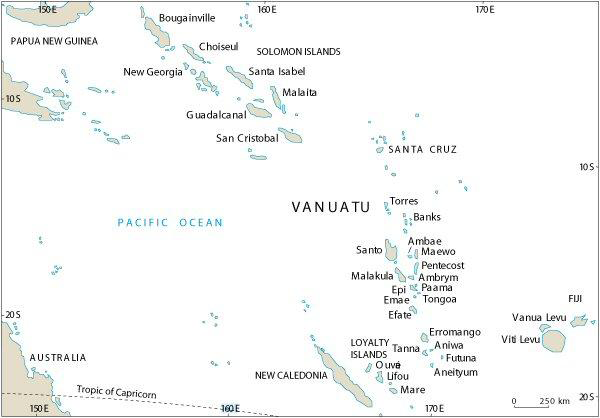
The emergence of the Lapita culture in the Bismarck Archipelago has been associated with the archaeological presence of small obsidian flaked artefacts. Obsidian is particularly important to the interpretation of long-distance movements because it is possible to determine its source with a high level of accuracy. Sources of raw material in the Lapita period include the Willaumez Peninsula sources on the island of New Britain and later sources in the Admiralty Island Group, particularly Lou Island (Figure 1). Obsidian from these sources found in the sites of Near Oceania has been used to infer the chronology of occupation as well as the patterns of movements and exchanges.
Map of the Melanesian region.

Obsidian flakes are generally absent from Lapita sites in Remote Oceania. This is attributed to the lack of suitable sources of volcanic glass beyond the Bismarck Archipelago. In a few sites from Fiji, New Caledonia and north Vanuatu a limited amount of small obsidian flakes sourced to the Bismarck are considered evidence for the long distance exchange systems in the Lapita sphere. However, up until now, relatively large amounts of obsidian in a Remote Oceania sites have only been identified in the Reef Islands, particularly Nenumbo (see Reference GreenGreen 1976; 1979; Sheppard & Green 1991; Reference SheppardSheppard 1993).
Herein initial source data is presented concerning obsidian artefacts found at the newly discovered site of Makué on Aore Island (Santo, Vanuatu) (Figure 2). This is the first Lapita site in Vanuatu with a significant amount of obsidian. A few pieces of obsidian (8 flakes, analysed by Ambrose and sourced to the Talasea and Lou Island sources) were previously found in Malo (Reference HedrickHedrick 1971) but no site with comparable quantities of obsidian had been found south of the Santa Cruz area. The amount of obsidian flakes found, the early dates from the site as well as the pottery style suggest that Makué represents an early, if not founding, Lapita settlement in Vanuatu.
Lapita in Vanuatu
An example of obsidian find from the Makué site. This is a typical appearence for obsidian belonging to 'Group 1'.

Few early Lapita settlements have been discovered in Remote Oceania. Roger Green found the first Lapita settlements in the Santa Cruz Islands dating to the beginning of the first millennium BC (Reference AllenAllen 1976). Research carried out in the 1970s by John Hedrick (Reference HedrickHedrick 1971) led to the discovery of similar early occupation with Lapita pottery on the western and northern coast of Malo. Other potential Lapita occupations in this area were located on the central island of Efate (Reference GarangerGaranger 1972) and on Erromango (Reference SpriggsSpriggs 1989). However, these sites were disturbed and only a few decorated sherds are evidence for Lapita occupation. In 2003, Lapita sites were also identified in the islands of north-east Malakula (Reference BedfordBedford 2003) and a rich Lapita occupation was found in Efate.
In the last few years, intensive research in the northern Vanuatu area (Galipaud 2000; 2002) has uncovered new Lapita sites on the islands of Malo and Aore. They were discovered through studies of environment changes and uplift history in the region (Pineda & Galipaud 1998). These sites are generally covered by a metre or more of sediment and located on uplifted terraces beyond the present shore. Even so most sites are in a poor state of preservation. An exception is the site of Makué (or Aore Resort Lapita site, as it was called in 2002).
Makué Site
Map showing the islands of Santo, Aore and Malo, located in Vanuatu.

Makué is located on the north-western coast of Aore, facing the south Santo coast (Figure 3). It is separated from the Santo mainland by the narrow Segond channel. The north coast of Aore is formed by an elongated narrow sand strip, stabilised by dense secondary vegetation. Several low terraces (1-3m) attest to the uplift of ancient shorelines. The Makué site is in a coconut plantation, 7m above the sea-level, on a terrace above the beach, next to the Aore Island Resort. Patterns of deposition at this site suggest that remains from the Lapita period are scattered along several hundred metres on the north-west coastline around the Aore Resort, and might extend as much as 100m to the east along what used to be the north point of Aore. Although remarkably intact, parts of the site have probably been disturbed by the construction of an American base camp in this area during World War II.
In 2002, a series of test-pits behind the Aore Resort uncovered a substantial quantity of remains. Amongst these were a relatively large number of obsidian pieces (62 pieces). Due to the density of remains, a 12m2 area was excavated in 2003. At this time, an in situ Lapita layer was identified, containing several fireplaces, large pottery sherds (including the pedestal of an open bowl), shell artefacts, faunal remains as well as some additional obsidian flakes (25 pieces). All the obsidian artefacts collected from the site of Makué thus far were included in this analysis.
The stratigraphy of the excavated areas is quite simple: the top 70cm are fine marine sand with fragments of Lapita sherds and shellfish remains. Below 70cm, the sand becomes indurated and contains larger remains as well as in situ fireplaces. Culturally sterile fine sand, mixed with coral cobbles, lies below this layer. Three AMS dates were obtained for this site: the first came from the single layer in the 2002 testpits (2935±41 BP [WK-11447]), the other two from a fireplace (2982±50 BP [WK-13722]) and from below the in situ layer (2957±51 BP [WK-13721]) of the 2003 excavation.
Obsidian analysis
Reference AmbroseAmbrose (1976) first demonstrated that the relative density of obsidian pieces could be used to differentiate between the sources in the Pacific. This method has since been refined several times (e.g. Ambrose & Duerden 1982; Harris 1994; Torrence & Victor 1995). It is a fast and efficient investigative technique for the preliminary sourcing of an obsidian assemblage. Although the accuracy of measuring single artefacts can be adversely affected by a number of variables, including high porosity or the presence of inclusions of different materials, results at an assemblage level can be informative. This has been demonstrated by comparisons between obsidian artefacts analysed using both density and PIXE-PIGME (a chemical characterisation method) techniques (White & Harris 1997; Swete Kelly & Summerhayes, in prep). The density procedures used for this analysis are similar to those used by Ambrose (see Ambrose & Stevenson 2004 for a recent description of this methodology).
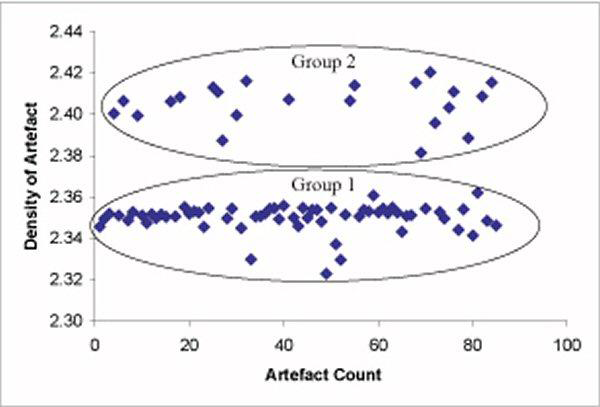
Density distributions of obsidian artefacts found in the 2002 and 2003 field seasons (1 artefact was left out of the final results, as it gave a very low density reading which was attributed to its coarse, friable nature).

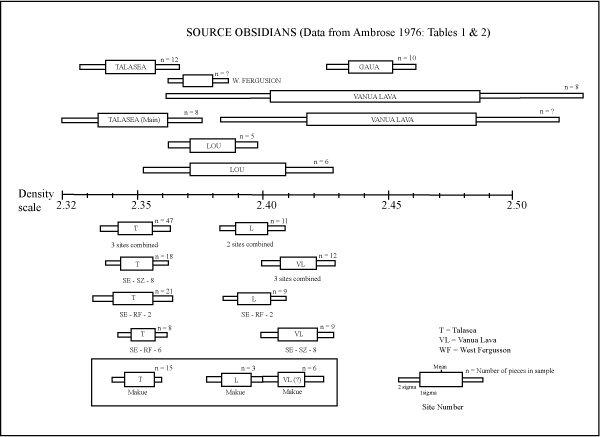
A large proportion of the obsidian artefacts from Makué have a density close to 2.35, which most closely corresponds to the Willaumez Peninsula sources on the island of New Britain (Reference AmbroseAmbrose 1976; Green & Anson 1998) (Group 1, Figure 4). The source location of Group 2 is not as easy to determine since the artefact density measurements do not closely correspond to any single source. The most likely origin, based solely on the density measurements, are the Banks Island or Lou Island, in the Admiralty Group (Figure 5). However, these sources possess overlapping density values of around 2.44 for the former (Reference AmbroseAmbrose 1976), and 2.38 for the latter (Reference AmbroseAmbrose 1976; Green & Anson 1998). That said, unlike the Lou Islands obsidian, that from the Banks Islands is a low quality volcanic glass which has been widely used in the last millennium over a vast area, from the Torres to Santo (Galipaud 1998) and the appearance of the artefacts from the Makué site is very similar. Additionally, exploitation of obsidian from Lou Island is generally thought to be later than exploitation of the New Britain sources. If the obsidian at Makué is arriving more or less simultaneously, as would be suggested by the dating and stratigraphy, then it would seem unusual to find a large amount from both sources. Future analyses will differentiate between these sources however it seems likely that at least some of this Group 2 obsidian is coming from the Banks Islands. These results thus closely reflect those from the Reef and Santa Cruz Islands.
Conclusions
A comparison of the densities for each of the known obsidian sources in Melanesia and the density range for the Makué obsidian, divided into groups 1 and 2.

In Aore, as in the Santa Cruz, there are few sites containing obsidian and these probably reflect the initial occupation. In the past, the presence of a few flakes of Banks obsidian in some Malo sites could be interpreted as an admixture from more recent levels. In contrast, there is only Lapita era occupation in Makué and thus an important outcome of this research is the confirmation that Banks obsidian was utilised by the original settlers. The presence of Banks obsidian in Makué further suggests that Lapita sailors knew of the Banks and utilised its resources, even if no Lapita site has yet been found in the Banks islands.
It is now clear that Makué is an important witness of the original settlement of Vanuatu. The similarity of the assemblage of Makué with the Santa-Cruz one, especially at Nenumbo suggest that the Reef-Santa Cruz area and the north Vanuatu have been an important stepping stone for the Lapita sailors on their voyage of discovery towards the south and east. The very early dates of the several layers of occupation at Makué support the hypothesis of an equally early settlement of Fiji and perhaps New Caledonia and comfort the tentative chronology of the Teouma site further to the south. The large amounts of obsidian flakes found on Makué are a good indicator of this antiquity but are probably also a distinctive trait of the function of this site, a function which still need to be researched.
Acknowledgements
The survey and excavations on Malo and Aore were supported by a grant from IRD and later financial support from the French Embassy and the New Zealand. High Commission in Port-Vila, as well as from the Australian National University. The Vanuatu Cultural Center, especially its director, helped at every stage to promote the project. Many fieldworkers of the Vanuatu Cultural Center and staff of the Vanuatu Historic and Cultural Site Survey took part in the research. Yoko Nojima and François Wadra assisted greatly in the instigation of the project. The Owner and Manager of the Aore Resort and Aore Plantation supported us while in the field and provided access to archaeologically important areas. Our thanks extend to all who took part in the excavation, especially Stephan and Rufino for their help in the field. We are particularly indebted to Chief Takau Mwele, the traditional owner of the area within which the site is located, and Chief Vira Joseph from Malo for the interest they have always shared and the kindness of their welcome.