

Televised debates have become one of the key features of election campaigns in many democracies. These events play a critical role in connecting candidates with voters, allowing candidates to promote their policies, ideology, and vision to a wide audience, including those otherwise difficult to reach. By offering a side-by-side comparison of candidates, debates help voters make informed decisions (Holbrook, Reference Holbrook1999; Jamieson and Adasiewicz, Reference Jamieson and Adasiewicz2000; Lee and Lee, Reference Lee and Mook Lee2015). Furthermore, watching presidential debates increases voters’ confidence in their decisions, potentially boosting turnout and political engagement (McKinney et al., Reference McKinney, Rill and Thorson2014; Benoit et al. Reference Benoit, McKinney and Lance Holbert2001).
However, in recent years, concerns have grown over televised debates’ heavy emphasis on personal attacks rather than substantive policy discussions (Woo et al. Reference Woo, Kim and Kyu Ahn2017; Benoit, Reference Benoit2007). Another criticism blames news media for amplifying attacks on opponents and downplaying policy content in their coverage of televised debates. According to this view, while candidates adequately address policy issues during debates, media outlets often fail to properly convey this substance, instead emphasizing attacks among candidates. To what extent is media responsible for the increasing negativity in televised debates? Does media coverage overemphasize attacks at the expense of policy discussions that occur during these events? Additionally, how does media’s debate coverage influence voter decision-making?
We address these questions by examining the presence of systematic bias in media coverage of televised debates. We hypothesize that media outlets are incentivized to highlight non-policy aspects of debates over substantive policy discussions. Based on this coverage pattern, we additionally expect to observe that voters with greater exposure to media debate coverage place less emphasis on policy-related considerations when evaluating candidates.
Using the 2022 South Korean presidential election as a case, we investigate whether media coverage of televised debates exhibits this bias. South Korea serves as a critical case for studying media coverage of televised debates, given the public’s high attention to these events during presidential elections. For instance, in a 2022 Gallup Korea presidential election poll, nearly half (46%) of respondents cited televised debates as a primary source of information for their voting decisions.Footnote 1 The viewership rating for televised debates in the 2022 presidential election was 39%, similar to the rating for televised debates during the 2020 U.S. presidential election. In contrast, televised party leaders’ debates in Japan have far lower influence, with viewership ratings reaching only around 3% even when broadcast in prime evening hours (Mainichi Shimbun, 2025). In addition, studies conducted in South Korea find that televised debates in South Korea had a significant effect on vote choices, partly because presidential contests in Korea often involve more than two major candidates (Kang and Bae, Reference Kang and Seok Bae2018; Park and Kim, Reference Park and Kyu Kim2014). At the same time, an increasing number of Korean voters rely on media coverage to learn about televised debates, rather than watching the debates in real time, thanks to the widespread use of news aggregator websites such as Naver and Daum. Given the highly salient nature of televised debates and the informational effects of their media coverage, South Korea provides a highly relevant case for investigating how media outlets cover televised debates.
Using automated text analysis, we compare the topic proportions in candidates’ speeches during the debates with those in media coverage of the debates. We constructed a comprehensive corpus of media coverage of the presidential debates in the 2022 election, which includes a total of 1304 news articles from ten news outlets with different ideological leanings. We then examined the differences in topic proportions between the candidates’ speeches and the coverage by news articles using keyword-assisted topic model (keyATM) (Eshima et al., Reference Eshima, Imai and Sasaki2023). Our findings suggest that although candidates devoted substantially more debate time to policy discussions than to attacking opponents, media coverage emphasized candidate conflicts and horse-race aspects of the campaign over policy content. Using survey data of South Korean citizens, we further show that the continued exposure to media’s election coverage is associated with voters’ increased tendency to base their voting decisions on non-policy issues.
Our study makes vital contributions to the literature on media coverage of election campaigns. Studying how the media presents the content of the debate is becoming increasingly important to the understanding of presidential campaigns. Although televised debates provide candidates a platform to communicate policy agendas to a broad electorate, an increasing number of citizens rely on media coverage rather than direct viewing to learn about these events (Reber and Benoit, Reference Reber and Benoit2001; Tsfati, Reference Tsfati2003). Our findings indicate that media coverage may diminish the debates’ informational value by prioritizing non-policy content over substantive policy discussions, raising important questions about the media’s role in democratic deliberation.
Theoretical framework
Electoral effects of televised debates
Televised debates have become a crucial component of election campaigns in many democracies. In countries like the United States, Canada, Australia, Germany, Israel, and South Korea, these debates are now the most visible and often most influential events of the campaign (Coleman, Reference Coleman2000). These events provide candidates with a rare opportunity to reach a broad and diverse electorate, including those who may not otherwise be paying attention to their campaign (Trent and Friedenberg, Reference Trent and Friedenberg2008). In addition, televised debates allow candidates to convey not only their policy agendas through words, but also to communicate nonverbally through facial expressions, vocal pitch, and interactions with other candidates (Boussalis et al., Reference Boussalis, Coan, Holman and Müller2021; Druckman, Reference Druckman2003). Both these verbal and nonverbal communications significantly shape voters’ evaluations of candidates.
A large body of research has demonstrated the informational effects of televised debates and their downstream effects on voters’ electoral decisions, primarily in the context of U.S. presidential elections. Televised debates provide voters with knowledge about election campaigns at significantly lower costs than other information sources. Consistent with this finding, earlier research in American politics shows that watching debates helps voters learn about candidates, their policy platforms, and key campaign issues (Abramowitz, Reference Abramowitz1978; Chaffee, Reference Chaffee1978; Holbrook, Reference Holbrook1999). Televised debates can also influence voters’ preferences by enabling side-by-side comparisons of the candidates, who debate on the same set of topics (Benoit and Harthcock, Reference Benoit and Harthcock1999). Studies show that watching televised debates can boost turnout by dissuading partisan voters from abstention or by helping undecided voters make an informed decision (Geer, Reference Geer1988; Lee, Reference Lee2016).
Previous research notes that while televised debates offer candidates a valuable opportunity to communicate their policy agendas to voters, they often feature personal attacks against the opponents at the expense of substantive policy discussions (Beom and Choi, Reference Beom and Hyeok Choi2013; Benoit, Reference Benoit2007; Choi and Benoit, Reference Choi and Benoit2009; Maier and Jansen, Reference Maier and Jansen2017). For instance, a study of 23 U.S. presidential debates finds that candidates spent, on average, 35 percent of their speaking time on negative attacks (Benoit, Reference Benoit2007). Although negativity in political discourse significantly undermines the democratic process by fueling voters’ political aversion and thereby demobilizing them (Ansolabehere and Iyengar, Reference Ansolabehere and Iyengar1995), candidates often find it beneficial to attack their opponents for several reasons. First, negative campaigning can improve a candidate’s electoral prospects by highlighting opponents’ weaknesses (Benoit, Reference Benoit2007; Damore, Reference Damore2002). Second, these attacks also increase campaign visibility and voter receptivity, as negative information tends to garner more attention than positive or neutral information – a phenomenon well-documented in psychological research (Geer and Geer, Reference Geer and Geer2003; Baumeister et al., Reference Baumeister, Bratslavsky, Finkenauer and Vohs2001).
In sum, televised debates feature both substantive policy discussions among candidates and non-policy content, such as personal attacks. How do media outlets cover these debates? Do they systematically underreport or overemphasize certain content relative to others? In this paper, we examine whether media coverage of debates focuses more on non-policy content than on the policy discussions that occur in the debates themselves.
Underreporting of policy content in media coverage of TV debates
Media plays a gatekeeping role in information dissemination, such that journalists’ perspectives and interpretations shape which issues they cover and how they report real-world events (Iyengar, Reference Iyengar2017). Thus, media coverage that perfectly mirrors the actual debate might be an unrealistic expectation. Still, there are reasons to believe that media outlets may systematically underreport substantive policy discussions in their debate coverage to a degree that exceeds typical organizational constraints. While candidates often prioritize personal attacks over policy discussions during televised debates, we expect that media coverage tends to amplify this trend beyond its actual presence by underreporting substantive policy discussions.
First, faced with increasing market pressure, media outlets may have financial incentives to focus on non-policy aspects of presidential debates, and such coverage often comes at the expense of coverage of substantive policy discussion. A well-documented feature of media campaign coverage is its focus on the ‘horse race’ aspect – tracking who is ahead and who is behind in polls, often at the expense of substantive reporting on candidates’ policy proposals and positions (Iyengar et al., Reference Iyengar, Norpoth and Hahn2004; Patterson, Reference Patterson1993; Cappella and Jamieson, Reference Cappella and Hall Jamieson1997). Relatedly, media outlets often frame elections as strategic games, focusing heavily on candidates’ campaign tactics rather than substantive issues (Patterson, Reference Patterson1993). When covering election campaigns, reporters also tend to focus on negative stories, such as attacks on the opposing candidates or scandals (Smith and Searles, Reference Smith and Searles2014). Existing research suggests several compelling reasons why election coverage so often focuses on horse race reporting and negative news stories during campaigns, often overshadowing substantive policy reporting. First, economic incentives drive reporters toward non-policy coverage to satisfy audience demand. By depicting the candidates as strategic players in a competitive game, horse race journalism transforms elections into entertainment spectacles that are designed to attract more viewers (Iyengar et al., Reference Iyengar, Norpoth and Hahn2004; Aalberg et al., Reference Aalberg, Strömbäck and De Vreese2012). Moreover, the growing competition among media outlets – including entertainment media, cable TV, and online platforms – combined with increased viewer choice creates economic pressure to emphasize horse-race journalism and make political news more entertaining (Prior, Reference Prior2005; Dunaway and Lawrence, Reference Dunaway and Lawrence2015; Chyi and Lewis, Reference Chyi and Lewis2009).
The same logic applies to news organizations’ decisions on how to cover presidential debates, leading them to focus on horse race reporting and negative news stories while underreporting substantive policy content. Televised debates offer a fitting venue for news organizations to highlight the “game” aspect of election. Since debates place candidates side by side to discuss the same topics and compete for voter support, media outlets can easily frame these events as contests between rivals (Reber and Benoit, Reference Reber and Benoit2001; Benoit et al., Reference Benoit, Stein and Hansen2005). In doing so, we expect that media will overemphasize debate content related to candidates’ attacks on the opponent while downplaying meaningful policy discussions. More coverage on these bickering between candidates will reinforce the ‘game frame’ of elections, making the debate coverage more entertaining and drawing greater viewer attention. Consistent with this logic, research on the U.S. presidential debates provides evidence of the media’s tendency to overemphasize candidates’ bickering in their coverage. For example, after classifying candidates’ remarks during the debates into self-praise, attacks, and defenses, Reber and Benoit (Reference Reber and Benoit2001) show that news stories tend to overrepresent attacks and defenses in candidates’ remarks more than self-praise. Moreover, a growing share of voters pays less attention to the substance of debates and is drawn instead to their entertainment value, as shown by their tendency to rely on media coverage rather than watching debates in full (Reber and Benoit, Reference Reber and Benoit2001).
Second, journalistic norms, such as news values, may guide reporters to focus on non-policy content, including personal attacks, campaign events and polling results, when covering debates. When deciding which events to cover, journalists often rely on newsworthiness criteria (Bridges and Bridges, Reference Bridges and Bridges1997; Boydstun, Reference Boydstun2013), learned in journalism schools and reinforced through the socialization processes in media outlets (Willig, Reference Willig2013; Gravengaard and Rimestad, Reference Gravengaard and Rimestad2012). Also, newsroom routines and decision-making processes tend to institutionalize the norm of seeking newsworthiness, thereby encouraging journalists to pay greater attention to unusual events and negativity during election campaigns (Lamberson and Soroka, Reference Lamberson and Soroka2018; Searles and Banda, Reference Searles and Banda2019).
Non-policy contents, such as unusual or controversial events during televised debates, are often considered newsworthy, as elements of negativity and conflict tend to appeal to a wide audience (Trussler and Soroka, Reference Trussler and Soroka2014). Negative content draws more attention, simply because it deviates from the normalcy (Iyengar, Reference Iyengar2017). Research shows that negative content also conveys risks and a sense of urgency (Fridkin and Kenney, Reference Fridkin and Kenney2012), motivating viewers to seek further information (Lau, Reference Lau1985). These characteristics increase the news value of non-policy content that often involves high levels of negativity.
Additionally, compared to policy-related discussions, non-policy content tends to carry greater emotional appeal. Attacks on opponents’ character, past performance, or controversial remarks can elicit strong emotional responses (Chang, Reference Chang2001; Maier and Nai, Reference Maier and Nai2020). For instance, research finds that stories about political scandals lead to intense negative emotions, such as disgust, anger, and sadness (Jiang et al., Reference Jiang, Kou, Wang, Wu, Li, Li, Yang, Cao, Wu and Jing2011; Walter and Redlawsk, Reference Walter and Redlawsk2023). Its strong emotional appeals enhance the news value of non-policy content, encouraging news outlets to cover such content more often (Maier and Nai, Reference Maier and Nai2020). Compared to non-policy-related stories, policy stories, often referred to as “hard news”, elicit weaker emotional responses as they typically focus on delivering factual information (Prior, Reference Prior2003).
Based on this reasoning, we hypothesize that media coverage of televised debates will underreport policy discussions while amplifying non-policy content, such as candidate attacks, scandals, and horse-race coverage.
Hypothesis 1 Media coverage of debates will contain fewer policy discussions than the actual debates themselves.
How does exposure to debate coverage influence voter decision-making?
Research suggests that while voters often rely on heuristics such as party cues or other information shortcuts when identifying candidates whose policy positions align with their own and making a choice accordingly (Lau and Redlawsk, Reference Lau and Redlawsk2001), candidates’ and parties’ policy positions continue to meaningfully influence voting behavior in several ways. A long tradition in the literature shows that voter evaluations of parties’ policy positions shape issue ownership of policy domains (Petrocik, Reference Petrocik1996), which subsequently influences vote decisions (Bélanger and Meguid, Reference Bélanger and Meguid2008; Bélanger and Nadeau, Reference Bélanger and Nadeau2015). For instance, parties or candidates who develop a reputation for competence in an issue that voters prioritize, such as the national economy, tend to receive greater electoral support (Bélanger and Meguid, Reference Bélanger and Meguid2008). Additionally, evidence from countries worldwide suggests that candidates who offer programmatic and populist policy promises to voters can enhance voter support (Golden and Min, Reference Golden and Min2013; Imai, King and Velasco Rivera, Reference Imai, King and Velasco Rivera2020; Camp, Reference Camp2013).
Given the continued importance of policy considerations in vote choice, examining how media coverage of televised debates influences the salience of policy issues for voters becomes crucial. In theory, televised debates should help voters make informed choices that are based on their evaluation of candidates’ policy proposals by featuring substantive discussions across multiple policy areas (Trent and Friedenberg, Reference Trent and Friedenberg2008; Benoit and Hansen, Reference Benoit and Hansen2004). However, the media’s tendency to focus on non-policy content over policy discussions in their debate coverage may undermine this informational effect, particularly for voters who primarily rely on media coverage to learn about the debates. Following this logic, we examine how exposure to media debate coverage affects voters’ consideration of policy factors in their electoral decisions. In particular, we expect that frequent exposure to media coverage of debates will make policy-related considerations less salient in voters’ decision-making.
Hypothesis 2 Voters who rely on media coverage of debates are less likely to prioritize policy-related factors in their vote choice than those who watch the debates firsthand.
Case: 2022 presidential election in South Korea
We test our theoretical expectations using the case of the 2022 South Korean presidential election. While extensive research has examined media coverage of presidential debates in Western democracies, particularly in the United States and Germany (Benoit, Reference Benoit2007; Maier and Jansen, Reference Maier and Jansen2017), relatively little attention has been paid to the South Korean context. This oversight is particularly noteworthy given South Korea’s unique media environment and the evolving nature of its presidential debates. The 2022 South Korean presidential election offers an especially compelling case study, as it was marked by an unprecedented level of personal attacks and scandal-focused discourse between candidates (Chae, Reference Chae2022; Lee and Park, Reference Lee and Park2023).
Television debates represent a crucial opportunity for voters to evaluate candidates’ policy positions and leadership capabilities. However, the media’s tendency to emphasize non-policy aspects of these debates—such as personal scandals, negative campaign—may undermine their democratic function (Reber and Benoit, Reference Reber and Benoit2001). This emphasis on non-policy content is particularly concerning in the South Korean context, where recent elections have witnessed increasing affective polarization among voters (Ka, Reference Ka2023). When media coverage prioritizes personal attacks and scandals over substantive policy discussions, it may exacerbate this polarization and impede voters’ ability to make informed decisions. The 2022 presidential election highlighted these concerns, as media coverage often focused on personal controversies—such as candidates’ family-related scandals and past misconduct allegations—rather than their policy proposals for addressing critical issues like housing affordability, economic inequality, and pandemic response. This selective emphasis may have significant implications for democratic discourse, as research suggests that voters increasingly rely on media interpretations of debates rather than watching them directly (Patterson, Reference Patterson1980). When media coverage emphasizes non-policy aspects of debates, it potentially deprives voters of crucial information needed for informed decision-making.
Media environment in South Korea
South Korea, with a population exceeding 51 million, maintains a sophisticated media ecosystem characterized by numerous newspapers, terrestrial and cable television networks, and digital news platforms. Similar to Hong Kong (Chan and Lee Reference Chan and Lee2014), the South Korean media landscape lacks a strict distinction between ‘local’ and ‘national’ media, as most outlets maintain a national reach, providing citizens with comprehensive access to major news sources.
South Korea operates as a full democracy, with a president elected by popular vote and a unicameral National Assembly elected primarily through direct suffrage. However, political ideologies in South Korea are sharply polarized, with two main political orientations: the “conservative” and the “progressive”. These factions often differ in their stance on key issues, particularly policy towards North Korea. Conservatives tend to take a harder line on North Korea, while progressives often advocate reconciliation with North Korea.
These ideological divides are reflected in South Korea’s media landscape, where news outlets demonstrate clear alignment with either conservative or progressive values (Choi and Im, Reference Choi and Im2021), a pattern commonly observed in other polarized democracies Major conservative newspapers, such as Chosun Ilbo, JoongAng Ilbo, and Dong-A Ilbo, are typically sympathetic to conservative policy positions, often supporting pro-business agendas and taking critical stances on North Korea-related appeasement policies. Conversely, progressive outlets such as Hankyoreh and KyungHyang Shinmun tend to support progressive policies, advocating social welfare and diplomatic engagement with North Korea. This ideological alignment influences how news is framed, with conservative media more likely to criticize progressive government initiatives, while progressive media may offer support or alternative perspectives.
In the broadcasting sector, while public broadcasters such as KBS and MBC are theoretically independent, their management appointments have historically been influenced by the ruling government, leading to periodic concerns about political influence. Cable news channels also show clear partisan tendencies, with channels such as TV Chosun and Channel A generally taking conservative positions, while JTBC is perceived as more progressive. The rise of online news portals such as Naver and Daum has added another layer of complexity to this media environment. These platforms serve as major news aggregators and have a significant impact on news consumption patterns, although they face ongoing debates about their role in news distribution and potential political bias.
This partisan media environment makes South Korea an interesting case study for examining how media bias and political parallelism influence public opinion and political discourse in a mature Asian democracy. However, unlike Hong Kong’s focus on pro-democracy versus pro-government divisions, South Korea’s media partisanship reflects deeper ideological divisions within a fully democratic system, particularly on economic policy, social issues and inter-Korean relations.
Issues in the 2022 presidential election campaign
The 2022 presidential election in South Korea was characterized by intense competition and overwhelmingly negative campaigning (Shin et al., Reference Shin, Yang and Deuk Hahm2024). The race between the two major candidates – Yoon Suk-yeol, the conservative People Power Party (PPP) candidate, and Lee Jae-myung, the liberal Democratic Party candidate – was exceptionally competitive, with a vote margin of only 0.73% (247,077 votes). This election was also dubbed the most unlikable election in Korean history. South Korea has demonstrated consistently high voter turnout in presidential elections, with participation rates of 77.2% in 2017 and 77.1% in 2022.
South Korea, like many other democracies, has experienced increasing political polarization in recent years. Both politicians and the electorate have become increasingly divided over policy issues, while affective polarization among supporters of major parties has grown substantially (Cheong and Haggard, Reference Cheong and Haggard2023; Han, Reference Han2022). The 2022 presidential election further amplified this affective polarization, as both major candidates engaged heavily in negative campaigning against their opponents (Shin et al., Reference Shin, Yang and Deuk Hahm2024).
The 2022 presidential election campaign was dominated by a combination of substantive policy issues and personal scandals that became central to public discourse. Policy-wise, the campaign was primarily shaped by pressing socioeconomic concerns that had intensified during the Moon Jae-in administration. Real estate and housing affordability emerged as the most salient issue, with Seoul apartment prices rising by 88.2% from 607 million won in 2017 to 1.1 billion won in 2021, and the total value of dwellings nationwide increasing by 42.9% during the same period (Kim and Lee, Reference Kim and Lee2021). This issue was considered so critical that real estate policy was selected as the first topic for discussion in South Korea’s first official four-way presidential debate on February 3, 2022. The election also centered on economic inequality, recovery from the ongoing COVID-19 pandemic, and issues related to sluggish job creation. Young voters, particularly those in their twenties and thirties, were especially concerned with employment opportunities and housing accessibility, making these demographics crucial swing voters in the election outcome.Footnote 2
However, the campaign was equally characterized by what observers called an unprecedented level of personal attacks and scandal-focused discourse, earning it the label “the election of the unfavorables.” The Daejang-dong development scandal became a central campaign issue, involving allegations that Lee Jae-myung, as mayor of Seongnam, provided business favors to Hwacheon Daeyu, enabling the firm to earn over 400 billion won in dividends from a development project (Moon, Reference Moon2022). In addition, controversy arose when Lee Jae-myung, during a televised debate, blamed Ukrainian President Zelensky for the war in Ukraine and dismissed him as a ‘novice president’. Lee made this remark to highlight his opponent Yoon’s political inexperience rather than to communicate his position on the Russia-Ukraine War. Opponents criticized this comment, questioning Lee’s capabilities as a national leader.Footnote 3
Additionally, shamanistic controversies persisted throughout the election period, representing another distinctive feature of the 2022 campaign. Allegations were raised that candidate Yoon Suk-yeol was “involved in shamanistic rituals,” to which the People Power Party responded by launching counterattacks, claiming that “associates of candidate Lee Jae-myung had performed shamanistic ceremonies.” Also, both candidates also faced controversies involving their spouses. As mutual negative attacks intensified rather than policy competition, the media criticized the candidates for engaging in “unprecedented negative warfare,” ultimately leading to the evaluation of this as an “unlikable election” (Kang, Reference Kang2022b). These personal scandals, combined with the substantive policy debates, created a complex campaign environment where media outlets had to navigate between covering legitimate policy discussions and the sensational aspects of candidate controversies, setting the stage for the systematic bias in debate coverage that our analysis reveals.
Analysis 1: media coverage of the 2022 presidential debates
To investigate patterns of media debate coverage, we collected data from two sources: (1) The National Broadcasting Debate CommissionFootnote 4 , which provides videos and transcripts of televised debates and (2) the Big Kinds website.Footnote 5 Korea’s largest newspaper article database. First, from The National Broadcasting Debate Commission website, we collected transcripts of statements made by presidential candidates Lee Jae-myung and Yoon Suk Yeol during the televised debates for the 20th presidential election, and created a corpus containing all candidate statements.Footnote 6 Second, we constructed a corpus of newspaper articles covering televised debates during the 20th presidential election using data from the BIG Kinds website. We analyze the patterns of televised debate coverage using newspaper articles rather than television news.
A growing share of Korean citizens obtains political and election information from newspaper articles through portal news aggregators like Naver and Daum, rather than from television news (Kim et al., Reference Kim, Rim and Hoon Sung2021; Lor et al., Reference Lor, Choi and Jung Oh2025). According to a survey conducted by the Korea Press Foundation in 2022, 75.1% of the respondents said they regularly consume online news. The same survey finds that this trend is particularly pronounced among the younger generation. Among respondents in their 20s, 90.5% regularly consume news through portal websites, whereas only 46.5% use TV news (Korea Press Foundation, 2022). Portal websites are popular among older respondents for news, with 61.8% of those in their 60s using them regularly. For those in their 70s or older, TV news remains a primary source of news. Yet, even in this age group, 23.2% regularly use portal websites for news, demonstrating the wide penetration of online news in South Korea.
In another survey of Korean citizens conducted in 2022, the largest share of respondents (35.1%) said they primarily use both portal websites and TV to access news, followed by 26.5%, who rely solely on portals (Lor et al., Reference Lor, Choi and Jung Oh2025). This suggests that while many Koreans continue to use traditional news sources such as TV, they increasingly supplement these with online portal websites for more convenient access to news. Given this trend, newspaper articles serve as one of the primary sources of televised debate information for many citizens, making them an appropriate source for analyzing media bias in debate coverage.
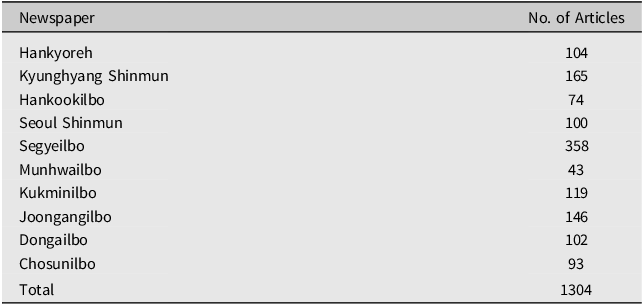
We retrieved the full text of the articles by extracting the URLs provided in the BIG Kinds database. We collected news articles published between the first presidential debate (February 21, 2022) and election day (March 8, 2022) from ten major newspapers: Hankyoreh, Kyunghyang Shinmun, Hankookilbo, Seoul Shinmun, Segyeilbo, Munhwailbo, Kukminilbo, Joongangilbo, Dongailbo, and Chosunilbo. Next, using the keywords “20th presidential TV debate,” “20th presidential debate,” and “2022 presidential debate,” we identified 1304 debate-related articles. Table 1 shows the number of articles by newspaper included in our corpus.
Number of articles by newspaper

Table 2 presents the key features of our corpus of candidate statements and news articles. The number of documents is 557 for Lee and 347 for Yoon. Because topic models require a minimum number of documents to produce stable estimates, and our debate transcripts contained only a small number of speeches, we treated each sentence as a separate document to increase our sample size sufficiently for reliable topic modeling.Footnote 7 Our news article corpus contains 1304 documents, where each document corresponds to a single news article.
Characteristics of corpus by source

We preprocessed our corpora of candidate statements and news articles through several steps. We first removed all characters except Hangul and English alphabets, and eliminated numbers. Next, we created a custom stop word list that includes meaningless words and removed all words in this list. We also processed words that have the same meaning but different postpositions as synonyms. Using UDPipe, a pre-trained universal POS tagger and dependency parser for Korean, we extracted nouns and adjectives with two or more characters after removing stop words.
We hypothesize that media coverage of televised debates will underreport policy content while overemphasizing non-policy content, such as the horserace aspect or attacks among candidates (H1). To examine differences in topical emphasis between candidate discourse and media coverage during the presidential debates, we employ keyword-Assisted Topic Model (keyATM), a semi-supervised topic modeling approach that extends Latent Dirichlet Allocation by allowing researchers to specify keywords as anchors for topics of theoretical interest (Eshima et al., Reference Eshima, Imai and Sasaki2023). KeyATM incorporates these keywords into the topic estimation process while still permitting topics to evolve beyond the initial keyword constraints, thus combining the theoretical grounding of supervised approaches with the flexibility of unsupervised methods to capture unexpected thematic patterns in the data. Compared to purely unsupervised approaches such as Latent Dirichlet Allocation or Structural Topic Models, keyATM offers improved topic interpretability without sacrificing flexibility. This feature makes it particularly well-suited for our analysis, as semi-supervised models of this kind allow researchers to predefine keywords and thereby ensure more consistent topic estimation criteria across heterogeneous corpora.Footnote 8
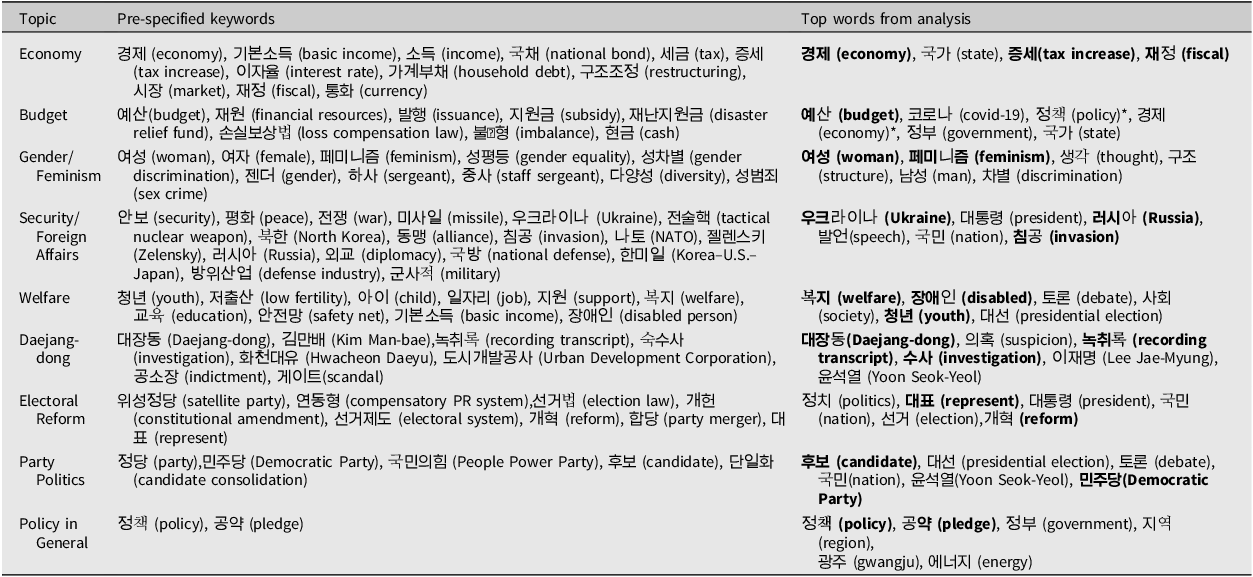
We identified nine topics relevant to the presidential debates in the 2022 election, focusing on the issues that consistently appeared across the two candidates’ statements and news articles covering the debates. These topics include: economy, budget, gender/feminism, security/ foreign affairs, welfare, the Daejang-dong scandal, electoral reform, party politics, and policy in general. Since we are interested in measuring the prevalence of policy-related topics, we classified these topics into seven policy-related topics (economy, budget, gender/feminism, security/ foreign affairs, welfare, and policy in general), and three non-policy topics (the Daejang-dong scandal, electoral reform, and party politics). Next, we pre-specified keywords for each topic based on our knowledge of the 2022 campaign and a thorough analysis of the debate transcripts. Table 3 displays these pre-specified keywords for each topic.
Comparison of pre-specified keywords and top words by topic

Note: Bold words in the “Top Words from Analysis” column indicate overlap with pre-specified keywords. Asterisks (*) denote the keywords pre-specified for another topic.
Figure 1 graphically illustrates the estimated proportions of each topic in our merged corpus, along with the top six words associated with each topic. We also report these top words with English translations in the rightmost column of Table 3. The results suggest that the top words associated with each topic include our pre-specified keywords and that other keywords align well with the topics.
Topic proportions.
Note: Keywords with check marks indicate pre-specified keywords. Keywords with numbers are those pre-specified for another topic. Numbers in square brackets indicate the topic category where the keyword was originally specified.

Next, we evaluate whether the topic proportions for policy-related topics vary meaningfully between candidates’ statements and news articles. Figure 2 plots the difference in marginal posterior means of each topic between candidates’ statements and news articles, along with 95% credible intervals. We estimated these posterior means using Bayesian bootstrap resampling with 5000 iterations. This approach accounts for sampling uncertainty and produces posterior credible intervals for the mean difference in topic proportions between the two groups. Positive values indicate that a topic is more prevalent in candidates’ statements, while negative values indicate greater appearance in news coverage.
Difference in posterior means between candidate statements and news articles.

Figure 2 shows that all policy-related topics, except security/foreign affairs, more frequently appeared in candidate statements than in news articles. For instance, the posterior mean of the distribution for the topic Economy is 17.5% higher in candidate statements than in news articles.Footnote 9 Additionally, the overall proportion of policy-related content in news articles remains markedly lower than in candidate statements. Our analysis reveals that policy-related topics comprise 86.35% of candidate statements during debates, while these same topics constitute only 38.62% of news articles. We discuss this aggregate comparison in detail in Appendix A.
The proportions of all three non-policy-related topics, electoral reform, the Daejangdong scandal, and party politics, are higher in news articles than in candidate statements. The posterior means of the Party politics and Daejang-Dong are 33.7% and 9.58% higher in news articles than in candidate statements, respectively. Overall, our results offer support for our hypothesis that media coverage of debates will include less policy-related content than the actual debates.
Analysis 2: the effect of media exposure on voter decision-making
Our analysis of televised debates and their media coverage reveals how media outlets prioritize non-policy content, such as candidate conflicts and campaign drama, over policy discussions. How does this biased media coverage shape voters’ decision-making during campaigns? As voters increasingly rely on media coverage to learn about debates (Reber and Benoit, Reference Reber and Benoit2001; Tsfati, Reference Tsfati2003), media’s focus on candidate conflicts and controversies overshadows policy discussions and limits voters’ ability to evaluate candidates’ policy proposals. Our second hypothesis expects that the exposure to media debate coverage is associated with voters’ increased tendency to prioritize policy-related factors in their decision-making.
To test this hypothesis, we use survey data conducted by the East Asia Institute (EAI) shortly after the 20th presidential election in 2022. The survey was conducted for 15 days from March 10, 2022, and 1104 people aged 18 and older across the country were recruited through random sampling. Post-stratification weights were applied by region, gender, and age. For our outcome variable, Policy Consideration, we analyzed responses about the factors participants considered when casting their presidential ballots. This variable was coded as 1 if respondents indicated policy-related factors and 0 otherwise.Footnote 10
While the survey did not directly measure respondents’ exposure to media coverage of televised debates, we used their general reliance on mass media for election information as a proxy measure. Our primary independent variable, Information Source, considers respondents’ primary sources of election information. We categorized these information channels as: television, radio, Internet/print newspaper, podcast, social media, and other sources. For comparison, we also examined the direct effect of debate viewership, coding responses from 0 (no debates watched) to 5 (all debates watched). We also included control variables in our models, including the voter’s age, income level, education level, gender, ideology, trust in government, and whether they voted for the winner, Yoon. Age was measured as the respondent’s age at the time of the survey. We coded monthly income on a scale from 1 (less than 2 million won) to 7 (over 7 million won). Ideology was measured on a one-dimensional spectrum ranging from 0 to 10, with 0 representing the most progressive and 10 representing the most conservative. Trust in government was assessed based on the respondent’s level of trust in the Korean government, ranging from 1 for no trust at all to 4 for complete trust. We included two additional control variables that capture the respondents’ perceptions of the democratic process. Democratic satisfaction was measured on a scale from 0 to 10, with 0 indicating complete dissatisfaction with democracy in Korea and 10 indicating complete satisfaction. Policy competition measured respondents’ perceptions of policy debate intensity in the presidential election compared to the previous election, ranging from 0 (perceiving weak policy competition) to 10 (perceiving strong policy competition).
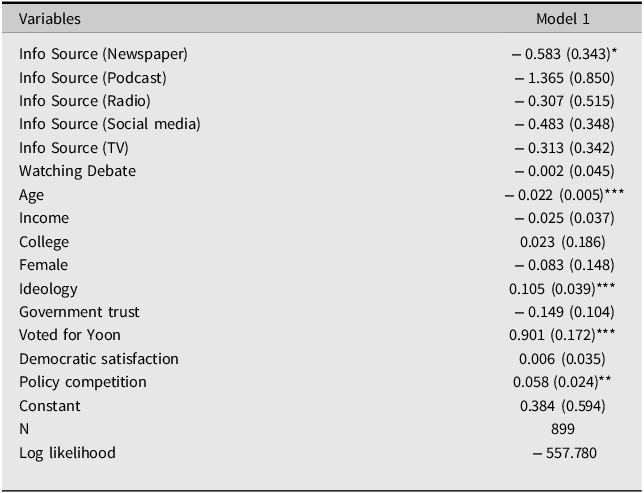
Since our outcome variable, Policy Consideration, is binary, we employ a logistic regression model. Table 4 presents the results of logistic regression analysis examining how reliance on different information sources (Information Source) influences the likelihood of policy-based voting.Footnote
11
The logistic regression analysis reveals several notable findings. First, we find that individuals with heavy reliance on newspapers as a source of election information are less likely to engage in policy-based voting (b = −0.606, SE = 0.340, p < 0.1) compared to those who rely on other sources of information, such as family and friends, materials from political parties, and official election leaflets. This finding specifically highlights the difference between newspaper consumption and more personalized or official information sources that comprise our reference category.Footnote
12
Other media sources, including podcast (b = −1.281, SE = 0.847), radio (b = −0.299, SE = 0.512), social media (b = −0.517, SE = 0.345) and TV (b = −0.304, SE = 0.340), show negative coefficients compared to the reference category, although these effects do not reach statistical significance. Second, we find that watching TV debates has no significant effect on the likelihood of policy-based voting (b = 0.004, SE = 0.045, p $ & #x3E; $
0.1). Figure 3 presents the marginal effects of different information sources on the likelihood of policy-based voting, with particular attention to the effect of newspaper reliance. The results reveal that respondents who primarily relied on newspapers show a significantly lower predicted probability of engaging in policy-based voting (approximately 0.38) compared to those who rely on other information sources (approximately 0.53), holding all other variables constant. This difference of about 15 percentage points is statistically significant at the 0.1 level. Additional analysis using alternative coding of the newspaper variable (1 for newspaper readers, 0 for all other media sources) showed a consistent negative direction, though not statistically significant, suggesting that the effect is most pronounced when comparing newspaper consumption specifically to personalized and official information sources rather than to all media types collectively.
$ & #x3E; $
0.1). Figure 3 presents the marginal effects of different information sources on the likelihood of policy-based voting, with particular attention to the effect of newspaper reliance. The results reveal that respondents who primarily relied on newspapers show a significantly lower predicted probability of engaging in policy-based voting (approximately 0.38) compared to those who rely on other information sources (approximately 0.53), holding all other variables constant. This difference of about 15 percentage points is statistically significant at the 0.1 level. Additional analysis using alternative coding of the newspaper variable (1 for newspaper readers, 0 for all other media sources) showed a consistent negative direction, though not statistically significant, suggesting that the effect is most pronounced when comparing newspaper consumption specifically to personalized and official information sources rather than to all media types collectively.
The effect of debate viewing on Policy Consideration

Note: *p $ \lt $
0.1, **p
$ \lt $
0.1, **p $ \lt $
0.05, ***p
$ \lt $
0.05, ***p $ \lt $
0.01. Standard errors in parentheses.
$ \lt $
0.01. Standard errors in parentheses.
The marginal effects of information sources on policy-based voting.

These results suggest an association between media exposure and voter decision-making patterns. While we cannot establish causality due to potential selection bias and unobserved confounding variables, our findings reveal a consistent negative relationship between reliance on newspaper coverage and policy-based voting considerations. We acknowledge that reverse causality remains a concern. That is, voters with limited interest in policy issues may be more likely to rely primarily on newspaper coverage, which tends to emphasize non-policy aspects of campaigns. However, our analysis controls for key factors associated with policy engagement, including education levels and political trust.
Our findings on media’s emphasis on non-policy content, such as horse-race coverage and campaign drama, over policy discussions help explain why newspaper readers were less likely to base voting decisions on policy considerations. The substantial coverage devoted to topics such as ‘Candidate Consolidation Negotiation’ (15.3%), ‘Daejang-dong Issue’ (15.1%), and controversial candidate remarks indicates that newspaper readers were primarily exposed to non-policy narratives, potentially overshadowing substantive policy discussions.
Among the control variables, there are several significant relationships. Age shows a negative association with policy-based voting (b = −0.022, SE = 0.005, p < 0.01), suggesting that older voters are less likely to base their voting decisions on policy considerations. Ideology shows a positive relationship (b = 0.105, SE = 0.039, p < 0.01), suggesting that those who identify as more conservative are more likely to engage in policy-based voting. In addition, having voted for Yoon is strongly associated with policy-based voting (b = 0.901, SE = 0.172, p < 0.01), suggesting that Yoon supporters were more likely to consider policy issues in their voting decisions. Policy competition shows a significant positive effect (b = 0.058, SE = 0.024, p < 0.05), indicating that voters who perceived stronger policy competition between candidates were more likely to engage in policy-based voting. Socioeconomic factors such as income and education level show no significant effects on policy-based voting. Similarly, gender, government trust, and democratic satisfaction do not appear to significantly influence policy-based voting behavior.
Additional analysis: analysis of the 2017 presidential election
To assess the generalizability of our findings beyond the 2022 case, we replicate the analysis using post-election survey data from the 2017 (19th) presidential election. The 2017 survey was fielded in May 2017 by the Korea Social Science Data Center (KSDC) at the request of the Korean Political Science Association, shortly after the presidential election. The sample consists of 914 Koreans aged 18 and over, with regional quota sampling stratified by gender and age.
To maintain consistency with the 2022 analysis, we use the same outcome and covariates, with Policy Consideration as the dependent variable. This variable is coded 1 if respondents cited policy-related reasons for their vote and 0 otherwise.Footnote 13 Control variables include age, income, education, gender, ideology, trust in government, democratic satisfaction, perceived policy competition, and an indicator for supporting the conservative candidate (Hong Joon-pyo), which parallels the “Voted for Yoon” control in 2022.Footnote 14
A key difference between the two surveys is how election information sources were measured. Unlike the 2022 survey, which asked for a single primary information source, the 2017 survey allowed respondents to select multiple channels from a list of 15 information source options. The 2017 survey included response options for both “TV debates and candidate speeches” and “news articles on internet portals,” enabling a direct comparison between the two. We therefore recoded their selections into a composition-based measure centered on TV debates and portal news.Footnote 15 For each respondent, we counted whether they selected TV debates/candidate speeches (hereafter “TV debates”), Portal, and any other source, and then classified them into four exhaustive combinations: (1) TV debates and Portal together (with or without other sources), (2) TV debates only (with or without non-portal sources), (3) Portal only (with or without non-TV debates sources), and (4) neither TV debates nor Portal. Our regression uses TV debates and Portal as the reference category. As in 2022, we also include a direct measure of debate exposure, the self-reported number of debates watched.
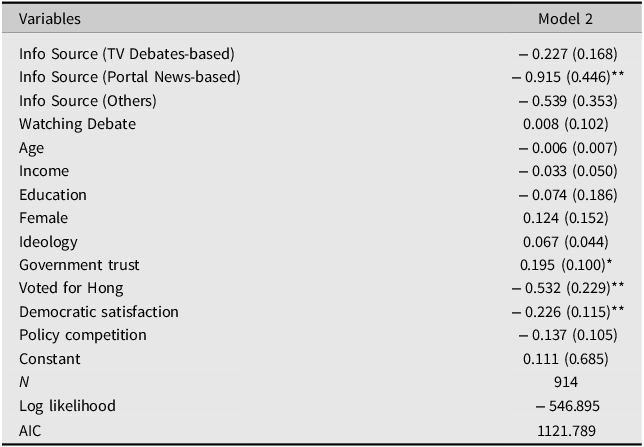
Table 5 presents a logistic regression with Policy Consideration as the dependent variable. Compared to the mixed TV-portal baseline, the reliance on portals in the absence of TV (Info Source (Portal-based)) is associated with a significantly lower probability of policy-based voting. The coefficients for Info Source (TV Debates-based) ( $b = - 0.227$
,
$b = - 0.227$
, $SE = 0.168$
) and Info Source (Others) (
$SE = 0.168$
) and Info Source (Others) ( $b = - 0.539$
,
$b = - 0.539$
, $SE = 0.353$
) are negative but not statistically distinguishable from the reference. In line with 2022, the direct debate viewing measure is small and not significant (
$SE = 0.353$
) are negative but not statistically distinguishable from the reference. In line with 2022, the direct debate viewing measure is small and not significant ( $b = 0.008$
,
$b = 0.008$
, $SE = 0.102$
). Among controls, trust in government is positively related to policy-based voting (
$SE = 0.102$
). Among controls, trust in government is positively related to policy-based voting ( $b = 0.195$
,
$b = 0.195$
, $SE = 0.100$
,
$SE = 0.100$
, $p \lt .10$
), democratic satisfaction is negatively related (
$p \lt .10$
), democratic satisfaction is negatively related ( $b = - 0.226$
,
$b = - 0.226$
, $SE = 0.115$
,
$SE = 0.115$
, $p \lt .05$
), and supporting the conservative candidate (Hong) shows a negative association (
$p \lt .05$
), and supporting the conservative candidate (Hong) shows a negative association ( $b = - 0.532$
,
$b = - 0.532$
, $SE = 0.229$
,
$SE = 0.229$
, $p \lt .05$
).
$p \lt .05$
).
The effect of debate viewing on policy consideration (2017 Election)

Notes: Logistic regression with Policy Consideration as the dependent variable. Reference category is TV and Portal (with or without other sources). Two-tailed tests: * $p \lt .10$
, **
$p \lt .10$
, ** $p \lt .05$
, ***
$p \lt .05$
, *** $p \lt .01$
. Standard errors in parentheses.
$p \lt .01$
. Standard errors in parentheses.
Figure 4 displays the adjusted predicted probabilities by information source group (covariates held at their means or modes). The pattern mirrors the finding from the 2022 data: respondents who relied on portal news without watching TV debates exhibit a meaningfully lower predicted probability of policy-based voting than those who combined TV debates and portal sources, whereas other combinations are directionally similar but less precise.
Adjusted predicted probabilities by information-source group (2017).

Taken together, the 2017 replication reinforces our central claim: reliance on media coverage of election campaigns is associated with reduced policy-based voting. The consistent effect of newspaper reliance across both elections suggests this pattern has persisted over time, strengthening the external validity of our 2022 findings.
Discussion and conclusion
Using automated text analysis, this study examined differences between candidates’ debate statements and subsequent media coverage. Contrary to popular belief, our findings suggest that the candidates devoted more time to communicating their policy agendas than attacking opponents. However, we find that newspaper articles tend to devote more coverage to non-policy content, such as the horse-race coverage and scandals, at the expense of policy coverage. We also find suggestive evidence that voters’ reliance on newspapers as their primary source of election information heightens the influence of non-policy considerations on their vote decisions.
Our findings complement and extend previous research on the effects of TV debates in South Korea. Lee (Reference Lee2016) demonstrated that watching TV debates strengthens the tendency to vote along party lines among partisan voters while influencing vote choice among independents. Building on these insights, our study reveals a more complex dynamic: although both candidates devoted substantial attention to policy discussions during the debates, subsequent media coverage significantly diverged from this policy focus.
This disconnect between debate content and media coverage carries important implications for electoral politics. Specifically, our analysis shows that voters who rely primarily on newspapers for election information are less likely to engage in policy-based voting, suggesting that the media’s shift away from policy coverage may systematically undermine voters’ ability to make informed electoral decisions. These results paint a concerning picture for democratic deliberation in South Korean elections. While televised debates continue to serve as platforms for substantial policy discussions by candidates, subsequent media coverage systematically undermines their potential to facilitate informed, policy-based voting.
The persistence of these patterns was evident in South Korea’s 2025 snap election, triggered by former President Yoon’s impeachment. During the debates, top contending candidates often diverged from substantive policy discussions, focusing instead on personal attacks. Media coverage fueled this heated focus by emphasizing spectacle-driven aspects over policy substance. This recurring dynamic suggests that current coverage practices may be inadvertently weakening democratic discourse rather than strengthening it. It further calls for media outlets to reconsider their debate coverage strategies and for policymakers to explore new frameworks that incentivize substantive reporting, ensuring that voters receive the policy-focused information necessary for informed democratic participation.
Our findings contribute to the broader literature on media effects and political communication by challenging conventional assumptions about the relationship between traditional print media consumption and informed political decision-making. While newspapers are often considered sources of in-depth policy coverage, our results suggest that in the context of televised debates, their coverage patterns might discourage policy-based voting by emphasizing political drama and conflict over substantive policy discussions.
At the same time, our results reveal notable variations in media focus across different policy domains. Our KeyATM analysis shows that while news coverage of debates featured significantly fewer policy-related topics overall, compared to candidates’ actual statements, it demonstrated a higher proportion of coverage devoted to security and foreign affairs than other policy areas. This pattern suggests that media outlets may selectively emphasize certain policy issues based on their perceived newsworthiness or political salience. For instance, given the heightened political polarization surrounding foreign policy in South Korea, the intensity of candidate disagreements on these issues may drive greater media attention, while less contentious domestic policy discussions receive comparatively little coverage despite their substantive importance for voters. Identifying the policy-level determinants of media attention will be an important avenue for future research to deepen our understanding of the media’s election coverage.
Our study is not without limitations. One notable limitation is the reliance on available newspaper articles and debate transcripts, which may not fully capture the nuances of live debate performances and real-time media reporting. Future research can expand this line of research by incorporating a wider variety of media sources and types, including audiovisual content and social media platforms.
Additionally, while our analysis demonstrates a correlation between newspaper consumption and reduced policy-based voting, we cannot establish definitive causal relationships from our cross-sectional survey data. The observed association could reflect self-selection effects, whereby voters with lower policy interest gravitate toward newspaper coverage, or other unmeasured confounding variables. Furthermore, our survey analysis relies on self-reported measures of media consumption, which may introduce recall bias and affect the precision of our estimates.
These limitations point to important directions for future research. Panel designs that track changes in media consumption and voting behavior over time would better isolate causal effects, as would experimental studies that randomly assign exposure to different types of media coverage. While such approaches were not feasible given our data constraints, they represent valuable extensions of this work that could strengthen causal inference about media influence on electoral decision-making.
Furthermore, the study’s focus on a single election cycle in South Korea may limit the generalization of the findings to other countries and electoral contexts. The political dynamics, media environment, and voter behavior in South Korea may differ significantly from those in other democracies, necessitating caution in extrapolating the results. Expanding the analysis to multiple election cycles and different countries will enhance the generalizability of the findings and enable cross-country comparisons.
Replication data
The replication data for this manuscript is: https://doi.org/10.7910/DVN/Z3S1LY.
Funding statement
This research was supported by the Yonsei University Humanities and Social Sciences Field Creative Research Fund of 2024 (2024-22-0561).








 Open access

