

Hostname: page-component-77f85d65b8-6c7dr Total loading time: 0 Render date: 2026-03-27T09:00:03.277Z Has data issue: false hasContentIssue false

Salidroside exerts antidepressant-like action by promoting adult hippocampal neurogenesis through SIRT1/PGC-1α signalling

Published online by Cambridge University Press:  30 September 2024

Shan Xing
Affiliation:
School of Chinese Medicine, Nanjing University of Chinese Medicine, Nanjing, China
Shuyi Xu
Affiliation:
School of Chinese Medicine, Nanjing University of Chinese Medicine, Nanjing, China
Linjiao Wang
Affiliation:
School of Chinese Medicine, Nanjing University of Chinese Medicine, Nanjing, China
Liyuan Guo
Affiliation:
Zhejiang Chinese Medical University, Hangzhou, China
Xin Zhou
Affiliation:
School of Chinese Medicine, Nanjing University of Chinese Medicine, Nanjing, China
Haoxin Wu*
Affiliation:
School of Chinese Medicine, Nanjing University of Chinese Medicine, Nanjing, China
Wei Wang*
Affiliation:
School of Medicine, Nanjing University of Chinese Medicine, Nanjing, China
Lanying Liu*
Affiliation:
Department of Psychiatry, Shanghai Mental Health Center, Shanghai, China Department of Psychiatry, Shanghai Jiao Tong University School of Medicine, Shanghai, China Shanghai Institute of Mental Diseases of Traditional Chinese Medicine, Shanghai, China
*
Corresponding authors: Lanying Liu; Email: balindaliu@163.com; Wei Wang; Email: wangw@njucm.edu.cn; Haoxin Wu; Email: wuhaoxin@sohu.com

Abstract

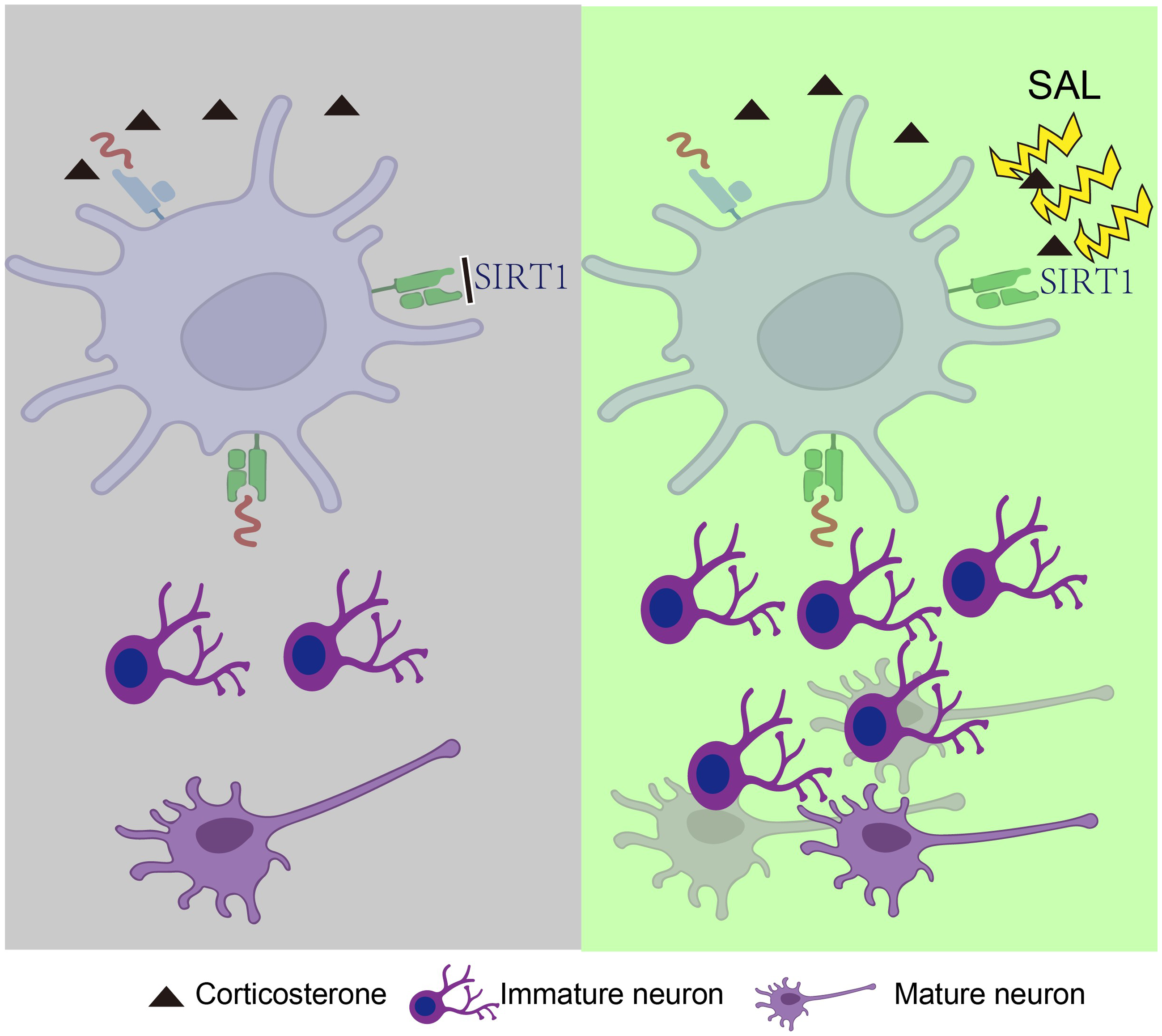
Depression is one of the major mental disorders, which seriously endangers human health, brings a serious burden to patients’ families. In this study, we intended to further explore the antidepressant-like effect and possible molecular mechanisms of Salidroside (SAL). We built corticosterone (CORT)-induced depressive mice model and used behavioural tests to evaluate depression behaviour. To explore the molecular mechanisms of SAL, we employed a variety of methods such as immunofluorescence, western blot, pharmacological interference, etc. The results demonstrated that SAL both at 25 mg/kg and 50 mg/kg can reduce immobility time in the tail suspension test (TST). At the same time, SAL treatment could restore the reduced sugar water intake preference in the sucrose preference test (SPT) in CORT-induced depressive mice and reduce the immobility time in TST and forced swimming experiments (FST). In addition, SAL treatment reversed the reduction in the number of Ki-67, BrdU, and NeuN in the hippocampus due to CORT treatment. SAL treatment also restored the expression of SIRT1, PGC-1α, brain-derived neurotrophic factor (BDNF) and other proteins in the hippocampus. In addition, after blocking SIRT1 signalling with EX527, we found that the treatment with SAL failed to reduce the immobility time in TST and FST, the level of SIRT1 and PGC-1α activity were correspondingly downregulated, and the expression of DCX and Ki-67 in the hippocampus failed to be activated. These findings suggested that SAL exerts antidepressant-like effects by promoting hippocampal neurogenesis through the SIRT1/PGC-1α signalling pathway.

Information

Type
Original Article
Copyright
© The Author(s), 2024. Published by Cambridge University Press on behalf of Scandinavian College of Neuropsychopharmacology

Access options

Get access to the full version of this content by using one of the access options below. (Log in options will check for institutional or personal access. Content may require purchase if you do not have access.)

Article purchase

Temporarily unavailable

Supplementary material: File

Xing et al. supplementary material

Xing et al. supplementary material
Download Xing et al. supplementary material(File)
File 2.9 MB