

1. Introduction
Global Adult Tobacco Survey (GATS) 2016 showed that India had 100 million smokers [1]. Smoking cessation substantially reduces the risk of death associated with smoking, and interventions to quit smoking are both efficacious and cost-effective [Reference Stead, Bergson and Lancaster2, Reference Tengs, Adams and Pliskin3]. Studies have shown that counseling hospitalized patients is effective if started during hospitalization and continued for at least a month after discharge [Reference Rigotti, Munafo and Stead4]. However, numerous barriers exist to widespread adoption of this practice [Reference Sharpe, Alsahlanee, Ward and Doyle5].
Most physicians lack the necessary knowledge and skills to offer effective cessation counseling to their patients [Reference Raupach, Merker, Hasenfuß, Andreas and Pipe6, Reference Aggarwal, Mathur, Dileep, Batra and Makkar7]. This gap likely starts from medical school [Reference Richmond, Zwar, Taylor, Hunnisett and Hyslop8]. Purely didactic-based teaching may not be sufficient in preparing students for independent practice, particularly if inadequately supplemented with the varied experience of counseling actual patients [Reference Stolz, Langewitz and Meyer9]. Educational interventions have been found to have greater student engagement when they include a component of integrative learning, such as in a real patient encounter [Reference Rouse10].
We designed the current study to test the hypothesis that utilizing trained medical students to counsel hospitalized smokers will lead to an increase in patient quit rates, while also improving medical student knowledge and confidence regarding smoking cessation counseling.
2. Materials and Methods
The Medical Student Counseling for Hospitalized patients Addicted to Tobacco (MS-CHAT) study protocol received institutional approval from the institutional review board at University Hospitals/Case Western Reserve University, USA, as well as the sites in India. The trial was registered in the https://clinicaltrials.gov/ database on 10 May 2018 (NCT03521466). The trial started recruiting in December 2018. It is expected to continue until July 2021. All patients enrolled in the trial will provide written informed consent. The operational definitions for the terms used in the methods and outcome sections are given in Table 1.

2.1. Medical Student Education
2.1.1. Participants
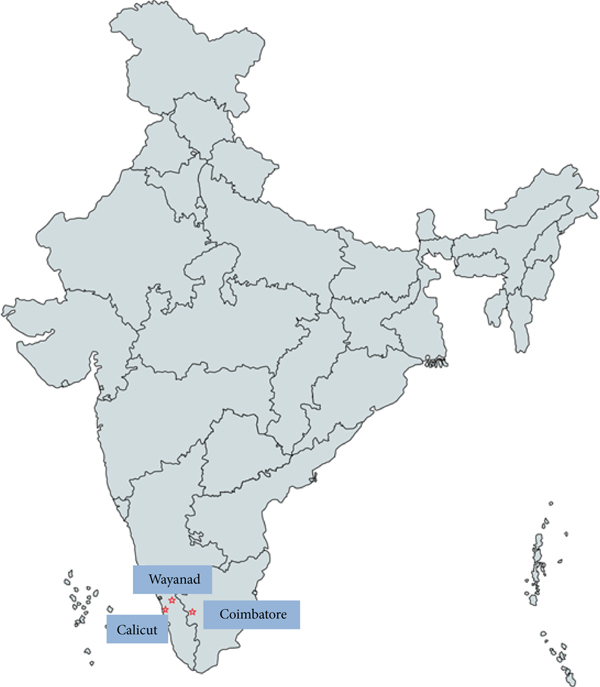
Second-year students from three different medical schools (Figure 1) are called upon to volunteer for the program, with 30 students from each school enrolled in the study. These medical schools train between 150 and 250 students in each class. The medical school course in the participating medical schools is of 5.5-year duration. Medical and surgical clinical rotations start during the students’ second year with case-based discussion, tailored to the level of training.
Location of study sites in India.
2.1.2. Training
The training modules were developed by adapting the WHO guide for tobacco cessation counselors to the Indian context. The content predominantly addresses the skills of behavioral counseling. The training consists of a three-hour didactic lecture, followed by group role-playing scenarios for two hours, with peer and proctor feedback. Following training, the students are asked to complete a knowledge questionnaire. Students are selected for the second part of the trial (patient counseling phase) once they obtain a minimum test score.
2.2. Patient Counseling
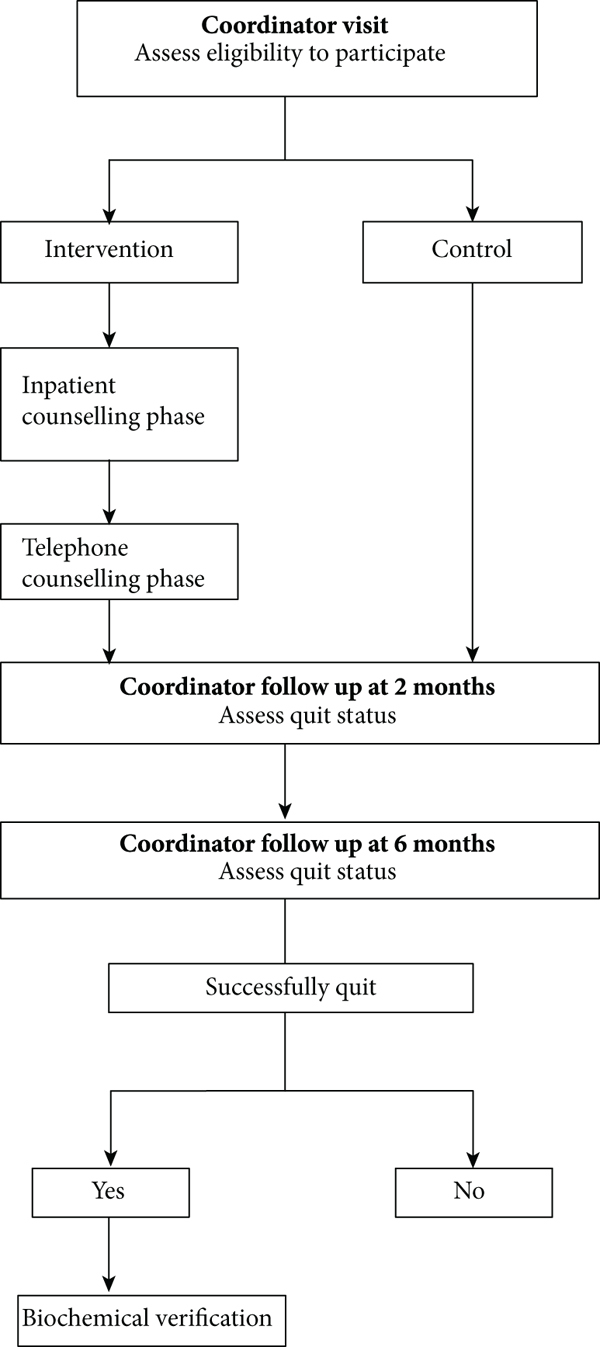
The structure of the study is described in Figure 2.
Structure of study.
2.2.1. Trial Design and Participants
This is an open-label, two-armed, parallel-group, block randomized controlled trial with 1 : 1 concealed allocation. Patients are the unit of randomization. Eligibility criteria include age 18-70 years, active admission to the hospital, and current smoking or report having smoked in the last four weeks prior to admission (to account for changes in behavior during illness). Eligible patients are stratified based on the medical school and block randomized into an intervention or control group using a block size of 20. Opaque envelopes developed by the research team are provided to the coordinators to be used for randomization.
Exclusion criteria include patients using only nonsmoked tobacco and those who are daily alcohol users or daily drug users. Patients deemed unable to follow-up, either because of distance from the hospital or because of psychiatric, social, or medical factors, will be excluded. Patients currently participating in another tobacco cessation program are also excluded.
2.2.2. Intervention Group
Participating medical students offer inpatient counseling to patients in the intervention group once during their hospitalization (recommended duration of 15-20 minutes). The medical students then follow-up with their patients and provide telephone counseling (a minimum of three sessions of 15 minutes each, over two months).
2.2.3. Control Group
Smoking cessation advice is left to the discretion of the treating physician, to reflect usual care.
2.3. Data Collection
A study coordinator, who is blinded to group assignment, will collect follow-up information from patients in both the intervention and control groups at six months after enrollment. Patients who claim to have stopped smoking (not a single puff in the last seven days) at six months will be called in for an exhaled breath carbon monoxide (CO) test. The follow-up procedure will be identical in both groups.
Focus group discussions will be conducted among patients at the end of the trial to analyze patient knowledge, attitudes, and behaviors towards smoking cessation. Focus group discussions of students will also be conducted to qualitatively understand their experience of the program.
2.4. Study Outcomes
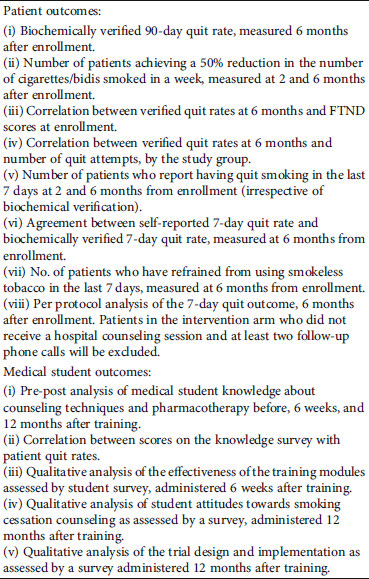
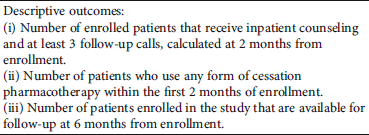
The primary outcome measure will be a biochemically verified seven-day quit rate at six months from enrollment. The criteria for a verified quit attempt will be an exhaled CO level of <10 PPM. The participant is blinded to the definition of the primary outcome (biochemically verified seven-day quit rate) until the follow-up visit is underway. Planned secondary and descriptive outcomes are listed in Tables 2 and 3, respectively.
2.5. Sample Size and Statistical Analysis
We calculated the sample size needed for a study with a power of 85%, α of .05 to detect a 10% absolute difference in the primary outcome assuming a control quit rate of 20%. This was based on a prior meta-analysis of tobacco cessation interventions among hospitalized smokers [Reference Rigotti, Munafo and Stead4]. We assumed an attrition rate of 20%. Based on these calculations, a sample size of 830 patients will be required, resulting in 415 patients in the intervention and a similar number of patients in the control group.
The primary outcome will be analyzed by an intention-to-treat approach. Patients lost to follow-up at any time point will be considered as smokers for analysis. A secondary analysis with smoking status at last phone contact will be performed.
3. Results and Discussion
The MS-CHAT trial will test if trained medical students can improve smoking cessation outcomes among hospitalized patients who smoke tobacco. This is a potentially scalable, low-cost model that combines medical student skill development with inpatient smoking cessation counseling. Providing experiential training to medical students has the potential to increase the delivery of smoking cessation counseling when they step into practice, by increasing their comfort with this skill. Furthermore, the skills acquired in MS-CHAT may enable medical students to provide counseling for diet, physical activity, and other behavioral barriers to optimal health [Reference Hivert, Arena and Forman11].
4. Conclusions
The findings of this trial will have implications for noncommunicable disease intervention strategies not just in other low- and middle-income countries but potentially also in advanced health care systems tackling some of the same issues.
Data Availability
There is no data collection associated with this paper.
Conflicts of Interest
Second author A.K is the cofounder of SEHAT. There are no other competing interests.
Acknowledgments
The trial is being funded by SEHAT (Society to Enhance Health and Access to Treatments), Dalkhola, West Bengal, India.


 Open access

