





Introduction
How a bilingual child's two languages affect each other has been a prominent topic of research in the field of bilingual first language acquisition over the past three decades. Such cross-linguistic influence, most commonly investigated at the level of (morpho)syntax, has been attested in both the spontaneous and elicited speech production of simultaneous bilingual children, as well as in their comprehension and judgements of sentences (see Serratrice, Reference Serratrice2013, for an overview). Cross-linguistic influence is defined here as the overuse or overacceptance of (morpho)syntactic properties in bilingual children's one language under influence of their other language. For example, Italian–English bilingual children have been found to overuse overt subject pronouns in Italian and this has been argued to result from cross-linguistic influence from English (e.g., Serratrice, Sorace & Paoli, Reference Serratrice, Sorace and Paoli2004). Researchers have aimed to identify the contexts in which cross-linguistic influence is most likely to appear. Well-studied predictors of cross-linguistic influence include surface overlap, language domain, language dominance, and age (e.g., Foroodi-Nejad & Paradis, Reference Foroodi-Nejad and Paradis2009; Hulk & Müller, Reference Hulk and Müller2000; Müller & Hulk, Reference Müller and Hulk2001; Sorace & Serratrice, Reference Sorace and Serratrice2009; Yip & Matthews, Reference Yip and Matthews2000).
Evidence for the contribution of these predictors is mixed, however. Cross-linguistic influence is not always found when predicted (e.g., Argyri & Sorace, Reference Argyri and Sorace2007; Nicoladis, Reference Nicoladis2002, Reference Nicoladis2003) and it is sometimes found when not predicted (e.g., Foroodi-Nejad & Paradis, Reference Foroodi-Nejad and Paradis2009; Strik & Pérez-Leroux, Reference Strik and Pérez-Leroux2011). Furthermore, cross-linguistic influence varies from child to child, as evidenced by the large standard deviations found in many studies (e.g., Mykhaylyk & Ytterstad, Reference Mykhaylyk and Ytterstad2017; Nicoladis, Reference Nicoladis2006). As a consequence, there is neither consensus on the extent to which cross-linguistic influence in bilingual language acquisition takes place, nor what predicts it. To shed light on these issues, we conducted a meta-analysis to systematically examine the effect of morphosyntactic cross-linguistic influence in relation to surface overlap, language domain, language dominance, and age.
This paper is organised as follows. The next section discusses previous studies on cross-linguistic influence and the role of our predictors of interest. Then we list our research questions and hypotheses. The method section details our screening process, our coding procedure for surface overlap, language domain, language dominance and age, and how we calculated effect sizes for cross-linguistic influence. Subsequently, we present the outcomes of the meta-analysis and we discuss the results in relation to previous literature. Finally, we formulate recommendations for future studies based on our findings.
Morphosyntactic development in bilingual children
Research on cross-linguistic influence is embedded in a larger debate about the architecture of simultaneous bilingual children's language systems. In the pioneering work of the 1990s, researchers focussed on whether or not children's morphosyntactic systems developed independently from one another (e.g., de Houwer, Reference de Houwer1990; Meisel, Reference Meisel, Hyltenstam and Obler1989; Paradis & Genesee, Reference Paradis and Genesee1996). Taking separate systems as a starting point, research in the subsequent two decades investigated the extent to which cross-linguistic influence occurred (e.g., Hulk & Müller, Reference Hulk and Müller2000; Meisel, Reference Meisel, Caunt-Nulton, Kulatilake and Woo2007; Paradis & Genesee, Reference Paradis and Genesee1996; Serratrice, Reference Serratrice2013).
Early work on cross-linguistic influence considered young children's spontaneous speech production in (multiple) case studies. Researchers typically compared the development of morphosyntactic properties in bilingual and monolingual children over a period of time (e.g., Döpke, Reference Döpke1998; Hulk & Müller, Reference Hulk and Müller2000; Paradis & Genesee, Reference Paradis and Genesee1996). On the one hand, bilingual children were found to behave in language-specific ways, showing that they were able to differentiate the morphosyntactic rules of their languages (e.g., Döpke, Reference Döpke1998; Paradis & Genesee, Reference Paradis and Genesee1996). On the other hand, the two languages were found to influence each other in both quantitative and qualitative ways: quantitative when acquisition of a certain morphosyntactic property was facilitated or delayed in bilingual children under influence of their other language; and qualitative when bilingual children used a morphosyntactic property unattested in the speech of monolingual peers under influence of their other language (e.g., Müller & Hulk, Reference Müller and Hulk2001; Paradis & Genesee, Reference Paradis and Genesee1996; Yip & Matthews, Reference Yip and Matthews2000).
More recent studies have typically employed experimental techniques, resulting in data on a wide range of linguistic properties and language combinations (see Serratrice, Reference Serratrice2013 for an overview). These data have allowed researchers to systematically test for cross-linguistic influence under specific conditions in larger groups of bilingual children. Furthermore, they make it possible to study cross-linguistic influence not only on the basis of children's speech production, but also children's comprehension and judgements (e.g., Meroni, Smeets & Unsworth, Reference Meroni, Smeets, Unsworth, Blom, Cornips and Schaeffer2017; Serratrice, Reference Serratrice2007). At the same time, the comparison between bilingual and monolingual peers has remained central. Experimental studies have found similar patterns of behaviour as those using spontaneous speech data: bilingual children differentiated between the morphosyntactic properties of their languages, but at the same time showed quantitative and – to a lesser degree – qualitative cross-linguistic influence (e.g., Argyri & Sorace, Reference Argyri and Sorace2007; Nicoladis, Reference Nicoladis2006; Strik & Pérez-Leroux, Reference Strik and Pérez-Leroux2011).
Some studies have investigated cross-linguistic influence by comparing different groups of bilingual children with each other rather than comparing bilinguals with monolinguals (e.g., Kaltsa, Tsimpli & Argyri, Reference Kaltsa, Tsimpli and Argyri2019; Serratrice, Sorace, Filiaci & Baldo, Reference Serratrice, Sorace, Filiaci and Baldo2009; Sorace & Serratrice, Reference Sorace and Serratrice2009). Such a design allows researchers to manipulate morphosyntactic properties cross-linguistically whilst at the same time controlling for bilingual vs. monolingual status (and all that this may entail) – we return to this design in more detail in the discussion. Because the vast majority of (experimental) studies on cross-linguistic influence have used a monolingual control group alongside a single bilingual group, we have focussed on this design in the present study.
Despite the many studies on the topic, the circumstances under which cross-linguistic influence emerges remain elusive. Cross-linguistic influence has been attested in various language combinations, for different linguistic properties, and using different tasks, but findings are inconsistent. Study outcomes can differ even when the same morphosyntactic property in the same language was under investigation (compare Rodina, Kupisch, Meir, Mitrofanova, Urek & Westergaard, Reference Rodina, Kupisch, Meir, Mitrofanova, Urek and Westergaard2020; Schwartz, Minkov, Dieser, Protassova, Moin & Polinsky, Reference Schwartz, Minkov, Dieser, Protassova, Moin and Polinsky2015). Various predictors of cross-linguistic influence have been identified to explain this variability. Typically, these have been discussed in relation to the presence of cross-linguistic influence – namely, whether certain conditions have to be met for cross-linguistic influence to occur – and in relation to the strength of cross-linguistic influence – namely, whether under certain circumstances the effect size of cross-linguistic influence increases.
In this study, we focus on four factors frequently studied in relation to cross-linguistic influence: (1) the type of surface overlap between bilingual children's languages, (2) the language domains involved, (3) language dominance, and (4) children's age. Whilst other factors, such as input quality (e.g., Paradis & Navarro, Reference Paradis and Navarro2003) and economy principles (e.g., Gavarró, Reference Gavarró2003; Serratrice et al., Reference Serratrice, Sorace, Filiaci and Baldo2009), have also been argued to predict cross-linguistic influence, the number of studies investigating these variables is more limited and hence they are not included here. In the following four subsections, we discuss each of the factors of interest in more detail. We will end this section by discussing other reasons why there is such variation in results between and within studies on cross-linguistic influence.
Predictors of cross-linguistic influence
Surface overlap
One factor argued to predict the presence of cross-linguistic influence in bilingual children is the type of overlap between children's languages. According to Hulk and Müller (Reference Hulk and Müller2000; Müller & Hulk, Reference Müller and Hulk2001), there has to be ambiguity in the child's language input for cross-linguistic influence to occur: if a certain structure in language A can be analysed (by the child) by either syntactic analysis X or Y and language B provides evidence for analysis X only, language B may reinforce the use of that analysis in language A, resulting in quantitative cross-linguistic influence. In other words, a certain type of overlap between children's languages is necessary for cross-linguistic influence to occur (see Döpke, Reference Döpke1998 for a similar proposal). Hulk and Müller's overlap hypothesis is usually referred to in terms of surface or structural overlap. Whilst some authors make an explicit distinction between the two terms (e.g., Nicoladis, Reference Nicoladis2006; Schmitz, Patuto & Müller, Reference Schmitz, Patuto and Müller2012), most use them interchangeably to refer to the same construct. We use surface overlap throughout.
Hulk and Müller's overlap condition describes a situation of partial overlap (e.g., Unsworth, Reference Unsworth2003). There is optionality in language A – due to ambiguity in the input – and in language B one of these options is the preferred option. As a consequence, cross-linguistic influence is predicted to go unidirectionally from language B to language A. For example, in Persian, compounds can either be left- or right-headed (e.g., bee-honey for honeybee versus headache). In English, compounds can only be right-headed (e.g., Foroodi-Nejad & Paradis, Reference Foroodi-Nejad and Paradis2009). As a consequence, in Persian–English bilingual children English may reinforce the use of right-headed compounds in Persian, leading to their overproduction. Following the surface overlap condition, however, situations of complete overlap (i.e., where bilingual children's two languages behave identically) and no overlap (i.e., where they behave completely differently) should not result in cross-linguistic influence.
Whilst some scholars have found cross-linguistic influence in the direction predicted by surface overlap (e.g., Austin, Reference Austin2007; Haznedar, Reference Haznedar, Belikova, Meroni and Umeda2007; Hulk & Müller, Reference Hulk and Müller2000), others have not; or they have found evidence of cross-linguistic influence in the absence of surface overlap (e.g., Argyri & Sorace, Reference Argyri and Sorace2007; Foroodi-Nejad & Paradis, Reference Foroodi-Nejad and Paradis2009; Nicoladis & Gavrila, Reference Nicoladis and Gavrila2015).
Language domain
A second factor that has been argued to predict the presence of cross-linguistic influence in bilingual children is the language domain of the morphosyntactic property tested. Hulk and Müller proposed that, in addition to surface overlap, cross-linguistic influence only occurs in the domain where syntax interfaces with pragmatics, the so-called C-domain (e.g., Hulk & Müller, Reference Hulk and Müller2000; Müller & Hulk, Reference Müller and Hulk2001). An example is children's use of subject pronouns in a null subject language (e.g., Argyri & Sorace, Reference Argyri and Sorace2007; Serratrice, Reference Serratrice2007; Sorace, Serratrice, Filiaci & Baldo, Reference Sorace, Serratrice, Filiaci and Baldo2009). Null subject languages allow both overt and null pronouns in subject position. However, the choice of a pronoun depends on discourse-pragmatics principles (e.g., Carminati, Reference Carminati2002). In particular, whilst a null pronoun is typically used to refer back to the topic of the discourse, an overt pronoun signals a shift in discourse topic. Consequently, subject pronoun use in null subject languages has been argued to be at the interplay of syntax and (discourse-)pragmatics (e.g., Sorace & Serratrice, Reference Sorace and Serratrice2009; Sorace et al., Reference Sorace, Serratrice, Filiaci and Baldo2009). However, Hulk and Müller did not rule out other domains at the interface with syntax (e.g., Hulk & Müller, Reference Hulk and Müller2000; Müller & Hulk, Reference Müller and Hulk2001, p. 2). Non-interface areas, such as purely syntactic language properties, were predicted to be unaffected (e.g., compounding; Foroodi-Nejad & Paradis, Reference Foroodi-Nejad and Paradis2009; Nicoladis, Reference Nicoladis2002; root infinitives; Hulk & Müller, Reference Hulk and Müller2000).
Whilst some researchers have found evidence for Hulk and Müller's proposal (e.g., Argyri & Sorace, Reference Argyri and Sorace2007; Haznedar, Reference Haznedar, Belikova, Meroni and Umeda2007), others have also found cross-linguistic influence in other domains, especially syntax-semantics (e.g., genericity and specificity; Serratrice et al., Reference Serratrice, Sorace, Filiaci and Baldo2009; indefinite object scrambling; Meroni et al., Reference Meroni, Smeets, Unsworth, Blom, Cornips and Schaeffer2017). Furthermore, cross-linguistic influence has not always been attested when discourse pragmatics were involved (e.g., Argyri & Sorace, Reference Argyri and Sorace2007). Moreover, cross-linguistic influence in purely (morpho)syntactic properties of language is also attested (e.g., Argyri & Sorace, Reference Argyri and Sorace2007; Nicoladis, Reference Nicoladis2012; Strik & Pérez-Leroux, Reference Strik and Pérez-Leroux2011).
Language dominance
A third factor that has been related to cross-linguistic influence is language dominance. Bilingual children typically have a dominant and a weaker language (e.g., Grosjean, Reference Grosjean1982). What counts as a child's dominant language can be defined in various ways, for example, as the language a child is most proficient in (e.g., Unsworth, Chondrogianni & Skarabela, Reference Unsworth, Chondrogianni and Skarabela2018). Language dominance has been observed to predict both the presence and the strength of cross-linguistic influence. Some studies have found cross-linguistic influence to be unidirectional and, thus, to predict the direction of cross-linguistic influence: namely, from children's dominant language into their non-dominant language (e.g., Argyri & Sorace, Reference Argyri and Sorace2007; Yip & Matthews, Reference Yip and Matthews2000). Others have shown cross-linguistic influence to be bidirectional and to be present regardless of languages’ dominance status. However, some studies found language dominance to predict the strength of cross-linguistic influence. To be more precise, the weaker the language was children have been tested in, the stronger the effect of cross-linguistic influence (e.g., Foroodi-Nejad & Paradis, Reference Foroodi-Nejad and Paradis2009; Kidd, Chan & Chiu, Reference Kidd, Chan and Chiu2015; Nicoladis, Reference Nicoladis2006). At the same time, others have found no effects of language dominance (e.g., Foroodi-Nejad & Paradis, Reference Foroodi-Nejad and Paradis2009; Nicoladis, Reference Nicoladis2002; Unsworth, Reference Unsworth, Biller, Chung and Kimball2012).
Age
A final factor observed to affect the presence and strength of cross-linguistic influence is age. Earlier studies of cross-linguistic influence were typically corpus studies with very young bilingual children (often before the age of four) investigating the development of a certain morphosyntactic property over a longer period of time (e.g., Döpke, Reference Döpke1998; Müller & Hulk, Reference Müller and Hulk2001; Serratrice et al., Reference Serratrice, Sorace and Paoli2004). As already discussed, in those studies cross-linguistic influence was evident during time periods where bilingual children's acquisition was slower or faster than monolingual peers', and where bilingual children used qualitatively different structures than monolingual peers. Importantly, these studies suggested that cross-linguistic influence is a developmental phenomenon that, with sufficient language exposure, disappears over time (e.g., Döpke, Reference Döpke1998; Müller & Hulk, Reference Müller and Hulk2001; Paradis & Genesee, Reference Paradis and Genesee1996).
In more recent experimental work, researchers have explored cross-linguistic influence in older bilingual children (e.g., Daskalaki, Chondrogianni, Blom, Argyri & Paradis, Reference Daskalaki, Chondrogianni, Blom, Argyri and Paradis2019; Kaltsa et al., Reference Kaltsa, Tsimpli and Argyri2019). In an early study, Argyri and Sorace (Reference Argyri and Sorace2007) found evidence for cross-linguistic influence in seven-to-nine-year-old children, and others have found cross-linguistic influence to remain stable with age (e.g., Bosch & Unsworth, Reference Bosch and Unsworth2020; Nicoladis, Reference Nicoladis2002, Reference Nicoladis2003). This suggests that rather than being an exclusively developmental phenomenon, cross-linguistic influence may be part and parcel of being bilingual (e.g., Nicoladis, Reference Nicoladis2006, Reference Nicoladis2012; Serratrice, Reference Serratrice2013, Reference Serratrice2016). At the same time, some experimental studies have found the effect of cross-linguistic influence to diminish (e.g., Serratrice et al., Reference Serratrice, Sorace, Filiaci and Baldo2009; Sorace et al., Reference Sorace, Serratrice, Filiaci and Baldo2009; Unsworth, Reference Unsworth, Biller, Chung and Kimball2012) or even increase with age (e.g., Nicoladis & Gavrila, Reference Nicoladis and Gavrila2015). As a consequence, it is currently still unclear whether cross-linguistic influence is primarily a developmental phenomenon, mostly found in young bilingual children, or persists with age. Furthermore, as pointed out to us by an anonymous reviewer, age can be an index of language input and might therefore correlate with the (cumulative) amount of language exposure children receive in their two languages. We return to this latter point in the discussion.
In sum, despite or perhaps even because of the considerable body of experimental research on the topic, there is as yet no consensus about the circumstances under which cross-linguistic influence occurs. The presence of cross-linguistic influence and effects of its predictors vary across studies. In the next section, we discuss several explanations for this variability.
Accounting for variability across studies
First of all, study designs vary considerably in task set-up, morphosyntactic properties, and language pairs tested. Furthermore, the context of bilingual acquisition varies both within and across studies (e.g., in terms of input and age of onset). Whilst this variation across studies is necessary to detect whether there is a robust effect of cross-linguistic influence, study differences may influence the extent of cross-linguistic influence in unknown ways.
Second, surface overlap and language dominance have been defined and operationalized in many ways. With regard to surface overlap, some studies have based their predictions about surface overlap on the perspective of the adult language (e.g., Argyri & Sorace, Reference Argyri and Sorace2007), whereas other studies focused on the (monolingual) child's point of view (e.g., Pirvulescu, Pérez-Leroux, Roberge, Strik & Thomas, Reference Pirvulescu, Pérez-Leroux, Roberge, Strik and Thomas2014). For example, whilst adult native speakers of English might not allow left-headed compounds (e.g., bee-honey referring to the insect), monolingual children might consider such orders possible in English (e.g., Foroodi-Nejad & Paradis, Reference Foroodi-Nejad and Paradis2009). The first scenario may have resulted in the underestimation of options available to the child and hence to the potentially incorrect classification of certain morphosyntactic properties as not overlapping between children's languages.
With regard to language dominance, authors have measured dominance differently, and operationalized it as both a categorical and continuous variable (e.g., Hervé, Serratrice & Corley, Reference Hervé, Serratrice and Corley2016; Nicoladis, Reference Nicoladis2002; Unsworth, Reference Unsworth, Biller, Chung and Kimball2012). For example, some divided bilingual children into dominance groups (e.g., Argyri & Sorace, Reference Argyri and Sorace2007; Foroodi-Nejad & Paradis, Reference Foroodi-Nejad and Paradis2009), whereas others included a continuous measure of dominance, such as percentage of language exposure or scores on some measure of language proficiency in their analyses (e.g., Bosch & Unsworth, Reference Bosch and Unsworth2020; Nicoladis, Reference Nicoladis2002). These differences in definitions and operationalizations may explain why studies have found different effects of surface overlap and language dominance.
Third, the absence of a significant effect in situations where cross-linguistic influence has been predicted should not be interpreted as absence of cross-linguistic influence. Instead, non-significant effects are to be expected due to random error. If we assume that the power of studies investigating cross-linguistic influence is 80%, then there is a 20% chance that studies fail to detect a significant effect of cross-linguistic influence when it is in fact there. Scholars often interpret non-significant effects incorrectly as the absence of an effect (cf. Borenstein, Hedges, Higgins & Rothstein, Reference Borenstein, Hedges, Higgins and Rothstein2009; Brysbaert, Reference Brysbaert2019). Instead, what is essential is whether the direction of the non-significant effects was consistent with cross-linguistic influence. Given that it is common for studies on cross-linguistic influence to test relatively few bilingual children (e.g., Foroodi-Nejad & Paradis, Reference Foroodi-Nejad and Paradis2009; Strik & Pérez-Leroux, Reference Strik and Pérez-Leroux2011), many studies probably even had a lower power level than 80%. Underpowered studies and random variables could therefore also explain why some studies have failed to find significant effects of surface overlap, language domain, language dominance and age, whilst others have.
The present study
The aim of the present study is to conduct a meta-analysis that systematically assesses cross-linguistic influence and its predictors. Such a meta-analysis allows us to go beyond problematic differences between studies, because summary effect sizes are calculated for relevant variables by averaging across studies. In this way, effects of cross-linguistic influence can be investigated in much larger groups of children than in individual studies. Furthermore, a meta-analysis can provide information on whether variation in the effect of cross-linguistic influence between studies appears to be random (i.e., is due to random error), or systematic (i.e., relates to predictor variables; Borenstein et al., Reference Borenstein, Hedges, Higgins and Rothstein2009). Finally, a meta-analysis allows us to statistically test the role of predictor variables (e.g., Borenstein et al., Reference Borenstein, Hedges, Higgins and Rothstein2009; Hedges & Olkin, Reference Hedges and Olkin1985).
In this study, we address the following research questions:
RQ1 To what extent is there cross-linguistic influence in bilingual children at the level of morphosyntax and how consistent is this effect across studies?
Given that cross-linguistic influence has been attested in various studies (e.g., Serratrice, Reference Serratrice2013), we expect to find an average effect size of cross-linguistic influence that is significantly larger than zero. At the same time, we expect considerable variation across studies due to differences in experimental designs. Nevertheless, findings from studies should generally be consistent with cross-linguistic influence.
RQ2 To what extent does surface overlap affect the strength and presence of cross-linguistic influence?
We hypothesize that if the strength of cross-linguistic influence is affected by surface overlap, its effect will be stronger in situations of partial surface overlap – when one language can reinforce a partially overlapping morphosyntactic structure in the other language – compared to situations without surface overlap. If, however, surface overlap is a necessary condition for cross-linguistic influence to occur at all (e.g., Hulk & Müller, Reference Hulk and Müller2000), the effect of cross-linguistic influence will be significant only in situations with partial surface overlap and not in situations of no surface overlap.
RQ3 To what extent does language domain affect the strength and presence of cross-linguistic influence?
If language domain affects the strength of cross-linguistic influence, we expect cross-linguistic influence to be stronger for morphosyntactic properties that interact with discourse pragmatics compared to properties in other language domains. However, if the interaction between morphosyntax and discourse pragmatics is necessary for cross-linguistic influence to be present (e.g., Hulk & Müller, Reference Hulk and Müller2000), the effect of cross-linguistic influence will only be significant in this domain and not in others.
RQ4 To what extent does language dominance affect the strength and presence of cross-linguistic influence?
If language dominance affects the strength of cross-linguistic influence (e.g., Argyri & Sorace, Reference Argyri and Sorace2007; Foroodi-Nejad & Paradis, Reference Foroodi-Nejad and Paradis2009), cross-linguistic influence should be stronger from children's dominant language into their non-dominant language than vice versa. If language dominance affects the presence of cross-linguistic influence, we hypothesize that cross-linguistic influence will be unidirectional from children's dominant language into the non-dominant language (e.g., Yip & Matthews, Reference Yip and Matthews2000). Hence, the effect of cross-linguistic influence should only be significant in children's non-dominant language and not in children's dominant language.
In sum, for the role of surface overlap (RQ 2), language domain (RQ 3) and language dominance (RQ 4), we formulated both a weaker and a stronger version of our hypotheses. The weaker hypothesis considers the predictor's effect on the strength of cross-linguistic influence. The stronger hypothesis considers its effect on the presence of cross-linguistic influence. We tested these hypotheses in two ways: (i) by using the authors’ categorization of surface overlap, language domain and language dominance; and (ii) by categorizing the predictors ourselves. This second way of coding had the advantage, first of all, that it allowed for systematicity in terms of the definition and operationalization of cross-linguistic influence across studies; and, second, effect sizes could be taken into account for predictors not explicitly tested by the authors themselves.
RQ5 How does cross-linguistic influence develop with age?
We hypothesize that if cross-linguistic influence is a developmental phenomenon (e.g., Hulk & Müller, Reference Hulk and Müller2000; Paradis & Genesee, Reference Paradis and Genesee1996), the effect of cross-linguistic influence should become weaker as children grow older. This is in line with studies that have found cross-linguistic influence to become weaker or disappear with age (e.g., Serratrice et al., Reference Serratrice, Sorace, Filiaci and Baldo2009; Sorace et al., Reference Sorace, Serratrice, Filiaci and Baldo2009). In contrast, if cross-linguistic influence is part and parcel of being bilingual, no significant effect of age on the strength of cross-linguistic influence should occur (e.g., Bosch & Unsworth, Reference Bosch and Unsworth2020; Nicoladis, Reference Nicoladis2002; Reference Nicoladis2003).
Method
Literature searches
We began by building a systematic inventory of studies investigating cross-linguistic influence in bilingual children (see Figure 1). We selected studies that measured differences in bilingual and monolingual children's performance on a certain language task for specific morphosyntactic properties and interpreted their findings in relation to cross-linguistic influence. The following additional inclusion and exclusion criteria were applied:
Flow chart showing selection process of experimental studies on cross-linguistic influence in simultaneous bilingual children following Preferred Reporting Items for Systematic Reviews and Meta-Analyses by Moher, Liberati, Tetzlaff, Altman & Group, Reference Moher, Liberati, Tetzlaff, Altman and Group2009.

Inclusion criteria
- Children were simultaneous and early sequential bilinguals, i.e., age of onset for both languages was before the age of 4;0 (e.g., Genesee, Paradis & Crago, Reference Genesee, Paradis and Crago2004; McLaughlin, Reference McLaughlin1978; Unsworth, Reference Unsworth2013);
- Children were no older than 10;0 at the time of testing;
- The study presented original data.
- The study contained data from at least two bilingual and two monolingual children.
Exclusion criteria
- Studies with bimodal bilingual children, adoptees and children with a developmental language disorder;
- Priming and narrative studies.
We first searched Google Scholar for articles using various terms for cross-linguistic influence in combination with “bilingual children” (July, 2018; see Figure 1). We selected the first 980 returns for each term. In a second step, all articles were screened by two coders, on the basis of titles and abstracts with respect to aforementioned criteria. Subsequent full-text screening revealed that the vast majority of articles were irrelevant for our purposes because they either focussed on bilingual adults or on a topic other than cross-linguistic influence. In cases of disagreement, a third person acted as arbiter. If necessary, we contacted the study's authors to check whether our criteria were met. In a third step, we searched the references cited in the selected articles for additional relevant studies, and we asked a number of experts in the field whether they knew of any studies not yet included.
In total, our search yielded 37 studies that met our inclusion criteria, and for 28 of these, we contacted authors for additional data (see below). In 15 cases, our request was met. For one study (Nicoladis, Reference Nicoladis2002), we were able to deduce the necessary information from reported statistics. For another study (Sorace et al., Reference Sorace, Serratrice, Filiaci and Baldo2009), we estimated data from figures reported in the paper. For 11 studies, no sufficient data could be retrieved. Our final dataset therefore consisted of 26 studies.
Data coding
All but one of the 26 studies reported multiple comparisons between bilingual and monolingual children. For example, some studies investigated cross-linguistic influence in both bilingual children's languages or for various morphosyntactic properties. Furthermore, some studies explored the behaviour of various bilingual groups, split up, for example, by age, country of residence, language dominance profile, and age of first exposure (e.g., Argyri & Sorace, Reference Argyri and Sorace2007; Meir, Walters & Armon-Lotem, Reference Meir, Walters and Armon-Lotem2017; Serratrice et al., Reference Serratrice, Sorace, Filiaci and Baldo2009; Serratrice, Sorace, Filiaci & Baldo, Reference Serratrice, Sorace, Filiaci and Baldo2012; Strik & Pérez-Leroux, Reference Strik and Pérez-Leroux2011). We entered each comparison as a separate row in a spreadsheet, yielding 187 unique datapoints.Footnote 1
Subsequently, we coded each datapoint for a number of characteristics, including task design, language tested and morphosyntactic property, adapting a template provided by Metalab (http://metalab.stanford.edu; e.g., Bergmann, Tsuji, Piccinini, Lewis, Braginsky, Frank & Cristia, Reference Bergmann, Tsuji, Piccinini, Lewis, Braginsky, Frank and Cristia2018). We coded for our variables of interest – namely, surface overlap, language domain, language dominance and age – and indicated whether a datapoint was considered as a testcase of cross-linguistic influence. The complete dataset is publicly available in the Data Archiving and Networked Services (DANS) repository (van Dijk, van Wonderen, Koutamanis, Kootstra & Unsworth, Reference van Dijk, van Wonderen, Koutamanis, Kootstra and Unsworth2021).
Testcases of cross-linguistic influence
A datapoint was coded as a testcase of cross-linguistic influence in two steps. We coded first whether authors made explicit predictions about cross-linguistic influence (yielding 145 datapoints), and second, the direction of the predicted effect. For example, Foroodi-Nejad and Paradis (Reference Foroodi-Nejad and Paradis2009) elicited the production of compounds in Persian–English bilingual children. They predicted that if cross-linguistic influence were to take place, the children should use more right-headed compounds in Persian and/or more left-headed compounds in English compared to their monolingual peers. Hence, for the Persian task the direction of cross-linguistic influence predicted by the authors was coded as “more right-headed compounds” and for the English task as “more left-headed compounds”. Cross-linguistic influence was predicted for a total of 103 datapoints. For 42 datapoints, authors predicted no effect of cross-linguistic influence. This was typically the case when bilingual children's languages patterned similarly for the morphosyntactic property under study (i.e., complete overlap). Hence, in those situations, bilingual children were predicted to behave similarly to monolingual children and datapoints were not included in the analyses.Footnote 2 Unfortunately, authors did not always formulate explicit predictions about cross-linguistic influence for each possible comparison (42 datapoints; e.g., Gathercole, Laporte & Thomas, Reference Gathercole, Laporte, Thomas, Cohen, McAlister, Rolstad and MacSwan2005; Sorace et al., Reference Sorace, Serratrice, Filiaci and Baldo2009).
To avoid inconsistencies across studies, we therefore applied a second, more neutral way of coding for testcases of cross-linguistic influence. We first identified every datapoint for which the authors had made no explicit predictions about cross-linguistic influence or for which they predicted no cross-linguistic influence (84 datapoints). We then checked whether the morphosyntactic property involved differed between bilingual children's languages. This was done based on information that was provided in the articles. If a morphosyntactic property was identical between bilingual children's languages, we predicted no cross-linguistic influence. These datapoints were then excluded from the analyses.Footnote 3 If a morphosyntactic property differed between bilingual children's languages, we coded the datapoint as a testcase of cross-linguistic influence. With regard to the direction of cross-linguistic influence for these newly identified datapoints, we predicted that bilingual children would use a certain morphosyntactic structure more than their monolingual peers if this structure was preferred in their other language. Our second way of coding yielded 40 possible testcases of cross-linguistic influence in addition to those datapoints for which the authors themselves predicted cross-linguistic influence. We now turn to how we coded our moderator variables.
Predictors of cross-linguistic influence
Surface overlap
Our first predictor of interest was operationalized in two ways: (i) the authors’ definition of overlap when based on Hulk and Müller's (Reference Hulk and Müller2000) overlap hypothesis; and (ii) our own definition of overlap. The first operationalization yielded 35 datapoints that were identified by the authors as a situation of surface overlap, 60 situations of no surface overlap, six situations of complete surface overlap, and one situation where the authors first identified the situation as surface overlap but later argued that their task may in fact have tested a situation of complete overlap instead. From these 102 datapoints, we excluded datapoints for which no predictions could be made about cross-linguistic influence, i.e., when the predicted direction of cross-linguistic influence could not be inferred (6 datapoints) and when there was complete overlap between languages (6 datapoints). This left us with a total of 90 datapoints.
This way of coding turned out to have two disadvantages, however. First, many authors either did not explicitly discuss their study in relation to Hulk and Müller's overlap hypothesis (65 datapoints) or made no explicit predictions (20 datapoints). Second, for those datapoints that could be included in the analysis, authors varied as to whether they defined surface overlap in terms of (i) the adult- or the child-language system (we will elaborate on this in the Discussion); and (ii) a narrowly defined morphosyntactic context versus a broader context (see S1 for an explanation of narrow versus broad scope, Supplementary Materials). To deal with these issues, we recoded all datapoints using the same criteria: namely, based on the adult system and using a narrow scope. This not only allowed us to code for surface overlap in a uniform way, it also meant we could include datapoints from studies that made no explicit predictions about surface overlap. Datapoints were either coded as a situation of partial overlap (41 datapoints), a situation of no overlap (67 datapoints) or a situation of complete overlap (27 datapoints). For the remaining 52 datapoints, no unambiguous classification was possible. A detailed illustration of how datapoints were classified is provided in the Supplementary Materials (Supplementary Materials, S2).
Language domain
With respect to our second predictor of interest, language domain, we coded whether authors indicated which language domains were involved in the distribution of a certain morphosyntactic property: for example, syntax and pragmatics, or syntax and semantics. This was mentioned explicitly for 70 datapoints only: 43 datapoints involved discourse pragmatics, 20 datapoints were identified as purely (morpho)syntactic, and 7 datapoints involved semantics and not discourse pragmatics.
In an attempt to include more datapoints, we tried to systematically code for language domains ourselves. This turned out to be problematic. Hulk and Müller's (Reference Hulk and Müller2000, p. 228) original definition was “the interface between two modules of grammar, and more particularly at the interface between pragmatics and syntax”. This definition is rather vague. Sorace and Serratrice (Reference Sorace and Serratrice2009, p. 196) provide a more specific definition: “the distribution of the morphosyntactic construction of interest must be regulated by the interface with discourse pragmatics”. This latter definition can be straightforwardly applied to cases such as the distribution of null and overt subjects in languages such as Greek and Italian (e.g., Argyri & Sorace, Reference Argyri and Sorace2007; Sorace et al., Reference Sorace, Serratrice, Filiaci and Baldo2009), but in many other cases it was almost impossible to determine when discourse pragmatics were not involved. Hence, we decided to only analyse those datapoints for which language domain was mentioned by the authors.
Language dominance
Our third variable of interest, language dominance, was coded in two ways: (i) depending on the definition of the authors; and (ii) depending on the societal language of the bilingual children tested. The first way of coding was as follows: if authors classified a group of bilingual children as dominant in one of their two languages, we classified them as dominant in the target language (“target language”; 24 datapoints) or in the non-target language (“other language”; 23 datapoints) depending on which language was tested. Children considered balanced by the authors were coded as “balanced” (14 datapoints), and in cases where authors wrote that bilingual children's dominance patterns varied, we coded dominance as “mixed” (6 datapoints). Information about dominance was not always provided. Consequently, language dominance was coded for a subset of datapoints only (67 in total).
Because language dominance was not consistently operationalized across studies, we also assessed children's language profile in a more systematic way by coding whether or not the target language was also the language of the society where the bilingual children lived. Although we realize that this is only a rough proxy of language dominance (Hervé et al., Reference Hervé, Serratrice and Corley2016; Unsworth et al., Reference Unsworth, Chondrogianni and Skarabela2018), it does provide a more objective measure of children's language experience that could be coded for most studies.
Societal language was operationalized as the majority language of the country or area where the children were living and was coded as follows: if the societal language was the target language of a study, language dominance was coded as “target” (81 datapoints); if not, it was coded as “other” (97 datapoints). In one study (Hervé & Lawyer, unpublished manuscript) bilingual children came from different countries with different societal languages (“mixed”; 8 datapoints) and in one study (Nicoladis & Gavrila, Reference Nicoladis and Gavrila2015) there was no clear distinction in status for the children’s two languages (“both”, 1 datapoint).
Age
Our fourth predictor of interest, age, was coded as mean age in months. In all studies the bilingual and monolingual children had similar mean ages except for the older bilingual group tested by Strik and Pérez-Leroux (Reference Strik and Pérez-Leroux2011). The age range of this bilingual group (6;05–7;11) and its monolingual control group (4;07–5;08) did not overlap. Such a large difference could have been problematic for our moderator analysis because younger children are typically less accurate on a language task than older children. Therefore, effects of cross-linguistic influence may both be exaggerated or minimized, depending on whether cross-linguistic influence is predicted to result in facilitation or delay. To avoid these effects, we excluded the datapoints from the older group of bilingual children in Strik and Pérez-Leroux (Reference Strik and Pérez-Leroux2011) from our analysis of age (4 datapoints). In addition, we also excluded the results from the English task in Serratrice et al. (2009; 8 datapoints), because it was unclear which results belonged to the younger and older age group tested.
Effect sizes
Effect size estimates
We calculated the standardized effect size Hedges’ g, and its variance, for each datapoint (e.g., Borenstein et al., Reference Borenstein, Hedges, Higgins and Rothstein2009; Hedges, Reference Hedges1981; all calculations were taken from Lakens, Reference Lakens2013, version 4.2). Each effect size was based on the differential mean of a bilingual and a monolingual group on a certain measure. The larger the difference in means between groups and the smaller their standard deviations were, the larger Hedges’ g. In addition, we calculated the variance of Hedges’ g. This indicated the precision of an effect size (e.g., Borenstein et al., Reference Borenstein, Hedges, Higgins and Rothstein2009). The larger the group sample sizes were, the smaller the variance and the more precise the corresponding effect size. In the meta-analysis, the more precise an effect size was, the more weight it was assigned.
The sign of the effect sizes indicated whether differences in scores found between bilingual and monolingual children were consistent with cross-linguistic influence. If the difference between a bilingual and a monolingual group was in the predicted direction the corresponding effect size was positive. If, on the other hand, there was a difference between a bilingual and monolingual group, but in the opposite direction than predicted (i.e., inconsistent with cross-linguistic influence), the corresponding effect size was negative. If bilingual and monolingual children had a similar score, the effect size was zero. We illustrate the interpretation of positive and negative effect sizes with two examples from Nicoladis (Reference Nicoladis2006).
Nicoladis (Reference Nicoladis2006) investigated cross-linguistic influence in adjective-noun orders in French–English bilingual children. In French, most adjectives typically appear postnominally (e.g., une pomme vert, “an apple green”) whereas some typically appear prenominally (e.g., une grande pomme, “a big apple”). In English, adjectives should – with a few exceptions – appear in prenominal position only (e.g., a green/big apple). Hence, Nicoladis predicted cross-linguistic influence from English into French to result in more prenominal adjectives in bilingual children's speech production compared to monolingual French peers. She elicited adjective-noun pairs in two conditions: (i) with typical French postnominal adjectives; and (ii) with typical French prenominal adjectives. She found bilingual children to produce the prenominal adjective order with postnominal adjectives in French more often than monolingual children. This difference between groups was consistent with cross-linguistic influence from English and therefore received a positive effect size (see Figure 1 in S4 in the Supplementary Materials, Supplementary Materials). In addition, bilingual children also placed prenominal adjectives more often in postnominal position than French monolingual children. This observation was inconsistent with cross-linguistic influence from English. Consequently, the effect size received a negative sign.
Data dependency
Effect sizes in our dataset were often not independent because they belonged to similar studies, similar groups of children or similar morphosyntactic properties investigated. Following Fernández-Castilla et al. (Fernández-Castilla, Jamshidi, Declercq, Beretvas, Onghena & Van den Noortgate, Reference Fernández-Castilla, Jamshidi, Declercq, Beretvas, Onghena and Van den Noortgate2020; Fernández-Castilla, Maes, Declercq, Jamshidi, Beretvas, Onghena & Van den Noortgate, Reference Fernández-Castilla, Maes, Declercq, Jamshidi, Beretvas, Onghena and Van den Noortgate2019) we controlled for dependencies in the data by a multiple level cross-classified random effects model. In this model, we added three random effects for observation (i.e., an individual datapoint): namely, (i) a random intercept of observation nested in experimental task, which, in turn, was nested in data collection,Footnote 4 (ii) a random intercept of observation nested in group of bilingual children, which, in turn, was nested in data collection, and (iii) a random intercept of observation nested in morphosyntactic property. All models in the paper used this random-effects structure.
Our random effect structure accounted for most dependencies in our dataset. One exception concerned those datapoints for which outcomes of different groups of bilingual children were compared to the same outcome from a group of monolingual children. To simplify our dataset, we collapsed means and standard deviations for datapoints belonging to different groups of bilingual children and similar groups of monolingual children by calculating weighted means and pooled standard deviations (e.g., Hoyt & Del Re, Reference Hoyt and Del Re2018). This resulted in a total of 128 datapoints. In our analyses of language dominance, we used uncollapsed datapoints in those situations where separate bilingual groups had different dominance patterns. This yielded 176 datapoints.
Data analyses
All analyses were conducted using the rma.mv function from the metafor-package (version 2.4-0; Viechtbauer, Reference Viechtbauer2010) in R (version 3.6.3; R Core Team, 2020). For all analyses, the aforementioned random effect structure was applied. We performed two types of analyses: general analyses of the weighted mean effect size, and predictor analyses. First, we tested the average weighted mean effect size of cross-linguistic influence twice: (i) for those datapoints for which the authors made explicit predictions about the direction of an effect of cross-linguistic influence, and (ii) for all datapoints which we identified as possible testcases of cross-linguistic influence.
Second, we conducted separate moderator analyses with surface overlap, language domain and language dominance as predictors to investigate their effect on the strength and presence of cross-linguistic influence. With respect to surface overlap, effect sizes were compared twice: (i) between situations of surface overlap and no surface overlap as defined by the authors of the studies based on Hulk and Müller's (Reference Hulk and Müller2000) overlap hypothesis, and (ii) between situations of partial overlap and no overlap as defined by us (see footnote 3 for an explanation why we could not take into account situations of complete overlap). If the difference between either of these surface overlap situations was significant, we tested whether surface overlap affected the presence of cross-linguistic influence. This was done by assessing whether the effect of no overlap and partial overlap was significantly larger than zero.
With respect to language domain, we conducted one analysis in which we compared the effect size of cross-linguistic influence for morphosyntactic properties that interacted with discourse pragmatics to the effect size for morphosyntactic properties that did not interact with discourse pragmatics. If this difference was significant, we assessed whether the effect size of cross-linguistic influence in each situation was significantly larger than zero.
To test the effect of language dominance on the strength of cross-linguistic influence, effect sizes were compared twice: (i) between groups of children that were categorized as either dominant in the language tested or in the other language by the authors of the studiesFootnote 5; and (ii) between groups of children whose language of testing was the societal language and whose language of testing was not the societal language. If the difference between dominance categories was significant, we tested whether language dominance affected the presence of cross-linguistic influence. This was done by assessing whether the effect in the dominant and non-dominant language was significantly larger than zero.
Finally, with regard to age, a meta-regression was conducted with the mean age of the bilingual groups as continuous predictor of the effect size of cross-linguistic influence.
Results
Descriptive results
Our dataset consisted of 187 datapoints belonging to 750 unique bilingual children compared to 739 unique monolingual children. An overview of the characteristics of the studies in the dataset can be found in the Supplementary Materials (Supplementary Materials, S3). The majority of studies employed elicited production tasks. However, most observations in the dataset belonged to grammaticality judgement experiments. Only a few studies considered cross-linguistic influence in children's comprehension. There is considerable variation in the languages and linguistic properties tested. Although English has received most attention, there are many observations for other languages, too. Moreover, the language combinations under study were even more varied, with 17 unique language combinations. With regard to the linguistic properties tested, a large proportion investigated cross-linguistic influence in word order. Furthermore, quite a few studies focussed on null subjects and objects. However, the category with the most observations was genericity/specificity of plural noun phrases, even though only two studies tested for this property. Finally, with regard to the number of items tested per child, the majority of studies tested for cross-linguistic influence for a specific condition in less than 10 items. Eleven studies tested 6 items or less. Only six studies tested more than 20 items.
An overview of the characteristics of the bilingual groups in the dataset can be found in the Supplementary Materials (Supplementary Materials, S3) as well. The most frequently tested age group for bilingual children was on average four years old. Only two studies considered cross-linguistic influence in three-year-olds. With regard to the number of children studied, it is noteworthy that 17 studies compared groups of bilingual children to monolingual peers with a sample size of less than 20 for the bilinguals, and, in seven studies, with a sample size of less than 10. Although the majority of studies tested groups of 20 or more bilingual children, the majority of observations in our dataset belong to smaller sample sizes.
Cross-linguistic influence: average effect size and consistency
Figure 2 shows the datapoints per study for which either the authors or we predicted cross-linguistic influence (see S4 in the Supplementary Materials for forest plots with information about the morphosyntactic property and the language combination tested split out by task type, Supplementary Materials).Footnote 6 The majority of effect sizes were larger than zero (73 datapoints), consistent with cross-linguistic influence. However, there was also a number of negative effect sizes (24 datapoints), which was inconsistent with cross-linguistic influence. Furthermore, the effect size of cross-linguistic influence varied between and within studies.
Effect sizes per study belonging to datapoints that were identified as possible testcases of cross-linguistic influence. The size of each dot indicates the precision of each effect size. Positive effect sizes reflect differences between bilingual and monolingual groups consistent with cross-linguistic influence. Negative effect sizes reflect differences inconsistent with cross-linguistic influence.
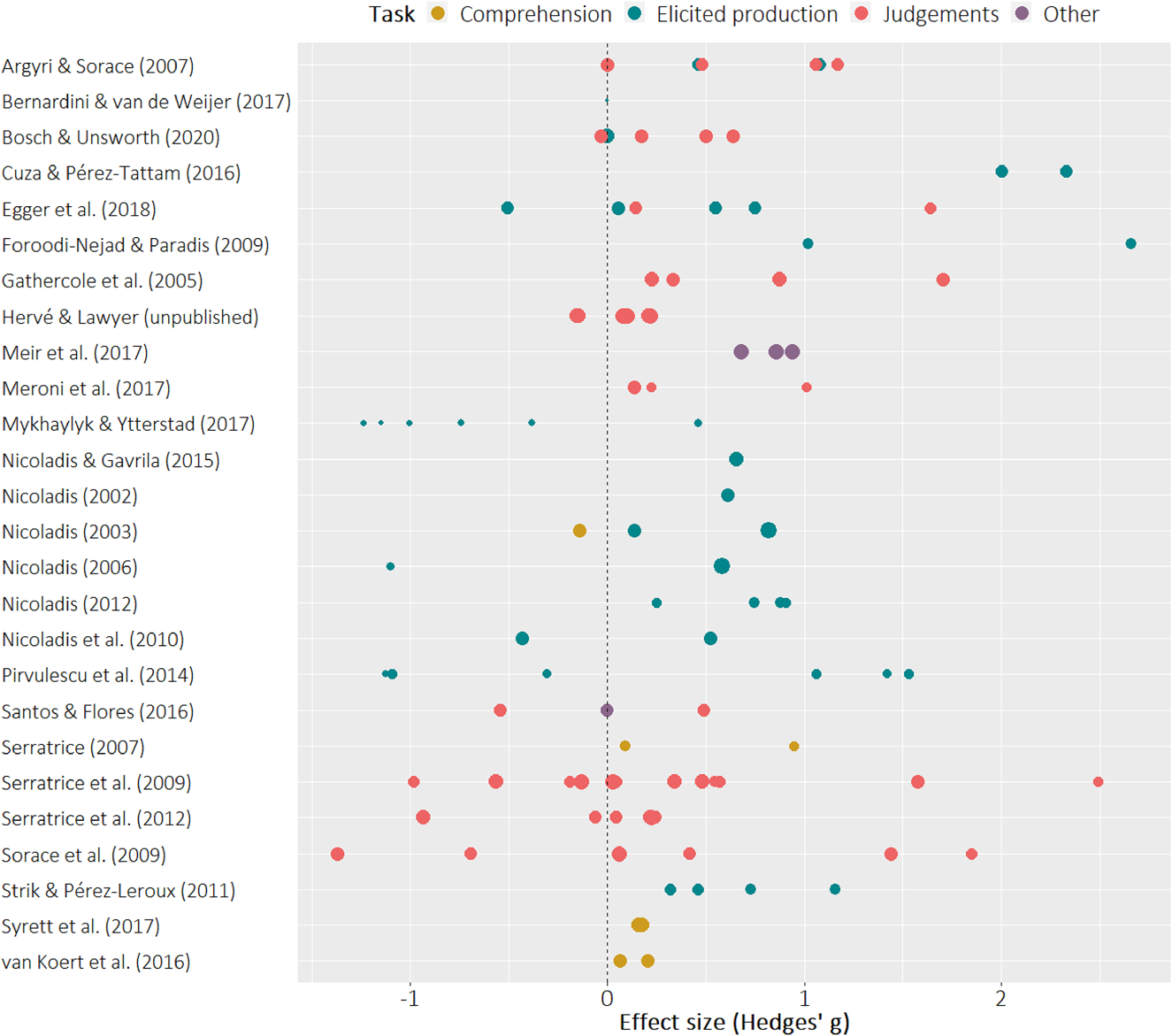
In our first analysis of the average effect size of cross-linguistic influence, we included only the 79 datapoints for which the authors of the studies explicitly predicted cross-linguistic influence. Effect sizes ranged from −1.24 to 2.66. The random effects model revealed a significant small to medium average effect size of g = 0.46 ((0.22, 0.71), p < .001). All models and model output reported in the result section can be found in the Supplementary Materials (Supplementary Materials, S5).
In our second analysis, we included an additional 34 effect sizes (a total of 113) previously identified as possible testcases of cross-linguistic influence. Now, the effect sizes ranged from −1.37 to 2.66. The random effects model revealed a significant small to medium average effect size of g = 0.39 ((0.21, 0.56), p < .001), slightly smaller than the average effect size in the first analysis.Footnote 7
We further investigated the distribution of effect sizes in the second analysis using a funnel plot (Figure 3). In this plot, datapoints are plotted with their effect size on the x-axis and their standard error on the y-axis. The vertical line represents the average effect size. Datapoints with a smaller standard error are predicted to be scattered closer to the average effect size than datapoints with a greater standard error, as indicated by the diagonal lines. If studies with significant results are more likely to be published than studies with null results (publication bias), this should be reflected in an asymmetrical distribution of datapoints in the funnel plot: there should be more datapoints at the bottom right side of the distribution than at the bottom left side (e.g., Rothstein, Sutton & Borenstein, Reference Rothstein, Sutton and Borenstein2005). We do not see this distribution in Figure 3. Instead, there seemed to be some asymmetry in the opposite direction: namely, there were a number of effect sizes at the lower left side of the distribution.
Funnel plot with observed effect sizes plotted on the x-axis and their standard errors on the y-axis.
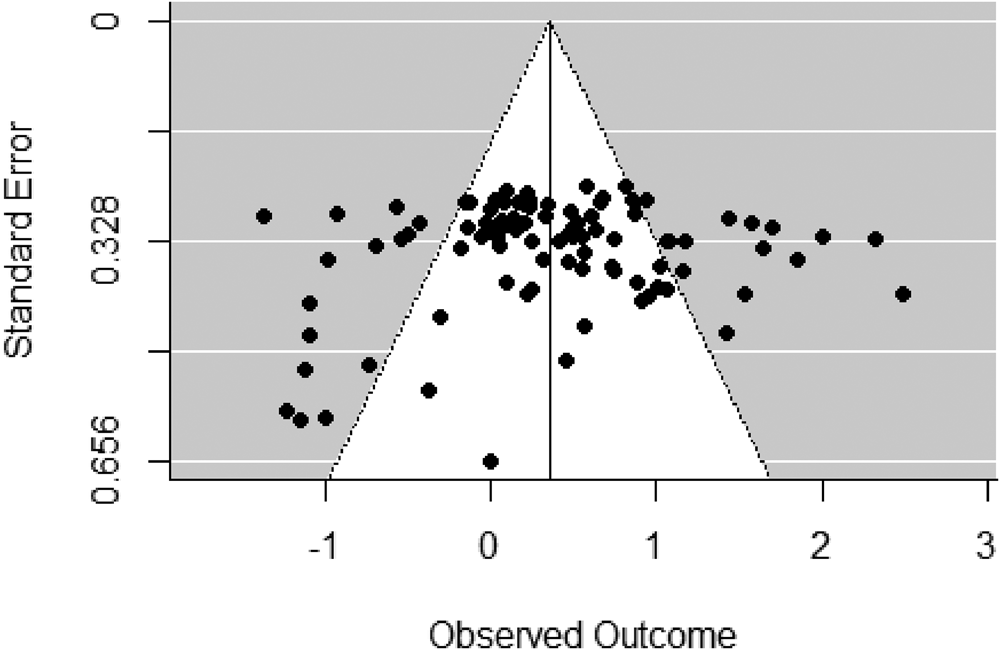
Figure 3 also revealed quite some horizontal scatter of datapoints, a signal of heterogeneity in the data (e.g., Sterne, Sutton, Ioannidis, Terrin, Jones, Lau, Carpenter, Rücker, Harbord, Schmid, Tetzlaff, Deeks, Peters, Macaskill, Schwarzer, Duval, Altman, Moher & Higgins, Reference Sterne, Sutton, Ioannidis, Terrin, Jones, Lau, Carpenter, Rücker, Harbord, Schmid, Tetzlaff, Deeks, Peters, Macaskill, Schwarzer, Duval, Altman, Moher and Higgins2011). This was confirmed by the significant test of heterogeneity of the model (Q(112) = 505.00, p < .001), which indicated that part of the variance in the data could not be explained by random error alone. This means that there must be other factors at play that account for differences in effect sizes. We tested whether this variance could be explained by our predictors of interest.
Analyses of predictors of cross-linguistic influence
We analysed the effect of our predictors by means of meta-regressions (e.g., Viechtbauer, Reference Viechtbauer2010). All predictor analyses were conducted with positive effect sizes only. Negative effect sizes reflected divergent behaviour between bilingual and monolingual children that was inconsistent with cross-linguistic influence. We will discuss possible reasons for negative effects sizes in the Discussion. Regardless of what causes negative effect sizes in our dataset, interpreting them is difficult, and their presence might muddy our predictor analyses. Therefore, we decided to leave out negative effect sizes from further analyses. Moderator tests were conducted separately for our predictors of interest.
Surface overlap
The first analysis took into account those datapoints for which the authors made predictions about the presence or absence of cross-linguistic influence based on Hulk and Müller's (Reference Hulk and Müller2000) overlap hypothesis. Overall, the average effect size for surface overlap situations was slightly larger (M = 0.69, SD = 0.81, range = 0–2.66, n = 20) than the average effect size of situations without surface overlap (M = 0.54, SD = 0.58, range = 0–2.49, n = 31). However, this difference was not significant as shown by the moderator test of surface overlap (QM (1) = 1.78, p = .182).
The second analysis compared the average effect size of those datapoints that we identified as partial overlap situations versus no overlap situations. The average effect size for partial overlap was slightly larger (M = 0.76, SD = 0.72, range = 0–2.66, n = 17) than the average effect size of no overlap (M = 0.62, SD = 0.64, range = 0–2.49, n = 42). However, the difference in effect size between partial overlap and no overlap situations did not reach significance either (QM (1) = 0.37, p = .541).
Language domain
The average effect size of morphosyntactic properties at the domain of discourse pragmatics (M = 0.30, SD = 0.38, range = 0–1.17, n = 19) was slightly smaller than the average effect size of morphosyntactic properties at other domains (M = 0.39, SD = 0.40, range = 0–1.06, n = 17). This difference was not significant, however (QM (1) = 0.05, p = .832).
Language dominance
In the first analysis, we compared effect sizes between children that were tested in their dominant language against children that were tested in their non-dominant language, as defined by the authors. Effect sizes were larger when children were tested in their non-dominant language (M = 0.53, SD = 0.90, range = 0–3.42, n = 21) compared to their dominant language (M = 0.35, SD = 0.52, range = 0–1.65, n = 23), QM (1) = 4.35, p = .037. However, when inspecting Cook's distance and DFBETA values one datapoint was identified that had a relatively large effect on the outcome of the model (g = 3.42, standardized residual, z = 3.00). We therefore re-ran the model without this datapoint. Effect sizes were still slightly larger when children were tested in their non-dominant language (M = 0.39, SD = 0.62, range = 0–1.80, n = 20) compared to their dominant language (M = 0.35, SD = 0.52, range = 0–1.65, n = 23). However, this difference no longer reached significance (QM (1) = 2.05, p = .152). This showed that the initial significant effect was carried by the effect size that was removed.
In the second analysis, the effect of societal language was tested. The average effect size of cross-linguistic influence was larger in those situations where the language of testing was not the societal language (M = 0.82, SD = 1.31, range = 0–7.54, n = 61) compared to when it was the societal language (M = 0.49, SD = 0.51, range = 0–2.05, n = 57), QM (1) = 6.86, p = .009. When inspecting Cook's distance and DFBETA values, two influential effect sizes were identified (g = 7.54, standardized residual, z = 6.83; and g = 5.16, standardized residual, z = 4.82). Without these two effect sizes, the difference in effect sizes between children tested in their non-societal language (M = 0.64, SD = 0.80, range = 0–3.64, n = 59) and in their societal languages (M = 0.49, SD = 0.51, range = 0–2.05, n = 57) was not significant but the trend was in the same direction (QM (1) = 3.36, p = .067). Furthermore, the estimated effect size of children tested in their non-societal and in their societal language was significantly larger than zero (non-societal language: B = 0.70, SE = 0.12, (0.47–0.93), p < .001; societal language: B = 0.52, SE = 0.12, (0.29–0.75), p < .001), indicating that the effect size of cross-linguistic influence was significant in the direction of the societal language into the non-societal language and in the direction of the non-societal language into the societal language.
Age
Figure 4 presents the distribution of the effect sizes by the average age of the bilingual groups by task type (107 datapoints). Two observations can be made. First, studies with younger children (< 6;0) in our dataset typically employed elicited production tasks to test for cross-linguistic influence. In older children, on the other hand, cross-linguistic influence was more often measured through judgement tasks. Second, the older children were, the smaller the effect of cross-linguistic influence became. This pattern was not significant, however (QM (1) = 0.46, B = −0.003, SE = 0.004, p = .497).
Effect sizes as a function of children's age (in years) by task.

Discussion
In this study, we systematically reviewed previous research on cross-linguistic influence in bilingual children by means of a meta-analysis. Our aim was to assess the strength of cross-linguistic influence by generalizing over differences in methodology and linguistic properties. In addition, we investigated the effect of previously identified predictors of cross-linguistic influence: namely, surface overlap, language domain, language dominance, and age. A total of 26 studies met our inclusion criteria, which resulted in a total of 187 datapoints. Subsets of the available datapoints were included in the analyses testing our predictors of interest. In this section we first discuss our findings, before using them to make a number of recommendations for future studies on cross-linguistic influence.
Cross-linguistic influence: average effect size and data consistency
We assessed the presence, strength and consistency of cross-linguistic influence in previous research with bilingual children. We hypothesized that (i) there would be an overall significant effect of cross-linguistic influence, and (ii) the effect sizes of individual studies would be consistent with cross-linguistic influence. Our findings fully supported our first hypothesis and partially supported our second hypothesis.
A significant summary effect of cross-linguistic influence was observed across studies. Bilingual children's languages influence each other at the level of morpho syntax, in line with the general consensus in the literature (e.g., Serratrice, Reference Serratrice2013). Our analyses revealed a small to moderate effect size, as reflected in a Hedges’ g between 0.39 and 0.45. The moderate but not strong effect size indicates that although bilingual children's languages can influence each other, they generally behave in language-specific ways similar to monolingual children (e.g., Nicoladis, Reference Nicoladis2002; Paradis & Genesee, Reference Paradis and Genesee1996). This effect size may serve as a benchmark for future studies on cross-linguistic influence, and stimulate researchers to conduct power analyses for determining the necessary minimum sample size (e.g., Cohen, Reference Cohen1988).
We observed that authors did not always formulate comprehensive predictions about cross-linguistic influence. Instead, some studies focussed on certain conditions only, even when more were tested. Possibly, authors might have felt inclined to solely report significant or large effects. Indeed, the summary effects of cross-linguistic influence was slightly larger when we only took those datapoints into account for which authors made explicit predictions. There was no evidence for a publication bias in our funnel plot, however. Alternatively, authors might have focussed on conditions that offered clearest support for their theoretical perspective on cross-linguistic influence. Regardless of the reason, incomplete predictions made studies less transparent and outcomes more difficult to interpret and compare to outcomes of other studies.
Finally, most but not all datapoints in our dataset were consistent with cross-linguistic influence. Out of 113 effect sizes, 73 showed a difference between bilingual and monolingual children consistent with cross-linguistic influence. Thus, given the variety of study designs in our dataset, cross-linguistic influence can present itself regardless of the type of task set-up used or the linguistic property and language combination tested. However, 24 effect sizes went in the opposite direction and the magnitude of cross-linguistic influence varied largely across and within studies. We address this in the next sections.
Predictors of cross-linguistic influence
Surface overlap
We hypothesized that cross-linguistic influence should be stronger in situations of surface overlap versus no surface overlap. If surface overlap is a necessary condition for cross-linguistic influence, the average effect size should be significant only in situations of surface overlap. (e.g., Hulk & Müller, Reference Hulk and Müller2000; Müller & Hulk, Reference Müller and Hulk2001). This turned out not to be the case, neither when surface overlap was coded based on authors’ definitions, nor when systematically coded by us based on the adult system. The average effect size of cross-linguistic influence was not significantly different in situations of surface overlap and situations of no surface overlap.
Our analyses show that surface overlap as presently defined does not significantly affect the size of the cross-linguistic effect. However, on the basis of our results it would be inappropriate to conclude that effects of cross-linguistic influence are unaffected by any type of surface overlap. It is possible that when surface overlap is defined in terms of ambiguity and optionality in the child's developing system, cross-linguistic influence may still be found (e.g., Hulk & Müller, Reference Hulk and Müller2000; Müller & Hulk, Reference Müller and Hulk2001).
Take, for example, Foroodi-Nejad and Paradis’ (Reference Foroodi-Nejad and Paradis2009) study. Their results can either be interpreted as evidence for or against the surface overlap hypothesis, depending on how surface overlap is defined. If surface overlap is based on the adult system, English constitutes a situation of no surface overlap with Persian, because English only allows right-headed compounds (whereas Persian allows both left- and right-headed compounds). If surface overlap is based on the child system, however, English might actually constitute a situation of surface overlap with Persian, because English monolingual children have been found to sometimes produce ungrammatical left-headed compounds (e.g., Foroodi-Nejad & Paradis, Reference Foroodi-Nejad and Paradis2009; Nicoladis, Reference Nicoladis2002). Foroodi-Nejad and Paradis (Reference Foroodi-Nejad and Paradis2009) found that Persian–English children produced more left-headed compounds in English than monolingual peers. On a definition of surface overlap based on the adult system, this means that there was cross-linguistic influence in a situation of no overlap. However, on a definition based on the child system, these results constitute cross-linguistic influence in a situation of surface overlap.
Because we and most authors of the studies in our dataset defined surface overlap based on the adult system, the number of situations of surface overlap in the meta-analysis might have been underestimated. Unfortunately, we were unable to test for effects of surface overlap based on the child system as most studies provided too little information to do so. Further systematic investigation of the role of surface overlap when defined in terms of child versus the adult language system is needed.
Language domain
We hypothesized that when morphosyntax interacts with discourse pragmatics, the size of cross-linguistic influence should be stronger than in other domains. If cross-linguistic influence is only present in a domain with such an interaction (e.g., Hulk & Müller, Reference Hulk and Müller2000; Müller & Hulk, Reference Müller and Hulk2001), the average effect size of cross-linguistic influence should be significant only in this domain. This hypothesis was not borne out: there was no significant difference in effect sizes for morphosyntactic properties whose distribution was governed by discourse pragmatics compared to other morphosyntactic properties. These findings suggest that cross-linguistic influence can occur irrespective of language domain (contra Hulk & Müller, Reference Hulk and Müller2000; Müller & Hulk, Reference Müller and Hulk2001).
However, it proved difficult to categorise morphosyntactic properties into specific domains, as there was often no clear line between situations in which discourse pragmatics are and are not involved (e.g., Montrul, Reference Montrul2011; Sorace, Reference Sorace2011). An alternative proposal would be to focus on computational complexity (e.g., Hopp, Reference Hopp2009; Sorace, Reference Sorace2011). Under such an account, certain morphosyntactic properties should be more sensitive to cross-linguistic influence due to their relative complexity (along the lines of Hulk and Müller's original proposal), and cross-linguistic influence could occur regardless of the language domain involved. Indeed, several studies have found evidence for the involvement of computational complexity in cross-linguistic influence (e.g., Gavarró, Reference Gavarró2003; Strik & Pérez-Leroux, Reference Strik and Pérez-Leroux2011).
In sum, rather than linguistic domain, computational complexity may be a more relevant predictor of cross-linguistic influence. Further investigation on this topic is needed to test this idea systematically.
Language dominance
With respect to language dominance, we hypothesized that if language dominance affects the size of cross-linguistic influence the average effect size of cross-linguistic influence would be larger from the dominant into the non-dominant language rather than the other way round. If cross-linguistic influence is from the dominant into the non-dominant language only, we predicted the effect of cross-linguistic influence to be significant in that situation only. Two analyses were conducted. We first analysed those datapoints for which the authors categorized the bilingual group as either dominant or non-dominant in the language tested. Subsequently, we operationalized language dominance in terms of the societal language. Evidence was found for the first, but not the second part of the hypothesis.
Cross-linguistic influence was stronger from children's societal language into the non-societal language than vice versa. Furthermore, the effect of cross-linguistic influence from children's non-societal language into their societal language was significantly larger than zero. In contrast, when the authors’ dominance groups were analysed, no evidence for an effect of language dominance was found. Taken together, these results suggest that language dominance, as operationalized by societal language, does not predict the presence of cross-linguistic influence, but rather its strength.
The absence of an effect of dominance in the first analysis is most likely due to the differences in how authors categorized children in dominance groups. Typically, three measurements were used to assess children's dominance profile: amount of language exposure (and use), lexical proficiency, and fluency ratings by parents or teachers. Some studies combined (some of) these measurements when categorizing children into dominance groups (e.g., Foroodi-Nejad & Paradis, Reference Foroodi-Nejad and Paradis2009; Pirvulescu et al., Reference Pirvulescu, Pérez-Leroux, Roberge, Strik and Thomas2014). Other studies used only one of these measurements (e.g., Argyri & Sorace, Reference Argyri and Sorace2007; Serratrice, Reference Serratrice2007). Different measures may lead to children being assigned to different dominance groups, however (Unsworth et al., Reference Unsworth, Chondrogianni and Skarabela2018).
In sum, variation within dominance groups may have masked differences between dominance groups in the first analysis, resulting in the absence of a significant effect of language dominance. Future studies should therefore consider testing for the effect of dominance on cross-linguistic influence by exploring different proxies for language dominance separately.
Age
With regard to age, two hypotheses were formulated: (i) if cross-linguistic influence is a developmental phenomenon, the average effect size of cross-linguistic influence should become smaller over age; (ii) if, on the other hand, cross-linguistic influence is part and parcel of being bilingual, the average effect size of cross-linguistic influence should not differ with age.
Our results were consistent with the second hypothesis. The average effect size of cross-linguistic influence did not significantly change over age. This is in line with those previous studies that found cross-linguistic influence to remain present in older bilingual children (e.g., Argyri & Sorace, Reference Argyri and Sorace2007; Bosch & Unsworth, Reference Bosch and Unsworth2020; Kaltsa et al., Reference Kaltsa, Tsimpli and Argyri2019).
Our findings are in contrast with spontaneous production studies with very young children that attested cross-linguistic influence only during a certain phase in language development (e.g., Döpke, Reference Döpke1998; Hulk & Müller, Reference Hulk and Müller2000). This could be explained by the different modalities tested with younger and older children. In our dataset, cross-linguistic influence in older groups of bilingual children was mainly tested by judgement tasks. Possibly, these studies detected subtle effects of cross-linguistic influence that were only present in older bilingual children's judgements of sentences and not in their (spontaneous) speech production. If this is correct, cross-linguistic influence may be less strong in older bilingual children's speech production than their judgements, but this needs empirical confirmation (cf. Argyri & Sorace, Reference Argyri and Sorace2007; Kaltsa et al., Reference Kaltsa, Tsimpli and Argyri2019). It is also possible that some instances of cross-linguistic influence may be developmental in nature, whereas others are more persistent.
Two words of caution are required here. As pointed out to us by two anonymous reviewers, the effect of age on cross-linguistic influence might be more complex than it appears in the present study. First, bilingual children's age might serve as a proxy for relative exposure and as such for their language dominance. In particular, children might experience a switch in dominance from the home language to the societal language after starting school (e.g., Polinsky & Kagan, Reference Polinsky and Kagan2007). Consequently, the expected direction of cross-linguistic influence may change as children become older. Second, the relation between age and cross-linguistic influence may be modulated by the age of acquisition of the specific morpho-syntactic phenomenon in question. If cross-linguistic influence only occurs whilst children are in the process of acquiring the language property in question, then it is predicted to persist for properties that are acquired late (e.g., pronoun interpretation in languages like Italian and Greek; Papadopoulou, Peristeri, Plemenou, Marinis & Tsimpli, Reference Papadopoulou, Peristeri, Plemenou, Marinis and Tsimpli2015), whereas it should be less apparent for properties that are acquired early (e.g., Verb Second in Dutch and German; Wijnen & Verrips, Reference Wijnen and Verrips1998). When the same property is acquired at different rates in different languages (e.g., gender in Greek versus gender in Dutch; Egger, Hulk & Tsimpli, Reference Egger, Hulk and Tsimpli2018), this may lead to asymmetric effects of cross-linguistic influence in bilingual children acquiring those languages. By combining different morphosyntactic properties from different languages, we were unfortunately unable to disentangle effects of age from effects of age of acquisition. We encourage researchers to use the information in our dataset to conduct more in-depth analyses of age effects whilst at the same time pointing out that establishing the age of acquisition for each property in all of the relevant languages is by no means trivial. Our initial attempts to do so revealed that the necessary information was often unavailable or inconclusive.
Unexplained variation
Although some of the variance in effect sizes of cross-linguistic influence in our dataset could be explained by children's societal language, much of the variance remains unexplained, as does the observation that there were negative effect sizes. We deal with each of these issues in turn.
With respect to unexplained variance, a number of causes can be considered. First, part of the unexplained variance in effect sizes may be due to the operationalization of surface overlap and language dominance. If it had been possible to define those two constructs in a different, better way – as explained above – they might have accounted for (more) variation in the data. Our observations that the average effect size of cross-linguistic influence in situations of partial overlap and in children's dominant language was slightly but not significantly larger than in situations of no overlap and in children's non-dominant language offer support for this view.
Second, part of the unexplained variance could potentially be attributed to different types of bilingual acquisition, as pointed out to us by an anonymous reviewer. In particular, whilst some of the children in our dataset were acquiring their languages in a one parent, one language situation, others were in families where both parents spoke the minority language at home. The context in which children acquire their languages is relevant for the (cumulative) amount of input children receive (e.g., Unsworth, Brouwer, de Bree & Verhagen, Reference Unsworth, Brouwer, de Bree and Verhagen2019), which, in turn, is related to their patterns of language dominance (e.g., Unsworth et al., Reference Unsworth, Chondrogianni and Skarabela2018). Consequently, average effect sizes of cross-linguistic influence might differ depending on the type of bilingual acquisition involved. Although studies in our dataset often reported at least some information about the languages spoken at home, they did not always provide the/enough relevant details. We therefore could not include the role of acquisition type in our analyses.
Third, more general effects of bilingualism could contribute to differences in performance between bilingual and monolingual children. For example, bilingual children might have performed less accurately on certain tasks compared to monolingual peers because of comparatively reduced input in their two languages or because they experienced increased processing demands having to deal with two languages instead of one (e.g., Pirvulescu et al., Reference Pirvulescu, Pérez-Leroux, Roberge, Strik and Thomas2014; Sorace & Serratrice, Reference Sorace and Serratrice2009). While this latter claim remains a moot point, it is possible that general effects of bilingualism may have had a greater impact on certain morphosyntactic properties than others, and especially on those properties that require a large amount of input to be acquired or that are difficult to process. This could, in part, explain why effect sizes differed across studies. In other words, effect sizes in our dataset may not have been pure reflections of cross-linguistic influence, but may have consisted of other effects as well.
Some evidence for general bilingualism effects in bilingual children comes from a study by Sorace and colleagues (2009). They tested bilingual and monolingual children's choices of null and overt subject pronouns in Italian. They included a group of Spanish–Italian bilingual children. Spanish and Italian are both null subject languages and have similar preferences regarding subject pronoun choices (e.g., Sorace et al., Reference Sorace, Serratrice, Filiaci and Baldo2009; but cf. Filiaci, Reference Filiaci, Borgonovo, Español-Echevarría and Prévost2010). Regardless of the overlap between languages, Sorace and colleagues found Spanish-Italian children to be less accurate in their pronoun choices than their monolingual Italian peers. Consequently, they argued that more general bilingualism effects, such as processing difficulties, affected children's pronoun choices, rather than cross-linguistic influence (also see Sorace & Serratrice, Reference Sorace and Serratrice2009 for an extensive discussion).
Fourth, all effect sizes in our dataset came from offline experiments. More recent accounts of cross-linguistic influence have suggested that cross-linguistic influence is the result of language co-activation during sentence processing (e.g., Bosch & Unsworth, Reference Bosch and Unsworth2020; Nicoladis, Reference Nicoladis2006, Reference Nicoladis2012; Serratrice, Reference Serratrice2013, Reference Serratrice2016). As the strength of language co-activation may have varied from study to study – for example, due to differences in children's language experiences – cross-linguistic influence may not always have surfaced in children's production and offline judgements and comprehension.
Special attention should be paid to the presence of negative effect sizes. These effect sizes represented differences between bilingual and monolingual children inconsistent with cross-linguistic influence. For example, we predicted that if cross-linguistic influence was to affect French–English bilingual children's placement of prenominal adjectives in French in Nicoladis (Reference Nicoladis2006), bilingual children should be more accurate in their production of adjective-noun strings than monolingual peers. This is because English only allows for prenominal adjectives. However, bilingual children (age-matched to the monolingual children) in Nicoladis (Reference Nicoladis2006) placed prenominal adjectives in French in postnominal position almost 50% of the time, versus about 10% in the French monolingual group (g = −1.10, s = 0.22). Although it could be argued that this difference between groups was a coincidence, it seems unlikely to find such a large difference between groups if cross-linguistic influence were actually present.
To account for negative effect sizes, two explanations should be considered. First, cross-linguistic influence might sometimes have resulted in a different strategy than predicted by the authors or by us. It is typically expected that cross-linguistic influence reinforces the use of a morphosyntactic structure in one of the children's languages when it is preferred in their other language. An alternative account would be that bilingual children may sometimes try to differentiate between the morphosyntax of their languages by making their languages as different as possible (Döpke, Reference Döpke1998). In other words, bilingual children might adhere to canonical morpho-syntactic structures as much as possible to differentiate between languages. In the case of French, postnominal adjectives are more frequent than prenominal ones (e.g., Nicoladis, Reference Nicoladis2006). Perhaps some bilingual children in Nicoladis (Reference Nicoladis2006) placed prenominal adjectives in French in postnominal position so frequently in order to contrast postnominal adjective-noun strings in French to prenominal adjective-noun strings in English. On this account, cross-linguistic influence may have led (some) bilingual children to behave in more language-specific ways than monolingual children.
It is also possible that general effects of bilingualism might explain negative effect sizes. For example, in some experiments bilingual children might have performed less accurately on a task compared to monolingual peers as a result of less input in the language tested (e.g., Pirvulescu et al., Reference Pirvulescu, Pérez-Leroux, Roberge, Strik and Thomas2014). This could explain why the bilingual children in Nicoladis (Reference Nicoladis2006) more often incorrectly placed prenominal adjectives in French in postnominal position than monolingual children: that is, they may not have heard enough input in French to establish the prenominal position as a consistent option in that language. If a bilingualism effect were indeed responsible for children's inconsistent behaviour with regard to cross-linguistic influence, the challenge for future studies would then be to disentangle those effects from effects of cross-linguistic influence, especially when predictions go in the same direction.
Recommendations
Facilitating reproducibility and cross-study comparisons
First of all, we recommend studies to formulate clear and testable hypotheses for each condition tested. Ideally, to make studies testing for cross-linguistic influence as transparent as possible and less vulnerable to bias, authors should take the following steps: (i) state for all conditions tested how children's languages are different or similar; and (ii) based on this first step, state for each condition if cross-linguistic influence could manifest itself, and, importantly, what this cross-linguistic influence should look like when there is cross-linguistic influence and when not. Furthermore, in order to make direct comparisons across studies possible, studies should report effect sizes.
Operationalising surface overlap and language dominance
Surface overlap and language dominance should be defined and operationalized in uniform and transparent ways. With regard to surface overlap, we recommend authors to take each of the following steps: (i) describe the morphosyntactic property under study in the adult system of bilingual children's languages, at both the level of the specific context tested as well as at a more general level (for example, subjects in Greek wh-embedded interrogatives are always postverbal (specific context) but in other contexts they can appear preverbally as well (general context)); (ii) describe how the morphosyntactic property is acquired by monolingual and, if the relevant information is available, by bilingual children, and describe whether there is optionality during acquisition; and (iii) formulate hypotheses regarding surface overlap and indicate whether these are based on optionality in the adult language or the child language (ideally both).
With regard to language dominance, the field should strive for a standard, uniform way to define dominance. As long as this is not available, we would recommend authors to measure and report effects of amount of language exposure/use, proficiency and societal language on cross-linguistic influence separately, for example, using existing questionnaires (e.g., ALDeQ – Paradis, Emmerzael & Sorenson Duncan, Reference Paradis, Emmerzael and Sorenson Duncan2010; BiLEC – Unsworth, Reference Unsworth2013; PaBiQ – Tuller, Reference Tuller, Armon-Lotem, de Jong and Meir2015). This way, effects of these separate proxies of language dominance can be compared and better understood.
Cross-linguistic influence versus general effects of bilingualism
We recommend that studies differentiate effects of cross-linguistic influence from possible effects of bilingualism. For most studies in our dataset, it was impossible to determine whether effect sizes consistent with cross-linguistic influence were (partially) driven by more general effects of bilingualism as well (cf. Pirvulescu et al., Reference Pirvulescu, Pérez-Leroux, Roberge, Strik and Thomas2014; Serratrice et al., Reference Serratrice, Sorace, Filiaci and Baldo2009, 2012; Sorace et al., Reference Sorace, Serratrice, Filiaci and Baldo2009). We therefore propose that future studies include, where possible, an appropriate bilingual control group (e.g., Kaltsa et al., Reference Kaltsa, Tsimpli and Argyri2019; Serratrice et al., Reference Serratrice, Sorace, Filiaci and Baldo2009, 2012; Sorace et al., Reference Sorace, Serratrice, Filiaci and Baldo2009). Crucially, without this bilingual control group, it may be impossible to determine whether differences between a bilingual and monolingual group should be attributed to cross-linguistic influence or to a more general bilingualism effect (for similar discussion concerning adult second language learners, see Jarvis, Reference Jarvis2000).
We do realize that for practical reasons it is not always possible to add a control group. In these situations, we recommend authors to consider the introduction of multiple within-experiment conditions that test the same cross-linguistic effects in different ways, and/or the inclusion of matched control-conditions in which only general bilingual effects would be expected (e.g., complete-overlap conditions).
Effect sizes from these studies could then be used to calculate a more precise average effect size of cross-linguistic influence.
Sample size and power
Ideally, future studies should consider the minimum sample size of children necessary to obtain a significant effect of cross-linguistic influence. If the true effect size of cross-linguistic influence is 0.39, then a sample size of at least 82 children would be necessary in the bilingual and monolingual control group to detect this effect (for an alpha level of .05 and a beta level of .80). If the true effect size is 0.45 a minimum sample size of 62 children per group would be necessary (calculations were performed with G*power; Faul, Erdfelder, Lang & Buchner, Reference Faul, Erdfelder, Lang and Buchner2007). This means that with just one exception (Meir et al., Reference Meir, Walters and Armon-Lotem2017), all the studies in our dataset will likely have been underpowered. In fact, the vast majority of studies did not even test half of the participants required. We do realize that increasing sample sizes is easier said than done, especially given the relative scarcity of certain bilingual populations and the labour intensity of the data collection process. One solution to the power problem would be for researchers to collaborate when possible (Brysbaert, Reference Brysbaert2019).
Apart from testing more participants, researchers could aim to increase the sensitivity of their studies by decreasing error variance as much as possible. For example, by keeping background variables, such as age, proficiency, and amount of exposure – or, if not possible, type of acquisition – as constant as possible between bilingual children and by increasing the numbers of items tested (Brysbaert, Reference Brysbaert2019; see also Quené, Reference Quené, Blom and Unsworth2010 for a further discussion how to increase the sensitivity of a study). For example, in 19 studies in our dataset at least some of the reported group means were based on less than 10 items per condition and in four studies there were even less than five items. This might have resulted in less precise outcomes – and therefore decreased power – compared to studies with more items per condition. Furthermore, many studies in our dataset reported rather broad language proficiency and/or exposures ranges for bilingual children (e.g., Cuza & Pérez-Tattam, Reference Cuza and Pérez-Tattam2016; Foroodi-Nejad & Paradis, Reference Foroodi-Nejad and Paradis2009; Serratrice et al., Reference Serratrice, Sorace, Filiaci and Baldo2009). It is possible that children with very different language profiles show different effects of cross-linguistic influence from other children, especially given our finding that language dominance affects the strength of cross-linguistic influence. Combining results from children with very different backgrounds might therefore increase the noise in the data, decreasing the likelihood of differences between bilingual and monolingual scores reaching significance. Moreover, one solution frequently adopted by authors of splitting children into different groups decreases the sample size, again resulting in a loss of power. As an alternative, authors could strive to select bilingual children with as similar linguistic background as possible to obtain more precise group effects.
Finally, our estimation of a minimum sample size of 62 to 82 children per group is based on the average effect size of cross-linguistic influence from studies for which it is unclear to what extent a more general effect of bilingualism was at play. Other factors might have affected the effect size of cross-linguistic influence that we were unable to test for in this meta-analysis and hence the effect size reported here may be an over- or underestimation. In the latter case, smaller minimum sample sizes would be required for a properly powered study. Future studies following our recommendations are necessary to clarify this issue further.
Understudied areas of cross-linguistic influence
Finally, we recommend conducting additional studies on cross-linguistic influence in children's comprehension. The majority of studies in our dataset were concerned with elicit production or judgement tasks and only a few studies concerned comprehension (Nicoladis, Reference Nicoladis2003; Serratrice, Reference Serratrice2007; Syrett, Lingwall, Perez-Cortes, Austin, Sánchez, Baker, Germak & Arias-Amaya, Reference Syrett, Lingwall, Perez-Cortes, Austin, Sánchez, Baker, Germak and Arias-Amaya2017; van Koert, Koeneman, Hulk & Weerman, Reference van Koert, Koeneman, Hulk, Weerman, Stringer, Garrett, Halloran and Mossman2016). It is therefore unclear whether the average effect sizes attested in our meta-analysis apply to cross-linguistic influence in comprehension as well.
Furthermore, all studies in our dataset focussed on cross-linguistic influence in children's offline production, judgements and comprehension. Until now, virtually no studies have focused on cross-linguistic influence during real-time morphosyntactic processing (cf. Lemmerth & Hopp, Reference Lemmerth and Hopp2019). This, too, might have resulted in an underestimation of cross-linguistic influence attested in bilingual children. More online data are necessary to explore more subtle effects of cross-linguistic influence.
Conclusion
This meta-analysis is the first study to systematically assess the effect size of cross-linguistic influence in bilingual children and effects of surface overlap, language domain, language dominance and age. Overall, there was a significant effect of cross-linguistic influence across studies and its average effect size was small to moderate. Furthermore, the results of most of the studies were consistent with cross-linguistic influence. Cross-linguistic influence was stronger from children's societal language into their non-societal language than vice versa. No effects were found for surface overlap – either as defined by the authors of the studies or based on the adult language system only – language domain, language dominance as operationalized by the authors of the studies, or age. These findings suggest that cross-linguistic influence is part and parcel of being bilingual and can manifest itself in various linguistic contexts. At the same time, our meta-analysis also shows that more systematic and standardized studies of cross-linguistic influence are necessary to fully understand this aspect of bilingual language development and use. This especially holds for the formulation of hypotheses about cross-linguistic influence and the operationalization of surface overlap and language dominance. We hope that the recommendations given here will serve as an impetus for the field to move towards a more standardized and unified way of testing for cross-linguistic influence and its predictors.
Acknowledgements
We are very grateful to all the authors who answered our questions about their studies and who dug into their archives to provide us with their data. We would also like to thank two anonymous reviewers for their constructive comments. This work was supported by a grant from the Netherlands Organisation for Scientific Research (NWO; project number 23000408) to the first author and (NWO; project number 23000407) to the last author.
Supplementary Material
For supplementary material accompanying this paper, visit https://doi.org/10.1017/S0305000921000337.


 Open access

