

The place of race in the present zeitgeist of contemporary American politics is, needless to say, as contested as any point in time in the nation’s recent history. The 2017 mass demonstrations of white supremacists against the dismantlement of Confederate statues in Charlottesville, Virginia, and the conference of “equal standing” to the white supremist protesters and counter-demonstrators by the sitting president, combined with the spate of police killings, including the murder of George Floyd in the summer of 2020, mobilized political Progressives, mainstream Liberals, and compassionate Conservatives to affirm proactive stances against racist policies and actions of specific law enforcement officers and agencies. By giving “the other side” standing, an authoritarian-leaning populist movement and its political leaders have pushed through a spate of policies at the federal, state, and local school board levels seeking to prohibit the teaching of the history of racism in schools, the offering of diversity, equity, and inclusion (DEI) programs in public bureaucracies, colleges, universities, and public schools, and specific training and professional development opportunities aimed at consciousness raising around issues pertaining to structural inequities, often bundled in sensationalized criticisms of “Critical Race Theory” (CRT). The term “wokeness” has entered the collective political consciousness of the United States, and with it, a sustained and politically effective push back on efforts to promote antiracist policies in the criminal justice system, in voting rights and voting access, and in hiring and related human resources practices, particularly in public sector organizations, public schools, and public universities.
The perpetuation of public policies that have contributed to the oppression of communities of color in the United States is well documented (Foner Reference Foner2025; Hahn Reference Hahn2024) and widely acknowledged, even among those waging political campaigns against CRT, the teaching of tolerance of others in schools, and DEI initiatives. As one such activist acknowledged, “We support teaching a full, honest look at American history—including the evils of slavery, racism, and segregation—but within the context of America’s highest ideals and our steady progress toward realizing them” (Rufo Reference Rufo2023,1). What Christopher Rufo is taking exception to is the promotion of what he deems as an “ideology of racial pessimism” that can prove “toxic” to children. In other words, that by teaching about the evils of racism, harm is done. In justifying his stance, Rufo makes a tacit appeal to “America’s highest ideals” and the nation’s “steady progress toward realizing them.” Leaning into Rufo’s suggestion we may ask, What exactly is meant by America’s highest ideals? And what is the relationship between these ideals and some of the hard truths of reality? These are the very questions posed by scholars who have considered the relationship between the ideals embedded in the “social contract” of the Enlightenment and constitutional forms of liberal democratic government (Hulliung Reference Hulliung2007), and the persistent, tangible realities emanating from the perpetuation of racial hierarchies (Mills Reference Mills2022). The blind promotion of ideals over the materially visible realities and history of racism in the United States ignores how American progress has evolved through the daily struggles of Americans to promote individual rights and liberties, to protect historically oppressed citizens from harms, and through the promotion of tolerance and acceptance of others. This progress has also been advanced through the applications of reason and the use of evidence to inform the advancement of substantive policies that have, indeed, led to improvements in the quality of lives of all Americans.
This essay takes a critical look at the subject of Rufo’s ire: those legal scholars, social scientists, and political philosophers who have advanced critical and we will argue constructive views regarding the relationship between racism and American ideals. The assertion to be made is thus: in contrast to the critiques of many who decry “woke” ideology, antiracist policy efforts are not a departure from but are wholly aligned with the ideals of classic small “l” liberalismFootnote 1 that have shaped the very basis of the American form of democracy. To address this point, we highlight the works of scholars and advocates who have made such assertions and contrast these assertions against other tenants of CRT and the critiques of CRT.
We begin by referencing a set of idealized standards of small “l” liberal democracy that are rooted in the political philosophies of the Enlightenment, codified in the liberal constitutions of modern democracies, and advanced through the implicit norms and accepted standards of tolerance, restraint, reform, and reason. These standards can serve as the benchmark (Koliba Reference Koliba2026) against which to judge how and to what extent antiracist policies advance or violate American ideals. To render this analysis, we will draw on the works of some of America’s foremost observers of race and its place in relation to the nation’s purported higher ideals, specifically Frederick Douglass and his famous “Fourth of July” speech of 1852, Charles W. Mills’ conception of the “racial contract,” and Ibram X Kendi’s recent work on antiracism. We conclude with a look at the contemporary “antiwoke” agenda, particularly in light of critical but sympathetic commentators of modern liberalism. We also recognize that antiracism as a central construct of liberal democracies can be pursued through decidedly illiberal means as well and present the conditions in which that is possible. We conclude by considering how best to close the gap between the higher ideals of democracy and the persistence of racism by focusing attention on the role of social equity in the public administration of liberal democracies. Ultimately this essay contributes to defining and describing the gap between ideals and reality and importantly recognizes how the pursuit of antiracist policies is an indelible feature of the legal and political accountabilities of liberal democracies.
Defining the Standards of Liberal Democracy
The distinction between the “ideals” and the “reality” of classical liberalism and liberal democracy needs to be acknowledged up front in any consideration of antiracism and democratic accountability. To a large extent, the ideals of classical small “l” liberalism have largely been advanced devoid of considerations of the persistence of racial and other forms of social hierarchies and their effects on the lives of people who have been designated as “nonwhite” (Mills Reference Mills2022). This includes the neglected history of chattel slavery, the oppression of Indigenous people, and the failures of both classical and contemporary political philosophers to recognize and integrate the divide between race-blind ideals and realities. In many cases, those most associated with the promotion of equality for all, such a John Locke and Thomas Jefferson, ultimately betray these ideals through their actions or in the prejudices and contradictions they convey in their subsequent writing and policies. There were, of course, leading lights of the Enlightenment, including Baron de Montesquieu, Diderot, Raynal, Samuel Johnson, and Benjamin Franklin (Kendi Reference Kendi2016, 103, 121; Robertson Reference Robertson2021, 316, 764) who were vocal advocates for abolitionism and the equality of all during their time. The Enlightenment project itself can be understood as asserting the value and equality of all individuals, even though those ideals are yet to be fully realized (Robertson Reference Robertson2021).
While the factors that play into the gap between ideals and reality are complex and replete with explicit and implicit biases, the points made by Mills in the Racial Contract originally published in 1997 (Reference Mills2022) are evident across a wide swath of the works of classical and contemporary political philosophers who have neglected to consider the persistence of racial hierarchies. However, even Plato, Hobbes, Locke, Burke, and Marx “recognized that to bring about the ideal polity, one needs to need to understand how the structures and the workings of the actual polity may interfere with our perceptions of the social truth” (emphasis added) (Mills Reference Mills2022, 123). Here, we see as well the importance of Hume’s notion of empiricism (Robertson Reference Robertson2021, 29), and the importance of making meaning through the use of sensory perception: namely the lived experience of people experiencing the policies reinforcing social hierarchies.
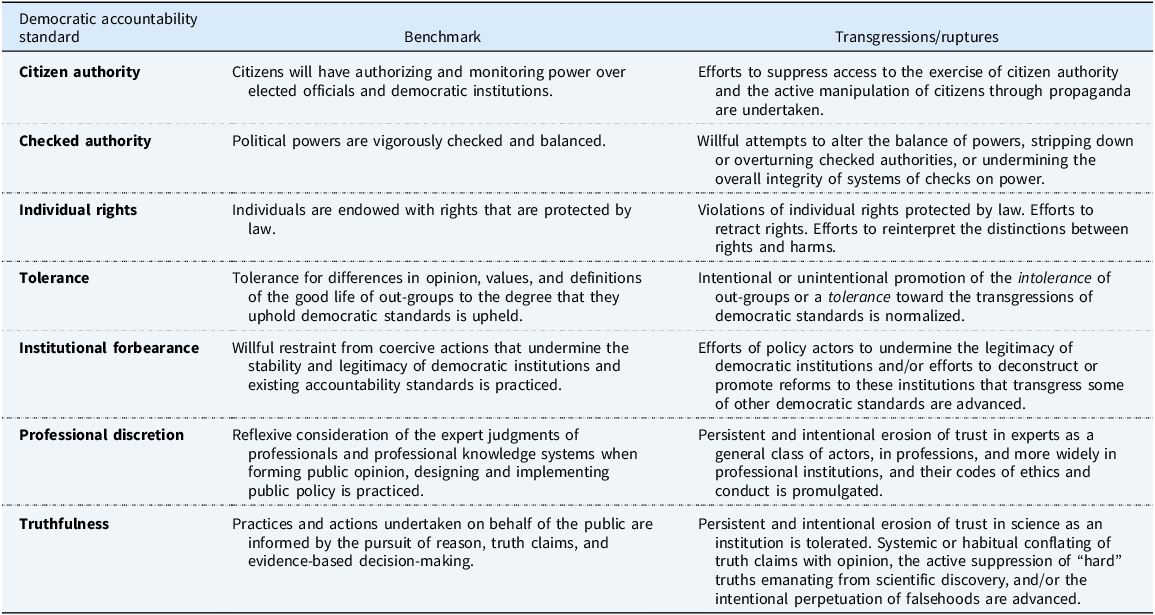
To better interpret the gap between reality and the ideals of American democracy, we define a set of standards that have been ideally and incompletely applied to the governance of liberal democracies. The legitimacy and indeed the sovereignty of democratic governments are found in the social contract between citizens and those they select to represent them to faithfully execute the operations of government. The core principles of small “l ” liberal democracies are legitimated by the ideal of the social contract first advanced by Hobbes, Locke, and Rousseau (Gray Reference Gray2000; Hulliung Reference Hulliung2007; Rawls Reference Rawls1971; Robertson Reference Robertson2021). The social contract of liberal democracies has evolved over time and is predicated on four key concepts: who has authority and how that authority is checked; the establishment of individual rights; the promotion of tolerance; and the pursuit of truth and reason. These concepts were central to the political philosophy of the Enlightenment that the framers of the U.S. Constitution drew on when designing the nation’s democratic governance system. A detailed breakdown of the core standards of liberal democracy to be drawn from these four pillars has recently been summarized and published elsewhere (Koliba Reference Koliba2024; Koliba Reference Koliba2026) and are briefly referenced in Table 1.
Democratic accountability standards (replicated from Koliba Reference Koliba2026, with permission)

Lic. Number from Oxford Press: 6215470721021.
We find here in these seven standards, three devoted to matters of authority and how power is structured in democracies. As a sovereign contract between citizens and their elected representatives, the citizen authority standard hinges on the formal role of elections, and informal role of public sentiment that forms the basis of citizens’ consent to be governed (Warren Reference Warren2009). The checked authority standard is another way of stating the checks and balances and separation of powers as they are articulated in the U.S. Constitution. A third dimension of authority is found in the professional discretion standard, through which the authority of the expertise and professional norms of civil servants and other professionals charged with executing the public’s will is recognized, valued, and held accountable.
The concept of individual rights and liberties is woven into the Bill of Rights of the U.S. Constitution. Over time, rights have been extended to additional classes of citizens through constitutional amendments, major pieces of legislation, and in some cases, common law. In addition to protection of individual rights, democratic governments are charged with protecting one’s expressions of rights and liberties from harming others, reflecting the positive and negative views of liberty first articulated by Hobbes and later endorsed by Mill and Berlin (Reference Berlin1969).
The two remaining core concepts of liberal democratic standards are based more on a set of implicit standards that may be viewed as complimenting the explicit standards relating to authority and rights. Liberal democracies were designed to allow for “value pluralism” (Galston Reference Galston2005), meaning that individuals possess the right to pursue their own values and expressions of liberty, a notion codified in the separation of church and state, but also seen in the expansion of individual rights and liberties eventually extended to all. In this manner, tolerance of others, their values and beliefs, and ways of living is essential for peaceful co-existence. This tolerance is to extend to democratic institutions. Institutional forbearance is the default setting through which reformers and revolutionaries alike pursue their agendas under the guise of reforming democratic institutions, rather than tearing them down or using them to advance decidedly “illiberal” aims.
The prominence of reason and the burgeoning institution of science fueled the political philosophies of classical liberalism of the Enlightenment (Gaus Reference Gaus2003; Robertson Reference Robertson2021). The ideal advanced in the coupling of governance and reason lies in the appeal to truth claims and truthfulness, in the entreaty to truth telling, and in a distain for the intentional perpetuation of falsehoods and conspiracy theories (Koliba Reference Koliba2025).
The inherent sense of progress that is embedded in classical liberalism, although in part fueled by Christian belief in salvation, were also grounded in the sense that through knowledge and reason humanity can reach higher states of perfection. This ideal was summarized by Martin Luther King, Jr. who observed that, to paraphrase, the arc of history bends toward justice (Reference King1997). The assumption that progress was evolving toward a more perfect union was codified in the preamble of the U.S. Constitution: “We the People of the United States, in Order to form a more perfect Union, establish Justice, insure domestic Tranquility, provide for the common defense, promote the general Welfare, and secure the Blessings of Liberty to ourselves and our Posterity, do ordain and establish this Constitution for the United States of America.” The preamble encapsulates all of the central features of this American ideal, including appeals to domestic tranquility and promotion of the general welfare.
At its core, the preeminence of the freedom of individuals is contextualized in light of the unity needed to ensure that the common defense, general welfare, and the blessings of liberty for all people are possible. When balancing this freedom and unity, we must consider what Locke asserted as the “natural State of all Men,” which implies a, “State of perfect Freedom to order their Actions, and dispose of their Possessions, and Persons as they think fit, within the bounds of the Law of Nature, without asking leave, or depending on the Will of any other Man” (Locke 1688/Reference Locke, Conte and Terchek2001, 7). Freedom is best expressed in human rights, and the capacity to fully realize one’s humanity, and in the parlance of classical liberalism, one’s ability to “pursue the good life” (Galston Reference Galston2005; Gray Reference Gray2000). This pursuit is not generally undertaken alone. It requires tolerance and restraint and more fully a deep appreciation of the common humanity of others that is tangibly expressed in government policy and public administration. Presumably, government policies play a vital role in securing and promoting the general welfare.
This concept of the communal value of liberty and freedom is best encapsulated in the political philosophies of John Rawls (Reference Rawls1971) and also, we shall assert, captured in Kendi’s understanding of antiracism as an ideal (Reference Kendi2023). The antiracist ideal, according to Kendi, lies in the understanding that to be fully human in a social sense means recognizing a deep bond linking us to every person on the planet. It means viewing all people as part of our wider human family and valuing every group equally, regardless of skin color. To be fully human in a political sense is to consider human rights—what everyone needs to live meaningful, flourishing lives—and to recognize the powerful forces, such as racism, that limit those possibilities. To be fully human is to use our collective strength to confront whatever blocks the full expression of our shared humanity (Kendi Reference Kendi2023, 12). The antiracism ideal calls for an end to any form of social hierarchy sanctioned by law or the actions of the state.
America’s history with slavery, racism, and oppression has stood in stark contrast to the ideals expressed above. The historical record of slavery in the United States is obviously beyond dispute. Historians have rightly documented the horrors of chattel slavery, how vested land owners and the U.S. economy as a whole profited from the free labor of the enslaved, and awareness of the role of racial oppression and racial politics have played throughout U.S. history including Jim Crow. The historical record also shows gains found in the 13th and 14th Amendments of the U.S. Constitution, the U.S. Civil Rights Movement, and the extension of rights to women, workers, and gay and lesbians over the course of the past 100 plus years. While the stain of slavery and Jim Crow cannot be ignored, the progress that has been made cannot be ignored either (see Foner Reference Foner2025 for a review of recent historical publications focusing on these issues). Nor, as we will argue, can the foundational concepts of individual liberty, appeals to reason and truth, tolerance, and forbearance be ignored.
The assertion that the standards of liberal democracy are consistent with antiracism is not a given. In fact, if all one reads are missives from right-wing critics like Rufo, they will assert that antiracism and democracy are antithetical. It is true that leading critical race theorists such as Derrick Bell, Richard Delgado, and Jean Stefanic believe CRT to have a “deep discontent” with liberalism (Delgado Reference Delgado, Delgado and Stefanic2013, 7–8). While others have been more positively assertive about the relationship between antiracism and liberalism. Such arguments may be found in Frederick Douglass’ strategic alignment of the U.S. Constitution with antislavery, Mills’ assertions about the racial contract, and Kendi’s definitions of antiracism and justifications for assessing antiracist policies.
Alignment of Antiracism with a Liberal Constitution
The most clear, compelling, and earliest assertion that the U.S. Constitution should be viewed as the vehicle for ensuring equality and freedom of all peoples was Fredrick Douglass. Douglass was a former slave on the Eastern Shores of the Chesapeake who escaped to the North and became a prominent abolitionist voice of current and former slaves of the time (Blight Reference Blight2018). It was estimated that he gave thousands of speeches over the course of his lifetime, often to crowds of white abolitionists eager to hear him represent the voices of slaves, former slaves, and freemen in the struggle. Douglass lived during the time when America’s history of racist policies hit their apex and rapidly escalated by the passing of the second Fugitive Slave Act of 1850. Douglass also lived through the U.S. Civil War and the early establishment of Jim Crow following a brief period of the Reconstruction. Like all of the figures we consider in this essay, his views on the remedies of racism were complicated. But his legacy endures and is perhaps best summed up in a speech he gave in Rochester, New York, in the summer of 1852.
Frederick Douglas’s “Fourth of July” Speech of 1852 is often singled out as one of the greatest speeches of American history (Blight Reference Blight2018). It is a speech marked by a dueling narrative that reflects the ambiguity and hope in America’s progress toward a more perfect union. Douglass knew his audience well: white abolitionists of the North who supported the cause of abolishing slavery. While he directed his comments to them, he essentially laid the groundwork on which to claim antiracism as a matter of constitutional right.
On this day, Douglas sought to situate his talk in the context of the occasion—the 86th anniversary of the signing of the Declaration of Independence. He framed the early section of the speech in terms of the celebration of “your” country’s founding and very early on he expressed his appreciation for the founders. He asserted that they, “felt themselves the victims of grievous wrongs, wholly incurable in their colonial capacity…” (Douglass Reference Douglass1852, 2). He called the founders “men of peace” who “preferred revolution to peaceful submission to bondage.” The founders did “not shrink from agitating against oppression.” They also demonstrated restraint and forbearance and believed in order. He assert that, “You may cherish the memory of such men. They were great in their day and generation” (Douglass Reference Douglass1852, 4).
Douglass essentially asserted that the United States was born out of rejection of oppression and applauded the founders for taking risks to do so, adding that, “Pride and patriotism, not less than gratitude, prompt you to celebrate and to hold it in perpetual remembrance.” He then famously went on to assert that the, “Declaration of Independence is the RINGBOLT to the chain of your nation’s destiny; so, indeed, I regard it. The principles contained in that instrument are saving principles. Stand by those principles, be true to them on all occasions, in all places, against all foes, and at whatever cost” (Douglass Reference Douglass1852, 3). In essence, Douglass equated the American Revolution, and the ideals that fueled it, with the struggle to overcome oppression.
Turning the page, Douglass shifted focus to the then present moment (Reference Douglass1852), bringing with it his characteristically rhetorical lightning and thunder. He compared the virtues of the founders and the founding documents to his present time, singling out the second Fugitive Slave Law that had been recently passed that called for the return of escaped slaves from the North. “In glaring violation of justice,” Douglass pronounced, “in shameless disregard of the forms of administering the law, in cunning arrangement to entrap the defenseless, and in diabolical intent, this Fugitive Slave Law stands alone in the annals of tyrannical legislation” (Douglass Reference Douglass1852, 9). The law was one of the most profound racists policies of American history.
To bring the lived experiences of enslaved people to life, Douglass described the human harms and injustices of the slave trade: “You know what is a swine-drover? I will show you a man-driver. They inhabit all of the Southern States. They perambulate the country, and crowd the highways of the nation, with droves of human stock…” He goes on to tell of the horrors of tearing a child from the arms of her mother to be auctioned off to the highest bidder, focusing attention on the degradation of proud people through public humiliation and torture. “Tell me citizens,” he asked, “WHERE, under the sun, you can witness a spectacle more fiendish and shocking? Yet this is but a glance at the American slave-trade, as it exists, at this moment, in the ruling part of the United States” (Douglass Reference Douglass1852, 8).
Douglass concluded the speech with an assertion he had only recently started to make: that the U.S. Constitution makes no mention of slavery and that essentially the Constitution is an anti-slavery document. While it took the passage of the 13th and 14th Amendments to begin to fully transform the U.S. Constitution into an antiracist document, Douglass was making a political claim that should not be lost to the critiques of history: the U.S. Constitution and the ideals it embodies provide the moral and political basis for the extension of the rights of all people of the United States with the authority to pursue happiness as described in Declaration of Independence and in turn the right and indeed the obligation to overcome oppression. Douglass coupled antiracism to the nation’s foundational legal, political, and social contract.
Douglass’ legacy with regard to antiracism have been complicated. Kendi sees him as an assimilationist (Reference Kendi2016, 195). Neo-conservatives have taken comments Douglass made at the end of the Civil War about Black self-determination to mean that he saw no value in government action and policy to assist former slaves (Canaparo Reference Canaparo2023, 2), a point strongly refuted if one takes into consideration the context of such remarks and the long arc of Douglass’ life contributions (Blight Reference Blight2018; Morris Reference Morris2025). Douglass’ legacy algins with those who have been and continue to be the most ardent defenders of liberal democratic ideals against illiberal and racists acts and those whose rights have been actively denied at such fundamental levels of oppression (Hahn Reference Hahn2024, 10). While our focus here lies in the struggles of people of color in the United States, by aligning the struggles of the founders of the early American establishment of democracy to overcome oppression with the universal struggles of all people against social hierarchy of any form, Douglass deserves standing in the pantheon of advocates of antiracism and the universal appeal and reach of antiracism as a cornerstone of healthy liberal democracies.
The Racial Contract and the Anomaly and Symbiosis Theses
The willingness to embrace the actions and documents of the founders of the United States by those most concerned about the current state of affairs around race has, no doubt, been muted by the hypocritical lives that some of the founders led as slave owners. Douglass himself clearly knew this when he made his comments on that day in July 1852 (Blight Reference Blight2018). In one sense, Douglass was appealing to the higher ideals over and above the actions of the slave owning founders. For instance, Thomas Jefferson declared that all people were created equal, but fell short of saying all races were equal, and later believed that Black people could be assimilated into society “after a few generations” (Kendi Reference Kendi2023, 38). Jefferson never freed his slaves, nor did any founder slave owner during their lifetimes. Kendi’s assessment of Jefferson led him to conclude that he was an “antislavery anti-abolitionist” (Reference Kendi2016, 151). Likewise, Mills provides an extensive examination of the either complete neglect or outright affirmation of racial hierarchy among almost every famous Enlightenment philosopher (2022). To address this problem, he introduced the concept of the “racial contract” in order to “make analytic political philosophy more socio-historically responsible” (Mills Reference Mills2022, xxxv).
The legitimate criticism of the founders and many of the prominent classical philosophers of the Enlightenment has led some to distance themselves from embracing the ideals of liberal democracy as initially laid out by the framers. It should be noted that Douglass, Kendi, Mills, and Hochschild all defend the ideals of classical liberal democracy in their work, while also recognizing the inherent tensions brought on by reality. The fidelity of classical liberal democratic standards should be viewed through this lens: that the flawed actions of the purveyor of higher ideals should be divorced from the ideals themselves. The separation of ideals from the actions of those defining or purportedly defending them allows us to draw on higher ideals as a benchmark for empirically assessing whether or not they have been transgressed (Koliba Reference Koliba2026). It is this persistent gap between ideals and reality that serves as the basis of the racial contract (Mills Reference Mills2022).
The history of illiberalism and racism is well documented (see for instance Foner (Reference Foner2025) for his series of book reviews relating to this topic). In his book Illiberal America: A History, Steven Hahn provides an extensive and provocative history of illiberalism in American history including chattel slavery and Jim Crow, the “Red Scare,” the open expression of support for fascism of the middle twentieth century, and more recent rise of the “Make America Great” (MAGA) coalition’s attacks on immigration and DEI (2024). These and other movements and events of American history provide a historical illustration of the gap between the country’s ideals and reality and roots these instances in a wider circle of illiberalism that impacts not only people of color but also women, homosexuals, immigrants, Jews, and ethnic minorities.
The persistence of the gap between ideals and reality results in a complicated relationship between antiracism and liberal democracy. Two theses have been presented to describe the persistent presence of racism amidst the projections of liberal democratic standards. The anomaly thesis is one that assumes that racism persists as a result of the failure to live up to liberal democratic ideals. It is the thesis encapsulated in Gunnar Myrdal’s volume, An American Dilemma: The Negro Problem and Modern Democracy (1944). Jennifer Hochschild sums up this thesis this way: “race discrimination is a terrible and inexplicable anomaly stuck in the middle of our liberal democratic ethos” (Reference Hochschild1984, 3).
The symbiosis thesis is one that considers racism as systemic and as a corruptive force of institutions. This view is most often associated with contemporary CRT (Hochschild Reference Hochschild1984; Ladson-Billings Reference Ladson-Billings2013, 37) and the conception of the racial contract (Mills Reference Mills2022). The thesis presumes that liberal ideals can support existing racism, even though liberalism rejects racial subjugation and subordination in principle. Core liberal commitments—such as equal treatment under the law, the emphasis on individuals over group identity, and broad tolerance for all perspectives—can end up allowing, and even enabling, racism to persist rather than confronting it and correcting it directly (Hochschild Reference Hochschild1984, 8). The proponents of the symbiosis thesis still claim that racism is antithetical to liberal democracy, but that the, “antiliberal and antidemocratic qualities of racism are as entwined as liberalism and democracy are” (Hochschild Reference Hochschild1984, 2–3).
If both theses still find value in liberal democratic standards, what then distinguishes between them? One way to consider this question lies in the extent to which one views democratic institutions (courts, public bureaucracies, free press, and networks of civil society organizations) as enabling and supporting racist policies that lead to state sanctioned discrimination and segregation, adopting assimilationist policies that attempt to gloss over oppression and place onus on people of color to conform to a normative basis dominated by white privilege, or rectifying racial injustices and inequity through the pursuit of antiracist policies.
Proponents of CRT are clearly advocates of the symbiosis thesis, resigned to the normalization of racism as a central feature of American life and institutions. CRT is tied to a specific form of analysis that has largely been applied as discourse and narrative analysis (Delgado and Stefanic Reference Delgado and Stefancic1998, 477). Those who have more recently attempted to summarize CRT associate it with a belief that racism as a normalized and not as an aberrant feature of the United States in particular (Delgado and Stefanic Reference Delgado and Stefancic1998, 470–1). It aligns with the wider discourse of critical theory and social deconstructionism (Ladson-Billings Reference Ladson-Billings2013, 37), and a form of historical realism (what Derrick Bell describes as “racial realism” (Reference Bell1992)) found in the works of the Frankfurt School and Foucault. Neo-conservative critics of CRT and antiracism have argued that this social constructionist perspective renders it difficult to set clear definitions around racial categories (Canaparo Reference Canaparo2023, 14).
The “deep discontent” with liberalism among some advocates of CRT (Delgado and Stefanic Reference Delgado and Stefancic1998, 489) lies in the perception of liberalism’s misguided faith in progress and its adherence to the tenants of a legal and a political system that have consistently promoted incrementalism at best and reified laws and norms that have perpetuated assumptions regarding a racial hierarchy resulting in systemic oppression, in the worst (Delgado and Stefanic Reference Delgado and Stefancic1998, 1). They would, in making this argument, identify illiberal and racist laws, rules, and norms that have become inherent properties of specific institutions, particularly courts and law enforcement systems, that have systemically neglected the rights of people of color, pointing to the long legacy of Jim Crow. They may view liberalism, and by inference liberal democracies, through an assessment of its outcomes, not on the basis of some higher ideals that bind a people together through social contract. They may also push back against what they view as assimilationist practices that call on people of color to conform to a form of white normativity (Humphery Reference Humphrey2023).
CRT is also anti-essentialist in character, critiquing essentialism as the belief that all people perceived to be in a single group think, act, and believe the same things in the same ways (Ladson-Billings Reference Ladson-Billings2013, 40), a position also held by Kendi. CRT is also skeptical of the motives of white allies to antiracism, claiming that it is best to assume that they need to establish strategic alliances based on rational self-interest—a form of Lowi’s interest group liberalism, rather than the altruism or basic sense of morality of white people. Not all see CRT as a clear and consistent doctrine, however. Mills, for instance, considers CRT as analogous to feminism and a broad political and theoretical movement within which there are multiple approaches (Mills Reference Mills2009, 270).
The matter of “intersectionality” is one that is also widely accepted within CRT and shared with anyone concerned with the discrimination of any groups or individuals. The Enlightenment philosophers widely recognized the need to bring about greater equality between men and women, and aristocrats and peasants, providing the basis for critical examination of gender and class-based discrimination and intolerance. Mills, however, asserts that the promulgation of racial hierarchies has only more recently risen to the forefront as a product of modernity. While class and gender discriminations have preceded modernity, as Europeans extended their global reach, white privilege, through a form of “racial Self-and Other-identification,” became “central to the social psychology of the world over the past few hundred years, tending to trump (contra orthodox Marxism) other identities in times of conflict” (Mills Reference Mills2009, 273).
The recognition that discrimination can extend beyond the perpetuation of racial hierarchies speaks to both the universal appeal of antiracism and the challenges with it. For if racism is indeed the driving force of modernity, as Mills, Kendi, and CRT theorists purport, the solutions for dismantling racism must go through the tenants of liberal democracies, not around them. It requires aligning antiracism with the dismantlement of social hierarchies of any form. To do so requires taking equality for all on its face value. Antiracism, as defined by Kendi, does just this.
Antiracism and the Role of Government
Those who have criticized antiracism and CRT have focused a great deal of attention on the writings and activities of Kendi. We argue here that these criticisms have largely focused on personal attacks on Kendi rather than a serious, sustained, and reasoned review of his assertions and their relation to American ideals. We believe it important to provide a close read of Kendi and concentrate attention on his focus on definitions and how antiracism is aligned with the standards of liberal democracies.
Kendi’s 2016 book, Stamped from the Beginning, provides the historical context for his more personal and definitional work, How to be an Antiracist (Reference Kendi2023). Stamped traces the history of racism and the struggles over it across U.S. history by using the biographies of Cotton Mather, Thomas Jefferson, William Lloyd Garrison, W.E.B. Du Bios, and Angela Davis to narrate this history (Reference Kendi2016).
In the prologue to this book, Kendi asserts that, “When you truly believe that the racial groups are equal, then you also believe that racial disparities must be the result of racial discrimination” (Reference Kendi2016, 11). As the book unfolds, the tensions resulting from Puritanism and the compromises of the America’s founders, abolitionists, and advocates for racial equality are spelled out. For instance, the inherent racial and social hierarchies of the Calvinistic religious beliefs of the Puritans underscores the tragedy and irony that a group of people fleeing religious persecution still support persecutions against others, specifically in relation to the treatment of Native Americans and acceptance of the institution of slavery as an extension of God’s will. The relationship to antiracism, liberalism, and the establishment of the U.S. Constitution is captured in Kendi’s treatment of the founders and particularly the hypocritical and conflicted divide between Jefferson’s higher ideals and his pessimistic racial realism and pragmatism (Reference Kendi2016, (76–160)).
Kendi’s recent efforts to define the critical terms associated with racism and antiracism are worth considering here (Reference Kendi2023). He anchors these definitions in the assertion that the relationship between classical liberalism and the persistence of racism in the United States can be understood within the context of three dimensions of race in a society like the United States: segregation, assimilation, and antiracism. While the distinctions between assimilation and segregation can be found in the debates about the anomaly and symbiosis thesis in early CRT, Kendi’s contribution lies in providing a definition of antiracism that is clearly rooted in the standards of liberal democracy.
Segregation is the clearest modern form of racist expression, as the perception of a racial hierarchy calls for a distinction of rights and privileges between races of people. Segregationist policies served as the centerpiece of Jim Crow. Present day, certain extremist white supremacists are still calling for the separation of races and to battle against the “Great Replacement,” a conspiracy theory salient among such groups (Ekman Reference Ekman2022).
Assimilation is defined by Kendi as “Any notion that suggests that a racial group is culturally or behaviorally inferior, which justifies support for cultural or behavioral enrichment programs to develop racial groups” (Kendi Reference Kendi2023, 30). It is unclear if Kendi is assuming that all differentiated programs directed to and for people of color are inherently assimilationist and imply inherent presumptions of inferiority. Where, for instance, is the line between assimilation and social service delivery drawn? Where do technical assistance and entitlement programs fit, particularly those that incent specific types of behavior, such as the pursuit of higher education or job seeking? What of those programs that explicitly seek to deliver healthcare services to individuals of protected classes, including people of color? The line between “leveling an uneven playing field” and providing policy prescriptions aimed at ensuring equitable outcomes regardless of race, and assimilationist enrichment and development programs, is admittedly a blurry one.
To better answer these questions, we may look to his definition of antiracism. Kendi defines antiracism as “Any notion that suggests that racial groups are equals and none needs developing, which justifies policy focused on creating racial equity and justice” (Reference Kendi2023, 30). He defines “racial inequality” as existing, “when two or more racial groups are not standing on approximately equal footing” (Reference Kendi2023, 20). He equates antiracism with specific policy goals or outcomes: equitable and just outcomes.
Not surprisingly, Kendi asserts that “race” is a social construction (Reference Kendi2023, 61). He departs, however, from Delgado and Bell by allowing for the possibility of a future that can be “colorblind” and even “post-racial,” a point that Kendi’s neo-conservative critics fail to acknowledge. In this manner, Kendi breaks from more traditional CRT theorists. A future in which disparities between races would be nonexistent and true racial equality and justice was self-evidence is possible. Kendi is skeptical, however, about the near-term prospects for achieving such a future. Evidence would bear him out, that “[i]magining away the existence of race” in a society where racism persists, “is as conserving and harmful as imagining away classes in capitalistic world-it allows the inequality to exist and persist undetected” (Kendi Reference Kendi2023, 61). “We are particularly poor at seeing the policies lurking behind the struggles of people, ” he claims (Reference Kendi2023, 34).
To determine just if and when the post-racial, colorblind moment arises and how it may be sustained when/if ever achieved requires that we not prohibit or censor the types of classification of race (or any other sociodemographic classifications of the population) needed to render empirical analysis for lawmaking and public policy design. “Terminating racial categories is potentially the last, not the first, step in the antiracist struggle,” asserts Kendi (Reference Kendi2023, 61). Essentially, if we are unable to or prohibited from defining and assessing racial inequality empirically, then we cannot recognize the policies and laws that produce it. If we cannot see and reform policies that contribute to the perpetuation of racial inequality, we will be unable to confront or change them (Kendi Reference Kendi2023, 62). In other words, we need to name it (racial distinctions) in order to track policy progress and regression. Kendi is most centrally concerned with the tangible impacts of racist and antiracist policies and the use of evidence and truth claims to render these determinations. A few examples in which racist policies have been overcome by antiracist policies include the outright prohibition of housing covenants and the setting of community standards for sale of a house and rental agreements (Jones-Correa Reference Jones-Correa2000), the overturning of the “separate but equal” doctrine that marked Jim Crow, and the Voting Rights Act of 1965.
Kendi applies an anti-essentialist perspective common to CRT. The juxtaposition of individual and collective group identity is often conflated in the rhetoric surrounding race and policy in the United States. He calls for a decoupling of individual behavior from ascriptions to whole groups of people. According to Kendi, racism is apparent in our thinking when we expect people to answer for their group’s behavior, or when we judge a whole group based on what one person does. Believing that every member of a racial group shares the same good or bad traits is a racist idea—and so is applying one person’s actions to everyone in that group (Kendi Reference Kendi2023, 105). This applies to people of all colors.
According to Kendi, group and individual stereotyping is capable of being exercised by all people. In fact, he spends much of Antiracist reflecting on this own past, how he upheld and advanced racist perceptions of other Black people, and argues that ascribing racist tendences to all white people is unto itself a racist thought. When critics of Kendi (Rufo Reference Rufo2023) claim that an antiracist agenda entails the blaming of all white people for oppression, they are mispresenting the ideal of antiracism. “To be antiracist,” asserts Kendi, “is to never conflate racist individuals with white people, knowing there are antiracist white individuals and racist individuals of color” (Reference Kendi2023, 143). Kendi cautions against anyone, from any background, asserting a racial hierarchy. In this manner, his definition of antiracism is directly aligned with the classical liberal democratic standards first stated by Locke, echoed in Declaration of Independence and Preamble of the U.S. Constitution pronouncing the equality of all people. If we are to value the freedoms and dignity of all peoples this value must extend to all peoples. We recall here how Douglass used this assertion to argue that the U.S. Constitution was an antislavery document, and that the American revolutionaries of the founding era were fighting a battle against oppression that ultimately justified the dismantlement of the institution of slavery.
The challenge in realizing this higher ideal applied to all peoples has historically depended on the details, specifically the material realities of all peoples. What happens though, when a political and legal movement is mounted under the assumption that indeed, the time of a post-racial, colorblind society has arrived and that any form of differentiation of services and policies for racial minorities (or any specific sociodemographic class) is construed as forms of discrimination? This argument may be found in the recent applications of the anti-classification doctrine—that call for the prohibition of differentiation of policy prescriptions of any form—in recent U.S. Supreme Court rulings (see Dobbs, Masterpiece Cakeshop, and SFFA cases) (Novkov Reference Novkov2025). The anti-classification doctrine, often associated with “colorblindness,” rejects policies that depend on group status and is quite skeptical of policies that are targeted to populations defined by specific traits.
The use of this doctrine stands in contrast to the anti-subjugation doctrine. Anti-subjugation (or anti-subordination) doctrine seeks to prevent the state from reinforcing the inferior status of historically oppressed groups, justifying affirmative action and targeted interventions (Powell Reference Powell2024). In other words, this doctrine asserts that the state is compelled to provide corrective measures to promote social equity. It should be noted that both doctrines have a history of passing constitutional muster. It would appear that both doctrines have been found to meet the baseline threshold under the Equal Protection Clause of the 14th Amendment.
The majority ruling of the U.S. Supreme Court in Students for Fair Admissions (SFFA) case in 2023 relied on the convergence of two arguments to justify its use of the anti-classification doctrine to rule against the use of race in making university admissions decisions. The first was to assert that differentiation of admissions by race apparently has a shelf life. Here, they align with the liberal values of progress that some post-racial and colorblind world was possible and is, in fact, already realized. Second, they found that the defendants, Harvard University and the University of North Carolina, failed to present compelling enough evidence to defend their admissions policies against claims of reverse discrimination.
In SFFA, the Roberts’ Court majority makes a “zero-sum” argument—that when privileging African-American applicants harm is done to white and Asian applicants. Their zero-sum rationale is that by granting privilege to one group, harm is done to other groups of individuals; that by paying particular legal and policy attention to the needs of some, you are taking away the capacities of others. The zero-sum assumption that by “raising some boats,” you “have to lower others,” is perpetuated and framed as an injustice, an afront to those who are excluded—presumably anyone not eligible to benefit from antiracist policies and programs. Zero-sum logic presumes that any form of differentiated public services is discriminatory.
What happens then to the full suite of programs and services designed to provide social and healthcare services to groups facing discrimination? What is the compelling role and interest of government in helping all attain a certain baseline level of social welfare? These types of questions lie at the heart of traditional Liberal and Conservative debates regarding the role of government institutions, and their relationship to personal agency and other traditional institutions like families, and religions and civic associations. At the heart of these distinctions lie competing assumptions regarding causes and effects. Liberal democracies rely on the pursuit of reason and truth claims to render such determinations (Koliba Reference Koliba2025). Realistically and pragmatically, the challenges faced by vulnerable individuals and groups result from a complex web of causes and effects.
The assumption that people are poor or oppressed because of their own actions is a political perception that is engrained in the consciousness of people from all walks of live. Personal agency certainly has role to play in an individual’s pursuit of the good life. This is, in fact, a core tenant of liberty and freedom. However, one can assume that yes, individuals can and should possess agency and personal responsibility and still recognize that political, social, and ultimately economic barriers to achieving success exist. These barriers matter too. The actions of the governments of liberal democracies have a compelling role to play in helping all to attain a better life for the “general welfare”—whether it be through the delivery of public goods and services, the provision of security from harms, or the equal protection of rights. And it is critical to note that in order to render this type of policy analysis requires the disaggregation of data relating to race and other protected classes, not the complete glossing over such distinctions.
Antiracism and Liberal Democratic Accountability
Claims that any antiracist and critical race prescriptions for society are inherently antiliberal or antidemocratic fail to take into account the fundamental point that racism—whether expressed through the extreme injustice of slavery or through the more subtle forms of prejudice and discrimination—stands in direct opposition to liberal and democratic ideals. Racism rejects the core liberal belief that all people possess equal worth and equal rights by nature. Antebellum justifications by Southern intellects during Douglass’ time tried to make the argument that people are born into specific stations in life, that some are born with more rights than others, and that it is “duty” of all to know their station (Hulliung Reference Hulliung2007, 63). The inherent racism of such assertions justified restricting freedom and opportunity for certain groups. Racism as a prescription judges individuals not by their actions or character but by the social group they are born into. It assigns status and determines life chances based on inherited traits rather than personal merit, ultimately declaring that some groups are unworthy of the very liberties that liberalism promises (Hochschild Reference Hochschild1984, 2).
To deepen our appreciation of the relationship between antiracism and liberal democratic standards and identify gaps between ideals and reality, we turn to a review of the seven standards introduced in Table 1, walking through each one in light of the topics covered thus far. Citizen authority is transgressed in any efforts that limit people’s ability to exercise their rightful power, manipulating that power through propaganda, or directly weakening citizens’ influence—all of these actions violate and effectively break the social contract of popular sovereignty (Koliba Reference Koliba2024, 23). The prohibition against giving citizen authority to slaves and freed slaves following the failure of Reconstruction during Jim Crow was, in part, overcome by the 1965 Voting Rights Act. Efforts to purge Black Americans from voting roles, disparities in waiting times at predominantly Black polling stations, gerrymandering to fragment the voting power of Blacks and efforts to not disaggregate demographic data by race, speak to the unfinished promises of citizen authority that are the centerpiece of democratic societies.
The struggle against racism in the United States has always been about the pursuit of individual rights and liberties of Black Americans. A violation of individual rights occurs when people experience actual or perceived systemic breaches of the rights guaranteed by the constitution (Koliba Reference Koliba2024, 24). The individual rights of African-Americans from slavery to Reconstruction to Jim Crow to post-Voting Rights Act reforms have been subject to a series of takes and gives and takes and gives. The gains made to define and protect individual rights and liberties of Black Americans were achieved through doubling down on liberal democratic values. This was the sentiment reflected in Douglass’ assertion that the U.S. Constitution was an anti-slavery document. Antiracism has legitimate claims to being chiefly grounded in an individual rights argument. Systemic and institutional racism stands in the way of people of color to achieve their full and rightful claim to pursue the good life.
The transgression of checked authority may be viewed through the deliberate efforts to shift the balance of power—by weakening or dismantling oversight mechanisms, or by compromising the integrity of checks and balances and the separation of powers (Koliba Reference Koliba2024, 24). While no one branch or judication of government is solely responsible for the advancement of racist and antiracist policies, the shape and complexity of American federalism provides for a suite of heterogenous responses that can both advance and stifle progress. Antiracist policies of one state can be countered by racist policies of another—a reality being played out in recent anti-DEI laws passed by some states. Newly elected chief executive administrators can prioritize or undermine antiracial progress and advance an illiberalism and that borders on white nationalism. As a result, the checks and balances of liberal democracies can, at times, help or hinder progress. While the constitutional foundations that shape policy formation and implementation can and do provide safeguards against violations of civil liberties of all, including people of color.
The transgression of tolerance shows up as efforts—whether deliberate or not—to ignore or deny differences among people and to draw sharp lines between groups in ways that divide and polarize society (Koliba Reference Koliba2024, 24). A “tolerance paradox” in relation to racism and antiracism provides for the most nuanced and challenging features of liberal democracy (Popper and Gombrich Reference Popper and Gombrich2020). To eventually and authentically progress beyond racial hierarchies requires an intolerance of racist policies and ideas. While some have argued that to have fidelity to liberal democratic standards we should accommodate the promulgation of white identity, such appeals should only have merit in cases where zero-sum policies are evidenced, not just rhetorically, but empirically so. Antiracism is a project that does, by definition, benefit all (Kendi Reference Kendi2023; McGhee Reference McGhee2022), and that labels of “racist” are not and should not be applied to people based on their racial identity alone. Yet zero-sum thinking persists, as noted by Heather McGhee, Kendi, and Mills. Since whiteness is often understood in contrast to nonwhiteness, white people may judge their own success by how they measure up against nonwhite people. Whiteness, as a status, is rooted in having advantages that others do not (Mills Reference Mills2022, 95).
The role of democratic institutions in advancing or overcoming racist policies is perhaps the most central feature of Kendi’s vision of antiracism. The transgression of institutional forbearance standard is evidenced, “in the attempts of elected officials, citizens, public administrators, and courts to undermine the legitimacy of democratic institutions or reform these institutions to align with illiberal values, norms, and standards” (Koliba Reference Koliba2024, 25). The relationship between institutional forbearance and antiracism is perhaps the most critical and likely most complex feature of antiracism’s rootedness in liberal democratic standards. The distinction between the anomaly and symbiosis theses are in play. The anomaly thesis would dictate that democratic institutions should be supported (when they are helping) and reformed (when they are discriminating). While the symbiosis thesis asserts that systemic racism permeates democratic institutions and that substantial deconstruction of these institutions is needed. Ironically, opponents of CTR and antiracism rail against the “deep state,” a similar claim of proponents of the symbiosis thesis in which there is a shared perception that “the system is rigged.” Recalling as well that both the anomaly and symbiosis theses still adhere to the core tenants of liberal democracy, we can assert here that antiracist policies need to be carried out through the actions and reforms of democratic institutions. The reform of institutional barriers to assessing and advancing antiracist policies, thus, becomes the focal point for antiracist reformers.
To effectively advance antiracist policies requires the use of evidence-based decision-making. This assertion is central to Kendi’s call for the rigorous assessment of the outcomes of public policies: that to eventually do away with racial hierarchies and racist policies requires the tracking of policy progress and regression impacting people of color. To do so requires the continued collection of data regarding how specific public policies either equitably or inequitably impact people of color or another other protected classes of people for that matter. Kendi is making an appeal to employ the truth and reason of democratic accountability to the study of racial disparities.
The growing apathy toward truthfulness and acceptance of falsehoods in contemporary American society (Arendt Reference Arendt, Medina and Wood2005; Koliba Reference Koliba2025; Koliba Reference Koliba2026) is being used to sow the seeds of intolerance and fear. The transgression of the truthfulness standard is demonstrated when facts are routinely treated as mere opinions, when scientific findings are deliberately ignored or silenced, and when false information is intentionally spread (Koliba Reference Koliba2024, 26). Recall that the reason Kendi gives for the continued use of the distinction between races is the need to track progress and regression of the quality of life of Black people and other underrepresented groups. If empirical data suggest pervasive differences in the quality of life based on race, this then should serve as the basis for policy action. Racial disparities based on health, security, rights, and wealth have continued to persist, raising deeper policy questions about what antiracist policies need to be put in place to mitigate these disparities (Dawes Reference Dawes2020).
The specific criteria for assessing the justification and efficacy of specific public policies is, when all is said and done, a matter that needs to be part of the public debate. Serious efforts to pursue evidenced-based solutions to racial disparities needs to be parsed in terms of authority (who is authorized to do what?), rights (what are they? what harms are caused and mitigated?), tolerance (how much to give and accept? when is intolerance justified?) and reason, evidence, and sincere pursuit of the truth (what does the evidence tell us?).
While all citizens are imbued with authority to select and sanction their elected representatives through elections, the work of making and implementing all public policies, including antiracist policies, is taken up by elected officials, judges, public administrators, and members of civil society organizations. This network of individuals, organizations, and institutions generally frames, defines, and parses racially associated policy problems and proposes and implements antiracist policies. This group of professional policy actors need to ground their actions in an adherence to liberal democratic accountability standards. In the case of many of these professions, public administration and the judiciary in particular, codes of ethics that appeal to the use of evidence and ground practice in honest representation of facts exist. In the case of public administrators working within governments in liberal democracies, allegiance to constitutional standards is owed through tort liability (Epp Reference Epp2009) and through the elevation of social equity as a central consideration of public administrative action (Frederickson Reference Frederickson1990; Guy and McCandless Reference Guy and McCandless2012). These professions also may be active in promoting specific interests, as in the case of those working through or with civil society organizations. The discretion of these policy actors are relied upon by the rest of society who benefit from their use of professional expertise when taking policy action, as well as designing, implementing, and evaluating policies. When their professional discretion is summarily questioned, we find the transgression of this standard in the persistent and intentional erosion of trust in experts as a general class of actors, in professions, and more widely in the institutions of professions, including professional associations, professional accreditation standards, and codes of ethics and conduct (Koliba Reference Koliba2024, 26; Koliba Reference Koliba2026).
Despite the clear and compelling rootedness of antiracism in liberal democratic accountability standards, the objectives of antiracism are being associated with a form of “woke” consciousness. Wokeness is said to be being advanced by “Liberal elites” who are bent on promoting a particular brand of political correctness, cancel culture, and a communal vision of peaceful co-existence among individuals expressing all manner of identity and group affiliation (Canaparo Reference Canaparo2023; Gray Reference Gray2023; Rufo Reference Rufo2021). This is a point we will turn to next.
“Anti-Wokism” and Liberalism
Public bureaucracies, public schools, and universities have recently been subject to prohibitions of DEI-related activities and teaching on matters of race and equity in some states. While several executive orders issued by the Trump administration in early 2025 outright prohibited the use of certain words and the disaggregation of statistics based on race, ethnicity, and gender. These trends may be thought of as extensions of long-standing efforts to dismantle affirmative action and racial preferences in college admissions. The critics of “wokeness” commonly couple DEI with the Black Lives Matter movement, the “Me Too” movement, advocacy for LGTBQ + rights, acceptance of gender fluidity, and advocacy for the teaching of CRT, and rail against the proliferation of the “identity” politics of people of color, women, LGTBQ+, etc. (Canaparo Reference Canaparo2023; Rufo Reference Rufo2021). There is likely to be little debate that the basis of woke consciousness (if such a thing exists) lies in the awareness and appreciation of these movements and, more importantly, concerns regarding the violations of individual rights and intolerance inherent to much anti-woke rhetoric.
Charges of “reverse discrimination” advanced by anti-woke activists and politicians are based on, ironically, the embracing of identity politics for white people, for men, for rural residents, etc. The result is the surfacing of a counter-identity movement—one that seeks to re-center white identity. If Black and Brown people, LGTBQ+, transgender, and women can advocate for their collective group identities to receive special treatment, then why not do so for white people? Or so the argument goes.
The anti-woke agenda appears to encompass a vigorous resistance to DEI policies and practices being advanced through DEI initiatives and curriculum. The agenda appears to suggest that antiracist policies and initiatives perpetuates racist policies against others, presumably white people (Canaparo Reference Canaparo2023; Rufo Reference Rufo2021, Reference Rufo2023). This logic assumes a “zero-sum” logic, which can largely be proven or disproven through rigorous empirical analysis if they were willing to permit it.
While some scholars of liberalism have deemed efforts to advance antiracist and DEI policies and initiatives as being “illiberal.” Writing about the state of modern liberal democracies, political philosopher John Gray asserts in 2023 that, “There is an unrelenting struggle for the control of thought and language. Enclaves of freedom persist, but a liberal civilization based on the practice of tolerance has passed into history” (Gray Reference Gray2023, 5). But the subjects of Gray’s concern are not the political movements and their leaders actively promoting illiberal authoritarian policies and rhetoric (Bauer Reference Bauer2025), but a form of “hyper-liberalism” that leads to, “the project of forging new collectives, and the prelude to a state of chronic warfare among the identities they embody” (Gray Reference Gray2023, 111). In essence, Gray is pessimistic that the pathway toward cohesion and harmony lies not in the further differentiation of identity, but in the rejection of this differentiation.
While Francis Fukuyama recently claims that personal autonomy is “expanding relentlessly” and viewed as a “value that trumps all other values…,” which is troubling to him (Fukuyama Reference Fukuyama2022, x). Both Gray and Fukuyama assume that racist policies are a permanent fixture of American society (agreeing here with many CRT theorists) and suggest that one can go too far in expressions of autonomy and individuality, regardless, it seems, of whether any discernable harms to others are associated with these expressions. Gray sees the discourse of race and antiracism as, “[c]arving up society into ethnic group identities” and perpetuating and intensifying “racial divisions.” He adds, aligning with Rufo (Reference Rufo2023), that, “Woke discourse on race is a symptom of the disease it pretends to cure” (Gray Reference Gray2023, 117), because it manifests into a hyper-liberal and “moral frenzy” (Gray Reference Gray2023, 123).
In a similar vein, Fukuyama raises concerns for a “progressive post-liberal society” where, “Considerations of race, gender, gender preference, and other identity categories would be injected into every sphere of everyday life, and would become the primary consideration for hiring, promotion, access to health, education, and other sectors.” Colorblind meritocracy “would take a back seat to overt preferences based on race and gender” (Fukuyama Reference Fukuyama2022, 126–7), a fear echoed by Rufo (Reference Rufo2021). By presenting such a stark bifurcation between merit and identity, he has chosen to parse policy trade-offs as a zero sum.
The possibility for illiberal prescriptions to correct for the persistence of racism needs to be taken seriously. A recommendation offered by Kendi in 2019, for example, was the suggestion to pass an antiracism constitutional amendment that would empower career civil servants to police all federal, state, and local policies (Reference Kendi2019). By proposing a new amendment, he assumes that the 13th and 14th amendments and civil rights statutory overlays are not enough to overcome racism (the symbiosis thesis). While this may be a viable pathway toward reform, the reliance on the centralization of authority and disconnection of enforcement mechanisms from political oversight are questionable from the standpoint of liberal democracy. In criticizing Kendi, Rufo sees “the end of federalism and the lawmaking authority of Congress” (Reference Rufo2021, 5) in this suggestion. Assuming Rufo is right in interpreting what amounted to a one paragraph blog post by Kendi, this would entail the transgression of the checked power standard of liberal democracy.
If a federal agency is created with sweeping powers to pursue one policy goal: the eradication of racist policies, what does this mean for other policy goals and objectives? This brings up the matter of how to evaluate antiracism in light of other policy goals and trade-offs. Wokeness is a conscious awareness alert to the inequities that exist between individuals and between classes of individuals. We have focused almost exclusively here on racial inequality, but the same kind of prejudices that perpetuate a racial hierarchy can be found in attacks on feminism (Pateman Reference Pateman2016), on homosexuality, and transgender and nonbinary individuals. When other classes of individuals are subsumed within a social hierarchy, how are we to prioritize? In this sense, Rufo has a point when he claims that to reduce the complex phenomenon of inequality to a single causal variable—racism—threatens to obscure important empirical realities (Rufo Reference Rufo2021, 6). Interestingly, Rufo makes the case that it is economic class, not race that matters most in relation to inequality (Rufo Reference Rufo2021, 7). While he likely rejects any effort for the types of redistributive justice required to tackle economic inequality and would likely be troubled by being associated with neo-Marxism. Perhaps the irony would be lost on him.
By focusing his ire on CRT Rufo fails to take into consideration the positive relationship between antiracism and liberal democratic standards by incorrectly claiming that they are antithetical to one another—a claim that we have spent the bulk of this essay refuting. By creating a boogeyman in some fictional illiberal application of CRT, he and his supporters are placing limits on how individual and group identity should be defined. And much like Kendi’s ill-advised suggestion to institutionalize antiracism policing through unelected officials, Rufo’s policy prescriptions that include the prohibition of the teaching of the horrors of slavery and the use of equity, diversity, and inclusion language and goals in any government program squarely violate the tenants of liberal democracy by advocating for censorship and state control over educational content.
Woke discourse only perpetuates racism when it fails to follow liberal democratic standards. The following actions would be examples of this: when someone is actually and intentionally falsely accused of racist wrong-doing; when checks on power are overridden in the pursuit of antiracist objectives; when intolerance silences reasoned debate; and when the core tenants of liberal democracies themselves come under attack by those claiming to advance an antiracist agenda.
Much of the anti-woke rhetoric focuses on the policing of language through its own form of political correctness. The banning of words and programs relating to DEI recently prohibited in Executive Orders of President Trump (Yourish et al. Reference Yourish, Daniel, Datar, White and Garrio2025) suggests that a new era of political correctness and state censorship is afoot—namely one that prohibits the use of specific words associated with a wide array of terms including equality, inequality, racism, and even women. There is reason to assert that the policing of language, even if meant to highlight the harms that words can convey, can itself do harms that are unwarranted. A focus on the substance of policies and their outcomes rather than a culture war tit-for-tat over words is called for. To do so requires an honest accounting of history and the pursuit of truth through the collection and analysis of evidence.
Conclusion
This essay is situated in a wider project to investigate how the political philosophy of classical liberal democracy is critical to informing public administrative practices in democratic societies. It is the obligation of public administrators to do their best to exercise their professional discretion to uphold democratic standards. The extent to which the conceptions of social equity and public administration have considered and/or are aligned with these democratic standards warrants further consideration (Blesset et al. Reference Blessett2016; Guy and McCandless Reference Guy and McCandless2012). Considerations of social equity is one of the policy goals that matters in liberal democracies (the others being welfare, security, liberty, and efficiency (Stone Reference Stone2012)). Equity is closely aligned with both the procedural and substantive rights of individuals to expect some measure of equitable or fair outcomes. Social equity is a tangible byproduct of the conception of antiracist policies we have been discussing in this essay. It therefore serves as the duty of democratically anchored public administrators to play a role in investigating how racial hierarchies impact the lives of citizens, and how antiracist policies can best be implemented in the protection of the rights of both marginalized and majoritarian groups. Such policies will have the impact of “raising all boats,” an assertion made in Heather McGhee’s recent book, The Sum of Us (Reference McGhee2022). Such efforts will need, of course, to be supported by democratically elected officials who are themselves held accountable to upholding democratic standards.
In the end, the liberal democratic accountability standards discussed here are offered as a means of grounding judgment in what is, and is not, attuned to classical liberal and democratic principles. Antiracism as a concept and a way to conceptualize policies that lead to reductions in inequalities and inequities is deeply aligned with core liberal democratic standards. While successful antiracist policies have historically been enacted that have contributed to the progression of American ideals, there is a reason to be concerned that these gains can be subject to backsliding. Recent efforts to use coercive powers of the state to censor language, limit the collection of data disaggregated by race, gender, ethnic group, and sexual orientation, and declarations that we have achieved a “colorblind” society as a policy while undercutting our ability to evaluate when, where, and how outcomes by racial, gender, and other disparities persist must all be considered as illiberal and antidemocratic reforms. While concerns regarding reverse discrimination deserve a fair hearing, their validity must be considered in light of zero-sum outcomes that are objectively observed.
The effort to form a more perfect union requires the steady evolution of rights, deepened understanding of when and how best government should protect us from harms, reasoned assessment of the efficacy of any and all policy prescriptions, and, in the end, levels of tolerance anchored in liberal democratic principles. Racism in all its forms, regardless of who is perpetuating it, is, to its core, illiberal and antidemocratic.
Acknowledgments
The author wishes to thank the reviewers of JREP, Ben Merriman, Charles Epp, D’Arlyn Bell, Noelle Broughton, Sean McCandless, Inoru Morris and Angel Rivera for their input into earlier drafts of this paper.
Funding statement
Partial support for this article was provided by the Robert Wood Johnson Foundation’s Policies for Action program. The views expressed here do not necessarily reflect the views of the Foundation.
Competing interests
The author declares that he has no known competing financial interests or personal relationships that could have appeared to influence the work reported in this paper.

 Open access

