

Introduction
In January 2020, researchers from the universities of Tehran and Jiroft, members of the Italian Archaeological Mission to South-Eastern Iran (ISMEO), and colleagues of Iran's Cultural Heritage Handicrafts and Tourism Ministry (ICHTM) joined for a three-week documentation project at Jiroft (Kerman, Iran), focused on a collection of about 500 ancient ceramic vessels and more than 100 copper and 100 carved chloriteFootnote 1 artefacts. All these materials had been held illegally by antique dealers and unauthorized excavators and were confiscated by Iranian security forces. None of them were previously published, and they were therefore forwarded to ICHTM for study, prior to entry in the collections of the Jiroft Archaeology Museum.
In spite of the irremediable loss due to illegal, undocumented extraction from archaeological contexts, the collection provides important new knowledge concerning Iran's heritage. These recent acquisitions supplement the masses of material recovered in similar manner and previously published in Iran (Madjidzadeh Reference Madjidzadeh2003a; Reference Madjidzadeh2007; Piran & Hesari Reference Piran and Hesari2005; Piran & Madjidzadeh Reference Piran and Madjidzadeh2013) in revealing the variety and outstanding technical-aesthetic standards of the craftspersons of the long-forgotten civilization of the Halil Rud (Madjidzadeh Reference Madjdzadeh2003b).
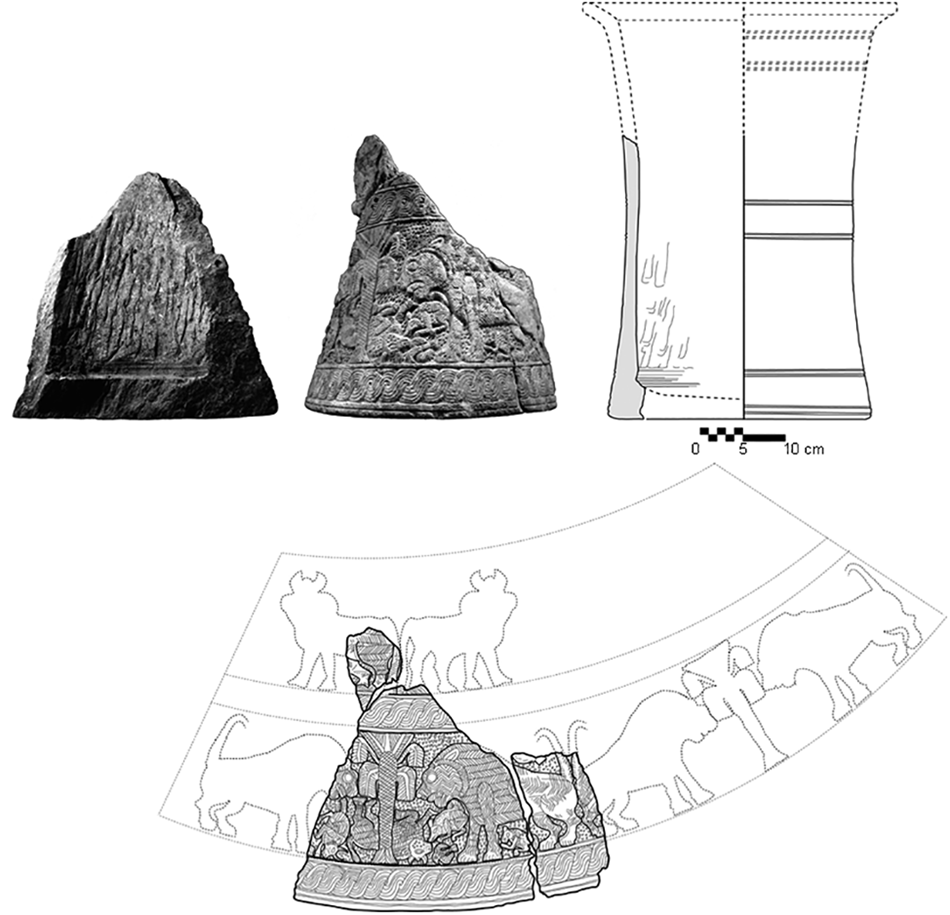
This article briefly considers some old and new theoretical approaches to the interpretation of prehistoric/protohistoric animal imagery, and then considers the particular case of a new find from the above-mentioned collection: what is left of a large sub-cylindrical vessel of tapering profile, rising to a slightly enlarged mouth (Figs 1–3). The stone is a light green to grey chlorite, relatively soft, of fibrous-laminated structure, with an evident micaceous component. The diameter of the base and mouth are respectively reconstructed as about 31 and 37 cm, conforming to an original height of 49–50 cm. The three surviving fragments of this vessel do not extend to the upper part; however, this has been conjecturally reconstructed based on the shape and proportions of a stylistically quite similar carved chlorite vessel, also fragmentary, found in the ruins of the Shamash temple at Mari in Syria (Margueron Reference Margueron2004, fig. 274, 8).Footnote 2 The chronology generally accepted for the chlorite artefacts carved in the Halil Rud style extends from the Early Dynastic II–III through early Akkadian periods (see, among others, Amiet Reference Amiet1986; Aruz Reference Aruz and Aruz2003; Margueron Reference Margueron2004; Vidale Reference Vidale2015; Wilson Reference Wilson2012).
The three fragments of a large chlorite vessel discussed in the paper: photographs and graphic reconstructions of the form and continuous decoration; the complete vase was c. 50 cm high.
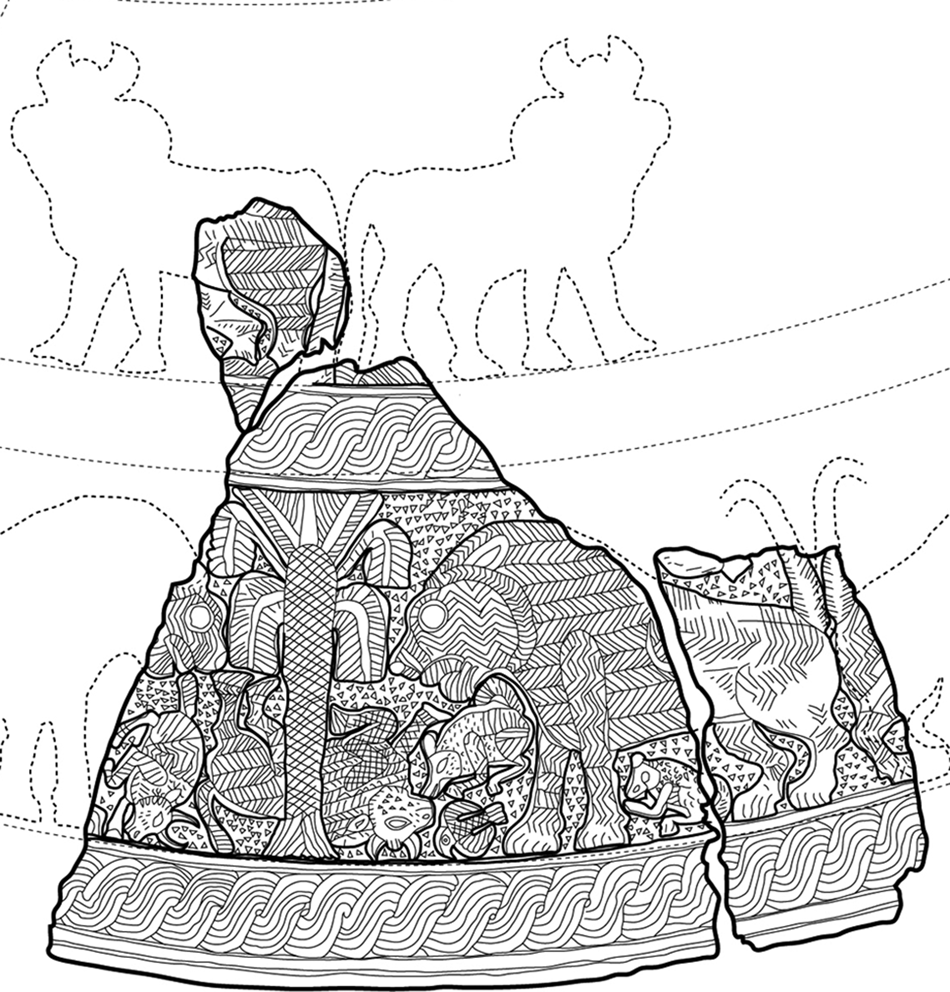
Graphic rendering of the recomposed carved surface, detail.
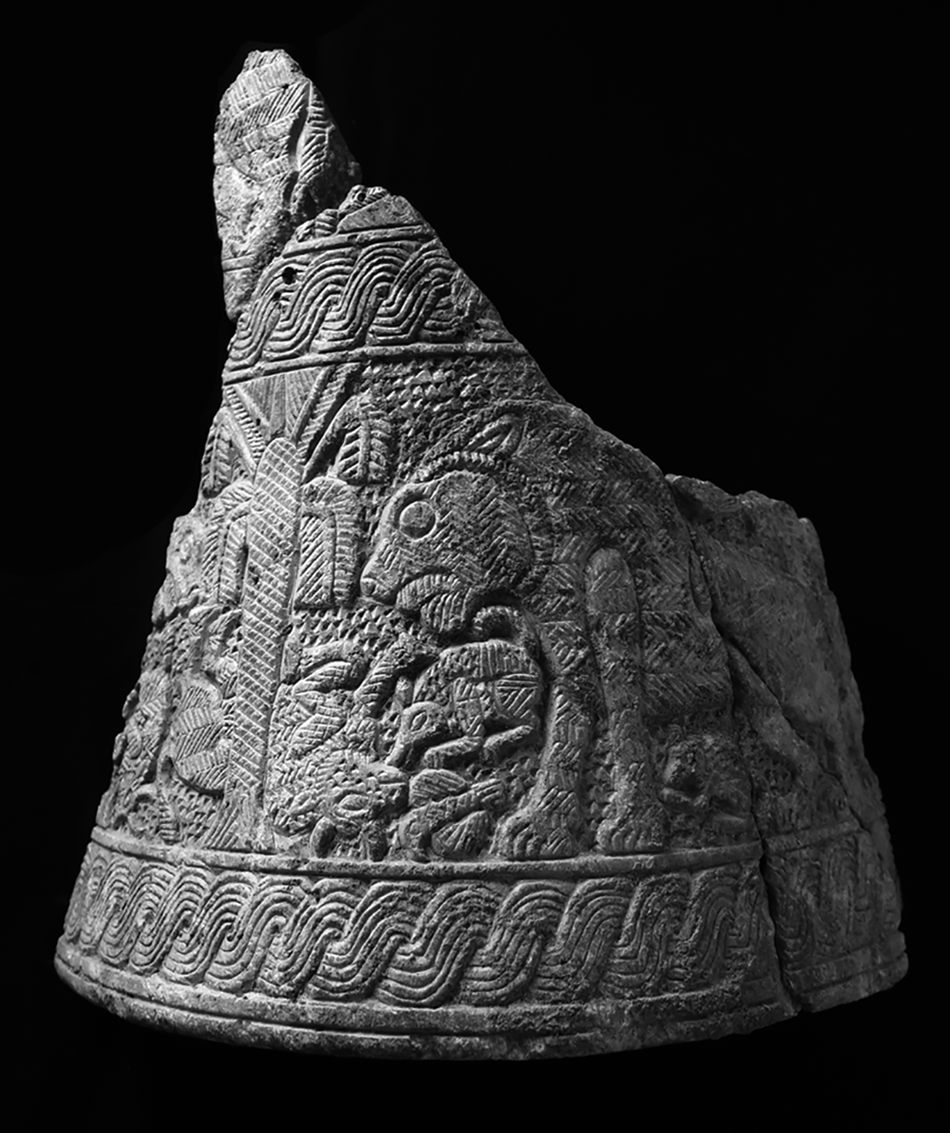
The three re-fitted shards.
The stone vessel is remarkable for its size, the intricacy of low-relief patterns, and in particular for its iconography. In the lower register, this features a crowded interaction between not less than four kinds of animals, gathered under a date palm—lions, bovines, vultures, and what we shall see are very likely hyenas—in a context of scavenging, while the more fragmentary upper register demonstrates the presence of at least a pair of bovines, in a symmetrical heraldic context.
Some theoretical approaches to animal imagery
‘Archaeological investigation continually confronts us with material contexts that show in no uncertain terms that people in the past classified animals in a myriad of ways different from those of the modern world’ (Boyd Reference Boyd2017, 300). Given this, archaeological analysis requires multiple, shifting classifications, converging from different viewpoints (Serjeantson Reference Serjeantson and Rowley-Conwy2000). Animal symbolism (Ryan & Crabtree 2015) may be considered as a widespread form of animal exploitation, largely inspired, of course, by banal anthropocentric concerns. In this regard, Boyd (Reference Boyd2017, 302) argues that, until two decades ago,
there was a feeling that anthropocentrism was not really an epistemic problem for anthropology because its fundamental object of study is/was the human. Nonhuman animals were of interest to cultural anthropologists insofar as they were instrumental to spheres of human practice such as rituals, as perceived components of human cosmologies, as symbols, etc.
At present, in contrast, there is a trend in anthropology to consider animals not simply as dependent objects, but rather as complex causative agents, encouraged by the fact that in the wider and crucial spheres of Anthropocene geopolitics and planetary ecology, human–non-human animal relationships are now core issues of discussion. Admittedly, when dealing with semantic systems extinguished 4000 years ago, any claim of confidently dismissing anthropocentrism on the part of the human actors would be unrealistic, and also of little use. And any post-processual social zooarchaeology (i.e. the investigation of the archaeological record from the viewpoint of the reflexive relationship between ideas on the animal worlds and social strategies), animal agency issue, or relativistic zoontology would risk remaining as anthropocentric as the most deterministic research based on statistics concerning prehistoric exploitation of animals for meat.
The current case study suggests, however, that in early complex societies, the conception and representation of animals was not limited to simplistic anthropocentric views. The Halil Rud carved artefacts, in fact, show many complex scenes of wild animals scavenging the carcasses of domestic ones. Here, neither the scavenger nor carcasses of animals are depicted as sources of human food, since both of these were and still are despised for such purposes. Nor are they shown as static icons, conveying the usual prestige implications. Instead, the image of the scavenger is that of an agent species, and it could be true that for us, who care to study such iconography,
the interaction between different species links us back to the pre-postmodern moment in anthropology, when animals and plants were central elements of ethnographic research, when cattle, coral gardens, rice cultivation, and so on were thoroughly embedded and attended to in almost every major anthropological monograph. (Smart Reference Smart2014, 4)
Perhaps this pre-postmodern perspective could help us understand the social dynamics of an early Bronze age polity, from which we have as yet no readable texts. What were the effects of these images in the cognitive and psychological processes of the intended viewers, embedded in urban elites? The aim of this study is, then, to investigate the potential meanings behind such a distinctive set of iconographic choices, recurring in the repertory of the most important early Bronze age cultural complex of southeastern Iran, but completely unknown in other contemporary civilizations (see this and similar issues posited in McMahon Reference McMahon2016, 178).
Description of the imagery
None of the animal protagonists of the subject Jiroft vessel have any evident sexual characterization, suggesting that rather than being of interest for their individual sexual roles, they may have been viewed as interacting species. On the other hand, the representation of these bovine, feline and other creatures leaves open the possibility that they could all be female. The uncertainty is intriguing: our current research, in fact, has documented instances where the Halil Rud sculptors clearly took pains to represent male and female specimens, particularly when showing herds or groups. Other considerations are that animals are often shown on chlorite in crouched position, negating the distinction of sex; lions are very rarely shown with male organs (the presence or absence of a mane is not indicative, given that male Asiatic lions lack the full mane of their African cousins); cheetahs/leopards are never portrayed with sexual attributes; bulls may be shown with large organs, but mostly when in prominent positions and while emitting powerful water flows, which might suggest their powers of fertility. Animal carcasses are never shown with penises. Given these considerations, in our own following discussion we intentionally use ‘lions’, ‘bovines’ and other animal names without suggestion of sex.
The larger fragment of the subject vessel shows the forequarters of a large lion and the head with open jaws (Fig. 4). The entire forequarters are covered with horizontal bands of alternating oblique segments, while the legs and the muzzle bear zig-zag lines. The head, seen in profile, is animated by a large round eye, pointed ear and a narrow crescent indicating the mane. The lion stands facing a palm with four bunches of dates; behind the trunk of the palm is a bovine lying supine with upturned legs—apparently dead (Fig. 5).
(4, right) The central part of the fragmentary vase: lion attacking or scavenging a dead bovine, accompanied by other animals; (5, left) Left side of the fragmentary vase: detail of a second dead bovine under a date-palm.
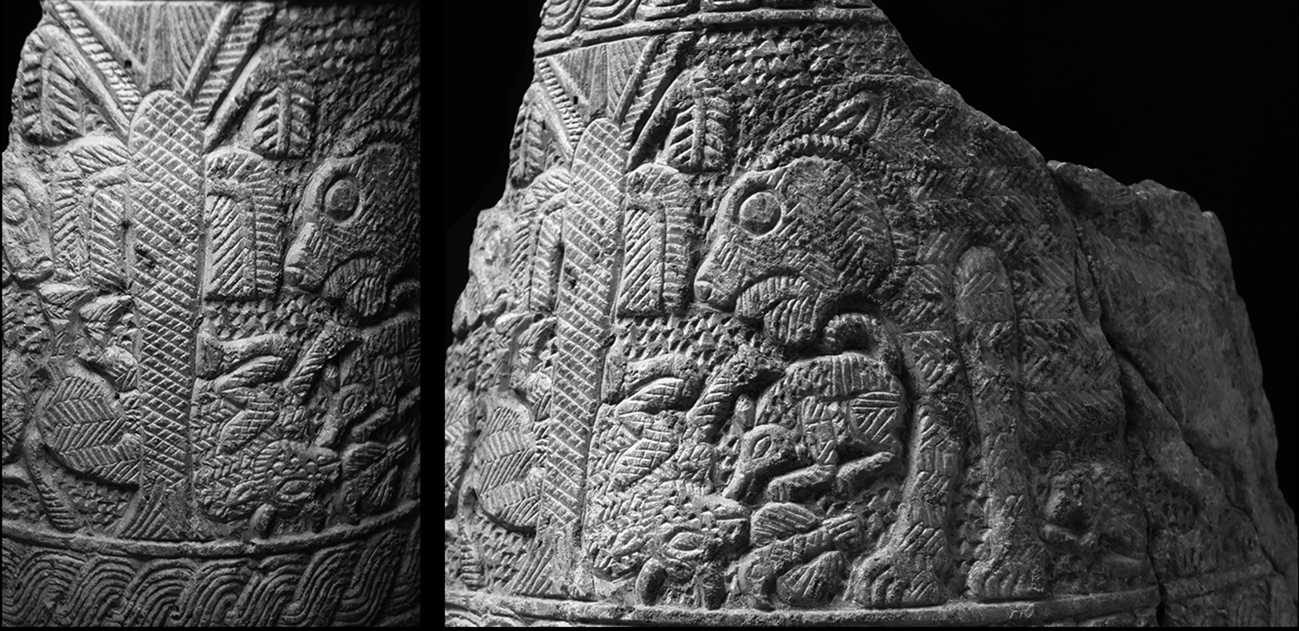
The space between the feline and its prey is occupied by a smaller carnivore which crouches to bite the throat of the bovine, and which, as we shall soon demonstrate, can be identified as a hyena (Fig. 6). Another similar creature, still smaller, appears in a similar position between the legs of the lion (Fig. 7). Although the poorer preservation of this smaller carved figure hinders identification, this could be a cub of the same carnivore species. A small raptor, wings tucked in diving position, arrives below the larger carnivore, very near the head of the dead bovine (Fig. 6, bottom). Of another raptor, carved above the back of the feline, only the tail and parts of a wing survive. On the side of the palm opposite the first lion/lioness, there appears the head of another (Fig. 8), at the same height as the first, which seems to bite the tail of a smaller bovine, shown in the peculiar position of a headstand (Fig. 9).
Detail of a carnivore, identified as a hyena (see text), scavenging the larger dead bovine.
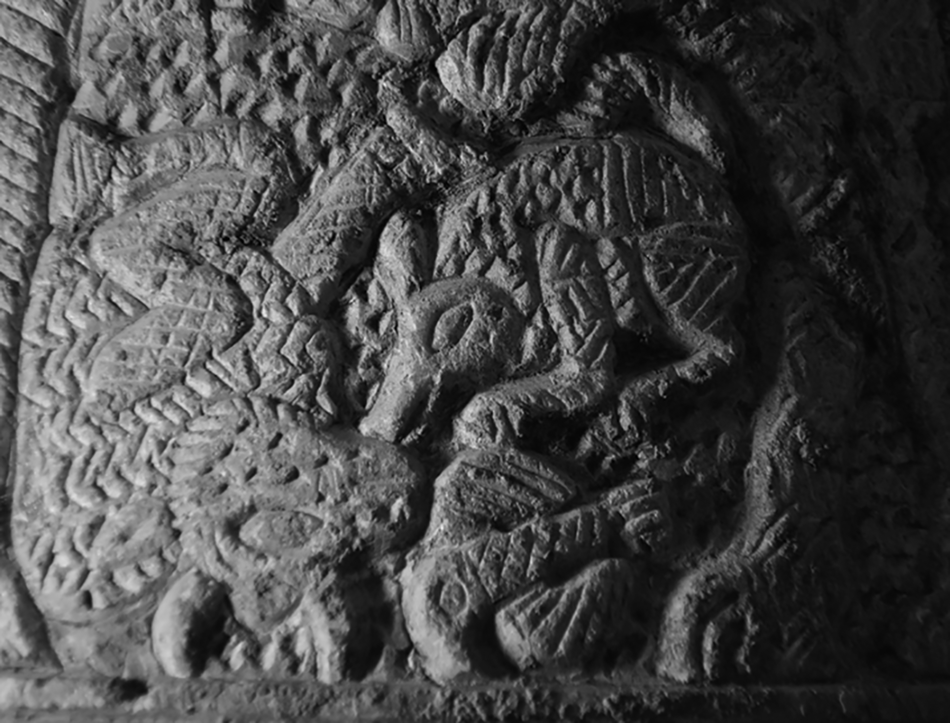
Detail of a smaller animal under the belly of the lion, possibly a hyena cub(?).
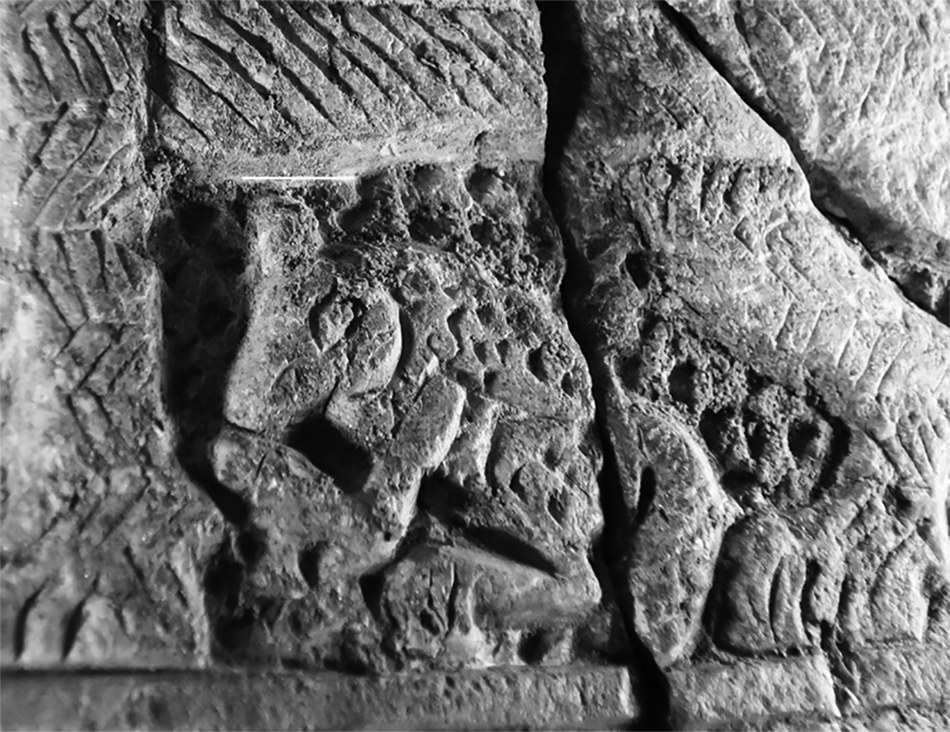
Detail of the head of a second lion in symmetric setting beside the palm. The mouth bites the tail of a second upturned bovine.
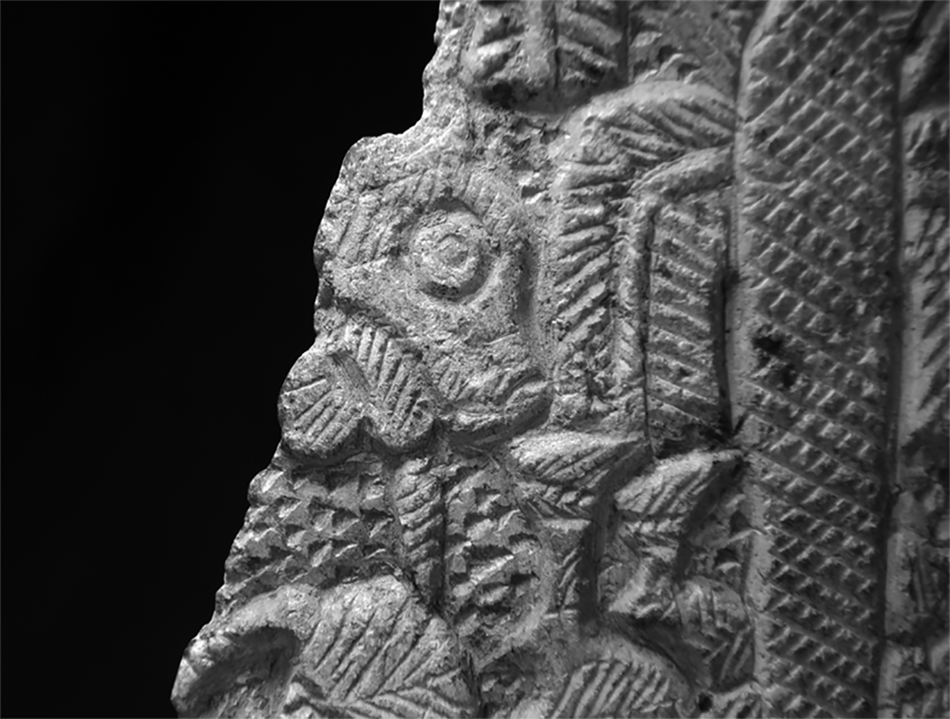
Detail of the second smaller upturned bovine, attacked by the second lion.
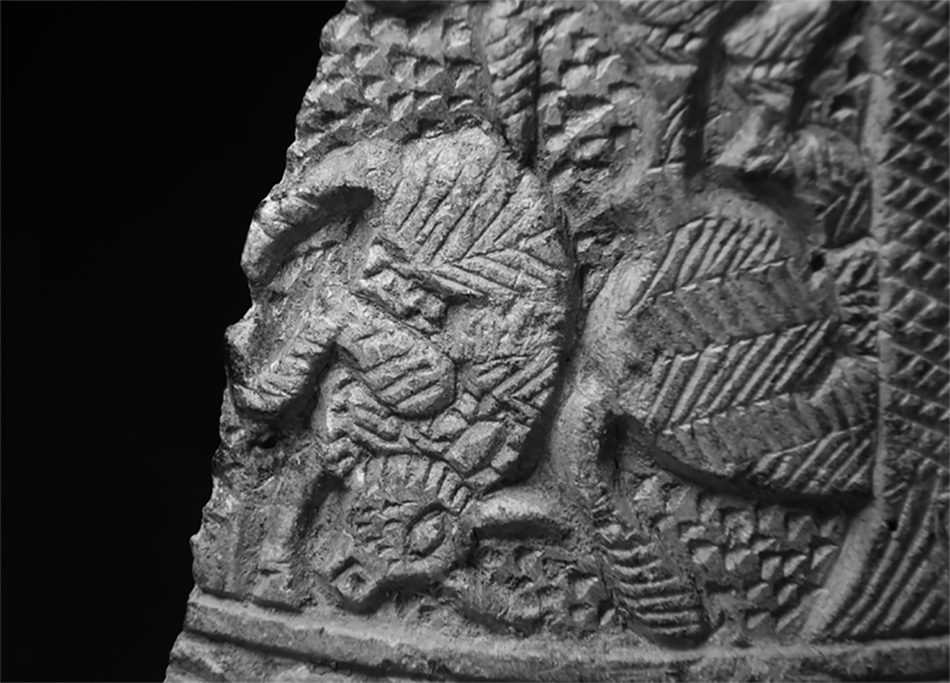
A smaller fragment completes the body of the first lion, adding part of an erect tail, and shows enough of the rear quarters and tail of another animal to conclude that the frieze probably continued with another symmetrical lion. The third and uppermost shard (Figs 2 & 10) shows that the upper frieze, now lost, featured one or more couples of undisturbed bovines in a heraldic posture, perhaps as a prequel to the events below.
The third fragment, joined at the upper left corner, indicates the presence of two other bulls, probably in symmetric/heraldic position (as reconstructed in Figure 2).
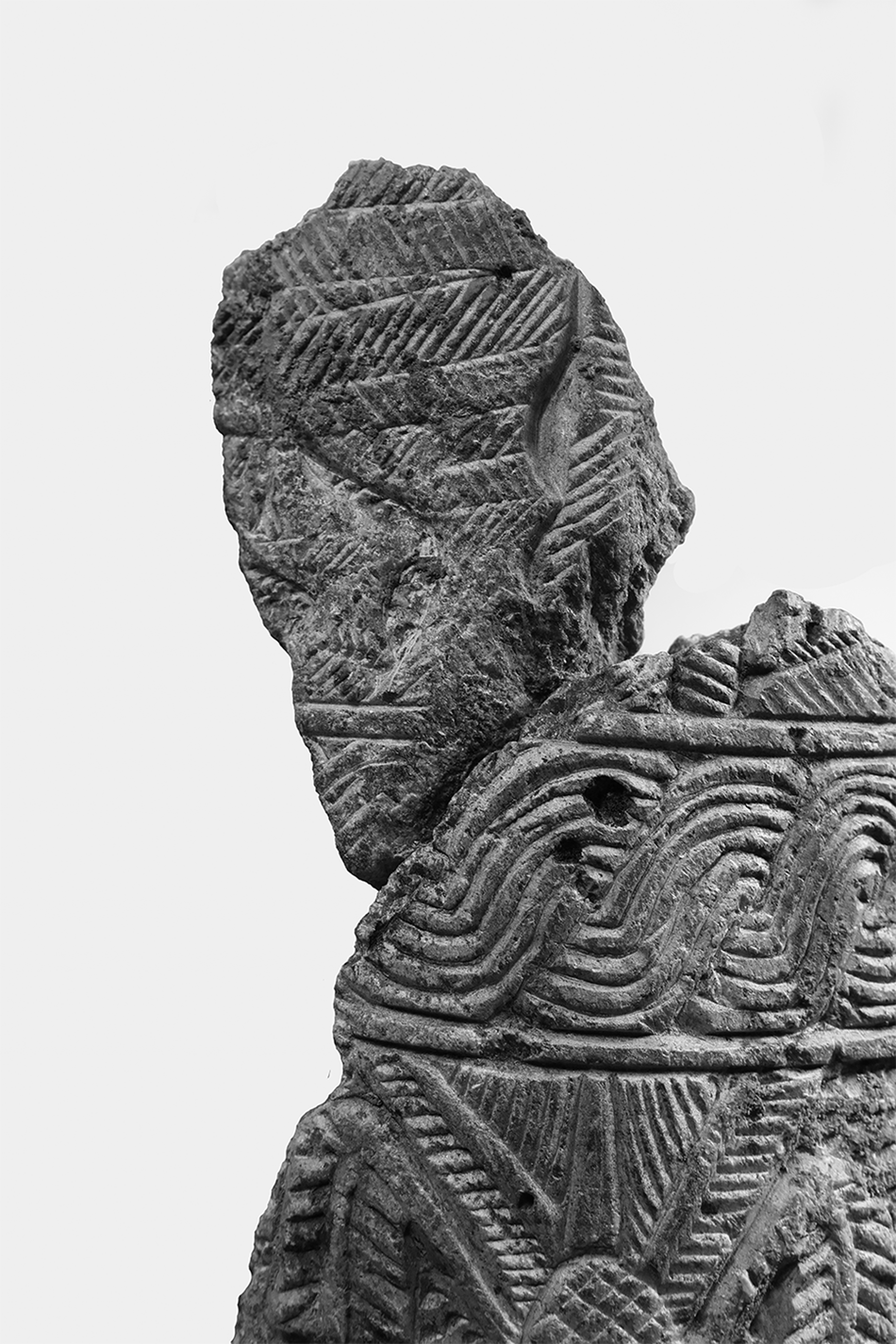
There are no coloured inlays, and the background of all fragments is densely filled by dots worked with a pointed tool.Footnote 3 The lower frieze clearly represents a scene of three kinds of animals engaged in the killing of bovines or scavenging of their carcasses. While the dimensions of the prey would rule out any other actor as the authors of the kill, it is impossible to understand if the lions are indeed responsible, or just opportunistic actors.
Previous studies have not provided specific comment on images of this kind, even though our survey has found publication of at least 14 different chlorite artefacts (Table 1) dealing in similar subject matter. The rest of this paper discusses the zoological identities and possible symbolism of the actors involved in the scenes of this particular vessel.
A list of all known animal scavenging scenes on carved chlorite vessels of the Halil Rud tradition, with bibliographic references. NI: not identified.
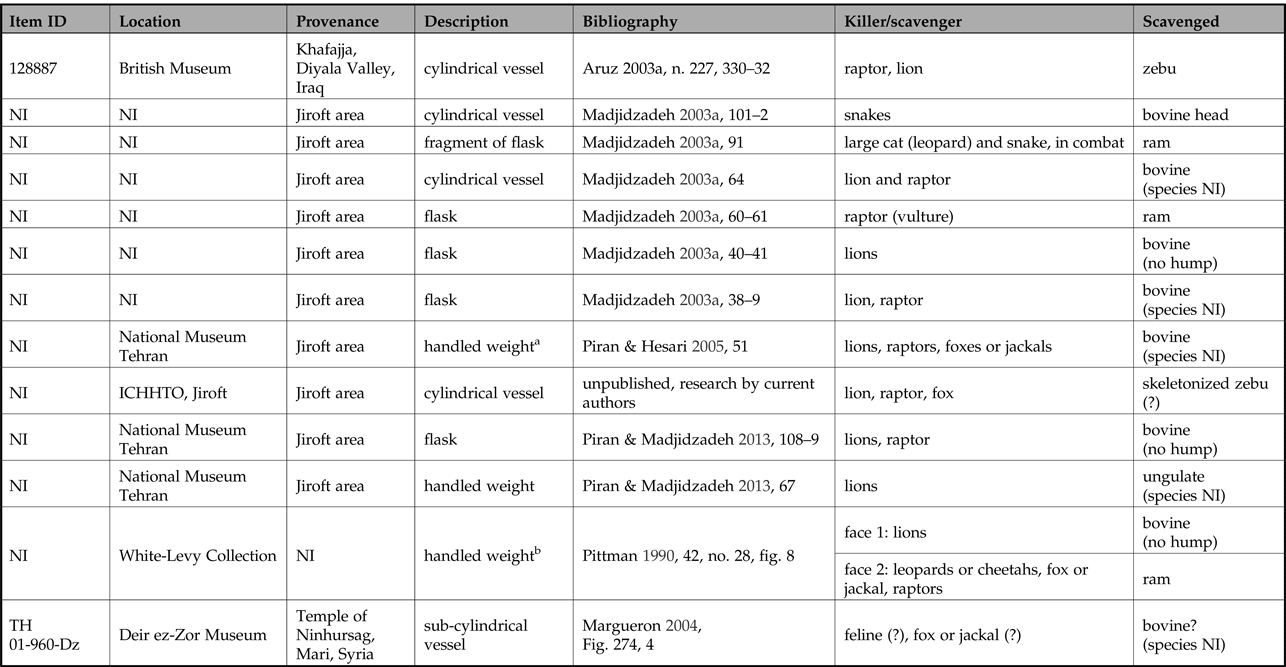
a A modern forgery, according to Muscarella (Reference Muscarella1993, 151), but we question this opinion.
b Also considered a modern forgery by Muscarella (Reference Muscarella1993, 151) and, again, we disagree.
Techniques of execution
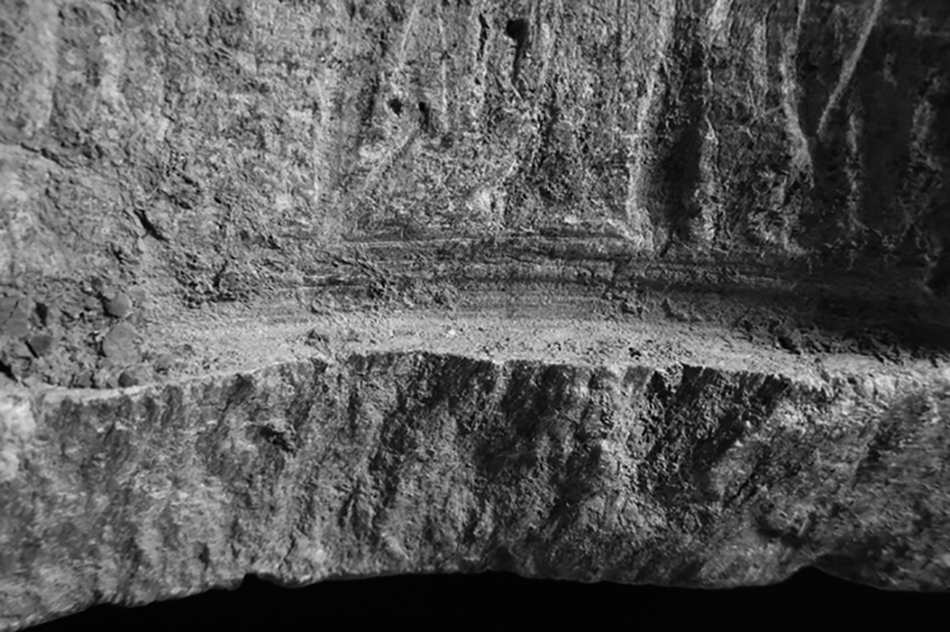
The surfaces of the vessel fragments bear evidence of the techniques of fabrication. The interior remains rough, which is a unique case among vessels of the Halil Rud corpus. From this observation, and considering the relatively thin vessel walls, it would appear the vessel broke before the stage of finishing the interior. Observation by the naked eye reveals the use of different specialized tools. The interior (Fig. 11) retains a dense tracery of shallow gouges left by a relatively large chisel, slanted both laterally and into the thickness of the stone as the work proceeded. The inner bottom edges of the fragments show signs of a rotating device, probably left by a gouge operated by hand in a rotating motion (Fig. 12). The outer surfaces show traces of work using different tools: a fine-bladed flat chisel (e.g. for textured detailing of the lion's head: Fig. 8); a pointed tool, used to remove triangular chips from backgrounds and other areas (e.g. surrounding the lion's head: Fig. 8); and most likely another chisel with a curved blade (e.g. for the mouth and possibly brow/muzzle of the same lion's head).
Detail of the rough interior of the fragmented vessel.
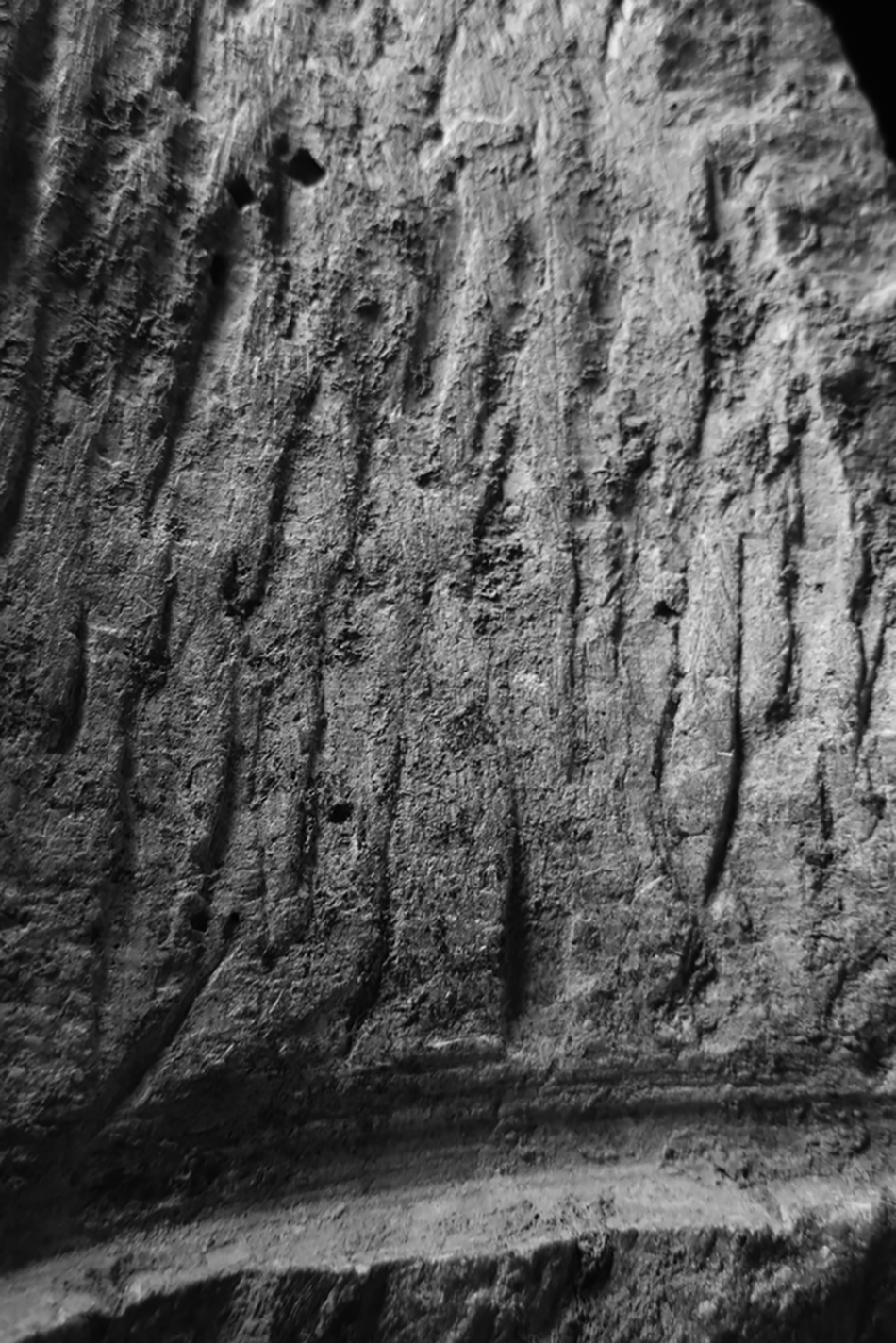
Detail of the rough interior of the fragmented vessel: trace left by a large rotating gouge.
The artisanal equipment for the final stages of execution of this particular piece therefore included not less than five different tools. Neither our own research nor the bibliographic sources have provided other exemplars of chlorite works with the pecked background seen in these fragments. This, with the scarce polishing of the outer surfaces, strengthens the supposition of a failure towards the final stages of execution. In view of the lack of the pecked effect on other known pieces, it seems probable that the next stages of the work would have involved lowering and finely polishing these areas, and further finishing of the interior, perhaps by operators of different skill levels, but that a breakage caused abandonment before these steps could be executed. All these observations and assumptions would imply a well-endowed workshop, operating with more than the five tools used in these early steps of execution, and possibly with two or more levels of skilled artisans.
Previous interpretations of the Halil Rud chlorite artefact imagery
Although there has been great interest in southeastern Iranian carved chlorite artefacts over the past 50 years,Footnote 4 there have been few attempts at interpreting their abundant iconographic content in any kind of coherent framework. Until recently, the paradigm conception of the ‘intercultural style’ vessels had directed research and iconographic interpretation towards only the most generic and readily apparent readings, potentially shared by the different cultures across all the regions of distribution, rather than seeking their significance with respect to the social contexts of origin.
D. Potts (Reference Potts1978) searched for religious inspirations in the chlorite artefacts, stressing that that scholars should not be ‘mesmerised’ by the sole interests of production and exchange (D. Potts Reference Potts1978, 481–2). He considered the possibility that some of the carved signs and representations could be ‘divine emblems’ of different Mesopotamian divinities, such as rosettes or solar signs, associated with the sun-god Utu; the ibex with Enki; dogs with Nininsina; while the lion-headed bird would be associated with Ningirsu-Ninurta.
C.C. Lamberg-Karlovsky (Reference Lamberg-Karlovsky1988) attempted the first holistic quantitative analysis, by means of counts of the motifs recognized at the time and their associations with one another and the different object types. The analyses suggested the existence of two main ‘iconographic clusters’: the hut or temple-façade motif (door with a curved lintel) and snakes in combat. He proposed that the repertory of images was associated with beliefs and behaviours involving death and burial. The analyses did not mention the iconography of predator/scavenger scenes.
S. Winkelmann applied a similar analytical approach. Intuitively, she identified 17 basic iconographic associations, among them: eagle on a tree; lions/snakes flanking a tree; feline/snake attacking hoofed animal; bird of prey landing on hoofed animal. She then argued that the ‘hoofed animal with bird of prey’ would be the narrative embryo of a broader story of the ‘hoofed animal killed by a lion with diving bird of prey’, or more specifically a ‘diving vulture’ (Winkelmann Reference Winkelmann, Franke Vogt and Weisshaar2005, 187), and reasoning rather freely that all 17 associations would pertain to a single ‘intercultural myth’ shared from Mesopotamia to Iran and South Central Asia, eventually emerging in written form as the celebrated Old Babylonian myth of Etana (Hess & Streck Reference Hess and Streck2009; Kinnier Wilson Reference Kinnier Wilson1985).
Perrot and Madjidzadeh (Reference Pereira, Owen-Smith and Moleón2005; Reference Perrot and Madjidzadeh2006) proposed that single elements of the Jiroft iconographic repertoire composed an overall semantic system, and that each would have certain associations, with some being inspired by aspects of the local environment (mountains, water), another representing a ‘transcendental portal’, and others serving as totemic symbols.
The representations of the various animals would be expressions of their qualities in a cultural view, in terms either of positive forces (e.g. zebu = strength; ibex = agility; lion = regal) or negative ones, represented by creatures such as snakes, scorpions and a small scavenging raptor (Perrot & Madjidzadeh Reference Perrot and Madjidzadeh2005, 144). The entire semantic system would have served in a funerary context. Surveying this entire system, the same authors remarked that although one can propose various interpretations of the images, their deepest meanings would remain elusive (Perrot & Madjidzadeh Reference Perrot and Madjidzadeh2006, 108). Still, their sense was that the semantic core of the Jiroft iconography was the search of a human order over nature (Perrot & Madjidzadeh Reference Perrot and Madjidzadeh2005, 146), or the generic contrast between life and death, culture and nature. Finally, this opposition would have been the basis for the later dualism of Iranian religions.
More recently, H.-P. Francfort (Reference Francfort, Meyer, Vila, Mashkour, Casanova and Vallet2020) recognized a less systemic iconography of ‘elementary life and death cycles’, featuring lethal predators (felines, scorpions, raptors) composed in ‘groups of death’, who kill and/or feed on ungulates turned upside down, with the scavenger birds being vultures.Footnote 5 The ‘groups of life’ are instead composed of a being of human appearance, kneeling or seating on a zebu and holding flows of water, associated with sun and crescent-moon emblems and often trees.Footnote 6 The deeper meanings of this fundamental opposition are not further explored.
M. Vidale (Reference Vidale2015; Reference Vidale2017), one of the present authors, has previously tried to relate the potential significance of the hut or temple-façade motif, the probable motif of a rainbow, and some specific depictions of multiple actors, to parts of an archaic Iranian version of the flood myth (see Lambert Reference Lambert1965; Lambert & Millard Reference Lambert and Millard1969), an association that could also account for the presence, on many chlorite objects, of palm trees loaded with bunches of dates. Moreover, similarly to Winkelmann, Vidale (Reference Vidale2015) recognizes a part of the Etana myth, in which the eagle hides in a carcass in search of revenge on the snake, as originating in one or more Iranian narratives involving scavenging animals.
The vessel: discussion of the animal imagery
Bovines
The smaller bovine, at the left of the main fragment, is sculpted with a plump body incised with an irregular patchwork of lines. As previously noted, the up-ended orientation of the body and the attitude of the lion above clearly communicate that the animal is either carcass or prey. The features are insufficient to suggest whether this small bovine, with horns but no hump, could be a juvenile of the larger one or a separate species.
The larger animal, behind the palm tree, is sculpted with one of its legs crumpled, probably communicating a violent death. The body is covered by horizontal bands of diagonal lines, similar to those incised on the felines, but the legs are cross-hatched. Although the detail of the back is interrupted by the palm trunk, the contour immediately to the rear of the head suggests a hump, probably communicating that this is a Bos indicus, the Indian zebu, a frequent subject in chlorite iconography. Of the 13 dead upturned animals observed on other chlorite artefacts (Table 1), nine are bovines, but often the depiction is limited to the severed head, prohibiting identification of species. Two are depicted with humps, similarly confirming the identification of Bos indicus.
In view of the chlorite iconography, Perrot and Madjidzadeh (Reference Perrot and Madjidzadeh2006, 104) had proposed that the residents of the Halil Rud basin and highlands of the third millennium bc would have shared these territories with populations of wild zebus, but recent genetic studies (Chen et al. Reference Chen, Lin and Baig2010) indicate that this was quite unlikely. The evidence is that in the Indus valley, the wild South Asian auroch, Bos primigenius namadicus, had instead already given way to herds of domestic Bos indicus between 6000 and 5000 bp. From here, domestic herding then progressively displaced the wild populations through Baluchistan and Makran, ensuring ample time for occupation of the Halil valley well before the third millennium bc.
Lions
The body of the right-hand big cat rises in dynamic lines from the rear haunches, in low relief covered completely in bands of diagonal lines, arriving at the ruff and details of nose and mouth, which frame a large, dilated eye (Fig. 4). The almost hypnotic total effect achieved by this technique is still present in the second cat, even though surviving only as the eye and part of the head. The short, thin mane of the lion leaves the ear in full sight, as is typical of southwest Asian populations. The recurved erect tail, in contrast, is a non-realistic detail seen frequently in the work of the Halil Rud stone carvers, possibly as a space-filling expedient (Perrot & Madjidzadeh Reference Perrot and Madjidzadeh2005).
The subspecies of the Asiatic/South Asian lion (Panthera leo persica) colonized these regions sometime between 100,000 bp and 20,000 bp (Kitchener et al. Reference Kitchener, Breitenmoser-Würsten, Eizirik, Gentry, Werdelin, Wilting and Yamaguchi2017, 72–3; Nowell & Jackson Reference Nowell and Jackson1996, 37). As late as the nineteenth century these felines could still be found from Iraq to eastern India and as far north as Greece; however, the last occurrence in Iran dates to 1942, and the subspecies now survives only in Gir National Wildlife Sanctuary, Gujarat, India.
In the first half of the twentieth century, Pocock (Reference Pocock1939, 222) reported the Gujarat lions feeding on wild buffaloes, but equally on livestock attacked in the night, near farms. In 1996, Nowell and Jackson estimated that herders were bringing up to 20,000 head of cattle into the sanctuary during peak season, and that these were now the lions’ primary source of both kills and carcasses. The ecology of the Halil Rud environment in the third millennium bc is not yet fully known; however, the identification of at least some of the bovines of subject vessel and the bibliographic reports convey a certain frequency of attacks on domestic animals, and thus the coexistence of man and beast in a substantially anthropized environment.
A. McMahon (Reference McMahon2016, 178) poignantly portrays the almost universal human perceptions of the lion: ‘They move smoothly and beautifully, they are efficient and powerful hunters, their roar is frightening but thrilling, they inspire fear, respect and awe.’ McMahon (Reference McMahon2009, 111) also makes clear, however, that there can be contrasting iconographic meanings: ‘Lions are paradoxically the equal and the opposite of kings; they are the only creatures powerful enough to be considered worthy opponents of kings, yet they are wild and vicious as contrasted with the kings’ reliable strength, protective abilities and place in civilization.’
Hyenas
The second carnivore species, with pointed muzzle and upraised ears, such as potentially to represent some kind of canid, can be much better understood as a member of the Hyaenidae family, neither dog nor cat (AbiSaid & Dloniak Reference AbiSaid and Dloniak2015), and specifically as the Asian striped hyena. The foxes and jackals of the Canidae can be excluded, since the current convention is that these are depicted on the Halil valley works with much more slender form and gracile posture (e.g. Fig. 13 a,b).Footnote 7 The other convincing factor is the aggressively hunched posture of the carnivores on the subject vessel, particularly for the one on the left (Fig. 6), which compares extremely well with the typical posture, features and even colouration of the Asian striped hyena (compare Fig. 13 c & d): robust body, substantially larger than the head; large erect ears, furry tail; stripes on the legs, haunches and abdomen.
(a, b) Wild canids portrayed on other chlorite vessels (a, accompanied by a small raptor, from an unpublished vessel of the Jiroft Museum collection; b, from Piran & Hesari Reference Piran and Hesari2005, 51); (c) The carnivore on the fragmentary vessel discussed in this article, also accompanied by a small raptor. The carnivore may be compared with the striped hyena illustrated in (d) (from Habibi Reference Habibi2004, 67): note the close similarity of muzzle and ears, and particularly of the stripes on the legs and on the rear, while the forepart of the fur is almost blank.
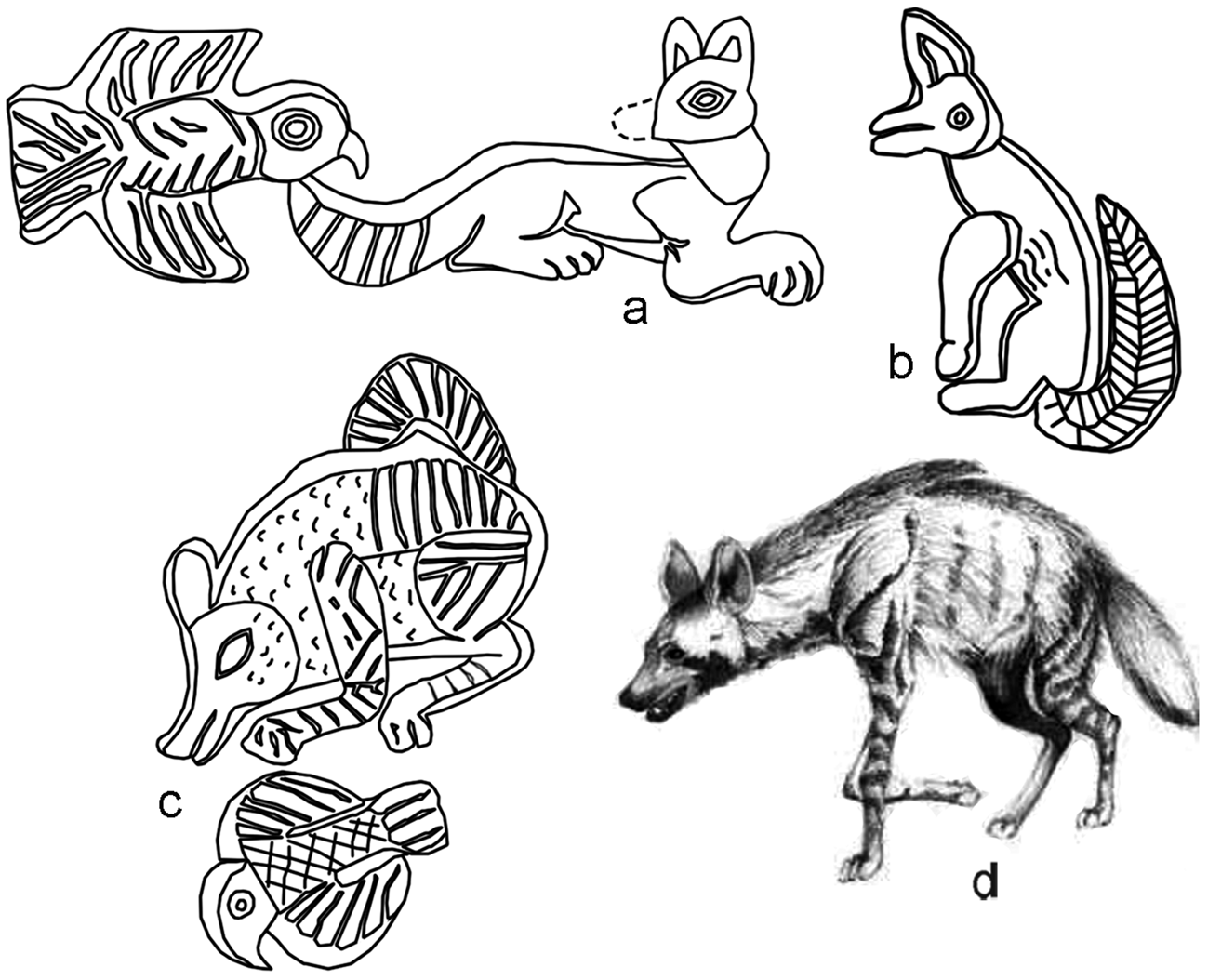
The detail of the almond-shaped eye seems potentially anomalous, since in the known art of the chlorite objects, carnivores are always observed with large round eyes, while the herbivores are shown with the almond shape. However, hyenas, like foxes and jackals, will also willingly eat fruit and vegetables, meaning they are omnivorous carnivores, whereas the lion and raptors, both shown with the round eyes, are exclusively carnivorous.
Although the striped hyena is native to a very wide range, from North Africa to the Caucasus and the Indian subcontinent, their nocturnal habits and current low population densities have contributed to making them the least studied of the Hyaenidae. This species, smaller than the brown and spotted hyenas, survives nowadays in peripheral regions of Israel and the Middle East, Afghanistan, Baluchistan, southern Punjab, Cholistan and Sindh (Frembgen Reference Frembgen1998). Known as kaftār in Persian, it was still common in Iran through the nineteenth century, and sighted as late as 1933 near large cities like Tehran. It is now rare in the north but remains relatively more common along the Persian Gulf (Anderson Reference Anderson2012). According to Monchot and Mashkour (Reference Monchot and Mashkour2010), it may still be encountered in marginal niches of the Halil valley. In spite of the anthropization of the entire Iranian region, there are no reports of attacks on humans.
In Africa, striped hyenas scavenge the carcasses of large and medium-sized ungulates, including zebras, gazelles and impalas, and also eat fruit, insects, birds, hares, rodents and reptiles (Howard Reference Howard1999). At present, in the Gir Wildlife Sanctuary of Gujarat, ‘the availability of safe refuge, with human and livestock presence (alternative food from carcasses by natural causes and by predators) may govern their population’ (Shamshad Alam et al. Reference Shamshad Alam, Akhtar Khan and Pathak2015, 37). A study specifically on the current feeding habits of striped hyenas in Kutch, Gujarat (Bopanna Reference Bopanna2013), finds that in the moderately anthropized rural environment hyenas are opportunistic predators and scavengers. Here, more than 50 per cent of their diet consists of vertebrate meat, of which the carcasses of domestic cattle, goats and sheep comprise the main part, followed by those of dogs and jackals. The remaining diet of this population consists of a wide range of vertebrate and invertebrate prey and vegetal foods (Bopanna Reference Bopanna2013, 95). Monchot and Mashkour (Reference Monchot and Mashkour2010, 17) add that ‘their behavioral adaptations are directly connected to modifications in their environment, such that it may be considered as a commensal animal associated with human activities’.
Habibi (Reference Habibi2004, 68) reports that in recent decades, ‘Hyenas are trapped by professional hunters in Kandahar, from their dens and forced to fight dogs, with tails tied to a pole or peg. However, they are released after being kept in captivity for a short period of time.’ Similar practices are reported across western and southern Asia, where striped hyenas are generally considered as creatures of the night, incarnations of jiins, vehicle of wizards and witches, and mystically powerful creatures. All bodily parts, but in particular the sexual organs and excrements, are ingredients of a variety of practices connected with love magic, sexuality, fertility and warding off evil (Frembgen Reference Frembgen1998).
Vultures
In general, the anatomical rendering of the raptors on chlorite artworks is highly stylized, lacking indicators for distinction at the level of species, which might include any of the hawks, eagles, kites, or at least nine species of griffons and vultures endemic to the Iranian Plateau.
The only exception is the ‘beard’ of the vulture Gypaetus barbatus, in reality the tuft of feathers that falls over the beak in adult individuals:Footnote 8 this detail is easily recognizable on a number of carved chlorite artworks. A study by Margalida et al. (Reference Margalida, Bertran and Heredia2009) on the diet of the bearded vulture in the Spanish Pyrenees showed that it was based on mammals (93 per cent), among which medium-sized ungulates (mainly sheep/goats) were most important (61 per cent of mammal remains). Surveys on Gypaetus barbatus and three other species of vultures in the Caucasus of Azerbaijan (Karimov and Guliyev Reference Karimov and Guliyev2017) showed that while the others fed on a variable range of domesticated and wild animals, bearded vultures ate the carcasses of the Dagestan tur Capra cylindricornis in 44–53 per cent of cases. Some of the carcasses were from dead kids, others from the kills of grey wolves or of trophy hunters, who left the unwanted bodies. In short, bearded vultures are strongly oriented to scavenging the carcasses of capriovines, a behaviour reflected in the scenes of the Halil Rud artefacts where birds of prey dive on carcasses of sheep or goats (Table 1).
The vultures’ feeding habits, in any case, like those of striped hyenas, appear deeply affected and modified by anthropogenic factors (see also Martin-Díaz et al. Reference Martin-Díaz, Cortés-Avizanda, Serrano, Arrondo, Sánchez-Zapata and Donázar2020).
Food web interconnection and hierarchy
Beginning in the early–middle Holocene, ‘domestic ungulates became a major food source for vultures and other carrion eaters in many regions’ (Moleón et al. Reference Moleón, Sánchez-Zapata, Margalida, Carrete, Owen-Smith and Donázar2014, 397). Intensification of herd management and domestic animal consumption in territories of early south Eurasian demographic concentration would have dramatically increased the supply of carcasses, providing an ‘anthropogenic subsidy’ to the primary scavengers and thereby deeply altering their specific ecological niches and thus the entire complex of interactions between humans and the other local species of big cats, raptors, hyenas, wild canids and secondary scavengers. In more arid peripheral landscapes, domesticated animals would have suffered a higher death rate due to climatic crises, malnutrition and related diseases,Footnote 9 with different effects compared to those in other areas.
Among humans of the Bronze Age, as today, it would be the shepherds and communities of specialized herders that would be the direct witnesses of the important role of the primary scavengers (Morales-Reyes et al. Reference Morales-Reyes, Martín-López and Moleón2019). As stated by McMahon (Reference McMahon2016, 180, 181),
Against the spread of humans and the sprawl of cities, animals are usually the losers. But vultures uniquely may have welcomed and thrived on the spread of humans and the expansion of cities, with their increased volume of organic rubbish, especially discard of dead draught animals and unused post-butchery carcass elements… The visual image of their associations with dead animals may have both reflected and invoked a mental image of the high value of their services.
As we have seen, however, vultures are and were not the only scavengers, and the same patterns likely held true for lions, hyenas and other smaller carnivore-scavengers. Animal deaths and the ensuing disposal patterns would have triggered foci of dynamic transformation involving multiple ecological actors, beginning with intense competition among vertebrate competitors for the nutrients in carrion and descending through the food chain of the invertebrates, microbial agents and finally the in situ vegetation. Vertebrate scavengers could also consume the lower-level invertebrates and microbes present in carrion; however, the ecological relations involving carrion should not be viewed as strictly hierarchical, since the transformations in populations and roles of a species would extend into the general ecosystem in a myriad of ways (Devault et. al. Reference DeVault, Beasley, Olson, Moleón, Carrete, Margalida, Sánchez-Zapata, Şekercioğlu, Wenny and Whelan2016).
No wonder, then, that the development of complex villages and then early urban societies was also a period in which ‘spiritual, religious, and aesthetic values inspired by scavengers flourished worldwide’ (Moléon et al. Reference Moleón, Sánchez-Zapata, Margalida, Carrete, Owen-Smith and Donázar2014, 397; see McMahon Reference McMahon2009; Reference McMahon2016), to the extent that, in a particular ecological community, ‘The decline of vultures … could lead to the loss of these ancient cultural and spiritual services’ (Devault et al. Reference DeVault, Beasley, Olson, Moleón, Carrete, Margalida, Sánchez-Zapata, Şekercioğlu, Wenny and Whelan2016, 246).
According to Steinbeiser et al. (Reference Steinbeiser, Wawrzynowski, Ramos and Olson2018, 30), ’The presence of scavengers and the occurrence of predator effects could be intertwined … vertebrate scavengers maintain their roles as predators even while engaged in the search for carrion. From the perspective of prey species near a carcass, an influx of scavengers could therefore enhance predation’. In short, the death of a larger animal triggers the temporary presence of a highly competitive trophic chain, with tangled sequences of access to the meat (Beasley et al. Reference Beasley, Olson, Devault, Benbow, Tomberlin and Tarone2015, 111–13). Today, in Africa, the dominant scavengers are lions, hyenas and vultures, which consume nearly 50 per cent of small carcasses and nearly 100 per cent for medium and large ones. Vultures are obligate scavengers, able to take very little live prey, while hyenas and lions are opportunistic predator-scavengers. All of these compete for access and dominance on carcasses within the framing context of the regional geography, with success then being further determined by seasonal climate, factors of microsite habitat such as the presence of trees, and even the time of day, all of which will favour differing group sizes of one species over the other (Beasley et al. Reference Beasley, Olson, Devault, Benbow, Tomberlin and Tarone2015, 111).
Vultures, differently from lions and hyenas, are daylight scavengers. Their advantage over lions is the speed with which they sight carcasses from air, exploiting hot air currents not available at night. They thus have carrion encounter rates much higher than their terrestrial competitors, and are often the initial consumers of carcasses. Lions and hyenas, in fact, locate carcasses through the presence of columns of spiralling birds, and lions also learn about the locations from the sounds of hyenas. Vultures can also swallow and depart with carrion meat at impressive speed, having evolved highly acidic stomachs which allow them to digest even putrefied flesh without being affected in the slightest (Beasley et al. Reference Beasley, Olson, Devault, Benbow, Tomberlin and Tarone2015; De Vault et al. Reference DeVault, Beasley, Olson, Moleón, Carrete, Margalida, Sánchez-Zapata, Şekercioğlu, Wenny and Whelan2016).
The striped hyena may in some cases attack larger animals, including the young of domestic species, but mainly feed upon carcasses. After diurnal rest in underground burrows or caves, they begin solo trips in search of food in the early hours of darkness. Although their sight is relatively poor, they have the advantage of being able to scent a rotting carcass from a distance of 4 km and, compared to other carnivores, can cover great distances rapidly and without fatigue. Relying on their strong forelegs, they can dig out carrion cached by other animals (Habibi Reference Habibi2004, 67). Lions, and particularly hyenas, have anatomy suited to opening thick bones for access to their nutrient contents. Bearded vultures can do the same by dropping the bones from height onto rocks (Kane et al. Reference Kane, Healy, Guillerme, Ruxton and Jackson2017, 327–31).
Smaller carcasses are more difficult to spot by dominant scavengers and are mainly exploited by small-sized carnivores like mongooses and genets (Moleón & Sánchez-Zapata Reference Moleón and Sánchez-Zapata2015, 1007).
Once the carnivore-scavengers are present at the scene of larger carcasses, success in interspecies competition depends on group size, body size and aggressivity. Vultures, although often numerous, are necessarily respectful of the large carnivores, and obliged to stand aside. The striped hyena, if isolated or few in number, will submit to the apex predator, generally the lion, and indeed ‘lions can acquire much of their carrion through kleptoparasitism of hyena kills’ (Kane et al. Reference Kane, Healy, Guillerme, Ruxton and Jackson2017, 329).Footnote 10 Hyenas are also known to submit even to cheetahs, leopards and caracal cats (Wagner et al. Reference Wagner, Frank and Creel2008). In the case of sufficient numbers of hyenas, however, they can abandon the usual safe distance and outcompete the apex predator for the carcass (Howard Reference Howard1999). In Africa, although lions may fairly often kill hyenas, hyenas can also kill young lions. Eventually, no matter how thorough the work of the big cats at the scavenging sites, the hyena will still find food in what is left (Pereira et. al. Reference Pereira, Owen-Smith and Moleón2014).
To sum up, obliged as we are to refer to African scenarios, a reconstructed hierarchy of interacting scavengers on the Iranian Plateau of the third millennium bc would have lions at the top, followed by other big cats (leopards, cheetahs), then striped hyenas, and finally large raptors (including bearded vultures). This is precisely the same threefold hierarchy expressed through the size and spacing of the iconographic elements on our chlorite vessel: the imposing lion in centre, hyenas nearby, raptors (readily understood as vultures) aside or in the background.
Conclusions
The scope of this work does not allow probing discussion of animal symbolism throughout the cities of the Near East and Middle Asia in the third millennium bc. In a cursory review of the coeval iconography of elite burials in Mesopotamia, however, we see rows of bovines, sheep and goats, illustrating wealth and the protective role of temples. Here, carnivores attack herbivores, while vultures feed on dead enemies—presumably legitimating aggressive and revengeful violence. On the well-known door plaques of Early Dynastic times, as well as in the central frieze of the ‘standard’ of the Royal Cemetery of Ur, sheep, goats and bulls quietly proceed to slaughter for ceremonial banqueting, while the draught animals that truly served in funerals were buried in the shafts of the tombs. More interestingly, from the same royal cemetery, on various forms of harps made or adorned with metals, we find different kinds of cloven-hoofed animals, perhaps hinting at the different sound of the instruments. On these, the ungulates and other animals, along with hybrid creatures, seem to work, play and sing like humans, almost mocking them.Footnote 11 In all these instances, however, all the animals are depicted as food to be consumed or in other messages of elementary socio-political propaganda, at the most with reference to immaterial or mythical functions that have thus far been very difficult to interpret.
The scene on the new Jiroft vessel is completely different: here, in a ‘materiality with its own independent characteristics’ (Smart Reference Smart2014, 4), we see the clear portrayal of four different animal species in dynamic interaction, composing the large part of a very realistic food web. The role of humans is indirectly communicated by the setting of these interactions in a liminal location, presumably the grounds between the irrigated lands and date-palm groves ringing the city and the more natural environment beyond, meaning the intermediate zone commonly used for dumping carcasses and known as the haunt of the nearest predator-scavengers. Both the dates and the flesh of bovids are food sources provided by domesticated species, offering a metaphor of nourishment ideally radiating from settlement into the wild outer landscapes—an effective praise for the ‘civilizing’ action of early states.
Recent studies have increasingly stressed the ecological importance of the scavenging animals and their roles in structuring and stabilizing trophic systems (Kane et al. Reference Kane, Healy, Guillerme, Ruxton and Jackson2017, 324; Moleón & Sánchez-Zapata Reference Moleón and Sánchez-Zapata2015). Moreover, ‘Appreciation of the ecosystem services provided by scavengers to humanity is emerging only as vertebrate scavenger populations are more at risk than ever. Currently, vultures and opportunistic scavengers among large mammalian carnivores are widely missing or threatened around the globe’ (Moléon et al. Reference Moleón, Sánchez-Zapata, Margalida, Carrete, Owen-Smith and Donázar2014, 394).
This new Halil Rud chlorite vessel shows an exceptionally early interest in the ecological and interspecies entanglement between predators, obligate and opportunistic scavengers, domestic animal and vegetal species and their associated human populations. Moreover, the carcass, and by extension its further decomposition processes, implicitly introduces insects and microbial processes to the iconographic conception: another important shift from the narrowest anthropocentric concerns (Boyd Reference Boyd2017, 300).
The images thus illustrate a highly transformative discourse, in which human observation of their animal commensals, as they adapted to the dramatically modified environments of the fourth and third millennia bc, supported new templates and the creation of new social identities. What mattered were not the animals per se, but the relationships among the four species depicted, as well as the others only suggested. The elite of a people who regularly observed these inter-species relationships could gain cognitive inspiration and symbolic activation, from which they could then generate a powerful narrative: from the codification of the eco-systemic relationships in trophic chains at the city limits to the activation of powerful relational frameworks within the urbanizing society.
The scenes carved on this new vase and on others reported from the same cultural milieu set out a hierarchy of visual prominence that also conveys the interrelations of food access. In our case, in a single temporal sequence, the hierarchy relates lions, hyenas, vultures and bovines. Is this hierarchy a metaphor of a precisely stratified social interrelation of control over resources?
In a ‘palaeo-Durkheimian’ but also structuralist perspective, we propose an analogy between the ecologically stabilizing effects of hierarchical scavenging in the food web, itself undergoing dramatic modification, and the mutual entanglement of social roles and ranked functions in a rapidly changing society. Bearded vultures, as obligate scavengers necessarily contented with picking over bones, would symbolically represent the lowest social strata—naturally accepting the limitation of their resources to the residues left by the others. The strength of the cats, dominating the food chain, would support the right of the elites to the best of food resources and the mastery of lifestyles. At the same time, the setting of this newly observed ‘scavenging hierarchy’ in its liminal location—at the margins between urban and natural—promotes a conception of order brought to natural existence and the value of the social order intrinsic to the newly forming state.
But we should avoid limitation to direct analogy of the structuralist type, since the Halil Rud chlorite cosmographic conceptions would evidently have been much vaster. The sensuous nature of the base material already suggests certain implications. Chlorite comes in different colours and shades, and whether plain, worked in patterns or figures, accepts an extraordinarily lustrous finish, both absorbing and reflecting light. The white colour of the powder from chlorite and steatite processing is similar to that of flour, while the yellowish-green, dark green to black colours of the finished products suggest the colours of many prepared foods. The ranges of brown stone, for example, echo the caramel and golden brown of the date halva that still features in Iranian funerary traditions.Footnote 12
The visual space of the chlorite art would also serve simultaneously in other semantic systems, speaking for example of generation of food and peace, of struggle and death, of vivifying water, of worldly and supernatural actors and events:
where other modes of eating, growing, seeing, exchanging, cultivating, and hence, decomposing were being set in motion … Not only people but entire ecologies—trees, soils, plants, seeds, insects, microbes, and farmers—strive to collectively change the conditions of their lives … not by transcending these conditions, but rather by sinking into them, slowly turning them over, aerating, and breathing in new life that also potentiates different possibilities for and relations to death … This is a death that decomposes into life, just as leaves spill from branch to ground, turn over and slowly rot to germinate from a pulsating layer … again. (Lyons Reference Lyons2016, 59, 65, 76)Footnote 13


 Open access

